EP0087923B1 - Alliages soudables à base de fer, renforçés par dispersion d'oxydes - Google Patents
Alliages soudables à base de fer, renforçés par dispersion d'oxydes Download PDFInfo
- Publication number
- EP0087923B1 EP0087923B1 EP83300962A EP83300962A EP0087923B1 EP 0087923 B1 EP0087923 B1 EP 0087923B1 EP 83300962 A EP83300962 A EP 83300962A EP 83300962 A EP83300962 A EP 83300962A EP 0087923 B1 EP0087923 B1 EP 0087923B1
- Authority
- EP
- European Patent Office
- Prior art keywords
- alloy
- hafnium
- niobium
- dispersoid
- tantalum
- Prior art date
- Legal status (The legal status is an assumption and is not a legal conclusion. Google has not performed a legal analysis and makes no representation as to the accuracy of the status listed.)
- Expired
Links
Images

Classifications
-
- C—CHEMISTRY; METALLURGY
- C22—METALLURGY; FERROUS OR NON-FERROUS ALLOYS; TREATMENT OF ALLOYS OR NON-FERROUS METALS
- C22C—ALLOYS
- C22C38/00—Ferrous alloys, e.g. steel alloys
- C22C38/18—Ferrous alloys, e.g. steel alloys containing chromium
-
- Y—GENERAL TAGGING OF NEW TECHNOLOGICAL DEVELOPMENTS; GENERAL TAGGING OF CROSS-SECTIONAL TECHNOLOGIES SPANNING OVER SEVERAL SECTIONS OF THE IPC; TECHNICAL SUBJECTS COVERED BY FORMER USPC CROSS-REFERENCE ART COLLECTIONS [XRACs] AND DIGESTS
- Y10—TECHNICAL SUBJECTS COVERED BY FORMER USPC
- Y10T—TECHNICAL SUBJECTS COVERED BY FORMER US CLASSIFICATION
- Y10T428/00—Stock material or miscellaneous articles
- Y10T428/12—All metal or with adjacent metals
- Y10T428/12014—All metal or with adjacent metals having metal particles
- Y10T428/12028—Composite; i.e., plural, adjacent, spatially distinct metal components [e.g., layers, etc.]
- Y10T428/12063—Nonparticulate metal component
- Y10T428/12069—Plural nonparticulate metal components
- Y10T428/12076—Next to each other
- Y10T428/12083—Nonmetal in particulate component
Definitions
- the present invention relates to weldable oxide dispersion strengthened iron based alloys and to welded structures made therefrom.
- UK Patent 1 407 867 relates to a wrought product made from a mechanically alloyed powder having the composition by weight 10 to 40% chromium and/or 1 to 10% aluminium, 0 to 10% nickel, 0 to 20% cobalt, 0 to 5% titanium, 0 to 2% each of rare earth metal, yttrium, zirconium, niobium, hafnium, tantalum, silicon and/or vanadium, 0 to 6% each of tungsten and molybdenum, 0 to 0.4% carbon, 0 to 0.4% manganese, the balance essentially iron, and including 0.1 to 10 volume % of a refractory dispersoid material.
- the commercial alloys covered by the patent have contained about 0.5% of titanium, to prevent brittleness that nitrogen in the alloy might cause. Nitrogen is often picked up in preparing the alloy powder. Titanium-containing alloys have been made which had good tensile strength and stress rupture properties at temperatures as high as 1093°C. Such alloys lose high temperature strength at the welds however and this precludes their use in various high temperature applications for which they might otherwise have been suitable.
- the present invention is based on the discovery that the use of titanium as a nitride or carbide former affects the weldability of iron-chromium-aluminium dispersion strengthened alloys.
- the replacement of titanium with alternative nitride and carbide formers has led to the discovery of weldable ferritic alloys which may be used to produce welded structures having good high temperature properties, at temperatures of around 1100°C.
- a weldable, ferritic, oxide-dispersion strengthened chromium-aluminium-iron wrought alloy consisting of by weight 10 to 40% chromium, 1 to 10% aluminium, less than 0.05% titanium, from 0.25 up to a total of 6% of at least one of tantalum, niobium and hafnium to combine with any carbon or nitrogen present, from 0 to 10% nickel and from 0 to 20% cobalt, the balance, apart from impurities, being iron and including 0.1 to 10 volume % of oxide dispersoid material, which alloy when welded exhibits a good oxide dispersoid distribution in the weld zone.
- Welded structures produced by welding the alloy of the invention are characterised by sound, high strength weld deposit with good high temperature properties.
- the weldable alloy of the present invention advantageously contains 12 to 30% chromium, since below about 12% the alloy may undergo undesirable phase transformations on heating and cooling whereas above about 30% the alloy tends to be brittle.
- the chromium range is 12 to 25%, or most preferably 19 to 21 %.
- the aluminium range is preferably in the range 1 1/2 to 10%, since less than 1 1/2% aluminium may impair the oxidation resistance of the alloy since formation of alumina scale would not take place. The presence of more than 10% aluminium may cause undesirable intermetallic phases to form.
- at least 3% aluminium is present, the most preferred range being 4 to 5%.
- niobium, tantalum and hafnium is present in the weldable alloy of the present invention.
- the additives serve as nitride or carbide formers and it is generally recognised by those skilled in the art that only one of these will be required for the particular effect desired.
- more than one of the three additives may be present as long as the total amount does not exceed 6%.
- Ta, Hf or Nb is present in the range 0.25 to 5%, but most preferably tantalum is present in the range from 1 to 2%, niobium from 0.5 to 2% or hafnium in the range from 1 to 2%.
- the total of niobium, tantalum and hafnium does not exceed 3%.
- the presence of the additive not only provides the high temperature strength in welded structures produced from the alloy but also provides oxidation resistance.
- molybdenum, tungsten, rare earth metals, yttrium, silicon and boron may be present in small amounts that do not interfere with the fusion welding characteristics of the alloys. These amounts should however be kept as low as possible.
- the weldable alloy containing 0.5 weight% will typically withstand a stress of 41.4 MN/m 2 for 24 hours at 1093°C. The weld will withstand a stress of 20.7 MN/m 2 for 1000 hours at 1093°C.
- the oxide dispersoid is preferably yttria.
- the weldable alloy of the present invention may be rolled into sheets, and welded, using a matching filler metal or wire, or other suitable filler metal.
- the alloy may be autogenously welded.
- Welding techniques such as electron beam welding, resistance welding, laser welding and micro plasma welding may be used.
- the welded structures formed from the alloy are characterised by a high temperature tensile strength and ductility, and good stress rupture properties relative to the titanium-containing alloys of this type. Such structures can be used particularly advantageously at high temperature, e.g. up to about 1100°C for extended periods.
- Eleven alloy compositions were prepared having the compositions shown in Table I. Of these compositions, Samples 1 to 9 were weldable alloys of the present invention, Sample X contained 0.5% titanium and Sample Y contained no titanium, tantalum, hafnium or niobium.
- the alloy compositions were prepared by mechanical alloying of powders to give the indicated compositions followed by extrusion at an elevated temperature, hot rolling and cold rolling to give a sheet of 1.14 mm thickness. The sheets were subjected to a final anneal for recrystallisation but conditions were not optimised to give a coarse grain structure for the recrystallisation of Sample 6.
- Table II Data compiled in Table II illustrate the comparison of room temperature tensile strength and ductility of welded and unwelded compositions. The data represent average values.
- the 2.0% Nb sample has a room temperature base metal ultimate tensile strength of approximately 82.7 MN/m 2 greater than the Ti-containing sample X, used for comparison. Even with this higher base metal strength the weld recovered 96% of the base metal ultimate tensile strength, which makes the as-welded condition about 10% stronger than the Ti-containing sheet. Recovery of base metal ductility is only 36% which, though not good, was not much worse than any of the other welds with comparable base metal ductility.
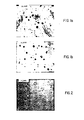
- This example illustrate the dispersoid distribution in the fusion zone of welded specimens compared with that in unmelted base metal samples of the same composition.
- Dispersoid distribution was determined both by transmission electron microscopy (TEM) from thin foils and by examination of replicas taken from a polished and etched fusion zone of several welds, and they were compared to replicas from unmelted base metal samples of the same composition.
- TEM transmission electron microscopy
- FIG. 4 is an optical photomicrograph at 50X showing a cross-section of an electron beam weld of a welded structure of the present invention containing 1.1 % tantalum, shows that there is an absence of grain boundaires in the fusion zone. It is believed that this type of structure would be advantageous for good stress-rupture properties.
- the 1.1 % Ta-containing appeared to be the best of the Ta-containing compositions, the 1.2% Nb the best of the Nb-containing compositions and the 1.2% Hf the best of the Hf-containing compositions.
- the Ta-containing alloys were superior to the Nb and Hf modifications.
Landscapes
- Chemical & Material Sciences (AREA)
- Engineering & Computer Science (AREA)
- Materials Engineering (AREA)
- Mechanical Engineering (AREA)
- Metallurgy (AREA)
- Organic Chemistry (AREA)
- Manufacture Of Alloys Or Alloy Compounds (AREA)
- Arc Welding In General (AREA)
- Welding Or Cutting Using Electron Beams (AREA)
Claims (9)
Priority Applications (1)
| Application Number | Priority Date | Filing Date | Title |
|---|---|---|---|
| AT83300962T ATE22469T1 (de) | 1982-03-01 | 1983-02-24 | Durch oxiddispersion verstaerkte, schweissbare legierungen auf eisenbasis. |
Applications Claiming Priority (2)
| Application Number | Priority Date | Filing Date | Title |
|---|---|---|---|
| US06/353,036 US4391634A (en) | 1982-03-01 | 1982-03-01 | Weldable oxide dispersion strengthened alloys |
| US353036 | 1999-07-13 |
Publications (3)
| Publication Number | Publication Date |
|---|---|
| EP0087923A2 EP0087923A2 (fr) | 1983-09-07 |
| EP0087923A3 EP0087923A3 (en) | 1984-03-07 |
| EP0087923B1 true EP0087923B1 (fr) | 1986-09-24 |
Family
ID=23387487
Family Applications (1)
| Application Number | Title | Priority Date | Filing Date |
|---|---|---|---|
| EP83300962A Expired EP0087923B1 (fr) | 1982-03-01 | 1983-02-24 | Alliages soudables à base de fer, renforçés par dispersion d'oxydes |
Country Status (7)
| Country | Link |
|---|---|
| US (1) | US4391634A (fr) |
| EP (1) | EP0087923B1 (fr) |
| JP (1) | JPS58193346A (fr) |
| AT (1) | ATE22469T1 (fr) |
| BR (1) | BR8300991A (fr) |
| CA (1) | CA1219152A (fr) |
| DE (1) | DE3366364D1 (fr) |
Families Citing this family (13)
| Publication number | Priority date | Publication date | Assignee | Title |
|---|---|---|---|---|
| AU600009B2 (en) * | 1986-08-18 | 1990-08-02 | Inco Alloys International Inc. | Dispersion strengthened alloy |
| US5688303A (en) * | 1990-08-30 | 1997-11-18 | Aluminum Company Of America | Mechanical alloying process |
| JPH06502891A (ja) * | 1990-08-30 | 1994-03-31 | アルミナム カンパニー オブ アメリカ | 機械的に合金化する方法 |
| US5427601A (en) * | 1990-11-29 | 1995-06-27 | Ngk Insulators, Ltd. | Sintered metal bodies and manufacturing method therefor |
| JP2510055B2 (ja) * | 1992-01-13 | 1996-06-26 | 株式会社神戸製鋼所 | 耐酸化性に優れたヒ―タ材の製造方法 |
| US5595706A (en) * | 1994-12-29 | 1997-01-21 | Philip Morris Incorporated | Aluminum containing iron-base alloys useful as electrical resistance heating elements |
| US5620651A (en) * | 1994-12-29 | 1997-04-15 | Philip Morris Incorporated | Iron aluminide useful as electrical resistance heating elements |
| US6280682B1 (en) | 1996-01-03 | 2001-08-28 | Chrysalis Technologies Incorporated | Iron aluminide useful as electrical resistance heating elements |
| US6033623A (en) | 1996-07-11 | 2000-03-07 | Philip Morris Incorporated | Method of manufacturing iron aluminide by thermomechanical processing of elemental powders |
| US6030472A (en) | 1997-12-04 | 2000-02-29 | Philip Morris Incorporated | Method of manufacturing aluminide sheet by thermomechanical processing of aluminide powders |
| US6143241A (en) * | 1999-02-09 | 2000-11-07 | Chrysalis Technologies, Incorporated | Method of manufacturing metallic products such as sheet by cold working and flash annealing |
| JP5339503B2 (ja) * | 2008-09-12 | 2013-11-13 | 国立大学法人京都大学 | スーパーods鋼 |
| CN110885954B (zh) * | 2018-09-07 | 2021-03-30 | 天津大学 | 铁素体基ods钢在超临界水服役条件中的应用 |
Family Cites Families (10)
| Publication number | Priority date | Publication date | Assignee | Title |
|---|---|---|---|---|
| US3131055A (en) * | 1960-03-11 | 1964-04-28 | Soc Metallurgique Imphy | Alloy based on iron, containing nickel, chromium and aluminium, and process for obtaining same |
| FR1422008A (fr) * | 1961-02-10 | 1965-12-24 | Bendix Corp | Matériau à base de chrome |
| JPS4889820A (fr) * | 1972-03-03 | 1973-11-24 | ||
| DE2161954A1 (de) * | 1971-12-14 | 1973-06-20 | Deutsche Edelstahlwerke Gmbh | Ferritischer hitzebestaendiger stahl |
| BE794142A (fr) * | 1972-01-17 | 1973-07-17 | Int Nickel Ltd | Alliages pour hautes temperatures |
| US3912552A (en) * | 1972-05-17 | 1975-10-14 | Int Nickel Co | Oxidation resistant dispersion strengthened alloy |
| US3992161A (en) * | 1973-01-22 | 1976-11-16 | The International Nickel Company, Inc. | Iron-chromium-aluminum alloys with improved high temperature properties |
| CH602330A5 (fr) * | 1976-08-26 | 1978-07-31 | Bbc Brown Boveri & Cie | |
| BE851449A (fr) * | 1977-02-15 | 1977-08-16 | Centre Rech Metallurgique | |
| DE2845099A1 (de) * | 1978-10-04 | 1980-04-24 | Bbc Brown Boveri & Cie | Schaufel fuer eine thermodynamische stroemungsmaschine |
-
1982
- 1982-03-01 US US06/353,036 patent/US4391634A/en not_active Expired - Fee Related
-
1983
- 1983-02-24 DE DE8383300962T patent/DE3366364D1/de not_active Expired
- 1983-02-24 AT AT83300962T patent/ATE22469T1/de not_active IP Right Cessation
- 1983-02-24 EP EP83300962A patent/EP0087923B1/fr not_active Expired
- 1983-02-28 CA CA000422532A patent/CA1219152A/fr not_active Expired
- 1983-03-01 BR BR8300991A patent/BR8300991A/pt unknown
- 1983-03-01 JP JP58033684A patent/JPS58193346A/ja active Pending
Also Published As
| Publication number | Publication date |
|---|---|
| CA1219152A (fr) | 1987-03-17 |
| EP0087923A3 (en) | 1984-03-07 |
| DE3366364D1 (en) | 1986-10-30 |
| US4391634A (en) | 1983-07-05 |
| EP0087923A2 (fr) | 1983-09-07 |
| JPS58193346A (ja) | 1983-11-11 |
| ATE22469T1 (de) | 1986-10-15 |
| BR8300991A (pt) | 1983-11-16 |
Similar Documents
| Publication | Publication Date | Title |
|---|---|---|
| Wadsworth et al. | Recent advances in aerospace refractory metal alloys | |
| Çam et al. | Microstructural and mechanical characterization of electron beam welded Al-alloy 7020 | |
| EP1107846B1 (fr) | Alliage de soudage nickel-chrome-fer | |
| RU1836475C (ru) | Сплав на основе кобальта | |
| Jácome et al. | Influence of filler composition on the microstructure and mechanical properties of steel—Aluminum joints produced by metal arc joining | |
| EP0087923A2 (fr) | Alliages soudables à base de fer, renforçés par dispersion d'oxydes | |
| JP6882582B2 (ja) | 融接における金属炭化物/窒化物の析出制御 | |
| EP0051979A1 (fr) | Alliage pour soudure à base de nickel | |
| EP0234172B1 (fr) | Superalliage à haute résistance à base de nickel pour pièces coulées, traitées par compression isostatique à chaud | |
| EP0046368B1 (fr) | Electrode enrobée | |
| US5545373A (en) | High-temperature corrosion-resistant iron-aluminide (FeAl) alloys exhibiting improved weldability | |
| EP0709477B1 (fr) | Alliage réfractaire et soudable à base de nickel | |
| EP2677053A1 (fr) | Alliage à base de Ni pour matériau de soudage et fil de soudage, tige et poudre | |
| EP0039450B1 (fr) | Alliage de rechargement dur à base de nickel | |
| US5167732A (en) | Nickel aluminide base single crystal alloys | |
| US3243285A (en) | High strength welding materials | |
| JP2952924B2 (ja) | TiAl基耐熱合金及びその製造方法 | |
| US3904383A (en) | Welded structure and method | |
| EP0076991A1 (fr) | Alliage nickel-palladium-chrome-bore pour brasage | |
| EP0186797B1 (fr) | Superalliage à base de cobalt et pièces moulées et soudées pour turbines à gaz industrielles fabriquées avec cet alliage | |
| US4750954A (en) | High temperature nickel base alloy with improved stability | |
| US4859544A (en) | Weld filter material for fusion welding of high strength aluminum alloys | |
| JPH02127981A (ja) | チタン合金の溶接方法 | |
| CA2010147A1 (fr) | Superalliages renfermant du tantale | |
| JPH093590A (ja) | 酸化物分散強化フェライト系耐熱鋼板及びその製造方法 |
Legal Events
| Date | Code | Title | Description |
|---|---|---|---|
| PUAI | Public reference made under article 153(3) epc to a published international application that has entered the european phase |
Free format text: ORIGINAL CODE: 0009012 |
|
| AK | Designated contracting states |
Designated state(s): AT BE CH DE FR GB IT LI NL SE |
|
| PUAL | Search report despatched |
Free format text: ORIGINAL CODE: 0009013 |
|
| AK | Designated contracting states |
Designated state(s): AT BE CH DE FR GB IT LI NL SE |
|
| 17P | Request for examination filed |
Effective date: 19840814 |
|
| RAP1 | Party data changed (applicant data changed or rights of an application transferred) |
Owner name: INCO ALLOYS INTERNATIONAL, INC. |
|
| GRAA | (expected) grant |
Free format text: ORIGINAL CODE: 0009210 |
|
| AK | Designated contracting states |
Kind code of ref document: B1 Designated state(s): AT BE CH DE FR GB IT LI NL SE |
|
| REF | Corresponds to: |
Ref document number: 22469 Country of ref document: AT Date of ref document: 19861015 Kind code of ref document: T |
|
| REF | Corresponds to: |
Ref document number: 3366364 Country of ref document: DE Date of ref document: 19861030 |
|
| ET | Fr: translation filed | ||
| ITF | It: translation for a ep patent filed | ||
| PGFP | Annual fee paid to national office [announced via postgrant information from national office to epo] |
Ref country code: AT Payment date: 19870112 Year of fee payment: 5 |
|
| PGFP | Annual fee paid to national office [announced via postgrant information from national office to epo] |
Ref country code: NL Payment date: 19870228 Year of fee payment: 5 |
|
| PLBE | No opposition filed within time limit |
Free format text: ORIGINAL CODE: 0009261 |
|
| STAA | Information on the status of an ep patent application or granted ep patent |
Free format text: STATUS: NO OPPOSITION FILED WITHIN TIME LIMIT |
|
| 26N | No opposition filed | ||
| PG25 | Lapsed in a contracting state [announced via postgrant information from national office to epo] |
Ref country code: AT Effective date: 19880224 |
|
| PG25 | Lapsed in a contracting state [announced via postgrant information from national office to epo] |
Ref country code: SE Effective date: 19880225 |
|
| PG25 | Lapsed in a contracting state [announced via postgrant information from national office to epo] |
Ref country code: LI Effective date: 19880229 Ref country code: CH Effective date: 19880229 |
|
| BERE | Be: lapsed |
Owner name: INCO ALLOYS INTERNATIONAL INC. Effective date: 19880228 |
|
| PG25 | Lapsed in a contracting state [announced via postgrant information from national office to epo] |
Ref country code: NL Effective date: 19880901 |
|
| NLV4 | Nl: lapsed or anulled due to non-payment of the annual fee | ||
| PG25 | Lapsed in a contracting state [announced via postgrant information from national office to epo] |
Ref country code: FR Free format text: LAPSE BECAUSE OF NON-PAYMENT OF DUE FEES Effective date: 19881028 |
|
| REG | Reference to a national code |
Ref country code: CH Ref legal event code: PL |
|
| PG25 | Lapsed in a contracting state [announced via postgrant information from national office to epo] |
Ref country code: DE Effective date: 19881101 |
|
| GBPC | Gb: european patent ceased through non-payment of renewal fee | ||
| PG25 | Lapsed in a contracting state [announced via postgrant information from national office to epo] |
Ref country code: GB Free format text: LAPSE BECAUSE OF NON-PAYMENT OF DUE FEES Effective date: 19881122 |
|
| REG | Reference to a national code |
Ref country code: FR Ref legal event code: ST |
|
| PG25 | Lapsed in a contracting state [announced via postgrant information from national office to epo] |
Ref country code: BE Effective date: 19890228 |
|
| EUG | Se: european patent has lapsed |
Ref document number: 83300962.4 Effective date: 19880927 |