EP0088346A2 - 2-Aminomethyl-phenol-Derivate, Verfahren zu ihrer Herstellung, ihre Verwendung sowie pharmazeutische Präparate auf Basis dieser Verbindungen - Google Patents
2-Aminomethyl-phenol-Derivate, Verfahren zu ihrer Herstellung, ihre Verwendung sowie pharmazeutische Präparate auf Basis dieser Verbindungen Download PDFInfo
- Publication number
- EP0088346A2 EP0088346A2 EP83102005A EP83102005A EP0088346A2 EP 0088346 A2 EP0088346 A2 EP 0088346A2 EP 83102005 A EP83102005 A EP 83102005A EP 83102005 A EP83102005 A EP 83102005A EP 0088346 A2 EP0088346 A2 EP 0088346A2
- Authority
- EP
- European Patent Office
- Prior art keywords
- carbon atoms
- dimethylethyl
- alkyl
- aminomethyl
- compounds
- Prior art date
- Legal status (The legal status is an assumption and is not a legal conclusion. Google has not performed a legal analysis and makes no representation as to the accuracy of the status listed.)
- Granted
Links
- 0 Cc(c(*)c(*)c(O)c1)c1O Chemical compound Cc(c(*)c(*)c(O)c1)c1O 0.000 description 6
Classifications
-
- C—CHEMISTRY; METALLURGY
- C07—ORGANIC CHEMISTRY
- C07C—ACYCLIC OR CARBOCYCLIC COMPOUNDS
- C07C315/00—Preparation of sulfones; Preparation of sulfoxides
- C07C315/04—Preparation of sulfones; Preparation of sulfoxides by reactions not involving the formation of sulfone or sulfoxide groups
-
- C—CHEMISTRY; METALLURGY
- C07—ORGANIC CHEMISTRY
- C07D—HETEROCYCLIC COMPOUNDS
- C07D295/00—Heterocyclic compounds containing polymethylene-imine rings with at least five ring members, 3-azabicyclo [3.2.2] nonane, piperazine, morpholine or thiomorpholine rings, having only hydrogen atoms directly attached to the ring carbon atoms
- C07D295/04—Heterocyclic compounds containing polymethylene-imine rings with at least five ring members, 3-azabicyclo [3.2.2] nonane, piperazine, morpholine or thiomorpholine rings, having only hydrogen atoms directly attached to the ring carbon atoms with substituted hydrocarbon radicals attached to ring nitrogen atoms
- C07D295/08—Heterocyclic compounds containing polymethylene-imine rings with at least five ring members, 3-azabicyclo [3.2.2] nonane, piperazine, morpholine or thiomorpholine rings, having only hydrogen atoms directly attached to the ring carbon atoms with substituted hydrocarbon radicals attached to ring nitrogen atoms substituted by singly bound oxygen or sulfur atoms
- C07D295/096—Heterocyclic compounds containing polymethylene-imine rings with at least five ring members, 3-azabicyclo [3.2.2] nonane, piperazine, morpholine or thiomorpholine rings, having only hydrogen atoms directly attached to the ring carbon atoms with substituted hydrocarbon radicals attached to ring nitrogen atoms substituted by singly bound oxygen or sulfur atoms with the ring nitrogen atoms and the oxygen or sulfur atoms separated by carbocyclic rings or by carbon chains interrupted by carbocyclic rings
-
- A—HUMAN NECESSITIES
- A61—MEDICAL OR VETERINARY SCIENCE; HYGIENE
- A61P—SPECIFIC THERAPEUTIC ACTIVITY OF CHEMICAL COMPOUNDS OR MEDICINAL PREPARATIONS
- A61P3/00—Drugs for disorders of the metabolism
-
- A—HUMAN NECESSITIES
- A61—MEDICAL OR VETERINARY SCIENCE; HYGIENE
- A61P—SPECIFIC THERAPEUTIC ACTIVITY OF CHEMICAL COMPOUNDS OR MEDICINAL PREPARATIONS
- A61P7/00—Drugs for disorders of the blood or the extracellular fluid
- A61P7/10—Antioedematous agents; Diuretics
-
- A—HUMAN NECESSITIES
- A61—MEDICAL OR VETERINARY SCIENCE; HYGIENE
- A61P—SPECIFIC THERAPEUTIC ACTIVITY OF CHEMICAL COMPOUNDS OR MEDICINAL PREPARATIONS
- A61P9/00—Drugs for disorders of the cardiovascular system
- A61P9/12—Antihypertensives
-
- C—CHEMISTRY; METALLURGY
- C07—ORGANIC CHEMISTRY
- C07C—ACYCLIC OR CARBOCYCLIC COMPOUNDS
- C07C309/00—Sulfonic acids; Halides, esters, or anhydrides thereof
-
- C—CHEMISTRY; METALLURGY
- C07—ORGANIC CHEMISTRY
- C07C—ACYCLIC OR CARBOCYCLIC COMPOUNDS
- C07C313/00—Sulfinic acids; Sulfenic acids; Halides, esters or anhydrides thereof; Amides of sulfinic or sulfenic acids, i.e. compounds having singly-bound oxygen atoms of sulfinic or sulfenic groups replaced by nitrogen atoms, not being part of nitro or nitroso groups
- C07C313/02—Sulfinic acids; Derivatives thereof
- C07C313/04—Sulfinic acids; Esters thereof
-
- C—CHEMISTRY; METALLURGY
- C07—ORGANIC CHEMISTRY
- C07C—ACYCLIC OR CARBOCYCLIC COMPOUNDS
- C07C317/00—Sulfones; Sulfoxides
-
- C—CHEMISTRY; METALLURGY
- C07—ORGANIC CHEMISTRY
- C07C—ACYCLIC OR CARBOCYCLIC COMPOUNDS
- C07C43/00—Ethers; Compounds having groups, groups or groups
- C07C43/02—Ethers
- C07C43/20—Ethers having an ether-oxygen atom bound to a carbon atom of a six-membered aromatic ring
- C07C43/21—Ethers having an ether-oxygen atom bound to a carbon atom of a six-membered aromatic ring containing rings other than six-membered aromatic rings
-
- C—CHEMISTRY; METALLURGY
- C07—ORGANIC CHEMISTRY
- C07D—HETEROCYCLIC COMPOUNDS
- C07D277/00—Heterocyclic compounds containing 1,3-thiazole or hydrogenated 1,3-thiazole rings
- C07D277/02—Heterocyclic compounds containing 1,3-thiazole or hydrogenated 1,3-thiazole rings not condensed with other rings
- C07D277/04—Heterocyclic compounds containing 1,3-thiazole or hydrogenated 1,3-thiazole rings not condensed with other rings having no double bonds between ring members or between ring members and non-ring members
-
- C—CHEMISTRY; METALLURGY
- C07—ORGANIC CHEMISTRY
- C07D—HETEROCYCLIC COMPOUNDS
- C07D307/00—Heterocyclic compounds containing five-membered rings having one oxygen atom as the only ring hetero atom
- C07D307/02—Heterocyclic compounds containing five-membered rings having one oxygen atom as the only ring hetero atom not condensed with other rings
- C07D307/34—Heterocyclic compounds containing five-membered rings having one oxygen atom as the only ring hetero atom not condensed with other rings having two or three double bonds between ring members or between ring members and non-ring members
- C07D307/38—Heterocyclic compounds containing five-membered rings having one oxygen atom as the only ring hetero atom not condensed with other rings having two or three double bonds between ring members or between ring members and non-ring members with substituted hydrocarbon radicals attached to ring carbon atoms
- C07D307/52—Radicals substituted by nitrogen atoms not forming part of a nitro radical
-
- Y—GENERAL TAGGING OF NEW TECHNOLOGICAL DEVELOPMENTS; GENERAL TAGGING OF CROSS-SECTIONAL TECHNOLOGIES SPANNING OVER SEVERAL SECTIONS OF THE IPC; TECHNICAL SUBJECTS COVERED BY FORMER USPC CROSS-REFERENCE ART COLLECTIONS [XRACs] AND DIGESTS
- Y02—TECHNOLOGIES OR APPLICATIONS FOR MITIGATION OR ADAPTATION AGAINST CLIMATE CHANGE
- Y02P—CLIMATE CHANGE MITIGATION TECHNOLOGIES IN THE PRODUCTION OR PROCESSING OF GOODS
- Y02P20/00—Technologies relating to chemical industry
- Y02P20/50—Improvements relating to the production of bulk chemicals
- Y02P20/55—Design of synthesis routes, e.g. reducing the use of auxiliary or protecting groups
Definitions
- the invention relates to 2-aminomethylphenols of the formula I. in which R is hydrogen or alkyl having 1 or 2 carbon atoms, R is alkyl having 1 to 8 carbon atoms, cycloalkyl having 3 to 12 carbon atoms and up to 8 ring members, alkenyl having 2 to 8 carbon atoms or cycloalkenyl with 5 to 12 carbon atoms and up to 8 ring members, where each of the above radicals can be substituted with 1 to 5 identical or different halogen atoms, R 2 and R 4 are identical or different and hydrogen, halogen, alkyl with 1 or 2 C atoms or alkoxy with 1 or 2 C atoms R 3 is halogen, alkyl with 1 to 12 C atoms or cycloalkyl with 3 to 12 C atoms and up to 8 ring members, R 5 and R are identical or different and for hydrogen, alkyl with 1 to 6 C atoms, cycloalkyl with 3 to 10 C atoms and up to 8
- An aromatic system Ar is preferably understood to mean phenyl.
- a 5- or 6-membered heteroaromatic system Ar is preferably a residue of a 5- or 6-membered O-, N- and / or S-heterocyclic ring, in particular furyl, thienyl, pyrrolyl, thiazolyl, isothiazolyl, oxazolyl, isoxazolyl, pyrazolyl , Imidazolyl, pyridyl, pyrazinyl, pyrimidinyl, pyridazinyl, triazinyl.
- Halogen as a substituent on Ar is understood to mean F, Cl, Br and / or J, preferably F and / or Cl.
- one of the cycloalkyl or cycloalkenyl groups defined above has a C number which exceeds the number of ring members, this means a cycloalkyl or cycloalkenyl group which is substituted by one or more alkyl groups or a qqf., Alkyl-substituted cycloalkylalkyl or Cycloalkenylalkyl group.
- both S-configured and R-configured compounds at the respective center are the subject of the invention.
- the compounds can then exist as optical isomers, as diastereomers, as racemates or as mixtures thereof.
- the compounds of the formula I according to the invention have a salidiuretic effect on dogs or rats which can reach the order of magnitude of the activity of the halogen derivatives described above, in particular the iodine compound.
- they differ from them advantageously in that they have a much lower acute toxicity, as can be shown in rats.
- R is hydrogen
- R 1 is alkyl having 1 to 4 carbon atoms, cycloalkyl having 3 to 7 carbon atoms and up to 6 ring members
- alkenyl having 2 to 6 carbon atoms are preferred Atoms or haloalkyl with 1 to 4 C atoms and 1 to 3 identical or different halogen atoms
- R 3 is halogen
- R 5 and R 6 has the meanings defined above, with the exception that R 5 and / or R represents alkyl having 1 or 2 carbon atoms
- n is 1 or 2
- the radicals R 5 and R 6 and / or two of the radicals R 2 , R and R 4 can form a polymethylene chain as defined above.
- R is hydrogen
- R 1 is methyl, chloromethyl, iodomethyl or ethyl
- R 2 and R are hydrogen
- R 3 iso-propyl, tert-butyl, tert-amyl or sec Butyl
- R 3 and R 6 are hydrogen and n is 1 or 2
- R is hydrogen
- R 1 is methyl or chloromethyl
- R 2 and R 4 are hydrogen
- R 3 is tert.
- R 5 and R 6 is hydrogen and n is 2.
- All groups which are easily nucleophilically displaceable, such as halogen, tosyl, dimethylamino or trimethylammonium, are suitable as escape groups Z of process variant c.
- Y as an amino protecting group means, for example, the diazo residue or the phthaloyl residue.
- R 6 as an amino protecting group stands for the monovalent radicals known from peptide synthesis, such as the benzyl radical or other acyl radicals -CO-R, where R has the meaning given above.
- the invention further relates to compounds of the general formula I I in which n, R to R 4 have the meaning given above. They are precursors in the preparation of compounds of general formula I.
- the splitting off of the rest Compounds of the general formula IV according to procedure a) are generally carried out with the aid of an acid or a base in the presence of water. If the cleavage takes place under acidic conditions, preference is given to using a strong mineral acid such as hydrochloric acid, hydrobromic acid or hydroiodic acid or sulfuric acid. If, on the other hand, a base is used, then alkali bases such as sodium hydroxide or potassium hydroxide are advantageously used. Practically any solvent which is inert to the reactants, such as, for example, alkanols, preferably ethanol, or, if acidic hydrolysis conditions are used, alkanoic acids such as acetic acid can be used.
- reaction temperature can be between 20 and 150 ° C, is advantageous at Boiling temperature of the solvent used worked.
- acidic saponification the product is obtained in crystalline form in the form of an acid addition salt immediately or after removal of the solvent. If necessary, it is purified in a customary manner by recrystallization from a suitable solvent.
- the compounds of the general formula IV are prepared in a manner known per se by reacting the phenols of the general formula II with N-hydroxymethylcarboxamides III, preferably with 2-halogen-N-hydroxymethylacetamides such as e.g. 2-Chloro-N-hydroxymethylacetamide implemented in the manner of the Tscherniac-Einhorn reaction with acid catalysis.
- Strong mineral acids such as hydrochloric acid or sulfuric acid are particularly suitable as efficient catalyst acids. All solvents commonly used for such reactions are used as solvents; alkanoic acids such as acetic acid or propionic acid have proved to be particularly suitable, but also excess mineral acid as a solvent such as e.g. pure concentrated sulfuric acid can be beneficial.
- the reactions are carried out between 0 and 100 ° C., advantageously in a range from 0 to 30 ° C. to avoid by-products.
- N-hydroxymethylcarboxamide of the formula III in situ, for example by mixing phenols of the formula II with a mixture of carboxamide and a carbonyl compound of the formula R-CHO, in which R has the meaning mentioned above, in the manner indicated above, in order to obtain compounds of the formula IV.
- amidomethylations of this type can still be carried out well if the reaction time is exactly adhered to, which can be between 10 minutes and a few hours depending on the compound and reaction temperature, even if more stringent reaction conditions (such as concentrated sulfuric acid as solvent) are used, which may prove necessary for a quick and complete turnover.
- Expected side reactions such as the dealkylation, especially the de-tert-butylation, can be reduced to a minimum by precisely controlled reaction conditions.
- reaction products are most conveniently done by adding a non-solvent, such as water, to the reaction mixture, as a rule they are immediately crystalline and can be processed further after recrystallization from a suitable solvent or in many cases without further purification.
- a non-solvent such as water
- the starting compounds of general formula II used for procedures a and b can be prepared by various processes.
- One method is, for example, to oxidize thioethers of the general formula VIII: where the radicals R 1 to R 4 and n have the meanings mentioned above.
- the thioethers of the general formula VIII can be prepared in a manner known per se from the phenols of the formula IX in which R 2 to R 4 have the meaning given above; e.g. B. by the action of a sulfoxide R 1 -SO-R 1 in the presence of perchloric acid and phosphorus oxychloride or by reaction with a sulfenyl chloride R 1 -S-Cl in a manner known per se, R 1 in each case having the meaning mentioned above.
- the phenols IX can easily be prepared by standard methods (cf. Houben-Weyl, Methods of the Org. Chem. Phenols, Part 2, pp. 925 ff. G, Thieme Verlag, Stuttgart 1976).
- the reduction to the sulfinic XIII can be by various methods (see. Houben-Weyl, Methoden der org. Chemie, Volume X, p. 563 f f., G. Thieme Verlag, Stuttgart, 1955) are performed. Reduction with sodium sulfite in the presence of sodium hydroxide in aqueous acetone solutions proved to be a simple and efficient method.
- alkylation of sulfinic acids to sulfones is a reaction which is known per se, preferably using base catalysis.
- alkyl iodides have proven to be particularly suitable alkylating agents R 1- X, where R has the meaning given above and X is halogen, preferably iodine.
- the bases used are advantageously organic bases such as triethylamine in acetone solution, but also inorganic bases such as LiOH, NaOH, KOH etc. in aqueous or aqueous acetone solution.
- R stands for an ⁇ -haloalkyl radical
- a number of variants of this alkylation reaction can advantageously be used, such as, for example, the reaction of sulfinic acids with ⁇ -dihalocarboxylic acids in the presence of K 2 CO 3 , the ß-sulfonyl- ⁇ -halocarboxylic acid formed as an intermediate in in a known manner cleaves C0 2 to form the ⁇ -halomethylsulfonyl radical.
- the anisoles XI are produced from the phenols IX by standard methods (Organikum, VEB German Publishing House of Sciences, Berlin 1971, p. 222).
- the solvent can also be varied within wide limits; particularly suitable solvents are alkanols such as methanol or ethanol.
- the process is carried out in a temperature range from 40 to 150 ° C., preferably in a range from 60 to 100 ° C.
- the reaction time depends crucially on the temperature; in general, the reactions are complete after a few hours.
- the products are preferably isolated by evaporating off the solvent and excess reagents; they are usually obtained as highly viscous oils, which are purified by crystallization from a suitable solvent or processed immediately after process variant c.
- Process variant c is particularly suitable for the preparation of benzylamines I, especially those in which R 5 and R 6 are hydrogen or which additionally carry an acid-sensitive radical such as the sulfinylalkyl radical.
- the type of implementation depends on the meaning of Y and the nature of the escape group Z in the compounds VI.
- Y stands for the diazo radical that is particularly suitable as an amine protecting group
- Z represents the trialkylammonium radical, for example the trimethylammonium radical with halide, preferably iodide as counterion
- Suitable bases are organic bases such as tertiary amines, for example triethylamine or quaternary nitrogen bases such as tetraethylammonium hydroxide, but inorganic bases such as alkali or alkaline earth metal hydroxides can also be used.
- the salts of hydrochloric acid can also be used particularly advantageously directly, for example the alkali salts, such as, for example, sodium azide.
- the solvents used are mainly polar aprotic solvents such as dimethyl sulfoxide, dimethylformamide or sulfolane, but also protic polar solvents such as alkanols, e.g. Ethanol can be used with or without the addition of water.
- the reaction is carried out in a temperature range from 40 to 150 ° C., preferably at temperatures between 60 and 120 ° C. Depending on the type of solvent and the temperature, the reaction usually ends after a few hours; As a rule, heating to 100 ° C for one hour is sufficient.
- the hydrogenation catalyst can also be varied within wide limits, e.g. all precious metal catalysts are used with or without a carrier, e.g. Platinum dioxide, rhodium, palladium, Raney nickel, preferably palladium on charcoal is used.
- a carrier e.g. Platinum dioxide, rhodium, palladium, Raney nickel, preferably palladium on charcoal is used.
- the hydrogenation can be carried out at temperatures between 0 and 100 ° C and pressures from 1 to 100 atm, but is preferably carried out at normal pressure and temperatures between 20 and 40 ° C.
- the product obtained generally requires further purification after it has been isolated by filtration and evaporation of the solvent. Chromatography is particularly suitable, preferably on silica gel and using polar eluents such as Acetone or methanol.
- any of the reaction - partners against inert solvents are used, for example, ketones such as acetone, esters such as ethyl acetate or chlorinated hydrocarbons such as methylene chloride.
- excess alkylating agent is used as the solvent.
- the reaction can be carried out in the temperature range between 0 and 150.degree. C. In the case of reactive alkylating agents such as iodomethane, room temperature is usually sufficient to allow the reaction to take place in relatively short times of a few minutes to hours.
- the carbonyl compounds of the formula XIV are reacted with amines of the formula R S -NH 2 under conditions which favor the formation of a Schiff base (see, for example, Chem. Reviews 63 [1963] 489-510). In the simplest case, this is done by mixing the starting components in a suitable solvent, for example in a lower alcohol such as methanol. The reaction usually takes place at room temperature, in a few cases higher reaction temperatures are necessary. If necessary, dehydrating agents have to be added, for example TiCl 4 or molecular sieve, or the reaction water is removed by azeotropic distillation.
- a suitable solvent for example in a lower alcohol such as methanol.
- dehydrating agents have to be added, for example TiCl 4 or molecular sieve, or the reaction water is removed by azeotropic distillation.
- the salt In order to generate the free base from an acid addition salt, it is necessary to treat the salt with at least one equivalent of a base.
- organic and inorganic bases are possible, e.g. Triethylamine, tetraethylammonium hydroxide or piperidine or lithium, sodium, potassium hydroxide, sodium hydrogen carbonate or sodium carbonate.
- the acid addition salt is advantageously used in dissolved form, e.g. in alkanols such as methanol or ethanol or, which has proven to be particularly advantageous, in the form of aqueous solutions in which the addition of inorganic base such as sodium hydroxide causes crystalline free base I to precipitate out.
- acid addition products with a desired acid HA are prepared by treating solutions of the free base I with at least one equivalent of the acid HA; preference is given to either alcoholic solutions such as a methanolic solution or aqueous solutions.
- the acid addition salt crystallizes in pure form either immediately or after removal of the solvent, if appropriate after recrystallization from a suitable solvent.
- Suitable acids HA for pharmaceutically preferred acid additions are:
- organic acids such as tartaric acid, malic acid. Lactic acid, acetic acid, citric acid, methanesulfonic acid, benzenesulfonic acid and the like, inorganic acids such as hydrochloric acid, hydrobromic acid, hydroiodic acid, sulfuric acid, nitric acid, acid, phosphoric acid or amidosulfonic acid etc.
- the compounds of the general formula I listed in the following table can also be obtained according to the invention:
- the compounds of the formula I according to the invention and their pharmaceutically acceptable salts are diuretics, salidiuretics and antihypertensives which can be used as pharmaceuticals in human and veterinary medicine. They are administered in doses of 6 - 4000 ⁇ g / kg.day, preferably 60 - 1300 gg / kg.day, in particular 60 - 700 ⁇ g / kg.day in capsules, coated tablets, tablets or solutions with various additives, for example orally with a probe or The like.
- parenterally injection into the vascular system, for example intravenously or also injection into the muscles or under the skin and the like
- injection into the vascular system for example intravenously or also injection into the muscles or under the skin and the like
- edema diseases such as cardiac, renal or hepatic edema and other symptoms due to disturbances in the water and electrolyte balance.
- the compounds can be used alone or in combination with other salidiuretically active substances of other types of action.
- Spironolactone, triaimterene, amiloride and other coronary compounds or long-acting salidiuretics of the chlorothalidone type are also possible combination partners, for example hydralazine, clonidine, reserpine and in particular also beta-blocking substances such as metoprolol or penbutolol.
- the substance is obtained as a light yellow oil.
- the 4-methyl-2-methylsulfonylphenol from Example 7.a) is prepared from 4-methylanisole analogously to reaction sequence 1.a) - d). It has a melting point of 84 - 85 ° C.
- the compound is prepared from 3- (1,1-dimethylpropyl) -6-methoxybenzenesulfinic acid and iodomethane analogously to Example 1.c).
- the compound is obtained from 4- (1,1-dimethylpropyl) -2-methylsulfonylanisole by the action of boron tribromide as in Example 3.b) and is obtained as a light yellow oil.
- the compound is prepared analogously to Example 1.f), but with 2-chloro-N- [5- (1,1-dimethylpropyl) -2-hydroxy-3-methylsulfonylbenzyl] acetamide as the starting material.
- This compound is prepared analogously to reaction sequence 1.a) - 1.c), but with 4-chloro-3,5-dimethylanisole as the starting material.
- the end product melts at 129 - 130 ° C.
- the compound is obtained from 5-methoxy-6-methylsulfonylindane by the action of boron tribromide as in Example 3.b).
- the compound is prepared analogously to Example 1.f) from 4- (N-chloroacetylaminomethyl) -5-hydroxy-6-methylsulfonylindane.
- the 4-bromo-2-methylsulfonylphenol from Example 15.a) is prepared from 4-bromoanisole analogously to reaction sequence 1.a) - d).
- the compound is prepared analogously to Example 1e, but with 4- (1-methylpropyl) -2-methylsulfonylphenol as the starting material.
- the crude product is recrystallized from ether / petroleum ether.
- the 4- (1-methylpropyl) -2-methylsulfonylphenol is prepared analogously to the reaction sequence 1a) - 1d) from 4- (1-methylpropyl) anisole.
- Example 1d The preparation proceeds analogously to Example 1d), but using 20% aqueous methanesulfonic acid instead of conc. Hydrochloric acid.
- This compound is prepared analogously to 1e, but with 4- (1-methylcyclohexyl) -2-methylsulfonylphenol as the starting material.
- the crude product is brought to crystallization by trituration with ether.
- 4- (1,1-Dimethylethyl) -2-iodomethylsulfonylphenol is prepared analogously to Example 1d) from 4- (1,1-dimethylethyl) -2-iodomethylsulfonylanisole and melts at 82-84 ° C.
- the 4- (1,1-dimethylethyl) -2-iodomethylsulfonylanisole is prepared in the manner known from the literature from the sulfinic acid and methylene iodide described under 1b).
- Example 28a 4- (1,1-Dimethylethyl) -2-allylsulfonylphenol from Example 28a) is prepared analogously to Example 1c) and 1d). Mp: 63 - 64 ° C
- the starting material 3-methylsulfonyl-5,6,7,8-tetrahydro-2-naphthol required in Example 30a) is prepared from 2-methoxy-5,6,7,8-tetrahydronaphthalene analogously to the reaction sequence 1a) to 1d) and melts at 132 - 135 ° C.
- the preparation is carried out of the reaction sequence 1a) analogously to 1f), but is at level 3 (analogously to 1c) butyl iodide in place of methyl iodide and at level 1 (analog 1a) 4- (1-methylpropyl) p henol place of 4- (1,1 -Dimethylethyl) phenol used. All intermediate products were obtained as oils. The end product melts at 148 - 151 ° C.
Landscapes
- Chemical & Material Sciences (AREA)
- Organic Chemistry (AREA)
- Health & Medical Sciences (AREA)
- Chemical Kinetics & Catalysis (AREA)
- Engineering & Computer Science (AREA)
- Veterinary Medicine (AREA)
- Bioinformatics & Cheminformatics (AREA)
- Public Health (AREA)
- General Chemical & Material Sciences (AREA)
- Medicinal Chemistry (AREA)
- Nuclear Medicine, Radiotherapy & Molecular Imaging (AREA)
- Pharmacology & Pharmacy (AREA)
- Life Sciences & Earth Sciences (AREA)
- Animal Behavior & Ethology (AREA)
- General Health & Medical Sciences (AREA)
- Hematology (AREA)
- Diabetes (AREA)
- Obesity (AREA)
- Cardiology (AREA)
- Heart & Thoracic Surgery (AREA)
- Organic Low-Molecular-Weight Compounds And Preparation Thereof (AREA)
- Acyclic And Carbocyclic Compounds In Medicinal Compositions (AREA)
- Pharmaceuticals Containing Other Organic And Inorganic Compounds (AREA)
- Thiazole And Isothizaole Compounds (AREA)
- Furan Compounds (AREA)
Abstract

Description
- Die Erfindung betrifft 2-Aminomethyl-phenole der Formel I

- Unter einem aromatischen System Ar wird vorzugsweise Phenyl verstanden. Ein 5- oder 6-gliedriges heteroaromatisches System Ar ist vorzugsweise ein Rest eines 5- oder 6- gliedriger O-, N- und/oder S-heterocyclischen Ringes, insbesondere Furyl, Thienyl, Pyrrolyl, Thiazolyl, Isothiazolyl, Oxazolyl, Isoxazolyl, Pyrazolyl, Imidazolyl, Pyridyl, Pyrazinyl, Pyrimidinyl, Pyridazinyl, Triazinyl. Unter Halogen als Substituent an Ar wird F, Cl, Br und/oder J, vorzugsweise F und/oder Cl verstanden.
- Hat eine der vorstehend definierten Cycloalkyl- oder Cycloalkenylgruppen eine C-Zahl,die über die Zahl der Ringglieder hinausgeht, so wird darunter eine Cycloalkyl- bzw. Cycloalkenylgruppe verstanden, die durch eine oder mehrere Alkylgruppen substituiert ist oder eine qqf., alkylsubstituierte Cycloalkylalkyl- bzw. Cycloalkenylalkylgruppe.
- Falls Verbindungen der Formel I chirale C- und/oder S-Atome aufweisen, so sind sowohl am jeweiligen Zentrum S-konfigurierte als auch R-konfigurierte Verbindungen Gegenstand der Erfindung. Die Verbindungen können dann als optische Isomere, als Diastereomere, als Racemate oder als Gemische derselben vorliegen.
- Aus J.med.Chem. 23 [1980], Seite 1414-1427 sind in 6-Stellung substituierte 2-Aminomethyl-phenole bekannt. Die 4-Alkyl-6-halogen-Derivate haben salidiuretische Eigenschaften von Art und Stärke, wie es kurz und intensiv wirksame Diuretika, wie beispielsweise Furosemid, zeigen. Speziell bei einem 6-Jod-Derivat wird auch eine antihypertensive Zusatzwirkung beobachtet.
- Es war daher äußerst überraschend, daß die erfindungsgemäßen Verbindungen der Formel I an Hund oder Ratte eine salidiuretische Wirkung ausüben, die die Größenordnung der Aktivität der oben beschriebenen Halogenderivate, insbesondere der Jodverbindung erreichen können. Sie unterscheiden sich jedoch von diesen vorteilhaft dadurch, daß sie eine wesentlich geringere akute Toxizität aufweisen, wie dies an Ratten aufgezeigt werden kann.
- Weiterhin war es überraschend, daß einige der erfindungsgemäßen Verbindungen nicht nur eine sehr gute salidiuretische Wirksamkeit aufweisen, sondern auch an spontan hypertensiven Ratten in Dosen unter 20 mg/kg stark blutdrucksenkend wirken.
- Bevorzugt sind Verbindungen der Formel I, die dadurch gekennzeichnet sind, daß R für Wasserstoff, R1 für Alkyl mit 1 bis 4 C-Atomen, Cycloalkyl mit 3 bis 7 C-Atomen und bis zu 6 Ringgliedern, Alkenyl mit 2 bis 6 C-Atomen oder Halogenalkyl mit 1 bis 4 C-Atomen und 1 bis 3 gleichen oder verschiedenen Halogenatomen steht, R3 Halogen, Alkyl mit 1 bis 8 C-Atomen oder Cycloalkyl mit 3 bis 10 C-Atomen und bis zu 7 Ringgliedern bedeutet R5 und R6 die vorstehend definierten Bedeutungen haben mit der Ausnahme, daß R5 und/oder R für Alkyl mit 1 oder 2 C-Atomen steht n 1 oder 2 ist, wobei die Reste R5 und R6 und/oder zwei der Reste R 2, R und R4 eine wie vorstehend definierte Polymethylenkette bilden können. Insbesondere kommen von den Verbindungen der Formel I diejenigen in Betracht, in denen R Wasserstoff, R1 Methyl, Chlormethyl, Jodmethyl oder Ethyl, R2 und R Wasserstoff, R3 iso-Propyl, tert.-Butyl, tert.-Amyl oder sec. Butyl, R3 und R6 Wasserstoff und n 1 oder 2 bedeuten, wobei als besonders bevorzugte Verbindungen solche hervorzuheben sind, bei denen R für Wasserstoff R1 für Methyl oder Chlormethyl, R2 und R4 für Wasserstoff, R 3 für tert. Butyl, R 5 und R6 für Wasserstoff und n für 2 steht.
- Die Erfindung betrifft weiterhin ein Verfahren zur Herstellung von 2-Aminomethyl-phenolen der Formel I, das dadurch gekennzeichnet ist, daß man
- a) Verbindungen der Formel II


- b) Verbindungen der Formel II, in der die Reste R bis R4 und n die oben erwähnten Bedeutungen haben, in Gegenwart von Formaldehyd mit Aminen der allgemeinen Formel V,

- c) Verbindungen der allgemeinen Formel VI,


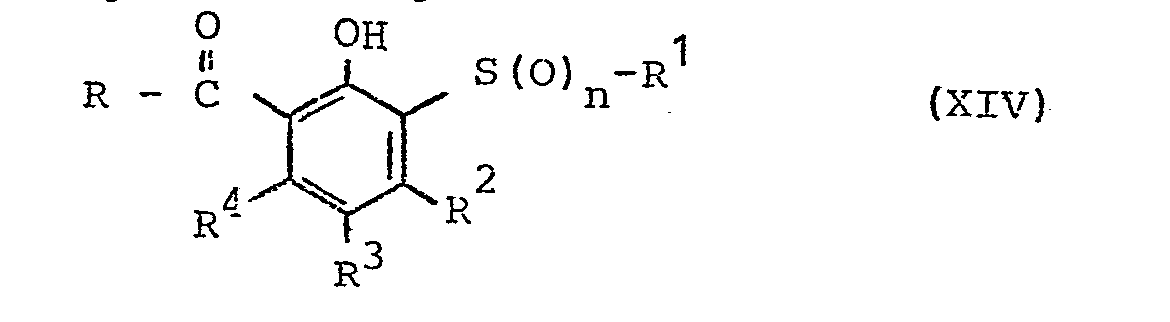
- d) Verbindungen der allgemeinen Formel XIV


- Als Fluchtgruppen Z der Verfahrensvariante c sind alle leicht nucleophil verdrängbaren Gruppen, wie beispielsweise Halogen, Tosyl, Dimethylamino oder Trimethylammonium, geeignet. Y als Aminoschutzgruppe bedeutet beispielsweise den Diazorest oder den Phthaloylrest. R6 als Aminoschutzgruppe steht für die aus Peptidsynthese bekannten einwertigen Reste, wie den Benzylrest oder andere Acylreste -CO-R , wobei R die vorstehend genannte Bedeutung zukommt.
- Die Erfindung betrifft weiterhin Verbindungen der allgemeinen Formel II, in welcher n, R bis R 4 die vorstehend genannte Bedeutung haben. Sie sind Vorprodukte bei der Herstellung von Verbindungen der allgemeinen Formel I.
- Die Abspaltung des Restes

- Bei alkalischen Verseifungen dagegen wird im allgemeinen nach Neutralisation überschüssiger Base sofort das freie Benzylamin der allgemeinen Formel I erhalten.
- Die Herstellung der Verbindungen der allgemeinen Formel IV geschieht in an sich bekannter Weise dadurch, daß man die Phenole der allgemeinen Formel II mit N-Hydroxymethylcarboxamiden III, vorzugsweise mit 2-Halogen-N-hydroxymethylacetamiden wie z.B. 2-Chlor-N-hydroxymethylacetamid nach Art der Tscherniac-Einhorn Reaktion unter Säurekatalyse umsetzt. Als effiziente Katalysatorsäuren eignen sich vor allem starke Mineralsäuren wie etwa Chlorwasserstoffsäure oder Schwefelsäure. Als Lösemittel dienen alle für derartige Reaktionen gebräuchlichen Lösemittel, als besonders geeignet erwiesen sich Alkansäuren wie Essigsäure oder Propionsäure, aber auch überschüssige Mineralsäure als Lösungsmittel wie z.B. reine konzentrierte Schwefelsäure kann vorteilhaft sein. Die Umsetzungen werden zwischen 0 und 100°C vorgenommen, zur Vermeidung von Nebenprodukten vorteilhaft in einem Bereich von O bis 30°C.
- Unter Umständen kann es sinnvoll sein, das N-Hydroxymethylcarboxamid der Formel III in situ zu erzeugen, z.B. dadurch, daß man Phenole der Formel II mit einem Gemisch aus Carboxamid

- Es zeigte sich insbesondere, daß derartige Amidomethylierungen bei genau eingehaltener Reaktionszeit, die je nach Verbindung und Reaktionstemperatur zwischen 10 Minuten und einigen Stunden liegen kann, auch dann noch gut durchführbar sind, wenn verschärfte Reaktionsbedingungen (wie etwa konz. Schwefelsäure als Lösemittel) angewandt werden, die sich unter Umständen als notwendig erweisen für einen raschen und vollständigen Umsatz. Zu erwartende Nebenreaktionen wie z.B. die Desalkylierung, insbesondere die De-tert.-butylierung können durch genau kontrollierte Reaktionsbedingungen auf ein Minimum reduziert werden.
- Die Isolierung der Reaktionsprodukte geschieht am zweckmäßigsten dadurch, daß man ein Nichtlösemittel, wie etwa Wasser, dem Reaktionsgemisch beigefügt, sie fallen dann in der Regel sofort kristallin an und können nach Umkristallisation aus einem geeigneten Lösemittel oder in vielen Fällen ohne weitere Reinigung weiterverarbeitet werden.
- Die für die Verfahrensweisen a und b benutzten Ausgangsverbindungen der allgemeinen Formel II können nach verschiedenen Verfahren hergestellt werden. Eine Methode besteht z.B. darin, daß man Thioether der allgemeinen Formel VIII oxidiert:

- Die Thioether der allgemeinen Formel VIII können in an sich bekannter Weise aus den Phenolen der Formel IX,in der R2 bis R4 obige Bedeutung hat,hergestellt werden; z. B. durch Einwirken eines Sulfoxides R1-SO-R1 in Gegenwart von Perchlorsäure und Phosphoroxychlorid oder durch Reaktion mit einem Sulfenylchlcrid R1-S-Cl in an sich bekannter Weise, wobei R1 jeweils die oben erwähnte Bedeutung hat.

- Die Phenole IX können leicht durch Standardmethoden (vgl. Houben-Weyl, Methoden der org. Chem. - Phenole, Teil 2, S. 925 ff. G, Thieme Verlag, Stuttgart 1976) hergestellt werden.
- Eine weitere Methode zur Herstellung von Phenolen der allgemeinen Formel II, in der R1 bis R4 die oben genannten Bedeutungen haben und n=2 ist, besteht in der Etherspaltung von Anisolen der allgemeinen Formel X mit entsprechenden Bedeutungen von R1 bis R4 und n.

- Sie wird in an sich bekannter Weise durch Einwirkung von Mineralsäuren wie Jodwasserstoffsäure oder von Lewissäuren wie Aluminiumchlorid oder Bortribromid in inerten Lösungsmitteln, wie z.B. Methylenchlorid oder Chloroform, vorgenommen. Auch die gängige Spaltung durch Pyridiniumhydrochlorid bei Temperaturen oberhalb 180°C kann erfolgreich durchgeführt werden.
- Verbindungen der allgemeinen Formel X mit n=2 werden durch eine Sequenz an sich bekannter Standardmethoden aus den Anisolen XI hergestellt:

- Die Reduktion zu den Sulfinsäuren XIII kann nach den verschiedensten Verfahren (vgl. Houben-Weyl, Methoden der org. Chemie, Band X, S. 563 ff., G. Thieme Verlag, Stuttgart, 1955) durchgeführt werden. Als einfache und effiziente Methode erwies sich die Reduktion mit Natriumsulfit in Gegenwart von Natriumhydroxid in wäßrig-acetonischen Lösungen.
- Die Alkylierung von Sulfinsäuren zu Sulfonen ist eine an sich bekannte Reaktion, wobei vorzugsweise unter Basenkatalyse gearbeitet wird. Im Falle der Sulfinsäuren XIII erweisen sich Alkyljodide als besonders geeignete Alkylierungsmittel R1-X, wobei R die oben genannte Bedeutung hat und X für Halogen, vorzugsweise für Jod steht. Als Basen werden vorteilhaft organische Basen wie z.B. Triethylamin in acetonischer Lösung aber auch anorganische Basen wie LiOH, NaOH, KOH usw. in wäßriger, oder wäßrig-acetonischer Lösung eingesetzt.
- Steht R für einen α-Halogenalkylrest, so können eine Reihe Varianten dieser Alkylierungsreaktion vorteilhaft zur Anwendung kommen, wie z.B. die Umsetzung von Sulfinsäuren mit α-Dihalogencarbonsäuren in Gegenwart von K2CO3, wobei die intermediär gebildete ß-Sulfonyl- α-halogencarbonsäure in an sich bekannter Weise C02 abspaltet unter Bildung des α-Halogenmethylsulfonylrestes.
- Die Anisole XI werden durch Standardmethoden (Organikum, VEB Deutscher Verlag der Wissenschaften, Berlin 1971, S. 222) aus den Phenolen IX hergestellt.
- Verbindungen der allgemeinen Formel I, in denen R und RO, wie eingangs definiert, beide Alkylreste sind oder cyclisch miteinander verbunden sind, werden vorteilhaft nach Verfahren b hergestellt, indem man in an sich bekannter Weise die Phenole II nach Art der Mannich-Reaktion mit Aminen der allgemeinen Formel V umsetzt. Formaldehyd wird dabei bevorzugt in Form einer wäßrigen Lösung eingesetzt, es können jedoch auch alle anderen gängigen Varianten der Mannich-Reaktion zur Anwendung kommen, wie z.B. der Einsatz von Paraformaldehyd.
- Auch das Lösemittel kann in weiten Grenzen variiert werden, besonders geeignete Lösemittel sind Alkanole wie etwa Methanol oder Ethanol. Man arbeitet in einem Temperaturbereich von 40 - 150°C, bevorzugt in einem Bereich von 60 bis 100°C. Die Reaktionszeit hängt entscheidend von der Temperatur ab, im allgemeinen sind die Umsetzungen nach wenigen Stunden beendet. Man isoliert die Produkte bevorzugt durch Abdampfen des Lösemittels und überschüssiger Reagentien, sie fallen meist als hochviskose Öle an, die durch Kristallisation aus einem geeigneten Lösemittel gereinigt werden oder sofort nach Verfahrensvariante c weiterverarbeitet werden.
- Für die Herstellung von Benzylaminen I, besonders von solchen, bei denen R5 und R6 für Wasserstoff stehen oder die zusätzlich einen säureempfindlichen Rest wie etwa den Sulfinylalkylrest tragen, ist die Verfahrensvariante c besonders geeignet. Man geht dabei so vor, daß man die Verbindungen VI mit den Aminen H-N=Y mit oder ohne Basenkatalyse umsetzt. Die Art der Durchführung richtet sich dabei nach der Bedeutung von Y sowie nach der Natur der Fluchtgruppe Z in den Verbindungen VI.
- Steht Y beispielsweise für den als Aminschutzgruppe besonders geeigneten Diazorest, so bedeutet dies, daß man aus den Verbindungen VI, bevorzugt aus solchen, bei denen Z für den Trialkylammoniumrest steht, beispielsweise für den Trimethylammoniumrest mit Halogenid, vorzugsweise Jodid als Gegenion, durch Einwirkung von Stickstoffwasserstoffsäure unter Basenkatalyse die Verbindungen XII erhält. Als Basen kommen organische Basen wie tertiäre Amine, z.B. Triethylamin oder quartäre Stickstoffbasen wie Tetraethylammoniumhydroxid in Frage aber auch anorganische Basen wie etwa Alkali- oder Erdalkalihydroxide können verwendet werden. Besonders vorteilhaft können auch unmittelbar die Salze der Stickstoffwasserstoffsäure eingesetzt werden, z.B. die Alkalisalze, wie etwa das Natriumazid.
- Als Lösemittel dienen vorwiegend polar aprotische Solventien, wie Dimethylsulfoxid, Dimethylformamid oder Sulfolan, aber auch protische, polare Solventien wie Alkanole, z.B. Ethanol können mit oder ohne Wasserzusatz verwendet werden.
- Die Reaktion wird dabei in einem Temperaturbereich von 40 - 150°C durchgeführt, vorzugsweise bei Temperaturen zwischen 60 und 120°C. Je nach Art des Lösemittels und Höhe der Temperatur ist die Reaktion meist nach wenigen Stunden beendet; in der Regel genügt einstündiges Erhitzen auf 100°C. Durch Zusatz eines Nichtlösemittels wie etwa Wasser wird das Azid der allgemeinen Formel VII (Y ist =N2) leicht in hinreichend reiner Form erhalten und sofort der Reduzierung zu den Aminen I unterworfen.
- Es kommen dabei prinzipiell alle für derartige Umsetzungen bekannten Methoden, wie sie z.B. in H. Bayley, D.N. Standring, J.R. Knowles, Tetrahedron Letters 39, 3633 (1978) zitiert sind, in Frage. Vorteilhaft wird dabei so vorgegangen, daß man das Azid einer katalytischen Hydrierung unterwirft. Als Lösemittel kommen praktisch alle bei Hydrierungen üblichen Lösemittel, bevorzugt jedoch Alkanole wie etwa Methanol in Betracht.
- Auch der Hydrierkatalysator kann in weiten Grenzen variiert werden, vorteilhaft können z.B. alle Edelmetallkatalysatoren mit oder ohne Träger benutzt werden, z.B. Platindioxid, Rhodium, Palladium, Raney-Nickel, bevorzugt wird mit Palladium auf Tierkohle gearbeitet.
- Die Hydrierung kann bei Temperaturen zwischen 0 und 100°C und Drücken von 1 bis 100 atm durchgeführt werden, wobei vorzugsweise jedoch bei Normaldruck und Temperaturen zwischen 20 und 40°C gearbeitet wird.
- Das erhaltene Produkt bedarf im allgemeinen einer weiteren Reinigung, nachdem es durch Filtration und Abdampfen des Lösemittels isoliert wurde. Gut geeignet ist unter anderem die Chromatographie, vorzugsweise an Kieselgel und unter Anwendung polarer Elutionsmittel wie z.B. Aceton oder Methanol.
- Verbindungen der allgemeinen Formel VI mit Z in der Bedeutung Trialkylammonium können leicht in Form ihrer Halogenide z.B. in Form ihrer Jodide erhalten werden, wenn man die nach Verfahrensvariante b erhaltenen Mannichbasen in an sich bekannter Weise quarternisiert mit Alkylierungsmitteln wie R8- X, wobei R für Alkyl mit 1 bis 4 C-Atomen, Benzyl oder Alkenyl mit 3 bis 6 C-Atomen steht und für X bevorzugt das Anion einer Fluchtgruppe wie Halogen bedeutet, es kommen jedoch auch andere Fluchtgruppen wie etwa der Tosylrest, der Mesylrest oder der Methylsulfatrest in Frage. Bevorzugt sind dabei Methylierungsmittel wie Jodmethan. Bei der Umsetzung kann jedes den Reaktions- partnern gegenüber inerte Lösemittel Verwendung finden, z.B. Ketone, wie Aceton, Ester wie Ethylacetat oder chlorierte Kohlenwasserstoffe wie Methylenchlorid. Bevorzugt wird überschüssiges Alkylierungsmittel als Solvens verwendet. Im allgemeinen kann die Umsetzung im Temperaturbereich zwischen O und 150°C durchgeführt werden, bei reaktiven Alkylierungsmitteln wie Jodmethan genügt meist Raumtemperatur, um die Reaktion in relativ kurzen Zeiten von wenigen Minuten bis Stunden ablaufen zu lassen.
- Werden Verbindungen der Formel I nach Verfahrensvariante d) hergestellt, so erfolgt die Umsetzung der Carbonylverbindungen der Formel XIV mit Aminen der Formel RS-NH2 unter Bedingungen, die das Entstehen einer Schiffschen Base begünstigen (vgl. z.B. Chem. Reviews 63 [1963] 489-510). Im einfachsten Fall geschieht dies durch Mischen der Ausgangskomponenten in eine geeigneten Lösemittel, beispielsweise in einem niederen Alkohol wie Methanol. Meist läuft die Reaktion schon bei Raumtemperatur ab, in wenigen Fällen sind höhere Reaktionstemperaturen notwendig. Gegebenenfalls müssen wasserentziehende Mittel zugesetzt werden, beispielsweise TiC14 oder Molekularsieb, oder das Rcaktionswasser wird durch azeotrope Destillation entfernt. Für die anschließende Reduktion ist es im allgemeinen nicht notwendig, die Schiffsche Base zu isolieren, die anfallenden Lösungen dieser Verbindungen werden vielmehr sofort weiterreduziert, wobei alle für derartigen Umsetzungen bekannten Methoden in Frage kommen, z.B. katalytische Hydrierung oder Reduktion mit komplexen Hydriden wie etwa NaBH4' LiBH4, LiAlH4 oder NaBH3CN (vgl. z.B. Houben-Weyl, Methoden der organischen Chemie, Bd. 11/1, Stuttgart 1957, Seite 341). Bevorzugt wird mit NaBH4 in alkoholischer Lösung gearbeitet, wobei Raumtemperatur im allgemeinen ausreichend ist. Die Carbonylverbindungen der Formel XIV können nach Standardmethoden, beispielsweise durch Oxidation mit Dimethylsulfoxid oder mit Urotropin aus den Verbindungen der Formel I mit R, R5, R6 = H hergestellt werden.
- Die nach den verschiedenen Verfahrensvarianten hergestellten Verbindungen der allgemeinen Formel I fallen entweder als freie Basen oder als Säureadditionssalze an.
- Um aus einem Säureadditionssalz die freie Base zu erzeugen, ist es notwendig, das Salz mit wenigstens einem Äquivalent einer Base zu behandeln. Es kommen dabei sowohl organische als auch anorganische Basen in Frage, z.B. Triethylamin, Tetraethylammoniumhydroxid oder Piperidin bzw. Lithium-, Natrium-, Kaliumhydroxid, Natriumhydrogencarbonat oder Natriumcarbonat. Vorteilhaft wird bei dieser Reaktion das Säureadditionssalz in gelöster Form eingesetzt, z.B. in Alkanolen wie Methanol oder Ethanol oder, was sich als besonders günstig erwies, in Form von wäßrigen Lösungen, bei denen der Zusatz von anorganischer Base wie etwa Natriumhydroxid ein Ausfällen von kristalliner freier Base I bewirkt.
- Umgekehrt werden Säureadditionsprodukte mit einer gewünschten Säure HA dadurch hergestellt, daß man Lösungen der freien Base I mit wenigstens einem Äquivalent der Säure HA behandelt, bevorzugt sind entweder alkoholische Lösungen wie etwa eine methanolische Lösung oder aber wäßrige Lösungen. Das Säureadditionssalz kristallisiert entweder sofort oder nach Entfernen des Lösemittels, gegebenenfalls nach Umkristallisation aus einem geeigneten Lösemittel, in reiner Form aus.
- Als Säuren HA für pharmazeutisch bevorzugte Säureadditionen kommen beispielsweise in Frage:
- organische Säuren wie Weinsäure, Äpfelsäure. Milchsäure, Essigsäure, Citronensäure, Methansulfonsäure, Benzolsulfonsäure u.ä., anorganische Säuren wie Chlorwasserstoff-, Bromwasserstoff-, Jodwasserstoffsäure, Schwefelsäure, Salpeter- , säure, Phosphorsäure oder Amidosulfonsäure usw.
- Erfindungsgemäß können außer den in den Ausführungsbeispielen beschriebenen Verbindungen auch die in der folgenden Tabelle zusammengestellten Verbindungen der allgemeinen Formel I erhalten werden:


- Die Verbindungen können allein oder in Kombination mit anderen salidiuretisch wirksamen Substanzen auch anderer Wirkungsart angewendet werden. Insbesondere sind zu nennen:
- Spironolacton, Triaimteren, Amilorid und andere K± retinierende Verbindungen oder langwirksame Salidiuretika vom Typ des Chlorthalidons. Aber auch andere, rein blutdrucksenkende Verbindungen kommen als mögliche Kombinationspartner in Frage, z.B. Hydralazin, Clonidin, Reserpin und insbesondere auch beta-blockierende Substanzen wie etwa Metoprolol oder Penbutolol.
- 12,3 g (0,075 Mol) 4-(1,1-Dimethylethyl)anisol in 30 ml Methylenchlorid tropft man unter Eiskühlung zu 16,5 ml Chlorsulfonsäure gelöst in 20 ml Methylenchlorid. Man rührt das Gemisch 40 Minuten und gießt auf Eiswasser. Die organische Phase wird abgetrennt, mit Wasser gewaschen, mit MgSO4 getrocknet und eingeengt. Die Umkristallisation erfolgt aus Toluol-Petrolether. Kristalle vom Schmp.: 75 - 77°C
- 10,7 g (0,04 Mol) 3-(1,1-Dimethylethyl)-6-methoxybenzol- sulfonsäurechlorid werden in eine Lösung von 15 g Na2SO3 und 4. g NaOH in 100 ml Wasser eingetragen. Nach Zusatz von wenig Aceton wird die Mischung 30 Minuten auf dem Dampfbad erhitzt, filtriert und mit konz. Salzsäure auf pH 2 - 3 gebracht.
- Farblose Kristalle vom Schmp.: 105 - 107°C
- 17,4 g (0,076 Mol) 3-(1,1-Dimethylethyl)-6-methoxybenzol- sulfinsäure werden in 120 ml Aceton suspendiert, mit 13,3 ml (0,095 Mol) Triethylamin sowie mit 8,5 ml (0,12 Mol) Jodmethan versetzt. Die Mischung wird 2 Stunden bei Raumtemperatur gerührt und anschließend auf Eiswasser gegossen. Der ausgefallene Niederschlag wird abgesaugt und aus n-Butanol umkristallisiert. Weiße Kristalle vom Schmp.: 111 - 112°C
- 23,1 g (0,095 Mol) 4-(1,1-Dimethylethyl)-2-methylsulfonyl- anisol werden mit 60 g Pyridiniumhydrochlorid vermischt und 2 Stunden auf 210 - 220°C erhitzt. Die erkaltete Masse wird in Wasser suspendiert, der sich abscheidende Feststoff abgesaugt und mit Petrolether ausgekocht. Man engt bis zur beginnenden Kristallisation ein. Weiße Nadeln vom Schmp.: 103 - 104°C
- 13,5 g (0,06 Mol) 4-(1,1-Dimethylethyl)-2-methylsulfonylphenol werden in 100 ml konz. Schwefelsäure gelöst. Man addiert 6,63 g (0,054 Mol) 2-Chlor-N-hydroxymethylacetamid und rührt 10 Minuten bei Raumtemperatur. Man gießt auf Eiswasser und kristallisiert das abgesaugte Rohprodukt aus Toluol um.
- Farblose Kristalle vom Schmp.: 134 - 135°C
- 6,3 g (0,028 Mol) 2-Chlor-N-[5-(1,1-dimethylethyl)-2-hydroxy-3-methylsulfonylbenzyl]acetamid werden in einer Mischung aus 20 ml konz. Salzsäure und 40 ml Ethanol 16 Stunden unter Rückfluß gekocht. Das ausgefallene Produkt wird abgesaugt und aus Ethanol umkristallisiert. Farblose Nadeln vom Schmp.: 242 - 243°C (Zers.)
- Aus 15 g (0,1 Mol) 4-Isopropylanisol und 20 ml Chloroschwefelsäure erhält man analog Beispiel 1.a) das 3-Iso-propyl-6-methoxybenzolsulfonsäurechlorid vom Schmp.: 60 - 61°C.
- Aus 21,6 g (0,09 Mol) 3-Isopropyl-6-methoxybenzolsulfon- säurechlorid 32,6 g Na2SO3 und 100 ml 2n Natronlauge erhält man analog Beispiel 1.b) die 3-Isopropyl-6-methoxy- benzolsulfinsäure vom Schmp. 98 - 99°C.
- 21,4 g (0,1 Mol) 3-Isopropyl-6-methoxybenzolsulfinsäure, 17,32 ml (0,125 Mol) Triethylamin und 10,6 ml (0,17 Mol) Jodmethan ergeben analog Beispiel 1.c) das 4-Isopropyl-2-methyl-sulfonylanisol vom Schmp. 50 - 52°C.
- 10,0 g (0,044 Mol) 4-Isopropyl-2-methylsulfonylanisol werden mit 36 g Pyridiniumhydrochlorid analog Beispiel 1.d) zum 4-Isopropyl-2-methylsulfonylphenol gespalten. Schmp.: 74 - 76°C
- 6,8 g (0,032 Mol) 4-Isopropyl-2-methylsulfonylphenol werden in einer Mischung aus 40 ml Eisessig und 40 ml konz. Schwefelsäure gelöst und mit 4,73 g (0,038 Mol) 2-Chlor-N-hydroxymethylacetamid versetzt. Man rührt 15 Minuten bei Raumtemperatur, gießt die Mischung auf Eiswasser und saugt ab. Das als weißes Pulver anfallende 2-Chlor-N-(2-hydroxy-5-isopropyl-3-methylsulfonylbenzyl)acetamid vom Schmp.: 97 - 98°C ist noch geringfügig mit Ausgangsmaterial verunreinigt. Es wird ohne weitere Reinigung in der nächsten Reaktion eingesetzt.
- Das bei der Reaktion 3.e) angefallene 2-Chlor-N-(2-hydroxy-5-isopropyl-3-methylsulfonylbenzyl)acetamid wird analog Beispiel 1.f) mit konz. Salzsäure in Ethanol behandelt. Nach Umkristallisation aus Ethanol erhält man das 2-Aminomethyl-4-isopropyl-6-methylsulfonylphenolhydrochlorid vom Schmp.: 246 - 247°C (Zers).
- 22,7 g (0,1 Mol) 3-(1,1-bimethylethyl)-6-methoxybenzol- sulfinsäure werden in 160 ml Aceton suspendiert und mit 19,35 ml (0,125 Mol) Triethylamin sowie mit 16,9 ml Isopropyljodid versetzt. Man rührt 1 Stunde bei Raumtemperatur und gießt anschließend auf Eiswasser. Man extrahiert dreimal mit Ethylacetat, engt die organische Phase stark ein und chromatographiert den Rückstand an Kieselgel, wobei mit Toluol/Ethylacetat eluiert wird.
- Weiße Kristalle vom Schmp.: 75 - 76°C
- 4,6 g (0,017 Mol) 4-(1,1-Dimethylethyl)-2-isopropyl- sulfonylanisol werden in 50 ml Methylenchlorid gelöst und mit 2,5 ml Bortribromid (0,027 Mol) versetzt. Man rührt 1 Stunde bei Raumtemperatur, zerstört überschüssiges BBr3 mit Methanol und zieht das Lösungsmittel im Vakuum ab. Der Rückstand wird mit Wasser verrieben und abgesaugt. Weiße Kristalle vom Schmp. 54 - 55°C
- 4,1 g (0,016 Mol) 4-(1,1-Dimethylethyl)-2-isopropyl- sulfonylphenol werden in 36 ml konz. Schwefelsäure gelöst und mit 3,65 g (0,03 Mol) 2-Chlor-N-hydroxy-methylacetamid versetzt. Nach 10 Min. Rühren bei Raumtemperatur wird mit Eiswasser versetzt, der ausgeschiedene Kristallbrei abgesaugt und mit Methanol/Ether umkristallisiert.
- Kristalle vom Schm.: 94 - 95°C
- 4,0 g (0,011 Moi) 2-Chlor-N-[5-(1,1-dimethylethyl)-2-hydroxy-3-isopropylsulfonylbenzyl]acetamid werden in 30 ml Ethanol und 10 ml konz. Salzsäure 8 Stunden am Rückfluß gekocht. Man engt ein, löst den Rückstand in 2n Salzsäure, schüttelt mehrfach mit Ethylacetat aus und zieht das Lösungsmittel im Vakuum ab. Der Rückstand wird mit Ether kristallisiert.
- Weiße Kristalle vom Schmp.: 209 - 212°C (Zers.)
- Aus 91 g (0,67 Mol) 4-Ethylanisol und 148 ml (1,5 Mol) Chloroschwefelsäure erhält man analog Beispiel 1.a) das 3-Ethyl-6-methoxybenzolsulfonsäurechlorid vom Schmp.: 61 - 62°C.
- 68,5 g (0,29 Mol) 3-Ethyl-6-methoxybenzolsulfonsäurechlorid werden mit 108 g Natriumsulfit und 360 ml 2n Natronlauge analog Beispiel 1.b) zur 3-Ethyl-6-methoxybenzolsulfin- säure reduziert.
- Schmp.: 57 - 58°C
- 2,0 g (0,01 Mol) 3-Ethyl-6-methoxybenzolsulfinsäure werden mit 1,73 ml (0,0125 Mol) Triethylamin und 1,06 ml Methyljodid zum 4-Ethyl-2-methylsulfonylanisol umgesetzt. Das Rohprodukt wird durch Säulenchromatographie an Kieselgel mit dem Elutionsmittel Toluol/Essigester 4:1 gereinigt.
- Die Substanz fällt als hellgelbes öl an.
- 6,0 g (0,028 Mol) 4-Ethyl-2-methylsulfonylanisol werden mit 18 g Pyridiniumhydrochlorid analog Beispiel 1.d) zum 4-Ethyl-2-methylsulfonylphenol gespalten.
- Schmp.: 101 - 102°C
- 2,5 g (0,012 Mol) 4-Ethyl-2-methylsulfonylphenol werden in 30 ml konz. Schwefelsäure gelöst und mit 1,77 g (0,014 Mol) 2-Chlor-N-hydroxymethylacetamid versetzt. Man rührt 10 Minuten bei Raumtemperatur, gießt auf Eiswasser und extrahiert mit Ether. Man engt die mit Magnesiumsulfat getrockneten Etherauszüge ein, bis das 2-Chlor-N-(2-hydroxy-5-ethyl-3-methylsulfonylbenzyl)acetamid auskristallisiert. Farblose Kristalle vom Schmp. 78 - 79°C
- 2,4 g (0,008 Mol) 2-Chlor-N-(2-hydroxy-5-ethyl-3-methyl- sulfonylbenzyl)acetamid werden analog Beispiel 1.f) zum 6-Aminomethyl-4-ethyl-2-methylsulfonylphenolhydrochlorid verseift. Umkristallisation aus Methanol/Ether liefert farblose Kristalle vom Schmp.: 210 - 211°C (Zers.).
- 15,3 g (0,067 Mol) 3-(1,1-Dimethylethyl)-6-methoxybenzol- sulfinsäure werden in 100 ml Aceton suspendiert, mit 12 ml Triethylamin und 8,6 ml (0,11 Mol) Ethylbromid versetzt und 1 Stunde bei Raumtemperatur gerührt. Man arbeitet analog Beispiel 1.c) auf.
- Schmp.: 104 - 105°C
- 6,0 g (0,038 Mol) 2-Ethylsulfonyl-4-(1,1-dimethylethyl)-anisol werden mit 18 g Pyridiniumhydrochlorid analog Beispiel 1.d) zum 2-Ethylsulfonyl-4-(1,1-dimethylethyl)-phenol umgesetzt.
- Schmp.: 74 - 75°C
- 5,7 g (0,026 Mol) 2-Ethylsulfonyl-4-(1,1-dimethylethyl)-phenol und 3,92 g (0,032 Mol) N-Hydroxymethylchloracetamid werden analog Beispiel 1.e) zum 2-Chlor-N-[5-(1,1-dimethylethyl)-3-ethylsulfonyl-2-hydroxybenzyl]acetamid umgesetzt. Weiße Kristalle vom Schmp.: 116 - 117°C
- 2,4g 2-Chlor-N-[5-(1,1-dimethylethyl)-3-ethylsulfonyl-2-hydroxybenzyl]acetamid werden in 25 ml EtOH und 2,5 ml konz. Salzsäure 8 Stunden unter Rückfluß gekocht. Aufarbeiten wie unter Beispiel 3.d) liefert Kristalle vom Schmp.: 203 - 204°C (Zers.)
- 22,8 g (0,1 Mol) 5-(1,1-Dimethylethyl)-2-methoxybenzol- sulfinsäure werden mit 23 g Na2CO3 und 15 g (0,117 Mol) Dichloressigsäure in 150 ml H20 gelöst. Die Lösung wird bei einer Badtemperatur von 160°C langsam zur Trockne eingedampft. Man nimmt erneut mit H20 auf, neutralisiert mit wenig verdünnter Salzsäure und schüttelt mehrfach mit Ethylacetat aus. Nach Entfernen des Lösungsmittels fällt das Produkt kristallin an.
- Schmp.: 114 - 116°C
- 13,4 g (0,049 Mol) 2-Chlormethylsulfonyl-4-(1,1-dimethylethyl)anisol werden analog Beispiel 3.b) zum 2-Chlor- methylsulfonyl-4- (1,1-dimethylethyl)phenol gespalten. Schmp.: 94 - 95°C
- Diese Verbindung wird analog Beispiel 1.e) hergestellt, das Rohprodukt aus Toluol/Petrolether umkristallisiert. Schmp.: 139 - 140°C
- Diese Verbindung wird analog Beispiel 1.d) hergestellt. Umkristallisation aus Methanol/Ether liefert weiße Kristalle vom Schmp.: 218 - 219°C (Zers.)
- 7,4 g (0,04 Mol) 4-Methyl-2-methylsulfonylphenol werden in 70 ml konz. Schwefelsäure gelöst. Man addiert 4,4 g (0,036 Mol) 2-Chlor-N-hydroxymethylacetamid und rührt 10 Minuten bei Raumtemperatur. Man gießt auf Eiswasser, saugt den Niederschlag ab und kristallisiert aus Methanol um. Weiße Kristalle vom Schmp.: 115 - 116°C.
- 7,4 g (0,026 Mol) 2-Chlor-N-(2-hydroxy-5-methyl-3-methyl- sulfonylbenzyl)acetamid werden in 25 ml Ethanol und 3 ml konz. Salzsäure gelöst und 10 Stunden am Rückfluß erhitzt. Das Produkt wird abgesaugt und aus Methanol/Ether umkristallisiert.
- Weiße Kristalle vom Schmp.: 227 - 228°C
- Das 4-Methyl-2-methylsulfonylphenol von Beispiel 7.a) wird analog der Reaktionsfolge 1.a) - d) aus 4-Methylanisol hergestellt. Es weist einen Schmelzpunkt von 84 - 85°C auf.
- Mit 4-(1,1-Dimethylpropyl)anisol als Ausgangsmaterial wird analog Beispiel 1.a) sulfochloriert. Weiße Kristalle vom Schmp.: 40.- 42°C.
- Diese Verbindung wird analog Beispiel 1.b) aus 3-(1,1-Dimethylpropyl)-6-methoxybenzolsulfonsäurechlorid hergestellt. Weiße Kristalle vom Schmp.: 91 - 92°C
- Die Verbindung wird aus 3-(1,1-Dimethylpropyl)-6-methoxy- benzolsulfinsäure und Jodmethan analog Beispiel 1.c) hergestellt.
- Kristalle vom Schmp.: 64 - 65°C
- Die Verbindung wird aus 4-(1,1-Dimethylpropyl)-2-methyl- sulfonylanisol durch Einwirkung von Bortribromid analog Beispiel 3.b) erhalten und fällt als hellgelbes Öl an.
- 8,5 g (0.035 Mol) 4-(1,1-Dimethylpropyl)-2-methylsulfonylphenol werden in 80 ml konz. Schwefelsäure gelöst, mit 8 g (0,065 Mol) 2-Chlor-N-hydroxymethylacetamid versetzt und 10 Minuten bei Raumtemperatur gerührt. Man gießt auf Eiswasser, saugt ab und kristallisiert aus Toluol/Petrolether um.
- Weiße Kristalle vom Schmp.: 119 - 120°C
- Die Verbindung wird analog Beispiel 1.f) hergestellt, jedoch mit 2-Chlor-N-[5-(1,1-dimethylpropyl)-2-hydroxy-3-methylsulfonylbenzyl]acetamid als Ausgangsmaterial.
- Weiße Nadeln vom Schmp.: 187 - 188°C (Zers.)
- 2-Aminomethyl-4-chlor-3,5-dimethyl-6-methylsulfonyl-
- Diese Verbindung wird analog der Reaktionsfolge 1.a) - 1.c) hergestellt, jedoch mit 4-Chlor-3,5-dimethylanisol als Ausgangsmaterial. Das Endprodukt schmilzt bei 129 - 130°C.
- 16,5 g 4-Chlor-3,5-dimethyl-2-methylsulfonylanisol (0,066 Mol) werden mit 50 g Pyridiniumhydrochlorid bei 190 - 210°C umgesetzt. Der Reaktionsbrei wird mit Wasser verrieben und der entstandene Niederschlag abgesaugt. Farblose Kristalle vom Schmp.: 119 - 120°C.
- 14,0 g (0,059 Mol) 4-Chlor-3,5-dimethyl-2-methylsulfonylphenol werden in 150 ml konz. Schwefelsäure gelöst, mit 8,7 g (0,07 Mol) 2-Chlor-N-hydroxymethylacetamid versetzt und 10 Minuten bei Raumtemperatur gerührt. Man rührt die Lösung in Eiswasser ein und saugt ab.
- Weiße Kristalle vom Schmp.: 204 - 205°C
- 16,0 g (0,048 Mol) 2-Chlor-N-[5-chlor-4,6-dimethyl-2-hydroxy-3-methylsulfonylbenzyl7acetamid werden in 120 ml .Ethanol und 40 ml konz. Salzsäure 8 Stunden am Rückfluß gekocht. Nach dem Abkühlen im Eisbad wird abgesaugt und aus Methanol/Ether umkristallisiert.
- Farblose Nadeln vom Schmp.: 259 - 260°C (Zers.)
- 22,8 g (0,1 Mol) 3-(1,1-Dimethylethyl)-6-methoxybenzol- sulfinsäure werden mit n-Propyljodid in Gegenwart von Triethylamin analog Beispiel 1.c) zum 4-(1,1-Dimethylethyl)-2-propylanisol umgesetzt.
- Weiße Kristalle vom Schmp.: 65 - 66°C.
- 7 g (0,026 Mol) 4-(1,1-Dimethylethyl)-2-propylsulfonyl- anisol werden analog Beispiel 1.d) zum Phenol gespalten. Die Substanz fällt als hellgelbes öl an, das ohne weitere Reinigung in der nächsten Reaktion eingesetzt wird.
- 5,1 g (0,02 Mol) 4-(1,1-Dimethylethyl)-2-propylsulfonyl- phenol werden in 45 ml konz. Schwefelsäure gelöst, mit 4,56 g (0,037 Mol) 2-Chlor-N-hydroxymethylacetamid versetzt und 10 Minuten bei Raumtemperatur gerührt. Man gießt auf Eiswasser, saugt ab und kristallisiert mit Ether. Weiße Kristalle vom Schmp.: 108 - 110°C.
- 2,35 g (0,007 Mol) 2-Chlor-N-[5-(1,1-dimethylethyl)-2-hydroxy-3-propylsulfonylbenzyl]acetamid werden in einer Mischung aus 20 ml Ethanol und 5 ml konz. Salzsäure 8 Stunden am Rückfluß gekocht. Das Lösungsmittelgemisch wird am Rotationsverdampfer abgezogen, der Rückstand aus Methanol/ Ether umkristallisiert.
- Weiße Nadeln vom Schmp.: 189 - 190°C (Zers.)
- 4,56 g (0,02 Mol) 4-(1,1-Dimethylethyl)-2-methylsulfonylphenol werden in 30 ml Ethanol gelöst, mit 5,6 ml (0,04 Mol) 40 %iger wässriger Dimethylaminlösung und 4 ml (0,04 Mol) 35 %iger wässriger Formaldehydlösung versetzt. Man kocht 1 Stunde am Rückfluß, engt die Lösung am Rotationsverdampfer bis zur Trockne ein und nimmt den Rückstand in 2n Salzsäure auf. Man schüttelt mehrfach mit Ethylacetat aus und engt die wässrige Phase bis zur Trockne ein. Der Rückstand wird aus Isopropanol/Ether umkristallisiert.
- 52 g (0,27 Mol) 4-(1,1-Dimethylethyl)-2-hydroxythioanisol werden in 300 ml Eisessig gelöst. Unter Eiskühlung werden 30 ml 30'% H2O2 zugetropft. Man rührt 2 Stunden bei Raumtemperatur, gießt auf Eiswasser und saugt ab. Umkristalli-. sation aus Toluol.
- Weiße Kristalle vom Schmp.: 149 - 150°C.
- 11 g (0,052 Mol) Methyl-[5-(1,1-dimethylethyl)-2-hydroxyphenyl]sulfoxid werden mit 14 ml (0,1 Mol) 40 %iger wässriger Dimethylaminlösung und 10 ml 35 %iger wässriger Formaldehydlösung (0,1 Mol) in 100 ml Ethanol 1 Stunde am Rückfluß gekocht. Man entfernt das Lösungsmittel am Rotationsverdampfer, nimmt in 2n Salzsäure auf und extrahiert mit Ethylacetat. Die wässrige Phase wird erneut bis zur Trockne eingedampft, der Rückstand in Aceton aufgenommen und mit 30 ml Jodmethan versetzt. Man beläßt ca. 1 Stunde bei Raumtemperatur und engt ein bis zur beginnenden Kristallisation.
- Weiße Kristalle vom Schmp.: 183 - 185°C
- 8,9 g (0,022 Mol) des unter 11.b) erhaltenen Ammoniumjodids werden in 80 ml Dimethylformamid gelöst, mit 5 g (0,08 Mol) Natriumazid versetzt und 30 Minuten bei 100°C gerührt. Anschließend gießt man auf Eiswasser und saugt ab. Das noch schwach feuchte, gelbliche Produkt wird ohne weitere Reinigung in 80.ml Methanol gelöst.
- Die unter 11.c) erhaltene methanolische Lösung von Methyl-[3-azidomethyl-5-(1,1-dimethylethyl)-2-hydroxyphenyl]-sulfoxid wird mit einer Suspension von 1 g 10 % Palladium auf Kohle vereint und 2 Stunden bei Raumtemperatur und Normaldruck hydriert. Man filtriert, engt ein und chromatographiert den Rückstand an Kieselgel, wobei ein Gemisch aus Ethylacetat und Methanol (2:1) als Elutionsmittel dient. Es fällt zunächst das freie Amin an (Schmp.: 192 - 193°C), das durch Umkristallisation aus 2n Salzsäure in die Titelverbindung übergeht.
- Weiße Kristalle vom Schmp.: 84 - 86°C.
- 50 g (0,34 Mol) 5-Methoxyindan werden analog Beispiel 1.a) mit 75 ml Chlorsulfonsäure zum 6-Chlorsulfonyl-5-methoxyindan umgesetzt.
- Weiße Kristalle vom Schmp.: 75 - 77°C.
- Aus 6-Chlorsulfonyl-5-methoxyindan wird analog Beispiel 1.b) die'Sulfinsäure erhalten.
- Weiße Kristalle vom Schmp.: 105 - 106°C
- Aus 5-Methoxy-6-sulfinoindan analog Beispiel 1.c) erhält man 5-Methoxy-6-methylsulfonylindan vom Schmp.: 108-110°C
- Die Verbindung wird aus 5-Methoxy-6-methylsulfonylindan durch Einwirken von Bortribromid analog Beispiel 3.b) erhalten.
- Weiße Kristalle vom Schmp.: 149 - 151°C.
- 13,5 g (0,064 Mol) 5-Hydroxy-6-methylsulfonylindan werden in 100 ml Schwefelsäure gelöst und mit 6 g 2-Chlor-N-hydroxy- methylacetamid (0,048 Mol)
- versetzt. Man rührt 10 Minuten bei Raumtemperatur und gießt die Mischung auf Eiswasser. Man saugt ab und kristallisiert aus Ethanol um.
- Weiße Kristalle vom Schmp.: 152 - 153°C
- Die Verbindung wird analog Beispiel 1.f) aus 4-(N-Chlor- acetylaminomethyl)-5-hydroxy-6-methylsulfonylindan hergestellt.
- Weiße Kristalle vom Schmp.: 244 - 248°C (zers.)
- 8,2 g (0,035 Mol) 4-Brom-2-methylsulfonylphenol werden in 82,5 ml konz. Schwefelsäure gelöst und mit 4,86 g (0,039 Mol) 2-Chlor-N-hydroxymethylacetamid versetzt. Man rührt ca. 30 Minuten bei Raumtemperatur und gießt die Mischung auf Eiswasser. Der abgesaugte Niederschlag wird aus Ethanol umkristallisiert.
- Schmp.: 124 - 125°C
- Diese Verbindung wird analog Beispiel 1.f) aus 2-Chlor-N-(2-hydroxy-5-brom-3-methylsulfonylbenzyl)acetamid hergestellt.
- Schmp.: 228 - 229°C (Zers.)
- Das 4-Brom-2-methylsulfonylphenol von Beispiel 15.a) wird analog der Reaktionsfolge 1.a) - d) aus 4-Bromanisol hergestellt.
- Es hat einen Schmelzpunkt von 63 - 65°C.
- Die Verbindung wird analog Beispiel 1e hergestellt, jedoch mit 4-(1-methylpropyl)-2-methylsulfonylphenol als Ausgangsmaterial. Das Rohprodukt wird aus Ether/Petrolether umkristallisiert.
- Schmp.: 61 - 62°C
- Die Herstellung erfolgt analog Beispiel 1d). Weiße Kristalle vom Schmp.: 236 - 238°C
- Das 4-(1-Methylpropyl)-2-methylsulfonylphenol wird analog der Reaktionsfolge 1a) - 1d) aus 4-(1-Methylpropyl)anisol hergestellt.
- Schmp.: 58 - 59°C
- Diese Verbindung wird analog Beispiel 1e hergestellt, jedoch mit 3,4,5-Trichlorphenol als Ausgangsmaterial. Schmp.: 224 - 225°C
- Die Herstellung verläuft analog Beispiel 1d), jedoch unter Verwendung von 20 % wäßriger Methansulfonsäure anstelle von konz. Salzsäure.
- Schmp.: 253 - 254°C
- Das unter 16a benötigte 3,4,5-Trichlor-2-methylsulfonylphenol wird analog der Reaktionsfolge 1a) - 1d) hergestellt.
- Schmp.: 146 - 147°C
- Diese Verbindung wird analog Beispiel 11 hergestellt. Anstelle einer Dimethylaminlösung verwendet man jedoch Pyrrolidin. Umkristallisation aus Isopropanol/Ether. Weiße Kristalle vom Schmp.: 230 - 231°C
- Herstellung analog Beispiel 11 unter Verwendung von Thiazolidin anstelle von Dimethylamin. Weiße Kristalle vom Schmp.: 207 - 208°C.
- Analog Beispiel 11 unter Verwendung von Thiomorpholin anstelle von Dimethylamin. Weiße Kristalle vom Schmp.: 249 - 250°C.
- Analog Beispiel 11 unter Verwendung von Morpholin anstelle von Dimethylamin. Weiße Kristalle vom Schmp.: 246 - 247°C.
- Analog Beispiel 11 unter Verwendung von Piperidin anstelle von Dimethylamin. Weiße Kristalle vom Schmp.: 233 - 234°C.
- Analog Beispiel 11 unter Verwendung von Hexamethylenimin anstelle von Dimethylamin.
- Schmp.: 174 - 175°C
- Diese Verbindung wird analog 1e hergestellt, jedoch mit 4-(1-Methylcyclohexyl)-2-methylsulfonylphenol als Ausgangsmaterial. Das Rohprodukt wird durch Verreiben mit Ether zur Kristallisation Gebracht.
- Schmp: 146 - 148°C.
- Weiße Kristalle vom Schmp.: 226 - 227°C
- Das unter 23a) benötigte 4-(1-Methylcyclohexyl)-2-methylsulfonylphenol wird analog Beispiel 1a) - 1d) hergestellt. Schmp.: 67 - 68°C
- Analog Beispiel 1e, jedoch unter Verwendung von 4-(1,1-diethylethyl)-2-methylsulfonylphenol-hydrochlorid als Ausgangsmaterial. Umkristallisation aus Ether.
- Schmp.: 117 - 118°C
- Weiße Kristalle vom Schmp.: 179 - 181°C
- Das unter 24a) benötigte 4-(1,1-diethylethyl)-2-methylsulfonylphenol wird analog Beispiel 1a) - 1d) hergestellt. Schmp.: 84 - 86°C
- Analog Beispiel 1e), jedoch unter Verwendung von 3,5-Dimethoxy-4-chlor-2-methylsulfonylphenol als Ausgangsmaterial. Die Reaktionsmischung wird außerdem auf 60°C für die Dauer von ca. 15 Minuten erwärmt. Das Rohprodukt wird durch Auskochen mit n-Butanol gereinigt.
- Schmp.: 181 - 182°C
- Analog Beispiel 1f). Umkristallisation aus Methanol/Ether liefert Kristalle vom Schmp.: 159 - 160°C
- Das unter 25a) benötigte 3,5-Dimethoxy-4-Chlor-2-methylsulfonylphenol wird analog Beispiel 12a),jedoch unter Verwendung von 2-Hydroxy-4,6-dimethoxy-5-chlorthioanisol als Ausgangsmaterial und von Trifluoressigsäure anstelle von Essigsäure als Lösemittel, hergestellt.
- Schmp.: 170 - 172°C
- Analog Beispiel 1e), jedoch unter Verwendung von 4-(1,1-Dimethylethyl)-2-jodmethylsulfonylphenol. Das Rohprodukt wird aus Isopropanol umkristallisiert.
- Schmp.: 118 - 119°C
- Analog Beispiel 1f). Weiße Kristalle vom Schmp.: 220 - 223°C
- 4-(1,1-Dimethylethyl)-2-jodmethylsulfonylphenol wird analog Beispiel 1d) hergestellt aus 4-(1,1-Dimethylethyl)-2-jodmethylsulfonylanisol und schmilzt bei 82 - 84°C. Das 4-(1,1-Dimethylethyl)-2-jodmethylsulfonylanisol wird in literaturbekannter Weise aus der unter 1b) beschriebenen Sulfinsäure und Methylenjodid hergestellt.
- Schmp.: 98 - 102°C
- Analog Beispiel 1e), jedoch unter Verwendung von 4-(1,1-Dimethylethyl)-2-(2-methylpropyl)-sulfonylphenol als Ausgangsmaterial.
- Schmp.: 97 - 98°C
- Analog Beispiel 1f). Schmp.: 216 - 217°C
- 4-(1,1-Dimethylethyl)-2-(2-methylpropyl)-sulfonylphenol von 27a) wird analog Beispiel 1c) und 1d) aus 2-Methoxy-5-(1,1-dimethylethyl)-benzolsulfinsäure und 1-Jod-2-methyl- propan anstelle von Jodmethan hergestellt.
- Schmp.: 52 - 53°C
- Analog Beispiel 1e), jedoch unter Verwendung von 4-(1,1-Dimethylethyl)-2-allylsulfonylphenol als Ausgangsmaterial. Schmp.: 119 - 120°C
- Analog Beispiel 1f). Schmp.: 242 - 245°C
- 4-(1,1-Dimethylethyl)-2-allylsulfonylphenol von Beispiel 28a) wird analog Beispiel 1c) und 1d) hergestellt. Schmp.: 63 - 64°C
- Analog Beispiel 1e), jedoch unter Verwendung von 4-(1,1-Dimethylethyl)-2-cyclopropylsulfonylphenol als Ausgangsmaterial. Das Rohprodukt wird aus Ether umkristallisiert. Schmp.: 96 - 97°C
- Analog Beispiel 1f), Umkristallisation des Rohprodukts aus Isopropanol/Ether.
- Schmp.: 159 - 160°C
- 26,5 g der unter 1b) erhaltenen Sulfinsäure (0,115 Mol) 87,5 g (0,1175 Mol) 20 % wäßrige Tetraethylammoniumhydroxidlösung sowie 55,5 g (0,275 Mol) Dibrompropan werden in 100 ml Dichlorethan 4 h am Rückfluß erhitzt. Die organische Phase wird abgetrennt und mit Toluol/Essigester 4:1 an Kieselgel chromatographiert.
- Man erhält das 4-(1,1-Dimethylethyl)-2-(3-brompropyl)-sulfonylanisol, welches mit 1,1 Äquivalenten Kalium-tert.-butylat in siedendem tert. Butanol zum 4-(1,1,-Dimethylethyl)-2-cyclopropylanisol umgesetzt. Aus diesem erhält man analog Beispiel 1d) das in Beispiel 29a) benötigte 4- (1,1-Dimethylethyl) -2-cyclopropylsulfonylphenol vom Schmp. : 85 - 86°C
- Diese Verbindung wird analog Beispiel 1e) hergestellt. Das Rohprodukt wird aus Ethanol umkristallisiert. Schmp.: 173 - 175°C
- Analog Beispiel 1f). Das Rohprodukt wird durch Verkochen mit Aceton gereinigt.
- Schmp.: 238 - 242°C
- Das in Beispiel 30a) benötigte Ausgangsmaterial 3-Methylsulfonyl-5,6,7,8-tetrahydro-2-naphthol wird analog der Reaktionsfolge 1a) bis 1d) hergestellt aus 2-Methoxy-5,6,7,8-tetrahydronaphthalin und schmilzt bei 132 - 135°C.
- 5,7 g (0,025 Mol) 4-(1,1-Dimethylethyl)-2-methylsulfonylphenol, 2,25 g (0,025 Mol) Chloracetamid sowie 1,1 g (0,025 Mol) Acetaldehyd werden in 30 ml konz. Schwefelsäure gelöst und 1 h bei 0°C gerührt. Man gießt auf Eiswasser, extrahiert mit Ethylacetat, trocknet mit MgS04 und engt ein. Durch Säulenchromatographie an Kieselgel erhält man mit dem Elutionsmittel Petrolether/Ethylacetat 4:1 zunächst 2,3 g Ausgangsmaterial sowie anschließend das gewünschte Produkt.
- Schmp.: 137 - 139°C
- Analog Beispiel 1f). Das Rohprodukt wird aus Isopropanol umkristallisiert.
- Schmp.: 205 - 206°C
- Die Herstellung erfolgt analog der Reaktionsfolge 1a) bis 1f), jedoch wird auf Stufe 3 (analog 1c) Butyljodid anstelle von Methyljodid und auf Stufe 1 (analog 1a) 4-(1-Methylpropyl)phenol anstelle von 4-(1,1-Dimethylethyl)-phenol eingesetzt. Alle Zwischenprodukte fielen als Öle an. Das Endprodukt schmilzt bei 148 - 151°C.
- 4,24 g (0,02 Mol) Methyl-[5-(1,1-Dimethylethyl)-2-hydroxyphenyl]sulfoxid werden in 30 ml Ethanol gelöst, mit 2,2 g Dimethylaminlösung (40 % in H20) sowie mit 2 ml (0,02 Mol) Formaldehydlösung (35 % in H20) versetzt. Man koch 2 h am Rückfluß engt ein und kristallisiert den Rückstand mit Petrolether.
- Schmp.: 105 - 106°C
- Analog Beispiel 33, anstelle von Dimethylamin verwendet man Pyrrolidin.
- Schmp.: 83 - 84°C
- Analog Beispiel 33,anstelle von Dimethylamin verwendet man Morpholin.
- Schmp.: 110 - 111°C
- Analog Beispiel 33, anstelle von Dimethylamin verwendet man Thiazolidin.
- Schmp.: 164 - 165°C
- 29,1 g (102 mMol) 2-Dimethylaminomethyl-4-(1,1-dimethylethyl)-6-methylsulfonylphenol werden in 250 ml Aceton gelöst und unter Eiskühlung mit 13,3 ml (108 mMol) Chlorameisensäuremethylester versetzt. Man beläßt 24 h bei Raumtemperatur und saugt den entstandenen Niederschlag ab. Schmp.: 152 - 153°C
- 9,85 g (25 mMol) des unter 36a) erhaltenen Ammoniumsalzes werden in 50 ml Methanol gelöst, mit 5,35 g (50 mMol) Benzylamin versetzt und 2 h unter Rückfluß gekocht. Man befreit vom Lösemittel, verreibt den Rückstand mit Ether, saugt ab und verrührt das Kristallisat mit 2 n Salzsäure. Das sich abscheidende öl kristallisiert. Weiße Kristalle vom Schmp.: 213 - 215°C
- Analog Beispiel 37b), jedoch mit 2-Phenylethylamin anstelle von Benzylamin. Das Rohprodukt wird aus Isopropanol umkristallisiert.
- Schmp.: 195 - 197°C
- Analog Beispiel 37b), jedoch mit Homoveratrylamin anstelle von Benzylamin.
- Schmp.: 216 - 218°C
- Analog Beispiel 37b), jedoch mit n-Butylamin anstelle von Benzylamin.
- Schmp.: 140 - 141°C
- Analog Beispiel 37b), jedoch mit Ethylamin anstelle von Benzylamin.
- Schmp.: 187 - 189°C
- Analog Beispiel 37b) mit Methylamin anstelle von Benzylamin. Die Reaktionsmischung wird in einer geschlossenen Apparatur 4 h auf 150°C gehalten.
- Schmp.: 164 - 165°C
- Analog Beispiel 37b) mit Cyclohexylamin anstelle von Benzylamin.
- Schmp.: 210 - 211°C
- Analog Beispiel 42, jedoch mit tert. Butylamin anstelle von Methylamin.
- Schmp.: 229 - 230°C
- Analog Beispiel 37b), jedoch mit 4-Methylbenzylamin anstelle von Benzylamin.
- Schmp.: 185 - 186°C
- Analog Beispiel 37b), jedoch mit 4-Methoxybenzylamin anstelle von Benzylamin.
- Schmp.: 160 - 161°C
- Analog Beispiel 37b), jedoch mit 2-Chlorbenzylamin anstelle von Benzylamin. Schmp.: 187 - 188°C
- Analog Beispiel 37b), jedoch mit 1-Phenylethylamin anstelle von Benzylamin. Schmp.: 217 - 219°C
- Analog Beispiel 37b), jedoch mit 2-(4-Chlorphenyl)ethylamin anstelle von Benzylamin.
- Schmp.: 172 - 173°C
- Analog Beispiel 37b), jedoch mit 2-(4-Methylphenyl)ethylamin anstelle von Benzylamin.
- Schmp.: 157 - 158°C
- Analog Beispiel 37b), jedoch mit 2-Furfurylamin anstelle von Benzylamin.
- Schmp.: 161 - 162°C
- 100 g 1,1-Dimethyl-5-hydroxy-indan werden nach literaturbekannten Methoden (s. "Reaktion und Synthesen", L.F. Tieze, Th. Eicher, Thieme Verlag, Stuttgart 1981, S. 56) alkyliert.
- Sdp.: 80 - 85°C / 2 mm Hg
- Analog Beispiel 1a), jedoch mit 1,1-Dimethyl-5-methoxyindan als Ausgangsmaterial. Das Produkt wird aus Diisopropylether umkristallisiert.
- Kristalle vom Schmp.: 142 - 143°C
- Analog Beispiel 1b) und 1c) jedoch mit 6-Chlorsulfonyl-1,1-dimethyl-5-methoxyindan als Ausgangsmaterial.
- Das Produkt wird aus Diisopropylether umkristallisiert. Kristalle vom Schmp.: 174 - 175°C
- Zu einer Lösung von 12,7 g (0.05 Mol) 1,1-Dimethyl-5-methoxy-6-methylsulfonyl-indan in 120 ml Methylenchlorid werden bei 0°C 10 ml ( 0.1 Mol) Bortribromid zugetropft. Nach 4 h Rühren bei RT wird das überschüssige Bortribromid mit Methanol in der Kälte zerstört, die Lösung im Vakuum eingeengt und in Eiswasser eingetragen. Der Niederschlag wird nach dem Trocknen aus Diisopropylether umkristallisiert.
- Kristalle vom Schmp.: 111 - 112°C
- Zu einer Lösung von 9,6 g (0.04 Mol) 1,1-Dimethyl-5-hydroxy-6-methylsulfonyl-indan in einer Mischung aus 60 ml Eisessig und 30 ml konz. H2S04 werden bei RT 7,4 g (0.06 Mol) Chloracetamidomethylol eingetragen, 1 h nachgerührt undin Eiswasser eingetragen. Der Niederschlag wird getrocknet und aus Essigsäureethylester umkristallisiert. Kristalle vom Schmp.: 190 - 191°C
- 3.1 g (0.01 Mol) 4-Chloracetamidomethyl-1,1-dimethyl-5-hydroxy-6-methylsulfonyl-indan werden in 50 ml einer Mischung aus Ethanol/konz. HCl (4:1) 20 Stunden bei Rückflußtemperatur hydrolisiert. Anschließend wird eingeengt und der Rückstand aus Ethanol umkristallisiert. Kristalle vom Schmp.: 246 - 248°C.
Claims (14)

wobei die Reste R5 und/oder zwei der Reste R 2, R 3 und R4 auch eine -[CH2]m-Kette mit m = 3 bis 6 bilden können, die gegebenenfalls durch 1 oder 2 Methylgruppen substituiert und die im Falle von R 5 und R 6 auch durch 1 oder 2 Sauerstoffatome, Schwefelatome und/oder Iminogruppen unterbrochen sein kann, sowie deren physiologisch verträglichen Salze, dadurch gekennzeichnet, daß man



und die nach einer der Varianten a) - d) erhaltenen Verbindungen der Formel I gegebenenfalls in ihre physiologisch verträglichen Salze überführt.
wobei die Reste R5 und R und/oder zwei der Reste R2, R3 und R4 eine wie im Anspruch 1 definierte Polymethylenkette bilden können.


Priority Applications (1)
| Application Number | Priority Date | Filing Date | Title |
|---|---|---|---|
| AT83102005T ATE13665T1 (de) | 1982-03-06 | 1983-03-02 | 2-aminomethyl-phenol-derivate, verfahren zu ihrer herstellung, ihre verwendung sowie pharmazeutische praeparate auf basis dieser verbindungen. |
Applications Claiming Priority (2)
| Application Number | Priority Date | Filing Date | Title |
|---|---|---|---|
| DE19823208190 DE3208190A1 (de) | 1982-03-06 | 1982-03-06 | 2-aminomethyl-phenol-derivate, verfahren zu ihrer herstellung, ihre verwendung sowie pharmazeutische praeparate auf basis dieser verbindungen |
| DE3208190 | 1982-03-06 |
Publications (3)
| Publication Number | Publication Date |
|---|---|
| EP0088346A2 true EP0088346A2 (de) | 1983-09-14 |
| EP0088346A3 EP0088346A3 (en) | 1983-11-09 |
| EP0088346B1 EP0088346B1 (de) | 1985-06-05 |
Family
ID=6157558
Family Applications (1)
| Application Number | Title | Priority Date | Filing Date |
|---|---|---|---|
| EP83102005A Expired EP0088346B1 (de) | 1982-03-06 | 1983-03-02 | 2-Aminomethyl-phenol-Derivate, Verfahren zu ihrer Herstellung, ihre Verwendung sowie pharmazeutische Präparate auf Basis dieser Verbindungen |
Country Status (19)
| Country | Link |
|---|---|
| EP (1) | EP0088346B1 (de) |
| JP (1) | JPS58162571A (de) |
| KR (1) | KR840004067A (de) |
| AT (1) | ATE13665T1 (de) |
| AU (1) | AU559514B2 (de) |
| CA (1) | CA1238908A (de) |
| DE (2) | DE3208190A1 (de) |
| DK (1) | DK109983A (de) |
| ES (1) | ES520313A0 (de) |
| FI (1) | FI75558C (de) |
| GR (1) | GR77952B (de) |
| HU (1) | HU192792B (de) |
| IL (1) | IL68044A (de) |
| MA (1) | MA19737A1 (de) |
| NO (1) | NO156047C (de) |
| NZ (1) | NZ203467A (de) |
| PH (1) | PH21318A (de) |
| PT (1) | PT76347B (de) |
| ZA (1) | ZA831499B (de) |
Cited By (1)
| Publication number | Priority date | Publication date | Assignee | Title |
|---|---|---|---|---|
| EP0144969A3 (de) * | 1983-12-10 | 1985-10-16 | Hoechst Aktiengesellschaft | Verfahren zur Herstellung von 2-Alkylsulfonyl-4-alkylphenolen |
Family Cites Families (2)
| Publication number | Priority date | Publication date | Assignee | Title |
|---|---|---|---|---|
| CH513832A (de) * | 1967-09-14 | 1971-10-15 | Boehringer Sohn Ingelheim | Verfahren zur Herstellung substituierter Phenole |
| GB1321701A (en) * | 1969-10-01 | 1973-06-27 | Continental Pharma | Amino-alcohols their salts and process for prepairing the same |
-
1982
- 1982-03-06 DE DE19823208190 patent/DE3208190A1/de not_active Withdrawn
-
1983
- 1983-03-02 EP EP83102005A patent/EP0088346B1/de not_active Expired
- 1983-03-02 DE DE8383102005T patent/DE3360236D1/de not_active Expired
- 1983-03-02 AT AT83102005T patent/ATE13665T1/de not_active IP Right Cessation
- 1983-03-03 FI FI830727A patent/FI75558C/fi not_active IP Right Cessation
- 1983-03-04 ZA ZA831499A patent/ZA831499B/xx unknown
- 1983-03-04 AU AU12131/83A patent/AU559514B2/en not_active Ceased
- 1983-03-04 CA CA000422951A patent/CA1238908A/en not_active Expired
- 1983-03-04 ES ES520313A patent/ES520313A0/es active Granted
- 1983-03-04 JP JP58034698A patent/JPS58162571A/ja active Pending
- 1983-03-04 PT PT76347A patent/PT76347B/de unknown
- 1983-03-04 KR KR1019830000888A patent/KR840004067A/ko not_active Withdrawn
- 1983-03-04 DK DK109983A patent/DK109983A/da not_active Application Discontinuation
- 1983-03-04 PH PH28599A patent/PH21318A/en unknown
- 1983-03-04 HU HU83747A patent/HU192792B/hu unknown
- 1983-03-04 GR GR70675A patent/GR77952B/el unknown
- 1983-03-04 NO NO830757A patent/NO156047C/no unknown
- 1983-03-04 IL IL68044A patent/IL68044A/xx unknown
- 1983-03-04 NZ NZ203467A patent/NZ203467A/en unknown
- 1983-03-07 MA MA19955A patent/MA19737A1/fr unknown
Cited By (1)
| Publication number | Priority date | Publication date | Assignee | Title |
|---|---|---|---|---|
| EP0144969A3 (de) * | 1983-12-10 | 1985-10-16 | Hoechst Aktiengesellschaft | Verfahren zur Herstellung von 2-Alkylsulfonyl-4-alkylphenolen |
Also Published As
| Publication number | Publication date |
|---|---|
| NZ203467A (en) | 1985-11-08 |
| DE3360236D1 (en) | 1985-07-11 |
| ES8401457A1 (es) | 1983-12-16 |
| IL68044A0 (en) | 1983-06-15 |
| FI75558B (fi) | 1988-03-31 |
| CA1238908A (en) | 1988-07-05 |
| KR840004067A (ko) | 1984-10-06 |
| EP0088346B1 (de) | 1985-06-05 |
| IL68044A (en) | 1988-01-31 |
| DE3208190A1 (de) | 1983-09-08 |
| PT76347A (de) | 1983-04-01 |
| ZA831499B (en) | 1983-11-30 |
| FI830727A0 (fi) | 1983-03-03 |
| DK109983D0 (da) | 1983-03-04 |
| HU192792B (en) | 1987-07-28 |
| FI75558C (fi) | 1988-07-11 |
| JPS58162571A (ja) | 1983-09-27 |
| NO156047B (no) | 1987-04-06 |
| EP0088346A3 (en) | 1983-11-09 |
| FI830727L (fi) | 1983-09-07 |
| PH21318A (en) | 1987-09-28 |
| MA19737A1 (fr) | 1983-10-01 |
| NO830757L (no) | 1983-09-07 |
| DK109983A (da) | 1983-09-07 |
| ES520313A0 (es) | 1983-12-16 |
| ATE13665T1 (de) | 1985-06-15 |
| AU1213183A (en) | 1983-09-08 |
| AU559514B2 (en) | 1987-03-12 |
| GR77952B (de) | 1984-09-25 |
| PT76347B (de) | 1985-12-16 |
| NO156047C (no) | 1987-07-15 |
Similar Documents
| Publication | Publication Date | Title |
|---|---|---|
| DE1185180B (de) | Verfahren zur Herstellung von Benzolsulfonylharnstoffen | |
| DE69120287T2 (de) | Aminosulfonylharnstoff-acat-inhibitoren | |
| EP0365915B1 (de) | Substituierte 2-Aminothiazole | |
| DE3031791A1 (de) | Guanidinobenzoesaeurederivate, verfahren zu ihrer herstellung zu ihrer herstellung und sie enthaltende arzneimittel. | |
| DE2416016A1 (de) | Neue 1- eckige klammer auf beta-(aminocarbonylphenoxy)-aethylamino eckige klammer zu -3- (thiazol-2-oxy)-2-propanole und ihre derivate | |
| DE2413937A1 (de) | Thiazolderivate, verfahren zu ihrer herstellung und ihre verwendung in pharmazeutischen zubereitungen | |
| EP0088346B1 (de) | 2-Aminomethyl-phenol-Derivate, Verfahren zu ihrer Herstellung, ihre Verwendung sowie pharmazeutische Präparate auf Basis dieser Verbindungen | |
| EP0005821B1 (de) | Indanaminderivate, Verfahren zur Herstellung derselben und Arzneimittel, welche diese enthalten | |
| EP0088345B1 (de) | 2-Aminomethyl-6-sulfamoylphenolderivate, Verfahren zu ihrer Herstellung, ihre Verwendung sowie pharmazeutische Präparate auf Basis dieser Verbindungen | |
| WO2001030750A1 (de) | Verfahren zur herstellung von n-(4,5-bis-methansulfonyl-2-methyl-benzoyl)-guanidin, hydrochlorid | |
| DE1912847A1 (de) | Verfahren zur Herstellung von neuen Derivaten des p-Aminoalkylbenzolsulfonamids | |
| DD249479A5 (de) | Verfahren zur herstellung von propionamidin-derivaten | |
| EP0135860B1 (de) | 6-Sulfoxyphenolderivate, ihre Herstellung und ihre Verwendung als Cytoprotektiva; Verwendung von Salicylaldehydabkömmlingen als Cytoprotektiva | |
| DE2654852C3 (de) | Verfahren zur Herstellung aromatischer Amine aus a, ß-ungesättigten cycloaliphatischen Ketoximen | |
| DE1545810A1 (de) | Verfahren zur Herstellung von Benzolsulfonylsemicarbaziden | |
| DE3643991A1 (de) | Optisch aktive 2-(chlor)-12-(3-(dimethylamino)-2-(methyl)-propyl)-12h-dibenzo(d,g)(1,3,6)dioxazocine sowie ihre saeureadditionssalze, verfahren zu ihrer herstellung und diese verbindungen enthaltende arzneimittel | |
| DE2720968C2 (de) | N↓1↓-Acyl-2-hydroxy-1,3-diaminopropane und Arzneimittel | |
| DE2107487A1 (de) | Neue Amine und Verfahren zu ihrer Herstellung | |
| DD144764A5 (de) | Verfahren zur herstellung von r-n-(2-phenyl-2-hydroxyethyl)-3-phenylpropylaminen | |
| DE2917178C2 (de) | ||
| DE1668199B2 (de) | Benzolsulfonyl-3-(2-hydroxycyclohexyl)harnstoffe | |
| AT334341B (de) | Verfahren zur herstellung von neuen alpha- (1-bis-arylalkylaminoalkyl) -aralkoxybenzylalkoholen | |
| AT360992B (de) | Verfahren zur herstellung neuer phenylazacyclo- alkane und von deren salzen und optisch aktiven verbindungen | |
| EP1282598A1 (de) | Verfahren zur herstellung von sulfonyl-benzoylguanidinium-salzen | |
| DE2437117A1 (de) | N-hydroxyamidinverbindungen |
Legal Events
| Date | Code | Title | Description |
|---|---|---|---|
| PUAI | Public reference made under article 153(3) epc to a published international application that has entered the european phase |
Free format text: ORIGINAL CODE: 0009012 |
|
| PUAL | Search report despatched |
Free format text: ORIGINAL CODE: 0009013 |
|
| AK | Designated contracting states |
Designated state(s): AT BE CH DE FR GB IT LI LU NL SE |
|
| AK | Designated contracting states |
Designated state(s): AT BE CH DE FR GB IT LI LU NL SE |
|
| 17P | Request for examination filed |
Effective date: 19831216 |
|
| ITF | It: translation for a ep patent filed | ||
| GRAA | (expected) grant |
Free format text: ORIGINAL CODE: 0009210 |
|
| AK | Designated contracting states |
Designated state(s): AT BE CH DE FR GB IT LI LU NL SE |
|
| REF | Corresponds to: |
Ref document number: 13665 Country of ref document: AT Date of ref document: 19850615 Kind code of ref document: T |
|
| REF | Corresponds to: |
Ref document number: 3360236 Country of ref document: DE Date of ref document: 19850711 |
|
| ET | Fr: translation filed | ||
| PG25 | Lapsed in a contracting state [announced via postgrant information from national office to epo] |
Ref country code: LU Free format text: LAPSE BECAUSE OF NON-PAYMENT OF DUE FEES Effective date: 19860331 |
|
| PLBE | No opposition filed within time limit |
Free format text: ORIGINAL CODE: 0009261 |
|
| STAA | Information on the status of an ep patent application or granted ep patent |
Free format text: STATUS: NO OPPOSITION FILED WITHIN TIME LIMIT |
|
| 26N | No opposition filed | ||
| PGFP | Annual fee paid to national office [announced via postgrant information from national office to epo] |
Ref country code: FR Payment date: 19890216 Year of fee payment: 7 |
|
| PGFP | Annual fee paid to national office [announced via postgrant information from national office to epo] |
Ref country code: SE Payment date: 19890223 Year of fee payment: 7 Ref country code: AT Payment date: 19890223 Year of fee payment: 7 |
|
| PGFP | Annual fee paid to national office [announced via postgrant information from national office to epo] |
Ref country code: GB Payment date: 19890228 Year of fee payment: 7 |
|
| PGFP | Annual fee paid to national office [announced via postgrant information from national office to epo] |
Ref country code: LU Payment date: 19890301 Year of fee payment: 7 |
|
| PGFP | Annual fee paid to national office [announced via postgrant information from national office to epo] |
Ref country code: BE Payment date: 19890324 Year of fee payment: 7 |
|
| ITTA | It: last paid annual fee | ||
| PGFP | Annual fee paid to national office [announced via postgrant information from national office to epo] |
Ref country code: NL Payment date: 19890331 Year of fee payment: 7 |
|
| PGFP | Annual fee paid to national office [announced via postgrant information from national office to epo] |
Ref country code: CH Payment date: 19890516 Year of fee payment: 7 |
|
| PGFP | Annual fee paid to national office [announced via postgrant information from national office to epo] |
Ref country code: DE Payment date: 19890517 Year of fee payment: 7 |
|
| PG25 | Lapsed in a contracting state [announced via postgrant information from national office to epo] |
Ref country code: GB Effective date: 19900302 Ref country code: AT Effective date: 19900302 |
|
| PG25 | Lapsed in a contracting state [announced via postgrant information from national office to epo] |
Ref country code: SE Effective date: 19900303 |
|
| PG25 | Lapsed in a contracting state [announced via postgrant information from national office to epo] |
Ref country code: LI Effective date: 19900331 Ref country code: CH Effective date: 19900331 Ref country code: BE Effective date: 19900331 |
|
| BERE | Be: lapsed |
Owner name: HOECHST A.G. Effective date: 19900331 |
|
| PG25 | Lapsed in a contracting state [announced via postgrant information from national office to epo] |
Ref country code: NL Effective date: 19901001 |
|
| GBPC | Gb: european patent ceased through non-payment of renewal fee | ||
| NLV4 | Nl: lapsed or anulled due to non-payment of the annual fee | ||
| PG25 | Lapsed in a contracting state [announced via postgrant information from national office to epo] |
Ref country code: FR Effective date: 19901130 |
|
| REG | Reference to a national code |
Ref country code: CH Ref legal event code: PL |
|
| PG25 | Lapsed in a contracting state [announced via postgrant information from national office to epo] |
Ref country code: DE Effective date: 19901201 |
|
| REG | Reference to a national code |
Ref country code: FR Ref legal event code: ST |
|
| EUG | Se: european patent has lapsed |
Ref document number: 83102005.2 Effective date: 19910110 |