EP0089029A2 - Produit de cuir reconstitué à partir de fibres de cuir fibrillé - Google Patents
Produit de cuir reconstitué à partir de fibres de cuir fibrillé Download PDFInfo
- Publication number
- EP0089029A2 EP0089029A2 EP83102425A EP83102425A EP0089029A2 EP 0089029 A2 EP0089029 A2 EP 0089029A2 EP 83102425 A EP83102425 A EP 83102425A EP 83102425 A EP83102425 A EP 83102425A EP 0089029 A2 EP0089029 A2 EP 0089029A2
- Authority
- EP
- European Patent Office
- Prior art keywords
- leather
- reconstituted
- fibers
- felt
- composition
- Prior art date
- Legal status (The legal status is an assumption and is not a legal conclusion. Google has not performed a legal analysis and makes no representation as to the accuracy of the status listed.)
- Withdrawn
Links
Images


Classifications
-
- C—CHEMISTRY; METALLURGY
- C14—SKINS; HIDES; PELTS; LEATHER
- C14B—MECHANICAL TREATMENT OR PROCESSING OF SKINS, HIDES OR LEATHER IN GENERAL; PELT-SHEARING MACHINES; INTESTINE-SPLITTING MACHINES
- C14B7/00—Special leathers and their manufacture
-
- C—CHEMISTRY; METALLURGY
- C08—ORGANIC MACROMOLECULAR COMPOUNDS; THEIR PREPARATION OR CHEMICAL WORKING-UP; COMPOSITIONS BASED THEREON
- C08L—COMPOSITIONS OF MACROMOLECULAR COMPOUNDS
- C08L89/00—Compositions of proteins; Compositions of derivatives thereof
- C08L89/04—Products derived from waste materials, e.g. horn, hoof or hair
- C08L89/06—Products derived from waste materials, e.g. horn, hoof or hair derived from leather or skin, e.g. gelatin
Definitions
- This invention is relates to reconstituted leather and in particular reconstituted leather containing fibrillated leather fibers.
- salt cured hides are converted into leather at tanneries.
- a single hide will usually eventually yield about 44 square feet of a finished grain leather.
- unwanted hide components are first removed by a series of washing, cutting and chemical treatments. Water, detergents, disinfectants, lye and enzymes capable of breaking down specific proteins are used to remove salt, dirt, bacteria, hair, fat and all proteins except the collagen fibers which are the major structural component of leather. Any flesh attached to the hide is removed and the hide is cut into two sides for ease of handling, each of which will usually eventually yield about 22 square feet of grain leather.
- the hides are then tanned by treatment with mineral salt, e.g. chromium sulphate, and/or natural/synthetic organic tanning agents which results in cross-linking between neighboring protein chains.
- mineral salt e.g. chromium sulphate
- natural/synthetic organic tanning agents which results in cross-linking between neighboring protein chains.
- the cross-linking or tanning process causes a stabilization of the hide protein against bacterial decomposition and decay as well as contributing to the physical characteristics of the leather such as strength and elongation.
- the tanned side of the leather is then split into two layers, each of which provides about 22 square feet of the desirable "grain” layer which is used in most premium leather goods, and about 7 square feet of a "split” layer which is used in some suedes and workgloves.
- the splitting process does not provide materials having a precise thickness and, therefore, the layers are cut thicker than desired and the excess thickness is shaved off resulting in waste leather or tanned shavings.
- the "split" layer is also trimmed and shaved to a desired thickness which results in additional waste.
- the total waste is about 2 pounds (dry) per side and it is estimated that the annual waste of the chrome tanned leather shavings in the United States is approximately 70 million pounds.
- the leather is then dyed to any desired color and "fat liquored".
- the latter operation involves the addition of fats or oils to lubricate the leather and impart desired characteristics.
- the leather product is then dried, rehumidified and "staked”.
- a staking machine is used to repeatedly jab the leather with many rods or stakes in order to break some of the leather fibers and produce a product with more pliability and improved feel or "hand".
- This leather may be finished with various combinations of waxes, lacquers, pigments and embossing to produce a range of leather finishes.
- Natural leather has high strength, high elongation and exceptional resistance to tear or burst as a result of its fibrous structure. It has good water vapor transmission permitting it to be used in shoes and upholstery.
- the properties of leather are due largely to its network of collagen fibers, each containing many chains of protein molecules oriented and bonded together.
- the fiber strength and stability of the protein structure is due to internal hydrogen bonding and electrostatic bonding between positive and negative groups on adjacent protein chains which bond and pack together to form fibrils and, in larger groups, fibers which intertwine in random fashion.
- the first group involves those processes in which leather, with or without other materials, is finely comminuted and handled through conventional paper and board making machinery without added binders.
- the second group of processes generally follows the method of the first group and adds conventional proteinaceous binding materials such as glue, casein, blood or hydrolyzed leather to the leather material which is then formed under heat and pressure into a sheet.
- leather fibers, alone or admixed with other fibers are worked into a dough form with various mastics such as rubber, resin, rosin, oil, grease, bitumin, and the like followed by molding into the desired sheet.
- leather fibers in the fourth group of processes, with or without other fibers, are formed into a porous felt, which is dried and then saturated with solutions or emulsions of rubber, resin, waxes or similar materials.
- the fifth class of processes involves the use of leather fibers, with or without other fibrous extenders as a fibrous reinforcement for plastic sheeting made from various plastic materials such as polyvinylchloride.
- the felts of the first group have a very low resistance to tearing or rupturing because of short fiber length and absence of the fiber interlocking found in natural leather. Addition of a size or binder as in the second group does not correct these defects but produces a stiff sheet which is incapable of being bent at a sharp angle. Additionally, the products of the second group are characterized by poor resistance to tearing and resemble dry, untanned and unplasticized hide. The products of the third group contain more mastic or plasticized binders and fiber and are usually expensive. The products of the fourth and fifth groups are essentially fiber reinforced plastic sheeting and in addition to being expensive, they are characterized by the feel and texture of such sheeting. The continuous resin film renders the products impervious and they do not "breathe" as does leather.
- U.S. 2,808,398 prepares leather dust by soaking tanned or cured leather to effect hydrolyzation, drying the resulting mass, pulverizing the mass to a screen size of about 5/8 inch by means of a hammer mill to yield the dust which can be mixed with a material such as polyvinyl acetate.
- Clapp U.S. 1,131,039, teaches a process of making a leather board by cutting up chrome scrap in the absence of moisture and mixing the resulting product with ordinary scrap in a beater.
- Wilson U.S. 2,158,265, prepares a leather pulp and teaches thoroughly drying chrome tanned leather, comminuting the leather in a rag beater in the presence of water, and then forming the resulting material into a sheet.
- the polyvinyl acetate resin and plasticizer are introduced into the resulting slurry which is then felted, draining off most of the water, to form a fibrous mat.
- the mat is generally cold pressed to remove more of the water and the cold pressed felt is then dried to further adjust the moisture content. Thereafter, the felt is hot pressed to activate the polyvinyl acetate and the sheet can thereafter be subjected to further finishing.
- anionic surfactants such as sulfated fatty materials are added to the stock prior to felting to improve the felting of the slurry.
- the binder must be polyvinyl acetate which may be mixed or copolymerized with polyvinyl chloride, polyvinyl alcohol, polyvinylidene chloride, polyacrylic acid, polyacrylamide, polyacrylonitrile, styrene-maleic anhydride or the like as long as the polyvinyl acetate is the major portion of the resin used as the binder.
- Young has many disadvantages. Common resins such as the formaldehyde resins and conventional proteinaceous materials such as glue, gelatin, blood, casein and the like, latices of synthetic and natural rubbers, polyvinyl chloride, polyvinylidene chloride, polyamides, polyethylene and polyisobutylene resins are not satisfactory in Young, although they can be used in small amounts as an adjunct to the polyvinyl acetate resin. Additionally, the product of Young is a sheet with low elongation and a stiffness which is several times that of natural feather. The plasticizers used in Young provide only a slight softening, significantly reduce the sheet's tensile and tear strength and also tend to migrate from the sheet with the passage of time.
- Haack U.S. Patent 3,984,597 discloses a leather textile substitute material which is a cellular porous unsupported sheet of a foamed polyethylene or ethylene-vinyl acetate copolymer or various mixtures thereof.
- This invention is directed to a reconstituted leather product, the method by which it is prepared and the novel fibrillated fibers used therein. More particularly, it relates to a reconstituted leather product which is prepared by wet fibrillafing to realize an aqueous slurry of fibrillated leather fiber, preferably mixing the slurry with binder and, optionally, a fat liquoring agent, felting the resulting slurry, removing the remaining water to realize a dried felt and final pressing the felt at a temperature sufficient to fuse the binder.
- the process produces a novel reconstituted leather composition consisting essentially of fibrillated leather fibers, preferably bonded together by a binding amount of an effective binder.
- leather scrap or waste preferably mineral, e.g., chrome, tanned leather scrap or waste
- leather scrap or waste is dried, if necessary, so that it contains less than about 60%, preferably less than 40% moisture, and most preferably less than about 10% moisture.
- the scrap is then dry milled, chopped or comminuted under ambient conditions in a suitable apparatus such as a hammer mill, rotating knife or the like.
- a suitable apparatus such as a hammer mill, rotating knife or the like.
- chopped leather fibers which pass through a Y 4 -inch mesh screen are obtained.
- the resulting chopped leather is then slurried in water to a concentration of about 2-15%, preferably about 2-12%, and most preferably about 2-4% in preparation for the wet fibrillating step which follows.
- organic natural/synthetic tanned leather e.g. vegetable tanned leather, scrap or waste may be processed in the same manner.
- the slurry is passed into a fibrillating zone in which it is subjected to an intense and prolonged rubbing or shearing action by closely spaced surfaces.
- a twin disc, optionally pressurized, fiberizer made by Sprout-Waldron (SW) has been found suitable for this purpose.
- the wet fibrillating is continued until the product has a Canadian Standard Freeness of about +100 ml to -800 ml., preferably past or less than the inversion point, i.e. about O.ml. CSF.
- a preferred range is about -100 ml to about -300ml.
- the amount of time required to achieve the desired Canadian Standard Freeness varies depending upon the concentration of the dry chopped leather in the slurry and other parameters and is generally about .I to 5 hours and preferably about 1/2 to 2 hours.
- a material with the desired Canadian Standard Freeness has the proper degree of fibril formation with a minimal amount of fibril breakage for production of the reconstituted leather product.
- Canadian Standard Freeness (CSF) and fibril formation are well known terms of art applicable to wood pulp, see for example, Osborn, U.S. Patent No. 3,125,098 and Hou et al U.S. Patents Nos. 4,305,782 and 4,309,247, Beitrage Zur Tabak Kau Kau Kau Kau Kau Kausch Band 8. Heft 5, March 1976 "Identification of Cellulose Fibers From Reconstituted Tobacco," Casey and Fiore; The entire disclosures of these references are incorporated herein by reference.
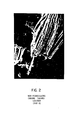
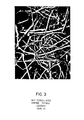
- fibrillated fibers having minute threadlike elements extending and/or detached therefrom.
- the leather fiber composition of this invention is considered to be “fibrillated” when the CSF is +100 ml or less.
- a typical fibrillated leather fiber composition is depicted in Fig. 3. It is believed that the fibrillated leather fibers provide a high degree of entanglement and surface area, which increases the reinforcing effect of the fibers and thus increase tensile strength and elongation.
- other type and size fibers may be admixed with the fibrillated leather fibers to impart desirable properties to the leather product, e.g. tear resistance and stitch retention.
- natural fibers e.g. cotton linter
- synthetic fibers e.g. polyester, nylons, acrylates etc.
- the slurry is diluted with additional water in order to achieve the proper consistency required for vacuum felting sheet formation.
- This latter consistency will vary depending on the type of equipment used to form the sheet and typically is in the range of about .1-3.0% solids, preferably about .25 to 1.5% solids.
- the binder is added to the slurry.
- the preferred binder employed is an ethylene-vinyl acetate resin in an amount, preferably, of about 10%-40% based on the weight of the total dry solids of the slurry, most preferably about 30%.
- the ethylene-vinyl acetate resin is added to the slurry in the form of an aqueous emulsion which can contain about 20% to 75% resin, preferably about 50% to 60% resin.
- the ethylene-vinyl acetate resin utilized in this invention is a copolymer containing about 30% to 50% by weight of acetyl, having a density of about 0.92 to 0.96g/cm 3 and having a glass transition temperature of about +10 to -30 0 C.
- ethylene-vinyl acetate copolymers are commercially available and one example thereof is Airflex-401 sold by Air Products and Chemicals, Inc.
- binders may be used with the fibrillated leather composition to form the leather product of this invention.
- the binder utilized is typically a film former which imparts enhanced flexibility and enhanced elongation to the fibrillated leather fibers.
- the amount of binder utilized is a binding amount.
- the binder may be completely omitted and a leather product produced by the subsequent steps described herein which has sufficient tensile strength, tear strength, elongation and 1% modulus to be considered an acceptable leather product for certain uses.
- binders that have been used to form the leather products of this invention are as follows;
- binders may include polyvinyl-chloride, polyisoprene (natural rubber), polyvinylidene chloride and fluoride, and epoxys.
- a conventional fat liquoring agent in an amount of about 1% to 50% by weight based on the weight of the leather in the slurry.
- Any conventional fat liquoring agent can be used and examples include those materials sold under the trademarks Dymsol-S, Tanyol-MB (Diamond Shamrock Corp.), Atiosol-160-S, Eureka-102 (Atlas Refining, Inc.), and Catalix GS and T (Sandoz Co.).
- the fat liquoring agent can be added to the slurry before, after or at the same time as the binder, preferably after binder addition.
- the final reconstituted leather product may also be treated with fat liquoring agents.
- the slurry will contain, as solids, about 60% to 90% of the refined leather scrap, about 10% to 40% of the binder and about 1% to 50% of fat liquoring agent.
- the slurry is deposited on a foraminous surface, for example a 100 mesh screen, and vacuum felted, for example, under a vacuum of 20-25 inches of mercury.
- a foraminous surface for example a 100 mesh screen, and vacuum felted, for example, under a vacuum of 20-25 inches of mercury.
- the felting equipment used in the manufacture of felts for subsequent processing into paper, hardboard, pasteboard, and the like can be used.
- the foraminous surface may be a reinforcing scrim mesh or fabric which becomes an integral part of the leather product. This scrim, mesh on fabric may be used to impart desired tear strength to the product.
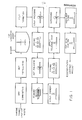
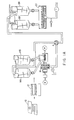
- Fig. IA is a schematic diagram of a preferred pilot plant used to produce the fibrillated leather fiber composition and felted product used to produce the reconstituted leather product of this invention.
- leather preferably leather scrap is fed into a chopping device (10) to reduce the size of the leather to a uniform size.
- the leather is then fed to a sifter (12) to separate the oversized material from the desired size material. Typically a quarter inch screen is used to sift the material.
- the oversized material is fed back to the chopper (10) so that it may be rechopped and again passed through sifter (12).
- the sifted material is then slurried with water in tanks 14A or 14B.
- the slurry is fed from one tank, e.g.
- the refiner (16) used in the preferred pilot plant of this invention is a disc refiner, in particular, a Sprout-Waldron refiner and in particular a Sprout-Waldron refiner with a 12 inch single disc operated at a fixed speed of about 2600 rpm.
- the plate pattern is Number 12716-A/AA, Ni-hard, closed periphery with sub-surface dams.
- the average slurry feed to the refiner is about 9 to 15 pounds per minute of slurry.
- the fibrillated leather fiber is then pumped into tanks 18A and/or 18B and continuously mixed with water and binder and other process aids described herein. This composition is then poured into felting box (20) and felted into sheets.
- An alternate method of felting or sheet forming is to utilize a continuous paper machine or web forming apparatus.
- a sheet is formed with an increased solids concentration of about 25% to 40%, preferably about 30%.
- Additional water is then removed from the felt, preferably by pressing and drying.
- the pressing may be effected by hydraulic pressing between large flat surfaces or running the felt through squeeze rolls with the pressure applied and the rate at which it is applied correlated to the felt freeness to extract water without damage to the felt.
- This pressing step can be accomplished at any temperature below that at which the binder fuses.
- pressing is effected by pressing between platens set at a pressure of about 25 to 500 psi for 30 to 300 seconds in order to realize a sheet which contains about 40 to 50% solids, most preferably about 45% solids. Pressing may also be assisted by vacuum conditions.
- the sheet is then dried using a combination of time and temperature conditions which do not cause the binder to fuse.
- drying can be effected by allowing the felt to stand at ambient temperature for about 16 hours or the felt can be placed into a 1760F oven for 15 minutes. The drying is continued until the felt has an increased solids concentration of about 80% to 90%, preferably about 85%.
- the resulting sheets are then subjected to a hot pressing in order to cause the binder, preferably ethylene-vinyl acetate, in the sheet to fuse into a matrix which bridges and reinforces the network of fibrillated leather fibers.
- the particular time and temperature will depend on the specific binder employed and the decomposition point of the fibrillated leather fibers.
- the pressing is effected at a sheet temperature of about 80oF to 220oF, preferably about 1750F to 190OF for a period of time which can vary from about 30 seconds to about 600 seconds, preferably about 60 to 180 seconds and at a pressure of about 25 to 500 psi, preferably about 25 to 100 psi. If a reconstituted leather product is produced without binder the foregoing temperatures and pressures are sufficient to consolidate the fibrillated fibers to form a satisfactory reconstituted leather product.
- the resulting reconstituted leather sheet is preferably staked in a conventional manner well known in the leather art.
- Conventional leather staking machines such as "Molissa”, and continuous vibration staking machines (Investa Ltd. Praha Czechoslovakia) are used to repeatedly jab the sheet with many rods or stakes in order to stretch and /or break up some of the fibers and binder.
- a soft, pliable reconstituted leather product can be obtained with leather scrap which has been less highly refined or fibrillated. However, it will not have optimum strength. Such a product may still be suitable for certain uses. It has been found that the reconstituted leather product of the aforementioned Young patent cannot be staked without detrimentally affecting tensile strength and/or tearing the sheets.
- One of the unique properties of leather which is also demonstrated by the preferred leather product of this invention and which is not demonstrated by other type reconstituted leather products, e.g. Young, is that the "hand" of the product improves with mechanical working.
- the surface of the reconstituted leather may have a conventional leather pigmented coating applied to it and dried in the normal manner.
- the pigmented sheet may then be embossed by first applying a release coating to the surface and then passing the sheet through embossing rolls.
- a highlight dye coating may then be applied to the surface of the reconstituted leather sheet and a conventional leather top sealer coating applied in the same manner as in the processing of grain leather.
- the aforementioned process for producing the leather product may be accomplished in a batch, semi-batch or continuous type process.
- reconstitued leather product of this invention has a high degree of formability.
- Such forming can be achieved by various combinations of heat, pressure and time and is useful for the fabrication of complex curvatures from flat sheets by embossing of deep surface textures thereon.
- a sufficient quantity of fibrillated leather fiber composition may be felted or flocked onto a formed belt, mandrel or porous shape to form a film of between a few thousandths of an inch to a quarter of an inch.
- the formed sheet is then taken off and the form subsequently consolidated by pressure and heat. This could be called wet or pulp forming.
- a felted flat sheet can be put into a mold and pressed out into a three dimensional configuration.
- a third way of forming the sheet into a desired shape is to take a flat sheet of the reconstituted leather product of this invention containing a binder which is amenable to bending, forming and flowing under the influence of heat and pressure, and to so form the sheet.
- a flat sheet of reconstituted leather product has been formed into a compound curvature of a portion of a basketball and football in this manner. Not only can the curve be formed but a pebble grain may be simultaneously placed thereon. This reduces significantly the labor required in taking a flat sheet and trying to conform it to, for example, a spherical configuration to make a basketball.
- panel-leather inflatable balls are presently made by hand pressing (stitching) flat, pre-embossed leather panels against an inflated ball carcass. In most cases both the carcass and the back of the panels are precoated with an adhesive. In a final step the carcass with applied panels is pressurized against the inner surface of a cold mold to further achieve intimate panel-to-carcass contact.
- the hand stitching operation is tedious, time-consuming and costly since a flat panel must be coaxed, bent, stretched, compressed etc. to a spherical configuration.
- the leather product of this invention permits (a) shortening and simplifying hand stitching and (b) providing novel means for producing inflatable balls from reconstituted leather. Many of the methods described below have been successfully tried; others are deemed possible and practical.
- Pre-textured reconstituted leather panels are inflation-pressed against the inner smooth surface of a 140OF to 160°F mold at 100 psi for I minute.
- the resulting curved panels retain their texture and, due to the curvature, can be hand stitched to a carcass in substantially less time than flat panels.
- Method 2 Smooth panels are inflation pressed against the inner textured surface of a 225 0 F to 250OF mold at ca. 135 psi for 3 minutes followed by several minutes cooling. This attains the benefits of Method I and additionally eliminates the need for pre-embossing. If necessary to provide proper mold registry, the panels may be held in the mold by vacuum.
- Method 3 The procedure of forming panels of Method I, hand positioning said panels on a carcass and final "stitching" and texturing in a hot mold as in Method 2.
- Method 4 Positioning flat (or pre-curved if necessary) smooth panels having adhesive on their inner sides in a textured mold. Holding said panels with vacuum, applying heat and pressure to a carcass as in Method 2 to accomplish stitching, embossing and final pressing in one step.
- the leather product of this invention may be coated, laminated to other materials, embossed, dyed and utilized in any manner in which natural leather and synthetic leathers have been used.
- the aforementioned procedure uses a large proportion of leather scrap waste in an economical fashion to provide a reconstituted leather which simulates the characteristics, feel, softness and hand of natural grain leather and has additional desirable properties.
- the fibrillated leather fiber may have other uses, for example, in gasket materials, filter media, insulation, as a composite with other materials, pre or post formed shapes, etc.
- a reconstituted leather sheet was prepared by chopping blue chrome leather shavings in a hammer mill and dispersing the chopped product at 6% dispersion solids in water. The slurry was then refined by wet fibrillating until the fibrillated leather fibers had a Canadian Standard Freeness of -170 ml. The slurry was then diluted to less than 2% solids. A 53% aqueous emulsion of an ethylene-vinyl acetate resin was added in an amount sufficient to realize a slurry containing 80 grams of solids of which 80% were fiber and 20% were binder. The slurry at this point contained 1.3% solids. The slurry was vacuum felted on a 144 square inch screen at 20 inches of mercury.
- the resulting sheet contained about 30% solids.
- the sheet was then cold pressed at 10.8 tons (ca. 150 psi) for 120 seconds.
- the pressed sheet was then allowed to dry at room temperature (72 0 F, 60% RH) for 16 hours and then hot pressed at 176 0 F for 180 seconds and 14.4 tons (ca 200 psi) pressure.
- a number of dimensional properties (such as thickness) play an extremely important role in how a material feels, especially if the material in question is being evaluated subjectively or if the test being used does not include a correction for its effect.
- the following latex binders were used in producing the leather product of this invention.
- Binder formulations, leather product formulations and properties are given in Table XVIll. Component concentrations are given as percent dry weight in the finished leather product.
- the plasticizers used for the binder were:
- the leather product of this invention was formed at various stages.
- Eastol 930 is a product of Henkel Corporation, Leather Chemicals Div., Saugus, Mass. It is a medium sulfated oil, 2.3% S0 3 , based on a combination of natural and synthetic oils. In addition it contains approximately 25% of a high boiling solvent to separate the fibers thus increasing softness.
- the objective of the test was to obtain a reproducible well defined refining curve that would relate "degree of fiber refining" to leather product physical properties.
- Sprout-Waldron (12" single disk) Laboratory Refiner operated at a fixed speed of about 2600 rpm. Plate pattern: #12716 -A/AA, Ni-hard, closed periphery with sub-surface dams. Feed system: batch-two tank. Average slurry feed rate 12 + 3 Ibs/minute.
- Figures 5 through 11 are graphs of Canadian Standard Freeness of the refined leather fiber vs. (a) number of passes through refiner, (b) felting time, (c) tensile strength, (d) elongation (e) 1% modulus, (f) sheet die "C” tear. These graphs demonstate the criticality and/or unexpected properties produced by fibrillation and in particular a CSF of less than +100 ml or less than the inversion point (CSF about Oml.).
- the vegetable tanned scrap was much more difficult to refine or fibrillate than chrome tanned scrap, e.g., it required 36 passes to reach a CSF of -200ml vs IS passes for chrome tanned scrap.
- Sprout Waldron (12" single disk) Laboratory Refiner operated at a fixed speed of 2600 rpm. Plate pattern: #12716 - A/AA, Ni-hard closed periphery with sub-surface dams. Feed system: batch -two tank.
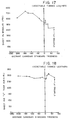
- Figs. 12 through 18 are graphs of Canadian Standard Freeness of the refined leather vs. (a) number of passes through refiner, (b) felting time, (c) tensile strength, (d) elongation, (e) 1% modulus, (f) sheet die "C” tear. These graphs demonstrate the criticality and/or unexpected properties due to fibrillation and in particular a CSF of less than +100 ml or less than the inversion point (CSF about 0ml).
Landscapes
- Chemical & Material Sciences (AREA)
- Engineering & Computer Science (AREA)
- Organic Chemistry (AREA)
- Health & Medical Sciences (AREA)
- Manufacturing & Machinery (AREA)
- Mechanical Engineering (AREA)
- Dermatology (AREA)
- Chemical Kinetics & Catalysis (AREA)
- Medicinal Chemistry (AREA)
- Polymers & Plastics (AREA)
- Treatment And Processing Of Natural Fur Or Leather (AREA)
- Nonwoven Fabrics (AREA)
Applications Claiming Priority (2)
| Application Number | Priority Date | Filing Date | Title |
|---|---|---|---|
| US35745082A | 1982-03-12 | 1982-03-12 | |
| US357450 | 1982-03-12 |
Publications (2)
| Publication Number | Publication Date |
|---|---|
| EP0089029A2 true EP0089029A2 (fr) | 1983-09-21 |
| EP0089029A3 EP0089029A3 (fr) | 1984-10-24 |
Family
ID=23405650
Family Applications (1)
| Application Number | Title | Priority Date | Filing Date |
|---|---|---|---|
| EP83102425A Withdrawn EP0089029A3 (fr) | 1982-03-12 | 1983-03-11 | Produit de cuir reconstitué à partir de fibres de cuir fibrillé |
Country Status (3)
| Country | Link |
|---|---|
| EP (1) | EP0089029A3 (fr) |
| JP (1) | JPS59500474A (fr) |
| WO (1) | WO1983003224A1 (fr) |
Cited By (12)
| Publication number | Priority date | Publication date | Assignee | Title |
|---|---|---|---|---|
| WO1994002300A1 (fr) * | 1992-07-18 | 1994-02-03 | Hp-Chemie Pelzer Research & Development Ltd. | Articles moules a proprietes superficielles analogues au cuir, pour l'industrie automobile |
| WO1998018863A1 (fr) * | 1996-10-25 | 1998-05-07 | Universidade De Aveiro | Procede de recyclage de chutes de cuir et de production de materiaux composites |
| WO2007121497A1 (fr) * | 2006-04-25 | 2007-11-01 | Stoll Remy | Matériau à base de cuir |
| EP3205668A1 (fr) * | 2016-02-15 | 2017-08-16 | Brendan Patrick Purcell | Procédé de bioproduction d'un matériau composite |
| FR3110485A1 (fr) * | 2020-05-20 | 2021-11-26 | Api'up | Procede de fabrication de pieces composites a partir de cuir, produits obtenus |
| US11214844B2 (en) | 2017-11-13 | 2022-01-04 | Modern Meadow, Inc. | Biofabricated leather articles having zonal properties |
| US11352497B2 (en) | 2019-01-17 | 2022-06-07 | Modern Meadow, Inc. | Layered collagen materials and methods of making the same |
| IT202100009206A1 (it) | 2021-04-13 | 2022-10-13 | Chiorino Tech S P A | Tessuto non tessuto da scarti di pelle conciata e metodo per la sua produzione |
| WO2023285111A1 (fr) * | 2021-07-14 | 2023-01-19 | Bader Gmbh & Co. Kg | Matériau isolant et sa production |
| CN117087255A (zh) * | 2016-02-24 | 2023-11-21 | 寰科创新有限公司 | 纤维素材料及其制备和使用方法 |
| US11913166B2 (en) | 2015-09-21 | 2024-02-27 | Modern Meadow, Inc. | Fiber reinforced tissue composites |
| US12600862B2 (en) | 2020-05-01 | 2026-04-14 | Modern Meadow, Inc. | Protein polyurethane alloys and layered materials including the same |
Families Citing this family (1)
| Publication number | Priority date | Publication date | Assignee | Title |
|---|---|---|---|---|
| KR20200075036A (ko) * | 2017-07-18 | 2020-06-25 | 모던 메도우 아이엔씨. | 생제작된 가죽 물품 및 이의 방법 |
Family Cites Families (13)
| Publication number | Priority date | Publication date | Assignee | Title |
|---|---|---|---|---|
| US1402085A (en) * | 1922-01-03 | Hiztohixo nakayama and keijibo adachi | ||
| NL273590A (fr) * | 1900-01-01 | |||
| US1131039A (en) * | 1913-01-11 | 1915-03-09 | Hide Ite Leather Company | Leather-board and process of producing the same. |
| CH118458A (fr) * | 1925-07-31 | 1927-01-03 | Antonio Ferretti | Procédé de fabrication de peaux et cuirs artificiels, en partant de déchets de peaux et cuirs. |
| GB342913A (en) * | 1929-09-10 | 1931-02-12 | Anna Engel | Process and apparatus for the treatment of scraps of skins and leather |
| US2158265A (en) * | 1934-02-02 | 1939-05-16 | Wilson Leather Company | Leather pulp and products made therefrom |
| GB456435A (en) * | 1935-02-02 | 1935-08-03 | Wilson Leather Company | Improvements in leather pulps and products made therefrom |
| US2047136A (en) * | 1935-10-24 | 1936-07-07 | Sturtevant Mill Co | Fabrication of leather boards and thinner leather sheets |
| US2808398A (en) * | 1953-10-05 | 1957-10-01 | Forward Frederick Bruce | Process for the preparation of leather dust |
| US3116200A (en) * | 1957-01-08 | 1963-12-31 | Swift & Co | Reconstituted leather product and method of making |
| FR1511650A (fr) * | 1966-12-22 | 1968-02-02 | Matériau ayant les qualités du cuir et procédé pour sa fabrication | |
| US4287252A (en) * | 1979-09-28 | 1981-09-01 | Serge Dimiter | Reconstituted leather and method of manufacture |
| US4288498A (en) * | 1980-05-06 | 1981-09-08 | Collagen Corporation | Method of making leather fiber insulation by drying-case hardening and product thereof |
-
1983
- 1983-03-09 JP JP58501402A patent/JPS59500474A/ja active Pending
- 1983-03-11 EP EP83102425A patent/EP0089029A3/fr not_active Withdrawn
- 1983-05-09 WO PCT/US1983/000309 patent/WO1983003224A1/fr not_active Ceased
Cited By (36)
| Publication number | Priority date | Publication date | Assignee | Title |
|---|---|---|---|---|
| WO1994002300A1 (fr) * | 1992-07-18 | 1994-02-03 | Hp-Chemie Pelzer Research & Development Ltd. | Articles moules a proprietes superficielles analogues au cuir, pour l'industrie automobile |
| US5624619A (en) * | 1992-07-18 | 1997-04-29 | Hp - Chemie Pelzer Research & Development, Ltd. | Moulded articles with leather-like surface properties for use in the automobile industry |
| WO1998018863A1 (fr) * | 1996-10-25 | 1998-05-07 | Universidade De Aveiro | Procede de recyclage de chutes de cuir et de production de materiaux composites |
| WO2007121497A1 (fr) * | 2006-04-25 | 2007-11-01 | Stoll Remy | Matériau à base de cuir |
| US11913166B2 (en) | 2015-09-21 | 2024-02-27 | Modern Meadow, Inc. | Fiber reinforced tissue composites |
| EP3747901A1 (fr) * | 2016-02-15 | 2020-12-09 | Modern Meadow, Inc. | Matériau biofabriqué contenant des fibrilles de collagène |
| US11001679B2 (en) | 2016-02-15 | 2021-05-11 | Modern Meadow, Inc. | Biofabricated material containing collagen fibrils |
| EP3205666A1 (fr) * | 2016-02-15 | 2017-08-16 | Brendan Patrick Purcell | Procédé de fabrication d'un matériau biofabriqué contenant des fibrilles de collagène |
| CN107405427A (zh) * | 2016-02-15 | 2017-11-28 | 现代牧场股份有限公司 | 生物制造复合材料 |
| CN107429479A (zh) * | 2016-02-15 | 2017-12-01 | 现代牧场股份有限公司 | 用于制备含有胶原原纤维的生物制造材料的方法 |
| CN107429066A (zh) * | 2016-02-15 | 2017-12-01 | 现代牧场股份有限公司 | 含有胶原原纤维的生物制造材料 |
| CN107530474A (zh) * | 2016-02-15 | 2018-01-02 | 现代牧场股份有限公司 | 用于生物制造复合材料的方法 |
| US10301440B2 (en) | 2016-02-15 | 2019-05-28 | Modern Meadow, Inc. | Biofabricated material containing collagen fibrils |
| US10370505B2 (en) | 2016-02-15 | 2019-08-06 | Modern Meadow, Inc. | Method for making biofabricated composite |
| US10370504B2 (en) | 2016-02-15 | 2019-08-06 | Modern Meadow, Inc. | Method for making a biofabricated material containing collagen fibrils |
| US10519285B2 (en) | 2016-02-15 | 2019-12-31 | Modern Meadow, Inc. | Method for biofabricating composite material |
| CN107429066B (zh) * | 2016-02-15 | 2020-04-17 | 现代牧场股份有限公司 | 含有胶原原纤维的生物制造材料 |
| CN111303641A (zh) * | 2016-02-15 | 2020-06-19 | 现代牧场股份有限公司 | 含有胶原原纤维的生物制造材料 |
| EP3205667A1 (fr) * | 2016-02-15 | 2017-08-16 | Brendan Patrick Purcell | Matériau biofabriqué contenant des fibrilles de collagène |
| EP3747900A1 (fr) * | 2016-02-15 | 2020-12-09 | Modern Meadow, Inc. | Procédé de bioproduction d'un matériau composite |
| EP3205669A1 (fr) * | 2016-02-15 | 2017-08-16 | Brendan Patrick Purcell | Matériau composite biofabriqué |
| EP3205668A1 (fr) * | 2016-02-15 | 2017-08-16 | Brendan Patrick Purcell | Procédé de bioproduction d'un matériau composite |
| US11542374B2 (en) | 2016-02-15 | 2023-01-03 | Modern Meadow, Inc. | Composite biofabricated material |
| US11286354B2 (en) | 2016-02-15 | 2022-03-29 | Modern Meadow, Inc. | Method for making a biofabricated material containing collagen fibrils |
| CN107429479B (zh) * | 2016-02-15 | 2022-04-29 | 现代牧场股份有限公司 | 用于制备含有胶原原纤维的生物制造材料的方法 |
| US11530304B2 (en) | 2016-02-15 | 2022-12-20 | Modern Meadow, Inc. | Biofabricated material containing collagen fibrils |
| US11525042B2 (en) | 2016-02-15 | 2022-12-13 | Modern Meadow, Inc. | Composite biofabricated material |
| CN117087255A (zh) * | 2016-02-24 | 2023-11-21 | 寰科创新有限公司 | 纤维素材料及其制备和使用方法 |
| US11214844B2 (en) | 2017-11-13 | 2022-01-04 | Modern Meadow, Inc. | Biofabricated leather articles having zonal properties |
| US11352497B2 (en) | 2019-01-17 | 2022-06-07 | Modern Meadow, Inc. | Layered collagen materials and methods of making the same |
| US12595366B2 (en) | 2019-01-17 | 2026-04-07 | Modern Meadow, Inc. | Layered collagen materials and methods of making the same |
| US12600862B2 (en) | 2020-05-01 | 2026-04-14 | Modern Meadow, Inc. | Protein polyurethane alloys and layered materials including the same |
| FR3110485A1 (fr) * | 2020-05-20 | 2021-11-26 | Api'up | Procede de fabrication de pieces composites a partir de cuir, produits obtenus |
| WO2022219484A1 (fr) * | 2021-04-13 | 2022-10-20 | Chiorino Technology S.P.A. | Procédés à sec pour produire un non tissé à partir de déchets de cuir tanné |
| IT202100009206A1 (it) | 2021-04-13 | 2022-10-13 | Chiorino Tech S P A | Tessuto non tessuto da scarti di pelle conciata e metodo per la sua produzione |
| WO2023285111A1 (fr) * | 2021-07-14 | 2023-01-19 | Bader Gmbh & Co. Kg | Matériau isolant et sa production |
Also Published As
| Publication number | Publication date |
|---|---|
| JPS59500474A (ja) | 1984-03-22 |
| WO1983003224A1 (fr) | 1983-09-29 |
| EP0089029A3 (fr) | 1984-10-24 |
Similar Documents
| Publication | Publication Date | Title |
|---|---|---|
| EP0089029A2 (fr) | Produit de cuir reconstitué à partir de fibres de cuir fibrillé | |
| US2206056A (en) | Method and apparatus for making fibrous sheetings | |
| US4011130A (en) | Leather-like waterlaid sheets containing particulate fillers | |
| US3116200A (en) | Reconstituted leather product and method of making | |
| US20050202268A1 (en) | Three-dimensional shaped bodies having a leather-like surface | |
| KR20170010998A (ko) | 가죽가공 잔재물을 이용한 재생가죽의 제조방법 | |
| US2158265A (en) | Leather pulp and products made therefrom | |
| US2237235A (en) | Process for making leather sheets | |
| US20240254668A1 (en) | Method for producing a vegetable planar textile structure | |
| US11499267B1 (en) | High-strength and tear-resistant leather materials and methods of manufacture | |
| US10577670B1 (en) | High-strength and tear-resistant leather materials and methods of manufacture | |
| US1675244A (en) | Manufacture of paper, paperboard, building boards, roofing and flooring sheets and cloths, and the like | |
| US11377765B1 (en) | High-strength and tear-resistant leather materials and methods of manufacture | |
| US10618199B1 (en) | High strength leather material | |
| AU1477883A (en) | Reconstituted leather product from fibrillated leather fibers | |
| US2084272A (en) | Plastic composition and articles and method of making the same | |
| EP4420655B1 (fr) | Biocomposite de cellulose bactérienne et article comprenant ledit biocomposite | |
| US1713846A (en) | Leather substitute and process of making | |
| US1499291A (en) | Process of making compressed fiber board | |
| US2125947A (en) | Manufacture of midsoles | |
| RU2094466C1 (ru) | Способ переработки кожевенных отходов в кожевенный порошок | |
| US3542910A (en) | Method of making fibrous sheet material | |
| US1964771A (en) | Manufacture of vulcanized rubber products | |
| JPH10108709A (ja) | 靴用芯材 | |
| JPS59144606A (ja) | 鞣されているコラーゲン繊維の製造方法 |
Legal Events
| Date | Code | Title | Description |
|---|---|---|---|
| PUAI | Public reference made under article 153(3) epc to a published international application that has entered the european phase |
Free format text: ORIGINAL CODE: 0009012 |
|
| 17P | Request for examination filed |
Effective date: 19830311 |
|
| AK | Designated contracting states |
Designated state(s): DE FR GB IT |
|
| PUAL | Search report despatched |
Free format text: ORIGINAL CODE: 0009013 |
|
| AK | Designated contracting states |
Designated state(s): DE FR GB IT |
|
| R17P | Request for examination filed (corrected) |
Effective date: 19840424 |
|
| R17P | Request for examination filed (corrected) |
Effective date: 19850424 |
|
| 17Q | First examination report despatched |
Effective date: 19860319 |
|
| STAA | Information on the status of an ep patent application or granted ep patent |
Free format text: STATUS: THE APPLICATION IS DEEMED TO BE WITHDRAWN |
|
| 18D | Application deemed to be withdrawn |
Effective date: 19860730 |
|
| RIN1 | Information on inventor provided before grant (corrected) |
Inventor name: INFANTINO, JOSEPH R. Inventor name: PICAGLI, RAYMOND G. Inventor name: TUCKER, E. SCOTT Inventor name: LIGHT, HERBERT J. Inventor name: MARINACCIO, PAUL J. Inventor name: FIORE, JOSEPH V. |