EP0089271A2 - Perfectionnements à la fabrication des cotons-tiges et à leur procédé de fabrication - Google Patents
Perfectionnements à la fabrication des cotons-tiges et à leur procédé de fabrication Download PDFInfo
- Publication number
- EP0089271A2 EP0089271A2 EP83400460A EP83400460A EP0089271A2 EP 0089271 A2 EP0089271 A2 EP 0089271A2 EP 83400460 A EP83400460 A EP 83400460A EP 83400460 A EP83400460 A EP 83400460A EP 0089271 A2 EP0089271 A2 EP 0089271A2
- Authority
- EP
- European Patent Office
- Prior art keywords
- cotton
- ball
- rod
- cotton swab
- shield
- Prior art date
- Legal status (The legal status is an assumption and is not a legal conclusion. Google has not performed a legal analysis and makes no representation as to the accuracy of the status listed.)
- Granted
Links
Images

Classifications
-
- A—HUMAN NECESSITIES
- A61—MEDICAL OR VETERINARY SCIENCE; HYGIENE
- A61F—FILTERS IMPLANTABLE INTO BLOOD VESSELS; PROSTHESES; DEVICES PROVIDING PATENCY TO, OR PREVENTING COLLAPSING OF, TUBULAR STRUCTURES OF THE BODY, e.g. STENTS; ORTHOPAEDIC, NURSING OR CONTRACEPTIVE DEVICES; FOMENTATION; TREATMENT OR PROTECTION OF EYES OR EARS; BANDAGES, DRESSINGS OR ABSORBENT PADS; FIRST-AID KITS
- A61F13/00—Bandages or dressings; Absorbent pads
- A61F13/15—Absorbent pads, e.g. sanitary towels, swabs or tampons for external or internal application to the body; Supporting or fastening means therefor; Tampon applicators
- A61F13/38—Swabs having a stick-type handle, e.g. cotton tips
Definitions
- the present invention relates to improvements in the manufacture of hygiene articles facilitating the cleaning of the ears, these articles being commonly called "cotton swabs”.
- Cotton swabs have taken on significant commercial development in recent years. They effectively replace the match or the hairpin around which a small piece of cotton was once wound in order to clean the ear and in particular its ear canal.
- the object of the invention is to propose a new cotton swab which makes it possible to resolve the difficulties mentioned.
- the invention also relates to the method for manufacturing such new cotton swabs.
- a cotton swab comprising a rod at least at one end of which is arranged a cotton ball or the like, the new cotton swab. manufactured according to the invention characterized in that the cotton ball or the like is shaped so as to present in transerval section at the axis of the rod a non-circular section allowing the introduction of the ball into the ear canal substantially without discharge of cerumen at the bottom of the duct and the collection of cerumen in the volume of grooves or grooves made on the ball.
- the section of the cotton ball will generally be cruciform, for example with four branches between which said grooves or grooves are formed.
- the ball has a generally substantially helical shape with grooves and helical grooves.
- the "cotton swabs" include a shield which is fixed on the rod substantially perpendicular to it at a distance from its end on which the cotton ball is fixed substantially less than that separating the entrance from the ear canal to the eardrum of the subject for which the use of the cotton swab is intended.
- the shield is fixed in a removable manner at the precise determined location of the rod, said shield and said rod comprising cooperating stop and locking means.
- the invention further relates to a method for the practical and automated manufacture of such improved cotton swabs.
- FIGS. 1 and 2 illustrating a stick forming a conventional cotton swab and its use.
- the cotton swab comprises the actual rod 1 at at least one end of which is rolled up a cotton ball or the like 2.
- the end of the cotton swab carrying the ovoid ball 2 inside the ear canal shown diagrammatically in 4.
- the earwax 5 which will therefore tend to accumulate at the bottom of the ear canal and form a plug of earwax which it will then be very difficult to extract.
- This drawback is immediately explained by the sight of FIGS. 1 and 2, since the earwax has practically no space to gather on the cotton ball 2.
- the cotton ball 6 has a shape generally substantially ovoid like the cotton ball 2 of the prior art. However, its section is not circular, but as it appears more clearly in Figure 4, it is cruciform.
- the cross formed by the ball 6 has four branches between which are formed four substantially longitudinal grooves or grooves 7. These grooves may possibly be slightly helically formed, which will improve the efficiency of the device.
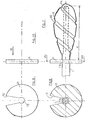
- the cotton ball 9 is formed with a helical groove or groove 10.
- the earwax 5 will not under these conditions that little tendency to be pushed back towards the bottom of the ear canal, flowing and accumulating in the groove 10 (or the grooves 10 if several helical-parallel grooves are formed on the cotton ball 9).
- the arrow 8 of the stick. 1 we will tend to extract the earwax out of the duct.
- the cotton swab can be formed substantially as according to the prior techniques. Then, it will suffice to come to compress, preferably hot in a tool of suitably suitable shape, the cotton ball to "iron" it into the desired shape.
- the cotton ball can be coated with a suitable finish, for example such as starch.
- a strand of cotton may be wound helically on the end of the stick.
- an adhesive may be applied to the end of the stick to facilitate winding and the good staying power of the cotton strand.
- the support rod 1 of the cotton swab comprising at one of its ends at least one cotton ball 9 formed with a helical groove 10 facilitating the cleaning operation of the ears avoiding the discharge of earwax at the bottom of the ear canal.
- a substantially circular, flat shield 11 removable around the end of the cotton swab comprising the cotton ball 9 has been fixed, having a notch 12 terminating in its center by an orifice 13 the diameter of which corresponds substantially to that of a groove or flange 14 formed around the rod 1 as it appears more clearly in FIG. 1.
- the distance d separating the shield 11 from the free end 1a of the rod 1 is chosen so as to be generally substantially less than that separating the entry of the ear canal to the eardrum of the subject for whom the use of the cotton swab is intended, for example a young child from 2 to 5 years old. A reasonable margin of safety can be taken, in the since, as mentioned above, there is no need to clean the ear canal to the bottom.
- the shield 11 is advantageously made of a transparent or translucent flexible plastic which locks elastically on the groove 14 by simple engagement on the rod. In this way, even in the event of untimely movements of the child, there is no risk of accidents, the shield preventing any penetration of the "cotton swab" beyond the authorized distance.
- the advantage of providing a removable shield is that a single shield is sufficient for a box of "cotton swab", and in addition the shield which can be thus separated does not cause any problem of storage and packaging of the article.
- two or a greater number of grooves can be provided more or less close to the end of the rod.
- the suitable groove can be chosen depending for example on the age of the child for whom the use of the cotton swab.
Landscapes
- Health & Medical Sciences (AREA)
- Life Sciences & Earth Sciences (AREA)
- Engineering & Computer Science (AREA)
- Biomedical Technology (AREA)
- Heart & Thoracic Surgery (AREA)
- Vascular Medicine (AREA)
- Epidemiology (AREA)
- Animal Behavior & Ethology (AREA)
- General Health & Medical Sciences (AREA)
- Public Health (AREA)
- Veterinary Medicine (AREA)
- Body Washing Hand Wipes And Brushes (AREA)
- Absorbent Articles And Supports Therefor (AREA)
- Media Introduction/Drainage Providing Device (AREA)
Abstract
Description
- La présente invention concerne des perfectionnements à la fabrication des articles d'hygiène facilitant le nettoyage des oreilles, ces articles étant dénommés couramment "cotons-tiges".
- Les cotons-tiges ont pris, ces récentes années, un développement commercial important. Ils remplacent en effet avantageusement l'allumette ou l'épingle à cheveux autour de laquelle on enroulait autrefois un petit morceau de coton en vue d'effectuer le nettoyage de l'oreille et en particulier de son conduit auditif.
- Cependant, ces cotons-tiges ne sont pas toujours bien supportés par les utilisateurs, et notamment ceux dont le conduit auditif est relativement restreint ou délicat. En particulier, l'utilisation des "cotons-tiges" est en général fortement déconseillée par les pédiatres et les médecins traitants chez les petits enfants.
- Un emploi inadéquat d'un coton-tige peut provoquer en effet le refoulement du cérumen au fond du conduit auditif qui formera un bouchon de cérumen dont l'enlèvement devra être réalisé en milieu hospitalier. Bien évidement, l'allumette portant à son extrémité une boule de coton enroulée sera sujette aux mêmes inconvénients, le pis-aller proposé étant d'utiliser un coton imbibé d'une solution alcoolique sans support rigide et dont l'efficacité est évidemment plus qu'aléatoire.
- L'invention a pour objet de proposer un nouveau coton-tige permettant de résoudre les difficultés mentionnées. L'invention concerne également le procédé de fabrication de tels nouveaux cotons-tiges.
- Conformément à l'invention, les difficultés mentionnées ci-dessus sont résolues par le fait que l'on propose un coton-tige comportant une tige à une extrémité au moins de laquelle est disposée une boule de coton ou analogue, le nouveau coton-tige fabriqué selon l'invention se caractérisant en ce que la boule de coton ou analogue est conformée de façon à présenter en coupe transervale à l'axe de la tige une section non circulaire permettant l'introduction de la boule dans le conduit auditif sensiblement sans refoulement de cérumen au fond du conduit et la collecte du cérumen dans le volume de saignées ou cannelures ménagées sur la boule.
- Par exemple, selon un mode de réalisation, la section de la boule de coton sera généralement cruciforme, par exemple à quatre branches entre lesquelles sont formées lesdites saignées ou cannelures.
- Selon une autre réalisation également très efficace, la boule à une forme générale sensiblement hélicoïdale avec saignées et cannelures en hélice.
- On comprend immédiatement qu'en utilisant un tel coton-tige, après introduction du coton-tige dans le conduit auditif, et lorsqu'on tourne le coton-tige, le cérumen est recueilli dans les saignées ou cannelures (hélicoïdalesou longitudinales) ménagées entre les parties faisant protubérance ou saillie de la boule de coton, le risque de refoulement du cérumen par la boule étant considérablement restreint, et en pratique éliminé, du fait que le coton-tige lors de son introduction ne viendra porter que très localement contre la paroi du conduit auditif.
- Un perfectionnement complémentaire à de tels "cotons-tiges" permet en outre d'éviter des accidents d'emplois plus particulièrement chez de jeunes enfants.
- Chez les enfants un nettoyage fréquent des oreilles est nécessaire du fait de l'abondante production de cérumen.
- Ce nettoyage, chez les tout petits, ne doit se faire que dans la partie visible : pavillons et parties externes du conduit auditif externe. Quelquefois le nettoyage peut se révéler très dangereux, du fait de la non coopération de l'enfant qui se débat et à cause de la zone réflexogène qui peut entrainer des gestes brusques.
- Tous ces mouvements intempestifs font courir le risque, lors du nettoyage de l'oreille avec un "coton-tige", d'enfoncement brutal du "coton-tige" dans le conduit auditif externe avec possibilité de perforation traumatique du typan par la tige relativement rigide support de la boule de coton.
- Pour éviter ce risque, les "cotons-tiges" comportent un bouclier qui se fixe sur la tige sensiblement perpendiculairement à elle à une distance de son extrémité sur laquelle est fixée la boule de coton sensiblement inférieure à celle séparant l'entrée du conduit auditif au tympan du sujet auquel est destiné l'usage du "coton-tige".
- Avantageusement le bouclier se fixe de façon amovible à l'endroit précis déterminé de la tige, ledit bouclier et ladite tige comportant des moyens de butée et verrouillage coopérants.
- Ainsi, sans augmentation sensible du prix de revient du "coton-tige", on éliminera radicalement les dangers réels que constituent les nettoyages fréquents nécessaires à une bonne hygiène des oreilles en particulier chez les jeunes enfants.
- L'invention vise en outre un procédé permettant la fabrication pratique et automatisée de tels cotons-tiges perfectionnés.
- L'invention, ses objets et avantages apparaîtront plus clairement à l'aide de la description qui va suivre faite en référence aux dessins annexés dans lesquels :
- - la figure 1 montre de façon schématique en coupe axiale un bâtonnet classique engagé dans le conduit auditif - et 1a'manière dont il agit sur le cérumen ;
- - la figure 2 est une vue en coupe transversale faite selon le plan II-II de la figure 1 ;
- - la figure 3 est une vue semblable à celle de la figure 1 mais relative à un bâtonnet ou coton-tige conforme à l'invention ;
- - la figure 4 est une vue en coupe faite selon le plan IV-IV de la figure 3 ;
- - la figure 5 montre, comme la figure 3, un autre coton-tige conforme à l'invention et la manière dont il travaille ;
- - la figure 6 est une vue en coupe faite selon le planVI-VI de la figure 5;
- - la figure 7 montre schématiquement en élévation un "coton-tige" conforme à l'invention pourvu des perfectionnements empêchant une trop grande introduction du bâtonnet ;
- - la figure 8 est une vue en coupe faite selon le plan VIII de la figure 7 ;
- - la figure 9 est une vue en élévation du bouclier séparé du "coton-tige", cette vue étant faite selon la flèche IX de la figure 10 ;
- - la figure 10 est une vue du côté du bouclier montré en élévation à la figure 9.
- On se reportera tout d'abord aux figures 1 et 2 illustrant un bâtonnet formant coton-tige classique et son utilisation. Le coton-tige comprend la tige proprement dite 1 à une extrémité au moins de laquelle est enroulée une boule de coton ou analogue 2. Lorsqu'on veut nettoyer le conduit auditif, il faut introduire, comme indiqué par la flèche 3, l'extrémité du coton-tige portant la boule ovoïde 2 à l'intérieur du conduit auditif schématisé en 4. En opérant de cette façon, si le conduit auditif n'est pas très large, et en particulier chez les jeunes enfants, on repousse devant soi le cérumen 5, qui aura donc tendance à venir s'accumuler au fond du conduit auditif et à former un bouchon de cérumen qu'il sera ensuite très difficile d'extraire. Cet inconvénient s'explique immédiatement à la vue des figures 1 et 2, étant donné que le cérumen n'a pratiquement pas d'espace pour se rassembler sur la boule de coton 2.
- Selon le mode de réalisation conforme à l'invention illustré aux figures 3 et 4, la boule de coton 6 a une forme généralesensiblement ovoïde comme la boule de coton 2 de l'art antérieur. Cependant, sa section n'est pas circulaire, mais comme il apparaît plus clairement à la figure 4, elle est cruciforme. Dans l'exemple illustré, la croix que forme la boule 6 a quatre branches entre lesquelles sont ménagées quatre saignées ou cannelures sensiblement longitudinales 7. Ces cannelures peuvent êtres éventuellement légèrement formées en hélice, ce qui améliorera l'efficacité du dispositif.
- Il apparaît immédiatement qu'avec une telle conformation du coton le cérumen 5 ne sera pas repoussé au fond du conduit auditif mais pourra fluer dans les saignées ou cannelures 7 comme il apparaît clairement à la figure 4.
- En outre, il apparaît clairement que dans ces conditions, un mouvement de rotation du bâtonnet sur lui-même comme indiqué par la flèche 8 aura tendance à récolter tout le cérumen le long du conduit auditif à l'intérieur des saignées ou cannelures 7.
- Selon la réalisation illustrée aux figures 5 et 6, la boule de coton 9 est formée avec une cannelure ou saignée hélicoïdale 10. Pour les mêmes raisons qu'expliquées ci-dessus en relation avec les figures 3 et 4, le cérumen 5 n'aura dans ces conditions que peu tendance à être refoulé vers le fond du conduit auditif, fluant et s'accumulant dans la cannelure 10 (ou les cannelures 10 si plusieurs cannelures hélicoldalesparrallèles sont formées sur la boule de coton 9). En outre, par un mouvement de rotation comme indiqué par la flèche 8 du bâtonnet. 1, on aura tendance à extraire le cérumen hors du conduit.
- De façon à former la boule du coton-tige, telle par exemple que la boule 6 ou la boule 9 des exemples illustrés, on pourra procéder de diverses manières.
- Par exemple, selon un procédé, on pourra former le coton-tige sensiblement comme selon les techniques antérieures. Ensuite, il suffira de venir comprimer, de préférence à chaud dans un outil de forme convenablement appropriée la boule de coton pour la "repasser" dans la forme souhaitée.
- Cette opération peut se faire rapidement, facilement et écomoniquement.
- Si l'on veut améliorer la tenue de la conformation ie la boule "rainurée", on pourra revêtir la boule de coton d'un apprêt convenable, tel par exemple que de l'amidon.
- D'autres procédés de fabrication peuvent cependant être employés.
- Par exemple, pour former une boule de coton telle qu'illustrée au mode de réalisation des figures 5 et 6, on pourra enrouler en hélice sur l'extrémité du bâtonnet un brin de coton. Eventuellement, une colle pourra être appliquée sur le bout du bâtonnet pour faciliter l'enroulement et la bonne tenue du brin de coton.
- Eventuellement, en lieu et place du coton, on pourra utiliser d'autres matières, telles par exemple que des mousses synthétiques qui pourront être facilement thermoformées avec les sections convenables, à condition de prendre des matières non allergisantes en soi connues et de souplesse appropriée .
- Selon les perfectionnements illustrés aux figures 7 à 10 des dessins, on retrouve la tige support 1 du coton-tige comportant à l'une de ses extrémités au moins une boule de coton 9 formée avec une cannelure hélicoïdale 10 facilitant l'opération de nettoyage des oreilles en évitant le refoulement de cérumen au fond du conduit auditif.
- En outre, on a fixé vers l'extrémité du coton-tige comportant la boule de coton 9 un bouclier 11 amovible sensiblement circulaire plat présentant une encoche 12 se terminant en son centre par un orifice 13 dont le diamètre correspond sensiblement à celui d'une saignée ou collerette 14 ménagée autour de la tige 1 comme il apparaît plus clairement à la figure 1. La distance d séparant le bouclier 11 de l'extrémité libre 1a de la tige 1 est choisi de façon à être généralement sensiblement inférieure à celle séparant l'entrée du conduit auditif au tympan du sujet auquel est destiné l'usage du "coton-tige", par exemple un jeune enfant de 2 à 5 ans. Une marge de sécurité raisonnable peut être prise, dans la mesure où, comme mentionné précédemment, il n'est pas nécessaire de nettoyer le conduit auditif jusqu'au fond.
- Le bouclier 11 est avantageusement constitué en une matière plastique transparente ou translucide souple qui vient se verrouiller élastiquement sur la saignée 14 par simple enclenchement sur la tige. De cette façon, même en cas de mouvements intempestifs de l'enfant, on ne risque pas d'accidents, le bouclier empêchant toute pénétration du "coton-tige" au-delà de la distance d autorisée.
- L'avantage de prévoir un bouclier amovible est qu'il suffit d'un seul bouclier pour une boîte de "coton-tige", et en outre le bouclier pouvant être ainsi séparé n'entraine aucun problème de stockage et de conditionnement de l'article.
- Bien entendu d'autres moyens de fixation et de mise en place du bouclier peuvent être prévus sans sortir du cadre des perfectionnements de l'invention. En outre, deux ou un plus grand nombre de saignées peuvent être prévues plus ou moins rapprochées de l'extrémité la de la.tige, la saignée conevable pouvant être choisie en fonction par exemple de l'âge de l'enfant auquel est destiné l'usage du "coton-tige".
Claims (13)
Applications Claiming Priority (4)
| Application Number | Priority Date | Filing Date | Title |
|---|---|---|---|
| FR8204167 | 1982-03-12 | ||
| FR8204167A FR2522961B1 (fr) | 1982-03-12 | 1982-03-12 | Perfectionnements a la fabrication des cotons-tiges et a leur procede de fabrication |
| FR8214139A FR2531626B2 (fr) | 1982-08-13 | 1982-08-13 | Perfectionnements a la fabrication des cotons-tiges et a leur procede de fabrication |
| FR8214139 | 1982-08-13 |
Publications (3)
| Publication Number | Publication Date |
|---|---|
| EP0089271A2 true EP0089271A2 (fr) | 1983-09-21 |
| EP0089271A3 EP0089271A3 (en) | 1984-02-22 |
| EP0089271B1 EP0089271B1 (fr) | 1986-05-28 |
Family
ID=26222804
Family Applications (1)
| Application Number | Title | Priority Date | Filing Date |
|---|---|---|---|
| EP83400460A Expired EP0089271B1 (fr) | 1982-03-12 | 1983-03-07 | Perfectionnements à la fabrication des cotons-tiges et à leur procédé de fabrication |
Country Status (3)
| Country | Link |
|---|---|
| US (1) | US4707318A (fr) |
| EP (1) | EP0089271B1 (fr) |
| DE (1) | DE3363681D1 (fr) |
Cited By (9)
| Publication number | Priority date | Publication date | Assignee | Title |
|---|---|---|---|---|
| FR2560519A1 (fr) * | 1984-03-05 | 1985-09-06 | Collin Marcel | Batonnet pour les soins de cavites du corps " nez-oreilles " |
| FR2579098A1 (fr) * | 1985-03-20 | 1986-09-26 | Tran Dinh Can | Perfectionnements a la fabrication des cotons-tiges et a leur procede de fabrication |
| US4746238A (en) * | 1986-11-03 | 1988-05-24 | Levine Robert A | Stick swab with augured head |
| GB2205752A (en) * | 1987-06-13 | 1988-12-21 | Keith Bernard Wakelam | Helical cavity cleaner |
| EP0321631A1 (fr) * | 1987-09-25 | 1989-06-28 | SISMA S.p.A. | Coton-tige (bâtonnet pour le nettoyage des oreilles) |
| EP0363533A1 (fr) * | 1988-10-12 | 1990-04-18 | Iwahashi Tsugio | Applicateur |
| US4935001A (en) * | 1987-10-06 | 1990-06-19 | George Gary F | Swab |
| US5147288A (en) * | 1988-04-25 | 1992-09-15 | Ivalda S.P.A. | Cotton swab with depth prevention mechanism |
| US5715559A (en) * | 1996-08-09 | 1998-02-10 | Mitri; George | Cleaning tool |
Families Citing this family (13)
| Publication number | Priority date | Publication date | Assignee | Title |
|---|---|---|---|---|
| US5374276A (en) * | 1994-02-04 | 1994-12-20 | Lay; Wuu P. | Ear wax remover |
| IL123024A0 (en) * | 1998-01-22 | 1998-09-24 | Jacob Begun | Moisture absorbing device |
| DE10114786C2 (de) * | 2001-03-26 | 2003-07-17 | Johnson & Johnson Gmbh | Tampon für die Frauenhygiene sowie Verfahren und Vorrichtung zur Herstellung desselben |
| USD477075S1 (en) | 2001-09-26 | 2003-07-08 | Johnson & Johnson Gmbh | Tampon with compressed grooves |
| US20050256440A1 (en) * | 2004-04-30 | 2005-11-17 | Zunker Maryann | Disposable device for mechanically engaging a vagina |
| US20080208100A1 (en) * | 2007-02-23 | 2008-08-28 | Ranan Wolff | Method and apparatus for removal of cerumen |
| USD647612S1 (en) * | 2008-01-17 | 2011-10-25 | Ontex Hygieneartikel Deutschland Gmbh | Tampon |
| USD647611S1 (en) * | 2008-01-17 | 2011-10-25 | Ontex Hygieneartikel Deutschland G.m.b.H. | Tampon |
| USD647610S1 (en) * | 2008-01-17 | 2011-10-25 | Ontex Hygieneartikel Deutschland Gmbh | Tampon |
| DE102008020640B4 (de) | 2008-04-24 | 2010-09-09 | Frank Ruhlmann | Tampon |
| USD701600S1 (en) | 2011-03-30 | 2014-03-25 | Steven B. Kauffman | Ear swab |
| USD779654S1 (en) | 2015-04-24 | 2017-02-21 | Filo America | Grooved swab |
| DE102017211242A1 (de) | 2017-07-03 | 2019-01-03 | Gérald Arabin | Reinigungsstäbchen mit Faserkörper |
Family Cites Families (9)
| Publication number | Priority date | Publication date | Assignee | Title |
|---|---|---|---|---|
| DE487198C (de) * | 1929-12-04 | Victor Daeufer Dr | Ohrreiniger | |
| DE551714C (de) * | 1932-06-03 | Curt Zocher | Wattetraeger fuer die Ohrenreinigung | |
| DE604145C (de) * | 1934-10-15 | Edmund Stiller | Vorrichtung zum Reinigen der Ohren und der Nase | |
| DE580729C (de) * | 1933-07-15 | Georg Hollstein Dr | Vorrichtung zum Saeubern der Ohren und der Nase | |
| US2987063A (en) * | 1956-04-06 | 1961-06-06 | Samuel W Glickston | Swab applicator |
| US2981127A (en) * | 1959-09-23 | 1961-04-25 | Norfolk Products Corp | Drill with chip remover |
| US3324855A (en) * | 1965-01-12 | 1967-06-13 | Henry J Heimlich | Surgical sponge stick |
| FR2249640B1 (fr) * | 1973-11-06 | 1978-02-24 | Rossignol Jacques | |
| US4547253A (en) * | 1984-07-18 | 1985-10-15 | Brown & Williamson Tobacco Corporation | Device for making grooves in cigarette filters |
-
1983
- 1983-03-07 EP EP83400460A patent/EP0089271B1/fr not_active Expired
- 1983-03-07 DE DE8383400460T patent/DE3363681D1/de not_active Expired
-
1985
- 1985-04-19 US US06/725,118 patent/US4707318A/en not_active Expired - Lifetime
Cited By (10)
| Publication number | Priority date | Publication date | Assignee | Title |
|---|---|---|---|---|
| FR2560519A1 (fr) * | 1984-03-05 | 1985-09-06 | Collin Marcel | Batonnet pour les soins de cavites du corps " nez-oreilles " |
| EP0158543A1 (fr) * | 1984-03-05 | 1985-10-16 | Marcel Collin | Instrument pour le soin des cavités du corps humain et plus particulièrement du conduit auditif |
| FR2579098A1 (fr) * | 1985-03-20 | 1986-09-26 | Tran Dinh Can | Perfectionnements a la fabrication des cotons-tiges et a leur procede de fabrication |
| US4746238A (en) * | 1986-11-03 | 1988-05-24 | Levine Robert A | Stick swab with augured head |
| GB2205752A (en) * | 1987-06-13 | 1988-12-21 | Keith Bernard Wakelam | Helical cavity cleaner |
| EP0321631A1 (fr) * | 1987-09-25 | 1989-06-28 | SISMA S.p.A. | Coton-tige (bâtonnet pour le nettoyage des oreilles) |
| US4935001A (en) * | 1987-10-06 | 1990-06-19 | George Gary F | Swab |
| US5147288A (en) * | 1988-04-25 | 1992-09-15 | Ivalda S.P.A. | Cotton swab with depth prevention mechanism |
| EP0363533A1 (fr) * | 1988-10-12 | 1990-04-18 | Iwahashi Tsugio | Applicateur |
| US5715559A (en) * | 1996-08-09 | 1998-02-10 | Mitri; George | Cleaning tool |
Also Published As
| Publication number | Publication date |
|---|---|
| EP0089271A3 (en) | 1984-02-22 |
| DE3363681D1 (en) | 1986-07-03 |
| EP0089271B1 (fr) | 1986-05-28 |
| US4707318A (en) | 1987-11-17 |
Similar Documents
| Publication | Publication Date | Title |
|---|---|---|
| EP0089271B1 (fr) | Perfectionnements à la fabrication des cotons-tiges et à leur procédé de fabrication | |
| FR2984803A1 (fr) | Pneumatique cloute perfectionne | |
| WO2015162354A1 (fr) | Dispositif de connexion de branches de lunette sur la face frontale | |
| EP0263769B1 (fr) | Paumelle à blocage axial de la broche pour porte ou fenêtre | |
| WO2007034082A2 (fr) | Surbranche interchangeable pour branche de lunettes, son procede d'obtention et branche composite de lunettes en faisant application | |
| CA2296201C (fr) | Element de connecteur pour fibre optique | |
| EP0108687A1 (fr) | Procédé de fabrication d'un cylindre, notamment pour moulin à cannes à sucre, et cylindre obtenu par ce procédé | |
| FR2627962A1 (fr) | Embauchoir reglable | |
| WO2019122708A1 (fr) | Cable optique a elements de dechirements | |
| FR2522961A1 (fr) | Perfectionnements a la fabrication des cotons-tiges et a leur procede de fabrication | |
| FR2648333A1 (fr) | Etui de rouge a levres; presentoir pour ledit etui et procede de fabrication d'un tel etui | |
| EP1857856A1 (fr) | Lunettes à montures amovibles | |
| WO1996019019A1 (fr) | Fiche electrique du type fiche anglaise | |
| FR3059878A1 (fr) | "applicateur pour produit cosmetique et ensemble applicateur associe" | |
| EP1508455A1 (fr) | Procédé de protection d'un essieu de véhicule ferroviaire, essieu et bogie de véhicule ferroviaire correspondants | |
| CH713211A1 (fr) | Brin de bracelet interchangeable pour montre-bracelet. | |
| EP2470942B1 (fr) | Branche pour monture de lunettes à pièce latérale enjoliveuse interchangeable | |
| FR2531626A2 (fr) | Perfectionnements a la fabrication des cotons-tiges et a leur procede de fabrication | |
| WO2004040356A1 (fr) | Ecran pour lunettes et pieces pour la fabrication d'un tel ecran | |
| CH694444A5 (fr) | Rotor pour moteur électromagnétique. | |
| FR2740663A1 (fr) | Article pouvant constituer une butee reglable et amovible sur un element filiforme tel qu'un cordon vestimentaire de serrage ou de cintrage | |
| BE891414A (fr) | Procede d'emballage d'objets et objets ainsi emballes. | |
| WO2002022384A1 (fr) | Procede de fixation d'au moins un insert de guidage entre deux tubes coaxiaux, notamment dans un dispositif anti-roulis de vehicule automobile | |
| FR2523716A1 (fr) | Enveloppe a prefragmentation pour projectile explosif | |
| FR2514434A1 (fr) | Bride de raccordement de deux elements |
Legal Events
| Date | Code | Title | Description |
|---|---|---|---|
| PUAI | Public reference made under article 153(3) epc to a published international application that has entered the european phase |
Free format text: ORIGINAL CODE: 0009012 |
|
| AK | Designated contracting states |
Designated state(s): CH DE FR GB IT LI NL |
|
| PUAL | Search report despatched |
Free format text: ORIGINAL CODE: 0009013 |
|
| AK | Designated contracting states |
Designated state(s): CH DE FR GB IT LI NL |
|
| 17P | Request for examination filed |
Effective date: 19840727 |
|
| GRAA | (expected) grant |
Free format text: ORIGINAL CODE: 0009210 |
|
| AK | Designated contracting states |
Kind code of ref document: B1 Designated state(s): CH DE FR GB IT LI NL |
|
| PG25 | Lapsed in a contracting state [announced via postgrant information from national office to epo] |
Ref country code: NL Effective date: 19860528 |
|
| REF | Corresponds to: |
Ref document number: 3363681 Country of ref document: DE Date of ref document: 19860703 |
|
| ITF | It: translation for a ep patent filed | ||
| NLV1 | Nl: lapsed or annulled due to failure to fulfill the requirements of art. 29p and 29m of the patents act | ||
| PLBE | No opposition filed within time limit |
Free format text: ORIGINAL CODE: 0009261 |
|
| STAA | Information on the status of an ep patent application or granted ep patent |
Free format text: STATUS: NO OPPOSITION FILED WITHIN TIME LIMIT |
|
| 26N | No opposition filed | ||
| PGFP | Annual fee paid to national office [announced via postgrant information from national office to epo] |
Ref country code: GB Payment date: 19890228 Year of fee payment: 7 |
|
| PG25 | Lapsed in a contracting state [announced via postgrant information from national office to epo] |
Ref country code: GB Effective date: 19900307 |
|
| GBPC | Gb: european patent ceased through non-payment of renewal fee | ||
| REG | Reference to a national code |
Ref country code: FR Ref legal event code: TP |
|
| ITTA | It: last paid annual fee | ||
| PGFP | Annual fee paid to national office [announced via postgrant information from national office to epo] |
Ref country code: CH Payment date: 19960215 Year of fee payment: 14 |
|
| PG25 | Lapsed in a contracting state [announced via postgrant information from national office to epo] |
Ref country code: LI Effective date: 19970331 Ref country code: CH Effective date: 19970331 |
|
| REG | Reference to a national code |
Ref country code: CH Ref legal event code: PL |
|
| REG | Reference to a national code |
Ref country code: FR Ref legal event code: CJ Ref country code: FR Ref legal event code: CD |
|
| PGFP | Annual fee paid to national office [announced via postgrant information from national office to epo] |
Ref country code: DE Payment date: 20000228 Year of fee payment: 18 |
|
| PGFP | Annual fee paid to national office [announced via postgrant information from national office to epo] |
Ref country code: FR Payment date: 20010112 Year of fee payment: 19 |
|
| REG | Reference to a national code |
Ref country code: FR Ref legal event code: CD |
|
| PG25 | Lapsed in a contracting state [announced via postgrant information from national office to epo] |
Ref country code: DE Free format text: LAPSE BECAUSE OF NON-PAYMENT OF DUE FEES Effective date: 20020101 |
|
| PG25 | Lapsed in a contracting state [announced via postgrant information from national office to epo] |
Ref country code: FR Free format text: LAPSE BECAUSE OF NON-PAYMENT OF DUE FEES Effective date: 20021129 |
|
| REG | Reference to a national code |
Ref country code: FR Ref legal event code: ST |