EP0089770B1 - Film piezoélectrique et pyroélectrique - Google Patents
Film piezoélectrique et pyroélectrique Download PDFInfo
- Publication number
- EP0089770B1 EP0089770B1 EP83301213A EP83301213A EP0089770B1 EP 0089770 B1 EP0089770 B1 EP 0089770B1 EP 83301213 A EP83301213 A EP 83301213A EP 83301213 A EP83301213 A EP 83301213A EP 0089770 B1 EP0089770 B1 EP 0089770B1
- Authority
- EP
- European Patent Office
- Prior art keywords
- film
- haul
- extruded
- slow
- extruded film
- Prior art date
- Legal status (The legal status is an assumption and is not a legal conclusion. Google has not performed a legal analysis and makes no representation as to the accuracy of the status listed.)
- Expired
Links
Images
Classifications
-
- H—ELECTRICITY
- H10—SEMICONDUCTOR DEVICES; ELECTRIC SOLID-STATE DEVICES NOT OTHERWISE PROVIDED FOR
- H10N—ELECTRIC SOLID-STATE DEVICES NOT OTHERWISE PROVIDED FOR
- H10N30/00—Piezoelectric or electrostrictive devices
- H10N30/01—Manufacture or treatment
- H10N30/09—Forming piezoelectric or electrostrictive materials
- H10N30/098—Forming organic materials
-
- H—ELECTRICITY
- H10—SEMICONDUCTOR DEVICES; ELECTRIC SOLID-STATE DEVICES NOT OTHERWISE PROVIDED FOR
- H10N—ELECTRIC SOLID-STATE DEVICES NOT OTHERWISE PROVIDED FOR
- H10N15/00—Thermoelectric devices without a junction of dissimilar materials; Thermomagnetic devices, e.g. using the Nernst-Ettingshausen effect
- H10N15/10—Thermoelectric devices using thermal change of the dielectric constant, e.g. working above and below the Curie point
-
- H—ELECTRICITY
- H10—SEMICONDUCTOR DEVICES; ELECTRIC SOLID-STATE DEVICES NOT OTHERWISE PROVIDED FOR
- H10N—ELECTRIC SOLID-STATE DEVICES NOT OTHERWISE PROVIDED FOR
- H10N30/00—Piezoelectric or electrostrictive devices
- H10N30/01—Manufacture or treatment
- H10N30/04—Treatments to modify a piezoelectric or electrostrictive property, e.g. polarisation characteristics, vibration characteristics or mode tuning
- H10N30/045—Treatments to modify a piezoelectric or electrostrictive property, e.g. polarisation characteristics, vibration characteristics or mode tuning by polarising
Definitions
- This invention relates to piezoelectric and pyroelectric film and its preparation.
- the prior art provides a method of making a film with piezoelectric and/or pyroelectric properties comprising the steps of:-
- EP0018802 discloses that previous piezoelectric and pyroelectric properties of polyvinylidene fluoride films produced by simultaneously stretching and applying a voltage across the film have not been successful in that they do not produce high piezoelectricity and pyroelectricity although they are stable.
- the document states that this problem of previous films is overcome by stretching a film disposed between electrodes whilst causing a corona discharge between those electrodes to polarise the film. Satisfactory results are obtained preferably below 80°C.
- a piece of film is pinched between the two electrode holders which are then moved apart to stretch the film, although the piece of film can be stretched in two directions.
- a length of film can be passed over a heated roller which forms part of the cor na discharge apparatus.
- a length of film can be passed through a temperature controlled bath which forms part of the corona discharge apparatus.
- the present invention provides a method of making a film with piezoelectric and/or pyroelectric properties characterized by the step of feeding the extruded film to the step of stretching without interruption or breakage of the film immediately after extrusion of the film.
- the electric field may be applied before, during or after the stretching and if desired, more than one field may be applied.
- the film is in the form of a tube.
- the formation of the film is conveniently carried out using a convention extruder, for example a cross-head extruder in the case of a tube.
- PVDF poly (vinylidene fluoride)
- the stretching may be carried out at temperatures from ambient up to the crystalline melting point of the polymer. When temperatures above ambient are used the extrudate is conveniently heated, e.g., by radiant heat, by hot air or in an oven.
- the stretching is preferably carried out by a slow haul-off followed by a fast haul-off running three to six times faster than the slow haul-off. There is often some slippage at the fast haul-off so the effective stretch ratio is often lower than the speed ratio, e.g. if the speed ratio (fast:slow) is 6:1 the stretch ratio (after:before) may only be 4:1. It is believed that the optimum stretch ratio is between 4:1 and 5:1.
- the minimum transverse electric field is 50 volts per micrometre of thickness and the maximum is provided by the strength of field which would cause sparking and puncture of the film.
- the strength of field required is dependent on drawing temperature, eg. at a higher temperature the same field may give an enhanced result.
- Suitable voltages are between 5 kilovolts and 150 kilovolts depending on the thickness of the wall of the tube. This part of the process is known as poling.
- the field is conveniently applied between a conductor situated in the bore of the tube and a corona discharge unit surrounding the tube.
- the conductor in the bore is conveniently earthed and the corona discharge unit is connected to a high constant potential (either positive or negative).
- the invention also includes tubes made as described above.
- Films made according to the invention are suitable for use as piezoelectric and pyroelectric detectors and suitable applications include probes for ultrasonic scanners, e.g. medical scanners; infra-red sensing elements; strain and deformation gauges; pressure sensitive devices, e.g., traffic counters, touch and wave sensitive switches; seismic detectors; weighing devices.
- the film made according to the invention may have conductors in contact with either or both surfaces.
- Suitable solid conductors include metals and non-metallic conductors such as conductive paints, conductive polymers, conductive adhesives and carbon.
- Metals may be deposited on the surface by such methods as vacuum evaporation, sputtering, electroless plating, ion plating or in the form of conducting paints, dispersions or adhesives.
- Liquid conductors e.g. mercury and aqueous electrolytes, are also applicable, especially in the bore of a tube according to the invention. In the case of tubes a metallic wire in the bore is particularly convenient for one electrode.
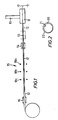
- an extruder 10 melts granular PVDF and passes it through an annular cross-head die 11 to produce a tube 12 which is cooled in a water bath 13.
- the cooled tube passes through a slow haul-off 14, a heated zone 15 (where orientation and neck-down occur) and a fast haul-off 16 which runs three to six times faster than the slow haul-off 14.
- the tube contains a conductor 17 which passes through the cross-head die 11 to an earth connection.
- the tube also passes through a corona discharge ring 18a connected to 5-150 kV and alternatively sited at position 18a before neck-down; at position 18b at neck-down or at position 18c after neck-down.
- the conductor 17 may be a mandrel so that the tube slides off resulting in an empty core or the conductor 17 may move with the tube so that the conductor 17 remains in the bore to act as an electrode.
- the corona discharge ring was a circle of tungsten wire.
- the circle had a radius of 1.25 cm and the wire had a diameter of 0.1 mm.
- the invention has been exemplified by the use of homopolymer PVDF.
- Other vinylidene fluoride polymers which can be used in the invention include copolymers or vinylidene fluoride with tetrafluorethylene and/or trifluorethylene.
- the stretching converts the crystalline regions of the polymer from crystall II into crystal form I and the poling modifies the crystal moiety to an assymetric arrangement.
- Mechanical stressing or a charge of temperature alters the charge distribution giving rise to the external effects known as “piezoelectricity” and "pyroelectricity”.
- the inner electrode was applied by running diluted conductive silver paint into the tube and contact to this electrode was made by a fine copper wire pushed into the central hole.
- the outer electrode consisted of a band of silver paint 8.9 mm long in the central portion of a tube about 40 mm long. No guard ring electrodes were used.
- a cross section through such a sample is shown in Figure 2.
- a tube with PVDF wall 20 has an electrode 21 in contact with its inner wall and an outer electrode 22 in contact with its outer wall.
- This coefficient expresses the voltage produced by forces applied to the sample.
- the piezoelectric voltage coefficient was measured by vibrating the tubes at 20 Hz under ambient conditions using a Bruel and Kjaer mini-shaker Type 4810 and monitoring both the voltage across the tube walls and the force applied to the tube.
- the force was measured by a Kistler 9203 quartz force transducer mounted in-line with the tube and feeding a Kistler 5001 charge amplifier.
- the tube voltage was measured using an Ancom 15A31 high impedance op-amp coupled with a Bryans Southern Instruments Transcribe 10 double transient signal recorder.
- the coefficient was calculated by dividing the measured voltage by the force producing it and multiplying by a shape factor.
- the units are millivolts metres per newton.
- This coefficient expresses the surface charge density produced by forces applied to the sample.
- the charge coefficient was measured and calculated in a similar manner to the voltage coefficient except that the charge developed was measured using a Kistler 5001 charge amplifier.
- the units are picocoulombs per newton.
- This coefficient expresses the surface charge density produced for unit change of temperature.
- the temperature of the sample was changed in a sinusoidal fashion at 20 mHz (ie, one cycle in 50 secs) by blowing nitrogen gas over the tube.
- the amplitude of the oscillation was 1 degree about a mean temperature of 20°C.
- the charge generated was collected by a Keithley electrometer operating in the fast feedback mode with a 10 nF capacitor in the feedback.
- the ratio of the electrometer output to the thermocouple output was measured using a Solartron 1172 frequency response analyser. This ratio is the charge divided by the temperature change which produced it. Multiplying this quotient by a shape factor gives the pyroelectric coefficient.
- the units are micro- coulombs per square metre per kelvin.
- This coefficient expresses the surface charge density produced by changes in ambient pressure.
- the sample which was used for the pyroelectric measurement was suspended from the electrode wires in a pressure vessel containing silicon oil.
- the output from the sample was measured, as before, using a Keithley electrometer but in this experiment the pressure was changed in a 'square step' fashion and the sample was subjected to six steps of magnitudes 0-3.5x10 6 Pa (0-500 psi) at one minute intervals. Each step lasted for ten seconds and an increase of about ten percent was noted in the charge generated between one and ten seconds. This is attributable to a cooling of the oil and sample after adiabatic heating which occurs on pressurisation since the pyroelectric response diminishes the charge generated by the piezoelectric response.
- the oil temperature was measured and the charge related to the change of temperature was calculated using the pyroelectric coefficient as found by the previous experiment.
- the calculated charge was added to the measured charge to give the charge attributable to the change of pressure.
- the coefficient was found by dividing the charge by the pressure causing it and multiplying by a shape factor. The units are picocoulombs per newton.
Landscapes
- Engineering & Computer Science (AREA)
- Manufacturing & Machinery (AREA)
- Shaping By String And By Release Of Stress In Plastics And The Like (AREA)
- Treatments Of Macromolecular Shaped Articles (AREA)
- Compositions Of Macromolecular Compounds (AREA)
- Manufacture Of Macromolecular Shaped Articles (AREA)
- Addition Polymer Or Copolymer, Post-Treatments, Or Chemical Modifications (AREA)
- Organic Insulating Materials (AREA)
- Manufacturing Of Electric Cables (AREA)
- Radiation Pyrometers (AREA)
- Piezo-Electric Transducers For Audible Bands (AREA)
Claims (13)
Priority Applications (1)
| Application Number | Priority Date | Filing Date | Title |
|---|---|---|---|
| AT83301213T ATE25898T1 (de) | 1982-03-18 | 1983-03-07 | Piezoelektrische und pyroelektrische folie. |
Applications Claiming Priority (2)
| Application Number | Priority Date | Filing Date | Title |
|---|---|---|---|
| GB8207921 | 1982-03-18 | ||
| GB8207921 | 1982-03-18 |
Publications (2)
| Publication Number | Publication Date |
|---|---|
| EP0089770A1 EP0089770A1 (fr) | 1983-09-28 |
| EP0089770B1 true EP0089770B1 (fr) | 1987-03-11 |
Family
ID=10529098
Family Applications (1)
| Application Number | Title | Priority Date | Filing Date |
|---|---|---|---|
| EP83301213A Expired EP0089770B1 (fr) | 1982-03-18 | 1983-03-07 | Film piezoélectrique et pyroélectrique |
Country Status (6)
| Country | Link |
|---|---|
| US (1) | US4557880A (fr) |
| EP (1) | EP0089770B1 (fr) |
| JP (1) | JPS58194908A (fr) |
| AT (1) | ATE25898T1 (fr) |
| CA (1) | CA1206277A (fr) |
| DE (1) | DE3370251D1 (fr) |
Families Citing this family (24)
| Publication number | Priority date | Publication date | Assignee | Title |
|---|---|---|---|---|
| US4623438A (en) * | 1983-11-08 | 1986-11-18 | Celanese Corporation | Electret making process using corona discharge |
| EP0146272A3 (fr) * | 1983-11-22 | 1988-03-16 | Focas Limited | Câble coaxial |
| US4629925A (en) * | 1983-11-22 | 1986-12-16 | Raychem Corporation | Piezoelectric coaxial cable |
| EP0156952A3 (fr) * | 1984-03-16 | 1986-07-02 | Pennwalt Corporation | Procédé d'étirage et appareillage pour films et tubes polymères piézoélectriques |
| CA1267216A (fr) * | 1984-07-06 | 1990-03-27 | Pravin L. Soni | Dispositif piezoelectrique |
| US4654546A (en) * | 1984-11-20 | 1987-03-31 | Kari Kirjavainen | Electromechanical film and procedure for manufacturing same |
| US4830795A (en) * | 1986-07-03 | 1989-05-16 | Rutgers, The State University Of New Jersey | Process for making polarized material |
| KR910001878B1 (ko) * | 1986-12-16 | 1991-03-28 | 가부시기가이샤 시마즈세이사구쇼 | 열센서 및 그 제조방법 |
| US5022944A (en) * | 1988-09-06 | 1991-06-11 | Hoechst Celanese Corporation | In-line extrusion coatable polyester film having an aminofunctional silane primer |
| CA2032015A1 (fr) * | 1990-12-11 | 1992-06-12 | Martin Perlman | Methode de duplication des constantes piezoelectriques et pyroelectriques des pellicules de polyfluorure de vinylidene (pvdf) |
| GB0115066D0 (en) * | 2001-06-20 | 2001-08-15 | 1 Ltd | Fabrication of a piezoelectric article |
| US7856837B2 (en) | 2002-02-10 | 2010-12-28 | Mitsubishi Denki Kabushiki Kaisha | Air conditioning equipment, fan equipment, method of reducing noise of equipment, pressure pulsation reducer for refrigeration cycle equipment, pressure pulsation reducer for pump equipment and method of reducing pressure pulsation of equipment |
| US7078101B1 (en) | 2002-11-21 | 2006-07-18 | The United States Of America As Represented By The Secretary Of The Navy | High strain electrostrictive polymer |
| JP3867709B2 (ja) * | 2003-03-26 | 2007-01-10 | ダイキン工業株式会社 | 薄膜の形成方法 |
| ATE518231T1 (de) * | 2003-03-26 | 2011-08-15 | Daikin Ind Ltd | Verfahren zur bildung eines ferroelektrischen dünnfilms |
| US20040214009A1 (en) * | 2003-04-28 | 2004-10-28 | Ebrahim Andideh | Adhesion promoting technique |
| US7922754B2 (en) * | 2005-04-18 | 2011-04-12 | Trireme Medical, Inc. | Apparatus and methods for delivering prostheses to luminal bifurcations |
| DE102010063555A1 (de) * | 2010-12-20 | 2012-06-21 | Robert Bosch Gmbh | Vorrichtung zum Senden und/oder Empfangen eines Ultraschallsignals |
| KR101539050B1 (ko) * | 2014-05-12 | 2015-07-23 | 울산대학교 산학협력단 | 강유전 고분자를 이용한 초음파 변환기 |
| US11753765B2 (en) * | 2017-09-08 | 2023-09-12 | The Johns Hopkins University | Biomimetic self-adaptable systems |
| US12225822B2 (en) * | 2017-11-30 | 2025-02-11 | Jabil Inc. | System for manufacturing piezoelectronics |
| CN110042481A (zh) * | 2019-04-26 | 2019-07-23 | 西安工程大学 | 一种连续生产压电纤维的装置及方法 |
| CN110306248A (zh) * | 2019-06-14 | 2019-10-08 | 西安工程大学 | 一种pvdf压电纤维的连续生产方法及装置 |
| TWI728569B (zh) * | 2019-11-25 | 2021-05-21 | 馗鼎奈米科技股份有限公司 | 放電極化設備 |
Family Cites Families (13)
| Publication number | Priority date | Publication date | Assignee | Title |
|---|---|---|---|---|
| US4204135A (en) * | 1970-12-02 | 1980-05-20 | Kureha Kagaku Kogyo Kabushiki Kaisha | Piezoelectric elements of organic high molecular weight materials |
| JPS4975182A (fr) * | 1972-11-20 | 1974-07-19 | ||
| US3985814A (en) * | 1975-02-28 | 1976-10-12 | Celanese Corporation | Production of alcohols from carboxylic acids |
| JPS5221189A (en) * | 1975-05-08 | 1977-02-17 | Sakamoto Shiyouten Kk | Apparatus for hangling line for fish living in deeppsea punks |
| US4056742A (en) * | 1976-04-30 | 1977-11-01 | Tibbetts Industries, Inc. | Transducer having piezoelectric film arranged with alternating curvatures |
| JPS5326995A (en) * | 1976-08-25 | 1978-03-13 | Daikin Ind Ltd | Highhmolecular piezooelectric material |
| JPS5569902A (en) * | 1978-11-21 | 1980-05-27 | Kureha Chemical Ind Co Ltd | Preparing piezoelectric* electrically scorchable film |
| DE2902545C2 (de) * | 1979-01-24 | 1985-04-04 | Akzo Gmbh, 5600 Wuppertal | Faden mit Leitschichten |
| GB2045522B (en) * | 1979-04-03 | 1983-03-16 | Standard Telephones Cables Ltd | Piezo-electric film manufacture |
| US4241128A (en) * | 1979-03-20 | 1980-12-23 | Bell Telephone Laboratories, Incorporated | Production of piezoelectric PVDF films |
| JPS55157801A (en) * | 1979-04-26 | 1980-12-08 | Rikagaku Kenkyusho | Process for producing piezooelectric current collecting high molecular film |
| GB2060994B (en) * | 1979-10-12 | 1984-01-25 | Marconi Co Ltd | Piezoelectric/pyroelectric elements |
| FR2490877A1 (fr) * | 1980-09-19 | 1982-03-26 | Thomson Csf | Procede de fabrication de films polymeres piezoelectriques |
-
1983
- 1983-03-07 AT AT83301213T patent/ATE25898T1/de not_active IP Right Cessation
- 1983-03-07 EP EP83301213A patent/EP0089770B1/fr not_active Expired
- 1983-03-07 DE DE8383301213T patent/DE3370251D1/de not_active Expired
- 1983-03-14 US US06/475,377 patent/US4557880A/en not_active Expired - Fee Related
- 1983-03-16 CA CA000423765A patent/CA1206277A/fr not_active Expired
- 1983-03-17 JP JP58045268A patent/JPS58194908A/ja active Pending
Also Published As
| Publication number | Publication date |
|---|---|
| EP0089770A1 (fr) | 1983-09-28 |
| US4557880A (en) | 1985-12-10 |
| ATE25898T1 (de) | 1987-03-15 |
| CA1206277A (fr) | 1986-06-17 |
| DE3370251D1 (en) | 1987-04-16 |
| JPS58194908A (ja) | 1983-11-14 |
Similar Documents
| Publication | Publication Date | Title |
|---|---|---|
| US4557880A (en) | Piezoelectric and pyroelectric film | |
| US4629925A (en) | Piezoelectric coaxial cable | |
| Zhou et al. | Electrical energy density and discharge characteristics of a poly (vinylidene fluoride-chlorotrifluoroethylene) copolymer | |
| US4419599A (en) | Piezoelectric transducer made from a polymer material and process for manufacturing same | |
| US4369391A (en) | Pressure-sensing transducer device having a piezoelectric polymer element and a method of fabrication of said device | |
| US4921928A (en) | Piezoelectric polymer materials from epoxy resins and polytetramethyleneoxide-di-p-aminobenzoate | |
| US4800048A (en) | Die drawing process and apparatus for piezoelectric polymer films and tubes | |
| US4390674A (en) | Uniaxially drawn vinylidene fluoride polymers | |
| Coates et al. | Die drawing: Solid phase drawing of polymers through a converging die | |
| EP0050185A1 (fr) | Appareil pour la polarisation rapide et continue d'un film polymère par effet couronne | |
| US3660549A (en) | Electrostatic pinning of dielectric film | |
| CN119773244B (zh) | 一种柔性压电超声纤维换能器及其制备方法和应用 | |
| EP0050332A1 (fr) | Procédé de polarisation par décharge couronne | |
| JPS5922378A (ja) | 圧電変換器及びその製造方法 | |
| Greaves et al. | The direct piezoelectric effect in extruded polyethylene | |
| EP0132147B1 (fr) | Fabrication de fils et câbles isolés | |
| EP0146272A2 (fr) | Câble coaxial | |
| JPS635891B2 (fr) | ||
| Honda et al. | Piezoelectricity of chiral polymeric fibers | |
| GB1599106A (en) | Manufacture of insulated wires and cables | |
| CN100411858C (zh) | 聚偏氟乙烯压电管的制备方法 | |
| JPS648476B2 (fr) | ||
| JP3451789B2 (ja) | 電気的特性値によるゴムの架橋反応進行状態の測定方法 | |
| US4918567A (en) | Moving corona discharging apparatus | |
| Stishkov et al. | Breakdown of the homogeneity of weakly conducting liquids in high electric fields |
Legal Events
| Date | Code | Title | Description |
|---|---|---|---|
| PUAI | Public reference made under article 153(3) epc to a published international application that has entered the european phase |
Free format text: ORIGINAL CODE: 0009012 |
|
| AK | Designated contracting states |
Designated state(s): AT BE CH DE FR GB IT LI LU NL SE |
|
| 17P | Request for examination filed |
Effective date: 19831013 |
|
| GRAA | (expected) grant |
Free format text: ORIGINAL CODE: 0009210 |
|
| AK | Designated contracting states |
Kind code of ref document: B1 Designated state(s): AT BE CH DE FR GB IT LI LU NL SE |
|
| REF | Corresponds to: |
Ref document number: 25898 Country of ref document: AT Date of ref document: 19870315 Kind code of ref document: T |
|
| ITF | It: translation for a ep patent filed | ||
| REG | Reference to a national code |
Ref country code: GB Ref legal event code: 732 |
|
| REF | Corresponds to: |
Ref document number: 3370251 Country of ref document: DE Date of ref document: 19870416 |
|
| ET | Fr: translation filed | ||
| BECA | Be: change of holder's address |
Free format text: 870311 *BRITISH TELECOMMUNICATIONS P.L.C.:81 NEWGATE STREET, LONDON EC1A 7AJ |
|
| BECH | Be: change of holder |
Free format text: 870311 *BRITISH TELECOMMUNICATIONS P.L.C. |
|
| PLBE | No opposition filed within time limit |
Free format text: ORIGINAL CODE: 0009261 |
|
| STAA | Information on the status of an ep patent application or granted ep patent |
Free format text: STATUS: NO OPPOSITION FILED WITHIN TIME LIMIT |
|
| 26N | No opposition filed | ||
| REG | Reference to a national code |
Ref country code: CH Ref legal event code: PUE Owner name: BRITISH TELECOMMUNICATIONS PUBLIC LIMITED COMPANY |
|
| REG | Reference to a national code |
Ref country code: FR Ref legal event code: TP |
|
| ITTA | It: last paid annual fee | ||
| PGFP | Annual fee paid to national office [announced via postgrant information from national office to epo] |
Ref country code: CH Payment date: 19940211 Year of fee payment: 12 |
|
| PGFP | Annual fee paid to national office [announced via postgrant information from national office to epo] |
Ref country code: AT Payment date: 19940214 Year of fee payment: 12 |
|
| PGFP | Annual fee paid to national office [announced via postgrant information from national office to epo] |
Ref country code: SE Payment date: 19940216 Year of fee payment: 12 |
|
| PGFP | Annual fee paid to national office [announced via postgrant information from national office to epo] |
Ref country code: BE Payment date: 19940224 Year of fee payment: 12 |
|
| PGFP | Annual fee paid to national office [announced via postgrant information from national office to epo] |
Ref country code: NL Payment date: 19940331 Year of fee payment: 12 Ref country code: LU Payment date: 19940331 Year of fee payment: 12 |
|
| ITPR | It: changes in ownership of a european patent |
Owner name: CESSIONE;BRITISH TELECOMMUNICATIONS PLC |
|
| EPTA | Lu: last paid annual fee | ||
| NLS | Nl: assignments of ep-patents |
Owner name: BRITISH TELECOMMUNICATIONS PLC TE LONDEN, GROOT-BR |
|
| EAL | Se: european patent in force in sweden |
Ref document number: 83301213.1 |
|
| PG25 | Lapsed in a contracting state [announced via postgrant information from national office to epo] |
Ref country code: LU Free format text: LAPSE BECAUSE OF NON-PAYMENT OF DUE FEES Effective date: 19950307 Ref country code: AT Effective date: 19950307 |
|
| PG25 | Lapsed in a contracting state [announced via postgrant information from national office to epo] |
Ref country code: SE Effective date: 19950308 |
|
| PG25 | Lapsed in a contracting state [announced via postgrant information from national office to epo] |
Ref country code: LI Effective date: 19950331 Ref country code: CH Effective date: 19950331 Ref country code: BE Effective date: 19950331 |
|
| BERE | Be: lapsed |
Owner name: BRITISH TELECOMMUNICATIONS P.L.C. Effective date: 19950331 |
|
| PG25 | Lapsed in a contracting state [announced via postgrant information from national office to epo] |
Ref country code: NL Effective date: 19951001 |
|
| REG | Reference to a national code |
Ref country code: CH Ref legal event code: PL |
|
| NLV4 | Nl: lapsed or anulled due to non-payment of the annual fee |
Effective date: 19951001 |
|
| EUG | Se: european patent has lapsed |
Ref document number: 83301213.1 |
|
| PGFP | Annual fee paid to national office [announced via postgrant information from national office to epo] |
Ref country code: FR Payment date: 19980209 Year of fee payment: 16 |
|
| PGFP | Annual fee paid to national office [announced via postgrant information from national office to epo] |
Ref country code: DE Payment date: 19980225 Year of fee payment: 16 |
|
| PG25 | Lapsed in a contracting state [announced via postgrant information from national office to epo] |
Ref country code: FR Free format text: LAPSE BECAUSE OF NON-PAYMENT OF DUE FEES Effective date: 19991130 |
|
| REG | Reference to a national code |
Ref country code: FR Ref legal event code: ST |
|
| PG25 | Lapsed in a contracting state [announced via postgrant information from national office to epo] |
Ref country code: DE Free format text: LAPSE BECAUSE OF NON-PAYMENT OF DUE FEES Effective date: 20000101 |
|
| PGFP | Annual fee paid to national office [announced via postgrant information from national office to epo] |
Ref country code: GB Payment date: 20000222 Year of fee payment: 18 |
|
| REG | Reference to a national code |
Ref country code: GB Ref legal event code: 732E |
|
| PG25 | Lapsed in a contracting state [announced via postgrant information from national office to epo] |
Ref country code: GB Free format text: LAPSE BECAUSE OF NON-PAYMENT OF DUE FEES Effective date: 20010307 |
|
| GBPC | Gb: european patent ceased through non-payment of renewal fee |
Effective date: 20010307 |