EP0089833A2 - Halbleiterspeicherschaltung mit einer Ladungsabsorptionsschaltung - Google Patents
Halbleiterspeicherschaltung mit einer Ladungsabsorptionsschaltung Download PDFInfo
- Publication number
- EP0089833A2 EP0089833A2 EP83301535A EP83301535A EP0089833A2 EP 0089833 A2 EP0089833 A2 EP 0089833A2 EP 83301535 A EP83301535 A EP 83301535A EP 83301535 A EP83301535 A EP 83301535A EP 0089833 A2 EP0089833 A2 EP 0089833A2
- Authority
- EP
- European Patent Office
- Prior art keywords
- transistor
- word line
- current
- hold
- circuit
- Prior art date
- Legal status (The legal status is an assumption and is not a legal conclusion. Google has not performed a legal analysis and makes no representation as to the accuracy of the status listed.)
- Granted
Links
Images



Classifications
-
- G—PHYSICS
- G11—INFORMATION STORAGE
- G11C—STATIC STORES
- G11C8/00—Arrangements for selecting an address in a digital store
- G11C8/08—Word line control circuits, e.g. drivers, boosters, pull-up circuits, pull-down circuits, precharging circuits, for word lines
-
- G—PHYSICS
- G11—INFORMATION STORAGE
- G11C—STATIC STORES
- G11C11/00—Digital stores characterised by the use of particular electric or magnetic storage elements; Storage elements therefor
- G11C11/21—Digital stores characterised by the use of particular electric or magnetic storage elements; Storage elements therefor using electric elements
- G11C11/34—Digital stores characterised by the use of particular electric or magnetic storage elements; Storage elements therefor using electric elements using semiconductor devices
- G11C11/40—Digital stores characterised by the use of particular electric or magnetic storage elements; Storage elements therefor using electric elements using semiconductor devices using transistors
- G11C11/41—Digital stores characterised by the use of particular electric or magnetic storage elements; Storage elements therefor using electric elements using semiconductor devices using transistors forming static cells with positive feedback, i.e. cells not needing refreshing or charge regeneration, e.g. bistable multivibrator or Schmitt trigger
- G11C11/413—Auxiliary circuits, e.g. for addressing, decoding, driving, writing, sensing, timing or power reduction
- G11C11/414—Auxiliary circuits, e.g. for addressing, decoding, driving, writing, sensing, timing or power reduction for memory cells of the bipolar type
- G11C11/415—Address circuits
Definitions
- the present invention especially refers to the static-type semiconductor memory circuit comprising saturation-type memory cells and incorporating delay circuits.
- the delay circuits are connected to word lines to improve both the rising and falling characteristics of the word lines and hold lines.
- the presence of such delay circuits makes it possible to achieve a high speed transition of the word lines between a selected state and a non-selected state. This results in a very short access time for the memory cells.
- time constant circuits have an advantage in that the short access time is obtained without increasing the memory cell current, that is, without increasing the power consumption.
- a semiconductor memory circuit comprising a plurality of word lines; a plurality of hold lines; a plurality of memory cells each connected to a pair of bit lines and driven by a corresponding word line and hold line; a pair of hold current sources operable always to pass a hold current through each hold line; and a common additional hold current source operable cooperating with a delay circuit, to pass or not pass an additional hold current through a hold line during its transition from a selected state to a nonselected state or during a transition from the nonselected state to the selected state of its corresponding word line, is characterised in that a charge absorbing circuit is included for each of the word lines the charge absorbing circuit being operable to absorb at least a current induced by a voltage .increase occurring in a word line soon after its switched from its selected state to its nonselected state.
- Figure 1 is a circuit diagram of a static-type semiconductor memory circuit to which the present invention is adapted.
- the symbol MC corresponds to a memory cell; WL to a word line; HL to a hold line; BL and BL to a pair of bit lines; WD to a word driver; BD to a bit line driver; I H to a hold current source; and D CR to a delay circuit.
- the delay circuits D CR exist for word lines WL.
- Each delay circuit D CR comprises: a first transistor T 1 which detects the voltage level change of the word line; a first resistor R1 and a first capacitor C 1 , together comprising a time constant circuit; and a second transistor T 2 which receives, at its base, the output from the time constant circuit (C 1 R 1 ).
- Each second transistor is connected, at its collector, to the hold line HL and, at its emitter, to a common additional hold current source ⁇ I H .
- the second transistors T 2 are commonly connected, at their emitters, to the current source ⁇ I H . Thereby, a so-called current switch is formed.
- the second transistors T 2 are commonly connected, at their bases, to a common bias current source I BS , through second resistors R 2 .
- Figure 2 depicts waveforms of signals appearing in the circuit of Fig. 1.
- Row (a) represents a change of address selection signal indicated as X 0 through X in Fig. 1. The address change occurs at time tl.
- Row (b) represents a change of the word line voltage level V W , which occurs at time t2 close to tl.
- Row (c) represents a change of the hold line voltage level V H , which follows immediately after the time t2.
- Row (d) represents a change of the additional hold current ⁇ i h absorbed by the additional hold current source ⁇ I H flowing through the conductive second transistor T 2 , which occurs at time t3 with a delay of time At after the time t2 due to the presence of the time constant circuit.
- the symbol "S” indicates a selection state and "NS" a nonselection state.
- the additional hold current ⁇ i h does not start flowing through the hold line HL until the word line voltage level V W completely rises to its saturation level. This means that the word line is allowed to carry a relatively light load during the transition from the nonselection state to the selection state.
- the additional hold current ⁇ i h continues flowing through the hold line for a while (At) even after the word driver WD stops supplying a current due to the address change. Consequently, the change of the word line voltage level, that is, the transition from the selection state to the nonselection state and vice versa, is completed very quickly.
- the current ⁇ i h is also stopped very quickly. This is because the current ⁇ i h is produced by the current switch comprised of the second transistor T 2 and the current source ⁇ I H , which current switch operates usually with high gain.
- the current switch comprised of the second transistor T 2 and the current source ⁇ I H , which current switch operates usually with high gain.
- Such undesired voltage increases ⁇ V and ⁇ V' result in double selection of the word lines.
- Figure 3 is a circuit diagram of a typical saturation-type memory cell. ' In Fig. 3, members the same as those of Fig. 1 are represented by the same reference symbols (same for later figures).
- Reference symbols T 3 and T 4 represent load transistors of the pnp type.
- Reference symbols T 5 and T 6 represent driver transistors of the npn and multiemitter type. Assuming that the transistors of the transistor T 6 side are now conductive, the current ⁇ i h for the current source ⁇ I H of Fig.
- the voltage increase ⁇ V ( ⁇ V') induces, in the worst case, undesired double selection between one word line which is going to be changed from the selection state to the nonselection state and another word line which is going to be changed from the nonselection state to the selection state. Even if such a worst case is not created, deterioration of the write operation characteristic may occur, because an undesired branching of the write current takes place in the two word lines interchanging the selection and nonselection states therebetween.
- FIG 4 is a circuit diagram of a part of the semiconductor memory circuit cooperating with a charge absorbing circuit according to a first embodiment of the present invention.
- the first embodiment is illustrated as a charge absorbing circuit CA 1 which is simply constructed by a third resistor R 3 .
- the resistor R 3 is connected, at one end, to the word line WL, while it receives, at the other end, a first constant voltage V 1 .
- the level of the voltage V 1 is set to the same voltage level as the word line appearing in the nonselection state. Accordingly, the current i, due to the traveling surplus charges, is absorbed by a voltage difference across the resistor R 3 identical to the voltage ⁇ V. At the same time, the voltage increase ⁇ V can be suppressed by the discharge of the current i. In other words, the impedance of the word line WL is lowered by the resistor R 3 .
- Transistors T 7 and T 8 receive, at their bases, a second constant voltage V 2 so as to form the common additional hold current source ⁇ I H producing the current ⁇ i h and the common bias current source I BS producing the current i bs , respectively, both shown in Fig. 1.
- FIG. 5 is a circuit diagram of a part of the semiconductor memory circuit cooperating with a charge absorbing circuit according to a second embodiment of the present invention.
- the second embodiment is illustrated as a charge absorbing circuit CA 2 which utilizes a current source ⁇ I.
- the current flowing through the source ⁇ I is not constant, but variable in accordance with the variation of the word line voltage V W . Therefore, when the voltage V w rises along with the voltage increase of ⁇ V, the current i, due to the traveling surplus charges, can immediately be absorbed by the source ⁇ I. Thus, the voltage increase' ⁇ V can be suppressed.
- FIG. 6 is a detailed circuit diagram of one example of the current source ⁇ I shown in Fig. 5.
- the current source ⁇ I is comprised at least of a transistor T i , a diode D i , and a resistor R . .
- the diode D i functions as a level shifter.
- the base voltage of the word driver WD is the low level and, accordingly, the base voltage of the transistor T i is the low level.
- the word line voltage V W rises with the voltage increase of ⁇ V. Then, the transistor T i is fully turned on, so that the current i can be absorbed into a voltage source of V 3 .
- FIG. 7A is a circuit diagram of a part of the semiconductor memory circuit cooperating with a charge absorbing circuit according to a third embodiment of the present invention.
- the third embodiment is illustrated as a charge absorbing circuit CA 3 .
- Transistor T 9 of the npn type is connected at its collector to the word line WL and at its base to the hold line HL. The emitter thereof receives the first constant voltage V 1 via a fourth resistor R 4 . Since, as previously mentioned, the hold line voltage V H increases along with the increase of the word line voltage V W , the transistor T 9 is turned on when the voltage increase ⁇ V takes place. Thus, the voltage V W is increased. At this time, the current i can be absorbed toward the voltage source of V 1 through the transistor T 9 , now on.
- FIG. 7B is a circuit diagram of a modification of the charge absorbing circuit CA 3 in Fig. 7A.
- the modified example is illustrated as a charge absorbing circuit CA 3 ' comprised of a resistor R 4 ' and a transistor T 9 ' of the pnp type, opposite to that of the transistor T 9 .
- the collector of the transistor T 9 ' is a negative constant voltage source or a constant voltage source of V 3 , as is the transistor T of Fig. 6.
- the emitter thereof is connected to the word line WL.
- the base thereof is not connected to the hold line HL, as in the circuit of Fig. 7A, but receives the first constant voltage V 1 . If the word line voltage V w rises with the voltage increase ⁇ V, the transistor T 9 ' is turned on. Then the current i starts flowing through the transistor T 9 ', now conductive.
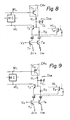
- FIG 8 is a circuit diagram of a part of the semiconductor memory circuit cooperating with a charge absorbing circuit according to a fourth embodiment of the present invention.
- the fourth embodiment utilizes a transistor having a low current amplification factor ⁇ as a charge absorbing circuit.
- the base is connected to the word line WL, while the emitter may be connected to an appropriate current source.
- the transistor When the transistor is turned on, a relatively large base current flows from the word line WL to its emitter, becuase it has a low current amplification factor ⁇ . Therefore, the transistor has sufficient capability for absorbing the current i induced by the voltage increase ⁇ V from the word line, and, thereby, the charge absorbing circuit can be realized.
- such a charge absorbing circuit is referenced by the symbol CA 4 and is preferably constructed as common to the aforesaid first transistor T 1 .
- a first transistor T 11 of low current amplification is used as both the first transistor T 1 and the charge absorbing circuit CA 4 .
- Such a low current amplification transistor can be fabricated in such a manner as to form a deep base diffusion region during the production process of the semiconductor memory device.
- Figure 9 is a circuit diagram of a part of the semiconductor memory circuit cooperating with a charge absorbing circuit according to a fifth embodiment of the present invention.
- the basic concept behind the fifth embodiment is the same as that of the above-mentioned fourth embodiment.
- the embodiments differ in that a transistor corresponding to the first transistor T 11 of Fig. 8 is realized in the fifth embodiment by an inverse transistor. That is, in Fig. 9, the charge absorbing circuit CA 5 of the fifth embodiment is comprised of the inverse transistor T 12 .
- the term "inverse transistor" means that a region which would usually act as an emitter is used inversely as a collector, and, similarly, a region which would usually act as a collector is used inversely as an emitter.
- Such an inversion between the emitter and collector is easily achieved merely by interchanging conductors during the production process of the semiconductor memory device. That is, a first conductor which would usually be connected to the emitter region is inversely connected to the collector region, and, similarly, a second conductor which would usually be connected to the collector region is inversely connected to the emitter region.
- the lower injection efficiency is due to the fact that the inverse transistor can no longer function as a drift transistor. This is because an electric field, which is oriented opposite to that of the drift transistor, is applied onto a transition path of electrons traveling from a usual collector region to a usual emitter.
- T he.lower collection efficiency is that electrons traveling from the usual collector region toward the usual emitter region partly leak into the base region, because the usual collector region has a wider area than the usual emitter region.
- the transistor T 12 has sufficient capability for absorbing the current i induced by the voltage increase ⁇ V from the word line WL, and, thereby, the charge absorbing circuit CA 5 can be realized, which is preferably constructed as common to the first transistor T 1 .
- a first transistor T 12 of low current amplification is used as both the first transistor T 1 and the charge absorbing circuit CA S .
- the charge absorbing circuit of each embodiment absorbs not only the current i to be suppressed, but also a charge current to be supplied to the word line during the transition from the nonselection state to the selection state. In this case, it would be preferable to absorb only the current i selectively and not the charge current, because, the charge current itself must not be drawn from the word line WL. If the charge current is unnecessarily drawn therefrom, it may cause increased power consumption in the device. However, it is important to know that such an increased power consumption is negligible. This is because the related charge current flows, at all times, into only the one selected word line, among the many word lines, from the selected word driver.
- FIG 10 is a circuit diagram of a part of the semiconductor memory circuit cooperating with a charge absorbing circuit according to a sixth embodiment of the present invention.
- the sixth embodiment is illustrated as a charge absorbing circuit CA 6 which can absorb the current i only.
- each pair of transistor and resistor such as T 101 - R 101 , T 102 - R 102 , T 103 - R 103 , forms a constant current source.
- Symbol V denotes a voltage for activating these constant current sources.
- Transistors T 104 and T 105 together with resistors R 105 and R 106 , form a flip-flop.
- V 2 ' denotes a voltage having substantially the same level as the second constant voltage V 2 , but a slightly higher level than V 2 by the value of V F , which is a forward voltage of a diode D 100 .
- the transistor T 105 and a transistor T 107 form emitter-coupled transistors. The operation is as follows. During the selection state, the base voltage of the transistor T 107 becomes higher than that of the transistor T 105 . Therefore, the transistor T 105 is turned off, while, inversely, the transistor T 104 is turned on, since they perform a flip flop operation. The transistor T 106 is then turned on due to a voltage drop across the resistor R 105 induced by the conductive transistor T 104 .
- a current produced by the conductive transistor T 106 flows toward the voltage source of V 2 ' through a resistor R 104 .
- This current creates a voltage drop across the resistor R 104 , and, thereby, the voltage level at the upper end of the resistor R 104 becomes higher than the voltage level of V 2 ' by the amount of the voltage drop.
- the diode D 100 is changed to a cut-off state now, and, thereby, no current flows from the word line WL to the voltage source of V 2 '.
- the base voltage of the transistor T 107 becomes lower than that of the transistor T105. Therefore, the transistor T 105 is turned on, while, inversely, the transistor T 104 is turned off, since they perform a flip flop operation. Since the transistor T 104 is turned off, the transistor T 106 is then turned off due to no voltage drop across the resistor R 105 . Therefore, a current which would be produced by the conductive transistor T 106 stops flowing toward the voltage source of V 2 ' through a resistor R104. This current stop does not create a voltage drop across the resistor R 104 . Therefore, the voltage level at the upper end of the resistor R 104 becomes the same as the voltage level of V2'.
- the diode D 100 is not fully in the cut-off state, but is liable to change into the conductive state if a slight voltage is induced in the word line WL. Under such circumstances, if the voltage increase ⁇ V occurs in the word line WL, the diode D 100 is necessarily made conductive. Thus, the current i is absorbed by the voltage source of V 2 '. In the present state, since the voltage level of V 2 ' is preset to be higher than the voltage level'of V 2 by the value of V F , for example 400 mV, i.e., the diode D 100 is fully biased reversely, no current is drawn from the word line WL so long as the word line voltage is maintained at its nominal level, i.e., V 2 . In conclusion, only the current i is drawn from the word line only during the nonselection state.
Landscapes
- Engineering & Computer Science (AREA)
- Microelectronics & Electronic Packaging (AREA)
- Computer Hardware Design (AREA)
- Static Random-Access Memory (AREA)
Applications Claiming Priority (4)
| Application Number | Priority Date | Filing Date | Title |
|---|---|---|---|
| JP57043978A JPS58161196A (ja) | 1982-03-19 | 1982-03-19 | 半導体記憶装置 |
| JP43978/82 | 1982-03-19 | ||
| JP57166711A JPS5956288A (ja) | 1982-09-27 | 1982-09-27 | 半導体メモリ |
| JP166711/82 | 1982-09-27 |
Publications (3)
| Publication Number | Publication Date |
|---|---|
| EP0089833A2 true EP0089833A2 (de) | 1983-09-28 |
| EP0089833A3 EP0089833A3 (en) | 1986-05-14 |
| EP0089833B1 EP0089833B1 (de) | 1989-01-11 |
Family
ID=26383816
Family Applications (1)
| Application Number | Title | Priority Date | Filing Date |
|---|---|---|---|
| EP83301535A Expired EP0089833B1 (de) | 1982-03-19 | 1983-03-18 | Halbleiterspeicherschaltung mit einer Ladungsabsorptionsschaltung |
Country Status (4)
| Country | Link |
|---|---|
| US (1) | US4601014A (de) |
| EP (1) | EP0089833B1 (de) |
| DE (1) | DE3378936D1 (de) |
| IE (1) | IE54937B1 (de) |
Families Citing this family (6)
| Publication number | Priority date | Publication date | Assignee | Title |
|---|---|---|---|---|
| US4730277A (en) * | 1985-12-16 | 1988-03-08 | Motorola, Inc. | Circuit for biasing row of memory cells |
| US4769785A (en) * | 1986-06-02 | 1988-09-06 | Advanced Micro Devices, Inc. | Writing speed of SCR-based memory cells |
| US5278795A (en) * | 1987-03-27 | 1994-01-11 | U.S. Philips Corporation | Memory circuit having a line decoder with a Darlington-type switching stage and a discharge current source |
| JP2583606B2 (ja) * | 1989-05-16 | 1997-02-19 | 富士通株式会社 | センスアンプ回路 |
| JPH03250494A (ja) * | 1990-02-27 | 1991-11-08 | Ricoh Co Ltd | 半導体記憶装置 |
| JPH0442495A (ja) * | 1990-06-07 | 1992-02-13 | Mitsubishi Electric Corp | 半導体記憶装置 |
Family Cites Families (8)
| Publication number | Priority date | Publication date | Assignee | Title |
|---|---|---|---|---|
| JPS6023434B2 (ja) * | 1978-05-17 | 1985-06-07 | 株式会社日立製作所 | メモリ回路 |
| JPS5637884A (en) * | 1979-08-30 | 1981-04-11 | Fujitsu Ltd | Terminating circuit for word selective signal line of semiconductor memory unit |
| JPS6047671B2 (ja) * | 1980-03-06 | 1985-10-23 | 日本電信電話株式会社 | 連想メモリ |
| JPS5788591A (en) * | 1980-11-21 | 1982-06-02 | Nippon Telegr & Teleph Corp <Ntt> | Semiconductor storage circuit device |
| US4393476A (en) * | 1981-07-13 | 1983-07-12 | Fairchild Camera & Instrument Corp. | Random access memory dual word line recovery circuitry |
| US4477885A (en) * | 1982-01-18 | 1984-10-16 | Fairchild Camera & Instrument Corporation | Current dump circuit for bipolar random access memories |
| JPS58147882A (ja) * | 1982-02-27 | 1983-09-02 | Fujitsu Ltd | 半導体記憶装置のワ−ド線放電回路 |
| US4488263A (en) * | 1982-03-29 | 1984-12-11 | Fairchild Camera & Instrument Corp. | Bypass circuit for word line cell discharge current |
-
1983
- 1983-03-17 US US06/476,263 patent/US4601014A/en not_active Expired - Fee Related
- 1983-03-18 DE DE8383301535T patent/DE3378936D1/de not_active Expired
- 1983-03-18 EP EP83301535A patent/EP0089833B1/de not_active Expired
- 1983-03-21 IE IE610/83A patent/IE54937B1/en not_active IP Right Cessation
Also Published As
| Publication number | Publication date |
|---|---|
| US4601014A (en) | 1986-07-15 |
| IE54937B1 (en) | 1990-03-28 |
| IE830610L (en) | 1983-09-19 |
| DE3378936D1 (en) | 1989-02-16 |
| EP0089833A3 (en) | 1986-05-14 |
| EP0089833B1 (de) | 1989-01-11 |
Similar Documents
| Publication | Publication Date | Title |
|---|---|---|
| US4090254A (en) | Charge injector transistor memory | |
| US4369502A (en) | Semiconductor memory circuit | |
| US4459686A (en) | Semiconductor device | |
| EP0053504B1 (de) | Statischer Halbleiterspeicher | |
| EP0025316A2 (de) | Abschlussschaltung für Wortleitungen für eine Halbleiterspeichervorrichtung | |
| US4601014A (en) | Semiconductor memory with word line charge absorbing circuit | |
| US4611303A (en) | Word-line discharging circuit in a static-type semiconductor memory device | |
| US4520462A (en) | Semiconductor memory device | |
| US4488261A (en) | Field programmable device | |
| US4706222A (en) | Darlington type switching stage for a line decoder of a memory | |
| US4272811A (en) | Write and read control circuit for semiconductor memories | |
| EP0121423B1 (de) | Wortleitungsentladung in statischen Halbleiterspeichern | |
| US4456979A (en) | Static semiconductor memory device | |
| US4922455A (en) | Memory cell with active device for saturation capacitance discharge prior to writing | |
| US4697251A (en) | Bipolar RAM cell | |
| EP0252780B1 (de) | Speicherzelle mit variabler Klemmschaltung | |
| JPH0787038B2 (ja) | ワード・ライン駆動回路 | |
| US4899311A (en) | Clamping sense amplifier for bipolar ram | |
| EP0107912B1 (de) | Halbleiterspeicheranordnung | |
| EP0080351B1 (de) | Multiemittertransistoren in Halbleiterspeicherelementen | |
| US4701882A (en) | Bipolar RAM cell | |
| US5299167A (en) | Bipolar ram apparatus | |
| KR0148580B1 (ko) | 반도체 메모리 및 반도체 메모리셀 | |
| JPS58161196A (ja) | 半導体記憶装置 | |
| JPS6255235B2 (de) |
Legal Events
| Date | Code | Title | Description |
|---|---|---|---|
| PUAI | Public reference made under article 153(3) epc to a published international application that has entered the european phase |
Free format text: ORIGINAL CODE: 0009012 |
|
| AK | Designated contracting states |
Designated state(s): DE FR GB |
|
| PUAL | Search report despatched |
Free format text: ORIGINAL CODE: 0009013 |
|
| AK | Designated contracting states |
Kind code of ref document: A3 Designated state(s): DE FR GB |
|
| 17P | Request for examination filed |
Effective date: 19860819 |
|
| 17Q | First examination report despatched |
Effective date: 19870724 |
|
| GRAA | (expected) grant |
Free format text: ORIGINAL CODE: 0009210 |
|
| AK | Designated contracting states |
Kind code of ref document: B1 Designated state(s): DE FR GB |
|
| REF | Corresponds to: |
Ref document number: 3378936 Country of ref document: DE Date of ref document: 19890216 |
|
| ET | Fr: translation filed | ||
| PLBE | No opposition filed within time limit |
Free format text: ORIGINAL CODE: 0009261 |
|
| STAA | Information on the status of an ep patent application or granted ep patent |
Free format text: STATUS: NO OPPOSITION FILED WITHIN TIME LIMIT |
|
| 26N | No opposition filed | ||
| PGFP | Annual fee paid to national office [announced via postgrant information from national office to epo] |
Ref country code: GB Payment date: 19930308 Year of fee payment: 11 |
|
| PGFP | Annual fee paid to national office [announced via postgrant information from national office to epo] |
Ref country code: FR Payment date: 19930330 Year of fee payment: 11 |
|
| PGFP | Annual fee paid to national office [announced via postgrant information from national office to epo] |
Ref country code: DE Payment date: 19930521 Year of fee payment: 11 |
|
| PG25 | Lapsed in a contracting state [announced via postgrant information from national office to epo] |
Ref country code: GB Effective date: 19940318 |
|
| GBPC | Gb: european patent ceased through non-payment of renewal fee |
Effective date: 19940318 |
|
| PG25 | Lapsed in a contracting state [announced via postgrant information from national office to epo] |
Ref country code: FR Effective date: 19941130 |
|
| PG25 | Lapsed in a contracting state [announced via postgrant information from national office to epo] |
Ref country code: DE Effective date: 19941201 |
|
| REG | Reference to a national code |
Ref country code: FR Ref legal event code: ST |