EP0090682A2 - Wärmebehandlungsverfahren und Vorrichtung zum Herstellen gebrauchsfertiger Stangen aus legierten Stählen - Google Patents
Wärmebehandlungsverfahren und Vorrichtung zum Herstellen gebrauchsfertiger Stangen aus legierten Stählen Download PDFInfo
- Publication number
- EP0090682A2 EP0090682A2 EP83400378A EP83400378A EP0090682A2 EP 0090682 A2 EP0090682 A2 EP 0090682A2 EP 83400378 A EP83400378 A EP 83400378A EP 83400378 A EP83400378 A EP 83400378A EP 0090682 A2 EP0090682 A2 EP 0090682A2
- Authority
- EP
- European Patent Office
- Prior art keywords
- bar
- cooling
- forced cooling
- transformation
- cooler
- Prior art date
- Legal status (The legal status is an assumption and is not a legal conclusion. Google has not performed a legal analysis and makes no representation as to the accuracy of the status listed.)
- Granted
Links
Images



Classifications
-
- C—CHEMISTRY; METALLURGY
- C21—METALLURGY OF IRON
- C21D—MODIFYING THE PHYSICAL STRUCTURE OF FERROUS METALS; GENERAL DEVICES FOR HEAT TREATMENT OF FERROUS OR NON-FERROUS METALS OR ALLOYS; MAKING METAL MALLEABLE, e.g. BY DECARBURISATION OR TEMPERING
- C21D1/00—General methods or devices for heat treatment, e.g. annealing, hardening, quenching or tempering
- C21D1/62—Quenching devices
-
- C—CHEMISTRY; METALLURGY
- C21—METALLURGY OF IRON
- C21D—MODIFYING THE PHYSICAL STRUCTURE OF FERROUS METALS; GENERAL DEVICES FOR HEAT TREATMENT OF FERROUS OR NON-FERROUS METALS OR ALLOYS; MAKING METAL MALLEABLE, e.g. BY DECARBURISATION OR TEMPERING
- C21D1/00—General methods or devices for heat treatment, e.g. annealing, hardening, quenching or tempering
- C21D1/02—Hardening articles or materials formed by forging or rolling, with no further heating beyond that required for the formation
-
- C—CHEMISTRY; METALLURGY
- C21—METALLURGY OF IRON
- C21D—MODIFYING THE PHYSICAL STRUCTURE OF FERROUS METALS; GENERAL DEVICES FOR HEAT TREATMENT OF FERROUS OR NON-FERROUS METALS OR ALLOYS; MAKING METAL MALLEABLE, e.g. BY DECARBURISATION OR TEMPERING
- C21D1/00—General methods or devices for heat treatment, e.g. annealing, hardening, quenching or tempering
- C21D1/18—Hardening; Quenching with or without subsequent tempering
- C21D1/19—Hardening; Quenching with or without subsequent tempering by interrupted quenching
Definitions
- the invention relates to the field of heat treatment of metal bars at the end of rolling and more particularly relates to the direct production of quenching structures (bainite, martensite) in the useful part of steel bars, intended in particular for mechanical construction. .
- the steel industry currently delivers alloy steels with improved machinability which, in the quenched and tempered state, have machinability comparable to that of conventional steels of the same composition but in the annealed state. Consequently, the possibility of machining certain parts from bars having the final characteristics of use is of considerable economic interest, in particular due to the elimination of annealing for machining on a blank, of the quenching and tempering treatment for the user, or resuming machining by rectification.
- Direct quenching in a swimming pool of water would, for its part, be insufficiently rapid for the largest diameters and would risk leading to bending of the bar (due to the asymmetries of treatment), or to curls (due to the setting in tension of the fragile peripheral layer of martensite during the swelling linked to the subsequent transformation of the heart).
- the object of the invention is to obtain, without bending or taping, quenching structures in the section of ready-to-use rolled alloy steel bars having large diameters.
- the invention also relates to an installation for setting up work or process comprising, for the severe forced cooling of step a), one or more boxes with a blade of water traversed by the moving product and in which the circulation of the product and the blade of water are collinear.
- the installation comprises, for the more moderate forced cooling of step c), oscillating booms with water spraying, or a swimming pool of water or oil.
- the installation comprises, for the thermal homogenization of step b), an air cooler with displacement with "no pilgrim” on which transit the bars arranged parallel to each other.
- FIG. 1 shows, by way of example only intended to better understand the technical field of the invention, a diagram, of common use in heat treatments.
- mi q ues which represents on a temperature-time graph, the different micrographic constituents resulting, according to the cooling laws considered, from the transformation ⁇ ⁇ ⁇ ce of the austenite austenite identified 1.
- fast cooling laws lead to the instantaneous formation of martensite 2 as soon as the temperature of the metal drops below the temperature Ms of the steel (310 ° C. in the example chosen).
- very slow cooling laws lead to the formation of ferrite 3 and perlite 4 at temperatures above 6 ° C. O C.
- intermediate cooling laws lead to the formation of bainite 5 and a volume fraction all the more important for martensite as the end of cooling is accelerated.
- step c) is therefore deleted.
- the operating methods of the pre-described installation depend, at each cooling step, on the bar diameter considered, the exit speed of the rolling mill, the quenchability of the steel grade considered and the desired structures to heart bars.
- the necessary cooling times have been seen depending on the diameter of the bars for a heat exchange coefficient of the quenching device of the order of 10 4 W / m 2. ° C. Knowing the exit speeds in rolling and the temperatures at the end of rolling, we can deduce the necessary quenching lengths.
- the cooling mode will be all the more severe the larger the bar diameter and the kinetics of transformation into a higher bainite (importance of the quenchability of steel considered between 600 and 300 ° C). In all cases, as has already been specified, it is undesirable to continue this cooling phase below 250 ° C. (core temperature).
- a limiting case is that where the speed of travel of the bar and the hardenability of the grade considered allows the following evolution of the average temperature of the section: end of rolling around 900 ° C., crossing of a first box with blade d from 900 to 600 ° C, natural cooling in 1 to 2 minutes, passing through a second box with a blade of water from 600 to 400-300 ° C before final tempering.
- Another borderline case is that where, pearlitic structures at the core being admitted, the 2nd and 3rd stages are these natural air coolings on a conventional cooler.
- the bar 20 leaves the last stand of the rolling mill 21 to enter one or two boxes 22 with circulation of a water blade of the type described in French patent application No. 79/14383.
- This bar is extracted at regular speed from the water boxes using the extractors 23, then slowed down to a stop on a line of braking rollers 24.
- a tilting device 25 allows the bar to be placed on a cooler 29 with movable beams performing a movement in "no pilgrim" to ensure the bar a slow translation and rotation on itself.
- the cooler 29 has three zones, marked 26, 27 and 28a. Zone 26 corresponds to the natural cooling of step b) according to the invention.
- Zone 27 is a natural cooling of evacuation of the bars after the forced cooling phase ensured in zone 28a, but we can possibly start the final income from this zone 27.
- zone 28a corresponds to forced cooling of the step c) according to the invention. This cooling is, in this example, ensured by water spraying ramps parallel to the bars and driven in a longitudinal movement back and forth sufficient for the treatment to be uniform along the bars.
- FIG. 3 corresponds very exactly to the description of FIG. 2, with the exception of the forced cooling of step c) which is carried out at 28b by progressive immersion in a pool of water or oil.
- An advantageous device of inclined planes not shown allows the progressive introduction and extraction of the bars.
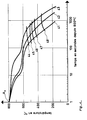
- Figure 5 corresponds to the same representations as Figure 4, but with a 3rd cooling step according to the invention (step c) characterized by a heat exchange coefficient of 10 3 W / m 2. ° C.
- the bainitic transformation conditions were carried out substantially from the heart to ⁇ ⁇ 4 mm from the skin, the annular peripheral layer being made of 15 self-returning martensite.
- a subsequent tempering of one hour at 500 ° C. on this bar made it possible to obtain a roughly uniform mechanical resistance throughout the section and close to 1000 N / mm 2 .
- the Charpy V resilience measured at the core of the bar was only 40 J / cm 2 at room temperature.
- ° C we follow, at the heart of a ⁇ 60 mm bar, the law 41 of the fioure 5.
- almost three-quarters of the core transformation takes place below 400 ° C with almost 50% martensite.
- an hour's income at 600 ° C. made it possible to obtain a resistance of the order of 1000 N / mm 2 and a Charpy V resilience to the ambient greater than 60 J / cm 2 .
- the method according to the invention allows a great flexibility of treatment according to the diameter of the bars to be treated and the level of mechanical characteristics desired. It also makes it possible to minimize the use of addition elements in steel by lending itself well, in its most general version, to the implementation of economic nuances having only a "pearlitic nose" (duration d incubation of the transformation ⁇ ⁇ ⁇ around 600 ° C) relatively clear and a slow transformation kinetics in the field of upper bainite (shades with Mn-R, etc ).
- the process according to the invention also lends itself well to the recovery of rolling operations completed at low temperature (around 850 ° C.), which make it possible to keep a hardened austenite which is not recrystallized at the time of the transformation ⁇ ⁇ ⁇ .
- the inheritance of the crystalline defects of the hardened austenite will be all the more interesting that one will pass quickly to temperatures where the restoration of austenite is difficult, then to final structures of hardening.
Landscapes
- Chemical & Material Sciences (AREA)
- Engineering & Computer Science (AREA)
- Materials Engineering (AREA)
- Thermal Sciences (AREA)
- Crystallography & Structural Chemistry (AREA)
- Mechanical Engineering (AREA)
- Physics & Mathematics (AREA)
- Metallurgy (AREA)
- Organic Chemistry (AREA)
- Heat Treatment Of Articles (AREA)
- Heat Treatment Of Strip Materials And Filament Materials (AREA)
- Heat Treatments In General, Especially Conveying And Cooling (AREA)
- Heat Treatment Of Steel (AREA)
- Solid-Phase Diffusion Into Metallic Material Surfaces (AREA)
- Coating With Molten Metal (AREA)
Priority Applications (1)
| Application Number | Priority Date | Filing Date | Title |
|---|---|---|---|
| AT83400378T ATE62278T1 (de) | 1982-03-03 | 1983-02-24 | Waermebehandlungsverfahren und vorrichtung zum herstellen gebrauchsfertiger stangen aus legierten staehlen. |
Applications Claiming Priority (2)
| Application Number | Priority Date | Filing Date | Title |
|---|---|---|---|
| FR8203659 | 1982-03-03 | ||
| FR8203659A FR2522688B1 (fr) | 1982-03-03 | 1982-03-03 | Procede et installation de traitement thermique de barres en acier allie pretes a l'emploi, notamment pour la construction mecanique |
Publications (3)
| Publication Number | Publication Date |
|---|---|
| EP0090682A2 true EP0090682A2 (de) | 1983-10-05 |
| EP0090682A3 EP0090682A3 (en) | 1987-09-02 |
| EP0090682B1 EP0090682B1 (de) | 1991-04-03 |
Family
ID=9271614
Family Applications (1)
| Application Number | Title | Priority Date | Filing Date |
|---|---|---|---|
| EP83400378A Expired - Lifetime EP0090682B1 (de) | 1982-03-03 | 1983-02-24 | Wärmebehandlungsverfahren und Vorrichtung zum Herstellen gebrauchsfertiger Stangen aus legierten Stählen |
Country Status (7)
| Country | Link |
|---|---|
| EP (1) | EP0090682B1 (de) |
| JP (1) | JPS58189328A (de) |
| AT (1) | ATE62278T1 (de) |
| BE (1) | BE896021A (de) |
| DE (1) | DE3382237D1 (de) |
| FR (1) | FR2522688B1 (de) |
| LU (1) | LU84666A1 (de) |
Cited By (1)
| Publication number | Priority date | Publication date | Assignee | Title |
|---|---|---|---|---|
| EP0418506A1 (de) * | 1989-08-18 | 1991-03-27 | Sms Schloemann-Siemag Aktiengesellschaft | Verfahren zum Härten von Stahl mit Hilfe flüssiger Kühlmedien |
Families Citing this family (2)
| Publication number | Priority date | Publication date | Assignee | Title |
|---|---|---|---|---|
| CN105400945B (zh) * | 2015-12-17 | 2018-02-16 | 北京科技大学 | 一种大直径斜轧球磨钢球热处理系统 |
| CN105385831B (zh) * | 2015-12-17 | 2018-02-16 | 北京科技大学 | 一种斜轧球磨钢球余热利用热处理装置 |
Family Cites Families (6)
| Publication number | Priority date | Publication date | Assignee | Title |
|---|---|---|---|---|
| DD84615A (de) * | ||||
| DE925527C (de) * | 1941-07-30 | 1955-03-24 | Oberhuetten Vereinigte Obersch | Verfahren und Vorrichtung zum Haerten und Vergueten von gewalzten Gegenstaenden |
| DD112144A1 (de) * | 1974-06-12 | 1975-03-20 | ||
| DD119270B1 (de) * | 1975-04-02 | 1987-10-14 | Florin Stahl Walzwerk | Verfahren zur herstellung von walzstahlerzeugnissen mit entfestigter randzone und hochfestem kern |
| FR2457724A1 (fr) * | 1979-06-01 | 1980-12-26 | Siderurgie Fse Inst Rech | Dispositif de refroidissement de produits longs lamines en defilement |
| FR2488279A1 (fr) * | 1980-08-08 | 1982-02-12 | Siderurgie Fse Inst Rech | Traitement par refroidissement accelere de barres en acier dans la chaude de laminage |
-
1982
- 1982-03-03 FR FR8203659A patent/FR2522688B1/fr not_active Expired - Lifetime
-
1983
- 1983-02-24 DE DE8383400378T patent/DE3382237D1/de not_active Expired - Lifetime
- 1983-02-24 EP EP83400378A patent/EP0090682B1/de not_active Expired - Lifetime
- 1983-02-24 AT AT83400378T patent/ATE62278T1/de active
- 1983-02-24 BE BE6/47786A patent/BE896021A/fr not_active IP Right Cessation
- 1983-02-25 LU LU84666A patent/LU84666A1/fr unknown
- 1983-03-03 JP JP58035216A patent/JPS58189328A/ja active Granted
Cited By (1)
| Publication number | Priority date | Publication date | Assignee | Title |
|---|---|---|---|---|
| EP0418506A1 (de) * | 1989-08-18 | 1991-03-27 | Sms Schloemann-Siemag Aktiengesellschaft | Verfahren zum Härten von Stahl mit Hilfe flüssiger Kühlmedien |
Also Published As
| Publication number | Publication date |
|---|---|
| FR2522688B1 (fr) | 1990-09-14 |
| ATE62278T1 (de) | 1991-04-15 |
| EP0090682B1 (de) | 1991-04-03 |
| JPS58189328A (ja) | 1983-11-05 |
| EP0090682A3 (en) | 1987-09-02 |
| BE896021A (fr) | 1983-06-16 |
| DE3382237D1 (de) | 1991-05-08 |
| JPH0335363B2 (de) | 1991-05-28 |
| FR2522688A1 (fr) | 1983-09-09 |
| LU84666A1 (fr) | 1983-09-08 |
Similar Documents
| Publication | Publication Date | Title |
|---|---|---|
| CA2314830C (fr) | Procede de fabrication de bandes minces en acier de type "trip", et bandes minces ainsi obtenues | |
| CA3022115A1 (fr) | Procede de fabrication d'une piece en acier inoxydable martensitique a partir d'une tole | |
| EP1427866B1 (de) | Verfahren zur herstellung von geschweissten röhren und dadurch hergestelltes rohr | |
| FR2796083A1 (fr) | Procede de fabrication de bandes en alliage fer-carbone-manganese, et bandes ainsi produites | |
| FR2495639A1 (fr) | Procede ameliore de traitement thermique des aciers utilisant un chauffage electrique direct par resistance et produits en acier obtenus par ce procede | |
| EP2957643A1 (de) | Stahl für mechanische werkstücke mit hochwertigen eigenschaften und oberflächenbehandlung, und mechanische werkstücke aus diesem stahl und ihr herstellungsverfahren | |
| EP0246986B1 (de) | Verfahren zur Herstellung von Bändern aus teilweise rekristallisiertem Zircaloy 2 oder Zircaloy 4 und nach diesem Verfahren hergestellte Bänder | |
| EP0090682B1 (de) | Wärmebehandlungsverfahren und Vorrichtung zum Herstellen gebrauchsfertiger Stangen aus legierten Stählen | |
| CA1107179A (fr) | Procede d'obtention d'un element allonge en acier dur | |
| CH639136A5 (en) | Process for manufacturing rolled products made of steel with a high elastic limit | |
| FR2511038A1 (fr) | Procede de fabrication de produits semi-finis siderurgiques en aciers durs mettant en oeuvre une operation de coulee continue | |
| FR2488279A1 (fr) | Traitement par refroidissement accelere de barres en acier dans la chaude de laminage | |
| JP2003105495A (ja) | 変形能に優れた線状または棒状鋼、および機械部品 | |
| JP4319808B2 (ja) | 弁ばね用鋼線材の製造方法 | |
| EP0092629B1 (de) | Verfahren zur Herstellung von Stäben und Röhren aus Stählen mit hohen mechanischen Eigenschaften | |
| EP0049004A1 (de) | Verfahren zur Herstellung von Schienen und so hergestellte Schienen | |
| FR2987372A1 (fr) | Procede de fabrication d'une piece en acier inoxydable. | |
| BE906040A (fr) | Procede continu de fabrication de fil d'acier. | |
| FR2585726A1 (fr) | Procede de traitement thermique de fil machine en acier inoxydable | |
| FR2488278A1 (fr) | Traitement d'aciers pour formage a froid | |
| BE854191A (fr) | Procede de traitement thermique en continu de toles laminees | |
| EP0545193A1 (de) | Verfahren zum Herstellen von Eisen- und Stahlgegenständen mit verschiedenen mechanischen Eigenschaften zwischen Kern- und Randbereiche | |
| CH717108B1 (fr) | Procédé de traitement thermique d'un composant horloger. | |
| BE735339A (de) | ||
| BE521019A (de) |
Legal Events
| Date | Code | Title | Description |
|---|---|---|---|
| PUAI | Public reference made under article 153(3) epc to a published international application that has entered the european phase |
Free format text: ORIGINAL CODE: 0009012 |
|
| AK | Designated contracting states |
Kind code of ref document: A2 Designated state(s): AT CH DE FR GB IT LI NL SE Designated state(s): AT CH DE FR GB IT LI NL SE |
|
| 17P | Request for examination filed |
Effective date: 19840323 |
|
| PUAL | Search report despatched |
Free format text: ORIGINAL CODE: 0009013 |
|
| AK | Designated contracting states |
Kind code of ref document: A3 Designated state(s): AT CH DE FR GB IT LI NL SE |
|
| 17Q | First examination report despatched |
Effective date: 19881223 |
|
| GRAA | (expected) grant |
Free format text: ORIGINAL CODE: 0009210 |
|
| AK | Designated contracting states |
Kind code of ref document: B1 Designated state(s): AT CH DE FR GB IT LI NL SE |
|
| REF | Corresponds to: |
Ref document number: 62278 Country of ref document: AT Date of ref document: 19910415 Kind code of ref document: T |
|
| REF | Corresponds to: |
Ref document number: 3382237 Country of ref document: DE Date of ref document: 19910508 |
|
| ITF | It: translation for a ep patent filed | ||
| GBT | Gb: translation of ep patent filed (gb section 77(6)(a)/1977) | ||
| PGFP | Annual fee paid to national office [announced via postgrant information from national office to epo] |
Ref country code: FR Payment date: 19911224 Year of fee payment: 10 |
|
| PGFP | Annual fee paid to national office [announced via postgrant information from national office to epo] |
Ref country code: GB Payment date: 19920102 Year of fee payment: 10 |
|
| PGFP | Annual fee paid to national office [announced via postgrant information from national office to epo] |
Ref country code: CH Payment date: 19920122 Year of fee payment: 10 |
|
| PLBE | No opposition filed within time limit |
Free format text: ORIGINAL CODE: 0009261 |
|
| STAA | Information on the status of an ep patent application or granted ep patent |
Free format text: STATUS: NO OPPOSITION FILED WITHIN TIME LIMIT |
|
| PGFP | Annual fee paid to national office [announced via postgrant information from national office to epo] |
Ref country code: SE Payment date: 19920212 Year of fee payment: 10 |
|
| PGFP | Annual fee paid to national office [announced via postgrant information from national office to epo] |
Ref country code: AT Payment date: 19920214 Year of fee payment: 10 |
|
| PGFP | Annual fee paid to national office [announced via postgrant information from national office to epo] |
Ref country code: DE Payment date: 19920218 Year of fee payment: 10 |
|
| PGFP | Annual fee paid to national office [announced via postgrant information from national office to epo] |
Ref country code: NL Payment date: 19920229 Year of fee payment: 10 |
|
| 26N | No opposition filed | ||
| PG25 | Lapsed in a contracting state [announced via postgrant information from national office to epo] |
Ref country code: GB Effective date: 19930224 Ref country code: AT Effective date: 19930224 |
|
| PG25 | Lapsed in a contracting state [announced via postgrant information from national office to epo] |
Ref country code: SE Effective date: 19930225 |
|
| PG25 | Lapsed in a contracting state [announced via postgrant information from national office to epo] |
Ref country code: LI Effective date: 19930228 Ref country code: CH Effective date: 19930228 |
|
| PG25 | Lapsed in a contracting state [announced via postgrant information from national office to epo] |
Ref country code: NL Effective date: 19930901 |
|
| NLV4 | Nl: lapsed or anulled due to non-payment of the annual fee | ||
| GBPC | Gb: european patent ceased through non-payment of renewal fee |
Effective date: 19930224 |
|
| PG25 | Lapsed in a contracting state [announced via postgrant information from national office to epo] |
Ref country code: FR Effective date: 19931029 |
|
| REG | Reference to a national code |
Ref country code: CH Ref legal event code: PL |
|
| PG25 | Lapsed in a contracting state [announced via postgrant information from national office to epo] |
Ref country code: DE Effective date: 19931103 |
|
| REG | Reference to a national code |
Ref country code: FR Ref legal event code: ST |
|
| EUG | Se: european patent has lapsed |
Ref document number: 83400378.2 Effective date: 19930912 |