EP0545193A1 - Verfahren zum Herstellen von Eisen- und Stahlgegenständen mit verschiedenen mechanischen Eigenschaften zwischen Kern- und Randbereiche - Google Patents
Verfahren zum Herstellen von Eisen- und Stahlgegenständen mit verschiedenen mechanischen Eigenschaften zwischen Kern- und Randbereiche Download PDFInfo
- Publication number
- EP0545193A1 EP0545193A1 EP92119895A EP92119895A EP0545193A1 EP 0545193 A1 EP0545193 A1 EP 0545193A1 EP 92119895 A EP92119895 A EP 92119895A EP 92119895 A EP92119895 A EP 92119895A EP 0545193 A1 EP0545193 A1 EP 0545193A1
- Authority
- EP
- European Patent Office
- Prior art keywords
- steel
- zone
- peripheral
- central
- domain
- Prior art date
- Legal status (The legal status is an assumption and is not a legal conclusion. Google has not performed a legal analysis and makes no representation as to the accuracy of the status listed.)
- Withdrawn
Links
Images


Classifications
-
- C—CHEMISTRY; METALLURGY
- C21—METALLURGY OF IRON
- C21D—MODIFYING THE PHYSICAL STRUCTURE OF FERROUS METALS; GENERAL DEVICES FOR HEAT TREATMENT OF FERROUS OR NON-FERROUS METALS OR ALLOYS; MAKING METAL MALLEABLE, e.g. BY DECARBURISATION OR TEMPERING
- C21D8/00—Modifying the physical properties of ferrous metals or ferrous alloys by deformation combined with, or followed by, heat treatment
- C21D8/06—Modifying the physical properties of ferrous metals or ferrous alloys by deformation combined with, or followed by, heat treatment during manufacturing of rods or wires
-
- C—CHEMISTRY; METALLURGY
- C21—METALLURGY OF IRON
- C21D—MODIFYING THE PHYSICAL STRUCTURE OF FERROUS METALS; GENERAL DEVICES FOR HEAT TREATMENT OF FERROUS OR NON-FERROUS METALS OR ALLOYS; MAKING METAL MALLEABLE, e.g. BY DECARBURISATION OR TEMPERING
- C21D8/00—Modifying the physical properties of ferrous metals or ferrous alloys by deformation combined with, or followed by, heat treatment
-
- C—CHEMISTRY; METALLURGY
- C21—METALLURGY OF IRON
- C21D—MODIFYING THE PHYSICAL STRUCTURE OF FERROUS METALS; GENERAL DEVICES FOR HEAT TREATMENT OF FERROUS OR NON-FERROUS METALS OR ALLOYS; MAKING METAL MALLEABLE, e.g. BY DECARBURISATION OR TEMPERING
- C21D2211/00—Microstructure comprising significant phases
- C21D2211/008—Martensite
-
- C—CHEMISTRY; METALLURGY
- C21—METALLURGY OF IRON
- C21D—MODIFYING THE PHYSICAL STRUCTURE OF FERROUS METALS; GENERAL DEVICES FOR HEAT TREATMENT OF FERROUS OR NON-FERROUS METALS OR ALLOYS; MAKING METAL MALLEABLE, e.g. BY DECARBURISATION OR TEMPERING
- C21D2221/00—Treating localised areas of an article
- C21D2221/10—Differential treatment of inner with respect to outer regions, e.g. core and periphery, respectively
Definitions
- the present invention relates to obtaining different mechanical properties between the central and peripheral zones of a steel product preferably used in the form of a wire or a steel bar and preferably having a martensitic structure.
- a whole series of processes are already known which influence the mechanical properties of a steel product in its peripheral zone.
- the most important of these relate to surface quenching processes in which the peripheral zone is subjected to rapid austenization, then quenched and possibly softened or annealed.
- Examples of surface quenching include immersion quenching, flame quenching and induction quenching, as well as more recent methods using surface heating using high energy pulses by electron bombardment, reheating by high frequencies or heating by laser beam.
- the aim of the present invention is to provide a process by which it is possible to obtain different strength and ductility properties between the peripheral zone and the central zone of a steel product, by implementing physical laws and relationships between subsequent heat treatments of cold-worked structures of various grades of steel. These laws are partially known and described in connection with martensitic structures, for example in "Draht, 38 (1987) 8/9, pages 681 to 684".
- this object is achieved by subjecting the steel product to a cold work hardening treatment in which an energetic cold work hardening is carried out in the product, and by heating its peripheral and central zones to different temperatures but located below the temperature A1 in the domain ⁇ of the steel.
- cold work hardening can be obtained by plastic elongation of at least 0.5% by creation of a tensile tension in the domain ⁇ of elongation before necking, or by a multidimensional energetic profiling d '' at least 0.5%.
- the peripheral zone of the steel product is heated to a temperature located in the lower region of the ⁇ domain of steel, but without affecting the central zone.
- the invention it is possible to reduce the resistance of the peripheral zone and to increase the resistance of the central zone by heating the peripheral zone of the steel product to a temperature located in the upper region of the domain ⁇ and by heating the central zone to a temperature located in the lower region of the ⁇ domain of the steel.
- the advantages offered by the invention essentially consist in the fact that predetermined gradients of resistance and ductility between the peripheral zone and the central zone can be established by differential heating of the central zone and the peripheral zone of a steel product. cold worked.
- the method according to the invention provides for controlled heating of the cold-worked steel product in such a way that the cold work hardening obtained is thermally activated differently between the peripheral zone and the central zone.
- Suitable cold work hardenings which penetrate to the central zone of a steel product are capable of being obtained by cold forming processes, such as hammering, upsetting, twisting, cold stretching or cold rolling. According to the chosen method, cold work hardening voltages of different intensities and orientations are established in the steel product.
- the multiple defects and modifications which follow in the structure of the steel offer a remarkable possibility of adjusting according to the invention the gradients of properties targeted between the central and peripheral zones, and this in both directions, namely for example high resistance values in the peripheral zone and low resistance values in the central zone, or vice versa.
- the process according to the invention is remarkably effective, since a slight reheating of the cold-worked structure at temperatures from 100 ° C. is already sufficient, for example, to clearly raise the elastic limit of the steel.
- One of the reasons for this is a higher concentration of defects in the structure obtained following plastic profiling, which allows blocking of dislocations in the steel structure, even when the thermal agitation is low.
- a specially adapted steel structure is martensite, where the effects of deformation and reheating are particularly rapid and reproducible in a very safe manner.
- the heat energy is brought from the surface to the central zone of a cold-worked metallurgical product, or created in the peripheral zone thanks to the skin effect of an induction heating, and if the intensities and the reheating times are chosen in such a way that the target temperature gradients are reached from the peripheral zone to the central zone, then it is possible to achieve without difficulty the property gradients described in the following examples which aim to provide further explanations of the process according to the invention.
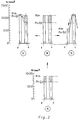
- the heating, in accordance with the invention, of the peripheral zone at temperatures of 300 ° C (lower values of the domain ⁇ ) leads to the following resistance gradients, in accordance with phase B -> C of the process of FIG. 1 from the peripheral zone to the central zone.
- the tensile strength increases at least from 10 N / mm2 to 1575 N / mm2.
- the conventional elastic limit ⁇ R eo , 2 of the peripheral zone increases all the more compared to that of the central zone, ie by 280 N / mm2, and up to 1445 N / mm2.
- the peripheral zone undergoes heating at a temperature of 600 ° C (value of the upper region of the domain ⁇ ), while the central zone heats up to a temperature of approximately 300 ° C (value of the lower region of the domain ⁇ ) by an appropriate choice of the density, the quantity of heat supplied, and the duration of the reheating of the peripheral zone by capture of the residual heat derived towards the interior of the product.
- stage A in Figure 2 A cold pressed wire quenched and uniformly returned until a tensile strength of 900 N / mm2 (stage A in Figure 2), generally used for the manufacture of bolting and joining elements, has been reduced by a cold drawing of 25.5% with a diameter of 13.5 mm to a diameter of 11.62 mm (stage C in FIG. 2).
- Negative resistance gradients are created when the peripheral zone is heated according to the invention to average temperatures of 650 ° C. (upper region of the domain ⁇ ), so that the residual heat resulting from the heating of the peripheral zone brings about by conduction thermal reheating of the central zone to average temperatures of 200 ° C (lower region of the domain ⁇ ).
- the degree of resistance is dependent on the grade of the steel used and on the choice of the cold work hardening mode, of its intensity, and also of the heating of the peripheral zone after cold work hardening.
- peripheral zone By heating the peripheral zone according to the invention to temperatures of 180 to 270 ° C. (lower region of the domain ⁇ ), the peripheral zone undergoes a slight increase in resistance of approximately 130 N / mm 3 and a large increase in the conventional elastic limit of approximately 360 N / mm2, while the resistance properties of the central zone are not affected (stage C of FIG. 3).
- the corresponding gradients between the peripheral zone and the central zone are therefore + 130 N / mm2 with regard to the tensile strength and + 360 N / mm2 with regard to the conventional elastic limit R eo , 2.
- This example describes the use of the process according to the invention on an entire part, which consists of a cold-worked steel product, and which must maintain the state of residual stresses necessary for its use.
- These are coil springs made by cold winding from spring steel wires.
- the subsequent reheating of the cold-worked coil spring is carried out according to the invention in such a way that the internal surfaces of the coils of the coil spring are heated for example to temperatures situated in the lower region of the domain ⁇ and the external surfaces of the coils to temperatures located in the upper region of the domain ⁇ .
- the heating can be carried out in such a way that the interior surfaces of the coils of the helical spring receive a determinable amount of heat, for example using a radiant heat emitting member, while the exterior surfaces undergo, together or separately, reheating to usual temperatures.
Landscapes
- Chemical & Material Sciences (AREA)
- Engineering & Computer Science (AREA)
- Physics & Mathematics (AREA)
- Thermal Sciences (AREA)
- Crystallography & Structural Chemistry (AREA)
- Mechanical Engineering (AREA)
- Materials Engineering (AREA)
- Metallurgy (AREA)
- Organic Chemistry (AREA)
- Manufacturing & Machinery (AREA)
- Heat Treatment Of Steel (AREA)
- Heat Treatment Of Strip Materials And Filament Materials (AREA)
Applications Claiming Priority (2)
| Application Number | Priority Date | Filing Date | Title |
|---|---|---|---|
| DE4138991 | 1991-11-27 | ||
| DE19914138991 DE4138991A1 (de) | 1991-11-27 | 1991-11-27 | Verfahren zum erzeugen von unterschiedlichen mechanischen eigenschaften zwischen rand- und kernbereich eines stahlkoerpers |
Publications (1)
| Publication Number | Publication Date |
|---|---|
| EP0545193A1 true EP0545193A1 (de) | 1993-06-09 |
Family
ID=6445696
Family Applications (1)
| Application Number | Title | Priority Date | Filing Date |
|---|---|---|---|
| EP92119895A Withdrawn EP0545193A1 (de) | 1991-11-27 | 1992-11-23 | Verfahren zum Herstellen von Eisen- und Stahlgegenständen mit verschiedenen mechanischen Eigenschaften zwischen Kern- und Randbereiche |
Country Status (2)
| Country | Link |
|---|---|
| EP (1) | EP0545193A1 (de) |
| DE (1) | DE4138991A1 (de) |
Families Citing this family (1)
| Publication number | Priority date | Publication date | Assignee | Title |
|---|---|---|---|---|
| DE102009011118A1 (de) * | 2008-11-21 | 2010-05-27 | Muhr Und Bender Kg | Vergüteter Federstahl, Federelement und Verfahren zur Herstellung eines Federelements |
Citations (4)
| Publication number | Priority date | Publication date | Assignee | Title |
|---|---|---|---|---|
| GB272240A (en) * | 1926-06-04 | 1928-09-07 | Ver Stahlwerke Ag | Process for improving the tensile qualities of drawn steel wire |
| FR1063452A (fr) * | 1952-08-27 | 1954-05-04 | Profilés de haute qualité en fer et acier et leur procédé de fabrication | |
| DE2166098A1 (de) * | 1971-04-10 | 1972-12-21 | Baustahlgewebe Gmbh | Kontinuierliches Warmebehandlungsver fahren an stabförmigen, niedriggekohlten Baustahlen Ausscheidung aus 2117744 |
| US3817796A (en) * | 1970-06-30 | 1974-06-18 | Martin Marietta Corp | Method of increasing the fatigue resistance and creep resistance of metals and metal body formed thereby |
Family Cites Families (3)
| Publication number | Priority date | Publication date | Assignee | Title |
|---|---|---|---|---|
| DE2530470A1 (de) * | 1975-07-08 | 1977-01-20 | Lasalle Steel Co | Verfahren zur herstellung von spannungsfreigegluehten vorverfestigten stahlprofilen |
| DE3631928C2 (de) * | 1986-09-19 | 1994-06-09 | Aicher Max | Verfahren zur Herstellung von Walzstahlerzeugnissen |
| DD268258A1 (de) * | 1988-01-08 | 1989-05-24 | Florin Stahl Walzwerk | Hoeherfester stahl, insbesondere betonstahl bzw. ziehereivormaterial, mit verbesserten werkstoffeigenschaften und besserer verarbeitbarkeit |
-
1991
- 1991-11-27 DE DE19914138991 patent/DE4138991A1/de not_active Withdrawn
-
1992
- 1992-11-23 EP EP92119895A patent/EP0545193A1/de not_active Withdrawn
Patent Citations (4)
| Publication number | Priority date | Publication date | Assignee | Title |
|---|---|---|---|---|
| GB272240A (en) * | 1926-06-04 | 1928-09-07 | Ver Stahlwerke Ag | Process for improving the tensile qualities of drawn steel wire |
| FR1063452A (fr) * | 1952-08-27 | 1954-05-04 | Profilés de haute qualité en fer et acier et leur procédé de fabrication | |
| US3817796A (en) * | 1970-06-30 | 1974-06-18 | Martin Marietta Corp | Method of increasing the fatigue resistance and creep resistance of metals and metal body formed thereby |
| DE2166098A1 (de) * | 1971-04-10 | 1972-12-21 | Baustahlgewebe Gmbh | Kontinuierliches Warmebehandlungsver fahren an stabförmigen, niedriggekohlten Baustahlen Ausscheidung aus 2117744 |
Non-Patent Citations (2)
| Title |
|---|
| DRAHT vol. 38, no. 8/9, 8 Septembre 1987, BAMBERG DE pages 681 - 684 S.SORAYA 'Maraform- Ein neuer Stahldraht für Umformprodukte, insbesondere für Schrauben und Befestigungsmittel, Federn und Kaltformteile' * |
| PATENT ABSTRACTS OF JAPAN vol. 12, no. 143 (C-492)(2990) 30 Avril 1988 & JP-A-62 260 015 ( SUMITOMO ELECTRIC IND ) 12 Novembre 1987 * |
Also Published As
| Publication number | Publication date |
|---|---|
| DE4138991A1 (de) | 1993-06-03 |
Similar Documents
| Publication | Publication Date | Title |
|---|---|---|
| FR2757877A1 (fr) | Acier et procede pour la fabrication d'une piece en acier mise en forme par deformation plastique a froid | |
| FR2495639A1 (fr) | Procede ameliore de traitement thermique des aciers utilisant un chauffage electrique direct par resistance et produits en acier obtenus par ce procede | |
| FR2727981A1 (fr) | Procede de fabrication d'une piece en acier de construction mecanique et piece ainsi fabriquee | |
| EP2134882B1 (de) | Mikrolegierter stahl mit guter beständigkeit gegenüber wasserstoff zur kaltumformung von maschinenteilen mit hohen eigenschaften | |
| EP0545193A1 (de) | Verfahren zum Herstellen von Eisen- und Stahlgegenständen mit verschiedenen mechanischen Eigenschaften zwischen Kern- und Randbereiche | |
| US11814693B2 (en) | High strength steel tube and method of manufacturing a high strength steel tube | |
| US6627005B1 (en) | High fatigue-strength steel wire and spring, and processes for producing these | |
| Aweda et al. | Rapid cyclic heating of mild steel and its effects on microstructure and mechanical properties | |
| JP2009091625A (ja) | 炭素鋼線の製造方法 | |
| FR2594142A1 (fr) | Tige brisable pour dispositif de fixation, et son procede d'obtention | |
| JP2005505689A (ja) | 高硬度で高変形能を有する鉄製品 | |
| BE1015018A3 (fr) | Procede pour le traitement thermique d'une bande d'acier laminee a froid, procede de fabrication d'une bande d'acier adaptee au fromage et bande d'acier ainsi obtenue. | |
| JP2565687B2 (ja) | 高強度太径異形鋼棒の製造方法 | |
| FR2712606A1 (fr) | Procédé d'élaboration d'une charge de fonte à graphite sphéroïdal à caractéristiques mécaniques élevées. | |
| JP4477761B2 (ja) | 高強度圧延pc鋼棒およびその製造方法 | |
| JP2017179399A (ja) | 建築用鋼材 | |
| EP0679724B1 (de) | Befestigungselement mit Gewinde aus legiertem Stahl mit hoher Ermüdungsbeständigkeit und dessen Herstellungsverfahren | |
| EP0090682A2 (de) | Wärmebehandlungsverfahren und Vorrichtung zum Herstellen gebrauchsfertiger Stangen aus legierten Stählen | |
| BE824960A (fr) | Procede d'amelioration de la qualite des produits en acier lamines | |
| FR2488279A1 (fr) | Traitement par refroidissement accelere de barres en acier dans la chaude de laminage | |
| EP0124501A1 (de) | Verfahren zur Qualitätsverbesserung von Stahlprofilen | |
| EP4347903A1 (de) | Warmgeformtes stahlteil und herstellungsverfahren | |
| Agas’ yants et al. | Experience in TMT with the use of cold lengthwise rolling in dead rolls | |
| LU86530A1 (fr) | Procede de traitement thermique de fil machine en acier inoxydable | |
| Silaev et al. | Research of the application of nickel-chrome-silicon bronze BrNHK for the manufacture of helical compression springs |
Legal Events
| Date | Code | Title | Description |
|---|---|---|---|
| PUAI | Public reference made under article 153(3) epc to a published international application that has entered the european phase |
Free format text: ORIGINAL CODE: 0009012 |
|
| AK | Designated contracting states |
Kind code of ref document: A1 Designated state(s): AT BE CH DK ES FR GB GR IE IT LI LU NL PT SE |
|
| 17P | Request for examination filed |
Effective date: 19931206 |
|
| 17Q | First examination report despatched |
Effective date: 19960529 |
|
| STAA | Information on the status of an ep patent application or granted ep patent |
Free format text: STATUS: THE APPLICATION IS DEEMED TO BE WITHDRAWN |
|
| 18D | Application deemed to be withdrawn |
Effective date: 19961210 |