EP0090895B1 - Appareil pour enregistrer des informations stéreo-chimiques au sujet de composés chimiques - Google Patents
Appareil pour enregistrer des informations stéreo-chimiques au sujet de composés chimiques Download PDFInfo
- Publication number
- EP0090895B1 EP0090895B1 EP82305050A EP82305050A EP0090895B1 EP 0090895 B1 EP0090895 B1 EP 0090895B1 EP 82305050 A EP82305050 A EP 82305050A EP 82305050 A EP82305050 A EP 82305050A EP 0090895 B1 EP0090895 B1 EP 0090895B1
- Authority
- EP
- European Patent Office
- Prior art keywords
- atom
- register
- atoms
- stereodescriptor
- asymmetric
- Prior art date
- Legal status (The legal status is an assumption and is not a legal conclusion. Google has not performed a legal analysis and makes no representation as to the accuracy of the status listed.)
- Expired
Links
Images


Classifications
-
- G—PHYSICS
- G16—INFORMATION AND COMMUNICATION TECHNOLOGY [ICT] SPECIALLY ADAPTED FOR SPECIFIC APPLICATION FIELDS
- G16C—COMPUTATIONAL CHEMISTRY; CHEMOINFORMATICS; COMPUTATIONAL MATERIALS SCIENCE
- G16C20/00—Chemoinformatics, i.e. ICT specially adapted for the handling of physicochemical or structural data of chemical particles, elements, compounds or mixtures
- G16C20/90—Programming languages; Computing architectures; Database systems; Data warehousing
Definitions
- the present invention relates to a device for storing stereochemical information about chemical compounds.
- Chemical compounds have three-dimensional structures by their own nature. When the information about these compounds is to be stored in electronic computers, however, various difficulties are encountered since it has to be expressed two-dimensionally. In particular, it is difficult to discriminate compounds which, when rotated in space, afford sterically different structures as well as to identify compounds which must be stereochemically the same.
- a method has, therefore, been employed to describe all of the three-dimensional coorindates of the atoms and to store them. With such a method however, the storage capacity must be tremendously great, involving much redundancy, and the three-dimensional agreements are not necessarily guaranteed.
- Fig. 7 and 8 a method for generating unique computer structural representations of stereoisomers.
- stereochemical information is stored using an atom address number register main atom right and reverse direction connectivity registers and side chain first and second direction connectivity registers.
- the object of the present invention is to provide a device for storing stereochemical information about chemical compounds, according to which the stereochemical information can be correctly described in an atom connection table and can be corresponded to the stereodescriptors on an atomic level.
- one aspect of the present invention provides a device for storing stereochemical information about a chemical compound, comprising:
- a device for storing stereochemical information about a chemical compound comprising:
- 2,4-Pentanediol is a chain compound consisting of three stereoisomers that can be described as formulas I, II and III on a paper according to Fischer's projection method which describes the main chain in the upward and downward directions.
- An isomer of formula IV is obtained by turning the isomer of formula III through 180° in the plane of the paper.
- a main atom right direction connectivity register as a means for specifying and storing connectivity in the right direction of the main atoms which form the skeleton of the compound (in a chain compound in which the main chain is described to lie in the upward and downward directions according to Fischer's projection method, the upward direction is referred to as the right direction and, in a ring compound, the clockwise direction is referred to as the right direction), and use is made of a main atom reverse direction connectivity register as a means for specifying and storing connectivity in the reverse direction of the main atoms which form the skeleton of the compound (in a chain compound, the downward direction is referred to as the reverse direction and, in a ring compound, the counterclockwise direction is referred to as the reverse direction).
- connectivities are so stored as to correspond to atom address numbers of the atoms by using a side chain first direction connectivity register as a means for specifying and storing connectivities of the side chain atoms bonded to the main atoms in the first direction (in a chain compound, the right front direction is referred to as the first direction and, in a ring compound, the direction which protrudes upward from the plane of the paper is referred to as the first direction), and by using a side chain second direction connectivity register as a means for specifying and storing connectivities of the side chain atoms bonded to the main atoms in the second direction (in a chain compound, the left front direction is referred to as the second direction and, in a ring compound, the direction which protrudes downward from the plane of the paper is referred to as the second direction).
- the direction from the right to the left is referred to as the right direction
- the direction from the left to the right is referred to as the reverse direction
- the upperfront direction is referred to as the first direction
- the lowerfront direction is referred to as the second direction.
- the atoms in the compound described by Fischer's projection method can be stored in a three-dimensional manner.
- the data stored in the main atom right direction connectivity register and that stored in the main atom reverse direction connectivity register can be exchanged for each storage field of the same atom address number
- the data stored in the side chain first direction connectivity register and that stored in the side chain second direction connectivity register can be exchanged for each storage field of the same atom address number, such that the stored data can be changed, for instance, from formula III into formula IV, or vice versa, making it possible to easily compare whether the isomer of formula III is identical with the isomer of formula IV.
- Formula I in which the atom address numbers are arbitrarily assigned to the atoms, can be numbered as shown by formulas I-M o1 and I-M o2 according to Morgan's numbering rule.
- Atom address numbers 1 to 7 assigned to the atoms of formula I except the hydrogen atom, are stored in the atom address number register.
- the locant register stores the locants that specify, from the chemical point of view, the positions of the atoms that constitute the main chain of formula I, to correspond to the atom address numbers.
- the element register stores the kinds of atoms to which the atom address numbers are assigned, in the manner of C, C, C, C, O, O so as to correspond to the atom address numbers 1, 2, 3, 4, 5, 6 and 7 of the atoms.
- the bond value register stores bond values of the atoms to which the atom address numbers are assigned, and which are bonded to atoms other than hydrogen atoms, so as to correspond to the atom address numbers of the atoms. For instance, in the case of the carbon atom C having atom address number 1, the bond value to an atom other than hydrogen is 1. In the case of the carbon atom C having atom address number 2, the bond value to atoms other than hydrogen is 3. The bond values of other atoms are determined in the same manner, and are stored to correspond to the atom address numbers.
- the hydrogen value register stores the number of hydrogen atoms connected to the atoms to which the atom address numbers are assigned, to correspond to the atom address numbers of the atoms. For instance, in the case of the carbon atom C having atom address number 1, the bond number relative to the hydrogen atoms is 3, and in the case of the carbon atom C having atom address number 2, the bond number relative to the hydrogen atoms is 1.
- the bond numbers of other atoms are determined in the same manner as above, and are stored to correspond to the atom address numbers.
- the stereodescriptor register stores stereodescriptors R (Rectus: which means right in Latin), and S (Sinister: which means left) assigned to asymmetric carbon atoms with atom address numbers 2 and 4, to correspond to the atom address number 2 and 4.
- the main atom right direction connectivity register stores which main atom is bonded in the right direction (an upward direction in the case of a chain compound) to a main atom of the main chain which constitutes the sekeleton of the compound, i.e., stores the atom address number of the bonded main atom in a location corresponding to the atom address number of the bonding main atom.
- no main atom which constitutes the main chain is bonded from above to the carbon atom C of atom address number 1. Therefore, the main atom right direction connectivity register stores nothing in a location which corresponds to the atom address number 1.
- the carbon atom C having atom address number 1 is bonded from above to the carbon atom C having atom address number 2. Therefore, the main atom right direction connectivity register stores 1 in a location corresponding to the atom address number 2. The same holds with the other main atoms.
- the main atom reverse direction connectivity register stores which main atom is bonded in the reverse direction (a downward direction in the case of a chain compound) to a main atom of the main chain which constitutes the skeleton of the compound, i.e., stores the atom address number of the bonded main atom in a location corresponding to the atom address number of the bonding main atom.
- carbon atom C of the atom address number 2 is bonded from below to the carbon atom C of atom address number 1. Therefore, the main atom reverse direction connectivity register stores 2 in a location which corresponds to the atom address number 1.
- the main atom reverse direction connectivity register stores 3 in a location corresponding to the atom address number 2. The same holds with the other main atoms.
- the side chain first direction connectivity register stores the atom address numbers or the atomic symbols of bonded side-chain atoms in the locations corresponding to the atom address numbers of the atoms of the main chain to which the side-chain atoms are bonded in the first direction (a right front direction in the case of a chain compound).
- a hydrogen atom H is bonded in the first direction, i.e., in the right front direction of the carbon atom C with atom address number 2. Therefore, H is stored in the side chain first direction connectivity register in a location corresponding to the atom address number 2.
- an oxygen atom 0 of atom address number 7 is bonded in the first direction, i.e., in the right front direction of the carbon atom C with atom address number 4. Therefore, the side chain first direction connectivity register stores 7 in a location corresponding to the atom address number 4.
- the side chain second direction connectivity register stores the atom address numbers of the atomic symbols of bonded side-chain atoms in the locations corresponding to the atom address numbers of the atoms of the main chain to which the side-chain atoms are bonded in the second direction (a left front direction in the case of the chain compound).
- an oxygen atom 0 of atom address number 6 is bonded in the second direction, i.e., in the left front direction of carbon atom C with atom address number 2. Therefore, the side chain second direction connectivity register stores 6 in a location corresponding to the atom address number 2.
- a hydrogen atom H is bonded in the second direction, i.e., in the left front direction of carbon atom C of atom address number 4. Therefore, the side chain second direction connectivity register stores H in a location which corresponds to the atom address number 4.
- Formulas I-M oi and I-M o2 are stored as follows. Namely, the atom address number register stores atom address numbers which are assigned to the atoms, except hydrogen atoms, of formulas I-M o1 and I-M o2 according to Morgan's numbering rule. The data for other registers are stored in the same manner as in the case of formula I. In this case, the atom address numbers stored in the registers are those assigned according to Morgan's numbering rule.
- formulas II, III and IV in which the address numbers are arbitrarily assigned to the atoms can be expressed as formulas II ⁇ M 01 , II ⁇ M 02 , III ⁇ M 01 , III ⁇ M 02 and IV ⁇ M 01 , according to Morgan's numbering rule. Further, formula IV-R is obtained by turning formula IV ⁇ M 01 through 180° in the plane of the paper.
- the result is the same as that obtained by turning the formula of a chain compound through 180° in the plane of the paper.
- Isomers of formulas I, II and III which cannot be distinguished in an ordinary planar atom connection table, can, according to the method of the present invention, be stereochemically distinguished. It can also be recognized that the isomer of formula III is identical with the one of formula IV.
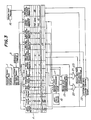
- a memory device for storing stereochemical information about a chain compound will now be described with reference to the case of (2R, 4R)-2,4-pentanediol.
- the device is equipped with a systematic nomenclature input register 1 which introduces the systematic nomenclature of a compound as character data.
- Output of the register 1 is supplied to a fundamental connection table preparation circuit 2 which prepares a fundamental connection table based upon the data from a dictionary register 3 which stores a variety of data.
- Output of the circuit 2 is stored in the predetermined registers of a fundamental connection table register 4 which is equipped with an atom address number register 5, a locant register 6, an element register 7, a bond value register 8, a hydrogen value register 9, a stereodescriptor register 10, a main atom right direction connectivity register 11, a main atom reverse direction connectivity register 12, a side chain first direction connectivity register 13, a side chain second direction connectivity register 14, and an unknown direction connectivity register 15.
- the input to the fundamental connection table register 4 may be obtained from a graphic input register 16.
- the data from the graphic input register 16 can be stored in all of the registers in the fundamental connection table register 4, except the stereodescriptor register 10.
- the following circuit is provided to store in the registers 13 and 14 the data on the three-dimensional bonding state of side-chain atoms bonded to asymmetric atoms that cannot be input via the fundamental connection table preparation circuit 2.
- a bonded atom priority comparator circuit 17 which compares the priority of atoms bonded to assymetric atoms based upon signals from the registers 5, 7, 11, 12 and 15 in the fundamental connection table register 4 and upon the data from an atom priority register 18 which stores priority in weight of the atoms bonded to the asymmetric atoms..
- the comparator circuit 17 compares and determines the priority in weight of the atoms bonded to the asymmetric atoms.
- the output signal from the comparator circuit 17 is supplied to a bonded atom rotational direction discriminator circuit 19 which discriminates the rotational direction of the atoms bonded to the asymmetric atoms.
- the discriminator circuit 19 discriminates whether the rotational direction of heavy atoms to light atoms based upon the priority in weight of the atoms bonded to the asymmetric atoms, is in agreement with the rotational direction of atoms as viewed from the direction of the register 11 to the register 12 in the fundamental connection table register 4.
- a coincidence signal produced by the discriminator circuit 19 is supplied to a first AND circuit 20 which works as a first stereodescriptor reading circuit.
- a non-coincidence signal produced by the discriminator circuit 19 is supplied to a second AND circuit 21 that works as a second stereodescriptor reading circuit.
- the first AND circuit 20 receives another input from the stereodescriptor register 10, and reads the stereodescriptor data R or S sent from the stereodescriptor register 10 when the coincidence signal is applied thereto from the discriminator circuit 19.
- the second AND circuit 21 receives another input from the stereodescriptor register 10, and reads the stereodescriptor data R or S from the stereodescriptor register 10, when the non-coincidence signal is applied thereto from the discriminator circuit 19.
- the examining circuit 22 stores the hydrogen atom H or the lightest atom between the two atoms temporarily stored in the unknown direction connectivity register 15 in the field of a predetermined atom address number of the side chain first direction connectivity register 13, and stores the other atom temporarily stored in the unknown direction connectivity register 15 in the field of a predetermined atom address number of the side chain second direction connectivity register 14.
- the examining circuit 23 stores the hydrogen atom H or the lightest atom between the two atoms temporarily stored in the unknown direction connectivity register 15 in the field of a predetermined atom address number of the side chain second direction connectivity register 14, and stores the other atom temporarily stored in the unknown direction connectivity register 15 in the field of a predetermined atom address number of the side chain first direction connectivity register.
- the unknown direction connectivity register 15 makes the fundamental connection table register 4 different from Table I.
- the unknown direction conectivity register 15 temporarily stores the side-chain atoms of which the directions of bonding to the asymmetric atoms are difficult to determine.
- the unknown direction connectivity register 15 stores 6 and H for the atom address number 2, and stores H and 7 for the atom address number 4.
- the comparator circuit 17 Upon receipt of signals from the registers 11, 12 and 15, the comparator circuit 17 detects that the asymmetric carbon atom C with atom address number 2 possesses a hydrogen atom H, CH 3 having a carbon atom C with atom address number 1, CH 2 having a carbon atom C with atom address number 3, and OH having an oxygen atom O with atom address number 6, that are connected thereto. Priorities in weight of these atoms, except hydrogen atoms H, are compared based upon the data from the atom priority register 18. In this case, the weight of atoms decreases in the order of oxygen atom O with atom address number 6, carbon atom C with atom address number 3, and carbon atom C with atom address number 1. The priority in weight is determined in the following way:
- the bonded atom rotational direction discriminator circuit 19 discriminates whether the rotation direction from the heavy atom toward the light atom based upon the priority in weight of the atoms bonded to the asymmetric carbon atom C with atom address number 2, is in agreement with the clockwise rotational direction as viewed from the register 11 to the register 12 of the fundamental connection table register 4.
- the priority order is indicated by encircled figures in the following formula I-A.
- the rotational direction of the atoms bonded to the asymmetric carbon atom C with atom address number 2 based upon the priority of weight is 6 ⁇ 3 ⁇ 1 as viewed from the right side of the formula I-A,
- the direction from the carbon atom C with atom address number 1 stored in the field of atom address number 2 in the register 11 to the carbon atom C with atom address number 3 stored in the register 12 is 1 3, which is a clockwise turn, and which does not agree with the above-mentioned rotational direction 6 ⁇ 3 ⁇ 1. Therefore, the rotational direction 6 ⁇ 3 ⁇ 1 is a counterclockwise rotation.
- the above discrimination is effected by the bonded atom rotational direction discriminator circuit 19.
- the noncoincidence signal produced from the discriminator circuit 19 is supplied to the second AND circuit 21 which works as a second stereodescriptor reading circuit which reads the data R stored in the stereodescriptor register 10 in the field of atom address number 2.
- the stereodescriptor data R which is read out, is supplied to a second side chain atom direction examined circuit 23.
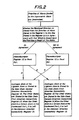
- the second side chain atom direction examining circuit 23 Upon receipt of the stereodescriptor data R, the second side chain atom direction examining circuit 23 works to store the hydrogen atom H temporarily stored in the unknown direction connectivity register 15 in the field of atom address number 2 of the side chain first direction connectivity register 13 and works to store the oxygen atom O of atom address number 6 temporarily stored in the unknown direction connectivity register 15 in the field of atom address number 2 of the side chain second direction connectivity register 14, as illustrated in the flow chart of Fig. 2. That is, when the stereodescriptor data is R, and the rotational direction is not in agreement, the hydrogen atom H is placed in front of the carbon atom C with atom address number 2 as viewed from the right side of the formula I-A.
- the comparator circuit 17 detects that the asymmetric carbon atom C with atom address number 4 possesses a hydrogen atom H, CH 2 having a carbon atom C with atom address number 3, CH 3 having a carbon atom C with atom address number 4, and OH having an oxygen atom 0 with atom address number 7, which are connected thereto.
- Priorities in weight of the atoms except hydrogen atoms H are compared based upon the data from the atom priority register 18.
- priority in weight of the atoms decreases in the order of oxygen atom O with atom address number 7, carbon atom C with atom address number 3, and carbon atom C with atom address number 5.
- the bonded atom rotational direction discriminator circuit 19 discriminates whether the rotational direction of the atoms bonded to the asymmetric carbon atom C of atom address number 4 based upon the priority in weight is in agreement with the clockwise rotational direction as viewed in the direction of from the register 11 to the register 12 of the fundamental connection table register 4.
- the priority order is indicated by encircled figures in the following formula I-B.
- the rotational direction of the atoms bonded to the asymmetric carbon atom C with atom address number 4 based upon the priority of weight is 7 ⁇ 3 ⁇ 5, as viewed from the right side of the formula I-B.
- the direction from the carbon atom C with atom address number 3 stored in the field of atom address number 4 in the register 11 to the carbon atom C with atom address number 5 stored in the register 12 is 3 ⁇ 5, which is a clockwise turn, and which is in agreement with the rotational direction 7 ⁇ 3 ⁇ 5.
- the above discrimination is effected by the bonded atom rotational direction discriminator circuit 19.
- the coincidence signal produced from the discriminator circuit 19 is supplied to the first AND circiut 20 which works as a first stereodescriptor reading circuit which reads the data R stored in the stereodescriptor register 10 in the field of atom address number 4.
- the stereodescriptor data R which is read out, is supplied to the first side chain atom direction examining circuit 22.
- the first side chain atom direction examining circuit 22 Upon receipt of the stereodescriptor data R, the first side chain atom direction examining circuit 22 works to store the hydrogen atom temporarily stored in the unknown direction connectivity register 15 in the field of atom address number 4 of the side chain second direction connectivity register 14, and works to store the oxygen atom 0 of atom address number 7 temporarily stored in the unknown direction connectivity register 15 in the field of atom address number 4 of the side chain first direction connectivity register 13, as illustrated in the flow chart of Fig. 2. That is, when the stereodescriptor data is R, and the rotational directions are in agreement, the hydrogen atom H is placed at the back of the carbon atom C with atom address number 4 as viewed from the right side of the formula I-B.
- Formulas I-M ol and I-M o2 are stored as follows. Namely, atom address numbers of formula I are converted into atom address numbers of formula I-M ol and I ⁇ M 02 , and are automatically stored in the device.
- Formulas II, II ⁇ M 01 , II ⁇ M 02 to IV, IV-M o1 and IV-R are also stored in the same manner.
- (3S)-cholestan-3-ol can be expressed by formula V, in which atom address numbers are arbitrarily assigned to the atoms except hydrogen atoms.
- broken lines represent bonds that protrude downward from the plane of the paper.
- the numbers are assigned to the ring atoms in a conventional manner.
- the atoms of formula V are stored in the registers to correspond to the address numbers, as illustrated in Table V.
- the data are stored as follows. Namely, the data are stored in the atom address number register, locant register, element register, bond value register, hydrogen value register, and stereodescriptor register, in the same manner as mentioned earlier.
- a condensation register stores condensation symbol J which corresponds to atom address numbers of carbon atoms that form a condensed part.
- the main atom right direction connectivity register stores which main atoms are bonded in the right direction (in a ring compound, the clockwise direction about the periphery of the ring is referred to as the right direction) to the main atoms which form the skeleton on the ring compound, i.e., stores the atom address numbers of the bonded main atoms in the locations corresponding to the bonding main atom address numbers.
- a carbon atom C of atom address number 10 is bonded to the right of the carbon atom C of atom address number 1. Therefore, the main atom right direction connectivity register stores 10 in a location corresponding to atom address number 1. The same holds with the other main atoms.
- the main atom reverse direction connectivity register stores which main atoms are bonded in the reverse direction (in a ring compound, the counterclockwise direction about the periphery of the ring is referred to as the reverse direction) to the main atoms forming the skeleton of the ring compound, i.e., stores atom address numbers of the bonded main atoms in the locations corresponding to atom address numbers of the bonding main atoms.
- a carbon atom C of atom address number 2 is bonded to the left of the carbon atom C of atom address number 1. Therefore, the main atom reverse direction connectivity register stores 2 in a location that corresponds to the atom address number 1. The same holds with the other main atoms.
- the side chain first direction connectivity register stores atom address numbers or atomic symbols of bonded side-chain atoms in the locations corresponding to the atom address numbers of the main atoms of the ring to which the side-chain atoms are bonded in the first direction (in a ring compound, the direction protruding upward from the plane of the paper is referred to as the first direction).
- the first direction in a ring compound, the direction protruding upward from the plane of the paper is referred to as the first direction.
- the side chain first direction connectivity register stores nothing in a location corresponding to the atom address number 1.
- the carbon atom C of atom address number 3 has an oxygen atom 0 of atom address number 28 bonded thereto in a direction protruding upward from the plane of the paper. Therefore, the side chain first direction connectivity register stores 28 in a location corresponding to the atom address number 3. The same holds with the other main atoms.
- the side chain second direction connectivity register stores atom address numbers or atom symbols of bonded side-chain atoms in the locations corresponding to the atom address numbers of the main atoms of the ring to which the side-chain atoms are bonded in the second direction (in a ring compound, the direction which protrudes downward from the plane of the paper is referred to as the second direction).
- a hydrogen atom H is bonded to the carbon atom C of atom address number 3 in the direction protruding downward from the plane of the paper. Therefore, the side chain second direction connectivity register stores H in a location correspoonding to atom address number 3. The same holds with the other main atoms.
- the unknown direction connectivity register stores atom address numbers or atomic symbols of the side-chain atoms to correspond to the atom address numbers of the main atoms.
- the unknown direction connectivity register further stores the atom address number of a carbon atom of the opposite side corresponding to a carbon atom of one side in a condensed part of the ring, in a manner to correspond to the atom address number of the carbon atom of the one side.
- a carbon atom of atom address number 10 is condensed with a carbon atom C of atom address number 5. Therefore, the unknown direction connectivity register stores 10 in a location corresponding to the atom address number 5. The same holds with the other side-chain atoms or condensed atoms.
- a memory device for storing stereochemical information about a ring compound will now be described with reference to the case of (3S)-cholestan-3-ol. As shown in Fig. 3, this device is nearly the same as that of Fig. 1, except that a condensation register 24 is added to the fundamental connection table register 4.
- the data in the registers 5, 7, 11, 12 and 15 related to the asymmetric atoms having the atom address numbers 3, 5, 8, 9, 10, 13, 14, 17 and 20, are successively supplied to the bonded atom priority comparator circuit 17 for every atom address number of the asymmetric atoms.
- the comparator circuit 17 Upon receipt of signals from the registers 11, 12 and 15, the comparator circuit 17 detects that the asymmetric carbon atom C of atom address number 3 has a hydrogen atom H, a carbon atom C of atom address number 2, a carbon atom C of atom address number 4, and an oxygen atom 0 of atom address number 28, that are connected thereto. Priorities in weight of these atoms, except hydrogen atoms H are compared based upon the data from the atom priority register 18. In this case, priorities in weight of the atom decreases in the order of oxygen atom 0 with atom address number 28, carbon atom C with atom address number 4, and carbon atom C with atom address number 2.
- the bonded atom rotational direction discriminator circuit 19 discriminates whether the rotational direction 28 ⁇ 4 - 2 ⁇ 28 based upon the priority in weight of the atoms bonded to the asymmetric carbon atom C of atom address number 3, is in agreement with the clockwise rotational direction 2 ⁇ 4 as viewed from the register 11 to the register 12 of the fundamental connection table register 4. In this case, it will be understood that the rotational direction given by the fundamental connection table register is not in agreement with the one based upon the priority in weight. The above discrimination is effected by the bonded atom rotational direction discriminator circuit 19.
- the non-coincidence signal produced by the discriminator circuit 19 is supplied to the second AND circuit 21 which works as a second stereodescriptor reading circuit which reads the data S stored in the stereodescriptor register 10 in the field of atom address number 3.
- the stereodescriptor data S which is read out, is supplied to the second side chain atom direction examining circuit 23.
- the second side chain atom direction examining circuit 23 Upon receipt of the stereodescriptor data S, the second side chain atom direction examining circuit 23 works to store the hydrogen atom H temporarily stored in the unknown direction connectivity register 15 in the field of atom address number 3 of the side chain second direction connectivity register 14, and works to store the oxygen atom 0 of atom address number 28 temporarily stored in the unknown direction connectivity register 15 in the field of atom address number 3 of the side chain first direction connectivity register 13, as illustrated in the flow chart of Fig. 2. That is, when the stereodescriptor data is S, and the rotational directions are not in agreement, the hydrogen atom H is placed at the back (back side of the paper) of the carbon atom C with atom address number 3 as viewed from the front of formula V.
- the comparator circuit 17 detects that the carbon-atom C with atom address number 5 possesses a hydrogen atom H, carbon atom C with atom address number 4, carbon atom with atom address number 6, and carbon atom C of a condensed part with atom address number 10, which are connected thereto.
- Priorities in weight of the atoms except hydrogen atoms are compared based upon the data from the atom priority register 18. In this case, priority in weight of the atoms decreases in the order of carbon atom C with atom address number 4, carbon atom C with atom address number 10, and carbon atom C with atom address number 6.
- the bonded atom rotational direction discriminator circuit 19 discriminates whether the rotational direction 4 - 10 6 - 4 of the atoms bonded to the asymmetric carbon atom C in a condensed part with atom address number 5 based upon the priority in weight is in agreement with the counterclockwise rotational direction 4 ⁇ 6 (the rotational direction is reversed in the condensed part) as viewed in the direction of from the register 11 to the register 12 of the fundamental connection table register 4. In this case, the rotational directions are not in agreement.
- the non-coincidence signal produced from the discriminator circuit 19 is supplied to the second AND circuit 21 which works as a second stereodescriptor reading circuit which reads the data S stored in the stereodescriptor register 10 in the field of atom address number 5.
- the second side chain atom direction examining circuit 23 works to store the hydrogen atom H temporarily stored in the unknown direction connectivity register 15 in the field of atom address number 5 of the side chain second direction connectivity register 14, and works to store the carbon atom C in the condensed part with atom address number 10 temporarily stored in the unknown direction connectivity register 15 in the same unknown direction connectivity register, as illustrated in the flow chart of Fig. 2. That is, when the stereodescriptor data is S, and the rotational directions are not in agreement, the hydrogen atom H is placed at the back (back side of the paper) of the carbon atom C with atom address number 5 as viewed from the front of the formula V.
- the oxygen atom 0 with atom address number 28 bonded to the carbon atom C with atom address number 3 may, first, be stored in the side chain first direction connectivity register 13.
- the circuits 17, 18, 19, 20, 21, 22, 23 and 24 may be used for checking the data stored in the registers 13 and 14 of the fundamental connection table register 4.
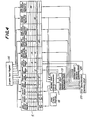
- the concrete setup of a memory device when the data are to be input from the graphic input register 16 to the fundamental connection table register 4 will be described by referring to Fig. 4.
- the graphic input register 16 By using the graphic input register 16, the required data from the graphic input register 16 can be stored in the registers 5, 6, 7, 8, 9, 11, 12, 13, 14, 15 and 24 in the fundamental connection table register 4, except the stereodescriptor register 10.
- the bonded atom rotational direction discriminator circuit 19 works to supply the coincidence signal to the first stereodescriptor examining circuit 25, and supply the non-coincidence signal to the second stereodescriptor examining circuit 26.
- the first stereodescriptor examining circuit 25 Upon receipt of a signal which indicates that the rotational directions are in agreement concerning the atoms bonded to a given asymmetric atom with a given atom address number, the signal being supplied from the bonded atom rotational direction discriminator circuit 19, the first stereodescriptor examining circuit 25 compares the weight of the atoms which are bonded to the asymmetric atom and stored in the registers 11, 12, 13, 14 and 15 to correspond to the atom address number of the asymmetric atom, as illustrated in a flow chart of Fig. 5.
- the stereodescriptor R is stored in the stereodescriptor register 10 to correspond to the address number of the asymmetric atom.
- the stereodescriptor S is stored in the stereodescriptor register 10 to correspond to the address number of the assymmetric atom.
- the stereodescriptor S is stored in the stereodescriptor register 10 to correspond to the address number of the asymmetric atom.
- the stereodescriptor R is stored in the stereodescriptor regsiter 10 to correspond to the address number of the asymmetric atom.
- the second stereodescriptor examining circuit 26 Upon receipt of a signal which indicates that the rotational directions are in agreement concerning the atoms bonded to a given asymmetric atom with a given atom address number, the signal being supplied from the bonded atom rotational direction discriminator circuit 19, the second stereodescriptor examining circuit 26 compares the weight of the atoms which are bonded to the asymmetric atom and stored in the registers 11, 12, 13, 14 and 15 to correspond to the atom address number of the asymmetric atom, as illustrated in the flow chart of Fig. 5.
- the stereodescriptor S is stored in the stereodescriptor register 10 to correspond to the address number of the asymmetric atom.
- the stereodescriptor R is stored in the stereodescriptor register 10 to correspond to the address number of the asymmetric atom.
- the stereodescriptor R is stored in the stereodescriptor register 10 to correspond to the address number of the asymmetric atom.
- the stereodescriptor S is stored in the stereodescriptor register 10 to correspond to the address number of the asymmetric atom.
- the second stereodescriptor examining circuit 26 stores the stereodescriptor S in the stereodescriptor register 10 to correspond to the atom address number 3 of the asymmetric carbon atom C, as exmplained in the flow chart of Fig. 5.
- the stereodescriptor S is in agreement with the symbol 3S of the original compound.
- the first stereodescriptor examining circuit 25 compares the weight of the atoms stored in the registers 11, 12, 13, 14 and 15 which store the atoms bonded to the asymmetric atom in the field of atom, address number 5.
- the first stereodescriptor examining circuit 25 stores the stereodescriptor S in the stereodescriptor register 10 to correspond to the atom address number 5 of the asymmetric carbon atom C, as explained in the flow chart of Fig. 5. Discrimination is also effected for other asymmetric carbon atoms in accordance with the flow chart of Fig. 5, and the stereodescriptors are stored in the stereodescriptor register 10 to correspond to atom address numbers of the asymmetric carbon atoms.
- the memory device of the present invention can be put into practice easily by using an electronic computer.
- the device for storing stereochemical information about chemical compounds of the present invention use is made of a main atom right direction connectivity register, a main atom reverse direction connectivity register, a side chain first direction connectivity register, and a side chain second direction connectivity register. Therefore, the stereodescriptor data of the compounds can be described and stored in a three-dimensional manner.
- the data stored in the main atom right direction connectivity register and those stored in the main atom reverse direction connectivity register can be exchanged for each of the fields of the same atom address numbers
- the data stored in the side chain first direction connectivity register and those stored in the side chain second direction connectivity register can be exchanged for each of the fields of the same atom address numbers.
- the stored data can be changed from those of a formula to those of a formula which is turning through 180° in the plane of the paper.
- the stored data can be changed from those of a formula to those of a formula that is turned back side front. Consequently, whether the formulae to be compared are identical or not can be easily discriminated.
- the present invention can be applied to the analysis of the systematic nomenclature of a compound including stereodescriptors for preparing an atom connection table.
- the initial stereospecific input of a fundamental skeleton such as pentane or cholestane
- the data system of stereospecific compounds can be established to exhibit very great effects for retrieving the compound data.
- a bond atom priority comparator circuit In the memory device according to the first and second embodiments of the present invention, there is included a bond atom priority comparator circuit, an atom priority register, a bonded atom rotational direction discriminator circuit, first and second stereodescriptor reading circuits, and first and second side chain atom direction examining circuits. It is therefore possible to automatically and easily determine in which one of the side chain first direction connectivity register and the side chain second direction connectivity register the side-chain atoms should be stored in a three-dimensional manner.
- the fundamental connection table register is provided with a condensation register, and the bonded atom priority comparator circuit discriminates the rotational direction based upon the data from the condensation register. Even for compounds having condensed parts, therefore, the decision can be properly rendered concerning in which one of the side chain first direction connectivity register the side chain second direction connectivity register the side-chain atom should be stored three-dimensionally, or concerning whether the side-chain atoms should be left stored in the unknown direction connectivity register.
- the memory device there is included a first stereodescriptor examining circuit and a second stereodescriptor examining circuit subsequent to the bonded atom rotational direction discriminator circuit. Therefore, the stereodescriptors that are to be stored in the stereodescriptor register in the fundamental connection table register but which cannot be input from the graphic input register can be automatically and easily discriminated.
Landscapes
- Engineering & Computer Science (AREA)
- Computing Systems (AREA)
- Theoretical Computer Science (AREA)
- Databases & Information Systems (AREA)
- Software Systems (AREA)
- Chemical & Material Sciences (AREA)
- Crystallography & Structural Chemistry (AREA)
- Life Sciences & Earth Sciences (AREA)
- Bioinformatics & Cheminformatics (AREA)
- Bioinformatics & Computational Biology (AREA)
- Executing Machine-Instructions (AREA)
- Information Retrieval, Db Structures And Fs Structures Therefor (AREA)
Claims (3)
Applications Claiming Priority (2)
| Application Number | Priority Date | Filing Date | Title |
|---|---|---|---|
| JP56750/82 | 1982-04-07 | ||
| JP57056750A JPS58175077A (ja) | 1982-04-07 | 1982-04-07 | 化合物の立体化学情報記憶方法及び装置 |
Publications (3)
| Publication Number | Publication Date |
|---|---|
| EP0090895A2 EP0090895A2 (fr) | 1983-10-12 |
| EP0090895A3 EP0090895A3 (en) | 1985-05-15 |
| EP0090895B1 true EP0090895B1 (fr) | 1989-01-18 |
Family
ID=13036196
Family Applications (1)
| Application Number | Title | Priority Date | Filing Date |
|---|---|---|---|
| EP82305050A Expired EP0090895B1 (fr) | 1982-04-07 | 1982-09-24 | Appareil pour enregistrer des informations stéreo-chimiques au sujet de composés chimiques |
Country Status (4)
| Country | Link |
|---|---|
| US (1) | US4473890A (fr) |
| EP (1) | EP0090895B1 (fr) |
| JP (1) | JPS58175077A (fr) |
| DE (1) | DE3279376D1 (fr) |
Families Citing this family (28)
| Publication number | Priority date | Publication date | Assignee | Title |
|---|---|---|---|---|
| US4642762A (en) * | 1984-05-25 | 1987-02-10 | American Chemical Society | Storage and retrieval of generic chemical structure representations |
| US4747059A (en) * | 1984-12-14 | 1988-05-24 | Suntory Limited | Process and apparatus for naming chemical structures and the application thereof |
| JPS61171435A (ja) * | 1984-12-14 | 1986-08-02 | Suntory Ltd | 有機化合物名の表記方法及びその装置 |
| JPS61223941A (ja) * | 1985-03-29 | 1986-10-04 | Kagaku Joho Kyokai | 化学構造の検索方法 |
| DE3689965T2 (de) * | 1985-08-12 | 1994-11-17 | Fuji Photo Film Co Ltd | Verfahren zum Verarbeiten von Informationen bezüglich chemischer Reaktionen. |
| JPS6257017A (ja) * | 1985-09-05 | 1987-03-12 | Fuji Photo Film Co Ltd | 化学反応情報の処理方法 |
| JPS6258331A (ja) * | 1985-09-09 | 1987-03-14 | Fuji Photo Film Co Ltd | 化学反応情報の記録・検索方法 |
| JPS6263335A (ja) * | 1985-09-13 | 1987-03-20 | Fuji Photo Film Co Ltd | 化学反応情報の処理方法 |
| US4967372A (en) * | 1986-05-16 | 1990-10-30 | The United States Of America As Represented By The Department Of Health And Human Services | Automatic orientation and interactive addressing of display |
| US5025388A (en) * | 1988-08-26 | 1991-06-18 | Cramer Richard D Iii | Comparative molecular field analysis (CoMFA) |
| DE3934220A1 (de) * | 1988-10-28 | 1990-06-07 | Akad Wissenschaften Ddr | Verfahren zur automatischen bildung des systematischen namens oder der strukturformel einer chemischen verbindung |
| US5157736A (en) * | 1991-04-19 | 1992-10-20 | International Business Machines Corporation | Apparatus and method for optical recognition of chemical graphics |
| US5345516A (en) * | 1991-04-19 | 1994-09-06 | International Business Machines Corporation | Apparatus and method for parsing a chemical string |
| US5386507A (en) * | 1991-07-18 | 1995-01-31 | Teig; Steven L. | Computer graphics system for selectively modelling molecules and investigating the chemical and physical properties thereof |
| EP0633534B1 (fr) * | 1992-03-27 | 2001-02-07 | ITAI, Akiko | Procede d'analyse de la structure d'un composite stable de biopolymere et de molecules de coordination |
| US5434796A (en) * | 1993-06-30 | 1995-07-18 | Daylight Chemical Information Systems, Inc. | Method and apparatus for designing molecules with desired properties by evolving successive populations |
| US5604859A (en) * | 1994-03-30 | 1997-02-18 | Ramsay; O. Bertrand | Display of partial periodic table arrays |
| US5577239A (en) * | 1994-08-10 | 1996-11-19 | Moore; Jeffrey | Chemical structure storage, searching and retrieval system |
| US6073080A (en) * | 1995-06-22 | 2000-06-06 | Kureha Kagaku Kogyo Kabushiki Kaisha | Computer system and method for production of molecular structure diagram |
| US7912689B1 (en) | 1999-02-11 | 2011-03-22 | Cambridgesoft Corporation | Enhancing structure diagram generation through use of symmetry |
| US7054754B1 (en) * | 1999-02-12 | 2006-05-30 | Cambridgesoft Corporation | Method, system, and software for deriving chemical structural information |
| US7295931B1 (en) | 1999-02-18 | 2007-11-13 | Cambridgesoft Corporation | Deriving fixed bond information |
| JP4660675B2 (ja) * | 1999-10-08 | 2011-03-30 | 独立行政法人理化学研究所 | 分子の立体化学コード化方法 |
| US6779152B1 (en) * | 1999-12-07 | 2004-08-17 | International Business Machines Corporation | Method for rotating a dynamic HTML table |
| US7356419B1 (en) * | 2000-05-05 | 2008-04-08 | Cambridgesoft Corporation | Deriving product information |
| US7272509B1 (en) * | 2000-05-05 | 2007-09-18 | Cambridgesoft Corporation | Managing product information |
| DE10043853A1 (de) * | 2000-09-06 | 2002-03-14 | Merck Patent Gmbh | Verfahren zur Erstellung von Synthesepfaden |
| WO2003012676A2 (fr) * | 2001-07-31 | 2003-02-13 | Apt Therapeutics, Inc. | Calcul d'une propriete caracteristique d'une molecule par une analyse de correlation |
Family Cites Families (1)
| Publication number | Priority date | Publication date | Assignee | Title |
|---|---|---|---|---|
| FR2286443A1 (fr) * | 1974-09-16 | 1976-04-23 | Anvar | Appareil pour le codage et la visualisation simultanes d'un graphe |
-
1982
- 1982-04-07 JP JP57056750A patent/JPS58175077A/ja active Granted
- 1982-09-24 EP EP82305050A patent/EP0090895B1/fr not_active Expired
- 1982-09-24 DE DE8282305050T patent/DE3279376D1/de not_active Expired
- 1982-09-24 US US06/422,921 patent/US4473890A/en not_active Expired - Fee Related
Also Published As
| Publication number | Publication date |
|---|---|
| EP0090895A3 (en) | 1985-05-15 |
| JPS58175077A (ja) | 1983-10-14 |
| EP0090895A2 (fr) | 1983-10-12 |
| DE3279376D1 (en) | 1989-02-23 |
| US4473890A (en) | 1984-09-25 |
| JPH0225549B2 (fr) | 1990-06-04 |
Similar Documents
| Publication | Publication Date | Title |
|---|---|---|
| EP0090895A2 (fr) | Appareil pour enregistrer des informations stéreo-chimiques au sujet de composés chimiques | |
| Mizuguchi et al. | JOY: protein sequence-structure representation and analysis. | |
| Stewart | Mutated hybrid inflation | |
| KR970703566A (ko) | 생화학 정보처리장치, 생화학 정보처리방법 및 생화학 정보기억매체 | |
| CN101509783B (zh) | 应用于导航电子地图生产中的数据检查方法及装置 | |
| Weisgerber | Chemical abstracts service chemical registry system: history, scope, and impacts | |
| EP1019848B1 (fr) | Masque de saisie associant des donnees a un type de champ correspondant | |
| Rosselló et al. | Chemical graphs, chemical reaction graphs, and chemical graph transformation | |
| WO2006041787A2 (fr) | Procede et appareil pour la presentation de modeles architecturaux techniques, et solutions correspondantes | |
| Fluck | Inorganic crystal structure database (ICSD) and standardized data and crystal chemical characterization of inorganic structure types (TYPIX)—Two tools for inorganic chemists and crystallographers | |
| US20010034748A1 (en) | Information architecture for the interactive environment | |
| Karp et al. | Ecocyc: The resource and the lessons learned | |
| EP0302547A2 (fr) | Appareil pour effectuer une recherche dans une représentation topologique d'un résau de connexion géographique. | |
| Burzlaff et al. | On quantitative relations among crystal structures | |
| Stewart | MOPAC manual. A general molecular orbital package | |
| CN112181435A (zh) | 一种跨平台的作业转换方法、装置、电子设备和存储介质 | |
| Norton | Vendor Catalogs in Science/Technical Libraries: Why–and How | |
| Mulholland et al. | Practical evaluation of ion chromatography methods developed by an expert system | |
| Jin et al. | Factbase filtering issues in an ontology-based reverse engineering tool integration system | |
| US20240005074A1 (en) | 3d integrated circuit with enhanced debugging capability | |
| Postma et al. | A data base approach on analytical chemical methods applying fuzzy logic in the search strategy and flow charts for the representation of the retrieved analytical procedures | |
| Robertson et al. | MASSFORM: a computer program for the assignment of elemental compositions to high resolution mass spectral data | |
| CN109448789A (zh) | 一种基于perl语言的种群特异SNP位点的自动化分析方法 | |
| Osinga et al. | Documentation of Chemical Reactions. IV. Further Applications of WLN Analysis Programs: A System for Automatic Generation and Retrieval of Information on Chemical Compounds (AGRICC) | |
| US20090299995A1 (en) | Method for outputting data records, and device therefor |
Legal Events
| Date | Code | Title | Description |
|---|---|---|---|
| PUAI | Public reference made under article 153(3) epc to a published international application that has entered the european phase |
Free format text: ORIGINAL CODE: 0009012 |
|
| AK | Designated contracting states |
Designated state(s): CH DE FR GB LI |
|
| PUAL | Search report despatched |
Free format text: ORIGINAL CODE: 0009013 |
|
| AK | Designated contracting states |
Designated state(s): CH DE FR GB LI |
|
| 17P | Request for examination filed |
Effective date: 19850703 |
|
| 17Q | First examination report despatched |
Effective date: 19861112 |
|
| GRAA | (expected) grant |
Free format text: ORIGINAL CODE: 0009210 |
|
| AK | Designated contracting states |
Kind code of ref document: B1 Designated state(s): CH DE FR GB LI |
|
| REF | Corresponds to: |
Ref document number: 3279376 Country of ref document: DE Date of ref document: 19890223 |
|
| ET | Fr: translation filed | ||
| PLBE | No opposition filed within time limit |
Free format text: ORIGINAL CODE: 0009261 |
|
| STAA | Information on the status of an ep patent application or granted ep patent |
Free format text: STATUS: NO OPPOSITION FILED WITHIN TIME LIMIT |
|
| 26N | No opposition filed | ||
| PGFP | Annual fee paid to national office [announced via postgrant information from national office to epo] |
Ref country code: GB Payment date: 19930824 Year of fee payment: 12 |
|
| PGFP | Annual fee paid to national office [announced via postgrant information from national office to epo] |
Ref country code: DE Payment date: 19930906 Year of fee payment: 12 |
|
| PGFP | Annual fee paid to national office [announced via postgrant information from national office to epo] |
Ref country code: FR Payment date: 19930921 Year of fee payment: 12 |
|
| PGFP | Annual fee paid to national office [announced via postgrant information from national office to epo] |
Ref country code: CH Payment date: 19930924 Year of fee payment: 12 |
|
| PG25 | Lapsed in a contracting state [announced via postgrant information from national office to epo] |
Ref country code: GB Effective date: 19940924 |
|
| PG25 | Lapsed in a contracting state [announced via postgrant information from national office to epo] |
Ref country code: LI Effective date: 19940930 Ref country code: CH Effective date: 19940930 |
|
| GBPC | Gb: european patent ceased through non-payment of renewal fee |
Effective date: 19940924 |
|
| PG25 | Lapsed in a contracting state [announced via postgrant information from national office to epo] |
Ref country code: FR Effective date: 19950531 |
|
| REG | Reference to a national code |
Ref country code: CH Ref legal event code: PL |
|
| PG25 | Lapsed in a contracting state [announced via postgrant information from national office to epo] |
Ref country code: DE Effective date: 19950601 |
|
| REG | Reference to a national code |
Ref country code: FR Ref legal event code: ST |