EP0091028A2 - Catalyse d'hydrogenation d'amines aromatiques par nickel de Raney - Google Patents
Catalyse d'hydrogenation d'amines aromatiques par nickel de Raney Download PDFInfo
- Publication number
- EP0091028A2 EP0091028A2 EP83102960A EP83102960A EP0091028A2 EP 0091028 A2 EP0091028 A2 EP 0091028A2 EP 83102960 A EP83102960 A EP 83102960A EP 83102960 A EP83102960 A EP 83102960A EP 0091028 A2 EP0091028 A2 EP 0091028A2
- Authority
- EP
- European Patent Office
- Prior art keywords
- catalyst
- amine
- nickel
- hydrogen
- alloy
- Prior art date
- Legal status (The legal status is an assumption and is not a legal conclusion. Google has not performed a legal analysis and makes no representation as to the accuracy of the status listed.)
- Granted
Links
Images

Classifications
-
- B—PERFORMING OPERATIONS; TRANSPORTING
- B01—PHYSICAL OR CHEMICAL PROCESSES OR APPARATUS IN GENERAL
- B01J—CHEMICAL OR PHYSICAL PROCESSES, e.g. CATALYSIS OR COLLOID CHEMISTRY; THEIR RELEVANT APPARATUS
- B01J25/00—Catalysts of the Raney type
- B01J25/02—Raney nickel
Definitions
- This invention relates to Raney nickel alloy catalysts useful for hydrogenation reactions.
- Raney nickel is a well-known hydrogenation catalyst which was described originally in U.S.
- Raney nickel is prepared by alloying nickel and aluminum and leaching out the aluminum with alkali to expose nickel as a finely divided porous solid in which form nickel is an effective hydrogenation catalyst.
- the present invention provides an improved monolithic Raney hydrogenation catalyst for use in hydrogenation reactions, said catalyst being comprised of an integral Raney metal alloy surface layer on a selected alloy substrate mesh structure wherein said surface layer is predominantly derived from an adherent Beta structured crystalline precursor outer portion of said structure.
- the invention further comprises a method of using said monolithic Raney catalyst in hydrogenation reactions wherein said catalyst is produced by
- Raney nickel-catalytic activator alloy catalysts of this invention have been utilized as catalysts for hydrogenating an amine-substituted aromatic compound of the type wherein K is either benzene or naphthalene, R 1 is a hydrogen atom or an aliphatic chain containing from about 1 to about 12 carbon atoms or a phenyl radical; R 2 is a hydrogen atom, an amine group or an aliphatic chain containing from about 1 to about 3 carbon atoms, R 3 is hydrogen or an amine group, and R 4 is an amine group.
- K is either benzene or naphthalene
- R 1 is a hydrogen atom or an aliphatic chain containing from about 1 to about 12 carbon atoms or a phenyl radical
- R 2 is a hydrogen atom, an amine group or an aliphatic chain containing from about 1 to about 3 carbon atoms
- R 3 is hydrogen or an amine group
- R 4 is an amine group.
- the catalysts of the present invention are applicable to this process in a manner which is substantially advantageous when compared to prior art catalysts.
- This invention is described in terms of the preparation and use of a monolithic Raney nickel alloy catalyst having about 5 to about 20 percent by weight of molybdenum therein. It should be understood that the molybdenum may be replaced in whole or in part by ruthenium, titanium, tantalum or mixtures thereof in the broader aspects of the invention.
- Catalyst (5) of the present invention is prepared as shown in FIG. 1.
- the integral Raney nickel alloy surface of the monolithic catalyst (5) of this invention is formed on a supportive nickel bearing core or substrate.
- cores of substantially pure nickel or an appropriate nickel bearing alloy such as Inconel 600, Hastelloy C or 310 stainless steel can be used, it is preferred to have the outer portions of the core (core is used interchangeably herein with substrate) itself serve as the nickel bearing alloy outer layer.
- a nickel alloy coating of the desired composition should first be deposited onto the surfaces thereof by a variety of known techniques such as metal dipping, electroplating, electroless plating and the like.
- This coating should be at least 100 microns and preferably at least 150 microns thick. This helps to substantially improve the thermal stability of the coating by making the transition across the coating/substrate interface much less abrupt and thus greatly reducing tensile stresses and the possibility of corrosion and subsequent failure at this interface.
- the core material for the catalyst of the present invention comprises an alloy in which nickel and the selected alloying material are melted together to form a precursor ingot (10) having the desired composition.
- the preferred alloy weight percentage for the molybdenum component is between about 10 and about 18; for ruthenium, it is betweeen about 5 and about 10 percent; for tantalum, it is between about 5 and about 15 percent; and for titanium, it is betweeen about 5 and about 10 percent.
- the cast ingot is then rolled out to form a sheet or strip (12) preferably in the thickness range of between about 0.0254and about 0.0508 cm
- a perforated metal base particularly an expanded metal screen or mesh (14)
- an open structure is found to be a significant factor in providing a catalytic process having substantial life-time and operational advantages over other types of catalytic structures used for this purpose.
- the final mesh which is prepared by conventional metal expansion techniques forms a.regularly shaped diamond or square celled structure typically having cells on the order of 0.508 to 0.762 cm - on a side.
- the thickness and mesh opening values are not critical and, depending on such.factors as alloy composition and reaction parameters, other cell sizes could easily be used.
- expanded mesh (14) Prior to further processing, expanded mesh (14) is thoroughly cleaned by conventional means, such as degreasing, acid etching and/or grit blasting (16) to remove surface contaminates and thus improve the wetting of the subsequently applied aluminum to the surface.
- conventional means such as degreasing, acid etching and/or grit blasting (16) to remove surface contaminates and thus improve the wetting of the subsequently applied aluminum to the surface.
- aluminizing as used herein, it is meant that aluminum is brought into intimate contact with the cleaned nickel bearing alloy material at the surface of the core so that when heat-treated at interdiffusion step (20), the desired nickel alloy-aluminum alloy layer is formed.
- an aluminum layer of at least 100-micron thickness should be deposited on the surface of the core.
- Interdiffusion step or heat treat step (20) is carried out at a temperature of at.least about 660°C., i.e., above the normal melting point of aluminum. However, to drive the interdiffusion process at a reasonable rate, higher temperatures should be used, with the temperature within the range of from about 700°C. to about 750°C. and particularly from about 715°C. to about 735°C. being most preferred.
- interdiffusion is carried out in an atmosphere ot hydrogen, nitrogen or an inert gas to prevent oxidation of the surface.
- This interdiffusion heat treatment is continued for a time sufficient for the aluminum and nickel alloy to react to form a nickel alloy-aluminum ternary alloy of at least about 40 microns and preferably at least about 80 microns in thickness. Interdiffusion times within the range of from about 5 to about 30 minutes satisfy this need.
- interdiffused alloy layers of about 100 to about 400 microns in thickness are preferred, with best results obtained with a thickness from about 150 to about 300 microns.
- the formation of the desired integral nickel-molybdenum-aluminum Beta structured ternary alloy layer is followed by a selective leaching step (22), wherein sufficient aluminum is removed to form an active Raney surface layer.
- a strong aqueous base such as NaOH, KOH or other strongly basic solution capable of dissolving aluminum, is generally used.
- leaching is carried out with an aqueous caustic solution containing about 1 to about 30 weight percent NaOH.
- a preferred selective leaching procedure for producing porous nickel surfaces of the invention is carried out first for about 2 hours with 1 percent NaOH, then for about 20 hours with about 10 percent NaOH, both of these substeps being under ambient conditions in which temperature is not controlled, and finally for about 4 hours with about 30 percent_NaOH at about 100 ° C.
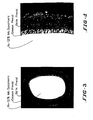
- This leaching procedure removes at least about 60 percent, and preferably between about 75 to about 95 percent, of the aluminum from the interdiffused alloy layer and as shown in FIGS. 3 and 4 provides a porous surface of unusually high catalytic activity. It is recognized that the leaching conditions can be varied from those mentioned above to achieve equally effective selective dissolution of the aluminum.
- catalyst (5) The appearance of catalyst (5) at this stage is shown in FIG. 2.
- An enlarged cross section (250x) of a strand of treated Ni-l2%Mo expanded metal is shown in FIG. 3 and a 750x enlargement of the porous Raney surface coating is shown in FIG. 4.
- Beta structured Raney Ni-12%Mo layer is about three times as thick as the underlying Gamma layer. Since the predominant Beta layer is the outer layer which will be in contact with any medium in which the coated core is placed and is what serves to control the catalytic activity of the coating, the structure shown in FIGS. 3 and 4 is collectively called a Beta Raney Ni-12%Mo coating.
- the active nickel alloy coatings may exhibit a tendency to heat up when exposed to air. If uncontrolled, this self-heating or pyrophoric tendency can easily lead to problems with coating ignition with consequent severe damage to the coating.
- chemically treating (24) the porous nickel alloy layer has been found to eliminate this problem. Convenient methods for this chemical treatment include immersing the porous nickel alloy for between about 1 hour and about 4 hours in a dilute aqueous solution of an oxidant containing, for example, by weight either
- This treatment safely eliminates the self-heating tendency of the porous nickel alloy surface without diminishing either its catalytic activity or mechanical properties.
- the mechanical properties of the layer can be improved still further by optionally coating a very thin layer of nickel onto the porous surface (26).
- This nickel layer which is preferably about 5 to about 10 microns thick, can be applied from conventional electroless nickel or a nickel electroplating bath and enhances the mechanical strength of the porous nickel alloy layer without diminishing its catalytic activity.
- the catalyst may have to be "activated” to remove any oxidation products which may coat the surface and cause some degree of deterioration of its catalytic properties. This can be done by treating the catalyst with a flowing stream of dry hydrogen at a temperature of between about 250°C. and 350°C. for a time of between about 2 and about 24 hours.
- this operation is done in the hydrogenation reactor system used, before the first hydrogenation with the activated catalyst, and then kept in a hydrogen atmosphere or covered with an inert solvent, such as cyclohexane, thereafter.
- catalyst (5) is placed in the reactor in a plurality pf randomly oriented layers such that a mixture of reactive material and hydrogen will contact said layers. Typically, this can be done by mounting the layers immediately above a stirrer which will cause a continuous flow of material through them.
- the reactive materials pass through the catalyst layers, which are present in the form of a plurality of randomly oriented stacked layers within the system, reacting enroute to form the saturated alicyclic amine compound corresponding to the aromatic amine compound entering the reactor.
- the open catalyst structure presents a relatively low impedance to the reactants so that the observed pressure drop through such a reactor is quite small. This low pressure drop combined with the high reactivity of the catalyst allows extremely high flow rates through the system.
- the reactive amine is often dissolved in an inert solvent as a carrier. This also tends to drive the reaction to completion by increasing the hydrogen:reactive amine ratio.
- an inert solvent for the amine reactant may be used. Typical solvents include cyclohexane, and similar cycloaliphatics, kerosene, and decahydronaphthalene.
- Suitable aromatic amine reactants include both primary and secondary aromatic amines such as aniline, 2,4- and 2,6-toluenediamine, 2,4,6-toluene triamine, toluidine, benzidine, naphthylamines, phenyl ethylamine, phenyl hexylamine, phenyl dodecylamine, naphthyl dodecylamine, p,p!-bis(aminophenyl) methane, 1,5-naphthylene diamine, etc. Mixtures of amines such as 2,4- and 2,6-toluenediamine can also be used.
- aromatic amines such as aniline, 2,4- and 2,6-toluenediamine, 2,4,6-toluene triamine, toluidine, benzidine, naphthylamines, phenyl ethylamine, phenyl hexylamine, phenyl dodecylamine
- the solute/solvent ratio will depend upon the solubility of the solute in the solvent. Generally speaking, it is desirable to utilize a saturated solution with flow rate and/or catalyst quantity being adjusted to assure adequate catalyst contact time to complete the reaction.
- the reaction takes between about 30 minutes and about 6 hours depending on the temperature, hydrogen pressure and quantity of catalyst used.
- the reaction with the underlying benzene ring was complete after about 4 hours.
- reaction kinetics as a function of temperature and pressure, will determine the catalyst contact time required for any particular compound.
- the catalyst of this invention offers a number of advantages when compared to prior art granular or supported Raney nickel based catalysts. For example, the markedly reduced sensitivity to both CO and sulfur as compared to present day Raney catalysts greatly increases the utility of this catalyst.
- Another advantage of this catalyst is its surprising ability to hydrogenate aromatic amines.
- a catalyst was prepared as follows:
- the cleaned nickel molybdenum alloy discs were aluminized by applying a commercial flux and then dipping in a pot of molten aluminum at 675° for 1 minute to entirely coat the discs with aluminum.
- the aluminized discs were then heat-treated at about 725°C. for about 15 minutes in a nitrogen.atmosphere to interdiffuse the nickel alloy and aluminum.
- the discs were allowed to cool in a current of nitrogen for about 2 hours which produced a predominantly Beta phase structured, interdiffused layer on the surface.
- the discs were then subjected to a leaching treatment in which the aluminum was selectively removed from the interdiffused layer to produce an active porous nickel-molybdenum surface on the discs.
- the leaching treatment comprised immersing the interdiffused discs in 20 percent NaOH at 80°C. for approximately'1 hour to dissolve away the excess aluminum and expose the catalytically active Beta phase.
- the catalyst discs were first washed to remove loose material and then placed in a Parr autoclave while still wet and dried in a stream of hydrogen. They were then activated by continuing the flow of hydrogen at a temperature of about 300°C. for about 16 hours.
- reaction products were identified by mass spectroscopic analyses. No evidence of ring cracking was observed.
Landscapes
- Chemical & Material Sciences (AREA)
- Engineering & Computer Science (AREA)
- Materials Engineering (AREA)
- Organic Chemistry (AREA)
- Chemical Kinetics & Catalysis (AREA)
- Organic Low-Molecular-Weight Compounds And Preparation Thereof (AREA)
- Catalysts (AREA)
- Low-Molecular Organic Synthesis Reactions Using Catalysts (AREA)
Applications Claiming Priority (2)
| Application Number | Priority Date | Filing Date | Title |
|---|---|---|---|
| US365211 | 1982-04-05 | ||
| US06/365,211 US4503251A (en) | 1982-04-05 | 1982-04-05 | Raney nickel catalysis of aromatic amines |
Publications (3)
| Publication Number | Publication Date |
|---|---|
| EP0091028A2 true EP0091028A2 (fr) | 1983-10-12 |
| EP0091028A3 EP0091028A3 (en) | 1986-02-05 |
| EP0091028B1 EP0091028B1 (fr) | 1987-12-23 |
Family
ID=23437936
Family Applications (1)
| Application Number | Title | Priority Date | Filing Date |
|---|---|---|---|
| EP83102960A Expired EP0091028B1 (fr) | 1982-04-05 | 1983-03-24 | Catalyse d'hydrogenation d'amines aromatiques par nickel de Raney |
Country Status (7)
| Country | Link |
|---|---|
| US (1) | US4503251A (fr) |
| EP (1) | EP0091028B1 (fr) |
| JP (1) | JPS58189142A (fr) |
| AU (1) | AU1253083A (fr) |
| CA (1) | CA1220489A (fr) |
| DE (1) | DE3375011D1 (fr) |
| ZA (1) | ZA831820B (fr) |
Cited By (6)
| Publication number | Priority date | Publication date | Assignee | Title |
|---|---|---|---|---|
| EP0120122A3 (en) * | 1983-01-31 | 1985-04-03 | Olin Corporation | Hydrogenation of long chain olefinic oils with raney catalyst |
| EP0799817A1 (fr) * | 1996-04-03 | 1997-10-08 | Bayer Ag | Procédé pour la préparation d'un mélange d'amino-méthyl-cyclohexane et de diamino-méthyl-cyclohexane |
| US5741929A (en) * | 1996-03-18 | 1998-04-21 | Bayer Aktiengesellschaft | Process for preparing a mixture of amino-methyl-cyclohexanes and diamino-methyl-cyclohexanes |
| WO1998049365A1 (fr) * | 1997-04-29 | 1998-11-05 | E.I. Du Pont De Nemours And Company | Revetements colonnaires a squelette |
| US6998366B2 (en) | 1999-12-28 | 2006-02-14 | Basf Aktiengesellschaft | Thin layer catalysts based on Raney alloys, and method for the production thereof |
| EP1702681A2 (fr) | 2005-03-08 | 2006-09-20 | H.C. Starck GmbH | Corps catalytique mis en forme, puls particulièrement utilisable en tant que catalyseur d'hydrogénation |
Families Citing this family (6)
| Publication number | Priority date | Publication date | Assignee | Title |
|---|---|---|---|---|
| US5322965A (en) * | 1991-03-01 | 1994-06-21 | Bayer Aktiengesellschaft | Process for the preparation of a mixture of cyclohexylamine and dicyclohexylamine using a supported noble metal catalyst |
| DE4133675A1 (de) * | 1991-10-11 | 1993-04-15 | Bayer Ag | Verfahren zur herstellung eines gemisches aus cyclohexylamin und dicyclohexylamin |
| US5380946A (en) * | 1993-07-30 | 1995-01-10 | Monsanto Company | Process for preparing p-nitroaromatic amides and products thereof |
| FR2710856B1 (fr) * | 1993-10-07 | 1995-12-29 | Rhone Poulenc Chimie | Composition de matière utile comme catalyseur de type Raney, pour l'hydrogénation d'halogénonitroaromatiques en halogénoaminoaromatiques et procédé en faisant application. |
| US9273559B2 (en) | 2013-03-08 | 2016-03-01 | General Electric Company | Turbine blade cooling channel formation |
| EP4685129A1 (fr) | 2024-07-26 | 2026-01-28 | Evonik Operations GmbH | Procédé d'hydrogénation de mda |
Family Cites Families (8)
| Publication number | Priority date | Publication date | Assignee | Title |
|---|---|---|---|---|
| US2092525A (en) * | 1932-06-27 | 1937-09-07 | Adkins Homer | Hydrogenation of primary aromatic amines |
| US2606925A (en) * | 1949-12-15 | 1952-08-12 | Du Pont | Ruthenium catalyzed hydrogenation process for obtaining aminocyclohexyl compounds |
| US2716135A (en) * | 1950-12-29 | 1955-08-23 | Allied Chem & Dye Corp | Catalytic hydrogenation of aromatic nitro compounds to amines |
| US3032586A (en) * | 1953-11-13 | 1962-05-01 | Bayer Ag | Hydrogenation of dinitrotoluene to toluylene diamine |
| US2948687A (en) * | 1955-12-13 | 1960-08-09 | Gen Electric | Hydrogenation catalyst |
| US2945063A (en) * | 1956-07-26 | 1960-07-12 | Monsanto Chemicals | Preparation of cyclohexane methylamine |
| US3697449A (en) * | 1970-12-14 | 1972-10-10 | Du Pont | Alkali moderation of supported ruthenium catalysts |
| US4153578A (en) * | 1978-07-31 | 1979-05-08 | Gaf Corporation | Catalyst comprising Raney nickel with adsorbed molybdenum compound |
-
1982
- 1982-04-05 US US06/365,211 patent/US4503251A/en not_active Expired - Fee Related
-
1983
- 1983-03-07 CA CA000423059A patent/CA1220489A/fr not_active Expired
- 1983-03-16 ZA ZA831820A patent/ZA831820B/xx unknown
- 1983-03-17 AU AU12530/83A patent/AU1253083A/en not_active Abandoned
- 1983-03-24 DE DE8383102960T patent/DE3375011D1/de not_active Expired
- 1983-03-24 EP EP83102960A patent/EP0091028B1/fr not_active Expired
- 1983-04-04 JP JP58058052A patent/JPS58189142A/ja active Pending
Cited By (8)
| Publication number | Priority date | Publication date | Assignee | Title |
|---|---|---|---|---|
| EP0120122A3 (en) * | 1983-01-31 | 1985-04-03 | Olin Corporation | Hydrogenation of long chain olefinic oils with raney catalyst |
| US5741929A (en) * | 1996-03-18 | 1998-04-21 | Bayer Aktiengesellschaft | Process for preparing a mixture of amino-methyl-cyclohexanes and diamino-methyl-cyclohexanes |
| EP0799817A1 (fr) * | 1996-04-03 | 1997-10-08 | Bayer Ag | Procédé pour la préparation d'un mélange d'amino-méthyl-cyclohexane et de diamino-méthyl-cyclohexane |
| US5739404A (en) * | 1996-04-03 | 1998-04-14 | Bayer Aktiengesellschaft | Process for preparing a mixture of amino-methyl-cyclohexanes and diamino-methyl-cyclohexanes |
| WO1998049365A1 (fr) * | 1997-04-29 | 1998-11-05 | E.I. Du Pont De Nemours And Company | Revetements colonnaires a squelette |
| US5993979A (en) * | 1997-04-29 | 1999-11-30 | E. I. Du Pont De Nemours And Company | Skeletal columnar coatings |
| US6998366B2 (en) | 1999-12-28 | 2006-02-14 | Basf Aktiengesellschaft | Thin layer catalysts based on Raney alloys, and method for the production thereof |
| EP1702681A2 (fr) | 2005-03-08 | 2006-09-20 | H.C. Starck GmbH | Corps catalytique mis en forme, puls particulièrement utilisable en tant que catalyseur d'hydrogénation |
Also Published As
| Publication number | Publication date |
|---|---|
| CA1220489A (fr) | 1987-04-14 |
| US4503251A (en) | 1985-03-05 |
| EP0091028A3 (en) | 1986-02-05 |
| EP0091028B1 (fr) | 1987-12-23 |
| JPS58189142A (ja) | 1983-11-04 |
| DE3375011D1 (en) | 1988-02-04 |
| ZA831820B (en) | 1983-12-28 |
| AU1253083A (en) | 1983-10-13 |
Similar Documents
| Publication | Publication Date | Title |
|---|---|---|
| US4513149A (en) | Raney nickel alloy expanded mesh hydrogenation catalysts | |
| US4422961A (en) | Raney alloy methanation catalyst | |
| EP0091028B1 (fr) | Catalyse d'hydrogenation d'amines aromatiques par nickel de Raney | |
| EP0120122B1 (fr) | Hydrogénation d'huiles oléfiniques à longue chaîne avec un catalyseur Raney | |
| US4743577A (en) | Catalyst composition | |
| US6878849B2 (en) | Metal modified PD/NI catalysts | |
| US4233185A (en) | Catalysts for oxidation and reduction | |
| CN117899856A (zh) | 一种用于腈加氢制备伯胺的催化剂及其制备方法 | |
| CN113600201A (zh) | 一种硝基苯液相加氢制备苯胺催化剂的制备方法及其应用 | |
| US4491564A (en) | Reactor containing a methanation catalyst | |
| JP2005528981A (ja) | 担持型触媒の製造のための湿式製錬方法 | |
| EP0076602A2 (fr) | Catalyseur pour la production du méthane | |
| USRE32104E (en) | Raney alloy methanation catalyst | |
| US1907710A (en) | Metal catalyst and preparation thereof | |
| US4187200A (en) | Method of making a supported porous metal catalyst | |
| CN114433127B (zh) | 加氢催化剂及其制备方法和应用以及顺酐加氢制丁二酸的方法 | |
| JPS58159426A (ja) | 改良されたメタン化方法 | |
| JPS6114862B2 (fr) | ||
| US3360335A (en) | Process for preparing hydrogen cyanide | |
| CA1133680A (fr) | Synthese catalysee de l'ammoniac | |
| JP2728900B2 (ja) | 隔壁型触媒及び該触媒用反応装置 | |
| US4389386A (en) | HNCO Manufacture by catalytic oxidation of HCN with a Pd doped Ag catalyst | |
| US4353841A (en) | Aromatic isocyanate preparation | |
| JPH09124562A (ja) | 芳香族アミノ化合物の製造方法 | |
| JPS60137434A (ja) | メタノ−ル改質用触媒 |
Legal Events
| Date | Code | Title | Description |
|---|---|---|---|
| PUAI | Public reference made under article 153(3) epc to a published international application that has entered the european phase |
Free format text: ORIGINAL CODE: 0009012 |
|
| AK | Designated contracting states |
Designated state(s): BE DE FR GB IT NL SE |
|
| 17P | Request for examination filed |
Effective date: 19830921 |
|
| PUAL | Search report despatched |
Free format text: ORIGINAL CODE: 0009013 |
|
| AK | Designated contracting states |
Designated state(s): BE DE FR GB IT NL SE |
|
| 17Q | First examination report despatched |
Effective date: 19870311 |
|
| GRAA | (expected) grant |
Free format text: ORIGINAL CODE: 0009210 |
|
| ITF | It: translation for a ep patent filed | ||
| AK | Designated contracting states |
Kind code of ref document: B1 Designated state(s): BE DE FR GB IT NL SE |
|
| PG25 | Lapsed in a contracting state [announced via postgrant information from national office to epo] |
Ref country code: SE Effective date: 19871231 |
|
| ET | Fr: translation filed | ||
| REF | Corresponds to: |
Ref document number: 3375011 Country of ref document: DE Date of ref document: 19880204 |
|
| PLBE | No opposition filed within time limit |
Free format text: ORIGINAL CODE: 0009261 |
|
| STAA | Information on the status of an ep patent application or granted ep patent |
Free format text: STATUS: NO OPPOSITION FILED WITHIN TIME LIMIT |
|
| 26N | No opposition filed | ||
| PG25 | Lapsed in a contracting state [announced via postgrant information from national office to epo] |
Ref country code: GB Effective date: 19890324 |
|
| PG25 | Lapsed in a contracting state [announced via postgrant information from national office to epo] |
Ref country code: BE Effective date: 19890331 |
|
| BERE | Be: lapsed |
Owner name: OLIN CORP. Effective date: 19890331 |
|
| PG25 | Lapsed in a contracting state [announced via postgrant information from national office to epo] |
Ref country code: NL Effective date: 19891001 |
|
| NLV4 | Nl: lapsed or anulled due to non-payment of the annual fee | ||
| GBPC | Gb: european patent ceased through non-payment of renewal fee | ||
| PG25 | Lapsed in a contracting state [announced via postgrant information from national office to epo] |
Ref country code: FR Free format text: LAPSE BECAUSE OF NON-PAYMENT OF DUE FEES Effective date: 19891130 |
|
| PG25 | Lapsed in a contracting state [announced via postgrant information from national office to epo] |
Ref country code: DE Effective date: 19891201 |
|
| REG | Reference to a national code |
Ref country code: FR Ref legal event code: ST |