EP0091132A2 - Système de robot - Google Patents
Système de robot Download PDFInfo
- Publication number
- EP0091132A2 EP0091132A2 EP83103402A EP83103402A EP0091132A2 EP 0091132 A2 EP0091132 A2 EP 0091132A2 EP 83103402 A EP83103402 A EP 83103402A EP 83103402 A EP83103402 A EP 83103402A EP 0091132 A2 EP0091132 A2 EP 0091132A2
- Authority
- EP
- European Patent Office
- Prior art keywords
- robot
- light
- slit
- image
- range data
- Prior art date
- Legal status (The legal status is an assumption and is not a legal conclusion. Google has not performed a legal analysis and makes no representation as to the accuracy of the status listed.)
- Granted
Links
Images





Classifications
-
- B—PERFORMING OPERATIONS; TRANSPORTING
- B25—HAND TOOLS; PORTABLE POWER-DRIVEN TOOLS; MANIPULATORS
- B25J—MANIPULATORS; CHAMBERS PROVIDED WITH MANIPULATION DEVICES
- B25J19/00—Accessories fitted to manipulators, e.g. for monitoring, for viewing; Safety devices combined with or specially adapted for use in connection with manipulators
- B25J19/02—Sensing devices
- B25J19/021—Optical sensing devices
- B25J19/023—Optical sensing devices including video camera means
-
- B—PERFORMING OPERATIONS; TRANSPORTING
- B25—HAND TOOLS; PORTABLE POWER-DRIVEN TOOLS; MANIPULATORS
- B25J—MANIPULATORS; CHAMBERS PROVIDED WITH MANIPULATION DEVICES
- B25J9/00—Program-controlled manipulators
- B25J9/10—Program-controlled manipulators characterised by positioning means for manipulator elements
- B25J9/1005—Program-controlled manipulators characterised by positioning means for manipulator elements comprising adjusting means
- B25J9/1015—Program-controlled manipulators characterised by positioning means for manipulator elements comprising adjusting means using additional, e.g. microadjustment of the end effector
-
- G—PHYSICS
- G06—COMPUTING OR CALCULATING; COUNTING
- G06T—IMAGE DATA PROCESSING OR GENERATION, IN GENERAL
- G06T1/00—General purpose image data processing
- G06T1/0014—Image feed-back for automatic industrial control, e.g. robot with camera
-
- G—PHYSICS
- G06—COMPUTING OR CALCULATING; COUNTING
- G06V—IMAGE OR VIDEO RECOGNITION OR UNDERSTANDING
- G06V10/00—Arrangements for image or video recognition or understanding
- G06V10/10—Image acquisition
-
- G—PHYSICS
- G06—COMPUTING OR CALCULATING; COUNTING
- G06V—IMAGE OR VIDEO RECOGNITION OR UNDERSTANDING
- G06V10/00—Arrangements for image or video recognition or understanding
- G06V10/10—Image acquisition
- G06V10/12—Details of acquisition arrangements; Constructional details thereof
- G06V10/14—Optical characteristics of the device performing the acquisition or on the illumination arrangements
- G06V10/145—Illumination specially adapted for pattern recognition, e.g. using gratings
-
- G—PHYSICS
- G06—COMPUTING OR CALCULATING; COUNTING
- G06V—IMAGE OR VIDEO RECOGNITION OR UNDERSTANDING
- G06V10/00—Arrangements for image or video recognition or understanding
- G06V10/20—Image preprocessing
-
- G—PHYSICS
- G06—COMPUTING OR CALCULATING; COUNTING
- G06V—IMAGE OR VIDEO RECOGNITION OR UNDERSTANDING
- G06V10/00—Arrangements for image or video recognition or understanding
- G06V10/20—Image preprocessing
- G06V10/24—Aligning, centring, orientation detection or correction of the image
-
- G—PHYSICS
- G06—COMPUTING OR CALCULATING; COUNTING
- G06V—IMAGE OR VIDEO RECOGNITION OR UNDERSTANDING
- G06V10/00—Arrangements for image or video recognition or understanding
- G06V10/40—Extraction of image or video features
-
- G—PHYSICS
- G06—COMPUTING OR CALCULATING; COUNTING
- G06V—IMAGE OR VIDEO RECOGNITION OR UNDERSTANDING
- G06V10/00—Arrangements for image or video recognition or understanding
- G06V10/40—Extraction of image or video features
- G06V10/42—Global feature extraction by analysis of the whole pattern, e.g. using frequency domain transformations or autocorrelation
-
- G—PHYSICS
- G06—COMPUTING OR CALCULATING; COUNTING
- G06V—IMAGE OR VIDEO RECOGNITION OR UNDERSTANDING
- G06V20/00—Scenes; Scene-specific elements
- G06V20/60—Type of objects
- G06V20/64—Three-dimensional [3D] objects
Definitions
- the present invention relates to a robot which can recognize the presence, position and posture of an object to be handled by the robot and spacial circumstances within operating limits, these information being required for executing various operations such as assembly, inspection and adjustments by the use of the robot.
- robot vision for recognizing the position and posture of an object detects an image by installing an image detector 3 over a work table 1 and illuminating this work table from near the same by means of an illuminator 4.
- a robot arm 2 operates in accordance with the information.
- This method can recognize the position and posture of the object on the plane of the table, but it cannot recognize the three-dimensional shape of the object. For example, regarding articles piled on the table, each article cannot be approached by inclining the robot arm in accordance with the inclination information thereof so as to agree with the grip surface thereof.
- the position and posture on the plane of the table cannot be determined.
- FIG. 2 shows an example of the system, wherein a weld line 5 along which a welding operation is conducted with a welding head 7 is tracked.
- a slit light projector 6 is mounted on the fore end of a robot arm 2, and projects slit light 8 on the weld line 5.
- An image detector 3 attached to the foremost end of the robot arm detects the image of the weld line and evaluates the position thereof, whereupon the robot arm is controlled so that the deviation of the weld line from a desired value may become zero.
- This system detects the positions of the weld line and feeds them back at respective detection timings and cannot recognize the three-dimensional position and posture of the object.
- An object of the present invention is to eliminate the disadvantages of the prior arts described above, and to provide a robot which can recognize the three-dimensional shape of an object with a coordinate system of the robot and then perform an operation irrespective of the posture and shape of the object to be handled.
- the present invention is characterized in that a slit light projection and detection head, which consists of a projector for projecting light so as to form a light segment on an object to-be-handled and an image detector for detecting the image of the light segment, is mounted on the operating member (such as the arm member and the wrist) of a robot, while means for causing the light segmentation and detection head to scan is disposed, and that the light segmentation and detection head is used for detecting a range data, on the basis of which the position, posture, inclination etc. of the object in a three-dimensional shape is detected, whereby the robot is permitted to perform operations such as gripping.
- a slit light projection and detection head which consists of a projector for projecting light so as to form a light segment on an object to-be-handled and an image detector for detecting the image of the light segment, is mounted on the operating member (such as the arm member and the wrist) of a robot, while means for causing the light segmentation and detection head to scan is
- the installation of the light segmentation and detection head on this robot makes it possible to detect the three-dimensional shape of the object irrespective of the posture and shape in which this object is put.
- the present invention furnishes the light segmentation and detection head with the device for the scanning of the image detector, it can detect the three-dimensional shape of the object in the state in which the robot is held in a predetermined posture and position, so that the three-dimensional shape of the object can be detected accurately and fast.
- the range data is differentiated to obtain an edge picture, a closed region surrounded chiefly with jump edges is segmented, and the desired object is separated and extracted using the area and the height of the center of gravity of each segmented closed region as a criterion.
- the position, posture, inclination etc. are detected on the basis of the range data likewise to the foregoing, so that the robot can perform the operation of, e.g., gripping ' this object.
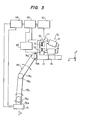
- Numeral 15 designates an industrial robot which is, for example, an articulated robot having five degrees of freedom.
- the industrial robot 15 is constructed of a turret 15a which turns about a vertical axis relative to a base 14, an upper arm 15b which rotates about a horizontal shaft 16a, a forearm 15c which rotates about a horizontal shaft 16b ahead of the upper arm, and a wrist 15d which rotates about a horizontal shaft 16c ahead of the forearm and which further rotates about an axis perpendicular to the horizontal shaft 16c.
- the wrist 15d is furnished with a hand 17 to which a finger (chuck) 18 is attached.
- the hand 17 is provided with a three-dimensional shape detector 11.
- the three-dimensional shape detector 11 is constructed of a slit light detector 12, a rectilinear movement mechanism 9 which scans the slit light detector 12 in the direction of a y-axis, a motor 10 which drives the rectilinear movement mechanism 9, and a displacement detector 13, such as rotary encoder, by which the scanning quantity of the slit light detector 12 scanned by the rectilinear movement mechanism 9 is detected from a reference position. While, in Figure 3, only a feed screw and nut are depicted as the rectilinear movement mechanism 9, a slide mechanism is included actually.
- Numeral 40 designates a motor control circuit for driving the motor 10 at a constant speed.
- Numeral 41 designates a light section waveform extracting circuit to which a two-dimensional image signal obtained from an image detector 3 is inputted and which extracts a light section waveform in a way described in U. S. Patent No. 4343553.
- An image processor 42 detects the position and inclination of an object which is closest to the robot and which is desired to be handled by the robot.
- Shown at numeral 43 is a robot control device for controlling the robot 15.
- the robot control device 43 is constructed of a control unit 50 which controls the articulated robot 15 having five types of freedom, and a teaching unit 51 which teaches information on a previously programmed path and speeds for causing the robot 15 to be operated or moved along the predetermined path at the programmed speeds on point-to-point basis.
- the control unit 50 and the robo.t mechanism 15 constitute a position control system in which output values produced by pulse encoders PE coupled to respective actuators M are fed back to the control unit 50 through a counter 5 1' ,whereby differences between the target or desired coordinate values determined previously by a microprocessor (A) 52 and the corresponding transformed values of the encoder outputs are converted into analog values by means of a digital-to-analog (D/A) converter 53 for driving the actuators M.
- D/A digital-to-analog
- Each drive circuit 54 drives the corresponding actuator M on the basis of a speed signal from a tachometer generator TG connected to this actuator M and an analog signal from the D/A converter 53.
- a serial interface 54' serves to connect the control unit 50 with the teaching unit 51.
- a ROM 56 is a memory which stores a program for operating the robot 15.
- a RAM 55 stores the operating path of the robot's hand on the basis of a teaching operation executed by the teaching unit 51 and an interpolation operation executed by an arithmetic 57.
- Shown at numeral 58 is a bus line.
- the positional data of the robot's hand stored in the ROM 56 are read out by the microprocessor 52 and undergo coordinate transformation into contrapositive displacements ⁇ 1 , 8 2 , Vietnamese and 0 51 which are outputted through the transformed output port 53 and utilized for driving the robot's hand to the desired or target position (for example, predetermined position for visually recognizing the object).
- the interface 59 of the control unit 50 serves to connect the image processor 42 to the robot control device 43.
- FIG 4 shows the slit light detector 12 in the embodiment of Figure 3 more in detail.
- the slit light projector 6 is constructed of a lamp 19 having a straight filament, a slit 20 and a cylindrical lens 21.
- the image detector 3 is constructed of an imaging lens 22 and a TV camera 23.
- Numeral 24 in the figure denotes the chip of a two-dimensional array sensor within the solid-state TV camera.
- Symbol 26a in Figure 4 indicates the plane of the illuminating slit light.
- the image detector 3 is inclined and fixed by a holding portion 25 so that its optic axis may intersect the slit light plane 26a obliquely (at an angle ct).
- a trapezoidal plane at symbol 26b in Figure 4 indicates the field of view which is detected by the image detector 3 within the slit light plane 26a.
- Figure 5 illustrates the circumstances of the operations of detecting the position and posture of a connector component 28 with wires, gripping the component and insertingly connecting it with pins 30 on a substrate 29.
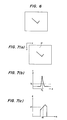
- Figure 6 shows a detection picture by the image detector 3 shown in Figure 4, and a slit bright-line, i.e. light-section image is detected as being'bright.
- the light-section waveform extracting circuit 41 extracts a light-section waveform with the slit bright-line image of Figure 6 being distant from the picture plane to the slit bright line.
- Figure 7 illustrates an example of the extracting processing (the details of which are disclosed in U.S. Patent No. 4343553). (a) of Figure 7 shows an input picture which is applied from the image detector 3 to the light-section waveform extracting circuit 41.
- the image signal of one vertical scanning line x i obtained from the image detector 3 is as shown in (b) of Figure 7 by way of example.
- the image signal is compared with a threshold value V 1 , and the central position Z i of the intersection points of V 1 is found.
- a light segment (waveform data) can be obtained as shown in (c) of Figure 7.
- the light-section waveform extraction may be based on peak position detection, instead of finding the center by the threshold value processing mentioned here.
- the origin of the z-axial coordinate is taken in a far part in this example, it may well be taken in a near part.
- the coordinate transformation of the z-axial direction can also be readily performed in perspective.
- the processing can be executed at high speed by electric circuitry, it may entirely be software processing.
- range data can be obtained.
- the movement of the head namely, the feed thereof in the y-axial direction is executed by a constant-speed motor, and the light segment extracting circuit 41 samples the light segments at fixed time intervals by the use of a sampling signal 60 ( Figure 11) obtained from the image processor 42.
- a sampling signal 60 Figure 11 obtained from the image processor 42.
- the light segment is sampled every fixed pulse interval (each time the head is moved a fixed distance p in the z-direction).
- the light segment is sampled each time the head is moved a fixed amount.
- at least two segments may be selected according to the job object of the robot's vision. The same applies to pitches.
- the processing contents of the distance picture inputted to the image processor 42 may also be selected according to the job object of the robot's vision.
- the job object of Figure 5 will be explained as an embodiment.
- the distance pictures obtained are those shown in Figure 8.
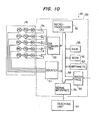
- the distance pictures (the values z i of distances corresponding to x i for the respective light segments) are obtained from the light-section waveform extracting circuit 41, and they are stored through a parallel interface 61 into a RAM 62 as an image memory.
- the microprocessor (B) 63 of the image processor 42 reads out distances (regarding 3 x 3 picture elements) z i-1 , j-1' z i+1 , j-1 ' z i-1, j+1 and z i+1, j+1 on x i-1 and x i+1 for the adjacent light segments y j-1 and y j+1 as shown by way of example in Figure 12, and then performs the following differentiation:
- the microprocessor 63 segments closed regions which are surrounded with solid lines (jump edges) E j as shown in Figure 13. Then, it evaluates the areas and the heights of the centers of gravity of the respective closed regions A 1 and A 2 . Thus, it separates and extracts the desired object which falls within an appointed range and which has the highest center of gravity.
- a plane region which is surrounded with the jump edge E j and a roof edge E r indicated by a dotted line in Figure 13 by way of example is extracted.
- the separated and extracted plane region is approximated into a plane, the normal direction of which is recognized as the three-dimensional posture of the component.
- the region of the major plane surrounded with the jump edge and the roof edge is approximated into a plane by the method of least squares.
- A denotes a matrix whose rows are (a i1 , a i2 , 1.0), b a matrix whose rows are (b i ), T a transposed matrix, and -1 an inverse matrix.
- the position of the center of gravity of the major plane region has already been found at the segmentation step.
- the normal direction of the major plane is denoted by an angle ⁇ defined between the z-axis and a normal to the plane, and an angle ⁇ defined between the x-axis and the projection of the normal on the xy-plane.
- the microprocessor (B) 63 can evaluate the position and spacial inclination of the major plane of the object aimed at, with reference to the robot's hand. Whether or not the plane is the surface of the connector, can be examined from the size and shape of the plane as described before. In addition, by sensing the direction in which the wire A 2 exists nearby, it can be decided that the opposite side is in the direction in which the pins are to be inserted. The remaining two sides are planes which the robot's fingers are to grip.
- a ROM 64 constituting the image processor 42 stores therein programs for the jump edge detection, the segmentation, the separate extraction of the component aimed at, the extraction of the plane region of the component based on the roof edge detection, the recognition of the three-dimensional posture of the component based on the normal direction of the plane, the recognition of the component, etc.
- a RAM 65 functions temporarily to / store data calculated by an arithmetic 68. Shown at numeral 67 is a bus line.
- Data on the position, posture and direction of the major surface of the object are sent from the interface 69 of the image processor 42 to the robot control device 43. Since the grip points, the position to be approached and the direction thereof for the robot's fingers 18 have been determined, the microprocessor 52 of the robot control device 43 adds them to the data of the robot arm control stored in the RAM 55, so as to transform them into the data of the control coordinate system of the robot. These data are transmitted through the D/A converter 53 to the drive circuits 54. The actuators M with which the robot 15 is furnished are driven, so that the fingers of the robot 15 grip the connector 28 on the basis of the aforementioned information and insertingly fit it on the pins 30 existing in a position given by a teaching operation beforehand.
- the slit-light projection and detection head and the head movement mechanism are mounted' on the robot arm, and the distance pictures obtained are subjected to the recognition processing, whereby the three-dimensional position and posture of the object having been undetectable with the prior arts can be detected and fed back to the robot arm.
- the steady slit light has been used for the slit-light projection, it may be replaced with stroboscopic slit-light.
- the slit light has been used in the embodiment of the present invention, it may be replaced with a bright and dark straight edge which is bright on one side and dark on the other side.
- the projection of the slit light may be replaced with a system in which spot light is scanned on the light segment plane 26a.
- this head is rectilinearly scanned by the detection head scanning mechanism 9 installed on the hand 17 as in the embodiment shown in Figure 3.
- an alternative measure may be taken in which, while the robot's hand 17 is being moved in the y-axial direction at a uniform speed by means of the robot control device 43, the coordinate values thereof are sent to the image processor 42 and are simultaneously sampled at fixed intervals p.
- the head is scanned by moving the robot's hand 17 is inferior in responsiveness to the embodiment of Figure 3.
- the detection head scanning mechanism is indispensable.
- the mechanism may be a mechanism wherein the image detector 3 and the slit light projector 6 are swiveled about a rotary pin 31 perpendicular to the sheet of the drawing by means of a rotating motor 32 as exemplified in Figure 14, or a mechanism wherein only the slit light projector 6 is swiveled as exemplified in Figure 15.
- the distance pictures are not proportional to the respective rotational angles, but they fall into a complicated expression of relationship including a trigonometric function. Therefore, it becomes very complicated to find the inclination, direction and position of a certain plane of the desired object.
- the expression of the relationship can be substituted by an approximation expression, and hence, the scanning mechanism may be the swivel mechanism. As the scanning mechanism to be installed on the hand 17, the swivel mechanism can be made mechanically simpler than the rectilinear scanning mechanism.
- the embodiment of the present invention has exemplified the case of attaching the light segmentation and detection head to the position as those having the same degrees of freedom / of the fingers, namely, to the hand, essentially the degrees of freedom of the arm are optional, and what part of the arm the detection head is to be mounted on ought to be decided depending upon the job object. Since, however, the posture and shape of the object to be handled assume various aspects, they need to be visually detected in the directions of at least three degrees of freedom. It is therefore recommended to mount the light segmentation and detection head on the fore end of that member of the robot which is moved with at least three degrees of freedom:
- the robot 15 in a case where the robot 15 is of the articulated type, it comprises the turret 15a which turns about the vertical axis z, the upper arm 15b which is supported on the turret 15a so as to an be turnable in the direction of / arrow, the forearm 15c which is supported on the turning end of the upper arm 15b so as to be turnable in the direction of the arrow, and the wrist 15d which is supported on the turning end of the forearm 15c so as to be turnable in the direction of an arrow and to which the hand 17 provided with the fingers 18 is attached.
- the slit-light detection head having the scanning device ought to be mounted on the fore end of any member which operates with at least three degrees of freedom, desirably it is attached to the forearm 15c, the wrist 15d or the hand 17.
- the attachment of the light segmentation head to the hand 17 is favorable in order to facilitate the transformation of the posture and position information of the object detected by the light segmentation head, into the coordinates of the robot system.
- the foregoing embodiment has been explained as to the articulated type robot, it is to be understood that the invention is also applicable to a cartesian type robot and a cylindrical type robot.
- job object is not restricted thereto but that it may be any of assembly operations, transportation operations, positioning operations,'plate working operations including welding, and inspection, adjustment and selection operations.
- a slit-light detector which has a slit light projector and a two-dimensional image detector is disposed near the fore end part of a robot, and the distance picture of an object to-be-handled as viewed from the robot is detected by actuating a scanning device or the robot itself, whereby the three-dimensional shape of the object can be detected.
- the present invention installs a three-dimensional shape detector on the robot and can change the three-dimensional shape detector into various positions and postures. This brings forth the effect that the three-dimensional shapes of objects having various postures and shapes can be accurately detected by conforming the detector to the objects.
Landscapes
- Engineering & Computer Science (AREA)
- Physics & Mathematics (AREA)
- General Physics & Mathematics (AREA)
- Multimedia (AREA)
- Theoretical Computer Science (AREA)
- Robotics (AREA)
- Computer Vision & Pattern Recognition (AREA)
- Mechanical Engineering (AREA)
- Artificial Intelligence (AREA)
- Length Measuring Devices By Optical Means (AREA)
- Manipulator (AREA)
- Image Processing (AREA)
Applications Claiming Priority (2)
| Application Number | Priority Date | Filing Date | Title |
|---|---|---|---|
| JP56584/82 | 1982-04-07 | ||
| JP57056584A JPS58177295A (ja) | 1982-04-07 | 1982-04-07 | ロボット制御装置 |
Publications (3)
| Publication Number | Publication Date |
|---|---|
| EP0091132A2 true EP0091132A2 (fr) | 1983-10-12 |
| EP0091132A3 EP0091132A3 (en) | 1984-04-25 |
| EP0091132B1 EP0091132B1 (fr) | 1986-08-13 |
Family
ID=13031218
Family Applications (1)
| Application Number | Title | Priority Date | Filing Date |
|---|---|---|---|
| EP83103402A Expired EP0091132B1 (fr) | 1982-04-07 | 1983-04-07 | Système de robot |
Country Status (4)
| Country | Link |
|---|---|
| US (1) | US4575304A (fr) |
| EP (1) | EP0091132B1 (fr) |
| JP (1) | JPS58177295A (fr) |
| DE (1) | DE3365240D1 (fr) |
Cited By (11)
| Publication number | Priority date | Publication date | Assignee | Title |
|---|---|---|---|---|
| EP0157299A1 (fr) * | 1984-03-26 | 1985-10-09 | Hitachi, Ltd. | Appareil d'exploitation d'images |
| US4660970A (en) * | 1983-11-25 | 1987-04-28 | Carl-Zeiss-Stiftung | Method and apparatus for the contact-less measuring of objects |
| AT385015B (de) * | 1983-12-19 | 1988-02-10 | Simmering Graz Pauker Ag | Greifvorrichtung einer transportvorrichtung fuer einen gegenstand, insbesondere ziegelstein |
| FR2606871A1 (fr) * | 1986-11-13 | 1988-05-20 | Imajesa | Dispositif de reconnaissance d'objets disposes sur un plan, et systeme de depalettisation mettant en oeuvre un tel dispositif |
| EP0205175A3 (fr) * | 1985-06-14 | 1989-04-12 | Asea Ab | Méthode et appareil pour la détermination de la position d'un objet par rapport à un équipement robotisé |
| FR2641607A1 (fr) * | 1989-01-06 | 1990-07-13 | Electricite De France | Systeme de releve de la surface d'une piece a distance par un capteur optique, notamment d'un auget de turbine pelton |
| WO1990008939A1 (fr) * | 1989-02-06 | 1990-08-09 | Vision 3D | Procede d'etalonnage d'un systeme d'acquisition tridimensionnelle de forme et systeme pour la mise en oeuvre dudit procede |
| AT508465A3 (de) * | 2009-07-10 | 2012-07-15 | Stiwa Holding Gmbh | Verfahren zur kontinuierlichen ermittlung einer greifposition |
| WO2013000572A1 (fr) | 2011-06-30 | 2013-01-03 | 2LUTION GmbH | Agents de lutte contre les parasites d'animaux |
| WO2013101620A1 (fr) * | 2011-12-28 | 2013-07-04 | Faro Technologies, Inc. | Dispositif de balayage de ligne utilisant une source lumineuse de cohérence faible |
| CN108482933A (zh) * | 2018-04-29 | 2018-09-04 | 广东聚联电子商务股份有限公司 | 一种基于区块链的大宗商品交易处理设备 |
Families Citing this family (78)
| Publication number | Priority date | Publication date | Assignee | Title |
|---|---|---|---|---|
| US4674057A (en) * | 1984-02-14 | 1987-06-16 | Lockheed Corporation | Ultrasonic ranging control system for industrial robots |
| JPS60200103A (ja) * | 1984-03-26 | 1985-10-09 | Hitachi Ltd | 光切断線抽出回路 |
| US4718023A (en) * | 1984-11-27 | 1988-01-05 | Photo Acoustic Technology, Inc. | Ultrasonic apparatus for positioning a robot hand |
| US4724480A (en) * | 1985-05-02 | 1988-02-09 | Robotic Vision Systems, Inc. | Method for optical alignment of one object with respect to another |
| US4639878A (en) * | 1985-06-04 | 1987-01-27 | Gmf Robotics Corporation | Method and system for automatically determining the position and attitude of an object |
| US4939439A (en) * | 1985-09-26 | 1990-07-03 | Unisearch Limited | Robot vision and optical location systems |
| JPS63288683A (ja) * | 1987-05-21 | 1988-11-25 | 株式会社東芝 | 組立てロボット |
| US4833383A (en) * | 1987-08-13 | 1989-05-23 | Iowa State University Research Foundation, Inc. | Means and method of camera space manipulation |
| US4905151A (en) * | 1988-03-07 | 1990-02-27 | Transitions Research Corporation | One dimensional image visual system for a moving vehicle |
| GB2222047A (en) * | 1988-07-25 | 1990-02-21 | Unisearch Ltd | Optical mapping of field of view and information storage |
| US5040116A (en) * | 1988-09-06 | 1991-08-13 | Transitions Research Corporation | Visual navigation and obstacle avoidance structured light system |
| US4954962A (en) * | 1988-09-06 | 1990-09-04 | Transitions Research Corporation | Visual navigation and obstacle avoidance structured light system |
| US4945493A (en) * | 1988-09-26 | 1990-07-31 | Ford Motor Company | Method and system for correcting a robot path |
| JP2710850B2 (ja) * | 1989-03-27 | 1998-02-10 | キヤノン株式会社 | ワーク把持装置、ワーク及びその収納ケース |
| DE69232403T2 (de) * | 1991-08-06 | 2002-08-22 | Canon K.K., Tokio/Tokyo | Dreidimensionales Modellverarbeitungsverfahren und -gerät |
| US5245409A (en) * | 1991-11-27 | 1993-09-14 | Arvin Industries, Inc. | Tube seam weld inspection device |
| JP3167404B2 (ja) * | 1992-02-26 | 2001-05-21 | 本田技研工業株式会社 | ロボットの関節駆動制御装置 |
| US5317388A (en) * | 1992-06-29 | 1994-05-31 | United Parcel Service Of America, Inc. | Method and apparatus for determining the displacement of a rectangular object with respect to a reference position |
| JPH0614108U (ja) * | 1992-07-24 | 1994-02-22 | 株式会社椿本チエイン | 搬送物載置面安全確認装置 |
| US5300869A (en) * | 1992-07-30 | 1994-04-05 | Iowa State University Research Foundation, Inc. | Nonholonomic camera space manipulation |
| DE69736348T2 (de) * | 1996-10-24 | 2006-11-30 | Fanuc Ltd. | Roboterkraftsteuersystem mit visuellem sensor für zusammenfügungsarbeiten |
| SE9704777L (sv) * | 1997-12-19 | 1999-06-20 | Alfa Laval Agri Ab | Anordning för övervakande av ett djurrelaterat område |
| SE9704776D0 (sv) * | 1997-12-19 | 1997-12-19 | Alfa Laval Agri Ab | An apparatus for monitoring an animal related area |
| DE19819646A1 (de) * | 1998-05-05 | 1999-11-11 | Entlog Entsorgung Und Logistik | Sammelfahrzeug für Abfälle und Wertstoffe |
| US6553138B2 (en) * | 1998-12-30 | 2003-04-22 | New York University | Method and apparatus for generating three-dimensional representations of objects |
| CN1162681C (zh) * | 1999-03-19 | 2004-08-18 | 松下电工株式会社 | 三维物体识别方法及使用该方法的零件抓取系统 |
| US6304050B1 (en) * | 1999-07-19 | 2001-10-16 | Steven B. Skaar | Means and method of robot control relative to an arbitrary surface using camera-space manipulation |
| US6166811A (en) | 1999-08-12 | 2000-12-26 | Perceptron, Inc. | Robot-based gauging system for determining three-dimensional measurement data |
| US6194860B1 (en) * | 1999-11-01 | 2001-02-27 | Yoder Software, Inc. | Mobile camera-space manipulation |
| US6548982B1 (en) | 1999-11-19 | 2003-04-15 | Regents Of The University Of Minnesota | Miniature robotic vehicles and methods of controlling same |
| EP1319164B2 (fr) * | 2000-09-22 | 2014-01-01 | Werth Messtechnik GmbH | Procede pour mesurer la geometrie d'un objet au moyen d'un appareil de mesure de coordonnees |
| EP1335235A3 (fr) * | 2002-02-12 | 2003-09-17 | MARICO s.a.s di Dallara Riccardo & C. | Un système de vision utilisant la projection des figures de la lumière |
| US7881896B2 (en) | 2002-02-14 | 2011-02-01 | Faro Technologies, Inc. | Portable coordinate measurement machine with integrated line laser scanner |
| US6860346B2 (en) * | 2002-04-19 | 2005-03-01 | Regents Of The University Of Minnesota | Adjustable diameter wheel assembly, and methods and vehicles using same |
| JP2004142015A (ja) * | 2002-10-24 | 2004-05-20 | Fanuc Ltd | センサ付きロボット |
| FR2846413B1 (fr) * | 2002-10-24 | 2005-03-11 | Luc Vergnaud | Dispositif de numerisation sans contact d'un objet en 3 dimensions |
| DE10361018C9 (de) * | 2003-12-23 | 2021-03-04 | QUISS Qualitäts-Inspektionssysteme und Service GmbH | Verfahren zum Erkennen einer auf einem Substrat aufzubringenden Struktur mit mehreren Kameras sowie eine Vorrichtung hierfür |
| US7559385B1 (en) | 2004-03-10 | 2009-07-14 | Regents Of The University Of Minnesota | Ruggedized robotic vehicles |
| JP4456561B2 (ja) * | 2005-12-12 | 2010-04-28 | 本田技研工業株式会社 | 自律移動ロボット |
| DE102007026956A1 (de) * | 2007-06-12 | 2008-12-18 | Kuka Innotec Gmbh | Verfahren und System zum Roboter geführten Depalettieren von Reifen |
| US8082064B2 (en) * | 2007-08-24 | 2011-12-20 | Elite Engineering Corporation | Robotic arm and control system |
| EP2036660A1 (fr) * | 2007-09-12 | 2009-03-18 | Hans Oxenfarth | Procédé et dispositif de fixation de composant à position et angle compensés |
| US8260459B2 (en) * | 2008-05-08 | 2012-09-04 | Regents Of The University Of Minnesota | Robotic vehicle system |
| US8229228B2 (en) * | 2008-09-16 | 2012-07-24 | Robert Bosch Gmbh | Image analysis using a pre-calibrated pattern of radiation |
| JP5164811B2 (ja) * | 2008-11-26 | 2013-03-21 | キヤノン株式会社 | 作業システム及び情報処理方法 |
| US8457791B2 (en) * | 2009-03-10 | 2013-06-04 | GM Global Technology Operations LLC | Method for dynamically controlling a robotic arm |
| CN102414696A (zh) * | 2009-04-23 | 2012-04-11 | 皇家飞利浦电子股份有限公司 | 物体学习机器人和方法 |
| EP2255930A1 (fr) * | 2009-05-27 | 2010-12-01 | Leica Geosystems AG | Procédé et système destinés au positionnement très précis d'au moins un objet dans une position finale dans l' espace |
| US8321055B2 (en) * | 2009-11-03 | 2012-11-27 | Jadak, Llc | System and method for multiple view machine vision target location |
| JP5978996B2 (ja) * | 2010-06-23 | 2016-08-24 | 日本電気株式会社 | 物体領域抽出装置、方法、及び、プログラム |
| JP4821934B1 (ja) * | 2011-04-14 | 2011-11-24 | 株式会社安川電機 | 3次元形状計測装置およびロボットシステム |
| US9965850B2 (en) * | 2012-07-05 | 2018-05-08 | Bernard Fryshman | Object image recognition and instant active response with enhanced application and utility |
| US12412414B2 (en) * | 2012-07-05 | 2025-09-09 | Bernard Fryshman | Insect and other small object image recognition and instant active response with enhanced application and utility |
| US10521896B2 (en) * | 2012-07-05 | 2019-12-31 | Bernard Fryshman | Object image recognition and instant active response with enhanced application and utility |
| US20140081459A1 (en) * | 2012-09-20 | 2014-03-20 | Marc Dubois | Depth mapping vision system with 2d optical pattern for robotic applications |
| JP6357300B2 (ja) * | 2013-05-10 | 2018-07-11 | 矢崎総業株式会社 | コネクタハウジング計測装置及びコネクタハウジング計測方法 |
| JP2015024453A (ja) * | 2013-07-25 | 2015-02-05 | トヨタ自動車株式会社 | 載置判断方法、載置方法、載置判断装置及びロボット |
| TWI542891B (zh) | 2014-12-29 | 2016-07-21 | 原相科技股份有限公司 | 光學測距方法與光學測距系統 |
| US11340352B2 (en) * | 2014-12-29 | 2022-05-24 | Pixart Imaging Inc. | Image noise compensating system, and auto clean machine |
| JP6500852B2 (ja) * | 2016-07-11 | 2019-04-17 | 株式会社安川電機 | ロボットシステム、ロボットの制御方法、ロボットコントローラ |
| US10078908B2 (en) | 2016-08-12 | 2018-09-18 | Elite Robotics | Determination of relative positions |
| SE540708C2 (en) * | 2016-10-14 | 2018-10-16 | Envac Optibag Ab | Disposable waste bag, system and method of gripping and emptying a bag, and a system for recycling waste |
| US20190226287A1 (en) * | 2017-05-11 | 2019-07-25 | National Oilwell Varco Norway As | System and method for placing pipe in and removing pipe from a finger rack |
| WO2019035913A1 (fr) | 2017-08-15 | 2019-02-21 | Reconrobotics, Inc. | Verrou magnétique pour robot pouvant être lancé |
| WO2019035894A1 (fr) | 2017-08-15 | 2019-02-21 | Reconrobotics, Inc. | Robot à deux roues avec convertibilité et accessoires |
| WO2019035929A1 (fr) | 2017-08-15 | 2019-02-21 | Reconrobotics, Inc. | Robot pouvant être lancé doté d'un système d'entraînement amélioré |
| US10828973B2 (en) | 2017-08-15 | 2020-11-10 | Reconrobtics, Inc. | Two wheel robot with convertibility and accessories |
| US12194824B2 (en) | 2017-08-15 | 2025-01-14 | Reconrobotics, Inc. | Two wheel robot with convertibility and accessories |
| PL3495202T3 (pl) * | 2017-12-05 | 2021-02-08 | Guima Palfinger S.A.S. | System detekcji montowany na ciężarówce |
| EP3788319A1 (fr) | 2018-04-30 | 2021-03-10 | Path Robotics, Inc. | Dispositif de balayage laser à rejet de réflexions |
| JP6904327B2 (ja) * | 2018-11-30 | 2021-07-14 | オムロン株式会社 | 制御装置、制御方法、及び制御プログラム |
| CN109625922A (zh) * | 2018-11-30 | 2019-04-16 | 安徽智训机器人技术有限公司 | 一种用于智能制造的自动上下料系统及方法 |
| US11407110B2 (en) | 2020-07-17 | 2022-08-09 | Path Robotics, Inc. | Real time feedback and dynamic adjustment for welding robots |
| US11648683B2 (en) | 2021-02-24 | 2023-05-16 | Path Robotics, Inc. | Autonomous welding robots |
| US12277369B2 (en) | 2021-10-18 | 2025-04-15 | Path Robotics, Inc. | Generating simulated weld paths for a welding robot |
| CA3239078A1 (fr) | 2021-11-19 | 2023-05-25 | Path Robotics, Inc. | Techniques de reglage a base de logique d'apprentissage machine pour robots |
| US12508665B2 (en) | 2022-04-19 | 2025-12-30 | Path Robotics, Inc. | Autonomous assembly robots |
| US12521884B2 (en) | 2022-07-26 | 2026-01-13 | Path Robotics, Inc. | Techniques for multipass welding |
Family Cites Families (6)
| Publication number | Priority date | Publication date | Assignee | Title |
|---|---|---|---|---|
| US3834819A (en) * | 1973-07-05 | 1974-09-10 | Western Electric Co | Thickness measuring |
| US4017721A (en) * | 1974-05-16 | 1977-04-12 | The Bendix Corporation | Method and apparatus for determining the position of a body |
| JPS5542185A (en) * | 1978-09-22 | 1980-03-25 | Kawasaki Heavy Ind Ltd | Detecting device for arc welding or the like |
| US4343553A (en) * | 1979-09-03 | 1982-08-10 | Hitachi, Ltd. | Shape testing apparatus |
| US4380696A (en) * | 1980-11-12 | 1983-04-19 | Unimation, Inc. | Method and apparatus for manipulator welding apparatus with vision correction for workpiece sensing |
| DE3279733D1 (en) * | 1981-07-27 | 1989-07-06 | Kawasaki Steel Co | Method and system for determining shape in plane to be determined in atmosphere of scattering materials |
-
1982
- 1982-04-07 JP JP57056584A patent/JPS58177295A/ja active Granted
-
1983
- 1983-04-07 DE DE8383103402T patent/DE3365240D1/de not_active Expired
- 1983-04-07 US US06/482,730 patent/US4575304A/en not_active Expired - Fee Related
- 1983-04-07 EP EP83103402A patent/EP0091132B1/fr not_active Expired
Cited By (14)
| Publication number | Priority date | Publication date | Assignee | Title |
|---|---|---|---|---|
| US4660970A (en) * | 1983-11-25 | 1987-04-28 | Carl-Zeiss-Stiftung | Method and apparatus for the contact-less measuring of objects |
| AT385015B (de) * | 1983-12-19 | 1988-02-10 | Simmering Graz Pauker Ag | Greifvorrichtung einer transportvorrichtung fuer einen gegenstand, insbesondere ziegelstein |
| EP0157299A1 (fr) * | 1984-03-26 | 1985-10-09 | Hitachi, Ltd. | Appareil d'exploitation d'images |
| EP0205175A3 (fr) * | 1985-06-14 | 1989-04-12 | Asea Ab | Méthode et appareil pour la détermination de la position d'un objet par rapport à un équipement robotisé |
| FR2606871A1 (fr) * | 1986-11-13 | 1988-05-20 | Imajesa | Dispositif de reconnaissance d'objets disposes sur un plan, et systeme de depalettisation mettant en oeuvre un tel dispositif |
| FR2641607A1 (fr) * | 1989-01-06 | 1990-07-13 | Electricite De France | Systeme de releve de la surface d'une piece a distance par un capteur optique, notamment d'un auget de turbine pelton |
| WO1990008939A1 (fr) * | 1989-02-06 | 1990-08-09 | Vision 3D | Procede d'etalonnage d'un systeme d'acquisition tridimensionnelle de forme et systeme pour la mise en oeuvre dudit procede |
| FR2642833A1 (fr) * | 1989-02-06 | 1990-08-10 | Vision 3D | Procede d'etalonnage d'un systeme d'acquisition tridimensionnelle de forme et systeme d'acquisition pour la mise en oeuvre dudit procede |
| AT508465A3 (de) * | 2009-07-10 | 2012-07-15 | Stiwa Holding Gmbh | Verfahren zur kontinuierlichen ermittlung einer greifposition |
| AT508465B1 (de) * | 2009-07-10 | 2013-02-15 | Stiwa Holding Gmbh | Verfahren zur kontinuierlichen ermittlung einer greifposition |
| WO2013000572A1 (fr) | 2011-06-30 | 2013-01-03 | 2LUTION GmbH | Agents de lutte contre les parasites d'animaux |
| WO2013101620A1 (fr) * | 2011-12-28 | 2013-07-04 | Faro Technologies, Inc. | Dispositif de balayage de ligne utilisant une source lumineuse de cohérence faible |
| CN108482933A (zh) * | 2018-04-29 | 2018-09-04 | 广东聚联电子商务股份有限公司 | 一种基于区块链的大宗商品交易处理设备 |
| CN108482933B (zh) * | 2018-04-29 | 2021-01-01 | 深圳市辰宝信息服务有限公司 | 一种基于区块链的大宗商品交易处理设备 |
Also Published As
| Publication number | Publication date |
|---|---|
| DE3365240D1 (en) | 1986-09-18 |
| US4575304A (en) | 1986-03-11 |
| EP0091132B1 (fr) | 1986-08-13 |
| EP0091132A3 (en) | 1984-04-25 |
| JPH0428518B2 (fr) | 1992-05-14 |
| JPS58177295A (ja) | 1983-10-17 |
Similar Documents
| Publication | Publication Date | Title |
|---|---|---|
| EP0091132B1 (fr) | Système de robot | |
| US6763284B2 (en) | Robot teaching apparatus | |
| EP0208406B1 (fr) | Méthode de détection et commande du point initial d'un robot | |
| US6681151B1 (en) | System and method for servoing robots based upon workpieces with fiducial marks using machine vision | |
| US10569419B2 (en) | Control device and robot system | |
| JPH0425583B2 (fr) | ||
| US12275134B2 (en) | Robot system | |
| EP3272473A1 (fr) | Dispositif d'enseignement et procédé de génération d'informations de commande | |
| JP2012076216A (ja) | ロボット制御システムのカメラ座標系とロボット座標系の結合方法、画像処理装置、プログラム、及び記憶媒体 | |
| US20190030722A1 (en) | Control device, robot system, and control method | |
| US11826919B2 (en) | Work coordinate generation device | |
| JP4274558B2 (ja) | キャリブレーション方法 | |
| US20230241780A1 (en) | Robotic System And Robot Control Method | |
| EP3224004B1 (fr) | Système robotique comprenant un dispositif télémétrique avec un appareil de mesure laser et une caméra video passive | |
| US20250083326A1 (en) | End effector, robot system, control method of end effector, control method of robot system, manufacturing method of article, and computer readable medium | |
| JP3160443B2 (ja) | 非接触点教示装置 | |
| EP4385684A1 (fr) | Système d'inspection de robot | |
| JP2603643B2 (ja) | 組立方法 | |
| JPH0428516B2 (fr) | ||
| SE456976B (sv) | Foerfarande och anordning vid en robotutrustning foer bestaemning av laeget av ett foeremaal | |
| JP2519442B2 (ja) | 工作線追従方法 | |
| CA1125412A (fr) | Dispositif video tournant de centrage, d'orientation et de positionnement d'objet pour systemes electroniques a ordinateur | |
| JPH0474155B2 (fr) | ||
| JP3229024B2 (ja) | 3次元位置標定装置 | |
| JPS59169793A (ja) | 工業用ロボツト |
Legal Events
| Date | Code | Title | Description |
|---|---|---|---|
| PUAI | Public reference made under article 153(3) epc to a published international application that has entered the european phase |
Free format text: ORIGINAL CODE: 0009012 |
|
| AK | Designated contracting states |
Designated state(s): DE FR GB |
|
| PUAL | Search report despatched |
Free format text: ORIGINAL CODE: 0009013 |
|
| AK | Designated contracting states |
Designated state(s): DE FR GB |
|
| 17P | Request for examination filed |
Effective date: 19840614 |
|
| GRAA | (expected) grant |
Free format text: ORIGINAL CODE: 0009210 |
|
| AK | Designated contracting states |
Kind code of ref document: B1 Designated state(s): DE FR GB |
|
| REF | Corresponds to: |
Ref document number: 3365240 Country of ref document: DE Date of ref document: 19860918 |
|
| ET | Fr: translation filed | ||
| PLBE | No opposition filed within time limit |
Free format text: ORIGINAL CODE: 0009261 |
|
| STAA | Information on the status of an ep patent application or granted ep patent |
Free format text: STATUS: NO OPPOSITION FILED WITHIN TIME LIMIT |
|
| 26N | No opposition filed | ||
| PGFP | Annual fee paid to national office [announced via postgrant information from national office to epo] |
Ref country code: GB Payment date: 19940328 Year of fee payment: 12 |
|
| PGFP | Annual fee paid to national office [announced via postgrant information from national office to epo] |
Ref country code: FR Payment date: 19940415 Year of fee payment: 12 |
|
| PG25 | Lapsed in a contracting state [announced via postgrant information from national office to epo] |
Ref country code: GB Effective date: 19950407 |
|
| GBPC | Gb: european patent ceased through non-payment of renewal fee |
Effective date: 19950407 |
|
| PG25 | Lapsed in a contracting state [announced via postgrant information from national office to epo] |
Ref country code: FR Effective date: 19951229 |
|
| REG | Reference to a national code |
Ref country code: FR Ref legal event code: ST |
|
| PGFP | Annual fee paid to national office [announced via postgrant information from national office to epo] |
Ref country code: DE Payment date: 19960628 Year of fee payment: 14 |
|
| PG25 | Lapsed in a contracting state [announced via postgrant information from national office to epo] |
Ref country code: DE Free format text: LAPSE BECAUSE OF NON-PAYMENT OF DUE FEES Effective date: 19980101 |