EP0091508A2 - Borosilikatzeolithe-ZBH und Verfahren zur Herstellung von kristallinen Borosilikatzeolithen (ZBH) und deren Verwendung als Katalysator - Google Patents
Borosilikatzeolithe-ZBH und Verfahren zur Herstellung von kristallinen Borosilikatzeolithen (ZBH) und deren Verwendung als Katalysator Download PDFInfo
- Publication number
- EP0091508A2 EP0091508A2 EP82109667A EP82109667A EP0091508A2 EP 0091508 A2 EP0091508 A2 EP 0091508A2 EP 82109667 A EP82109667 A EP 82109667A EP 82109667 A EP82109667 A EP 82109667A EP 0091508 A2 EP0091508 A2 EP 0091508A2
- Authority
- EP
- European Patent Office
- Prior art keywords
- zbh
- zeolites
- borosilicate zeolites
- crystallization
- crystalline
- Prior art date
- Legal status (The legal status is an assumption and is not a legal conclusion. Google has not performed a legal analysis and makes no representation as to the accuracy of the status listed.)
- Granted
Links
- 238000000034 method Methods 0.000 title claims abstract description 10
- 239000003054 catalyst Substances 0.000 title claims abstract description 5
- 238000002360 preparation method Methods 0.000 title claims abstract description 5
- 239000010457 zeolite Substances 0.000 title claims description 30
- OKKJLVBELUTLKV-UHFFFAOYSA-N Methanol Chemical compound OC OKKJLVBELUTLKV-UHFFFAOYSA-N 0.000 claims abstract description 12
- 239000000203 mixture Substances 0.000 claims abstract description 8
- VYPSYNLAJGMNEJ-UHFFFAOYSA-N Silicium dioxide Chemical compound O=[Si]=O VYPSYNLAJGMNEJ-UHFFFAOYSA-N 0.000 claims abstract description 7
- LCGLNKUTAGEVQW-UHFFFAOYSA-N Dimethyl ether Chemical compound COC LCGLNKUTAGEVQW-UHFFFAOYSA-N 0.000 claims abstract description 6
- 150000001336 alkenes Chemical class 0.000 claims abstract description 4
- 238000002425 crystallisation Methods 0.000 claims abstract description 4
- 230000008025 crystallization Effects 0.000 claims abstract description 4
- 230000001476 alcoholic effect Effects 0.000 claims abstract description 3
- KGBXLFKZBHKPEV-UHFFFAOYSA-N boric acid Chemical compound OB(O)O KGBXLFKZBHKPEV-UHFFFAOYSA-N 0.000 claims abstract description 3
- 239000004327 boric acid Substances 0.000 claims abstract description 3
- 238000005216 hydrothermal crystallization Methods 0.000 claims abstract description 3
- 238000004519 manufacturing process Methods 0.000 claims abstract 2
- 238000002441 X-ray diffraction Methods 0.000 claims description 8
- WERYXYBDKMZEQL-UHFFFAOYSA-N butane-1,4-diol Chemical compound OCCCCO WERYXYBDKMZEQL-UHFFFAOYSA-N 0.000 claims description 6
- 239000011541 reaction mixture Substances 0.000 claims description 5
- 229910004298 SiO 2 Inorganic materials 0.000 claims description 4
- 150000001447 alkali salts Chemical class 0.000 claims description 3
- XXMIOPMDWAUFGU-UHFFFAOYSA-N hexane-1,6-diol Chemical compound OCCCCCCO XXMIOPMDWAUFGU-UHFFFAOYSA-N 0.000 claims description 2
- 239000002904 solvent Substances 0.000 claims description 2
- 238000010586 diagram Methods 0.000 claims 1
- 235000012239 silicon dioxide Nutrition 0.000 claims 1
- 239000000377 silicon dioxide Substances 0.000 claims 1
- -1 alkali metal salts Chemical class 0.000 abstract description 2
- 229910052814 silicon oxide Inorganic materials 0.000 abstract description 2
- 229910052783 alkali metal Inorganic materials 0.000 abstract 1
- 229910052796 boron Inorganic materials 0.000 description 11
- ZOXJGFHDIHLPTG-UHFFFAOYSA-N Boron Chemical compound [B] ZOXJGFHDIHLPTG-UHFFFAOYSA-N 0.000 description 10
- HNPSIPDUKPIQMN-UHFFFAOYSA-N dioxosilane;oxo(oxoalumanyloxy)alumane Chemical group O=[Si]=O.O=[Al]O[Al]=O HNPSIPDUKPIQMN-UHFFFAOYSA-N 0.000 description 10
- LFQSCWFLJHTTHZ-UHFFFAOYSA-N Ethanol Chemical compound CCO LFQSCWFLJHTTHZ-UHFFFAOYSA-N 0.000 description 8
- 229910021536 Zeolite Inorganic materials 0.000 description 7
- 238000006243 chemical reaction Methods 0.000 description 7
- HEMHJVSKTPXQMS-UHFFFAOYSA-M Sodium hydroxide Chemical compound [OH-].[Na+] HEMHJVSKTPXQMS-UHFFFAOYSA-M 0.000 description 6
- 239000013078 crystal Substances 0.000 description 6
- 239000003513 alkali Substances 0.000 description 4
- XLYOFNOQVPJJNP-UHFFFAOYSA-N water Substances O XLYOFNOQVPJJNP-UHFFFAOYSA-N 0.000 description 4
- 239000004215 Carbon black (E152) Substances 0.000 description 3
- 229910052782 aluminium Inorganic materials 0.000 description 3
- 229910000323 aluminium silicate Inorganic materials 0.000 description 3
- 238000001354 calcination Methods 0.000 description 3
- 229930195733 hydrocarbon Natural products 0.000 description 3
- 150000002430 hydrocarbons Chemical class 0.000 description 3
- QGZKDVFQNNGYKY-UHFFFAOYSA-O Ammonium Chemical class [NH4+] QGZKDVFQNNGYKY-UHFFFAOYSA-O 0.000 description 2
- 150000001298 alcohols Chemical class 0.000 description 2
- XAGFODPZIPBFFR-UHFFFAOYSA-N aluminium Chemical compound [Al] XAGFODPZIPBFFR-UHFFFAOYSA-N 0.000 description 2
- 150000001412 amines Chemical class 0.000 description 2
- 150000001768 cations Chemical class 0.000 description 2
- 239000007795 chemical reaction product Substances 0.000 description 2
- 150000001875 compounds Chemical class 0.000 description 2
- 238000005336 cracking Methods 0.000 description 2
- 238000001035 drying Methods 0.000 description 2
- 150000002170 ethers Chemical class 0.000 description 2
- 238000010348 incorporation Methods 0.000 description 2
- 150000002500 ions Chemical class 0.000 description 2
- 239000000047 product Substances 0.000 description 2
- 239000000126 substance Substances 0.000 description 2
- QCOXXQPKBAIGBQ-UHFFFAOYSA-N 1-hydroxy-2,4,5-trioxa-1-sila-3-aluminabicyclo[1.1.1]pentane Chemical compound O[Si]12O[Al](O1)O2 QCOXXQPKBAIGBQ-UHFFFAOYSA-N 0.000 description 1
- 229910002012 Aerosil® Inorganic materials 0.000 description 1
- 229910018072 Al 2 O 3 Inorganic materials 0.000 description 1
- 229910018516 Al—O Inorganic materials 0.000 description 1
- OKTJSMMVPCPJKN-UHFFFAOYSA-N Carbon Chemical compound [C] OKTJSMMVPCPJKN-UHFFFAOYSA-N 0.000 description 1
- RYGMFSIKBFXOCR-UHFFFAOYSA-N Copper Chemical compound [Cu] RYGMFSIKBFXOCR-UHFFFAOYSA-N 0.000 description 1
- 229910004283 SiO 4 Inorganic materials 0.000 description 1
- 229910001854 alkali hydroxide Inorganic materials 0.000 description 1
- 150000008044 alkali metal hydroxides Chemical class 0.000 description 1
- 150000003863 ammonium salts Chemical class 0.000 description 1
- 238000004458 analytical method Methods 0.000 description 1
- 125000004429 atom Chemical group 0.000 description 1
- QVGXLLKOCUKJST-UHFFFAOYSA-N atomic oxygen Chemical compound [O] QVGXLLKOCUKJST-UHFFFAOYSA-N 0.000 description 1
- 230000015572 biosynthetic process Effects 0.000 description 1
- 229910001593 boehmite Inorganic materials 0.000 description 1
- CDQSJQSWAWPGKG-UHFFFAOYSA-N butane-1,1-diol Chemical compound CCCC(O)O CDQSJQSWAWPGKG-UHFFFAOYSA-N 0.000 description 1
- 238000005341 cation exchange Methods 0.000 description 1
- 239000003795 chemical substances by application Substances 0.000 description 1
- 230000008602 contraction Effects 0.000 description 1
- 229910052802 copper Inorganic materials 0.000 description 1
- 239000010949 copper Substances 0.000 description 1
- 230000018044 dehydration Effects 0.000 description 1
- 238000006297 dehydration reaction Methods 0.000 description 1
- 229910021485 fumed silica Inorganic materials 0.000 description 1
- 229910052733 gallium Inorganic materials 0.000 description 1
- 239000010439 graphite Substances 0.000 description 1
- 229910002804 graphite Inorganic materials 0.000 description 1
- ACCCMOQWYVYDOT-UHFFFAOYSA-N hexane-1,1-diol Chemical compound CCCCCC(O)O ACCCMOQWYVYDOT-UHFFFAOYSA-N 0.000 description 1
- GPRLSGONYQIRFK-UHFFFAOYSA-N hydron Chemical compound [H+] GPRLSGONYQIRFK-UHFFFAOYSA-N 0.000 description 1
- FAHBNUUHRFUEAI-UHFFFAOYSA-M hydroxidooxidoaluminium Chemical compound O[Al]=O FAHBNUUHRFUEAI-UHFFFAOYSA-M 0.000 description 1
- 239000012535 impurity Substances 0.000 description 1
- 229910052742 iron Inorganic materials 0.000 description 1
- 238000006317 isomerization reaction Methods 0.000 description 1
- 235000021190 leftovers Nutrition 0.000 description 1
- 239000000463 material Substances 0.000 description 1
- 239000011159 matrix material Substances 0.000 description 1
- 230000001089 mineralizing effect Effects 0.000 description 1
- 239000002808 molecular sieve Substances 0.000 description 1
- 239000001301 oxygen Substances 0.000 description 1
- 229910052760 oxygen Inorganic materials 0.000 description 1
- 125000004430 oxygen atom Chemical group O* 0.000 description 1
- 150000004714 phosphonium salts Chemical class 0.000 description 1
- 239000011148 porous material Substances 0.000 description 1
- 239000000843 powder Substances 0.000 description 1
- 150000003138 primary alcohols Chemical class 0.000 description 1
- 230000005855 radiation Effects 0.000 description 1
- 150000003333 secondary alcohols Chemical class 0.000 description 1
- 229910052710 silicon Inorganic materials 0.000 description 1
- 239000010703 silicon Substances 0.000 description 1
- URGAHOPLAPQHLN-UHFFFAOYSA-N sodium aluminosilicate Chemical compound [Na+].[Al+3].[O-][Si]([O-])=O.[O-][Si]([O-])=O URGAHOPLAPQHLN-UHFFFAOYSA-N 0.000 description 1
- 229910001220 stainless steel Inorganic materials 0.000 description 1
- 239000010935 stainless steel Substances 0.000 description 1
- 239000012258 stirred mixture Substances 0.000 description 1
- 150000005846 sugar alcohols Polymers 0.000 description 1
- 238000003786 synthesis reaction Methods 0.000 description 1
- 150000003509 tertiary alcohols Chemical class 0.000 description 1
- 238000002255 vaccination Methods 0.000 description 1
Classifications
-
- C—CHEMISTRY; METALLURGY
- C07—ORGANIC CHEMISTRY
- C07C—ACYCLIC OR CARBOCYCLIC COMPOUNDS
- C07C1/00—Preparation of hydrocarbons from one or more compounds, none of them being a hydrocarbon
- C07C1/20—Preparation of hydrocarbons from one or more compounds, none of them being a hydrocarbon starting from organic compounds containing only oxygen atoms as heteroatoms
-
- B—PERFORMING OPERATIONS; TRANSPORTING
- B01—PHYSICAL OR CHEMICAL PROCESSES OR APPARATUS IN GENERAL
- B01J—CHEMICAL OR PHYSICAL PROCESSES, e.g. CATALYSIS OR COLLOID CHEMISTRY; THEIR RELEVANT APPARATUS
- B01J29/00—Catalysts comprising molecular sieves
- B01J29/86—Borosilicates; Aluminoborosilicates
-
- C—CHEMISTRY; METALLURGY
- C01—INORGANIC CHEMISTRY
- C01B—NON-METALLIC ELEMENTS; COMPOUNDS THEREOF; METALLOIDS OR COMPOUNDS THEREOF NOT COVERED BY SUBCLASS C01C
- C01B35/00—Boron; Compounds thereof
- C01B35/08—Compounds containing boron and nitrogen, phosphorus, oxygen, sulfur, selenium or tellurium
- C01B35/10—Compounds containing boron and oxygen
- C01B35/1009—Compounds containing boron and oxygen having molecular-sieve properties
-
- C—CHEMISTRY; METALLURGY
- C07—ORGANIC CHEMISTRY
- C07C—ACYCLIC OR CARBOCYCLIC COMPOUNDS
- C07C2529/00—Catalysts comprising molecular sieves
- C07C2529/86—Borosilicates; Aluminoborosilicates
Definitions
- the invention relates to new borosilicate zeolites-ZBH and a process for the preparation of crystalline borosilicate zeolites-ZBH of the pentasil type in a pure or aqueous-alcoholic medium without the use of amines and the use as catalysts.
- ZBH zeolites catalyze the conversion of methanol and / or dimethyl ether to lower olefins and / or aromatics.
- Al-containing zeolitic materials both natural and synthetic, have been found to be catalytically active for various types of hydrocarbon conversion, e.g. in hydrocarbon cracking technology, and also find technical use as ion exchangers and molecular sieves.
- zeolites have a highly ordered structure with a rigid three-dimensional network of SiO 4 and MeO 4 tetrahedra, where Me can be, for example, Al, Fe, Ga and B. These tetrahedra are connected by common oxygen atoms.
- the ratio of Si and Me atoms to oxygen is 1: 2.
- the electrovalence of the tetrahedra containing trivalent elements Me is determined by the inclusion of cations in the crystal, e.g. of an alkali or hydrogen ion balanced. A cation exchange is possible. The spaces between the tetrahedra are occupied by drying or calcining water molecules before dehydration.
- crystalline aluminosilicates with a high Si02 / A1203 ratio 11 have gained increasing interest.
- Such zeolites have a pentasil structure and are distinguished by high thermal stability and extraordinarily high acidity.
- These zeolites are synthesized in a known manner from a silicon and an aluminum component in the presence of voluminous quaternary organic ammonium or phosphonium compounds and alkali compounds as mineralizing agents. Such a method is described, for example, in US Pat. No. 3,702,886.
- the large ammonium or phosphonium ions are intended to act as a template for the desired zeolite structure and enable the synthesis of aluminum zeolites with SiO 2 / Al 2 O 3 ratios, for example from 100 to 3000.
- novel borosilicate zeolites ZBH of the pentasil type can be obtained by hydrothermal crystallization of silicon oxide and boric acid in the presence of alkali salts if the crystallization is carried out at temperatures of 80 to 150 ° C. in an alcoholic or aqueous-alcoholic mixture.
- a preferred embodiment for the preparation of these amine-free borosilicate zeolites-ZBH is that a reaction mixture of SiO 2, for example a commercially available fumed silica, H 3 BO 3 and NaOH in an alcohol / water mixture of 50:50 wt.% For 5 to 7 days at 110 to 130 0 C under autogenous pressure in a stirred autoclave.
- the reaction product initially obtained can still contain alcohol before the calcination instead of the H 2 O molecules contained in the intracrystalline pores. All leftovers ganic compounds are removed by drying and calcining, so that only the free alkali ions are contained in the boron zeolite.
- the molar ratio of SiO 2 to B 2 0 3 in the reaction mixture is set between 3 and 300, preferably 10 to 50.
- the proportion of alkali hydroxide is 1 to 3 moles per equivalent of B 2 O 3 , preferably 1.5 moles.
- the solvent used can generally be monohydric , dihydric or polyhydric, primary, secondary or tertiary alcohols, for example CH30H , CH 3 CH 2 O H , (CH 3 ) 2 CH-OH, butanediol, hexanediol, preferably 1,4- Butanediol and / or 1,6-hexanediol.
- concentration of the ethers in H 2 0 can be between 10 and 100% by weight, preferably 50% by weight.
- reaction temperatures in the range from 80 to 150 ° C., preferably between 110 and 130 ° C. and advantageously under autogenous pressure performed in a stainless steel stirred autoclave for 3 to 7 days.
- reaction product is expediently filtered off, washed well with water and dried at 110 ° C./16 h.
- the product is then calcined at 550 ° C / 20 h to burn out the still trapped alcohol and to dehydrate the boron zeolite.
- the alkaline form of the zeolite can be converted into the catalytically active H form by known exchange methods, for example with ammonium salts.
- the general formula of the borosilicate zeolites manufactured here is: where M is at least one cation with a valence n, x is 10 and y is between 0 and 80.
- the borosilicate zeolites ZBH produced according to the invention in alcohol show the following X-ray diffraction lines:
- the X-ray diffraction pattern is made with an APD-10 automatic powder diffractometer. Copper radiation is used together with a graphite monochromator.
- the X-ray diffraction pattern typical of the borosilicate zeolites - ZBH produced in alcohol identifies them as members of the Pentasil family.
- the boron is built into the tetrahedral lattice sites of the crystal structure.
- the incorporation of boron into the crystal framework is reflected in the shift of the X-ray diffraction lines to smaller d values in comparison to corresponding aluminosilicate zeolites (Table 2); the bond length of a B-0 bond is considerably shorter than the Al-O distance.
- the incorporation of boron into the crystal framework therefore causes a contraction of the unit cell, i.e. a shift in the d distances to smaller values in comparison to corresponding aluminosilicate zeolites or in comparison to the d distances of silicalite.
- the ZBH borosilicates show the differences in both the d values and the intensities as novel zeolites.
- the borosilicate zeolite ZBH produced in alcohols belong to the Pentasil family in terms of their structure, they show clearly different X-ray diffraction lines and thus different grating distances compared to the other members of this structure.
- the zeolites obtained after exchange in H form can be extruded with matrix material and used as a catalyst for hydrocarbon conversions such as isomerizations, cracking and conversion of alcohols and / or ethers into olefins, gasolines and aromatics.
- the analytical values given in the examples refer to a dry basis.
- the substances are calcined at 550 ° / 20 h before chemical analysis.
- the difference to 100 p results from adsorbed water.
- Aerosil 80 g Aerosil are stirred into 1000 g alcohol / H 2 0 mixture (50:50) at approx. 40 ° C. 15.2 g H 3 B0 3 are dissolved in 200 g alcohol / H 2 O mixture. Both solutions are combined. Then 14.7 g of NaOH and possibly vaccination crystals added. The homogeneously stirred mixture is reacted in a stirred autoclave for 5 days at temperatures between 90 and 150 ° C under autogenous pressure. After the reaction mixture has cooled, the crystalline product is filtered off, washed with 10 l, dried at 110 ° C. for 16 h and calcined at 500 ° C. for 20 h.
- Examples 1 to 5 are summarized in Table 3.
- the synthetic boron zeolites were without impurities. receive.
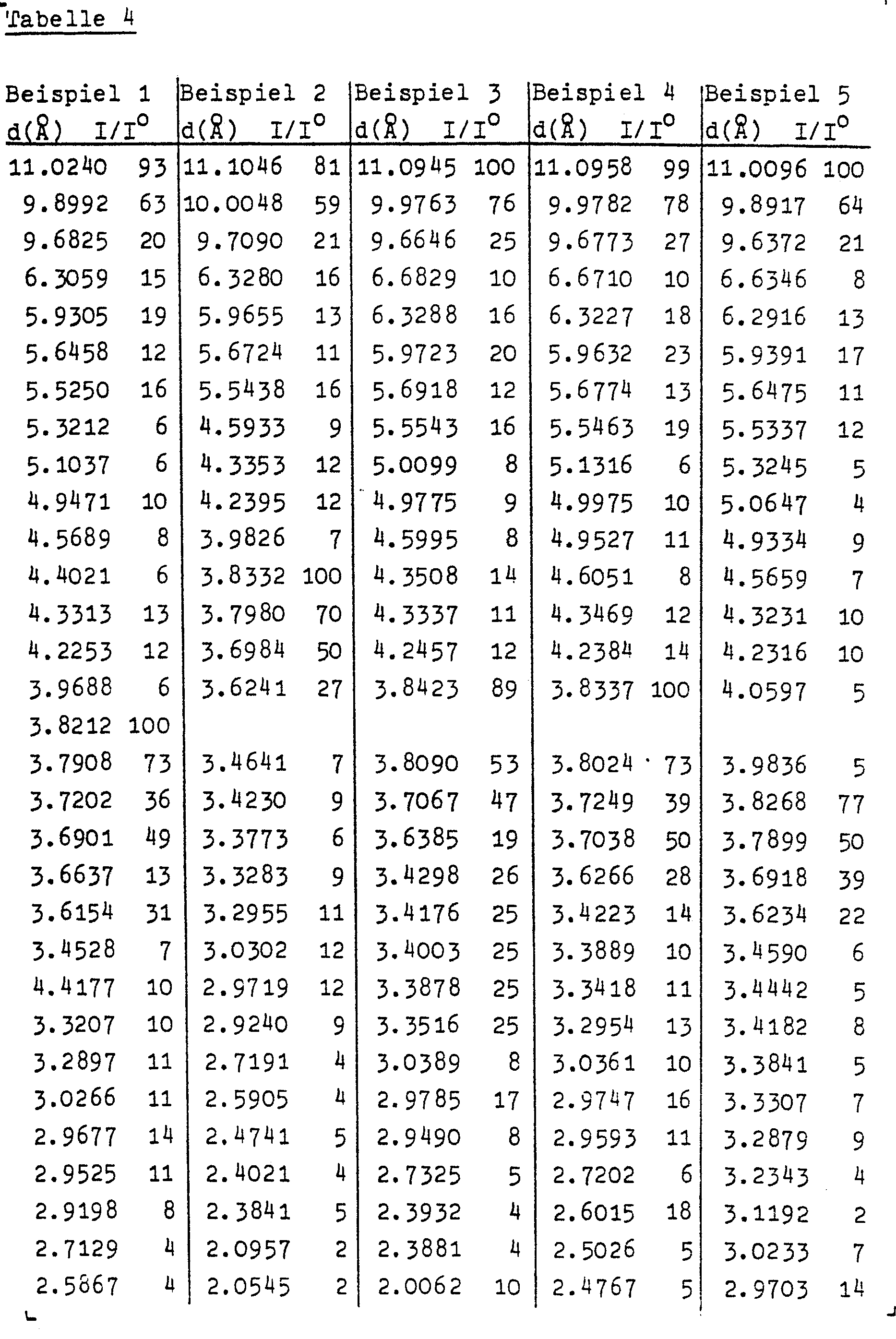
- interplanar interplanar distances (d values in ⁇ ) and the intensities of the X-ray diffraction lines are summarized in Table 4 for the borosilicate zeolites given in the individual examples.
- the borosilicate zeolite ZBH prepared in 1,4-butanediol in Example 4 is extruded with boehmite in a ratio of 60:40.
- the Na form is converted into the catalytically active H form of the zeolite by exchange with NH 4 Cl (20% NH 4 Cl solution) in a ratio of 1:15 in 2 h at 80 ° C.
Landscapes
- Chemical & Material Sciences (AREA)
- Organic Chemistry (AREA)
- Inorganic Chemistry (AREA)
- Engineering & Computer Science (AREA)
- Materials Engineering (AREA)
- Chemical Kinetics & Catalysis (AREA)
- Silicates, Zeolites, And Molecular Sieves (AREA)
- Catalysts (AREA)
- Detergent Compositions (AREA)
- Production Of Liquid Hydrocarbon Mixture For Refining Petroleum (AREA)
Abstract
Description
- Die Erfindung betrifft neue Borosilikatzeolithe-ZBH und ein Verfahren zur Herstellung kristalliner Borosilikatzeolithe-ZBH vom Pentasiltyp in reinem oder wäßrig-alkoholischem Medium ohne Verwendung von Aminen sowie die Verwendung als Katalysatoren. Diese ZBH-Zeolithe katalysieren die Umwandlung von Methanol und/oder Dimethylether zu niederen Olefinen und/oder Aromaten.
- Bor-Zeolithe sind bisher in der Natur nicht gefunden worden. Man erhält sie nur auf synthetischem Wege (DE-OS 27 46 790). Al-haltige zeolithische Materialien, sowohl natürlicher als auch synthetischer Herkunft, haben sich als katalytisch wirksam erwiesen für verschiedene Arten von Kohlenwasserstoffumwandlung, z.B. in der Technik zum Cracken von Kohlenwasserstoffen, und finden auch als Ionenaustauscher und Molekularsiebe technische Verwendung.
- Allgemein besitzen Zeolithe eine hochgeordnete Struktur mit einem starren dreidimensionalen Netzwerk von Si04-und MeO4-Tetraedern, wobei Me z.B. Al, Fe, Ga und B sein kann. Diese Tetraeder sind durch gemeinsame Sauerstoffatome verbunden. Das Verhältnis der Si- und Me-Atome zu Sauerstoff beträgt 1:2.
- Die Elektrovalenz der dreiwertigen Elemente Me-enthaltenden Tetraeder ist durch Einschluß von Kationen in den Kristall, z.B. eines Alkali- oder Wasserstoffions ausgeglichen. Ein Kationenaustausch ist möglich. Die Räume zwischen den Tetraedern sind vor der Dehydration durch Trocknen bzw. Calcinieren von Wassermolekeln besetzt.
- In den letzten Jahren gewannen kristalline Aluminosilikate mit einem hohen Si02/A1203-Verhältnis 11 zunehmendes Interesse. Derartige Zeolithe besitzen Pentasilstruktur und zeichnen sich durch hohe thermische Stabilität und außerordentlich hohe Acidität aus. Die Synthese dieser Zeolithe erfolgt in bekannter Weise aus einer Silicium- und einer Aluminiumkomponente in Gegenwart von voluminösen quaternären organischen Ammonium- bzw. Phosphoniumverbindungen und Alkaliverbindungen als Mineralisierungsmittel. Ein derartiges Verfahren ist z.B. in US-PS 3 702 886 beschrieben. Die großen Ammonium- bzw. Phosphoniumionen sollen als Templat für die gewünschte Zeolithstruktur wirken und ermöglichen die Synthese von Aluminium-Zeolithen mit SiO2/Al2O3-Verhältnissen z.B. von 100 bis zu 3000.
- Bor-Zeolithe mit Pentasil-Struktur wurden bisher nur in Gegenwart von Aminen hergestellt.
- Es wurde nun gefunden, daß man neuartige Borosilikatzeolithe-ZBH vom Pentasiltyp durch hydrothermale Kristallisation von Siliciumoxid und Borsäure in Gegenwart von Alkalisalzen erhält, wenn man die Kristallisation bei Temperaturen von 80 bis 150°C in alkoholischer oder wäßrig-alkoholischer Mischung ausführt.
- Eine bevorzugte Ausführungsform zur Herstellung dieser aminfreien Borosilikatzeolithe-ZBH besteht darin, daß man eine Reaktionsmischung aus Si02, z.B. eine käufliche pyrogene Kieselsäure, H3B03 und NaOH in einer Alkohol/ Wasser-Mischung von 50:50 Gew.% 5 bis 7 Tage bei 110 bis 1300C unter autogenem Druck in einem Rührautoklaven umsetzt. Das zunächst erhaltene Reaktionsprodukt kann vor der Calcierung noch Alkohol enthalten anstelle der in den intrakristallinen Poren enthaltenen H2O-Molekeln. Alle Reste or- ganischer Verbindungen werden durch Trocknen und Calcinieren entfernt, so daß nur noch die freien Alkaliionen im Bor-Zeolith enthalten sind.
- Das Molverhältnis von SiO2 zu B203 in der Reaktionsmischung wird zwischen 3 und 300, vorzugsweise bei 10 bis 50 eingestellt.
- Der Anteil an Alkalihydroxid liegt bei 1 bis 3 Mol pro Äquivalent B2O3, bevorzugt bei 1,5 Mol.
- Es ist zweckmäßig, Impfkristalle zur Reaktionsführung und -beschleunigung zuzusetzen.
- Als Lösungsmittel kann man allgemein ein-, zwei- oder mehrwertige, primäre, sekundäre oder tertiäre Alkohole z.B. CH30H, CH3CH2OH, (CH3)2CH-OH, Butandiol, Hexandiol einsetzen, vorzugsweise verwendet man 1,4-Butandiol und/oder 1,6-Hexandiol.
- Die molare Zusammensetzung der Reaktionsmischung wird wie folgt eingestellt:

- Das erfindungsgemäße Verfahren wird bei Reaktionstemperaturen im Bereich von 80 bis 150°C, vorzugsweise zwischen 110 und 130°C und vorteilhafterweise unter dem Eigendruck in einem Rührautoklaven aus Edelstahl während 3 bis 7 Tagen durchgeführt.
- Nach der Reaktion wird das Reaktionsprodukt zweckmäßigerweise abfiltriert, mit Wasser gut ausgewaschen und bei 110oC/16 h getrocknet. Anschließend wird das Produkt bei 550°C/20 h calciniert, um den noch eingeschlossenen Alkohol herauszubrennen und den Bor-Zeolith zu dehydratisieren. Die Überführung der Alkaliform des Zeolithen in die katalytisch aktive H-Form kann nach bekannten Austauschverfahren, z.B. mit Ammoniumsalzen, erfolgen.
- Die allgemeine Formel der hier hergestellten Borosilikatzeolithe-ZBH lautet:

- Die erfindungsgemäß im Alkohol hergestellten Borosilikatzeolithe-ZBH zeigen folgende Röntgenbeugungslinien:


- Das Röntgenbeugungsdiagramm wird mit einem automatischen Pulverdiffraktometer APD-10 hergestellt. Es wird Kupferstrahlung zusammen mit einem Graphitmonochromator verwendet.
- Das für die in Alkohol hergestellten Borosilikatzeolithe--ZBH typische Röntgenbeugungsmuster weist diese als Mitglieder der Pentasilfamilie aus.
- In den erfindungsgemäßen Borosilikatzeolithen-ZBH ist das Bor in die tetraedrischen Gitterplätze des Kristallgerüstes eingebaut. Der Einbau von Bor in das Kristallgerüst kommt in der Verschiebung der Röntgenbeugungslinien nach kleineren d-Werten im Vergleich zu entsprechenden Aluminosilikatzeolithen zum Ausdruck (Tabelle 2); die Bindungslänge einer B-0-Bindung ist erheblich kürzer als der Al-O-Abstand. Der Einbau des Bors in das Kristallgerüst bewirkt daher eine Kontraktion der Elementarzelle, d.h. eine Verschiebung der d-Abstände nach kleineren Werten im Vergleich zu entsprechenden Aluminosilikatzeolithen bzw. im Vergleich zu den d-Abständen des Silicalith.
- Ein Vergleich der Netzebenenabstände der hier beschriebenen Borzeolithe mit denen des ZSM-5 zeigt, daß die d-Werte (1) beim Borzeolith kleiner sind als beim Alumonosilikat ZSM-5 (Tabelle 2).


- Die hier beschriebenen kristallinen Borosilikatzeolithe-ZBH unterscheiden sich in ihren interplanaren Abständen (d-Werte in R) deutlich von den Werten des Borozeolithen AMS - 1 B der Standard Oil Co. (Tabelle 2).
- Auch ein Vergleich der Intensitäten der Röntgenbeugungslinien zeigt deutliche Unterschiede auf.
- Die Unterschiede sowohl in den d-Werten als auch in den Intensitäten weisen die ZBH-Borosilikate für den Experten als neuartige Zeolithe aus.
- Die in Alkoholen hergestellten Borosilikatzeolith-ZBH gehören zwar im Strukturtyp zur Pentasilfamilie, zeigen jedoch gegenüber den anderen Mitgliedern dieses Strukturtyps deutlich verschiedene Röntgenbeugungslinien und damit andere Gitterabstände.
- Die nach Austausch in H-Form erhaltenen Zeolithe können mit Matrixmaterial verstrangt und als Katalysator für Kohlenwasserstoffumwandlungen wie Isomerisierungen, Cracken und Umwandlung von Alkoholen und/oder Ethern in Olefine, Gasoline und Aromaten eingesetzt werden.
- Die in den Beispielen angegebenen Analysenwerte beziehen sich auf Trockenbasis. Die Substanzen werden vor der chemischen Analyse bei 550°/20 h calciniert. Die Differenz zu 100 p ergibt sich durch adsorbiertes Wasser.
- In 1000 g Alkohol/H20-Gemisch (50:50) werden bei ca. 40°C 80 g Aerosil eingerührt. 15,2 g H3B03 werden in 200 g Alkohol/H2O-Gemisch gelöst. Beide Lösungen werden zusammengegeben. Danach werden 14,7 g NaOH und eventuell Impfkristalle zugesetzt. Die homogen gerührte Mischung wird in einem Rührautoklaven 5 Tage bei Temperaturen zwischen 90 und 150°C unter autogenem Druck umgesetzt. Nach Abkühlen des Reaktionsgemisches wird das kristalline Produkt abfiltriert, mit 10 1 ausgewaschen, 16 h bei 110°C getrocknet und 20 h bei 500°C calciniert.
- Die Beispiele 1 bis 5 sind in der Tabelle 3 zusammengefaßt. Die synthetischen Borzeolithe wurden ohne Verunreinigungen . erhalten.
- Die interplanaren Netzebenenabstände (d-Werte in Å) und die Intensitäten der Röntgenbeugungslinien sind für die in den einzelnen Beispielen angegebenen Borosilikatzeolithe in Tabelle 4 zusammengefaßt.
- Der in Beispiel 4 in 1,4-Butandiol hergestellte Borosilikatzeolith-ZBH wird mit Böhmit im Verhältnis 60:40 verstrangt. Das Überführen der Na-Form in die katalytisch aktive H-Form des Zeolithen erfolgt durch Austausch mit NH4Cl (20 %ige NH4Cl-Lösung) im Verhältnis 1:15 in 2 h bei 80°C.
- 80 %iges Methanol wird bei 450°C bei einer Belastung von WHSV = 7,8 h-1 zu 100 % umgesetzt.



Claims (6)

Applications Claiming Priority (2)
| Application Number | Priority Date | Filing Date | Title |
|---|---|---|---|
| DE3143045 | 1981-10-30 | ||
| DE19813143045 DE3143045A1 (de) | 1981-10-30 | 1981-10-30 | Borosilikatzeolithe-zbh und verfahren zur herstellung von kristallinen borosilikatzeolithen (zbh) und deren verwendung als katalysator |
Publications (3)
| Publication Number | Publication Date |
|---|---|
| EP0091508A2 true EP0091508A2 (de) | 1983-10-19 |
| EP0091508A3 EP0091508A3 (en) | 1984-03-07 |
| EP0091508B1 EP0091508B1 (de) | 1986-07-23 |
Family
ID=6145176
Family Applications (1)
| Application Number | Title | Priority Date | Filing Date |
|---|---|---|---|
| EP82109667A Expired EP0091508B1 (de) | 1981-10-30 | 1982-10-20 | Borosilikatzeolithe-ZBH und Verfahren zur Herstellung von kristallinen Borosilikatzeolithen (ZBH) und deren Verwendung als Katalysator |
Country Status (2)
| Country | Link |
|---|---|
| EP (1) | EP0091508B1 (de) |
| DE (2) | DE3143045A1 (de) |
Cited By (3)
| Publication number | Priority date | Publication date | Assignee | Title |
|---|---|---|---|---|
| EP0219804A3 (en) * | 1985-10-22 | 1989-05-03 | Basf Aktiengesellschaft | Process for the manufacture of large zeolite crystals |
| EP0423530A1 (de) * | 1989-10-16 | 1991-04-24 | VAW Aluminium AG | Verfahren zur Herstellung synthetischer, kristalliner, metallhaltiger Borosilikate |
| AU634962B2 (en) * | 1988-06-10 | 1993-03-11 | Kohmix Co., Ltd. | Water-Soluble, film-forming inorganic compounds |
Family Cites Families (4)
| Publication number | Priority date | Publication date | Assignee | Title |
|---|---|---|---|---|
| IN146957B (de) * | 1976-10-18 | 1979-10-20 | Standard Oil Co | |
| GR66589B (de) * | 1978-06-22 | 1981-03-30 | Snam Progetti | |
| DE2830787B2 (de) * | 1978-07-13 | 1981-02-19 | Basf Ag, 6700 Ludwigshafen | Verfahren zur Herstellung von stickstoffhaltigen kirstallinen Metallsilikaten mit Zeolithstniktur |
| DE3006471A1 (de) * | 1980-02-21 | 1981-08-27 | Basf Ag, 6700 Ludwigshafen | Kristalline isotaktische zeolithe, verfahren zur herstellung derselben sowie deren verwendung als katalysatoren |
-
1981
- 1981-10-30 DE DE19813143045 patent/DE3143045A1/de not_active Withdrawn
-
1982
- 1982-10-20 DE DE8282109667T patent/DE3272178D1/de not_active Expired
- 1982-10-20 EP EP82109667A patent/EP0091508B1/de not_active Expired
Cited By (3)
| Publication number | Priority date | Publication date | Assignee | Title |
|---|---|---|---|---|
| EP0219804A3 (en) * | 1985-10-22 | 1989-05-03 | Basf Aktiengesellschaft | Process for the manufacture of large zeolite crystals |
| AU634962B2 (en) * | 1988-06-10 | 1993-03-11 | Kohmix Co., Ltd. | Water-Soluble, film-forming inorganic compounds |
| EP0423530A1 (de) * | 1989-10-16 | 1991-04-24 | VAW Aluminium AG | Verfahren zur Herstellung synthetischer, kristalliner, metallhaltiger Borosilikate |
Also Published As
| Publication number | Publication date |
|---|---|
| DE3143045A1 (de) | 1983-05-05 |
| DE3272178D1 (en) | 1986-08-28 |
| EP0091508B1 (de) | 1986-07-23 |
| EP0091508A3 (en) | 1984-03-07 |
Similar Documents
| Publication | Publication Date | Title |
|---|---|---|
| DE2442240C2 (de) | Verfahren zur Herstellung eines kristallinen Aluminosilicatzeoliths | |
| DE4310792C2 (de) | Zeolithisches Material, dessen Verwendung sowie Verfahren zum Herstellen eines solchen zeolithhaltigen Materials | |
| DE2643929C2 (de) | Verfahren zur Herstellung von Zeolith | |
| DD298379A5 (de) | Verfahren zur herstellung eines ethers | |
| EP0007081A1 (de) | Verfahren zur Herstellung von stickstoffhaltigen kristallinen Metallsilikaten mit Zeolithstruktur, nach dem Verfahren hergestellte Metallsilikate sowie deren Verwendung als Katalysatoren | |
| EP0034727A2 (de) | Kristalline isotaktische Zeolithe, Verfahren zur Herstellung derselben sowie deren Verwendung als Katalysatoren | |
| DE2817577A1 (de) | Verfahren zur synthetischen herstellung eines kristallinen aluminosilicat-zeoliths und dessen verwendung | |
| EP0074651B1 (de) | Gallium- und/oder indiumhaltige Zeolithe und Verfahren zu deren Herstellung sowie ihre Verwendung | |
| EP0051741B1 (de) | Verfahren zur Herstellung eines kristallinen Aluminiumsilikates (Zeoliths) und dessen Verwendung als Katalysator | |
| DE3875587T2 (de) | Verfahren zur herstellung von 1,4-bis(4-phenoxybenzoyl)-benzen in gegenwart eines zeolithkatalysators. | |
| EP0077946B1 (de) | Borosilikatzeolithe - ZBH und Verfahren zur Herstellung kristalliner Borosilikatzeolithe (ZBH) und Verwendung als Katalysator | |
| DE3586198T2 (de) | Metallsilikate von tetravalenten metallen der lanthanid- und actinidreihe. | |
| EP0049386B1 (de) | Verfahren zur Herstellung eines Zeoliths vom Strukturtyp des Ferrierit | |
| DE2813969A1 (de) | Verfahren zur herstellung kristalliner zeolithe | |
| EP0091508B1 (de) | Borosilikatzeolithe-ZBH und Verfahren zur Herstellung von kristallinen Borosilikatzeolithen (ZBH) und deren Verwendung als Katalysator | |
| EP0111147B1 (de) | Titan-, zirkon- und/oder hafniumhaltige Zeolithe und Verfahren zu ihrer Herstellung sowie ihre Verwendung | |
| DE68904216T2 (de) | Kristalline, kieselsaeurereiche (metallo)silikate vom sodalittyp sowie verfahren zur deren herstellung. | |
| EP0111700B1 (de) | Titan-, zirkon- und/oder hafniumhaltige Zeolithe und Verfahren zu ihrer Herstellung sowie ihre Verwendung | |
| EP0219804B1 (de) | Verfahren zur Herstellung grosser Zeolithkristalle | |
| DE3217324A1 (de) | Titanhaltige zeolithe und verfahren zu ihrer herstellung sowie ihre verwendung | |
| EP0219810B1 (de) | Kristalline Borosilikatzeolithe vom Sodalithtyp und Verfahren zu ihrer Herstellung | |
| EP0089574B1 (de) | Niob-haltige Alumino- und Borosilikatzeolithe, deren Herstellung und Verwendung als Katalysator | |
| DE69504764T2 (de) | Galliumsilikat mit 12-Ring Poren (ECR-34) sowie Verfahren zu seiner Herstellung | |
| DE2739950A1 (de) | Herstellung von alkylbenzol | |
| EP0423530B1 (de) | Verfahren zur Herstellung synthetischer, kristalliner, metallhaltiger Borosilikate |
Legal Events
| Date | Code | Title | Description |
|---|---|---|---|
| PUAI | Public reference made under article 153(3) epc to a published international application that has entered the european phase |
Free format text: ORIGINAL CODE: 0009012 |
|
| 17P | Request for examination filed |
Effective date: 19821211 |
|
| AK | Designated contracting states |
Designated state(s): BE DE FR GB NL |
|
| PUAL | Search report despatched |
Free format text: ORIGINAL CODE: 0009013 |
|
| AK | Designated contracting states |
Designated state(s): BE DE FR GB NL |
|
| GRAA | (expected) grant |
Free format text: ORIGINAL CODE: 0009210 |
|
| AK | Designated contracting states |
Kind code of ref document: B1 Designated state(s): BE DE FR GB NL |
|
| REF | Corresponds to: |
Ref document number: 3272178 Country of ref document: DE Date of ref document: 19860828 |
|
| ET | Fr: translation filed | ||
| PLBE | No opposition filed within time limit |
Free format text: ORIGINAL CODE: 0009261 |
|
| STAA | Information on the status of an ep patent application or granted ep patent |
Free format text: STATUS: NO OPPOSITION FILED WITHIN TIME LIMIT |
|
| 26N | No opposition filed | ||
| PGFP | Annual fee paid to national office [announced via postgrant information from national office to epo] |
Ref country code: FR Payment date: 19920914 Year of fee payment: 11 |
|
| PGFP | Annual fee paid to national office [announced via postgrant information from national office to epo] |
Ref country code: BE Payment date: 19921009 Year of fee payment: 11 |
|
| PGFP | Annual fee paid to national office [announced via postgrant information from national office to epo] |
Ref country code: GB Payment date: 19921016 Year of fee payment: 11 |
|
| PGFP | Annual fee paid to national office [announced via postgrant information from national office to epo] |
Ref country code: DE Payment date: 19921021 Year of fee payment: 11 |
|
| PGFP | Annual fee paid to national office [announced via postgrant information from national office to epo] |
Ref country code: NL Payment date: 19921031 Year of fee payment: 11 |
|
| PG25 | Lapsed in a contracting state [announced via postgrant information from national office to epo] |
Ref country code: GB Effective date: 19931020 |
|
| PG25 | Lapsed in a contracting state [announced via postgrant information from national office to epo] |
Ref country code: BE Effective date: 19931031 |
|
| BERE | Be: lapsed |
Owner name: BASF A.G. Effective date: 19931031 |
|
| PG25 | Lapsed in a contracting state [announced via postgrant information from national office to epo] |
Ref country code: NL Effective date: 19940501 |
|
| GBPC | Gb: european patent ceased through non-payment of renewal fee |
Effective date: 19931020 |
|
| NLV4 | Nl: lapsed or anulled due to non-payment of the annual fee | ||
| PG25 | Lapsed in a contracting state [announced via postgrant information from national office to epo] |
Ref country code: FR Effective date: 19940630 |
|
| PG25 | Lapsed in a contracting state [announced via postgrant information from national office to epo] |
Ref country code: DE Effective date: 19940701 |
|
| REG | Reference to a national code |
Ref country code: FR Ref legal event code: ST |