EP0091596A2 - Neue Hydantoine, ihre Herstellung und Verwendung - Google Patents
Neue Hydantoine, ihre Herstellung und Verwendung Download PDFInfo
- Publication number
- EP0091596A2 EP0091596A2 EP83103022A EP83103022A EP0091596A2 EP 0091596 A2 EP0091596 A2 EP 0091596A2 EP 83103022 A EP83103022 A EP 83103022A EP 83103022 A EP83103022 A EP 83103022A EP 0091596 A2 EP0091596 A2 EP 0091596A2
- Authority
- EP
- European Patent Office
- Prior art keywords
- formula
- compounds
- above meaning
- alkyl
- meaning
- Prior art date
- Legal status (The legal status is an assumption and is not a legal conclusion. Google has not performed a legal analysis and makes no representation as to the accuracy of the status listed.)
- Granted
Links
- 0 CCC(*)(*C(*)=C1)*(C)=C1N(C(C)N*1)C1=O Chemical compound CCC(*)(*C(*)=C1)*(C)=C1N(C(C)N*1)C1=O 0.000 description 4
- PAFZNILMFXTMIY-UHFFFAOYSA-N NC1CCCCC1 Chemical compound NC1CCCCC1 PAFZNILMFXTMIY-UHFFFAOYSA-N 0.000 description 1
Classifications
-
- C—CHEMISTRY; METALLURGY
- C07—ORGANIC CHEMISTRY
- C07D—HETEROCYCLIC COMPOUNDS
- C07D233/00—Heterocyclic compounds containing 1,3-diazole or hydrogenated 1,3-diazole rings, not condensed with other rings
- C07D233/54—Heterocyclic compounds containing 1,3-diazole or hydrogenated 1,3-diazole rings, not condensed with other rings having two double bonds between ring members or between ring members and non-ring members
- C07D233/66—Heterocyclic compounds containing 1,3-diazole or hydrogenated 1,3-diazole rings, not condensed with other rings having two double bonds between ring members or between ring members and non-ring members with hetero atoms or with carbon atoms having three bonds to hetero atoms with at the most one bond to halogen, e.g. ester or nitrile radicals, directly attached to ring carbon atoms
- C07D233/72—Two oxygen atoms, e.g. hydantoin
-
- C—CHEMISTRY; METALLURGY
- C07—ORGANIC CHEMISTRY
- C07D—HETEROCYCLIC COMPOUNDS
- C07D235/00—Heterocyclic compounds containing 1,3-diazole or hydrogenated 1,3-diazole rings, condensed with other rings
- C07D235/02—Heterocyclic compounds containing 1,3-diazole or hydrogenated 1,3-diazole rings, condensed with other rings condensed with carbocyclic rings or ring systems
-
- A—HUMAN NECESSITIES
- A01—AGRICULTURE; FORESTRY; ANIMAL HUSBANDRY; HUNTING; TRAPPING; FISHING
- A01N—PRESERVATION OF BODIES OF HUMANS OR ANIMALS OR PLANTS OR PARTS THEREOF; BIOCIDES, e.g. AS DISINFECTANTS, AS PESTICIDES OR AS HERBICIDES; PEST REPELLANTS OR ATTRACTANTS; PLANT GROWTH REGULATORS
- A01N43/00—Biocides, pest repellants or attractants, or plant growth regulators containing heterocyclic compounds
- A01N43/48—Biocides, pest repellants or attractants, or plant growth regulators containing heterocyclic compounds having rings with two nitrogen atoms as the only ring hetero atoms
- A01N43/50—1,3-Diazoles; Hydrogenated 1,3-diazoles
-
- A—HUMAN NECESSITIES
- A01—AGRICULTURE; FORESTRY; ANIMAL HUSBANDRY; HUNTING; TRAPPING; FISHING
- A01N—PRESERVATION OF BODIES OF HUMANS OR ANIMALS OR PLANTS OR PARTS THEREOF; BIOCIDES, e.g. AS DISINFECTANTS, AS PESTICIDES OR AS HERBICIDES; PEST REPELLANTS OR ATTRACTANTS; PLANT GROWTH REGULATORS
- A01N43/00—Biocides, pest repellants or attractants, or plant growth regulators containing heterocyclic compounds
- A01N43/48—Biocides, pest repellants or attractants, or plant growth regulators containing heterocyclic compounds having rings with two nitrogen atoms as the only ring hetero atoms
- A01N43/50—1,3-Diazoles; Hydrogenated 1,3-diazoles
- A01N43/52—1,3-Diazoles; Hydrogenated 1,3-diazoles condensed with carbocyclic rings, e.g. benzimidazoles
-
- C—CHEMISTRY; METALLURGY
- C07—ORGANIC CHEMISTRY
- C07C—ACYCLIC OR CARBOCYCLIC COMPOUNDS
- C07C275/00—Derivatives of urea, i.e. compounds containing any of the groups, the nitrogen atoms not being part of nitro or nitroso groups
- C07C275/28—Derivatives of urea, i.e. compounds containing any of the groups, the nitrogen atoms not being part of nitro or nitroso groups having nitrogen atoms of urea groups bound to carbon atoms of six-membered aromatic rings of a carbon skeleton
-
- C—CHEMISTRY; METALLURGY
- C07—ORGANIC CHEMISTRY
- C07C—ACYCLIC OR CARBOCYCLIC COMPOUNDS
- C07C275/00—Derivatives of urea, i.e. compounds containing any of the groups, the nitrogen atoms not being part of nitro or nitroso groups
- C07C275/28—Derivatives of urea, i.e. compounds containing any of the groups, the nitrogen atoms not being part of nitro or nitroso groups having nitrogen atoms of urea groups bound to carbon atoms of six-membered aromatic rings of a carbon skeleton
- C07C275/30—Derivatives of urea, i.e. compounds containing any of the groups, the nitrogen atoms not being part of nitro or nitroso groups having nitrogen atoms of urea groups bound to carbon atoms of six-membered aromatic rings of a carbon skeleton being further substituted by halogen atoms, or by nitro or nitroso groups
-
- C—CHEMISTRY; METALLURGY
- C07—ORGANIC CHEMISTRY
- C07C—ACYCLIC OR CARBOCYCLIC COMPOUNDS
- C07C275/00—Derivatives of urea, i.e. compounds containing any of the groups, the nitrogen atoms not being part of nitro or nitroso groups
- C07C275/28—Derivatives of urea, i.e. compounds containing any of the groups, the nitrogen atoms not being part of nitro or nitroso groups having nitrogen atoms of urea groups bound to carbon atoms of six-membered aromatic rings of a carbon skeleton
- C07C275/32—Derivatives of urea, i.e. compounds containing any of the groups, the nitrogen atoms not being part of nitro or nitroso groups having nitrogen atoms of urea groups bound to carbon atoms of six-membered aromatic rings of a carbon skeleton being further substituted by singly-bound oxygen atoms
- C07C275/34—Derivatives of urea, i.e. compounds containing any of the groups, the nitrogen atoms not being part of nitro or nitroso groups having nitrogen atoms of urea groups bound to carbon atoms of six-membered aromatic rings of a carbon skeleton being further substituted by singly-bound oxygen atoms having nitrogen atoms of urea groups and singly-bound oxygen atoms bound to carbon atoms of the same non-condensed six-membered aromatic ring
-
- C—CHEMISTRY; METALLURGY
- C07—ORGANIC CHEMISTRY
- C07D—HETEROCYCLIC COMPOUNDS
- C07D233/00—Heterocyclic compounds containing 1,3-diazole or hydrogenated 1,3-diazole rings, not condensed with other rings
- C07D233/54—Heterocyclic compounds containing 1,3-diazole or hydrogenated 1,3-diazole rings, not condensed with other rings having two double bonds between ring members or between ring members and non-ring members
- C07D233/66—Heterocyclic compounds containing 1,3-diazole or hydrogenated 1,3-diazole rings, not condensed with other rings having two double bonds between ring members or between ring members and non-ring members with hetero atoms or with carbon atoms having three bonds to hetero atoms with at the most one bond to halogen, e.g. ester or nitrile radicals, directly attached to ring carbon atoms
- C07D233/72—Two oxygen atoms, e.g. hydantoin
- C07D233/74—Two oxygen atoms, e.g. hydantoin with only hydrogen atoms or radicals containing only hydrogen and carbon atoms, attached to other ring members
-
- C—CHEMISTRY; METALLURGY
- C07—ORGANIC CHEMISTRY
- C07D—HETEROCYCLIC COMPOUNDS
- C07D233/00—Heterocyclic compounds containing 1,3-diazole or hydrogenated 1,3-diazole rings, not condensed with other rings
- C07D233/54—Heterocyclic compounds containing 1,3-diazole or hydrogenated 1,3-diazole rings, not condensed with other rings having two double bonds between ring members or between ring members and non-ring members
- C07D233/66—Heterocyclic compounds containing 1,3-diazole or hydrogenated 1,3-diazole rings, not condensed with other rings having two double bonds between ring members or between ring members and non-ring members with hetero atoms or with carbon atoms having three bonds to hetero atoms with at the most one bond to halogen, e.g. ester or nitrile radicals, directly attached to ring carbon atoms
- C07D233/72—Two oxygen atoms, e.g. hydantoin
- C07D233/76—Two oxygen atoms, e.g. hydantoin with substituted hydrocarbon radicals attached to the third ring carbon atom
-
- C—CHEMISTRY; METALLURGY
- C07—ORGANIC CHEMISTRY
- C07D—HETEROCYCLIC COMPOUNDS
- C07D233/00—Heterocyclic compounds containing 1,3-diazole or hydrogenated 1,3-diazole rings, not condensed with other rings
- C07D233/54—Heterocyclic compounds containing 1,3-diazole or hydrogenated 1,3-diazole rings, not condensed with other rings having two double bonds between ring members or between ring members and non-ring members
- C07D233/66—Heterocyclic compounds containing 1,3-diazole or hydrogenated 1,3-diazole rings, not condensed with other rings having two double bonds between ring members or between ring members and non-ring members with hetero atoms or with carbon atoms having three bonds to hetero atoms with at the most one bond to halogen, e.g. ester or nitrile radicals, directly attached to ring carbon atoms
- C07D233/72—Two oxygen atoms, e.g. hydantoin
- C07D233/76—Two oxygen atoms, e.g. hydantoin with substituted hydrocarbon radicals attached to the third ring carbon atom
- C07D233/78—Radicals substituted by oxygen atoms
-
- C—CHEMISTRY; METALLURGY
- C07—ORGANIC CHEMISTRY
- C07D—HETEROCYCLIC COMPOUNDS
- C07D233/00—Heterocyclic compounds containing 1,3-diazole or hydrogenated 1,3-diazole rings, not condensed with other rings
- C07D233/54—Heterocyclic compounds containing 1,3-diazole or hydrogenated 1,3-diazole rings, not condensed with other rings having two double bonds between ring members or between ring members and non-ring members
- C07D233/66—Heterocyclic compounds containing 1,3-diazole or hydrogenated 1,3-diazole rings, not condensed with other rings having two double bonds between ring members or between ring members and non-ring members with hetero atoms or with carbon atoms having three bonds to hetero atoms with at the most one bond to halogen, e.g. ester or nitrile radicals, directly attached to ring carbon atoms
- C07D233/86—Oxygen and sulfur atoms, e.g. thiohydantoin
-
- C—CHEMISTRY; METALLURGY
- C07—ORGANIC CHEMISTRY
- C07D—HETEROCYCLIC COMPOUNDS
- C07D401/00—Heterocyclic compounds containing two or more hetero rings, having nitrogen atoms as the only ring hetero atoms, at least one ring being a six-membered ring with only one nitrogen atom
- C07D401/02—Heterocyclic compounds containing two or more hetero rings, having nitrogen atoms as the only ring hetero atoms, at least one ring being a six-membered ring with only one nitrogen atom containing two hetero rings
- C07D401/04—Heterocyclic compounds containing two or more hetero rings, having nitrogen atoms as the only ring hetero atoms, at least one ring being a six-membered ring with only one nitrogen atom containing two hetero rings directly linked by a ring-member-to-ring-member bond
-
- C—CHEMISTRY; METALLURGY
- C07—ORGANIC CHEMISTRY
- C07C—ACYCLIC OR CARBOCYCLIC COMPOUNDS
- C07C2601/00—Systems containing only non-condensed rings
- C07C2601/02—Systems containing only non-condensed rings with a three-membered ring
-
- C—CHEMISTRY; METALLURGY
- C07—ORGANIC CHEMISTRY
- C07C—ACYCLIC OR CARBOCYCLIC COMPOUNDS
- C07C2601/00—Systems containing only non-condensed rings
- C07C2601/12—Systems containing only non-condensed rings with a six-membered ring
- C07C2601/14—The ring being saturated
Definitions
- the invention relates to new hydantoins, their preparation by processes known per se and their use in combating undesirable plant growth.
- halogen means fluorine, chlorine, bromine or iodine (preferably chlorine).
- X mainly stands for hydrogen, chlorine, bromine, methyl, methoxy and trifluoromethyl
- Y especially for chlorine, bromine, methyl, methoxy and trifluoromethyl.
- the lower alkyl and lower alkoxy radicals and the C 1 -C 4 alkyl and alkoxy radicals are or include methyl, ethyl, n-propyl, i-propyl, n-butyl, i-butyl, s-butyl and t-butyl.
- R 4 and R 5 are primarily methyl, ethyl, n-propyl and i-propyl. Allyl is particularly worth mentioning as alkenyl.
- R 4 and / or R 5 represent or contain substituted phenyl or benzyl radicals
- the substituents are one or more C 1 -C 4 alkyl or C 1 -C 4 alkoxy radicals, trifluoromethyl or halogen, optionally in a mixture. Methyl, methoxy, chlorine and bromine should be emphasized.
- Group A is derived primarily from cyclohexane, cyclopentane or their mono- to triple-lower alkyl, in particular methyl-substituted homologs, for example menthan, or from bi- or tricyclic, optionally mono- to tri-lower alkyl, in particular methyl-substituted, cycloalkanes, for example carane, Pinan.
- the cyclization of the acid according to process a) is advantageously carried out in aqueous or alcoholic solution in the presence of an acid such as hydrochloric acid, sulfuric acid at elevated temperature. It is easiest to heat the mixture to boiling temperature for some time.
- the cyclization of the esters according to process b) is preferably carried out in an alcohol or another organic solvent, for example dioxane.
- a tertiary organic base is preferably used as the base, e.g. Triethylamine, tripropylamine.
- the reaction mixture is heated, generally at boiling temperature for a few hours.
- the amino group (s) are removed in a manner known per se via the diazonium compounds, for example by performs the diazotization in the presence of boiling ethanol (Houben-Weyl, Vol. 10/3 (1965), page 116 ff) or enters the suspension or solution of the diazonium salt in an aqueous solution of hypophosphorous acid (loc. cit., p. 131 ff. ) or the diazotization with alkyl nitrites in the presence of derivatives of formic acid, such as dimethylformamide, (loc. cit., p. 137 ff.).
- Process d) can be influenced favorably by adding a phase transfer catalyst (e.g. crown ether, tetraalkylammonium salts, tetraalkylphosphonium salts).
- a phase transfer catalyst e.g. crown ether, tetraalkylammonium salts, tetraalkylphosphonium salts.
- the compounds of the invention can in part. exist in the form of cis / trans isomers and / or in enantiomeric forms.
- the assignment to the cis or trans series was made according to Cahn-Ingold-Prelog.
- Mixtures of geometric isomers obtained according to the invention can, if desired, be subsequently separated, e.g. by fractional crystallization, as well as racemates.
- the starting materials III to VII are known or can be prepared analogously to known compounds by customary processes.
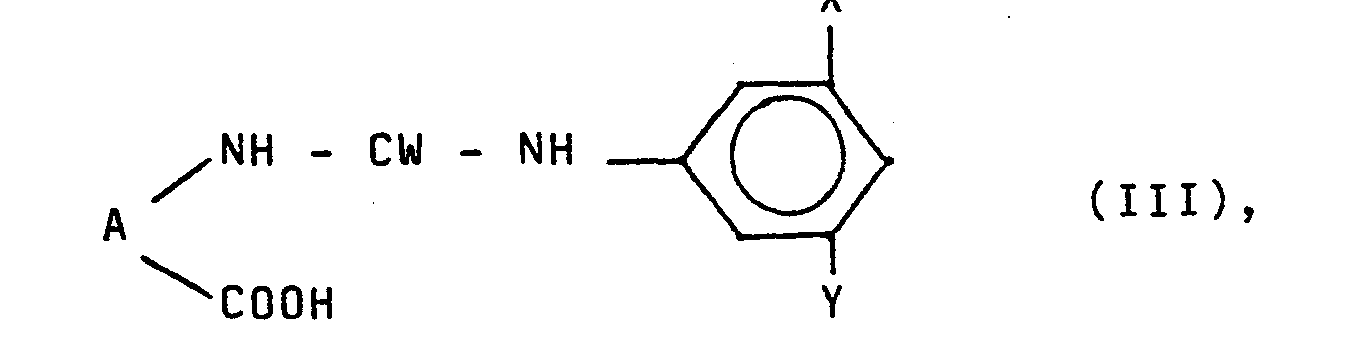
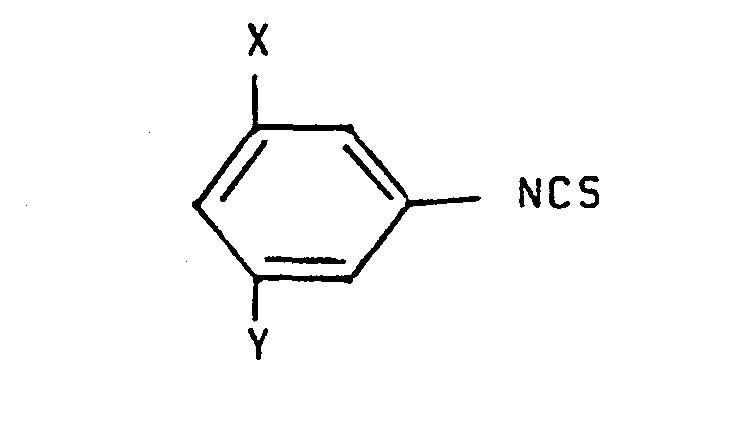
- a 1-aminocycloalkane carboxylic acid of the formula is used, for example, to prepare the compounds of the formula III wherein A has the meaning given above, with an isocyanate or isothiocyanate of the formula where W, X and Y have the meaning given above, in aqueous or alcoholic solution at low temperatures, preferably 0-10 ° C, in the presence of a basic substance (e.g. sodium hydroxide solution, potassium hydroxide solution, potassium carbonate, sodium methylate) and falls over with a suitable acid (eg hydrochloric acid, sulfuric acid, acetic acid) from the compound of formula III.
- a basic substance e.g. sodium hydroxide solution, potassium hydroxide solution, potassium carbonate, sodium methylate
- a suitable acid eg hydrochloric acid, sulfuric acid, acetic acid
- the starting materials of the formula IV can be obtained by reacting esters of the formula in which A and Z have the meaning given above, are obtained with an isocyanate or isothiocyanate of the formula IX.
- Reactants IX and X are reacted in an inert solvent (eg ether, methylene chloride, toluene, ethyl acetate) at low temperatures, preferably 10-20 ° C.
- the radical Z generally means a lower to medium alkyl radical C 1 -C 12 or an optionally substituted benzyl radical. Its type is generally uncritical, that is, unless it leads to side reactions or to an inhibition of the reaction because of an unfavorable structure or reactive substituents.
- the compounds XIII become the corresponding amino compounds of the formula (A, W, Y as defined above; E, E 'H or NH 29, however, at least one of the two NH 2 ) reduced.
- These amino compounds themselves or their halogenation product (after halogenation with, for example, Cl 2 , SO 2 Cl 2 , Br 2 ), compounds of the formula V where X is chlorine or bromine are then deaminated in accordance with process c).
- the compounds according to the invention are notable for a strong action against numerous, in particular monocotyledonous, weeds. It is preferably used before emergence.
- the good tolerance of the active compounds according to the invention enables use in numerous cultures, e.g. in soy, corn, rice, cotton, barley, beets, potatoes, tomatoes, onions.
- the application rates can vary between 0.1 and 10 kg / ha, in particular between 0.3 and 3 kg / ha.
- Combinations with urea derivatives e.g. chlorotoluron
- triazine derivatives e.g. atrazine, simazine
- dinitroaniline derivatives e.g. trifluralin
- chloroacetanilide derivatives e.g. alachlor
- thiocarbamates e.g. benthiocarb
- diphenyl ether e.g. acifluorfen
- the active compounds of the formula I can be processed in the customary manner to give customary formulations, e.g. to granules, dusts, suspension powders or concentrates, water-dispersible granules.
- formulations are made by mixing the active ingredients with excipients, e.g. Solvents and / or solid carriers, optionally with the addition of surface-active agents (emulsifiers, dispersants) and / or stabilizing and / or foam-preventing agents and, if appropriate, further additives.
- excipients e.g. Solvents and / or solid carriers
- surface-active agents emulsifiers, dispersants
- stabilizing and / or foam-preventing agents e.g., foam-preventing agents.
- Rock solid materials e.g. kaolins, clays, talc, chalk, quartz, highly disperse silica, aluminum oxide, silicates
- kaolins e.g. kaolins, clays, talc, chalk, quartz, highly disperse silica, aluminum oxide, silicates
- Carriers suitable for granules are broken and fractionated rocks (e.g. calcite, marble, pumice) on the one hand, and granules made of organic material (e.g. sawdust, coconut shells, corn cobs) on the other.
- granules made of organic material e.g. sawdust, coconut shells, corn cobs
- Suitable emulsifiers are nonionic and anionic compounds, such as polyoxyethylene fatty acid esters, polyoxyethylene fatty alcohol ethers, e.g. Alkylaryl polyglycol ethers, alkyl sulfonates, alkyl sulfates, aryl sulfonates and protein hydrolyzates.
- Suitable dispersants are lye from wood processing or methyl cellulose, while foam-preventing agents are branched higher alcohols. From the concentrated preparations, which generally contain between 0.1 and 95 percent by weight, preferably between 0.5 and 90 percent by weight, of active ingredient, spray or pouring liquors of the desired concentration are optionally prepared by dilution with water.
- the Nutsche residue is now suspended in 500 ml of ethanol and, after adding 10.1 g (0.1 mol) of triethylamine, boiled under reflux for 3 hours. Then poured onto 2 liters of ice water and suctioned off the resulting precipitate. Wash thoroughly with water and dry in a forced air cabinet.
- the catalyst is then suctioned off, concentrated and taken up in water.
- the mixture is neutralized with bicarbonate, the precipitate which has separated out is filtered off with suction, washed with water and crystallized from isopropanol.
- the temperature is then increased to 70-80 ° C. by the end of the N Z evolution.
- the mixture is then concentrated in vacuo and the dark residue is purified by column chromatography (silica gel / ethyl acetate).
- a suspension consisting of 3.1 g of 5-methyl-5-cyclopropyl-hydantoin, 3.86 g of 2,6-dichloro-4-nitropyridine and 5.6 g of potassium carbonate in 10 ml of dimethylformamide is 18 hours at 20 ° C. stirred and then added to 100 ml of water. After stirring for 30 minutes, the precipitate formed is suction filtered and taken up in methylene chloride. After drying and stripping off the solvent, 3.2 g of 5-methyl-5-cyclopropyl-3- [4 - (2,6-dichloropyridyl)] hydantoin, mp. 160 ° C. (reprecipitation from toluene / petroleum ether).
- the active compounds according to the invention combine very good activity (largely rating 1) with excellent tolerability (rating 10 in all cases).
Landscapes
- Chemical & Material Sciences (AREA)
- Organic Chemistry (AREA)
- Life Sciences & Earth Sciences (AREA)
- Dentistry (AREA)
- Wood Science & Technology (AREA)
- Plant Pathology (AREA)
- Health & Medical Sciences (AREA)
- Engineering & Computer Science (AREA)
- Agronomy & Crop Science (AREA)
- General Health & Medical Sciences (AREA)
- Pest Control & Pesticides (AREA)
- Zoology (AREA)
- Environmental Sciences (AREA)
- Nitrogen Condensed Heterocyclic Rings (AREA)
- Plural Heterocyclic Compounds (AREA)
- Agricultural Chemicals And Associated Chemicals (AREA)
- Pharmaceuticals Containing Other Organic And Inorganic Compounds (AREA)
Abstract
Description
- Die Erfindung betrifft neue Hydantoine, ihre Herstellung nach an sich bekannten Verfahren und ihre Verwendung bei der Bekämpfung unerwünschten Pflanzenwachstums.
- Die neuen Verbindungen haben die Formel
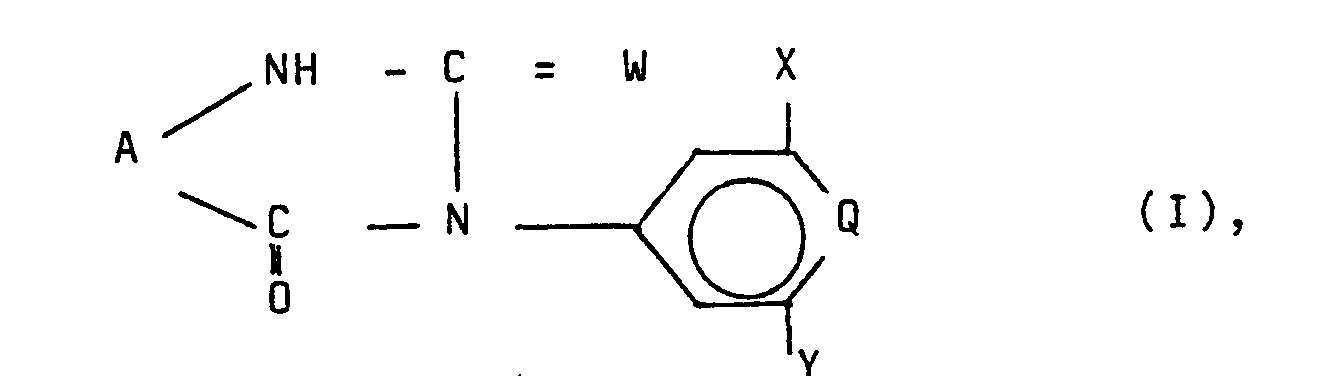
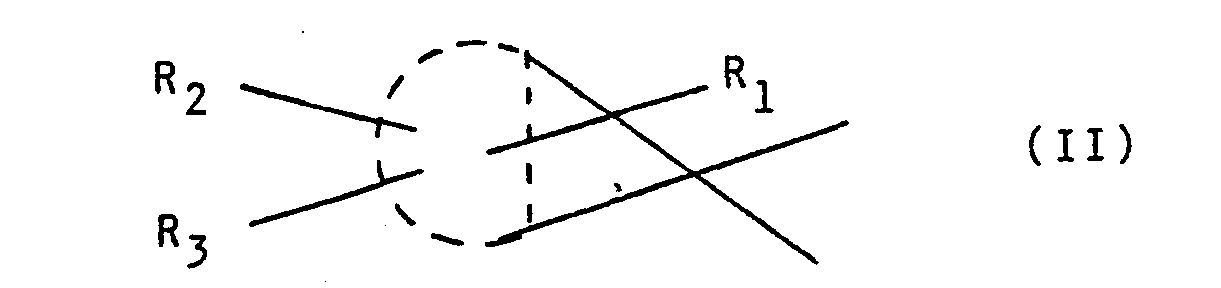
- A für einen gegebenenfalls ein- oder mehrfach verbrückten Cycloalkanrest der Formel

- Q für CH oder N,
- R1, RZ und R3, die gleich oder verschieden sein können, für Wasserstoff, für geradkettiges oder verzweigtes C1-C4-Alkyl oder für geradkettiges oder verzweigtes C3-C4-Alkenyl,
- R4 und R5, die gleich oder verschieden sein können, für Cl-C4-Alkyl, das auch durch C1-C4-O- oder Cl-C4-S-oder eine gegebenenfalls substituierte Phenyl-0-oder Phenyl-S-Gruppe substituiert sein kann, Für C2-C4-Alkenyl, für C3- C6-Cycloalkyl, das auch niederalkylsubstituiert sein kann, für gegebenenfalls substituiertes Phenyl oder Benzyl,
- W für Sauerstoff oder, falls Q CH ist, auch für Schwefel,
- X und Y, die gleich oder verschieden sein können, für Halogen, C1-C4-Alkyl, C1-C4-Alkoxy oder Trifluormethyl, X außerdem auch für Wasserstoff
- Diese Verbindungen zeichnen sich durch eine starke Wirkung gegen Unkräuter und Ungräser aus und können in zahlreichen Kulturen als selektive Herbizide eingesetzt werden.
- In den obigen Definitionen ist unter Halogen Fluor, Chlor, Brom oder Jod (bevorzugt Chlor) zu verstehen. X steht vor allem für Wasserstoff, Chlor, Brom, Methyl, Methoxy und Trifluormethyl, Y vor allem für Chlor, Brom, Methyl, Methoxy und Trifluormethyl. Die Niederalkyl-und Niederalkoxyreste sowie die C1-C4- Alkyl- und -Alkoxyreste sind bzw. umfassen Methyl, Ethyl, n-Propyl, i-Propyl, n-Butyl, i-Butyl, s-Butyl und t-Butyl. R4 und R5 sind vor allem Methyl, Ethyl, n-Propyl und i-Propyl. Als Alkenyl ist besonders Allyl zu nennen.
- Soweit R4 und/oder R5 substituierte Phenyl- oder Benzylreste bedeuten oder enthalten, sind die Substituenten ein oder mehrere Cl-C4-Alkyl- oder C1-C4-Alkoxyreste, Trifluormethyl oder Halogen, gegebenenfalls in Mischung. Dabei sind Methyl, Methoxy, Chlor und Brom hervorzuheben. Die Gruppe A leitet sich vor allem von Cyclohexan, Cyclopentan oder ihren ein- bis dreifach niederalkyl-, insbesondere methylsubstituierten Homologen ab, etwa Menthan, oder von bi- oder tricyclischen, gegebenenfalls ein- bis dreifach niederalkyl-, insbesondere methylsubstituierten Cycloalkanen, etwa Caran, Pinan.
- Die Verbindungen der Formel I können nach an sich bekannten Methoden hergestellt werden, indem man
- a) zur Herstellung solcher Verbindungen, in denen Q CH ist, eine Carbonsäure der Formel

oder daß man - b) zur Herstellung solcher Verbindungen, in denen Q CH ist, einen Ester der Formel

- c) zur Herstellung solcher Verbindungen, in denen Q CH ist, eine Aminoverbindung der Formel

oder daß man - d) zur Herstellung solcher Verbindungen der Formel I, in denen Q für N steht, ein Hydantoin der Formel


- Die Cyclisierung der Säure gemäß Verfahren a) erfolgt zweckmäßig in wäß.riger oder alkoholischer Lösung in Gegenwart einer Säure wie Salzsäure, Schwefelsäure bei erhöhter Temperatur. Am einfachsten ist es, die Mischung einige Zeit auf Siedetemperatur zu erhitzen.
- Die Cyclisierung der Ester gemäß Verfahren b) erfolgt bevorzugt in einem Alkohol oder einem anderen organischen Lösungsmittel, beispielsweise Dioxan. Als Base wird bevorzugt eine tertiäre organische Base verwendet, z.B. Triethylamin, Tripropylamin. Das Reaktionsgemisch wird erwärmt, im allgemeinne einige Stunden auf Siedetemperatur.
- Im Verfahren c)erfolgt die Entfernung der Aminogruppe(n) in an sich bekannter Weise über die Diazonium-Verbindungen, indem man z.B. die Diazotierung in Gegenwart von siedendem Ethanol vornimmt (Houben-Weyl, Bd. 10/3 (1965), Seite 116 ff) oder die Suspension bzw. Lösung des Diazoniumsalzes in eine wäßrige Lösung von unterphosphoriger Säure einträgt (a.a.O, S. 131 ff.) oder die Diazotierung mit Alkylnitriten in Gegenwart von Derivaten der Ameisensäure, etwa Dimethylformamid, durchführt (a.a.O, S. 137 ff.).
- Verfahren d) kann durch Zugabe eines Phasentransferkatalysators (z.B. Kronenether, Tetraalkylammoniumsalze, Tetraalkylphosphoniumsalze) günstig beeinflußt werden.
- Die erfindungsgemäßen Verbindungen können z.T. in Form von cis-/trans-Isomeren und/oder in enantiomeren Formen vorliegen. Die Zuordnung zur cis- bzw. trans-Reihe ist nach Cahn-Ingold-Prelog vorgenommen worden. Erfindungsgemäß erhaltene Gemische geometrischer Isomerer können gewünschtenfalls nachträglich aufgetrennt werden,'z.B. durch fraktionierte Kristallisation, ebenso Racemate.
- Verwendet man zur Herstellung der Ausgangsstoffe (VIII, X) unsymmetrisch substituierte Ketone, können je nach den Synthesebedingungen unterschiedliche geometrische Isomere gebildet werden. Entsprechend werden daraus schließlich die isomeren Cycloalkan-spirohydantoine I gebildet (vgl. z.B. L. Hoyer, Chem.Ber. 83, S. 491 (1950)).
- Die Ausgangsstoffe III bis VII sind bekannt oder können nach üblichen Verfahren analog bekannten Verbindungen hergestellt werden.
- Zur Herstellung der Verbindungen der Formel III setzt man beispielsweise eine 1-Aminocycloalkancarbonsäure der Formel


- Die Ausgangsstoffe der Formel IV können durch Umsetzung von Estern der Formel

- Der Rest Z bedeute im allgemeinen einen niederen bis mittleren Alkylrest C1-C12 oder einen gegebenenfalls substituierten Benzylrest. Seine Art ist im allgemeinen unkritisch, d.h. sofern er nicht wegen ungünstiger Struktur oder wegen reaktionsfähiger Substituenten zu Nebenreaktionen oder einer Hemmung.der Reaktion führt.
- Die Ausgangsstoffe für das Verfahren c) können z.B. wie folgt erhalten werden:
- Man setzt ein Spirohydantoin der Formel
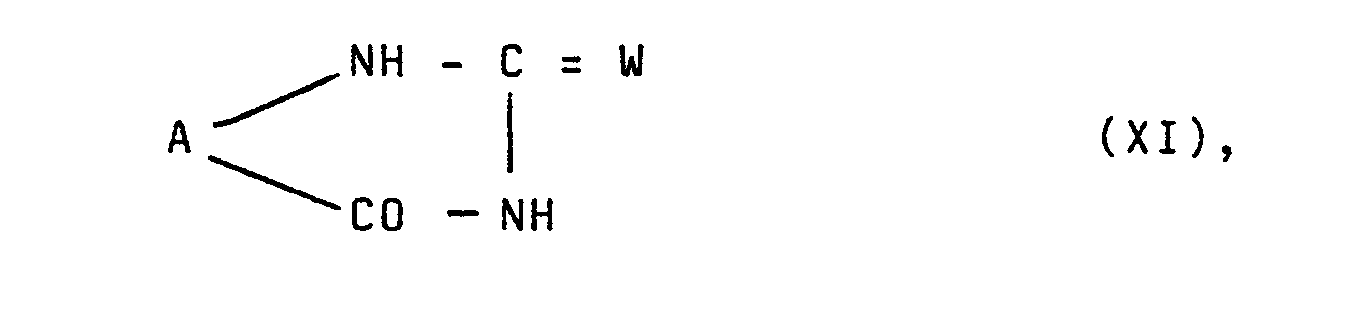


- Die Verbindungen XIII werden zu den entsprechenden Aminoverbindungen der Formel

- Die erfindungsgemäßen Verbindungen zeichnen sich durch eine starke Wirkung gegen zahlreiche, insbesondere monokotyle Unkräuter aus. Die Anwendung erfolgt bevorzugt vor dem Auflaufen. Die gute Verträglichkeit der erfindungsgemäßen Wirkstoffe ermöglicht den Einsatz in zahlreichen Kulturen, z.B. in Soja, Mais, Reis, Baumwolle, Gerste, Rüben, Kartoffeln, Tomaten, Zwiebeln.
- Die Aufwandmengen können je nach Substanz, Unkraut und äußeren Bedingungen zwischen 0,1 und 10 kg/ha, insbesondere zwischen 0,3 und 3kg/ha schwanken.
- Häufig erweist es sich als vorteilhaft, Kombinationen von Verbindungen der Formel I und bekannten Herbiziden anzuwenden. Zu nennen sind hier Kombinationen mit Harnstoff-Derivaten (z.B. Chlortoluron), Triazin-Derivaten (z.B. Atrazin, Simazin), Dinitroanilin-Derivaten (z.B. Trifluralin), Chloracetanilid-Derivaten (z.B. Alachlor), Thiocarbamaten (z.B. Benthiocarb), Diphenylether (z.B. Acifluorfen).
- Die Wirkstoffe der Formel I können für die Anwendung in gebräuchlicher Weise zu üblichen Formulierungen verarbeitet werden, z.B. zu Granulaten, Stäubemitteln, Suspensionspulvern bzw. -konzentraten, wasserdispergierbaren Granulaten.
- Diese Formulierungen werden hergestellt durch Vermischen bzw. Vermahlen der Wirkstoffe mit Streckmitteln, z.B. Lösungsmitteln und/oder festen Trägerstoffen, gegebenenfalls unter Zusatz oberflächenaktiver Mittel (Emulgatoreh, Dispergiermitteln) und/oder stabilisierender und/oder schaumverhindernder Mittel sowie gegebenenfalls weiterer Zusätze.
- Als Lösungsmittel wird Wasser bevorzugt; als feste Trägerstoffe eignen sich beispielsweise Gesteinsmehle (z.B. Kaoline, Tonerden, Talkum, Kreide, Quarz, hochdisperse Kieselsäure, Aluminiumoxid, Silikate).
- Für Granulate geeignete Träger sind einerseits gebrochene und fraktionierte Gesteine (z.B. Calcit, Marmor, Bims), andererseits Granulate aus organischem Material (z.B. aus Sägemehl, Kokosnußschalen, Maiskolben).
- Als Emulgatoren eignen sich nichtionogene und anionische Verbindungen, etwa Polyoxyethylen-Fettsäure-Ester, Polyoxyethylen-Fettalkohol-Ether, z.B. Alkylarylpolyglykolether, Alkylsulfonate, Alkylsulfate, Arylsulfonate und Eiweißhydrolysate.
- Als Dispergiermittel kommen z.B. Sulfitablaugen aus der Holzverarbeitung oder Methylzellulose in Betracht, als schaumverhindernde Mittel verzweigte höhere Alkohole. Aus den konzentrierten Zubereitungen, die im allgemeinen zwischen 0,1 und 95 Gewichtsprozent, vorzugsweise zwischen 0,5 und 90 Gewichtsprozent Wirkstoff enthalten, werden gegebenenfalls durch Verdünnen mit Wasser Spritz- oder Gießbrühen gewünschter Konzentration hergestellt.
- Die Anwendung erfolgt je nach der Zubereitung durch Gießen, Spritzen, Streuen oder Stäuben.
-
- 25 Gew.-% einer Verbindung der Formel I
- 55 Gew.-% Kaolin
- 10 Gew.-% kolloidale Kieselsäure
- 9 Gew.-% Ligninsulfonat
- 1 Gew.-% Natriumtetrapropylenbenzolsulfonat
-
- 80 Gew.-% einer Verbindung der Formel I
- 8 Gew.-% Calciumligninsulfonat
- 5 Gew.-% kolloidale Kieselsäure
- 5 Gew.-% Natriumsulfat
- 2 Gew.-% Natriumdiisobutylnaphthalinsulfonat
- 171 g (1 mol) 1-Amino-cyclohexan-carbonsäure-ethylester, hergestellt durch Veresterung (mit HCl/EtOH) von 1-Amino-cyclohexan-carbonsäure, werden in 500 ml Ether gelöst. Man läßt unter Eiskühlung eine Lösung von 188,5 g (1 mol) 3,5-Dichlorphenylisocyanat in 500 ml Ether innerhalb von 15 Minuten einfließen. Nach beendeter Zugabe wird noch 30 Minuten bei Raumtemperatur gerührt und danach abgesaugt.
- Der Nutschenrückstand wird nun in 500 ml Ethanol suspendiert und nach Zugabe von 10,1 g (0,1 mol) Triethylamin 3 Stunden unter Rückfluß gekocht. Danach gießt man auf 2 Ltr. Eiswasser und saugt den entstandenen Niederschlag ab. Man wäscht gründlich mit Wasser und trocknet im Umluftschrank.
- Man erhält ca. 280 g (89 % d.Th.) der Titelverbindung. Fp. 210° - 211°C (aus Ethanol).
- Man löst 11,5 g (0,5 mol) Natrium in 500 ml Ethanol und trägt in die Lösung 79 g (0,5 mol) cis-l-Amino-2-methyl- cyclohexancarbonsäure ein. Zu der erhaltenen Suspension gibt man nun innerhalb von 30 Minuten fein gepulvertes 3,5-Dichlorphenylisothiocyanat. Die nun klare Lösung wird 3 Stunden bei Raumtemperatur gerührt und anschließend 3 Stunden unter Rückfluß gekocht. Man gießt nun auf 2 Ltr-Eiswasser, saugt den ausgefallenen Niederschlag ab und wäscht gründlich mit Wasser.
- Nach dem Trocknen verbleiben 140 g (82 % d.Th.) der Titelverbindung. Fp. 237 - 239°C (aus Ethanol)
- Die stereochemische Zuordnung (cis bzw. trans) erfolgte entsprechend den Regeln nach Cahn-Ingold-Prelog).
- Ausgangsstoffe der Formel III und IV:

- Entsprechend den Beispielen werden die Verbindungen der Formel I der nachstehenden Tabelle erhalten:


- 18,2 g (0,1 mol) cis-4-Methylcyclohexan-5'-spirohydantoin, 18 g (0,1 mol) 2-Nitro-chlorbenzol und 41,4 g (0,3 mol) Kaliumcarbonat werden in 100 ml .Dimethylformamid gelöst bzw. suspendiert und 5 Stunden bei ca. 120°C gerührt.
- Man gießt die Mischung anschließend auf Eis, saugt den ausgefallenen Niederschlag ab, wäscht gründlich mit Wasser und kristallisiert aus Acetonitril.
- Ausbeute: 15,5 g (51 % d.Th:)
- Fp.: 227°C - 229°C.
- 15,2 g (0,05 mol) cis-4-Methylcyclohexan-5'-spiro-3'-(2-nitrophenyl)-hydantoin werden in 200 ml Methylalkohol und 5 ml konz. Salzsäure gelöst und nach Zugabe von 4 g Katalysator (Pd/C 10 %ig) bei max. 40°C und einem Druck von 5 bar hydriert. Nach beendeter H2-Aufnahme wird der Katalysator abgesaugt und die Mutterlauge eingeengt. Man nimmt den Rückstand in Wasser auf und neutralisiert mit Bicarbonat. Der entstandene Feststoff wird abgesaugt, mit Wasser gewaschen und aus Isopropanol kristallisiert.
- Ausbeute: 11,5 g (84 % d.Th.)
- Fp. 255°C - 256°C.
- 27,33 g (0,1 mol) cis-4-Methyl-cyclohexan-5'-spiro-3'-(2-amino-phenyl)-hydantoin werden in 200 ml Eisessig gelöst. Dazu tropft man bei Raumtemperatur eine Lösung von 32 g (0,2 mol) Brom in 50 ml Eisessig innerhalb von 30 Minuten ein. Man rührt ca. 30 Minuten nach, verdünnt dann mit 1 Ltr. Wasser, saugt den Niederschlag ab, wäscht mit Wasser und kristallisiert aus Acetonitril.
- Ausbeute: 35,4 g (82 % d.Th.)
- Fp. 264 - 266°C
- 21,6 g (0,05 mol) cis-4-Methyl-5'-spiro-3'-(2-amino-3,5-dibromphenyl)-hydantoin werden in 300 ml Ethanol und 10 ml konz. Schwefelsäure gelöst, und die Mischung wird zum Sieden erhitzt. Dazu gibt man innerhalb von ca. 20 Minuten portionsweise 3,8 g (0,055 mol) Natriumnitrit und rührt dann eine weitere Stunde unter Rückfluß. Nach dem Abkühlen wird mit 1 Ltr. Eiswasser verdünnt, der entstandene Niederschlag abgesaugt, mit Wasser gewaschen und aus Acetonitril kristallisiert.
- Ausbeute: 12,3 g ( 59 % d.Th.)
- Fp. 247-249°C.
- 39 g (0,2 mol) cis-2-Ethylcyclohexan-5'-spirohydantoin, 40,4 g (0,2 mol) l-Chlor-2,4-dinitro- benzol, 83 g (0,6 mol) Kaliumcarbonat und 1 g Tetrabutylammonium-hydrogensulfat werden in 200 ml Dimethylsulfoxid bei 10°C 6 Stunden gerührt. Danach verdünnt man mit 500 ml Wasser, saugt ab, wäscht mit Wasser und kaltem Methanol und trocknet.
- Ausbeute: 62,4 g (86 %d.Th.)
- Fp. 231 - 232°C
- 36,2 g (0,1 mol) cis-2-Ethylcyclohexan-5'-spiro-3'-(2,4-dinitrophenyl)-hydantoin werden in 500 ml Methanol und 20 ml konz. Salzsäure gelöst. Dazu gibt man 10 g Katalysator (Pd/C 10 %ig) und hydriert unter 5 bar bei einer Temperatur von max. 65°C.
- Danach wird vom Katalysator abgesaugt, eingeengt und in Wasser aufgenommen. Man neutralisiert mit Bicarbonat, saugt den ausgefallenen Niederschlag ab, wäscht mit Wasser und kristallisiert aus Isopropanol.
- Ausbeute: 25,4 g (84 % d.Th.)
- Fp. 183 - 185°C.
- 15 g (0,05 mol) cis-2-Ethylcyclohexan-5'-spiro-3'-(2,4-diaminophenyl)-hydantoin werden in 100 ml Eisessig gelöst. Dazu tropft man bei Raumtemperatur eine Lösung von 5,06 g (0,1 mol) Brom in 20 ml Eisessig innerhalb von 10 Minuten ein. Man rührt ca. 20 Minuten nach, versetzt dann mit 300 ml Eiswasser, saugt den Feststoff ab, wäscht mit Wasser gründlich nach und trocknet im Vakuum.
- Ausbeute: 18 g (78,3 % d.Th.)
- Fp. 263 - 265°C.
- Man erwärmt eine Lösung von 3,5 g (0,03 mol) Isoamylnitrit in 50 ml Dimethylformamid auf 55°C und tropft dazu bei dieser Temperatur eine Lösung von 6,9 g (0,015 mol) cis-2-Ethyl-cyclohexan-5'- spiro-3'-(2,4-diamino-3,5-dibrom-phenyl)-hydantoin in 20 ml Dimethylformamid innerhalb einer Stunde ein.
- Man erhöht anschließend die Temperatur bis zum Ende der NZ-Entwicklung auf 70 - 80°C. Dann wird im Vakuum eingeengt und der dunkle Rückstand säulenchromatographisch (Kieselgel/Essigester) gereinigt.
- Ausbeute: 3,9 g (59 % d.Th.)
- Fp. 213 - 215°C.
- Entsprechend erhält man die Verbindungen der Tabelle II.

- 192 g (1 mol) cis-2-Methylcyclohexan-5'- spirohydantoin, 194 g (1 mol) 2,6-Dichlor-4-nitro- pyridin, 207 g (1,5 mol) Kaliumcarbonat und 3,4 g (0,01 mol) Tetrabutylammonium-hydrogensulfat werden in 1000 ml Dimethylsulfoxid bei Raumtemperatur gelöst bzw. suspendiert. Danach wird das Gemisch weitere ca. 16 Stunden bei 15°C - 20°C gerührt.
- Man läßt nun ca. 5000 ml Eiswasser zulaufen, saugt den gebildeten Niederschlag ab, wäscht gründlich mit Wasser nach und kristallisiert aus Acetonitril um.
- Ausbeute: 250 g (79 %d.Th.)
- Fp. 227 - 229°C.
- Entsprechend werden die Verbindungen der Tabelle III erhalten.

- Eine Suspension, bestehend aus 3,1 g 5-Methyl-5-cyclopropyl-hydantoin, 3,86 g 2,6-Dichlor-4-nitropyridin und 5,6 g Kaliumcarbonat in 10 ml Dimethylformamid, wird 18 Stunden bei 20°C gerührt und anschließend auf 100 ml Wasser gegeben. Nach 30 Minuten Rühren wird der entstandene Niederschlag abgesaugt und in Methylenchlorid aufgenommen. Nach dem Trocknen und Abziehen des Lösungsmittels erhält man 3,2 g 5-Methyl-5-cyclopropyl-3-[4 -(2 ,6 -dichlorpyridyl)]-hydantoin, Fp. 160°C (Umfällung aus Toluol/Petrolether).
- Ausbeute 64% d.Th.
- Zu einer Lösung von 0,8 g 1-(3,5-Dimethylphenyl)-3-[2-(2-cyclopropyl)-propansäuremethylester]-harnstoff in 30 ml Methanol gibt man 0,3 g Triethylamin und erhitzt 12 Stunden zum Rückfluß. Nach dem Abziehen des Lösungsmittels wird der Rückstand mit Petrolether verrieben und der erhaltene kristalline Niederschlag abgesaugt.
- Fp. 121°C, Ausbeute 0,6 g (85 % d.Th.).
- Zu einer Lösung von 1,7 g 2-Amino-2-(l-methylethyl)-pentansäuremethylester in 10 ml absolutem Tetrahydrofuran tropft man bei 20 ° C eine Lösung von 2,0 g 3,5-Dichlorphenylisothiocyanat in 10 ml absolutem Tetrahydrofuran zu, rührt noch 4 Stunden bei 20°C weiter und zieht anschließend das Lösungsmittel ab. Der Rückstand wird aus Diisopropylether umkristallisiert.
- Fp. 160°C, Ausbeute 1,6 g (46 % d.Th.).
- Analog den Beispielen erhält man die Verbindungen der Tabelle IV.


-


- Die Verbindungen der vorstehenden Tabelle wurden durch MNR- und IR-Spektrum charakterisiert.


- Wirkung und Verträglichkeit der erfindungsgemäßen Verbindungen wurden in Gewächshausversuchen geprüft. Bei der Bonitierung wurde ein zehnstufiger Bonitierungsschlüssel angewendet, wobei 1 100 % Wirkung, 10 keine Wirkung bedeutet. Die Pflanzen I bis III sind Unkräuter, IV bis VI Nutzpflanzen.

- Wie die Tabelle zeigt, verbinden die erfindungsgemäßen Wirkstoffe sehr gute Wirkung (weit überwiegend Bonitierungsnote 1) mit ausgezeichneter Verträglichkeit (in allen Fällen Bonitierungsnote 10).
steht.
Claims (10)


steht.


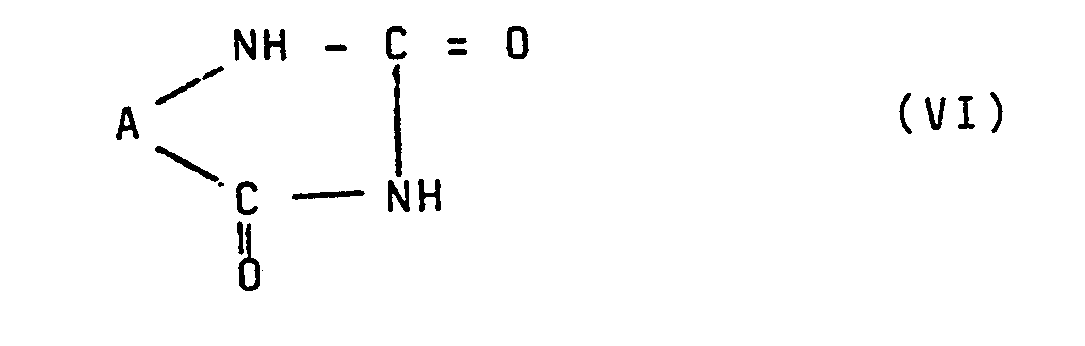
mit einem Pyridin der Formel

und gegebenenfalls die erhaltenen Verbindungen in die cis- und trans-Form und/oder in die Enantiomeren auftrennt.


Priority Applications (1)
| Application Number | Priority Date | Filing Date | Title |
|---|---|---|---|
| AT83103022T ATE67192T1 (de) | 1982-04-08 | 1983-03-26 | Neue hydantoine, ihre herstellung und verwendung. |
Applications Claiming Priority (6)
| Application Number | Priority Date | Filing Date | Title |
|---|---|---|---|
| DE3213140 | 1982-04-08 | ||
| DE19823213140 DE3213140A1 (de) | 1982-04-08 | 1982-04-08 | Cycloalkan-5'-spiro-hydrantoine, ihre herstellung und verwendung |
| DE3238447 | 1982-10-16 | ||
| DE19823238447 DE3238447A1 (de) | 1982-10-16 | 1982-10-16 | Neue hydantoine, ihre herstellung und verwendung |
| DE3301008A DE3301008A1 (de) | 1983-01-14 | 1983-01-14 | Cyclaolkan-5'spiro-hydantoine, ihre herstellung und verwendung |
| DE3301008 | 1983-01-14 |
Publications (3)
| Publication Number | Publication Date |
|---|---|
| EP0091596A2 true EP0091596A2 (de) | 1983-10-19 |
| EP0091596A3 EP0091596A3 (en) | 1985-04-10 |
| EP0091596B1 EP0091596B1 (de) | 1991-09-11 |
Family
ID=27190024
Family Applications (1)
| Application Number | Title | Priority Date | Filing Date |
|---|---|---|---|
| EP83103022A Expired - Lifetime EP0091596B1 (de) | 1982-04-08 | 1983-03-26 | Neue Hydantoine, ihre Herstellung und Verwendung |
Country Status (13)
| Country | Link |
|---|---|
| US (1) | US4944791A (de) |
| EP (1) | EP0091596B1 (de) |
| JP (1) | JPS58188864A (de) |
| KR (1) | KR900006834B1 (de) |
| BR (1) | BR8301792A (de) |
| CA (1) | CA1264750A (de) |
| DD (1) | DD207910A5 (de) |
| DE (1) | DE3382406D1 (de) |
| DK (1) | DK164904C (de) |
| ES (4) | ES8402283A1 (de) |
| HU (1) | HU191208B (de) |
| IL (1) | IL68327A0 (de) |
| ZA (1) | ZA832422B (de) |
Cited By (32)
| Publication number | Priority date | Publication date | Assignee | Title |
|---|---|---|---|---|
| US4600430A (en) * | 1985-02-22 | 1986-07-15 | Eli Lilly And Company | Pyridinylimidazolidinone compounds |
| US4604127A (en) * | 1984-07-17 | 1986-08-05 | Eli Lilly And Company | Herbicidal pyridazinylimidazolidinone compounds |
| FR2619381A1 (fr) * | 1987-08-13 | 1989-02-17 | Roussel Uclaf | Nouvelles imidazolidines substituees par un radical hydroxymethyle et un radical phenyl substitue, leur procede de preparation, leur application comme medicaments, les compositions pharmaceutiques les renfermant et un intermediaire pour leur preparation |
| US4824850A (en) * | 1982-05-18 | 1989-04-25 | University Of Florida | Brain-specific drug delivery |
| EP0358595A1 (de) * | 1988-07-15 | 1990-03-14 | Schering Aktiengesellschaft | N-Hetaryl-imidazolderivate |
| US5008257A (en) * | 1982-05-18 | 1991-04-16 | University Of Florida | Brain-specific drug delivery |
| FR2656302A1 (fr) * | 1989-12-22 | 1991-06-28 | Roussel Uclaf | Nouveau procede de preparation de l'anandron et derives de l'anandron. |
| EP0578516A1 (de) * | 1992-07-08 | 1994-01-12 | Roussel Uclaf | Gegebenenfalls substituierte Phenylimidazolidine, Verfahren zu ihrer Herstellung, ihre Anwendung als Medikamente und die sie enthaltende pharmazeutische Präparate |
| FR2693461A1 (fr) * | 1992-07-08 | 1994-01-14 | Roussel Uclaf | Nouvelles phénylimidazolidines substituées, leur procédé de préparation, leur application comme médicaments et les compositions pharmaceutiques les renfermant. |
| WO1995018794A1 (fr) * | 1994-01-05 | 1995-07-13 | Roussel Uclaf | Nouvelles phenylimidazolidines eventuellement substituees, leur procede et des intermediaires de preparation, leur application comme medicaments et les compositions pharmaceutiques les renfermant |
| FR2715402A1 (fr) * | 1994-01-05 | 1995-07-28 | Roussel Uclaf | Nouvelles phénylimidazolines éventuellement substituées, leur procédé et des intermédiaires de préparation, leur application comme médicaments et les compositions pharmaceutiques les renfermant. |
| FR2724169A1 (fr) * | 1994-09-06 | 1996-03-08 | Roussel Uclaf | Nouvelles phenylimidazolidines eventuellement substituees, leur procede et des intermediaires de preparation, leur application comme medicaments et les compositions pharmaceutiques les renfermant |
| WO1998039303A1 (en) * | 1997-03-03 | 1998-09-11 | Boehringer Ingelheim Pharmaceuticals, Inc. | Small molecules useful in the treatment of inflammatory disease |
| WO2001007048A1 (en) * | 1999-07-21 | 2001-02-01 | Boehringer Ingelheim Pharmaceuticals, Inc. | Small molecules useful in the treatment of inflammatory disease |
| US6235910B1 (en) | 1998-09-22 | 2001-05-22 | Degussa-Huls Ag | Process for the preparation of imidazolidine-2, 4-diones |
| US6353013B1 (en) | 1999-07-21 | 2002-03-05 | Boehringer Ingelheim Pharmaceuticals, Inc. | Small molecules useful in the treatment of inflammatory disease |
| US6355664B1 (en) | 1997-03-03 | 2002-03-12 | Boehringer Ingelheim Pharmaceuticals, Inc. | Phenylpyrrolidines, phenylimidazolidines, 3-phenyl-1,3-oxizolidines and 3-phenyl-1,3-thiazolidines and their use in the treatment of inflammatory disease |
| US6365615B1 (en) | 1999-07-21 | 2002-04-02 | Boehringer Ingelheim Pharmaceuticals, Inc. | Small molecules useful in the treatment of inflammatory disease |
| US6414153B1 (en) | 1999-07-21 | 2002-07-02 | Boehringer Ingelheim Pharmaceuticals, Inc. | 1-phenylpydrrolidin-2-ones and -thiones and 1-(4-pyridyl)pydrrolidin-2-ones and -thiones which are useful in the treatment of inflammatory disease |
| USRE38132E1 (en) | 1997-03-03 | 2003-06-03 | Boehringer Ingelheim Pharmaceuticals, Inc. | Phenylpyrrolidines, phenylimidazolidines,3-phenyl-1,3-oxizolidines and 3-phenyl-1,3-thiazolidines and their use in the treatment of inflammatory disease |
| US6689804B2 (en) | 1999-07-21 | 2004-02-10 | Boehringer Ingelheim Pharmaceuticals, Inc. | Small molecules useful in the treatment of inflammatory disease |
| US6953679B2 (en) | 2000-09-19 | 2005-10-11 | Bristol-Myers Squibb Company | Method for the preparation of fused heterocyclic succinimide compounds and analogs thereof |
| US6960474B2 (en) * | 2000-06-28 | 2005-11-01 | Bristol-Myers Squibb Company | Method for the treatment of a condition remediable by administration of a selective androgen receptor modulator |
| US7001911B2 (en) | 2000-06-28 | 2006-02-21 | Bristol-Myers Squibb Company | Fused cyclic modulators of nuclear hormone receptor function |
| US7141578B2 (en) | 2000-09-19 | 2006-11-28 | Bristol-Myers Squibb Company | Fused heterocyclic succinimide compounds and analogs thereof, modulators of nuclear hormone receptor function |
| US7968581B2 (en) | 2008-09-11 | 2011-06-28 | Galapagos Nv | Imidazolidine compounds as androgen receptor modulators |
| US8168667B2 (en) | 2006-05-31 | 2012-05-01 | Galapagos Nv | Imidazolidine derivatives, uses therefor, preparation thereof and compositions comprising such |
| US8183274B2 (en) | 2005-05-13 | 2012-05-22 | The Regents Of The University Of California | Treatment of hyperproliferative disorders with diarylhydantoin compounds |
| US8481750B2 (en) | 2009-06-02 | 2013-07-09 | Boehringer Ingelheim International Gmbh | Derivatives of 6,7-dihydro-5H-imidazo[1,2-α]imidazole-3-carboxylic acid amides |
| US8648105B2 (en) | 2006-03-29 | 2014-02-11 | The Regents Of The University Of California | Diarylthiohydantoin compounds |
| US8680291B2 (en) | 2007-10-26 | 2014-03-25 | The Regents Of The University Of California | Diarylhydantoin compounds |
| US20150322001A1 (en) * | 2012-11-21 | 2015-11-12 | The University Of Sydney | Omega-3 analogues |
Families Citing this family (21)
| Publication number | Priority date | Publication date | Assignee | Title |
|---|---|---|---|---|
| USRE35956E (en) * | 1991-01-09 | 1998-11-10 | Roussel Uclaf | Phenylimidazolidines having antiandrogenic activity |
| US5411981A (en) * | 1991-01-09 | 1995-05-02 | Roussel Uclaf | Phenylimidazolidines having antiandrogenic activity |
| FR2725206B1 (fr) * | 1994-09-29 | 1996-12-06 | Roussel Uclaf | Nouvelles imidazolidines substituees par un heterocycle, leur procede et des intermediaires de preparation, leur application comme medicaments et les compositions pharmaceutiques les renfermant |
| DE19540027A1 (de) * | 1995-10-27 | 1997-04-30 | Gruenenthal Gmbh | Substituierte Imidazolidin-2,4-dion-Verbindungen als pharmazeutische Wirkstoffe |
| FR2741342B1 (fr) * | 1995-11-22 | 1998-02-06 | Roussel Uclaf | Nouvelles phenylimidazolidines fluorees ou hydroxylees, procede, intermediaires de preparation, application comme medicaments, nouvelle utilisation et compositions pharmaceutiques |
| NZ335586A (en) | 1996-10-25 | 2000-08-25 | Monsanto Co | Composition and method for treating plants with exogenous chemicals |
| US6699888B2 (en) | 2000-05-31 | 2004-03-02 | Tanabe Seiyaku Co., Ltd. | Inhibitors of αLβ2 mediated cell adhesion |
| EP1854798A3 (de) | 2000-09-19 | 2007-11-28 | Bristol-Myers Squibb Company | Kondensierte heterozyklische Succinimid-Verbindungen und Analoga daraus, Modulatoren der nuklearen Hormonrezeptorfunktion |
| US20040087548A1 (en) | 2001-02-27 | 2004-05-06 | Salvati Mark E. | Fused cyclic succinimide compounds and analogs thereof, modulators of nuclear hormone receptor function |
| US7087636B2 (en) | 2001-12-19 | 2006-08-08 | Bristol-Myers Squibb Company | Fused heterocyclic compounds and analogs thereof, modulators of nuclear hormone receptor function |
| NZ550102A (en) * | 2004-02-24 | 2010-10-29 | Univ California | Methods and materials for assessing prostate cancer therapies and compounds (thiohydantoine derivatives) |
| BRPI0709771B1 (pt) | 2006-03-27 | 2022-01-25 | The Regents Of The University Of California | Composto e composição farmacêutica |
| RS53602B1 (sr) * | 2007-11-29 | 2015-02-27 | Boehringer Ingelheim International Gmbh | DERIVATI AMIDA 6,7-DIHIDRO-5H-IMIDAZO[1,2-α]IMIDAZOL-3-KARBOKSILNE KISELINE |
| BRPI1012581A2 (pt) | 2009-06-02 | 2016-03-29 | Boehringer Ingelheim Int | derivados de amidas de ácido 6, 7-di-hidro-5h-imidazol[1,2-a]imidazol-3-carboxílico |
| EP3124481B1 (de) | 2010-02-16 | 2018-03-28 | Aragon Pharmaceuticals, Inc. | Androgenrezeptormodulatoren und verwendungen davon |
| WO2014052237A1 (en) | 2012-09-26 | 2014-04-03 | Aragon Pharmaceuticals, Inc. | Anti-androgens for the treatment of non-metastatic castrate-resistant prostate cancer |
| EP2945628B1 (de) | 2013-01-15 | 2020-04-15 | Aragon Pharmaceuticals, Inc. | Androgenrezeptormodulator in kombination mit abirateronacetat und prednison zur behandlung von prostatkrebs |
| CA2898534C (en) * | 2013-03-20 | 2017-09-19 | F. Hoffmann-La Roche Ag | Urea derivatives and their use as fatty-acid binding protein (fabp) inhibitors |
| TWI726969B (zh) | 2016-01-11 | 2021-05-11 | 比利時商健生藥品公司 | 用作雄性激素受體拮抗劑之經取代之硫尿囊素衍生物 |
| TWI746660B (zh) * | 2016-10-06 | 2021-11-21 | 日商第一三共股份有限公司 | 尿素衍生物及其用途 |
| KR20240096623A (ko) | 2017-10-16 | 2024-06-26 | 아라곤 파마슈티컬스, 인코포레이티드 | 비-전이성 거세-저항성 전립선암의 치료를 위한 항-안드로겐 |
Family Cites Families (15)
| Publication number | Priority date | Publication date | Assignee | Title |
|---|---|---|---|---|
| GB817745A (en) * | 1956-12-14 | 1959-08-06 | Ici Ltd | 2-thiohydantoins |
| DE1032258B (de) * | 1956-12-20 | 1958-06-19 | Kali Chemie Ag | Verfahren zur Herstellung von in 5-Stellung mono- und disubstituierten 1-Aryl-hydantoinen |
| GB997037A (en) * | 1962-03-19 | 1965-06-30 | Ici Ltd | New hydrantoin derivatives |
| DK123717B (da) * | 1968-11-25 | 1972-07-24 | Sumitomo Chemical Co | 3-(3',5'-Dihalogenphenyl)-imidazolidin-2,4-dionderivater med mirobicid virkning. |
| CA931087A (en) * | 1970-01-14 | 1973-07-31 | The Dunlop Company Limited | Flexible hose |
| JPS4916937B1 (de) * | 1970-01-21 | 1974-04-25 | ||
| JPS4920973B1 (de) * | 1970-05-28 | 1974-05-29 | ||
| US3847933A (en) * | 1970-12-09 | 1974-11-12 | Exxon Research Engineering Co | Acid catalyzed alkylation of hydantoin |
| JPS5136332B1 (de) * | 1970-12-09 | 1976-10-07 | ||
| JPS5316133B2 (de) * | 1972-06-07 | 1978-05-30 | ||
| IL45459A (en) * | 1973-09-03 | 1978-01-31 | Ciba Geigy Ag | 1-(dichlorofluoromethylthio)-3-phenyl-imidazolidine-2,4-dione derivatives their preparation and their use as bactericides and fungicides |
| JPS5371073A (en) * | 1976-12-03 | 1978-06-24 | Sumitomo Chem Co Ltd | 1-cyclic alkyl carbonyl-3(3,5-dihalogenophenyl)hydantoin derivs., process fo r their preparation and fungicides for agriculture and horti culture contg. the same as active constituents |
| IL55774A (en) * | 1977-10-28 | 1982-04-30 | Sparamedica Ag | Pharmaceutical compositions containing urea derivatives,certain such novel derivatives and their manufacture |
| MC1220A1 (fr) * | 1977-10-28 | 1979-07-20 | Hoffmann La Roche | Nouveaux derives d'imidazolidine |
| JPS5531098A (en) * | 1979-08-22 | 1980-03-05 | Sumitomo Chem Co Ltd | 1-acyl-3-(3,5-dihalogenophenyl)-hydantoin derivative, its preparation, and agricultural and horticultural fungicide comprising it as active constituent |
-
1983
- 1983-03-26 EP EP83103022A patent/EP0091596B1/de not_active Expired - Lifetime
- 1983-03-26 DE DE8383103022T patent/DE3382406D1/de not_active Expired - Lifetime
- 1983-04-05 DD DD83249565A patent/DD207910A5/de not_active IP Right Cessation
- 1983-04-07 DK DK155583A patent/DK164904C/da not_active IP Right Cessation
- 1983-04-07 HU HU831199A patent/HU191208B/hu not_active IP Right Cessation
- 1983-04-07 IL IL68327A patent/IL68327A0/xx not_active IP Right Cessation
- 1983-04-07 ES ES521301A patent/ES8402283A1/es not_active Expired
- 1983-04-07 BR BR8301792A patent/BR8301792A/pt not_active IP Right Cessation
- 1983-04-07 ZA ZA832422A patent/ZA832422B/xx unknown
- 1983-04-07 CA CA000425387A patent/CA1264750A/en not_active Expired - Lifetime
- 1983-04-08 KR KR1019830001473A patent/KR900006834B1/ko not_active Expired
- 1983-04-08 JP JP58062883A patent/JPS58188864A/ja active Pending
- 1983-10-27 ES ES526806A patent/ES8406446A1/es not_active Expired
- 1983-10-27 ES ES526807A patent/ES8406153A1/es not_active Expired
- 1983-10-27 ES ES526808A patent/ES8406154A1/es not_active Expired
-
1988
- 1988-12-14 US US07/284,093 patent/US4944791A/en not_active Expired - Lifetime
Cited By (46)
| Publication number | Priority date | Publication date | Assignee | Title |
|---|---|---|---|---|
| US4824850A (en) * | 1982-05-18 | 1989-04-25 | University Of Florida | Brain-specific drug delivery |
| US5008257A (en) * | 1982-05-18 | 1991-04-16 | University Of Florida | Brain-specific drug delivery |
| US4604127A (en) * | 1984-07-17 | 1986-08-05 | Eli Lilly And Company | Herbicidal pyridazinylimidazolidinone compounds |
| US4600430A (en) * | 1985-02-22 | 1986-07-15 | Eli Lilly And Company | Pyridinylimidazolidinone compounds |
| EP0200299A1 (de) * | 1985-02-22 | 1986-11-05 | Eli Lilly And Company | Pyridinylimidazolidinon-Verbindungen |
| FR2619381A1 (fr) * | 1987-08-13 | 1989-02-17 | Roussel Uclaf | Nouvelles imidazolidines substituees par un radical hydroxymethyle et un radical phenyl substitue, leur procede de preparation, leur application comme medicaments, les compositions pharmaceutiques les renfermant et un intermediaire pour leur preparation |
| EP0305270A1 (de) * | 1987-08-13 | 1989-03-01 | Roussel-Uclaf | Durch ein Hydroxymethyl- und ein substituiertes Phenylradikal substituierte Imidazolidine, Verfahren zu deren Herstellung, deren Anwendung als Arzneimittel, diese enthaltende pharmazeutische Zusammenstellungen und ein Zwischenprodukt für deren Herstellung |
| EP0358595A1 (de) * | 1988-07-15 | 1990-03-14 | Schering Aktiengesellschaft | N-Hetaryl-imidazolderivate |
| FR2656302A1 (fr) * | 1989-12-22 | 1991-06-28 | Roussel Uclaf | Nouveau procede de preparation de l'anandron et derives de l'anandron. |
| EP0436426A1 (de) * | 1989-12-22 | 1991-07-10 | Roussel-Uclaf | Verfahren zur Herstellung von 1-Phenylimidazolin-2,5-dion-Derivate |
| EP0578516A1 (de) * | 1992-07-08 | 1994-01-12 | Roussel Uclaf | Gegebenenfalls substituierte Phenylimidazolidine, Verfahren zu ihrer Herstellung, ihre Anwendung als Medikamente und die sie enthaltende pharmazeutische Präparate |
| FR2693461A1 (fr) * | 1992-07-08 | 1994-01-14 | Roussel Uclaf | Nouvelles phénylimidazolidines substituées, leur procédé de préparation, leur application comme médicaments et les compositions pharmaceutiques les renfermant. |
| EP0580459A1 (de) * | 1992-07-08 | 1994-01-26 | Roussel Uclaf | Substituierte Phenylimidazolidine, Verfahren zu ihrer Herstellung, ihre Anwendung als Medikamente und die sie enthaltende pharmazeutische Präparate |
| FR2694290A1 (fr) * | 1992-07-08 | 1994-02-04 | Roussel Uclaf | Nouvelles phénylimidazolidines éventuellement substituées, leur procédé de préparation, leur application comme médicaments et les compositions pharmaceutiques les renfermant. |
| US5434176A (en) * | 1992-07-08 | 1995-07-18 | Roussel Uclaf | Phenylimidazolidines |
| WO1995018794A1 (fr) * | 1994-01-05 | 1995-07-13 | Roussel Uclaf | Nouvelles phenylimidazolidines eventuellement substituees, leur procede et des intermediaires de preparation, leur application comme medicaments et les compositions pharmaceutiques les renfermant |
| FR2715402A1 (fr) * | 1994-01-05 | 1995-07-28 | Roussel Uclaf | Nouvelles phénylimidazolines éventuellement substituées, leur procédé et des intermédiaires de préparation, leur application comme médicaments et les compositions pharmaceutiques les renfermant. |
| CN1113873C (zh) * | 1994-01-05 | 2003-07-09 | 鲁索-艾克勒夫公司 | 新的任选取代的苯基咪唑烷、中间体及其制备方法,作为药物的应用和含有它们的药物组合 |
| FR2724169A1 (fr) * | 1994-09-06 | 1996-03-08 | Roussel Uclaf | Nouvelles phenylimidazolidines eventuellement substituees, leur procede et des intermediaires de preparation, leur application comme medicaments et les compositions pharmaceutiques les renfermant |
| WO1998039303A1 (en) * | 1997-03-03 | 1998-09-11 | Boehringer Ingelheim Pharmaceuticals, Inc. | Small molecules useful in the treatment of inflammatory disease |
| USRE38132E1 (en) | 1997-03-03 | 2003-06-03 | Boehringer Ingelheim Pharmaceuticals, Inc. | Phenylpyrrolidines, phenylimidazolidines,3-phenyl-1,3-oxizolidines and 3-phenyl-1,3-thiazolidines and their use in the treatment of inflammatory disease |
| US6355664B1 (en) | 1997-03-03 | 2002-03-12 | Boehringer Ingelheim Pharmaceuticals, Inc. | Phenylpyrrolidines, phenylimidazolidines, 3-phenyl-1,3-oxizolidines and 3-phenyl-1,3-thiazolidines and their use in the treatment of inflammatory disease |
| US6235910B1 (en) | 1998-09-22 | 2001-05-22 | Degussa-Huls Ag | Process for the preparation of imidazolidine-2, 4-diones |
| US6353013B1 (en) | 1999-07-21 | 2002-03-05 | Boehringer Ingelheim Pharmaceuticals, Inc. | Small molecules useful in the treatment of inflammatory disease |
| US7550494B2 (en) | 1999-07-21 | 2009-06-23 | Boehringer Ingelheim Pharmaceuticals, Inc. | Small molecules useful in the treatment of inflammatory disease |
| US6414153B1 (en) | 1999-07-21 | 2002-07-02 | Boehringer Ingelheim Pharmaceuticals, Inc. | 1-phenylpydrrolidin-2-ones and -thiones and 1-(4-pyridyl)pydrrolidin-2-ones and -thiones which are useful in the treatment of inflammatory disease |
| US6350763B1 (en) * | 1999-07-21 | 2002-02-26 | Boehringer Ingelheim Pharmaceuticals, Inc. | Small molecules useful in the treatment of inflammation disease |
| WO2001007048A1 (en) * | 1999-07-21 | 2001-02-01 | Boehringer Ingelheim Pharmaceuticals, Inc. | Small molecules useful in the treatment of inflammatory disease |
| US6689804B2 (en) | 1999-07-21 | 2004-02-10 | Boehringer Ingelheim Pharmaceuticals, Inc. | Small molecules useful in the treatment of inflammatory disease |
| US6365615B1 (en) | 1999-07-21 | 2002-04-02 | Boehringer Ingelheim Pharmaceuticals, Inc. | Small molecules useful in the treatment of inflammatory disease |
| US6960474B2 (en) * | 2000-06-28 | 2005-11-01 | Bristol-Myers Squibb Company | Method for the treatment of a condition remediable by administration of a selective androgen receptor modulator |
| US7001911B2 (en) | 2000-06-28 | 2006-02-21 | Bristol-Myers Squibb Company | Fused cyclic modulators of nuclear hormone receptor function |
| US7432267B2 (en) | 2000-06-28 | 2008-10-07 | Bristol-Myers Squibb Comapny | Fused cyclic modulators of nuclear hormone receptor function |
| US6953679B2 (en) | 2000-09-19 | 2005-10-11 | Bristol-Myers Squibb Company | Method for the preparation of fused heterocyclic succinimide compounds and analogs thereof |
| US7141578B2 (en) | 2000-09-19 | 2006-11-28 | Bristol-Myers Squibb Company | Fused heterocyclic succinimide compounds and analogs thereof, modulators of nuclear hormone receptor function |
| US7470797B2 (en) | 2001-06-20 | 2008-12-30 | Bristol-Myers Squibb Company | Fused heterocyclic imido and amido compounds |
| US8183274B2 (en) | 2005-05-13 | 2012-05-22 | The Regents Of The University Of California | Treatment of hyperproliferative disorders with diarylhydantoin compounds |
| US9126941B2 (en) | 2005-05-13 | 2015-09-08 | The Regents Of The University Of California | Treatment of hyperproliferative disorders with diarylhydantoin compounds |
| US8648105B2 (en) | 2006-03-29 | 2014-02-11 | The Regents Of The University Of California | Diarylthiohydantoin compounds |
| US8168667B2 (en) | 2006-05-31 | 2012-05-01 | Galapagos Nv | Imidazolidine derivatives, uses therefor, preparation thereof and compositions comprising such |
| US8680291B2 (en) | 2007-10-26 | 2014-03-25 | The Regents Of The University Of California | Diarylhydantoin compounds |
| US9896437B2 (en) | 2007-10-26 | 2018-02-20 | The Regents Of The University Of California | Diarylhydantoin compounds |
| US7968581B2 (en) | 2008-09-11 | 2011-06-28 | Galapagos Nv | Imidazolidine compounds as androgen receptor modulators |
| US8383608B2 (en) | 2008-09-11 | 2013-02-26 | Dart Therapeutics Llc | Imidazolidine compounds as androgen receptor modulators |
| US8481750B2 (en) | 2009-06-02 | 2013-07-09 | Boehringer Ingelheim International Gmbh | Derivatives of 6,7-dihydro-5H-imidazo[1,2-α]imidazole-3-carboxylic acid amides |
| US20150322001A1 (en) * | 2012-11-21 | 2015-11-12 | The University Of Sydney | Omega-3 analogues |
Also Published As
| Publication number | Publication date |
|---|---|
| KR900006834B1 (ko) | 1990-09-22 |
| KR840004406A (ko) | 1984-10-15 |
| ES526808A0 (es) | 1984-07-01 |
| BR8301792A (pt) | 1983-12-20 |
| ES521301A0 (es) | 1984-01-16 |
| ES8406154A1 (es) | 1984-07-01 |
| IL68327A0 (en) | 1983-07-31 |
| ES526806A0 (es) | 1984-07-01 |
| DK164904B (da) | 1992-09-07 |
| JPS58188864A (ja) | 1983-11-04 |
| ES526807A0 (es) | 1984-07-01 |
| ES8406153A1 (es) | 1984-07-01 |
| DK164904C (da) | 1993-01-25 |
| ZA832422B (en) | 1984-12-24 |
| DK155583D0 (da) | 1983-04-07 |
| CA1264750A (en) | 1990-01-23 |
| ES8406446A1 (es) | 1984-07-01 |
| ES8402283A1 (es) | 1984-01-16 |
| DD207910A5 (de) | 1984-03-21 |
| EP0091596B1 (de) | 1991-09-11 |
| DE3382406D1 (de) | 1991-10-17 |
| DK155583A (da) | 1983-10-09 |
| US4944791A (en) | 1990-07-31 |
| EP0091596A3 (en) | 1985-04-10 |
| HU191208B (en) | 1987-01-28 |
Similar Documents
| Publication | Publication Date | Title |
|---|---|---|
| EP0091596B1 (de) | Neue Hydantoine, ihre Herstellung und Verwendung | |
| US4531964A (en) | Heterocyclic compound and a herbicidal composition containing said compound | |
| DE2639796A1 (de) | Neue diphenylaether | |
| EP0098953B1 (de) | Substituierte Maleinsäureimide, Verfahren zu ihrer Herstellung und ihre Verwendung als Schädlingsbekämpfungsmittel | |
| US3133079A (en) | Herbicidal aryl alkyl imidazolinones | |
| DE2527677A1 (de) | Verfahren zur herstellung von 2,4- dioxo-1,2,3,4-tetrahydro-s-triazino- eckige klammer auf 1,2-a eckige klammer zu -benzimidazolen | |
| CH623575A5 (de) | ||
| EP0072528A2 (de) | (Thio-) Harnstoffe, ein Verfahren zu ihrer Herstellung und ihre Verwendung als Pflanzenschutzmittel | |
| EP0029908B1 (de) | 6H-1,2,4,6-Thiatriazin-1,1-dioxide, Herbizide, die diese Verbindungen enthalten, ihre Anwendung als Herbizide und Verfahren zu ihrer Herstellung | |
| EP0010692B1 (de) | Neue m-Anilidurethane, sie enthaltende Herbizide und Verfahren zu deren Herstellung, sowie Verfahren zur Bekämpfung von unerwünschtem Pflanzenwuchs | |
| EP0257518A1 (de) | Chinolin-8-carbonsäurederivate | |
| EP0058868B1 (de) | Substituierte Tetrahydropyrimidinonderivate, Verfahren zu ihrer Herstellung und Herbizide, die diese Derivate als Wirkstoffe enthalten | |
| DE3026140A1 (de) | 1,3-dioxan-5-yl-alkenyltriazole, ihre herstellung, ihre verwendung zur regulierung des pflanzenwachstums und mittel dafuer | |
| EP0144895B1 (de) | Thiolan-2,4-dion-3-carboxamide | |
| US3216816A (en) | Herbicidal composition and method | |
| EP0010250B1 (de) | Verwendung von Sulfonaniliden zur Hemmung des Pflanzenwachstums | |
| DE3003933A1 (de) | (beta) -imidazolylalkohole, verfahren zu ihrer herstellung, diese enthaltende fungizide und verfahren zur bekaempfung von pilzen mit ihnen | |
| CH622510A5 (de) | ||
| EP0144052A2 (de) | Chinolinoxyphenylharnstoffe, Verfahren zu ihrer Herstellung und ihre Verwendung zur Bekämpfung unerwünschten Pflanzenwuchhses | |
| EP0065189B1 (de) | Heterocyclische Dihalogenacetamide, Verfahren zu ihrer Herstellung und herbizide Mittel, die Acetanilide als herbizide Wirkstoffe und diese Dihalogenacetamide als antagonistische Mittel enthalten | |
| EP0161455A1 (de) | Beta-naphthylalkylamine | |
| EP0023306A1 (de) | N-(Alpha-Chlorpropionyl)-1,2,3,4-tetrahydro-chinaldin, Verfahren zu dessen Herstellung und dessen Verwendung als Gegenmittel zum Schutz von Kulturpflanzen vor Schädigungen durch Herbizide | |
| EP0066771B1 (de) | 1-Iod-1-propin-3-ole, Verfahren zu ihrer Herstellung sowie ihre Verwendung als Pflanzenschutzmittel | |
| US4267186A (en) | Combating fungi with substituted spiro-derivatives of 3-(3,5-dihalogenophenyl)-oxazolidine-2,4-diones (thione-ones) | |
| EP0493721B1 (de) | Styrolderivate |
Legal Events
| Date | Code | Title | Description |
|---|---|---|---|
| PUAI | Public reference made under article 153(3) epc to a published international application that has entered the european phase |
Free format text: ORIGINAL CODE: 0009012 |
|
| AK | Designated contracting states |
Designated state(s): AT BE CH DE FR GB IT LI NL SE |
|
| 17P | Request for examination filed |
Effective date: 19831109 |
|
| PUAL | Search report despatched |
Free format text: ORIGINAL CODE: 0009013 |
|
| AK | Designated contracting states |
Designated state(s): AT BE CH DE FR GB IT LI NL SE |
|
| 17Q | First examination report despatched |
Effective date: 19861029 |
|
| RAP1 | Party data changed (applicant data changed or rights of an application transferred) |
Owner name: SHELL AGRAR GMBH & CO. KG |
|
| RAP1 | Party data changed (applicant data changed or rights of an application transferred) |
Owner name: SHELL INTERNATIONALE RESEARCH MAATSCHAPPIJ B.V. |
|
| GRAA | (expected) grant |
Free format text: ORIGINAL CODE: 0009210 |
|
| AK | Designated contracting states |
Kind code of ref document: B1 Designated state(s): AT BE CH DE FR GB IT LI NL SE |
|
| REF | Corresponds to: |
Ref document number: 67192 Country of ref document: AT Date of ref document: 19910915 Kind code of ref document: T |
|
| ITF | It: translation for a ep patent filed | ||
| REF | Corresponds to: |
Ref document number: 3382406 Country of ref document: DE Date of ref document: 19911017 |
|
| GBT | Gb: translation of ep patent filed (gb section 77(6)(a)/1977) | ||
| ET | Fr: translation filed | ||
| PLBE | No opposition filed within time limit |
Free format text: ORIGINAL CODE: 0009261 |
|
| STAA | Information on the status of an ep patent application or granted ep patent |
Free format text: STATUS: NO OPPOSITION FILED WITHIN TIME LIMIT |
|
| 26N | No opposition filed | ||
| EAL | Se: european patent in force in sweden |
Ref document number: 83103022.6 |
|
| PGFP | Annual fee paid to national office [announced via postgrant information from national office to epo] |
Ref country code: GB Payment date: 19950208 Year of fee payment: 13 |
|
| PGFP | Annual fee paid to national office [announced via postgrant information from national office to epo] |
Ref country code: SE Payment date: 19950221 Year of fee payment: 13 |
|
| PGFP | Annual fee paid to national office [announced via postgrant information from national office to epo] |
Ref country code: AT Payment date: 19950222 Year of fee payment: 13 |
|
| PGFP | Annual fee paid to national office [announced via postgrant information from national office to epo] |
Ref country code: FR Payment date: 19950315 Year of fee payment: 13 |
|
| PGFP | Annual fee paid to national office [announced via postgrant information from national office to epo] |
Ref country code: DE Payment date: 19950328 Year of fee payment: 13 |
|
| PGFP | Annual fee paid to national office [announced via postgrant information from national office to epo] |
Ref country code: NL Payment date: 19950331 Year of fee payment: 13 |
|
| PGFP | Annual fee paid to national office [announced via postgrant information from national office to epo] |
Ref country code: BE Payment date: 19950410 Year of fee payment: 13 |
|
| PGFP | Annual fee paid to national office [announced via postgrant information from national office to epo] |
Ref country code: CH Payment date: 19950420 Year of fee payment: 13 |
|
| PG25 | Lapsed in a contracting state [announced via postgrant information from national office to epo] |
Ref country code: GB Effective date: 19960326 Ref country code: AT Effective date: 19960326 |
|
| PG25 | Lapsed in a contracting state [announced via postgrant information from national office to epo] |
Ref country code: SE Effective date: 19960327 |
|
| PG25 | Lapsed in a contracting state [announced via postgrant information from national office to epo] |
Ref country code: LI Effective date: 19960331 Ref country code: CH Effective date: 19960331 Ref country code: BE Effective date: 19960331 |
|
| BERE | Be: lapsed |
Owner name: SHELL INTERNATIONALE RESEARCH MAATSCHAPPIJ B.V. Effective date: 19960331 |
|
| PG25 | Lapsed in a contracting state [announced via postgrant information from national office to epo] |
Ref country code: NL Effective date: 19961001 |
|
| GBPC | Gb: european patent ceased through non-payment of renewal fee |
Effective date: 19960326 |
|
| REG | Reference to a national code |
Ref country code: CH Ref legal event code: PL |
|
| PG25 | Lapsed in a contracting state [announced via postgrant information from national office to epo] |
Ref country code: FR Effective date: 19961129 |
|
| NLV4 | Nl: lapsed or anulled due to non-payment of the annual fee |
Effective date: 19961001 |
|
| PG25 | Lapsed in a contracting state [announced via postgrant information from national office to epo] |
Ref country code: DE Effective date: 19961203 |
|
| EUG | Se: european patent has lapsed |
Ref document number: 83103022.6 |
|
| REG | Reference to a national code |
Ref country code: FR Ref legal event code: ST |