EP0091639A2 - Anilinderivate, Verfahren zu ihrer Herstellung und ihre Verwendung zur Bekämpfung unerwünschten Pflanzenwuchses - Google Patents
Anilinderivate, Verfahren zu ihrer Herstellung und ihre Verwendung zur Bekämpfung unerwünschten Pflanzenwuchses Download PDFInfo
- Publication number
- EP0091639A2 EP0091639A2 EP83103304A EP83103304A EP0091639A2 EP 0091639 A2 EP0091639 A2 EP 0091639A2 EP 83103304 A EP83103304 A EP 83103304A EP 83103304 A EP83103304 A EP 83103304A EP 0091639 A2 EP0091639 A2 EP 0091639A2
- Authority
- EP
- European Patent Office
- Prior art keywords
- hydrogen
- formula
- carbon atoms
- alkyl
- methyl
- Prior art date
- Legal status (The legal status is an assumption and is not a legal conclusion. Google has not performed a legal analysis and makes no representation as to the accuracy of the status listed.)
- Granted
Links
Classifications
-
- C—CHEMISTRY; METALLURGY
- C07—ORGANIC CHEMISTRY
- C07D—HETEROCYCLIC COMPOUNDS
- C07D295/00—Heterocyclic compounds containing polymethylene-imine rings with at least five ring members, 3-azabicyclo [3.2.2] nonane, piperazine, morpholine or thiomorpholine rings, having only hydrogen atoms directly attached to the ring carbon atoms
- C07D295/16—Heterocyclic compounds containing polymethylene-imine rings with at least five ring members, 3-azabicyclo [3.2.2] nonane, piperazine, morpholine or thiomorpholine rings, having only hydrogen atoms directly attached to the ring carbon atoms acylated on ring nitrogen atoms
- C07D295/20—Heterocyclic compounds containing polymethylene-imine rings with at least five ring members, 3-azabicyclo [3.2.2] nonane, piperazine, morpholine or thiomorpholine rings, having only hydrogen atoms directly attached to the ring carbon atoms acylated on ring nitrogen atoms by radicals derived from carbonic acid, or sulfur or nitrogen analogues thereof
- C07D295/215—Radicals derived from nitrogen analogues of carbonic acid
-
- A—HUMAN NECESSITIES
- A01—AGRICULTURE; FORESTRY; ANIMAL HUSBANDRY; HUNTING; TRAPPING; FISHING
- A01N—PRESERVATION OF BODIES OF HUMANS OR ANIMALS OR PLANTS OR PARTS THEREOF; BIOCIDES, e.g. AS DISINFECTANTS, AS PESTICIDES OR AS HERBICIDES; PEST REPELLANTS OR ATTRACTANTS; PLANT GROWTH REGULATORS
- A01N37/00—Biocides, pest repellants or attractants, or plant growth regulators containing organic compounds containing a carbon atom having three bonds to hetero atoms with at the most two bonds to halogen, e.g. carboxylic acids
- A01N37/18—Biocides, pest repellants or attractants, or plant growth regulators containing organic compounds containing a carbon atom having three bonds to hetero atoms with at the most two bonds to halogen, e.g. carboxylic acids containing the group —CO—N<, e.g. carboxylic acid amides or imides; Thio analogues thereof
- A01N37/22—Biocides, pest repellants or attractants, or plant growth regulators containing organic compounds containing a carbon atom having three bonds to hetero atoms with at the most two bonds to halogen, e.g. carboxylic acids containing the group —CO—N<, e.g. carboxylic acid amides or imides; Thio analogues thereof the nitrogen atom being directly attached to an aromatic ring system, e.g. anilides
-
- A—HUMAN NECESSITIES
- A01—AGRICULTURE; FORESTRY; ANIMAL HUSBANDRY; HUNTING; TRAPPING; FISHING
- A01N—PRESERVATION OF BODIES OF HUMANS OR ANIMALS OR PLANTS OR PARTS THEREOF; BIOCIDES, e.g. AS DISINFECTANTS, AS PESTICIDES OR AS HERBICIDES; PEST REPELLANTS OR ATTRACTANTS; PLANT GROWTH REGULATORS
- A01N39/00—Biocides, pest repellants or attractants, or plant growth regulators containing aryloxy- or arylthio-aliphatic or cycloaliphatic compounds, containing the group or, e.g. phenoxyethylamine, phenylthio-acetonitrile, phenoxyacetone
-
- A—HUMAN NECESSITIES
- A01—AGRICULTURE; FORESTRY; ANIMAL HUSBANDRY; HUNTING; TRAPPING; FISHING
- A01N—PRESERVATION OF BODIES OF HUMANS OR ANIMALS OR PLANTS OR PARTS THEREOF; BIOCIDES, e.g. AS DISINFECTANTS, AS PESTICIDES OR AS HERBICIDES; PEST REPELLANTS OR ATTRACTANTS; PLANT GROWTH REGULATORS
- A01N47/00—Biocides, pest repellants or attractants, or plant growth regulators containing organic compounds containing a carbon atom not being member of a ring and having no bond to a carbon or hydrogen atom, e.g. derivatives of carbonic acid
- A01N47/08—Biocides, pest repellants or attractants, or plant growth regulators containing organic compounds containing a carbon atom not being member of a ring and having no bond to a carbon or hydrogen atom, e.g. derivatives of carbonic acid the carbon atom having one or more single bonds to nitrogen atoms
- A01N47/10—Carbamic acid derivatives, i.e. containing the group —O—CO—N<; Thio analogues thereof
- A01N47/20—N-Aryl derivatives thereof
-
- A—HUMAN NECESSITIES
- A01—AGRICULTURE; FORESTRY; ANIMAL HUSBANDRY; HUNTING; TRAPPING; FISHING
- A01N—PRESERVATION OF BODIES OF HUMANS OR ANIMALS OR PLANTS OR PARTS THEREOF; BIOCIDES, e.g. AS DISINFECTANTS, AS PESTICIDES OR AS HERBICIDES; PEST REPELLANTS OR ATTRACTANTS; PLANT GROWTH REGULATORS
- A01N47/00—Biocides, pest repellants or attractants, or plant growth regulators containing organic compounds containing a carbon atom not being member of a ring and having no bond to a carbon or hydrogen atom, e.g. derivatives of carbonic acid
- A01N47/08—Biocides, pest repellants or attractants, or plant growth regulators containing organic compounds containing a carbon atom not being member of a ring and having no bond to a carbon or hydrogen atom, e.g. derivatives of carbonic acid the carbon atom having one or more single bonds to nitrogen atoms
- A01N47/28—Ureas or thioureas containing the groups >N—CO—N< or >N—CS—N<
- A01N47/30—Derivatives containing the group >N—CO—N aryl or >N—CS—N—aryl
-
- C—CHEMISTRY; METALLURGY
- C07—ORGANIC CHEMISTRY
- C07C—ACYCLIC OR CARBOCYCLIC COMPOUNDS
- C07C275/00—Derivatives of urea, i.e. compounds containing any of the groups, the nitrogen atoms not being part of nitro or nitroso groups
- C07C275/28—Derivatives of urea, i.e. compounds containing any of the groups, the nitrogen atoms not being part of nitro or nitroso groups having nitrogen atoms of urea groups bound to carbon atoms of six-membered aromatic rings of a carbon skeleton
- C07C275/32—Derivatives of urea, i.e. compounds containing any of the groups, the nitrogen atoms not being part of nitro or nitroso groups having nitrogen atoms of urea groups bound to carbon atoms of six-membered aromatic rings of a carbon skeleton being further substituted by singly-bound oxygen atoms
-
- C—CHEMISTRY; METALLURGY
- C07—ORGANIC CHEMISTRY
- C07C—ACYCLIC OR CARBOCYCLIC COMPOUNDS
- C07C275/00—Derivatives of urea, i.e. compounds containing any of the groups, the nitrogen atoms not being part of nitro or nitroso groups
- C07C275/28—Derivatives of urea, i.e. compounds containing any of the groups, the nitrogen atoms not being part of nitro or nitroso groups having nitrogen atoms of urea groups bound to carbon atoms of six-membered aromatic rings of a carbon skeleton
- C07C275/40—Derivatives of urea, i.e. compounds containing any of the groups, the nitrogen atoms not being part of nitro or nitroso groups having nitrogen atoms of urea groups bound to carbon atoms of six-membered aromatic rings of a carbon skeleton being further substituted by nitrogen atoms not being part of nitro or nitroso groups
-
- C—CHEMISTRY; METALLURGY
- C07—ORGANIC CHEMISTRY
- C07C—ACYCLIC OR CARBOCYCLIC COMPOUNDS
- C07C275/00—Derivatives of urea, i.e. compounds containing any of the groups, the nitrogen atoms not being part of nitro or nitroso groups
- C07C275/64—Derivatives of urea, i.e. compounds containing any of the groups, the nitrogen atoms not being part of nitro or nitroso groups having nitrogen atoms of urea groups singly-bound to oxygen atoms
-
- C—CHEMISTRY; METALLURGY
- C07—ORGANIC CHEMISTRY
- C07C—ACYCLIC OR CARBOCYCLIC COMPOUNDS
- C07C323/00—Thiols, sulfides, hydropolysulfides or polysulfides substituted by halogen, oxygen or nitrogen atoms, or by sulfur atoms not being part of thio groups
- C07C323/23—Thiols, sulfides, hydropolysulfides or polysulfides substituted by halogen, oxygen or nitrogen atoms, or by sulfur atoms not being part of thio groups containing thio groups and nitrogen atoms, not being part of nitro or nitroso groups, bound to the same carbon skeleton
- C07C323/39—Thiols, sulfides, hydropolysulfides or polysulfides substituted by halogen, oxygen or nitrogen atoms, or by sulfur atoms not being part of thio groups containing thio groups and nitrogen atoms, not being part of nitro or nitroso groups, bound to the same carbon skeleton at least one of the nitrogen atoms being part of any of the groups, X being a hetero atom, Y being any atom
- C07C323/43—Y being a hetero atom
- C07C323/44—X or Y being nitrogen atoms
-
- C—CHEMISTRY; METALLURGY
- C07—ORGANIC CHEMISTRY
- C07C—ACYCLIC OR CARBOCYCLIC COMPOUNDS
- C07C2601/00—Systems containing only non-condensed rings
- C07C2601/02—Systems containing only non-condensed rings with a three-membered ring
-
- C—CHEMISTRY; METALLURGY
- C07—ORGANIC CHEMISTRY
- C07C—ACYCLIC OR CARBOCYCLIC COMPOUNDS
- C07C2601/00—Systems containing only non-condensed rings
- C07C2601/12—Systems containing only non-condensed rings with a six-membered ring
- C07C2601/14—The ring being saturated
Definitions
- the invention relates to aniline derivatives, processes for their preparation, herbicides which contain these compounds as active ingredients, and a process for controlling unwanted vegetation using these compounds.
- N- (trichlorobenzylthiomethylphenyl) ureas and N- (3-phenoxymethylphenyl) amides are herbicidal (DE-PS 12 04 880; DE-OS 28 55 699).
- Preferred compounds of the formula I are those in which R 1 is the radical -N (OCH 3 ) (CH 3 ), Y is hydrogen or halogen, in particular chlorine, A methylene or dimethylene, R is hydrogen or methyl, R 3 is hydrogen, X is oxygen, Z is halogen, in particular chlorine, or alkyl having up to 4 carbon atoms, in particular methyl or methoxy, and n is 0 or 1.
- the aniline derivatives of the formula I are obtained by reacting amines of the formula in which R 2 , R3, X , Y , A, Z and n have the meanings given above, with compounds of the formula in which R 1 has the abovementioned meanings and X denotes a leaving group, preferably halogen, such as chlorine or bromine, or R denotes -CO-0-.
- the reaction is carried out in an inert organic solvent.
- organic solvent Suitable are ethers such as tetrahydrofuran, dimethoxyethane, diethyl ether, methyl tert-butyl ether, esters such as ethyl acetate, optionally chlorinated aliphatic or aromatic hydrocarbons such as toluene, dichloromethane, pyridine. Mixtures of these solvents can also be used.
- the amount of solvent, based on the amine of the formula II, is 100 to 5000% by weight.
- the reaction is expediently carried out in the presence of an acid acceptor.
- Alkali metal hydroxides, alkali metal carbonates, alkali metal hydrogen carbonates, alkaline earth metal hydroxides, alkaline earth metal carbonates, alkaline earth metal hydrogen carbonates, alkaline earth metal oxides or amines for example sodium trium hydrogen carbonate, potassium carbonate, triethylamine, pyridine, N, N-dimethylaniline, N, N-dimethyl-N-cyclohexylamine, quinoline.
- the amount of the acid acceptor is 1 to 4 moles, based on 1 mole of the compound of the formula III.
- the starting materials of the formulas II and III are preferably reacted with one another in an equimolar ratio.
- the reaction temperature is between 20 and 80 ° C, preferably between 20 and 30 ° C.
- the aniline derivatives of the formula I are preferably obtained by reacting compounds of the formula in which Hal represents chlorine or bromine and R 1 , R 2 , R 3 and Y have the meanings given above, with a compound of the formula in which X, A, Z and n have the meanings given above.
- Suitable solvents are ethers, such as diethyl ether, methyl tert-butyl ether, tetrahydrofuran, esters, such as ethyl acetate, optionally chlorinated aliphatic or aromatic hydrocarbons, such as ligroin, toluene, cyclohexane, gasoline, dichloromethane, chloroform, chlorobenzene, o-, m-, p-dichlorobenzene, nitrobenzene, ketones, such as acetone, nitriles , such as acetonitrile, dimethyl sulfoxide or dimethylformamide. Mixtures of these solvents can also be used.
- the compounds V are expediently used in the form of their alkali metal salts, but it is also possible to work with acid acceptors such as alkali metal hydroxide, alkali metal carbonate, alkali metal bicarbonate, tertiary amines such as triethylamine, dimethylcyclohexylamine, N, N-dimethylaniline or pyridine.
- acid acceptors such as alkali metal hydroxide, alkali metal carbonate, alkali metal bicarbonate, tertiary amines such as triethylamine, dimethylcyclohexylamine, N, N-dimethylaniline or pyridine.
- -NR - in the compound of the formula V X has the meaning, it makes sense to use the compound V at the same time as an acid acceptor.
- the amount of acid acceptor is 1 to 4 moles, based on 1 mole of the compound of the formula IV.
- the starting materials of the formulas IV and V are reacted with one another in a molar ratio of 1: 1 to 1:50.
- the reaction temperature is between 0 and 100 ° C, preferably between 10 and 30 ° C.
- the starting materials of the formula IV are obtained by reacting corresponding isocyanates with amines, alcohols or mercaptans (DE-AS 12 04 880 and Annalen der Chemie 562, 75 ff. (1949)) or by reacting corresponding ones Hydroxyalkyl aniline derivatives (DE-OS 30 24 538) with phosphorus trihalides.
- the aniline derivatives of the formula I can be, for example, in the form of directly sprayable solutions, powders, suspensions, and also high-strength aqueous, oily or other suspensions or dispersions, emulsions, oil dispersions, pastes, dusts, scattering agents or granules by spraying, atomizing, dusting, scattering or pouring be applied.
- the application forms depend entirely on the purposes; in any case, they should ensure the finest possible distribution of the active compounds according to the invention.
- emulsions, pastes or oil dispersions mineral oil fractions from medium to high boiling points, such as kerosene or diesel oil, furthermore coal tar oils as well as oils of vegetable or animal origin, aliphatic, cyclic and aromatic hydrocarbons, e.g. Benzene, toluene, xylene, paraffin, tetrahydronaphthalene, alkylated naphthalenes or their derivatives, e.g.
- Aqueous use forms can be prepared from emulsion concentrates, pastes or wettable powders (wettable powders, oil dispersions) by adding water.
- emulsions, pastes or oil dispersions the substances as such or dissolved in an oil or solvent can be homogenized in water by means of wetting agents, adhesives, dispersants or emulsifiers.
- wetting agents, adhesives, dispersants or emulsifiers, and possibly solvents or oil can also be prepared from active substance and are suitable for dilution with water.
- Powders, materials for broadcasting and dusts can be prepared by mixing or grinding the active substances together with a solid carrier.
- Granules e.g. Coating, impregnation and homogeneous granules can be produced by binding the active ingredients to solid carriers.
- Solid carriers are mineral soils such as silica gel, silicas, silica gels, silicates, talc, kaolin, attaclay, limestone, lime, chalk, bolus, loess, clay, dolomite, diatomaceous earth, calcium and magnesium sulfate, magnesium oxide, ground plastics, fertilizers, e.g. Ammonium sulfate, ammonium phosphate, ammonium nitrate, ureas and vegetable products such as cereal flour, tree bark, wood and nutshell flour, cellulose powder and other solid carriers.
- the formulations contain between 0.1 and 95 percent by weight, preferably between 0.5 and 90 percent by weight of active ingredient.
- the active ingredients or agents can be applied pre-emergence or post-emergence. If the active ingredients are less tolerable for the crop plants, application techniques can also be used in which the herbicidal compositions are sprayed with the aid of sprayers in such a way that the leaves of the sensitive crop plants are not hit wherever possible, while the active ingredients are more undesirable on the leaves below them Plants or the uncovered floor area (post-directed, lay-by).
- the application rates of active ingredient are 0.1 to 15 kg / ha and more, preferably 0.5 to 3 kg / ha, depending on the season, the control target and the growth stage.
- test plants are first grown to a height of 3 to 15 cm and then treated. For this purpose, either plants that have been sown directly and grown in the same containers are selected, or those that were first grown separately as seedlings and transplanted into the test containers a few days before the treatment.
- peat is added to the potting soil in order to achieve a better emergence and a more favorable growth.
- the application rate for post-emergence application is 0.5 and 1.0 kg of active ingredient / ha.
- test vessels are set up in the greenhouse, ranges from 20 to 35 ° C. being preferred for heat-loving species and 10 to 25 ° C. being preferred for those with moderate climates.
- the trial period spans 2 to 4 weeks. During this time, the plants are cared for and their response to the individual treatments is evaluated. It is rated on a scale from 0 to 100. 100 means no emergence of the plants or complete destruction of at least the aerial parts.
- compound No. 31 with 1.0 kg and compound No. 9 with 0.5 kg of active ingredient / ha control undesired plants and behave selectively in crop plants.
- the compounds according to the invention can be used in a large number of crop plants for eliminating unwanted plants.
- the compounds according to the invention or herbicidal compositions comprising them can be mixed with numerous representatives of other herbicidal or growth-regulating active compound groups and applied together.
- active compound groups for example, diazines, 4H-3,1-benzoxazine derivatives, benzothiadiazinones, 2,6-dinitroanilines, N-phenyl carbamates, thiol carbamates, halocarboxylic acids, triazines, amides, ureas, diphenyl ethers, triazinones, uracils, benzofuran derivatives, cyclohexane-1,3- dione derivatives and others into consideration.
- aniline derivatives of the formula I may also be useful to apply the aniline derivatives of the formula I, alone or in combination with other herbicides, mixed with other crop protection agents, for example with agents for controlling pests or phytopathogenic fungi or bacteria.
- miscibility with mineral salt solutions which are used to correct nutritional or trace element deficiencies.
- Non-phytotoxic oils and oil concentrates can also be added.
Landscapes
- Chemical & Material Sciences (AREA)
- Organic Chemistry (AREA)
- Life Sciences & Earth Sciences (AREA)
- Agronomy & Crop Science (AREA)
- Pest Control & Pesticides (AREA)
- Plant Pathology (AREA)
- Health & Medical Sciences (AREA)
- Engineering & Computer Science (AREA)
- Dentistry (AREA)
- General Health & Medical Sciences (AREA)
- Wood Science & Technology (AREA)
- Zoology (AREA)
- Environmental Sciences (AREA)
- Organic Low-Molecular-Weight Compounds And Preparation Thereof (AREA)
- Agricultural Chemicals And Associated Chemicals (AREA)
Abstract
Description
- Die Erfindung betrifft Anilinderivate, Verfahren zu ihrer Herstellung, Herbizide, die diese Verbindungen als Wirkstoffe enthalten, sowie ein Verfahren zur Bekämpfung unerwünschten Pflanzenwuchses mit diesen Verbindungen.
- Es ist bekannt, daß N-(Trichlorbenzyl-thiomethyl-phenyl)--harnstoffe und N-(3-Phenoxymethyl-phenyl)-amide herbizid wirksam sind (DE-PS 12 04 880; DE-OS 28 55 699).
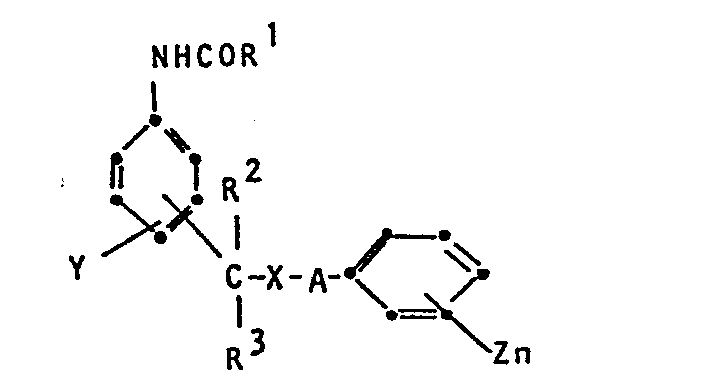
- Es wurde gefunden, daß Anilinderivate der Formel


- R1 Alkoxy, Alkenoxy, Alkinoxy, Alkylthio oder gegebenenfalls durch Halogen oder Alkoxy mit 1 bis 5 Kohlenstoffatomen substituiertes Alkyl oder Alkenyl mit jeweils bis zu 4 Kohlenstoffatomen oder Cycloalkyl mit 3 bis 6 Kohlenstoffatomen oder den Rest -NR4R5, wobei R4 und R5 unabhängig voneinander Wasserstoff, Alkyl, Alkenyl, Alkinyl oder Alkoxy mit jeweils bis zu 4 Kohlenstoffatomen oder Cycloalkyl oder Cycloalkoxy mit 3 bis 6 Kohlenstoffatomen bedeuten oder R4 und R5 zusammen eine gegebenenfalls durch Methyl substituierte und gegebenenfalls Sauerstoff als Kettenglied enthaltende Alkylenkette mit bis zu 6 Kohlenstoffatomen bedeuten,
- R2 und R 3 unabhängig voneinander Wasserstoff oder Alkyl mit 1 bis 3 Kohlenstoffatomen,
- X Sauerstoff, Schwefel oder den Rest -NR6-, wobei R6 ein Alkyl mit 1 bis 5 Kohlenstoffatomen bedeutet,
- Y Wasserstoff, Halogen, Methyl, Methoxy oder Trifluormethyl,
- A eine gegebenenfalls durch Alkyl mit 1 bis 5 Kohlenstoffatomen substituierte und gegebenenfalls Sauerstoff als Kettenglied enthaltende Alkylen- oder Alkenylenkette mit bis zu 5 Kohlenstoffatomen,
- Z Wasserstoff, Halogen, Alkyl, Alkoxy, Halogenalkyl oder Halogenalkoxy mit jeweils bis zu 6 Kohlenstoffatomen, Phenyl oder gegebenenfalls durch Halogen, Nitro, Alkyl, Halogenalkyl oder Alkoxy mit jeweils 1 bis 3 Kohlenstoffatomen substituiertes Phenoxy und
- n die Zahlen 1, 2 oder 3 bedeuten,
- Die Substituenten in Formel I können die folgenden Bedeutungen haben:
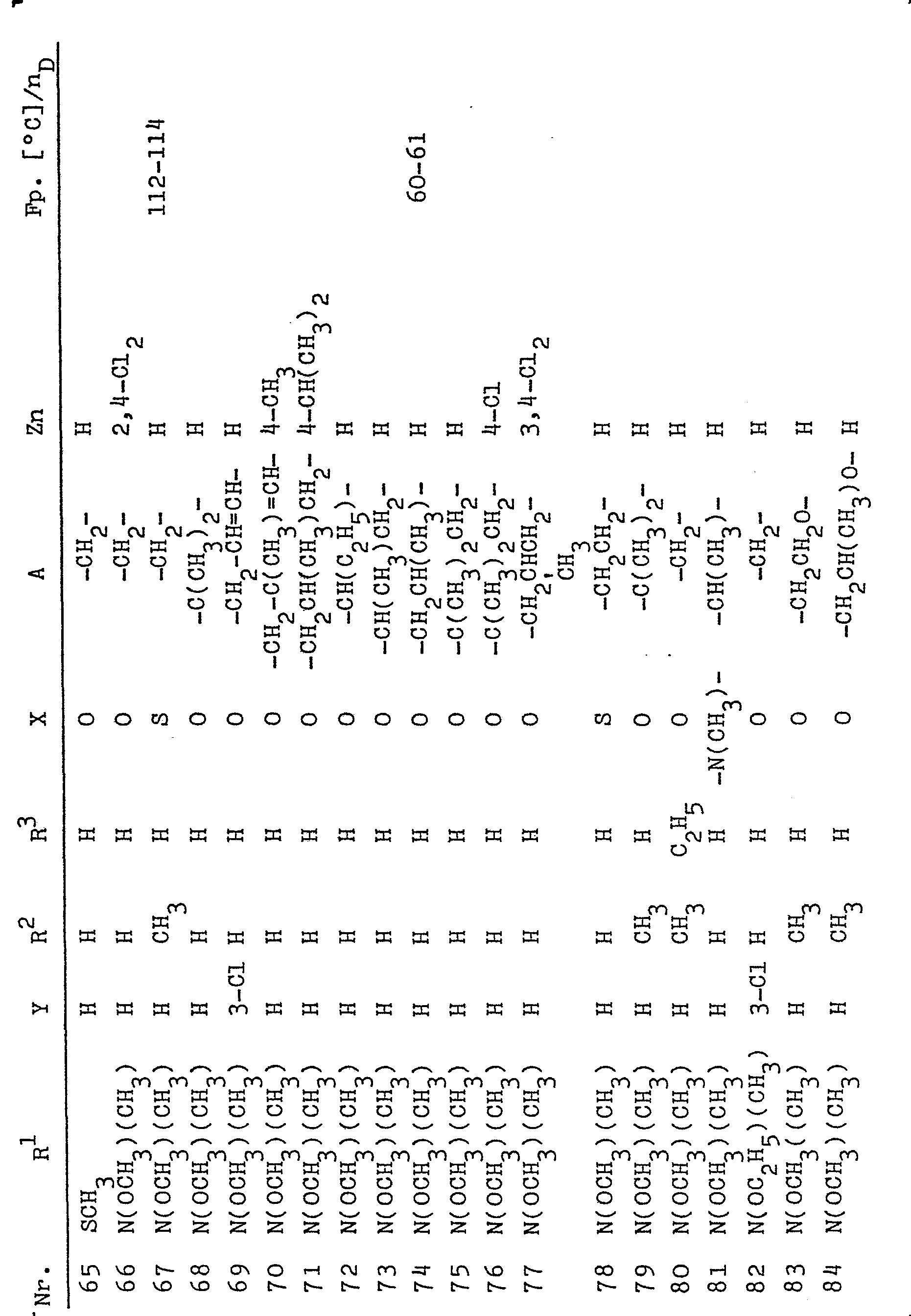
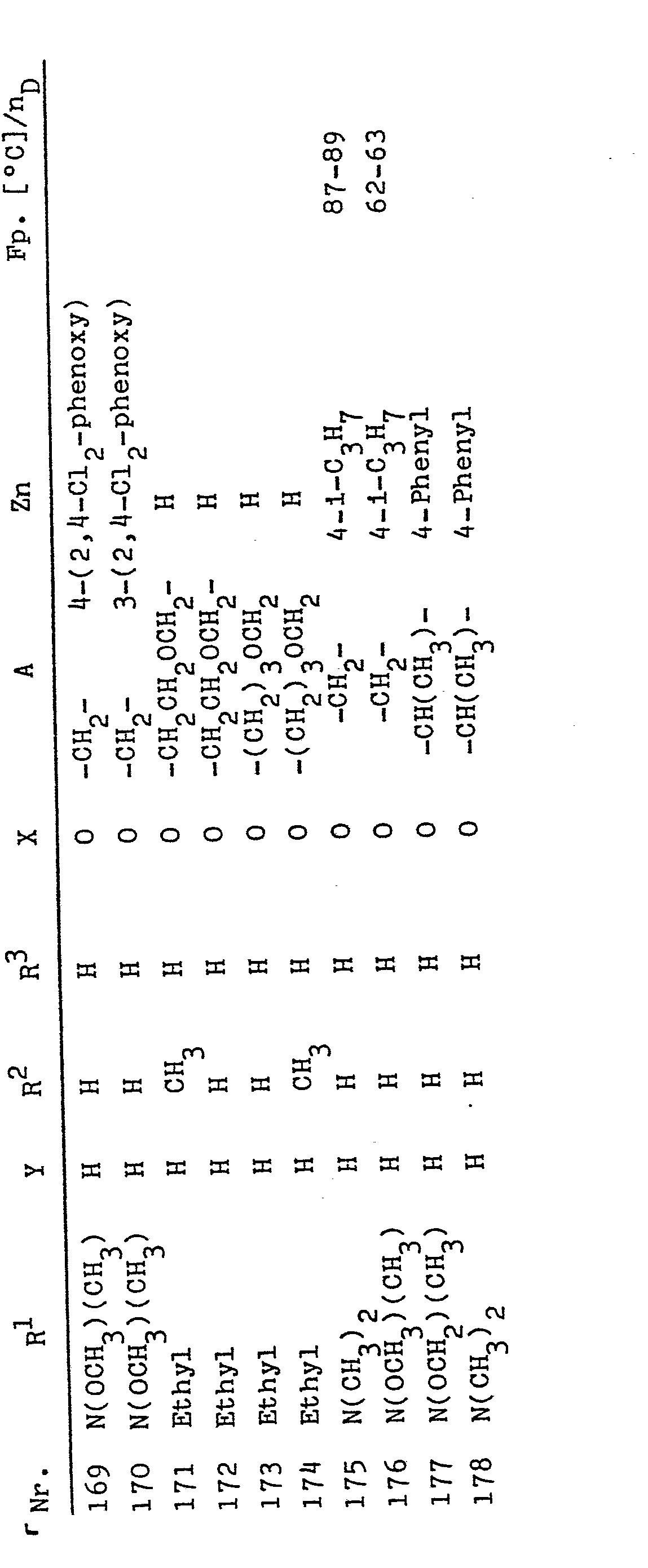
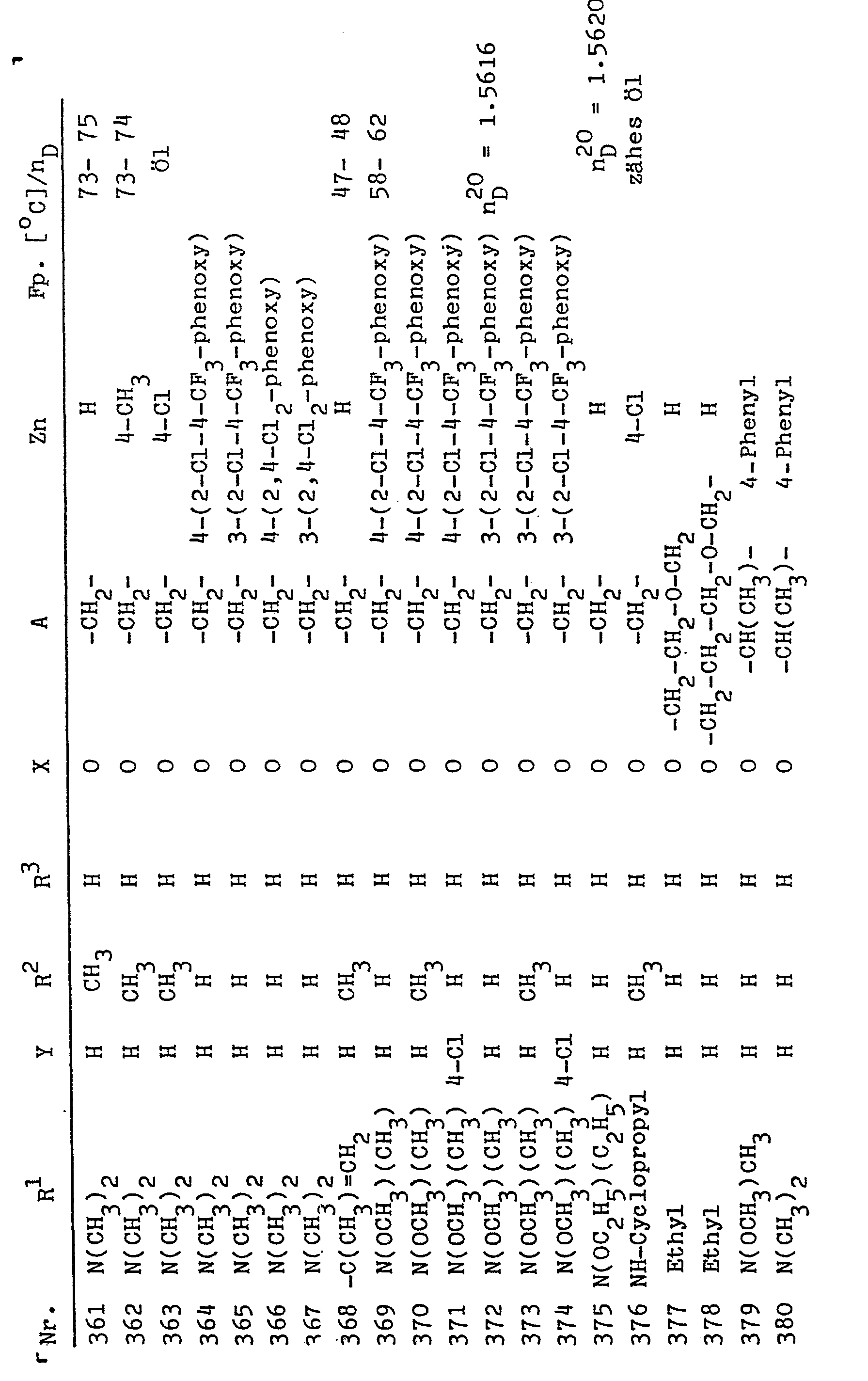
- R bedeutet Alkoxy, Alkenoxy, Alkinoxy, Alkylthio oder gegebenenfalls durch Halogen oder Alkoxy mit 1 bis 4 Kohlenstoffatomen substituiertes Alkyl oder Alkenyl mit jeweils bis zu 5 Kohlenstoffatomen, beispielsweise Methoxy, Ethoxy, n-Propoxy, Isopropoxy, sec-Butoxy, tert.-Butoxy, n-Pentoxy, Propargyloxy, Allyloxy, 1-Methyl-propgargyloxy, Methylthio, Ethylthio, n-Propylthio, sec.-Butyl- thio, tert.-Butylthio, Methyl, Ethyl, n-Propyl, n-Butyl, sec.-Butyl, tert.-Butyl, Isobutyl, n-Pentyl, sec.-Pentyl, Chlormethyl, 1,1-Dichlorethyl, Dichlormethyl, Trichlormethyl, Methoxymethyl, 1-Methoxyethyl, 2-Methoxyethyl, Vinyl, Propenyl, Isopropenyl, Allyl, Cycloalkyl mit 3 bis 6 Kohlenstoffatomen, beispielsweise Cyclopropyl, Cyclopentyl, Cyclohexyl, Cycloalkoxy mit 3 bis 6 Kohlenstoffatomen, beispielsweise Cyclohexoxy, oder den Rest -NR4 R 5, wobei R4 und R5 unabhängig voneinander Wasserstoff, Alkyl, Alkenyl, Alkinyl oder Alkoxy mit jeweils bis zu 4 Kohlenstoffatomen, beispielsweise Methyl, Ethyl, Isopropyl, n-Butyl, sec-Butyl, Isobutyl, tert.-Butyl, Allyl, 1,1-Dimethylpropargyl, Methoxy, Ethoxy, oder Cycloalkyl mit 3 bis 6 Kohlenstoffatomen, beispielsweise Cyclopropyl, Cyclopentyl, Cyclohexyl, oder R4 und R5 zusammen eine gegebenenfalls durch Methyl substituierte und gegebenenfalls Sauerstoff als Kettenglied enthaltende Alkylenkette mit bis zu 6 Kohlenstoffatomen, beispielsweise Trimethylen, Tetramethylen, 1,4-Dimethyltetramethylen, Pentamethylen, Hexamethylen, 3-0xapentamethylen, 1-0xa--pentamethylen, 1-Oxa-tetramethylen, bedeuten.
- R2 und R3 bedeuten unabhängig voneinander Wasserstcff oder Alkyl mit 1 bis 3 Kohlenstoffatomen, Methyl, Ethyl, n-Propyl, i-Propyl.
- X bedeutet Sauerstoff, Schwefel oder den Rest -NR6-, wobei R6 Alkyl mit 1 bis 5 Kohlenstoffatomen, beispielsweise Methyl, Ethyl, Pentyl bedeutet.
- Y bedeutet außer Wasserstoff, Methyl, Methoxy oder Trifluormethyl Halogen, wie Fluor, Chlor, Brom.
- A bedeutet eine Alkylen- oder Alkenylenkette mit bis zu 5 Kohlenstoffatomen und gegebenenfalls mit Sauerstoff als Kettenglied, die durch Alkyl mit 1 bis 5 Kohlenstoffatomen, insbesondere durch Methyl, substituiert sein kann, beispielsweise -CH2-, -CH(CH3)-, -(CH2)3-, -(CH2)2-, -CH2CH(CH3)-, -(CH2)5-, -CH 2-CH=CH-, -CH2-CH2-O-, -CH2-CH(CH3)O-, -(CH2)40-, -CH2CH2OCH2- oder -CH2CH2CH2OCH2-.
- Z steht für Wasserstoff, Halogen, beispielsweise Fluor, Chlor, Brom, Alkyl, Alkoxy, Halogenalkyl oder Halogenalkoxy mit jeweils bis zu 6 Kohlenstoffatomen, beispielsweise Methyl, Ethyl, Isopropyl, tert.-Butyl, n-Hexyl, Methoxy, Ethoxy, Isopropoxy, tert.-Butoxy, n-Hexoxy, Trifluormethyl, 1,1,2-Trifluor-2-chlorethoxy, Difluormethoxy, Phenyl, Phenoxy, 2,4-Dichlorphenoxy, 2-Chlor-4-tri- fluormethylphenoxy oder 3-Chlor-4-trifluormethylphenoxy, Z steht in ortho-, meta- oder para-Stellung zu A, n ist vorzugsweise 1, kann jedoch auch 2 oder 3 bedeuten, insbesondere, wenn Z für Fluor, Chlor, Brom oder Methyl steht.
- Bevorzugte Verbindungen der Formel I sind solche, bei denen R1 den Rest -N(OCH3)(CH3), Y Wasserstoff oder Halogen, insbesondere Chlor, A Methylen oder Dimethylen, R Wasserstoff oder Methyl, R3 Wasserstoff, X Sauerstoff, Z Halogen, insbesondere Chlor, oder Alkyl mit bis zu 4 Kohlenstoffatomen, insbesondere Methyl oder Methoxy, und n 0 oder 1 bedeuten.
- Man erhält die Anilinderivate der Formel I durch Umsetzung von Aminen der Formel


- Die Umsetzung wird in einem inerten organischen Lösungsmittel durchgeführt. Geeignet sind Ether, wie Tetrahydrofuran, Dimethoxyethan, Diethylether, Methyl-tert.-butyl--ether, Ester wie Essigsäureethylester, gegebenenfalls chlorierte aliphatische oder aromatische Kohlenwasserstoffe, wie Toluol, Dichlormethan, Pyridin. Auch Gemische dieser Lösungsmittel können verwendet werden. Die Menge an Lösungsmittel, bezogen auf Amin der Formel II beträgt 100 bis 5000 Gew.%.
- Zweckmäßigerweise wird die Umsetzung in Gegenwart eines Säureakzeptors durchgeführt. In Betracht kommen Alkalihydroxide, Alkalicarbonate, Alkalihydrogencarbonate, Erdalkalihydroxide, Erdalkalicarbonate, Erdalkalihydrogencarbonate, Erdalkalioxide oder Amine, beispielsweise Na- triumhydrogencarbonat, Kaliumcarbonat, Triethylamin, Pyridin, N,N-Dimethylanilin, N,N-Dimethyl-N-cyclohexylamin, Chinolin. Die Menge an'Säureakzeptor beträgt 1 bis 4 Mol, bezogen auf 1 Mol Verbindung der Formel III.
- Die Ausgangsstoffe der Formeln II und III werden bevorzugt in äquimolarem Verhältnis miteinander umgesetzt. Die Reaktionstemperatur liegt zwischen 20 und 80°C, vorzugsweise zwischen 20 und 30°C.
- Die Anilinderivate der Formel I werden vorzugsweise durch Umsetzung von Verbindungen der Formel


- Die Umsetzung wird entweder in einem inerten Lösungsmittel oder in einem überschuß von V durchgeführt. Als Lösungsmittel kommen Ether, wie Diethylether, Methyl-tert.-butyl- -ether, Tetrahydrofuran, Ester, wie Essigsäureethylester, gegebenenfalls chlorierte aliphatische oder aromatische Kohlenwasserstoffe, wie Ligroin, Toluol, Cyclohexan, Benzin, Dichlormethan, Chloroform, Chlorbenzol, o-, m-, p-Dichlorbenzol, Nitrobenzol, Ketone, wie Aceton, Nitrile, wie Acetonitril, Dimethylsulfoxid oder Dimethylformamid in Betracht. Auch Gemische dieser Lösungsmittel können verwendet werden.
- Zweckmäßigerweise werden die Verbindungen V in Form ihrer Alkalisalze eingesetzt, man kann aber auch mit Säureakzeptoren wie Alkalihydroxid, Alkalicarbonat, Alkali-hydrogencarbonat, tert.-Aminen, wie Triethylamin, Dimethylcyclohexylamin, N,N-Dimethylanilin oder Pyridin arbeiten. Für den Fall, daß in der Verbindung der Formel V X die Bedeutung -NR - hat, bietet es sich an, die Verbindung V gleichzeitig als Säureakzeptor einzusetzen.
- Die Menge an Säureakzeptor beträgt 1 bis 4 Mol, bezogen auf 1 Mol Verbindung der Formel IV.
- Die Ausgangsstoffe der Formeln IV und V werden in einem molaren Verhältnis von 1 : 1 bis 1 : 50 miteinander umgesetzt. Die Reaktionstemperatur liegt zwischen 0 und 100 C, vorzugsweise zwischen 10 und 30°C.
- Die Ausgangsstoffe der Formel II erhält man durch Reduktion entsprechender Nitroverbindungen (Houben-Weyl, Methoden der Org. Chemie, Bd. 4/lc, Seite 506-532, Georg Thieme Verlag, Stuttgart, 1980).
- Die Ausgangsstoffe der Formel IV erhält man durch Reaktion entsprechender Isocyanate mit Aminen, Alkoholen oder Mercaptanen (DE-AS 12 04 880 und Annalen der Chemie 562, 75 ff. (1949)) bzw. durch Umsetzung entsprechender Hydroxyalkyl-anilinderivate (DE-OS 30 24 538) mit Phosphortrihalogeniden.
- Die folgenden Beispiele, die die Herstellung der Anilinderivate der Formel I erläutern, wurden durchgeführt:
- 42,35 g Methylbenzylamin, 260 ml Ethanol und 30 g 4-Nitrobenzylchlorid wurden langsam zum Sieden erhitzt und 3 Stunden unter Rückfluß gerührt. Nach dem Einengen wurde der Rückstand mit 300 ml Essigester versetzt, 2x mit Wasser gewaschen, über MgS04 getrocknet, filtriert und eingeengt. Das erhaltene öl wurde in 750 ml Tetrahydrofuran gelöst und in Gegenwart von 5 g Pd/Tierkohle (5 %ig) bei 25°C und 1,1 bar Wasserstoffdruck hydriert. Nach 11,5 h H-Aufnahme wurde abfiltriert und eingeengt. Es wurden 21 g 4-[(N--Benzyl-N-methyl-amino)-methyl]-anilin in Form eines öls vom

- 13,5 g des so erhaltenen Amins wurden in 150 ml Tetrahydrofuran gelöst, mit 10,0 g Natriumhydrogencarbonat versetzt und unter gutem Rühren bei 20 bis 250C mit 7,4 g N-Methoxy-N-methylcarbaminsäurechlorid zur Reaktion gebracht. Nach 16-stündigem Nachrühren wurde filtriert, eingeengt, in Essigester gelöst, mit Wasser gewaschen, über Na2SO4 getrocknet und eingeengt. Es wurden 11 g eines Öls vom


- 8 Gewichtsteile N-Methoxy-N-methylamin in 50 Gewichtsteilen Toluol wurden bei 0°C mit 23,5 Gewichtsteilen 4-(1-Chlorethyl)-phenylisocyanat in 100 Gewichtsteilen Toluol 30 Minuten lang zur Reaktion gebracht. Der entstandene Niederschlag wurde abgesaugt; es wurden 12 Gewichtsteile N-[4-(1-Chlorethyl)-phenyl]-N'-methoxy-N'-methylharnstoff vom Schmelzpunkt 86°C erhalten.
- Zu 17 g N-Benzyl-N-methylamin in 50 ml Toluol wurden bei 20 bis 30°C 17 g N-(4-[1-Chlorethyl]phenyl)-N'-methyl-N'--methoxyharnstoff in 200 ml Toluol zugetropft. Dann wurde 2 Stunden bei 30°C, dann über Nacht bei Raumtemperatur gerührt. Nach dem Trocknen wurde eingeengt, mit Diethylether verrührt, abgesaugt und getrocknet. Nach dem Umkristallisieren aus Essigester wurden 10,5 g weiße Kristalle vom Schmelzpunkt 93-94°C und folgender Strukturformel erhalten:

- 66 Gewichtsteile p-(1-Chlorethyl)-phenylisocyanat in 200 Gewichtsteilen Essigester wurden bei 15°C mit 15 Ge-wichtsteilen Dimethylamin in 100 Teilen Essigester versetzt und 1 Stunde lang zur Reaktion gebracht. Der entstandene Niederschlag wurde abgesaugt; es wurden 77 Gewichtsteile N-[4-(1-Chlorethyl)-phenyl]-N',N'-dimethylharnstoff vom Schmelzpunkt 120°C erhalten.
- Zu 32 g Benzylalkohol wurden langsam 2,3 g 80 %iges Natriumhydrid gegeben, dann wurde 2 Stunden bei 40 bis 450C gerührt, und anschließend wurden bei 20 bis 25°C 15 g N-[4-(1-Chlorethyl)phenyl]-N',N'-dimethylharnstoff in 200 ml Benzylalkohol zugetropft. Nach Rühren über Nacht bei Raumtemperatur wurde der überschüssige Benzylalkohol im Hochvakuum am Rotationsverdampfer abdestilliert und der Rückstand mit Diisopropylether ausgekocht. Nach dem Abkühlen wurde der ausgefallene Feststoff abgesaugt und getrocknet. Es wurden 8 g einer weißen, kristallinen Substanz vom Schmelzpunkt 98 bis 100°C und folgender Strukturformel erhalten:

- Zu 2,5 g 80 %igem Natriumhydrid in 50 ml trockenem Dimethylformamid tropfte man bei Raumtemperatur 9,3 g Thiobenzylalkohol. Es wurde 2 Stunden bei 40 bis 45°C nachgerührt, und dann wurden bei Raumtemperatur 15 g N-(4-Chlor- methylphenyl)-N',N'-dimethylharnstoff in 100 ml Dimethylformamid zugetropft. Es wurde über Nacht bei Raumtemperatur nachgerührt, abgesaugt, das Filtrat wurde eingeengt und mit Essigester zum Kristallisieren gebracht. Nach dem Absaugen wurden 12 g eines Feststoffs vom Schmelzpunkt 94 bis 96°C und folgender Struktur erhalten:

- 9,05 g N(3-Hydroxymethylphenyl)-0-methylcarbamat wurden in 125 ml Methylenchlorid und 2 Tropfen Pyridin gelöst. Bei 0°C wurden dann 5,4 g Phosphortribromid zugetropft. Nach einstündigem Rühren wurde mit Eiswasser versetzt, die organische Phase abgetrennt, über Na2SO4 getrocknet und eingeengt. Es wurden 10,7 g N-Methoxycarbonyl-3-brommethyl- anilin vom Fp. 94 bis 96°C erhalten.
- 10,7 g N-Methoxycarbonyl-3-brommethylanilin, 5,5 g Thiobenzylalkohol und 6,7 g Kaliumcarbonat wurden in 150 ml Methylethylketon unter gutem Rühren unter Rückfluß gekocht. Dann wurde mit Methyl-tert.-butylether verdünnt, mit Wasser, verdünnter Natronlauge und nochmals mit Wasser gewaschen, getrocknet und eingeengt. Das so erhaltene öl wurde mit Pentan/Methyl-tert.-butylether (8:5) chromatographiert. Dabei wurden 6 g eines Feststoffes vom Fp. 139 bis 1410C und folgender Struktur erhalten:
-






- Die Anilinderivate der Formel I können beispielsweise in Form von direkt versprühbaren Lösungen, Pulvern, Suspensionen, auch hochprozentigen wäßrigen, öligen oder sonstigen Suspensionen oder Dispersionen, Emulsionen, Öldispersionen, Pasten, Stäubemitteln, Streumitteln oder Granulaten durch Versprühen, Vernebeln, Verstäuben, Verstreuen oder Gießen angewendet werden. Die Anwendungsformen richten sich ganz nach den Verwendungszwecken; sie sollten in jedem Fall möglichst .die feinste Verteilung der erfindungsgemäßen Wirkstoffe gewährleisten.
- Zur Herstellung von direkt versprühbaren Lösungen, Emulsionen, Pasten oder öldispersionen kommen Mineralölfraktionen von mittlerem bis hohem Siedepunkt, wie Kerosin oder Dieselöl, ferner Kohlenteeröle sowie öle pflanzlichen oder tierischen Ursprungs, aliphatische, cyclische und aromatische Kohlenwasserstoffe, z.B. Benzol, Toluol, Xylol, Paraffin, Tetrahydronaphthalin, alkylierte Naphthaline oder deren Derivate, z.B. Methanol, Ethanol, Propanol, Butanol, Chloroform, Tetrachlorkohlenstoff, Cyclohexanol, Cyclohexanon, Chlorbenzol, Isophoron, stark polare Lösungsmittel, wie z.B. Dimethylformamid, Dimethylsulfoxid, N-Methylpyrrolidon, Wasser, in Betracht.
- Wäßrige Anwendungsformen können aus Emulsionskonzentraten, Pasten oder netzbaren Pulvern (Spritzpulvern, öldispersionen) durch Zusatz von Wasser bereitet werden. Zur Herstellung von Emulsionen, Pasten oder öldispersionen können die Substanzen als solche oder in einem Öl oder Lösungsmittel gelöst, mittels Netz-, Haft-, Dispergier- oder Emulgiermittel in Wasser homogenisiert werden. Es können aber auch aus wirksamer Substanz Netz-, Haft-, Dispergier- oder Emulgiermittel und eventuell Lösungsmittel oder öl bestehende Konzentrate hergestellt werden, die zur Verdünnung mit Wasser geeignet sind.
- Als oberflächenaktive Stoffe kommen Alkali-, Erdalkali-, Ammoniumsalze von Ligninsulfonsäure, Naphthalinsulfonsäure, Phenolsulfonsäure, Alkylarylsulfonate, Alkylsulfate, Alkylsulfonate, Alkali- und Erdalkalisalze der Dibutylnaphthalinsulfonsäure, Laurylethersulfat, Fettalkoholsulfate, fettsaure Alkali- und Erdalkalisalze, Salze sulfatierter Hexadecanole, Heptadecanole, Octadecanole, Salze von sulfatiertem Fettalkoholglykolether, Kondensationsprodukte von sulfoniertem Naphthalin und Naphthalinderivaten mit Formaldehyd, Kondensationsprodukte des Naphthalins bzw. der Naphthalinsulfonsäuren mit Phenol und Formaldehyd, Polyoxyethylenoctylphenoläther, ethoxyliertes Isooctylphenol, Octylphenol, Nonylphenol, Alkylphenolpolyglykolether, Tributylphenylpolyglykolether, Alkylarylpolyetheralkohole, Isotridecylalkohol, Fettalkoholethylenoxid-Kondensate, ethoxyliertes Rizinusöl, Polyoxyethylenalkylether, ethoxyliertes Polyoxypropylen, Laurylalkoholpolyglykoletheracetal, Sorbitester, Lignin, Sulfitablaugen Phospholipide und Methylcellulose in Betracht.
- Pulver-, Streu- und Stäubemittel können durch Mischen oder gemeinsames Vermahlen der wirksamen Substanzen mit einem festen Trägerstoff hergestellt werden.
- Granulate, z.B. Umhüllungs-, Imprägnierungs- und Homogengranulate, können durch Bindung der Wirkstoffe an festen Trägerstoffen hergestellt werden. Feste Trägerstoffe sind Mineralerden wie Silicagel, Kieselsäuren, Kieselgele, Silikate, Talkum, Kaolin, Attaclay, Kalkstein, Kalk, Kreide, Bolus, Löß, Ton, Dolomit, Diatomeenerde, Calcium- und Magnesiumsulfat, Magnesiumoxid, gemahlene Kunststoffe, Düngemittel, wie z.B. Ammoniumsulfat, Ammoniumphosphat, Ammoniumnitrat, Harnstoffe und pflanzliche Produkte, wie Getreidemehl, Baumrinden-, Holz- und Nußschalenmehl, Cellulosepulver und andere feste Trägerstoffe.
- Die Formulierungen enthalten zwischen 0,1 und 95 Gewichtsprozent, vorzugsweise zwischen 0,5 und 90 Gewichtsprozente Wirkstoff.
- Beispiele für Formulierungen sind:
- I. Man vermischt 90 Gewichtsteile der Verbindung Nr. 1 mit 10 Gewichtsteilen N-Methyl-α-pyrrolidon und erhält eine Lösung, die zur Anwendung in Form kleinster Tropfen geeignet ist.
- II. 20 Gewichtsteile der Verbindung Nr. 9 werden in einer Mischung gelöst, die aus 80 Gewichtsteilen Xylol, 10 Gewichtsteilen des Anlagerungsproduktes von 8 bis 10 Mol Ethylenoxid an 1 Mol ölsäure-N-monoethanolamid, 5 Gewichtsteilen Calciumsalz der Dodecylbenzolsulfonsäure und 5 Gewichtsteilen des Anlagerungsproduktes von 40 Mol Ethylenoxid an 1 Mol Ricinusöl besteht. Durch Ausgießen und feines Verteilen der Lösung in 100 000 Gewichtsteilen Wasser erhält man eine wäßrige Dispersion, die 0,02 Gewichtsprozent des Wirkstoffs enthält.
- III. 20 Gewichtsteile der Verbindung Nr. 262 werden in einer Mischung gelöst, die aus 40 Gewichtsteilen Cyclohexanon, 30 Gewichtsteilen Isobutanol, 20 Gewichtsteilen des Anlagerungsproduktes von 7 Mol Ethylenoxid an 1 Mol Isooctylphenol und 10 Gewichtsteilen des Anlagerungsproduktes von 40 Mol Ethylenoxid an 1 Mol Ricinusöl besteht. Durch Eingießen und feines Verteilen der Lösung in 100 000 Gewichtsteilen Wasser erhält man eine wäßrige Dispersion, die 0,02 Gewichtsprozent des Wirkstoffs enthält.
- IV. 20 Gewichtsteile der Verbindung Nr. 1 werden in einer Mischung gelöst, die aus 25 Gewichtsteilen Cyclohexanol, 65 Gewichtsteilen einer Mineralölfraktion vom Siedepunkt 210 bis 280oC und 10 Gewichtsteilen des Anlagerungsproduktes von 40 Mol Ethylenoxid an 1 Mol Ricinusöl besteht. Durch Eingießen und feines Verteilen der Lösung in 100 000 Gewichtsteilen Wasser erhält man eine wäßrige Dispersion, die 0,02 Gewichtsprozent des Wirkstoffs enthält.
- V. 20 Gewichtsteile der Verbindung Nr. 27 werden mit 3 Gewichtsteilen des Natriumsalzes der Diisobutylnaphthalin-α-sulfonsäure, 17 Gewichtsteilen des Natriumsalzes einer Ligninsulfonsäure aus einer Sulfit-Ablauge und 60 Gewichtsteilen pulverförmigem Kieselsäuregel gut vermischt und in einer Hammermühle vermahlen. Durch feines Verteilen der Mischung In ,20 000 Gewichtsteilen Wasser erhält man eine Spritzbrühe, die 0,1 Gewichtsprozent des Wirkstoffs enthält.
- VI. 5 Gewichtsteile der Verbindung Nr. 31 werden mit 95 Gewichtsteilen feinteiligem Kaolin vermischt. Man erhält auf diese Weise ein Stäubemittel, das 5 Gewichtsprozent des Wirkstoffs enthält.
- VII. 30 Gewichtsteile der Verbindung Nr. 360 werden mit einer Mischung aus 92 Gewichtsteilen pulverförmigem Kieselsäuregel und 8 Gewichtsteilen Paraffinöl, das auf die Oberfläche dieses Kieselsäuregels gesprüht wurde, innig vermischt. Man erhält auf diese Weise eine Aufbereitung des Wirkstoffs mit guter Haftfähigkeit.
- RVIII. 20 Teile der Verbindung Nr. 31 werden mit 2 Teilen ' Calciumsalz der Dodecylbenzolsulfonsäure, 8 Teilen Fettalkohol-polyglykolether, 2 Teilen Natriumsalz eines Phenol-Harnstoff-Formaldehyd-Kondensates und 68 Teilen eines paraffinischen Mineralöls innig vermischt. Man erhält eine stabile ölige Dispersion.
- Die Applikation der Wirkstoffe bzw. der Mittel kann im Vorauflaufverfahren oder im Nachauflaufverfahren erfolgen. Sind die Wirkstoffe für die Kulturpflanzen weniger verträglich, so können auch Ausbringungstechniken angewandt werden, bei welchen die herbiziden Mittel mit Hilfe der Spritzgeräte so gespritzt werden, daß die Blätter der empfindlichen Kulturpflanzen nach Möglichkeit nicht getroffen werden, während die Wirkstoffe auf die Blätter darunter wachsender unerwünschter Pflanzen oder die unbedeckte Bodenfläche gelangen (post-directed, lay-by).
- Die Aufwandmengen an Wirkstoff betragen je nach Jahreszeit, Bekämpfungsziel und Wachstumsstadium 0,1 bis 15 kg/ha und mehr, vorzugsweise 0,5 bis 3 kg/ha.
- Die herbizide Wirkung der Anilinderivate der Formel I läßt sich durch Gewächshausversuche zeigen:
- Als Kulturgefäße dienen Plastikblumentöpfe mit 300 cm3 Inhalt und lehmigem Sand mit etwa 1,5 % Humus als Substrat. Die Samen der Testpflanzen werden nach Arten getrennt flach eingesät. Unmittelbar danach erfolgt bei Vorauflaufbehandlung das Aufbringen der Wirkstoffe auf die Erdoberfläche. Sie werden hierzu in Wasser als Verteilungsmittel suspendiert oder emulgiert und mittels fein verteilender Düsen gespritzt. Bei dieser Applikationsmethode beträgt die Aufwandmenge 3,0 kg Wirkstoff/ha. Nach dem Aufbringen der Mittel beregnet man die Gefäße leicht, um Keimung und Wachstum in Gang zu bringen. Danach deckt man die Gefäße mit durchsichtigen Plastikhauben ab, bis die Pflanzen angewachsen sind. Diese Abdeckung bewirkt ein gleichmäßiges Keimen der Testpflanzen, sofern dies nicht durch die Wirkstoffe beeinträchtigt wird.
- Zum Zwecke der Nachauflaufbehandlung zieht man die Testpflanzen je nach Wuchsform erst bis zu einer Wuchshöhe von 3 bis 15 cm an und behandelt sie danach. Hierzu werden entweder direkt gesäte und in den gleichen Gefäßen aufgewachsene Pflanzen ausgewählt, oder aber solche, die erst als Keimpflanzen getrennt angezogen und einige Tage vor der Behandlung in die Versuchsgefäße verpflanzt wurden. Zur Aufzucht der in den Nachauflaufversuchen verwendeten Sojabohnen setzt man der Topferde etwas Torf zu, um einen besseren Aufgang und ein günstigeres Wachstum zu erzielen. Die Aufwandmenge bei Nachauflaufanwendung beträgt 0,5 und 1,0 kg Wirkstoff/ha.
- Die Versuchsgefäße werden im Gewächshaus aufgestellt, wobei für wärmeliebende Arten Bereiche von 20 bis 35 °C und für solche gemäßigter Klimate 10 bis 25 °C bevorzugt werden. Die Versuchsperiode erstreckt sich über 2 bis 4 Wochen. Während dieser Zeit werden die Pflanzen gepflegt, und ihre Reaktion auf die einzelnen Behandlungen wird ausgewertet. Bewertet wird nach einer Skala von 0 bis 100. Dabei bedeutet 100 kein Aufgang der Pflanzen bzw. völlige Zerstörung zumindest der oberirdischen Teile.
- Die in den Gewächshausversuchen verwendeten Pflanzen setzen sich aus folgenden Arten zusammen:
- Amaranthus spp. (Fuchsschwanz), Chenopodium album (Weißer Gänsefuß), Daucus carota (Möhren), Glycine max (Soja), Lolium multiflorum (Ital. Raygras), Mercurialis annua (Einjähriges Bingelkraut), Sesbania exaltata (Turibaum), Sinapis alba (Weißer Senf), Triticum aestivum (Weizen).
- Bei der Prüfung auf herbizide Eigenschaften bekämpfen beispielsweise die Verbindungen Nr. 1, 27, 262 und 360 mit 3,0 kg Wirkstoff/ha unerwünschten Pflanzenwuchs bei Vorauflaufanwendung.
- Bei Nachauflaufanwendung bekämpfen beispielsweise die Verbindung Nr. 31 mit 1,0 kg und die Verbindung Nr. 9 mit 0,5 kg Wirkstoff/ha unerwünschte Pflanzen und verhalten sich dabei selektiv in Kulturpflanzen.
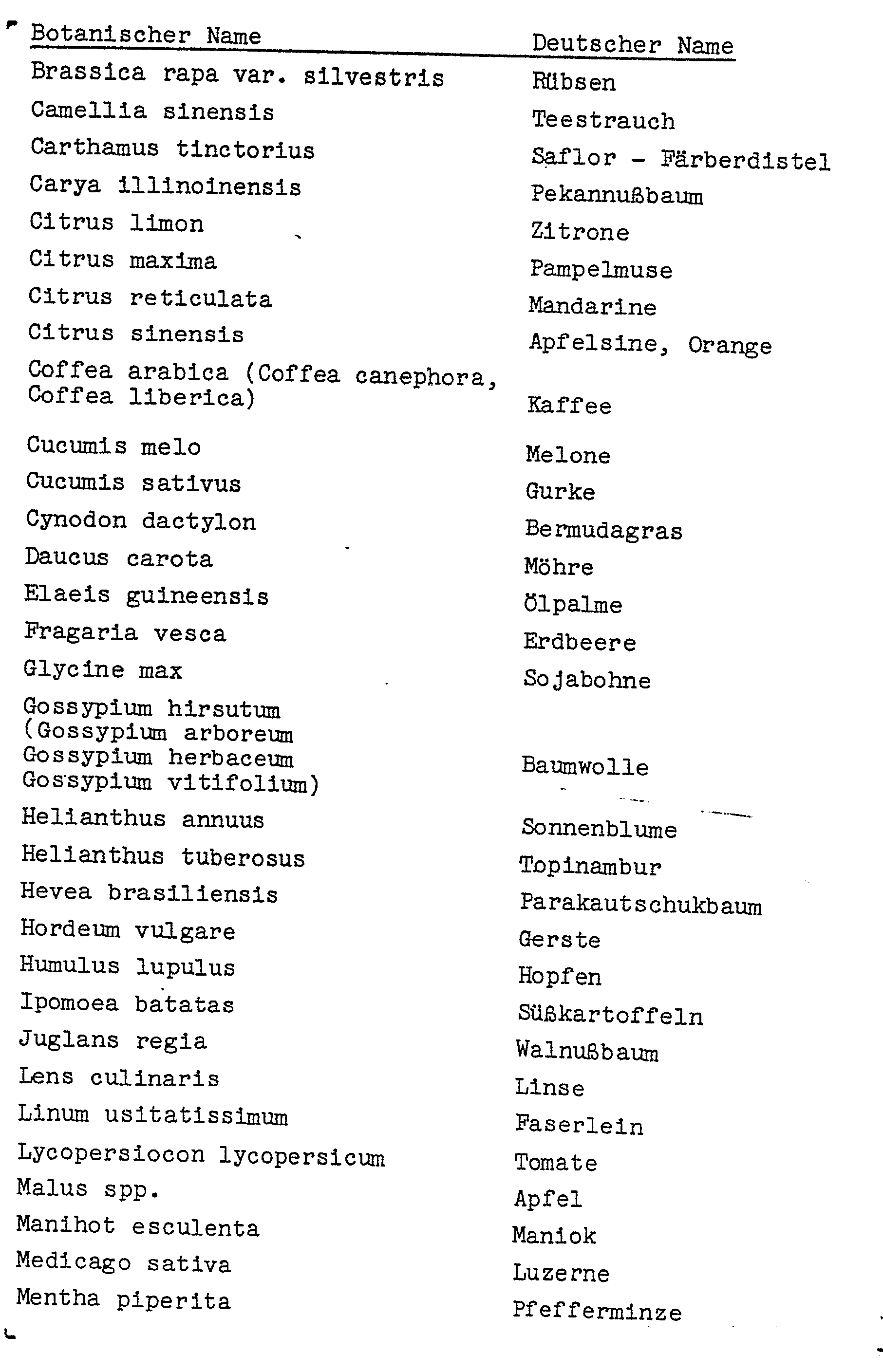
- In Anbetracht der Verträglichkeit und der Vielseitigkeit der Applikationsmethoden können die erfindungsgemäßen Verbindungen in einer großen Zahl von Kulturpflanzen zur Beseitigung unerwünschter Pflanzen eingesetzt werden.
- In Betracht können beispielsweise folgende Kulturen kommen:


- Außerdem kann es von Nutzen sein, die Anilinderivate der Formel I allein oder in Kombination mit anderen Herbiziden auch noch mit weiteren Pflanzenschutzmitteln gemischt gemeinsam auszubringen, beispielsweise mit Mitteln zur Bekämpfung von Schädlingen oder phytopathogenen Pilzen bzw. Bakterien. Von Interesse ist ferner die Mischbarkeit mit Mineralsalzlösungen, welche zur Behebung von Ernährungs-oder Spurenelementmängeln eingesetzt werden. Es können auch nichtphytotoxische Öle und ölkonzentrate zugesetzt werden.
mit der Maßgabe, daß X nicht Schwefel bedeutet, wenn R Wasserstoff, R3 Wasserstoff, A Methylen, Z Chlor und n 3 bedeuten,
eine herbizide Wirkung haben.
Claims (10)





Applications Claiming Priority (2)
| Application Number | Priority Date | Filing Date | Title |
|---|---|---|---|
| DE3213376 | 1982-04-10 | ||
| DE19823213376 DE3213376A1 (de) | 1982-04-10 | 1982-04-10 | Anilinderivate, verfahren zu ihrer herstellung und ihre verwendung zur bekaempfung unerwuenschten pflanzenwuchses |
Publications (3)
| Publication Number | Publication Date |
|---|---|
| EP0091639A2 true EP0091639A2 (de) | 1983-10-19 |
| EP0091639A3 EP0091639A3 (en) | 1984-07-18 |
| EP0091639B1 EP0091639B1 (de) | 1987-06-16 |
Family
ID=6160683
Family Applications (1)
| Application Number | Title | Priority Date | Filing Date |
|---|---|---|---|
| EP83103304A Expired EP0091639B1 (de) | 1982-04-10 | 1983-04-05 | Anilinderivate, Verfahren zu ihrer Herstellung und ihre Verwendung zur Bekämpfung unerwünschten Pflanzenwuchses |
Country Status (5)
| Country | Link |
|---|---|
| EP (1) | EP0091639B1 (de) |
| JP (1) | JPS5916868A (de) |
| CA (1) | CA1250305A (de) |
| DE (2) | DE3213376A1 (de) |
| HU (1) | HU188271B (de) |
Cited By (1)
| Publication number | Priority date | Publication date | Assignee | Title |
|---|---|---|---|---|
| EP0498396A3 (en) * | 1991-02-07 | 1993-02-24 | Ishihara Sangyo Kaisha, Ltd. | N-phenylcarbamate compound, process for preparing the same and biocidal composition for control of harmful organisms |
Family Cites Families (1)
| Publication number | Priority date | Publication date | Assignee | Title |
|---|---|---|---|---|
| DE1192454B (de) * | 1963-12-03 | 1965-05-06 | Basf Ag | Selektive herbizide Mittel |
-
1982
- 1982-04-10 DE DE19823213376 patent/DE3213376A1/de not_active Withdrawn
-
1983
- 1983-03-29 CA CA000424738A patent/CA1250305A/en not_active Expired
- 1983-04-05 EP EP83103304A patent/EP0091639B1/de not_active Expired
- 1983-04-05 DE DE8383103304T patent/DE3372092D1/de not_active Expired
- 1983-04-08 JP JP58061058A patent/JPS5916868A/ja active Pending
- 1983-04-08 HU HU831226A patent/HU188271B/hu unknown
Cited By (3)
| Publication number | Priority date | Publication date | Assignee | Title |
|---|---|---|---|---|
| EP0498396A3 (en) * | 1991-02-07 | 1993-02-24 | Ishihara Sangyo Kaisha, Ltd. | N-phenylcarbamate compound, process for preparing the same and biocidal composition for control of harmful organisms |
| US5436267A (en) * | 1991-02-07 | 1995-07-25 | Ishihara Sangyo Kaisha, Ltd. | N-phenylcarbamate compound, process for preparing the sasme and biocidal composition for control of harmful organisms |
| TR28289A (tr) * | 1991-02-07 | 1996-04-24 | Ishihara Sangyo Kaisha | N-fenilkarbamat bilesigi, bu bilesigin hazirlanmasi ve zararli organizmalarin kontrolü icin biyosidal bilesim. |
Also Published As
| Publication number | Publication date |
|---|---|
| EP0091639B1 (de) | 1987-06-16 |
| JPS5916868A (ja) | 1984-01-28 |
| EP0091639A3 (en) | 1984-07-18 |
| DE3213376A1 (de) | 1983-10-13 |
| HU188271B (en) | 1986-03-28 |
| CA1250305A (en) | 1989-02-21 |
| DE3372092D1 (en) | 1987-07-23 |
Similar Documents
| Publication | Publication Date | Title |
|---|---|---|
| EP0084893B1 (de) | 4H-3,1-Benzoxazinderivate, Verfahren zu ihrer Herstellung und ihre Verwendung zur Bekämpfung unerwünschten Pflanzenwuchses | |
| EP0090309A1 (de) | Dihydrothiophen-carbonester, Verfahren zu ihrer Herstellung und ihre Verwendung zur Bekämpfung unerwünschten Pflanzenwuchses | |
| EP0388873B1 (de) | Herbizide [[1,3,5-Triazin-2-yl) aminocarbonyl] aminsulfonyl] benzoesäureester, Verfahren zu ihrer Herstellung und ihre Verwendung | |
| EP0135838B1 (de) | 3-Phenyl-4-methoxycarbonylpyrazole, Verfahren zu ihrer Herstellung und ihre Verwendung zur Bekämpfung unerwünschten Pflanzenwuchses | |
| EP0081141A1 (de) | Harnstoffderivate, Verfahren zu ihrer Herstellung und ihre Verwendung zur Bekämpfung unerwünschten Pflanzenwuchses | |
| EP0090258B1 (de) | 3-Chlor-8-cyano-chinoline, Verfahren zu ihrer Herstellung und ihre Verwendung zur Bekämpfung unerwünschten Pflanzenwuchses | |
| EP0103252A2 (de) | Aryloxyalkylamine, Verfahren zu ihrer Herstellung und ihre Verwendung zur Bekämpfung unerwünschten Pflanzenwuchses | |
| EP0081206A2 (de) | Anilinderivate, Verfahren zu ihrer Herstellung und ihre Verwendung zur Bekämpfung unerwünschten Pflanzenwuchses | |
| EP0107123B1 (de) | Anilinderivate, Verfahren zu ihrer Herstellung und ihre Verwendung zur Bekämpfung unerwünschten Pflanzenwuchses | |
| EP0169521B1 (de) | Cyclohexenonderivate, Verfahren zur ihrer Herstellung und ihre Verwendung zur Bekämpfung unerwünschten Pflanzenwuchses | |
| EP0091639B1 (de) | Anilinderivate, Verfahren zu ihrer Herstellung und ihre Verwendung zur Bekämpfung unerwünschten Pflanzenwuchses | |
| EP0010692A1 (de) | Neue m-Anilidurethane, sie enthaltende Herbizide und Verfahren zu deren Herstellung, sowie Verfahren zur Bekämpfung von unerwünschtem Pflanzenwuchs | |
| EP0192998B1 (de) | Thiazolylamide, Verfahren zu ihrer Herstellung und ihre Verwendung zur Bekämpfung unerwünschten Pflanzenwuchses | |
| EP0144052A2 (de) | Chinolinoxyphenylharnstoffe, Verfahren zu ihrer Herstellung und ihre Verwendung zur Bekämpfung unerwünschten Pflanzenwuchhses | |
| EP0084671B1 (de) | Anilinderivate, Verfahren zu ihrer Herstellung und ihre Verwendung zur Bekämpfung unerwünschten Pflanzenwuchses sowie Zwischenprodukte für ihre Herstellung | |
| EP0136703B1 (de) | Cyclohexenonderivate, Verfahren zu ihrer Herstellung und ihre Verwendung zur Bekämpfung unerwünschten Pflanzenwuchses | |
| EP0084673A1 (de) | Aminothiadiazole, Verfahren zu ihrer Herstellung und ihre Verwendung zur Bekämpfung unerwünschten Pflanzenwuchses | |
| EP0084149B1 (de) | Phenoxyphenylharnstoffe, Verfahren zu ihrer Herstellung und ihre Verwendung zur Bekämpfung unerwünschten Pflanzenwuchses | |
| EP0129192A1 (de) | Anilinderivate, Verfahren zu ihrer Herstellung und ihre Verwendung zur Bekämpfung unerwünschten Pflanzenwuchses | |
| EP0123727B1 (de) | Substituierte Harnstoffe, Verfahren zu ihrer Herstellung und ihre Verwendung zur Bekämpfung unerwünschten Pflanzenwuchses | |
| EP0081207A2 (de) | Anilinderivate, Verfahren zu ihrer Herstellung und ihre Verwendung zur Bekämpfung unerwünschten Pflanzenwuchses | |
| EP0067381B1 (de) | Anilide, Verfahren zu ihrer Herstellung und diese enthaltende Herbizide | |
| EP0476403B1 (de) | Herbizide[[(1,3,5-Triazin-2-yl)aminocarbonyl]aminosulfonyl]benzoesäureester, Verfahren zu ihrer Herstellung und ihre Verwendung | |
| EP0133918A1 (de) | Harnstoffderivate, Verfahren zu ihrer Herstellung und ihre Verwendung zur Bekämpfung unerwünschten Pflanzenwuchses | |
| EP0114299A2 (de) | Phenylglyoxylsäurederivate, Verfahren zu ihrer Herstellung und ihre Verwendung zur Bekämpfung unerwünschten Pflanzenwuchses |
Legal Events
| Date | Code | Title | Description |
|---|---|---|---|
| PUAI | Public reference made under article 153(3) epc to a published international application that has entered the european phase |
Free format text: ORIGINAL CODE: 0009012 |
|
| AK | Designated contracting states |
Designated state(s): BE DE FR GB IT |
|
| PUAL | Search report despatched |
Free format text: ORIGINAL CODE: 0009013 |
|
| AK | Designated contracting states |
Designated state(s): BE DE FR GB IT |
|
| 17P | Request for examination filed |
Effective date: 19840519 |
|
| GRAA | (expected) grant |
Free format text: ORIGINAL CODE: 0009210 |
|
| AK | Designated contracting states |
Kind code of ref document: B1 Designated state(s): BE DE FR GB IT |
|
| ITF | It: translation for a ep patent filed | ||
| REF | Corresponds to: |
Ref document number: 3372092 Country of ref document: DE Date of ref document: 19870723 |
|
| ET | Fr: translation filed | ||
| PLBE | No opposition filed within time limit |
Free format text: ORIGINAL CODE: 0009261 |
|
| STAA | Information on the status of an ep patent application or granted ep patent |
Free format text: STATUS: NO OPPOSITION FILED WITHIN TIME LIMIT |
|
| PG25 | Lapsed in a contracting state [announced via postgrant information from national office to epo] |
Ref country code: DE Effective date: 19880429 |
|
| 26N | No opposition filed | ||
| BERE | Be: lapsed |
Owner name: BASF A.G. Effective date: 19880430 |
|
| PG25 | Lapsed in a contracting state [announced via postgrant information from national office to epo] |
Ref country code: GB Effective date: 19881122 |
|
| GBPC | Gb: european patent ceased through non-payment of renewal fee | ||
| PG25 | Lapsed in a contracting state [announced via postgrant information from national office to epo] |
Ref country code: FR Free format text: LAPSE BECAUSE OF NON-PAYMENT OF DUE FEES Effective date: 19881229 |
|
| REG | Reference to a national code |
Ref country code: FR Ref legal event code: ST |
|
| PG25 | Lapsed in a contracting state [announced via postgrant information from national office to epo] |
Ref country code: BE Effective date: 19890430 |