EP0091686A2 - Halbleiteranordnung mit diffundierter Zone mit reduzierter Länge und Verfahren zur Herstellung dieser Zone - Google Patents
Halbleiteranordnung mit diffundierter Zone mit reduzierter Länge und Verfahren zur Herstellung dieser Zone Download PDFInfo
- Publication number
- EP0091686A2 EP0091686A2 EP83103501A EP83103501A EP0091686A2 EP 0091686 A2 EP0091686 A2 EP 0091686A2 EP 83103501 A EP83103501 A EP 83103501A EP 83103501 A EP83103501 A EP 83103501A EP 0091686 A2 EP0091686 A2 EP 0091686A2
- Authority
- EP
- European Patent Office
- Prior art keywords
- region
- invention according
- mosfet
- source
- type
- Prior art date
- Legal status (The legal status is an assumption and is not a legal conclusion. Google has not performed a legal analysis and makes no representation as to the accuracy of the status listed.)
- Granted
Links
Images






Classifications
-
- H—ELECTRICITY
- H10—SEMICONDUCTOR DEVICES; ELECTRIC SOLID-STATE DEVICES NOT OTHERWISE PROVIDED FOR
- H10D—INORGANIC ELECTRIC SEMICONDUCTOR DEVICES
- H10D30/00—Field-effect transistors [FET]
- H10D30/60—Insulated-gate field-effect transistors [IGFET]
- H10D30/64—Double-diffused metal-oxide semiconductor [DMOS] FETs
- H10D30/66—Vertical DMOS [VDMOS] FETs
-
- H—ELECTRICITY
- H10—SEMICONDUCTOR DEVICES; ELECTRIC SOLID-STATE DEVICES NOT OTHERWISE PROVIDED FOR
- H10D—INORGANIC ELECTRIC SEMICONDUCTOR DEVICES
- H10D12/00—Bipolar devices controlled by the field effect, e.g. insulated-gate bipolar transistors [IGBT]
- H10D12/01—Manufacture or treatment
- H10D12/031—Manufacture or treatment of IGBTs
- H10D12/032—Manufacture or treatment of IGBTs of vertical IGBTs
- H10D12/038—Manufacture or treatment of IGBTs of vertical IGBTs having a recessed gate, e.g. trench-gate IGBTs
-
- H—ELECTRICITY
- H10—SEMICONDUCTOR DEVICES; ELECTRIC SOLID-STATE DEVICES NOT OTHERWISE PROVIDED FOR
- H10D—INORGANIC ELECTRIC SEMICONDUCTOR DEVICES
- H10D12/00—Bipolar devices controlled by the field effect, e.g. insulated-gate bipolar transistors [IGBT]
- H10D12/411—Insulated-gate bipolar transistors [IGBT]
- H10D12/441—Vertical IGBTs
- H10D12/461—Vertical IGBTs having non-planar surfaces, e.g. having trenches, recesses or pillars in the surfaces of the emitter, base or collector regions
-
- H—ELECTRICITY
- H10—SEMICONDUCTOR DEVICES; ELECTRIC SOLID-STATE DEVICES NOT OTHERWISE PROVIDED FOR
- H10D—INORGANIC ELECTRIC SEMICONDUCTOR DEVICES
- H10D12/00—Bipolar devices controlled by the field effect, e.g. insulated-gate bipolar transistors [IGBT]
- H10D12/411—Insulated-gate bipolar transistors [IGBT]
- H10D12/441—Vertical IGBTs
- H10D12/461—Vertical IGBTs having non-planar surfaces, e.g. having trenches, recesses or pillars in the surfaces of the emitter, base or collector regions
- H10D12/481—Vertical IGBTs having non-planar surfaces, e.g. having trenches, recesses or pillars in the surfaces of the emitter, base or collector regions having gate structures on slanted surfaces, on vertical surfaces, or in grooves, e.g. trench gate IGBTs
-
- H—ELECTRICITY
- H10—SEMICONDUCTOR DEVICES; ELECTRIC SOLID-STATE DEVICES NOT OTHERWISE PROVIDED FOR
- H10D—INORGANIC ELECTRIC SEMICONDUCTOR DEVICES
- H10D30/00—Field-effect transistors [FET]
- H10D30/60—Insulated-gate field-effect transistors [IGFET]
- H10D30/64—Double-diffused metal-oxide semiconductor [DMOS] FETs
- H10D30/66—Vertical DMOS [VDMOS] FETs
- H10D30/668—Vertical DMOS [VDMOS] FETs having trench gate electrodes, e.g. UMOS transistors
-
- H—ELECTRICITY
- H10—SEMICONDUCTOR DEVICES; ELECTRIC SOLID-STATE DEVICES NOT OTHERWISE PROVIDED FOR
- H10D—INORGANIC ELECTRIC SEMICONDUCTOR DEVICES
- H10D62/00—Semiconductor bodies, or regions thereof, of devices having potential barriers
- H10D62/10—Shapes, relative sizes or dispositions of the regions of the semiconductor bodies; Shapes of the semiconductor bodies
- H10D62/17—Semiconductor regions connected to electrodes not carrying current to be rectified, amplified or switched, e.g. channel regions
- H10D62/393—Body regions of DMOS transistors or IGBTs
-
- H—ELECTRICITY
- H10—SEMICONDUCTOR DEVICES; ELECTRIC SOLID-STATE DEVICES NOT OTHERWISE PROVIDED FOR
- H10P—GENERIC PROCESSES OR APPARATUS FOR THE MANUFACTURE OR TREATMENT OF DEVICES COVERED BY CLASS H10
- H10P50/00—Etching of wafers, substrates or parts of devices
- H10P50/60—Wet etching
- H10P50/64—Wet etching of semiconductor materials
- H10P50/642—Chemical etching
- H10P50/644—Anisotropic liquid etching
-
- H—ELECTRICITY
- H10—SEMICONDUCTOR DEVICES; ELECTRIC SOLID-STATE DEVICES NOT OTHERWISE PROVIDED FOR
- H10P—GENERIC PROCESSES OR APPARATUS FOR THE MANUFACTURE OR TREATMENT OF DEVICES COVERED BY CLASS H10
- H10P50/00—Etching of wafers, substrates or parts of devices
- H10P50/69—Etching of wafers, substrates or parts of devices using masks for semiconductor materials
- H10P50/691—Etching of wafers, substrates or parts of devices using masks for semiconductor materials for Group V materials or Group III-V materials
-
- H—ELECTRICITY
- H10—SEMICONDUCTOR DEVICES; ELECTRIC SOLID-STATE DEVICES NOT OTHERWISE PROVIDED FOR
- H10D—INORGANIC ELECTRIC SEMICONDUCTOR DEVICES
- H10D64/00—Electrodes of devices having potential barriers
- H10D64/20—Electrodes characterised by their shapes, relative sizes or dispositions
- H10D64/23—Electrodes carrying the current to be rectified, amplified, oscillated or switched, e.g. sources, drains, anodes or cathodes
- H10D64/251—Source or drain electrodes for field-effect devices
- H10D64/256—Source or drain electrodes for field-effect devices for lateral devices wherein the source or drain electrodes are recessed in semiconductor bodies
-
- H—ELECTRICITY
- H10—SEMICONDUCTOR DEVICES; ELECTRIC SOLID-STATE DEVICES NOT OTHERWISE PROVIDED FOR
- H10D—INORGANIC ELECTRIC SEMICONDUCTOR DEVICES
- H10D64/00—Electrodes of devices having potential barriers
- H10D64/60—Electrodes characterised by their materials
- H10D64/66—Electrodes having a conductor capacitively coupled to a semiconductor by an insulator, e.g. MIS electrodes
- H10D64/667—Electrodes having a conductor capacitively coupled to a semiconductor by an insulator, e.g. MIS electrodes the conductor comprising a layer of alloy material, compound material or organic material contacting the insulator, e.g. TiN workfunction layers
- H10D64/668—Electrodes having a conductor capacitively coupled to a semiconductor by an insulator, e.g. MIS electrodes the conductor comprising a layer of alloy material, compound material or organic material contacting the insulator, e.g. TiN workfunction layers the layer being a silicide, e.g. TiSi2
Definitions
- 0ur invention relates to a semiconductor device having a diffused region of reduced length forming the SOURCE or corresponding region in a device other than a MOSFET, and to a method of fabricating the same.
- Our invention is particularly useful in helping to prevent turn-on, or incipience of current conduction, in a parasitic bipolar transistor inherent in some types of semiconductor devices, such as MOSFETs or IGRs. Turn-on of such parasitic transistor is inevitably accompanied by a partial or total loss of control of current in the semiconductor device, and may even result in complete destruction of the device.
- a typical prior art device for instance, a MOSFET, incorporates a "electrical short", or low resistance connection, between the adjoining SOURCE and BASE regions, which have a P-N junction between them.
- the purpose is to prevent such P-N junction from becoming forward biased above a threshold level that would induce turn-on of the parasitic transistor.
- the distance between the short and the furthest part of the P-N junction which corresponds generally to the length of the SOURCE, should be minimized.
- the SOURCE however, has a minimum length typically in excess of about 10 micrometers, as a result of the prior art method of fabricating the MOSFET.
- a prior art MOSFET is made by diffusing into its BASE a suitable type dopant, through a diffusion window, to form its SOURCE. Thereafter, an etchant is applied to the an intermediate portion of SOURCE through an etch window, to etch through/the SOURCE. This requires aligning the etch window over the SOURCE, this alignment being a delicate procedure because the SOURCE is so small. Consequently, the SOURCE must be long enough to accommodate an alignment tolerance. It would thus be desirable to provide a semiconductor device having a diffused region (i.e., the SOURCE in a MOSFET) of reduced length.
- a further object of our invention is to provide a method of fabricating a semiconductor device not requiring a delicate alignment step for forming the SOURCE or corresponding. region in a device other than a MOSFET.
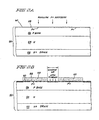
- FIGURE 1A is a schematic view in cross-section of a prior art MOSFET:
- FIGURE 1A illustrates a prior art MOSFET 10 having many identical "cells", or repeated units of structure. For simplicity, explicit reference is made only to the centrally depicted cell of the MOSFET 10.
- the MOSFET 10 is typically used to control the current level in an external circuit (not shown), which is connected between its SOURCE and drain electrodes 12 and 14.
- the "gate" or control electrode 16 normally determines such current level, depending upon the amplitude of a control voltage impressed on it.
- Normal operation of the MOSFET 10 is subject, however, to the adverse effect of turn-on of its inherent parasitic N-P-N transistor, formed from N region 18, P BASE 20, and N + SOURCE 22. If the parasitic transistor turns-on, the MOSFET 10 begins to lose control of the external circuit current level. The parasitic transistor can become so conductive that all control of the external circuit current level is lost, and the MOSFET 10 itself can be destroyed.
- the parasitic transistor will turn-on if any portion of the P-N junction 24 between P BASE 20 and N + SOURCE 22 (e.g., between locations A and C) becomes forward biased by more than about 0.7 volts (for a silicon device).
- an electrical short between P BASE 20 and N SOURCE 22 is implemented at location B by source electrode 12.
- the voltage drop across the P-N junction 24 at location B is held to 0 volts.
- This condition does not hold for portions of the P-N junction 24 remote from location B.
- the voltage drop between locations A and C can rise above 0.7 volts if sufficient hole current flows between locations A and B in P BASE 20, resulting in a voltage drop from location A to B.
- FIGURE 1B shows a semiconductor body 28 including N + DRAIN 30, N region 18, and P BASE 20.
- a diffusion barrier or mask 32 such as silicon diaxide,is provided on the upper surface 33 of the body 28.
- the diffusion mask 32 defines diffusion window 34 (and adjacent diffusion windows).
- An N diffusion of dopant through the upper surface 33 is performed and forms the N SOURCE 22 (shown in phantom).
- an etch barrier or mask 38 such as silicon dioxide, is next provided on the upper surface 33.
- the etch mask 38 defines an etch window 40.
- An etchant is applied through the etch window 40 to remove semiconductor material from the body 28 to form groove 42 (shown in phantom), necessary for implementing the completed MOSFET 10 (FIG.1).
- Proper construction of the N SOURCE 22 requires that the etch window 40 be aligned as closely as is feasible to the center of the N SOURCE 22. However, this alignment step is extremely delicate, since the dimensions involved are exceedingly minute (e.g., on the order of 5 microns).
- the foregoing alignment step is delicate, precise alignment is not consistently attainable. Consequently, the etch window 40 falls at random within a minimum alignment tolerance 44.
- the completed N SOURCE 22 must be lengthy. This, however, increases the risk of the parasitic transistor turning on.
- a further drawback of having the N + SOURCE 22 lengthy is that the individual size of each cell in the MOSFET 10 is increased. This undesirably limits the amount of current that the MOSFET 10 can carry, and reduces the manufacturing yield of operable MOSFETs. Additionally, the inclusion of the foregoing delicate alignment step further reduces the manufacturing yield of operable MOSFETs.
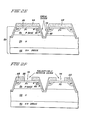
- FIGURES 2A-2G inclusive illustrating a preferred method of fabricating a MOSFET.
- N DRAIN 52 typically comprises a substrate layer, with N-type layer 54 epitaxially grown on N + DRAIN 52, and P BASE 56 . epitaxially grown (or diffused into) the N-type layer 54.
- This construction is typical of "power" MOSFET, or MOSFETs designed to carry substantial levels of current. Our invention, however, can be practised with non-power devices.
- FIGURE 2A additionally illustrates a processing step for implementing P region 58 (shown in phantom).
- P region 58 shown in phantom
- P-type dopant such as boron
- a thick layer e.g.,2 micrometers of silicon dioxide,or other suitable diffusion resistant material, to the body upper surface 60, and pattern it using photolithography (a known technique) to provide a mask 62, as shown in FIGURE 2B, which defines a window 64.
- This etching need not be anisotropic, or directional.
- a suitable etching technique for example, is planar plasma etching.
- N-type dopant such as phosphorus
- the mask 62 serves an additional purpose as an etch barrier or mask, as shown in FIGURE 2D.
- the etchant is dependent upon the crystal orientation of the silicon body 50 , such orientation being (100).
- Such etchant does not undercut beneath the mask 62 and hence/completely etch away the N + SOURCE 66. This allows portions of N + SOURCE 66 beneath the mask 62, or "shoulders" 72, to remain intact.
- an insulating layer 73 to cover the surface of the groove 68.
- a preferred way of implementing the layer 73 is by growing it as an oxide of the semiconductor body 50. This is accomplished by exposing the body 50 to oxygen at high temperature.
- the P region 58 advantageously completes an electrical short between P BASE 56 and N + SOURCE 66,e.g., location E.
- This electrical short has three components.
- One component comprises the junction 82 between the P region 58 and the N SOURCE 66,which junction forms a "tunnel" junction, because each of the foregoing regions is heavily doped(i.e.,each has a doping concentration in excess of about 10 19 dopant atoms per cc of silicon).
- the tunnel junction 82 constitutes a low resistance connection between the N + SOURCE 66 and the P + region 58,at least during normal device operation.
- Tunnel junctions are discussed more fully,for example, in S.M.Sze,Physics of Semiconductor Devices, New York: Wiley-Interscience,1969,Chapter 4.
- the second component of the electrical short /loca ti on E comprises the junction 84,between P BASE 56 and P + region 58.
- the junction 84 constitutes a low resistance path between the P BASE 56 and the P + region 58, because holes can freely pass from the P BASE.56 to the P + region 58.
- the third component of the electrical short/location E comprises the P region 58, in the vicinity/location E, between the tunnel junction 82 and the junction 84.
- the region 58 is highly doped, and so constitutes a low resistance path between the junctions 82 and 84. All three of the foregoing low resistance paths collectively provide a low resistance path between the P BASE 56 and the N SOURCE 66, thus implementing the electrical short between these regions at location E.
- the tunnel junction 82 is also part of a low resistance path between the N SOURCE 66 and the source electrode 76, such low resistance path also including the highly-doped P region 58. Because the P region 58 is highly-doped and thus conductive, the source electrode 76 only needs to make contact with it at isolated locations.
- the MOSFET 80 possesses significant advantages over the prior art MOSFET 10, described above.
- the length of the N + SOURCE 66 is drastically reduced compared to the prior art. This is because all but the shoulders 72 of the N SOURCE 66 have been etched away. Accordingly, the electrical short at location E is highly effective. This is because hole current flowing in P BASE 56, from location D to location E, produces only a low voltage drop because the distance D-E is short. Accordingly, it is unlikely that any portion of.P-N junction 86 between P BASE 56 and N + SOURCE 66 (e.g., between locations D and F) can become excessively forward biased. This greatly reduces the likelihood of turn-on of the parasitic bipolar transistor in the MOSFET 80(i.e., the transistor formed by N-region 54, P BASE 56, and N SOURCE 66).
- MOSFETs made by our invention allow reduced cell size using present state of the art processing techniques. For a typical MOSFET, this size reduction amounts to about 50 percent. This dramatically increases the manufacuring yield of operable MOSFETs, which makes them less increases the costly. Additionally, the size reduction/current-carrying capability of a 500 volt-rated MOSFET by about 30 percent, and of a 50 volt-rated MOSFET by about 100 percent. Accordingly, smaller and less costly MOSFETs made in accordance with our invention are needed in a given application, compared with MOSFETs made by the conventional methods.
- our foregoing method of fabricating the MOSFET 80 could be modified, for example, by employing an anisotropic etchant other than the preferred orientation-dependent etchant such mentioned above.
- suitable etchants must allow shoulders 72 of the N + SOURCE 66 to remain intact.
- these other suitable etchants include a vertically collimated beam of reactive ions and a planar plasma etchant. These etchants tend to form a groove 68 (FIGURE 2D) having more of a U-shape than a V-shape. These etchants do not to be require the semiconductor body/(100) crystal oriented, as does the preferred, orientation-dependent etchant.
- a further modification of our foregoing method of fabricating the MOSFET 80 is to form the gate electrode 74 from a conductive refractory material, rather than by metallization.
- Suitable refractory materials include highly-doped polysilicon, molybdenum silicide and tungsten silicide. If polysilicon were used, our foregoing method could be altered as follows, by way of example. After the insulating layer 62 of FIGURE 2E has been formed, polysilicon (not illustrated) is deposited on the upper surface of the structure shown in FIGURE 2E. The polysilicon layer is highly doped to make it conductive, and is patterned to remove it from the desired locations for the source electrode. A layer of oxide is grown on the polysilicon by exposing it to oxygen at high temperature, openings similar to openings 75 (FIGURE 2F) are made, and, finally, metallization is applied to the upper surface of the modified structure to implement the source electrode.
- IGR insulated gate rectifier
- FIGURE 3 Another appropriate semiconductor device is an insulated gate rectifier (IGR), shown in FIGURE 3.
- the IGR 90 includes a.P + substrate 92, in contrast with the N + DRAIN substrate 52 of the MOSFET 80. With this substitution, the foregoing method of fabricating the present embodiment of our invention is applicable to IGR 90.
- the parasitic N-P-N transistor in the IGR 90 formed by N region 94, P region 96, and N region 97, is electrically coupled in thyristor fashion to a parasitic P-N-P transistor -- namely, the transistor formed by P region 92, N region 94, and P region 96. Accordingly, these parasitic transistors can "latch", or become established in a current-conducting state, if the N-P-N (or upper transistor) is allowed to turn on. Once the IGR 90 becomes latched, control of its current level by its gate 98 is totally lost.
- This risk of the IGR 90 becoming latched is always present when the IGR 90 is in its active or current- carrying state.
- Our invention greatly diminishes this risk by preventing the N-P-N transistor from becoming excessively active. This is because the distance H-I in P region 96 along P-N junction 100 is so short that P-N junction 100 (e.g., between locations H and J)cannot become excessively forward biased. Additionally, the IGR 90 can have a reduced cell size, compared to IGRs made from prior art methods, enabling the IGR 90 to be made more economically and carry more current.
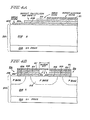
- FIGURE 4A a semiconductor body 200,typically of silicon.
- the body 200 typically comprises a substrate 202, constituting an N DRAIN,and an N region 204, typically epitaxially grown on the N + DRAIN 202.
- This construction is typical of power MOSFETs, although our invention can be practised with non-power devices.
- an insulating layer 206 On the upper surface 205 of the body 200, we form an insulating layer 206, suitably by growing an oxide on the body 200.
- a conductive refractory material 208 (shown partially broken away) on the insulating layer 206.
- the refractory material comprises polysilicon we dope it highly to make it conductive.
- insulating layer 210 on the upper surface of the refractory material 208.
- the insulating layer 210 suitably comprises an oxide grown thereon.
- the layer 211 comprises a material, such as aluminum oxide, which is resistant to an etchant,that etches through silicon dioxide and silicon during a processing step described below.
- the mask 216 defines a window 217 and serves as a diffusion barrier when we next make a P-type diffusion through the window 217 to form P BASE 218 (shown in phantom).
- N + SOURCE 220 (shown in phantom).
- the N diffusion extends laterally beneath the refractory material 208, i.e., in region 222, approximately the same distance as it diffuses vertically downward. This diffusion occurs at high temperature in an oxidizing atmosphere.
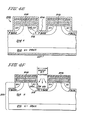
- the exposed surfaces 219(shown in FIGURE 4B) of the refractory material 208 become oxidized so that the refractory material 208 becomes surrounded by insulating material, as shown in FIGURE 4C.
- the exposed portions of the semiconductor body surface 205(shown in FIGURE 4B) becomes oxidized to form oxide layer 221,(shown in FIGURE 4C).
- this etchant suitably comprises a vertically collimated beam of reactive ions or a planar plasma etchant, and forms a generally U-shaped groove 224.
- a V-shaped groove (not illustrated) could be formed by first using one of the preceeding etchants to remove the oxide layer 221, and then using an orientation-dependent etchant (such as a mixture of potassium hydroxide and isopropanol, in the approximate ratio of 3 to 1) to etch into the semiconductor body 200.
- an orientation-dependent etchant such as a mixture of potassium hydroxide and isopropanol, in the approximate ratio of 3 to 1
- the body 200 would need to have a (100) crystal orientation, and an insulating layer 210 (FIGURE 4A) is necessary, because the layer 211 (at least where it comprises aluminum oxide) is removed by the orientation-dependent etchant (at least where it comprises potassium hydroxide).
- MOSFET 228 as shown in FIGURE 4E by applying metallization 226 and 227 to the upper and lower surfaces, respectively, of the structure of FIGURE 4D.
- An electrical short in the MOSFET 228 exists at location A, where the metallization 226 electrically connects the P BASE 218 to the N + SOURCE 220.
- the present embodiment of our invention applies to semiconductor devices other than MOSFETs.
- Another appropriate semiconductor device is an insulated gate rectifier (IGR) 240, as shown in FIGURE 5.
- the IGR 240 is similar to the MOSFET 238 (FIGURE 4G), except that the IGR 240 includes a P substrate 242, in contrast with the N + DRAIN substrate 202 of the MOSFET 238. With this sub- method of stitution, the foregoing/fabricating of the present embodiment of our. invention is applicable to the IGR 240.
Landscapes
- Metal-Oxide And Bipolar Metal-Oxide Semiconductor Integrated Circuits (AREA)
- Electrodes Of Semiconductors (AREA)
- Weting (AREA)
- Insulated Gate Type Field-Effect Transistor (AREA)
Applications Claiming Priority (2)
| Application Number | Priority Date | Filing Date | Title |
|---|---|---|---|
| US36731682A | 1982-04-12 | 1982-04-12 | |
| US367316 | 1982-04-12 |
Publications (3)
| Publication Number | Publication Date |
|---|---|
| EP0091686A2 true EP0091686A2 (de) | 1983-10-19 |
| EP0091686A3 EP0091686A3 (en) | 1986-03-19 |
| EP0091686B1 EP0091686B1 (de) | 1989-06-28 |
Family
ID=23446680
Family Applications (1)
| Application Number | Title | Priority Date | Filing Date |
|---|---|---|---|
| EP83103501A Expired EP0091686B1 (de) | 1982-04-12 | 1983-04-11 | Halbleiteranordnung mit diffundierter Zone mit reduzierter Länge und Verfahren zur Herstellung dieser Zone |
Country Status (3)
| Country | Link |
|---|---|
| EP (1) | EP0091686B1 (de) |
| JP (1) | JPH0626253B2 (de) |
| DE (1) | DE3380136D1 (de) |
Cited By (11)
| Publication number | Priority date | Publication date | Assignee | Title |
|---|---|---|---|---|
| EP0094891A3 (en) * | 1982-05-20 | 1985-07-31 | Fairchild Camera & Instrument Corporation | Power mosfet structure and method of fabricating it |
| WO1985005224A1 (en) * | 1984-05-02 | 1985-11-21 | Bell Telephone Manufacturing Company Naamloze Venn | Semiconductor device and arrangement |
| EP0164095A3 (de) * | 1984-06-08 | 1987-01-07 | Eaton Corporation | Vertikaler, bidirektionaler, gestapelter Leistungs-Feldeffekttransistor |
| EP0164096A3 (de) * | 1984-06-08 | 1987-01-14 | Eaton Corporation | Lateraler, bidirektionaler Leistungs-Feldeffekttransistor mit einem nutdurchzogenen Mehrkanalstapel |
| EP0159663A3 (de) * | 1984-04-26 | 1987-09-23 | General Electric Company | Thyristoren, Feldeffekttransistoren mit isoliertem Gate und MOSFETs hoher Dichte gesteuert durch eine in einer V-Nut angebrachte MOS-Struktur und Verfahren zur Herstellung |
| EP0202477A3 (de) * | 1985-04-24 | 1988-04-20 | General Electric Company | Verfahren zum Herstellen elektrischer Kurzschlüsse zwischen benachbarten Gebieten in einer Halbleiteranordnung mit isoliertem Gate |
| EP0326187A3 (de) * | 1982-05-20 | 1989-09-27 | Fairchild Semiconductor Corporation | Leistungs-MOSFET-Struktur |
| GB2227605A (en) * | 1989-01-30 | 1990-08-01 | Philips Electronic Associated | A vertical field effect semiconductor device |
| GB2303487A (en) * | 1995-07-21 | 1997-02-19 | Plessey Semiconductors Ltd | Semiconductor devices with recessed emitters |
| US5701023A (en) * | 1994-08-03 | 1997-12-23 | National Semiconductor Corporation | Insulated gate semiconductor device typically having subsurface-peaked portion of body region for improved ruggedness |
| WO2001006568A3 (en) * | 1999-07-20 | 2001-09-07 | Koninkl Philips Electronics Nv | Trench-gate field-effect transistors and their manufacture |
Families Citing this family (9)
| Publication number | Priority date | Publication date | Assignee | Title |
|---|---|---|---|---|
| JPH0693512B2 (ja) * | 1986-06-17 | 1994-11-16 | 日産自動車株式会社 | 縦形mosfet |
| JP2615667B2 (ja) * | 1987-09-28 | 1997-06-04 | 日産自動車株式会社 | Mos電界効果トランジスタの製造方法 |
| JPH01108775A (ja) * | 1987-10-21 | 1989-04-26 | Nec Kansai Ltd | 縦型電界効果トランジスタ |
| JPH0817233B2 (ja) * | 1987-11-11 | 1996-02-21 | 三菱電機株式会社 | 絶縁ゲート型バイポーラトランジスタ |
| JP3260944B2 (ja) * | 1993-12-15 | 2002-02-25 | 三菱電機株式会社 | 電圧駆動型サイリスタおよびその製造方法 |
| KR100824205B1 (ko) * | 2006-12-26 | 2008-04-21 | 매그나칩 반도체 유한회사 | Dmos 트랜지스터 및 그 제조방법 |
| JP2009302510A (ja) * | 2008-03-03 | 2009-12-24 | Fuji Electric Device Technology Co Ltd | トレンチゲート型半導体装置およびその製造方法 |
| JP2012084739A (ja) * | 2010-10-13 | 2012-04-26 | Sumitomo Electric Ind Ltd | 半導体装置およびその製造方法 |
| JP5630552B2 (ja) * | 2013-10-15 | 2014-11-26 | 富士電機株式会社 | 炭化珪素半導体装置およびその製造方法 |
Family Cites Families (7)
| Publication number | Priority date | Publication date | Assignee | Title |
|---|---|---|---|---|
| US3975221A (en) * | 1973-08-29 | 1976-08-17 | American Micro-Systems, Inc. | Low capacitance V groove MOS NOR gate and method of manufacture |
| JPS55110066A (en) * | 1979-02-17 | 1980-08-25 | Fujitsu Ltd | Semiconductor device |
| US4379305A (en) * | 1980-05-29 | 1983-04-05 | General Instrument Corp. | Mesh gate V-MOS power FET |
| FR2487583A1 (fr) * | 1980-07-25 | 1982-01-29 | Thomson Csf | Procede de fabrication d'un transistor a effet de champ a rainure |
| SE8107136L (sv) * | 1980-12-02 | 1982-06-03 | Gen Electric | Styrelektrodforsedd likriktaranordning |
| JPS58106870A (ja) * | 1981-12-18 | 1983-06-25 | Nissan Motor Co Ltd | パワ−mosfet |
| JPS58168277A (ja) * | 1982-03-30 | 1983-10-04 | Toshiba Corp | 絶縁ゲ−ト電解効果トランジスタ |
-
1983
- 1983-04-11 DE DE8383103501T patent/DE3380136D1/de not_active Expired
- 1983-04-11 EP EP83103501A patent/EP0091686B1/de not_active Expired
- 1983-04-12 JP JP58063130A patent/JPH0626253B2/ja not_active Expired - Lifetime
Cited By (13)
| Publication number | Priority date | Publication date | Assignee | Title |
|---|---|---|---|---|
| EP0326187A3 (de) * | 1982-05-20 | 1989-09-27 | Fairchild Semiconductor Corporation | Leistungs-MOSFET-Struktur |
| EP0094891A3 (en) * | 1982-05-20 | 1985-07-31 | Fairchild Camera & Instrument Corporation | Power mosfet structure and method of fabricating it |
| EP0159663A3 (de) * | 1984-04-26 | 1987-09-23 | General Electric Company | Thyristoren, Feldeffekttransistoren mit isoliertem Gate und MOSFETs hoher Dichte gesteuert durch eine in einer V-Nut angebrachte MOS-Struktur und Verfahren zur Herstellung |
| US4779125A (en) * | 1984-05-02 | 1988-10-18 | Alcatel N.V. | Semiconductor device and arrangement |
| WO1985005224A1 (en) * | 1984-05-02 | 1985-11-21 | Bell Telephone Manufacturing Company Naamloze Venn | Semiconductor device and arrangement |
| EP0164096A3 (de) * | 1984-06-08 | 1987-01-14 | Eaton Corporation | Lateraler, bidirektionaler Leistungs-Feldeffekttransistor mit einem nutdurchzogenen Mehrkanalstapel |
| EP0164095A3 (de) * | 1984-06-08 | 1987-01-07 | Eaton Corporation | Vertikaler, bidirektionaler, gestapelter Leistungs-Feldeffekttransistor |
| EP0202477A3 (de) * | 1985-04-24 | 1988-04-20 | General Electric Company | Verfahren zum Herstellen elektrischer Kurzschlüsse zwischen benachbarten Gebieten in einer Halbleiteranordnung mit isoliertem Gate |
| GB2227605A (en) * | 1989-01-30 | 1990-08-01 | Philips Electronic Associated | A vertical field effect semiconductor device |
| US5701023A (en) * | 1994-08-03 | 1997-12-23 | National Semiconductor Corporation | Insulated gate semiconductor device typically having subsurface-peaked portion of body region for improved ruggedness |
| US5897355A (en) * | 1994-08-03 | 1999-04-27 | National Semiconductor Corporation | Method of manufacturing insulated gate semiconductor device to improve ruggedness |
| GB2303487A (en) * | 1995-07-21 | 1997-02-19 | Plessey Semiconductors Ltd | Semiconductor devices with recessed emitters |
| WO2001006568A3 (en) * | 1999-07-20 | 2001-09-07 | Koninkl Philips Electronics Nv | Trench-gate field-effect transistors and their manufacture |
Also Published As
| Publication number | Publication date |
|---|---|
| JPS58202575A (ja) | 1983-11-25 |
| DE3380136D1 (en) | 1989-08-03 |
| EP0091686A3 (en) | 1986-03-19 |
| JPH0626253B2 (ja) | 1994-04-06 |
| EP0091686B1 (de) | 1989-06-28 |
Similar Documents
| Publication | Publication Date | Title |
|---|---|---|
| EP0091686B1 (de) | Halbleiteranordnung mit diffundierter Zone mit reduzierter Länge und Verfahren zur Herstellung dieser Zone | |
| US4567641A (en) | Method of fabricating semiconductor devices having a diffused region of reduced length | |
| US5032532A (en) | Method for fabricating insulated gate semiconductor device | |
| US6872611B2 (en) | Method of manufacturing transistor | |
| US4791462A (en) | Dense vertical j-MOS transistor | |
| US4682405A (en) | Methods for forming lateral and vertical DMOS transistors | |
| US4983535A (en) | Vertical DMOS transistor fabrication process | |
| KR100451450B1 (ko) | 바디 영역내에 트렌치 형상의 게이트-전극 및 추가 고도핑 층을 갖는 전계 효과 트랜지스터 | |
| US4663644A (en) | Semiconductor device and method of manufacturing the same | |
| JPH04146674A (ja) | 半導体装置及びその製造方法 | |
| US4115797A (en) | Integrated injection logic with heavily doped injector base self-aligned with injector emitter and collector | |
| US5034336A (en) | Method of producing insulated gate bipolar tranistor | |
| JPH0719838B2 (ja) | 半導体装置およびその製造方法 | |
| JPH0817233B2 (ja) | 絶縁ゲート型バイポーラトランジスタ | |
| US4454523A (en) | High voltage field effect transistor | |
| JPS60253275A (ja) | 高密度v溝型mos制御型サイリスタ、絶縁ゲ−ト型トランジスタおよびmosfet、並びに製造方法 | |
| US5397905A (en) | Power semiconductor device having an insulated gate field effect transistor and a bipolar transistor | |
| US5179034A (en) | Method for fabricating insulated gate semiconductor device | |
| JPH0715011A (ja) | 自動調心陰極パターンを有する絶縁ゲートバイポーラトランジスタ及びその製造方法 | |
| US5285094A (en) | Vertical insulated gate semiconductor device with less influence from the parasitic bipolar effect | |
| KR950003934B1 (ko) | 양방향성 수직 전원 mos소자 및 그 제조방법 | |
| US3860454A (en) | Field effect transistor structure for minimizing parasitic inversion and process for fabricating | |
| US5143859A (en) | Method of manufacturing a static induction type switching device | |
| JPH02178965A (ja) | 絶縁分離型電界効果半導体装置 | |
| US3753806A (en) | Increasing field inversion voltage of metal oxide on silicon integrated circuits |
Legal Events
| Date | Code | Title | Description |
|---|---|---|---|
| PUAI | Public reference made under article 153(3) epc to a published international application that has entered the european phase |
Free format text: ORIGINAL CODE: 0009012 |
|
| AK | Designated contracting states |
Designated state(s): CH DE FR GB LI NL SE |
|
| 17P | Request for examination filed |
Effective date: 19840323 |
|
| PUAL | Search report despatched |
Free format text: ORIGINAL CODE: 0009013 |
|
| AK | Designated contracting states |
Kind code of ref document: A3 Designated state(s): CH DE FR GB LI NL SE |
|
| 17Q | First examination report despatched |
Effective date: 19880202 |
|
| GRAA | (expected) grant |
Free format text: ORIGINAL CODE: 0009210 |
|
| AK | Designated contracting states |
Kind code of ref document: B1 Designated state(s): CH DE FR GB LI NL SE |
|
| REF | Corresponds to: |
Ref document number: 3380136 Country of ref document: DE Date of ref document: 19890803 |
|
| ET | Fr: translation filed | ||
| PLBE | No opposition filed within time limit |
Free format text: ORIGINAL CODE: 0009261 |
|
| STAA | Information on the status of an ep patent application or granted ep patent |
Free format text: STATUS: NO OPPOSITION FILED WITHIN TIME LIMIT |
|
| 26N | No opposition filed | ||
| EAL | Se: european patent in force in sweden |
Ref document number: 83103501.9 |
|
| PGFP | Annual fee paid to national office [announced via postgrant information from national office to epo] |
Ref country code: SE Payment date: 20010320 Year of fee payment: 19 |
|
| REG | Reference to a national code |
Ref country code: GB Ref legal event code: IF02 |
|
| PGFP | Annual fee paid to national office [announced via postgrant information from national office to epo] |
Ref country code: NL Payment date: 20020329 Year of fee payment: 20 |
|
| PGFP | Annual fee paid to national office [announced via postgrant information from national office to epo] |
Ref country code: FR Payment date: 20020401 Year of fee payment: 20 |
|
| PGFP | Annual fee paid to national office [announced via postgrant information from national office to epo] |
Ref country code: GB Payment date: 20020403 Year of fee payment: 20 Ref country code: CH Payment date: 20020403 Year of fee payment: 20 |
|
| PG25 | Lapsed in a contracting state [announced via postgrant information from national office to epo] |
Ref country code: SE Free format text: LAPSE BECAUSE OF NON-PAYMENT OF DUE FEES Effective date: 20020412 |
|
| PGFP | Annual fee paid to national office [announced via postgrant information from national office to epo] |
Ref country code: DE Payment date: 20020418 Year of fee payment: 20 |
|
| EUG | Se: european patent has lapsed |
Ref document number: 83103501.9 |
|
| PG25 | Lapsed in a contracting state [announced via postgrant information from national office to epo] |
Ref country code: LI Free format text: LAPSE BECAUSE OF EXPIRATION OF PROTECTION Effective date: 20030410 Ref country code: GB Free format text: LAPSE BECAUSE OF EXPIRATION OF PROTECTION Effective date: 20030410 Ref country code: CH Free format text: LAPSE BECAUSE OF EXPIRATION OF PROTECTION Effective date: 20030410 |
|
| PG25 | Lapsed in a contracting state [announced via postgrant information from national office to epo] |
Ref country code: NL Free format text: LAPSE BECAUSE OF EXPIRATION OF PROTECTION Effective date: 20030411 |
|
| REG | Reference to a national code |
Ref country code: GB Ref legal event code: PE20 |
|
| REG | Reference to a national code |
Ref country code: CH Ref legal event code: PL |