EP0092700A1 - Verfahren zur Herstellung hochelastischer kalthärtender Polyurethanschaumstoffe - Google Patents
Verfahren zur Herstellung hochelastischer kalthärtender Polyurethanschaumstoffe Download PDFInfo
- Publication number
- EP0092700A1 EP0092700A1 EP83103339A EP83103339A EP0092700A1 EP 0092700 A1 EP0092700 A1 EP 0092700A1 EP 83103339 A EP83103339 A EP 83103339A EP 83103339 A EP83103339 A EP 83103339A EP 0092700 A1 EP0092700 A1 EP 0092700A1
- Authority
- EP
- European Patent Office
- Prior art keywords
- group
- radical
- organopolysiloxanes
- foams
- hydroxyl groups
- Prior art date
- Legal status (The legal status is an assumption and is not a legal conclusion. Google has not performed a legal analysis and makes no representation as to the accuracy of the status listed.)
- Granted
Links
- 238000000034 method Methods 0.000 title claims abstract description 21
- 229920005830 Polyurethane Foam Polymers 0.000 title claims abstract description 11
- 239000011496 polyurethane foam Substances 0.000 title claims abstract description 11
- 229920001296 polysiloxane Polymers 0.000 claims abstract description 36
- 125000002887 hydroxy group Chemical group [H]O* 0.000 claims abstract description 32
- 239000003381 stabilizer Substances 0.000 claims abstract description 30
- -1 alkyl radical Chemical class 0.000 claims abstract description 19
- 229920005862 polyol Polymers 0.000 claims abstract description 18
- 150000003077 polyols Chemical class 0.000 claims abstract description 17
- 239000003054 catalyst Substances 0.000 claims abstract description 7
- 125000004432 carbon atom Chemical group C* 0.000 claims abstract description 6
- 239000000654 additive Substances 0.000 claims abstract description 5
- 229920001228 polyisocyanate Polymers 0.000 claims abstract description 5
- 239000005056 polyisocyanate Substances 0.000 claims abstract description 5
- 229910052736 halogen Inorganic materials 0.000 claims abstract description 4
- 150000002367 halogens Chemical class 0.000 claims abstract description 4
- 238000002360 preparation method Methods 0.000 claims abstract description 4
- YZCKVEUIGOORGS-IGMARMGPSA-N Protium Chemical compound [1H] YZCKVEUIGOORGS-IGMARMGPSA-N 0.000 claims abstract description 3
- 150000005840 aryl radicals Chemical class 0.000 claims abstract description 3
- 150000003254 radicals Chemical class 0.000 claims description 3
- WCYWZMWISLQXQU-UHFFFAOYSA-N methyl Chemical compound [CH3] WCYWZMWISLQXQU-UHFFFAOYSA-N 0.000 claims description 2
- 239000004604 Blowing Agent Substances 0.000 abstract description 3
- 125000002577 pseudohalo group Chemical group 0.000 abstract description 2
- 239000006260 foam Substances 0.000 description 44
- 239000000203 mixture Substances 0.000 description 37
- 238000009472 formulation Methods 0.000 description 25
- 150000001875 compounds Chemical class 0.000 description 13
- 238000005187 foaming Methods 0.000 description 8
- 238000012545 processing Methods 0.000 description 8
- 239000012948 isocyanate Substances 0.000 description 7
- 150000002513 isocyanates Chemical class 0.000 description 7
- 238000004519 manufacturing process Methods 0.000 description 7
- 238000003825 pressing Methods 0.000 description 7
- 239000000047 product Substances 0.000 description 7
- PPBRXRYQALVLMV-UHFFFAOYSA-N Styrene Chemical compound C=CC1=CC=CC=C1 PPBRXRYQALVLMV-UHFFFAOYSA-N 0.000 description 6
- 238000006243 chemical reaction Methods 0.000 description 6
- IAYPIBMASNFSPL-UHFFFAOYSA-N Ethylene oxide Chemical compound C1CO1 IAYPIBMASNFSPL-UHFFFAOYSA-N 0.000 description 5
- 238000005259 measurement Methods 0.000 description 5
- IJGRMHOSHXDMSA-UHFFFAOYSA-N Atomic nitrogen Chemical compound N#N IJGRMHOSHXDMSA-UHFFFAOYSA-N 0.000 description 4
- GOOHAUXETOMSMM-UHFFFAOYSA-N Propylene oxide Chemical compound CC1CO1 GOOHAUXETOMSMM-UHFFFAOYSA-N 0.000 description 4
- 239000013518 molded foam Substances 0.000 description 4
- 229920000570 polyether Polymers 0.000 description 4
- 230000000087 stabilizing effect Effects 0.000 description 4
- 238000012360 testing method Methods 0.000 description 4
- NLHHRLWOUZZQLW-UHFFFAOYSA-N Acrylonitrile Chemical compound C=CC#N NLHHRLWOUZZQLW-UHFFFAOYSA-N 0.000 description 3
- 230000015572 biosynthetic process Effects 0.000 description 3
- 238000007664 blowing Methods 0.000 description 3
- 238000006555 catalytic reaction Methods 0.000 description 3
- 239000000460 chlorine Substances 0.000 description 3
- 238000004132 cross linking Methods 0.000 description 3
- 238000007373 indentation Methods 0.000 description 3
- 230000009257 reactivity Effects 0.000 description 3
- DVKJHBMWWAPEIU-UHFFFAOYSA-N toluene 2,4-diisocyanate Chemical compound CC1=CC=C(N=C=O)C=C1N=C=O DVKJHBMWWAPEIU-UHFFFAOYSA-N 0.000 description 3
- STMDPCBYJCIZOD-UHFFFAOYSA-N 2-(2,4-dinitroanilino)-4-methylpentanoic acid Chemical compound CC(C)CC(C(O)=O)NC1=CC=C([N+]([O-])=O)C=C1[N+]([O-])=O STMDPCBYJCIZOD-UHFFFAOYSA-N 0.000 description 2
- UPMLOUAZCHDJJD-UHFFFAOYSA-N 4,4'-Diphenylmethane Diisocyanate Chemical compound C1=CC(N=C=O)=CC=C1CC1=CC=C(N=C=O)C=C1 UPMLOUAZCHDJJD-UHFFFAOYSA-N 0.000 description 2
- LRHPLDYGYMQRHN-UHFFFAOYSA-N N-Butanol Chemical compound CCCCO LRHPLDYGYMQRHN-UHFFFAOYSA-N 0.000 description 2
- 239000004721 Polyphenylene oxide Substances 0.000 description 2
- 230000002378 acidificating effect Effects 0.000 description 2
- 125000000217 alkyl group Chemical group 0.000 description 2
- 239000000440 bentonite Substances 0.000 description 2
- 229910000278 bentonite Inorganic materials 0.000 description 2
- SVPXDRXYRYOSEX-UHFFFAOYSA-N bentoquatam Chemical compound O.O=[Si]=O.O=[Al]O[Al]=O SVPXDRXYRYOSEX-UHFFFAOYSA-N 0.000 description 2
- 230000009134 cell regulation Effects 0.000 description 2
- 229910052801 chlorine Inorganic materials 0.000 description 2
- 238000007906 compression Methods 0.000 description 2
- 230000006835 compression Effects 0.000 description 2
- 229920001577 copolymer Polymers 0.000 description 2
- 235000013870 dimethyl polysiloxane Nutrition 0.000 description 2
- KPUWHANPEXNPJT-UHFFFAOYSA-N disiloxane Chemical class [SiH3]O[SiH3] KPUWHANPEXNPJT-UHFFFAOYSA-N 0.000 description 2
- 230000000694 effects Effects 0.000 description 2
- 150000002170 ethers Chemical class 0.000 description 2
- 238000011156 evaluation Methods 0.000 description 2
- 238000002474 experimental method Methods 0.000 description 2
- 239000004872 foam stabilizing agent Substances 0.000 description 2
- 239000007788 liquid Substances 0.000 description 2
- 125000002496 methyl group Chemical group [H]C([H])([H])* 0.000 description 2
- 229910052757 nitrogen Inorganic materials 0.000 description 2
- 229920000435 poly(dimethylsiloxane) Polymers 0.000 description 2
- 229920000642 polymer Polymers 0.000 description 2
- 239000004814 polyurethane Substances 0.000 description 2
- 229920002635 polyurethane Polymers 0.000 description 2
- QQONPFPTGQHPMA-UHFFFAOYSA-N propylene Natural products CC=C QQONPFPTGQHPMA-UHFFFAOYSA-N 0.000 description 2
- 125000004805 propylene group Chemical group [H]C([H])([H])C([H])([*:1])C([H])([H])[*:2] 0.000 description 2
- 239000002994 raw material Substances 0.000 description 2
- 230000006641 stabilisation Effects 0.000 description 2
- 238000011105 stabilization Methods 0.000 description 2
- 150000003512 tertiary amines Chemical class 0.000 description 2
- 150000003672 ureas Chemical class 0.000 description 2
- XLYOFNOQVPJJNP-UHFFFAOYSA-N water Substances O XLYOFNOQVPJJNP-UHFFFAOYSA-N 0.000 description 2
- WKBOTKDWSSQWDR-UHFFFAOYSA-N Bromine atom Chemical compound [Br] WKBOTKDWSSQWDR-UHFFFAOYSA-N 0.000 description 1
- 229910014033 C-OH Inorganic materials 0.000 description 1
- KZBUYRJDOAKODT-UHFFFAOYSA-N Chlorine Chemical compound ClCl KZBUYRJDOAKODT-UHFFFAOYSA-N 0.000 description 1
- ZAMOUSCENKQFHK-UHFFFAOYSA-N Chlorine atom Chemical compound [Cl] ZAMOUSCENKQFHK-UHFFFAOYSA-N 0.000 description 1
- XFXPMWWXUTWYJX-UHFFFAOYSA-N Cyanide Chemical compound N#[C-] XFXPMWWXUTWYJX-UHFFFAOYSA-N 0.000 description 1
- 229910014570 C—OH Inorganic materials 0.000 description 1
- LFQSCWFLJHTTHZ-UHFFFAOYSA-N Ethanol Chemical compound CCO LFQSCWFLJHTTHZ-UHFFFAOYSA-N 0.000 description 1
- UFHFLCQGNIYNRP-UHFFFAOYSA-N Hydrogen Chemical compound [H][H] UFHFLCQGNIYNRP-UHFFFAOYSA-N 0.000 description 1
- 239000002841 Lewis acid Substances 0.000 description 1
- 229910019032 PtCl2 Inorganic materials 0.000 description 1
- XUIMIQQOPSSXEZ-UHFFFAOYSA-N Silicon Chemical group [Si] XUIMIQQOPSSXEZ-UHFFFAOYSA-N 0.000 description 1
- ATJFFYVFTNAWJD-UHFFFAOYSA-N Tin Chemical class [Sn] ATJFFYVFTNAWJD-UHFFFAOYSA-N 0.000 description 1
- XSQUKJJJFZCRTK-UHFFFAOYSA-N Urea Chemical compound NC(N)=O XSQUKJJJFZCRTK-UHFFFAOYSA-N 0.000 description 1
- 229920013701 VORANOL™ Polymers 0.000 description 1
- 241000143957 Vanessa atalanta Species 0.000 description 1
- LNWBFIVSTXCJJG-UHFFFAOYSA-N [diisocyanato(phenyl)methyl]benzene Chemical class C=1C=CC=CC=1C(N=C=O)(N=C=O)C1=CC=CC=C1 LNWBFIVSTXCJJG-UHFFFAOYSA-N 0.000 description 1
- 239000002253 acid Substances 0.000 description 1
- 150000007513 acids Chemical class 0.000 description 1
- 239000003513 alkali Substances 0.000 description 1
- XAGFODPZIPBFFR-UHFFFAOYSA-N aluminium Chemical compound [Al] XAGFODPZIPBFFR-UHFFFAOYSA-N 0.000 description 1
- 229910052782 aluminium Inorganic materials 0.000 description 1
- 230000001174 ascending effect Effects 0.000 description 1
- GDTBXPJZTBHREO-UHFFFAOYSA-N bromine Substances BrBr GDTBXPJZTBHREO-UHFFFAOYSA-N 0.000 description 1
- 229910052794 bromium Inorganic materials 0.000 description 1
- 239000004202 carbamide Substances 0.000 description 1
- 239000007795 chemical reaction product Substances 0.000 description 1
- 239000003795 chemical substances by application Substances 0.000 description 1
- 230000009194 climbing Effects 0.000 description 1
- 230000002860 competitive effect Effects 0.000 description 1
- 239000000470 constituent Substances 0.000 description 1
- 238000001816 cooling Methods 0.000 description 1
- 239000013256 coordination polymer Substances 0.000 description 1
- 125000004966 cyanoalkyl group Chemical group 0.000 description 1
- 239000004205 dimethyl polysiloxane Substances 0.000 description 1
- 210000003608 fece Anatomy 0.000 description 1
- 239000000945 filler Substances 0.000 description 1
- 239000003063 flame retardant Substances 0.000 description 1
- 239000007789 gas Substances 0.000 description 1
- 239000001257 hydrogen Substances 0.000 description 1
- 229910052739 hydrogen Inorganic materials 0.000 description 1
- 125000002768 hydroxyalkyl group Chemical group 0.000 description 1
- 229910052500 inorganic mineral Inorganic materials 0.000 description 1
- 230000001788 irregular Effects 0.000 description 1
- 239000002655 kraft paper Substances 0.000 description 1
- 150000007517 lewis acids Chemical class 0.000 description 1
- 239000011707 mineral Substances 0.000 description 1
- NKCCODPFBDGPRJ-UHFFFAOYSA-N nitridocarbon(1+) Chemical compound N#[C+] NKCCODPFBDGPRJ-UHFFFAOYSA-N 0.000 description 1
- 125000000962 organic group Chemical group 0.000 description 1
- 125000000466 oxiranyl group Chemical group 0.000 description 1
- 125000006353 oxyethylene group Chemical group 0.000 description 1
- 230000000704 physical effect Effects 0.000 description 1
- 239000000049 pigment Substances 0.000 description 1
- 229920002239 polyacrylonitrile Polymers 0.000 description 1
- NHDHVHZZCFYRSB-UHFFFAOYSA-N pyriproxyfen Chemical compound C=1C=CC=NC=1OC(C)COC(C=C1)=CC=C1OC1=CC=CC=C1 NHDHVHZZCFYRSB-UHFFFAOYSA-N 0.000 description 1
- 239000011541 reaction mixture Substances 0.000 description 1
- 238000010992 reflux Methods 0.000 description 1
- 238000007142 ring opening reaction Methods 0.000 description 1
- 150000003839 salts Chemical class 0.000 description 1
- 238000007086 side reaction Methods 0.000 description 1
- 238000003860 storage Methods 0.000 description 1
- 239000000126 substance Substances 0.000 description 1
Classifications
-
- C—CHEMISTRY; METALLURGY
- C08—ORGANIC MACROMOLECULAR COMPOUNDS; THEIR PREPARATION OR CHEMICAL WORKING-UP; COMPOSITIONS BASED THEREON
- C08J—WORKING-UP; GENERAL PROCESSES OF COMPOUNDING; AFTER-TREATMENT NOT COVERED BY SUBCLASSES C08B, C08C, C08F, C08G or C08H
- C08J9/00—Working-up of macromolecular substances to porous or cellular articles or materials; After-treatment thereof
- C08J9/0061—Working-up of macromolecular substances to porous or cellular articles or materials; After-treatment thereof characterized by the use of several polymeric components
-
- C—CHEMISTRY; METALLURGY
- C08—ORGANIC MACROMOLECULAR COMPOUNDS; THEIR PREPARATION OR CHEMICAL WORKING-UP; COMPOSITIONS BASED THEREON
- C08J—WORKING-UP; GENERAL PROCESSES OF COMPOUNDING; AFTER-TREATMENT NOT COVERED BY SUBCLASSES C08B, C08C, C08F, C08G or C08H
- C08J2375/00—Characterised by the use of polyureas or polyurethanes; Derivatives of such polymers
- C08J2375/04—Polyurethanes
-
- C—CHEMISTRY; METALLURGY
- C08—ORGANIC MACROMOLECULAR COMPOUNDS; THEIR PREPARATION OR CHEMICAL WORKING-UP; COMPOSITIONS BASED THEREON
- C08J—WORKING-UP; GENERAL PROCESSES OF COMPOUNDING; AFTER-TREATMENT NOT COVERED BY SUBCLASSES C08B, C08C, C08F, C08G or C08H
- C08J2483/00—Characterised by the use of macromolecular compounds obtained by reactions forming in the main chain of the macromolecule a linkage containing silicon with or without sulfur, nitrogen, oxygen, or carbon only; Derivatives of such polymers
Definitions
- the invention relates to a process for the production of highly elastic, cold-curing polyurethane foams from at least difunctional polyisocyanates, polyols with at least two hydroxyl groups per molecule, of which at least 40% are primary hydroxyl groups and the equivalent weight per hydroxyl group is 700 to 3000, catalysts, blowing agents and stabilizers and optionally other usual additives.
- an at least difunctional polyisocyanate e.g. Toluene diisocyanate or diphenylmethane diisocyanate
- a polyol which has at least two hydroxyl groups per molecule and which on average has a high proportion of primary hydroxyl groups.
- Such polyols are generally prepared by first adding propylene oxide to a starting alcohol and then adding ethylene oxide in such amounts that at least 40% of the hydroxyl groups, preferably 70 to 90% of the hydroxyl groups, are in the form of primary hydroxyl groups.
- the foaming raw materials As a result of the high reactivity of the foaming raw materials, it is possible in principle to obtain stable foam bodies without the addition of foam stabilizers in the production of highly elastic cold-curing polyurethane foams by using higher-functional isocyanates or polyethers and with the use of low-molecular polyfunctional crosslinking compounds.
- the foams obtained in this way have an irregular cell structure and, moreover, are essentially closed-celled and are therefore not technically usable.
- low molecular weight methyl or phenylmethylpolysiloxanes can be used, as are described, for example, in DE-PS 25 33 074 and DE-OS 22 21 811.
- the processing latitude is closely l and more important, for many applications the physical properties of these foams are not sufficient.
- these foams have low values for elongation at break and tensile strength and also a relatively low hardness.
- Formulations on this basis do not result in inherently stable foams, i.e. without the addition of stabilizers, the foams collapse after climbing.
- the stabilizers required for these foams must therefore have a stabilizing and cell-regulating effect against relapse and ensure the formation of open-cell foams in the widest possible range.
- One group is formed from polysiloxane-polyoxyalkylene copolymers, the polysiloxane block having a molecular weight of approximately 150 to 2500 and the polyoxyalkylene block having a molecular weight of approximately 150 to 500.
- the products are free of hydroxyl groups.
- Such products and their use in polyurethane defoaming are described in U.S. Patent 3,741,917 and U.S. Patent 4,031,044.
- the other group of stabilizers includes polysiloxanes modified with organic groups.
- groups are the cyanoalkyl group (US Pat. No. 3,952,038), the cyanoalkoxyalkyl group (DE-AS 2 402 690), the sulfolanyloxyalkyl group (US Pat. No. 4 110 272), the morpholinoalkoxyalkyl group (US Pat. No. 4,067,828) and the tert. Hydroxyalkyl group (U.S. Patent 4,039,490).
- a disadvantage of the aforementioned stabilizers which can be used in principle is their relatively narrow processing latitude. This forces the processor to adhere to very tight tolerances when metering the foaming components, which cannot always be met with the necessary certainty.
- the main task of the stabilizer is to perform a balancing function for the changes occurring in practice. If the reactivity and stability of a foam formulation differ , it must be possible to set the desired level by changing the concentration of the stabilizer. For this reason, the processing game of a stabilizer with regard to concentration changes is particularly important in practice.
- a good stabilizer must result in comparable open-cell structure and cell structures in addition to foam stabilization in both lower and higher application concentrations.
- the present invention has for its object to find stabilizers for the aforementioned use in the production of highly elastic cold-curing polyurethane foams, which have improved stabilizing properties and at the same time provide open-cell foams with a relatively wide range of processing options. This combination of properties was not found in products of the prior art.
- the group X can thus be, for example, an -OCH 3 -, -OC 2 H 5 -, -OC 4 H 9 -, -OC 6 H 5 - or an -OH group.
- the groups -OCH 3 , -OC 2 H 5 and -OH are preferred here.
- the group X can also be an N (CH 3 ) 2 , N (C 2 H 5 ) 2 , N (C 3 H 7 ) 2 , N (C 4 H 9 ) 2 group, the group N (CH 3 ) 2 is preferred.
- the group X can also be the group SCH 3 , SC 2 H 5 , SC 3 H 7 , SC 4 H 9 or SH .
- Another meaning of the group X is a halogen or pseudo halogen ge nres t it, in particular a chlorine, bromine, cyanide or Rhodanidrestes. The chlorine and cyanide radical is particularly preferred.
- the groups Z may be either a terminal pendently bound to the O rgano- as polysiloxane.
- the organopolysiloxane is preferably a linear organopolysiloxane, linear methylpolysiloxanes being particularly preferred.
- These compounds can be prepared by adding the compound XH to the oxirane ring with ring opening on the corresponding organopolysiloxane, which has at least one glycidoxypropyl group at the end and / or at the side and whose preparation is described, for example, in US Pat. No. 3,431,143 , where X has the meaning already given.
- X has the meaning already given.
- predominantly compounds with primary or secondary hydroxyl groups are formed.
- Basic catalysts are, for example, alkali alcoholates or tertiary amines.
- Acidic catalysts are, for example, Lewis acids, such as BF 3 or mineral acids.
- the desired compounds can also be prepared by first reacting allyl glycidyl ether with compounds of the HX type and the allyl ethers of the formula formed or subsequently attached to organopolysiloxanes with terminal or pendant SiH groups in a manner known per se.
- Pt catalysts used for this purpose selectively acting compounds which keep the side reaction of C-OH with SiH groups low, for example cis- [Pt (NH 3 ) 2 Cl 2 ], are preferred.
- organopolysiloxanes according to the invention are produced, those compounds which have secondary hydroxyl groups are preferred for the method according to the invention.
- organopolysiloxanes to be used in the process according to the invention have the desired combination of properties. Rather, the person skilled in the art had to fear that the compounds to be used in the process according to the invention, because of their primary or secondary hydroxyl groups, would react with the isocyanates in competition with the polyols and would thus lose their stabilizing effect.
- This surprising behavior is also not suggested from the prior art, according to which compounds with tertiary hydroxyl groups also do not show this competitive reaction. Due to their steric hindrance and their low basicity, compounds with tertiary hydroxyl groups are not or only barely able to react with isocyanates. This ver However, prior art bonds do not show the improved stabilizing properties of the stabilizers to be used in the method according to the invention.
- organopolysiloxanes to be used by the process according to the invention can optionally be combined with alkyl or alkyl / arylpolysiloxanes of relatively short chain length in order to further improve the cell regulation and the open-cell nature of the highly elastic foams.
- Preferred polysiloxanes of this type are those which have defined chain lengths with -4 to 12 silicon atoms and as e.g. are described in DE-PS 25 33 074.
- reaction components or additives which are known and customary for the production of highly elastic polyurethane foams.
- difunctional polyisocyanates e.g. the isomers of toluenediisocyanate, the isomers of diisocyanatodiphenylmethane or oligomeric polyphenylmethylene isocyanates can be used.
- the polyols have at least 2, in particular 2 to 8, hydroxyl groups per molecule, of which on average at least 40%, preferably 70 to 90%, of which are primary hydroxyl groups.
- the molecular weight fraction (equivalent weight) attributable to each hydroxyl group is 700 to 3000.
- the polyols can be composed exclusively of oxyethylene and oxypropylene units. Up to 30% by weight of other polymeric components can be chemically bound in the polyols or physically dispersed therein.
- Such other polymeric components are e.g. Polymers of styrene or acrylonitrile or copolymers thereof and e.g. polymeric organic urea derivatives.
- the usual catalysts such as e.g. organic salts of tin and tertiary amines.
- blowing agents are the chlorofluorocarbons known per se for this purpose.
- Other additives are flame retardants, e.g. Chloroalkyl phosphoric acid esters as well as inert fillers and color pigments.
- the foams were produced and evaluated using the organopolysiloxanes according to the invention in formulations for molded and block foams in the following manner.
- the foam part was carefully removed from the mold. Immediately afterwards, the indentation hardness at 50% compression was measured on the non-pressed foam part. The round stamp used for this had the area of 300 cm. After relieving the pressure, the closed cells in the foam part were completely opened by extensive walking. Then the indentation hardness was measured again at 50% compression. The difference between the two measured values was taken as a measure of the pressing force.
- the blowing-off was assessed qualitatively in the block foams; the pressing force, the porosity of the foams and their elasticity were measured after the pressing. In addition, the number of cells per cm and the uniformity of the cell structure were also assessed for the block foams. The measurements were carried out as follows.
- press-on force, porosity and elasticity are closely related and represent a measure of the open-cell nature of the foams after production. Since the remnants of cell windows remaining during the press-on impede the passage of air, originally closed foams also show poorer porosity after the press-on. and elasticity values.
- organopolysiloxanes to be used according to the invention were checked in the following formulations for highly elastic molded polyurethane foams.
- Desmophen® 3900 is a polyol made exclusively from propylene and ethylene oxide from Bayer with approximately 70% primary OH groups and an average molecular weight of 4800.
- Desmophen ® 3119 is a polyol from Bayer made of urea segments with 70 to 80% primary OH groups and an average molecular weight of 6000.
- the molded foams according to this formulation have a density of approximately 34 kg / m 3 .
- Voranol ⁇ CP 4711 is a polyol made exclusively from propylene and ethylene oxide from Daw Chemical with approximately 70% primary OH groups and an average molecular weight of 4800.
- Niax Polyol 34 - 28 is a polyol from Union Carbide containing polymeric acrylonitrile / styrene components with predominantly primary OH groups and an OH number of 28.
- the molded foams produced by this formulation have a density of about 35 k g / m 3.
- organopolysiloxanes to be used according to the invention were investigated in the following formulations for highly elastic polyurethane block foams.
- the following formulations were used:
- the foams that are formed according to formulation 3 have a density of between 26 and 28 kg / m 3 ; Formulation 4 resulted in densities in the range from 28 to 30 kg / m 3 .
- organopolysiloxanes to be used according to the invention in these formulations were checked using the stabilizer mixture C.
- organopolysiloxanes according to the invention result in significantly lower opening forces and better porosities compared to products of the prior art. They also lead to a better blowing off after ascending, which is an additional measure of the completeness of the cell opening.
Landscapes
- Chemical & Material Sciences (AREA)
- Engineering & Computer Science (AREA)
- Materials Engineering (AREA)
- Health & Medical Sciences (AREA)
- Chemical Kinetics & Catalysis (AREA)
- Medicinal Chemistry (AREA)
- Polymers & Plastics (AREA)
- Organic Chemistry (AREA)
- Polyurethanes Or Polyureas (AREA)
Abstract
Description
- Die Erfindung betrifft ein Verfahren zur Herstellung hochelastischer kalthärtender Polyurethanschaumstoffe aus mindestens difunktionellen Polyisocyanaten, Polyolen mit mindestens zwei Hydroxylgruppen je Molekül, wovon im Mittel mindestens 40 % hiervon primäre Hydroxylgruppen sind und das Äquivalentgewicht je Hydroxylgruppe 700 bis 3000 beträgt, Katalysatoren, Treibmitteln und Stabilisatoren sowie gegebenenfalls anderen üblichen Zusatzmitteln.
- Bei der Herstellung von sogenanntem hochelastischen Polyurethankaltschaum läßt man ein mindestens difunktionelles Polyisocyanat, z.B. Toluoldiisocyanat oder Diphenylmethandiisocyanat, mit einem Polyol reagieren, welches mindestens zwei Hydroxylgruppen je Molekül aufweist und das im Mittel einen hohen Anteil an primären Hydroxylgruppen hat. Derartige Polyole werden in der Regel dadurch hergestellt, daß man zunächst Propylenoxid an einen Startalkohol anlagert und hieran Ethylenoxid in solchen Mengen anlagert, daß mindestens 40 % der Hydroxylgruppen, vorzugsweise 70 bis 90 % der Hydroxylgruppen, in Form primärer Hydroxylgruppen vorliegen.
- Bedingt durch den hohen Gehalt an primären OH-Gruppen weisen die Polyole in bezug auf die Isocyanate eine hohe Reaktivität auf. Im Gegensatz zu konventionellen Polyurethanschäumen, sogenannten Heißschäumen, wird deshalb bereits beim Aufschäumen eine hohe Vernetzungsdichte erzielt. Dies hat den Vorteil, daß beim Aushärten auf die Zufuhr von äußerer Energie verzichtet werden kann und daß die Zeit für die Aushärtung der Schäume insgesamt verkürzt wird. Nachteilig ist aber, daß die Tendenz zur Bil- dung geschlossenzelliger Schäume erhöht und der Verarbeitungsspielraum eingeengt wird. Unter Verarbeitungsspielraum sind dabei die Toleranzgrenzen zu verstehen, innerhalb derer von einer Rezeptur abgewichen werden kann, ohne daß die Ausbildung stabiler und gleichzeitig offenzelliger Schäume gefährdet wird.
- Der durch die hohe Reaktivität der Verschäumungskcmponenten bedingte engere Verarbeitungsspielraum und damit der enge Bereich der Ausbildung eines zwar stabilen, aber doch offenzelligen Schaumes gestattet es nicht, als Schaumstabilisatoren diejenigen Produkte zu verwenden, die bei der Herstellung von sogenannten Heißschäumen mit Erfolg eingesetzt werden.
- Infolge der hohen Reaktivität der Verschäumungsrohstoffe ist es bei der Herstellung von hochelastischen kalthärtenden Polyurethanschäumen durch Anwendung höherfunktioneller Isocyanate oder Polyether und unter Mitverwendung von niedermolekularen polyfunktionellen Vernetzerverbindungen im Prinzip möglich, auch ohne Zusatz von Schaumstabilisatoren stabile Schaumkörper zu erhalten. Die auf diesem Wege erhaltenen Schaumstoffe weisen jedoch eine unregelmäßige Zellstruktur auf und sind zudem im wesentlichen geschlossenzellig und daher technisch nicht brauchbar.
- Zur Regulierung der Zellstruktur dieser Schaumstoffe können niedermolekulare Methyl- oder Phenylmethylpolysiloxane eingesetzt werden, wie sie z.B. in der DE-PS 25 33 074 und der DE-OS 22 21 811 beschrieben sind. Es werden dadurch in einem engen Bereich ausreichend offenzellige Schäume mit regulierter Zellstruktur erhalten, jedoch ist der Verarbeitungsspielraum engl und was noch wesentlicher ist, für viele Anwendungen sind die physikalischen Eigenschaften dieser Schaumstoffe nicht ausreichend. Infolge ihres hohen Vernetzungsgrades haben diese Schaumstoffe niedrige Werte für die Bruchdehnung und Reißfestigkeit und außerdem eine relativ geringe Härte.
- Um diese Nachteile zu beseitigen, sind hochelastische Schaumstoffe entwickelt worden, die neben den reaktiven Polyolen mit überwiegend difunktionellen Isocyanaten, wie reinem Toluoldiisocyanat oder Mischungen von TDI mit 20 % oder weniger Diphenylmethandiisocyanat und geringen Anteilen an Vernetzerverbindungen als Rohstoffen, hergestellt werden. Um die Härte dieser Schaumstoffe zu verbessern, können neben den aus Propylen- und Ethylenoxid bestehenden Polyolen weiterhin solche Polyole eingesetzt werden, die zusätzlich chemisch gebunden oder physikalisch eindispergiert polymere Bestandteile enthalten, wie z.B. Polymerisate des Acrylnitrils und Styrol oder polymere Harnstoffderivate.
- Formulierungen auf dieser Basis ergeben keine eigenstabilen Schäume, d.h. ohne Zusatz von Stabilisatoren fallen die Schaumstoffe nach dem Aufsteigen in sich zusammen. Die für diese Schaumstoffe erforderlichen Stabilisatoren müssen demnach gegen Rückfall stabilisierend und zellregulierend wirken und in einem möglichst weiten Bereich die Bildung von offenzelligen Schäumen gewährleisten.
- Zur Erzielung dieser Anforderungen sind bereits Verbindungen vorgeschlagen worden. Dabei kann man unter den Stabilisatoren des Standes der Technik zwei Gruppen unterscheiden:
- Die eine Gruppe wird von Polysiloxan-Polyoxyalkylen-Copolymerisaten gebildet, wobei der Polysiloxanblock ein Molekulargewicht von etwa 150 bis 2500 und der Polyoxyalkylenblock ein Molekulargewicht von etwa 150 bis 500 hat. Die Produkte sind frei von Hydroxylgruppen. Derartige Produkte und ihre Verwendung bei der Polyurethanversehäumung sind in der US-PS 3 741 917 und der US-PS 4 031 044 beschrieben.
- Die andere Gruppe von Stabilisatoren umfaßt Polysiloxane, welche mit organischen Gruppen modifiziert sind. Derartige Gruppen sind die Cyanoalkylgruppe (US-PS 3 952 038), die Cyanoalkoxyalkylgruppe (DE-AS 2 402 690), die Sulfolanyloxyalkylgruppe (US-PS 4 110 272), die Morpholinoalkoxyalkylgruppe (US-PS 4 067 828) und die tert. Hydroxyalkylgruppe (US-PS 4 039 490).
- Ein Nachteil der vorgenannten und im Prinzip brauchbaren Stabilisatoren ist in ihrem verhältnismäßig engen Verarbeitungsspielraum zu sehen. Dies zwingt den Verarbeiter zur Einhaltung sehr enger Toleranzen bei der Dosierung der Verschäumungskomponenten, die nicht immer mit der erforderlichen Sicherheit eingehalten werden können. Neben den prinzipiellen Anfordenungen an einen Stabilisator, d.h. Stabilisierung gegen Rückfall, Zellregulierung und Zellöffnung nach dem Aufsteigen, kommt dem Stabilisator hauptsächlich die Aufgabe zu, für die in der Praxis auftretenden Veränderungen eine ausgleichende Funktion auszuüben. Bei unterschiedlicher Reaktivität und Stabilität einer Schaumformulierung muß es möglich sein, durch Konzentrationsänderung des Stabilisators das gewünschte Niveau einzustellen. Aus diesem Grunde ist für die Praxis das Verarbeitungsspiel eines Stabilisators in bezug auf Konzentrationsveränderungen besonders wichtig. Ein guter Stabilisator muß sowohl in niedrigeren wie in höheren Anwendungskonzentrationen neben der Schaumstabilisierung vergleichbare Offenzelligkeit und Zellstrukturen ergeben.
- Der vorliegenden Erfindung liegt die Aufgabe zugrunde, für den vorgenannten Einsatzzweck bei der Herstellung von hochelastischen kalthärtenden Polyurethanschäumen Stabilisatoren zu finden, welche verbesserte stabilisierende Eigenschaften haben und bei verhältnismäßig breitem Verarbeitungsspielraum gleichzeitig offenzellige Schaumstoffe liefern. Diese Eigenschaftskombination war bei Produkten des Standes der Technik nicht zu finden.
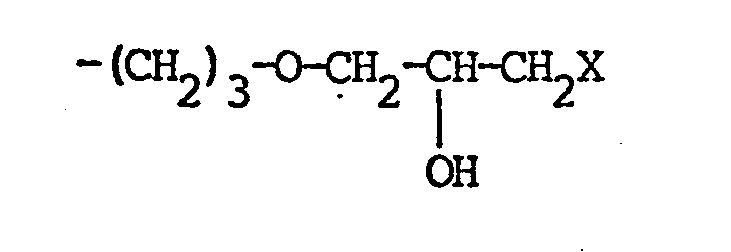
- Diese Aufgabe wird erfindungsgemäß dadurch gelöst, daß man als Stabilisatoren Organopolysiloxane mit im Mittel mindestens einer end- oder seitenständig gebundenen Gruppe Z der Formel


- R ein Alkylrest mit 1 bis 4 Kohlenstoffatomen, ein Wasserstoffrest oder ein Arylrest,
- R2 ein Alkylrest mit 1 bis 4 Kohlenstoffatomen ist,
- Die Gruppe X kann somit z.B. eine -OCH3-, -OC2H5-, -OC4H9-, -OC6H5-oder eine -OH -Gruppe sein. Bevorzugt sind hierbei die Gruppen -OCH3, -OC2H5 und -OH. Die Gruppe X kann ferner eine N(CH3)2-, N(C2H5)2-, N(C3H7)2-, N (C4H9)2-Gruppe sein, wobei die Gruppe N (CH3) 2 bevorzugt ist. Die Gruppe X kann ferner die Gruppe SCH3, SC2H5, SC3H7, SC4H9 oder SH sein. Eine weitere Bedeutung der Gruppe X ist die eines Halogen- oder Pseudohalogenrestes, insbesondere eines Chlor-, Brom-, Cyanid- oder Rhodanidrestes. Besonders bevorzugt ist der Chlor- und Cyanidrest.
- Die Gruppen Z können sowohl end- als auch seitenständig an das Organo- polysiloxan gebunden sein. Das Organopolysiloxan ist vorzugsweise ein lineares Organopolysiloxan, wobei insbesondere lineare Methylpolysiloxane bevorzugt sind.
- Entsprechend einer besonders bevorzugten Ausführungsform des erfindungsgemäßen Verfahrens verwendet man Organopolysiloxane der allgemeinen Formel

- Besonders bevorzugt sind die Organopolysiloxane, bei denen die Gruppen Y, die die Bedeutung von Z haben, seitenständig gebunden sind und a = 2 bis 12, b = 1 bis 5 ist.
- Die Herstellung dieser Verbindungen kann dadurch erfolgen, daß man an das entsprechende Organopolysiloxan, welches end- und/oder seitenständig mindestens eine Glycidoxypropylgruppe aufweist und deren Herstellung z.B. in der US-PS 3 431 143 beschrieben ist, die Verbindung XH an den Oxiranring unter Ringöffnung anlagert, wobei X die bereits angegebene Bedeutung hat. Dabei entstehen je nach Art der Katalyse vorwiegend Verbindungen mit primären oder sekundären Hydroxylgruppen. Bei basischer Katalyse werden vorwiegend sekundäre Hydroxylgruppen, bei saurer Kata- lyse vorwiegend primäre Hydroxylgruppen gebildet. Basische Katalysatoren sind z.B. Alkalialkoholate oder tertiäre Amine. Saure Katalysatoren sind z.B. Lewis-Säuren, wie z.B. BF3 oder Mineralsäuren.
- Alternativ können die gewünschten Verbindungen auch in der Weise hergestellt werden, daß zunächst Allylglycidether mit Verbindungen des Typs HX umgesetzt wird und die gebildeten Allylether der Formel


- Unabhängig nach welchem Verfahren die erfindungsgemäßen Organopolysiloxane hergestellt werden, sind solche Verbindungen, die sekundäre Hydroxylgruppen auf weisen, für das erfindungsgemäße Verfahren bevorzugt.
- Es war für den Fachmann nicht vorherzusehen, daß die beim erfindungsgemäßen Verfahren zu verwendenden Organopolysiloxane die gewünschte Eigenschaftskombination aufweisen. Der Fachmann mußte vielmehr befürchten, daß die beim erfindungsgemäßen Verfahren zu verwendenden Verbindungen aufgrund ihrer primären oder sekundären Hydroxylgruppen in Konkurrenz zu den Polyolen mit den Isocyanaten reagieren und damit ihre stabilisierende Wirkung verlieren würden. Dieses überraschende Verhalten wird auch nicht aus dem Stand der Technik nahegelegt, demzufolge Verbindungen mit tertiären Hydroxylgruppen diese Konkurrenzreaktion ebenfalls nicht zeigen. Verbindungen mit tertiären Hydroxylgruppen sind durch ihre sterische Hinderung und ihre geringe Basizität zur Reaktion mit Isocyanaten nicht oder nur kaum befähigt. Diese Verbindungen des Standes der Technik zeigen aber auch nicht die verbesserten stabilisierenden Eigenschaften der beim erfindungsgemäßen Verfahren zu verwendenden Stabilisatoren.
- Die nach dem erfindungsgemäßen Verfahren zu verwendenden Organopolysiloxane können gegebenenfalls zur weiteren Verbesserung der Zellregulierung und der Offenzelligkeit der hochelastischen Schaumstoffe mit Alkyl- oder Alkyl-/Arylpolysiloxanen von relativ kurzer Kettenlänge kombiniert werden. Bevorzugte Polysiloxane dieses Typs sind solche, die definierte Kettenlängen mit-4 bis 12 Siliciumatomen aufweisen und wie sie z.B. in der DE-PS 25 33 074 beschrieben sind.
- Beim erfindungsgemäßen Verfahren kann man die Reaktionskomponenten bzw. Zusätze verwenden, die für die Herstellung von hochelastischen Polyurethanschäumen bekannt und üblich sind.
- Als mindestens difunktionelle Polyisocyanate sind z.B. die Isomeren des Toluoldiisocyanates, die Isomeren des Diisocyanatodiphenylmethans oder oligomere Polyphenylmethylenisocyanate einsetzbar.
- Die Polyole weisen mindestens 2, insbesondere 2 bis 8, Hydroxylgruppen je Molekül auf, wovon im Mittel mindestens 40 %, vorzugsweise 70 bis 90 %, hiervon primäre Hydroxylgruppen sind. Der auf jede Hydroxylgruppe entfallende Molekulargewichtsanteil (Äquivalentgewicht) beträgt 700 bis 3000. Die Polyole können ausschließlich aus Oxyethylen- und Oxypropyleneinheiten aufgebaut sein. Bis zu 30 Gew.-% anderer polymerer Bestandteile können chemisch in den Polyolen gebunden oder physikalisch in diesen dispergiert sein. Derartige andere polymere Bestandteile sind z.B. Polymerisate des Styrols oder Acrylnitrils oder Copolymerisate hiervon sowie z.B. polymere organische Harnstoffderivate.
- Als Katalysatoren werden die üblichen Katalysatoren, wie z.B. organische Salze von Zinn und tertiäre Amine, eingesetzt.
- Geeignete Treibmittel sind neben Wasser die an sich für diesen Zweck bekannten Fluorchlorkohlenwasserstoffe. Weitere Zusatzmittel sind Flammschutzmittel, wie z.B. Chloralkylphosphorsäureester sowie inerte Füllstoffe und Farbpigmente.
- In den folgenden Beispielen werden die überlegenen Eigenschaften der beim erfindungsgemäßen Verfahren verwendeten Stabilisatoren in üblichen Schaumrezepturen des Standes der Technik gezeigt.
- Die Herstellung der beim erfindungsgemäßen Verfahren zu verwendenden Organopolysiloxane erfolgt nach den im Prinzip bekannten, zuvor be-schriebenen Methoden. Beispielhaft für die bevorzugte Verfahrensweise - Anlagerungen von Umsetzungsprodukten des Allylglycidethers an SiH-Gruppen enthaltende Organopolysiloxane - sind die folgenden Ausfüh- rungsbeispiele.
- In einem Kolben, der mit Tropftrichter, Rührer, Thermometer, Gaseinleitung und Rückflußkühler versehen war, wurden 90 g (20 % Überschuß) Allyl-2-hydroxy-3-methoxypropyl-ether und 3 mg cis-[PtCl2(NH3)2] vorgelegt. Durch die Apparatur wurde Stickstoff geleitet. Bei einer Temperatur von 100 bis 105°C wurden 110 g eines Siloxans mit der durchschnittlichen Formel (CH3)3SiO[(CH3)2SiO]2,8[(CH3)HSiO]2,4Si(CH3)3 in 20 Min. eingetropft. Anschließend ließ man den Versuch noch 2 Std. nachreagieren. Danach wurde der Ansatz bei 80°C mit 1 g Bentonit versetzt, 1 Std. gerührt und anschließend filtriert. Man erhielt eine klare, farblose Flüssigkeit. Der SiH-Umsatz betrug 96,8 % (bestimmt über in alkalischem Medium mit n-Butanol-abspaltbaren Wasserstoff). Das Produkt hatte eine Viskosität bei 20°C von 51 mPas.
- In einer Apparatur wie bei Beispiel 1 wurden 100 g (22 % Überschuß) Allyl-2-hydroxy-3-methoxypropyl-ether und 4 mg cis-[PtCl2 (NH3) 2] unter Stickstoff vorgelegt und auf 110°C erhitzt. Nun wurden 127 g eines Siloxans mit der durchschnittlichen Formel H(CH3)2SiO[(CH3)2SiO]4,3Si(CH3)2H in 25 Min. eingetropft. Man ließ noch 2 1/2 Std. nachreagieren. Nach Abkühlung auf 60°C wurde der Ansatz mit 1,5 g Bentonit versetzt, 1 Std. gerührt und filtriert. Es fiel eine klare, farblose Flüssigkeit an. Die Analyse ergab einen SiH-Umsatz von 97,2 %. Die Viskosität bei 20°C lag bei 32 mPas.
- Entsprechend den Bedingungen von Beispiel 1 wurden weitere Umsetzungen von Siloxanen der Formel (CH3)3SiO[(CH3)2SiO]a[(CH3)HSiO]bSi(CH3)3 mit Verbindungen des Typs CH2=CH-CH2-O-CH2-CH-CH2X in Gegenwart von OH cis-[PtCl2(NH3)2] durchgeführt.


- Die Herstellung und Bewertung der Schaumstoffe unter Anwendung der erfindungsgemäßen Organopolysiloxane erfolgte in Formulierungen für Form-und Blockschäume auf folgende Weise.
- In einem 2 1-Becher wurden die in der Formulierung 1 bzw. Formulierung 2 aufgeführten Komponenten, außer dem Isocyanat, eingewogen und durch einen Propellerrührer 60 Sek. bei 500 U/Min. vermischt. Danach wurden die entsprechenden Isocyanatmengen zugegeben, und das Gemisch wurde für weitere 7 Sek. bei 2000 U/Min. gerührt. Das Reaktionsgemisch wurde dann in eine auf 50°C vorbeheizte und mit einem Trennmittel vorbehandelte Aluminiumform mit den Maßen 40 cm x- 40 cm x 10 cm gegeben. Die Formenstandzeit für beide Formulierungen-betrug 8 Min.
- Zur Bestimmung der Aufdrückkraft wurde das Schaumteil behutsam der Form entnommen. Unmittelbar darauf wurde am nicht angedrückten Schaumteil die Eindruckhärte bei 50 % Stauchung gemessen. Der hierzu verwendete Rundstempel hatte die Fläche von 300 cm . Nach Entlastung wurden die im Schaumteil vorhandenen geschlossenen Zellen durch ausgiebiges Walken vollständig geöffnet. Danach wurde nochmals die Eindruckhärte bei 50 % Stauchung gemessen. Die Differenz der beiden Meßewerte wurde als Maß für die Aufdrückkraft genommen.
- Außerdem wurde die Zahl der Zellen pro cm sowie die Gleichmäßigkeit der Zellstruktur bewertet.
- Versuchsdurchführung:
- Die Versuche wurden auf einer 2-Komponenten-Admiral-Niederdruckmaschine durchgeführt. Der Polyolausstoß betrug 10 kg/Min. Der Schäumprozeß erfolgte in einer oben offenen Box mit den Maßen 100 cm x 60 cm x 60 cm.
- Zur Bewertung des Einflusses von verschiedenen Stabilisatoren bei unterschiedlichen Konzentrationen wurde in den Blockschäumen das Abblasen qualitativ beurteilt; die Aufdrückkraft, die Porosität der Schaumstoffe und ihre Elastizität wurden nach dem Aufdrücken gemessen. Zusätzlich worde auch bei den Blockschäumen die Zahl der Zellen pro cm und die Gleichmäßigkeit der Zellstruktur bewertet. Die Messungen wurden wie folgt durchgeführt.
- Beurteilung des Abblasens:
- Unterschieden wurde zwischen keinem, leichtem und gutem Abblasen. Mit einem guten Abblasen wurde eine gleichmäßig über die gesamte Schaumbreite auftretende Öffnung der Kuppenhaut nach Beendigung der Steigreaktion bezeichnet.
- Messung der Elastizität:
- Zur Anwendung kam der Ball-Rebound-Test nach ASTM D 1564.
- Messung der Porosität:
- Die angegebenen Werte geben den notwendigen Staudruck in mn Wassersäule an, der notwendig ist, um einen gleichbleibenden Luftstrom von 6 1/Min. durch ein 10 cm dickes Schaumstück mit den Seitenlängen 30 cm x 30 cm aufrechtzuerhalten. Niedrigere Meßwerte zeigen demnach eine höhere Offenzelligkeit an.
- Messung der Aufdrückkraft:
- Zur Durchführung dieser Messung wurde in eine oben offene Box mit den Maßen 25 cm x 25 cm x 25 cm geschäumt. Nach einer zweitägigen Lagerung unter normaler Atmosphäre wurde dem Päckchen in einer Höhe von 20 cm die Kuppe abgeschnitten. Gemessen wurde die Eindruckstauchhärte am unberührten sowie am gut durchgewalkten Schaum. Die Differenz der ermittelten Kräfte ist die zum Aufdrücken der Zellen benötigte'Kraft. Zum Messen der Eindruckkräfte wurde ein quadratischer Stempel mit einer Fläche von 100 cm2 verwendet. Die danach bestimmten Aufdrückkräfte sind in Newton (N) angegeben.
- Die Werte für Aufdrückkraft, Porosität und Elastizität stehen in einem engen Zusammenhang und stellen ein Maß für die Offenzelligkeit der Schaumstoffe nach der Herstellung dar. Da die beim Aufdrücken verbleibenden Reste von Zellfenstem den Luftdurchgang behindern, zeigen ursprünglich geschlossene Schaumstoffe auch nach dem Aufdrücken schlechtere Porositäts- und Elastizitätswerte.
- Die Überprüfung der erfindungsgemäß zu verwendenden Organopolysiloxane erfolgte in folgenden Formulierungen für hochelastische Polyurethanformschäume.
- Formulierung 1:

- Desmophen® 3119 ist ein polymere Harnstoffsegmente enthaltendes Polyol der Firma Bayer mit 70 bis 80 % primären OH-Gruppen und einem mittleren Molekulargewicht von 6000.
- Die Formschäume nach dieser Formulierung haben ein Raumgewicht von ungefähr 34 kg/m 3 .
- Formulierung 2:

- Niax Polyol 34 - 28 ist ein polymere Acrylnitril/Styrol-Anteile enthaltendes Polyol der Firma Union Carbide mit überwiegend primären OH-Gruppen und einer OH-Zahl von 28.
- Die nach dieser Formulierung entstehenden Formschäume haben ein Raumgewicht von ungefähr 35 kg/m3.
- Als Stabilisatoren wurden folgende Gemische eingesetzt:
- A) 10 Gew.-% Organopolysiloxan, gelöst in 90 Gew.-% eines Polyetehrs vom Molekulargewicht 1000 und einem Gewichtsverhältnis Ethylenoxid/Propylenoxid wie 42 : 58.
- B) 10 Gew.-% Organopolysiloxan, gelöst in 85 Gew.-% des gleichen Polyethers wie bei A) und 5 Gew.% einer Polydimethylsiloxanfraktion der Kettenlänge N = 5 bis 9
- C) 10 Gew.-% Organopolysiloxan, gelöst in 86 Gew.-% des gleichen Poly- ethers wie bei A) und 4 Gew.-% einer Polydimethylsiloxanfraktion der Kettenlänge N = 8 bis 13.
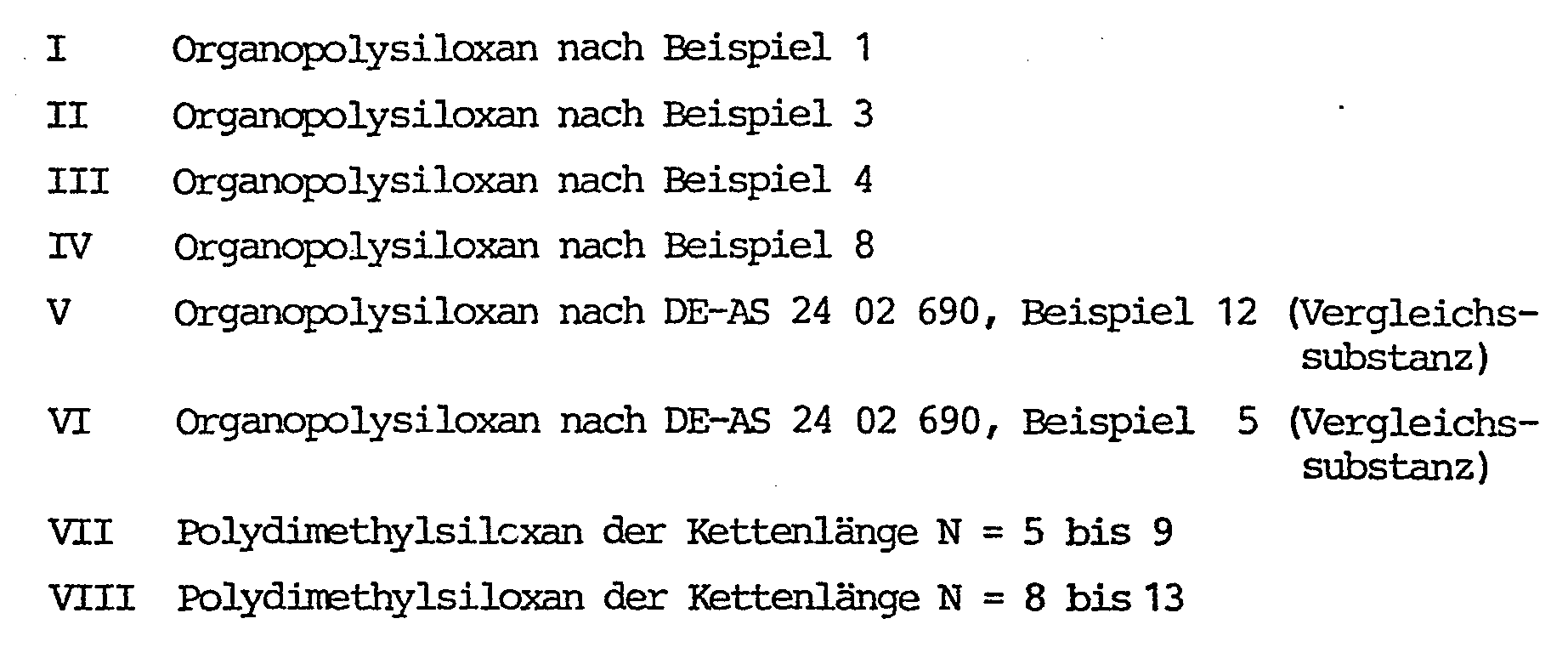
- Als Organopolysiloxane wurden folgende Produkte eingesetzt:
- In der Schawnformulierung 1 wurden folgende Ergebnisse erhalten:
-

-

-


-

-

- Weiterhin wurden die erfindungsgemäß zu verwendenden Organopolysiloxane in folgenden Formulierungen für hochelastische Polyurethanblockschäume untersucht. Dabei wurden folgende Formulierungen angewandt:
-

-

- Die Überprüfung der erfindungsgemäß zu verwendenden Organopolysiloxane in diesen Formulierungen erfolgte unter Anwendung des Stabilisatorgemisches C.
-

-


Claims (5)


Applications Claiming Priority (2)
| Application Number | Priority Date | Filing Date | Title |
|---|---|---|---|
| DE3215317A DE3215317C1 (de) | 1982-04-23 | 1982-04-23 | Verfahren zur Herstellung hochelastischer kalthaertender Polyurethanschaumstoffe |
| DE3215317 | 1982-04-23 |
Publications (2)
| Publication Number | Publication Date |
|---|---|
| EP0092700A1 true EP0092700A1 (de) | 1983-11-02 |
| EP0092700B1 EP0092700B1 (de) | 1986-07-16 |
Family
ID=6161830
Family Applications (1)
| Application Number | Title | Priority Date | Filing Date |
|---|---|---|---|
| EP83103339A Expired EP0092700B1 (de) | 1982-04-23 | 1983-04-06 | Verfahren zur Herstellung hochelastischer kalthärtender Polyurethanschaumstoffe |
Country Status (2)
| Country | Link |
|---|---|
| EP (1) | EP0092700B1 (de) |
| DE (2) | DE3215317C1 (de) |
Cited By (5)
| Publication number | Priority date | Publication date | Assignee | Title |
|---|---|---|---|---|
| EP0122743A3 (en) * | 1983-04-13 | 1986-03-26 | Ici Americas Inc | Process for making polyurethane and related products by reaction injection molding in presence of siloxane mold release agent and compositions therefor |
| WO1991007458A1 (en) * | 1989-11-14 | 1991-05-30 | Union Carbide Chemicals And Plastics Company Inc. | Process for making flexible polyurethane foam |
| EP0679668A1 (de) * | 1994-04-28 | 1995-11-02 | Th. Goldschmidt AG | Verfahren zur Herstellung von Polyurethankaltschäumen |
| WO2000056805A1 (en) * | 1999-03-24 | 2000-09-28 | Ck Witco Corporation | Polyurethane foam stabilizers |
| US7838566B2 (en) | 2005-10-21 | 2010-11-23 | Evonik Goldschmidt Gmbh | Process for the preparation of polyurethane cold cure foams |
Families Citing this family (3)
| Publication number | Priority date | Publication date | Assignee | Title |
|---|---|---|---|---|
| DE4444898C1 (de) * | 1994-12-16 | 1996-10-10 | Goldschmidt Ag Th | Verfahren zur Herstellung von Polyurethankaltschäumen |
| MX2021008058A (es) | 2019-01-07 | 2021-08-05 | Evonik Operations Gmbh | Produccion de espuma rigida de poliuretano. |
| PL3677610T5 (pl) | 2019-01-07 | 2026-04-13 | Evonik Operations Gmbh | Wytwarzanie sztywnej pianki poliuretanowej |
Citations (4)
| Publication number | Priority date | Publication date | Assignee | Title |
|---|---|---|---|---|
| US3966650A (en) * | 1973-02-22 | 1976-06-29 | Union Carbide Corporation | Polyether urethane foam |
| US4014825A (en) * | 1975-12-29 | 1977-03-29 | Union Carbide Corporation | Tertiary alcohol-bearing organosilicone polymers |
| US4031044A (en) * | 1974-04-15 | 1977-06-21 | Dow Corning Corporation | Polyether based, high resilient polyurethane foam |
| EP0035080A1 (de) * | 1979-12-10 | 1981-09-09 | BAUSCH & LOMB INCORPORATED | Biomedizinische Formkörper aus Polysiloxanpolymere |
-
1982
- 1982-04-23 DE DE3215317A patent/DE3215317C1/de not_active Expired
-
1983
- 1983-04-06 EP EP83103339A patent/EP0092700B1/de not_active Expired
- 1983-04-06 DE DE8383103339T patent/DE3364491D1/de not_active Expired
Patent Citations (4)
| Publication number | Priority date | Publication date | Assignee | Title |
|---|---|---|---|---|
| US3966650A (en) * | 1973-02-22 | 1976-06-29 | Union Carbide Corporation | Polyether urethane foam |
| US4031044A (en) * | 1974-04-15 | 1977-06-21 | Dow Corning Corporation | Polyether based, high resilient polyurethane foam |
| US4014825A (en) * | 1975-12-29 | 1977-03-29 | Union Carbide Corporation | Tertiary alcohol-bearing organosilicone polymers |
| EP0035080A1 (de) * | 1979-12-10 | 1981-09-09 | BAUSCH & LOMB INCORPORATED | Biomedizinische Formkörper aus Polysiloxanpolymere |
Cited By (6)
| Publication number | Priority date | Publication date | Assignee | Title |
|---|---|---|---|---|
| EP0122743A3 (en) * | 1983-04-13 | 1986-03-26 | Ici Americas Inc | Process for making polyurethane and related products by reaction injection molding in presence of siloxane mold release agent and compositions therefor |
| WO1991007458A1 (en) * | 1989-11-14 | 1991-05-30 | Union Carbide Chemicals And Plastics Company Inc. | Process for making flexible polyurethane foam |
| US5070112A (en) * | 1989-11-14 | 1991-12-03 | Union Carbide Chemicals And Plastics Technology Corporation | Process for making flexible polyurethane foam |
| EP0679668A1 (de) * | 1994-04-28 | 1995-11-02 | Th. Goldschmidt AG | Verfahren zur Herstellung von Polyurethankaltschäumen |
| WO2000056805A1 (en) * | 1999-03-24 | 2000-09-28 | Ck Witco Corporation | Polyurethane foam stabilizers |
| US7838566B2 (en) | 2005-10-21 | 2010-11-23 | Evonik Goldschmidt Gmbh | Process for the preparation of polyurethane cold cure foams |
Also Published As
| Publication number | Publication date |
|---|---|
| DE3215317C1 (de) | 1983-06-09 |
| DE3364491D1 (en) | 1986-08-21 |
| EP0092700B1 (de) | 1986-07-16 |
Similar Documents
| Publication | Publication Date | Title |
|---|---|---|
| EP0106101B1 (de) | Verfahren zur Herstellung hochelastischer kalthärtender Polyurethanschaumstoffe | |
| EP1777252B1 (de) | Verfahren zur Herstellung von Polyurethan-Kaltschäumen | |
| DE102006061351A1 (de) | Verfahren zur Herstellung von SiOC-verknüpften, linearen Polydimethylsiloxan-Polyoxyalkylen-Blockcopolymeren und ihre Verwendung | |
| DE19831285A1 (de) | Prepolymerabmischung mit Silan-terminierten Prepolymeren | |
| DE1544634A1 (de) | Verfahren zur Herstellung von flexiblem Polyurethanschaum | |
| DE2624046A1 (de) | Verfahren zur herstellung von zellfoermigen urethanpolymerisaten | |
| DE2541865A1 (de) | Polysiloxan-polyoxyalkylen-blockmischpolymere, verfahren zu deren herstellung sowie verwendung | |
| DE2533074B2 (de) | Verfahren zur Herstellung von hochelastischen Polyurethanweichschäumen | |
| DE1260150B (de) | Verfahren zur Herstellung von Organopolysiloxan-Polyaetherurethan-Mischpolymerisaten | |
| EP0585771A2 (de) | Polysiloxan-Polyoxyalkylen-Blockmischpolymerisat mit unterschiedlichen Polyoxyalkylenblöcken im durchschnittlichen Molekül | |
| CH653350A5 (de) | Verfahren zur herstellung eines polyurethans sowie polymer-modifizierter polyole. | |
| DE102005039931A1 (de) | Verfahren zur Herstellung von SiOC-verknüpften, linearen Polydimethylsiloxan-Polyoxyalkylen-Blockcopolymeren | |
| DE2063522A1 (de) | Verfahren zur Herstellung von flexib len offenzelligen Polyatherpolyurethan Schaumstoffen | |
| EP0415208B1 (de) | Verwendung von Polysiloxan-Polyoxyalkylen-Blockmischpolymerisaten bei der Herstellung von Polyurethanhartschäumen | |
| DE4444898C1 (de) | Verfahren zur Herstellung von Polyurethankaltschäumen | |
| DE3787306T2 (de) | Oberflächenaktives Mittel auf der Basis von Polysiloxanen und dessen Verwendung bei der Herstellung von Polyurethanschaum. | |
| EP0092700B1 (de) | Verfahren zur Herstellung hochelastischer kalthärtender Polyurethanschaumstoffe | |
| DE1213988B (de) | Verfahren zur gegebenenfalls einstufigen Herstellung von Polyurethanschaumstoffen | |
| EP0258600B1 (de) | Verfahren zur Herstellung hochelastischer, kalthärtender Polyurethanschaumstoffe | |
| DE1240273B (de) | Verfahren zur Herstellung von Polyurethan-schaumstoffen | |
| DE1669611A1 (de) | Zellulare Polyurethane und Verfahren zu ihrer Herstellung | |
| DE1162070B (de) | Verfahren zur Herstellung von Polyurethanschaumstoffen | |
| DE2657413A1 (de) | Verfahren zur herstellung eines polyurethanschaumstoffs mit hoher elastizitaet | |
| DE1113810B (de) | Verfahren zur Herstellung von Urethangruppen enthaltenden Schaumstoffen | |
| DE4414803C1 (de) | Verfahren zur Herstellung von Polyurethankaltschäumen |
Legal Events
| Date | Code | Title | Description |
|---|---|---|---|
| PUAI | Public reference made under article 153(3) epc to a published international application that has entered the european phase |
Free format text: ORIGINAL CODE: 0009012 |
|
| 17P | Request for examination filed |
Effective date: 19830411 |
|
| AK | Designated contracting states |
Designated state(s): BE DE FR GB IT NL |
|
| ITF | It: translation for a ep patent filed | ||
| GRAA | (expected) grant |
Free format text: ORIGINAL CODE: 0009210 |
|
| AK | Designated contracting states |
Kind code of ref document: B1 Designated state(s): BE DE FR GB IT NL |
|
| REF | Corresponds to: |
Ref document number: 3364491 Country of ref document: DE Date of ref document: 19860821 |
|
| ET | Fr: translation filed | ||
| PLBE | No opposition filed within time limit |
Free format text: ORIGINAL CODE: 0009261 |
|
| STAA | Information on the status of an ep patent application or granted ep patent |
Free format text: STATUS: NO OPPOSITION FILED WITHIN TIME LIMIT |
|
| 26N | No opposition filed | ||
| ITTA | It: last paid annual fee | ||
| PGFP | Annual fee paid to national office [announced via postgrant information from national office to epo] |
Ref country code: GB Payment date: 19940329 Year of fee payment: 12 |
|
| PGFP | Annual fee paid to national office [announced via postgrant information from national office to epo] |
Ref country code: FR Payment date: 19940411 Year of fee payment: 12 |
|
| PGFP | Annual fee paid to national office [announced via postgrant information from national office to epo] |
Ref country code: NL Payment date: 19940430 Year of fee payment: 12 |
|
| PGFP | Annual fee paid to national office [announced via postgrant information from national office to epo] |
Ref country code: BE Payment date: 19940607 Year of fee payment: 12 |
|
| PG25 | Lapsed in a contracting state [announced via postgrant information from national office to epo] |
Ref country code: GB Effective date: 19950406 |
|
| PGFP | Annual fee paid to national office [announced via postgrant information from national office to epo] |
Ref country code: DE Payment date: 19950410 Year of fee payment: 13 |
|
| PG25 | Lapsed in a contracting state [announced via postgrant information from national office to epo] |
Ref country code: BE Effective date: 19950430 |
|
| BERE | Be: lapsed |
Owner name: TH. GOLDSCHMIDT A.G. Effective date: 19950430 |
|
| PG25 | Lapsed in a contracting state [announced via postgrant information from national office to epo] |
Ref country code: NL Effective date: 19951101 |
|
| GBPC | Gb: european patent ceased through non-payment of renewal fee |
Effective date: 19950406 |
|
| PG25 | Lapsed in a contracting state [announced via postgrant information from national office to epo] |
Ref country code: FR Effective date: 19951229 |
|
| NLV4 | Nl: lapsed or anulled due to non-payment of the annual fee |
Effective date: 19951101 |
|
| REG | Reference to a national code |
Ref country code: FR Ref legal event code: ST |
|
| PG25 | Lapsed in a contracting state [announced via postgrant information from national office to epo] |
Ref country code: DE Effective date: 19970101 |