EP0093326A2 - Boyau de saucisses plissé et procédé de sa fabrication - Google Patents
Boyau de saucisses plissé et procédé de sa fabrication Download PDFInfo
- Publication number
- EP0093326A2 EP0093326A2 EP83103851A EP83103851A EP0093326A2 EP 0093326 A2 EP0093326 A2 EP 0093326A2 EP 83103851 A EP83103851 A EP 83103851A EP 83103851 A EP83103851 A EP 83103851A EP 0093326 A2 EP0093326 A2 EP 0093326A2
- Authority
- EP
- European Patent Office
- Prior art keywords
- casing
- twisted
- adhesive
- sausage
- speed
- Prior art date
- Legal status (The legal status is an assumption and is not a legal conclusion. Google has not performed a legal analysis and makes no representation as to the accuracy of the status listed.)
- Granted
Links
Images



Classifications
-
- A—HUMAN NECESSITIES
- A22—BUTCHERING; MEAT TREATMENT; PROCESSING POULTRY OR FISH
- A22C—PROCESSING MEAT, POULTRY, OR FISH
- A22C13/00—Sausage casings
- A22C13/02—Shirring of sausage casings
-
- A—HUMAN NECESSITIES
- A22—BUTCHERING; MEAT TREATMENT; PROCESSING POULTRY OR FISH
- A22C—PROCESSING MEAT, POULTRY, OR FISH
- A22C13/00—Sausage casings
-
- A—HUMAN NECESSITIES
- A22—BUTCHERING; MEAT TREATMENT; PROCESSING POULTRY OR FISH
- A22C—PROCESSING MEAT, POULTRY, OR FISH
- A22C13/00—Sausage casings
- A22C2013/0066—Sausage casings casings according to the presence or absence of seams
- A22C2013/0069—Sausage casings casings according to the presence or absence of seams seamed casings, casings with at least one longitudinal seam
-
- Y—GENERAL TAGGING OF NEW TECHNOLOGICAL DEVELOPMENTS; GENERAL TAGGING OF CROSS-SECTIONAL TECHNOLOGIES SPANNING OVER SEVERAL SECTIONS OF THE IPC; TECHNICAL SUBJECTS COVERED BY FORMER USPC CROSS-REFERENCE ART COLLECTIONS [XRACs] AND DIGESTS
- Y10—TECHNICAL SUBJECTS COVERED BY FORMER USPC
- Y10T—TECHNICAL SUBJECTS COVERED BY FORMER US CLASSIFICATION
- Y10T428/00—Stock material or miscellaneous articles
- Y10T428/13—Hollow or container type article [e.g., tube, vase, etc.]
- Y10T428/1324—Flexible food casing [e.g., sausage type, etc.]
Definitions
- the invention relates to a gathered sausage casing of the type mentioned in the preamble of claim 1 and to a method for its production.
- a shirred sausage casing of this type is known from EP-A-0 037 543.
- US Pat can twist.
- the seam zone is to be arranged spirally around the longitudinal axis of the shirred tubular envelope.
- the number of spiral turns in the seam zone per 10 m of sleeve length is far less than 10 and is therefore unsatisfactory for a high gathering ratio.
- no reproducible slope of the coiled N ahtzone can be achieved in this way, moreover, the hollow channel of the bead does not exhibit a circular cross-section because the relatively thick seam zone is at least partially displaced into the hollow channel during shirring.
- the object of the present invention is to provide a gathered sausage casing of the type described there, which has a considerably higher compression of the seam zone and nevertheless a uniform cross section with a circular cross section , straight inner cavity with a relatively smooth inner wall, which allows a problem-free application of the gathered sausage casing to the filling pipe of a filling device, even with filling pipes with a relatively large diameter, which enable a quick and therefore economical filling of sausage mass into the gathered sausage casing.
- Another object of the invention is to provide a method for producing such a gathered sausage casing.
- This gathered sausage casing has the advantage that, despite its relatively thick adhesive seam, it exhibits a relatively high compression and at the same time has a substantially uniform outer circumference and a uniform circular inner circumference.
- the hollow channel of the caterpillar is straight and shows an essentially smooth inner wall, despite the thickening of the casing in the area of the adhesive seam.
- the process is particularly simple to carry out without any changes in the apparatus being required in the gathering device.
- the relatively thick-walled seam zone can be shifted to the outside of the shirred tubular casing, so that the shirred casing can be easily pushed onto filling pipes with a relatively large diameter and runs smoothly from the filling pipe during unloading.
- a sheet-like or web-shaped one bent around its longitudinal axis becomes right angular film cut or a correspondingly curved, for example endless film web, preferably made of cellulose, optionally with an anchoring agent for the adhesive on its surface, by overlapping and gluing the longitudinally axially extending edge regions with an adhesive-containing solution or dispersion into a tubular casing with a longitudinally axially extending connecting seam .
- endless film web preferably made of cellulose
- an anchoring agent for the adhesive on its surface
- edge zones it is also possible to connect the edge zones to one another in such a way that the edges are brought flush, ie with the edges at least substantially abutting each other, and then with a tape, film or film strip, hereinafter referred to as a film strip, both of which Border zones covered, connected.
- the film strip is then located on the outside or inside of the tubular casing, or film strips running parallel to one another are used, one of which is then located on the inside and one on the outside of the tubular casing.
- One or more film strips can also be used if the edge zones overlap.
- the adhesive layer is applied in the form of a solution or dispersion to the edge zones of the web and / or optionally to the surfaces of the web immediately before the connection seam is produced Film strip applied, for example with a nozzle or an application roller.
- the film strip expediently has a width of 5 to 15% of the circumference of the tube and preferably consists of the same material as the tube cover, in particular of smoke-permeable, optionally fiber-reinforced cellulose, the strength values of which lie in the longitudinal and transverse directions in the same range as in the film web.
- a film strip made of paper or plastic, a film composite, a nonwoven, a foam film or a microporous film or membrane it is also possible to use a film strip made of paper or plastic, a film composite, a nonwoven, a foam film or a microporous film or membrane. Bands made of fabric, network or mesh are also suitable as film strips for connecting the edge zones.
- compact film strips in particular made of smoke-permeable material, in particular the above-mentioned film strip made of cellulose, optionally with fiber reinforcement.
- the film strip can also be used as a tear tape for the hose filled with filling material, in particular for sausage casings which are to be removed from the contents without great effort.
- the web is formed into a tube, for example, either over a sufficiently long distance or by deflection using a shoulder-like molding tool, as described in EP-A-0 037 543.
- the base material for the production of the tubular casing is preferably cellulose webs, i.e. made of cellophane, regenerated cellulose or cellulose hydrate, which are optionally reinforced with a fiber insert, as is customary for packaging food, in particular as a sausage casing material.
- cellulose webs made by the viscose process (U.S. Patent 3,884,270), by denitration of cellulose nitrate or hydrolysis of other cellulose esters, e.g. Deacetylation of cellulose acetate with aqueous or alcoholic alkali solution (US Pat. No. 3,546,209) were used.
- cellulose webs are used.
- the production of the optionally fiber-reinforced cellulose web and the production of a coating of anchoring agent is carried out in particular by the process described in EP-A-0 037 543.
- Anchoring agents or adhesion promoters in relation to adhesives are known to mean substances or mixtures of substances which are applied to one or both adhesive surfaces before the adhesive is applied in order to improve the adhesion between the adhesive and adhesive surfaces.
- the adhesion promoter is intended to wet-anchor the adhesive layer on the web and / or film strip.
- the anchoring means is located between the adhesive layer and the web surface or between the adhesive layer and the Surface of the film strip and is preferably a water-insoluble hardened cationic resin. Polyurethane resins, nitrocellulose and other compounds known as water-insoluble anchoring agents can also be used. These adhesion-promoting resins and their application to the film web are described in detail in EP-A-0 037 543.
- the web can have a conventional means of improving the peelability of the tubular casing on the surface which later forms the inside of the tubular casing.
- the web or the film strip can be printed with labels or decorative patterns before gluing, whereby in addition to the printing method customary in the production of seamless sausage casings, there are further printing options, since in the present case it is not the tube but the flat web that is printed before the tube is formed can be.
- the adhesive particularly preferred according to the invention is a cationic resin initially in water-soluble form in a solution or dispersion, suitably in a wet film thickness in the range of about 5 to 20 / um to the directly joined together edge zones of the cellulosic web prior to or during the tube forming is applied. If a film strip is used to connect the edge zones of the cellulose web, the solution or dispersion is applied to the film strip and / or applied to the edge zones of the cellulose web. The adhesive is applied to the film strips on both sides if the film strip is arranged in the overlap between the edge zones of the cellulose web.
- an organic solvent or dispersion medium or a mixture is used for the adhesive; the adhesive is preferably applied in 5 to 20% by weight, in particular 10 to 15% by weight, aqueous solution.
- aqueous solution for the sake of simplicity, only the expression "adhesive solution” is used in the following.
- Examples of the cationic resin forming the adhesive which is still curable in solution and changes to its water-insoluble, hardened form during storage at room temperature, optionally with the aid of a catalyst, include urea-formaldehyde, melamine-formaldehyde and Phenol-formaldehyde resins.
- the resins are hardened in the alkaline range, e.g. B. by adding concentrated ammonia solution, and at room temperature.
- Further cationic resins suitable as adhesives are described in US Pat. No. 3,378,379.
- Particularly preferred adhesives are condensation products of aliphatic polyamines or of polyamides, in particular of polyamide polyamine with bifunctional halohydrins or their derivatives, such as, for example, epichlorohydrin, as described, for example, in US Pat 2,926,154 and 2,573,956 or in British Patents 865,727 and 908,205.
- a particularly suitable resin is the reaction product of aliphatic 2,6-polyamide, diethylene triamine and epichlorohydrin.
- the total width of the application of the adhesive solution depends on the desired strength values and circumference of the tubular casing as well as on the wet layer thickness of the applied adhesive solution. Usually the total width of the adhesive application will be between about 1 to 15 mm, in particular 2 to 3 mm, and is only a few percent of the later circumference of the tubular casing. When using a film strip for the overlapping connection of a butt joint formed from the edge zones, a correspondingly twice as wide application of the adhesive solution is required.
- the surface of the cellulose web to be provided with the adhesive solution is in the dried or in the moistened state and may already have the above-described layer of an anchoring agent.
- the connecting seam is produced by overlapping the edge zones of the cellulose web or by overlapping the film strip with the edge zones of the cellulose web.
- the solvent or dispersion medium can be removed by careful heating with hot air or infrared radiators; however, heating is expediently not used, since it can lead to embrittlement of the cellulose material.
- the solvent or dispersion medium is preferably removed and the cationic resin is also cured during the subsequent storage at room temperature over a period of about 1 to 3 days.
- the overlapping edge zones of the cellulose web connect to one another or the film strip connects to the edge zones.
- a layer thickness for the adhesive corresponding to a basis weight in the range from 0.5 to 10 g / m 2 is generally sufficient.
- the usual thickness of the adhesive layer corresponds to a weight per unit area of approximately 1 to 3 g / m 2 with a total width of the adhesive layer of approximately 1 to 15 mm.
- the tubular casing has a moisture content of 4 to 15, in particular 7 to 10% by weight.
- the adhesive layer and / or the anchoring agent layer can also contain further additives, for example agents to protect this layer or the tubular casing from attack by microorganisms, wetting agents, Plasticizers, fillers such as kaolin, glass balls, chalk, quartz powder, microdolomite, heavy spar, fine-grained sand, zinc oxide and pigments as well as organic and inorganic dyes, e.g. in powder or flake form, which make the twist of the casing during winding and in the finished bead optically recognizable.
- the color coding of the coiled adhesive layer makes it easy to check whether the sausage casing has been completely peeled off when the sausage casing is used as a peeling casing.
- the tensile strength of splices is the preferred anchoring means and K gingerbread material with the same values or even above the values for the tensile strength of the cellulosic material. If an adhesive analogous to EP-A-0 037 543 is used, it is not necessary to store the casing before gathering.
- the casing is twisted in a helical shape before gathering. This is preferably done by twisting the casing and winding it in a twisted state onto a roll, from which the twisted casing is then fed to the gathering device. It is particularly advantageous if the casing is twisted as soon as it is produced and rolled up immediately after its seam has been formed. In the latter case, the adhesive seam formed by the adhesive bonding of the edge zones of the endless web is twisted immediately after the tubular casing is formed, the twisted casing is laid flat and wound up.
- a suitable device consists, for example, of a first pair of pull rollers, which pulls the glued hose off the gluing station, and a second pair of pull rollers, which rotates about the longitudinal axis of the sleeve and thereby twists the sleeve in the outlet from this second pair of pull rollers. Between the two Z ugwalzen- pairs, the tube is held with a supporting gas in the inflated state.
- the casing In the gap formed by the second pair of pull rollers, the casing is laid flat at the same time.
- elements can be attached in front of the second pair of draw rollers when the sleeve enters this gap, which elements increasingly flatten the sleeve and gradually bring it to the flat state.
- Suitable elements are, for example, baffles, roller conveyors, conveyor belts or guide rolls which converge to one another, as are customary, for example, in the production of extruded plastic hoses.
- All parts of the device for twisting, laying flat and winding up rotate at the same speed around the longitudinal axis of the casing. These parts are therefore expediently housed on a common rotating frame and can also be part of the tube molding system.
- the degree of twisting of the hose and the adhesive seam is determined by the rotational speed of these device parts or the frame and by the hose speed.
- the casing receives 10 turns per 10 m casing length and at one speed the casing of 200 m / min and a speed of 200 revolutions / min, the number of turns per 10 m casing length is also 10.
- 10 turns / 10 m casing length is the Spiral distance 1 cm (2 cm) on the caterpillar.
- the mutual adjustment of the casing speed and the speed is determined by the quotient of the speed (revolutions / min) and the casing speed (m / min), which is preferably greater than 1 (revolutions / m) and usually not more than 4 (revolutions / m) increases. With these values, optimal beads can be produced from casings with an adhesive seam.
- any other desired slopes of the seam or any other number of turns of the shell can be achieved per unit length.
- a periodically changing slope of the seam zone on the tube and thus also in the bead can be generated by a periodic change in the speed of the winding roll. This is done, for example, in such a way that the relatively thick seam zone of the casing has a different slope at the beginning and end of the bead than in the middle of the bead.
- the differently gathered piece of sausage casing which results from the differently rapid rotation of the sausage casing during winding, results in a recognizable marking of a desired predetermined length of the gathered sausage casing and allows the shirred length to be cut off at the marked point during the gathering process.
- the shirring is gathered regularly. After reaching a predetermined length during gathering, the sausage casing receives a marking in the form of a different slope of the coiled seam zone due to the different speed. This marking is used, for example, to identify the severing point at which a predetermined length of gathered sausage casing is severed.
- the shirring mandrel is a hollow tube that holds the hose supports and gives the tubular caterpillar formed during gathering a certain inner diameter.
- the tube is slightly inflated through the tube during gathering in order to give it the plump shape required for the attack of the gathering forces.
- the means for gathering the hose are the usual toothed wheels or drivers attached to circulating chains.
- the Rafforgan is preferably an internally helically toothed rotating sleeve which exerts an axially compressing force on the hose material. It is also possible to apply the shirring force with an air jet.
- the sausage casing receives an additional rotational movement around the shirring pin, whereby the shirring pleats are rotated into a helical pattern in addition to the previous twisting.
- this alternative is not preferred, since in this way a substantial reduction in the helix spacing is not achieved and there is also a great risk that the sleeve will be damaged by the attacking deformation forces. Further, the slope of the coiled N then ahtzone not exactly reproducible.
- the sausage casing z. B. is provided for sensitive sausage mass or has a high water content
- the web, the tubular casing or the gathered sausage casing is sterilized, using conventional methods such.
- B. Heat or ozone treatment or high frequency radiation, applies, or with a chemical agent offset, which shows germicidal effect, especially against fungal attack.
- Viscose is pressed through a gap into an acidic coagulation bath.
- the cellulose hydrate gel sheet obtained after the regeneration is passed through a trough which is filled with a 0.3% by weight aqueous solution of a water-soluble cationic resin.
- the resin is a reaction product of ethylenediamine, adipic acid, diethylene triamine and epichlorohydrin and is commercially available as a 12 and 20% strength by weight aqueous solution under the name R R esamin EW 601 (manufacturer Cassella).
- the cellulose hydrate gel web is then passed through a plasticizer bath consisting of a 9% by weight aqueous glycerol solution.
- the obtained sheet is made of regenerated cellulose has a basis weight of 50 g / m 2, a water content of about 8 G e w .-% and a glycerin content of about 20 wt .-%.
- the water content may be adjusted by rewetting. Both of their surfaces contain 20 mg / m 2 of the resin hardened by the heating.
- Ellulosebahn the water vapor permeability of C obtained is about 700 g / m 2.
- 24 h (DIN 53 122, determined gravimetrically), the swelling value after 24 h at Room temperature about 160%.
- the swelling value is the amount of water, in percent by weight, based on the cellulose web that can be taken up by the web material.
- the swelling value is determined according to a regulation which is described in "Dyeing and Textile-Technical Investigations" (page 400), H. Agster, Springer-Verlag, Berlin 1956.
- the web material also shows a tensile strength of 48 to 53 N / mm 2 in the transverse direction.
- Each band-shaped blank is made with a device, as shown in FIG. 8 of EP-A-0 037 543, along one of its two edges with a 12% by weight aqueous solution (pH 7.5, adjusted with concentrated ammonia solution) of the above-mentioned water-soluble cationic resin coated in strips in the longitudinal direction of the tape and, as also shown there, crimped into a tube.
- aqueous solution pH 7.5, adjusted with concentrated ammonia solution
- the solution is transferred by means of a rotating, about 2 mm wide applicator roll from a storage trough for the current film strip, where it holds at a wet film thickness 10 to 12 / um, a width of 2 to 3 mm a.
- the band coated near the edge is shaped with the aid of externally and internally engaging shaping aids to form a tube with a diameter of 17 mm in such a way that the edge coated with the solution and the uncoated edge overlap by approximately 5 mm.
- the respective regions close to the edges form an overlapping adhesive seam running in the longitudinal direction (cf. FIG. 1 of the EP-A-0 037 543), resulting in an adhesive layer corresponding to a basis weight of 1 to 2 g / m 2 .
- the tube formed is laid flat about 1 to 2 seconds after the overlap seam has been formed, inflated between two pairs of pull rollers, twisted and laid flat by the second pair of pull rollers, and then rolled up.
- the speed of the hose travel is 50 m / min, the speed is 60 revolutions / min.
- the joint After approx. 3 days of storage at room temperature, the joint has a hot water resistance of several hours if test specimens cut 15 mm wide and 50 mm long are suspended in 80 ° C hot water and loaded with 300 g at the lower end.
- Tubular casings conditioned in a standard climate show a tensile strength in the transverse direction of 50 N / mm 2 and a burst pressure of more than 1 bar; Hoses placed in water (40 ° C) for 30 min have a burst pressure of 0.35 to 0.45 bar. These values are sufficient for small-caliber sausage casings.
- tubular casings thus produced and wound in a twisted manner are unwound from the roll and gathered in a ratio of 1:50 using the device known from US Pat. No. 4,185,358.
- the caterpillar obtained shows a spirally displaced seam with a helix spacing of 1.7 cm.
- the helix distance (cm) results from the relationship hose speed during winding (m / min) x100 speed (revolutions / min) x gathering density
- the gathering density is the quotient of hose length / caterpillar length and is at the usual values, i.e. between 20 and 120.
- the caterpillar's hollow channel is straight and has a smooth inner wall.
- the caterpillar can be pushed onto the filling tube of a stuffing device without any problems and is evenly filled when the sausage mass is pressed in.
- a typical sausage mass is used for this, e.g. B. Viennese or Frankfurt style.
- the sausages obtained are smoked under known conditions and brewed at 70 to 85 ° C.
- Boiled sausages are obtained which have a uniform, typical red-brown smoked color; the adhesive seam withstands the forces that occur during processing.
- tubular casing can be removed from the sausage; Caseless sausages remain in well-developed skin.
- Example 1 is repeated, but a 12% strength by weight aqueous solution (pH 9) of a cationic polyamide resin from Hercules with the R name Kymene 557 H is used as the adhesive for the adhesive seam.
- the solution is obtained from a pressurized storage vessel is conveyed through a thin hose to a coating nozzle, the opening of which has a diameter of approximately 0.4 mm and which is positioned in the area of the molding head in such a way that the adhesive solution is released directly into the overlap area of the cellulose tape placed on the hose.
- a suitable pressure By selecting a suitable pressure, an approximately 2 to 3 mm wide track of the adhesive solution in the overlap area can be continuously produced, with which the edge areas of the tape are connected in an overlapping manner.
- the tube obtained is immediately laid flat, twisted and rolled up in the twisted state.
- the hose is moved at a speed of 70 m / min, the twisting is carried out at a speed of 15) revolutions / min.
- Viscose is pressed through a gap into an acidic coagulation bath and the sheet of cellulose hydrate gel obtained after regeneration and washing is passed through a plasticizer bath which consists of a 9% by weight aqueous glycerol solution. After drying at 85-90 ° C., the sheet of regenerated cellulose shows a basis weight of 40 g / m 2 , a water content of approx. 8% by weight and a glycerol content of approx. 20% by weight.
- the swelling value is about 153%
- the tensile strength of the web material is 96 N / mm2 in the longitudinal direction and 68 N / mm2 in the transverse direction.
- the cellulose web is cut into 58 mm wide strips. Each sheet-like blank is coated along one of its two edges with an adhesive solution adjusted to pH 7.5 by means of concentrated aqueous ammonia solution.
- the adhesive solution consists of 94 parts by weight of a 12% strength aqueous solution of the water-soluble cationic resin from Example 1, 5 parts by weight of glycerol and 1 part by weight of a red pigmented color dough ( R Novofil BB 02, manufacturer Hoechst). As described in Example 2, it is conveyed by pressure through a coating nozzle into the overlap area of the cellulose tape formed into a tube and connects the areas of the tape near the edges together.
- the flat, glued, 17 mm caliber hose is conveyed at a speed of 100 m / min directly from the gluing station to a closed pair of traction rollers, behind which it is blown up with supporting air to form a round pair of closed traction rollers.
- the second pair of traction rollers rotates around the hose axis at a speed of 100 revolutions / min, twisting the hose and laying it flat.
- the twisted and flattened tube is fed to a rotating winding device.
- the hose wrap thus formed is placed in the unwinding device of a shirring machine and the twisted hose running off is shirred.
- Rigid and straight beads are obtained which, at a gathering ratio of 1:80, have a spiral spacing of the seam of 1.25 cm.
- a sheet of long-fiber hemp paper with a flat width of 235 mm and a weight per unit area of 21 g / m 2 is coated on both sides with viscose.
- the gap width is, for example, 0.8 mm, the web speed is 5 m / min.
- a liquid suitable for precipitation and regeneration is then applied to the viscose-coated web.
- the web width is kept constant by holding elements acting on the two web edges, so that the shrinkage which usually occurs during regeneration is prevented in the transverse direction.
- the fiber-reinforced web of cellulose gel then passes through washing and E ntschwefelungsbäder.
- the cellulose hydrate gel sheet now has a width of 210 mm.
- the fiber reinforced web of cellulose hydrate gel is drawn through a trough which contains a 3% by weight aqueous solution of the resin used in Example 1. The web then passes through a bath with 15% by weight aqueous glycerol solution.
- the web is predried, in which the water content of the web is reduced to 80 to 150% by weight.
- the web edges are then gripped by holding elements, the web being stretched to a width of 252 to 262 mm in the transverse direction.
- the web is dried while still being held at this width, preferably at about 80 to 110 ° C.
- the residual moisture of the wound web is about 14% by weight, it shows a tensile strength in the longitudinal direction of 52 N / mm 2 , in the transverse direction 58 N / mm 2 and an elongation at break of about 17.5% in both directions.
- Your basis weight is approximately 1 0 0 g / m 2 , their glycerol content about 21%.
- On both surfaces are layers of the cured, water-insoluble resin, each having a basis weight of about 0. 5 available to 1 g / m 2.
- the water vapor permeability is 650 g / m 2 .24 h.
- the sheet of fiber-reinforced regenerated cellulose is cut into 170 mm wide strips.
- Such a tape is passed through a forming device, whereby a tube with a diameter of 50 mm is created and the two edges of the tape overlap by 13 mm. In this overlap protrudes the tip of a fine nozzle through which by pressure a 12% aqueous solution of the resin mentioned in Example 1, which with conc. Ammonia was adjusted to a pH of 7.5, is injected.
- the approx. 10 mm wide layer of adhesive solution with a wet layer thickness of approx. 10 / um now exists in the overlap area and connects the areas of the tape close to the edge.
- the hose which is formed continuously and provided with a longitudinally extending adhesive seam, is immediately laid flat, twisted and rolled up in the twisted state without the overlapping edge zones slipping.
- the speed of the hose travel is 40 m / min, the twisting takes place at 40 revolutions / min.
- the Adhesive seams After 2 days of storage in a normal climate, the Adhesive seams have a hot water resistance of more than one hour when test strips cut 50 mm long and 15 mm wide, cut perpendicular to the seam, are suspended vertically in 80 ° C hot water and loaded with a weight of 2000 g. After soaking in a water bath for 30 minutes, the hose shows a burst pressure of 1.2 bar.
- the hoses obtained and wound in a twisted manner are gathered in a ratio of 1:50 under unwinding using the gathering device known from US Pat. No. 4,185,358.
- the caterpillar obtained has a helix spacing of 2 cm.
- it shows a relatively high compression and at the same time a smooth inner wall and uniform cross section in the hollow channel. It is stiff and unbreakable and can therefore be handled safely, especially during transport and during the filling process.
- the shirred tube produced according to this example is filled on a conventional sausage filling device with a sausage meat for scalded sausages (e.g. Lyoner or Jagdwurst) and sectionally closed by tying or clipping. Then the sausages obtained are smoked as usual, e.g. B. 20 minutes in damp smoke at 70 to 80 ° C, and brewed in water at 80 to 82 ° C for a further 50 minutes, then cooled and stored in the cold room. In the case of salami fillings, the sausages are smoked and dried.
- a sausage meat for scalded sausages e.g. Lyoner or Jagdwurst
- the sausage casings can be removed easily.
- the sausages also show a uniform smoke color in the seam area.
- the adhesive seam is stable against the mechanical and thermal loads during processing and storage.
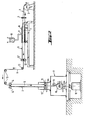
- the shirred tubular casing 1 shows a coiled seam zone 2, which in the example of Fig. La has a uniform slope, in the example of Fig. lb different slopes.
- the caterpillar shown in FIG. 1b is produced from a hose which was twisted at different rotational speeds during winding.
- the support tube 7 and the sleeve 8 serve to support the hose formation, the hose being supported from the inside and outside.
- the application device uses a nozzle 11 to produce a strip-shaped application of the adhesive solution 10 between the overlapping edge zones of the web 4.
- the tube After passing through the drawing rollers 12, 12 'and deflection rollers 13, the tube is inflated between two pairs of squeezing rollers 14, 14' and 15, 15 ' wound up with the roll 16.
- the pinch roller pair 15, 15 'and the roller 16 are located on a common frame 17 which is rotated by the drive motor 18, as a result of which the hose seam 2 is wound on the roller 16 in a twisted form.
- the reference numerals have the same meaning as in the previous figures.
- the twisted wound hose 6 is unwound from the roll 16 and after passing through the squeeze rollers 19, 19 'held in the inflated state, wherein by the R affdorn 20 air is blown in a known manner.
- the inflated hose 6 moves through two further driven rollers 21, 21 'in the direction of the device 22, where the actual gathering process takes place. With 23 an abutment is designated against which the hose is compressed to the caterpillar 1.
Landscapes
- Life Sciences & Earth Sciences (AREA)
- Engineering & Computer Science (AREA)
- Wood Science & Technology (AREA)
- Zoology (AREA)
- Food Science & Technology (AREA)
- Processing Of Meat And Fish (AREA)
- Containers And Plastic Fillers For Packaging (AREA)
- Meat, Egg Or Seafood Products (AREA)
- Measuring Pulse, Heart Rate, Blood Pressure Or Blood Flow (AREA)
- Undergarments, Swaddling Clothes, Handkerchiefs Or Underwear Materials (AREA)
- Apparatus For Radiation Diagnosis (AREA)
- Laminated Bodies (AREA)
Priority Applications (1)
| Application Number | Priority Date | Filing Date | Title |
|---|---|---|---|
| AT83103851T ATE30369T1 (de) | 1982-05-03 | 1983-04-20 | Geraffte wursthuelle und verfahren zu ihrer herstellung. |
Applications Claiming Priority (2)
| Application Number | Priority Date | Filing Date | Title |
|---|---|---|---|
| DE3216437 | 1982-05-03 | ||
| DE19823216437 DE3216437A1 (de) | 1982-05-03 | 1982-05-03 | Geraffte wursthuelle und verfahren zu ihrer herstellung |
Publications (3)
| Publication Number | Publication Date |
|---|---|
| EP0093326A2 true EP0093326A2 (fr) | 1983-11-09 |
| EP0093326A3 EP0093326A3 (en) | 1985-03-27 |
| EP0093326B1 EP0093326B1 (fr) | 1987-10-28 |
Family
ID=6162541
Family Applications (1)
| Application Number | Title | Priority Date | Filing Date |
|---|---|---|---|
| EP83103851A Expired EP0093326B1 (fr) | 1982-05-03 | 1983-04-20 | Boyau de saucisses plissé et procédé de sa fabrication |
Country Status (7)
| Country | Link |
|---|---|
| US (1) | US4562101A (fr) |
| EP (1) | EP0093326B1 (fr) |
| JP (1) | JPS58201940A (fr) |
| AT (1) | ATE30369T1 (fr) |
| CA (1) | CA1204017A (fr) |
| DE (2) | DE3216437A1 (fr) |
| FI (1) | FI73865C (fr) |
Cited By (1)
| Publication number | Priority date | Publication date | Assignee | Title |
|---|---|---|---|---|
| EP0149839A3 (fr) * | 1984-01-20 | 1985-08-21 | Hoechst Aktiengesellschaft | Usage d'un boyau plissé |
Families Citing this family (8)
| Publication number | Priority date | Publication date | Assignee | Title |
|---|---|---|---|---|
| DE3343635A1 (de) * | 1983-12-02 | 1985-06-13 | Hoechst Ag, 6230 Frankfurt | Folie aus faserverstaerkter regenerierter cellulose mit gasundurchlaessiger schicht zur herstellung von schlauchhuellen |
| DE3538702A1 (de) * | 1985-10-31 | 1987-05-07 | Hoechst Ag | Sauerstoff- und wasserdampfundurchlaessige folie zur herstellung geraffter schlauchhuellen, insbesondere wursthuellen |
| US4808099A (en) * | 1985-11-20 | 1989-02-28 | Minigrip, Inc. | Apparatus for making tubular film with transverse closure strips |
| US4701361A (en) * | 1985-11-20 | 1987-10-20 | Minigrip, Inc. | Tubular film with transverse closure strips |
| US4965910A (en) * | 1988-04-28 | 1990-10-30 | Townsend Engineering Company | Encased product and method and apparatus for encasing same |
| DE102007021048A1 (de) * | 2007-05-04 | 2008-11-06 | Poly-Clip System Gmbh & Co. Kg | Aufreißstreifen und Verfahren zu dessen Bereitstellung |
| US20090280221A1 (en) * | 2008-05-07 | 2009-11-12 | Reg Macquarrie | Vegetable casing film and method for production of tubular sausage casings |
| DK2482668T3 (en) * | 2009-10-02 | 2018-10-15 | Living Cell Res Inc | Vegetarian holster film |
Family Cites Families (20)
| Publication number | Priority date | Publication date | Assignee | Title |
|---|---|---|---|---|
| US2573956A (en) * | 1949-06-28 | 1951-11-06 | American Cyanamid Co | Process for treating nonfibrous cellulosic film and resulting product |
| LU33675A1 (fr) * | 1954-07-07 | |||
| US2926154A (en) * | 1957-09-05 | 1960-02-23 | Hercules Powder Co Ltd | Cationic thermosetting polyamide-epichlorohydrin resins and process of making same |
| NL110447C (fr) * | 1957-09-05 | |||
| GB908205A (en) * | 1960-03-31 | 1962-10-17 | American Cyanamid Co | Regenerated cellulose film and process for producing same |
| US3378379A (en) * | 1963-05-21 | 1968-04-16 | Union Carbide Corp | Food casing and method of producing same |
| US3766603A (en) * | 1964-12-15 | 1973-10-23 | Union Carbide Corp | Shirred tubing, method and apparatus for making same |
| DE1288994B (de) * | 1965-05-15 | 1969-02-06 | Steinzeug U Kunststoffwarenfab | Muffenrohrdichtung fuer Steinzeug-Kanalisationsrohre |
| DE1288943B (de) * | 1966-10-01 | 1969-02-06 | Kalle Ag | Verfahren zum Raffen von kuenstlichen Wursthuellen |
| DE1288944B (de) * | 1966-10-01 | 1969-02-06 | Kalle Ag | Verfahren zum Raffen von kuenstlichen Wursthuellen |
| FR96372E (fr) * | 1967-12-27 | 1972-06-16 | ||
| US3546209A (en) * | 1968-10-10 | 1970-12-08 | Dow Chemical Co | Process for the fabrication of a cellulose hollow fiber separatory cell |
| US3884270A (en) * | 1969-01-06 | 1975-05-20 | Union Carbide Corp | Method for producing flexible regenerated cellulosic tubing and the tubing obtained therefrom |
| BE789054A (fr) * | 1971-09-23 | 1973-03-20 | Kalle Ag | Procede et dispositif pour froncer des tubes d'emballage et notamment des boyaux pour la fabrication de saucisses |
| US4185358A (en) * | 1971-09-23 | 1980-01-29 | Hoechst Aktiengesellschaft | Apparatus for shirring casings |
| US3986230A (en) * | 1973-02-27 | 1976-10-19 | Hoechst Aktiengesellschaft | Apparatus for shirring tubular casings |
| DE2309721C2 (de) * | 1973-02-27 | 1983-04-14 | Hoechst Ag, 6230 Frankfurt | Verfahren und Vorrichtung zum Raffen von Schlauchhüllen |
| DE3013320A1 (de) * | 1980-04-05 | 1981-10-15 | Hoechst Ag, 6000 Frankfurt | Fuer lebensmittel, insbesondere wurstwaren geeignete schlauchhuelle mit einer klebenaht und verfahren zu ihrer herstellung |
| DE3045086A1 (de) * | 1980-11-29 | 1982-06-24 | Hoechst Ag, 6000 Frankfurt | Schlauchhuelle, insbesondere wursthuelle, mit wasserdampfundurchlaessiger schicht, verfahren zu ihrer herstellung und ihre verwendung |
| DE3228675A1 (de) * | 1982-07-31 | 1984-04-12 | Hoechst Ag, 6230 Frankfurt | Geraffte wursthuelle und verfahren zu ihrer herstellung |
-
1982
- 1982-05-03 DE DE19823216437 patent/DE3216437A1/de not_active Withdrawn
-
1983
- 1983-04-20 AT AT83103851T patent/ATE30369T1/de not_active IP Right Cessation
- 1983-04-20 EP EP83103851A patent/EP0093326B1/fr not_active Expired
- 1983-04-20 DE DE8383103851T patent/DE3374163D1/de not_active Expired
- 1983-04-27 CA CA000426832A patent/CA1204017A/fr not_active Expired
- 1983-04-28 US US06/489,594 patent/US4562101A/en not_active Expired - Fee Related
- 1983-04-29 FI FI831479A patent/FI73865C/fi not_active IP Right Cessation
- 1983-05-02 JP JP58076353A patent/JPS58201940A/ja active Granted
Cited By (1)
| Publication number | Priority date | Publication date | Assignee | Title |
|---|---|---|---|---|
| EP0149839A3 (fr) * | 1984-01-20 | 1985-08-21 | Hoechst Aktiengesellschaft | Usage d'un boyau plissé |
Also Published As
| Publication number | Publication date |
|---|---|
| DE3374163D1 (en) | 1987-12-03 |
| JPS58201940A (ja) | 1983-11-25 |
| FI831479L (fi) | 1983-11-04 |
| CA1204017A (fr) | 1986-05-06 |
| US4562101A (en) | 1985-12-31 |
| EP0093326A3 (en) | 1985-03-27 |
| FI73865C (fi) | 1987-12-10 |
| FI831479A0 (fi) | 1983-04-29 |
| FI73865B (fi) | 1987-08-31 |
| JPH0318861B2 (fr) | 1991-03-13 |
| DE3216437A1 (de) | 1983-11-03 |
| ATE30369T1 (de) | 1987-11-15 |
| EP0093326B1 (fr) | 1987-10-28 |
Similar Documents
| Publication | Publication Date | Title |
|---|---|---|
| EP0076436B1 (fr) | Enveloppe tubulaire pour aliments à fumer, en particulier pour saucisses à fumer, son procédé de fabrication et son application | |
| EP0101892B1 (fr) | Enveloppe pelable pour saucisses à joint adhésif, son procédé de fabrication et son application | |
| EP0050702B1 (fr) | Enveloppe tubulaire à joint adhésif pour aliments, et en particulier pour saucisses, son procédé de fabrication et son application pour la fabrication de saucisses courbées ou annulaires | |
| EP0058240B1 (fr) | Enveloppe tubulaire à joint adhésif, perméable à la vapeur, pour aliments, et en particulier pour saucisses et son procédé de fabrication | |
| EP0054162B1 (fr) | Enveloppe tubulaire, en particulier pour boyaux de saucisses, renfermant un revêtement imperméable à la vapeur d'eau, son procédé de fabrication et son application | |
| EP0080120B1 (fr) | Dispositif pour la fabrication d'un tube à partir d'un matériau en bande plate | |
| DE1285908B (de) | Verfahren zum Kräuseln und Befeuchten von trockenen Wursthüllen | |
| EP0060926B1 (fr) | Enveloppe tubulaire comportant un renforcement fibreux pour aliments, en particulier pour saucisses, et son procédé de fabrication | |
| EP0093326B1 (fr) | Boyau de saucisses plissé et procédé de sa fabrication | |
| EP0139112A1 (fr) | Feuille, perméable à la fumée, en cellulose régénérée à renforcement fibreux, pour la fabrication d'enveloppes tubulaires, et en particulier pour enveloppes de saucisses | |
| DE2338418A1 (de) | Geraffte und zusammengepresste schlauchfoermige huelle | |
| DE3343635A1 (de) | Folie aus faserverstaerkter regenerierter cellulose mit gasundurchlaessiger schicht zur herstellung von schlauchhuellen | |
| EP0100495A1 (fr) | Boyau à saucisses plissé et procédé pour sa fabrication | |
| EP0224060A1 (fr) | Film d'emballage tubulaire ou en forme de bande contenant une couche de barrage, spécialement pour enveloppes de saucisses | |
| DE2756683A1 (de) | Verfahren zum umdrehen eines langgestreckten flexiblen schlauches | |
| DE1954103A1 (de) | Verfahren und Vorrichtung zum Raffen von endlosen stranggepressten Schlaeuchen | |
| EP0338365A2 (fr) | Enveloppes tubulaires courbées d'emballage, spécialement pour enveloppes de saucisses | |
| EP0129705B1 (fr) | Pellicules perméables à la fumée, sans renforcement, à base de cellulose régénérée, pour la fabrication d'enveloppes pour saucisses | |
| DE69320318T2 (de) | Verfahren und Material zum Verbinden von röhrenförmigen Nahrungsmittelhüllen | |
| EP1659868B1 (fr) | Boyau contracte a stabilite propre | |
| DE2803043A1 (de) | Nahrungsmittelhuelle aus zellulose | |
| DE3018861A1 (de) | Faserhuelle zur aufnahme von verarbeitetem fleisch und verfahren zur herstellung der faserhuelle | |
| DE8905289U1 (de) | Vorrichtung zum Umhüllen eines plastischen Produktes | |
| DE1952464C3 (de) | Verwendung von faserverstärkten Polyvinylalkoholharzfolien zum Abpacken von Lebensmitteln | |
| EP0149839A2 (fr) | Usage d'un boyau plissé |
Legal Events
| Date | Code | Title | Description |
|---|---|---|---|
| PUAI | Public reference made under article 153(3) epc to a published international application that has entered the european phase |
Free format text: ORIGINAL CODE: 0009012 |
|
| AK | Designated contracting states |
Designated state(s): AT BE CH DE FR GB IT LI LU NL SE |
|
| PUAL | Search report despatched |
Free format text: ORIGINAL CODE: 0009013 |
|
| AK | Designated contracting states |
Designated state(s): AT BE CH DE FR GB IT LI LU NL SE |
|
| 17P | Request for examination filed |
Effective date: 19850918 |
|
| 17Q | First examination report despatched |
Effective date: 19870120 |
|
| GRAA | (expected) grant |
Free format text: ORIGINAL CODE: 0009210 |
|
| AK | Designated contracting states |
Kind code of ref document: B1 Designated state(s): AT BE CH DE FR GB IT LI LU NL SE |
|
| REF | Corresponds to: |
Ref document number: 30369 Country of ref document: AT Date of ref document: 19871115 Kind code of ref document: T |
|
| REF | Corresponds to: |
Ref document number: 3374163 Country of ref document: DE Date of ref document: 19871203 |
|
| ET | Fr: translation filed | ||
| ITF | It: translation for a ep patent filed | ||
| GBT | Gb: translation of ep patent filed (gb section 77(6)(a)/1977) | ||
| PLBE | No opposition filed within time limit |
Free format text: ORIGINAL CODE: 0009261 |
|
| STAA | Information on the status of an ep patent application or granted ep patent |
Free format text: STATUS: NO OPPOSITION FILED WITHIN TIME LIMIT |
|
| 26N | No opposition filed | ||
| PGFP | Annual fee paid to national office [announced via postgrant information from national office to epo] |
Ref country code: FR Payment date: 19930315 Year of fee payment: 11 |
|
| PGFP | Annual fee paid to national office [announced via postgrant information from national office to epo] |
Ref country code: CH Payment date: 19930317 Year of fee payment: 11 |
|
| PGFP | Annual fee paid to national office [announced via postgrant information from national office to epo] |
Ref country code: GB Payment date: 19930319 Year of fee payment: 11 |
|
| PGFP | Annual fee paid to national office [announced via postgrant information from national office to epo] |
Ref country code: SE Payment date: 19930322 Year of fee payment: 11 |
|
| PGFP | Annual fee paid to national office [announced via postgrant information from national office to epo] |
Ref country code: LU Payment date: 19930324 Year of fee payment: 11 |
|
| PGFP | Annual fee paid to national office [announced via postgrant information from national office to epo] |
Ref country code: AT Payment date: 19930326 Year of fee payment: 11 |
|
| PGFP | Annual fee paid to national office [announced via postgrant information from national office to epo] |
Ref country code: BE Payment date: 19930414 Year of fee payment: 11 |
|
| ITTA | It: last paid annual fee | ||
| PGFP | Annual fee paid to national office [announced via postgrant information from national office to epo] |
Ref country code: NL Payment date: 19930430 Year of fee payment: 11 |
|
| PGFP | Annual fee paid to national office [announced via postgrant information from national office to epo] |
Ref country code: DE Payment date: 19930624 Year of fee payment: 11 |
|
| EPTA | Lu: last paid annual fee | ||
| PG25 | Lapsed in a contracting state [announced via postgrant information from national office to epo] |
Ref country code: LU Free format text: LAPSE BECAUSE OF NON-PAYMENT OF DUE FEES Effective date: 19940420 Ref country code: GB Effective date: 19940420 Ref country code: AT Effective date: 19940420 |
|
| PG25 | Lapsed in a contracting state [announced via postgrant information from national office to epo] |
Ref country code: SE Effective date: 19940421 |
|
| PG25 | Lapsed in a contracting state [announced via postgrant information from national office to epo] |
Ref country code: LI Effective date: 19940430 Ref country code: CH Effective date: 19940430 Ref country code: BE Effective date: 19940430 |
|
| BERE | Be: lapsed |
Owner name: HOECHST A.G. Effective date: 19940430 |
|
| PG25 | Lapsed in a contracting state [announced via postgrant information from national office to epo] |
Ref country code: NL Effective date: 19941101 |
|
| GBPC | Gb: european patent ceased through non-payment of renewal fee |
Effective date: 19940420 |
|
| NLV4 | Nl: lapsed or anulled due to non-payment of the annual fee | ||
| PG25 | Lapsed in a contracting state [announced via postgrant information from national office to epo] |
Ref country code: FR Effective date: 19941229 |
|
| REG | Reference to a national code |
Ref country code: CH Ref legal event code: PL |
|
| PG25 | Lapsed in a contracting state [announced via postgrant information from national office to epo] |
Ref country code: DE Effective date: 19950103 |
|
| EUG | Se: european patent has lapsed |
Ref document number: 83103851.8 Effective date: 19941110 |
|
| REG | Reference to a national code |
Ref country code: FR Ref legal event code: ST |