EP0093377B1 - Wärmehaltendes, dampfdurchlässiges und wasserundurchlässiges Textilflächengebilde - Google Patents
Wärmehaltendes, dampfdurchlässiges und wasserundurchlässiges Textilflächengebilde Download PDFInfo
- Publication number
- EP0093377B1 EP0093377B1 EP19830104062 EP83104062A EP0093377B1 EP 0093377 B1 EP0093377 B1 EP 0093377B1 EP 19830104062 EP19830104062 EP 19830104062 EP 83104062 A EP83104062 A EP 83104062A EP 0093377 B1 EP0093377 B1 EP 0093377B1
- Authority
- EP
- European Patent Office
- Prior art keywords
- layer
- heat
- resistant fabric
- water
- set forth
- Prior art date
- Legal status (The legal status is an assumption and is not a legal conclusion. Google has not performed a legal analysis and makes no representation as to the accuracy of the status listed.)
- Expired
Links
- 239000004744 fabric Substances 0.000 title claims description 108
- XLYOFNOQVPJJNP-UHFFFAOYSA-N water Substances O XLYOFNOQVPJJNP-UHFFFAOYSA-N 0.000 title claims description 71
- 229920000642 polymer Polymers 0.000 claims description 75
- 239000011148 porous material Substances 0.000 claims description 63
- 239000000758 substrate Substances 0.000 claims description 40
- 229910001111 Fine metal Inorganic materials 0.000 claims description 35
- 239000004411 aluminium Substances 0.000 claims description 14
- 229910052782 aluminium Inorganic materials 0.000 claims description 14
- XAGFODPZIPBFFR-UHFFFAOYSA-N aluminium Chemical compound [Al] XAGFODPZIPBFFR-UHFFFAOYSA-N 0.000 claims description 14
- 229910052751 metal Inorganic materials 0.000 claims description 8
- 239000002184 metal Substances 0.000 claims description 8
- 229920002635 polyurethane Polymers 0.000 claims description 8
- 239000004814 polyurethane Substances 0.000 claims description 8
- PXHVJJICTQNCMI-UHFFFAOYSA-N Nickel Chemical compound [Ni] PXHVJJICTQNCMI-UHFFFAOYSA-N 0.000 claims description 6
- 229920002125 Sokalan® Polymers 0.000 claims description 5
- 150000002148 esters Chemical class 0.000 claims description 5
- 239000004584 polyacrylic acid Substances 0.000 claims description 5
- 229920006254 polymer film Polymers 0.000 claims description 5
- VYZAMTAEIAYCRO-UHFFFAOYSA-N Chromium Chemical compound [Cr] VYZAMTAEIAYCRO-UHFFFAOYSA-N 0.000 claims description 3
- FYYHWMGAXLPEAU-UHFFFAOYSA-N Magnesium Chemical compound [Mg] FYYHWMGAXLPEAU-UHFFFAOYSA-N 0.000 claims description 3
- BQCADISMDOOEFD-UHFFFAOYSA-N Silver Chemical compound [Ag] BQCADISMDOOEFD-UHFFFAOYSA-N 0.000 claims description 3
- ATJFFYVFTNAWJD-UHFFFAOYSA-N Tin Chemical compound [Sn] ATJFFYVFTNAWJD-UHFFFAOYSA-N 0.000 claims description 3
- 229910052804 chromium Inorganic materials 0.000 claims description 3
- 239000011651 chromium Substances 0.000 claims description 3
- 239000011777 magnesium Substances 0.000 claims description 3
- 229910052749 magnesium Inorganic materials 0.000 claims description 3
- 229910052759 nickel Inorganic materials 0.000 claims description 3
- 239000004332 silver Substances 0.000 claims description 3
- 229910052709 silver Inorganic materials 0.000 claims description 3
- 239000011135 tin Substances 0.000 claims description 3
- 229910052718 tin Inorganic materials 0.000 claims description 3
- 239000010410 layer Substances 0.000 description 114
- 239000011248 coating agent Substances 0.000 description 49
- 238000000576 coating method Methods 0.000 description 49
- 239000000243 solution Substances 0.000 description 31
- 239000007787 solid Substances 0.000 description 30
- 239000006185 dispersion Substances 0.000 description 28
- 239000002904 solvent Substances 0.000 description 22
- 230000015271 coagulation Effects 0.000 description 18
- 238000005345 coagulation Methods 0.000 description 18
- 230000000694 effects Effects 0.000 description 18
- 238000012360 testing method Methods 0.000 description 18
- 230000005540 biological transmission Effects 0.000 description 17
- 238000000034 method Methods 0.000 description 15
- ZWEHNKRNPOVVGH-UHFFFAOYSA-N 2-Butanone Chemical compound CCC(C)=O ZWEHNKRNPOVVGH-UHFFFAOYSA-N 0.000 description 12
- ZMXDDKWLCZADIW-UHFFFAOYSA-N N,N-Dimethylformamide Chemical compound CN(C)C=O ZMXDDKWLCZADIW-UHFFFAOYSA-N 0.000 description 12
- 229920002302 Nylon 6,6 Polymers 0.000 description 10
- 239000000126 substance Substances 0.000 description 8
- CSCPPACGZOOCGX-UHFFFAOYSA-N Acetone Chemical compound CC(C)=O CSCPPACGZOOCGX-UHFFFAOYSA-N 0.000 description 7
- YCKRFDGAMUMZLT-UHFFFAOYSA-N Fluorine atom Chemical compound [F] YCKRFDGAMUMZLT-UHFFFAOYSA-N 0.000 description 6
- 238000001035 drying Methods 0.000 description 6
- 239000011737 fluorine Substances 0.000 description 6
- 229910052731 fluorine Inorganic materials 0.000 description 6
- 235000011837 pasties Nutrition 0.000 description 6
- 230000001112 coagulating effect Effects 0.000 description 5
- 239000003960 organic solvent Substances 0.000 description 5
- 238000003825 pressing Methods 0.000 description 5
- 239000003431 cross linking reagent Substances 0.000 description 4
- 238000004519 manufacturing process Methods 0.000 description 4
- 229920003009 polyurethane dispersion Polymers 0.000 description 4
- 238000006467 substitution reaction Methods 0.000 description 4
- 239000004677 Nylon Substances 0.000 description 3
- 230000005484 gravity Effects 0.000 description 3
- 239000012948 isocyanate Substances 0.000 description 3
- 150000002513 isocyanates Chemical class 0.000 description 3
- 239000000463 material Substances 0.000 description 3
- 229920001778 nylon Polymers 0.000 description 3
- 229920000728 polyester Polymers 0.000 description 3
- 229920002994 synthetic fiber Polymers 0.000 description 3
- XEEYBQQBJWHFJM-UHFFFAOYSA-N Iron Chemical compound [Fe] XEEYBQQBJWHFJM-UHFFFAOYSA-N 0.000 description 2
- 239000004952 Polyamide Substances 0.000 description 2
- 239000000853 adhesive Substances 0.000 description 2
- 230000001070 adhesive effect Effects 0.000 description 2
- 238000009835 boiling Methods 0.000 description 2
- 230000000052 comparative effect Effects 0.000 description 2
- 238000010586 diagram Methods 0.000 description 2
- 238000000635 electron micrograph Methods 0.000 description 2
- 238000000605 extraction Methods 0.000 description 2
- 239000004088 foaming agent Substances 0.000 description 2
- 239000000203 mixture Substances 0.000 description 2
- 239000002245 particle Substances 0.000 description 2
- 229920002647 polyamide Polymers 0.000 description 2
- 229920005749 polyurethane resin Polymers 0.000 description 2
- 238000012546 transfer Methods 0.000 description 2
- 239000002759 woven fabric Substances 0.000 description 2
- HMUNWXXNJPVALC-UHFFFAOYSA-N 1-[4-[2-(2,3-dihydro-1H-inden-2-ylamino)pyrimidin-5-yl]piperazin-1-yl]-2-(2,4,6,7-tetrahydrotriazolo[4,5-c]pyridin-5-yl)ethanone Chemical compound C1C(CC2=CC=CC=C12)NC1=NC=C(C=N1)N1CCN(CC1)C(CN1CC2=C(CC1)NN=N2)=O HMUNWXXNJPVALC-UHFFFAOYSA-N 0.000 description 1
- LDXJRKWFNNFDSA-UHFFFAOYSA-N 2-(2,4,6,7-tetrahydrotriazolo[4,5-c]pyridin-5-yl)-1-[4-[2-[[3-(trifluoromethoxy)phenyl]methylamino]pyrimidin-5-yl]piperazin-1-yl]ethanone Chemical compound C1CN(CC2=NNN=C21)CC(=O)N3CCN(CC3)C4=CN=C(N=C4)NCC5=CC(=CC=C5)OC(F)(F)F LDXJRKWFNNFDSA-UHFFFAOYSA-N 0.000 description 1
- OEPOKWHJYJXUGD-UHFFFAOYSA-N 2-(3-phenylmethoxyphenyl)-1,3-thiazole-4-carbaldehyde Chemical compound O=CC1=CSC(C=2C=C(OCC=3C=CC=CC=3)C=CC=2)=N1 OEPOKWHJYJXUGD-UHFFFAOYSA-N 0.000 description 1
- UXVMQQNJUSDDNG-UHFFFAOYSA-L Calcium chloride Chemical compound [Cl-].[Cl-].[Ca+2] UXVMQQNJUSDDNG-UHFFFAOYSA-L 0.000 description 1
- 229920003043 Cellulose fiber Polymers 0.000 description 1
- 229920000742 Cotton Polymers 0.000 description 1
- 206010061218 Inflammation Diseases 0.000 description 1
- YXFVVABEGXRONW-UHFFFAOYSA-N Toluene Natural products CC1=CC=CC=C1 YXFVVABEGXRONW-UHFFFAOYSA-N 0.000 description 1
- BZHJMEDXRYGGRV-UHFFFAOYSA-N Vinyl chloride Chemical compound ClC=C BZHJMEDXRYGGRV-UHFFFAOYSA-N 0.000 description 1
- QCWXUUIWCKQGHC-UHFFFAOYSA-N Zirconium Chemical compound [Zr] QCWXUUIWCKQGHC-UHFFFAOYSA-N 0.000 description 1
- 239000000654 additive Substances 0.000 description 1
- 230000015572 biosynthetic process Effects 0.000 description 1
- 239000003054 catalyst Substances 0.000 description 1
- 239000003795 chemical substances by application Substances 0.000 description 1
- 238000004891 communication Methods 0.000 description 1
- 230000007547 defect Effects 0.000 description 1
- 239000012153 distilled water Substances 0.000 description 1
- 230000002708 enhancing effect Effects 0.000 description 1
- 238000007756 gravure coating Methods 0.000 description 1
- 230000004054 inflammatory process Effects 0.000 description 1
- 229910052742 iron Inorganic materials 0.000 description 1
- 239000007788 liquid Substances 0.000 description 1
- 239000013528 metallic particle Substances 0.000 description 1
- 150000002739 metals Chemical class 0.000 description 1
- 239000011259 mixed solution Substances 0.000 description 1
- 239000004745 nonwoven fabric Substances 0.000 description 1
- 239000000049 pigment Substances 0.000 description 1
- 229920002239 polyacrylonitrile Polymers 0.000 description 1
- 229920001296 polysiloxane Polymers 0.000 description 1
- 239000011527 polyurethane coating Substances 0.000 description 1
- 239000000843 powder Substances 0.000 description 1
- 239000004627 regenerated cellulose Substances 0.000 description 1
- 229920005989 resin Polymers 0.000 description 1
- 239000011347 resin Substances 0.000 description 1
- 238000003756 stirring Methods 0.000 description 1
- 239000002344 surface layer Substances 0.000 description 1
- 239000004094 surface-active agent Substances 0.000 description 1
- 210000004243 sweat Anatomy 0.000 description 1
- 150000003613 toluenes Chemical class 0.000 description 1
- 238000012549 training Methods 0.000 description 1
- 229910052726 zirconium Inorganic materials 0.000 description 1
Images

Classifications
-
- D—TEXTILES; PAPER
- D06—TREATMENT OF TEXTILES OR THE LIKE; LAUNDERING; FLEXIBLE MATERIALS NOT OTHERWISE PROVIDED FOR
- D06N—WALL, FLOOR, OR LIKE COVERING MATERIALS, e.g. LINOLEUM, OILCLOTH, ARTIFICIAL LEATHER, ROOFING FELT, CONSISTING OF A FIBROUS WEB COATED WITH A LAYER OF MACROMOLECULAR MATERIAL; FLEXIBLE SHEET MATERIAL NOT OTHERWISE PROVIDED FOR
- D06N3/00—Artificial leather, oilcloth or other material obtained by covering fibrous webs with macromolecular material, e.g. resins, rubber or derivatives thereof
- D06N3/0056—Artificial leather, oilcloth or other material obtained by covering fibrous webs with macromolecular material, e.g. resins, rubber or derivatives thereof characterised by the compounding ingredients of the macro-molecular coating
- D06N3/0063—Inorganic compounding ingredients, e.g. metals, carbon fibres, Na2CO3, metal layers; Post-treatment with inorganic compounds
-
- D—TEXTILES; PAPER
- D06—TREATMENT OF TEXTILES OR THE LIKE; LAUNDERING; FLEXIBLE MATERIALS NOT OTHERWISE PROVIDED FOR
- D06N—WALL, FLOOR, OR LIKE COVERING MATERIALS, e.g. LINOLEUM, OILCLOTH, ARTIFICIAL LEATHER, ROOFING FELT, CONSISTING OF A FIBROUS WEB COATED WITH A LAYER OF MACROMOLECULAR MATERIAL; FLEXIBLE SHEET MATERIAL NOT OTHERWISE PROVIDED FOR
- D06N3/00—Artificial leather, oilcloth or other material obtained by covering fibrous webs with macromolecular material, e.g. resins, rubber or derivatives thereof
- D06N3/12—Artificial leather, oilcloth or other material obtained by covering fibrous webs with macromolecular material, e.g. resins, rubber or derivatives thereof with macromolecular compounds obtained otherwise than by reactions only involving carbon-to-carbon unsaturated bonds, e.g. gelatine proteins
- D06N3/14—Artificial leather, oilcloth or other material obtained by covering fibrous webs with macromolecular material, e.g. resins, rubber or derivatives thereof with macromolecular compounds obtained otherwise than by reactions only involving carbon-to-carbon unsaturated bonds, e.g. gelatine proteins with polyurethanes
-
- Y—GENERAL TAGGING OF NEW TECHNOLOGICAL DEVELOPMENTS; GENERAL TAGGING OF CROSS-SECTIONAL TECHNOLOGIES SPANNING OVER SEVERAL SECTIONS OF THE IPC; TECHNICAL SUBJECTS COVERED BY FORMER USPC CROSS-REFERENCE ART COLLECTIONS [XRACs] AND DIGESTS
- Y10—TECHNICAL SUBJECTS COVERED BY FORMER USPC
- Y10T—TECHNICAL SUBJECTS COVERED BY FORMER US CLASSIFICATION
- Y10T428/00—Stock material or miscellaneous articles
- Y10T428/24—Structurally defined web or sheet [e.g., overall dimension, etc.]
- Y10T428/24942—Structurally defined web or sheet [e.g., overall dimension, etc.] including components having same physical characteristic in differing degree
-
- Y—GENERAL TAGGING OF NEW TECHNOLOGICAL DEVELOPMENTS; GENERAL TAGGING OF CROSS-SECTIONAL TECHNOLOGIES SPANNING OVER SEVERAL SECTIONS OF THE IPC; TECHNICAL SUBJECTS COVERED BY FORMER USPC CROSS-REFERENCE ART COLLECTIONS [XRACs] AND DIGESTS
- Y10—TECHNICAL SUBJECTS COVERED BY FORMER USPC
- Y10T—TECHNICAL SUBJECTS COVERED BY FORMER US CLASSIFICATION
- Y10T428/00—Stock material or miscellaneous articles
- Y10T428/24—Structurally defined web or sheet [e.g., overall dimension, etc.]
- Y10T428/24942—Structurally defined web or sheet [e.g., overall dimension, etc.] including components having same physical characteristic in differing degree
- Y10T428/2495—Thickness [relative or absolute]
- Y10T428/24967—Absolute thicknesses specified
-
- Y—GENERAL TAGGING OF NEW TECHNOLOGICAL DEVELOPMENTS; GENERAL TAGGING OF CROSS-SECTIONAL TECHNOLOGIES SPANNING OVER SEVERAL SECTIONS OF THE IPC; TECHNICAL SUBJECTS COVERED BY FORMER USPC CROSS-REFERENCE ART COLLECTIONS [XRACs] AND DIGESTS
- Y10—TECHNICAL SUBJECTS COVERED BY FORMER USPC
- Y10T—TECHNICAL SUBJECTS COVERED BY FORMER US CLASSIFICATION
- Y10T428/00—Stock material or miscellaneous articles
- Y10T428/249921—Web or sheet containing structurally defined element or component
- Y10T428/249953—Composite having voids in a component [e.g., porous, cellular, etc.]
- Y10T428/249978—Voids specified as micro
- Y10T428/249979—Specified thickness of void-containing component [absolute or relative] or numerical cell dimension
-
- Y—GENERAL TAGGING OF NEW TECHNOLOGICAL DEVELOPMENTS; GENERAL TAGGING OF CROSS-SECTIONAL TECHNOLOGIES SPANNING OVER SEVERAL SECTIONS OF THE IPC; TECHNICAL SUBJECTS COVERED BY FORMER USPC CROSS-REFERENCE ART COLLECTIONS [XRACs] AND DIGESTS
- Y10—TECHNICAL SUBJECTS COVERED BY FORMER USPC
- Y10T—TECHNICAL SUBJECTS COVERED BY FORMER US CLASSIFICATION
- Y10T428/00—Stock material or miscellaneous articles
- Y10T428/249921—Web or sheet containing structurally defined element or component
- Y10T428/249953—Composite having voids in a component [e.g., porous, cellular, etc.]
- Y10T428/249978—Voids specified as micro
- Y10T428/24998—Composite has more than two layers
-
- Y—GENERAL TAGGING OF NEW TECHNOLOGICAL DEVELOPMENTS; GENERAL TAGGING OF CROSS-SECTIONAL TECHNOLOGIES SPANNING OVER SEVERAL SECTIONS OF THE IPC; TECHNICAL SUBJECTS COVERED BY FORMER USPC CROSS-REFERENCE ART COLLECTIONS [XRACs] AND DIGESTS
- Y10—TECHNICAL SUBJECTS COVERED BY FORMER USPC
- Y10T—TECHNICAL SUBJECTS COVERED BY FORMER US CLASSIFICATION
- Y10T428/00—Stock material or miscellaneous articles
- Y10T428/249921—Web or sheet containing structurally defined element or component
- Y10T428/249953—Composite having voids in a component [e.g., porous, cellular, etc.]
- Y10T428/249981—Plural void-containing components
-
- Y—GENERAL TAGGING OF NEW TECHNOLOGICAL DEVELOPMENTS; GENERAL TAGGING OF CROSS-SECTIONAL TECHNOLOGIES SPANNING OVER SEVERAL SECTIONS OF THE IPC; TECHNICAL SUBJECTS COVERED BY FORMER USPC CROSS-REFERENCE ART COLLECTIONS [XRACs] AND DIGESTS
- Y10—TECHNICAL SUBJECTS COVERED BY FORMER USPC
- Y10T—TECHNICAL SUBJECTS COVERED BY FORMER US CLASSIFICATION
- Y10T428/00—Stock material or miscellaneous articles
- Y10T428/31504—Composite [nonstructural laminate]
- Y10T428/31551—Of polyamidoester [polyurethane, polyisocyanate, polycarbamate, etc.]
- Y10T428/31554—Next to second layer of polyamidoester
-
- Y—GENERAL TAGGING OF NEW TECHNOLOGICAL DEVELOPMENTS; GENERAL TAGGING OF CROSS-SECTIONAL TECHNOLOGIES SPANNING OVER SEVERAL SECTIONS OF THE IPC; TECHNICAL SUBJECTS COVERED BY FORMER USPC CROSS-REFERENCE ART COLLECTIONS [XRACs] AND DIGESTS
- Y10—TECHNICAL SUBJECTS COVERED BY FORMER USPC
- Y10T—TECHNICAL SUBJECTS COVERED BY FORMER US CLASSIFICATION
- Y10T442/00—Fabric [woven, knitted, or nonwoven textile or cloth, etc.]
- Y10T442/30—Woven fabric [i.e., woven strand or strip material]
- Y10T442/3325—Including a foamed layer or component
- Y10T442/3333—Including a free metal or alloy constituent
-
- Y—GENERAL TAGGING OF NEW TECHNOLOGICAL DEVELOPMENTS; GENERAL TAGGING OF CROSS-SECTIONAL TECHNOLOGIES SPANNING OVER SEVERAL SECTIONS OF THE IPC; TECHNICAL SUBJECTS COVERED BY FORMER USPC CROSS-REFERENCE ART COLLECTIONS [XRACs] AND DIGESTS
- Y10—TECHNICAL SUBJECTS COVERED BY FORMER USPC
- Y10T—TECHNICAL SUBJECTS COVERED BY FORMER US CLASSIFICATION
- Y10T442/00—Fabric [woven, knitted, or nonwoven textile or cloth, etc.]
- Y10T442/30—Woven fabric [i.e., woven strand or strip material]
- Y10T442/3325—Including a foamed layer or component
- Y10T442/3366—Woven fabric is coated, impregnated, or autogenously bonded
- Y10T442/3374—Coating or impregnation includes particulate material other than fiber
-
- Y—GENERAL TAGGING OF NEW TECHNOLOGICAL DEVELOPMENTS; GENERAL TAGGING OF CROSS-SECTIONAL TECHNOLOGIES SPANNING OVER SEVERAL SECTIONS OF THE IPC; TECHNICAL SUBJECTS COVERED BY FORMER USPC CROSS-REFERENCE ART COLLECTIONS [XRACs] AND DIGESTS
- Y10—TECHNICAL SUBJECTS COVERED BY FORMER USPC
- Y10T—TECHNICAL SUBJECTS COVERED BY FORMER US CLASSIFICATION
- Y10T442/00—Fabric [woven, knitted, or nonwoven textile or cloth, etc.]
- Y10T442/40—Knit fabric [i.e., knit strand or strip material]
- Y10T442/469—Including a foamed layer or component
Definitions
- the present invention relates to a moisture-transmissible water-resistant fabric excellent in the heat-insulating and -retaining properties.
- Fabrics having water vapor transmission and water resistance in combination have been known.
- Japanese Unexamined Patent Publication No. 53-19457 and No. 55-7483 disclose a fabric comprising a porous polymer layer formed on one surface thereof. Pores in the polymer layer interconnect with one another and communicate with fine pores on the surface of the polymer layer. Accordingly, the fabrics are moisture-transmissible. Most of the fine pores on the surface of the polymer layer have a size of not larger than 5 um and do not allow liquid water to pass therethrough. Accordingly, the fabrics have water resistance. These moisture-transmissible water-resistant fabrics are used for ski wear, training wear, parkas, raincoats, tents and the like.
- FR-A-2,183,990 discloses an external lining material comprising a fabric, more particularly bed-linen, and fabric for covering furniture, which exhibits a considerably improved resistance of inflammation by applying metallic particles allowing fast conduction of heat.
- FR-A-1,138,020 materials for tarpaulins are described based on synthetic material, which contains finely distributed metal pieces and which isolates against external influences.
- the material is also suitable for cloth or mats, but it is impermeable for moisture.
- DE-A-23 10 970 a coating of synthetic material on fabric is described, which contains powder of iron in order to reach high specific gravity.
- This fabric is used as floor covering and exhibits improved properties as it does not slide, because of its high specific gravity.
- a heat-retaining moisture-transmissible water-resistant fabric comprising a fibrous substrate and a polymer layer having a multiplicity of interconnecting fine pores having a size of 1 to 20 pm (layer A), formed on at least one surface of the fibrous substrate, characterized in that a polymer layer (layer B) containing 15 to 70% by weight, based on the weight of layer B, of heat ray-reflecting fine metal pieces and having a multiplicity of interconnecting fine pores communicating from the surface to the interior and also having on the surface thereof fine pores having an average size of not larger than 5 ⁇ m, is formed on layer A; the size of the interconnecting fine pores in the interior of layer B being in the range of from 1 to 20 um, and the major axis of the heat ray-reflecting fine metal pieces being in the range of from 0.1 to 30 um.
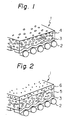
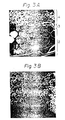
- the water-resistant fabric of the present invention is of a laminate structure as diagrammatically illustrated in Figs. 1 and 2 and shown in Figs. 3A and 4A which are electron photomicrographs (1000x) taken by a scanning electron microscope. More specifically, in one aspect of the present invention, as shown in Figs. 1 and 3A, the water-resistant fabric 1 is of a two-layer laminate structure comprising a fibrous substrate 2, a layer A 3 formed on the substrate 2 and a layer B 4 formed on the layer A. In another aspect of the present invention, as shown in Figs. 2 and 4A, the water-resistant fabric 1 is of a three-layer laminate structure comprising a fibrous substrate 2, a layer A 3 formed on the substrate, a layer C 5 formed on the layer A 3 and a layer D 6 formed on the layer C 5.
- Synthetic fibres such as polyamide fibres, polyester fibres and polyacrylonitrile fibres, chemical fibres such as regenerated cellulose fibres and natural fibres such as cotton are used as the fibres for the fibrous substrate in the present invention. These fibres may be used either alone or as mixture of two or more thereof.
- the fibrous substrate may be used in the form of a woven fabric, a knitted fabric, a nonwoven fabric or the like. Among these, a woven fabric or knitted fabric is preferable.
- a polyurethane, a polyacrylic acid ester, a polyamide, a vinyl chloride polymer, a vinylidene chloride polymer and a fluorine-containing polymer can be mentioned. These polymers may be used either alone or as a mixture of two or more thereof. In the present invention, a polyurethane and a polyacrylic acid ester are preferably used. Polyurethane is most preferable.
- Layer A is a polymer layer having a plurality of interconnecting fine pores. Layer A is interposed between layer B and the fibrous substrate to increase the adhesion between layer B and the fibrous substrate and improve the water resistance of the fabric as a whole.
- Polymer layer A has interconnecting fine pores having a size of 1 to 20 um, more preferably 1 to 10 pm.
- the thickness of the polymer layer A is not particularly critical, but it is preferred to be in the range of from 1 to 50 um, more preferably from 2 to 20 ⁇ m. If the thickness of polymer layer A is smaller than 1 um, the effect of improving the adhesion and water-proofness is reduced. In contrast, if the thickness of the polymer layer A exceeds 50 um, the fabric becomes hard.
- Layer B is a polymer layer containing 15 to 70% by weight, based on the wsight of layer B, of heat ray-reflecting fine metal pieces and having a plurality of interconnecting fine pores communicating from the surface to the interior of the water-resistant fabric.
- Polymer layer B is formed on the fibrous substrate through the interposed polymer layer A.
- All solid metals such as aluminium, tin, nickel, silver, magnesium and chromium may be used as the heat ray-reflecting metal. Of these, aluminium is the most preferable because it has a low specific gravity and a high heat ray-reflecting effect.
- the fine metal pieces may be circular, angular or flat. The size of the fine metal pieces is such that their major axis is in the range of from 0.1 to 30 ⁇ m. If the amount of the fine metal pieces is smaller than 15% by weight based on layer B, the heat ray-reflecting effect is low.
- the amount of the fine metal pieces is larger than 70% by weight based on the weight of layer B, the uniformity of the microporous polymer film is degraded and falling of the fine metal pieces is caused.
- the amount of the fine metal pieces is preferably in the range of from 20 to 50% by weight based on layer B.
- a thin transparent polymer layer may be additionally formed on the fine metal piece-containing layer B to such an extent that the fine pores on the surface are not completely filled.
- a plurality of fine pores are present on the surface of layer B, as shown in Fig. 3B, which is an electron microphotograph (1000x) taken by a scanning electron microscope. These pores have an average size of not larger than 5 um, especially not larger than 3 um. In the interior of the layer B, there are present many pores interconnecting with one another in all the directions, which communicate with the fine pores on the surface and extend to the other surface. The size of these pores is of 1 to 20 ⁇ m, more preferably 1 to 10 ⁇ m.
- the thickness of layer B is not particularly critical, but it is preferable to be in the range of from 3 to 100 um.
- the heat-retaining moisture-transmissible water-resistant fabric of the present invention has a basic structure in which the fibrous substrate is covered with the above-mentioned two polymer layers A and B.
- the heat ray-reflecting fine metal pieces are incorporated in the surface layer B to reflect the radiant heat from the interior, such as body heat, whereby the heat-retaining property is improved.
- the surface of the layer B has fine pores, which have an average size of not larger than 5 pm, that is, much smaller than the size of water drops such as rain drops, good water resistance is obtained. Furthermore, since many interconnecting fine pores are present in layer B and they communicate with the fine pores present on the surface, water vapour such as vapour from sweat is allowed to transmit through the fabric and, thus, good moisture transmission can be attained.
- the water-resistant fabric is of a three layer structure of substrate/layer A/layer C/layer D, as shown in Figs. 2 and 4A.
- layers C and D are used instead of layer B.
- Layer C has in the interior thereof pores interconnecting in all the directions, which have an average size of 1 to 20 um.
- Layer D contains 10 to 70% by weight, based on the weight of layer D, of heat-ray reflecting fine metal pieces and has on the surface thereof fine pores having a size smaller than 0.5 pm and pores communicating with said fine surface pores, which have an average size of not larger than 1 pm.
- layer C Since the pores present in layer C extend to both the surfaces of layer C, fine pores are present on both the surfaces of layer C. Since layer C has pores, which have an average size of 1 to 20 ⁇ m, a sufficient moisture transmission is maintained and a good heat-retaining property is given by air present in the interior pores.
- the size of the fine pores on the surface of layer C be not larger than 5 pm, especially not larger than 3 um.
- the thickness of layer C is not particularly critical, but it is preferable to be in the range of from 3 to 100 um.
- fine metal pieces are incorporated in layer C in an amount of 5 to 70% by weight, preferably 20 to 50% by weight, based on the weight of layer C, the radiant heat from a heat source, such as body heat, is effectively reflected and, therefore, the heat-retaining effect is further improved. If the amount of the metal fine pieces exceeds 70% by weight, the uniformity of the interconnecting pores is degraded, and the heat-retaining effect by the fine pores is reduced.
- Layer D contains metal fine pieces in an amount of 10 to 70% by weight based on the weight of layer D and is effective for smoothening the surface of layer C and reflecting the radiant heat from a heat source, such as body heat. Layer D is formed on the fibrous substrate through the interposed layer C.
- Fig. 4B is an electron microphotograph (1000x) taken by a scanning electron microscope. Pores communication with these fine pores, which have an average size of not larger than 1 pm, are present in the interior of layer D. Since both the fine surface pores and interior pores are small in the size, reduction of the brightness of the incorporated fine metal pieces is small and the moisture transmission is maintained at a high level.
- Layer C located below layer D has on the surface thereof fine pores having, preferably, a size of not larger than 5 um, preferably not larger than 3 pm, and also has in the interior thereof pores interconnecting in all the directions and being larger than the pores present in layer D, i.e. having an average size of at least 1 um. Accordingly, the moisture transmission due to layer D is not degraded at all.
- the film layer is undesirably thin.
- this dry basis amount is larger than 20 g/ M 2 , the intended fine pores are not formed on the surface of layer C and the moisture transmission is degraded, though the effect of reflecting the radiant heat is sufficient.
- this dry basis amount is in the range of from 2 to 15 g/m 2 , optimum results can be obtained.
- the thickness of layer D is in the range of from 1 to 10 pm.
- the amount of the fine metal pieces is smaller than 10% by weight based on the weight of layer D, no substantial effect of reflecting the radiant heat is obtained. If the amount of the fine metal pieces is larger than 70% by weight based on the weight of layer D, the film-forming property is degraded and falling of the fine metal pieces is caused. It is preferred that the amount of the fine metal pieces be in the range of from 15 to 60% by weight, based on the weight of layer D.
- An organic solvent solution containing 5 to 40% by weight of the polymer is coated on the fibrous substrate to form layer A on the fibrous substrate.
- a solvent capable of dissolving the polymer therein, such as methyl ethyl ketone or dimethyl formamide, is used as the organic solvent.
- the coating is preferably accomplished by using a known coating machine such as a knife coater, a reverse roll coater, a kiss-roll coater or a gravure coater.
- the polymer solution coated on the substrate can be coagulated by the conventional dry or wet coagulation method.
- the dry coagulation method the polymer solution-coated substrate is passed through a hot air-drier to evaporate the solvent of the polymer solution and coagulate the polymer.
- an appropriate foaming agent is incorporated in the polymer solution and a method wherein an appropriate non-solvent is dispersed in the polymer solution.
- the polymer solution-coated substrate is immersed in a non-solvent for the polymer, which is compatible with the solvent of the polymer solution, to effect coagulation by the extraction substitution of the solvent with the non-solvent, whereby a porous polymer film is formed. Then, the coated substrate is dried by a hot air-drier.
- a dispersion (such as a water-in-oil type dispersion) formed by dispersing in a polymer solution a poor solvent (for example, water) for the polymer, which has a boiling point higher than the boiling point of the solvent (for example, methyl ethyl ketone) of the polymer solution, is coated.
- a poor solvent for example, water
- the solvent for example, methyl ethyl ketone
- the ratio of the poor solvent to the solvent be 5 to 50% by weight. If this ratio is lower than 5% by weight, completely communicating pores cannot be obtained. If the ratio is higher than 50% by weight, pores become too large and the intended porosity cannot be obtained.
- the substrate is coated with a polymer solution, and then the coated substrate is immersed in a mixed solution (coagulating bath) comprising the solvent (for example, dimethyl formamide) of the polymer solution and a non-solvent (for example, water) for the polymer, which is compatible with the solvent of the polymer solution, to effect extraction substitution of the solvent of the polymer solution with the non-solvent of the coagulating bath and thereby coagulate the polymer.
- a mixed solution coagulating bath
- the ratio of the solvent to the non-solvent in the coagulating bath be not higher than 40% by weight. If this ratio is higher than 40% by weight, the rate of substitution is low, and formed pores are not uniform, and pores having too large a size are formed.
- the coagulating bath be maintained at 0 to 50°C. If the temperature of the coagulating bath is outside this range, the rate of substitution is not appropriate and formed pores are not uniform.
- a discontinuous polymer layer is formed.
- Additives such as a crosslinking agent, a curing agent, a foaming agent, a surface active agent and a pigment may be added to the polymer solution, if desired.
- a polymer solution in an organic solvent having a 5 to 40% by weight concentration and containing 15 to 70% by weight of the fine metal pieces is coated on the so-formed polymer layer in the same manner as described above, and the dry coagulation or wet coagulation is similarly carried out.
- the polymer solution containing the fine metal pieces is coated on a release paper by using a coating machine such as mentioned above.
- the polymer is coagulated and then laminated on the above-mentioned polymer layer.
- Layer A is formed on the fibrous substrate according to the above-mentioned method.
- a polymer solution in an organic solvent of a 5 to 40% by weight concentration is coated on layer A, then the dry or wet coagulation is effected to form layer C.
- 5 to 70% by weight, preferably 20 to 50% by weight, of fine metal pieces may be added to the polymer.
- a polymer solution in an organic solvent having a 5 to 40% by weight concentration and containing 10 to 70% by weight, based on the polymer, of fine metal pieces is coated on the polymer layer C and, then, the dry or wet coagulation is effected to form layer D.
- a water-repellant is further coated on the so-obtained laminated fabric, the water resistance is further increased.
- a fluorine type water-repellant, a silicone type water-repellant or a zirconium type water-repellant may be used.
- the heat-retaining moisture-transmissible water-resistant fabric of the present invention has improved heat retaining property and durability as well as good moisture transmission. Accordingly, the fabric of the present invention can be widely used for production of winter clothes such as ski wear, mountain parkas and warm-up jackets.
- the water pressure resistance was determined according to method B (high water pressure method) of' Japanese Industrial Standard (JIS) L-1092 described below.
- test pieces having a size of about 15 cm x 15 cm were collected from a sample fabric and attached to a water pressure resistance tester. Water pressure was applied at a rate of 98.1 kPa (0.1 kgf/cm 2 ) per minute. The water pressure (Pa) was measured when water was leaked out from the back side of the test piece at three points. The test was thus conducted on four test pieces and a mean value was calculated.
- the moisture transmission was determined according to the method of JIS K-6328 described below.
- test body A moisture transmission test cup was filled with about 10 ml of distilled water, and a test piece was placed on the edge of the cup so that the polymer surface was located on the inner side. A lid was turned and fastened by screws to secure the test piece. Then, the test piece-attached cup ("test body") was carefully placed in a desiccator maintained at 40t1°C, in the bottom portion of which a sufficient amount of anhydrous calcium chloride was charged, so as not to shake the water. The test body was allowed to stand in this state for 2 hours. The test body was taken out and the total weight of the test body was measured. The test body was placed in the above-mentioned desiccator again, and the total weight of the test body was measured after 24 hours' standing.
- the moisture transmission (g/m 2 ) was calculated according to the equation shown below: in which T stands for the moisture transmission (g/m 2 ), C stands for the weight (g) of the test body after 2 hours' standing, C 24 stands for the weight (g) of the test body after 24 hours' standing and C F stands for the moisture transmission area (m 2 ) of the cup.
- T stands for the moisture transmission (g/m 2 )
- C stands for the weight (g) of the test body after 2 hours' standing
- C 24 stands for the weight (g) of the test body after 24 hours' standing
- C F stands for the moisture transmission area (m 2 ) of the cup.
- a heat-retaining vessel having a temperature-controllable heat source and an opening formed in the upper portion was placed in a thermostat tank.
- a sample was placed on the opening and a detector of a heat flow meter was contacted with the surface of the sample.
- the difference between the temperature (T 1 °C) of the thermostat tank and the temperature (T2°C) in the heat-retaining vessel was kept constant.
- the heat flow (Q W/m 2 ) caused by this temperature difference (T 2 -T l ) was measured.
- a larger value of Q indicates a larger heat flow (that is, a larger heat loss) and a lower heat-retaining property.
- a dyed nylon 66 taffeta fabric woven from 7,77 tex (70-denier) nylon 66 yarns as both the warps and wefts at a density of 8268 yarns per meter (210 yarns per inch) was subjected to a pre-heat pressing treatment by using a calender roll maintained at 180°C.
- the coating dispersion A was coated on this fabric as the substrate in a dry solid deposited amount shown in Table 2 by means of a knife coated and the coated substrate was dried in a drying zone at a relatively low temperature varying from 50°C to 70°C and then at 90°C to form a coating film layer A (the fabric having this layer A referred to as "laminate fabric A").
- a coating dispersion (B) 100 parts of the coating dispersion (A) was mixed with an aluminium paste ("STAPA® 15HK” supplied by Asahi Chemical Industry Co. and having a fine metal piece content of 65% and an average particle size of 5 ⁇ m) in an amount shown in Table 1 to form a coating dispersion (B).
- an aluminium paste "STAPA® 15HK” supplied by Asahi Chemical Industry Co. and having a fine metal piece content of 65% and an average particle size of 5 ⁇ m
- each of the coating dispersions (B) No. 3 and No. 4 shown in Table 1 was coated on the coated surface of the laminate fabric A by a roll coater and dried in a drying zone at relatively low temperatures varying from 40°C to 60°C and then at 80°C to form a coating film layer B (the fabric having this layer B is referred to as "laminate fabric B").
- the laminate fabric B was subjected to a padding treatment with an aqueous 2.5% solution of a fluorine type water-repellant ("Sumifluoil@ EM-11" supplied by Sumitomo Chemical Co., and having a solid content of 18%).
- the laminate fabric B was dried and heat-treated at 160°C for 1 minute. The obtained results are shown in Table 2.
- the coating dispersion (A) was coated on the substrate in a dry solid deposited amount of 5 g/m 2 to form a coating film layer A.
- a coating film layer B was formed thereon in the same manner as described in Example 1 by using each of the coating dispersions (B) No. 2 and No. 5 in a dry solid deposited amount of 25 g/m 2 .
- the laminate fabric, so obtained, was post-treated in the same manner as described in Example 1.
- the product obtained by using the coating dispersion (B) No. 2 was not different from the product of Example 1 in moisture transmission, but had a very poor heat-retaining property.
- the product obtained by using the coating dispersion (B) No. 5 had a good heat-retaining property, but was not satisfactory because the aluminium pieces readily fell out. The obtained results are shown in Table 2.
- a dyed nylon taffeta fabric woven from 7,77 tex (70-denier) nylon 66 yarns as both the warps and wefts at a density of 8268 yarns per meter (210 yarns per inch) was subjected to a pre-heat-pressing treatment by using a calender roll maintained at 180°C. Then, the fabric as the substrate was coated with a polyurethane dispersion ("Crisvon@ 8166" supplied by Dainippon Ink and Chemicals Inc. and having a solid content of 15%) so that the dry solid deposited amount was 5 g/m 2. The coating was dried in the same manner as described in Example 1.
- a polymer solution formed by dissolving 30 parts of a polyurethane dispersion ("Crisvon@ 8166" having a solid content of 30%) and 5 parts of an aluminium paste in 65 parts of dimethyl formamide was coated on the polyurethane-coated surface of the nylon taffeta fabric by means of a knife coater so that the dry solid deposited amount was 25 g/m 2.
- the fabric was immersed in water (maintained at 25°C) containing 5% of dimethyl formamide to effect coagulation. Then, the coated fabric was treated with the water-repellant in the same manner as described in Example 1. The obtained results are shown in Table 2.
- Example 2 The polymer solution used in Example 2 was coated on a release paper by means of a knife coater so that the dry solid deposited amount was 20 g/m 2. Then, the coating was dried to effect coagulation. An adhesive ("Crisvon@ 8166" having a solid content of 10%) was coated on the film-coated surface in a coated amount of 15 g/m 2 . When the adhesive became semi-dry, the same nylon taffeta fabric as that used in Example 2 was pressed to the coated surface of the release paper by means of a heated press roll. Then, the obtained laminate fabric was treated with the water-repellant in the same manner as described in Example 1. The obtained results are shown in Table 2.
- Example 2 The same nylon 66 taffeta fabric as that used in Example 1 was coated with the same polyurethane solution as that used in Example 2 by means of a roll coated in a dry solid deposited amount of 10 g/m 2 . The coating was then dried.
- a coating solution comprising 30 parts of Crisvon@ 8166 (having a solid content of 30%) and 7.5 parts of an aluminium paste was coated on the surface of the polyurethane coating layer of the fabric by means of a knife coater in a dry solid deposited amount of 74 g/m 2.
- the obtained laminate fabric was post-treated in the same manner as described in Example 2. The obtained results are shown in Table 2.
- a pasty coating dispersion [the same as coating dispersion (B) No. 1 shown in Table 1] formed by incorporating 2.6 parts of an aluminium paste into 100 parts of the pasty coating dispersion (A) used in Example 1 was thinly coated on release paper by means or a roller coater. The coating was then dried. The amount of the dry solid was 1.6 g/m 2. Then, the pasty coating dispersion (A) was coated on the dried coating by a roll coater so that the dry solid deposited amount was 20 g/m 2. When the coating became semi-dry, a polyester grey sheeting (having a basis weight of 110 g/m 2 ) was pressed to the coating by a heated press roll. The obtained results are shown in Table 2.
- a polyacrylic acid ester resin in the form of a toluol solution having a solid content of 18%, supplied by Teikoku Chemical Industry Co.
- a fluorine type water repellant ("Scotchgard@ FC232" supplied by Sumitomo-3M Co.)
- 10 parts of acetone 10 parts of water and 0.1 part of an isocyanate type crosslinking agent ("Catalyst #40(g)” supplied by Teikoku Chemical Industry Co.) to form a pasty coating dispersion.
- Catalyst #40(g) supplied by Teikoku Chemical Industry Co.
- a dyed polyester taffeta fabric (8,33 tex [75-denier] warps, 5,55 tex (50-denier) wefts, density of 7480 yarns per meter (190 yarns per inch)) was subjected to a pre-heat-pressing treatment by using a calender roll maintained at 150°C.
- the above-mentioned coating dispersion was coated on the fabric by means of a knife-over-roll coater and then dried in a drying zone at temperatures varying from 60°C to 100°C and then at 150°C to effect coagulation, whereby a coating film was formed in a dry solid deposited amount of 5 g /m 2 .
- a metallic coating dispersion formed by incorporating 15 parts of aluminium pieces ("Stapa@ AV-10" supplied by Asahi Chemical Industry Co.) in 100 parts of the above-mentioned coating dispersion was coated on the coated surface of the fabric by means of a roll knife coater in a dry solid deposited amount of 9 g/ M 2. The coating was then dried to effect coagulation.
- the coated fabric was subjected to a padding treatment with an aqueous 2% solution of a fluorine type water-repellant ("FC 220@" supplied by Sumitomo-3M Co.), dried, baked for 2 minutes at 160°C and then heat-pressed by a calender roll maintained at 150°C.
- FC 220@ fluorine type water-repellant supplied by Sumitomo-3M Co.
- a dyed nylon 66 taffeta fabric woven from 7,77 tex (70-denier) nylon 66 warps and 7,77 tex (70-denier) nylon 66 wefts at a density of 8268 yarns per meter (210 yarns per inch) was subjected to a pre-heat-pressing treatment by a calender roll maintained at 180°C.
- the above-mentioned coating dispersion (A) was coated on the fabric as the substrate by a knife coater and then the coating was'dried in a drying zone at relatively low temperatures varying from 50°C to 70°C and then at 90°C to form a coating film layer C in a dry solid deposited amount of 5 g/m 2 (the fabric having this layer C is referred to as "laminate fabric C").
- a coating dispersion (C) was prepared by incorporating an aluminium paste ("STAPA@ 15HK” supplied by Asahi Chemical Industry Co. and having a fine metal piece content of 65% and an average particle size of 5 um) in an amount shown in Table 3 in 100 parts of the coating dispersion (A).
- each of the coating dispersions (C) No. 1, 2, 3 and 4 shown in Table 3 was coated on the coated surface of the laminate fabric C as indicated in Table 4 by a roll coater. Then, the coating was dried in a drying zone at relatively low temperatures varying from 40°C to 60°C and then at 80°C to form a coating film layer D in a dry solid deposited amount of 25 g/m 2 (the obtained fabric having this layer D is referred to as "laminate fabric D").
- Table 3 2, 4, 5 and 6 shown in Table 3 was coated on the coated surface of the laminate fabric D as indicated in Table 4 and, then, the coating was dried in a drying zone at relatively high temperatures varying from 70°C to 90°C and then at 130°C to form a coating film in a dry solid deposited amount of 4 g/m 2 .
- the laminate fabric was subjected to a padding treatment with an aqueous 2.5% solution of a fluorine type water-repellant ("Sumifluoil@ EM-11" supplied by Sumitomo Chemical Co. and having a solid content of 18%).
- the fabric was dried and then heat-treated at 160°C for 1 minute. The obtained results are shown in Table 4.
- the laminate fabric D (the aluminium content was 0 or 14.6%) was similarly subjected to the water repellant treatment (Comparative Example 3-1 or 3-2). The obtained results are shown in Table 4.
- the products according to the present invention were excellent in heat-retaining property, moisture transmission and water resistance.
- a dyed nylon 66 taffeta fabric woven from 7,77 tex (70-denier) nylon 66 warps and 7,77 tex (70-denier) nylon 66 wefts at a density of 8268 yarns per meter (210 yarns per inch) was subjected to a pre-heat-pressing treatment by a calender roll maintained at 180°C.
- the fabric as the substrate was coated with a polyurethane dispersion ("Crisvon@ 8166" supplied by Dainippon Ink and Chemicals Inc. and having a solid content of 15%) so that the dry solid adhering amount was 5 g/m 2. Then, the coating was dried and coagulated.
- a polymer solution was prepared by incorporating and dissolving 30 parts of a polyurethane dispersion ("Crisvon@ 8166" having a solid content to 30%) and 5 parts of an aluminium paste in 65 parts of dimethyl formaldehyde.
- This polymer solution was coated on the coated surface of the above-mentioned laminated fabric by a knife coater in a dry solid deposited amount of 20 g/m 2.
- the coated fabric was immersed in water containing 5% of dimethyl formaldehyde to effect coagulation, and then dried.
- the coating dispersion (C) No. 4 shown in Table 3 was coated on the coated surface of the laminated fabric by a roll coater so that the dry solid deposited amount was 4 g/m 2.
- the coated fabric was dried and post-treated in the same manner as described in Example 7. The obtained results are shown in Table 4.
- the product according to the present invention was excellent in the heat-retaining property, moisture transmission and water resistance.
Landscapes
- Chemical & Material Sciences (AREA)
- Engineering & Computer Science (AREA)
- Textile Engineering (AREA)
- Chemical Kinetics & Catalysis (AREA)
- Dispersion Chemistry (AREA)
- Inorganic Chemistry (AREA)
- Laminated Bodies (AREA)
Claims (21)
eine Polymer-Schicht (Schicht D), die 10 bis 70 Gew.-%, bezogen auf das Gewicht der Schicht D, feiner Metall-Stückchen, die Wärmestrahlung reflektieren, enthält und auf ihrer Oberfläche feine Poren mit einer Größe von weniger als 0,5 um aufweist und auch feine Poren, die mit den feinen Poren der Oberfläche in Verbindung stehen, aufweist, die eine mittlere Größe von nicht mehr als 1 um aufweisen, auf der Schicht C gebildet ist, wobei die Hauptachse der die Wärmestrahlung reflektierenden feinen Metall-Stückchen im Bereich von 0,1 bis 30 um liegt.
Applications Claiming Priority (6)
| Application Number | Priority Date | Filing Date | Title |
|---|---|---|---|
| JP74365/82 | 1982-04-28 | ||
| JP7436582A JPS6037229B2 (ja) | 1982-04-28 | 1982-04-28 | 透湿性防水布の製造方法 |
| JP233171/82 | 1982-12-29 | ||
| JP23317182A JPS59125974A (ja) | 1982-12-29 | 1982-12-29 | 保温・透湿性防水布 |
| JP4722/83 | 1983-01-14 | ||
| JP58004722A JPS59129141A (ja) | 1983-01-14 | 1983-01-14 | 保温・透湿性防水布 |
Publications (3)
| Publication Number | Publication Date |
|---|---|
| EP0093377A2 EP0093377A2 (de) | 1983-11-09 |
| EP0093377A3 EP0093377A3 (en) | 1984-07-11 |
| EP0093377B1 true EP0093377B1 (de) | 1987-04-01 |
Family
ID=27276425
Family Applications (1)
| Application Number | Title | Priority Date | Filing Date |
|---|---|---|---|
| EP19830104062 Expired EP0093377B1 (de) | 1982-04-28 | 1983-04-26 | Wärmehaltendes, dampfdurchlässiges und wasserundurchlässiges Textilflächengebilde |
Country Status (3)
| Country | Link |
|---|---|
| US (2) | US4510194A (de) |
| EP (1) | EP0093377B1 (de) |
| DE (1) | DE3370666D1 (de) |
Families Citing this family (14)
| Publication number | Priority date | Publication date | Assignee | Title |
|---|---|---|---|---|
| JPS60193645A (ja) * | 1984-03-16 | 1985-10-02 | ジヤパンゴアテツクス株式会社 | 透湿保温性材料 |
| US5130342A (en) * | 1988-10-14 | 1992-07-14 | Mcallister Jerome W | Particle-filled microporous materials |
| US4957943A (en) * | 1988-10-14 | 1990-09-18 | Minnesota Mining And Manufacturing Company | Particle-filled microporous materials |
| GB9416076D0 (en) * | 1994-08-09 | 1994-09-28 | Courtaulds Aerospace Ltd | Textille composites |
| US5955175A (en) * | 1996-09-20 | 1999-09-21 | W. L. Gore & Associates, Inc. | Infra-red reflective coverings |
| TWI229037B (en) * | 2000-09-29 | 2005-03-11 | Toray Industries | Fiber structure of heat retaining property |
| US20040224584A1 (en) * | 2003-05-08 | 2004-11-11 | Techfab, Llc - Anderson, Sc | Facing sheet of open mesh scrim and polymer film for cement boards |
| US20070111624A1 (en) * | 2005-11-15 | 2007-05-17 | Tiong Liong Industrial Co. Ltd. | Breathable warm-keeping fabric |
| US20100059095A1 (en) * | 2006-01-25 | 2010-03-11 | The Coleman Company, Inc. | Reversible tent rainfly |
| EP2262945B1 (de) | 2008-03-28 | 2013-03-13 | Clariant Finance (BVI) Limited | Beeinflussung der nahinfrarotreflexion gefärbter textilstoffe |
| CN102083618B (zh) * | 2009-06-01 | 2015-04-08 | 东洋纺高机能制品贸易株式会社 | 透湿防水性布料及其制备方法 |
| US11439191B2 (en) | 2018-05-16 | 2022-09-13 | Nike, Inc. | Textiles and garments having thermo-reflective material |
| US20200060365A1 (en) * | 2018-08-22 | 2020-02-27 | Pacific Eagle Enterprise Co., Ltd. | Waterproof and breathable sea fishing trousers having a titanium alloy heat insulation layer |
| CN113622204A (zh) * | 2021-07-07 | 2021-11-09 | 浙江大学 | 一种保温与散热双功能热管理织物及其制备方法 |
Family Cites Families (11)
| Publication number | Priority date | Publication date | Assignee | Title |
|---|---|---|---|---|
| FR1138020A (fr) * | 1955-12-06 | 1957-06-06 | Kunstlederwerk Laufenburg G M | Procédé d'imprégnation de tissus, tissus conformes à ceux obtenus, et articles fabriqués avec ces tissus |
| GB1187031A (en) * | 1965-04-01 | 1970-04-08 | Porvair Ltd | Water Vapour Permeable Flexible Sheet Materials. |
| SU915808A3 (en) * | 1968-10-21 | 1982-03-23 | Emikon Corp | Process for producing porous membrane |
| BE757690A (fr) * | 1969-10-20 | 1971-04-19 | Minnesota Mining & Mfg | Pellicules microporeuses et procedes pour leur fabrication |
| US3854983A (en) * | 1972-05-10 | 1974-12-17 | Rohm & Haas | Flameproof covering material, such as ticking |
| DE2310970A1 (de) * | 1973-03-06 | 1974-09-12 | Hans Dr Hendrix | Schwerbeschichtung fuer textile und andere flexible flaechengebilde |
| US3971315A (en) * | 1974-08-12 | 1976-07-27 | Porelon, Inc. | Macroporous microporous marking structure |
| JPS5724456Y2 (de) * | 1977-09-09 | 1982-05-27 | ||
| JPS6047955B2 (ja) * | 1979-08-02 | 1985-10-24 | 東レ株式会社 | 透湿性、防水性コーテイング生地 |
| US4429000A (en) * | 1979-12-11 | 1984-01-31 | Toray Industries, Inc. | Moisture-permeable waterproof coated fabric and method of making the same |
| US4342811A (en) * | 1979-12-28 | 1982-08-03 | Albany International Corp. | Open-celled microporous sorbent-loaded textile fibers and films and methods of fabricating same |
-
1983
- 1983-04-25 US US06/487,949 patent/US4510194A/en not_active Expired - Lifetime
- 1983-04-26 DE DE8383104062T patent/DE3370666D1/de not_active Expired
- 1983-04-26 EP EP19830104062 patent/EP0093377B1/de not_active Expired
-
1984
- 1984-12-05 US US06/678,326 patent/US4562108A/en not_active Expired - Lifetime
Also Published As
| Publication number | Publication date |
|---|---|
| DE3370666D1 (en) | 1987-05-07 |
| EP0093377A3 (en) | 1984-07-11 |
| US4510194A (en) | 1985-04-09 |
| EP0093377A2 (de) | 1983-11-09 |
| US4562108A (en) | 1985-12-31 |
Similar Documents
| Publication | Publication Date | Title |
|---|---|---|
| EP0093377B1 (de) | Wärmehaltendes, dampfdurchlässiges und wasserundurchlässiges Textilflächengebilde | |
| US5439733A (en) | Insert intended for use in the clothing industry | |
| EP0348425B1 (de) | Schützende oberflächenbehandlung und erhaltenes produkt | |
| JP4503096B1 (ja) | 透湿防水性布帛およびその製造方法 | |
| US6824819B2 (en) | Wash-durable, down-proofed metallized fabric | |
| NO339413B1 (no) | Sjiktprodukt og tekstilprodukt som anvender dette | |
| NO331363B1 (no) | Vannsikret tekstil, vanntett klesplagg, forseglingstape samt anvendelse derav | |
| US6787487B1 (en) | Water vapor-permeable and waterproof material and method for manufacturing the same | |
| JP2025520159A (ja) | 超薄超通気微孔膜の製造方法 | |
| JP2004256939A (ja) | 撥水性布帛およびそれを用いた衣料 | |
| JP3212418B2 (ja) | 透湿性防水布帛 | |
| US3846156A (en) | Process for producing a soft,drapable artificial leather | |
| Lomax | Coated fabrics: part 1—lightweight breathable fabrics | |
| JP2004169233A (ja) | 透湿防水性コーティング布帛とその製造方法 | |
| JP3133131B2 (ja) | 複合シート | |
| JPH024712B2 (de) | ||
| US3912840A (en) | Microporous sheet having suede-like surface and method of making | |
| JPH06280163A (ja) | 透湿防水性コーティング布帛の製造方法 | |
| JP2853573B2 (ja) | 撥水・防水・透湿性ヌバック調合成皮革 | |
| JPS6319335B2 (de) | ||
| JPS6218252A (ja) | 複合積層生地 | |
| IE65865B1 (en) | Insert intended for use in the clothing industry | |
| KR890000247B1 (ko) | 보온성이 향상된 코팅직물의 제조방법 | |
| JPS59137577A (ja) | 保温性の優れた防水透湿布帛およびその製造方法 | |
| JPH06270343A (ja) | 透湿防水性コーティング布帛の製造方法 |
Legal Events
| Date | Code | Title | Description |
|---|---|---|---|
| PUAI | Public reference made under article 153(3) epc to a published international application that has entered the european phase |
Free format text: ORIGINAL CODE: 0009012 |
|
| 17P | Request for examination filed |
Effective date: 19830426 |
|
| AK | Designated contracting states |
Designated state(s): DE FR GB IT |
|
| PUAL | Search report despatched |
Free format text: ORIGINAL CODE: 0009013 |
|
| AK | Designated contracting states |
Designated state(s): DE FR GB IT |
|
| GRAA | (expected) grant |
Free format text: ORIGINAL CODE: 0009210 |
|
| AK | Designated contracting states |
Kind code of ref document: B1 Designated state(s): DE FR GB IT |
|
| REF | Corresponds to: |
Ref document number: 3370666 Country of ref document: DE Date of ref document: 19870507 |
|
| ITF | It: translation for a ep patent filed | ||
| ET | Fr: translation filed | ||
| PLBE | No opposition filed within time limit |
Free format text: ORIGINAL CODE: 0009261 |
|
| STAA | Information on the status of an ep patent application or granted ep patent |
Free format text: STATUS: NO OPPOSITION FILED WITHIN TIME LIMIT |
|
| 26N | No opposition filed | ||
| ITTA | It: last paid annual fee | ||
| REG | Reference to a national code |
Ref country code: GB Ref legal event code: IF02 |
|
| PGFP | Annual fee paid to national office [announced via postgrant information from national office to epo] |
Ref country code: FR Payment date: 20020410 Year of fee payment: 20 |
|
| PGFP | Annual fee paid to national office [announced via postgrant information from national office to epo] |
Ref country code: GB Payment date: 20020424 Year of fee payment: 20 |
|
| PGFP | Annual fee paid to national office [announced via postgrant information from national office to epo] |
Ref country code: DE Payment date: 20020502 Year of fee payment: 20 |
|
| PG25 | Lapsed in a contracting state [announced via postgrant information from national office to epo] |
Ref country code: GB Free format text: LAPSE BECAUSE OF EXPIRATION OF PROTECTION Effective date: 20030425 |
|
| REG | Reference to a national code |
Ref country code: GB Ref legal event code: PE20 |