EP0093417A2 - Bloc creux - Google Patents
Bloc creux Download PDFInfo
- Publication number
- EP0093417A2 EP0093417A2 EP83104191A EP83104191A EP0093417A2 EP 0093417 A2 EP0093417 A2 EP 0093417A2 EP 83104191 A EP83104191 A EP 83104191A EP 83104191 A EP83104191 A EP 83104191A EP 0093417 A2 EP0093417 A2 EP 0093417A2
- Authority
- EP
- European Patent Office
- Prior art keywords
- hollow block
- wider
- groove
- cavities
- grooves
- Prior art date
- Legal status (The legal status is an assumption and is not a legal conclusion. Google has not performed a legal analysis and makes no representation as to the accuracy of the status listed.)
- Withdrawn
Links
Images




Classifications
-
- E—FIXED CONSTRUCTIONS
- E04—BUILDING
- E04C—STRUCTURAL ELEMENTS; BUILDING MATERIALS
- E04C1/00—Building elements of block or other shape for the construction of parts of buildings
- E04C1/40—Building elements of block or other shape for the construction of parts of buildings built-up from parts of different materials, e.g. composed of layers of different materials or stones with filling material or with insulating inserts
- E04C1/41—Building elements of block or other shape for the construction of parts of buildings built-up from parts of different materials, e.g. composed of layers of different materials or stones with filling material or with insulating inserts composed of insulating material and load-bearing concrete, stone or stone-like material
-
- E—FIXED CONSTRUCTIONS
- E04—BUILDING
- E04B—GENERAL BUILDING CONSTRUCTIONS; WALLS, e.g. PARTITIONS; ROOFS; FLOORS; CEILINGS; INSULATION OR OTHER PROTECTION OF BUILDINGS
- E04B2/00—Walls, e.g. partitions, for buildings; Wall construction with regard to insulation; Connections specially adapted to walls
- E04B2/02—Walls, e.g. partitions, for buildings; Wall construction with regard to insulation; Connections specially adapted to walls built-up from layers of building elements
- E04B2002/0202—Details of connections
- E04B2002/0204—Non-undercut connections, e.g. tongue and groove connections
- E04B2002/0208—Non-undercut connections, e.g. tongue and groove connections of trapezoidal shape
-
- E—FIXED CONSTRUCTIONS
- E04—BUILDING
- E04B—GENERAL BUILDING CONSTRUCTIONS; WALLS, e.g. PARTITIONS; ROOFS; FLOORS; CEILINGS; INSULATION OR OTHER PROTECTION OF BUILDINGS
- E04B2/00—Walls, e.g. partitions, for buildings; Wall construction with regard to insulation; Connections specially adapted to walls
- E04B2/02—Walls, e.g. partitions, for buildings; Wall construction with regard to insulation; Connections specially adapted to walls built-up from layers of building elements
- E04B2002/0202—Details of connections
- E04B2002/0204—Non-undercut connections, e.g. tongue and groove connections
- E04B2002/0228—Non-undercut connections, e.g. tongue and groove connections with tongues next to each other on one end surface and grooves next to each other on opposite end surface
-
- E—FIXED CONSTRUCTIONS
- E04—BUILDING
- E04B—GENERAL BUILDING CONSTRUCTIONS; WALLS, e.g. PARTITIONS; ROOFS; FLOORS; CEILINGS; INSULATION OR OTHER PROTECTION OF BUILDINGS
- E04B2/00—Walls, e.g. partitions, for buildings; Wall construction with regard to insulation; Connections specially adapted to walls
- E04B2/02—Walls, e.g. partitions, for buildings; Wall construction with regard to insulation; Connections specially adapted to walls built-up from layers of building elements
- E04B2002/0256—Special features of building elements
- E04B2002/0289—Building elements with holes filled with insulating material
- E04B2002/0293—Building elements with holes filled with insulating material solid material
Definitions
- thermal insulation made of local foam or silicate foam or polyurethane foam not only significantly inhibited heat transfer, but also increased sound insulation and even met the requirements of fire resistance class F-120.
- the inhibition of the heat transfer could be increased even more if the cavities were shifted axially relative to one another, so that the spaces between the individual cavities did not form cold bridges. Only where the stones were interlocked with one another or with an intermediate layer of mortar or other binding agents did cold bridges inevitably arise, via which the heat could escape.
- DE-OS 24 40 466 describes a hollow block with a longitudinally axially oriented insulation layer insert, which form tongue and groove both on the butt sides and on the contact sides.
- This invention was undoubtedly effective, but not suitable for practical use, as the outstanding, structurally weak parts of the thermoplastic material were largely broken off during transport.
- the proposals cer DE-OS 19 53 354 and 24 22 236 are not much more realistic.
- the stone is provided with several longitudinal rows of cavities, which have different diameters and are axially displaced relative to one another.
- the inventor endeavors to inhibit the heat transfer on the abutting sides by means of vertical slots into which the bricklayer is supposed to insert heat-insulating materials during the brickwork. This latter idea is far from practical because it is far too labor-intensive.
- a hollow block, from which thermal insulation material - usually foam - protrudes unprotected over the stone level, is, as already mentioned, unusable in practice. Building blocks must be able to endure rough transport and rough treatment by the bricklayer; with appropriate careful handling of the stones, the labor-intensive construction work would be even more complex, to the point of unbearable.
- the insulation fillings of the cavities may only extend to the levels of the contact surfaces or to the abutting surfaces of the stone. Under this condition, which is indispensable for practical use, it has so far not been possible to create effective thermal insulation in the areas particularly exposed as cold bridges around the tongue-and-groove toothing and around the contact surfaces.
- the contact surfaces are particularly critical, as mortar is usually a better heat conductor than the stone itself.
- the object of the invention is to eliminate this problem and to ensure effective thermal insulation in the areas mentioned.
- this task of the invention is solved with the solvents set out in the protection claims.
- the advantages achieved by the invention compared to the known state of the art are obvious: for the first time a hollow block has been created, on which the previously critical areas around the tongue and groove toothing and the contact surfaces have been provided with effective thermal insulation, without weakening the stone. These advantages have been achieved with an undemanding and robust design of the stone. Compared to the prior art, the hollow block according to the invention achieves an improvement in the thermal resistance by approx. 35%.
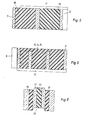
- the hollow block in FIGS. 1 and 2 has two narrower springs 1, 2, a central broad spring 3 and two grooves 4, 5 on one end. On the other end of the joint, two tongues 6, 7, a wider central groove 8 and two half-grooves 9, 10 are formed.
- a longitudinal web 11 which extends from the outer edge of the central tongue 3 to the bottom plane of the central groove 8.
- a longitudinal groove 12 corresponding to the profile of the web is formed on the lower contact surface of the hollow block.
- the hollow block has three rows of cavities, three broad cavities 13, 14, 15 in the middle and two somewhat narrower cavities 16 to 19 on each side.
- the rows of cavities run parallel to the longitudinal axis of the hollow block and extend from the upper to the lower contact surface , see. Figure 2, 5,6,7.
- the cavities 13, 14, 15 are connected to one another, cf. Figures 2 and 6.
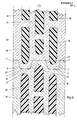
- FIG. 8 shows in section the interlocking of two hollow block bricks, namely “cold” bricked, that is, without mortar between the abutting surfaces.
- the dashed lines 20, 21 show that heat transfer at the abutting surfaces is effectively inhibited by the thermal insulation fillings of the cavities 13, 17, 18 on both sides via the tongue and groove joints 3.8; 4.6; 5.7 protrude.
- thermal insulation on the bearing surfaces is shown in FIG. 9.
- two hollow blocks are connected to one another by means of a mortar layer 22.
- the arrow on the right schematically represents a heat beam that penetrates the stone structure through the mortar layer (and of course on both sides of the mortar layer). As the two curved arrows in the center of the picture show, this heat ray is rejected and bent at the thermal insulation of the cavity 13.
- the mortar layer generally forms a cold bridge because it usually conducts heat better than the stone.
- Attempts to increase the thermal conductivity of the mortar by adapting the raw weight of the mortar material to the raw weight of the stone have brought improvements, but have not been able to remove the cold bridges formed on the mortar joints. It was only the present invention that made extensive thermal insulation at the mortar joints possible.
- FIG. 10 shows an interesting variant of the thermal insulation according to FIG. 9.
- mortar (or other binding agents) 22 are applied only to the edges of the support sides, to the flanks of the web 11, with the result that the flanks of the web 11 bear directly against the side walls of the longitudinal groove 12 of the hollow block lying directly thereon.
- the thermal insulation area of the cavity 13 is thereby shifted further upwards and the heat barrier effect is increased accordingly.
- the dashed box 23 shows the restricted area around the mortar joint 22.
- the hollow block of the design example consists of pumice concrete with a bulk density of 0.80 kg / dm 3 .
- the hollow block according to the invention can be made from any common material, such as gas concrete or the like.
- the cavities are filled with a plastic foam (material density 0.015 kg / dm 3 ).
- the bathleitzah _ the Bimsbetons is and that of the filling foam
Landscapes
- Engineering & Computer Science (AREA)
- Architecture (AREA)
- Civil Engineering (AREA)
- Structural Engineering (AREA)
- Building Environments (AREA)
- Thermal Insulation (AREA)
Applications Claiming Priority (2)
| Application Number | Priority Date | Filing Date | Title |
|---|---|---|---|
| DE19823216080 DE3216080A1 (de) | 1982-04-30 | 1982-04-30 | Hohlblockstein |
| DE3216080 | 1982-04-30 |
Publications (2)
| Publication Number | Publication Date |
|---|---|
| EP0093417A2 true EP0093417A2 (fr) | 1983-11-09 |
| EP0093417A3 EP0093417A3 (fr) | 1984-10-03 |
Family
ID=6162314
Family Applications (1)
| Application Number | Title | Priority Date | Filing Date |
|---|---|---|---|
| EP83104191A Withdrawn EP0093417A3 (fr) | 1982-04-30 | 1983-04-29 | Bloc creux |
Country Status (2)
| Country | Link |
|---|---|
| EP (1) | EP0093417A3 (fr) |
| DE (1) | DE3216080A1 (fr) |
Cited By (10)
| Publication number | Priority date | Publication date | Assignee | Title |
|---|---|---|---|---|
| WO2004072400A1 (fr) * | 2003-02-17 | 2004-08-26 | Perez Aranda Carlos | Briqueterie thermo acoustique integree polyvalente |
| DE102009011992A1 (de) * | 2009-03-05 | 2010-09-09 | Greisel Bauelemente Gmbh | Mauerstein aus Porenbeton |
| EP2138645A3 (fr) * | 2008-06-23 | 2012-10-10 | Laterizi F.lli di Carlantonio S.r.l. con Unico Socio | Bloc de construction |
| WO2013036271A1 (fr) * | 2011-09-08 | 2013-03-14 | Samobi Industries, Llc | Blocs de construction à emboîtement |
| ITRM20110544A1 (it) * | 2011-10-14 | 2013-04-15 | Ceramica D Arte Santoriello | Elemento costruttivo per la costruzione di strutture edili e relativo sistema per la costruzione di strutture edili. |
| CN103388373A (zh) * | 2013-07-31 | 2013-11-13 | 无锡柯马机械有限公司 | 混凝土砌块 |
| CN104060749A (zh) * | 2014-07-02 | 2014-09-24 | 贾文忠 | 自保温混凝土复合砌块 |
| CN105442741A (zh) * | 2015-11-09 | 2016-03-30 | 无锡新人居科贸有限公司 | 一种用于装配式建筑的外墙砖 |
| EP3269891A1 (fr) * | 2016-07-14 | 2018-01-17 | ADT Aero Dämm Technik GmbH | Bloc de construction et maçonnerie créé à partir de ceux-ci |
| RU207019U1 (ru) * | 2021-06-07 | 2021-10-06 | Нурби Хусинович Кятов | Многослойный газобетонный блок |
Families Citing this family (3)
| Publication number | Priority date | Publication date | Assignee | Title |
|---|---|---|---|---|
| AT392309B (de) * | 1986-03-10 | 1991-03-11 | Wienerberger Baustoffind Ag | Mauerwerksverband |
| US9822529B1 (en) * | 2016-11-08 | 2017-11-21 | King Saud University | Interlocking and insulated construction blocks |
| CN109113256B (zh) * | 2018-09-21 | 2020-10-09 | 山东金锐住宅工业科技有限公司 | 一种建筑节能砌块 |
Family Cites Families (7)
| Publication number | Priority date | Publication date | Assignee | Title |
|---|---|---|---|---|
| FR717432A (fr) * | 1931-05-21 | 1932-01-08 | éléments de construction et leur mode d'assemblage | |
| FR40523E (fr) * | 1931-07-24 | 1932-07-22 | éléments de construction et leur mode d'assemblage | |
| FR1300139A (fr) * | 1961-04-27 | 1962-08-03 | Structure portante préfabriquée et éléments de construction monoblocs autoportants à isolement incorporé | |
| FR1320636A (fr) * | 1962-04-27 | 1963-03-08 | Blocs préfabriqués en béton tels que parpaings | |
| FR2115117A7 (en) * | 1970-11-30 | 1972-07-07 | Benenati Vincent | Wall panel - of plaster with expanded plastic core |
| FR2201377B1 (fr) * | 1972-09-22 | 1976-03-12 | Marseille Tuileries | |
| EP0018328A3 (fr) * | 1979-04-19 | 1980-11-26 | Procima S.A. | Elément de construction préfabriqué |
-
1982
- 1982-04-30 DE DE19823216080 patent/DE3216080A1/de not_active Withdrawn
-
1983
- 1983-04-29 EP EP83104191A patent/EP0093417A3/fr not_active Withdrawn
Cited By (13)
| Publication number | Priority date | Publication date | Assignee | Title |
|---|---|---|---|---|
| WO2004072400A1 (fr) * | 2003-02-17 | 2004-08-26 | Perez Aranda Carlos | Briqueterie thermo acoustique integree polyvalente |
| EP2138645A3 (fr) * | 2008-06-23 | 2012-10-10 | Laterizi F.lli di Carlantonio S.r.l. con Unico Socio | Bloc de construction |
| EP2226445A3 (fr) * | 2009-03-05 | 2013-10-09 | Greisel Bauelemente GmbH | Pierre taillée en béton poreux |
| DE102009011992A1 (de) * | 2009-03-05 | 2010-09-09 | Greisel Bauelemente Gmbh | Mauerstein aus Porenbeton |
| WO2013036271A1 (fr) * | 2011-09-08 | 2013-03-14 | Samobi Industries, Llc | Blocs de construction à emboîtement |
| US8601758B2 (en) | 2011-09-08 | 2013-12-10 | Samobi Industries, Llc | Interlocking construction blocks |
| EP2581514A1 (fr) * | 2011-10-14 | 2013-04-17 | Ceramica D'Arte Santoriello | Brique avec plusieurs cavités |
| ITRM20110544A1 (it) * | 2011-10-14 | 2013-04-15 | Ceramica D Arte Santoriello | Elemento costruttivo per la costruzione di strutture edili e relativo sistema per la costruzione di strutture edili. |
| CN103388373A (zh) * | 2013-07-31 | 2013-11-13 | 无锡柯马机械有限公司 | 混凝土砌块 |
| CN104060749A (zh) * | 2014-07-02 | 2014-09-24 | 贾文忠 | 自保温混凝土复合砌块 |
| CN105442741A (zh) * | 2015-11-09 | 2016-03-30 | 无锡新人居科贸有限公司 | 一种用于装配式建筑的外墙砖 |
| EP3269891A1 (fr) * | 2016-07-14 | 2018-01-17 | ADT Aero Dämm Technik GmbH | Bloc de construction et maçonnerie créé à partir de ceux-ci |
| RU207019U1 (ru) * | 2021-06-07 | 2021-10-06 | Нурби Хусинович Кятов | Многослойный газобетонный блок |
Also Published As
| Publication number | Publication date |
|---|---|
| DE3216080A1 (de) | 1983-11-03 |
| EP0093417A3 (fr) | 1984-10-03 |
Similar Documents
| Publication | Publication Date | Title |
|---|---|---|
| DE3005402C2 (de) | Isolierendes Verbandsmauerwerk | |
| DE3216080A1 (de) | Hohlblockstein | |
| DE3201832A1 (de) | Hohlbaustein und darauf aufgebautes baukastensystem | |
| DE2552699C2 (de) | Mauerwerk | |
| DE3429097A1 (de) | Baustein fuer gemauerte konstruktionen sowie aus solchen bausteinen gebildete mauer | |
| AT394222B (de) | Formstein, vorzugsweise aus beton | |
| DE2751542A1 (de) | Element zur aussenisolation von aeusseren gebaeudewaenden | |
| DE8212413U1 (de) | Hohlblockstein | |
| DE2111652C3 (de) | Verbuhdstein, vorzugsweise zur Befestigung von Böschungen | |
| DE2203824A1 (de) | Schalungsstein | |
| DE7632861U1 (de) | Mauerstein | |
| DE2251621C2 (de) | Verbundbelag mit Verlegeeinheiten und Verfahren zum Herstellen des Verbundbelages | |
| CH524028A (de) | Mauerstein, insbesondere Hohlblockstein und eine Verwendung des Steins | |
| DE807985C (de) | Deckenhohlstein und aus ihm gefertigter Hohlziegelbalken | |
| DE3310074A1 (de) | Hohlblockstein | |
| DE2921113A1 (de) | Schalungsstein | |
| DE2313316A1 (de) | Quaderfoermiger schalungsstein fuer tragende wandungen | |
| CH687339A5 (de) | Verfahren zur Herstellung eines wärmeisolierenden Sturzes. | |
| DE2235985A1 (de) | Baustein | |
| DE521060C (de) | Verfahren zur Herstellung von Eisenbetonrippendecken ohne Schalung | |
| DE585821C (de) | Hohlsteindecke | |
| DE19823657B4 (de) | Verfahren zum Befüllen von Wandtafeln aus Schalungssteinen | |
| DE2332678A1 (de) | Block zum errichten von mauern | |
| DE3212582A1 (de) | Baustein und waermedaemmschicht fuer einen baustein | |
| DE3206373C2 (fr) |
Legal Events
| Date | Code | Title | Description |
|---|---|---|---|
| PUAI | Public reference made under article 153(3) epc to a published international application that has entered the european phase |
Free format text: ORIGINAL CODE: 0009012 |
|
| AK | Designated contracting states |
Designated state(s): AT BE CH DE FR GB IT LI LU NL SE |
|
| 17P | Request for examination filed |
Effective date: 19840509 |
|
| R17P | Request for examination filed (corrected) |
Effective date: 19840509 |
|
| PUAL | Search report despatched |
Free format text: ORIGINAL CODE: 0009013 |
|
| AK | Designated contracting states |
Designated state(s): AT BE CH DE FR GB IT LI LU NL SE |
|
| STAA | Information on the status of an ep patent application or granted ep patent |
Free format text: STATUS: THE APPLICATION IS DEEMED TO BE WITHDRAWN |
|
| 18D | Application deemed to be withdrawn |
Effective date: 19851101 |
|
| RIN1 | Information on inventor provided before grant (corrected) |
Inventor name: DOSE, HORST-PETER, ING. GRAD. |