EP0093434B1 - Herstellung von Polyalkylenpolyaminen - Google Patents
Herstellung von Polyalkylenpolyaminen Download PDFInfo
- Publication number
- EP0093434B1 EP0093434B1 EP19830104238 EP83104238A EP0093434B1 EP 0093434 B1 EP0093434 B1 EP 0093434B1 EP 19830104238 EP19830104238 EP 19830104238 EP 83104238 A EP83104238 A EP 83104238A EP 0093434 B1 EP0093434 B1 EP 0093434B1
- Authority
- EP
- European Patent Office
- Prior art keywords
- reaction
- water
- hydrogen
- phosphorus
- acid
- Prior art date
- Legal status (The legal status is an assumption and is not a legal conclusion. Google has not performed a legal analysis and makes no representation as to the accuracy of the status listed.)
- Expired
Links
- 229920001281 polyalkylene Polymers 0.000 title claims description 33
- 229920000768 polyamine Polymers 0.000 title claims description 33
- 238000002360 preparation method Methods 0.000 title description 2
- 238000006243 chemical reaction Methods 0.000 claims description 77
- XLYOFNOQVPJJNP-UHFFFAOYSA-N water Substances O XLYOFNOQVPJJNP-UHFFFAOYSA-N 0.000 claims description 71
- 238000000034 method Methods 0.000 claims description 46
- -1 hydroxy alkylene compound Chemical class 0.000 claims description 39
- 229910052698 phosphorus Inorganic materials 0.000 claims description 36
- 239000002253 acid Substances 0.000 claims description 32
- 239000011574 phosphorus Substances 0.000 claims description 31
- LYCAIKOWRPUZTN-UHFFFAOYSA-N Ethylene glycol Chemical compound OCCO LYCAIKOWRPUZTN-UHFFFAOYSA-N 0.000 claims description 24
- OAICVXFJPJFONN-UHFFFAOYSA-N Phosphorus Chemical compound [P] OAICVXFJPJFONN-UHFFFAOYSA-N 0.000 claims description 23
- 150000001875 compounds Chemical class 0.000 claims description 19
- 239000011541 reaction mixture Substances 0.000 claims description 17
- 125000000217 alkyl group Chemical group 0.000 claims description 16
- 125000005263 alkylenediamine group Chemical group 0.000 claims description 16
- 239000001257 hydrogen Substances 0.000 claims description 15
- 229910052739 hydrogen Inorganic materials 0.000 claims description 15
- GLUUGHFHXGJENI-UHFFFAOYSA-N Piperazine Chemical compound C1CNCCN1 GLUUGHFHXGJENI-UHFFFAOYSA-N 0.000 claims description 11
- NBIIXXVUZAFLBC-UHFFFAOYSA-N Phosphoric acid Chemical compound OP(O)(O)=O NBIIXXVUZAFLBC-UHFFFAOYSA-N 0.000 claims description 10
- 125000004435 hydrogen atom Chemical group [H]* 0.000 claims description 9
- UFHFLCQGNIYNRP-UHFFFAOYSA-N Hydrogen Chemical compound [H][H] UFHFLCQGNIYNRP-UHFFFAOYSA-N 0.000 claims description 8
- HZAXFHJVJLSVMW-UHFFFAOYSA-N 2-Aminoethan-1-ol Chemical compound NCCO HZAXFHJVJLSVMW-UHFFFAOYSA-N 0.000 claims description 7
- PIICEJLVQHRZGT-UHFFFAOYSA-N Ethylenediamine Chemical compound NCCN PIICEJLVQHRZGT-UHFFFAOYSA-N 0.000 claims description 7
- 125000003118 aryl group Chemical group 0.000 claims description 7
- 229910000149 boron phosphate Inorganic materials 0.000 claims description 7
- 239000007792 gaseous phase Substances 0.000 claims description 5
- 229910000147 aluminium phosphate Inorganic materials 0.000 claims description 4
- YZYDPPZYDIRSJT-UHFFFAOYSA-K boron phosphate Chemical compound [B+3].[O-]P([O-])([O-])=O YZYDPPZYDIRSJT-UHFFFAOYSA-K 0.000 claims description 4
- 229910052799 carbon Inorganic materials 0.000 claims description 4
- 208000012839 conversion disease Diseases 0.000 claims description 4
- ZBCBWPMODOFKDW-UHFFFAOYSA-N diethanolamine Chemical compound OCCNCCO ZBCBWPMODOFKDW-UHFFFAOYSA-N 0.000 claims description 4
- 239000007791 liquid phase Substances 0.000 claims description 4
- 229910052760 oxygen Inorganic materials 0.000 claims description 4
- 239000001301 oxygen Substances 0.000 claims description 4
- MYMOFIZGZYHOMD-UHFFFAOYSA-N Dioxygen Chemical compound O=O MYMOFIZGZYHOMD-UHFFFAOYSA-N 0.000 claims description 3
- 239000005955 Ferric phosphate Substances 0.000 claims description 3
- ILRRQNADMUWWFW-UHFFFAOYSA-K aluminium phosphate Chemical compound O1[Al]2OP1(=O)O2 ILRRQNADMUWWFW-UHFFFAOYSA-K 0.000 claims description 3
- 238000004821 distillation Methods 0.000 claims description 3
- 229940032958 ferric phosphate Drugs 0.000 claims description 3
- WBJZTOZJJYAKHQ-UHFFFAOYSA-K iron(3+) phosphate Chemical compound [Fe+3].[O-]P([O-])([O-])=O WBJZTOZJJYAKHQ-UHFFFAOYSA-K 0.000 claims description 3
- 229910000399 iron(III) phosphate Inorganic materials 0.000 claims description 3
- FDIOSTIIZGWENY-UHFFFAOYSA-N n-[bis(diethylamino)phosphanyl]-n-ethylethanamine Chemical compound CCN(CC)P(N(CC)CC)N(CC)CC FDIOSTIIZGWENY-UHFFFAOYSA-N 0.000 claims description 3
- 150000003839 salts Chemical class 0.000 claims description 3
- 238000001179 sorption measurement Methods 0.000 claims description 3
- 229910052717 sulfur Inorganic materials 0.000 claims description 3
- ISIJQEHRDSCQIU-UHFFFAOYSA-N tert-butyl 2,7-diazaspiro[4.5]decane-7-carboxylate Chemical compound C1N(C(=O)OC(C)(C)C)CCCC11CNCC1 ISIJQEHRDSCQIU-UHFFFAOYSA-N 0.000 claims description 3
- 125000003545 alkoxy group Chemical group 0.000 claims description 2
- 125000004104 aryloxy group Chemical group 0.000 claims description 2
- 238000010533 azeotropic distillation Methods 0.000 claims description 2
- 238000004508 fractional distillation Methods 0.000 claims description 2
- XVDBWWRIXBMVJV-UHFFFAOYSA-N n-[bis(dimethylamino)phosphanyl]-n-methylmethanamine Chemical compound CN(C)P(N(C)C)N(C)C XVDBWWRIXBMVJV-UHFFFAOYSA-N 0.000 claims description 2
- 125000002924 primary amino group Chemical group [H]N([H])* 0.000 claims description 2
- PXQLVRUNWNTZOS-UHFFFAOYSA-N sulfanyl Chemical group [SH] PXQLVRUNWNTZOS-UHFFFAOYSA-N 0.000 claims description 2
- 125000004434 sulfur atom Chemical group 0.000 claims description 2
- 125000004356 hydroxy functional group Chemical group O* 0.000 claims 2
- 125000001475 halogen functional group Chemical group 0.000 claims 1
- 150000002431 hydrogen Chemical class 0.000 claims 1
- 239000003054 catalyst Substances 0.000 description 35
- 239000000376 reactant Substances 0.000 description 23
- 238000004519 manufacturing process Methods 0.000 description 18
- 125000004122 cyclic group Chemical group 0.000 description 14
- 238000001035 drying Methods 0.000 description 11
- 239000000203 mixture Substances 0.000 description 11
- 125000002887 hydroxy group Chemical group [H]O* 0.000 description 10
- 239000000047 product Substances 0.000 description 10
- WGCNASOHLSPBMP-UHFFFAOYSA-N hydroxyacetaldehyde Natural products OCC=O WGCNASOHLSPBMP-UHFFFAOYSA-N 0.000 description 9
- 230000001965 increasing effect Effects 0.000 description 8
- 235000011007 phosphoric acid Nutrition 0.000 description 8
- 150000001412 amines Chemical class 0.000 description 7
- 239000000543 intermediate Substances 0.000 description 7
- XKRFYHLGVUSROY-UHFFFAOYSA-N Argon Chemical compound [Ar] XKRFYHLGVUSROY-UHFFFAOYSA-N 0.000 description 6
- 230000015572 biosynthetic process Effects 0.000 description 6
- 150000003016 phosphoric acids Chemical class 0.000 description 6
- 150000007513 acids Chemical class 0.000 description 5
- 125000002947 alkylene group Chemical group 0.000 description 5
- 150000001923 cyclic compounds Chemical class 0.000 description 5
- 229910019142 PO4 Inorganic materials 0.000 description 4
- 125000004429 atom Chemical group 0.000 description 4
- 238000006482 condensation reaction Methods 0.000 description 4
- 238000002474 experimental method Methods 0.000 description 4
- 235000021317 phosphate Nutrition 0.000 description 4
- 125000004437 phosphorous atom Chemical group 0.000 description 4
- VILCJCGEZXAXTO-UHFFFAOYSA-N 2,2,2-tetramine Chemical compound NCCNCCNCCN VILCJCGEZXAXTO-UHFFFAOYSA-N 0.000 description 3
- DNIAPMSPPWPWGF-UHFFFAOYSA-N Propylene glycol Chemical compound CC(O)CO DNIAPMSPPWPWGF-UHFFFAOYSA-N 0.000 description 3
- 150000001408 amides Chemical class 0.000 description 3
- 150000008064 anhydrides Chemical class 0.000 description 3
- 229910052786 argon Inorganic materials 0.000 description 3
- 239000006227 byproduct Substances 0.000 description 3
- 238000009833 condensation Methods 0.000 description 3
- 230000005494 condensation Effects 0.000 description 3
- 150000002148 esters Chemical class 0.000 description 3
- 238000004817 gas chromatography Methods 0.000 description 3
- 229910052751 metal Inorganic materials 0.000 description 3
- 239000002184 metal Substances 0.000 description 3
- 229910052757 nitrogen Chemical group 0.000 description 3
- 238000006068 polycondensation reaction Methods 0.000 description 3
- 238000011084 recovery Methods 0.000 description 3
- 230000000717 retained effect Effects 0.000 description 3
- 230000002441 reversible effect Effects 0.000 description 3
- PAOXFRSJRCGJLV-UHFFFAOYSA-N 2-[4-(2-aminoethyl)piperazin-1-yl]ethanamine Chemical compound NCCN1CCN(CCN)CC1 PAOXFRSJRCGJLV-UHFFFAOYSA-N 0.000 description 2
- IJGRMHOSHXDMSA-UHFFFAOYSA-N Atomic nitrogen Chemical compound N#N IJGRMHOSHXDMSA-UHFFFAOYSA-N 0.000 description 2
- 0 CN(C(*)C(*)N1C)C(*)C1S Chemical compound CN(C(*)C(*)N1C)C(*)C1S 0.000 description 2
- RPNUMPOLZDHAAY-UHFFFAOYSA-N Diethylenetriamine Chemical compound NCCNCCN RPNUMPOLZDHAAY-UHFFFAOYSA-N 0.000 description 2
- 230000002378 acidificating effect Effects 0.000 description 2
- 125000003277 amino group Chemical group 0.000 description 2
- LHIJANUOQQMGNT-UHFFFAOYSA-N aminoethylethanolamine Chemical compound NCCNCCO LHIJANUOQQMGNT-UHFFFAOYSA-N 0.000 description 2
- IMUDHTPIFIBORV-UHFFFAOYSA-N aminoethylpiperazine Chemical compound NCCN1CCNCC1 IMUDHTPIFIBORV-UHFFFAOYSA-N 0.000 description 2
- 238000004458 analytical method Methods 0.000 description 2
- 239000007864 aqueous solution Substances 0.000 description 2
- 230000001419 dependent effect Effects 0.000 description 2
- 239000002274 desiccant Substances 0.000 description 2
- 230000000694 effects Effects 0.000 description 2
- 125000000524 functional group Chemical group 0.000 description 2
- 229910052736 halogen Inorganic materials 0.000 description 2
- 125000005843 halogen group Chemical group 0.000 description 2
- 150000002367 halogens Chemical group 0.000 description 2
- 238000010438 heat treatment Methods 0.000 description 2
- BHEPBYXIRTUNPN-UHFFFAOYSA-N hydridophosphorus(.) (triplet) Chemical compound [PH] BHEPBYXIRTUNPN-UHFFFAOYSA-N 0.000 description 2
- 150000002440 hydroxy compounds Chemical class 0.000 description 2
- 229910001463 metal phosphate Inorganic materials 0.000 description 2
- 239000002808 molecular sieve Substances 0.000 description 2
- ROZPNEGZBIUWBX-UHFFFAOYSA-N n-[bis(diethylamino)phosphoryl]-n-ethylethanamine Chemical compound CCN(CC)P(=O)(N(CC)CC)N(CC)CC ROZPNEGZBIUWBX-UHFFFAOYSA-N 0.000 description 2
- 125000004433 nitrogen atom Chemical group N* 0.000 description 2
- 125000004430 oxygen atom Chemical group O* 0.000 description 2
- 239000010452 phosphate Substances 0.000 description 2
- 150000003009 phosphonic acids Chemical class 0.000 description 2
- 150000003017 phosphorus Chemical class 0.000 description 2
- YPFDHNVEDLHUCE-UHFFFAOYSA-N propane-1,3-diol Chemical compound OCCCO YPFDHNVEDLHUCE-UHFFFAOYSA-N 0.000 description 2
- URGAHOPLAPQHLN-UHFFFAOYSA-N sodium aluminosilicate Chemical compound [Na+].[Al+3].[O-][Si]([O-])=O.[O-][Si]([O-])=O URGAHOPLAPQHLN-UHFFFAOYSA-N 0.000 description 2
- 239000000126 substance Substances 0.000 description 2
- PUPZLCDOIYMWBV-UHFFFAOYSA-N (+/-)-1,3-Butanediol Chemical compound CC(O)CCO PUPZLCDOIYMWBV-UHFFFAOYSA-N 0.000 description 1
- OKTJSMMVPCPJKN-UHFFFAOYSA-N Carbon Chemical compound [C] OKTJSMMVPCPJKN-UHFFFAOYSA-N 0.000 description 1
- 239000004593 Epoxy Substances 0.000 description 1
- JOYRKODLDBILNP-UHFFFAOYSA-N Ethyl urethane Chemical compound CCOC(N)=O JOYRKODLDBILNP-UHFFFAOYSA-N 0.000 description 1
- UEZVMMHDMIWARA-UHFFFAOYSA-N Metaphosphoric acid Chemical compound OP(=O)=O UEZVMMHDMIWARA-UHFFFAOYSA-N 0.000 description 1
- ZWBALHRZGYPNNG-UHFFFAOYSA-N Monomethyl phenylphosphonate Chemical compound COP(O)(=O)C1=CC=CC=C1 ZWBALHRZGYPNNG-UHFFFAOYSA-N 0.000 description 1
- 239000004952 Polyamide Substances 0.000 description 1
- NINIDFKCEFEMDL-UHFFFAOYSA-N Sulfur Chemical group [S] NINIDFKCEFEMDL-UHFFFAOYSA-N 0.000 description 1
- 238000010521 absorption reaction Methods 0.000 description 1
- 239000003377 acid catalyst Substances 0.000 description 1
- 239000000654 additive Substances 0.000 description 1
- 239000002671 adjuvant Substances 0.000 description 1
- 150000001335 aliphatic alkanes Chemical class 0.000 description 1
- 229910052783 alkali metal Inorganic materials 0.000 description 1
- 150000001340 alkali metals Chemical class 0.000 description 1
- 150000004984 aromatic diamines Chemical class 0.000 description 1
- 239000010426 asphalt Substances 0.000 description 1
- QVGXLLKOCUKJST-UHFFFAOYSA-N atomic oxygen Chemical compound [O] QVGXLLKOCUKJST-UHFFFAOYSA-N 0.000 description 1
- 238000007630 basic procedure Methods 0.000 description 1
- 238000004364 calculation method Methods 0.000 description 1
- 150000001768 cations Chemical class 0.000 description 1
- 239000002738 chelating agent Substances 0.000 description 1
- 239000003153 chemical reaction reagent Substances 0.000 description 1
- 239000003795 chemical substances by application Substances 0.000 description 1
- 230000000052 comparative effect Effects 0.000 description 1
- 238000001816 cooling Methods 0.000 description 1
- 238000005260 corrosion Methods 0.000 description 1
- 230000007797 corrosion Effects 0.000 description 1
- 230000009849 deactivation Effects 0.000 description 1
- 230000002939 deleterious effect Effects 0.000 description 1
- RLMOMHNXIWBGTF-UHFFFAOYSA-N diaminophosphinoamine Chemical class NP(N)N RLMOMHNXIWBGTF-UHFFFAOYSA-N 0.000 description 1
- OXDOANYFRLHSML-UHFFFAOYSA-N dimethoxyphosphorylbenzene Chemical compound COP(=O)(OC)C1=CC=CC=C1 OXDOANYFRLHSML-UHFFFAOYSA-N 0.000 description 1
- 150000002009 diols Chemical class 0.000 description 1
- XPPKVPWEQAFLFU-UHFFFAOYSA-N diphosphoric acid Chemical compound OP(O)(=O)OP(O)(O)=O XPPKVPWEQAFLFU-UHFFFAOYSA-N 0.000 description 1
- 230000008034 disappearance Effects 0.000 description 1
- 238000005485 electric heating Methods 0.000 description 1
- 230000002708 enhancing effect Effects 0.000 description 1
- 125000001495 ethyl group Chemical group [H]C([H])([H])C([H])([H])* 0.000 description 1
- 238000001914 filtration Methods 0.000 description 1
- 238000009472 formulation Methods 0.000 description 1
- 239000002816 fuel additive Substances 0.000 description 1
- 239000007789 gas Substances 0.000 description 1
- 125000000623 heterocyclic group Chemical group 0.000 description 1
- GNOIPBMMFNIUFM-UHFFFAOYSA-N hexamethylphosphoric triamide Chemical compound CN(C)P(=O)(N(C)C)N(C)C GNOIPBMMFNIUFM-UHFFFAOYSA-N 0.000 description 1
- XXMIOPMDWAUFGU-UHFFFAOYSA-N hexane-1,6-diol Chemical compound OCCCCCCO XXMIOPMDWAUFGU-UHFFFAOYSA-N 0.000 description 1
- 238000005984 hydrogenation reaction Methods 0.000 description 1
- 230000003301 hydrolyzing effect Effects 0.000 description 1
- TUJKJAMUKRIRHC-UHFFFAOYSA-N hydroxyl Chemical compound [OH] TUJKJAMUKRIRHC-UHFFFAOYSA-N 0.000 description 1
- 238000011065 in-situ storage Methods 0.000 description 1
- 239000003112 inhibitor Substances 0.000 description 1
- 239000003456 ion exchange resin Substances 0.000 description 1
- 229920003303 ion-exchange polymer Polymers 0.000 description 1
- 230000002427 irreversible effect Effects 0.000 description 1
- 239000007788 liquid Substances 0.000 description 1
- 239000000463 material Substances 0.000 description 1
- ZUYQAYFMISSPTF-UHFFFAOYSA-N methoxy-oxo-phenylphosphanium Chemical compound CO[P+](=O)C1=CC=CC=C1 ZUYQAYFMISSPTF-UHFFFAOYSA-N 0.000 description 1
- GHZKGHQGPXBWSN-UHFFFAOYSA-N methyl(propan-2-yloxy)phosphinic acid Chemical compound CC(C)OP(C)(O)=O GHZKGHQGPXBWSN-UHFFFAOYSA-N 0.000 description 1
- BCDIWLCKOCHCIH-UHFFFAOYSA-N methylphosphinic acid Chemical class CP(O)=O BCDIWLCKOCHCIH-UHFFFAOYSA-N 0.000 description 1
- WBIWIXJUBVWKLS-UHFFFAOYSA-N n'-(2-piperazin-1-ylethyl)ethane-1,2-diamine Chemical compound NCCNCCN1CCNCC1 WBIWIXJUBVWKLS-UHFFFAOYSA-N 0.000 description 1
- 239000003960 organic solvent Substances 0.000 description 1
- MPQXHAGKBWFSNV-UHFFFAOYSA-N oxidophosphanium Chemical class [PH3]=O MPQXHAGKBWFSNV-UHFFFAOYSA-N 0.000 description 1
- 150000002989 phenols Chemical class 0.000 description 1
- 150000003003 phosphines Chemical class 0.000 description 1
- PTMHPRAIXMAOOB-UHFFFAOYSA-N phosphoramidic acid Chemical class NP(O)(O)=O PTMHPRAIXMAOOB-UHFFFAOYSA-N 0.000 description 1
- SXADIBFZNXBEGI-UHFFFAOYSA-N phosphoramidous acid Chemical class NP(O)O SXADIBFZNXBEGI-UHFFFAOYSA-N 0.000 description 1
- 150000003014 phosphoric acid esters Chemical group 0.000 description 1
- OJMIONKXNSYLSR-UHFFFAOYSA-N phosphorous acid Chemical group OP(O)O OJMIONKXNSYLSR-UHFFFAOYSA-N 0.000 description 1
- 150000003018 phosphorus compounds Chemical class 0.000 description 1
- 125000004193 piperazinyl group Chemical group 0.000 description 1
- 229920002647 polyamide Polymers 0.000 description 1
- 229920000137 polyphosphoric acid Polymers 0.000 description 1
- 150000003152 propanolamines Chemical class 0.000 description 1
- 229940005657 pyrophosphoric acid Drugs 0.000 description 1
- 238000010791 quenching Methods 0.000 description 1
- 230000035484 reaction time Effects 0.000 description 1
- 239000011347 resin Substances 0.000 description 1
- 229920005989 resin Polymers 0.000 description 1
- 239000004576 sand Substances 0.000 description 1
- 150000003335 secondary amines Chemical class 0.000 description 1
- 239000000243 solution Substances 0.000 description 1
- 239000002904 solvent Substances 0.000 description 1
- 229910001220 stainless steel Inorganic materials 0.000 description 1
- 239000010935 stainless steel Substances 0.000 description 1
- 239000011593 sulfur Chemical group 0.000 description 1
- 125000001302 tertiary amino group Chemical group 0.000 description 1
- FAGUFWYHJQFNRV-UHFFFAOYSA-N tetraethylenepentamine Chemical class NCCNCCNCCNCCN FAGUFWYHJQFNRV-UHFFFAOYSA-N 0.000 description 1
Classifications
-
- C—CHEMISTRY; METALLURGY
- C07—ORGANIC CHEMISTRY
- C07C—ACYCLIC OR CARBOCYCLIC COMPOUNDS
- C07C209/00—Preparation of compounds containing amino groups bound to a carbon skeleton
- C07C209/04—Preparation of compounds containing amino groups bound to a carbon skeleton by substitution of functional groups by amino groups
- C07C209/14—Preparation of compounds containing amino groups bound to a carbon skeleton by substitution of functional groups by amino groups by substitution of hydroxy groups or of etherified or esterified hydroxy groups
- C07C209/16—Preparation of compounds containing amino groups bound to a carbon skeleton by substitution of functional groups by amino groups by substitution of hydroxy groups or of etherified or esterified hydroxy groups with formation of amino groups bound to acyclic carbon atoms or to carbon atoms of rings other than six-membered aromatic rings
-
- C—CHEMISTRY; METALLURGY
- C08—ORGANIC MACROMOLECULAR COMPOUNDS; THEIR PREPARATION OR CHEMICAL WORKING-UP; COMPOSITIONS BASED THEREON
- C08G—MACROMOLECULAR COMPOUNDS OBTAINED OTHERWISE THAN BY REACTIONS ONLY INVOLVING UNSATURATED CARBON-TO-CARBON BONDS
- C08G73/00—Macromolecular compounds obtained by reactions forming a linkage containing nitrogen with or without oxygen or carbon in the main chain of the macromolecule, not provided for in groups C08G12/00 - C08G71/00
- C08G73/02—Polyamines
- C08G73/0206—Polyalkylene(poly)amines
- C08G73/0213—Preparatory process
Definitions
- This invention relates to the production of polyalkylene polyamines, and more particularly to a process for enhancing the production of predominantly linearly extended polyalkylene polyamines while substantially avoiding the production of heterocyclic by-products.
- a preferred embodiment of the Brennan process is to retain water in the reaction zone and remove it from the reaction mass during recovery of the product.
- the disclosed process even provides for the addition of water to the reaction mass to generate an aqueous solution for conducting the process, such as described in Example II in Brennan I.
- U.S. Patent 3,121,115 contains a disclosure for the production of aminoalkylated compounds containing tertiary amino groups.
- the disclosed process involves reacting alkylatable amines or phenols with N-tertiary aminoalkanols in the presence of a phosphoric acid catalyst.
- alkylenediamine reactant since the patent is limited to specifically describing monoamines or aromatic diamines.
- difunctional alkylene glycol or alkanolamine reactant since the patent is specifically limited to monofunctional, tertiary aminoalkanol reactants.
- U.S. Patent 3,714,259 discloses an alternative process for the production of linear polyalkylene polyamines using a hydrogenation catalyst. There is no disclosure of water removal, or that the use of a phosphorus-containing catalyst would create a dependency on water concentration.
- the present invention relates to a process for producing predominantly linearly extended polyalkylene polyamines comprising:
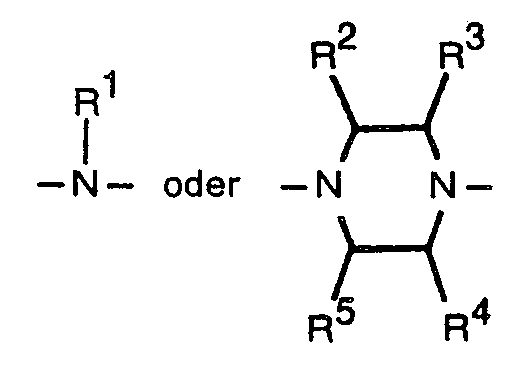
- the alkylenediamine includes cyclic or non-cyclic alkyleneamine compounds having the structure: wherein A is x is an integer greater than 1, preferably from 2 to about 6; y is an integer from 0 to about 6, preferably from 0 to about 2; wherein when y is 0, A is and each R, R', R 2 , R 3 , R 4 and R 5 is a hydrogen or lower alkyl, preferably hydrogen.
- the difunctional hydroxy alkylene compound includes cyclic or non-cyclic compounds with the structure: wherein A is each R, R 1 , R 2 , R 3 , R 4 and R 5 is hydrogen or lower alkyl, preferably hydrogen; each a, b and c is any integer greater than 1, preferably 2 to about 6; d is 0 or an integer greater than 1; each x and z is 0 or 1; each wand y is any integer from 0 to about 6, preferably from 0 to about 2; provided that d, w and y are 0 and z is 1 when x is 0; and z is 0 when x is 1 and d is 0.
- the present invention provides for an improved process for producing predominantly linearly extended polyalkylene polyamines in enhanced conversion rates by reacting an alkylenediamine with an alkylene glycol or alkanolamine, in the presence of a phosphorus-containing catalyst, wherein water is removed during the reaction.
- the alkylenediamine reactants are defined as cyclic or non-cyclic compounds, or mixtures of compounds, which contain two primary or secondary, preferably primary, amines separated by alkylene chains.
- the alkylenediamines that can be generally employed in the present invention include those having the structure: wherein A is x is an integer greater than 1, preferably from 2 to about 6; y is an integer from 0 to about 6, preferably from 0 to about 2, wherein when y is 0 A is and R, R 1 , R 2 , R 3 , R 4 and R 5 are hydrogen or lower alkyl, preferably hydrogen.
- alkylenediamines that can be used as reactants in the process of the present invention, along with their structure defined by the parameters in Formula III, include those listed in Table 1 :
- alkylenediamine reagents include ethylenediamine and piperazine.
- Pip.erazine is a preferred cyclic reactant for the reason that the process of the present invention provides for the relatively selective attachment of non-cyclic alkyleneamine groups onto the piperazine cyclic ring. In this manner, the cyclic by-products formed during the production of polyalkylene polyamines may be given greater utility by increasing the linear structures within the molecules.
- the difunctional hydroxy alkylene reactants are defined as cyclic or non-cyclic compounds; or mixtures of compounds, containing a difunctional alkylene moiety connected at one point to a hydroxy group and at another point, either directly or through a chain of one or more alkyleneamine groups, to another hydroxy group or to an amino group that has at least one hydrogen substituent.
- the term therefore comprises the classes of alkylene glycols and alkanolamines having active amine hydrogens.
- Such compounds include those with the structure: wherein A is each R, R 1 , R 2 , R 3 , R 4 , and R S is hydrogen or lower alkyl, preferably hydrogen; each a, b and c is any integer greater than 1, preferably 2 to about 6; d is 0 or an integer greater than 1; each x and z is 0 or 1; each wand y is any integer from 0 to about 6, preferably from 0 to about 2; provided that d, w and y are 0 and z is 1 when x is 0; and z is 0 when x is 1 and d is 0.
- the alkylene glycol reactants include the noncyclic diols of lower alkylene groups.
- alkylene glycol compounds are ethylene glycol, propylene glycol, butylene glycol, trimethylene glycol, hexamethylene glycol, and the like.
- a preferred alkylene glycol is ethylene glycol.
- the alkanolamine reactants include such compounds as monoethanolamine, diethanolamine, N-(2-aminoethyl)ethanolamine, propanolamines, N,N-bis(hydroxyethyl)piperazine and the like.
- Preferred alkanolamines include monoethanolamine and diethanolamine.
- R term in the groups can, of course, represent either hydrogen or various alkyl groups alternatively within the same alkylene chain of x carbon, atoms.
- R' term in the groups can, of course, vary between groups.
- the relative proportions of alkylenediamine to difunctional hydroxy alkylene compound utilized can be from about 6:1 to about 1:1, preferably about 3:1 to about 1:1, based on the molar equivalents of alkylenediamine compound to hydroxy.groups.
- the molar amount of alkylene glycol will usually be about half the molar amount of alkanolamine, used with a given amount of alkylenediamine reactant.
- Particularly preferred embodiments of the invention include condensation reactions of ethylenediamine with either monoethanolamine or ethylene glycol.
- the catalyst utilized in the process of the present invention is a phosphorus acid or acid derivative compound.
- phosphorus acid or acide derivative defines compounds having a P-X bond wherein P is a phosphorus atom bonded to a halogen, oxygen, sulfur or nitrogen atom in X which is a radical capable of 1) hydrolyzing to produce the correspondingg phosphorus acid structure, or 2) exchanging with a hydroxyl group from the hydroxy alkylene reactant to provide a phosphorus ester.
- the phosphorus acid or acid derivative catalyst in the present invention is believed to function by forming with the alkanolamine or alkylene glycol compound a phosphorus ester in situ. For this reason, it is believed that a requirement for a good phosphnorus catalyst is that it contain as a substructure an atom bonded to phosphorus that can be replaced readily by the oxygen atom of a hydroxyl group of the difunctional hydroxy alkylene compound.
- Such a replaceable atom might be oxygen (as in the case of phosphorous or phosphoric acids or their esters), halogen, nitrogen (as in the case of amides of phosphorous or phosphoric acids) or another atom that can be transformed into a phosphorus ester by a similar process.
- Phosphorus-containing compounds such as trialkyl and triaryl phosphines and phosphine oxides, which contain no such exchangeable substructure, do not function as catalysts in the subject process.
- Very sterically hindered phosphorus compounds such as hexaethyl phosphoric triamide, while containing the requisite exchangeable substructure and functioning to some extent as catalyst for the subject invention, are less preferred catalysts because they undergo the exchange process with the alkanolamine or alkylene glycol hydroxyl moieties only slowly.
- Phosphorus acids are defined by those structures wherein X in the P-X radical is a hydroxyl radical.
- Acid derivatives are defined by structures wherein X is a substitute functional group.
- Various acids derivatives include: salts when -X is -O-M + wherein M + is a mono or polyvalent cation; amides when -X is bonded to the phosphorus atom through a nitrogen atom; anhydrides when -X contains a second phosphorus atom bonded to the first phosphorus atom through an oxygen atom; esters when -X is -OR; and so on with regard to other functional groups defined by -X.
- the precise phosphorus acid or acid derivative structure is not critical so long as it fulfills the following two functional requirements: 1) that it provides for the relatively selective production of predominantly linearly extended polyalkylene polyamines and 2) that it enables increased conversion rates for polyalkylene polyamine production when water is removed during the reaction, possibly due to the water-inhibited formation of a phosphorus intermediate compound during the reaction.
- the phosphorus acids or acid derivative catalysts include those having the structure: wherein Y is an oxygen or sulfur atom; n is 0 or 1; X is hydroxy, alkoxy, aryloxy or the thioanalogs of the foregoing, alkyl or aryl substituted amino, halo, or the salts or phosphorus anhydrides or thioanhydrides of the foregoing when X is hydroxy or mercapto; R' and R" are hydrogen, alkyl, aryl or one of the groups previously defined by X.
- Suitable phosphorus acid or acid derivatives which can be employed include, for example, acidic metal or semi-metal phosphates, phosphoric acid compounds, and their anhydrides, phosphorous acid compounds and anhydrides, alkyl or aryl phosphates, alkyl or aryl phosphites, alkyl or aryl substituted phosphonic acids and phosphinic acids, alkali metal monosalts of phosphoric acid, phosphorous amides and phosphoric amides, the thioanalogs of the foregoing, and mixtures of any of the above.
- Suitable acidic metal or semi-metal phosphates include boron phosphate, ferric phosphate, aluminum phosphate and the like.
- Suitable phosphoric acid compounds include aqueous or anhydrous phosphoric acids, such as orthophosphoric acid, pyrophosphoric acid, metaphosphoric acid, and condensed phosphoric acids, such as polyphosphoric acids.
- any commercially available mono-, di-, or trialkyl or aryl phosphate or phosphate ester can be employed.
- bis-(phosphates) and secondary phosphate esters such as those disclosed in U.S. 3,869,526 (Combey et al) and U.S. 3,869,527 (Hogberg et al), respectively, can be utilized.
- Suitable alkyl or aryl substituted phosphonic acids or phosphinic acids include alkyl phosphonic acids, aryl phosphonic acids, alkyl phosphinic acids and aryl phosphinic acids.
- Examples of such phosphorus acid or acid derivative compounds include phenylphosphinic, ethylphosphonic, phenylphosphonic, naphthaphosphonic, and methylphosphinic acids; methyl phenylphosphonate, dimethyl phenylphosphonate, methyl phenylphosphinate, ethyl naphthaphosphinate, propyl methylphosphonate; hexamethyl phosphoric triamide, hexaethyl phosphoric triamide and their analogous phosphorous triamides.
- Preferred phosphorus catalysts include hexamethyl phosphorous triamide, hexaethyl phosphorous triamide, boron phosphate, ferric phosphate, aluminum phosphate, phosphoric acid and phosphorous acid.
- the amount of phosphorus acid or acid derivative catalyst utilized is a catalytically effective amount to cause condensation of the reactants to produce predominantly linearly extended polyalkylene polyamines. This quantity will vary depending upon the reaction conditions and catalyst utilized. Usually a catalytically effective amount will be from about 0.01 to about 10 mole percent, and preferably from about 1 to about 3 mole percent, based on the moles of hydroxy alkylene compound used.
- Catalyst may be charged to the reaction in the form of aqueous solutions, however the water so charged should be removed before or during the reaction.
- the reaction is generally conducted at temperatures of from above about 250° to about 350°C, preferably from about 280° to about 310°C, and most preferably at around 300°C.
- the reaction is conducted at a pressure sufficient to provide a reaction mixture in a liquid phase, preferably at a pressure of 13,8 to 172,5 bar (200 to 2500 psig), and most preferably at a pressure of from 20,7 to 48,3 bar (300 to 700 psig).
- the reaction is typically conducted for a time period sufficient to provide a total reaction conversion of from about 10% to about 80%, generally within from about ten minutes to twenty hours.
- reaction be conducted without the presence of a solvent, however, the reaction could be conducted using an organic solvent which does not exhibiit a deleterious effect upon the reaction.
- the process of the present invention may be carried out batchwise or continuously by employing conventional process techniques and apparatus 'well known to those skilled in the art.
- the phosphorus catalyst may be added alone or in combination with the reactants.
- the catalyst may be provided as a fixed bed on conventional support materials well known to those skilled in the art.
- Theamount of water can be reduced by removal of any residual water in the reaction mixture, and by removal of the water of reaction as it is formed. It is preferred that the water be removed continuously during the reaction process.
- the procedure for removing water continuously during the reaction can be any of the well established procedures in the art. In a preferred embodiment, water is removed by drawing off a portion of a gaseous phase of water and reaction mixture as by distillation.
- Procedures that can be utilized for separating water from the withdrawn reaction mixture include fractional or azeotropic distillation, adsorption using for example molecular sieves, absorption, and the like.
- the amount of water withdrawn from the reaction is preferably such as to minimize the water retained during the reaction process.
- the predominantly linearly extended polyalkylene polyamine product may be recovered using conventional procedures, well established in the art, such as distillation or filtration.
- the polyalkylene polyamine produced by the process of the present invention is predominantly linearly extended in the sense that the phosphorus acid or acid derivative catalyst provides for the selective formation of linear alkylene chains through polycondensation reactions, minimizing the production of cyclic by-products.
- a polyalkylene polyamine product is selectively produced which contains these piperazine groups extended or connected by predominantly linear alkyleneamine groups with minimal formation of additional cyclic substructures.
- the process of the present invention for reacting alkylenediamines, i.e., compounds containing at least two amine groups containing active hydrogen atoms, with difunctional hydroxy alkylene compounds, i.e., difunctional hydroxy compounds capable of condensing with active hydrogen atoms, provides for a complex series of polycondensation reactions to occur generating a variety of polyalkylene polyamine products.
- the preferred predominantly linearly extended polyalkylene polyamines have the structure: wherein R and A are as previously defined; each a and b is any integer greater than 1, preferably from 2 to about 6; and u is an integer from 1 to about 6.
- Representative examples of such compounds include: _
- the alkylenediamine is mixed with the difunctional hydroxy alkylene compound and heated in the presence of the phosphorus acid or acid derivative compound at a temperature of from above about 250° to about 350°C, at a pressure sufficient to provide a reaction mixture in a liquid phase, which is usually from about 200 to about 2500 psig.
- the reaction is conducted in a vessel in which the vapor pressure of the reaction mixture generates a gaseous phase of water and reaction mixture during the reaction. A portion of this gaseous phase is removed, preferably continuously, from the reaction vessel. Water is separated from the mixture so removed and the remaining relatively anhydrous reaction mixture is recycled to the reaction.
- the predominantly linearly extended polyalkylene polyamine can be withdrawn at the end of the batch operation once the desired amount of conversion has been achieved.
- the reactants may be added continuously to a reaction vessel with the polyalkylene polyamine product separated from a reaction mixture which is continuously withdrawn from the reaction vessel.
- the analysis of the polyalkylene polyamines produced by the process of the present invention can be conducted by using standard gas chromatography techniques using columns selected for their ability to separate the individual components that may be present in a particular reaction mixture.
- the predominantly linearly extended polyalkylene polyamines are useful in a wide variety of applications, such as chemical intermediates in such areas as the manufacture of chelating agents, fuel additives, corrosion inhibitors, paper wet strength resins, polyamide production, ion exchange resins, epoxy curing agents, asphalt additives, urethane catalysts and pharmaceutical applications.
- Examples 1 through 10 were conducted to determine the effect water addition has on the polyalkylene polyamine production process for various catalysts.
- the experiments were conducted using 3 cm 3 tube reactors heated using a fluidized sand bath.
- the basic procedure was as follows.
- the tube reactor was charged with about 2 g of a 1:1 molar mixture of EDA and MEA along with the indicated amounts of catalyst and water.
- the tube was sealed and heated to 300°C, usually in just under 5 minutes, and held at the reaction temperature for about 2 hours.
- the reaction was then quenched by plunging the tube in water, cooling the reaction to' room temperature in about 2 to 3 minutes.
- the reaction mixture so produced was analyzed using standard gas chromatography with an internal standard.
- Examples 1 and 2 were conducted using boron phosphate, BP0 4 , catalyst. In Example 1 there was no water addition, whereas in Example 2, 0.25 mole per mole MEA of water was added to the reaction. Examples 3 to 6 were conducted using phosphorous acid, H 3 P0 3 , as catalyst. Example 3 was conducted without water addition whereas examples 4, 5, and 6 were conducted using increasing amounts of water added to the reaction. Examples 7-10 were conducted using hexaethylphosphorous triamide, (Et 2 N) 3 P, as catalyst. Example 7 was conducted without water addition, whereas Examples 8, 9, and 10 were conducted with increasing amounts of water added. The results are shown in Table 2 below:
- Examples 11 through 16 were conducted to compare the water removal process of the present invention with the general procedure set forth in the prior art wherein water is retained during the reaction and removed during recovery of the predominantly linearly extended polyalkylene polyamine products.
- the reactions were conducted in a 1-liter stainless steel autoclave with an electric heating jacket and magnetically coupled stirrer.
- a gas flow line from the reactor vessel was connected to a water-cooled condenser and a drying reservoir containing DRYING AGENT I.
- a liquid flow line positioned at the downstream end of the drying reservoir passed through a pump and back to the reactor vessel.
- the reactor and drying reservoir were charged with the necessary reactants and the autoclave was purged using argon, and heated to the desired reaction temperature of approximately 300°C.
- the reactor was left open to atmospheric pressure until the internal temperature reachhed 130°C, and the reactor was then sealed until the final temperature was achieved.
- Recirculation of reactants was begun by starting the pump such that a mixture of reactants and water vapor in a gaseous phase was continuously removed from the reaction vessel and passed through the drying reservoir. Water was removed in the drying reservoir, and the remaining relatively anhydrous mixture was recycled to the reactor vessel. After the designated reaction time, the pump was stopped, and water was passed through an internal coil to quench the reaction. The internal temperature dropped to below 200°C within three minutes or less. When the internal pressure fell below atmospheric, the reactor was flooded with argon at atmospheric pressure, then cooled under argon overnight before it was opened and the products removed for standard gas chromatography analysis.
- Examples 11 through 14 were conducted using H 3 P0 3 catalyst, whereas Examples 15 and 16 were conducted using BP0 4 catalyst.
- the reaction conditions are set forth in Table 3 below:
- Example 11 the drying reservoir was charged before the reaction with dry EDA, with (Example 11) or without (Example 12) DRYING AGENT I.
- Table 3 The data in Table 3 below indicates that the MEA conversion rate was higher in the example undergoing water removal during the reaction.
- An appreciable fraction of the MEA passed into the drying reservoir during the reaction, so that the drying reservoir at the conclusion of each example contained about 5% MEA.
- Examples 13 through 16 were conducted with the drying reservoir initially charged with a 7% solution of MEA in EDA. This concentration was approximately equal to the 6.5 through 7.9% concentrations found in the drying reservoirs at the conclusion of these reactions, such that there was essentially no net outflow of MEA from the reactor during the course of the experiments. In this manner, the amount of MEA outside of the reactor at the start and end of the experiment was approximately equal thereby enabling the calculation of MEA conversion within the reactor.
- Examples 15 and 16 conducted on the same basis as Examples 13 and 14 but using BP0 4 catalyst in place of the H 3 P0 3 catalyst, show a similar comparative advantage for the water removal process.
Landscapes
- Chemical & Material Sciences (AREA)
- Organic Chemistry (AREA)
- Health & Medical Sciences (AREA)
- Chemical Kinetics & Catalysis (AREA)
- Medicinal Chemistry (AREA)
- Polymers & Plastics (AREA)
- Low-Molecular Organic Synthesis Reactions Using Catalysts (AREA)
- Organic Low-Molecular-Weight Compounds And Preparation Thereof (AREA)
- Catalysts (AREA)
- Polymers With Sulfur, Phosphorus Or Metals In The Main Chain (AREA)
- Macromolecular Compounds Obtained By Forming Nitrogen-Containing Linkages In General (AREA)
- Polyamides (AREA)
Claims (12)



Applications Claiming Priority (2)
| Application Number | Priority Date | Filing Date | Title |
|---|---|---|---|
| US37372682A | 1982-04-30 | 1982-04-30 | |
| US373726 | 1982-04-30 |
Publications (4)
| Publication Number | Publication Date |
|---|---|
| EP0093434A2 EP0093434A2 (de) | 1983-11-09 |
| EP0093434A3 EP0093434A3 (en) | 1985-04-10 |
| EP0093434B1 true EP0093434B1 (de) | 1986-08-13 |
| EP0093434B2 EP0093434B2 (de) | 1993-08-25 |
Family
ID=23473616
Family Applications (1)
| Application Number | Title | Priority Date | Filing Date |
|---|---|---|---|
| EP19830104238 Expired - Lifetime EP0093434B2 (de) | 1982-04-30 | 1983-04-29 | Herstellung von Polyalkylenpolyaminen |
Country Status (4)
| Country | Link |
|---|---|
| EP (1) | EP0093434B2 (de) |
| JP (1) | JPS58208251A (de) |
| CA (1) | CA1228449A (de) |
| DE (1) | DE3365258D1 (de) |
Families Citing this family (8)
| Publication number | Priority date | Publication date | Assignee | Title |
|---|---|---|---|---|
| US4617418A (en) * | 1984-11-26 | 1986-10-14 | Air Products And Chemicals, Inc. | Polyalkylene polyamines via vapor phase reaction |
| US4827037A (en) * | 1985-04-04 | 1989-05-02 | Union Carbide Corporation | Quality of catalytically prepared polyalkylene polyamines |
| US4910342A (en) * | 1987-05-12 | 1990-03-20 | Air Products And Chemicals, Inc. | Polyalkylene polyamines via vapor phase reaction |
| CN103025430B (zh) * | 2010-05-31 | 2015-11-25 | 巴斯夫欧洲公司 | 通过均相催化醇胺化获得的聚亚烷基聚胺 |
| IN2014CN03841A (de) * | 2011-11-25 | 2015-09-04 | Basf Se | |
| US9328201B2 (en) * | 2011-11-25 | 2016-05-03 | Basf Se | Alkoxylated polyalkylenepolyamines |
| JP2014534249A (ja) * | 2011-11-25 | 2014-12-18 | ビーエーエスエフ ソシエタス・ヨーロピアBasf Se | 水素の存在下でのアルコールの均一系接触アミノ化による低い色数を有するポリアルキレンポリアミンの合成 |
| BR112014012580A2 (pt) * | 2011-11-25 | 2017-06-06 | Basf Se | processo para aumentar a massa molar de polialquileno poliaminas, polialquileno poliamina, polietileno imina, e, usos das polialquileno poliaminas |
Family Cites Families (3)
| Publication number | Priority date | Publication date | Assignee | Title |
|---|---|---|---|---|
| US4036881A (en) * | 1975-06-02 | 1977-07-19 | Texaco Development Corporation | Preparation of polyalkylene polyamines |
| US4044053A (en) * | 1975-06-02 | 1977-08-23 | Texaco Development Corporation | Preparation of polyalkylene polyamines |
| US4314083A (en) * | 1980-10-03 | 1982-02-02 | Air Products And Chemicals, Inc. | Preparation of linear polyalkylene polyamines |
-
1983
- 1983-04-08 CA CA000425470A patent/CA1228449A/en not_active Expired
- 1983-04-29 EP EP19830104238 patent/EP0093434B2/de not_active Expired - Lifetime
- 1983-04-29 DE DE8383104238T patent/DE3365258D1/de not_active Expired
- 1983-04-30 JP JP58074962A patent/JPS58208251A/ja active Granted
Also Published As
| Publication number | Publication date |
|---|---|
| CA1228449A (en) | 1987-10-20 |
| EP0093434A2 (de) | 1983-11-09 |
| EP0093434A3 (en) | 1985-04-10 |
| DE3365258D1 (de) | 1986-09-18 |
| EP0093434B2 (de) | 1993-08-25 |
| JPH048418B2 (de) | 1992-02-17 |
| JPS58208251A (ja) | 1983-12-03 |
Similar Documents
| Publication | Publication Date | Title |
|---|---|---|
| CA1069136A (en) | Preparation of polyalkylene polyamines | |
| US4036881A (en) | Preparation of polyalkylene polyamines | |
| US4552961A (en) | Preparation of polyalkylene polyamines using phosphorus amide catalyst | |
| EP0073520B1 (de) | Herstellung von Polyalkylenpolyaminen aus Ammoniak, Alkylenaminen und Alkanolaminen | |
| EP0131958B1 (de) | Herstellung von nichtcyclischen Polyalkylenpolyaminen | |
| US4827037A (en) | Quality of catalytically prepared polyalkylene polyamines | |
| JPS59496B2 (ja) | ポリアルキレン・ポリアミンの製造方法 | |
| US4605770A (en) | Noncyclic polyalkylene polyamines by the reaction of an alkanolamine compound and an alkyleneamine compound in the presence of a Group IIA or Group IIIB metal acid phosphate catalyst | |
| EP0197611A2 (de) | Umsetzung von Sauerstoff enthaltenden Polyaminen | |
| EP0093434B2 (de) | Herstellung von Polyalkylenpolyaminen | |
| EP0197612A2 (de) | Schema eines austauschbaren Verfahrens | |
| CA1070309A (en) | Preparation of n-(aminoalkyl) piperazine | |
| CA1078381A (en) | Production of bis-(morpholino-n-alkyl) ethers | |
| US4888425A (en) | Preparation of polyalkylene polyamines | |
| US4117227A (en) | Production of n-(substituted) morpholine | |
| EP0093983B1 (de) | Herstellung von Polyalkylenpolyaminen in Gegenwart eines Phosphoramidkatalysators | |
| CA2039316A1 (en) | Selective production of higher polyalkylene polyamines and hydroxyl-containing polyalkylene polyamines | |
| CA1293255C (en) | Water addition to enchance phosphoric acid salt catalytic activity | |
| CA1070305A (en) | Method of producing morpholine compound | |
| NO761856L (de) | ||
| CA1279871C (en) | Use of pressure to control the non-cyclics/cyclics ratio of polyalkylene polyamines | |
| CA1074317A (en) | Production of an n-(substituted) piperazine compound | |
| CA1074314A (en) | Method of producing morpholine compound | |
| US4066649A (en) | Method of producing n,n'-(dimethyl) piperazine compounds | |
| CA1074312A (en) | Method of producing an n,n'-(disubstituted) piperazine compound |
Legal Events
| Date | Code | Title | Description |
|---|---|---|---|
| PUAI | Public reference made under article 153(3) epc to a published international application that has entered the european phase |
Free format text: ORIGINAL CODE: 0009012 |
|
| AK | Designated contracting states |
Designated state(s): BE DE FR GB IT SE |
|
| PUAL | Search report despatched |
Free format text: ORIGINAL CODE: 0009013 |
|
| RHK1 | Main classification (correction) |
Ipc: C07C 85/06 |
|
| AK | Designated contracting states |
Designated state(s): BE DE FR GB IT SE |
|
| 17P | Request for examination filed |
Effective date: 19850510 |
|
| GRAA | (expected) grant |
Free format text: ORIGINAL CODE: 0009210 |
|
| AK | Designated contracting states |
Kind code of ref document: B1 Designated state(s): BE DE FR GB IT SE |
|
| ITF | It: translation for a ep patent filed | ||
| REF | Corresponds to: |
Ref document number: 3365258 Country of ref document: DE Date of ref document: 19860918 |
|
| ET | Fr: translation filed | ||
| PLBI | Opposition filed |
Free format text: ORIGINAL CODE: 0009260 |
|
| 26 | Opposition filed |
Opponent name: HUELS AKTIENGESELLSCHAFT Effective date: 19870428 |
|
| ITTA | It: last paid annual fee | ||
| PGFP | Annual fee paid to national office [announced via postgrant information from national office to epo] |
Ref country code: SE Payment date: 19930312 Year of fee payment: 11 |
|
| PGFP | Annual fee paid to national office [announced via postgrant information from national office to epo] |
Ref country code: DE Payment date: 19930315 Year of fee payment: 11 |
|
| PGFP | Annual fee paid to national office [announced via postgrant information from national office to epo] |
Ref country code: GB Payment date: 19930322 Year of fee payment: 11 |
|
| PGFP | Annual fee paid to national office [announced via postgrant information from national office to epo] |
Ref country code: FR Payment date: 19930323 Year of fee payment: 11 |
|
| PGFP | Annual fee paid to national office [announced via postgrant information from national office to epo] |
Ref country code: BE Payment date: 19930325 Year of fee payment: 11 |
|
| PUAH | Patent maintained in amended form |
Free format text: ORIGINAL CODE: 0009272 |
|
| STAA | Information on the status of an ep patent application or granted ep patent |
Free format text: STATUS: PATENT MAINTAINED AS AMENDED |
|
| 27A | Patent maintained in amended form |
Effective date: 19930825 |
|
| AK | Designated contracting states |
Kind code of ref document: B2 Designated state(s): BE DE FR GB IT SE |
|
| ITF | It: translation for a ep patent filed | ||
| ET3 | Fr: translation filed ** decision concerning opposition | ||
| PG25 | Lapsed in a contracting state [announced via postgrant information from national office to epo] |
Ref country code: GB Effective date: 19940429 |
|
| PG25 | Lapsed in a contracting state [announced via postgrant information from national office to epo] |
Ref country code: SE Effective date: 19940430 Ref country code: BE Effective date: 19940430 |
|
| BERE | Be: lapsed |
Owner name: UNION CARBIDE CORP. Effective date: 19940430 |
|
| PG25 | Lapsed in a contracting state [announced via postgrant information from national office to epo] |
Ref country code: FR Effective date: 19941229 |
|
| PG25 | Lapsed in a contracting state [announced via postgrant information from national office to epo] |
Ref country code: DE Effective date: 19950103 |
|
| GBPC | Gb: european patent ceased through non-payment of renewal fee |
Effective date: 19940429 |
|
| EUG | Se: european patent has lapsed |
Ref document number: 83104238.7 Effective date: 19941110 |
|
| REG | Reference to a national code |
Ref country code: FR Ref legal event code: ST |
|
| APAH | Appeal reference modified |
Free format text: ORIGINAL CODE: EPIDOSCREFNO |