EP0093661A1 - Alliage de type fer-nickel-chrome-aluminium-terre rare - Google Patents
Alliage de type fer-nickel-chrome-aluminium-terre rare Download PDFInfo
- Publication number
- EP0093661A1 EP0093661A1 EP83400845A EP83400845A EP0093661A1 EP 0093661 A1 EP0093661 A1 EP 0093661A1 EP 83400845 A EP83400845 A EP 83400845A EP 83400845 A EP83400845 A EP 83400845A EP 0093661 A1 EP0093661 A1 EP 0093661A1
- Authority
- EP
- European Patent Office
- Prior art keywords
- alloys
- nickel
- chromium
- iron
- contain
- Prior art date
- Legal status (The legal status is an assumption and is not a legal conclusion. Google has not performed a legal analysis and makes no representation as to the accuracy of the status listed.)
- Withdrawn
Links
- 229910045601 alloy Inorganic materials 0.000 title claims abstract description 29
- 239000000956 alloy Substances 0.000 title claims abstract description 29
- 229910052761 rare earth metal Inorganic materials 0.000 title claims description 7
- 229910052751 metal Inorganic materials 0.000 claims abstract description 18
- 239000002184 metal Substances 0.000 claims abstract description 18
- PXHVJJICTQNCMI-UHFFFAOYSA-N Nickel Chemical compound [Ni] PXHVJJICTQNCMI-UHFFFAOYSA-N 0.000 claims abstract description 12
- 150000002739 metals Chemical class 0.000 claims abstract description 10
- QCWXUUIWCKQGHC-UHFFFAOYSA-N Zirconium Chemical compound [Zr] QCWXUUIWCKQGHC-UHFFFAOYSA-N 0.000 claims abstract description 9
- 229910052726 zirconium Inorganic materials 0.000 claims abstract description 9
- XEEYBQQBJWHFJM-UHFFFAOYSA-N Iron Chemical compound [Fe] XEEYBQQBJWHFJM-UHFFFAOYSA-N 0.000 claims abstract description 8
- 229910052782 aluminium Inorganic materials 0.000 claims abstract description 6
- XAGFODPZIPBFFR-UHFFFAOYSA-N aluminium Chemical compound [Al] XAGFODPZIPBFFR-UHFFFAOYSA-N 0.000 claims abstract description 6
- 229910052759 nickel Inorganic materials 0.000 claims abstract description 6
- VYZAMTAEIAYCRO-UHFFFAOYSA-N Chromium Chemical compound [Cr] VYZAMTAEIAYCRO-UHFFFAOYSA-N 0.000 claims abstract description 5
- 229910052804 chromium Inorganic materials 0.000 claims abstract description 5
- 239000011651 chromium Substances 0.000 claims abstract description 5
- 229910052742 iron Inorganic materials 0.000 claims abstract description 4
- 230000003647 oxidation Effects 0.000 claims description 11
- 238000007254 oxidation reaction Methods 0.000 claims description 11
- 229910052748 manganese Inorganic materials 0.000 claims description 5
- 239000011572 manganese Substances 0.000 claims description 5
- PWHULOQIROXLJO-UHFFFAOYSA-N Manganese Chemical compound [Mn] PWHULOQIROXLJO-UHFFFAOYSA-N 0.000 claims description 4
- 239000004411 aluminium Substances 0.000 abstract 1
- 230000007797 corrosion Effects 0.000 description 4
- 238000005260 corrosion Methods 0.000 description 4
- 239000000203 mixture Substances 0.000 description 3
- 229910052727 yttrium Inorganic materials 0.000 description 3
- VWQVUPCCIRVNHF-UHFFFAOYSA-N yttrium atom Chemical compound [Y] VWQVUPCCIRVNHF-UHFFFAOYSA-N 0.000 description 3
- 230000000694 effects Effects 0.000 description 2
- 238000010438 heat treatment Methods 0.000 description 2
- 239000010410 layer Substances 0.000 description 2
- 150000002910 rare earth metals Chemical class 0.000 description 2
- 229910018138 Al-Y Inorganic materials 0.000 description 1
- 229910018580 Al—Zr Inorganic materials 0.000 description 1
- 229910052684 Cerium Inorganic materials 0.000 description 1
- 229910002061 Ni-Cr-Al alloy Inorganic materials 0.000 description 1
- 230000001464 adherent effect Effects 0.000 description 1
- 230000015572 biosynthetic process Effects 0.000 description 1
- GWXLDORMOJMVQZ-UHFFFAOYSA-N cerium Chemical compound [Ce] GWXLDORMOJMVQZ-UHFFFAOYSA-N 0.000 description 1
- 238000001816 cooling Methods 0.000 description 1
- 229910052746 lanthanum Inorganic materials 0.000 description 1
- FZLIPJUXYLNCLC-UHFFFAOYSA-N lanthanum atom Chemical compound [La] FZLIPJUXYLNCLC-UHFFFAOYSA-N 0.000 description 1
- 239000011241 protective layer Substances 0.000 description 1
- 229910052706 scandium Inorganic materials 0.000 description 1
- SIXSYDAISGFNSX-UHFFFAOYSA-N scandium atom Chemical compound [Sc] SIXSYDAISGFNSX-UHFFFAOYSA-N 0.000 description 1
- 238000005382 thermal cycling Methods 0.000 description 1
Images

Classifications
-
- C—CHEMISTRY; METALLURGY
- C22—METALLURGY; FERROUS OR NON-FERROUS ALLOYS; TREATMENT OF ALLOYS OR NON-FERROUS METALS
- C22C—ALLOYS
- C22C19/00—Alloys based on nickel or cobalt
- C22C19/03—Alloys based on nickel or cobalt based on nickel
- C22C19/05—Alloys based on nickel or cobalt based on nickel with chromium
- C22C19/058—Alloys based on nickel or cobalt based on nickel with chromium without Mo and W
Definitions
- the present invention relates to alloys of the iron-nickel-chromium-aluminum-rare earth type resistant to hot oxidation and to articles, in particular electrical resistances, molded or forged from such alloys.
- Fe-Ni-Cr-Al-rare earth alloys for example according to or 78-01173 the French patent of the applicant n ° 78-01172 /. These alloys contain, by weight, 20 to 60% of nickel, 15 to 27% of chromium, 20 to 60% of iron, 4 to 6% of aluminum, 0.001% to 0.04% of at least one metal of the group formed by rare earths and assimilated metals. These alloys can be forged and have good resistance to hot oxidation.
- the object of the present invention is to improve the resistance to oxidation and to sulfurous corrosion of such alloys of the Fe-Ni-Cr-Al-rare earth type.
- the alloys according to the invention contain by weight, 10 to 60% of nickel, 10 to 30% of chromium, 20 to 70% of iron, 4 to 6% of aluminum, 0.001% to 0.1% of at least a metal from the group formed by rare earths and assimilated metals, and they are characterized in that they contain 0.005% to 0.19% of zirconium.
- they contain less than 0.03% of manganese.
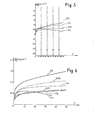
- Figure 1 or 2 represents a graph which gives the variation in weight per unit area ( ⁇ M in mg.cm -2 ) as a function of the number N of oxidation cycles (one cycle corresponds to heating at 1300 ° C for 15 hours followed by air cooling).
- FIG. 3 represents a graph giving the variation in weight per unit area ( ⁇ M in mg.cm -2 ) as a function of time T in hours of thermal cycling between 260 ° and 1200 ° C.
- FIG. 4 represents a graph giving the variation in weight per unit area ( ⁇ M in mg.cm - 2 ) as a function of time T in hours during isothermal heating at 1200 ° C.
- the alloys according to the invention have an austenitic or austeferritic structure.
- They contain 10 to 60% nickel by weight. Preferably, they contain between 20 and 60% of nickel so that the structure is entirely austenitic.
- the alloys contain between 13 and 30% by weight of chromium which promotes resistance to corrosion and counteracts internal oxidation.
- the alloys contain by weight 4 to 6% of aluminum which forms a continuous layer of oxide Al 2 0 3 on the surface of the articles formed with these alloys.
- the alloy contains between 0.001% and 0.1% of at least one metal from the group formed by rare earths and by assimilated metals such as yttrium and scandium.
- the metals which are particularly suitable are, in addition to yttrium, rare earth metals such as cerium and lanthanum.
- the alloys according to the invention contain at least 0.001% of a metal from the group formed by rare earths and assimilated metals so that the effect of this addition is appreciable.
- the content of this metal from the group of rare earths and assimilated metals is greater than 0.01% so that the resistance to oxidation is improved.
- the upper limit of the content of rare earth metal and assimilated metals is critical when the alloy must be forgeable. This limit is then 0.03%.
- the alloys contain 0.005% to 0.19% by weight of zirconium.
- the upper limit of 0.19% is a critical level in order to avoid the formation of local burns.
- Table I gives the composition of - alloys according to the invention.
- the alloys according to the invention were studied as regards oxidation and corrosion in comparison with alloys of Fe-Ni-Cr-Al-type (r e ference 0), Fe-Ni-Cr-Al-Y - (referenced Y) and Fe-Ni-Gr-Al-Zr (referenced Z).
- the compositions of these alloys are given in Table II below.
- the alloys according to the invention have a low manganese content which has an unfavorable effect and 2 (less than 0.03% in poies) /.
- FIGS. 1 / show the good behavior of the alloys Y1 Y3, YZ3 and YZ4 at low Mn and C which forms, from the start of the test, a layer of compact and adherent Al 2 0 3 .
Landscapes
- Chemical & Material Sciences (AREA)
- Engineering & Computer Science (AREA)
- Materials Engineering (AREA)
- Mechanical Engineering (AREA)
- Metallurgy (AREA)
- Organic Chemistry (AREA)
- Hard Magnetic Materials (AREA)
- Resistance Heating (AREA)
- Catalysts (AREA)
Abstract
L'invention se rapporte à des alliages du type fer-nickel-chrome-aluminium-terre rare. Ils contiennent en poids, 10 à 60% de nickel, 10 à 30% de chrome, 20 à 70% de fer, 4 à 6% d'aluminium, 0,001% à 0,1% d'au moins un métal du groupe formé par les terres rares et les métaux assimilés, et ils sont caractérisés par le fait qu'ils contiennent 0,005% à 0,19% de zirconium. Ces alliages s'appliquent à des articles moulés ou forgés notamment à des résistances électriques.
Description
- La présente invention se rapporte à des alliages du type fer-nickel-chrome-aluminium-terre rare résistants à l'oxydation à chaud et à des articles, notamment des résistances électriques, moulés ou forgés à partir de tels alliages.
- On connaît déjà des alliages Fe-Ni-Cr-Al-terre rare, par exemple selon ou 78-01173 le brevet français de la demanderesse n° 78-01172/. Ces alliages contiennent, en poids, 20 à 60 % de nickel, 15 à 27 % de chrome, 20 à 60 % de fer, 4 à 6 % d'aluminium, 0,001 % à 0,04 % d'au moins un métal du groupe formé par les terres rares et les métaux assimilés. Ces alliages peuvent être forgés et ont une bonne résistance à l'oxydation à chaud.
- La présente invention a pour but d'améliorer la résistance à l'oxydation et à la corrosion sulfureuse de tels alliages du type Fe-Ni-Cr-Al-terre rare.
- Les alliages selon l'invention contiennent en poids, 10 à 60 % de nickel, 10 à 30 % de chrome, 20 à 70 % de fer, 4 à 6 % d'aluminium, 0,001 % à 0,1 % d' au moins un métal du groupe formé par les terres rares et les métaux assimilés, et ils sont caractérisés par le fait qu'ils contiennent 0,005 % à 0,19 % de zirconium.
- Selon une autre caractéristique, ils contiennent moins de 0,03 % de manganèse.
- D'autres caractéristiques et avantages de l'invention ressortiront de la description suivante qui se réfère aux dessins annexés.
- La figure 1 ou 2, représente un graphique qui donne la variation de poids par unité de surface (ΔM en mg.cm -2) en fonction du nombre N de cycles d'oxydation (un cycle correspond à un chauffage à 1300°C pendant 15 heures suivi d'un refroidissement à l'air).
- La figure 3 représente un graphique donnant la variation de poids par unité de surface (ΔM en mg.cm-2) en fonction du temps T en heures de cycla- ges thermiques entre 260° et 1200°C.
- La figure 4 représente un graphique donnant la variation de poids par unité de surface (ΔM en mg.cm - 2) en fonction du temps T en heures lors de chauffages isothermes à 1200°C.
- Les alliages selon l'invention ont une structure austénitique ou austé- ferritique.
- Ils contiennent en poids 10 à 60 % de nickel. De préférence, ils contiennent entre 20 et 60 % de nickel de manière que la structure soit entièrement austénitique.
- Les alliages contiennent en poids entre 13 et 30 % de chrome qui favorise la tenue à la corrosion et contrarie l'oxydation interne.
- Les alliages contiennent en poids 4 à 6 % d'aluminium qui forme une couche continue d'oxyde Al2 03 en surface des articles formés avec ces alliages.
- L'addition d'aluminium seul ne permet pas d'obtenir une couche suffisamment protectrice pour empêcher l'oxydation interne et l'alliage contient entre 0,001 % et 0,1% d'au moins un métal du groupe formé par les terres rares et par les métaux assimilés tels que l'yttrium et le scandium. Les métaux qui sont particulièrement appropriés sont outre l'yttrium les métaux des terres rares tels que le cérium et le lanthane.
- Les alliages selon l'invention contiennent au moins 0,001 % d'un métal du groupe formé par les terres rares et les métaux assimilés pour que l'effet de cette addition soit sensible. De préférence la teneur en ce métal du groupe des terres rares et des métaux assimilés est supérieure à 0,01 % pour que la résistance à l'oxydation soit améliorée.
- La limite supérieure de la teneur en métal des terres rares et métaux assimilés est critique lorsque l'alliage doit être forgeable. Cette limite est alors de 0,03 %.
- Les alliages contiennent en poids 0,005 % à 0,19 % de zirconium. La limite supérieure de 0,19 % est une teneur critique si l'on veut éviter la formation de brûlures locales.
- Le tableau I ci-dessous donne la composition d' - alliages selon l'invention.

- Les alliages selon l'invention ont été étudiés en ce qui concerne l'oxydation et la corrosion en comparaison avec des alliages du type Fe-Ni-Cr-Al (ré- férencé 0), Fe-Ni-Cr-Al-Y- (référencés Y) et Fe-Ni-Gr-Al-Zr (référencés Z). Les compositions de ces alliages sont données dans le tableau II ci-dessous.
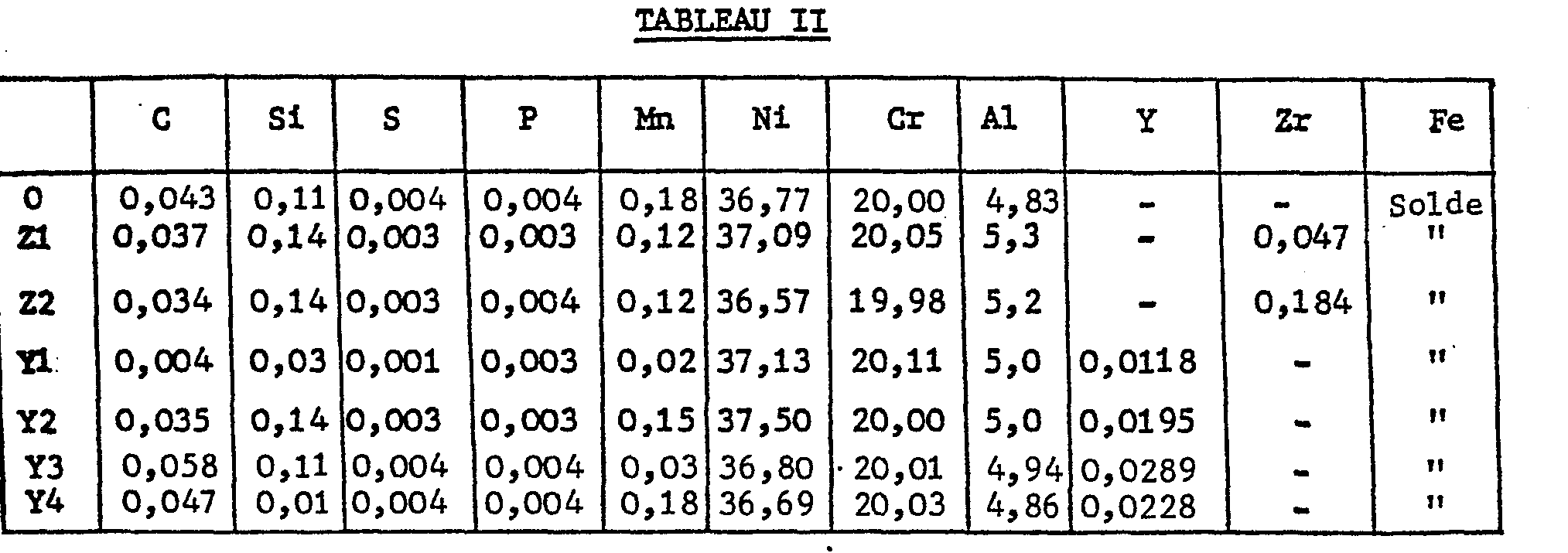
- L'addition de zirconium seul, à des alliages Fe-Ni-Cr-Al, n'est pas très efficace comme le montrent les courbes/1 et Z2 sur les figures 1, 3 et 4. Lorsque le zirconium est présent en même temps que l'yttrium dans les alliages référencés YZ il y a une synergie du point devue de la résistance à l'oxydation comme le montrent les courbes YZ des figures 1, 2 et 3.

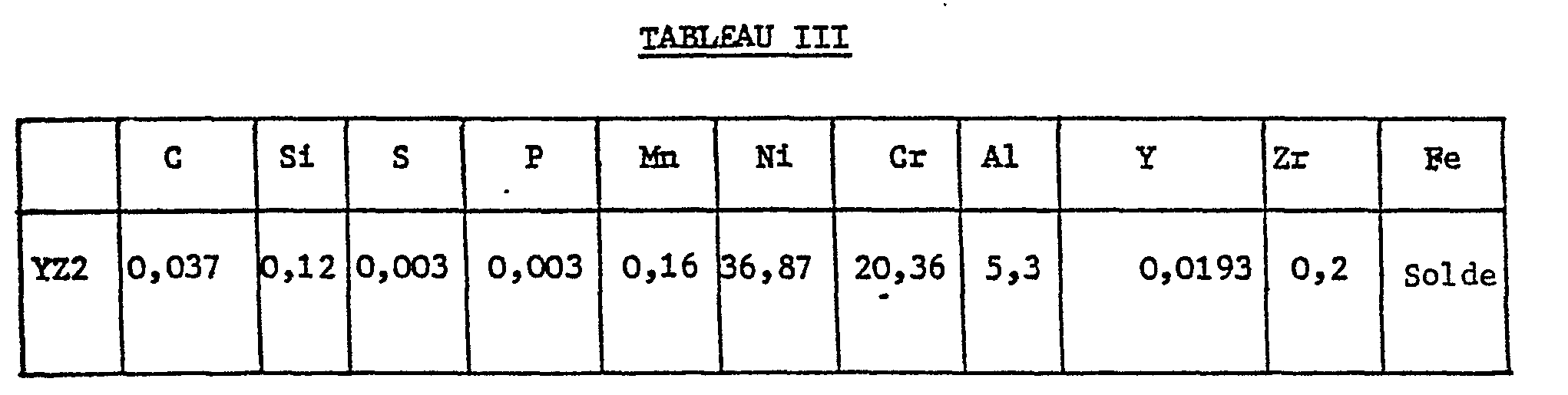
- Une addition trop élevée de zirconium est défavorable du point de vue de la résistance à l'oxydation comme le montre l'alliage YZ 2 du type Fe-Ni-Cr-Al-Y-Zr dont la composition est donnée dans le tableau III ci-dessous qui contient 0,2 % de zirconium.
- Les alliages selon l'invention comportent une faible teneur en manganèse qui a effet défavorable et 2 (moins de 0,03 % en poies)/. Les figures 1/montrent le bon comportement des alliage s Y1 Y3,YZ3 et YZ4 à bas Mn et C qui formetdès le début de l'essai une couche d'Al 2 03 compacte et adhérente.
- L'addition de zirconium et la limitation de la teneur en manganèse sont intéressantes vis à vis de la corrosion sulfureuse.
- Il est bien entendu que l'on peut sans sortir du cadre de l'invention envisager l'emploi de moyens équivalents.
Claims (3)
1.- Alliages du type fer-nickel-chrome-aluminium-terre rare résistants à l'oxydation à chaud, contenant en poids 10 à 60 x de nickel, 10 à 30 % de chrome, 20 à 70 % de fer, 4 à 6 % d'aluminium, 0,001 x à 0,1 % d'au moins un métal du groupe formé par les terres rares et les métaux assimilés, caractérisés par le fait qu'ils contiennento,005 à 0,19 % de zirconium.
2.- Alliages selon la revendication 1, caractérisés par le fait qu'ils contiennent en poids moins de 0,03 % de manganèse.
3.- Alliages selon l'une quelconque des revendications précédentes, caractérisés par le fait qu'ils contiennent moins de 0,03 % d'au moins un métal du groupe formé par les terres rares et les métaux assimilés.
Applications Claiming Priority (2)
| Application Number | Priority Date | Filing Date | Title |
|---|---|---|---|
| FR8207386A FR2526046B1 (fr) | 1982-04-29 | 1982-04-29 | Alliages du type fer-nickel-chrome-aluminium-terre rare |
| FR8207386 | 1982-04-29 |
Publications (1)
| Publication Number | Publication Date |
|---|---|
| EP0093661A1 true EP0093661A1 (fr) | 1983-11-09 |
Family
ID=9273523
Family Applications (1)
| Application Number | Title | Priority Date | Filing Date |
|---|---|---|---|
| EP83400845A Withdrawn EP0093661A1 (fr) | 1982-04-29 | 1983-04-28 | Alliage de type fer-nickel-chrome-aluminium-terre rare |
Country Status (3)
| Country | Link |
|---|---|
| EP (1) | EP0093661A1 (fr) |
| JP (1) | JPS5953658A (fr) |
| FR (1) | FR2526046B1 (fr) |
Cited By (9)
| Publication number | Priority date | Publication date | Assignee | Title |
|---|---|---|---|---|
| GB2204452A (en) * | 1987-05-08 | 1988-11-09 | Dale Electronics | Nichrome resistor |
| US4908185A (en) * | 1987-05-08 | 1990-03-13 | Dale Electronics, Inc. | Nichrome resistive element and method of making same |
| DE4035114A1 (de) * | 1989-11-06 | 1991-05-08 | Matsushita Electric Works Ltd | Fe-cr-ni-al ferritlegierungen |
| US5130085A (en) * | 1987-04-24 | 1992-07-14 | Nippon Steel Corporation | High al austenitic heat-resistant steel superior in hot workability |
| WO1995027804A1 (fr) * | 1994-04-08 | 1995-10-19 | Hoskins Manufacturing Company | Alliage nickel-chrome-fer-aluminium modifie |
| WO2003057932A1 (fr) * | 2002-01-09 | 2003-07-17 | Thyssenkrupp Vdm Gmbh | Alliage resistant a la chaleur et a l'oxydation a haute temperature et procede de production dudit alliage |
| RU2310004C2 (ru) * | 2005-12-20 | 2007-11-10 | Федеральное государственное унитарное предприятие "Всероссийский научно-исследовательский институт авиационных материалов" (ФГУП "ВИАМ") | Способ производства безуглеродистых литейных жаропрочных сплавов на никелевой основе |
| DE19934989B4 (de) * | 1998-07-27 | 2008-04-17 | Hitachi Metals, Ltd. | Magnetisches Verbundelement, Verfahren zum Herstellen des ferromagnetischen Teils desselben sowie Verfahren zum Herstellen des unmagnetischen Teils desselben |
| RU2426810C1 (ru) * | 2010-08-18 | 2011-08-20 | Российская Федерация, от имени которой выступает Министерство промышленности и торговли Российской Федерации (Минпромторг России) | Способ производства безуглеродистых литейных жаропрочных сплавов на никелевой основе |
Families Citing this family (2)
| Publication number | Priority date | Publication date | Assignee | Title |
|---|---|---|---|---|
| DE3620167A1 (de) * | 1986-06-14 | 1987-12-17 | Bayer Ag | Verwendung einer chromhaltigen legierung |
| US4742265A (en) * | 1986-11-12 | 1988-05-03 | Ford Motor Company | Spark plug center electrode of alloy material including aluminum and chromium |
Citations (5)
| Publication number | Priority date | Publication date | Assignee | Title |
|---|---|---|---|---|
| FR770112A (fr) * | 1934-03-14 | 1934-09-08 | Heraeus Vacuumschmelze Ag | Alliages de fer-chrome-aluminium résistant à la chaleur |
| FR48129E (fr) * | 1937-02-08 | 1937-10-25 | Heraeus Vacuumschmelze Ag | Alliages de fer-chrome-aluminium résistant à la chaleur |
| FR48507E (fr) * | 1937-06-01 | 1938-03-08 | Heraeus Vacuumschmelze Ag | Alliages de fer chrome-aluminium résistant à la chaleur |
| US3754898A (en) * | 1972-01-07 | 1973-08-28 | Gurty J Mc | Austenitic iron alloys |
| FR2284683A1 (fr) * | 1974-06-17 | 1976-04-09 | Cabot Corp | Alliage ni-cr-al-y resistant a l'oxydation et son procede de preparation |
-
1982
- 1982-04-29 FR FR8207386A patent/FR2526046B1/fr not_active Expired
-
1983
- 1983-04-28 EP EP83400845A patent/EP0093661A1/fr not_active Withdrawn
- 1983-04-30 JP JP7733783A patent/JPS5953658A/ja active Pending
Patent Citations (5)
| Publication number | Priority date | Publication date | Assignee | Title |
|---|---|---|---|---|
| FR770112A (fr) * | 1934-03-14 | 1934-09-08 | Heraeus Vacuumschmelze Ag | Alliages de fer-chrome-aluminium résistant à la chaleur |
| FR48129E (fr) * | 1937-02-08 | 1937-10-25 | Heraeus Vacuumschmelze Ag | Alliages de fer-chrome-aluminium résistant à la chaleur |
| FR48507E (fr) * | 1937-06-01 | 1938-03-08 | Heraeus Vacuumschmelze Ag | Alliages de fer chrome-aluminium résistant à la chaleur |
| US3754898A (en) * | 1972-01-07 | 1973-08-28 | Gurty J Mc | Austenitic iron alloys |
| FR2284683A1 (fr) * | 1974-06-17 | 1976-04-09 | Cabot Corp | Alliage ni-cr-al-y resistant a l'oxydation et son procede de preparation |
Cited By (16)
| Publication number | Priority date | Publication date | Assignee | Title |
|---|---|---|---|---|
| US5130085A (en) * | 1987-04-24 | 1992-07-14 | Nippon Steel Corporation | High al austenitic heat-resistant steel superior in hot workability |
| GB2204452B (en) * | 1987-05-08 | 1991-07-03 | Dale Electronics | Nichrome resistive element and method of making same |
| FR2615031A1 (fr) * | 1987-05-08 | 1988-11-10 | Dale Electronics | Element a resistivite meilleure que le nichrome et methode de fabrication |
| US4837550A (en) * | 1987-05-08 | 1989-06-06 | Dale Electronics, Inc. | Nichrome resistive element and method of making same |
| US4908185A (en) * | 1987-05-08 | 1990-03-13 | Dale Electronics, Inc. | Nichrome resistive element and method of making same |
| GB2204452A (en) * | 1987-05-08 | 1988-11-09 | Dale Electronics | Nichrome resistor |
| DE4035114A1 (de) * | 1989-11-06 | 1991-05-08 | Matsushita Electric Works Ltd | Fe-cr-ni-al ferritlegierungen |
| US5089223A (en) * | 1989-11-06 | 1992-02-18 | Matsushital Electric Works, Ltd. | Fe-cr-ni-al ferritic alloys |
| GB2238317A (en) * | 1989-11-06 | 1991-05-29 | Matsushita Electric Works Ltd | Fe-Cr-Ni-Al ferritic alloys |
| GB2238317B (en) * | 1989-11-06 | 1994-01-19 | Matsushita Electric Works Ltd | Fe-Cr-Ni-Al ferritic alloys |
| DE4035114C2 (de) * | 1989-11-06 | 1999-08-19 | Matsushita Electric Works Ltd | Fe-Cr-Ni-Al Ferritlegierungen |
| WO1995027804A1 (fr) * | 1994-04-08 | 1995-10-19 | Hoskins Manufacturing Company | Alliage nickel-chrome-fer-aluminium modifie |
| DE19934989B4 (de) * | 1998-07-27 | 2008-04-17 | Hitachi Metals, Ltd. | Magnetisches Verbundelement, Verfahren zum Herstellen des ferromagnetischen Teils desselben sowie Verfahren zum Herstellen des unmagnetischen Teils desselben |
| WO2003057932A1 (fr) * | 2002-01-09 | 2003-07-17 | Thyssenkrupp Vdm Gmbh | Alliage resistant a la chaleur et a l'oxydation a haute temperature et procede de production dudit alliage |
| RU2310004C2 (ru) * | 2005-12-20 | 2007-11-10 | Федеральное государственное унитарное предприятие "Всероссийский научно-исследовательский институт авиационных материалов" (ФГУП "ВИАМ") | Способ производства безуглеродистых литейных жаропрочных сплавов на никелевой основе |
| RU2426810C1 (ru) * | 2010-08-18 | 2011-08-20 | Российская Федерация, от имени которой выступает Министерство промышленности и торговли Российской Федерации (Минпромторг России) | Способ производства безуглеродистых литейных жаропрочных сплавов на никелевой основе |
Also Published As
| Publication number | Publication date |
|---|---|
| FR2526046A1 (fr) | 1983-11-04 |
| FR2526046B1 (fr) | 1985-11-15 |
| JPS5953658A (ja) | 1984-03-28 |
Similar Documents
| Publication | Publication Date | Title |
|---|---|---|
| JP5680192B2 (ja) | ニッケル基合金 | |
| KR870001284B1 (ko) | 철-크롬-알루미늄 합금과 합금제품 및 그 제조방법 | |
| FR2526046A1 (fr) | Alliages du type fer-nickel-chrome-aluminium-terre rare | |
| EP0924310B1 (fr) | Alliage d'aluminium avec silicium pour un piston dans une voiture | |
| JPH09157777A (ja) | 耐熱疲労特性、高温クリープおよび高温耐食性に優れたNi基合金 | |
| FR2585727A1 (fr) | Alliage cuivre-chrome-titane-silicium et son utilisation | |
| GB2211515A (en) | Ni base alloy for spark plug electrodes of internal combustion engine | |
| EP0467756B1 (fr) | Acier austénitique ayant une résistance améliorée à haute température et procédé pour son obtention et la réalisation de pièces mécaniques, en particulier de soupapes | |
| USRE32005E (en) | Magnetic alloy having a low melting point | |
| JPH02221349A (ja) | 軽量鋳造材料 | |
| RU2048589C1 (ru) | Сталь | |
| EP0187573B1 (fr) | Alliage à base de nickel | |
| JPS55138052A (en) | High electric resistance aluminum alloy for cage rotor | |
| EP0291492B1 (fr) | Alliage à base de zinc résistant à chaud | |
| SU1548244A1 (ru) | Чугун дл тиглей плавильно-разлаточных печей алюминиевых сплавов | |
| CH627788A5 (en) | Nickel alloy with a high boron content | |
| JPH10251787A (ja) | 熱伝導特性に優れた点火プラグ用電極材料 | |
| JPS63118040A (ja) | 点火プラグ用電極材料 | |
| JPS6389638A (ja) | 点火プラグ用電極材料 | |
| JPS5933181B2 (ja) | バ−ナ−ヘツド用銅合金 | |
| JPH0598397A (ja) | 高温耐食性に優れたFe基耐熱合金 | |
| JP3237482B2 (ja) | 高耐熱性アルミニウム合金 | |
| JPS58113344A (ja) | アルミニウム軸受合金 | |
| CN85102457B (zh) | 共晶铝硅铜镁镍碲系活塞铝合金 | |
| JPS55100949A (en) | Ni base alloy for engine valve and valve seat of internal combustion engine |
Legal Events
| Date | Code | Title | Description |
|---|---|---|---|
| PUAI | Public reference made under article 153(3) epc to a published international application that has entered the european phase |
Free format text: ORIGINAL CODE: 0009012 |
|
| AK | Designated contracting states |
Designated state(s): DE FR GB IT SE |
|
| 17P | Request for examination filed |
Effective date: 19831025 |
|
| STAA | Information on the status of an ep patent application or granted ep patent |
Free format text: STATUS: THE APPLICATION IS DEEMED TO BE WITHDRAWN |
|
| 18D | Application deemed to be withdrawn |
Effective date: 19860615 |
|
| RIN1 | Information on inventor provided before grant (corrected) |
Inventor name: DAVIDSON, JAMES HENRY |