EP0093662A2 - Dispositif d'orientation pour capteur solaire - Google Patents
Dispositif d'orientation pour capteur solaire Download PDFInfo
- Publication number
- EP0093662A2 EP0093662A2 EP83400847A EP83400847A EP0093662A2 EP 0093662 A2 EP0093662 A2 EP 0093662A2 EP 83400847 A EP83400847 A EP 83400847A EP 83400847 A EP83400847 A EP 83400847A EP 0093662 A2 EP0093662 A2 EP 0093662A2
- Authority
- EP
- European Patent Office
- Prior art keywords
- screw
- tube
- nut
- rotation
- mirror
- Prior art date
- Legal status (The legal status is an assumption and is not a legal conclusion. Google has not performed a legal analysis and makes no representation as to the accuracy of the status listed.)
- Granted
Links
- 229920002994 synthetic fiber Polymers 0.000 claims description 5
- 230000001681 protective effect Effects 0.000 claims description 2
- 238000000605 extraction Methods 0.000 claims 1
- 238000006073 displacement reaction Methods 0.000 description 4
- 239000012530 fluid Substances 0.000 description 4
- 230000005540 biological transmission Effects 0.000 description 2
- 230000002427 irreversible effect Effects 0.000 description 2
- 239000004677 Nylon Substances 0.000 description 1
- 239000012141 concentrate Substances 0.000 description 1
- 239000003822 epoxy resin Substances 0.000 description 1
- -1 for example Polymers 0.000 description 1
- 239000007788 liquid Substances 0.000 description 1
- 238000005461 lubrication Methods 0.000 description 1
- 238000012423 maintenance Methods 0.000 description 1
- 230000007246 mechanism Effects 0.000 description 1
- 239000002184 metal Substances 0.000 description 1
- 239000007769 metal material Substances 0.000 description 1
- 229920001778 nylon Polymers 0.000 description 1
- 230000000737 periodic effect Effects 0.000 description 1
- 230000002093 peripheral effect Effects 0.000 description 1
- 239000004033 plastic Substances 0.000 description 1
- 229920000647 polyepoxide Polymers 0.000 description 1
- 230000002441 reversible effect Effects 0.000 description 1
Images
Classifications
-
- F—MECHANICAL ENGINEERING; LIGHTING; HEATING; WEAPONS; BLASTING
- F15—FLUID-PRESSURE ACTUATORS; HYDRAULICS OR PNEUMATICS IN GENERAL
- F15B—SYSTEMS ACTING BY MEANS OF FLUIDS IN GENERAL; FLUID-PRESSURE ACTUATORS, e.g. SERVOMOTORS; DETAILS OF FLUID-PRESSURE SYSTEMS, NOT OTHERWISE PROVIDED FOR
- F15B15/00—Fluid-actuated devices for displacing a member from one position to another; Gearing associated therewith
- F15B15/02—Mechanical layout characterised by the means for converting the movement of the fluid-actuated element into movement of the finally-operated member
- F15B15/06—Mechanical layout characterised by the means for converting the movement of the fluid-actuated element into movement of the finally-operated member for mechanically converting rectilinear movement into non- rectilinear movement
- F15B15/068—Mechanical layout characterised by the means for converting the movement of the fluid-actuated element into movement of the finally-operated member for mechanically converting rectilinear movement into non- rectilinear movement the motor being of the helical type
-
- F—MECHANICAL ENGINEERING; LIGHTING; HEATING; WEAPONS; BLASTING
- F24—HEATING; RANGES; VENTILATING
- F24S—SOLAR HEAT COLLECTORS; SOLAR HEAT SYSTEMS
- F24S30/00—Arrangements for moving or orienting solar heat collector modules
- F24S30/40—Arrangements for moving or orienting solar heat collector modules for rotary movement
- F24S30/42—Arrangements for moving or orienting solar heat collector modules for rotary movement with only one rotation axis
- F24S30/422—Vertical axis
-
- F—MECHANICAL ENGINEERING; LIGHTING; HEATING; WEAPONS; BLASTING
- F24—HEATING; RANGES; VENTILATING
- F24S—SOLAR HEAT COLLECTORS; SOLAR HEAT SYSTEMS
- F24S25/00—Arrangement of stationary mountings or supports for solar heat collector modules
- F24S25/10—Arrangement of stationary mountings or supports for solar heat collector modules extending in directions away from a supporting surface
-
- Y—GENERAL TAGGING OF NEW TECHNOLOGICAL DEVELOPMENTS; GENERAL TAGGING OF CROSS-SECTIONAL TECHNOLOGIES SPANNING OVER SEVERAL SECTIONS OF THE IPC; TECHNICAL SUBJECTS COVERED BY FORMER USPC CROSS-REFERENCE ART COLLECTIONS [XRACs] AND DIGESTS
- Y02—TECHNOLOGIES OR APPLICATIONS FOR MITIGATION OR ADAPTATION AGAINST CLIMATE CHANGE
- Y02E—REDUCTION OF GREENHOUSE GAS [GHG] EMISSIONS, RELATED TO ENERGY GENERATION, TRANSMISSION OR DISTRIBUTION
- Y02E10/00—Energy generation through renewable energy sources
- Y02E10/40—Solar thermal energy, e.g. solar towers
- Y02E10/47—Mountings or tracking
Definitions
- the present invention relates to a device for orienting a solar collector as a function of the apparent movement of the sun.
- Solar energy can be recovered in the form of heat by using a concave mirror intended to concentrate the rays collected towards a hearth where can be placed, for example, a boiler.
- a concave mirror intended to concentrate the rays collected towards a hearth where can be placed, for example, a boiler.
- the concave mirror must follow the apparent movements of the sun, it is necessary to provide a device for orienting the mirror in azimuth and a device for orienting the mirror in elevation.
- These orientation devices must ensure precise movement and positioning of the mirror in all circumstances, and in particular despite the varied actions of the wind on the entire structure.
- These devices must also be irreversible, that is to say that a direct action on the mirror must not disturb its position.
- the devices must be simple, easy to install on the site, and must retain all their qualities despite being exposed to the weather.
- the orientation devices currently known are relatively complex, and include delicate mechanisms which require periodic maintenance.
- the present invention aims to overcome these drawbacks.
- the invention therefore relates to a solar collector comprising a concave mirror mounted on a support movable in rotation about an axis of rotation, and comprising an orientation device controlling the angular position of the mirror around this axis of rotation.
- the orientation device consists of a screw mounted along the axis of rotation of the mirror, connected to said movable support in rotation of the mirror, of a nut movable in translation cooperating with the screw, and a double-acting cylinder controlling the translational movements of the nut in order to consequently control the orientation of the mirror.
- the screw is made of a metallic material
- the nut is made of a molded synthetic material.
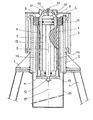
- the single figure shows, in longitudinal section, a device orientation according to the invention.
- the screw 5 has the shape of a tube whose cylindrical outer face comprises helical grooves 6 and whose cylindrical inner face 7 constitutes the working cylinder of a double action cylinder.
- This cylinder therefore comprises a piston 8 which can slide inside the bore 7 of the screw 5, under the action of a control fluid which can be brought into the working cylinder.
- the piston 8 is connected to a rod 9 which opens into the lower part of the working cylinder 7.
- the working cylinder 7 is closed upwards by a sealed radial wall 10 and downwards by another sealed radial wall 11 tightly traversed by the rod 9.
- the outer end 12 of the cylinder rod is connected to a radial plate 13, and at the periphery of this plate 13 are fixed rigid parts 14 which extend longitudinally in space between the rigid tube 2 and the screw-forming part 5.
- These rigid parts 14 are fixed by their upper part to a nut 15 which is screwed onto the screw 5 and which is subjected to sliding only longitudinally inside the tube 2 thanks to guide parts 16 extending longitudinally on the internal face of the tube 2 and coming to engage in corresponding notches formed on the peripheral part of the nut 15.
- the orientation device which has just been described operates in the following manner.
- the mirror of the solar collector is mounted, by means of an appropriate support (not shown), on the plate 4.
- the mirror is pivotally mounted around the vertical axis 17, since it is rigidly mounted with respect to the vertical tube 3 which can rotate via the bearings with respect to the whole of the fixed structure 1, 2.
- the mirror rotation control is therefore carried out by the rotation control of the support plate 4. To achieve this rotation, it suffices to send to one of the two chambers 18 or 19 of the jack, a working fluid, preferably a liquid which controls the movement of the piston 8.
- This orientation device can be completed by a protective waterproof casing 20 fixed from below to the lower part of the tube 2, or in its vicinity.
- This casing thus allows the screw-nut system to be completely enclosed, which makes it possible to produce a device which withstands all weather conditions well.
- the hydraulic fluid can be supplied to the jack by flexible pipes connecting a suitable pump device with the chambers 18 and 19.
- the pipes (not shown) can, for example, be fixed to the orientation device at the level of the support plate 4, of the screw-forming part 5, or at the end 12 of the piston rod 9.
- the orientation device which has just been described allows in in addition to easy disassembly of the entire screw-nut system and the actuator. In fact, to make this assembly removable, it suffices to provide a connection between the radial plate 4 and the screw-forming part 5 produced by a keyed or lug fitting 21 and screwed 22 from above the device. Disassembly is then carried out by extracting the device downwards, without any disassembly of the mirror or of its rotating support 1, 2, 3, 4.
Landscapes
- Engineering & Computer Science (AREA)
- General Engineering & Computer Science (AREA)
- Physics & Mathematics (AREA)
- Mechanical Engineering (AREA)
- Combustion & Propulsion (AREA)
- Life Sciences & Earth Sciences (AREA)
- Sustainable Development (AREA)
- Sustainable Energy (AREA)
- Thermal Sciences (AREA)
- Chemical & Material Sciences (AREA)
- Fluid Mechanics (AREA)
- Optical Elements Other Than Lenses (AREA)
- Liquid Crystal (AREA)
- Vaporization, Distillation, Condensation, Sublimation, And Cold Traps (AREA)
- Physical Or Chemical Processes And Apparatus (AREA)
- Measuring Fluid Pressure (AREA)
- Surgical Instruments (AREA)
- Gloves (AREA)
- Photovoltaic Devices (AREA)
- Polarising Elements (AREA)
Abstract
Description
- La présente invention concerne un dispositif destiné à orienter un capteur solaire en fonction du mouvement apparent du soleil.
- L'énergie solaire peut être récupérée sous forme de chaleur en utilisant un miroir concave destiné à concentrer les rayons captés vers un foyer oùpeut être placée, par exemple, une chaudière. Comme le miroir concave doit suivre les mouvements apparents du soleil, il est nécessaire de prévoir un dispositif d'orientation du miroir en azimut et un dispositif d'orientation du miroir en site. Ces dispositifs d'orientation doivent assurer un mouvement et un positionnement précis du miroir en toute circonstance, et notamment malgré les actions variées du vent sur l'ensemble de la structure. Ces dispositifs doivent être aussi irréversibles, c'est à dire qu'une action directe sur le miroir ne doit pas dérégler sa position. Enfin, les dispositifs doivent être simples, faciles à installer sur le site, et doivent conserver toutes leurs qualités bien qu'étant exposés aux intempéries.
- Les dispositifs d'orientation connus actuellement sont relativement complexes, et comportent des mécanismes délicats qui nécessitent un entretien périodique.
- La présente invention vise à pallier ces inconvénients.
- L'invention concerne donc un capteur solaire comprenant un miroir concave monté sur un support mobile en rotation autour d'un axe de rotation, et comprenant un dispositif d'orientation contrôlant la position angulaire du miroir autour de cet axe de rotation.
- Selon une caractéristique essentielle de cette invention, le dispositif d'orientation est constitué d'une vis montée suivant l'axe de rotation du miroir, reliée audit support mobile en rotation du miroir, d'un écrou mobile en translation coopérant avec la vis, et d'un vérin à double action commandant les déplacements en translation de l'écrou afin de commander en conséquence l'orientation du miroir.
- Selon une autre caractéristique de l'invention, la vis est réalisée dans un matériau métallique, et l'écrou est réalisé dans une matière synthétique moulée.
- D'autres caractéristiques et avantages apparaitront lors de la description détaillée de l'exemple de réalisation qui va suivre, illustré par le dessin annexé.
- La figure unique représente, en coupe longitudinale, un dispositif d'orientation conforme à l'invention.
- Nous allons maintenant décrire l'exemple de réalisation en se reportant à la figure annexée. On distingue sur cette figure une structure rigide 1 fixée au sol, sur laquelle est fixé un tube rigide vertical 2 s'étendant essentiellement au-dessus de la structure 1, sur lequel vient s'emboiter concentriquement, par l'extérieur, un autre tube 3 relié au tube 2 par l'intermédiaire de roulements, de sorte que le tube 3 peut tourner librement par rapport au tube 2. Le tube 3 est en outre relié, par sa partie supérieure, à une plaque radiale 4 elle-même reliée de façon démontable à la partie supérieure 10 d'une pièce formant vis 5. De ce fait, la vis 5 est disposée concentriquement à l'intérieur du tube rigide 2. La vis 5 présente la forme d'un tube dont la face extérieure cylindrique comporte des gorges hélicoïdales 6 et dont la face interne cylindrique 7 constitue le cylindre de travail d'un vérin à double action. Ce vérin comprend donc un piston 8 pouvant coulisser à l'intérieur de l'alésage 7 de la vis 5, sous l'action d'un fluide de commande pouvant être amené dans le cylindre de travail. Le piston 8 est relié à une tige 9 qui débouche dans la partie inférieure du cylindre de travail 7. Bien sûr, le cylindrede travail 7 est obturé vers le haut par une paroi radiale 10 étanche et vers le bas par une autre paroi radiale 11 étanche traversée de façon étanche par la tige 9. L'extrémité externe 12 de la tige du vérin est reliée à une plaque radiale 13, et à la périphérie de cette plaque 13 sont fixées des pièces rigides 14 qui s'étendent longitudinalement dans l'espace compris entre le tube rigide 2 et la pièce formant vis 5. Ces pièces rigides 14 sont fixées par leur partie supérieure à un écrou 15 qui est vissé sur la vis 5 et qui est assujetti à coulisser uniquement longitudinalement à l'intérieur du tube 2 grâce à des pièces de guidage 16 s'étendant longitudinalement sur la face interne du tube 2 et venant s'engager dans des encoches correspondantes ménagées sur la partie périphérique de l'écrou 15.
- Le dispositif d'orientation qui vient d'être décrit fonctionne de la manière suivante. Le miroir du capteur solaire est monté, par l'intermédiaire d'un support approprié (non représenté), sur la plaque 4. De la sorte, on voit que le miroir est monté pivotant autour de l'axe vertical 17, puisqu'il est monté rigidement par rapport au tube vertical 3 qui peut tourner par l'intermédiaire des roulements par rapport à l'ensemble de la structure fixe 1, 2. On voit par conséquent que le dispositif d'orientation qui vient d'être décrit correspond à une commande de réglage du miroir en azimut. La commande de rotation du miroir s'effectue donc par la commande de rotation de la plaque support 4. Pour réaliser cette rotation, il suffit d'envoyer dans l'une des deux chambres 18 ou 19 du vérin, un fluide de travail, de préférence liquide qui contrôle le déplacement du piston 8. Comme ce piston 8 est relié, par l'intermédiaire des pièces 9, 13, 14, à la pièce formant écrou 15, les déplacements linéaires du piston 8 entrainent donc des déplacements linéaires équivalents de l'écrou 15. Par conséquent, tous déplacements en translation de l'écrou 15 se traduisent par des déplacements en rotation de la vis 5 sur laquellel'écrou est vissé. L'envoi de fluide dans les deux chambres du vérin entraine donc la rotation de la pièce formant vis 5 et par conséquent du miroir. Bien sûr, les filets 6 de la vis 5 doivent être suffisamment inclinés pour que la transmission vis-écrou s'effectue avec un bon rendement. On peut même s'arranger pour choisir une inclinaison des filets de telle sorte que le mouvement soit irréversible, c'est à dire que les déplacements linéaires de l'écrou puissent entrainer la rotation de la vis mais que l'inverse soit impossible. On peut remarquer aussi que avec une telle conception, la totalité des filets de l'écrou 15 sont en contact permanent avec les filets de la vis 5. Cette disposition confère à l'ensemble un couple admissible en rotation très grand. De ce fait, il est possible, comme préconisé dans l'invention, d'utiliser pour l'écrou 15 un matériau synthétique, tel, par exemple, qu'un nylon, une résine époxy, ou tout autre matière plastique de haute résistance. L'association d'une vis métallique et d'un écrou en matière synthétique donne au système vis-écrou des qualités mécaniques de frottement et d'usure excellents, évite tout problème de graissage, et permet de réaliser une transmission pratiquement sans jeu et sans rodage. L'écrou, réalisé en matière synthétique, peut être usiné ou, de préférence, moulé.
- On peut compléter ce dispositif d'orientation par un carter étanche protecteur 20 fixé par dessous à la partie inférieure du tube 2, ou à son voisinage. Ce carter permet ainsi d'enfermer complètement le système vis-écrou, ce qui permet de réaliser un dispositif qui résiste bien à toutes les intempéries. L'alimentation en fluide hydraulique du vérin peut s'effectuer par des canalisations souples reliant un dispositif de pompes appropriées avec les chambres 18 et 19. Les canalisations (non représentées) peuvent être , par exemple, fixées sur le dispositif d'orientation au niveau de la plaque support 4, de la pièce formant vis 5, ou au niveau de l'extrémité 12 de la tige de piston 9.
- Le dispositif d'orientation qui vient d'être décrit permet en outre un démontage facile de l'ensemble du système vis-écrou et du vérin de commande. En effet, pour rendre démontable cet ensemble, il suffit de prévoir une liaison entre la plaque radiale 4 et la pièce formant vis 5 réalisée par un emboitement claveté ou à ergots 21 et vissé 22 depuis le dessus du dispositif. Le démontage s'effectue alors par extraction du dispositif vers le bas, sans aucun démontage du miroir ou de son support tournant 1, 2, 3, 4.
- On peut concevoir un dispositif d'orientation en site conçu de manière tout à fait identique à celui décrit précédemment ; il suffit en effet de disposer un tel dispositif autour d'un axe de rotation 17 horizontal au lieu de vertical.
- L'invention ne se limite pas au mode de réalisation qui vient d'être décrit, à titre d'exemple, mais elle en comporte au contraire toutes les variantes d'exécution.
Claims (6)
Priority Applications (1)
| Application Number | Priority Date | Filing Date | Title |
|---|---|---|---|
| AT83400847T ATE24602T1 (de) | 1982-04-29 | 1983-04-28 | Orientierungsapparat fuer sonnenkollektor. |
Applications Claiming Priority (2)
| Application Number | Priority Date | Filing Date | Title |
|---|---|---|---|
| FR8207387 | 1982-04-29 | ||
| FR8207387A FR2526135B1 (fr) | 1982-04-29 | 1982-04-29 | Dispositif d'orientation pour capteur solaire |
Publications (3)
| Publication Number | Publication Date |
|---|---|
| EP0093662A2 true EP0093662A2 (fr) | 1983-11-09 |
| EP0093662A3 EP0093662A3 (en) | 1984-11-14 |
| EP0093662B1 EP0093662B1 (fr) | 1986-12-30 |
Family
ID=9273524
Family Applications (1)
| Application Number | Title | Priority Date | Filing Date |
|---|---|---|---|
| EP83400847A Expired EP0093662B1 (fr) | 1982-04-29 | 1983-04-28 | Dispositif d'orientation pour capteur solaire |
Country Status (7)
| Country | Link |
|---|---|
| EP (1) | EP0093662B1 (fr) |
| AT (1) | ATE24602T1 (fr) |
| BR (1) | BR8301986A (fr) |
| DE (1) | DE3368756D1 (fr) |
| FR (1) | FR2526135B1 (fr) |
| IN (1) | IN159464B (fr) |
| OA (1) | OA07415A (fr) |
Cited By (2)
| Publication number | Priority date | Publication date | Assignee | Title |
|---|---|---|---|---|
| DE4443834A1 (de) * | 1994-12-09 | 1996-06-13 | Gottfried Baehr | Verfahren und Vorrichtung einer selbstversorgenden blitzschutzgesicherten Einständer Energie-Umwandlungsanlage |
| US5622078A (en) * | 1995-08-21 | 1997-04-22 | Mattson; Brad A. | Linear/helix movement support/solar tracker |
Families Citing this family (1)
| Publication number | Priority date | Publication date | Assignee | Title |
|---|---|---|---|---|
| DE4235290A1 (de) * | 1992-06-16 | 1994-04-21 | Gottfried Baehr | Verfahren und Vorrichtung eines Schwenk-Drall-Getriebes zur Nachsteuerung und somit Ausnutzung von Sonnen-Energie und ähnlicher veränderlicher Quellen |
Family Cites Families (5)
| Publication number | Priority date | Publication date | Assignee | Title |
|---|---|---|---|---|
| US3393610A (en) * | 1965-04-27 | 1968-07-23 | Goetaverken Ab | Pressure medium operated torque actuator |
| DE2715334A1 (de) * | 1977-04-06 | 1978-10-12 | Martin Schatta | Wind- und sonnenkraftmaschine |
| ATA387978A (de) * | 1978-05-29 | 1982-08-15 | Ife Gmbh | Drehantrieb fuer tueren od.dgl. |
| FR2449919A1 (fr) * | 1979-01-02 | 1980-09-19 | Semed | Systeme de commande du mouvement d'un ensemble d'heliostats |
| FR2484096A1 (fr) * | 1980-06-05 | 1981-12-11 | Sicopa | Dispositifs pour capter et focaliser des radiations provenant d'une source eloignee qui se deplace |
-
1982
- 1982-04-29 FR FR8207387A patent/FR2526135B1/fr not_active Expired
-
1983
- 1983-04-05 IN IN219/DEL/83A patent/IN159464B/en unknown
- 1983-04-19 BR BR8301986A patent/BR8301986A/pt unknown
- 1983-04-28 DE DE8383400847T patent/DE3368756D1/de not_active Expired
- 1983-04-28 EP EP83400847A patent/EP0093662B1/fr not_active Expired
- 1983-04-28 AT AT83400847T patent/ATE24602T1/de not_active IP Right Cessation
- 1983-04-29 OA OA57987A patent/OA07415A/fr unknown
Cited By (2)
| Publication number | Priority date | Publication date | Assignee | Title |
|---|---|---|---|---|
| DE4443834A1 (de) * | 1994-12-09 | 1996-06-13 | Gottfried Baehr | Verfahren und Vorrichtung einer selbstversorgenden blitzschutzgesicherten Einständer Energie-Umwandlungsanlage |
| US5622078A (en) * | 1995-08-21 | 1997-04-22 | Mattson; Brad A. | Linear/helix movement support/solar tracker |
Also Published As
| Publication number | Publication date |
|---|---|
| EP0093662B1 (fr) | 1986-12-30 |
| FR2526135A1 (fr) | 1983-11-04 |
| ATE24602T1 (de) | 1987-01-15 |
| OA07415A (fr) | 1984-11-30 |
| DE3368756D1 (en) | 1987-02-05 |
| EP0093662A3 (en) | 1984-11-14 |
| BR8301986A (pt) | 1983-12-20 |
| FR2526135B1 (fr) | 1987-04-17 |
| IN159464B (fr) | 1987-05-23 |
Similar Documents
| Publication | Publication Date | Title |
|---|---|---|
| FR2697882A1 (fr) | Dispositif d'actionnement linéaire différentiel. | |
| FR2515383A1 (fr) | Dispositif de reglage continu de l'amplitude de vibration d'elements excentriques | |
| EP0344028A1 (fr) | Dispositif et procédé de vissage et de dévissage d'un écrou sur un élément de liaison | |
| EP0664859B1 (fr) | Moteur de frein a encombrement reduit | |
| EP0041455A1 (fr) | Monture d'orientation de module héliothermique | |
| EP0624425A1 (fr) | Equipement interne pour le soudage bout à bout par faisceau d'électrons de deux pièces annulaires et utilisation | |
| EP0093662B1 (fr) | Dispositif d'orientation pour capteur solaire | |
| LU87938A1 (fr) | Installation de chargement d'un four a cuve | |
| FR2553863A1 (fr) | Outillage pour le percage de canalisations de fluide sous pression | |
| FR2466646A1 (fr) | Corps de pompe centrifuge | |
| FR2596702A1 (fr) | Dispositif pour regler la position relative en rotation entre un pignon et une couronne dentee montee coaxialement par rapport a ce dernier | |
| WO2019149540A1 (fr) | Actionneur d'embrayage | |
| EP0074888A2 (fr) | Dispositif de manutention d'une charge et son application à la manutention d'une charge immergée | |
| EP0577453A1 (fr) | Procédé d'utilisation d'un doigt de gant d'un réacteur nucléaire à eau sous pression et dispositif de réglage de la position axiale du doigt de gant | |
| EP1498646A1 (fr) | Dispositif de vanne | |
| EP0364341B1 (fr) | Mât périscopique à structure télescopique | |
| EP0253735B1 (fr) | Vérin électrique à vis creuse à billes | |
| FR2584150A1 (fr) | Systeme d'accrochage et de tensionnement a distance d'un element allonge | |
| FR2750460A1 (fr) | Perfectionnement a un dispositif aero-generateur | |
| FR2678678A1 (fr) | Dispositif de reglage de l'azimut de la trajectoire d'un outil de forage en mode rotary. | |
| BE1007692A3 (fr) | Dispositif auxiliaire de relachement commande a distance pour un mecanisme a action positive. | |
| FR3083818A1 (fr) | Systeme d'entrainement d'un ecran et installation comprenant un tel systeme | |
| EP1112681A2 (fr) | Dispositif d'actionnement, notamment destiné à un racleur d'étable | |
| EP0541479A1 (fr) | Dispositif d'entraînement de portail par un moteur électrique | |
| FR2484096A1 (fr) | Dispositifs pour capter et focaliser des radiations provenant d'une source eloignee qui se deplace |
Legal Events
| Date | Code | Title | Description |
|---|---|---|---|
| PUAI | Public reference made under article 153(3) epc to a published international application that has entered the european phase |
Free format text: ORIGINAL CODE: 0009012 |
|
| AK | Designated contracting states |
Designated state(s): AT BE CH DE FR GB IT LI LU NL SE |
|
| PUAL | Search report despatched |
Free format text: ORIGINAL CODE: 0009013 |
|
| AK | Designated contracting states |
Designated state(s): AT BE CH DE FR GB IT LI LU NL SE |
|
| 17P | Request for examination filed |
Effective date: 19841219 |
|
| GRAA | (expected) grant |
Free format text: ORIGINAL CODE: 0009210 |
|
| AK | Designated contracting states |
Kind code of ref document: B1 Designated state(s): AT BE CH DE FR GB IT LI LU NL SE |
|
| PG25 | Lapsed in a contracting state [announced via postgrant information from national office to epo] |
Ref country code: NL Effective date: 19861230 Ref country code: AT Effective date: 19861230 |
|
| REF | Corresponds to: |
Ref document number: 24602 Country of ref document: AT Date of ref document: 19870115 Kind code of ref document: T |
|
| PG25 | Lapsed in a contracting state [announced via postgrant information from national office to epo] |
Ref country code: SE Effective date: 19861231 |
|
| ITF | It: translation for a ep patent filed | ||
| REF | Corresponds to: |
Ref document number: 3368756 Country of ref document: DE Date of ref document: 19870205 |
|
| PG25 | Lapsed in a contracting state [announced via postgrant information from national office to epo] |
Ref country code: LU Free format text: LAPSE BECAUSE OF NON-PAYMENT OF DUE FEES Effective date: 19870430 |
|
| NLV1 | Nl: lapsed or annulled due to failure to fulfill the requirements of art. 29p and 29m of the patents act | ||
| PLBE | No opposition filed within time limit |
Free format text: ORIGINAL CODE: 0009261 |
|
| STAA | Information on the status of an ep patent application or granted ep patent |
Free format text: STATUS: NO OPPOSITION FILED WITHIN TIME LIMIT |
|
| 26N | No opposition filed | ||
| PGFP | Annual fee paid to national office [announced via postgrant information from national office to epo] |
Ref country code: CH Payment date: 19890317 Year of fee payment: 7 |
|
| PGFP | Annual fee paid to national office [announced via postgrant information from national office to epo] |
Ref country code: DE Payment date: 19890328 Year of fee payment: 7 |
|
| PGFP | Annual fee paid to national office [announced via postgrant information from national office to epo] |
Ref country code: FR Payment date: 19890428 Year of fee payment: 7 |
|
| ITTA | It: last paid annual fee | ||
| PGFP | Annual fee paid to national office [announced via postgrant information from national office to epo] |
Ref country code: GB Payment date: 19890430 Year of fee payment: 7 |
|
| PGFP | Annual fee paid to national office [announced via postgrant information from national office to epo] |
Ref country code: BE Payment date: 19890517 Year of fee payment: 7 |
|
| PG25 | Lapsed in a contracting state [announced via postgrant information from national office to epo] |
Ref country code: GB Effective date: 19900428 |
|
| PG25 | Lapsed in a contracting state [announced via postgrant information from national office to epo] |
Ref country code: LI Effective date: 19900430 Ref country code: CH Effective date: 19900430 Ref country code: BE Effective date: 19900430 |
|
| BERE | Be: lapsed |
Owner name: CREUSOT-LOIRE Effective date: 19900430 |
|
| PG25 | Lapsed in a contracting state [announced via postgrant information from national office to epo] |
Ref country code: FR Effective date: 19901228 |
|
| REG | Reference to a national code |
Ref country code: CH Ref legal event code: PL |
|
| PG25 | Lapsed in a contracting state [announced via postgrant information from national office to epo] |
Ref country code: DE Effective date: 19910101 |
|
| GBPC | Gb: european patent ceased through non-payment of renewal fee | ||
| REG | Reference to a national code |
Ref country code: FR Ref legal event code: ST |