EP0094162A2 - Verfahren zur Erzeugung von Spannungssignalen mit einer Gleichspannungskomponente und einem grossen Dynamikbereich - Google Patents
Verfahren zur Erzeugung von Spannungssignalen mit einer Gleichspannungskomponente und einem grossen Dynamikbereich Download PDFInfo
- Publication number
- EP0094162A2 EP0094162A2 EP83302220A EP83302220A EP0094162A2 EP 0094162 A2 EP0094162 A2 EP 0094162A2 EP 83302220 A EP83302220 A EP 83302220A EP 83302220 A EP83302220 A EP 83302220A EP 0094162 A2 EP0094162 A2 EP 0094162A2
- Authority
- EP
- European Patent Office
- Prior art keywords
- frequency
- signal
- negative
- output
- cycle
- Prior art date
- Legal status (The legal status is an assumption and is not a legal conclusion. Google has not performed a legal analysis and makes no representation as to the accuracy of the status listed.)
- Withdrawn
Links
Images

Classifications
-
- H—ELECTRICITY
- H04—ELECTRIC COMMUNICATION TECHNIQUE
- H04M—TELEPHONIC COMMUNICATION
- H04M19/00—Current supply arrangements for telephone systems
- H04M19/02—Current supply arrangements for telephone systems providing ringing current or supervisory tones, e.g. dialling tone or busy tone
- H04M19/023—Current supply arrangements for telephone systems providing ringing current or supervisory tones, e.g. dialling tone or busy tone by reversing the polarity of the current at the exchange
Definitions
- This invention relates generally to producing high-level signalling in a telephone switching office, and more particularly to producing ringing voltages of great dynamic range while maintaining a DC component on the telephone line.
- Ringing voltages commonly consist of an AC (alternating current) component at a discrete frequency superimposed on a steady-state DC (direct current) voltage.
- AC alternating current
- DC direct current
- One AC component commonly used in North America is 86 volts (RMS) at a sinusoidal frequency of 20 Hz superimposed on a -48 volt DC level. This results in a composite ringing voltage waveform that alternates between a large negative value and a relatively small positive value; this of course results in an overall negative DC component.
- Ringing generators for producing ringing voltages are well known in the prior art.
- U.S. patent 4,152,670 dated May 1, 1979 by A. Rimondini et al depicts one such generator.
- U.S. patent 4,284,854 dated August 18, 1981 by R. Hayward, J. Bottrill, and R.C. Dittburner depicts another generator suited for producing ringing voltages using digital concepts.
- the present invention is directed to increasing the dynamic range of high-level signals employed in telephone systems.
- the present invention is directed to producing high-level signals (such as ringing voltages) by using a waveform that comprises, for one cycle, one positive half cycle of one frequency, followed by one negative half cycle of a lower frequency.
- the two frequencies are chosen such that the total period, for the two half cycles, constitutes one cycle at the ringing frequency desired.
- the required waveform is generated by two main circuits.
- the first main circuit is a pulse width modulation (PWM) signal generator for producing a 32 KHz train of pulses having an adjustable duty cycle (i.e. pulse width) for driving the second main circuit, a switching bridge (i.e. power converter).
- PWM pulse width modulation
- the switching bridge can produce a variety of different waveforms. This technique is described in aforementioned U.S. patent 4,284,854.
- the present invention is a method of producing an alternating current waveform with a direct current component, each cycle of the waveform having a positive portion and a negative portion, the method comprising: generating, as the positive portion, a positive half cycle of a sine wave having a first frequency; and generating, as the negative portion, a negative half cycle of a sine wave having a second frequency, wherein the second frequency does not equal the first frequency.
- the present invention is a method of producing an alternating current waveform with a direct current component, each cycle of the waveform having a positive portion and a negative portion, wherein the absolute maximum magnitudes of the positive portion and the negative portion are equal, the method comprising: generating, as the positive portion, a positive half cycle of a sine wave having a first frequency; and generating, as the negative portion, a negative half cycle of a sine wave having a second frequency, wherein the second frequency does not equal the first frequency.
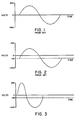
- Figure 1 depicts a waveshape well known as a sine wave.
- Sine wave generators are well known, and it is this sine wave shape that is commonly used to cause ringing in telephone systems.
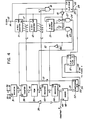
- a typical sine wave for that application has a frequency of 40 Hz and an RMS voltage of 130 volts (i.e. 184 volts peak).
- Figure 2 depicts such a sine wave superimposed upon a DC level of -53 volts. It will be noted that it is the usual practice, at present in North America, to have a DC level of approximately -48 volts on a telephone line. The result, as depicted in Figure 2, is an AC waveform that varies from a positive high of 131 volts to a negative low of 237 volts. In other words, a voltage swing of +131 volts to -237 volts, peak-to-peak. The maximum RMS (root-mean-square) AC voltage is. limited by clipping of the negative peak. At higher frequencies (e.g. 66 2/3 Hz), higher AC voltages are required.
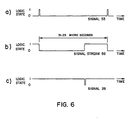
- the waveform of Figure 3 results in a ringing voltage of greater dynamic range than that depicted in Figure 2.
- the waveform of Figure 3 is comprised of a positive portion and a negative portion having equal absolute maximum values.
- the positive portion has a shorter duration than does the negative.portion resulting in the waveform of Figure 3 having a DC component shown in the Figure by a dashed line.
- the single period of the waveform depicted in Figure 3 is comprised of two half cycles of different frequencies.
- the positive portion is one positive half-cycle of one frequency
- the negative portion is one negative half-cycle of a lower frequency.
- the frequencies are chosen such that the total period of the two half cycles constitutes one cycle at the desired ringing frequency.
- the positive portion has a frequency of 102 Hz (half-cycle period equal to 4.90 milliseconds) and the negative portion has a frequency of 49.5 Hz (half-cycle period equal to 10.1 milliseconds) for a composite wave having a frequency of 66 2/3 Hz (period equal to 15.0 milliseconds).
- V DC is the DC component
- Figure 4 depicting a simplified schematic for producing the waveshape shown in Figure 3, will now be described.
- Figure 4 depicts what can be referred to generally as a pulse width modulation (PWM) signal generator 10, which generates a stream of periodically occurring high and low logic states (see Fig. 6).
- PWM pulse width modulation
- Counter 11 is responsive to clock signal 14 appearing on clock lead 15.
- Clock signal 14 has a pulse repetition frequency (PRF) of 5.12 MHz.
- PRF pulse repetition frequency
- Clock signal 14 is applied to the count input C of counter 11 and is counted to provide four least significant bits, 0 to 3 (respectively, in increasing order of significance), on real time bus 13.
- the carry output CO of counter 11 provides a carry signal 17 once every 16 pulses to the input C of counter 12.
- the frequency of carry signal 17 on carry output CO of counter 11 is 320 KHz (i.e. clock signal 14 divided by sixteen).
- NAND gate 18 is connected to the counters 11 and 12, as depicted, so as to cause counter 12 to act as a divide-by-ten circuit whereby the most significant bit (i.e. bit 7) on real time bus 13 has a PRF of 32 KHz.
- the output of NAND gate 18 is connected to the clear input CLR of both counters 11 and 12 and becomes asserted with each occurrence of 160 pulses of clock signal 14 (i.e. at a 32 KHz rate). This causes counters 11 and 12 to be cleared to all zeroes and to commence to generate another sequential series of 160 data bytes.
- NAND gate 18 The output of NAND gate 18 is also buffered by an inverter 19 which has its output connected both to the count input C of counter 21 and to NAND gates 26 and 27.
- the 32 KHz signal from inverter 19 is divided by four by counter 21 and is used to generate complementary phased 8 KHz timing signals 23 and 24 at the output of NAND gates 26 and 27, respectively.
- Flip-flop 22 has a clock input C1K connected to receive the 5.12 MHz PRF clock signal 14 on clock lead 15.
- Clock signal 14, in combination with the output of NAND gate 18 causes flip-flop 22 to generate a timing signal 28 at a 32 KHz rate at its Q output.
- Signal 28. on lead 29 coincides with the occurrence of each highest value data byte on real time bus 13.
- ROM 30 Binary data bytes, each representative of a discrete period of time, are stored at addressable locations in read only memory (ROM) 30.
- ROM 30 e.g. a Texas Instruments model 2716
- the data bytes, stored in ROM 30, are arranged in groups of address ranges, each range corresponding to a predetermined waveform (i.e. shape and magnitude).
- An address range, relating to signals having an alternating current component, consists of a plurality of addresses. Note that if the signal involved were a direct current signal, the address range would consist of only a single address.
- one data byte consists of eight bits and each data byte includes one data bit which is used to control access to ROM 30.
- This data bit is consistently in a first state throughout the address range for the signal in question, except for the last address of the range where the stored data bit is of a second state. When there is only one address in a range, the data bit is of the second state at that one address. When this data bit occurs, during a readout from ROM 30, the next readout from ROM 30 is derived from the beginning of an address range. The use of this data bit will become more apparent in the following description.
- Register 31 receives a load signal 32 on control lead 33 and data, comprising function address 34, on bus 35.
- Function address 34 is registered in register 31 under the control of load signal 32.
- the function address 34 is available from the output of register 31 at the data input 37 of counter 38 (e.g. 2 Texas Instruments model 74LS163).
- Counter 38 also includes a count input C which receives the 8 KHz PRF signal 23 from NAND gate 26.
- Counter 38 also has a load input LD, connected to the output of inverter 39, for controlling operation of counter 38. If the output of inverter 39 is asserted (i.e. a logic 1), then counter 38 is set at the function address 34 in register 31 from which point it is caused to count at an 8 KHz rate (due to timing signal 23 at the C input of counter 38).
- ROM 30 produces, on its data output 42, data bytes from its corresponding addressed storage locations as counter 38 progresses through a range.
- Registers 43 and 44 are connected in series with the output of ROM 30 as shown.
- Register 43 is controlled by signal 24 from NAND gate 27 being applied to its clock input C1K.
- register 44 is controlled by the inverted signal 23 (inverted by inverter 46) being applied to its clock input C1K.
- Adder 48 (e.g. 2 Texas Instruments model 74LS283) has an A input connected to output 47 of register 44 and a B input connected to a hard wired constant, of value 16, via a bus 49.
- ROM 30 has an eight bit data byte output. As one of these bits is used for the load control of counter 38, there are seven remaining bits yielding 128 codes (i.e. 2 7 ). However, there are 160 data bytes produced on real time bus 13. Hence the output of ROM 30 is augmented by the constant sixteen in adder circuit 48 to provide a useable code range from 16 to 144 which is adequate for the operation of the circuitry yet to be described.
- Bus 51 carries the sum of the A input and the B input of adder 48. This sum is applied to the A input of digital comparator 52 (e.g. 2 Texas Instruments model 74LS65).
- Timing signal 53 is applied to the clock input C1K of D-type flip-flop 57 and period signal 28 is applied to the clear input CLR of flip-flop 57.
- a signal stream 58 of width modulated pulses is generated on lead 56 connected to the Q output of flip-flop 57.
- the Q output is also connected back to the D input of flip-flop 57 as depicted. Consequently, flip-flop 57 operates under the control of timing signal 53 and period signal 28 to produce a stream of width modulated pulses 58 at a 32'KHz rate.
- the stream of pulses 58 is used to control the switching bridge 66 shown in Figure 5; the output of bridge 66 is dependent upon the duty cycle of signal stream 58.
- Figure 5 depicts the circuitry for producing high level signal voltages in response to the low level stream of pulses 58 generated by the circuitry of Figure 4.
- the pulses of signal stream 58 are raised to a higher voltage level, suitable for the operation of drive circuits 61, 62 and 63 by inverter 59 having an output connected to a +V power source via resistor 64.
- Voltage V is typically in the range of twenty to thirty volts.
- Voltage V1 to be discussed later, is typically about 150 volts; consequently +V1 is +150 volts and -V1 is -150 volts.
- switching bridge 66 comprises four switches 67, 68, 69 and 70 which are switched in pairs, sequentially at a rate of 32 KHz (i.e. switches 67 and 68 operate together, and switches 69 and 70 operate together).
- the mean voltage across the output of bridge 66 i.e. across terminals 111 and 112 is zero if each pair of switches is turned on for an equal time period (i.e. 50% duty cycle).
- the duty cycle By varying the duty cycle from approximately 20% to 80%, the mean output voltage can be varied from -240 volts to +240 volts.
- the duty cycle it is possible to generate voltages having a myriad of waveforms, frequencies and DC offset.
- Switching bridge 66 includes four switches 67, 68, 69, and 70 and three drive circuits 61, 62, and 63.
- the switches 67 and 68 are connected to the output of drive circuit 61 via an RC network 72, and a transformer 73 having a primary winding 74 and a pair of secondary windings 75a and 75b.
- Switches 69 and 70 are connected to the output of drive circuit 63 via an RC network 77 and a transformer 78 having a primary winding 79 and two secondary windings 80a and 80b.
- the transformers 73 and 78 are each polarized such that when the primary winding is conducting current, the secondary windings provide turn OFF bias to the switches. When current flow through the primary winding is halted, turn ON current is provided by the secondary windings.
- Each driver circuit 61 and 62 includes an input connected to the output of the inverter 59.
- a resistor 82 is also connected between the output of the inverter 59 and ground.
- the output of the driver circuit 62 is connected to a load resistor 83 and to the input of the driver circuit 63.
- the driver circuits each function as inverting amplifiers and by this means the signal stream 58 and its complement are used to drive pairs of the switches 67, 68, 69 and 70 in complement.
- Each drive circuit includes a metal oxide silicon field effect transistor (MOSFET) 86 with source, drain and gate electrodes s, d and g respectively (e.g. 2N6661).
- MOSFET metal oxide silicon field effect transistor
- the drain electrode d is connected to an output port 87a
- the source electrode is connected to ground
- the gate electrode g is connected to the input port 84a via the parallel combination of a resistor 88a and a capacitor 89a.
- a diode 91a and a resistor 92a are connected in parallel across the gate electrode g and the source electrode s.
- each driver circuit acts as an inverting amplifier.
- the signal at the output port 87b of the driver circuit 62 is received and inverted by the driver circuit 63 to generate at its output port 87c the complement of the signal at the output port 87a of the driver circuit 61.
- Each of the switches 67, 68, 69 and 70 includes a series string of a resistor 93, a diode 94 and a resistor 95 connected across the associated secondary winding.
- An NPN transistor 97 includes an emitter electrode connected at the junction of the resistor 95 and the secondary winding.
- a resistor 98 is connected at the junction of the secondary winding and the resistor 93 and in series with two diodes 101 and 102 to the base electrode of transistor 97.
- the base electrode is also connected to the junction of the diode 94 and the resistor 95.
- a diode 103 is connected between the collector electrode of transistor 97 and the junction of the resistor 98 and the diode 101.
- a diode 104 is connected across the collector and emitter electrodes in current opposing relationship.
- turn ON current from the associated secondary winding flows via the resistor 98, the diodes 101 and 102 and via the base emitter junction of the transistor 97, to cause the transistor 97 to conduct current.
- Turn OFF bias is developed at the base electrode when current flows in the opposite direction through the secondary winding via the series string of the resistors 95 and 93 and the diode 94, to cause the transistor 97 to cease conduction.
- Diodes 101, 102 and 103 provide an anti-saturation network to ensure rapid switching of the transistor 97.
- the diode 104 provides a conducting path for inverse reactive load currents.
- Switches 67 and 68 provide a first set of two switches connected to apply a voltage V1 in one direction across the network 105 in response to the signal stream being of a first state.
- Switches 69 and 70 provide a second set of two switches connected to apply the voltage V1 in the reverse direction across the network 105 in response to the signal stream being of a second state.
- the network 105 includes a series connection of an inductor 107 and a capacitor 108. Signal output terminals 111 and 112 are connected across capacitor 108, across which the high level signal voltages are derived.
- switching bridge 66 is operated by pulse width modulated signal 58 at the 32 KHz PRF.
- a value for the inductor 107 in this case has been found to be 50 mh, to produce an output high level signal of suitable quality.
- the switching bridge were operated by a signal having a lower PRF, for example 8 KHz, the value of the inductor 107 would be increased to obtain an output high level signal of similar quality.
- Each of the switches 67, 68, 69 and 70 includes a voltage terminal connected as indicated to the negative -V1 or positive +V1 power terminals associated with a power supply (not shown).
- the following table is a listing in hexadecimal format (Intel format) of the data byte contents of ROM 30.
- the waveform of Figure 3 begins at address 6D8 and finishes at address 74E.
- an address as depicted in the Table, is defined as follows: the first two characters in the address depict a row, and the final character depicts a column.
- the top line, leftmost column of the Table depicts the contents BE at an address 000; the top line, rightmost column of the Table depicts the contents 4D at an address OOF. Consequently, the data for the waveform of Figure 3 commences at data contents 71 (address: 6D8) and finishes at data contents 72 (address:. 74E)
Landscapes
- Engineering & Computer Science (AREA)
- Signal Processing (AREA)
- Devices For Supply Of Signal Current (AREA)
- Inverter Devices (AREA)
Applications Claiming Priority (2)
| Application Number | Priority Date | Filing Date | Title |
|---|---|---|---|
| US37668082A | 1982-05-10 | 1982-05-10 | |
| US376680 | 1982-05-10 |
Publications (2)
| Publication Number | Publication Date |
|---|---|
| EP0094162A2 true EP0094162A2 (de) | 1983-11-16 |
| EP0094162A3 EP0094162A3 (de) | 1984-12-27 |
Family
ID=23486010
Family Applications (1)
| Application Number | Title | Priority Date | Filing Date |
|---|---|---|---|
| EP83302220A Withdrawn EP0094162A3 (de) | 1982-05-10 | 1983-04-19 | Verfahren zur Erzeugung von Spannungssignalen mit einer Gleichspannungskomponente und einem grossen Dynamikbereich |
Country Status (2)
| Country | Link |
|---|---|
| EP (1) | EP0094162A3 (de) |
| JP (1) | JPS58205360A (de) |
Cited By (1)
| Publication number | Priority date | Publication date | Assignee | Title |
|---|---|---|---|---|
| EP0796033A1 (de) * | 1996-03-13 | 1997-09-17 | Koninklijke Philips Electronics N.V. | Telefon mit elektromechanischem Wandler, Verfahren zur Adaption der Wandlersfrequenzwiedergabe und Verfahren zur Melodiekodierung |
Family Cites Families (2)
| Publication number | Priority date | Publication date | Assignee | Title |
|---|---|---|---|---|
| CA1118922A (en) * | 1979-06-29 | 1982-02-23 | Northern Telecom Limited | Universal signal generator for generating telephone system high level signals |
| NL8000859A (nl) * | 1980-02-12 | 1981-09-01 | Philips Nv | Inrichting voor het toevoeren van een wekspanning aan een abonneelijn. |
-
1983
- 1983-04-19 EP EP83302220A patent/EP0094162A3/de not_active Withdrawn
- 1983-05-09 JP JP7944583A patent/JPS58205360A/ja active Pending
Cited By (3)
| Publication number | Priority date | Publication date | Assignee | Title |
|---|---|---|---|---|
| EP0796033A1 (de) * | 1996-03-13 | 1997-09-17 | Koninklijke Philips Electronics N.V. | Telefon mit elektromechanischem Wandler, Verfahren zur Adaption der Wandlersfrequenzwiedergabe und Verfahren zur Melodiekodierung |
| FR2746240A1 (fr) * | 1996-03-13 | 1997-09-19 | Philips Electronics Nv | Telephone equipe d'un transducteur electro-mecanique, procede d'adaptation de la reponse en frequence d'un tel transducteur et procede de codage d'une melodie |
| US5953408A (en) * | 1996-03-13 | 1999-09-14 | U.S. Philips Corporation | Telephone including an electromechanical transducer, method of adapting the frequency response of such a transducer and method of coding a melody |
Also Published As
| Publication number | Publication date |
|---|---|
| JPS58205360A (ja) | 1983-11-30 |
| EP0094162A3 (de) | 1984-12-27 |
Similar Documents
| Publication | Publication Date | Title |
|---|---|---|
| JPS5757025A (en) | Waveform converting circuit | |
| US4914396A (en) | PWM waveform generator | |
| US4295089A (en) | Methods of and apparatus for generating reference voltages | |
| GB1575445A (en) | Rectangular waveform signal reproducing circuit for electronic musical instruments | |
| US4152670A (en) | Signal generator, especially for ringing current in telecommunication system | |
| US4301499A (en) | Inverter circuit with current equalization | |
| EP0094162A2 (de) | Verfahren zur Erzeugung von Spannungssignalen mit einer Gleichspannungskomponente und einem grossen Dynamikbereich | |
| US5942858A (en) | Apparatus for supplying direct current pulses to an electrical load for improved efficiences | |
| CA1145493A (en) | Digitally activated ringing circuit for generation of ac voltages | |
| US4648019A (en) | High efficiency ringing generator | |
| US3056891A (en) | Digital pulse-translating circuit | |
| US4284854A (en) | Universal signal generator for generating telephone system high level signals | |
| US4471419A (en) | Circuitry and method of operation for an intermediate-like converter | |
| US4240135A (en) | Regulated cycloconverter circuit | |
| JPH11318082A (ja) | 高調波抑制スイッチング電源 | |
| US6160792A (en) | Pulse amplitude modulated tone generator | |
| US4760319A (en) | Circuit for removing unwanted slope transitions from an incoming signal | |
| US4764734A (en) | Class SM power amplifier | |
| US5554952A (en) | Fast responding method and apparatus for three phase A/C voltage sensing | |
| US4047090A (en) | Digital controlled low frequency power amplifier | |
| EP0457807B1 (de) | Wellenformerzeugung und -steuerung | |
| RU2038690C1 (ru) | Преобразователь синусоидальных сигналов в сигналы прямоугольной формы | |
| SU1508202A1 (ru) | Многоканальное устройство дл ввода информации | |
| SU1622826A1 (ru) | Измерительный преобразователь | |
| SU547744A1 (ru) | Стабилизированный источник питани |
Legal Events
| Date | Code | Title | Description |
|---|---|---|---|
| PUAI | Public reference made under article 153(3) epc to a published international application that has entered the european phase |
Free format text: ORIGINAL CODE: 0009012 |
|
| AK | Designated contracting states |
Designated state(s): AT DE FR GB NL SE |
|
| PUAL | Search report despatched |
Free format text: ORIGINAL CODE: 0009013 |
|
| AK | Designated contracting states |
Designated state(s): AT DE FR GB NL SE |
|
| 17P | Request for examination filed |
Effective date: 19850410 |
|
| 17Q | First examination report despatched |
Effective date: 19860204 |
|
| STAA | Information on the status of an ep patent application or granted ep patent |
Free format text: STATUS: THE APPLICATION IS DEEMED TO BE WITHDRAWN |
|
| 18D | Application deemed to be withdrawn |
Effective date: 19860618 |
|
| RIN1 | Information on inventor provided before grant (corrected) |
Inventor name: POLLARD, BRIAN JOSEPH Inventor name: MCHARRY, JOHN DYER |