EP0094180A2 - Stafetten-in-einer-Ringleitung verteiltes Zugriffsverfahren für serielle Busse mit Doppelzählung - Google Patents
Stafetten-in-einer-Ringleitung verteiltes Zugriffsverfahren für serielle Busse mit Doppelzählung Download PDFInfo
- Publication number
- EP0094180A2 EP0094180A2 EP83302414A EP83302414A EP0094180A2 EP 0094180 A2 EP0094180 A2 EP 0094180A2 EP 83302414 A EP83302414 A EP 83302414A EP 83302414 A EP83302414 A EP 83302414A EP 0094180 A2 EP0094180 A2 EP 0094180A2
- Authority
- EP
- European Patent Office
- Prior art keywords
- node
- bus
- arbitration
- access
- acv
- Prior art date
- Legal status (The legal status is an assumption and is not a legal conclusion. Google has not performed a legal analysis and makes no representation as to the accuracy of the status listed.)
- Granted
Links
Images
Classifications
-
- H—ELECTRICITY
- H04—ELECTRIC COMMUNICATION TECHNIQUE
- H04L—TRANSMISSION OF DIGITAL INFORMATION, e.g. TELEGRAPHIC COMMUNICATION
- H04L12/00—Data switching networks
- H04L12/28—Data switching networks characterised by path configuration, e.g. LAN [Local Area Networks] or WAN [Wide Area Networks]
- H04L12/40—Bus networks
- H04L12/40143—Bus networks involving priority mechanisms
-
- G—PHYSICS
- G06—COMPUTING OR CALCULATING; COUNTING
- G06F—ELECTRIC DIGITAL DATA PROCESSING
- G06F13/00—Interconnection of, or transfer of information or other signals between, memories, input/output devices or central processing units
- G06F13/14—Handling requests for interconnection or transfer
- G06F13/36—Handling requests for interconnection or transfer for access to common bus or bus system
- G06F13/368—Handling requests for interconnection or transfer for access to common bus or bus system with decentralised access control
- G06F13/374—Handling requests for interconnection or transfer for access to common bus or bus system with decentralised access control using a self-select method with individual priority code comparator
-
- H—ELECTRICITY
- H04—ELECTRIC COMMUNICATION TECHNIQUE
- H04L—TRANSMISSION OF DIGITAL INFORMATION, e.g. TELEGRAPHIC COMMUNICATION
- H04L12/00—Data switching networks
- H04L12/28—Data switching networks characterised by path configuration, e.g. LAN [Local Area Networks] or WAN [Wide Area Networks]
- H04L12/40—Bus networks
- H04L12/407—Bus networks with decentralised control
Definitions
- This invention relates generally to the field of digital data processing systems.
- it relates to the interconnection of various units in such a system, in a network, and controlling the transfer of information among those units.
- the invention relates to digital data processing networks wherein the units of such network are interconnected by a contention-arbitrated serial bus, and to controlling access to that bus by the various units or devices attached to it.
- a digital data processing system comprises at least a memory element, an input-output element and a processor element; and it may contain plural numbers of any or all of them.
- the memory element stores information in addressable storage locations. This information includes data and instructions for processing the data, including commands and responses.
- the processor element transfers information to and from the memory element, intreprets the incoming information as either data or instructions and processes data in accordance with the instructions.
- Input-output elements also communicate with the memory element(s) in order to transfer input data to and from the system and to obtain and process data from it.
- a transmission between two units over a communications bus requires two steps, since more than one unit has the capability of originating such a connection.
- the first step is for the initiating unit to obtain control of the bus for some more or less defined interval.
- a second (or transfer) step is used to complete the transfer that is controlled by the selected initiating unit.
- central arbitration a single, central priority circuit or device receives all requests for bus access and determines which requesting unit at any given time should be accorded the greatest priority and allowed to use the bus. Once that unit is selected, it is allowed to control the bus and effect the transfer.
- distributed arbitration each unit connected to the bus is assigned a specific priority and each unit individually determines whether it has sufficient priority to obtain control of the bus when it desires to do so. If a unit of higher priority simultaneously seeks bus access, a device of lower priority must wait until some later time when it is the highest priority requester.
- the bus is provided with an assigned arbitration conductor.
- each unit transmits a request signal onto that conductor; the unit then compares its request level with all other requests and only if there is no higher priority level request does it grant itself control of the bus.
- CSMA/CD carrier-sense multiple access with collision detection
- each device or unit connected to the network controls its own access to the bus (which is generally a coaxial cable).
- Each device which uses the bus connects to the cable through an interface which includes apparatus for transmitting a signal onto the channel as well as apparatus for receiving a signal placed thereon by another device's interface.
- Each interface includes circuitry for monitoring the channel and indicating whenever two devices are transmitting at the same time. When a device which is transmitting detects that another device is transmitting at the same time, the two devices stop transmitting and signal to their associated information sources (which are supplying the information to be transmitted) to stop transmitting. Both then retry transmission after the channel is clear.
- Each device that wants to use (i.e., transmit on) the channel first "listens" to hear if any other unit is transmitting. If it detects no other transmission, the station (i.e., unit) starts its transmission, while simultaneously “listening" to the channel. If it detects that another station has started transmitting at the same time, both detect the collision and stop, as noted above. To avoid repeated collisions, each then waits briefly and tries again; various approaches exist for assigning to each unit a unique or suitable random delay to control the interval prior to retransmission. Such a system is illustrated, for example, in U.S. patent 4,063,220, issued December 13, 1977 to Robert M. Metcalfe et al. The same assignee as the present invention also has copending herewith the following previously filed applications which relate to a CSMA/CD network:
- a slightly different system is marketed by Network Systems Corporation, 6820 Shingle Creek Parkway, Brookline Center, Minnesota 55430, and is described in C. Weitzman, Distributed Micro/Minicomputer Systems: Structure, Implementation and Application, ⁇ 4.3 at 180-183, Prentice Hall, Inc. 1980.
- an adapter i.e., the interface to the coaxial cable
- Three mechanisms are used within the contention procedure.
- the first mechanism is carrier sensing: If the coaxial cable is busy (i.e., a signal is detected), the unit will not initiate transmission.
- the second mechanism involves delaying transmission, following detection of coaxial cable availability, by a fixed interval.
- Each interface contains a hardware delay element which prevents transmission from the time it senses the "cable not busy" condition until the delay has elapsed. This allows a receiver time to respond promptly to a transmission on termination of the message, without having to contend for the bus again; it also allows an adapter that has access to the cable to continue to use it in a series of transmissions. This fixed delay is 4 nanoseconds per foot of cable length and, for a 1,000 foot bus, it is therefore 8 microseconds (since it is necessary to allow for the trailing edge of the transmission to travel the full length and for the leading edge of a response to also travel the full length).
- the third mechanism assigns a transmission priority to each adapter.
- each adapter Following the bus becoming not busy and the fixed delay having elapsed, each adapter generates a time pulse at which time it may initiate transmission on the bus and capture the bus for its use.
- the time following the end of the fixed delay at which a bus interface generates the time pulse enabling a transmission to start is referred to as "n-delay".
- n-delay is 0.
- n-delay is given by the following formula:
- an adapter immediately can initiate transmission. If collision occurs due to nearly simultaneous transmission by two adapters, it will be resolved during a retry, with the adapter having the higher priority being the one to get access.
- each node or unit connected to the bus has substantially equal average priority for obtaining bus access.
- Yet another object of this invention is to provide a high reliability arbitration mechanism.
- Still another object of this invention is to provide an arbitration mechanism which exhibits deterministic, not simply statistical behavior.
- Yet another object is to provide an arbitration mechanism which permits a node to contend with two or more bus channels over which the node may communicate alternatively.
- a further object of this invention is to provide an arbitration mechanism which satisfies one or more of the foregoing objectives and is relatively simple to implement.
- the present invention provides an arbitration scheme for a slotted CSMA/CD system, referred to as a dual-count, round-robin technique.
- a dual-count, round-robin technique For each node, two delay interval possibilities exist; the delay selection for each node is switched from time to time, on a round-robin basis, such that all nodes are given equal average priority for bus access.
- node refers to a device communicating over a bus and minimally includes a processor or memory and a bus interface.
- Other terms used to like effect herein are “device” and “unit”.
- the technique is based on a slot, or time interval, which is the maximum time for a node to sense that some other node (at any other physical location) is transmitting.
- a node desiring to transmit starts by examining the bus (or selected bus if two are available) to determine if a carrier is present (i.e., if another node is transmitting). As soon as the bus becomes idle (i.e., a carrier-to-no carrier state change is observed), the initiating node begins to wait for a unique number of "quiet" slots; the number is based on the address N of the node. The number of slots waited may have one of two values, N+l or M+N+1, where M represents the maximum number of nodes allowed on the bus. The selection of the value is a function of history - i.e., it depends on the previous transmissions by other nodes.
- the waiting period is N+M+1 slots. If the waiting period elapses without another node's carrier having been detected, the initiating node has won arbitration and transmits its packet(s) if the node is not currently receiving data on the alternate path. If, however, carrier is detected, arbitration is lost and a count is taken of the number of slots waited before the carrier was detected. The number of slots waited (modulo M) minus one is the number of the node that transmitted - i.e., the node (LW) which last won arbitration. The initiating node compares its node number to LW and sets its waiting time value based on this comparison.
- the new waiting value will be N +l (i.e., the waiting value is low and the priority is high); if LW is greater than its own node number (N), the new waiting value will be N+M+1 (i.e., the waiting value is high and the priority is low).
- the comparison may be made more directly by determining the relative value of LW with respect to N.
- Collisions can occur only when the bus has been idle and two nodes then begin arbitrating at times different (in numbers of slots) by the same amount as their addresses differ. When they both try to transmit at the same time, a collision results The collision corrupts the packets and is detected by failure of the error correcting code transmitted with the packet to match the one calculated at the receiver (this may, for example be a cyclical redundancy check - i.e., CRC - code).
- a timeout period is specified for situations wherein a node is unable to prevail in arbitration (i.e., an absence of carrier is never detected for the current arbitration count value).
- the expiration of an arbitration timer results in a response indicating a transmission failure.
- the timer may be in the node's processor or in the interface.
- An immediate acknowledgment is sent to verify the successful transmission and reception of packets.
- a node When a node successfully receives an information packet, it immediately acknowledges the receipt of that packet. Acknowledgment is performed by the transmission of a special packet that carries an acknowledgment type code. Arbitration for transmission of the acknowledgment packet is not required; the packet is transmitted as soon as the carrier of the transmission is removed from the physical channel. The acknowledgment must be returned before the carrier gap becomes long enough for another node (node 0 in this case being the critical one) to arbitrate for a quiet slot.
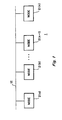
- a network 1 is formed from a plurality of nodes 2(a) - 2(n) interconnected by a serial bus 12.
- the present arbitration scheme provides a node with the ability to contend for arbitration also with a second (or third, fourth, etc.) serial path over which that node may transmit or receive data.
- the scheme allows the arbitration process to continue in a controlled manner if the node is receiving data on the alternate path from the one on which it is arbitrating. Once the reception and acknowledgement on the alternate path is complete, the node is allowed to transmit once the arbitration process has completed on the desired path. Each time a transmission is to be made, one of the two paths is selected.
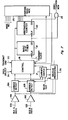
- the basic arbitration system of this invention is illustrated in Fig. 2. As shown there, arbitration is carried out with respect to two bus paths, bus path A (12A) and bus path B (12B). Each bus path has its own line receiver (14A, 14B) and carrier detection circuit (16A, 16B). Dual path reception is implemented by monitoring the carrier detector 16A, 16B of both paths, looking for the initial presence of carrier on either path. (i.e., the off-to-on transition)
- the carrier switch 17 responds to the carrier detectors 16A, 16B and switches the receiver processing circuitry 26 to the path which first exhibits the initial presence of carrier. In the event that carrier assertions are detected simultaneously on both paths one of the paths will be selected by prior arrangement.
- the carrier switch 17 continues monitoring the selected path until the pocket header is decoded.
- Circuitry in the receiver processing section 26 decodes the destination address in the header; the carrier switch 17 continues to monitor that path if the packet is for that node, and switches away from that path if the packet is for another node.
- the carrier switch 17 switches receive processing circuitry 26 away from a path, it goes to a state where it again looks for the initial presence of carrier. The carrier switch will not switch to a path that already has carrier asserted.
- bus A In general, the arbitration process is the same on both buses, so the remainder of the discussion will address the arbitration process for bus A only, it being understood that bus B is virtually a mirror image.
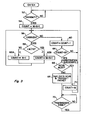
- the arbitration process starts, for a particular node, with a control circuit 18 in a first state 52.
- a transmit command line 20 is monitored and a determination is made as to whether the node desires to transmit. If not, it keeps monitoring the status of line 20 until a transmit command is detected.
- the process enters state 54 wherein an arbitration counter 22 is loaded by control circuit 18 with a count (i.e., an arbitration count value, or ACV) equal to M+N+1, where M is the maximum number of nodes in the network and N is the number of that node.
- ACV arbitration count value
- the arbitration value count loaded into counter 22 is the number of consecutive slots that must be observed free of carrier before a node can transmit.
- the basic quiet slot interval is long enough to allow a receiving node to turn around and start transmitting an acknowledgment packet and to have the acknowledgment seen by another node trying to arbitrate on the same path before the quiet slot expires.
- Acknowledgment packets are the only packets transmitted over the bus without first arbitrating for control.
- Arbitration slots are signalled by a carryout (CO) overflow of a basic slot timer 21, which indicates the passage of slot intervals as multiples of the transmit clock period.
- CO carryout
- Control circuit 18 next checks the state of the bus on which transmission is desired (indicated by the state of a path selection signal on line 24). State (or step) 56. If the carrier detector (16A or 16B) for the selected path indicates the presence of carrier thereon, that signifies that arbitration was won by another node, and control branches to step 58; otherwise, to step 60.
- step 58 a comparison is made between the number of the last node to win arbitration of the bus (LW) and the number of this node (N).
- the arbitration counter 22 is then loaded with a new arbitration count value, either N+l (if LW is less than N) or M+N+1 (if LW is greater than or equal to N).
- Steps 62A, 62B Following the reloading of the arbitration counter, step 56 ! is reentered.
- a node determines which node won the last arbitration (i.e., LW) as follows: At the beginning of the arbitration process, a node saves a copy of its own arbitration countdown value (e.g., in a node number comparison means 25). When arbitration ends by detection of a carrier, the remaining value in the arbitration counter, (modulo M) indicates whether the node number (LW) of the node which won the arbitration is higher or lower than the node number (N) of the node waiting to transmit. Observe, however, that this is true only when there is activity on a bus, since the de-assertion of carrier is the event which synchronizes each node's arbitration logic.
- step 60 the count indicated by arbitration counter 22 is decremented by one.
- step 64 the counter's contents are tested for overflow, i.e., reaching zero.
- step 64 A count of zero indicates arbitration was successful. This is signalled at the output of AND gate 23. If the count is not zero, arbitration was not successful and control reverts to step 56.
- the transmitter i.e., control circuitry 18
- the transmitter next checks to see whether the receiver is busy on one of the alternate buses. Step 66. If it is not, the receiver processing circuitry 26 is locked onto the selected transmit path and the transmission is begun. Step 68. The transmission is monitored (step 70), and when done, control reverts to the entry point of the arbitration process.
- step 66 If the receiver circuitry was found busy in step 66, the arbitration counter is loaded with a count of M, step 72, and arbitration continues at step 56.
- the receiver circuitry 26 is indicated as busy when one of the following occurs: (1) carrier has been detected on the alternate path and it has not yet been determined that the transmission is destined for another node; (2) a packet or message is being received for the node on the alternate path; or (3) a packet has been received and the transmitter is in the process of sending an acknowledgment packet.
- the shared receiver circuitry is locked onto the selected path during the entirety of a transmission and until an acknowledgment is received or an acknowledgment timer (not shown) expires.
- NO RSP No .Response
- NO RSP's may occur as the result of bus noise (causing CRC comparison failure), simultaneous transmission by multiple nodes (i.e., a collision, which is signalled by a failure of CRC comparisons), or inability of a node to receive the packet on the bus path on which it was transmitted, such as due to a malfunction of path or interface hardware.
- the first is positive acknowledgment (ACK), which indicates that the reception was successful; that is, the transmitted packet is available to the host computer in the receiving node.
- the second is negative acknowledgment (NAK), which indicates that the packet was correctly received, but that the interface was unable to buffer it (i.e., the packet was discarded).
- ACK positive acknowledgment
- NAK negative acknowledgment
- the concept of a congested interface that is unable to process a packet applies to all implementations.
- the probability of congestion in interfaces should be minimized, as it reduces the amount of bandwidth available to all nodes on the interconnection media.
- Each acknowledgment message is checked to insure that it was received from the node to which the triggering transmission was sent.
- packet format used for this purpose, see the aforementioned U.S. Patent Application Serial Number 375,984.
- retransmission must be attempted according to the following algorithm: for NO RS P , if fewer than a predetermined number (e.g., 64 of consecutive NO RSP's on the packet have occurred, retransmission should be attempted. For NA K , if fewer than another predetermined number (e.g., 128) of NAK's on the packet have occurred (not necessarily consecutively), retransmission should be attempted.
- a predetermined number e.g., 64 of consecutive NO RSP's on the packet have occurred
- NA K if fewer than another predetermined number (e.g., 128) of NAK's on the packet have occurred (not necessarily consecutively), retransmission should be attempted.
- a "coin-flip" decision must be made when the packet is available for retransmission. If the result if TRUE, retransmission is attempted. If FALSE, a delay time interval is waited and the decision repeated.
- the delay time value should be a minimum of M slot times.
- the normally selected slot time value is fixed at, e.g., 800 nanoseconds, which implies a minimum delay interval of 12.8 microseconds for a 16 node network.
- the maximum time is unlimited, though throughput considerations usually limit the maximum.
- the delay need not be consistent. This allows for software or firmware controlled retry with non-constant service latencies (such as in a polled system).
- the first decision has special properties.
- This scheme is designed to break deadlocks.
- the selection of retry limits was calculated from simulation results to meet the following criteria: The mistaking of failure in a correctly functioning system (due to congestion) should occur no more than once per year with the factors typically encountered in heavily loaded clusters (i.e., networks).
- a path that has failed in retransmission need not be retried for the failing packet. Rather, it is appropriate to retry it at whatever frequency is used for configuration update polling.
Landscapes
- Engineering & Computer Science (AREA)
- Theoretical Computer Science (AREA)
- Physics & Mathematics (AREA)
- General Engineering & Computer Science (AREA)
- General Physics & Mathematics (AREA)
- Computer Networks & Wireless Communication (AREA)
- Signal Processing (AREA)
- Small-Scale Networks (AREA)
- Bus Control (AREA)
- Information Transfer Systems (AREA)
- Multi Processors (AREA)
Applications Claiming Priority (2)
| Application Number | Priority Date | Filing Date | Title |
|---|---|---|---|
| US06375983 US4560985B1 (en) | 1982-05-07 | 1982-05-07 | Dual-count, round-robin ditributed arbitration technique for serial buses |
| US375983 | 1982-05-07 |
Publications (3)
| Publication Number | Publication Date |
|---|---|
| EP0094180A2 true EP0094180A2 (de) | 1983-11-16 |
| EP0094180A3 EP0094180A3 (en) | 1985-05-08 |
| EP0094180B1 EP0094180B1 (de) | 1988-09-07 |
Family
ID=23483198
Family Applications (1)
| Application Number | Title | Priority Date | Filing Date |
|---|---|---|---|
| EP83302414A Expired EP0094180B1 (de) | 1982-05-07 | 1983-04-28 | Stafetten-in-einer-Ringleitung verteiltes Zugriffsverfahren für serielle Busse mit Doppelzählung |
Country Status (6)
| Country | Link |
|---|---|
| US (1) | US4560985B1 (de) |
| EP (1) | EP0094180B1 (de) |
| JP (2) | JPS5941079A (de) |
| AU (1) | AU567291B2 (de) |
| CA (1) | CA1198522A (de) |
| DE (1) | DE3377965D1 (de) |
Cited By (7)
| Publication number | Priority date | Publication date | Assignee | Title |
|---|---|---|---|---|
| FR2558667A1 (fr) * | 1984-01-19 | 1985-07-26 | Minisystemes | Procede de transmission de donnees numeriques, reseau et module mettant en oeuvre le procede |
| GB2254982A (en) * | 1991-04-19 | 1992-10-21 | British Aerospace | Data networks. |
| GB2262862A (en) * | 1991-12-23 | 1993-06-30 | Motorola Israel Ltd | Method and apparatus for contending for access to a communication channel |
| EP0629063A1 (de) * | 1993-05-21 | 1994-12-14 | Nortel Networks Corporation | Serielles Bussystem |
| GB2293943A (en) * | 1994-10-04 | 1996-04-10 | Motorola Israel Ltd | Communications system with priority scheme for reduced access delay |
| CN1037480C (zh) * | 1993-06-23 | 1998-02-18 | 摩托罗拉公司 | 争用通信信道的方法和装置 |
| GB2437589A (en) * | 2006-02-14 | 2007-10-31 | Furuno Electric Co | Determining time slot use in an AIS system |
Families Citing this family (66)
| Publication number | Priority date | Publication date | Assignee | Title |
|---|---|---|---|---|
| AU568490B2 (en) * | 1982-05-07 | 1988-01-07 | Digital Equipment Corporation | Memory-to-memory intercomputer communication |
| US4560985B1 (en) * | 1982-05-07 | 1994-04-12 | Digital Equipment Corp | Dual-count, round-robin ditributed arbitration technique for serial buses |
| US4559595A (en) * | 1982-12-27 | 1985-12-17 | Honeywell Information Systems Inc. | Distributed priority network logic for allowing a low priority unit to reside in a high priority position |
| US4763249A (en) * | 1983-09-22 | 1988-08-09 | Digital Equipment Corporation | Bus device for use in a computer system having a synchronous bus |
| US4661905A (en) * | 1983-09-22 | 1987-04-28 | Digital Equipment Corporation | Bus-control mechanism |
| US4630265A (en) * | 1984-09-26 | 1986-12-16 | General Electric Company | Method and apparatus for selecting for use between data buses in a redundant bus communication system |
| US4910658A (en) * | 1985-09-04 | 1990-03-20 | Eaton Leonard Technologies, Inc. | Real time process controller with serial I/O bus |
| US4663620A (en) * | 1985-09-05 | 1987-05-05 | International Business Machines Corporation | Modified crossbar switch operation with fixed priority conflict resolution and apparatus for performing same |
| JPS6276341A (ja) * | 1985-09-27 | 1987-04-08 | Toshiba Corp | 通信方法および装置 |
| DE3882991T2 (de) * | 1987-05-01 | 1994-03-24 | Digital Equipment Corp | Anordnung und methode zur erzielung von unterbrechungen mit einem "pended bus". |
| US4980854A (en) * | 1987-05-01 | 1990-12-25 | Digital Equipment Corporation | Lookahead bus arbitration system with override of conditional access grants by bus cycle extensions for multicycle data transfers |
| US4947368A (en) * | 1987-05-01 | 1990-08-07 | Digital Equipment Corporation | Lookahead bus arbitration system with override of conditional access grants by bus cycle extensions for multicycle data transfers |
| DE3888353T2 (de) * | 1987-05-01 | 1994-11-17 | Digital Equipment Corp | Unterbrechungsknoten zum vorsehen von unterbrechungsanforderungen auf einem anstehenden bus. |
| US5111424A (en) * | 1987-05-01 | 1992-05-05 | Digital Equipment Corporation | Lookahead bus arbitration system with override of conditional access grants by bus cycle extensions for multicycle data transfer |
| US4953072A (en) * | 1987-05-01 | 1990-08-28 | Digital Equipment Corporation | Node for servicing interrupt request messages on a pended bus |
| US5034883A (en) * | 1987-05-01 | 1991-07-23 | Digital Equipment Corporation | Lockhead bus arbitration system with override of conditional access grants by bus cycle extensions for multicycle data transfers |
| US4897833A (en) * | 1987-10-16 | 1990-01-30 | Digital Equipment Corporation | Hierarchical arbitration system |
| US4887076A (en) * | 1987-10-16 | 1989-12-12 | Digital Equipment Corporation | Computer interconnect coupler for clusters of data processing devices |
| JPH06101732B2 (ja) * | 1987-11-30 | 1994-12-12 | 三菱電機株式会社 | 通信制御方式 |
| NL8802884A (nl) * | 1988-11-22 | 1990-06-18 | Philips Nv | Werkwijze en stelsel voor het overdragen van gebufferde datapakketten via een communicatienetwerk. |
| US4969120A (en) * | 1989-02-13 | 1990-11-06 | International Business Machines Corporation | Data processing system for time shared access to a time slotted bus |
| CA2011935A1 (en) * | 1989-04-07 | 1990-10-07 | Desiree A. Awiszio | Dual-path computer interconnect system with four-ported packet memory control |
| US5187780A (en) * | 1989-04-07 | 1993-02-16 | Digital Equipment Corporation | Dual-path computer interconnect system with zone manager for packet memory |
| US5167019A (en) * | 1989-06-23 | 1992-11-24 | Digital Equipment Corporation | Apparatus and method for interconnecting a plurality of devices to a single node in a node-limited serial data bus computer network |
| US5193151A (en) | 1989-08-30 | 1993-03-09 | Digital Equipment Corporation | Delay-based congestion avoidance in computer networks |
| US5072363A (en) * | 1989-12-22 | 1991-12-10 | Harris Corporation | Multimode resource arbiter providing round robin arbitration or a modified priority arbitration |
| US5247671A (en) * | 1990-02-14 | 1993-09-21 | International Business Machines Corporation | Scalable schedules for serial communications controller in data processing systems |
| AU7453491A (en) * | 1990-03-29 | 1991-10-21 | Sf2 Corporation | Method and apparatus for scheduling access to a csma communication medium |
| US5175537A (en) * | 1990-03-29 | 1992-12-29 | Micro Technology, Inc. | Method and apparatus for scheduling access to a CSMA communication medium |
| US5239630A (en) * | 1990-07-02 | 1993-08-24 | Digital Equipment Corporation | Shared bus arbitration apparatus having a deaf node |
| US5230044A (en) * | 1990-07-02 | 1993-07-20 | Digital Equipment Corporation | Arbitration apparatus for shared bus |
| CA2045087A1 (en) * | 1990-07-02 | 1992-01-03 | Nii Quaynor | Shared arbitration apparatus suitable for deaf node |
| US5276877A (en) * | 1990-10-17 | 1994-01-04 | Friedrich Karl S | Dynamic computer system performance modeling interface |
| US5175731A (en) * | 1990-12-11 | 1992-12-29 | International Business Machines Corporation | Arbitration circuit for a multimedia system |
| US5249183A (en) * | 1991-03-14 | 1993-09-28 | Level One Communications, Inc. | Interfacing unit for local area networks |
| JPH04369755A (ja) * | 1991-06-18 | 1992-12-22 | Japan Radio Co Ltd | データ伝送装置 |
| US5301282A (en) * | 1991-10-15 | 1994-04-05 | International Business Machines Corp. | Controlling bus allocation using arbitration hold |
| EP0559214A1 (de) * | 1992-03-06 | 1993-09-08 | Pitney Bowes Inc. | Ereignisgesteuertes Kommunikationsnetzwerk |
| US5301283A (en) * | 1992-04-16 | 1994-04-05 | Digital Equipment Corporation | Dynamic arbitration for system bus control in multiprocessor data processing system |
| US5430848A (en) * | 1992-08-14 | 1995-07-04 | Loral Fairchild Corporation | Distributed arbitration with programmable priorities |
| US5553248A (en) * | 1992-10-02 | 1996-09-03 | Compaq Computer Corporation | System for awarding the highest priority to a microprocessor releasing a system bus after aborting a locked cycle upon detecting a locked retry signal |
| US5553310A (en) * | 1992-10-02 | 1996-09-03 | Compaq Computer Corporation | Split transactions and pipelined arbitration of microprocessors in multiprocessing computer systems |
| US5535395A (en) * | 1992-10-02 | 1996-07-09 | Compaq Computer Corporation | Prioritization of microprocessors in multiprocessor computer systems |
| US5351241A (en) * | 1992-12-24 | 1994-09-27 | Intel Corporation | Twisted pair ethernet hub for a star local area network |
| DE69433882T2 (de) * | 1993-02-15 | 2005-08-25 | Honda Giken Kogyo K.K. | Vorrichtung zur Übertragung von Daten |
| US5604487A (en) * | 1993-07-30 | 1997-02-18 | Lockheed Martin Tactical Systems, Inc. | Apparatus and method for user-selective data communication with verification |
| US5742239A (en) * | 1993-08-24 | 1998-04-21 | Mti Technology Corporation | Background arbitration monitoring to improve access on lightly consumed network |
| JP2644185B2 (ja) * | 1994-06-27 | 1997-08-25 | 甲府日本電気株式会社 | データ処理装置 |
| US5751974A (en) * | 1994-07-21 | 1998-05-12 | Motorola, Inc. | Contention resolution for a shared access bus |
| US5519837A (en) * | 1994-07-29 | 1996-05-21 | International Business Machines Corporation | Pseudo-round-robin arbitration for a shared resource system providing fairness and high throughput |
| US5793993A (en) * | 1995-01-26 | 1998-08-11 | General Magic, Inc. | Method for transmitting bus commands and data over two wires of a serial bus |
| US5608341A (en) * | 1995-05-09 | 1997-03-04 | Level One Communications, Inc. | Electrical circuit for setting internal chip functions without dedicated configuration pins |
| US5926504A (en) * | 1995-06-05 | 1999-07-20 | Level One Communications, Inc. | Electrical circuit for selectively connecting a repeater to a DTE port |
| US5852600A (en) * | 1995-06-07 | 1998-12-22 | Mci Communications Corporation | System and method for resolving substantially simultaneous bi-directional requests of spare capacity |
| US5802057A (en) | 1995-12-01 | 1998-09-01 | Apple Computer, Inc. | Fly-by serial bus arbitration |
| US5875338A (en) * | 1995-12-14 | 1999-02-23 | International Business Machines Corporation | Method and apparatus for arbitrating resource requests utilizing independent tokens for arbiter cell selection |
| US5898694A (en) * | 1996-12-30 | 1999-04-27 | Cabletron Systems, Inc. | Method of round robin bus arbitration |
| US6070193A (en) * | 1997-11-26 | 2000-05-30 | International Business Machines Corp. | Apparatus and method for ordered transmission on networks |
| US6385210B1 (en) * | 1998-04-17 | 2002-05-07 | Ford Global Technologies, Inc. | Method for detecting and resolving data corruption in a UART based communication network |
| US6298067B1 (en) * | 1998-05-01 | 2001-10-02 | 3 Com Corporation | Distributed arbitration scheme for network device |
| US6724772B1 (en) * | 1998-09-04 | 2004-04-20 | Advanced Micro Devices, Inc. | System-on-a-chip with variable bandwidth |
| US7606257B2 (en) * | 2004-01-15 | 2009-10-20 | Atheros Communications, Inc. | Apparatus and method for transmission collision avoidance |
| JP4766160B2 (ja) * | 2009-07-29 | 2011-09-07 | 株式会社デンソー | 通信システムおよび通信ノード |
| US9149188B2 (en) * | 2010-07-01 | 2015-10-06 | Shenzhen Mindray Bio-Medical Electronics Co. Ltd. | Systems and methods for synchronizing data received from multiple sensor modules in a patient monitor system |
| CN104333499B (zh) * | 2014-10-23 | 2017-09-15 | 南京国电南自软件工程有限公司 | 基于m‑lvds的装置背板高速总线链路层通信协议 |
| CN115589398B (zh) * | 2022-09-21 | 2024-12-13 | 河南昆仑技术有限公司 | I2c地址分配方法及计算设备 |
Family Cites Families (8)
| Publication number | Priority date | Publication date | Assignee | Title |
|---|---|---|---|---|
| GB1314180A (en) * | 1969-11-21 | 1973-04-18 | Plessey Telecommunications Res | Electrical data transmission systems |
| US4232294A (en) * | 1979-04-30 | 1980-11-04 | Control Data Corporation | Method and apparatus for rotating priorities between stations sharing a communication channel |
| US4337465A (en) * | 1980-09-25 | 1982-06-29 | Burroughs Corporation | Line driver circuit for a local area contention network |
| US4385382A (en) * | 1980-09-29 | 1983-05-24 | Honeywell Information Systems Inc. | Communication multiplexer having a variable priority scheme using a read only memory |
| US4395710A (en) * | 1980-11-26 | 1983-07-26 | Westinghouse Electric Corp. | Bus access circuit for high speed digital data communication |
| US4494113A (en) * | 1981-03-13 | 1985-01-15 | Hitachi, Ltd. | Method and apparatus for self-control in distributed priority collision |
| US4466096A (en) * | 1982-03-11 | 1984-08-14 | International Business Machines Corporation | Apparatus and method for providing transmitter hierarchy control for efficient channel management |
| US4560985B1 (en) * | 1982-05-07 | 1994-04-12 | Digital Equipment Corp | Dual-count, round-robin ditributed arbitration technique for serial buses |
-
1982
- 1982-05-07 US US06375983 patent/US4560985B1/en not_active Expired - Lifetime
-
1983
- 1983-04-20 AU AU13696/83A patent/AU567291B2/en not_active Ceased
- 1983-04-28 EP EP83302414A patent/EP0094180B1/de not_active Expired
- 1983-04-28 DE DE8383302414T patent/DE3377965D1/de not_active Expired
- 1983-05-06 JP JP58079197A patent/JPS5941079A/ja active Granted
- 1983-05-06 CA CA000427594A patent/CA1198522A/en not_active Expired
-
1986
- 1986-10-13 JP JP61242870A patent/JPS62229354A/ja active Pending
Cited By (15)
| Publication number | Priority date | Publication date | Assignee | Title |
|---|---|---|---|---|
| FR2558667A1 (fr) * | 1984-01-19 | 1985-07-26 | Minisystemes | Procede de transmission de donnees numeriques, reseau et module mettant en oeuvre le procede |
| WO1985003395A3 (fr) * | 1984-01-19 | 1985-09-12 | Minisystemes | Procede de transmission de donnees numeriques, reseau et module mettant en oeuvre le procede |
| US4700343A (en) * | 1984-01-19 | 1987-10-13 | Minisystems | Method and device for module contention to non-dedicated common line |
| GB2254982A (en) * | 1991-04-19 | 1992-10-21 | British Aerospace | Data networks. |
| GB2254982B (en) * | 1991-04-19 | 1995-06-14 | British Aerospace | Data networks |
| US5390360A (en) * | 1991-12-23 | 1995-02-14 | Motorola, Inc. | R.F. communication system interrogation apparatus and method |
| GB2262862A (en) * | 1991-12-23 | 1993-06-30 | Motorola Israel Ltd | Method and apparatus for contending for access to a communication channel |
| GB2262862B (en) * | 1991-12-23 | 1996-05-22 | Motorola Israel Ltd | Method and apparatus for contending for access to a communication channel |
| EP0629063A1 (de) * | 1993-05-21 | 1994-12-14 | Nortel Networks Corporation | Serielles Bussystem |
| CN1037480C (zh) * | 1993-06-23 | 1998-02-18 | 摩托罗拉公司 | 争用通信信道的方法和装置 |
| GB2293943A (en) * | 1994-10-04 | 1996-04-10 | Motorola Israel Ltd | Communications system with priority scheme for reduced access delay |
| GB2293943B (en) * | 1994-10-04 | 1998-06-17 | Motorola Israel Ltd | Communications system with priority scheme for reduced access delay |
| GB2437589A (en) * | 2006-02-14 | 2007-10-31 | Furuno Electric Co | Determining time slot use in an AIS system |
| GB2437589B (en) * | 2006-02-14 | 2009-12-16 | Furuno Electric Co | Navigational aid and carrier sense technique |
| US7693177B2 (en) | 2006-02-14 | 2010-04-06 | Furuno Electric Company, Ltd. | Navigational aid and carrier sense technique |
Also Published As
| Publication number | Publication date |
|---|---|
| DE3377965D1 (en) | 1988-10-13 |
| JPS5941079A (ja) | 1984-03-07 |
| US4560985A (en) | 1985-12-24 |
| EP0094180A3 (en) | 1985-05-08 |
| US4560985B1 (en) | 1994-04-12 |
| AU1369683A (en) | 1983-11-10 |
| JPS635789B2 (de) | 1988-02-05 |
| JPS62229354A (ja) | 1987-10-08 |
| CA1198522A (en) | 1985-12-24 |
| AU567291B2 (en) | 1987-11-19 |
| EP0094180B1 (de) | 1988-09-07 |
Similar Documents
| Publication | Publication Date | Title |
|---|---|---|
| US4560985A (en) | Dual-count, round-robin distributed arbitration technique for serial buses | |
| CA2027230C (en) | Station-to-station full duplex communication in a communications network | |
| EP0674790B1 (de) | Verfahren und gerät zur umwandlung einer beliebigen topologie von einer knotensammlung in einen acyclischen gerichteten graph | |
| JP2545508B2 (ja) | 車両に対するデータ処理装置の作動方法およびデータ処理装置 | |
| EP0100662B1 (de) | Digitales Übertragungssystem | |
| US5960001A (en) | Apparatus and method for guaranteeing isochronous data flow on a CSMA/CD network | |
| JP3767904B2 (ja) | 高効率なポーリング手順によるデータ通信 | |
| US4719458A (en) | Method of data arbitration and collision detection in a data bus | |
| US4581734A (en) | Multipriority communication system | |
| US6133846A (en) | Low cost redundant communications system | |
| EP0076880B1 (de) | Lokales Netz mit Konkurrenzbetrieb für Datenkommunikationssysteme | |
| US4561092A (en) | Method and apparatus for data communications over local area and small area networks | |
| WO1994015302A1 (en) | Method and apparatus for arbitrating on an acyclic directed graph | |
| WO1997032254A1 (en) | System and method for bus contention resolution | |
| US5230044A (en) | Arbitration apparatus for shared bus | |
| US5856921A (en) | Apparatus and method for intermodular communications using system bus controllers | |
| EP0237839B1 (de) | Serieller Datenbus für Datenübertragung zwischen Modulen und Verfahren zur Datenarbitrierung und zur Kollisionsdetektion auf einem Datenbus | |
| US5742239A (en) | Background arbitration monitoring to improve access on lightly consumed network | |
| RU2122234C1 (ru) | Шинная система одноканальной многостанционной связи | |
| WO1994015305A1 (en) | Method and apparatus for transforming an arbitrary acyclic topology collection of nodes into an acyclic directed graph | |
| CN114363112A (zh) | 一种总线组网系统及总线仲裁方法 | |
| KR0165440B1 (ko) | 폴링통신방법 | |
| JPH09181754A (ja) | 通信制御システム及び通信制御方法 | |
| JP2536978B2 (ja) | デフ・ノ―ドのために好適な共有型ア―ビトレ―ション装置および方法 | |
| JP2001086121A (ja) | データ通信装置 |
Legal Events
| Date | Code | Title | Description |
|---|---|---|---|
| PUAI | Public reference made under article 153(3) epc to a published international application that has entered the european phase |
Free format text: ORIGINAL CODE: 0009012 |
|
| AK | Designated contracting states |
Designated state(s): DE FR GB IT NL SE |
|
| PUAL | Search report despatched |
Free format text: ORIGINAL CODE: 0009013 |
|
| AK | Designated contracting states |
Designated state(s): DE FR GB IT NL SE |
|
| 17P | Request for examination filed |
Effective date: 19850627 |
|
| 17Q | First examination report despatched |
Effective date: 19870423 |
|
| GRAA | (expected) grant |
Free format text: ORIGINAL CODE: 0009210 |
|
| AK | Designated contracting states |
Kind code of ref document: B1 Designated state(s): DE FR GB IT NL SE |
|
| ITF | It: translation for a ep patent filed | ||
| REF | Corresponds to: |
Ref document number: 3377965 Country of ref document: DE Date of ref document: 19881013 |
|
| ET | Fr: translation filed | ||
| PLBE | No opposition filed within time limit |
Free format text: ORIGINAL CODE: 0009261 |
|
| STAA | Information on the status of an ep patent application or granted ep patent |
Free format text: STATUS: NO OPPOSITION FILED WITHIN TIME LIMIT |
|
| 26N | No opposition filed | ||
| PGFP | Annual fee paid to national office [announced via postgrant information from national office to epo] |
Ref country code: SE Payment date: 19930315 Year of fee payment: 11 |
|
| ITTA | It: last paid annual fee | ||
| PG25 | Lapsed in a contracting state [announced via postgrant information from national office to epo] |
Ref country code: SE Effective date: 19940429 |
|
| EUG | Se: european patent has lapsed |
Ref document number: 83302414.4 Effective date: 19941110 |
|
| PGFP | Annual fee paid to national office [announced via postgrant information from national office to epo] |
Ref country code: FR Payment date: 19980319 Year of fee payment: 16 |
|
| PGFP | Annual fee paid to national office [announced via postgrant information from national office to epo] |
Ref country code: NL Payment date: 19980320 Year of fee payment: 16 |
|
| PGFP | Annual fee paid to national office [announced via postgrant information from national office to epo] |
Ref country code: GB Payment date: 19980325 Year of fee payment: 16 |
|
| PGFP | Annual fee paid to national office [announced via postgrant information from national office to epo] |
Ref country code: DE Payment date: 19980326 Year of fee payment: 16 |
|
| PG25 | Lapsed in a contracting state [announced via postgrant information from national office to epo] |
Ref country code: GB Free format text: LAPSE BECAUSE OF NON-PAYMENT OF DUE FEES Effective date: 19990428 |
|
| PG25 | Lapsed in a contracting state [announced via postgrant information from national office to epo] |
Ref country code: NL Free format text: LAPSE BECAUSE OF NON-PAYMENT OF DUE FEES Effective date: 19991101 |
|
| GBPC | Gb: european patent ceased through non-payment of renewal fee |
Effective date: 19990428 |
|
| PG25 | Lapsed in a contracting state [announced via postgrant information from national office to epo] |
Ref country code: FR Free format text: LAPSE BECAUSE OF NON-PAYMENT OF DUE FEES Effective date: 19991231 |
|
| NLV4 | Nl: lapsed or anulled due to non-payment of the annual fee |
Effective date: 19991101 |
|
| REG | Reference to a national code |
Ref country code: FR Ref legal event code: ST |
|
| PG25 | Lapsed in a contracting state [announced via postgrant information from national office to epo] |
Ref country code: DE Free format text: LAPSE BECAUSE OF NON-PAYMENT OF DUE FEES Effective date: 20000201 |