EP0096320A1 - Verwendung von 5-Phenyl-1,4-benzodoazepinen zur Herstellung von analgetisch wirksamen pharmazeutischen Zubereitungen - Google Patents
Verwendung von 5-Phenyl-1,4-benzodoazepinen zur Herstellung von analgetisch wirksamen pharmazeutischen Zubereitungen Download PDFInfo
- Publication number
- EP0096320A1 EP0096320A1 EP83105297A EP83105297A EP0096320A1 EP 0096320 A1 EP0096320 A1 EP 0096320A1 EP 83105297 A EP83105297 A EP 83105297A EP 83105297 A EP83105297 A EP 83105297A EP 0096320 A1 EP0096320 A1 EP 0096320A1
- Authority
- EP
- European Patent Office
- Prior art keywords
- formula
- phenyl
- hydrogen
- lower alkyl
- halogen
- Prior art date
- Legal status (The legal status is an assumption and is not a legal conclusion. Google has not performed a legal analysis and makes no representation as to the accuracy of the status listed.)
- Granted
Links
- 0 *C1N(*)C(C*C(*)=C2)=C2C(c2c(*)cccc2)=NC1 Chemical compound *C1N(*)C(C*C(*)=C2)=C2C(c2c(*)cccc2)=NC1 0.000 description 1
Classifications
-
- A—HUMAN NECESSITIES
- A61—MEDICAL OR VETERINARY SCIENCE; HYGIENE
- A61K—PREPARATIONS FOR MEDICAL, DENTAL OR TOILETRY PURPOSES
- A61K31/00—Medicinal preparations containing organic active ingredients
- A61K31/33—Heterocyclic compounds
- A61K31/395—Heterocyclic compounds having nitrogen as a ring hetero atom, e.g. guanethidine or rifamycins
- A61K31/55—Heterocyclic compounds having nitrogen as a ring hetero atom, e.g. guanethidine or rifamycins having seven-membered rings, e.g. azelastine, pentylenetetrazole
-
- A—HUMAN NECESSITIES
- A61—MEDICAL OR VETERINARY SCIENCE; HYGIENE
- A61P—SPECIFIC THERAPEUTIC ACTIVITY OF CHEMICAL COMPOUNDS OR MEDICINAL PREPARATIONS
- A61P25/00—Drugs for disorders of the nervous system
- A61P25/04—Centrally acting analgesics, e.g. opioids
Definitions
- the lower alkyl or alkanoyl groups can contain 1 to 4 carbon atoms.
- R 1 preferably represents methyl, ethyl or hydrogen.
- R 2 preferably represents lower alkyl, in particular alkyl having 1 to 3 carbon atoms, preferably methyl, or hydrogen.
- R 3 preferably represents halogen, in particular fluorine, chlorine or bromine, preferably chlorine.
- the halogen substituent R 4 is in particular chlorine or bromine, preferably bromine.
- 1-Methyl-7-bromo-2-methoxymethyl-5- (2-chlorophenyl) -1H-2,3-dihydro-1,4- is particularly suitable. benzodiazepine and its physiologically acceptable acid addition salts.
- benzodiazepine derivatives of the formula I used as analgesic active ingredients in the pharmaceutical preparations according to the invention fall under 5-phenyl-1H-2,3-dihydro-1,4-benzodiazepine compounds which carry a substituted methyl radical in the 2-position and which are known from the German published documents 22 21 558, 23 55 160, 25 20 937 and 31 38 769 as well as Belgian patent 799 001 and European patent application 82 108 758 are known and which have central nervous system influencing, in particular anxiolytic and tranquilizing properties.
- the object of the invention is to develop new analgesically active pharmaceutical preparations with an improved activity profile.
- the compounds of the formula I are notable for a novel activity profile and, in addition to the aforementioned CNS effects, also have a strong analgesic action component.
- the analgesic effect of the substances of the Formula I surprisingly develops in a dose range in which sedating and muscle-relaxing effects cannot yet be observed.
- the compounds of the formula I prove to be particularly suitable as valuable active substances for the treatment of pain and for the production of pain-relieving pharmaceutical preparations.
- analgesic activity and the good tolerance of the compounds of formula I in particular the favorable ratio of analgesically effective doses to doses in which undesirable sedative and muscle relaxant properties can be observed, can be demonstrated in standard pharmacological tests on animals, e.g. by comparing the pain-inhibiting effects in the arthritis pain test and the sedative and muscle-relaxing effects in rats affecting general activity.
- mice of the OFA strain with a weight of 160-180 g are anesthetized by administration of 20 mg / kg ip pentobarbital sodium.
- 0.1 ml of a suspension of Mycobacterium Smegmae (SI043) in paraffin oil (0.6 mg Mycobakt./0.1 ml oil) is injected intracutaneously into the left hind paw. 14 days later, when a pronounced secondary arthritis has developed especially in the right hind paw, the effects of the test substances are examined. 30 minutes before administration When the test substances are reached, a control measurement is made by bending the ankle of the right hind paw three times and counting the number of sounds. Rats that do not react are discarded. The diffraction procedure is repeated 3 hours after oral administration of the test substances. Animals that sound only once or not at all are considered to be protected against pain. ED 50 is the dose that provides protection in 50% of the animals treated.
- test substance is administered orally to male rats of the Spraque-Dawley type in the form of a suspension in 2% tylose solution 1 hour before the start of the experiment. 6 pairs of rats are used per dose. The rats are placed in pairs in an environment unknown to them and their locomotor activity in the exploration and curiosity phase during the first 30 seconds is registered by 2 observers. The activity is rated according to a point system, with the highest possible score for 6 pairs being 18 points. The ED 50 is the dose that gives 9 points for the 6 pairs.
- the following table shows the test methods for 1-methyl-7-bromo-2-methoxymethyl-5- (2-chlorophenyl) -1H-2,3-dihydro-1,4-benzodiazepine (compound no. 1, as hydrochloride) and for 1-methyl-7-chloro-2-methoxymethyl-5- (2-chlorophenyl) -1H-2,3-dihydro-1,4-benzodiazepine (compound No. 2, obtained as hydrochloride) with the values obtained for the comparison substance diazepam (7-chloro-1-methyl-5-phenyl-1,3-dihydro-2H-1,4-benzodiazepin-2-one).
- the compounds of the formula I can be used in the form of the free bases or their physiologically tolerable acid addition salts as active ingredients for the treatment of pain and for the preparation of analgesically active pharmaceutical preparations.
- Suitable physiologically acceptable acid addition salts of the compounds of the formula I are, for example, their salts with inorganic acids such as hydrochloric acid, hydrobromic acid, sulfuric acid or phosphoric acid, or salts with organic acids such as maleic acid, fumaric acid, acetic acid, benzoic acid, methanesulfonic acid, cyclohexylaminosulfonic acid, lactic acid or tartaric acid, tartaric acid .
- the doses to be used can vary individually and naturally vary depending on the type of condition to be treated, the substance used and the form of administration.
- parenteral formulations will generally contain less active ingredient than oral preparations.
- pharmaceutical forms with an active ingredient content of 0.25 to 25, in particular 5 to 15 mg of active ingredient per single dose are suitable for application to humans and larger mammals.
- the compounds of the formula I can be present in solid or liquid pharmaceutical preparations together with customary pharmaceutical auxiliaries and / or carriers.
- solid preparations are orally administrable preparations such as tablets, capsules, powders, granules or dragees or suppositories.
- Solid preparations can be pharmaceutically customary inorganic and / or organic carriers such as e.g. Talc, milk sugar or starch in addition to pharmaceutically customary auxiliaries, for example lubricants such as magnesium stearate or tablet disintegrants.
- Liquid preparations such as solutions, suspensions or emulsions can contain the usual diluents such as water, oils or petroleum jelly and / or suspending agents such as polyoxyethylene glycol and the like. Additional auxiliary substances can also be added, e.g. Preservatives, stabilizers, flavor correctors and the like.
- solid oral dosage forms can also delay the release of the active substance, e.g. Contain polyvinyl acetates, acrylate or methacrylate copolymers, higher fatty alcohols and other waxy substances.
- the active ingredients can be mixed and formulated with the pharmaceutical auxiliaries and / or carriers in a manner known per se.
- the active ingredients can be mixed, for example, with the auxiliaries and / or carriers in the customary manner and granulated wet or dry. J e on the type of the additives used a directly compressible powder may optionally also be obtained by simple mixing.
- the granules or powder can be filled directly into capsules or pressed into tablet cores in the usual way. If desired, these can be dragged in a known manner.
- the compounds of formula I are known from DOS 22 21 558, 23 55 160, 25 20 957 and 31 38 769 as well as Belgian patent 799 001 and European patent application 82 108 758 or can be prepared by the processes described in these patents.
- a nucleophilic reagent for example an alkali metal hydroxide or alcoholate
- R 4 ' is hydrogen, this can be converted into chlorine or bromine in a manner known per se in the compounds of the formulas IIIa and IIIb, or, if desired, subsequently in the end products of the formula I, for example by treatment with chloro- or bromosuccinimide .
- Tablets are produced in the following composition per tablet:
- the active ingredient, corn starch and milk sugar are thickened with the 10% gelatin solution.
- the paste is crushed and the resulting granulate is placed on a suitable plate and dried at 45 ° C.
- the dried granulate is passed through a comminution machine and mixed in a mixer with the following auxiliaries:
- the tablet cores produced according to Example 1 are coated in a manner known per se and the coated tablets obtained are polished using beeswax.
- Tablets are produced in the following composition per tablet:
- the ingredients are processed into tablets of 240 mg weight as described in Example 1.
- Capsules are made with the following composition per capsule:
- the sieved substances are mixed and the powder obtained is filled into capsules in 200 mg portions.
- Suppositories are produced in the following composition per suppository:
- the active ingredient and the finely grated suppository base are mixed thoroughly and then melted. Suppositories of 2 g are poured from the melt, which is kept homogeneous by stirring.
- the active ingredient is dissolved in dimethylacetamide and mixed with benzyl alcohol, propylene glycol, ethanol and water. It is filtered through a candle filter, filled into suitable ampoules, sealed and sterilized.
- a drip solution with the following composition per ml is prepared:
- the active ingredient is dissolved in the liquid components and the solution is poured into dropper bottles.
Landscapes
- Health & Medical Sciences (AREA)
- Animal Behavior & Ethology (AREA)
- Public Health (AREA)
- Veterinary Medicine (AREA)
- Pharmacology & Pharmacy (AREA)
- General Health & Medical Sciences (AREA)
- Life Sciences & Earth Sciences (AREA)
- Chemical & Material Sciences (AREA)
- Medicinal Chemistry (AREA)
- Epidemiology (AREA)
- Bioinformatics & Cheminformatics (AREA)
- Engineering & Computer Science (AREA)
- Organic Chemistry (AREA)
- Nuclear Medicine, Radiotherapy & Molecular Imaging (AREA)
- Neurology (AREA)
- General Chemical & Material Sciences (AREA)
- Biomedical Technology (AREA)
- Neurosurgery (AREA)
- Chemical Kinetics & Catalysis (AREA)
- Pain & Pain Management (AREA)
- Pharmaceuticals Containing Other Organic And Inorganic Compounds (AREA)
- Plural Heterocyclic Compounds (AREA)
Abstract
Description
- Die vorliegende Erfindung betrifft analgetisch wirksame pharmazeutische Zubereitungen, welche als analgetischen Wirkstoff 5-Phenyl-1H-2,3-dihydro-1,4-benzodiazepin-Derivate der allgemeinen Formel I

- R Wasserstoff oder niederes Alkyl bedeutet,
- R2 Wasserstoff, niederes Alkyl oder niederes Alkanoyl bedeutet,
- R3 Wasserstoff oder Halogen bedeutet, und
- R4 Halogen bedeutet,
- In den Verbindungen der Formel I können die niederen Alkyl- oder Alkanoylgruppen 1 bis 4 Kohlenstoffatome enthalten. R1 stellt vorzugsweise Methyl, Äthyl oder Wasserstoff dar. R2 stellt bevorzugt niederes Alkyl, insbesondere Alkyl mit 1 bis 3 Kohlenstoffatomen, bevorzugt Methyl, oder Wasserstoff dar. R3 steht vorzugsweise für Halogen, insbesondere Fluor, Chlor oder Brom, bevorzugt Chlor. Der Halogensubstituent R4 stellt insbesondere Chlor oder Brom, bevorzugt Brom dar. Insbesondere eignen sich das 1-Methyl-7-brom-2-methoxymethyl-5-(2-chlorphenyl)-1H-2,3-dihydro-1,4-benzodiazepin und seine physiologisch verträglichen Säureaddtionssalze.
- Die als analgetische Wirkstoffe in den erfindungsgemäßen pharmazeutischen Zubereitungen verwendeten Benzodiazepin-Derivate der Formel I fallen unter in 2-Stellung einen substituierten Methylrest tragende 5-Phenyl-1H-2,3-dihydro-1,4-benzodiazepin-Verbindungen welche aus den deutschen Offenlegungsschriften 22 21 558, 23 55 160, 25 20 937 und 31 38 769 sowie dem belgischen Patent 799 001 und der europäischen Patentanmeldung 82 108 758 bekannt sind und welche das Zentralnervensystem beeinflußende, insbesondere anxiolytische und tranquilisierende Eigenschaften besitzen.
- Der Erfindung liegt die Aufgabe zugrunde neue analgetisch wirksame pharmazeutische Zubereitungen mit verbessertem Wirkungsprofil zu entwickeln.
- Es wurde nun überraschend gefunden, daß die Verbindungen der Formel I sich durch ein neuartiges Wirkungsprofil auszeichnen und neben den vorgenannten ZNS-Wirkungen auch eine starke analgetische Wirkungskomponente besitzen. Die analgetische Wirkung der Substanzen der Formel I entfaltet sich überraschenderweise bereits in einem Dosisbereich, in welchem sedierende und muskelrelaxierende Effekte noch nicht beobachtet werden können.
- Aufgrund dieses günstigen Wirkungsprofils und ihrer guten Verträglichkeit erweisen sich die Verbindungen der Formel I besonders geeignet als wertvolle Wirkstoffe zur Behandlung von Schmerzen und zur Herstellung von schmerzstillenden pharmazeutischen Zubereitungen.
- Die analgetische Wirkung und die gute Verträglichkeit der Verbindungen der Formel I, insbesondere das günstige Verhältnis von analgetisch wirksamen Dosen zu Dosen, in welchen unerwünschte sedierende und muskelrelaxierende Eigenschaften beobachtet werden können, lassen sich in pharmakologischen Standardtests an Tieren nachweisen, z.B. durch Vergleich der schmerzhemmenden Wirkung im Arthritisschmerztest und der die allgemeine Aktivität beeinträchtigenden sedativen und muskelrelaxierenden Wirkungen an Ratten.
- Männlichen Ratten vom Stamm OFA mit einem Gewicht von 160 - 180 g werden durch Gaben von 20 mg/kg i.p. Pentobarbitalnatrium anästhesiert. 0,1 ml einer Suspension von Mycobakterium Smegmae (SI043) in Paraffinöl (0,6 mg Mycobakt./0,1 ml öl) werden intracutan in die linke Hinterpfote injiziert. 14 Tage später, wenn sich besonders in der rechten Hinterpfote eine ausgeprägte sekundäre Arthritis entwickelt hat, werden die Wirkungen der Testsubstanzen untersucht. 30 Minuten vor Verabreichung der Testsubstanzen wird eine Kontrollmessung vorgenommen, indem das Fußgelenk der rechten Hinterpfote dreimal gebeugt wird und die Anzahl der Lautgebungen gezählt wird. Ratten, welche nicht reagieren, werden ausgesondert. 3 Stunden nach oraler Gabe der Testsubstanzen wird die Beugeprozedur wiederholt. Tiere, welche entweder nur einmal oder überhaupt nicht Laut geben, werden als geschützt gegen Schmerzen angesehen. Als ED50 wird die Dosis bezeichnet, welche einen Schutz in 50 % der behandelten Tiere erzeugt.
- 2. Bestimmung der Hemmung der lokomotorischen Explorationsaktivität nach der Methode von Janssen (Psychopharmakol. 1 (1961), 141 - 146).
- Männlichen Ratten vom Typ Spraque-Dawley wird die Testsubstanz in Form einer Suspension in 2 %iger Tyloselösung 1 Stunde vor Versuchsbeginn oral appliziert. Es werden 6 Rattenpaare pro Dosis eingesetzt,. Die Ratten werden paarweise in eine für sie unbekannte Umgebung gegeben und ihre lokomotorische Aktivität in der Erkundungs- und Neugierphase während der ersten 30 Sek. wird von 2 Beobachtern registriert. Die Aktivität wird nach einem Punktsystem bewertet, wobei die höchstmögliche Punktzahl für 6 Paare 18 Punkte beträgt. Als ED50 wird diejenige Dosis bezeichnet, welche 9 Punkte für die 6 Paare ergibt.
- In der folgenden Tabelle werden die nach den vorstehend beschriebenen Testmethoden für das 1-Methyl-7-brom-2-methoxymethyl-5-(2-chlorphenyl)-1H-2,3-dihydro-1,4-benzodiazepin (Verbindung Nr. 1, als Hydrochlorid) und für das 1-Methyl-7-chlor-2-methoxymethyl-5-(2-chlorphenyl)-1H-2,3-dihydro-1,4-benzodiazepin (Verbindung Nr. 2, als Hydrochlorid) erhaltenen Werte mit den für die Vergleichssubstanz Diazepam (7-Chlor-1-methyl-5-phenyl-1,3-dihydro-2H-1,4-benzodiazepin-2-on) erhaltenen Werten verglichen.

- Aus den Testergebnissen geht klar hervor, daß die Verbindungen der Formel I eine gute analgetische Wirkung besitzen, im Gegensatz zu Diazepam eine negative Beeinflussung des normalen lokomotorischen Neugierverhaltens jedoch erst bei wesentlich höheren Dosierungen bewirken.
- Als Wirkstoffe zur Behandlung von Schmerzen und zur Herstellung von analgetisch wirksamen pharmazeutischen Zubereitungen können die Verbindungen der Formel I in Form der freien Basen oder ihrer physiologisch verträglichen Säureadditionssalze eingesetzt werden. Als physiologisch verträgliche Säureadditonssalze der Verbindungen der Formel I eignen sich beispielsweise deren Salze mit anorganischen Säuren wie Chlorwasserstoffsäure, Bromwasserstoffsäure, Schwefelsäure oder Phosphorsäure, oder Salze mit organischen Säuren wie beispielsweise Maleinsäure, Fumarsäure, Essigsäure, Benzoesäure, Methansulfonsäure, Cyclohexylaminosulfonsäure, Milchsäure, Weinsäure oder Phenylessigsäure.
- Die zu verwendenden Dosen können individuell verschieden sein und variieren naturgemäß je nach Art des zu behandelnden Zustandes, der verwendeten Substanz und der Applikationsform. Z.B. werden parenterale Formulierungen im allgemeinen weniger Wirkstoff enthalten als orale Präparate. Im allgemeinen eignen sich zur Applikation an Menschen und größeren Säugetieren jedoch Arzneiformen mit einem Wirkstoffgehalt von 0,25 bis 25, insbesondere 5 bis 15 mg Wirkstoff pro Einzeldosis.
- Die Verbindungen der Formel I können erfindungsgemäß zusammen mit üblichen pharmazeutischen Hilfs-und/oder Trägerstoffen in festen oder flüssigen pharmazeutischen Zubereitungen enthalten sein. Als Beispiele fester Präparate seien oral applizierbare Präparate wie Tabletten, Kapseln, Pulver, Granulate oder Dragees genannt oder auch Suppositorien. Feste Präparate können pharmazeutisch übliche anorganische und/oder organische Trägerstoffe wie z.B. Talkum, Milchzucker oder Stärke neben pharmazeutisch üblichen Hilfsmitteln, beispielsweise Gleitmitteln wie Magnesiumstearat oder Tablettensprengmitteln, enthalten. Flüssige Präparate wie Lösungen, Suspensionen oder Emulsionen können die üblichen Verdünnungsmittel wie Wasser, öle oder Vaseline und/oder Suspensionsmittel wie Polyoxyäthylenglykol und dergl. enthalten. Es können zusätzlich weitere Hilfsstoffe zugegeben werden, wie z.B. Konservierungsmittel, Stabilisierungsmittel, Geschmackskorrigenzien und dergl.
- Gewünschtenfalls können feste orale Arzneiformen auch die Freisetzung des Wirkstoffes verzögernde Stoffe wie z.B. Polyvinylacetate, Acrylat- oder Methacrylatcopolymere, höhere Fettalkohole und andere wachsartige Substanzen enthalten.
- Die Wirkstoffe können mit den pharmazeutischen Hilfs- und/oder Trägerstoffen in an sich bekannter Weise gemischt und formuliert werden. Zur Herstellung fester Arzneiformen können die Wirkstoffe beispielsweise mit den Hilfs- und/oder Trägerstoffen in üblicher Weise gemischt und naß oder trocken granuliert werden. Je nach Art der verwendeten Zusatzstoffe kann gegebenenfalls auch durch einfaches Mischen ein direkt tablettierbares Pulver erhalten werden. Das Granulat oder Pulver kann direkt in Kapseln abgefüllt oder in üblicher Weise zu Tablettenkernen verpreßt werden. Diese können gewünschtenfalls in bekannter Weise dragiert werden.
- Die Verbindungen der Formel I sind aus den DOS 22 21 558, 23 55 160, 25 20 957 und 31 38 769 sowie dem belgischen Patent 799 001 und der europäischen Patentanmeldung 82 108 758 bekannt oder können nach in diesen Patenten beschriebenen Verfahren hergestellt werden.
- Insbesondere können durch Acylierung entsprechender 2-Hydroxy-1,4-diaminopropane hergestellte Acyldiaminoverbindungen der Formel II


- Sofern R4' für Wasserstoff steht, kann dieses auf an sich bekannte Weise in den Verbindungen der Formel IIIa und IIIb, oder gewünschtenfalls auch nachträglich in den Endprodukten der Formel I, in Chlor oder Brom überführt werden, z.B. durch Behandeln mit Chlor- oder Bromsuccinimid.
- Zur Herstellung von Verbindungen der Formel I worin R1 Wasserstoff bedeutet, werden zweckmäßigerweise Verbindungen der Formel IIIa, worin R1' Methyl und R4 Halogen bedeuten, durch Behandlung mit Jodwasserstoff demethyliert und die demethylierten Produkte durch Behandeln mit einer starken Base, beispielsweise einen Alkalimetallalkoholat oder -hydrid, in einem inerten Lösungsmittel bei erhöhten Temperaturen cyclisiert zu Verbindungen der Formel IV


- Die nachfolgenden Beispiele erläutern die Herstellung der erfindungsgemäßen pharmazeutischen Zubereitungen Sie sollen jedoch den Umfang der Erfindung in keiner Weise beschränken.
- Man stellt Tabletten in folgender Zusammensetzung pro Tablette her:

- Der Wirkstoff, die Maisstärke und der Milchzucker werden mit der 10 %igen Gelatinelösung eingedickt. Die Paste wird zerkleinert und das entstandene Granulat wird auf ein geeignetes Blech gebracht und bei 45 °C getrocknet. Das getrocknete Granulat wird durch eine Zerkleinerungsmaschine geleitet und in einem Mixer mit weiteren folgenden Hilfsstoffen vermischt:

- Die nach Beispiel 1 hergestellten Tablettenkerne werden in an sich bekannter Weise dragiert und die erhaltenen Dragees mit Hilfe von Bienenwachs poliert.
- Man stellt Tabletten in folgender Zusammensetzung pro Tablette her:

- Die Bestandteile werden wie in Beispiel 1 beschrieben zu Tabletten von 240 mg Gewicht verarbeitet.
- Man stellt Kapseln mit folgender Zusammensetzung pro Kapsel her:
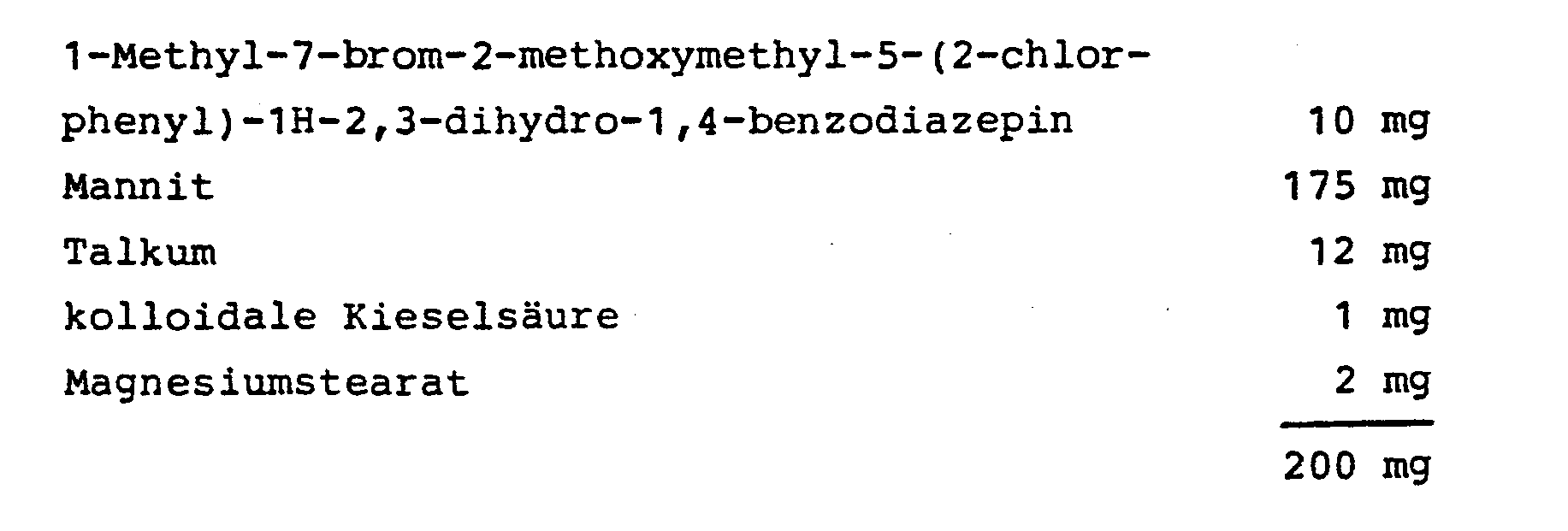
- Die gesiebten Substanzen werden gemischt und das erhaltene Pulver in Portionen von 200 mg in Kapseln abgefüllt.
- Man stellt Suppositorien in folgender Zusammensetzung pro Suppositorium her:

- Der Wirkstoff und die fein geriebene Suppositoriengrundmasse werden gründlich gemischt und dann geschmolzen. Aus der durch Rühren homogen gehaltenen Schmelze werden Suppositorien von 2 g gegossen.
- Man stellt eine Injektionslösung in folgender Zusammensetzung pro ml her:

- Der Wirkstoff wird in Dimethylacetamid gelöst und mit Benzylalkohol, Propylenglykol, Äthanol und Wasser versetzt. Man filtriert durch einen Kerzenfilter, füllt in geeignete Ampullen, verschließt und sterilisiert.
- Man stellt eine Tropflösung mit folgender Zusammensetzung pro ml her:

- Der Wirkstoff wird in den flüssigen Bestandteilen gelöst und die Lösung auf Tropffläschchen abgefüllt.
oder deren physiologisch verträgliche Säureadditionssalze enthalten.
Claims (9)

oder deren verträglichen Säureadditionssalzen und pharmazeutisch übliche Hilfs- und Trägerstoffe enthalten.

Priority Applications (1)
| Application Number | Priority Date | Filing Date | Title |
|---|---|---|---|
| AT83105297T ATE19472T1 (de) | 1982-06-05 | 1983-05-28 | Verwendung von 5-phenyl-1,4-benzodoazepinen zur herstellung von analgetisch wirksamen pharmazeutischen zubereitungen. |
Applications Claiming Priority (2)
| Application Number | Priority Date | Filing Date | Title |
|---|---|---|---|
| DE19823221402 DE3221402A1 (de) | 1982-06-05 | 1982-06-05 | 5-phenyl-1,4-benzodiazepine enthaltende analgetisch wirksame pharmazeutische zubereitungen |
| DE3221402 | 1982-06-05 |
Publications (2)
| Publication Number | Publication Date |
|---|---|
| EP0096320A1 true EP0096320A1 (de) | 1983-12-21 |
| EP0096320B1 EP0096320B1 (de) | 1986-04-30 |
Family
ID=6165505
Family Applications (1)
| Application Number | Title | Priority Date | Filing Date |
|---|---|---|---|
| EP83105297A Expired EP0096320B1 (de) | 1982-06-05 | 1983-05-28 | Verwendung von 5-Phenyl-1,4-benzodoazepinen zur Herstellung von analgetisch wirksamen pharmazeutischen Zubereitungen |
Country Status (9)
| Country | Link |
|---|---|
| US (1) | US4482548A (de) |
| EP (1) | EP0096320B1 (de) |
| JP (1) | JPS58219119A (de) |
| AT (1) | ATE19472T1 (de) |
| AU (1) | AU567498B2 (de) |
| BE (1) | BE896635A (de) |
| DE (2) | DE3221402A1 (de) |
| IT (1) | IT1175915B (de) |
| PH (1) | PH21768A (de) |
Cited By (1)
| Publication number | Priority date | Publication date | Assignee | Title |
|---|---|---|---|---|
| EP0486271A3 (en) * | 1990-11-13 | 1993-06-23 | Merck & Co. Inc. | Cholecystokinin antagonists for treating neurological disorders |
Families Citing this family (2)
| Publication number | Priority date | Publication date | Assignee | Title |
|---|---|---|---|---|
| US4684646A (en) * | 1984-06-26 | 1987-08-04 | Merck & Co., Inc. | 2-acylaminomethyl-1,4-benzodiazepine derivatives as CCK-antagonists |
| GB2185887B (en) * | 1987-02-18 | 1989-12-06 | Farmitalia Carlo Erba Ltd | Temazepam composition |
Citations (3)
| Publication number | Priority date | Publication date | Assignee | Title |
|---|---|---|---|---|
| CA826159A (en) * | 1969-10-28 | Bernard Belleau | Benzodiazepines and process for the production thereof | |
| DE2221558A1 (de) * | 1972-05-03 | 1973-11-15 | Kali Chemie Ag | Neue benzodiazepinderivate und verfahren zu deren herstellung |
| EP0075855A2 (de) * | 1981-09-30 | 1983-04-06 | Kali-Chemie Pharma GmbH | 7-Brom-5-(2-halogenphenyl)-1H-2,3-dihydro-1,4-benzodiazepin-Verbindungen sowie Verfahren und Zwischenprodukte zu ihrer Herstellung und diese Verbindungen enthaltende Arzneimittel |
Family Cites Families (1)
| Publication number | Priority date | Publication date | Assignee | Title |
|---|---|---|---|---|
| US4244869A (en) * | 1972-05-03 | 1981-01-13 | Kali-Chemie A.G. | Benzodiazepine derivatives and process of making them |
-
1982
- 1982-06-05 DE DE19823221402 patent/DE3221402A1/de not_active Withdrawn
-
1983
- 1983-04-27 IT IT20808/83A patent/IT1175915B/it active
- 1983-05-02 BE BE0/210677A patent/BE896635A/fr unknown
- 1983-05-16 US US06/494,645 patent/US4482548A/en not_active Expired - Fee Related
- 1983-05-28 EP EP83105297A patent/EP0096320B1/de not_active Expired
- 1983-05-28 DE DE8383105297T patent/DE3363261D1/de not_active Expired
- 1983-05-28 AT AT83105297T patent/ATE19472T1/de not_active IP Right Cessation
- 1983-06-02 JP JP58097035A patent/JPS58219119A/ja active Pending
- 1983-06-03 PH PH29012A patent/PH21768A/en unknown
- 1983-06-03 AU AU15416/83A patent/AU567498B2/en not_active Ceased
Patent Citations (3)
| Publication number | Priority date | Publication date | Assignee | Title |
|---|---|---|---|---|
| CA826159A (en) * | 1969-10-28 | Bernard Belleau | Benzodiazepines and process for the production thereof | |
| DE2221558A1 (de) * | 1972-05-03 | 1973-11-15 | Kali Chemie Ag | Neue benzodiazepinderivate und verfahren zu deren herstellung |
| EP0075855A2 (de) * | 1981-09-30 | 1983-04-06 | Kali-Chemie Pharma GmbH | 7-Brom-5-(2-halogenphenyl)-1H-2,3-dihydro-1,4-benzodiazepin-Verbindungen sowie Verfahren und Zwischenprodukte zu ihrer Herstellung und diese Verbindungen enthaltende Arzneimittel |
Cited By (1)
| Publication number | Priority date | Publication date | Assignee | Title |
|---|---|---|---|---|
| EP0486271A3 (en) * | 1990-11-13 | 1993-06-23 | Merck & Co. Inc. | Cholecystokinin antagonists for treating neurological disorders |
Also Published As
| Publication number | Publication date |
|---|---|
| DE3221402A1 (de) | 1983-12-08 |
| IT1175915B (it) | 1987-08-12 |
| IT8320808A0 (it) | 1983-04-27 |
| JPS58219119A (ja) | 1983-12-20 |
| AU567498B2 (en) | 1987-11-26 |
| EP0096320B1 (de) | 1986-04-30 |
| US4482548A (en) | 1984-11-13 |
| PH21768A (en) | 1988-02-24 |
| AU1541683A (en) | 1983-12-08 |
| BE896635A (fr) | 1983-09-01 |
| ATE19472T1 (de) | 1986-05-15 |
| DE3363261D1 (en) | 1986-06-05 |
Similar Documents
| Publication | Publication Date | Title |
|---|---|---|
| DE69534975T2 (de) | Verwendung von noribogain derivaten zur behandlung von chemischer abhängigkeit bei säugern | |
| EP0059387A2 (de) | Imidazodiazepine, Verfahren und Zwischenprodukte zu ihrer Herstellung, sowie diese enthaltende Arzneimittel | |
| DE2915318A1 (de) | Cycloalkyltriazole, verfahren zu ihrer herstellung und diese enthaltende arzneimittel | |
| DD202715A5 (de) | Verfahren zur herstellung von substituierten derivaten des pyridazin | |
| DE3685604T2 (de) | 1,7-naphthyridinderivate und diese enthaltende arzneimittel. | |
| DE2163911B2 (de) | 2-Aminomethyl-phenole, Verfahren zur Herstellung derselben und diese enthaltende Arzneimittel | |
| EP0075855B1 (de) | 7-Brom-5-(2-halogenphenyl)-1H-2,3-dihydro-1,4-benzodiazepin-Verbindungen sowie Verfahren und Zwischenprodukte zu ihrer Herstellung und diese Verbindungen enthaltende Arzneimittel | |
| DE3402060A1 (de) | Substituierte 5,11-dihydro-6h-dibenz(b,e)azepin-6-one, verfahren zu ihrer herstellung und diese verbindungen enthaltende arzneimittel | |
| DE2624558A1 (de) | Arzneimittel mit analgetischer wirkung | |
| DE3009071A1 (de) | 2-isopropylaminopyrimidinhydroxyderivate, verfahren zu ihrer herstellung und diese verbindungen enthaltende arzneimittel | |
| EP0096320B1 (de) | Verwendung von 5-Phenyl-1,4-benzodoazepinen zur Herstellung von analgetisch wirksamen pharmazeutischen Zubereitungen | |
| DE2157272C3 (de) | Verwendung von bis-(p-Chlorphenoxy)acetylharnstoff | |
| DE1670305B2 (de) | 5-Phenyl-2,4-dioxo-1,2,3,4-tetrahydro-3H-1,5-benzodiazepine und Verfahren zu ihrer Herstellung | |
| DE3031703C2 (de) | ||
| DE1470139C3 (de) | 5,11-Dihydrodibenz eckige Klammer auf b,e eckige Klammer zu-1,4-oxazepine und Verfahren zu ihrer Herstellung | |
| DE2035517B2 (de) | 11-Aminoalkylidenmorphanthridine sowie Verfahren zu deren Herstellung | |
| DE2000775B2 (de) | Substituierte 1,2,3,4-Tetrahydrobenzothieno [23-c] pyridin-Verbindungen, Verfahren zu ihrer Herstellung und pharmazeutische Zubereitung, die diese Verbindungen enthält | |
| DE2125892C3 (de) | 23-Dihydro-S-trifIuormethyl-lH- dibenzo [23 zu 6,7] thiepine [4,5] pyrrole, Verfahren zu ihrer Herstellung und diese enthaltende therapeutsche Präparate | |
| EP0086980B1 (de) | Substituierte Dibenzodiazepinone, Verfahren zu ihrer Herstellung und diese Verbindungen enthaltende Arzneimittel | |
| DE3706399A1 (de) | Mittel mit antidepressiver wirkung | |
| EP0177853B1 (de) | Antirheumatisch wirksame Suppositorien und Verfahren zu deren Herstellung | |
| DE2709851A1 (de) | 2,2-diaryl-3-(1-azabicyclo eckige klammer auf 2.2.2 eckige klammer zu oct- 2-yl)-propionamide, ein verfahren zu ihrer herstellung sowie arzneimittel | |
| DE1770429B2 (de) | In 1-Stellung basisch substituierte 33-Diphenylpyridazone-6 | |
| DE2730312A1 (de) | (2-azabicyclo eckige klammer auf 2.2.2 eckige klammer zu octan-2-yl) diphenyl-alkanone, verfahren zu deren herstellung sowie dieselben enthaltende pharmazeutische praeparate | |
| DE2166662B2 (de) | Dibenzothiazepinderivate, Verfahren zu ihrer Herstellung und sie enthaltende Arzneimittel |
Legal Events
| Date | Code | Title | Description |
|---|---|---|---|
| PUAI | Public reference made under article 153(3) epc to a published international application that has entered the european phase |
Free format text: ORIGINAL CODE: 0009012 |
|
| AK | Designated contracting states |
Designated state(s): AT CH DE FR GB LI NL SE |
|
| 17P | Request for examination filed |
Effective date: 19840515 |
|
| GRAA | (expected) grant |
Free format text: ORIGINAL CODE: 0009210 |
|
| AK | Designated contracting states |
Kind code of ref document: B1 Designated state(s): AT CH DE FR GB LI NL SE |
|
| PGFP | Annual fee paid to national office [announced via postgrant information from national office to epo] |
Ref country code: AT Payment date: 19860430 Year of fee payment: 4 |
|
| REF | Corresponds to: |
Ref document number: 19472 Country of ref document: AT Date of ref document: 19860515 Kind code of ref document: T |
|
| REF | Corresponds to: |
Ref document number: 3363261 Country of ref document: DE Date of ref document: 19860605 |
|
| ET | Fr: translation filed | ||
| R20 | Corrections of a patent specification |
Effective date: 19860821 |
|
| PLBE | No opposition filed within time limit |
Free format text: ORIGINAL CODE: 0009261 |
|
| STAA | Information on the status of an ep patent application or granted ep patent |
Free format text: STATUS: NO OPPOSITION FILED WITHIN TIME LIMIT |
|
| 26N | No opposition filed | ||
| PGFP | Annual fee paid to national office [announced via postgrant information from national office to epo] |
Ref country code: NL Payment date: 19870531 Year of fee payment: 5 |
|
| PG25 | Lapsed in a contracting state [announced via postgrant information from national office to epo] |
Ref country code: GB Effective date: 19890528 Ref country code: AT Effective date: 19890528 |
|
| PG25 | Lapsed in a contracting state [announced via postgrant information from national office to epo] |
Ref country code: SE Effective date: 19890529 |
|
| PG25 | Lapsed in a contracting state [announced via postgrant information from national office to epo] |
Ref country code: LI Effective date: 19890531 Ref country code: CH Effective date: 19890531 |
|
| PG25 | Lapsed in a contracting state [announced via postgrant information from national office to epo] |
Ref country code: NL Effective date: 19891201 |
|
| NLV4 | Nl: lapsed or anulled due to non-payment of the annual fee | ||
| GBPC | Gb: european patent ceased through non-payment of renewal fee | ||
| PG25 | Lapsed in a contracting state [announced via postgrant information from national office to epo] |
Ref country code: FR Free format text: LAPSE BECAUSE OF NON-PAYMENT OF DUE FEES Effective date: 19900131 |
|
| REG | Reference to a national code |
Ref country code: CH Ref legal event code: PL |
|
| PG25 | Lapsed in a contracting state [announced via postgrant information from national office to epo] |
Ref country code: DE Effective date: 19900201 |
|
| REG | Reference to a national code |
Ref country code: FR Ref legal event code: ST |
|
| EUG | Se: european patent has lapsed |
Ref document number: 83105297.2 Effective date: 19900412 |