EP0096419A1 - Verteiltes Vermittlungssystem mit variabler Bandbreite für Sprache und Daten - Google Patents
Verteiltes Vermittlungssystem mit variabler Bandbreite für Sprache und Daten Download PDFInfo
- Publication number
- EP0096419A1 EP0096419A1 EP83105631A EP83105631A EP0096419A1 EP 0096419 A1 EP0096419 A1 EP 0096419A1 EP 83105631 A EP83105631 A EP 83105631A EP 83105631 A EP83105631 A EP 83105631A EP 0096419 A1 EP0096419 A1 EP 0096419A1
- Authority
- EP
- European Patent Office
- Prior art keywords
- speech
- bus
- transmission
- packets
- terminals
- Prior art date
- Legal status (The legal status is an assumption and is not a legal conclusion. Google has not performed a legal analysis and makes no representation as to the accuracy of the status listed.)
- Granted
Links
- 230000005540 biological transmission Effects 0.000 claims abstract description 84
- 238000004891 communication Methods 0.000 claims abstract description 52
- 230000000694 effects Effects 0.000 claims abstract description 30
- 238000011144 upstream manufacturing Methods 0.000 claims abstract description 21
- 230000015654 memory Effects 0.000 claims description 70
- 238000000034 method Methods 0.000 claims description 10
- 230000007704 transition Effects 0.000 claims description 10
- 230000015572 biosynthetic process Effects 0.000 claims 1
- 230000008054 signal transmission Effects 0.000 claims 1
- 230000001360 synchronised effect Effects 0.000 abstract description 18
- 238000010586 diagram Methods 0.000 description 5
- 241000700560 Molluscum contagiosum virus Species 0.000 description 4
- 238000012423 maintenance Methods 0.000 description 3
- 238000012546 transfer Methods 0.000 description 3
- 230000001419 dependent effect Effects 0.000 description 2
- 238000000605 extraction Methods 0.000 description 2
- 230000006870 function Effects 0.000 description 2
- 238000003780 insertion Methods 0.000 description 2
- 230000037431 insertion Effects 0.000 description 2
- 239000013307 optical fiber Substances 0.000 description 2
- 230000008569 process Effects 0.000 description 2
- AYEKOFBPNLCAJY-UHFFFAOYSA-O thiamine pyrophosphate Chemical compound CC1=C(CCOP(O)(=O)OP(O)(O)=O)SC=[N+]1CC1=CN=C(C)N=C1N AYEKOFBPNLCAJY-UHFFFAOYSA-O 0.000 description 2
- 101100172132 Mus musculus Eif3a gene Proteins 0.000 description 1
- 230000007423 decrease Effects 0.000 description 1
- 238000001514 detection method Methods 0.000 description 1
- 230000001627 detrimental effect Effects 0.000 description 1
- 230000007274 generation of a signal involved in cell-cell signaling Effects 0.000 description 1
- 230000003287 optical effect Effects 0.000 description 1
- 238000011084 recovery Methods 0.000 description 1
- 230000009467 reduction Effects 0.000 description 1
- 230000011664 signaling Effects 0.000 description 1
Images




Classifications
-
- H—ELECTRICITY
- H04—ELECTRIC COMMUNICATION TECHNIQUE
- H04L—TRANSMISSION OF DIGITAL INFORMATION, e.g. TELEGRAPHIC COMMUNICATION
- H04L12/00—Data switching networks
- H04L12/64—Hybrid switching systems
Definitions
- the present invention relates to integrated services networks.
- it concerns a distributed variable-band switching system for speech and data.
- connection structure itself in conjunction with intelligent units distributed in all the stations, implements a distributed switching system.
- This trend is suggested by the simple architecture which makes it possible to integrate transmission and switching.
- the star configuration makes it possible to interconnect a higher number of terminals. Yet also the use of this configuration is hindered by two factors. The first is technological, as nowadays big-sized star-couplers are not feasible (in particular, it is possible to implement only star-couplers capable of connecting some tens of terminals at the most, instead of some hundreds of terminals).
- the second factor concerns the distribution of the terminals: in fact a star configuration is convenient when all the points to be connected are at about the same distance from the connection point while, as mentioned, in public networks there are "islands" irregularly distributed along the network.
- each terminal may establish also several simultaneous connections with several terminals.
- Asynchronous access systems are subdivided into two classes: random - access systems and ordered - access systems.
- CSMA-CD Carrier Sense Multiple Access with Collision Detection
- the system efficiency which is optimal when the ratio Tr/Tp between round trip delay Tr and time Tp of transmission of a packet at the line rate is ⁇ 1 (i. e. when the terminals are quite close), decreases as such a ratio increases and becomes insufficient when such a ratio is ⁇ 1. This just happens in case of a rather wide network implemented with a wide-band transmission medium, like that into which the invention is to be inserted: hence CSMA-CD system is not suitable.
- the so-called “Round Robin” system is of particular interest to the applications concerned by the invention.
- a number of “rounds” are established and in every "round” the stations having packets to be transmitted are allowed to intervene at least and only once: for instance the station more distant from the bus folding point (most upstream station) can intervene first and the other ones can follow, up to the most downstream station.
- the efficiency of the system is strictly dependent on the ordered terminal arrangement: since the terminals are generally at a distance from the bus, side branches even of different length will be present, whereby the attaifument of the sequential arrangement is obtainable to the detriment of the system performance.
- the problem may be solved if the terminal activity is preceded by a suitable preamble, whose length depends on the length of the branch; that solution however is detrimental to the efficiency.
- This application concerns a process for multiple random access to a transmission line in a local network for speech and data transmission, which network comprises a plurality of stations mutually exchanging information through the line in packet form, wherein at each station, under exclusive control of a local timing system, the station activity is organized into frames each having a duration equal to the time elapsing between the generation of two subsequent packets relating to the same communication of a kind requiring the maintenance of synchronous characteristics (hereinafter called "speech communication") and, during each frame, the speech communications are allotted time slots equal to the duration of transmission of a packet, which time slots are reserved to said communications for their whole duration, thus implementing synchronous communication channels; wherein a timing map of the line occupation by the synchronous channels is built up at every frame; and wherein the frame periods not allotted to active synchronous channels are utilized both for communications which do not require the synchronous characteristics to be maintained (hereinafter called “data communications”)and for the booking of further synchronous channels by each station, the time slots .which may be allotted
- the data transmission is managed by a conventional CSMA protocol, hence the previously mentioned disadvantages concerning the application of such access protocol to the public network are encountered. It is the object of the present invention to provide a distributed variable-band switching system for speech and data suited to a topology with islands with high terminal concentration, which system makes it possible to maintain the synchronous characteristics of the voice and to have for the data the advantages of both the linear bus and the star - structures and of both the random-access and the ordered-access systems.
- the system establishes an ordered sequence of the islands (as along a linear bus) so that the bus capacity may be shared among the various islands according to an ordered access procedure; the activity of the terminals inside an island can be controlled by a random - acces protocol , as if the island were a star.
- the system according to the invention comprises a folded unidirectional bus, with a writing ( or signal trasmission ) branch and a reading ( or signal reception ) branch, as well as a plurality of nodes distributed along the bus and associated each with a plurality of terminals, and is characterized in that, to obtain an ordered arrangement of all the terminals connected with the system, each node comprises a transmission and a reception coupler common to all the terminals of the node and connected to the writing and reading branches of the bus, respectively; a detector of the activity of the terminals belonging to upstream nodes, said detector being connected to the bus writing branch upstream the transmission coupler; a detector of the activity of the terminals belonging to the node itself and of the activity of upstream nodes and a collision detector for sharing the activity among the node terminals whichtwolastmentioneddetec- tors are also connected to the bus writing branch, but downstream the coupler; in that said detectors are connected to a device which, at each node terminal and on the ground of information extracted from the packet flow on
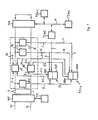
- the system collecting packetized speech and data comprises a wide-band unidirectional bus 1, which by way of example is assumed to be implemented with an optical fibre, folded at one end so as to form a writing branch IS and a reading branch 1L.
- the "islands" of terminals are distributed along bus l, and are connected therewith by nodes Nl.... Ni.... Nm.
- Block TE1 schematizes the whole of the terminals associated with node Nl; references TEil.... TEin and TEml, TEm2... TEmp denote the terminals associated with nodes N1 and Nm, respectively.
- Logic networks AB are shown only for terminals associated with node Ni.
- node Ni for all the terminals of a node, signals are fed to writing branch 1S (transmission) and extracted from the reading branch 1L (reception) at only two bus points, one for the transmission and the other for the reception, through directional couplers AT, AR.
- a physical distribution of this kind makes information broadcast possible, i. e. allows information transmitted by a terminal to be received by all the others.
- the coupler structure depends on the physical nature of bus 1 and on how the terminals are organized.
- the terminals in node Ni are connected to AT through lines 2-1, 2-j, 2-k, 2-n, and to AR through lines 3-1, 3-j, 3-k, 3-n, and hence couplers AT, AR will be star - couplers; in node Nm a secondary bus 4 connected to terminals TEml, TEm2.... TEmp has been considered, so that T-couplers will be required.
- a device RRS able to detect the activity of one or a plurality of nodes upstream Ni (i. e. nodes which are more distant from the folding point of the bus), is connected to writing branch lS, upstream transmission coupler AT, a device CS able to detect the activity of the terminals of node Ni or of nodes upstream Ni and a device CD able to detect collision among terminals of Ni are connected to the writing branch IS, still inside Ni but downstream AT.
- Detectors RRS, CS, CD supply the information to logic network AB 1.... ABn of all the terminals of the node through lines 5, 6, 7.
- Devices RRS and CS which advantageously have the same circuit structure, may be implemented in various ways, depending on the transmission code and on the bus type. In particular, they can operate by detecting the transitions, thereby delivering signals indicating the beginning and end of carrier, or by integrating the mean activity.
- CD can be a threshold system (based on the fact that the power transmitted on a bus by a terminal is known and each increase denotes collision) or it can detect the absence of the syncronism information in the received data string.
- the latter systems are based on the fact that in certain kinds of code individual pulses present rigid phase correlations which are missing when a plurality of signals overlap.
- a given terminal can sense the activity on bus 1 both upstream and downstream coupler AT of its node, and can detect the collisions with other terminals connected to the same node. Moreover, being bus 1 unidirectional, a given terminal can sense the activity of the upstream terminals both on the writing branch (through RRS and CS) and on the reading branch (through AR and line 3) and can sense the activity of the downstream terminals only on the reading branch. This asymmetry allows for a "Round Robin" arrangement of the nodes or islands.. Inside each island the access to the channel is managed according to a CSMA-CD protocol.
- Red denotes the time interval during which the bus control is allotted at least once (for a time sufficient to the transmission) to all the terminals which have packets ready to be transmitted, independently of the packet generation instant with respect to the terminal which is transmitting.
- each "round" varies in function of the number of terminals which are to transmit.
- an upperbound will be set to the number of accesses possible for a terminal, and that bound can be different for the different terminals and be varied during operation.
- the transmission initiated by a terminal is completed unless RRS or CD emit signals. If RRS emits a signal before CD, the activity is generated by an upstream terminal and the transmission initiated is stopped and resumed as soon as the line becomes idle again. Since a transmission cannot be stopped instantaneously and it is desirable that the information coming from the upstream terminal is not damaged, a preamble will be transmitted in each period of a terminal activity, which preamble has no information content and has such a duration that the activity overlap affects only the preamble.
- Signals emitted by CD in the absence of signals coming from RRS, indicate the "simultaneous" activity of another terminal belonging to the same node, and the transmission will be rescheduled according to the CSMA-CD protocol chosen.
- a contention access with the described procedure is possible only for data communications, which are characterized by sequences of packets with random occurrence instants; in case the network is used also for speech communications (or in general for communications which demand synchronous characteristics to be maintained), in said communications only the instant of occurrence of the booking packet is random, whereas the subsequent packets occur at regularly spaced instants.
- logic AB in each terminal is to manage data communications and the setting up of a speech communication (i. e. the booking packet) according to a random-access protocol and to establish synchronous communication channels for speech communications. Said synchronous channels are to be established without resorting to a centralized synchronization of all the terminals, which would be a reliability node.
- the station activity is subdivided into frames whose minimum duration is equal to the time elapsing between the generation of two consecutive packets relating to the speech communication and, during each frame, the speech communications are allotted time slots equal to the duration of transmission of a packet, which time slots are reserved to said communications for their whole duration.
- An upper limit can be set to the number of time slots allotted to speech communications, so as to leave always space to data communications; said time slots will be grouped together, consequently a frame will be subdivided into a "speech period” and "data period".
- the "speech period” will comprise the booking packets of new calls, which can then collide only with other booking packets.
- the "data period” will contain packets relating to the communications which do not demand the maintenance of synchronous characteristics (data communications) as well the packet booking the first speech communication.
- the "rounds" described above concern only the data period and can extend over several frames.
- the relative duration of the two periods may vary in function of traffic and, in absence of speech communications, the whole channel capacity could be allotted to data communications.
- the frame beginning instant can vary, in that it can be established each time by the terminal the first active channel is associated with.
- each terminal is to build up a map of the line occupation by the speech communications, said map having a duration equal to that of a frame and being updated at each frame.
- the map will store the busy or idle state of each synchronous channel, the beginning of the speech period and the number of active channels.
- the map built up with the information extracted during a frame from the reading branch lL will be used in the subsequent frame for packet transmission on writing branch 1S.
- the duration of the speech period can vary at each frame depending on traffic conditions. This variation is to be controlled so as to allow for the best exploitation of the available band. This causes no problem when the traffic increases, as it is easy to allot each new booking a channel adjacent to or at least close to the last busy channel; traffic reduction on the contrary occurs in random way so that in the extreme case only two channels (for the two directions of the same conversation), quite distant from each other, might remain busy.
- the most advantageous solution consists in defining the speech period by the two extreme active channels and, when an increase is required due to the arrival of new booking requests, in acting so that possible gaps are eliminated first and only subsequently the speech period is actually extended; when that extension is required, the speech period ought to be allotted a further channel, following the last active channel and reserved to bookings; this can be done only when the maximum number of active speech channels has not yet been reached.
- logic network AB of a terminal of node Ni comprises a part RX for information reception, a transmission part TX and a control and timing part CT.
- the reception part RX basically comprises a circuit RP for recognizing the type of packet present on the bus, recognizing and extracting from the bus the packets addressed to the terminal RX belongs to, and organizing in parallel form the bits of these packets, and memory means MR for the temporary storage of the received packets.
- Said packets arrive at AB through wire 3a of connection 3, the devices LF interfacing AB with the bus (devices managing the physical level of the protocol) and wire 103a.
- a circuit basically performing as RP is described and claimed in Italian Patent Application No. 67340-A/82 filed on 17. 3. 82 in the name of the Applicant.
- Such a circuit which belongs to the first part of an interface, implemented in two parts, for the access to a wide-band bus for integrated speechdata traffic, comprises:
- circuit RP Since circuit RP is also to recognize the type of packet (coded in the header), the comparator will be replaced by a decoder which generates the signals above. Moreover, "the second part of the interface" is here replaced by devices belonging to AU (Fig. 1).
- memory means MR comprises two random access memories MDR, MVR for data packets and for speech-communications signalling (booking and release) and speech packets, respectively, and the respective controller CDR, CVR; in this case RP will emit two enabling signals for CDR and CVR, respectively.
- Memory MDR is controlled by CDR so that both reading and writing are cyclical, and it receives the suitable commands from CDR through a connection 19.
- the data read are forwarded to the devices in AU through connection 8.
- controller CDR exchanges signals with AU through connection 20.
- Controller CDR can be implemented as described and claimed in Italian Patent Application No. 67340 - A/82. It comprises:
- Speech packet memory MVR preferably comprises two identical memory units which alternate in the reading/writing operations at every frame, upon command of a signal extracted from frame synchronism.
- connection 9 the content of memory MVR is forwarded to AU through connection 9.
- the commands are supplied by CVR through a connection 22; line 21 schematizes the connection between CVR and the remaining devices of AU.
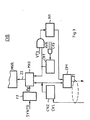
- a possible implementation of CVR is represented in Fig. 3.
- Transmission part TX comprises three memories with the respective controllers, namely a memory MDT for data packets to be transmitted, with controller CDT, a memory MPT for booking packets, with controller CPT, and a memory MVT for speech packets with controller CVT.
- the packets to be stored into the three memories are supplied by AU through connections 10a, lla, 12a, as words with a suitable number of bits; packets read from the memories are presented on respective connections 110, 111, 112 and through a multiplexer MX1 are sent to a serializer TB which forwards them bit by bit to AT (Fig. 1) through wire 2a, LF and wire 2.
- Multiplexer MX1 is controlled by a signal obtained from the enabling signals of CDT, CPT, CVT, so as to send TB the content of that memory whose controller is enabled at that instant.
- MDT, MPT for data and booking packets are cyclically read and written; speech packet memory MVT can be organized as MVR or, if desired, as MDT and MPT. In the latter case the same kind of controller can be used for the three memories.
- references 13, 13a, 13b denote the connections between memory controllers and a logic network GP belonging to CT and managing the protocol
- references 14, 15, 16 denote the connections of the controllers with AU, LF and with their memories.
- Controllers. CDT. CPT can be implemented as the controller of the transmission memory of the interface according to patent application No. 67340 - A/82.
- Such a controller comprises:
- the control and timing part CT comprises, in addition to GP, a memory MSC of the bus state, with a controller CSC of the write operations, a logic DVD discriminating the speech and data periods, and a local time base BT.
- Logic network GP carries out the operations described above, enabling transmission memory controllers at suitable instants.
- GP receives: the commands for the transmission of data packets (TDP)speech packets (TPV), booking packets TPP), said commands being sent by AU through wires lOb, llb, 12b; the information coming from the bus and relating to the state of the bus itself, in particular: signal CS (delivered by the homonymous block of Fig. 1 through wire 6, LF and wire 6a), the information on the beginning and end of the carrier during the reading phase (signals BCR, ECC obtained by LF on the basis of the information delivered by AR, Fig. 1) and during the writing phase (signals BCW, ECW obtained by LF on the basis of signals delivered by RRS, Fig.
- Discriminator DVD generates these signals on the basis of SYNVT, of a frame synchronism signal SYNTT relating to transmission, and of the information on the number of channels forming the speech period (NCP) delivered by controller CSC.
- CSC receiving the signal indicating the beginning of the speech period from RP, starts the synchronism signal generation in BT (signal RST); moreover, on the basis of the information delivered by RP and of frame and channel synchronism signals relative to reception (SYNTR, SYNVR) it writes the significant events relating to the speech period (i. e. booking and idle/busy state of each channel and beginning of the speech period) and the number of channels in the speech period, into memory MSC. This is done by CSC so that possible gaps are eliminated. Moreover CSC sends AU (Fig. 1) the signals PCV, LCV, indicating incoming channel booking and release.
- memory MSC of the bus state will consist of two units, which at each frame alternate in the reading/writing operations.
- the information written in MSC during a frame upon command of CSC are read by GP in the subsequent frame.
- the connection between GP and MSC is represented by line 18.
- each unit of memory MVR receives the write and read addresses from counters CN1, CN2 through a multiplexer MX2, which at every two frames transfers to the output the signal emitted by CN1 or CN2.
- the multiplexer select is signal RW, which establishes the alternance between the two memory units.
- the signal is obtained by means of a flip-flop FF from frame synchronism SYNTR; the same signal, once inverted, controls the multiplexer associated with the other unit of MVR.
- Counter CN1 is advanced by a clock signal CKS, supplied by RP, provided an enabling signal AVR delivered by RP is present.
- Counter CN2 is advanced by a suitable clock signal CKL delivered by AU (Fig. 1).
- a register Rl (Fig. 3) stores the address present at the output of CN1 at the instant of transition from the speech to date period (signal VTD emitted by DVD), i. e. it stores the last address concerned by a write operation in a frame; said address is kept present at the input of a comparator CP1 which receives at a second input the read addresses generated by CN2. This comparator is to recognize the equality between the two addresses, which indicates the complete reading of what has been written in the memory in . the preceding frame. Such event is signalled to AU (Fig. 1) in order to stop the reading.
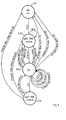
- logic GP presents an initial idle state (Sl) which it leaves at the arrival of a packet to transmit, signalled by the occurrence of one of signals TPD, PPV, TPP. From Sl, GP passes to a state S2 where it waits for the signals coming from DVD (wait for speech/data period). Upon receiving signals which indicate data period, GP passes to a state S3 of "wait for data transmission" if the terminal has not yet successfully effected a transmission in the present round (ZD/l); otherwise it passes to the rest state S8 (DZ/2); upon the arrival of signal ZV, GP passes to a state S4 of wait for speech channel synchronism.
- Sl initial idle state
- GP leaves state S3 andpasses to state S5 of actual transmission when the bus is idle, which is indicated by the arrival of signals CSOFF, ECW. This takes place also for the first booking packet of a speech channel , as under these condition no synchronous frame exists yet.
- GP passes to rest state S8 at the transmission end (signal ENDTX), or resumes state S2 if during transmission signal DTV arrives, indicating the beginiming of a speech period, or yet it resumes state S3 in case of collision with other terminals of the same node (signal CD) or of activity of an upstream terminal (signal BCW). GP leaves state S8 either at the arrival of signal DTV, which causes the recovery of state S2, or at the end of a round (ENDR).
- the end of a round is recognized in that a predetermined minimum time has elapsed between signal ECR and the subsequent signal BCR.
- GP recovers idle state Sl in the absence of packets to be transmitted (NO PCK), or state S2 if speech or booking packets arrive and the frame already exists (V/P PCK) or yet state S3, if data packets or the first booking packet are to be transmitted (DPCK).
- logic GP passes from state S4 to state S2.
- state S6 is left at the transmission end and states Sl, S2 or S4 are resumed depending on whether no packets or data packets or booking or speech packets are to be transmitted.
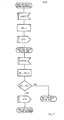
- CSC From the wait for SYNTR state, CSC passes to a state Sll (Fig. 5) corresponding to "existing" speech period (ZV) at the arrival of signal SYNTR, or it remains in SlOdue to the arrival of another booking packet.
- Sll "existing" speech period
- the serial number of the channel is incremented, and the new value is compared with number NCP of channels in the speech period.
Landscapes
- Engineering & Computer Science (AREA)
- Computer Networks & Wireless Communication (AREA)
- Signal Processing (AREA)
- Small-Scale Networks (AREA)
- Data Exchanges In Wide-Area Networks (AREA)
- Use Of Switch Circuits For Exchanges And Methods Of Control Of Multiplex Exchanges (AREA)
Applications Claiming Priority (2)
| Application Number | Priority Date | Filing Date | Title |
|---|---|---|---|
| IT6773682 | 1982-06-09 | ||
| IT67736/82A IT1157035B (it) | 1982-06-09 | 1982-06-09 | Sistema di raccolta e commutazione a banda variabile per voci e dati |
Publications (2)
| Publication Number | Publication Date |
|---|---|
| EP0096419A1 true EP0096419A1 (de) | 1983-12-21 |
| EP0096419B1 EP0096419B1 (de) | 1985-10-16 |
Family
ID=11304885
Family Applications (1)
| Application Number | Title | Priority Date | Filing Date |
|---|---|---|---|
| EP83105631A Expired EP0096419B1 (de) | 1982-06-09 | 1983-06-08 | Verteiltes Vermittlungssystem mit variabler Bandbreite für Sprache und Daten |
Country Status (8)
| Country | Link |
|---|---|
| US (1) | US4538263A (de) |
| EP (1) | EP0096419B1 (de) |
| JP (1) | JPS58220539A (de) |
| AU (1) | AU557026B2 (de) |
| CA (1) | CA1207416A (de) |
| DE (2) | DE3361026D1 (de) |
| ES (1) | ES522852A0 (de) |
| IT (1) | IT1157035B (de) |
Cited By (3)
| Publication number | Priority date | Publication date | Assignee | Title |
|---|---|---|---|---|
| EP0193906A1 (de) * | 1985-03-06 | 1986-09-10 | CSELT Centro Studi e Laboratori Telecomunicazioni S.p.A. | Rekonfigurierbares, integriertes lokales Netzwerk hoher Geschwindigkeit |
| GB2175177A (en) * | 1985-05-17 | 1986-11-19 | Racal Data Communications Inc | Method and apparatus for interfacing a contention device to a token passing network |
| EP0242030A3 (de) * | 1986-04-15 | 1989-07-05 | Chauncey I Bartholet | Verteiltes Fernsprechsystem |
Families Citing this family (23)
| Publication number | Priority date | Publication date | Assignee | Title |
|---|---|---|---|---|
| GB8417910D0 (en) * | 1984-07-13 | 1984-08-15 | British Telecomm | Communications network |
| GB2162022B (en) * | 1984-07-17 | 1988-03-02 | Stc Plc | Data transmission system |
| IT1179081B (it) * | 1984-08-28 | 1987-09-16 | Cselt Centro Studi Lab Telecom | Sistema di comunicazione integrato a larga banda in ambito locale |
| US4707828A (en) * | 1984-09-11 | 1987-11-17 | Ricoh Company, Ltd. | Multiaccess communication system |
| GB2175774B (en) * | 1985-05-24 | 1988-09-01 | Stc Plc | Intelligence transmission system of the local area network type |
| US4665514A (en) * | 1985-08-02 | 1987-05-12 | American Telephone And Telegraph Company, At&T Bell Laboratories | Integrated voice/data network |
| DE3684270D1 (de) * | 1985-12-27 | 1992-04-16 | Toshiba Kawasaki Kk | Verfahren und kommunikationsnetzwerk zur begrenzten rundschreibuebertragung. |
| IT1203544B (it) * | 1986-03-05 | 1989-02-15 | Cselt Centro Studi Lab Telecom | Procedimento di accesso a una rete locale con linea di trasmissione unidirezionale ad anello e rete locale utilizzante tale procedimento di accesso |
| GB8605613D0 (en) * | 1986-03-07 | 1986-04-16 | Limb J O | Traffic scheduler |
| US4773066A (en) * | 1986-04-15 | 1988-09-20 | The Mitre Corporation | Synchronized multiple access apparatus and method for a local area network |
| GB8618118D0 (en) * | 1986-07-24 | 1986-09-03 | British Telecomm | Communications system |
| DE3736466A1 (de) * | 1987-10-28 | 1989-05-11 | Philips Patentverwaltung | Verfahren zum uebertragen von informationen sowie anordnung zur durchfuehrung des verfahrens |
| US5487066A (en) * | 1988-03-21 | 1996-01-23 | First Pacific Networks, Inc. | Distributed intelligence network using time and frequency multiplexing |
| US4972411A (en) * | 1988-04-27 | 1990-11-20 | Mitsubishi Denki Kabushiki Kaisha | Signalling transmission system |
| US4894826A (en) * | 1989-01-30 | 1990-01-16 | Honeywell, Inc. | Message generating communication apparatus having a message preamble format allowing parts of certain messages to be ignored |
| US4962497A (en) * | 1989-09-21 | 1990-10-09 | At&T Bell Laboratories | Building-block architecture of a multi-node circuit-and packet-switching system |
| JPH03135133A (ja) * | 1989-10-20 | 1991-06-10 | Toshiba Corp | マルチメディア統合ネットワークシステム |
| AU627953B2 (en) * | 1989-11-15 | 1992-09-03 | Digital Equipment Corporation | Integrated communications link having dynamically allocatable bandwidth and a protocol for transmission or allocation information over the link |
| US5526344A (en) * | 1994-04-15 | 1996-06-11 | Dsc Communications Corporation | Multi-service switch for a telecommunications network |
| US5761439A (en) * | 1995-09-25 | 1998-06-02 | Intel Corporation | Method and apparatus for synchronizing communications between networked computers |
| AR007704A1 (es) * | 1996-07-03 | 1999-11-10 | Siemens Ag | Procedimiento para el intercambio de informaciones entre modulos que presentan dispositivos emisores y receptores |
| US6275884B1 (en) * | 1999-03-25 | 2001-08-14 | International Business Machines Corporation | Method for interconnecting components within a data processing system |
| US7209490B2 (en) * | 2004-07-01 | 2007-04-24 | Temic Automotive Of North America, Inc. | Rapid vehicle bus network activity |
Citations (2)
| Publication number | Priority date | Publication date | Assignee | Title |
|---|---|---|---|---|
| US4210780A (en) * | 1978-03-27 | 1980-07-01 | The Mitre Corporation | Multiple access digital communications system |
| EP0077563A1 (de) * | 1981-10-20 | 1983-04-27 | CSELT Centro Studi e Laboratori Telecomunicazioni S.p.A. | Verfahren und Gerät für wahlfreien Vielfachzugriff auf eine Übertragungsleitung in einem lokalen Netz für Sprache und Daten |
Family Cites Families (6)
| Publication number | Priority date | Publication date | Assignee | Title |
|---|---|---|---|---|
| US3681759A (en) * | 1970-08-06 | 1972-08-01 | Collins Radio Co | Data loop synchronizing apparatus |
| FR2192752A5 (de) * | 1972-07-10 | 1974-02-08 | Ibm France | |
| US3786418A (en) * | 1972-12-13 | 1974-01-15 | Ibm | Multi-terminal digital signal communication apparatus |
| US3904829A (en) * | 1974-09-16 | 1975-09-09 | Control Data Corp | Demand driven multiplexing system |
| US4225752A (en) * | 1978-03-03 | 1980-09-30 | Burroughs Corporation | High speed, low noise digital data communication system |
| IT1108325B (it) * | 1978-04-10 | 1985-12-09 | Cselt Centro Studi Lab Telecom | Procedimento e dispositivo di in stradamento per una rete di comunicazione a commutazione di pacchetto |
-
1982
- 1982-06-09 IT IT67736/82A patent/IT1157035B/it active
-
1983
- 1983-05-27 AU AU15024/83A patent/AU557026B2/en not_active Ceased
- 1983-05-27 JP JP58092600A patent/JPS58220539A/ja active Pending
- 1983-05-31 ES ES522852A patent/ES522852A0/es active Granted
- 1983-06-08 EP EP83105631A patent/EP0096419B1/de not_active Expired
- 1983-06-08 CA CA000429916A patent/CA1207416A/en not_active Expired
- 1983-06-08 DE DE8383105631T patent/DE3361026D1/de not_active Expired
- 1983-06-08 US US06/502,084 patent/US4538263A/en not_active Expired - Fee Related
- 1983-06-08 DE DE198383105631T patent/DE96419T1/de active Pending
Patent Citations (2)
| Publication number | Priority date | Publication date | Assignee | Title |
|---|---|---|---|---|
| US4210780A (en) * | 1978-03-27 | 1980-07-01 | The Mitre Corporation | Multiple access digital communications system |
| EP0077563A1 (de) * | 1981-10-20 | 1983-04-27 | CSELT Centro Studi e Laboratori Telecomunicazioni S.p.A. | Verfahren und Gerät für wahlfreien Vielfachzugriff auf eine Übertragungsleitung in einem lokalen Netz für Sprache und Daten |
Non-Patent Citations (3)
| Title |
|---|
| COMPCON 82, DIGEST OF PAPERS, 22nd-25th February 1982, pages 121-127,IEEE Computer Society Press, New York, USA * |
| NATIONAL TELECOMMUNICATIONS CONFERENCE, CONFERENCE RECORD, vol. 2 of 4, Houston, 30th November - 4th December 1980, pages 41.1.1 - 41.1.5, New York, USA * |
| PROCEEDINGS OF THE FIFTH INTERNATIONAL CONFERENCE ON COMPUTER COMMUNICATION, Atlanta, 27th-30th October 1980, pages 281-286, Jack Salz, USA * |
Cited By (3)
| Publication number | Priority date | Publication date | Assignee | Title |
|---|---|---|---|---|
| EP0193906A1 (de) * | 1985-03-06 | 1986-09-10 | CSELT Centro Studi e Laboratori Telecomunicazioni S.p.A. | Rekonfigurierbares, integriertes lokales Netzwerk hoher Geschwindigkeit |
| GB2175177A (en) * | 1985-05-17 | 1986-11-19 | Racal Data Communications Inc | Method and apparatus for interfacing a contention device to a token passing network |
| EP0242030A3 (de) * | 1986-04-15 | 1989-07-05 | Chauncey I Bartholet | Verteiltes Fernsprechsystem |
Also Published As
| Publication number | Publication date |
|---|---|
| AU557026B2 (en) | 1986-12-04 |
| ES8405220A1 (es) | 1984-05-16 |
| AU1502483A (en) | 1983-12-15 |
| DE3361026D1 (en) | 1985-11-21 |
| DE96419T1 (de) | 1984-04-12 |
| IT8267736A0 (it) | 1982-06-09 |
| IT1157035B (it) | 1987-02-11 |
| CA1207416A (en) | 1986-07-08 |
| JPS58220539A (ja) | 1983-12-22 |
| ES522852A0 (es) | 1984-05-16 |
| US4538263A (en) | 1985-08-27 |
| EP0096419B1 (de) | 1985-10-16 |
Similar Documents
| Publication | Publication Date | Title |
|---|---|---|
| EP0096419B1 (de) | Verteiltes Vermittlungssystem mit variabler Bandbreite für Sprache und Daten | |
| US4726018A (en) | Method of providing priority access to a transmission communication ring | |
| EP0054077B1 (de) | Verfahren zur Übertragung von Information zwischen Stationen, die an eine unidirektionale Ringleitung angeschlossen sind | |
| EP0462349B1 (de) | Breitbandringkommunikationssystem und Zugriffssteuerungsverfahren | |
| EP0173947B1 (de) | Lokales Kommunikationssystem für integrierte Breitbanddienste | |
| AU591645B2 (en) | Queueing protocol | |
| US4858232A (en) | Distributed switching system | |
| US5042032A (en) | Packet route scheduling in a packet cross connect switch system for periodic and statistical packets | |
| EP0256526B1 (de) | Paketvermitteltes Kommunikationsnetz zur wirkungsvollen Vermittlung von Nichtburstsignalen | |
| NL194571C (nl) | Basisstation in een abonneecommunicatienetwerk. | |
| US5020055A (en) | Multi-length packet format including fixed length information words | |
| EP0227852A1 (de) | Lokales Kommunikationssystem für integrierte Dienste, basierend auf einem Tokenring-Übertragungsmedium | |
| US4979165A (en) | Multiple queue bandwidth reservation packet system | |
| JPS59154846A (ja) | デ−タ伝送線路付通信装置用伝送方式 | |
| JPS6338130B2 (de) | ||
| US5001706A (en) | Packet cross connect switch system including improved throughput | |
| Rios et al. | A hybrid multiple-access protocol for data and voice-packet over local area networks | |
| RU2068579C1 (ru) | Способ доступа абонента к шине данных в вычислительной сети ethernet и устройство для его осуществления | |
| JPH0133061B2 (de) | ||
| JPS5964946A (ja) | ロ−カルエリアネツトワ−ク方式 | |
| JPS6288457A (ja) | ル−プ式通信方式 | |
| JPS6199442A (ja) | ル−プネツトワ−クの優先制御方法及び装置 | |
| JPH07288526A (ja) | Atm通信システム |
Legal Events
| Date | Code | Title | Description |
|---|---|---|---|
| PUAI | Public reference made under article 153(3) epc to a published international application that has entered the european phase |
Free format text: ORIGINAL CODE: 0009012 |
|
| AK | Designated contracting states |
Designated state(s): BE CH DE FR GB LI NL SE |
|
| EL | Fr: translation of claims filed | ||
| DET | De: translation of patent claims | ||
| 17P | Request for examination filed |
Effective date: 19840301 |
|
| TCNL | Nl: translation of patent claims filed | ||
| GRAA | (expected) grant |
Free format text: ORIGINAL CODE: 0009210 |
|
| AK | Designated contracting states |
Designated state(s): BE CH DE FR GB LI NL SE |
|
| REF | Corresponds to: |
Ref document number: 3361026 Country of ref document: DE Date of ref document: 19851121 |
|
| ET | Fr: translation filed | ||
| PLBE | No opposition filed within time limit |
Free format text: ORIGINAL CODE: 0009261 |
|
| STAA | Information on the status of an ep patent application or granted ep patent |
Free format text: STATUS: NO OPPOSITION FILED WITHIN TIME LIMIT |
|
| 26N | No opposition filed | ||
| PGFP | Annual fee paid to national office [announced via postgrant information from national office to epo] |
Ref country code: SE Payment date: 19890511 Year of fee payment: 7 |
|
| PGFP | Annual fee paid to national office [announced via postgrant information from national office to epo] |
Ref country code: GB Payment date: 19890531 Year of fee payment: 7 |
|
| PGFP | Annual fee paid to national office [announced via postgrant information from national office to epo] |
Ref country code: CH Payment date: 19890609 Year of fee payment: 7 |
|
| PGFP | Annual fee paid to national office [announced via postgrant information from national office to epo] |
Ref country code: BE Payment date: 19890616 Year of fee payment: 7 |
|
| PGFP | Annual fee paid to national office [announced via postgrant information from national office to epo] |
Ref country code: DE Payment date: 19890628 Year of fee payment: 7 |
|
| PGFP | Annual fee paid to national office [announced via postgrant information from national office to epo] |
Ref country code: NL Payment date: 19890630 Year of fee payment: 7 Ref country code: FR Payment date: 19890630 Year of fee payment: 7 |
|
| PG25 | Lapsed in a contracting state [announced via postgrant information from national office to epo] |
Ref country code: GB Effective date: 19900608 |
|
| PG25 | Lapsed in a contracting state [announced via postgrant information from national office to epo] |
Ref country code: SE Effective date: 19900609 |
|
| PG25 | Lapsed in a contracting state [announced via postgrant information from national office to epo] |
Ref country code: LI Effective date: 19900630 Ref country code: CH Effective date: 19900630 Ref country code: BE Effective date: 19900630 |
|
| BERE | Be: lapsed |
Owner name: CSELT CENTRO STUDI E LABORATORI TELECOMUNICAZIONI Effective date: 19900630 |
|
| PG25 | Lapsed in a contracting state [announced via postgrant information from national office to epo] |
Ref country code: NL Effective date: 19910101 |
|
| GBPC | Gb: european patent ceased through non-payment of renewal fee | ||
| NLV4 | Nl: lapsed or anulled due to non-payment of the annual fee | ||
| PG25 | Lapsed in a contracting state [announced via postgrant information from national office to epo] |
Ref country code: FR Effective date: 19910228 |
|
| REG | Reference to a national code |
Ref country code: CH Ref legal event code: PL |
|
| PG25 | Lapsed in a contracting state [announced via postgrant information from national office to epo] |
Ref country code: DE Effective date: 19910301 |
|
| REG | Reference to a national code |
Ref country code: FR Ref legal event code: ST |
|
| EUG | Se: european patent has lapsed |
Ref document number: 83105631.2 Effective date: 19910206 |