EP0096555A2 - Mit Kautschuk modifizierte thermoplastische Harze und ihre Herstellung - Google Patents
Mit Kautschuk modifizierte thermoplastische Harze und ihre Herstellung Download PDFInfo
- Publication number
- EP0096555A2 EP0096555A2 EP83303215A EP83303215A EP0096555A2 EP 0096555 A2 EP0096555 A2 EP 0096555A2 EP 83303215 A EP83303215 A EP 83303215A EP 83303215 A EP83303215 A EP 83303215A EP 0096555 A2 EP0096555 A2 EP 0096555A2
- Authority
- EP
- European Patent Office
- Prior art keywords
- rubber
- feed
- feed solution
- acrylonitrile
- rubber polymer
- Prior art date
- Legal status (The legal status is an assumption and is not a legal conclusion. Google has not performed a legal analysis and makes no representation as to the accuracy of the status listed.)
- Granted
Links
Images


Classifications
-
- C—CHEMISTRY; METALLURGY
- C08—ORGANIC MACROMOLECULAR COMPOUNDS; THEIR PREPARATION OR CHEMICAL WORKING-UP; COMPOSITIONS BASED THEREON
- C08F—MACROMOLECULAR COMPOUNDS OBTAINED BY REACTIONS ONLY INVOLVING CARBON-TO-CARBON UNSATURATED BONDS
- C08F279/00—Macromolecular compounds obtained by polymerising monomers on to polymers of monomers having two or more carbon-to-carbon double bonds as defined in group C08F36/00
- C08F279/02—Macromolecular compounds obtained by polymerising monomers on to polymers of monomers having two or more carbon-to-carbon double bonds as defined in group C08F36/00 on to polymers of conjugated dienes
-
- B—PERFORMING OPERATIONS; TRANSPORTING
- B29—WORKING OF PLASTICS; WORKING OF SUBSTANCES IN A PLASTIC STATE IN GENERAL
- B29C—SHAPING OR JOINING OF PLASTICS; SHAPING OF MATERIAL IN A PLASTIC STATE, NOT OTHERWISE PROVIDED FOR; AFTER-TREATMENT OF THE SHAPED PRODUCTS, e.g. REPAIRING
- B29C48/00—Extrusion moulding, i.e. expressing the moulding material through a die or nozzle which imparts the desired form; Apparatus therefor
- B29C48/25—Component parts, details or accessories; Auxiliary operations
- B29C48/36—Means for plasticising or homogenising the moulding material or forcing it through the nozzle or die
- B29C48/395—Means for plasticising or homogenising the moulding material or forcing it through the nozzle or die using screws surrounded by a cooperating barrel, e.g. single screw extruders
- B29C48/40—Means for plasticising or homogenising the moulding material or forcing it through the nozzle or die using screws surrounded by a cooperating barrel, e.g. single screw extruders using two or more parallel screws or at least two parallel non-intermeshing screws, e.g. twin screw extruders
-
- C—CHEMISTRY; METALLURGY
- C08—ORGANIC MACROMOLECULAR COMPOUNDS; THEIR PREPARATION OR CHEMICAL WORKING-UP; COMPOSITIONS BASED THEREON
- C08F—MACROMOLECULAR COMPOUNDS OBTAINED BY REACTIONS ONLY INVOLVING CARBON-TO-CARBON UNSATURATED BONDS
- C08F2/00—Processes of polymerisation
- C08F2/04—Polymerisation in solution
- C08F2/06—Organic solvent
-
- C—CHEMISTRY; METALLURGY
- C08—ORGANIC MACROMOLECULAR COMPOUNDS; THEIR PREPARATION OR CHEMICAL WORKING-UP; COMPOSITIONS BASED THEREON
- C08F—MACROMOLECULAR COMPOUNDS OBTAINED BY REACTIONS ONLY INVOLVING CARBON-TO-CARBON UNSATURATED BONDS
- C08F291/00—Macromolecular compounds obtained by polymerising monomers on to macromolecular compounds according to more than one of the groups C08F251/00 - C08F289/00
- C08F291/02—Macromolecular compounds obtained by polymerising monomers on to macromolecular compounds according to more than one of the groups C08F251/00 - C08F289/00 on to elastomers
-
- Y—GENERAL TAGGING OF NEW TECHNOLOGICAL DEVELOPMENTS; GENERAL TAGGING OF CROSS-SECTIONAL TECHNOLOGIES SPANNING OVER SEVERAL SECTIONS OF THE IPC; TECHNICAL SUBJECTS COVERED BY FORMER USPC CROSS-REFERENCE ART COLLECTIONS [XRACs] AND DIGESTS
- Y02—TECHNOLOGIES OR APPLICATIONS FOR MITIGATION OR ADAPTATION AGAINST CLIMATE CHANGE
- Y02P—CLIMATE CHANGE MITIGATION TECHNOLOGIES IN THE PRODUCTION OR PROCESSING OF GOODS
- Y02P20/00—Technologies relating to chemical industry
- Y02P20/141—Feedstock
- Y02P20/143—Feedstock the feedstock being recycled material, e.g. plastics
-
- Y—GENERAL TAGGING OF NEW TECHNOLOGICAL DEVELOPMENTS; GENERAL TAGGING OF CROSS-SECTIONAL TECHNOLOGIES SPANNING OVER SEVERAL SECTIONS OF THE IPC; TECHNICAL SUBJECTS COVERED BY FORMER USPC CROSS-REFERENCE ART COLLECTIONS [XRACs] AND DIGESTS
- Y10—TECHNICAL SUBJECTS COVERED BY FORMER USPC
- Y10S—TECHNICAL SUBJECTS COVERED BY FORMER USPC CROSS-REFERENCE ART COLLECTIONS [XRACs] AND DIGESTS
- Y10S525/00—Synthetic resins or natural rubbers -- part of the class 520 series
- Y10S525/942—Polymer derived from nitrile, conjugated diene and aromatic co-monomers
Definitions
- This invention relates to rubber-modified thermoplastic resins and to the production thereof.
- the present invention provides a process for the production of rubber-modified thermoplastic copolymers resulting in improved properties, such as impact strength and tensile properties.
- One such resin of proven utility is the terpolymer of acrylonitrile, butadiene and styrene (ABS) and the present process may produce superior ABS as compared with the products from known bulk and/or emulsion processes.
- ABS resins are useful in injection and compression moulding applications where high impact thermoplastics are desired.
- the present process may be conducted in a single vessel, preferably a twin screw reactor extruder.
- the present process is particularly applicable to the production of ABS resins having a high acrylonitrile content, as well as a host of other rubber-modified thermoplastic resins.
- the process provides that a solution comprising from 2.5 to 19 weight percent polybutadiene in a mixture of acrylonitrile and styrene monomers be added to the first stage reactor which already contains a styrene homopolymer or acrylonitrile/styrene copolymer. Combining the two solutions causes the rubber to precipitate while the agitation within the-vessel disperses the rubber before significant cross-linking may occur. Viscosity is continuously reduced and polymerisation increases in each of the three reactors.
- a solvent selected from ethylenically unsaturated monomers and non-polymerisable organic compounds
- the present invention also relates to a process for the production of rubber modified thermoplastic resins in a reactor extruder which includes the steps of dissolving a rubber polymer in a solvent selected from ethylenically unsaturated monomers and non-polymerisable organic compounds to form a feed solution, introducing the feed solution into the feed section of a twin screw reactor extruder, introducing into the feed section a separate liquid feed stream containing a material in sufficient amount to precipitate the rubber polymer and to form a dispersion thereof in the feed solution and separate feed stream, heating the feed solution, feed stream and precipitated rubber under pressure to a temperature sufficient for polymerisation of the monomers to begin, shearing the feed solution and feed stream to maintain the dispersion of precipitated rubber, thereafter reacting the dispersion of precipitated rubber, feed solution and feed stream until at least 70 weight percent of the monomers have been converted to a thermoplastic resin and extruding the thermoplastic resin through a die.
- the resulting rubber-modified thermoplastic resins are also considered to be novel and are characterised by having a uniform, small particle size of rubber uniformly dispersed within the plastic phase of the resin and, in some,,instances, a composition comprising greater percentages of a plastic, such as acrylonitrile than has previously been possible utilising emulsion or bulk polymerisation techniques.
- exemplary novel resins include ABS thermoplastics having an acrylonitrile content of greater than 26 weight percent and as high as 60 weight percent.
- the rubber particle size of the present resins is of the order of from 0.01 to 0.25 microns.
- Polymers produced according to the present process are polymerised within a twin screw extruder.
- the polymer product or resin is produced by polymerising a feed solution, which comprises a solution of a rubber. polymer in a solvent selected from ethylenically unsaturated monomers and non-polymerisable organic compounds, along with a separate feed which contains a material that will precipitate the rubber polymer which material may also be an ethylenically unsaturated monomer and/or non-polymerisable organic compound.
- the rubber-modified thermoplastic copolymers that may be produced according to the present process include those which are produced by polymerising a monounsaturated or olefinically unsaturated nitrile, e.g. acrylonitrile, and another monovinyl monomer component copolymerisable therewith, such as styrene.
- a monounsaturated or olefinically unsaturated nitrile e.g. acrylonitrile
- another monovinyl monomer component copolymerisable therewith such as styrene.
- the olefinically unsaturated nitriles that may be employed in accordance with the present invention are the alpha, beta-olefinically unsaturated mononitriles corresponding to the following general formula: wherein R represents hydrogen, a lower alkyl group having from one to four carbon atoms or a halogen.
- R represents hydrogen, a lower alkyl group having from one to four carbon atoms or a halogen.
- Such compounds include acrylonitrile, alpha-chloro-acrylonitrile, alpha- fluoroacrylonitrile, methacrylonitrile and ethacrylonitrile.
- the most preferred olefinically unsaturated nitriles useful in accordance with the present invention are acrylonitrile and methacrylonitrile and mixtures thereof.
- the monovinyl aromatic monomers are in particular those having from eight to twenty carbon atoms including styrene, alpha-methyl styrene, halogen-substituted styrene, such as chlorostyrene and bromostyrene, the vinyl toluenes and the vinyl xylenes, styrene being preferred.
- the feed solution being polymerised contains a pre-formed'rubber polymer, preferably having a high elongation, low modulus and low glass transition temperature.
- a pre-formed'rubber polymer preferably having a high elongation, low modulus and low glass transition temperature.
- Such polymers may be a homopolymer or a copolymer of a conjugated diene monomer having from four to twelve carbon atoms selected from butadiene-1,3, isoprene, chloroprene, bromoprene, cyano- prene, 2,3-dimethyl butadiene-1,3, 2-ethyl butadiene-1,3 and 2,3-diethyl butadiene-1,3, butadiene-1,3 and isoprene being preferred.
- other rubbers may be employed, such as atactic polypropylene, epichlorohydrin polyethers and ethylene-propylene-diene rubber.
- the conjugated diene monomer selected for production of the rubber may itself be copolymerised with a comonomer selected from the monovinyl aromatic monomers described above, such as styrene giving styrene-butadiene rubber (SBR), the olefinic nitrile monomers corresponding to the following general formula:
- SBR styrene giving styrene-butadiene rubber
- R is as defined above, such as acrylonitrile, giving butadiene-acrylonitrile copolymer or nitrile rubber and an ester corresponding to the following gener'al ' formula: wherein R 1 represents hydrogen, an alkyl group having from one to thirty carbon atoms or a halogen and R 2 represents an alkyl group having from one to six carbon atoms.
- Compounds of this type include methyl acrylate, ethyl acrylate, the propyl acrylates, the butyl acrylates, the amyl acrylates, the hexyl acrylates, methyl methacrylate, ethyl methacrylate, the propyl methacrylates, the butyl methacrylates, the amyl methacrylates and the hexyl methacrylates, methyl alpha-chloro-acrylates and ethyl alpha-chloro-acrylates, methyl acrylate, ethyl acrylate, methyl methacrylate and ethyl methacrylate being preferred.
- the rubber polymer contains from 50 to 100 percent, by weight, of polymerised conjugated diene monomer and from 0 to 50 percent, by weight of a comonomer.
- an organic solvent for the rubber should be employed.
- an inert solvent such as heptane
- inert is meant that the solvent is not unsaturated and will not polymerise.
- Other such solvents would include compounds, such as aliphatic and aromatic ketones, oxygen- and nitrogen-containing heterocyclic compounds, formamides and carbonates.
- thermoplastic resin product By proper selection of the monomers or inert solvents, an initially homogeneous feed solution is obtained which will provide a uniform distribution of the rubber throughout the plastic. Upon the subsequent addition of the separate feed stream which contains a material selected to precipitate the rubber from the feed solution, small and uniform rubber particles are formed .which greatly benefits the properties of the thermoplastic resin product. While the polymerisation in a reactor extruder of the foregoing feed solution of rubber dissolved in monomers improves properties of the thermoplastics, the present invention employs at least one additional step which permits greater concentrations of particular monomers to be employed.
- ABS copolymers may be obtained by polymerising a solution of butadiene rubber in styrene and acrylonitrile monomers.
- the acrylonitrile content cannot exceed 35 percent. Any attempt to increase the content of acrylonitrile in the feed solution will cause the precipitation of the rubber. If precipitation in the feed solution were to occur, it could not properly be pumped to and into the reactor extruder and the distribution of rubber in the subsequently formed plastic would not be uniform.
- a separate feed stream of acrylonitrile is added to the reactor extruder after the feed solution has been introduced. Once inside the extruder, precipitation of the rubber is desirable so that the particles may become encapsulated within the plastic polymer being formed. Also, within the extruder intensive controlled shear provides a good suspension of the rubber.
- the feed solution should comprise the rubber in an inert solvent and the monomers should be introduced in a separate feed stream.
- the step of introducing a separate feed stream of a material to precipitate the rubber polymer inside the reactor extruder provides a means for uniformly distributing the rubber throughout the plastic.
- a separate feed stream of rubber precipitating compound provides several benefits. Firstly, where a monomer is employed, the separate feed stream allows the monomer to become part of the resin composition. In some instances, even a small amount of a given monomer would cause precipitation of the rubber and hence it cannot be present in the initial feed solution. In other instances, the initial feed solution may tolerate the presence of some of a given monomer, but not in amounts sufficient to provide the desired composition. Thus, a high acrylonitrile-containing ABS resin may be produced according to the present invention by use of an initial feed solution wherein butadiene rubber is dissolved in styrene and a small amount of acrylontrile.
- a separate feed stream of 100 percent acrylonitrile is fed to the reactor extruder with the initial feed solution. Without the separate feed stream, acrylonitrile content of the ABS resin product will not exceed 25 percent, by weight. By employing the independent feed stream, the content of acrylonitrile in the product may easily exceed 26 percent and may be extended to as much as 60 percent.
- the composition is based upon 100 parts of thermoplastic polymer or copolymer.
- 100 parts of the desired thermoplastic copolymer may comprise from 40 to 74 parts of a monovinyl aromatic, such as styrene, and from 26 to 60 -parts of an olefinically unsaturated nitrile, such as acrylonitrile.
- the rubber content is next given as an amount based upon the weight of the thermoplastic portion of the resin and for the preferred resin, the rubber is present in an amount of from 5 to 35 parts per 100 parts of the aforementioned thermoplastic copolymer. Of course, the rubber content may exceed 35 parts where it is desired to increase it beyond the preferred amount.
- a resin product having up to 60 weight percent of acrylonitrile comprises a thermoplastic copolymer having 60 percent acrylonitrile and 40 percent of a copolymer. This copolymer may then contain from 5 to 35 parts of rubber based upon 100 parts.of copolymer.
- a second benefit of the separate feed stream is that of the rubber precipitation which provides the small, uniformly distributed rubber particles throughout the plastic matrix that improve properties of the resin.
- a compound that is incompatible with the solubility of the rubber in the feed solution is selected. This may be either a menomer or a non-monomer which functions as a rubber precipitator. An example of the latter would be an alcohol such as methanol, which will cause butadiene rubber to precipitate from styrene.
- butadiene rubber may be distributed throughout by initial precipitation of the rubber once inside the reactor extruder.
- the separate feed stream may contain all alcohol for precipitation or a mixture of alcohol with monomer, e.g. styrene.
- the first step requires that a homogeneous, precipitate-free solution of dissolved rubber be formed which is fed to the reactor extruder.
- the next step requires that the dissolved rubber be precipitated in the reactor extruder which is accomplished by adding a compound which is inherently a precipitator for the rubber employed or which is added in such an amount that precipitation occurs.
- the amount of the rubber and thermoplastic monomers will be in part controlled by the solubility of the rubber and partially by the ultimate physical properties desired. In order to impart improved properties, such as greater impact strength and adequate tensile strength, it is necessary that the rubber-modified thermoplastic resins have at least 5 parts of rubber. An upper limit of 50 parts is a maximum otherwise the product will be more characteristically a rubber rather than a plastic. It is to be understood that 50 parts is only an upper limit insofar as improving physical properties of the plastics are concerned and that the process according to the present invention may be employed to incorporate even greater amounts of rubber.
- The-initial feed solution contains all of the rubber that is desired or may be dissolved in the inert solvent or thermoplastic monomer or monomers. Generally this amount will range from 5 to 25 percent, by weight, based upon the weight of the feed solution, the remaining from 75 to 95 percent comprising the rubber solvent. It is important that the feed solution be homogeneous and contain no precipitate of rubber. This condition may be physically observed to exist where the feed solution does not appear cloudy or turbid when examined.
- the amount of the separate liquid feed material this should be at least enough to cause precipitation of the rubber in the feed solution to commence.
- Such 'an amount may be determined empirically by adding a gradually increasing volume of the precipitating monomer or other compound to a known volume of the feed solution. At the point where turbitidy in the feed solution is detected, precipitation of the rubber has commenced and the minimum volume is known. Greater amounts may be employed to concentrate the rubber and, in the case of a monomer, such amounts will also depend upon the amount desired in the specific rubber-modified thermoplastic resin being produced. It is believed that for some feed solutions a quantity of separate liquid monomer or rubber precipitating monomer equal to 5 weight percent may be sufficient for precipitation, while other rubber solutions may accommodate as much as from 60 to 80 weight percent of separate liquid monomer or rubber precipitating material.
- FIG. 1 A simple method for determining the amount of precipitating separate liquid feed material is depicted in accompanying Fig. 1.
- a series of suitable glass containers such as beakers, graduated cylinders or vials, should be about half filled with a measured amount of the rubber solution initial feed.
- the number of containers necessary will be a function of the volume of separate material added incrementally to cause precipitation of the rubber.
- An actual experiment was conducted for the preparation of a high acrylonitr.ile-containing ABS resin in nine containers as follows:
- container 10 had.one phase, the clear phase 20 which depicts the rubber dissolved in the monomers.
- To container 11 was added 10 ml of acrylonitrile, bringing the total volume to 260 ml; only a clear phase 20 was observed.
- containers 12, 13 and 14 received 20, 30 and 40 ml of acrylonitrile, respectively, and a clear, single phase 20 remained.
- container 15 to which was added 50 ml of acrylonitrile, bringing the total volume to 300 ml, a precipitate of rubber was observed in the lower layer 22, above which was a small clear upper layer 21.
- the polymerisation of the monomers is by a bulk polymerisation system for which an initiator may be employed.
- Suitable initiators include the azo- and organic peroxide-types, which are well known. These may readily be dissolved in an organic solvent and fed to the reactor extruder with the feed solution and separate feed stream.
- the process according to the present invention is particularly-suitable for the production of high acrylonitrile content ABS copolymers.
- High acrylonitrile ABS copolymers contain at least 26 weight percent acrylonitrile and may contain as much as 60 weight percent.
- the feed solution for the production of the high acrylonitrile copolymer should comprise from 5 to 25 percent, by weight, of rubber polymer, based upon the total weight of the feed solution.
- P olyLutadiene rubber having a cis-content of at least 98 percent is preferred, although a range of from 8.0 to 100 percent is entirely operable.
- Average molecular weight of the rubber polymer is from 100,000 to 500,000, about 300,000 being preferred.
- the feed monomers make up the balance of the feed solution, ranging in amount from 75 to 95 percent, about 90 percent being preferred.
- the monomers in the feed solution include acrylonitrile and styrene, the amount of the former being from 10 to 30 percent and the amount of the latter being from 70 to 90 percent with a 1:3 ratio being about the preferred maximum. Such amounts will provide for an acrylonitrile content of up to 25 percent, by weight.
- acrylonitrile acrylonitrile
- twin screw extruder is preferred.
- Such extruders are known and provide mating twin screws which rotate in the same direction.
- Different bushings are placed on the screw shafts, which provide helical screw sections for conveying and kneading blocks for shearing, wherein controlled polymerisation is allowed to occur.
- the specific configuration and arrangement of conveying and kneading sections selected will depend-upon a'plurality of factors which relate to the product being sought.
- screw rotation and the pitch of the conveying sections will provide control over back-pressure, throughput time and to some extent temperature.
- the kneading sections similarly are designed to effect control over polymerisation time and temperature.
- the arrangement must provide for conveyance and mixing to begin at the feeding port.
- one or more kneading blocks are located to provide high shearing forces.
- a conventional die or pelletiser head is positioned at the exit of the extruder to shape the resin for subsequent use.
- the extruder is also provided with appropriate vents for the removal of volatile, unreacted monomers or side products prior to extrusion. In systems where the reactivity ratio is low, removal and recycling of unreacted components is advantageous.
- a flow control valve may also be incorporated to regulate the overall pressure within the extruder. Just prior to extrusion through the pelletiser die, the heat may be adjusted to the approximate melt temperature of the resin to facilitate the formation of a smooth extrudate.
- the present process employs a reactor extruder as the polymerisation vessel
- novelty of the present invention is not premised solely on the use of such extruders.
- the present process is directed more particularly to the components being fed; the use of a liquid feed solution comprising a rubber polymer dissolved in one or more thermoplastic monomers or solvents; a separate feed stream containing a precipitating material; and the various polymerisation conditions disclosed herein.
- twin screw reactor extruder that has been employed for the illustrative practice of the present invention is .available from Werner and Pfleiderer, other comparable equipment could readily be substituted.
- Resins such as high acrylonitrile ABS, produced in the reactor extruder are slightly different in chemical and physical properties from the emulsion-produced analogues because greater amounts of acrylonitrile may be present with good generation of rubber particle size and distribution. Higher acrylonitrile content does stiffen the resin; however, much better tensile properties and impact strength also result.
- the resin from the reactor extruder offers better control over elastomer cross-link density and occluded phase volume than resin produced by conventional emulsion or bulk systems.
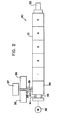
- Fig. 2 provides a schematic representation of the extruder, indicated generally by the numeral 30.
- the extruder 30 includes the outer barrel'31, which may be heated and cooled via means not shown, a drive motor 32 and a pelletiser head or other suitable extrusion die 33.
- a feeding zone 34 is provided for the rubber containing feed solution, separate precipitating liquid material feed and initiator from independent tanks 35, 36 and 37, respectively, connected by supply lines 38, 39 and 40, respectively.
- twin screws not shown, driven by shafts 41 and 42. The screws provide a combination of conveying and kneading action, as discussed above.
- Polymerisation zones 1 to 5 are depicted which may be heated or cooled independently to control temperature, as indicated for the Examples. Vents, not shown, may be provided as necessary to remove volatile gases or residual unreacted monomers flashed off at the die head by the hot polymer.
- Polymerisation zones 1 to 5 contain different arrangements of conveying sections and kneading or shearing sections as mentioned above. Conveying sections are usually provided in zones 1 and 5-while kneading sections will be provided in zones 2 to 4. Individual zones 2 to 4 may also contain some short conveying sections to maintain a flow of polymer as it is formed.
- the design or arrangement of the extruder screws is within the skill of the art and is determined or controlled by factors, such as the polymer being formed and the temperature, pressure, residence time and shear rate. desired.
- the process according to the present invention involves dissolving a rubber polymer in one or more plastic-forming monomers or inert solvents -to form a solution which is thereafter fed to the reactor extruder for polymerisation.
- an initiation temperature ranging from 20 to 100° C . should be reached in the feeding zone 34. While the desired temperature could also be obtained in zone 1 or subsequently, it is desirable that polymerisation commence as soon as possible, firstly, to form a viscous product that may be conveyed through the extruder and, secondly, so that the polymer may be subjected to the shearing action of the kneading blocks.
- initiators may result in lower initiation temperatures and/or the earlier commencement of polymerisation. Also, particular initiators may be selected that will selectively migrate to the rubber phase being precipitated within the feed port of the reaction extruder.
- the step of shearing occurs within the reactor extruder, specifically as the combined feed streams are subjected to the kneading blocks. It is necessary for the shearing to occur and continue to such an extent that the solids content, i.e. the resin product, formed is equal to about twice the elastomer content in the feed solution so that phase inversion caused by chemical precipitation will be maintained.
- the occurrence of phase inversion is necessary for the formation of the resins according to the present invention and it is initially triggered by the impingement of the feed solution with the separate feed stream which causes precipitation of the rubber. Initially, the plastic-forming monomer or monomers is/are dispersed throughout the homogeneous rubber polymer in the feed solution.
- the solubility limit of the rubber is surpassed and a point is reached where there are present more units of plastic polymer and/or solvent of a character different from the rubber and the rubber becomes dispersed in the plastic and other solvent that may be present.
- the shearing within the reactor extruder, to which the feed solution and polymer is subjected should be controlled until the amount of solids present is equal to at least twice the amount of the elastomer content present in the feed solution.
- the rubber content of the feed solution is equal to X, for instance 10 weight percent, then the solids content must be equal to at least 2X (or 20 weight percent) before shearing is complete.
- the amount of shearing action may be controlled by many factors, such as screw rotation, positioning of the kneading sections and residence time within the reactor extruder. Another factor is the rubber polymer content of the feed solution. If the content is high, that is, greater than 15 percent, then the shearing zone may extend beyond zone 3 in order to produce the two-fold increase in solids content. On the other hand, a lower rubber content feed solution may not require as long a shearing zone in order to avoid over-shearing of the resin. Of course, control over the amount of shear in a longer shearing section may still be facilitated to an extent by adjusting temperature, pressure and throughput rate.
- the extruder may operate at pressures of from 0.69 to 6.9 MPa so long as the feed solution is forced into the feed section at a pressure at least equal to the vapour pressure of the monomers at the maximum zone temperature being employed. If the pressure is lower, monomer gases will form which do not polymerize. Above this minimum pressure value, there is an optimum pressure range that exists, but only when all other variables are held constant.
- reaction rate increases as pressure increases. Reaction rate increases with higher pressure because the higher pressure ensures that liquid monomers are forced into the voids created by previously reacted monomers, so additional reaction may take place. Best operation may be achieved when the overall machine pressure is maintained above the vapour pressure of the monomers, preventing the formation of internal vapour spaces.
- the monomers employed herein react to polymers having a higher density than the starting monomers.
- process feed pressure There also exists an upper limit for process feed pressure. If the feed pressure is above the plastic viscous drag forces, the plastic will be pushed or forced out of the reaction/shear zone before the optimum plastic has formed, that is, one having optimum viscosity, elastomer level and elastomer cross-linking level.
- the rate of reaction increases with increasing temperature.
- an optimum temperature range exists that reacts feed solution to a plastic in the shear zone at an optimum elastomer level. If the temperature is too high, elastomer cross-linking level may be too high causing the molecular weight of the rubber and resin product to suffer, as well as lowering of resin impact strength.. If the temperature is too low, the plastic may have passed through the shear zone without having reacted to the optimum solids level for shear forces to form the proper elastomer particle size. Temperatures may generally range from 80°C. to as high as the melt temperature of the resin formed, e.g. from 177 to 191°C.
- Residence time within the reactor is a factor particularly applicable to the reaction/shear zones. It is approximately equal to the total volumetric void space of the reaction/shear zones, divided by the volumetric feed solution rate to the reactor extruder. With all other variables held constant, it is indirectly proportional to the feed solution rate. There is an optimum residence time range for a given set of variables. Too high a feed rate could result in too short a residence time to allow for the optimum plastic reaction to have been reached in the shear zone. Too low a feed rate could result in too long a residence time such that the plastic became "over-reacted" or "over-sheared", in the shear zone.
- shear forces are generally varied by varying screw configuration and/or screw RPM. If all variables are held constant, including screw configuration, shear is directly proportional to screw RPM. Too little or too much shear may result in an undesirable too large or too small elastomer particle size. It is believed that a shear rate ranging from 50 to 300 sec will provide the necessary shearing action to maintain the suspension of precipitated rubber. Similarly, the desired size of the elastomer particles for the resins should range from 0.01 to 0.25 microns.
- properties of the resins produced by the process according to the present invention may be modified by the selection of proper cross-linking catalysts in the initiator feed stream. If, for example, the system is constrained to a certain temperature, such as due to concern for thermal stability of the plastic components, peroxides may be used to ensure that the elastomer becomes sufficiently cured while polymerisation is taking place.
- the first two resins reported below are high acrylonitrile content ABS resins which were produced using styrene (S), acrylonitrile (An) and polybutadiene rubber (BR).
- S styrene
- An acrylonitrile
- BR polybutadiene rubber
- Polybutadiene utilised was "Taktene 502" the properties of which, as well as “Taktene 1202", are set forth in Table 1 below. All parts are presented on a weight percent basis. The polymerisations were initiated in part with peroxides and thermally aided with heat.
- a third resin was also produced wherein the rubber feed solution comprised "Taktene 502" dissolved in styrene and the independent feed stream comprised a mixture of styrene and methanol, the latter being employed to precipitate the rubber.
- Table 2 provides composition and molecular weights of the three resins and Tables 3 and 4 provide resin properties for Resins 1 and 2.
- Rubber feed solution 74.06%, S, 25.94% An, 10.85% " T aktene 502"
- No. 1 Feed rate: Rubber feed solution 25 cc/min Pure acrylonitrile 10 cc/min Initiator 0.5 cc/min composed of.25 wt% "Di Cup” plus 50 wt% "Polygard"
- Feed rate Rubber feed solution 22 cc/min Pure acrylonitrile 10 cc/min Initiator 0.7 cc/min composed of 25 wt% "Di Cup” plus 50 wt% "Polygard"
- Rubber feed solution 100% S with 15.0 wt% "Taktene 502"
- Independent feed solution 50/50 wt% mixture of methanol and S
- the tensile properties, HDT and Brabender Torque of the high acrylonitrile-containing resins, 1 and 2, are somewhat higher than normal ABS (75 wt % S/25 wt% An) while the melt index is lower than most typical ABS resins. These trends are expected as the acrylonitrile level is raised and the resin takes on the properties normally found in other high acrylonitrile-type plastics.
- Perhaps the most significant feature of the high acrylonitrile-containing ABS is the strong Notched Izod at a relatively low rubber content, i.e. N20 wt% polybutadiene. From this it is evident that the less expensive acrylonitrile may be substituted for the more expensive elastomer component while still maintaining a high Notched Izod and improved tensile properties.
Landscapes
- Chemical & Material Sciences (AREA)
- Health & Medical Sciences (AREA)
- Chemical Kinetics & Catalysis (AREA)
- Medicinal Chemistry (AREA)
- Polymers & Plastics (AREA)
- Organic Chemistry (AREA)
- Engineering & Computer Science (AREA)
- Mechanical Engineering (AREA)
- Graft Or Block Polymers (AREA)
- Addition Polymer Or Copolymer, Post-Treatments, Or Chemical Modifications (AREA)
- Extrusion Moulding Of Plastics Or The Like (AREA)
- Polymerisation Methods In General (AREA)
Applications Claiming Priority (2)
| Application Number | Priority Date | Filing Date | Title |
|---|---|---|---|
| US06/384,980 US4463137A (en) | 1982-06-04 | 1982-06-04 | Process for the preparation of rubber-modified thermoplastic resins |
| US384980 | 1982-06-04 |
Publications (3)
| Publication Number | Publication Date |
|---|---|
| EP0096555A2 true EP0096555A2 (de) | 1983-12-21 |
| EP0096555A3 EP0096555A3 (en) | 1984-02-15 |
| EP0096555B1 EP0096555B1 (de) | 1986-04-09 |
Family
ID=23519544
Family Applications (1)
| Application Number | Title | Priority Date | Filing Date |
|---|---|---|---|
| EP83303215A Expired EP0096555B1 (de) | 1982-06-04 | 1983-06-03 | Mit Kautschuk modifizierte thermoplastische Harze und ihre Herstellung |
Country Status (6)
| Country | Link |
|---|---|
| US (1) | US4463137A (de) |
| EP (1) | EP0096555B1 (de) |
| JP (1) | JPS58219209A (de) |
| KR (1) | KR840005162A (de) |
| AU (1) | AU552990B2 (de) |
| DE (1) | DE3362897D1 (de) |
Cited By (1)
| Publication number | Priority date | Publication date | Assignee | Title |
|---|---|---|---|---|
| EP0372978A3 (de) * | 1988-12-09 | 1991-07-17 | Asahi Kasei Kogyo Kabushiki Kaisha | Zusammensetzungen von ABS und geformte Gegenstände davon mit verbesserter Beschichtungsfähigkeit |
Families Citing this family (8)
| Publication number | Priority date | Publication date | Assignee | Title |
|---|---|---|---|---|
| DE3335954A1 (de) * | 1983-10-04 | 1985-04-04 | Roland Dipl.-Kaufm. 7022 Leinfelden-Echterdingen Belz | Verfahren zur durchfuehrung von chemischen reaktionen, insbesondere zur herstellung von kunststoffen mit hilfe von extrudern und anlage hierzu |
| US4619979A (en) * | 1984-03-28 | 1986-10-28 | Minnesota Mining And Manufacturing Company | Continuous free radial polymerization in a wiped-surface reactor |
| US5166261A (en) * | 1990-09-04 | 1992-11-24 | Monsanto Company | High gloss ABS made by continuous process |
| US5424367A (en) * | 1991-12-13 | 1995-06-13 | Exxon Chemical Patents Inc. | Multiple reaction process in melt processing equipment |
| US5552096A (en) * | 1991-12-13 | 1996-09-03 | Exxon Chemical Patents Inc. | Multiple reaction process in melt processing equipment |
| CA2447769C (en) | 2001-06-13 | 2011-07-26 | Energy & Environmental International, L.C. | Bulk polymerization reactors and methods for polymerization |
| US9815946B2 (en) * | 2013-08-16 | 2017-11-14 | Exxonmobil Chemical Patents Inc. | Stabilized poly(arylene ether) compositions and methods of making them |
| CN113912782A (zh) * | 2020-07-08 | 2022-01-11 | 成都肆零壹科技有限公司 | 一种含共轭二烯类单体高抗冲聚合物的制备工艺 |
Family Cites Families (11)
| Publication number | Priority date | Publication date | Assignee | Title |
|---|---|---|---|---|
| US3248455A (en) * | 1963-08-14 | 1966-04-26 | Us Rubber Co | Method of recovering resinous polymer from latex |
| NL128227C (de) * | 1963-09-20 | 1900-01-01 | ||
| US3511895A (en) * | 1966-04-01 | 1970-05-12 | Union Carbide Corp | Polymerization process and product thereof |
| DE1595343C3 (de) * | 1966-09-10 | 1974-06-20 | Basf Ag, 6700 Ludwigshafen | Verfahren zum Herstellen scMagfester Styrol-Acrylnitrilmischpolymerisate |
| AT293013B (de) * | 1968-04-25 | 1971-09-27 | Bayer Ag | Verfahren zur Herstellung von Segmentcopolymerisaten aus 1,3-Dienen und vinylaromatischen Verbindungen |
| US3607983A (en) * | 1969-05-28 | 1971-09-21 | Columbian Carbon | Process for the production of high impact strength graft polymers |
| US3931356A (en) * | 1974-04-26 | 1976-01-06 | Monsanto Company | Continuous process for the preparation of ABS type polyblends |
| US3928495A (en) * | 1974-04-26 | 1975-12-23 | Monsanto Co | Continuous process for the preparation of ABS type polyblends |
| FR2299349A1 (fr) * | 1975-02-03 | 1976-08-27 | Ugine Kuhlmann | Procede de preparation de copolymeres greffes |
| DE3065714D1 (en) * | 1979-11-07 | 1983-12-29 | Standard Oil Co Ohio | Manufacture of rubber-modified co-polymers in an extruder-type reactor |
| DE3002394A1 (de) * | 1980-01-24 | 1981-07-30 | Röhm GmbH, 6100 Darmstadt | Verfahren zur herstellung schlagzaeher formmassen |
-
1982
- 1982-06-04 US US06/384,980 patent/US4463137A/en not_active Expired - Fee Related
-
1983
- 1983-05-18 AU AU14664/83A patent/AU552990B2/en not_active Ceased
- 1983-05-30 JP JP58095584A patent/JPS58219209A/ja active Pending
- 1983-06-02 KR KR1019830002477A patent/KR840005162A/ko not_active Withdrawn
- 1983-06-03 DE DE8383303215T patent/DE3362897D1/de not_active Expired
- 1983-06-03 EP EP83303215A patent/EP0096555B1/de not_active Expired
Cited By (1)
| Publication number | Priority date | Publication date | Assignee | Title |
|---|---|---|---|---|
| EP0372978A3 (de) * | 1988-12-09 | 1991-07-17 | Asahi Kasei Kogyo Kabushiki Kaisha | Zusammensetzungen von ABS und geformte Gegenstände davon mit verbesserter Beschichtungsfähigkeit |
Also Published As
| Publication number | Publication date |
|---|---|
| KR840005162A (ko) | 1984-11-05 |
| AU552990B2 (en) | 1986-06-26 |
| US4463137A (en) | 1984-07-31 |
| EP0096555A3 (en) | 1984-02-15 |
| DE3362897D1 (en) | 1986-05-15 |
| JPS58219209A (ja) | 1983-12-20 |
| EP0096555B1 (de) | 1986-04-09 |
| AU1466483A (en) | 1983-12-08 |
Similar Documents
| Publication | Publication Date | Title |
|---|---|---|
| US4904730A (en) | Rubber-modified resin blends | |
| US3903200A (en) | Continuous mass polymerization process for ABS polymeric polyblends | |
| US5569709A (en) | Grafting, phase-inversion and cross-linking controlled multi-stage bulk process for making ABS graft copolymers | |
| EP0015752B1 (de) | Kontinuierliches Massepolymerisationsverfahren zur Herstellung von Polyblend-Kautschuk, der eine dispergierte Kautschukphase mit bimodalen Kautschukteilchengrössen enthält | |
| US4334039A (en) | Process for preparing polymeric polyblends having a rubber phase as particles with a bimodal particle size distribution | |
| US4476283A (en) | Graft copolymerization process | |
| US4417030A (en) | Mass polymerization process for ABS polyblends | |
| EP0096555B1 (de) | Mit Kautschuk modifizierte thermoplastische Harze und ihre Herstellung | |
| US3442979A (en) | Thermoplastic-elastic moulding compositions with improved notched bar impact strength | |
| US3928495A (en) | Continuous process for the preparation of ABS type polyblends | |
| US4252911A (en) | Mass polymerization process for ABS polyblends | |
| US3903199A (en) | Continuous mass polymerization process for ABS polymeric polyblends | |
| US5387650A (en) | Preparation of ABS molding materials | |
| US4393171A (en) | Process for preparing rubbery polymer reinforced styrenic resins | |
| JPH037708A (ja) | ゴム変性スチレン系樹脂の製造法 | |
| US4419492A (en) | Process for preparing ABS polymeric polyblends | |
| US4410659A (en) | Manufacture of rubber modified copolymers in an extruder type reactor | |
| EP0227098B1 (de) | Verfahren zur Herstellung von mit Gummi modifizierten thermoplastischen Harzen | |
| JPH0714990B2 (ja) | ゴム変性スチレン系樹脂の製造法 | |
| US4387179A (en) | Method for the preparation of alkenyl aromatic monomer nitrile copolymer reinforced with rubbery copolymer | |
| US4362850A (en) | Process for the continuous polymerization of polyblends | |
| JPWO1999062976A1 (ja) | ゴム補強スチレン系樹脂の製造方法 | |
| US4598124A (en) | Mass polymerization process for ABS polyblends | |
| JP3349859B2 (ja) | 熱可塑性樹脂組成物及びその製造方法 | |
| US4692498A (en) | Novel rubber-modified thermoplastic resin compositions |
Legal Events
| Date | Code | Title | Description |
|---|---|---|---|
| PUAI | Public reference made under article 153(3) epc to a published international application that has entered the european phase |
Free format text: ORIGINAL CODE: 0009012 |
|
| PUAL | Search report despatched |
Free format text: ORIGINAL CODE: 0009013 |
|
| AK | Designated contracting states |
Designated state(s): BE CH DE FR GB IT LI LU NL SE |
|
| AK | Designated contracting states |
Designated state(s): BE CH DE FR GB IT LI LU NL SE |
|
| 17P | Request for examination filed |
Effective date: 19840717 |
|
| GRAA | (expected) grant |
Free format text: ORIGINAL CODE: 0009210 |
|
| AK | Designated contracting states |
Kind code of ref document: B1 Designated state(s): BE CH DE FR GB IT LI LU NL SE |
|
| ITF | It: translation for a ep patent filed | ||
| REF | Corresponds to: |
Ref document number: 3362897 Country of ref document: DE Date of ref document: 19860515 |
|
| ET | Fr: translation filed | ||
| PG25 | Lapsed in a contracting state [announced via postgrant information from national office to epo] |
Ref country code: LU Free format text: LAPSE BECAUSE OF NON-PAYMENT OF DUE FEES Effective date: 19860630 |
|
| PLBE | No opposition filed within time limit |
Free format text: ORIGINAL CODE: 0009261 |
|
| STAA | Information on the status of an ep patent application or granted ep patent |
Free format text: STATUS: NO OPPOSITION FILED WITHIN TIME LIMIT |
|
| 26N | No opposition filed | ||
| PGFP | Annual fee paid to national office [announced via postgrant information from national office to epo] |
Ref country code: NL Payment date: 19870630 Year of fee payment: 5 |
|
| PG25 | Lapsed in a contracting state [announced via postgrant information from national office to epo] |
Ref country code: GB Effective date: 19880603 |
|
| PG25 | Lapsed in a contracting state [announced via postgrant information from national office to epo] |
Ref country code: SE Effective date: 19880604 |
|
| PG25 | Lapsed in a contracting state [announced via postgrant information from national office to epo] |
Ref country code: LI Effective date: 19880630 Ref country code: CH Effective date: 19880630 |
|
| BERE | Be: lapsed |
Owner name: THE STANDARD OIL CY Effective date: 19880630 |
|
| PG25 | Lapsed in a contracting state [announced via postgrant information from national office to epo] |
Ref country code: NL Effective date: 19890101 |
|
| NLV4 | Nl: lapsed or anulled due to non-payment of the annual fee | ||
| GBPC | Gb: european patent ceased through non-payment of renewal fee | ||
| PG25 | Lapsed in a contracting state [announced via postgrant information from national office to epo] |
Ref country code: FR Free format text: LAPSE BECAUSE OF NON-PAYMENT OF DUE FEES Effective date: 19890228 |
|
| REG | Reference to a national code |
Ref country code: CH Ref legal event code: PL |
|
| PG25 | Lapsed in a contracting state [announced via postgrant information from national office to epo] |
Ref country code: DE Effective date: 19890301 |
|
| REG | Reference to a national code |
Ref country code: FR Ref legal event code: ST |
|
| PG25 | Lapsed in a contracting state [announced via postgrant information from national office to epo] |
Ref country code: BE Effective date: 19890630 |
|
| EUG | Se: european patent has lapsed |
Ref document number: 83303215.4 Effective date: 19890220 |