EP0096895A2 - Matériel polymère organique à poids moléculaire élevé, de type positif, sensible à la radiation et procédé pour l'obtention de microstructures l'utilisant - Google Patents
Matériel polymère organique à poids moléculaire élevé, de type positif, sensible à la radiation et procédé pour l'obtention de microstructures l'utilisant Download PDFInfo
- Publication number
- EP0096895A2 EP0096895A2 EP83105867A EP83105867A EP0096895A2 EP 0096895 A2 EP0096895 A2 EP 0096895A2 EP 83105867 A EP83105867 A EP 83105867A EP 83105867 A EP83105867 A EP 83105867A EP 0096895 A2 EP0096895 A2 EP 0096895A2
- Authority
- EP
- European Patent Office
- Prior art keywords
- group
- positive type
- alkyl group
- type radiation
- halogenated
- Prior art date
- Legal status (The legal status is an assumption and is not a legal conclusion. Google has not performed a legal analysis and makes no representation as to the accuracy of the status listed.)
- Withdrawn
Links
Images
Classifications
-
- G—PHYSICS
- G03—PHOTOGRAPHY; CINEMATOGRAPHY; ANALOGOUS TECHNIQUES USING WAVES OTHER THAN OPTICAL WAVES; ELECTROGRAPHY; HOLOGRAPHY
- G03F—PHOTOMECHANICAL PRODUCTION OF TEXTURED OR PATTERNED SURFACES, e.g. FOR PRINTING, FOR PROCESSING OF SEMICONDUCTOR DEVICES; MATERIALS THEREFOR; ORIGINALS THEREFOR; APPARATUS SPECIALLY ADAPTED THEREFOR
- G03F7/00—Photomechanical, e.g. photolithographic, production of textured or patterned surfaces, e.g. printing surfaces; Materials therefor, e.g. comprising photoresists; Apparatus specially adapted therefor
- G03F7/004—Photosensitive materials
- G03F7/039—Macromolecular compounds which are photodegradable, e.g. positive electron resists
Definitions
- the present invention relates to a positive type radiation-sensitive organic high-polymer material which exhibits high sensitivities to radiations of high energy such as electron beam, X-ray and ion beam and which is suited to the formation of fine patterns required for fabricating a semiconductor ievice, a magnetic bubble memory device, an IC, etc. It also relates to a method of forming the fine patterns by using the aforementioned material.
- Resists are classified into (a) a positive type radiation-sensitive organic high-polymer material, such as poly(methyl methacrylate) or poly(l-butene sulfone), which induces the reaction of severing a high-polymer chain upon irradiation with, the radiation, and the irradiated part of which becomes soluble in a developing solution, thereby to form the pattern, and (b) a negative type radiation-sensitive organic high-polymer material, which cross-links by the radiation, and the irradiated part of which becomes insoluble in a developing solution, thereby to form the pattern.
- a positive type radiation-sensitive organic high-polymer material such as poly(methyl methacrylate) or poly(l-butene sulfone
- the positive type material (a) is higher in ⁇ resolution than the negative type material (b). Since, however, the former has as low a sensitivity as - of that of the latter, it requires a long time for forming the fine pattern (refer to Japanese Patent Application Publication No. 57-24801).
- An object of the present invention is to provide a positive type radiation-sensitive organic high-polymer material which,has high sensitivities to radiations of high energy such as electron beam, X-ray and ion beam, which has a high resolution, and whose part irradiated with the radiation depolymerizes in chain-reacting fashion and evaporates, so that any special developing step is dispensed with, and also a method of forming a fine pattern on a substrate by using the positive type material.
- the polymer of a single aliphatic aldehyde is difficult to dissolve in many organic solvents because of its high crystallinity, so that it cannot be used as a resist material.
- an aldehyde copolymer having an improved solubility is produced (refer, for example, to 'K ⁇ bunshi-Kagaku (polymer chemistry)', 21, 694 (1963) by Tanaka et al.). This material has been found usable as a radiation-sensitive organic high-polymer material.
- Aliphatic aldehyde monomers to form a mixture for use in the present invention are at least two kinds of aldehyde monomers selected from the group consisting of aliphatic aldehydes expressed by a general formula, R-CHO where R denotes an alkyl group, a halogenated alkyl group, an aralkyl group or a halogenated aralkyl group. Especially preferable are aliphatic aldehydes of the alkyl group, the halogenated alkyl group, the aralkyl group or the halogenated aralkyl group having an aliphatic carbon number of 1 to 8.
- the mol ratio of the mixture are controlled in terms of the composition of the polymer, they are selected from within a composition range within which the component of the largest ratio contained in the copolymer does not exceed 99 mol-% Particularly for obtaining a copolymer of high solubility, it is desirable that the component of the largest ratio contained in the copolymer does not exceed 80 mol-%.
- the polymer is produced by the anionic polymerization.
- Used as a polymerization initiator is any of dimethylaluminum diphenylamid e (CH 3 ) 2 A N(C 6 H 5 ) 2 , d i ethylaluminum diphenylamide (C 2 H 5 ) 2 AlN(C 6 H 5 ) 2 , ethylaluminum bis(diphenylamide) (C 2 H 5 )Al[N(C 6 H 5 ) 2 ] 2 , ethylzinc diphenylamide C 2 H 5 ZnN(C 6 H 5 ) 2 ethylmagnesium diphenylamide C2H5MgN(C6H5)2, etc.
- the amount of addition of the catalyst is a proportion of 0.1 - 5 mol-% with respect to the aldehyde monomer mixture.
- a hydrocarbon type solvent such as toluene or an ethyl ether type solvent is used.
- the polymerization is performed at a temperature in a range of 0°C to -100°C. Usually, a temperature of -50°C to -80°C is preferable.
- the anionic polymerization is conducted in such a way that the initiator is dissolved in the inactive organic solvent, whereupon the aldehyde mixture is subjected to reduced-pressure distillation in the initiator solution, or that the initiator itself or a solution thereof is added to the aldehyde mixture itself or a solution thereof, whereupon the resultant system is incubated.
- the radiation-sensitive organic high-polymer material thus produced is used for forming the pattern of a semiconductor device or the like
- the material dissolved in a conventianal organic solvent for example, toluene or xylene is applied on the substrate of the element by spin coating or dip coating.
- the applied material After the applied material has been prebaked under a suitable temperature condition, it is irradiated with radiation in a desired pattern. Then, the irradiated part disintegrates in chain-reacting fashion and evaporates, whereby the positive type resist pattern is obtained without performing any developing process.
- wet development may well be performed using a toluene-isopropyl alcohol type organic solvent.
- the radiation-sensitive organic high-polymer material composed of the aldehyde-polymer according to the present invention may well be mixed in use with novolak resin, polyacrylate ester type polymer, polyisoprene resin, polystyrene, etc.
- a developing solution is selected depending upon the mixed polymer, and the characteristics, e.g., dry-etching resistance can be variously changed.
- aldehyde polymer of the present invention exhibits high sensitivities to radiations, it is also sensitive to light and usable as a photosensitive material.
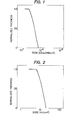
- Figure 1 is a graph showing the electron beam exposure characteristic of a radiation-sensitive high-polymer material according to the present invention
- Figure 2 is a graph showing the soft X-ray exposure characteristic of a radiation-sensitive high-polymer material according to the present invention.
- Polymerization was carried out by the use of a polymerizing tube provided with a three-way stopcock. Predetermined amounts of aldehyde monomers and solvent (usually, toluene was used) were introduced into the cylindrical polymerizing vessel having a capacity of about 100 m-6, through the three-way stopcock with a syringe under a nitrogen stream. While the reaction vessel containing the monomer solution was being violently moved in the state in which it was cooled to 0°C by an ice - water bath, a predetermined amount of the initiator solution produced in Example of Synthesis 1 was gradually added into the vessel.
- aldehyde monomers and solvent usually, toluene was used
- the vessel was cooled to -78°C by a dry ice - acetone bath, and the monomer solution was allowed to polymerize for a predetermined period of time. Then the polymerization mixture was treated with ammoniac methanol so as to terminate the reaction and decompose the unreacted initiator. Thereafter, it was immersed in a large amount of methanol for 1 day and then the precipitated polymer was collected by filtration. The polymer was washed with methanol several times, and dried under vacuum.
- the monomer solution was added into the catalyst solution and polymerized.
- composition ratio of each copolymer was evaluated by the elementary analysis or the analysis of the monomer mixture produced by the thermal decomposition of the polymer under high vacuum at elevated temperature. Polymerization time: 24 hours, total monomer quantity: 100 mmol, solvent: toluene, total volume of reaction mixture: 27 ml, initiator (C 2 H 5 ) 2 AlN(C 6 H 5 ) 2 : 0.18 mmol.
- PhPA 3-phenylpropanal HA: heptanal IBA: isobutyraldehyde
- the acetaldehyde - butyraldehyde copolymer obtained in Example of Synthesis 2 was dissolved in xylene, to prepare a 0.2 weight-% resist solution.
- the resist solution was applied on a silicon wafer by dip coating and was prebaked at 80°C for 20 minutes, to form a high-polymer film of 1.5 ⁇ m thickness.
- the resultant wafer was put into an electron beam irradiation.apparatus, and the film was irradiated with an electron beam at an acceleration voltage of 20 kV under vacuum, with doses differing depending upon places.
- the irradiated part of the film decreased without any developing treatment.
- the thicknesses of the residual high-polymer film were measured with a Talystep film thickness gauge, and the residual film thicknesses (normalized) were plotted against the electron beam doses (coulomb/cm2). Then, Figure 1 expressive of the electron beam sensitivity characteristic of the high-polymer film was obtained. When the minimum dose with which the remaining film thickness became null was evaluated from the characteristic, it was 8 x 10 -7 C/cm 2 , It has accordingly been verified that the high-polymer film is a positive type resist of very high sensitivity.
- poly(methyl methacrylate) which is a typical positive type resist has an electron beam sensitivity of 1 x 10 -4 C/cm 2 . It has therefore been verified that, as compared with the poly(methyl methacrylate), the positive type resist material of the present invention exhibits the sensitivity of more than 100 times higher than that of poly(methyl methacrylate).
- the resist solution was applied on a silicon wafer by dip coating and was prebaked at 80°C for 20 minutes, to form a high-polymer film of 2.0 ⁇ m thickness.
- the resultant wafer was put into a soft X-ray generator, the film was irradiated under vacuum with soft X-ray of a wavelength of 4.2 R emitted from a water-cooled rotary silver target of 10 kW, and the relationship between residual film thicknesses (normalized) and soft X-ray doses (mJ/cm 2 ) was evaluated.
- the result is shown in Figure 2.
- the minimum dose affording the null film thickness was found to be 19 mJ/cm 2 , and the high-polymer film has been verified to be a positive type resist of very high sensitivity.
- poly(methyl methacrylate) which is a typical positive type resist has a soft X-ray sensitivity of about 2000 mJ/cm 2 . It has therefore been verified that, as compared with the poly(methyl methacrylate), the positive type resist material of the present invention has the soft X-ray sensitivity which is more than 100 times times higher than that of poly(methyl methacrylate).
- the resist solution was applied on a silicon wafer by dip coating and was prebaked at 30°C for 20. minutes, to form a high-polymer film having a thickness of about 1.5 ⁇ m.
- the high-polymer film was irradiated with an electron beam having an acceleration voltage of 20 kV or soft X-rays (AlK ⁇ or AgL ⁇ ) of 10 kW so as to evaluate an electron beam sensitivity or a soft X-ray sensitivity.
- PhPA 3-pehnylpropanal HA: heptanal IBA: isobutyraldehyde
Landscapes
- Physics & Mathematics (AREA)
- Spectroscopy & Molecular Physics (AREA)
- General Physics & Mathematics (AREA)
- Exposure And Positioning Against Photoresist Photosensitive Materials (AREA)
- Materials For Photolithography (AREA)
- Addition Polymer Or Copolymer, Post-Treatments, Or Chemical Modifications (AREA)
Applications Claiming Priority (4)
| Application Number | Priority Date | Filing Date | Title |
|---|---|---|---|
| JP57102019A JPS58219736A (ja) | 1982-06-16 | 1982-06-16 | パターン形成方法 |
| JP10201882A JPS58219547A (ja) | 1982-06-16 | 1982-06-16 | ポジ形放射線感応性有機高分子材料 |
| JP102018/82 | 1982-06-16 | ||
| JP102019/82 | 1982-06-16 |
Publications (2)
| Publication Number | Publication Date |
|---|---|
| EP0096895A2 true EP0096895A2 (fr) | 1983-12-28 |
| EP0096895A3 EP0096895A3 (fr) | 1984-05-16 |
Family
ID=26442765
Family Applications (1)
| Application Number | Title | Priority Date | Filing Date |
|---|---|---|---|
| EP83105867A Withdrawn EP0096895A3 (fr) | 1982-06-16 | 1983-06-15 | Matériel polymère organique à poids moléculaire élevé, de type positif, sensible à la radiation et procédé pour l'obtention de microstructures l'utilisant |
Country Status (1)
| Country | Link |
|---|---|
| EP (1) | EP0096895A3 (fr) |
Cited By (3)
| Publication number | Priority date | Publication date | Assignee | Title |
|---|---|---|---|---|
| EP0111655A1 (fr) * | 1982-11-18 | 1984-06-27 | International Business Machines Corporation | Procédé pour la fabrication de dessins autodéveloppants utilisant une photoréserve positive |
| GB2189493A (en) * | 1986-04-11 | 1987-10-28 | James C W Chien | Self-developing resist comprising polymer of aliphatic aldehyde or cyclic ether |
| US4897336A (en) * | 1986-04-11 | 1990-01-30 | Chien James C W | Self-developing radiation sensitive resist with amorphous polymer having haloalkyl substitution derived from cycic ether |
Family Cites Families (5)
| Publication number | Priority date | Publication date | Assignee | Title |
|---|---|---|---|---|
| US3549733A (en) * | 1968-12-04 | 1970-12-22 | Du Pont | Method of producing polymeric printing plates |
| US3915706A (en) * | 1974-03-11 | 1975-10-28 | Xerox Corp | Imaging system based on photodegradable polyaldehydes |
| US3940507A (en) * | 1974-05-03 | 1976-02-24 | Rca Corporation | Electron beam recording media and method of recording |
| US3923514A (en) * | 1974-06-27 | 1975-12-02 | Xerox Corp | Method for the preparation of relief printing masters |
| US4086092A (en) * | 1977-04-18 | 1978-04-25 | Polychrome Corporation | Process for making photosensitive lithographic printing plates involving sequentially coating with potassium zirconium fluoride and sodium silicate |
-
1983
- 1983-06-15 EP EP83105867A patent/EP0096895A3/fr not_active Withdrawn
Cited By (4)
| Publication number | Priority date | Publication date | Assignee | Title |
|---|---|---|---|---|
| EP0111655A1 (fr) * | 1982-11-18 | 1984-06-27 | International Business Machines Corporation | Procédé pour la fabrication de dessins autodéveloppants utilisant une photoréserve positive |
| GB2189493A (en) * | 1986-04-11 | 1987-10-28 | James C W Chien | Self-developing resist comprising polymer of aliphatic aldehyde or cyclic ether |
| US4897336A (en) * | 1986-04-11 | 1990-01-30 | Chien James C W | Self-developing radiation sensitive resist with amorphous polymer having haloalkyl substitution derived from cycic ether |
| GB2189493B (en) * | 1986-04-11 | 1990-12-19 | James C W Chien | Self-developing resist |
Also Published As
| Publication number | Publication date |
|---|---|
| EP0096895A3 (fr) | 1984-05-16 |
Similar Documents
| Publication | Publication Date | Title |
|---|---|---|
| US6368773B1 (en) | Photoresist cross-linker and photoresist composition comprising the same | |
| CA1166061A (fr) | Methode pour former un resist negatif en exposant a la reticulation croisee un copolymere contenant des unites styreniques a substitution par un halomethyle ou un acrylmethyle | |
| KR19990057361A (ko) | 공중합체 수지와 이의 제조방법 및 이 수지를 이용한 포토레지스트 | |
| KR100362937B1 (ko) | 신규의포토레지스트가교제,이를포함하는포토레지스트중합체및포토레지스트조성물 | |
| EP0226956A1 (fr) | Polycyclo-oléfines sous forme de revêtement, de film et de couche | |
| Bowden et al. | Vapor development of poly (olefin sulfone) resists | |
| US3950173A (en) | Electron beam recording article with o-quinone diazide compound | |
| US5212047A (en) | Resist material and process for use | |
| US5527646A (en) | Method of forming a micro structure and an x-ray mask | |
| US4315067A (en) | Method for making electron sensitive negative resist | |
| EP0524246B1 (fr) | Materiau de reserve et procede d'utilisation | |
| EP0109617B1 (fr) | Matériel polymère organique sensible aux radiations du type positif | |
| JPH0380300B2 (fr) | ||
| US4024122A (en) | Method of purifying 2,4-bis(6-diazo-5,6-dihydro-5-oxo-1-naphthalenesulfonyloxy benzophenone) | |
| JPH087443B2 (ja) | 高解像度ポジ型放射線感応性レジスト | |
| US4600684A (en) | Process for forming a negative resist using high energy beam | |
| Hatada et al. | Highly sensitive self developing electron-beam resist of aldehyde copolymer | |
| Bowden et al. | Radiation degradation of poly (olefin sulphone) s—fundamental research to practical applications | |
| JPS58219547A (ja) | ポジ形放射線感応性有機高分子材料 | |
| JPS59198448A (ja) | 放射線感応性有機高分子材料 | |
| JPS6311932A (ja) | 自己現像する放射レジスト | |
| KR100504436B1 (ko) | 포토 레지스트용 중합체 및 이의 제조 방법 | |
| JPS5975244A (ja) | 放射線感応性有機高分子材料 | |
| JPH0158496B2 (fr) | ||
| Nate et al. | Highly sensitive self‐developing soft X‐ray resists of silicon‐containing aldehyde copolymers and sensitive novolac‐based composite resists containing aldehyde copolymer |
Legal Events
| Date | Code | Title | Description |
|---|---|---|---|
| PUAI | Public reference made under article 153(3) epc to a published international application that has entered the european phase |
Free format text: ORIGINAL CODE: 0009012 |
|
| 17P | Request for examination filed |
Effective date: 19830615 |
|
| AK | Designated contracting states |
Designated state(s): DE GB |
|
| PUAL | Search report despatched |
Free format text: ORIGINAL CODE: 0009013 |
|
| AK | Designated contracting states |
Designated state(s): DE GB |
|
| 17Q | First examination report despatched |
Effective date: 19860604 |
|
| STAA | Information on the status of an ep patent application or granted ep patent |
Free format text: STATUS: THE APPLICATION HAS BEEN WITHDRAWN |
|
| 18W | Application withdrawn |
Withdrawal date: 19860908 |
|
| RIN1 | Information on inventor provided before grant (corrected) |
Inventor name: HATADA, KOICHI Inventor name: YUKI, HEIMEI |