EP0097597A2 - Einrichtung zur optischen Beobachtung der Mischungsvorgänge, die durch Unstetigkeiten zwischen zwei Flüssigkeiten verursacht werden - Google Patents
Einrichtung zur optischen Beobachtung der Mischungsvorgänge, die durch Unstetigkeiten zwischen zwei Flüssigkeiten verursacht werden Download PDFInfo
- Publication number
- EP0097597A2 EP0097597A2 EP83401283A EP83401283A EP0097597A2 EP 0097597 A2 EP0097597 A2 EP 0097597A2 EP 83401283 A EP83401283 A EP 83401283A EP 83401283 A EP83401283 A EP 83401283A EP 0097597 A2 EP0097597 A2 EP 0097597A2
- Authority
- EP
- European Patent Office
- Prior art keywords
- diaphragm
- axis
- extraction
- observation chamber
- enclosure
- Prior art date
- Legal status (The legal status is an assumption and is not a legal conclusion. Google has not performed a legal analysis and makes no representation as to the accuracy of the status listed.)
- Withdrawn
Links
- 239000012530 fluid Substances 0.000 title claims abstract description 31
- 230000003287 optical effect Effects 0.000 title claims description 6
- 238000000605 extraction Methods 0.000 claims abstract description 35
- 230000001133 acceleration Effects 0.000 claims abstract description 6
- 238000006073 displacement reaction Methods 0.000 claims abstract description 4
- 239000000203 mixture Substances 0.000 claims abstract 2
- 230000005855 radiation Effects 0.000 claims description 6
- 238000007789 sealing Methods 0.000 claims description 4
- 230000003068 static effect Effects 0.000 claims description 4
- 239000000463 material Substances 0.000 claims description 3
- 238000013016 damping Methods 0.000 claims description 2
- 238000002474 experimental method Methods 0.000 abstract description 9
- 230000009471 action Effects 0.000 description 2
- 230000001276 controlling effect Effects 0.000 description 2
- 230000005484 gravity Effects 0.000 description 2
- 229910052751 metal Inorganic materials 0.000 description 2
- 239000002184 metal Substances 0.000 description 2
- 230000035939 shock Effects 0.000 description 2
- VVQNEPGJFQJSBK-UHFFFAOYSA-N Methyl methacrylate Chemical compound COC(=O)C(C)=C VVQNEPGJFQJSBK-UHFFFAOYSA-N 0.000 description 1
- 229920005372 Plexiglas® Polymers 0.000 description 1
- 229910052782 aluminium Inorganic materials 0.000 description 1
- XAGFODPZIPBFFR-UHFFFAOYSA-N aluminium Chemical compound [Al] XAGFODPZIPBFFR-UHFFFAOYSA-N 0.000 description 1
- 230000002596 correlated effect Effects 0.000 description 1
- 230000008878 coupling Effects 0.000 description 1
- 238000010168 coupling process Methods 0.000 description 1
- 238000005859 coupling reaction Methods 0.000 description 1
- 239000013013 elastic material Substances 0.000 description 1
- 239000011521 glass Substances 0.000 description 1
- 239000007788 liquid Substances 0.000 description 1
- 230000008520 organization Effects 0.000 description 1
- 229920003023 plastic Polymers 0.000 description 1
- 238000000926 separation method Methods 0.000 description 1
- 230000001960 triggered effect Effects 0.000 description 1
Images
Classifications
-
- G—PHYSICS
- G01—MEASURING; TESTING
- G01N—INVESTIGATING OR ANALYSING MATERIALS BY DETERMINING THEIR CHEMICAL OR PHYSICAL PROPERTIES
- G01N13/00—Investigating surface or boundary effects, e.g. wetting power; Investigating diffusion effects; Analysing materials by determining surface, boundary, or diffusion effects
Definitions
- the present invention relates to the field of fluid physics and, more particularly, to the study by optical observation of the evolution of the phenomena of instabilities occurring at the separation interface of two fluids of different densities subjected to a acceleration not zero.
- the purpose of the present invention is to extend the field of this study under much wider experimental conditions, and mainly under accelerations, clearly greater than those of the natural gravity field, said accelerations being obtained by application to the 'one of the fluids with a high pressure which can reach several tens of bars.
- the invention aims more precisely to solve the problem then becoming very critical, of the extraction, in as short a time as possible, of the diaphragm separating, before the start of the experiment, the two fluids under high pressure.
- the subject of the invention is an apparatus for the optical observation of the evolution of the phenomena of instabilities between two fluids of different densities subjected to high initial pressures of the type comprising an observation chamber with parallel faces containing the two fluids initially separated by a diaphragm and essentially characterized in that, in combination: said observation chamber is disposed inside 'A sealed enclosure provided with static pressurizing means and one side of which consists of an optical observation window parallel to the two parallel faces of the observation chamber; said diaphragm is of straight cylindrical shape and coupled to a mechanical extraction axis, the geometric axes of said diaphragm and said extraction axis being perpendicular to the faces of said observation chamber, said extraction axis sliding with sealing through the wall of said pressure enclosure opposite to said porthole, and part of the extraction axis external to the pressure enclosure is secured respectively: to a piston sliding inside a cylinder and capable of being actuated by a high pressure fluid to drive the extraction axis towards the outside of the enclosure, a mechanical device
- this apparatus is as follows: initially, the diaphragm for separating the two fluids is put in place. The extraction axis, integral with the diaphragm, is then locked. The lower part of the observation chamber is then filled with a first fluid and the gas pockets which may remain under the diaphragm are eliminated. The upper part of the observation chamber is then filled with a second fluid of density different from that of the first. The en girdle containing this chamber is then gradually put under pressure by the introduction of a gaseous fluid and this until a desired pressure. Similarly, the high pressure fluid is introduced into a cylinder containing the aforementioned piston secured to the extraction axis.
- the axis unlocking device When the selected high pressure, which may be different from that of the enclosure, is reached in this cylinder, the axis unlocking device is actuated. The extraction axis is then released and propelled with a very high force to extract the diaphragm. When the diaphragm is completely removed from the observation chamber, the end-of-travel stop device intervenes to stop the mechanical extraction axis.
- the sealed autonomous static overpressure enclosure enclosing the observation chamber, can be dimensioned and equipped in such a way that it allows the creation of overpressure values as high as desired to extend the field of experimentation.
- the driving force of the mechanical axis of extraction of the diaphragm can be as high as necessary by choosing consequently the surface of the piston integral with this axis and the value of the high pressure of the fluid which actuates it. . This will reduce the extraction time of the diaphragm to a minimum acceptable value.
- Another object of the invention is to allow the automatic triggering and unfolding of a certain number of functions from an initial time reference correlated with the beginning of an experiment, that is to say the extraction of the diaphragm.
- the invention has for another object an apparatus of the aforementioned type, characterized in that a part of the extraction axis is integral with a blade, pierced with calibrated slots and known spaces, and susceptible to move between a source of radiation and a receiver of this radiation to generate a train of pulses image of the displacement of the diaphragm.
- the first pulse of the aforementioned train can in particular control the automatic triggering of a film marking device, the camera having been triggered beforehand, the shooting speed being identified by a time base which is permanently registered. on the film.
- Another object of the invention is also to make it possible to vary the conditions of instabilities caused.
- the invention also has for another object an apparatus of the aforementioned type, characterized in that the lower part of said observation chamber is connected by a pipe to an expansion vessel with adjustable damping.
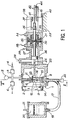
- the apparatus comprises a first part constituted by the static overpressure enclosure.
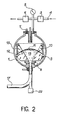
- the latter is formed by a circular cylindrical chamber 1, one front face of which is closed by an observation window 2 made of thick glass or of a plastic material such as that known under the trade name of plexiglass.
- the interior of the enclosure is connected, by means of a supply valve 3, to a source of high pressure fluid 4, for example compressed air capable of reaching experimental pressures of 20, 40, 60 and even 100 bars.
- a source of high pressure fluid 4 for example compressed air capable of reaching experimental pressures of 20, 40, 60 and even 100 bars.
- a pressure gauge 5 indicates the pressure of this source of high pressure fluid.
- Different pressure sensors 7 are provided to measure the pressures during the experiment in different places and allow their recording.
- the observation chamber proper is housed inside the enclosure 1.
- This chamber, supported by a base 8 is formed by a lower block 9 and an upper block 10 which adjusts just above from it with the interposition of the diaphragm 11.
- the seal between the blocks 9 and 10 is ensured both by the presence of the diaphragm 11 and also by means of sealing O-rings shown diagrammatically by the reference 12.
- the diaphragm a seen in section, an arc shape.
- the geometric axis of the cylinder which it forms is perpendicular to the two parallel faces 14 and 15 of the observation chamber.
- sectional shape of the diaphragm could be different: planar, sinusoidal, or any other.
- the useful internal volume 16 of the observation chamber converges downwards and is connected to the consequent entry formed in the base 8.
- the shape of this useful interior volume 16 could be other.
- This useful volume 16 communicates by a pipe 17, with an expansion tank 18.
- a blade of gas for example air
- a sensor 21 measures the pressure of the gas plate 20.
- a bubble trap device 22 below the lower block 9 of the observation chamber.
- This trap makes it possible to extract the gas bubbles which, after filling with light liquid, adhere to the diaphragm 11 in the upper part of the lower chamber.
- This trap consists of an orifice closed by a pad made of elastic material. This orifice makes it possible to introduce, through the buffer, one end of a metal capillary tube to the level of the bubble. This is sucked in through the other end of the capillary using a bulb. The capillary is then removed. A metal plug closes the opening during the experiments.
- the diaphragm 11 is connected, by a coupling 23, to a mechanical extraction axis 24 of the diaphragm.
- This axis 24 slides with sealing in the front wall 25 of the overpressure enclosure 1.
- the apparatus comprises, in combination with the first part described above, a second part which constitutes the system for controlling the movement of the axis 24 of the diaphragm extraction.
- This system firstly comprises the motor member of the axis 24 which consists of a piston 26, integral with the axis 24, and capable of sliding inside a cylinder 27 equipped with a pipe intake 28 of a high pressure fluid, for example air, and an exhaust pipe 29.
- a high pressure fluid for example air
- This system then comprises a locking-unlocking member in the axial position of the axis 24.
- this member is constituted as follows: balls 30 are housed in a grooved groove 31 machined in the axis 24. These balls 30 are, in the locking position, engaged inside the groove 31 under the action of a piston 32 having an internal bore, on its part shown on the left in the figure, precisely holding these balls 30 in the groove 31.
- the position thus represented of the piston 32 is obtained by the action of a pressurized fluid admitted via a pipe 33. After fitting of said piston, the admission of this fluid is interrupted.
- Unlocking is obtained by performing the admission of a fluid into the unlocking pipe 34. Then the piston 32 moves to the left and a larger bore 35 is presented with regard to the balls 30 which then exit from the grooved groove 31 and release the axis d extraction 24.
- the system for controlling the movement of the extraction axis 24 finally comprises a stop member at the end of the travel of this axis 24.
- This member in this example, comprises a consumable male cone 36, made of a deforming material by consuming energy, aluminum for example, and coming to be embedded by crashing at the end of the race in a female cone 37.
- a consumable male cone 36 made of a deforming material by consuming energy, aluminum for example, and coming to be embedded by crashing at the end of the race in a female cone 37.
- this support 38 is mounted on runners 39 with shock absorbing springs 40.
- the apparatus finally comprises, according to another advantageous characteristic of the invention, a member for measuring the displacement and speed of the axis 24 of diaphragm extraction.
- This member very simply consists of a blade 41, integral with the axis 24, having slots 42 calibrated and spaced from each other by a known value.
- a source of radiation 43 for example a light-emitting diode, is disposed on one side of the blade 41, while a receiver 44 of this radiation, for example a phototransistor, is disposed on the other side of the blade.
- the diaphragm is flush with, or is slightly set back from the front face of the observation chamber. This initial condition is provided so that when the left edge of the diaphragm arrives just at the entrance of the useful interior volume 16 of the chamber, the extraction axis 24 may have had time to reach its maximum speed to minimize the actual time of extraction of the diaphragm from this useful volume 16.
- the invention is not limited to the particular example described above.
Landscapes
- Physics & Mathematics (AREA)
- Health & Medical Sciences (AREA)
- Life Sciences & Earth Sciences (AREA)
- Chemical & Material Sciences (AREA)
- Analytical Chemistry (AREA)
- Biochemistry (AREA)
- General Health & Medical Sciences (AREA)
- General Physics & Mathematics (AREA)
- Immunology (AREA)
- Pathology (AREA)
- Measuring Fluid Pressure (AREA)
- Sampling And Sample Adjustment (AREA)
Applications Claiming Priority (2)
| Application Number | Priority Date | Filing Date | Title |
|---|---|---|---|
| FR8210974 | 1982-06-23 | ||
| FR8210974A FR2529339A1 (fr) | 1982-06-23 | 1982-06-23 | Appareillage pour l'observation optique des phenomenes de melanges provoques par instabilites entre deux fluides |
Publications (2)
| Publication Number | Publication Date |
|---|---|
| EP0097597A2 true EP0097597A2 (de) | 1984-01-04 |
| EP0097597A3 EP0097597A3 (en) | 1986-08-06 |
Family
ID=9275302
Family Applications (1)
| Application Number | Title | Priority Date | Filing Date |
|---|---|---|---|
| EP83401283A Withdrawn EP0097597A3 (en) | 1982-06-23 | 1983-06-21 | Apparatus for the optical observation of the mixing phenomena caused by the instability between two fluids |
Country Status (3)
| Country | Link |
|---|---|
| US (1) | US4492116A (de) |
| EP (1) | EP0097597A3 (de) |
| FR (1) | FR2529339A1 (de) |
Cited By (1)
| Publication number | Priority date | Publication date | Assignee | Title |
|---|---|---|---|---|
| EP0317736A3 (en) * | 1987-09-29 | 1989-10-25 | Hajime Honda | Surface tension measuring method and concentration controlling device utilizing a surface tensiometer |
Families Citing this family (2)
| Publication number | Priority date | Publication date | Assignee | Title |
|---|---|---|---|---|
| US5073482A (en) * | 1988-06-21 | 1991-12-17 | Epitope, Inc. | Elastic barrier permeability testing device and method of use |
| US5834635A (en) * | 1997-04-25 | 1998-11-10 | Preikschat; Ekhard | Plug flow converting pipeline and method |
-
1982
- 1982-06-23 FR FR8210974A patent/FR2529339A1/fr active Granted
-
1983
- 1983-06-21 EP EP83401283A patent/EP0097597A3/fr not_active Withdrawn
- 1983-06-23 US US06/507,089 patent/US4492116A/en not_active Expired - Fee Related
Non-Patent Citations (4)
| Title |
|---|
| JOURNAL OF APPLIED PHYSICS, vol. 52, no. 2, février 1981, pages 655-663, American Institute of Physics, New York, US; L. BAKER et al.: "Heuristic model of the nonlinear Rayleigh-Taylor instability" * |
| PROCEEDINGS OF THE ROYAL SOCIETY, vol. 202 (A), 1950, pages 81-85, Londres, GB; D.J. LEWIS: "The instability of liquid surfaces when accelerated in a direction perpendicular to their planes. II" * |
| REVIEW OF SCIENTIFIC INSTRUMENTS, vol. 48, no. 4, avril 1977, pages 476-481, American Institute of Physics, New York, US; W.Z. BLACK: "Interferometric method for the determination of binary gas mass diffusivities" * |
| SOVIET PHYSICS JETP, vol. 44, no. 2, août 1976, pages 424-427, American Institute of Physics, New York, US; V.A. ANDRONOV et al.:"Turbulent mixing at contact surface accelerated by shock waves" * |
Cited By (1)
| Publication number | Priority date | Publication date | Assignee | Title |
|---|---|---|---|---|
| EP0317736A3 (en) * | 1987-09-29 | 1989-10-25 | Hajime Honda | Surface tension measuring method and concentration controlling device utilizing a surface tensiometer |
Also Published As
| Publication number | Publication date |
|---|---|
| US4492116A (en) | 1985-01-08 |
| FR2529339A1 (fr) | 1983-12-30 |
| FR2529339B1 (de) | 1984-12-21 |
| EP0097597A3 (en) | 1986-08-06 |
Similar Documents
| Publication | Publication Date | Title |
|---|---|---|
| EP1138957B1 (de) | Schockarmer, wiederaufladbarer Trennbolzen | |
| FR2474101A1 (fr) | Dispositif d'injection a regeneration, equipe de valves, pour moteur-fusee | |
| FR2554512A1 (fr) | Appareil portatif de controle des injecteurs de moteurs diesel | |
| EP3068557B1 (de) | Vorrichtung zur elektrohydraulischen formung | |
| EP0097597A2 (de) | Einrichtung zur optischen Beobachtung der Mischungsvorgänge, die durch Unstetigkeiten zwischen zwei Flüssigkeiten verursacht werden | |
| EP2010886B1 (de) | Vorrichtung zur entnahme unter druck stehender proben | |
| EP1588591B1 (de) | Einrichtung zur injektion eines gepulsten überschallgasstroms | |
| CA1033048A (en) | Implosion sound wave generating device | |
| FR2843198A1 (fr) | Dispositif de separation de constituants d'echantillons par chromatograhie liquide sous pression | |
| EP0351339B1 (de) | Verfahren und Vorrichtung um das in einem versenkten Raum enthaltene Gas auf dem gleichen Druck zu halten wie draussen | |
| EP0146448B1 (de) | Gerät zum Erzeugen von akustischen Impulsen durch Implosion in einem Bohrloch | |
| EP0039654A2 (de) | Sprengvorrichtung zum Verankern von Pfählen und ähnlichen Gegenständen im Boden | |
| FR2713905A1 (fr) | Machine automatique pour la préparation d'infusions de boissons chaudes. | |
| EP2222547B1 (de) | Vorrichtung mit einstellbarem auftrieb | |
| FR2596166A1 (fr) | Appareil pour generer des impulsions acoustiques pour l'exploration sismique du sol | |
| EP0242290B1 (de) | Hydraulische Abwurfvorrichtung für Lasten an Trägerfahrzeugen | |
| EP0597750B1 (de) | Gerät zum Halten und Auswerfen eines Objekts bezüglich eines Trägers, mit einer kontrollierten Ablauffolge | |
| EP0109467B1 (de) | Halbautomatisches Ventil zur Abgabe einer vorbestimmten Flüssigkeitsmenge unter Druck, insbesondere Druckspüler | |
| FR2687222A1 (fr) | Procede pour prelever un echantillon d'eau a une profondeur determinee, dispositif pour obturer un recipient de prelevement d'eau et recipient de prelevement d'eau utilises pour la mise en óoeuvre du procede. | |
| EP0619868B1 (de) | Dämpfung des kolbens eines geschützes für flüssigkeitstreibmittel | |
| WO2020217033A2 (fr) | Système à pression ajustable pour refroidir un milieu amplificateur laser | |
| EP0285501B1 (de) | Gerät zum Erzeugen von akustischen Wellen in Wasser | |
| EP2617997A1 (de) | Anzeigevorrichtung für den Membranbruch für hydraulisch angetriebene Pumpe | |
| BE1005081A3 (fr) | Traceur. | |
| FR2688826A1 (fr) | Procede et dispositif de prelevement d'un echantillon de fluide. |
Legal Events
| Date | Code | Title | Description |
|---|---|---|---|
| PUAI | Public reference made under article 153(3) epc to a published international application that has entered the european phase |
Free format text: ORIGINAL CODE: 0009012 |
|
| AK | Designated contracting states |
Designated state(s): DE GB IT |
|
| STAA | Information on the status of an ep patent application or granted ep patent |
Free format text: STATUS: THE APPLICATION HAS BEEN WITHDRAWN |
|
| PUAL | Search report despatched |
Free format text: ORIGINAL CODE: 0009013 |
|
| PUAF | Information related to the publication of a search report (a3 document) modified or deleted |
Free format text: ORIGINAL CODE: 0009199SEPU |
|
| 18W | Application withdrawn |
Withdrawal date: 19860517 |
|
| AK | Designated contracting states |
Kind code of ref document: A3 Designated state(s): DE GB IT |
|
| D17D | Deferred search report published (deleted) | ||
| RIN1 | Information on inventor provided before grant (corrected) |
Inventor name: GILLIER, HUGUES Inventor name: REDASSE, JEAN-CLAUDE Inventor name: RENAUT, MAURICE |