EP0097783A1 - Künstliche Gegenstände mit korkähnlichem Aussehen - Google Patents
Künstliche Gegenstände mit korkähnlichem Aussehen Download PDFInfo
- Publication number
- EP0097783A1 EP0097783A1 EP83103815A EP83103815A EP0097783A1 EP 0097783 A1 EP0097783 A1 EP 0097783A1 EP 83103815 A EP83103815 A EP 83103815A EP 83103815 A EP83103815 A EP 83103815A EP 0097783 A1 EP0097783 A1 EP 0097783A1
- Authority
- EP
- European Patent Office
- Prior art keywords
- resinous material
- closure
- caramel
- colorant
- thermoplastic resinous
- Prior art date
- Legal status (The legal status is an assumption and is not a legal conclusion. Google has not performed a legal analysis and makes no representation as to the accuracy of the status listed.)
- Granted
Links
Images

Classifications
-
- C—CHEMISTRY; METALLURGY
- C08—ORGANIC MACROMOLECULAR COMPOUNDS; THEIR PREPARATION OR CHEMICAL WORKING-UP; COMPOSITIONS BASED THEREON
- C08J—WORKING-UP; GENERAL PROCESSES OF COMPOUNDING; AFTER-TREATMENT NOT COVERED BY SUBCLASSES C08B, C08C, C08F, C08G or C08H
- C08J3/00—Processes of treating or compounding macromolecular substances
- C08J3/20—Compounding polymers with additives, e.g. colouring
-
- C—CHEMISTRY; METALLURGY
- C08—ORGANIC MACROMOLECULAR COMPOUNDS; THEIR PREPARATION OR CHEMICAL WORKING-UP; COMPOSITIONS BASED THEREON
- C08J—WORKING-UP; GENERAL PROCESSES OF COMPOUNDING; AFTER-TREATMENT NOT COVERED BY SUBCLASSES C08B, C08C, C08F, C08G or C08H
- C08J9/00—Working-up of macromolecular substances to porous or cellular articles or materials; After-treatment thereof
- C08J9/0004—Use of compounding ingredients, the chemical constitution of which is unknown, broadly defined, or irrelevant
-
- B—PERFORMING OPERATIONS; TRANSPORTING
- B29—WORKING OF PLASTICS; WORKING OF SUBSTANCES IN A PLASTIC STATE IN GENERAL
- B29C—SHAPING OR JOINING OF PLASTICS; SHAPING OF MATERIAL IN A PLASTIC STATE, NOT OTHERWISE PROVIDED FOR; AFTER-TREATMENT OF THE SHAPED PRODUCTS, e.g. REPAIRING
- B29C44/00—Shaping by internal pressure generated in the material, e.g. swelling or foaming ; Producing porous or cellular expanded plastics articles
- B29C44/34—Auxiliary operations
- B29C44/36—Feeding the material to be shaped
- B29C44/38—Feeding the material to be shaped into a closed space, i.e. to make articles of definite length
- B29C44/42—Feeding the material to be shaped into a closed space, i.e. to make articles of definite length using pressure difference, e.g. by injection or by vacuum
-
- C—CHEMISTRY; METALLURGY
- C08—ORGANIC MACROMOLECULAR COMPOUNDS; THEIR PREPARATION OR CHEMICAL WORKING-UP; COMPOSITIONS BASED THEREON
- C08K—Use of inorganic or non-macromolecular organic substances as compounding ingredients
- C08K11/00—Use of ingredients of unknown constitution, e.g. undefined reaction products
-
- B—PERFORMING OPERATIONS; TRANSPORTING
- B29—WORKING OF PLASTICS; WORKING OF SUBSTANCES IN A PLASTIC STATE IN GENERAL
- B29C—SHAPING OR JOINING OF PLASTICS; SHAPING OF MATERIAL IN A PLASTIC STATE, NOT OTHERWISE PROVIDED FOR; AFTER-TREATMENT OF THE SHAPED PRODUCTS, e.g. REPAIRING
- B29C43/00—Compression moulding, i.e. applying external pressure to flow the moulding material; Apparatus therefor
- B29C43/32—Component parts, details or accessories; Auxiliary operations
- B29C43/36—Moulds for making articles of definite length, i.e. discrete articles
- B29C43/361—Moulds for making articles of definite length, i.e. discrete articles with pressing members independently movable of the parts for opening or closing the mould, e.g. movable pistons
- B29C2043/3615—Forming elements, e.g. mandrels or rams or stampers or pistons or plungers or punching devices
-
- B—PERFORMING OPERATIONS; TRANSPORTING
- B29—WORKING OF PLASTICS; WORKING OF SUBSTANCES IN A PLASTIC STATE IN GENERAL
- B29C—SHAPING OR JOINING OF PLASTICS; SHAPING OF MATERIAL IN A PLASTIC STATE, NOT OTHERWISE PROVIDED FOR; AFTER-TREATMENT OF THE SHAPED PRODUCTS, e.g. REPAIRING
- B29C43/00—Compression moulding, i.e. applying external pressure to flow the moulding material; Apparatus therefor
- B29C43/32—Component parts, details or accessories; Auxiliary operations
- B29C43/36—Moulds for making articles of definite length, i.e. discrete articles
- B29C43/361—Moulds for making articles of definite length, i.e. discrete articles with pressing members independently movable of the parts for opening or closing the mould, e.g. movable pistons
- B29C2043/3615—Forming elements, e.g. mandrels or rams or stampers or pistons or plungers or punching devices
- B29C2043/3621—Forming elements, e.g. mandrels or rams or stampers or pistons or plungers or punching devices a plurality of individual elements acting on the material in the same or diferent directions, e.g. making tubular T-joints, profiles
- B29C2043/3623—Forming elements, e.g. mandrels or rams or stampers or pistons or plungers or punching devices a plurality of individual elements acting on the material in the same or diferent directions, e.g. making tubular T-joints, profiles coupled on a support, e.g. plate
-
- B—PERFORMING OPERATIONS; TRANSPORTING
- B29—WORKING OF PLASTICS; WORKING OF SUBSTANCES IN A PLASTIC STATE IN GENERAL
- B29L—INDEXING SCHEME ASSOCIATED WITH SUBCLASS B29C, RELATING TO PARTICULAR ARTICLES
- B29L2031/00—Other particular articles
- B29L2031/56—Stoppers or lids for bottles, jars, or the like, e.g. closures
-
- B—PERFORMING OPERATIONS; TRANSPORTING
- B29—WORKING OF PLASTICS; WORKING OF SUBSTANCES IN A PLASTIC STATE IN GENERAL
- B29L—INDEXING SCHEME ASSOCIATED WITH SUBCLASS B29C, RELATING TO PARTICULAR ARTICLES
- B29L2031/00—Other particular articles
- B29L2031/56—Stoppers or lids for bottles, jars, or the like, e.g. closures
- B29L2031/565—Stoppers or lids for bottles, jars, or the like, e.g. closures for containers
-
- Y—GENERAL TAGGING OF NEW TECHNOLOGICAL DEVELOPMENTS; GENERAL TAGGING OF CROSS-SECTIONAL TECHNOLOGIES SPANNING OVER SEVERAL SECTIONS OF THE IPC; TECHNICAL SUBJECTS COVERED BY FORMER USPC CROSS-REFERENCE ART COLLECTIONS [XRACs] AND DIGESTS
- Y10—TECHNICAL SUBJECTS COVERED BY FORMER USPC
- Y10T—TECHNICAL SUBJECTS COVERED BY FORMER US CLASSIFICATION
- Y10T428/00—Stock material or miscellaneous articles
- Y10T428/21—Circular sheet or circular blank
- Y10T428/214—End closure
-
- Y—GENERAL TAGGING OF NEW TECHNOLOGICAL DEVELOPMENTS; GENERAL TAGGING OF CROSS-SECTIONAL TECHNOLOGIES SPANNING OVER SEVERAL SECTIONS OF THE IPC; TECHNICAL SUBJECTS COVERED BY FORMER USPC CROSS-REFERENCE ART COLLECTIONS [XRACs] AND DIGESTS
- Y10—TECHNICAL SUBJECTS COVERED BY FORMER USPC
- Y10T—TECHNICAL SUBJECTS COVERED BY FORMER US CLASSIFICATION
- Y10T428/00—Stock material or miscellaneous articles
- Y10T428/249921—Web or sheet containing structurally defined element or component
- Y10T428/249953—Composite having voids in a component [e.g., porous, cellular, etc.]
- Y10T428/249976—Voids specified as closed
-
- Y—GENERAL TAGGING OF NEW TECHNOLOGICAL DEVELOPMENTS; GENERAL TAGGING OF CROSS-SECTIONAL TECHNOLOGIES SPANNING OVER SEVERAL SECTIONS OF THE IPC; TECHNICAL SUBJECTS COVERED BY FORMER USPC CROSS-REFERENCE ART COLLECTIONS [XRACs] AND DIGESTS
- Y10—TECHNICAL SUBJECTS COVERED BY FORMER USPC
- Y10T—TECHNICAL SUBJECTS COVERED BY FORMER US CLASSIFICATION
- Y10T428/00—Stock material or miscellaneous articles
- Y10T428/249921—Web or sheet containing structurally defined element or component
- Y10T428/249953—Composite having voids in a component [e.g., porous, cellular, etc.]
- Y10T428/249987—With nonvoid component of specified composition
- Y10T428/249988—Of about the same composition as, and adjacent to, the void-containing component
- Y10T428/249989—Integrally formed skin
-
- Y—GENERAL TAGGING OF NEW TECHNOLOGICAL DEVELOPMENTS; GENERAL TAGGING OF CROSS-SECTIONAL TECHNOLOGIES SPANNING OVER SEVERAL SECTIONS OF THE IPC; TECHNICAL SUBJECTS COVERED BY FORMER USPC CROSS-REFERENCE ART COLLECTIONS [XRACs] AND DIGESTS
- Y10—TECHNICAL SUBJECTS COVERED BY FORMER USPC
- Y10T—TECHNICAL SUBJECTS COVERED BY FORMER US CLASSIFICATION
- Y10T428/00—Stock material or miscellaneous articles
- Y10T428/31504—Composite [nonstructural laminate]
- Y10T428/3167—Of cork
Definitions
- the present invention relates to molded articles having the appearance of natural cork, such as closures for liquid pr.oduct containers, and to methods and apparatus for making the same. More specifically, the present invention relates to the use of a particular colorant in the molding of synthetic plastic closures which gives the closures the appearance of natural cork.
- thermoplastic material may be expanded from a granular form to assume a porous, solidified foam-like structure by the action of various propellants or agents for expanding or blowing the materials.
- the blowing agents in accordance with normal practice, are usually gases or gas generating substances that have been dissolved or otherwise intimately incorporated within the thermoplastic resinous material while it is in an unexpanded granular form.
- thermoplastic material is attaining a foaming temperature at which it is sufficiently softened and yieldable to permit the pressure of the expanding blowing agent to expand it into the desired foam structure.
- the resulting foamed articles will exhibit elastic properties closely resembling similar products manufactured from other natural and synthetic elastomers.
- This flexibility and resiliency plus the presence of an essentially impermeable skin allows these same articles, if molded in the proper size and shape, to function as closures for liquid product containers by being compressed and fitted into the container opening, then being allowed to expand, filling the opening and creating a continuous seal about its perimeter. Therefore, such articles would theoretically be useful as replacements for similar closure devices manufactured of more familiar materials, such as natural cork used in containers of medicine, wine and spirits.
- thermoplastic resinous material having a natural, cork-like appearance
- a thermoplastic resin is injected into one or more mold cavities through a single orifice in each mold cavity which forms the material into a single and continuous elongated strand within each mold cavity.
- the strand length builds in each mold cavity, it is contained by the cavity walls which force the single and continuous elongated strand to collect in a random fashion when the strand meets resistance within the mold cavity and contacts itself at various points along its length.
- the expansion of the blowing agent causes the randomly positioned loops of the strand to expand and coalesce leaving grain lines in the surface of the molded article similar to those found in the surface of extruded articles manufactured in accordance with previously known teachings but which, in distinction, are not straight or parallel but of varying direction, occasionally intersecting, and which are formed from a single and continuous elongated strand of resin.
- these articles contain the randomly oriented grain lines on the entire outer surface, including the ends thereof, and thus constitutes an improvement over articles manufactured by extrusion that normally do not contain randomly oriented grain lines on the ends of the articles.
- the retarding of the expansion of the ⁇ thermoplastic material is achieved through temporary pressurization of the mold cavity which is achieved by rapidly injecting at high pressure, an expandable thermoplastic resinous material into said mold cavity and gradually removing a portion of the air displaced by said injected thermoplastic resinous material through controlled minimum venting of the mold cavity and expanding the coiled resinous material in a controlled manner through a continuation of the minimum venting to fill the mold cavity.
- Resistance to wrinkling during subsequent compression of the article is improved to a satisfactory level by incorporating into the molding method a specific technique and series of embodiments to the molding equipment which, together, eliminate the tendency of the foaming material to form large void spaces between the dense outer skin and the foamed interior of the article. This is accomplished by insuring that all the resin material to be utilized in each article enters the mold cavity, and that each cavity entrance is positively sealed prior to the expansion of the resin, to form a solidified outer skin adjacent to the cavity wall.
- Chronological separation of injection and expansion steps is achieved by several embodiments to the improved molding technique and equipment, including:
- each shutoff in its associated cavity as a means of initiating and terminating the injection of material into each cavity such that the period for transfer of material to or from each mold cavity through its respective injection orif-ice can be positively controlled.
- the entrance orifice is immediately sealed after the thermoplastic resinous material has been injected into the cavity to stop any further flow of the resinous material, with the cavity and also the entrance orifice being kept in a sealed condition until the resinous material subsequently expands and solidifies to form the closure.
- the closure thus formed has a liquid impervious outer skin and a foamed inner core with no appreciable void spaces or separations between the outer skin and the foamed inner core into which said outer skin could collapse when compressed.
- a blend of pigments were utilized to impart a cork-like appearance to the products.
- at least 5 percent of the pigment utilized is noted as being a blend of FD&C certified alumina lake powders having a particle size of 40 to 60 microns.
- the total pigment blend was said to comprise approximately 0.5 percent by weight of the raw material formulation used in the process.
- colorants do not possess universal governmental acceptability and are also a relatively expensive portion of the final product.
- an object of the present invention is to provide a molded article having a cork-like appearance.
- a further object of the present invention is to provide a synthetic cork closure product having an improved cork-like appearance.
- Another object of the present invention is to provide a new and improved colorant for a synthetic cork closure porduct which imparts a color to the closure which very closely resembles the color of natural cork closures.
- a further object of the present invention is to provide a new and improved colorant for a synthetic cork closure product which is particularly compatible in the injection molding method for making closures as described hereinbelow.
- Still another object of the present invention is to provide a new and improved colorant for a synthetic cork closure product which possesses universal governmental acceptability.
- a still further object of the present invention is to provide a new and improved colorant for a synthetic cork closure product which is relatively inexpensive when compared to other colorants normally used in plastic materials.
- Yet another object of the present invention is to provide an injection molding method for making a closure made of a resinous material containing a new and improved colorant which gives the closure a cork-like appearance.
- plastic articles having a cork-like appearance, particularly synthetic cork closure products having a natural cork-like appearance can be obtained by incorporating into the thermoplastic material used to make the-synthetic cork closure an effective amount of caramel as.the colorant therefor.
- caramel colorant is already used in various alcoholic beverages and because it is readily recognized as a commonly used food additive, its presence as a colorant in a synthetic cork possesses universal governmental acceptability as a truly international product.
- caramel is relatively inexpensive, representing approximately 4 percent of the cost of presently known and used FD&C colorants.
- the basic resinous materials or blends thereof which can be utilized to make articles which are molded or otherwise formed into articles of manufacture according to the present invention include those thermoplastic resins which possess good flexibility and resiliency and which are sufficiently compatible with the caramel colorant to produce a cork-like color and whose processing temperature is not so high as to rapidly degrade the caramel colorant.
- resinous materials with processing temperatures of less than 400 0 are desirable.
- the preferred resinous materials which can be utilized to make closure products, such as synthetic cork closures according to the present invention include polyolefins or copolymers or blends thereof which are non-toxic and which possesses good flexibility and resiliency, such as for example polyethylene, polypropylene, ethylene-vinyl acetate copolymer (EVA) and the like.
- EVA ethylene-vinyl acetate copolymer
- an EVA copolymer having a vinyl acetate content of about 9 to 25% by weight and a melt index of about 2 to 8 has been found to be particularly effective.
- the properties of the finished closures may be enhanced by the addition to the basic resin of small quantities of a hardness modifying additive, such as polyethylene or ionically cross-linked ethylene-methacrylic acid copolymers.
- a hardness modifying additive such as polyethylene or ionically cross-linked ethylene-methacrylic acid copolymers.
- the addition of such hardness modifying additives, such as polyethylene or ionically cross-linked ethylene-methacrylic acid copolymers tends to vary the hardness and strength of the finished article and can be added to the molding composition in an amount up to.about 20% by weight advantageously 5 to 19% by weight, based on the total weight of the composition.
- the total amount of resinous material that is, the basic resinous materials including the hardness modifying additive, if any, comprise up to about 99.5% by weight of the molding composition, advantageously about 99 to 99.5% by weight.
- the caramel colorants which can be used in the molded articles of the present invention, particularly the synthetic closures of the present invention include those in either liquid or powdered form which are added to the resinous material in an amount sufficient to impart a color to the synthetic closures which very closely resembles the color of natural cork closures. Whether liquid caramel or powdered caramel is utilized depends largely upon the particular molding method. When using the injection molding method as defined in the present application, caramel in the liquid form, that is containing a high water content of say up to about 72% by weight is not desirable because of its tacky consistency which causes it to attach itself to the internal elements of the injection molding equipment where it tends to crystallize and burn.
- Powdered caramel on the other hand, possesses a much smaller amount of water of say about 28% by weight and thus is particularly effective in the injection molding method utilized in the present application. Obviously, when using molding methods where a tacky consistency is acceptable, then the use of liquid caramel is acceptable.
- the powdered caramel colorant which can be utilized in the present invention is of the type described in Title 21, S73.85 of-the U.S. Code of Federal Regulations.
- the use of this particular colorant is very effective in imparting a color to the synthetic closures which very closely replicates the color of natural cork closures. Because this caramel colorant is already used in various alcoholic beverages and is readily recognized as a commonly used food additive, it already possesses universal governmental acceptability at both national and international levels.
- caramel colorants are the commercially available powdered caramels as designated by the International Caramel Institute. These caramel colorants have been designated into four classes as follows:
- caramel colorants can be identified as to their class based solely on their total nitrogen and total sulfur contents.
- the type of caramel to be utilized in a preferred embodiment of the present invention is the powdered caramel falling into Class I (Caramel Color (plain)), having a spectrograph color intensity of approximately 31 x 10 3 (CP-1) and a total nitrogen content of ⁇ 0.1% by weight and a total sulfur content of ⁇ 0.1 % by weight.
- Caramel Color (plain) which is also known as spirit caramel is a class of caramel color prepared by the controlled heat treatment of carbohydrates with caustic or acid.
- the carbohydrate raw materials are commercially available food-grade nutritive carbohydrate sweeteners which are the monomers, glucose and fructose, and/or polymers thereof.
- the reactants may be the carbonates and hydroxides of sodium and potassium or hydrochloric, acetic, citric and sulfuric acids. Ammonia and sulfite compounds may not be used.
- Maximum temperature is defined as the maximum temperature obtained during processing.
- Time maximum in hours is defined as the total time of heating above 100°C including the time of any hold.
- Class I, CP-1 is particularly preferred because it was found to impart a very realistic, light yellowish-brown color to the resulting products which closely ressmble the color of natural cork.
- the caramel colorant is added to the synthetic resinous material in an amount sufficient to impart to the resulting plastic closures a color which very closely resembles that of natural cork.
- an amount of powdered caramel up to about 1% by weight, based on the total weight of the mixture to be molded, preferably shout 0.25 to 1% by weight has been found to be effective in achieving the desired natural cork color, with about 0.25 % by weight being particularly preferable. Since the color intensity of natural cork is known to vary widely, the amount of colorant can be correspondingly varied widely based upon the desired final color.
- suitable chemical blowing agent is added to the basic resin or mixture of resins to expand the resin to a desired density.
- the preferred blowing agent is azodicarbonamide (ABFA) because of its decomposition temperature which is in the normal processing range of the EVA resin and because of its relatively high rate of gas evolution.
- ABFA azodicarbonamide
- other known blowing agents may be utilized without departing from the spirit and scope of the present invention.
- the amount of blowing agent to be added is dependent upon the density distribution desired in the finished article and the processing temperature of the raw material. For example, it has been found that by minimizing the proportion of blowing agent level and/or the processing temperature, articles are produced that exhibit a less dense outer skin and a less porous inner core, thereby making the density distribution through the article more uniform, which of course, is more desirable in preventing leakage paths on the exterior surface of the molded articles.
- An amount of blowing agent up to about 1% by weight has been found to be desirable with an amount of 0.25 to 0.75% by weight being particularly effective.
- a number of other materials also may be added including surface lubricants, chemical blowing agent activators and ultra-violet radiation stabilizers, all of which may add slight improvements to the producibility and/or performance of the articles.
- surface lubricants such as surface lubricants, chemical blowing agent activators and ultra-violet radiation stabilizers, all of which may add slight improvements to the producibility and/or performance of the articles.
- powdered caramel is particularly advantageous since it can be pre-blended with other powdered materials such as the blowing agents, the surface lubricants, the activators, the stabilizers and the like to insure uniform dispersion.
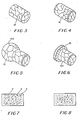
- closures 12 24 mm diameter by 1.75 inch long closures 12 of the type often utilized in standard 750 ml wine bottles, and as shown in Figures 3 and 4, were manufactured at processing temperatures in the range of 370 - 400°F and an injection pressure of 20,000 psig.
- This particular closure size and resultant density distribution showed superior mechanical performance characteristics similar to natural cork closures or to other synthetic cork closures of a different density distribution.
- Other closure styles have been manufactured using this blend of materials and have shown comparable results. These include a closure 12 having an enlarged end 12A for gripping, as shown in Figure 5, and the shank portion 12S of a 2-piece closure as shown in Figure 6, which is substantially attached or glued to a metal, plastic or wooden cap 13 with an adhesive..
- the optimum mold temperature was found to be about 70 - 90 0 F.
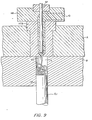
- Figure 1 One type of mold which can be utilized is depicted in Figure 1. Because the molded article's ability to seal the container is improved by its smoothness on the surface which contacts the container, it is desirable that this surface contain no parting lines or gating blemishes. Therefore, the mold should be designed so that the parting line is along the edge of the contact surface and gating is accomplished on a surface which will not contact the container, when the closure is used in sealing the container, namely, an end of the closure being formed.
- a mold having at least four plates which separate during the ejection sequence was required.
- Plate A contains the sprue bushing SBU which has a means of pulling the solidified material 10 remaining in the sprue S and runner EA away from the molded article during ejection.
- Plate X-1 is designed to strip the solidified material from the sprue bushing SBU.
- Plate X-2 forms the top surface of the cavities and contains the runner EA and the orifice gates OG required for injection of material into the ' cavities C.
- Plate B contains the cavities C, themselves.
- the three plates X-1, X-2, and B constitute a conventional type of 3-plate injection mold.
- the Plate A is bolted to the fixed platen (not shown) of the molding machine using the locating ring LR for alignment with a corresponding hole on the platen.
- the ejector housing EH is then bolted to the moving platen (not shown).
- the mold is then operated simply by travel of the moving platen which opens and closes the mold as follows: From the full shut position, which is shown, the moving platen starts pulling the mold apart, the plates sliding on four guide pins GP.
- the mold may part originally at either parting line Pl or P2.
- the ejector housing EH and Plate B which are bolted together plus the plate X-2, will travel away with the moving platen until the stripper bolts SB2 take up. This action breaks the connection between the molded part 12 and the solidified material in.the sprue S and runner 10 at the gate opening OG.
- the distance between the X-I and X-2 plates is held and, as the platen continues to travel, the mold parts at parting line P2. Plate B will continue to separate from plate X-2 until stripper bolts SB1 take up.
- the ejector plate EP makes contact with a fixed stop, forcing the ejector pin EJ to remain still while the Plate B continues to travel. This forces the molded parts I2 to be automatically ejected from their respective cavity.
- plate X-1 is pulled away from Plate A.
- the Plate X-1 was originally held in position by the solidified material in the sprue and runner channel which forms the shape of the sprue channel 5 having a bulge BU and a runner EA.
- the bulge holds the solidified material 10 in the sprue bushing SBU when the plate X-2 starts away, allowing the sprue and runner to break at the gate OG.
- the plate X-1 starts to travel it acts on the solidified material to pull it from the sprue channel.
- the plate X-1 is slotted (not shown) so that after the solidified material is pulled from the channel it drops through the slot and out of the mold. The mold is reclosed by reversing the moving platen.
- the injection nozzle valve N1 is brought into contact with the sprue bushing SBU. It is then opened by retracting pin Pl and softened resin is injected into the sprue channel defined by sprue bushing SBU where it initially starts to expand. Continued injection, however, fills and pressurizes the sprue channel, compressing the resin back towards its original state. At a certain pressure, the resin will begin to be injected through the small orifice gates OG leading to the mold cavities C where it again starts to.expand. At the appropriate time, before each cavity C becomes completely filled, the nozzle valve Nl is shut off, stopping the flow of material to the sprue channel.
- these voids would serve as spaces into which the dense outer skin of the article could deflect to avoid compression, thereby creating a longitudinal channel on the molded closure surface.
- These longitudinal channels often become leakage paths between the molded closure and the container wall allowing substances into or out of the container. To avoid these leaks, it is necessary to eliminate the presence of the void spaces by completing the injection of resin material into the mold cavity prior to its expansion to form a rigid and dense outer skin.
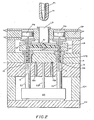
- the mold of Figure 2 works similarly to that of Figure 1, except that there are far fewer parts since no solidified material must be ejected from the sprue and runner chamber.
- a hot runner system is utilized instead.
- the hot runner manifold HR and the hot tip bushings HTB, contain heaters (not shown) which prevent the plastic resin in the runner system EA from solidifyina.
- a lone parting line P1 exists between plats A and B since the X-1 and X-2 plates no longer exist.
- mold cavity venting should be decreased to a minimum by reducing the clearances between the mold parts such as plates A and B which form the cavities C. This results in the cavities being temporarily pressurized by the entrance of the resin and -subsequent displacement of the air so that the pressure, which served to restrict the expansion of the resin, is retained longer.
- valve pins SP of Figure 2 are specially designed to fit into orifice gates OG of the mold and to perform the intended function of allowing sprueless molding..
- the pins SP slide back and forth in the runner system EA, opening and closing the orifice gates.
- the pins SP can be powered hydraulically or pneumatically, using a piston arrangement PN as shown in Figure 2. Of additional importance is the fact that the sealing is accomplished at the very tip of the orifice gate OG to prevent any premature expansion of resin.
- the remainder of the molding cycle is similar to other conventional injection molding operations, as described in the operation of the mold of Figure 1.
- the mold is opened and the solidified closure 12 is automatically ejected into water or similar refrigerated environment. Re- closing the mold initiates a repeat of the cycle. Closures molded by this method of Figure 2, as shown in Figure 8, have been found to exhibit none of the boundary layer-created voids of previous methods. Subsequent usage in liquid product containers has shown that leakage due to channels in the closure surface has ceased to be a problem. Furthermore, in the present molding method, no material is wasted by solidification in the sprue and runner chamber, thereby reducing molding costs.
- the injection pressure is a function of the injection speed and thus these parameters are dependent upon each other.
- the pressure within the mold is continually changing depending upon the injection pressure and/or injection speed, the size of the mold, the extent of the venting of the mold, and the like. Because of the many process variables which are mutually interdependent and continually changing it is difficult to generalize as to specific process parameters of the molding operation. However, knowing the desired properties of the plastic closure and a method which can be followed to achieve these results one can readily determine specific parameters for a given molding device possessing specific mold sizes and injection orifice sizes, such as mold - temperatures, injection speeds and the like.
Landscapes
- Chemical & Material Sciences (AREA)
- Medicinal Chemistry (AREA)
- Organic Chemistry (AREA)
- Polymers & Plastics (AREA)
- Health & Medical Sciences (AREA)
- Chemical Kinetics & Catalysis (AREA)
- Materials Engineering (AREA)
- Engineering & Computer Science (AREA)
- General Chemical & Material Sciences (AREA)
- Chemical And Physical Treatments For Wood And The Like (AREA)
- Manufacture Of Porous Articles, And Recovery And Treatment Of Waste Products (AREA)
- Closures For Containers (AREA)
- Moulds For Moulding Plastics Or The Like (AREA)
- Injection Moulding Of Plastics Or The Like (AREA)
- Laminated Bodies (AREA)
- Compositions Of Macromolecular Compounds (AREA)
- Plural Heterocyclic Compounds (AREA)
- Adornments (AREA)
- Sealing Material Composition (AREA)
- Steroid Compounds (AREA)
- Blow-Moulding Or Thermoforming Of Plastics Or The Like (AREA)
- Casting Or Compression Moulding Of Plastics Or The Like (AREA)
- Molding Of Porous Articles (AREA)
- Acyclic And Carbocyclic Compounds In Medicinal Compositions (AREA)
- Detergent Compositions (AREA)
Applications Claiming Priority (2)
| Application Number | Priority Date | Filing Date | Title |
|---|---|---|---|
| US06/389,509 US4507405A (en) | 1982-06-17 | 1982-06-17 | Synthetic articles having a cork-like appearance |
| US389509 | 1982-06-17 |
Publications (2)
| Publication Number | Publication Date |
|---|---|
| EP0097783A1 true EP0097783A1 (de) | 1984-01-11 |
| EP0097783B1 EP0097783B1 (de) | 1986-08-20 |
Family
ID=23538544
Family Applications (1)
| Application Number | Title | Priority Date | Filing Date |
|---|---|---|---|
| EP83103815A Expired EP0097783B1 (de) | 1982-06-17 | 1983-04-20 | Künstliche Gegenstände mit korkähnlichem Aussehen |
Country Status (23)
| Country | Link |
|---|---|
| US (2) | US4507405A (de) |
| EP (1) | EP0097783B1 (de) |
| JP (2) | JPS596228A (de) |
| KR (1) | KR860001373B1 (de) |
| AT (1) | ATE21523T1 (de) |
| AU (1) | AU568491B2 (de) |
| BG (1) | BG46749A3 (de) |
| CA (1) | CA1197045A (de) |
| CS (1) | CS258464B2 (de) |
| DE (2) | DE3365407D1 (de) |
| ES (1) | ES8404938A1 (de) |
| GR (1) | GR78819B (de) |
| HU (1) | HU200349B (de) |
| IE (1) | IE54020B1 (de) |
| IL (1) | IL68517A (de) |
| MA (1) | MA19816A1 (de) |
| MX (1) | MX162483A (de) |
| NZ (1) | NZ203931A (de) |
| PL (2) | PL242278A1 (de) |
| PT (1) | PT76666B (de) |
| RO (1) | RO88230B1 (de) |
| YU (1) | YU43310B (de) |
| ZA (1) | ZA832929B (de) |
Cited By (4)
| Publication number | Priority date | Publication date | Assignee | Title |
|---|---|---|---|---|
| EP0684148A3 (de) * | 1994-05-27 | 1997-09-03 | Cubic Co Ltd | Dekorierter Formkörper. |
| WO2000047390A1 (en) * | 1999-02-11 | 2000-08-17 | C.T.E.B. Equipment Pty. Ltd. | Improvements in moulded synthetic closure manufacture |
| EP1145815A1 (de) * | 2000-04-06 | 2001-10-17 | Eduardo Ortiz Aycart | Verfahren zum Herstellen von Flaschenstopfen und nach diesem Verfahren hergestellte Flaschenstopfen |
| WO2012159126A1 (en) * | 2011-05-13 | 2012-11-22 | Dorasamy Ramchander | Moulding method |
Families Citing this family (29)
| Publication number | Priority date | Publication date | Assignee | Title |
|---|---|---|---|---|
| US4756914A (en) * | 1986-10-20 | 1988-07-12 | Viskase Corporation | Caramel-containing cellulosic article |
| US4984703A (en) * | 1989-10-03 | 1991-01-15 | Owens-Illinois Closure Inc. | Plastic closure with compression molded sealing liner |
| US5047273A (en) * | 1989-11-20 | 1991-09-10 | Ernst Cox Julie C | Plug structure |
| AU721157B3 (en) * | 1993-05-05 | 2000-06-22 | Supreme Corq | Molded closure for a liquid container |
| US5496862A (en) * | 1993-05-05 | 1996-03-05 | Supreme Corq | Molded styrene block copolymer closure for a wine container |
| US5641573A (en) * | 1993-11-19 | 1997-06-24 | Lermer Packaging Corp. | Printed synthetic resinous corks and method of making same |
| US5366675A (en) * | 1994-03-02 | 1994-11-22 | Needham Donald G | Foamable polyethylene-based composition for rotational molding |
| US6085923A (en) * | 1996-08-13 | 2000-07-11 | Neocork Technologies, Inc. | Composite synthetic stopper |
| US6153275A (en) | 1996-08-13 | 2000-11-28 | Neocork Technologies, Llc | Multilayer synthetic stopper |
| US6613406B1 (en) | 1996-08-13 | 2003-09-02 | Neocork Technologies, Llc | Multilayer synthetic stopper |
| DE19707136C2 (de) * | 1997-02-22 | 2001-03-08 | Moeller Plast Gmbh | Verfahren und schäumbare Masse zur Ausschäumung oder Schaumbeschichtung von Bauteilen |
| US5904965A (en) * | 1997-04-24 | 1999-05-18 | Nomaco, Inc. | Synthetic closure |
| AUPP591998A0 (en) * | 1998-09-15 | 1998-10-08 | Anthony Smith Australasia Pty Ltd | Closure |
| USD435217S (en) * | 1999-04-15 | 2000-12-19 | Supreme Corq | Synthetic cork for a liquid container |
| KR100549574B1 (ko) * | 1999-12-30 | 2006-02-08 | 주식회사 하이닉스반도체 | 유기 반사 방지막용 중합체 및 그의 제조방법 |
| DE10012394A1 (de) * | 2000-03-15 | 2001-10-04 | Ulrich Stieler | Verschluss für flaschenartige Behältnisse sowie Verfahren zu dessen Herstellung |
| US20030102283A1 (en) * | 2001-12-03 | 2003-06-05 | Fox Robert W. | Composite closure for removable insertion into wine or similar style bottle |
| US20050233109A1 (en) * | 2004-04-15 | 2005-10-20 | Jeanine Hettinga | Bottle closure |
| ITMI20042454A1 (it) * | 2004-12-22 | 2005-03-22 | Guizzardi Maria Morena | Metodo per la marchiatura di tappi sintetici dispositivo per realizzare detto metodo e tappo sintetico |
| US20070202327A1 (en) * | 2005-12-19 | 2007-08-30 | Alberto Baban | Synthetic cork with a natural cork appearance and method of making it |
| PT103591B (pt) * | 2006-10-17 | 2010-03-23 | Inst Superior Tecnico | Processo de produção de corpos cilíndricos de material compósito de cortiça, destinados à produção de rolhas para vinhos de pressão, bem como as rolhas produzidas por este processo |
| US7959844B1 (en) * | 2007-08-16 | 2011-06-14 | Maxi-Life, Inc. | Plastic injection molding process |
| EP2100824B1 (de) | 2008-03-12 | 2011-05-04 | Nestec S.A. | Kapsel mit Flussregulierung und Filterelement |
| US20100117270A1 (en) * | 2008-11-10 | 2010-05-13 | Jan Alac | Extrusion molding technique and synthetic stopper produced therefrom |
| US20110274515A1 (en) * | 2009-01-16 | 2011-11-10 | R & B Marketing Corporation | Plugs With Dimensional Tolerance Absorbing Hold-In Surfaces |
| USD647401S1 (en) * | 2010-05-28 | 2011-10-25 | Black Forest Distillers GmbH | Bottle closure |
| KR101293154B1 (ko) | 2010-07-29 | 2013-08-12 | 에코메이드(주) | 에틸렌 비닐아세테이트와 유황분을 이용한 스펀지의 제조방법 |
| ITTO20120956A1 (it) * | 2012-10-30 | 2014-05-01 | Menabreaz Ivaldi S R L | Macchina per la fabbricazione di corpi di agglomerato di sughero, particolarmente tappi per l'impiego nel settore enologico. |
| JP2022141139A (ja) * | 2021-03-15 | 2022-09-29 | 康公 鈴木 | 発泡構造体 |
Citations (4)
| Publication number | Priority date | Publication date | Assignee | Title |
|---|---|---|---|---|
| GB1395105A (en) * | 1972-08-25 | 1975-05-21 | Idemitsui Kosan Co Ltd | Method of preparing wood substitute |
| US4042543A (en) * | 1976-02-13 | 1977-08-16 | Strickman Robert L | Material for stoppers |
| EP0019021A1 (de) * | 1979-05-16 | 1980-11-26 | The Dow Chemical Company | Verfahren zur kontinuierlichen Herstellung von Polyolefinharzschaum |
| EP0051277A2 (de) * | 1980-10-30 | 1982-05-12 | The Coca-Cola Company | Kunststoffverschlussglieder für Flüssigkeitsbehälter und deren Herstellung |
Family Cites Families (7)
| Publication number | Priority date | Publication date | Assignee | Title |
|---|---|---|---|---|
| GB1282563A (en) * | 1968-07-19 | 1972-07-19 | Bakelite Xylonite Ltd | A blowing agent composition |
| GB1282564A (en) * | 1968-07-19 | 1972-07-19 | Bakelite Xylonite Ltd | Cellular polyethylene |
| US4091136A (en) * | 1976-05-17 | 1978-05-23 | Shaw Plastics Corporation | Synthetic cork-like material and method of making same |
| DE2846620C2 (de) * | 1978-10-26 | 1980-09-11 | Dynamit Nobel Ag, 5210 Troisdorf | Verfahren zum Herstellen von Schaumstoffen auf Polyolefinbasis |
| DE2832287A1 (de) * | 1978-07-22 | 1980-02-07 | Bayer Ag | Geschaeumte polyaethylenfolien |
| CA1076267A (en) * | 1979-02-26 | 1980-04-22 | Keith Bell | Radon detection |
| AU7720581A (en) * | 1980-11-10 | 1982-06-07 | Pupimatic S.A. | Cellular plastic material stoppers |
-
1982
- 1982-06-17 US US06/389,509 patent/US4507405A/en not_active Expired - Lifetime
-
1983
- 1983-01-18 US US06/458,775 patent/US4522856A/en not_active Expired - Fee Related
- 1983-04-12 IE IE834/83A patent/IE54020B1/en not_active IP Right Cessation
- 1983-04-19 CA CA000426157A patent/CA1197045A/en not_active Expired
- 1983-04-19 NZ NZ203931A patent/NZ203931A/en unknown
- 1983-04-20 AU AU13697/83A patent/AU568491B2/en not_active Ceased
- 1983-04-20 AT AT83103815T patent/ATE21523T1/de not_active IP Right Cessation
- 1983-04-20 DE DE8383103815T patent/DE3365407D1/de not_active Expired
- 1983-04-20 EP EP83103815A patent/EP0097783B1/de not_active Expired
- 1983-04-20 DE DE198383103815T patent/DE97783T1/de active Pending
- 1983-04-25 ES ES521817A patent/ES8404938A1/es not_active Expired
- 1983-04-26 ZA ZA832929A patent/ZA832929B/xx unknown
- 1983-04-27 MX MX197082A patent/MX162483A/es unknown
- 1983-04-28 IL IL68517A patent/IL68517A/xx unknown
- 1983-05-10 PT PT76666A patent/PT76666B/pt not_active IP Right Cessation
- 1983-05-17 GR GR71375A patent/GR78819B/el unknown
- 1983-05-21 KR KR1019830002241A patent/KR860001373B1/ko not_active Expired
- 1983-05-23 YU YU1139/83A patent/YU43310B/xx unknown
- 1983-05-31 PL PL24227883A patent/PL242278A1/xx unknown
- 1983-05-31 PL PL1983255942A patent/PL144788B1/pl unknown
- 1983-06-02 RO RO111153A patent/RO88230B1/ro unknown
- 1983-06-14 JP JP58105086A patent/JPS596228A/ja active Granted
- 1983-06-16 HU HU832154A patent/HU200349B/hu not_active IP Right Cessation
- 1983-06-16 MA MA20038A patent/MA19816A1/fr unknown
- 1983-06-16 CS CS834368A patent/CS258464B2/cs unknown
- 1983-06-16 BG BG061361A patent/BG46749A3/xx unknown
-
1991
- 1991-10-09 JP JP3289453A patent/JPH0525307A/ja active Granted
Patent Citations (4)
| Publication number | Priority date | Publication date | Assignee | Title |
|---|---|---|---|---|
| GB1395105A (en) * | 1972-08-25 | 1975-05-21 | Idemitsui Kosan Co Ltd | Method of preparing wood substitute |
| US4042543A (en) * | 1976-02-13 | 1977-08-16 | Strickman Robert L | Material for stoppers |
| EP0019021A1 (de) * | 1979-05-16 | 1980-11-26 | The Dow Chemical Company | Verfahren zur kontinuierlichen Herstellung von Polyolefinharzschaum |
| EP0051277A2 (de) * | 1980-10-30 | 1982-05-12 | The Coca-Cola Company | Kunststoffverschlussglieder für Flüssigkeitsbehälter und deren Herstellung |
Cited By (7)
| Publication number | Priority date | Publication date | Assignee | Title |
|---|---|---|---|---|
| EP0684148A3 (de) * | 1994-05-27 | 1997-09-03 | Cubic Co Ltd | Dekorierter Formkörper. |
| US5925452A (en) * | 1994-05-27 | 1999-07-20 | Cubic Co., Ltd. | Decorated shaped product having source expression applied thereto, method for manufacturing same and shaped base material therefor |
| US6103342A (en) * | 1994-05-27 | 2000-08-15 | Cubic Co., Ltd. | Decorated shaped product having source expression applied thereto, method for manufacturing same and shaped base material therefor |
| WO2000047390A1 (en) * | 1999-02-11 | 2000-08-17 | C.T.E.B. Equipment Pty. Ltd. | Improvements in moulded synthetic closure manufacture |
| EP1145815A1 (de) * | 2000-04-06 | 2001-10-17 | Eduardo Ortiz Aycart | Verfahren zum Herstellen von Flaschenstopfen und nach diesem Verfahren hergestellte Flaschenstopfen |
| WO2012159126A1 (en) * | 2011-05-13 | 2012-11-22 | Dorasamy Ramchander | Moulding method |
| CN103501987A (zh) * | 2011-05-13 | 2014-01-08 | 罗姆禅德·德诺萨米 | 模制方法 |
Also Published As
Similar Documents
| Publication | Publication Date | Title |
|---|---|---|
| US4522856A (en) | Synthetic articles having a cork-like appearance | |
| EP0156957B1 (de) | Kunststoffverschlussglieder für Flüssigkeitsbehälter und deren Herstellung | |
| US4499141A (en) | Composition for making a plastic closure for liquid product containers | |
| US3436446A (en) | Molding of foamed thermoplastic articles | |
| US4129635A (en) | Method for producing foamed moldings from synthetic resin materials | |
| US3966372A (en) | Injection molding apparatus for forming a composite, foam-skin, article | |
| US5090886A (en) | Apparatus for the injection molding of fluid-filled plastic bodies | |
| US4806293A (en) | Method of producing a foamed, molded article | |
| HU180099B (en) | Method for penoplastic material by means of injection mo | |
| JP2001501884A (ja) | 発泡品を射出成形する方法 | |
| EP1159118B1 (de) | Vorrichtung und herstellungsverfahren von spritzgegossenen synthetischen verschlüssen, sowie hergestellter verschluss | |
| IE56508B1 (en) | Plastic closure for liquid product containers and its preparation | |
| AU769151B2 (en) | Improvements in moulded synthetic closure manufacture | |
| US3801686A (en) | Method of injection molding articles of foam material | |
| US4296055A (en) | Method of injection molding thermoplastic resinous products substantially free from sink marks, swirls and related blemishes | |
| CA1298047C (en) | Method of injection-molding foamed products |
Legal Events
| Date | Code | Title | Description |
|---|---|---|---|
| PUAI | Public reference made under article 153(3) epc to a published international application that has entered the european phase |
Free format text: ORIGINAL CODE: 0009012 |
|
| AK | Designated contracting states |
Designated state(s): AT BE CH DE FR GB IT LI LU NL SE |
|
| 17P | Request for examination filed |
Effective date: 19831208 |
|
| ITCL | It: translation for ep claims filed |
Representative=s name: ING. C. GREGORJ S.P.A. |
|
| TCAT | At: translation of patent claims filed | ||
| TCNL | Nl: translation of patent claims filed | ||
| EL | Fr: translation of claims filed | ||
| RAP1 | Party data changed (applicant data changed or rights of an application transferred) |
Owner name: THE COCA-COLA COMPANY |
|
| DET | De: translation of patent claims | ||
| GRAA | (expected) grant |
Free format text: ORIGINAL CODE: 0009210 |
|
| AK | Designated contracting states |
Kind code of ref document: B1 Designated state(s): AT BE CH DE FR GB IT LI LU NL SE |
|
| REF | Corresponds to: |
Ref document number: 21523 Country of ref document: AT Date of ref document: 19860915 Kind code of ref document: T |
|
| ITF | It: translation for a ep patent filed | ||
| REF | Corresponds to: |
Ref document number: 3365407 Country of ref document: DE Date of ref document: 19860925 |
|
| ET | Fr: translation filed | ||
| PLBE | No opposition filed within time limit |
Free format text: ORIGINAL CODE: 0009261 |
|
| STAA | Information on the status of an ep patent application or granted ep patent |
Free format text: STATUS: NO OPPOSITION FILED WITHIN TIME LIMIT |
|
| 26N | No opposition filed | ||
| ITTA | It: last paid annual fee | ||
| PGFP | Annual fee paid to national office [announced via postgrant information from national office to epo] |
Ref country code: CH Payment date: 19920227 Year of fee payment: 10 Ref country code: AT Payment date: 19920227 Year of fee payment: 10 |
|
| PGFP | Annual fee paid to national office [announced via postgrant information from national office to epo] |
Ref country code: SE Payment date: 19920306 Year of fee payment: 10 |
|
| PGFP | Annual fee paid to national office [announced via postgrant information from national office to epo] |
Ref country code: BE Payment date: 19920312 Year of fee payment: 10 |
|
| PGFP | Annual fee paid to national office [announced via postgrant information from national office to epo] |
Ref country code: LU Payment date: 19920326 Year of fee payment: 10 |
|
| PGFP | Annual fee paid to national office [announced via postgrant information from national office to epo] |
Ref country code: NL Payment date: 19920430 Year of fee payment: 10 |
|
| EPTA | Lu: last paid annual fee | ||
| PG25 | Lapsed in a contracting state [announced via postgrant information from national office to epo] |
Ref country code: LU Free format text: LAPSE BECAUSE OF NON-PAYMENT OF DUE FEES Effective date: 19930420 Ref country code: AT Effective date: 19930420 |
|
| PG25 | Lapsed in a contracting state [announced via postgrant information from national office to epo] |
Ref country code: SE Effective date: 19930421 |
|
| PG25 | Lapsed in a contracting state [announced via postgrant information from national office to epo] |
Ref country code: LI Effective date: 19930430 Ref country code: CH Effective date: 19930430 Ref country code: BE Effective date: 19930430 |
|
| BERE | Be: lapsed |
Owner name: THE COCA-COLA CY Effective date: 19930430 |
|
| PG25 | Lapsed in a contracting state [announced via postgrant information from national office to epo] |
Ref country code: NL Effective date: 19931101 |
|
| NLV4 | Nl: lapsed or anulled due to non-payment of the annual fee | ||
| REG | Reference to a national code |
Ref country code: CH Ref legal event code: PL |
|
| EUG | Se: european patent has lapsed |
Ref document number: 83103815.3 Effective date: 19931110 |
|
| PGFP | Annual fee paid to national office [announced via postgrant information from national office to epo] |
Ref country code: GB Payment date: 19950413 Year of fee payment: 13 |
|
| PGFP | Annual fee paid to national office [announced via postgrant information from national office to epo] |
Ref country code: FR Payment date: 19950424 Year of fee payment: 13 |
|
| PGFP | Annual fee paid to national office [announced via postgrant information from national office to epo] |
Ref country code: DE Payment date: 19950428 Year of fee payment: 13 |
|
| PG25 | Lapsed in a contracting state [announced via postgrant information from national office to epo] |
Ref country code: GB Effective date: 19960420 |
|
| GBPC | Gb: european patent ceased through non-payment of renewal fee |
Effective date: 19960420 |
|
| PG25 | Lapsed in a contracting state [announced via postgrant information from national office to epo] |
Ref country code: FR Effective date: 19961227 |
|
| PG25 | Lapsed in a contracting state [announced via postgrant information from national office to epo] |
Ref country code: DE Effective date: 19970101 |
|
| REG | Reference to a national code |
Ref country code: FR Ref legal event code: ST |