EP0097926B2 - Quartäre Ammoniumsalze und deren Verwendung als Strömungsbeschleuniger - Google Patents
Quartäre Ammoniumsalze und deren Verwendung als Strömungsbeschleuniger Download PDFInfo
- Publication number
- EP0097926B2 EP0097926B2 EP83106177A EP83106177A EP0097926B2 EP 0097926 B2 EP0097926 B2 EP 0097926B2 EP 83106177 A EP83106177 A EP 83106177A EP 83106177 A EP83106177 A EP 83106177A EP 0097926 B2 EP0097926 B2 EP 0097926B2
- Authority
- EP
- European Patent Office
- Prior art keywords
- alkyl
- hydroxy
- surfactant
- denotes
- quaternary ammonium
- Prior art date
- Legal status (The legal status is an assumption and is not a legal conclusion. Google has not performed a legal analysis and makes no representation as to the accuracy of the status listed.)
- Expired - Lifetime
Links
- HRVKQNOMEZHTDK-UHFFFAOYSA-N C(C1)C[N]11CCCCC1 Chemical compound C(C1)C[N]11CCCCC1 HRVKQNOMEZHTDK-UHFFFAOYSA-N 0.000 description 1
Images
Classifications
-
- C—CHEMISTRY; METALLURGY
- C07—ORGANIC CHEMISTRY
- C07D—HETEROCYCLIC COMPOUNDS
- C07D213/00—Heterocyclic compounds containing six-membered rings, not condensed with other rings, with one nitrogen atom as the only ring hetero atom and three or more double bonds between ring members or between ring members and non-ring members
- C07D213/02—Heterocyclic compounds containing six-membered rings, not condensed with other rings, with one nitrogen atom as the only ring hetero atom and three or more double bonds between ring members or between ring members and non-ring members having three double bonds between ring members or between ring members and non-ring members
- C07D213/04—Heterocyclic compounds containing six-membered rings, not condensed with other rings, with one nitrogen atom as the only ring hetero atom and three or more double bonds between ring members or between ring members and non-ring members having three double bonds between ring members or between ring members and non-ring members having no bond between the ring nitrogen atom and a non-ring member or having only hydrogen or carbon atoms directly attached to the ring nitrogen atom
- C07D213/06—Heterocyclic compounds containing six-membered rings, not condensed with other rings, with one nitrogen atom as the only ring hetero atom and three or more double bonds between ring members or between ring members and non-ring members having three double bonds between ring members or between ring members and non-ring members having no bond between the ring nitrogen atom and a non-ring member or having only hydrogen or carbon atoms directly attached to the ring nitrogen atom containing only hydrogen and carbon atoms in addition to the ring nitrogen atom
- C07D213/16—Heterocyclic compounds containing six-membered rings, not condensed with other rings, with one nitrogen atom as the only ring hetero atom and three or more double bonds between ring members or between ring members and non-ring members having three double bonds between ring members or between ring members and non-ring members having no bond between the ring nitrogen atom and a non-ring member or having only hydrogen or carbon atoms directly attached to the ring nitrogen atom containing only hydrogen and carbon atoms in addition to the ring nitrogen atom containing only one pyridine ring
- C07D213/20—Quaternary compounds thereof
-
- C—CHEMISTRY; METALLURGY
- C07—ORGANIC CHEMISTRY
- C07C—ACYCLIC OR CARBOCYCLIC COMPOUNDS
- C07C309/00—Sulfonic acids; Halides, esters, or anhydrides thereof
-
- C—CHEMISTRY; METALLURGY
- C07—ORGANIC CHEMISTRY
- C07C—ACYCLIC OR CARBOCYCLIC COMPOUNDS
- C07C63/00—Compounds having carboxyl groups bound to a carbon atoms of six-membered aromatic rings
- C07C63/04—Monocyclic monocarboxylic acids
-
- C—CHEMISTRY; METALLURGY
- C07—ORGANIC CHEMISTRY
- C07C—ACYCLIC OR CARBOCYCLIC COMPOUNDS
- C07C65/00—Compounds having carboxyl groups bound to carbon atoms of six—membered aromatic rings and containing any of the groups OH, O—metal, —CHO, keto, ether, groups, groups, or groups
- C07C65/01—Compounds having carboxyl groups bound to carbon atoms of six—membered aromatic rings and containing any of the groups OH, O—metal, —CHO, keto, ether, groups, groups, or groups containing hydroxy or O-metal groups
- C07C65/03—Compounds having carboxyl groups bound to carbon atoms of six—membered aromatic rings and containing any of the groups OH, O—metal, —CHO, keto, ether, groups, groups, or groups containing hydroxy or O-metal groups monocyclic and having all hydroxy or O-metal groups bound to the ring
- C07C65/05—Compounds having carboxyl groups bound to carbon atoms of six—membered aromatic rings and containing any of the groups OH, O—metal, —CHO, keto, ether, groups, groups, or groups containing hydroxy or O-metal groups monocyclic and having all hydroxy or O-metal groups bound to the ring o-Hydroxy carboxylic acids
- C07C65/10—Salicylic acid
-
- C—CHEMISTRY; METALLURGY
- C07—ORGANIC CHEMISTRY
- C07C—ACYCLIC OR CARBOCYCLIC COMPOUNDS
- C07C65/00—Compounds having carboxyl groups bound to carbon atoms of six—membered aromatic rings and containing any of the groups OH, O—metal, —CHO, keto, ether, groups, groups, or groups
- C07C65/01—Compounds having carboxyl groups bound to carbon atoms of six—membered aromatic rings and containing any of the groups OH, O—metal, —CHO, keto, ether, groups, groups, or groups containing hydroxy or O-metal groups
- C07C65/105—Compounds having carboxyl groups bound to carbon atoms of six—membered aromatic rings and containing any of the groups OH, O—metal, —CHO, keto, ether, groups, groups, or groups containing hydroxy or O-metal groups polycyclic
- C07C65/11—Compounds having carboxyl groups bound to carbon atoms of six—membered aromatic rings and containing any of the groups OH, O—metal, —CHO, keto, ether, groups, groups, or groups containing hydroxy or O-metal groups polycyclic with carboxyl groups on a condensed ring system containing two rings
-
- C—CHEMISTRY; METALLURGY
- C07—ORGANIC CHEMISTRY
- C07C—ACYCLIC OR CARBOCYCLIC COMPOUNDS
- C07C65/00—Compounds having carboxyl groups bound to carbon atoms of six—membered aromatic rings and containing any of the groups OH, O—metal, —CHO, keto, ether, groups, groups, or groups
- C07C65/21—Compounds having carboxyl groups bound to carbon atoms of six—membered aromatic rings and containing any of the groups OH, O—metal, —CHO, keto, ether, groups, groups, or groups containing ether groups, groups, groups, or groups
-
- C—CHEMISTRY; METALLURGY
- C09—DYES; PAINTS; POLISHES; NATURAL RESINS; ADHESIVES; COMPOSITIONS NOT OTHERWISE PROVIDED FOR; APPLICATIONS OF MATERIALS NOT OTHERWISE PROVIDED FOR
- C09K—MATERIALS FOR MISCELLANEOUS APPLICATIONS, NOT PROVIDED FOR ELSEWHERE
- C09K3/00—Materials not provided for elsewhere
-
- F—MECHANICAL ENGINEERING; LIGHTING; HEATING; WEAPONS; BLASTING
- F17—STORING OR DISTRIBUTING GASES OR LIQUIDS
- F17D—PIPE-LINE SYSTEMS; PIPE-LINES
- F17D1/00—Pipe-line systems
- F17D1/08—Pipe-line systems for liquids or viscous products
- F17D1/16—Facilitating the conveyance of liquids or effecting the conveyance of viscous products by modification of their viscosity
-
- Y—GENERAL TAGGING OF NEW TECHNOLOGICAL DEVELOPMENTS; GENERAL TAGGING OF CROSS-SECTIONAL TECHNOLOGIES SPANNING OVER SEVERAL SECTIONS OF THE IPC; TECHNICAL SUBJECTS COVERED BY FORMER USPC CROSS-REFERENCE ART COLLECTIONS [XRACs] AND DIGESTS
- Y02—TECHNOLOGIES OR APPLICATIONS FOR MITIGATION OR ADAPTATION AGAINST CLIMATE CHANGE
- Y02E—REDUCTION OF GREENHOUSE GAS [GHG] EMISSIONS, RELATED TO ENERGY GENERATION, TRANSMISSION OR DISTRIBUTION
- Y02E60/00—Enabling technologies; Technologies with a potential or indirect contribution to GHG emissions mitigation
- Y02E60/30—Hydrogen technology
- Y02E60/34—Hydrogen distribution
Definitions
- a flow accelerator is then understood to mean a substance that is added to a turbulent or pulsating flowing liquid in a small amount and allows this liquid to flow faster - under otherwise identical conditions. Flow accelerators make it possible to pump more liquid through a given pipeline with a given pump.
- Chang et al. (US Pat. No. 3,961,639) described the flow-accelerating effect of aqueous solutions of some nonionic surfactants with the addition of foreign electrolytes at temperatures in the region of the cloud point.
- N-dodecylpyridinium, ethyltrimethylammonium and N-octadecylpyridinium are already known from Chemical Abstracts 56.11109 i; 95.175 879 g and 58.11376 e. They are used as emulsifiers in photographic emulsions. Also known are the salicylates, halobenzoates and alkyl carboxylates of C 16 alkyl and C 16 alkenyl trialkylammonium or pyridinium salts and their use as flow accelerators (EP-A-91 086; prior art according to Art. 54 (3 ) EPC).
- Inventions are new quaternary ammonium salts of the formula where R 1 is C 12 -C 28 alkyl or C 12 -C 26 alkenyl, K ⁇ is a group of the formula
- the alkyl trimethylammonium halides or pyridinium chlorides, bromides or iodides are first dissolved in anhydrous solvents such as, for. B. methanol and add freshly precipitated, last washed with methanol in a slight excess. In this way, water should not be introduced into the system if possible, since this would lead to difficulties with crystallization.
- anhydrous solvents such as, for. B. methanol and add freshly precipitated, last washed with methanol in a slight excess.
- water should not be introduced into the system if possible, since this would lead to difficulties with crystallization.
- the alkyltrimethyl-ammonium or pyridinium hydroxide is formed, which remains dissolved in the methanol.
- the silver halide precipitate is then suctioned off at about 15 °.
- the alkyltrimethylammonium or pyridinium hydroxide present in the methanolic filtrate can be neutralized by adding the stoichiometric amount of a carboxylic acid or sulfonic acid.
- the desired alkyltrimethylammonium salt or pyridinium salt is obtained by evaporating the methanol.
- the alkali metal carboxylates can also be dissolved in water and silver nitrate solution added if the silver carboxylate fails. It is suctioned off, washed and dried the silver carboxylate. This can then be added in the stoichiometrically required amount to a solution of the alkyl trimethylammonium or pyridinium halide in an anhydrous solvent such as methanol and heated briefly to 50 to 60 ° C.
- the silver halide is filtered off at 15 ° C. and the mixed alkyl-trimethylammonium or pyridinium carboxylate is obtained by evaporating the filtrate.
- a further pure presentation can be carried out by recrystallization from practically anhydrous solvents (ethyl acetate, acetone, acetonitrile, dichloroethane).
- alkyltrimethylammonium or pyridinium hydroxide solution by treating the alkyltrimethylammonium or pyridinium halides (or other salts) with a strongly basic anion exchanger, which is also in an anhydrous solvent such as. B. methanol must happen. This is followed by the neutralization with the desired carboxylic acid.
- the salts mentioned are suitable for reducing the frictional resistance of aqueous media. They are added in concentrations of 0.006 to 2% by weight, preferably 0.04 to 0.4% by weight, but there is a different lower critical concentration limit for each salt for sufficient effectiveness than SB.
- the effect as SB is also dependent on the temperature. Depending on the salt used, there is a sufficient effect as SB in the temperature range from 0 ° C to 90 ° C and for some of the surfactants listed below, for the first time a reduction in friction was also found above 90 ° C.
- the lower temperature limit for use as SB for all surfactants is the solubility temperature. However, if the surfactant is in solution, the solubility temperature can fall below 5 - 20 ° C for a few hours to weeks.
- n-dodecyltrimethylammonium salicylate in which the optimum activity as SB occurs: 0.14 to 1% by weight from 0 to 30 ° C.
- the temperature range in which there is a sufficient effect as SB is shifted by approximately 15 ° C. to higher temperatures with each additional C 2 H 4 group.
- the preferred temperature range is about 8-12 ° C lower than the trimethylammonium salts of the same chain length.
- the preferred temperature and concentration range is determined not only by the chain length of the n-alkyltrimethylammonium or n-alkylpyridinium compound, but also by the type of counterion.
- a further increase in the temperature range in which there is an effect as SB is by using the surfactants with the anions reached.
- the compounds hexadecyltrimethyl-ammonium-3 (or 4) hydroxy-2-naphthoate show activity as SB at 50 ° C. in the concentration range from 0.005% by weight to 1% by weight and above 80 ° C. in the concentration range from 0.025%. -% to 1% by weight.
- the same applies to the corresponding pyridinium compounds only that the temperature ranges are shifted downwards by approx. 5 - 15 ° C for the salicylate compounds, the change in the chain length of the n-alkyltrimethylammonium and n-alkylpyridinium cations also causes a shift in the temperature range for the SB effect in the case of the hydroxynaphthoates.
- the effective temperature range is extended by 30 to 40 ° C. to higher temperatures compared to the respective n-alkyltrimethylammonium or n Alkyl pyridinium salicylates.
- the temperature range and concentration range in which the activity is available as SB is likewise due to the chain lengths of the alkyl groups both for the anion and for the cation certainly.
- the compound shows tetradecyltrimethyl-ammonium-heptane-1-suffonate in the concentration range from 0.02 to 2% by weight, preferably 0.07 to 0.5% by weight, in the temperature range from 0 ° C. to 38 ° C. as SB.
- the compound hexadecyltrimethylammonium heptane-1-sulfonate is effective as SB in the concentration range from 0.02 to 2% by weight, preferably 0.07 to 0.5% by weight in the temperature range from 10 ° C. to 50 ° C.
- a further increase in the chain length of the n-alkyltrimethylammonium or n-alkylpyridinium cation causes a further shift in the effective temperature range to higher temperatures.
- the compound n-docosyltrimethylammonium-n-heptane-1-sulfonate in the concentration range 0.1 to 1% by weight also has a SB effect even at temperatures above 75 ° C.
- the corresponding n-octane-1-sulfonates are effective as SB in a temperature range that is 10 to 30 ° C higher.
- the compound n-tetradecyltrimethylammonium-n-octane-1-sulfonate in the concentration range 0.2 to 1% by weight also shows activity above 45 ° C. as SB and the compound n-octadecyltrimethylammonium-n-octane-1-sulfonate in the concentration range from 0.2 to 1% by weight, even above 85 ° C., still effective as SB.
- the lengthening of the n-alkyl chain in both the anions and the cations causes a shift in the effective temperature range towards higher temperatures.
- Such foreign electrolytes are, for example, weak acids such as acetic acid or formic acid and salts which are formed from the following ions: alkali metal, alkaline earth metal, transition metal, ammonium or aluminum cations; Halides,
- the effect of the foreign electrolytes also depends on the valency of the ions and the effect shifts to lower concentrations according to the following scheme: 1 -1 -valent electrolyte ⁇ 2-1-valued electrolyte ⁇ 1-2-valued electrolyte ⁇ 2-2-valued Electrolyte ⁇ 3-2-valent electrolyte ⁇ 2-3-valent electrolyte.
- the improvement in the effectiveness as a flow accelerator in the hydroxybenzoates and the compounds derived therefrom is particularly effective when a salt is added which at the same time raises the pH to pH. 9.9. So z. B. the addition of Na 2 CO 3 in the concentration range 0.1.C to 10 ° C is particularly positive if C is the molar concentration of the surfactant used.
- Hal with Hal CI, Br, J in a molar ratio of 1: 1 with an alkali salt of the anion NaA, such as. Na-n-alkyl-1-sulfonate, Na-hydroxy-benzoate and the acid anion derived therefrom or such as e.g. B. Na-hydroxy-naphthoate is used as a flow accelerator.
- the effect is then equal to the effect that can be achieved with the pure surfactant salts with the addition of alkali halides.
- Mixtures that differ from the molar ratio 1: 1, such as. B. 1: 2 still show effect as SB.
- the maximum effectiveness as a flow accelerator also depends on the time that has elapsed since the aqueous surfactant solutions were prepared.
- the surfactant solutions show an effect as a flow accelerator immediately after the solutions have been prepared, but this effect can still change significantly during a week.
- the time required to achieve an optimal effect can easily be determined in individual cases by simple experiments. In most cases, the optimal effect is achieved after a week. A change or improvement in the effect then no longer occurs.
- Some surfactants such as. B. the Hexadecylpyridiniumsalicylat is known (H. Hoffmann et al., Ber. Bunsenges. Phys. Chem. 85 (1981) 255) that they, large, non-spherical, from a very specific, characteristic for each surfactant, the CMC 11 , usually build rod-shaped micelles from the individual surfactant ions and counterions.
- Non-spherical, preferably rod-shaped micelles are present when the surfactant solution is examined using the electrical birefringence method with a pulsed, rectangular electrical field (E. Fredericq and C. Houssier, Eletric Dichroism and Eletric Birefringence, Claredon Press, Oxford 1973 and H. Hofmann et al., Bar. Bunsenges. Phys. Chem.
- the lower concentration limit above which a surfactant in aqueous solution acts as a flow accelerator is therefore always determined by the CMC 11 , preferably by 1.5 times the concentration value of the CMC II .
- the determination of the CMC 11 is e.g. B. by measuring the electrical conductivity of the surfactant solution depending on the surfactant concentration, as described by H. Hoffmann et al. (Ber. Bunsenges. Phys. Chem. 85 (1981) 255). It was shown that the value of the CMC 11 is temperature-dependent and shifts with increasing temperature to higher surfactant concentrations.
- Determining the CMC 11 at the application temperature with the help of electrical conductivity is a suitable preliminary test to determine the surfactant concentration that is minimally necessary to achieve a sufficient SB effect in a certain temperature range.
- the surfactant solutions mentioned act as SB in such a way that the percentage reduction in friction increases with an increasing Reynolds number, but then decreases again very quickly after a certain Reynolds number, Re max , is exceeded with a maximum percentage reduction in friction.
- the investigations of the surfactant solutions mostly only gave reproductive results if the aqueous solutions of the surfactant salts were kept at the measuring temperatures for about 1 week before the measurements. The solutions show an effect as a flow accelerator immediately after preparation, which can, however, change significantly over the course of a week.
- the surfactant salts mentioned are suitable as flow accelerators wherever water is pumped through pipelines, but especially where water is continuously circulated in a pipeline system, such as, for. B. in cooling circuits, since here a high long-term stability of the SB, as they have the surfactant salts mentioned, is absolutely necessary.
- some of the surfactants mentioned are particularly suitable for district heating networks, since these surfactants retain their action as flow accelerators even above 90 ° C when used for weeks (see Example 22).
- the surfactant salts can be metered into the water flowing through the pipelines either in the form of a concentrated surfactant solution (1-10% by weight) or by adding the pure critical surfactant salts. Because of the good mixing effect, metering into the piping system just before a pump is the cheapest place.
- the filtrate is a water-clear, clear solution of cetyl-trimethylammonium hydroxide in methanol. It is divided into three equal parts and the first third is neutralized by adding 10.29 g of m-cresotinic acid [4-methyl-2-oxy-benzoic acid]. After evaporating the methanol solution on a rotary evaporator, 29.0 g of colorless powder are obtained, which can be purified by repeated recrystallization from (400 ml) ethyl acetate: colorless leaves.
- This compound can be titrated with perchloric acid in glacial acetic acid.
- cetyltrimethylammonium hydroxide can also be neutralized with 3-methyl- (1 a) and with 5-methyl-2-oxy-benzoic acid (1b). These substances are also obtained by recrystallization from ethyl acetate in the form of colorless leaflets.
- a second third of the cetyl-trimethylammonium-hydroxy solution can be neutralized by adding 12.71 g of 3-oxy-2-naphthoic acid (titr. ⁇ G 190.6). After concentration of this solution in a rotary evaporator to dryness, 30.5 g of a slightly brownish powder are obtained.
- the 3-oxy-2-naphthoate is obtained as light yellow crystals (tritation with perchloric acid in glacial acetic acid).
- the last third of the cetyl-trimethylammonium hydroxide solution is neutralized with 12.39 g of 4-ethoxy-2-oxy-benzoic acid (the equivalent weight of which had been determined to be 185.8 by titration with 0.1N sodium hydroxide solution) by being sprinkled in as a powder.
- the yellow solution obtained in methanol was evaporated to dryness. This gave 31.1 g of a slightly brownish residue which could be purified by repeated recrystallization from 300 ml of ethyl acetate.
- the cetyltrimethylammonium-4-ethoxy-salicylate is obtained in (slightly reddish) crystals (titration with perchloric acid in solution gives the expected equivalent weight).
- C 14 TA-heptane-1-sulfonate tetradecyltrimethylammonium heptane-1-suifonate
- Tables 1 and 2 summarize the results of all measurements for 23 ° C and 35 ° C by reproducing Re max and ⁇ max .
- Aqueous solutions of different concentrations of C 14 TA-heptane-1-sulfonate were prepared by weighing in the salts C 14 TA-Cl and Na-heptane-1-sulfonate in a molar mixing ratio of 1: 1 with the total concentrations 500, 1000, 1500 and 2000 ppm, prepared as described in Example 5.
- the results of the investigation for friction reduction in turbulence rheometers are summarized in Table 4. As can be seen from Table 4, the additional equimolar amount of NaC1 does not influence the reduction in friction of C 14 thethane-1-sulfonate.
- aqueous solutions of n-alkyltrimethylammonium -n-alkyl-1-sulfonate with different alkyl radicals were prepared by weighing in the salts n-alkyltrimethylammonium chloride and Na-alkyl-1-sulfonate in a molar mixing ratio of 1: 1.
- Table 5 summarizes the results of the investigation for friction reduction with the turbulence rheometer for the various surfactants. The equimolar amounts of NaCl which the solutions additionally contain were not listed
- n-hexadecyltrimethylammonium-3-methyl-salicylate (abbreviated to C 16 TA-3-methyl-Sal), as described in Example 5, were prepared and pretreated and tested for friction reduction in a turbulence rheometer at various temperatures.
- Table 6 summarizes the results.
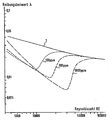
- Fig. 1 shows the flow curves at 50 ° C for 150, 300 and 1000 ppm solutions of C 16 TA-3-methyl-Sal.
- (1) shows the measurement curve for pure water.
- Aqueous solutions of n-hexadecyltrimethylammonium-3-hydroxy-2-naphthoate (C 16 TA-3-hydroxy-2-naphthoate), as described in Example 5, were prepared and pretreated and in a turbulence rheometer at 68, 80 and 93 ° C. Examined for friction reduction as can be seen in Table 11, which summarizes the measurement results, this surfactant shows good activity as SB even above 90 ° C.
- aqueous solutions of n-alkyltrimethylammonium-3-hydroxy-2-naphthoate (C n TA-3-hydroxy-2-naphthoate) with different alkyl radicals were obtained by weighing the salts n-alkyltrimethylammonium chloride, 3 -Hydroxy-2-naphthoic acid and NaOH in a molar ratio of 1: 1: 1 produced and examined in the turbulence rheometer for friction reduction.
- Table 13 summarizes the results. The equimolar amounts of NaCl, which additionally contain the solutions, were not listed separately.
- aqueous solutions of various surfactants such as C, 4 TA-naphthalene-1-hydroxy-2-sulfonate, C 14 Ta-3-chloro-benzoate, C 16 TA-4-methyl-benzoate, C 16 TA-3-nitro-benzoate and C 16 TA-naphthalene-1-hydroxy-2-sulfonate, by weighing the respective salts n-alkyltrimethylammonium chloride, the aromatic acids and NaOH in a molar ratio of 1: 1: 1 and in a turbulence rheometer examined for friction reduction.
- Table 14 summarizes the results. The equimolar amounts of NaCl which the solutions contain were not listed.
- a flow apparatus consisting of a 400 I storage vessel, a centrifugal pump (type: CPK 50 - 250 from KSB, speed of rotation of the rotor 1450 rpm), an inductive flow meter and a pipeline 20 m long with an inner diameter of 29.75 mm.
- the pressure drop AP is determined over a measuring distance of 1 m.
- a immersion heater is used for thermostatting, which electrically heats the liquid in the storage container.
- the liquid is continuously pumped out at the bottom of the storage vessel and fed back to the storage container via the pipeline.
- The% friction reduction a was calculated according to the equations already listed (page 14), although the coefficient of friction for pure electric water, ⁇ H 2 0, was theoretically calculated for the Re number resulting from the increased delivery capacity of the pump after the addition of the SB revealed.
- Table 15 summarizes the results of the endurance test, the time in days, the temperature T, the Reynolds number Re and the% friction reduction a.
- n-alkyltrimethylammonium-3-hydroxy-2-naphthoate C n TA-3-hydroxy-2-naphthoate
- NaOH NaOH
Landscapes
- Chemical & Material Sciences (AREA)
- Organic Chemistry (AREA)
- Engineering & Computer Science (AREA)
- Water Supply & Treatment (AREA)
- Health & Medical Sciences (AREA)
- Public Health (AREA)
- Materials Engineering (AREA)
- Mechanical Engineering (AREA)
- General Engineering & Computer Science (AREA)
- Organic Low-Molecular-Weight Compounds And Preparation Thereof (AREA)
- Lubricants (AREA)
- Pyridine Compounds (AREA)
- Pharmaceuticals Containing Other Organic And Inorganic Compounds (AREA)
Applications Claiming Priority (2)
| Application Number | Priority Date | Filing Date | Title |
|---|---|---|---|
| DE3224148 | 1982-06-29 | ||
| DE19823224148 DE3224148A1 (de) | 1982-06-29 | 1982-06-29 | Quartaere ammoniumsalze und deren verwendung als stroemungsbeschleuniger |
Publications (3)
| Publication Number | Publication Date |
|---|---|
| EP0097926A1 EP0097926A1 (de) | 1984-01-11 |
| EP0097926B1 EP0097926B1 (de) | 1987-04-29 |
| EP0097926B2 true EP0097926B2 (de) | 1991-08-21 |
Family
ID=6167078
Family Applications (1)
| Application Number | Title | Priority Date | Filing Date |
|---|---|---|---|
| EP83106177A Expired - Lifetime EP0097926B2 (de) | 1982-06-29 | 1983-06-24 | Quartäre Ammoniumsalze und deren Verwendung als Strömungsbeschleuniger |
Country Status (7)
| Country | Link |
|---|---|
| US (1) | US4705860A (da) |
| EP (1) | EP0097926B2 (da) |
| JP (1) | JPS5946246A (da) |
| CA (1) | CA1231099A (da) |
| DE (2) | DE3224148A1 (da) |
| DK (1) | DK166539C (da) |
| FI (1) | FI82685C (da) |
Families Citing this family (12)
| Publication number | Priority date | Publication date | Assignee | Title |
|---|---|---|---|---|
| DE3307252A1 (de) * | 1983-03-02 | 1984-09-06 | Hoechst Ag, 6230 Frankfurt | Verfahren zur mobilitaetskontrolle von spalt-, schlitz oder porestroemungen |
| DE3307637A1 (de) * | 1983-03-04 | 1984-09-06 | Hoechst Ag, 6230 Frankfurt | Verfahren zur herstellung von reinen 1-hydroxy-2-naphtoesaeurealkylestern |
| DE3347378A1 (de) * | 1983-12-29 | 1985-07-11 | Hoechst Ag, 6230 Frankfurt | Fluorierte quaternaere ammonium-verbindungen, verfahren zu deren herstellung und deren verwendung als stroemungsbeschleuniger |
| US4806256A (en) * | 1984-06-18 | 1989-02-21 | The Dow Chemical Company | Water-based hydraulic fluids |
| DE3431414A1 (de) * | 1984-08-27 | 1986-02-27 | Hoechst Ag, 6230 Frankfurt | Mobilitaetskontrolle von spalt-, schlitz- oder porenstroemungen |
| DE3523088A1 (de) * | 1985-06-28 | 1987-01-08 | Hoechst Ag | Verfahren zur vermeidung der korrosion metallischer werkstoffe |
| DE3827183A1 (de) * | 1988-08-11 | 1990-02-15 | Hoechst Ag | Mischungen von organischen ammonium-salzen und deren verwendung als stroemungsbeschleuniger |
| US20020063241A1 (en) * | 2000-10-16 | 2002-05-30 | Alink Bernardus Antonius Maria Oude | Corrosion inhibitor-drag reducer combinations |
| JP4719873B2 (ja) * | 2004-09-15 | 2011-07-06 | 国立大学法人山口大学 | 冷温水用腐食抑制性流れ促進剤および冷温水熱媒における腐食抑制流れ促進方法 |
| DE102005032836A1 (de) * | 2005-07-14 | 2007-01-18 | Merck Patent Gmbh | Verfahren zur Herstellung von Onium-Alkylsulfonaten |
| DE102005032837A1 (de) * | 2005-07-14 | 2007-02-08 | Merck Patent Gmbh | Verfahren zur Herstellung von Onium-Alkylsulfiten |
| JP5660037B2 (ja) * | 2009-05-18 | 2015-01-28 | Jsr株式会社 | 感放射線性樹脂組成物 |
Family Cites Families (7)
| Publication number | Priority date | Publication date | Assignee | Title |
|---|---|---|---|---|
| US2605281A (en) * | 1948-04-07 | 1952-07-29 | Innovations Chimiques Sa D | Cation-active compounds derived from alkaryl sulfonyl chlorides or alkaryl sulfonates |
| DE1122064B (de) * | 1960-01-09 | 1962-01-18 | Basf Ag | Verfahren zur Einfuehrung von alyphatischen Kohlenwasserstoffresten in organische Verbindungen, die Hydroxylgruppen, tertiaere Aminogruppen, aromatische gebundene Sulfhydrylgruppen und bzw. oder aromatisch gebundene primaere oder sekundaere Aminogruppen enthalten |
| FR1518427A (fr) * | 1966-04-11 | 1968-03-22 | Nuclear Chicago Corp | Nouveaux composés d'ammonium quaternaire et leur utilisation dans des solvants pourscintillomètres à milieu liquide |
| JPS5735161B2 (da) * | 1972-07-05 | 1982-07-27 | ||
| US4182765A (en) * | 1973-06-29 | 1980-01-08 | Nippon Oil Company Limited | Oil soluble fungicide obtained from the reaction of a quaternary ammonium salt and an alkyl benzene sulfonic acid |
| US4016894A (en) * | 1975-08-28 | 1977-04-12 | Belknap Corporation | Drag reducing composition and method |
| US4016984A (en) * | 1975-08-28 | 1977-04-12 | Eaton Corporation | Shuttle assembly for a load handling apparatus |
-
1982
- 1982-06-29 DE DE19823224148 patent/DE3224148A1/de not_active Withdrawn
-
1983
- 1983-06-24 EP EP83106177A patent/EP0097926B2/de not_active Expired - Lifetime
- 1983-06-24 DE DE8383106177T patent/DE3371198D1/de not_active Expired
- 1983-06-27 FI FI832330A patent/FI82685C/fi not_active IP Right Cessation
- 1983-06-28 DK DK298583A patent/DK166539C/da not_active IP Right Cessation
- 1983-06-28 CA CA000431354A patent/CA1231099A/en not_active Expired
- 1983-06-28 JP JP58115285A patent/JPS5946246A/ja active Granted
-
1986
- 1986-03-11 US US06/838,893 patent/US4705860A/en not_active Expired - Fee Related
Also Published As
| Publication number | Publication date |
|---|---|
| CA1231099A (en) | 1988-01-05 |
| FI832330L (fi) | 1983-12-30 |
| FI82685C (fi) | 1991-04-10 |
| JPS5946246A (ja) | 1984-03-15 |
| FI832330A0 (fi) | 1983-06-27 |
| DE3371198D1 (en) | 1987-06-04 |
| JPH0547534B2 (da) | 1993-07-19 |
| DK166539B (da) | 1993-06-07 |
| DK166539C (da) | 1993-10-25 |
| EP0097926B1 (de) | 1987-04-29 |
| EP0097926A1 (de) | 1984-01-11 |
| DE3224148A1 (de) | 1983-12-29 |
| DK298583A (da) | 1983-12-30 |
| FI82685B (fi) | 1990-12-31 |
| DK298583D0 (da) | 1983-06-28 |
| US4705860A (en) | 1987-11-10 |
Similar Documents
| Publication | Publication Date | Title |
|---|---|---|
| EP0097926B1 (de) | Quartäre Ammoniumsalze und deren Verwendung als Strömungsbeschleuniger | |
| DE2338281C2 (de) | Verfahren zur gesteuerten Veränderung der elektrischen Eigenschaften von nematischen Flüssigkeiten und Dotierungsmittel hierfür | |
| EP0146097B1 (de) | Oxalkylierte quaternäre Ammonium-Verbindungen, Verfahren zu deren Herstellung und deren Verwendung als Strömungsbeschleuniger | |
| DE69300541T3 (de) | Wasserhaltige Lauge. | |
| DE2718697B2 (de) | Komposition mit geregelter Änderung von Farbe und pH-Wert beim Gefrieren sowie Verfahren zu ihrer Herstellung | |
| DE3435516A1 (de) | Massen zur ausbildung von vesikeln | |
| DE2815335C2 (da) | ||
| DE2518725A1 (de) | Fluessigkeitskristalle mit positiver dielektrischer anisotropie | |
| EP0091086B1 (de) | Verfahren zur Verminderung des Reibungswiderstandes in strömenden wässrigen Medien | |
| EP0149172B1 (de) | Fluorierte quaternäre Ammonium-Verbindungen, Verfahren zu deren Herstellung und deren Verwendung als Strömungsbeschleuniger | |
| EP0118089B1 (de) | Verfahren zur Mobilitätskontrolle von Spalt-, Schlitz- oder Porenströmungen | |
| DE19732139C2 (de) | Mesomorphe Komplexe aus Vitamin A-Säure und kationischen Polyelektrolyten, Verfahren zu ihrer Herstellung und diese enthaltende pharmazeutische Zusammensetzungen | |
| DE1618827B1 (de) | Nematische flüssigkristall-zusammensetzung | |
| EP0013257B1 (de) | Verfahren zur Erhöhung der Lichtechtheit, Fluoreszenzpolarisation und Fluoreszenzquantenausbeute von Cyaninfarbstoffen, stabilisierte Cyaninfarbstoffzubereitung, Verfahren zu ihrer Herstellung und ihre Verwendung | |
| EP0357953B1 (de) | Mischungen von organischen Ammonium-Salzen und deren Verwendung als Strömungsbeschleuniger | |
| EP0173176A2 (de) | Mobilitätskontrolle von Spalt-, Schlitz- oder Porenströmungen | |
| DE3336198A1 (de) | Verfahren zur verminderung des reibungswiderstandes in stroemenden waessrigen medien | |
| DE1767991A1 (de) | Herbizidverfahren und Massen dafuer | |
| EP1517731A1 (de) | Verfahren zur herstellung spezifischer kristallmodifikationen polymorpher substanzen | |
| DE1492238A1 (de) | Verfahren zur Herstellung von stabilisierte Stannoverbindungen enthaltenden Praeparaten | |
| Danielli | The constitution of oestrin | |
| AT275965B (de) | Schädlingsbekämpfungsmittel zur Bekämpfung von Pilzen | |
| DE2832814C2 (de) | Wässriges, oberflächenaktives Mittel | |
| DE2723525C2 (de) | Avivagemittel | |
| DE919602C (de) | Lichtschutzmittel |
Legal Events
| Date | Code | Title | Description |
|---|---|---|---|
| PUAI | Public reference made under article 153(3) epc to a published international application that has entered the european phase |
Free format text: ORIGINAL CODE: 0009012 |
|
| AK | Designated contracting states |
Designated state(s): BE CH DE FR GB LI NL SE |
|
| 17P | Request for examination filed |
Effective date: 19840525 |
|
| GRAA | (expected) grant |
Free format text: ORIGINAL CODE: 0009210 |
|
| AK | Designated contracting states |
Kind code of ref document: B1 Designated state(s): BE CH DE FR GB LI NL SE |
|
| REF | Corresponds to: |
Ref document number: 3371198 Country of ref document: DE Date of ref document: 19870604 |
|
| ET | Fr: translation filed | ||
| PLBI | Opposition filed |
Free format text: ORIGINAL CODE: 0009260 |
|
| 26 | Opposition filed |
Opponent name: HENKEL KOMMANDITGESELLSCHAFT AUF AKTIEN Effective date: 19880121 |
|
| NLR1 | Nl: opposition has been filed with the epo |
Opponent name: HENKEL KOMMANDITGESELLSCHAFT AUF AKTIEN |
|
| PUAH | Patent maintained in amended form |
Free format text: ORIGINAL CODE: 0009272 |
|
| STAA | Information on the status of an ep patent application or granted ep patent |
Free format text: STATUS: PATENT MAINTAINED AS AMENDED |
|
| 27A | Patent maintained in amended form |
Effective date: 19910821 |
|
| AK | Designated contracting states |
Kind code of ref document: B2 Designated state(s): BE CH DE FR GB LI NL SE |
|
| REG | Reference to a national code |
Ref country code: CH Ref legal event code: AUV Free format text: AUFRECHTERHALTUNG DES PATENTES IN GE?NDERTEM UMFANG. |
|
| NLR2 | Nl: decision of opposition | ||
| ET3 | Fr: translation filed ** decision concerning opposition | ||
| NLR3 | Nl: receipt of modified translations in the netherlands language after an opposition procedure | ||
| EAL | Se: european patent in force in sweden |
Ref document number: 83106177.5 |
|
| PGFP | Annual fee paid to national office [announced via postgrant information from national office to epo] |
Ref country code: DE Payment date: 19950811 Year of fee payment: 13 |
|
| PGFP | Annual fee paid to national office [announced via postgrant information from national office to epo] |
Ref country code: FR Payment date: 19960514 Year of fee payment: 14 |
|
| PGFP | Annual fee paid to national office [announced via postgrant information from national office to epo] |
Ref country code: CH Payment date: 19960520 Year of fee payment: 14 |
|
| PGFP | Annual fee paid to national office [announced via postgrant information from national office to epo] |
Ref country code: NL Payment date: 19960521 Year of fee payment: 14 |
|
| PGFP | Annual fee paid to national office [announced via postgrant information from national office to epo] |
Ref country code: SE Payment date: 19960528 Year of fee payment: 14 |
|
| PGFP | Annual fee paid to national office [announced via postgrant information from national office to epo] |
Ref country code: GB Payment date: 19960529 Year of fee payment: 14 |
|
| PGFP | Annual fee paid to national office [announced via postgrant information from national office to epo] |
Ref country code: BE Payment date: 19960613 Year of fee payment: 14 |
|
| PG25 | Lapsed in a contracting state [announced via postgrant information from national office to epo] |
Ref country code: DE Effective date: 19970301 |
|
| PG25 | Lapsed in a contracting state [announced via postgrant information from national office to epo] |
Ref country code: GB Free format text: LAPSE BECAUSE OF NON-PAYMENT OF DUE FEES Effective date: 19970624 |
|
| PG25 | Lapsed in a contracting state [announced via postgrant information from national office to epo] |
Ref country code: SE Effective date: 19970625 |
|
| PG25 | Lapsed in a contracting state [announced via postgrant information from national office to epo] |
Ref country code: LI Free format text: LAPSE BECAUSE OF NON-PAYMENT OF DUE FEES Effective date: 19970630 Ref country code: CH Free format text: LAPSE BECAUSE OF NON-PAYMENT OF DUE FEES Effective date: 19970630 Ref country code: BE Effective date: 19970630 |
|
| BERE | Be: lapsed |
Owner name: HOECHST A.G. Effective date: 19970630 |
|
| PG25 | Lapsed in a contracting state [announced via postgrant information from national office to epo] |
Ref country code: NL Effective date: 19980101 |
|
| GBPC | Gb: european patent ceased through non-payment of renewal fee |
Effective date: 19970624 |
|
| REG | Reference to a national code |
Ref country code: CH Ref legal event code: PL |
|
| PG25 | Lapsed in a contracting state [announced via postgrant information from national office to epo] |
Ref country code: FR Free format text: LAPSE BECAUSE OF NON-PAYMENT OF DUE FEES Effective date: 19980227 |
|
| EUG | Se: european patent has lapsed |
Ref document number: 83106177.5 |
|
| NLV4 | Nl: lapsed or anulled due to non-payment of the annual fee |
Effective date: 19980101 |
|
| REG | Reference to a national code |
Ref country code: FR Ref legal event code: ST |
|
| REG | Reference to a national code |
Ref country code: FR Ref legal event code: ST |