EP0099105B1 - Procédé pour le lissage des surfaces des feuilles ou profilés calandrés ou extrudés en matière thermoplastique - Google Patents
Procédé pour le lissage des surfaces des feuilles ou profilés calandrés ou extrudés en matière thermoplastique Download PDFInfo
- Publication number
- EP0099105B1 EP0099105B1 EP83106820A EP83106820A EP0099105B1 EP 0099105 B1 EP0099105 B1 EP 0099105B1 EP 83106820 A EP83106820 A EP 83106820A EP 83106820 A EP83106820 A EP 83106820A EP 0099105 B1 EP0099105 B1 EP 0099105B1
- Authority
- EP
- European Patent Office
- Prior art keywords
- grinding
- process according
- profile
- amounts
- plastics
- Prior art date
- Legal status (The legal status is an assumption and is not a legal conclusion. Google has not performed a legal analysis and makes no representation as to the accuracy of the status listed.)
- Expired
Links
- 238000000034 method Methods 0.000 title claims abstract description 35
- 238000009499 grossing Methods 0.000 title claims abstract description 16
- 229920001169 thermoplastic Polymers 0.000 title claims abstract description 11
- 239000004416 thermosoftening plastic Substances 0.000 title claims description 8
- 239000004033 plastic Substances 0.000 claims abstract description 23
- 229920003023 plastic Polymers 0.000 claims abstract description 23
- 230000010355 oscillation Effects 0.000 claims abstract description 5
- 230000002093 peripheral effect Effects 0.000 claims abstract description 5
- 238000003825 pressing Methods 0.000 claims abstract 4
- 239000002826 coolant Substances 0.000 claims description 6
- 239000000839 emulsion Substances 0.000 claims description 4
- XLYOFNOQVPJJNP-UHFFFAOYSA-N water Substances O XLYOFNOQVPJJNP-UHFFFAOYSA-N 0.000 claims description 4
- 239000003795 chemical substances by application Substances 0.000 claims description 3
- HBMJWWWQQXIZIP-UHFFFAOYSA-N silicon carbide Chemical compound [Si+]#[C-] HBMJWWWQQXIZIP-UHFFFAOYSA-N 0.000 claims description 3
- 229910010271 silicon carbide Inorganic materials 0.000 claims description 3
- 239000011230 binding agent Substances 0.000 claims description 2
- 239000012459 cleaning agent Substances 0.000 claims description 2
- 229910052593 corundum Inorganic materials 0.000 claims description 2
- 239000010431 corundum Substances 0.000 claims description 2
- PNEYBMLMFCGWSK-UHFFFAOYSA-N Alumina Chemical compound [O-2].[O-2].[O-2].[Al+3].[Al+3] PNEYBMLMFCGWSK-UHFFFAOYSA-N 0.000 claims 3
- 239000002245 particle Substances 0.000 claims 2
- 239000010438 granite Substances 0.000 claims 1
- 238000004018 waxing Methods 0.000 claims 1
- 239000004800 polyvinyl chloride Substances 0.000 description 6
- 229920000915 polyvinyl chloride Polymers 0.000 description 6
- 238000005299 abrasion Methods 0.000 description 5
- 239000006061 abrasive grain Substances 0.000 description 5
- 239000002985 plastic film Substances 0.000 description 5
- 238000004049 embossing Methods 0.000 description 4
- 238000003490 calendering Methods 0.000 description 3
- 230000002277 temperature effect Effects 0.000 description 3
- 239000003082 abrasive agent Substances 0.000 description 2
- 238000010438 heat treatment Methods 0.000 description 2
- -1 polyethylene Polymers 0.000 description 2
- 239000004698 Polyethylene Substances 0.000 description 1
- 239000004743 Polypropylene Substances 0.000 description 1
- 230000006978 adaptation Effects 0.000 description 1
- 238000010276 construction Methods 0.000 description 1
- 238000011437 continuous method Methods 0.000 description 1
- 238000001816 cooling Methods 0.000 description 1
- 238000005520 cutting process Methods 0.000 description 1
- 230000000694 effects Effects 0.000 description 1
- 239000000835 fiber Substances 0.000 description 1
- 238000005187 foaming Methods 0.000 description 1
- 238000007710 freezing Methods 0.000 description 1
- 230000008014 freezing Effects 0.000 description 1
- 239000002223 garnet Substances 0.000 description 1
- 238000003754 machining Methods 0.000 description 1
- 239000000463 material Substances 0.000 description 1
- 229910052751 metal Inorganic materials 0.000 description 1
- 239000002184 metal Substances 0.000 description 1
- 150000002739 metals Chemical class 0.000 description 1
- 239000000203 mixture Substances 0.000 description 1
- 239000002991 molded plastic Substances 0.000 description 1
- 238000000465 moulding Methods 0.000 description 1
- 239000004745 nonwoven fabric Substances 0.000 description 1
- TWNQGVIAIRXVLR-UHFFFAOYSA-N oxo(oxoalumanyloxy)alumane Chemical compound O=[Al]O[Al]=O TWNQGVIAIRXVLR-UHFFFAOYSA-N 0.000 description 1
- 230000000704 physical effect Effects 0.000 description 1
- 229920003229 poly(methyl methacrylate) Polymers 0.000 description 1
- 229920000573 polyethylene Polymers 0.000 description 1
- 239000004926 polymethyl methacrylate Substances 0.000 description 1
- 229920000098 polyolefin Polymers 0.000 description 1
- 229920001155 polypropylene Polymers 0.000 description 1
- 238000005096 rolling process Methods 0.000 description 1
- 239000005060 rubber Substances 0.000 description 1
- 238000004381 surface treatment Methods 0.000 description 1
- 239000012209 synthetic fiber Substances 0.000 description 1
- 229920002994 synthetic fiber Polymers 0.000 description 1
- 238000005496 tempering Methods 0.000 description 1
- 230000008646 thermal stress Effects 0.000 description 1
- 239000012815 thermoplastic material Substances 0.000 description 1
- 235000012431 wafers Nutrition 0.000 description 1
Images
Classifications
-
- B—PERFORMING OPERATIONS; TRANSPORTING
- B24—GRINDING; POLISHING
- B24B—MACHINES, DEVICES, OR PROCESSES FOR GRINDING OR POLISHING; DRESSING OR CONDITIONING OF ABRADING SURFACES; FEEDING OF GRINDING, POLISHING, OR LAPPING AGENTS
- B24B7/00—Machines or devices designed for grinding plane surfaces on work, including polishing plane glass surfaces; Accessories therefor
- B24B7/20—Machines or devices designed for grinding plane surfaces on work, including polishing plane glass surfaces; Accessories therefor characterised by a special design with respect to properties of the material of non-metallic articles to be ground
Definitions
- the invention relates to a method for smoothing surfaces according to the preamble of claim 1.
- grinding is understood to mean mechanical, metal-cutting or abrasion-related surface processing of metals and plastics.
- a suitable device for machining surface processing is described, for example, in DE-Z “Rubber and Rubber-Plastics •, 17th Year, No. 10/1964.
- a surface is smoothed using a rotating and possibly oscillating grinding wheel roller.
- An oscillating grinding wheel is also recommended in the Kunststofflexikon, Stoeckert, Carl Hanser Verlag, 1981, p. 455.
- a disadvantage of the usual grinding processes is the occurrence of large amounts of abrasion, which leads to a reduction in the thickness of the treated surface and to a loss of material.
- the invention is therefore based on the object of providing a method for smoothing surfaces of thermoplastic plastic sheets or profiles, in which, in comparison to known grinding, the usual abrasion and, in comparison to known embossing, the temperature effects which occur, which cause thermal stresses the core of the plastic sheet or profile is avoided.
- a temperature effect on the core of the plastic web or profile is avoided, i. H. it is the plastic sheet or the plastic profile in the solidified, cooled state, d. H. processed at room temperature.
- the method according to the invention works almost without abrasion. It is precisely the property of the plastic that it heats up when rubbed and tends to smear is exploited according to the invention in order to achieve a smoothing of the surface almost without abrasion.
- process conditions in particular the feed speed, the peripheral speed of the grinding wheel rollers and the pressure acting on the plastic web, are important.
- the surface can be treated by several successive smoothing processes when passing two or more grinding wheel rollers depending on the desired surface quality, grinding wheel rollers with the same conditions or different conditions can be provided, e.g. B. similar grinding wheel rollers or in particular with finer abrasive grain compared to the previous grinding wheel roller.
- Abrasive disc rollers made of nonwovens impregnated with binders and abrasive grains, in particular plastic fibers, are preferably used. Silicon carbide, aluminum oxide, garnet, corundum or the like are particularly suitable as abrasive grains. Grinding wheel wafers, which are composed on the basis of fleece wheels, are advantageous to the desired length corresponding to the width of the web or profile to be smoothed.
- the method according to the invention is a continuous method in which an extruded or calendered web or a profile is continuously smoothed. Depending on The quality and number of grinding wheel rollers can be used to achieve matt to high-gloss smooth surfaces. This also depends on the type of abrasive grains with which the grinding wheel rollers are equipped and the grain size, ie the grain size.
- thermoplastic plastic surfaces of thermoplastics such as polyvinyl chloride, rigid PVC, soft PVC, polyolefins such as polyethylene, polypropylene, mentioned as examples
- thermoplastics such as polyvinyl chloride, rigid PVC, soft PVC, polyolefins such as polyethylene, polypropylene, mentioned as examples
- the fleece disks can, for example, be constructed from synthetic fibers as described in DE-OS-26 21 176.
- the same grinding wheel rollers with abrasives and grains are used for the method according to the invention for smoothing plastic surfaces as for grinding metallic surfaces.
- An adaptation is effected according to the invention by the technical process conditions of contact pressures and peripheral speeds on the thermoplastic and on the desired surface finish.
- the method according to the invention it is also possible, but not necessary, in the method according to the invention to cool the surface by means of a cooling medium, in particular water, during the smoothing. It is advantageous to use an emulsion containing a cleaning agent and / or wax agent for the plastic as the cooling medium. In this way, in the method according to the invention for smoothing the surface, the surface can be sealed at the same time, the surface being sealed simultaneously with a thickness of 2 to 5 f.lm. Suitable emulsions for thermoplastic materials are wax combinations with little foaming, as are known as care products for floor coverings.
- the method according to the invention for smoothing surfaces has proven itself in particular in the surface treatment of floor coverings made from highly filled soft PVC molding compositions which are produced by calendering or extruding or rolling.
- the grinding wheel roller With a width of the floor covering web of 1 to 3 m, the grinding wheel roller has a corresponding width with a roller diameter between 100 and 500 mm.
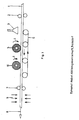
- FIG. 1 A device for carrying out the method according to the invention is shown schematically in FIG. 1
- one or more rollers can be used by using different types of grinding wheel rollers and different fleece construction of the grinding wheels. Directional surface structures are avoided with simultaneous oscillation of the grinding wheel rollers.
- the plastic web 1 is inserted and pulled past a pull-off or transport device, that is the pair of guide rollers 2, the pair of pull-off rollers 7 and the rotating conveyor belt 6, which serves as a counter-pressure bearing, into the smoothing device, comprising the grinding wheel rollers 5, 10.
- a coolant feed device 3 for water or an emulsion containing an additional wax care agent is arranged in front of the grinding wheel roller 5.
- a second grinding wheel roller 10 and possibly also a third one can be arranged, the grinding grains preferably becoming finer with each subsequent grinding wheel roller.
- the peripheral speeds and also the oscillation frequencies can be the same or different, depending on the desired surface. This also applies to the pressure applied.
- the surface in region 9 can be air-dried before the web or profile thus smoothed is cut to length and transported away.
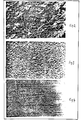
- FIG. 2 shows the surface of a calendered soft PVC web on a scale of 1:50. This surface should be smoothed.
- FIG. 3 shows the surface smoothed according to the method according to German patent 2143135, also on a scale of 1:50.
- the smoothing of the thermoplastic surface is in this case at a temperature of 170 ° C. with a contact pressure of 60 kg / cm 2 at Running speed of 6 m / min. This surface also shows considerable unevenness when enlarged.
- FIG. 4 shows the surface smoothed by the process according to the invention on a scale of 1:50.
- a grinding wheel roller with a grinding wheel diameter of 350 mm, made of plastic fleece with an abrasive grain of silicon carbide grain 280 is used.
- Two passes were carried out at 10 m / s rotational speed of the grinding wheel rollers and 5 m / min transport speed and a contact pressure of 1 bar, the surface being leveled and smoothed.
Landscapes
- Engineering & Computer Science (AREA)
- Mechanical Engineering (AREA)
- Polishing Bodies And Polishing Tools (AREA)
- Shaping Of Tube Ends By Bending Or Straightening (AREA)
- Extrusion Moulding Of Plastics Or The Like (AREA)
- Treatment Of Fiber Materials (AREA)
Claims (6)
Priority Applications (1)
| Application Number | Priority Date | Filing Date | Title |
|---|---|---|---|
| AT83106820T ATE25030T1 (de) | 1982-07-13 | 1983-07-12 | Verfahren zum glaetten von oberflaechen von kalandrierten bzw. extrudierten thermoplastischen kunststoffbahnen oder -profilen. |
Applications Claiming Priority (2)
| Application Number | Priority Date | Filing Date | Title |
|---|---|---|---|
| DE3226102 | 1982-07-13 | ||
| DE3226102A DE3226102C2 (de) | 1982-07-13 | 1982-07-13 | Verfahren zum Glätten von Oberflächen von kalandrierten bzw. extrudierten plastischen Kunststoffbahnen oder -profilen |
Publications (2)
| Publication Number | Publication Date |
|---|---|
| EP0099105A1 EP0099105A1 (fr) | 1984-01-25 |
| EP0099105B1 true EP0099105B1 (fr) | 1987-01-21 |
Family
ID=6168293
Family Applications (1)
| Application Number | Title | Priority Date | Filing Date |
|---|---|---|---|
| EP83106820A Expired EP0099105B1 (fr) | 1982-07-13 | 1983-07-12 | Procédé pour le lissage des surfaces des feuilles ou profilés calandrés ou extrudés en matière thermoplastique |
Country Status (3)
| Country | Link |
|---|---|
| EP (1) | EP0099105B1 (fr) |
| AT (1) | ATE25030T1 (fr) |
| DE (2) | DE3226102C2 (fr) |
Families Citing this family (1)
| Publication number | Priority date | Publication date | Assignee | Title |
|---|---|---|---|---|
| CN112676951A (zh) * | 2020-12-24 | 2021-04-20 | 张家港保税区卓尔诺新材料科技有限公司 | 用于铝塑复合带的磨砂装置 |
Family Cites Families (6)
| Publication number | Priority date | Publication date | Assignee | Title |
|---|---|---|---|---|
| DD28208A (fr) * | ||||
| DE1078906B (de) * | 1955-03-31 | 1960-03-31 | Robert Buerkle & Co Maschinenf | Vorrichtung zum Glaetten von Spachtelmasse od. dgl. auf plattenfoermigen Werkstuecken |
| AT210129B (de) * | 1958-03-29 | 1960-07-11 | Galon Aktiebolag | Verfahren zur Oberflächenbehandlung von Kunststoffolien |
| DE2143135C3 (de) * | 1971-08-28 | 1979-10-04 | Dynamit Nobel Ag, 5210 Troisdorf | Vorrichtung zum Prägen bzw. Glätten einer Oberflache von Bahnen aus Thermoplasten, die bei den Bearbeitungstemperaturen an den metallischen Prageflächen kleben |
| DE2728545A1 (de) * | 1977-06-24 | 1979-01-11 | Otto Tiemann Kg | Poliermaschine fuer kunststoffprofile |
| GB2051663B (en) * | 1979-01-10 | 1983-04-27 | Asahi Chemical Ind | Process for producing extruded rigid thermoplastic sheet having optically smooth surfaces |
-
1982
- 1982-07-13 DE DE3226102A patent/DE3226102C2/de not_active Expired
-
1983
- 1983-07-12 DE DE8383106820T patent/DE3369275D1/de not_active Expired
- 1983-07-12 EP EP83106820A patent/EP0099105B1/fr not_active Expired
- 1983-07-12 AT AT83106820T patent/ATE25030T1/de not_active IP Right Cessation
Non-Patent Citations (1)
| Title |
|---|
| Kernstoff-Lexikon, K. Stöckert, 7. Auflage, 1981, Carl Hanser Verlag, Seite 455 * |
Also Published As
| Publication number | Publication date |
|---|---|
| ATE25030T1 (de) | 1987-02-15 |
| DE3226102A1 (de) | 1984-01-26 |
| EP0099105A1 (fr) | 1984-01-25 |
| DE3369275D1 (en) | 1987-02-26 |
| DE3226102C2 (de) | 1986-04-17 |
Similar Documents
| Publication | Publication Date | Title |
|---|---|---|
| EP2539080B1 (fr) | Procédé d'application de revêtement sur des pièces | |
| EP1045751B1 (fr) | Procede pour produire des bandes thermofixees constituees de particules de materiaux polymeres thermoplastiques | |
| EP3147135B1 (fr) | Procede de fabrication d'un panneau mural ou de sol decore | |
| DE2848157A1 (de) | Vorrichtung zum aufbringen von fluessigkeit auf ein gewebe | |
| DE10297710T5 (de) | Vorrichtung zur Verarbeitung von faserverstärkten Verbundwerkstoffen unter Verwendung einer Fasermatte und deren Herstellung | |
| DE2445070A1 (de) | Verfahren zur herstellung von materialien mit plueschoberflaeche | |
| EP0226946B1 (fr) | Procédé de fabrication continue de plaques pour le bâtiment | |
| EP0099105B1 (fr) | Procédé pour le lissage des surfaces des feuilles ou profilés calandrés ou extrudés en matière thermoplastique | |
| EP1684968B1 (fr) | Procede pour produire une plaque thermoplastique ayant au moins une arete laterale lissee, dispositif correspondant | |
| DD247870A1 (de) | Verfahren zum ummanteln von profilen aus holzpartikelwerkstoffen | |
| AT351412B (de) | Verfahren zur herstellung von mindestens eine glasfaserverstaerkte kunstharzschicht aufweisenden koerpern | |
| EP0839855A1 (fr) | Revêtement des surfaces de plaques en matière thermoplastique | |
| DE19718735C2 (de) | Verfahren und Vorrichtung zur Herstellung von Profilteilen aus Holz und Holzwerkstoffen | |
| EP2998052B1 (fr) | Procede et dispositif de revetement de surface etroite de demi-produits en forme de plaque ou de pieces a usiner | |
| DE202020101169U1 (de) | Doppelbandpresse | |
| EP3543034A1 (fr) | Plaque porteuse pour un panneau de paroi, de sol ou de plafond directement imprimés | |
| DE2454975A1 (de) | Verfahren und vorrichtung zur verbesserung des aussehens einer schicht aus elastomerem material, insbesondere zur verbesserung des aussehens eines teppichbodens, und ein solches verbessertes aussehen aufweisendes produkt | |
| DE1502636C (de) | Verfahren zum Herstellen eines Schleifwerkzeuges | |
| JPH043722B2 (fr) | ||
| DE1779487B2 (de) | Verfahren und Vorrichtung zur kontinuierlichen Herstellung von zusammengesetzten Tafeln, Platten od.dgl. insbesondere für Bauzwecke aus zelligem Material mit einer Deckschicht aus Kunststoff | |
| AT252059B (de) | Verfahren zur Herstellung eines Schmirgelwerkzeuges und Vorrichtung zur Durchführung des Verfahrens | |
| DE102023118221A1 (de) | Vorrichtung und Verfahren zum Bearbeiten einer Kante eines plattenförmigen Werkstücks | |
| DE202020101130U1 (de) | Doppelbandpresse | |
| EP2093054B1 (fr) | Installation et procédé pour le revêtement sans désalignement de pièces de support à chambre creuse et de pièces de support massives à l'aide de systèmes de colle à plusieurs composants | |
| DE1219667B (de) | Vorrichtung zur Beschichtung der Oberflaechen eines Traegermaterials mit Kunststoff |
Legal Events
| Date | Code | Title | Description |
|---|---|---|---|
| PUAI | Public reference made under article 153(3) epc to a published international application that has entered the european phase |
Free format text: ORIGINAL CODE: 0009012 |
|
| AK | Designated contracting states |
Designated state(s): AT BE DE FR GB NL SE |
|
| 17P | Request for examination filed |
Effective date: 19840614 |
|
| GRAA | (expected) grant |
Free format text: ORIGINAL CODE: 0009210 |
|
| AK | Designated contracting states |
Kind code of ref document: B1 Designated state(s): AT BE DE FR GB NL SE |
|
| REF | Corresponds to: |
Ref document number: 25030 Country of ref document: AT Date of ref document: 19870215 Kind code of ref document: T |
|
| REF | Corresponds to: |
Ref document number: 3369275 Country of ref document: DE Date of ref document: 19870226 |
|
| ET | Fr: translation filed | ||
| PGFP | Annual fee paid to national office [announced via postgrant information from national office to epo] |
Ref country code: NL Payment date: 19870731 Year of fee payment: 5 |
|
| PLBE | No opposition filed within time limit |
Free format text: ORIGINAL CODE: 0009261 |
|
| STAA | Information on the status of an ep patent application or granted ep patent |
Free format text: STATUS: NO OPPOSITION FILED WITHIN TIME LIMIT |
|
| 26N | No opposition filed | ||
| PG25 | Lapsed in a contracting state [announced via postgrant information from national office to epo] |
Ref country code: DE Effective date: 19890401 |
|
| PG25 | Lapsed in a contracting state [announced via postgrant information from national office to epo] |
Ref country code: GB Effective date: 19890712 Ref country code: AT Effective date: 19890712 |
|
| PG25 | Lapsed in a contracting state [announced via postgrant information from national office to epo] |
Ref country code: SE Effective date: 19890713 |
|
| PG25 | Lapsed in a contracting state [announced via postgrant information from national office to epo] |
Ref country code: BE Effective date: 19890731 |
|
| BERE | Be: lapsed |
Owner name: DYNAMIT NOBEL A.G. Effective date: 19890731 |
|
| PG25 | Lapsed in a contracting state [announced via postgrant information from national office to epo] |
Ref country code: NL Effective date: 19900201 |
|
| GBPC | Gb: european patent ceased through non-payment of renewal fee | ||
| NLV4 | Nl: lapsed or anulled due to non-payment of the annual fee | ||
| PG25 | Lapsed in a contracting state [announced via postgrant information from national office to epo] |
Ref country code: FR Free format text: LAPSE BECAUSE OF NON-PAYMENT OF DUE FEES Effective date: 19900330 |
|
| REG | Reference to a national code |
Ref country code: FR Ref legal event code: ST |
|
| EUG | Se: european patent has lapsed |
Ref document number: 83106820.0 Effective date: 19900418 |