EP0099497A1 - Insektizid-Formulierungen - Google Patents
Insektizid-Formulierungen Download PDFInfo
- Publication number
- EP0099497A1 EP0099497A1 EP83106402A EP83106402A EP0099497A1 EP 0099497 A1 EP0099497 A1 EP 0099497A1 EP 83106402 A EP83106402 A EP 83106402A EP 83106402 A EP83106402 A EP 83106402A EP 0099497 A1 EP0099497 A1 EP 0099497A1
- Authority
- EP
- European Patent Office
- Prior art keywords
- phospholipid
- solvent
- dissolved
- formulations
- formulations according
- Prior art date
- Legal status (The legal status is an assumption and is not a legal conclusion. Google has not performed a legal analysis and makes no representation as to the accuracy of the status listed.)
- Withdrawn
Links
Classifications
-
- A—HUMAN NECESSITIES
- A01—AGRICULTURE; FORESTRY; ANIMAL HUSBANDRY; HUNTING; TRAPPING; FISHING
- A01N—PRESERVATION OF BODIES OF HUMANS OR ANIMALS OR PLANTS OR PARTS THEREOF; BIOCIDES, e.g. AS DISINFECTANTS, AS PESTICIDES OR AS HERBICIDES; PEST REPELLANTS OR ATTRACTANTS; PLANT GROWTH REGULATORS
- A01N57/00—Biocides, pest repellants or attractants, or plant growth regulators containing organic phosphorus compounds
- A01N57/10—Biocides, pest repellants or attractants, or plant growth regulators containing organic phosphorus compounds having phosphorus-to-oxygen bonds or phosphorus-to-sulfur bonds
- A01N57/12—Biocides, pest repellants or attractants, or plant growth regulators containing organic phosphorus compounds having phosphorus-to-oxygen bonds or phosphorus-to-sulfur bonds containing acyclic or cycloaliphatic radicals
Definitions
- the invention relates to new pyrethroid-containing insecticide formulations.
- the new formulations are particularly characterized by their strong adhesiveness and long-lasting effect.
- Pyrethroids have become very important in recent years due to their high, rapidly occurring insecticidal activity and low toxicity for humans and animals.
- the natural and synthetic pyrethroids are difficult to dissolve in water, sensitive to heat and easily inactivated in the air.
- pyrethroids are very expensive products due to their complex isolation (natural pyrethroids) or complex syntheses.
- the aim of the present invention is therefore to provide new insecticide formulations which contain pyrethroids as the active ingredient and which have good, long-lasting activity with small amounts of active ingredient show good adhesion to the goods to be protected.
- a good distribution is of great importance, because for spraying fields, e.g. of cotton or tobacco fields, only 25 - 70 g of active ingredient per hectare of commercially available formulations are required. With the new formulations, amounts of active ingredient from 10 to 60 g per hectare can still be distributed well, without the effectiveness being influenced thereby.
- the new formulations are also suitable for the treatment of ectoparasites in domestic and grazing animals. They show good adhesion to the animal skin or coat. When spraying stable walls, the active ingredient adheres well to the wall and provides long-lasting protection against insects such as e.g. To fly.
- Suitable phospholipids are natural or synthetic phospholipids from the group phosphatidylcholine, the hydrogenated phosphatidylcholines, phosphatidylethanolamine, the N-acylphosphatidylethanolamines, phosphatidylinositol, phosphatidylglycerol or a mixture of several such phospholipids, but in particular a mixture of phosphatidylchanol and phosphatididylcholine and phosphatididylcholine and phosphatididylcholine and phosphatididylcholine and phosphatididylcholine and phosphatididylcholine and phosphatididylcholine and phosphatididylcholine and phosphatididylcholine and phosphatididylcholine and phosphatididylcholine and phosphatididylcholine and phosphatididylcholine and phosphatididylcholine and phosphatididylcholine and phosphatididylcho
- Natural phosphatidylcholines which can be obtained by the processes described in the following patents are particularly preferred: DE-PS 10 47 579, DE-PS 10 53 299, DE-PS 16 17 679, DE-PS 16 17 680, DE-OS 30 47 048, DE-OS 30 47 012, DE-OS 30 37 Oll.
- Examples of compounds of the formula I are known compounds which have already proven themselves as insecticides (Chemistry of Plant Protection Products and Pest Control, Springer 1970, p. 87 ff).
- the corresponding phospholipid is dissolved in a suitable solvent, such as, for example, toluene, ethyl acetate, xylene, gasoline, methanol or ethanol, or mixtures of these solvents.
- a suitable solvent such as, for example, toluene, ethyl acetate, xylene, gasoline, methanol or ethanol, or mixtures of these solvents.
- the choice of solvent depends on the solution properties of the active ingredient used.
- the phospholipid solution if necessary, dissolved with heating of the active ingredient or a commercially available formulation. After the dissolution process has ended, the solvent is distilled off in vacuo with heating.
- suitable inert auxiliaries such as fillers, swelling agents, emulsifiers, wetting agents and spraying agents, to give customary commercial products.
- the new insecticide formulations can also be prepared by dissolving or slurrying the active ingredient or a commercial formulation, the phospholipid and the auxiliaries which are still desired in the solvent or solvent mixture by heating and then removing the solvent or solvents in vacuo. A finished mixture is obtained which is immediately ready for use.
- the active substance is advantageously first dissolved in water or water-alcohol mixtures and the phospholipid or the phospholipid mixture is processed into a solution or emulsion with stirring or by using ultrasound.
- the emulsifiers which may be required can be added before or after this stirring process.
- the emulsion or solution thus obtained is usually, for example by distillation, Spray drying, lyophilizing, freed from the solvent mixture or water.
- the resulting product can be used as a dry product, if necessary with the addition of auxiliaries and fillers.
- the product can also be emulsified or dissolved in water again with the addition of suitable auxiliaries and used as a liquid product.
- Emulsion concentrates are preferably prepared by dissolving the phospholipid in a solvent or solvent mixture in the presence of co-emulsifiers and adding the pyrethrin with stirring and gentle heating.
- the concentrate obtained can be processed into customary spray liquors before use with the addition of the necessary amount of water.
- Carriers are e.g. Talc, kaolin, bentonite, diatomaceous earth, lime or rock powder.
- Other tools are e.g. surface-active compounds, such as soaps (fatty acid salts), fatty alcohol sulfonates or alkyl sulfonates.
- Gelatin, casein, albumin, starch or methyl cellulose can be used as stabilizers or protective coloids.
- Spreading agents such as silicone oils, fatty acid esters, triglycerides, fatty alcohol or fatty acids can also be used.
- the new formulations can be used in the form of sprays, solutions, emulsions or suspensions.
- the phospholipid is dissolved in isophorone, glycerol, cremophor, methanol mixture with stirring and the pyrethrum extract is mixed into this solution with stirring and gentle heating.
Landscapes
- Life Sciences & Earth Sciences (AREA)
- Agronomy & Crop Science (AREA)
- Pest Control & Pesticides (AREA)
- Plant Pathology (AREA)
- Health & Medical Sciences (AREA)
- Engineering & Computer Science (AREA)
- Dentistry (AREA)
- General Health & Medical Sciences (AREA)
- Wood Science & Technology (AREA)
- Zoology (AREA)
- Environmental Sciences (AREA)
- Agricultural Chemicals And Associated Chemicals (AREA)
Abstract
Die vorliegende Erfindung betrifft neue Insektizid-Formulierungen, die aus einem oder mehreren Wirkstoffen aus der Gruppe der Pyrethroide und einem oder mehreren Phospholipiden neben üblichen Träger-, Verdünnungs-, Lösungs- und/oder anderen inerten Hilfsmitteln bestehen, wobei das Gewichtsverhältnis Wirkstoff bzw. Wirkstoffgemisch zu reinem Phospholipid bzw. Gemisch aus reinen Phospholipiden 1:20 bis 1:50 beträgt.
Description
- Die Erfindung betrifft neue Pyrethroid-haltige Insektizid-Formulierungen. Die neuen Formulierungen zeichnen sich besonders durch eine starke Haftfähigkeit sowie lang anhaltende Wirkung aus.
- Pyrethroide haben durch ihre hohe, schnell eintretende insektizide Wirkung und geringe Toxizität für Mensch und Tier in den letzten Jahren große Bedeutung erlangt. Die natürlichen sowie die synthetischen Pyrethroide sind schwer wasserlöslich, wärmeempfindlich u nd werden an der Luft leicht inaktiviert. Darüberhinaus sind Pyrethroide durch ihre aufwendige Isolierung (natürliche Pyrethroide) bzw. aufwendige Synthesen sehr kostspielige Produkte.
- Ziel der vorliegenden Erfindung ist es deshalb, neue Insektizid-Formulierungen, die als aktiven Wirkstoff Pyrethroide enthalten, zur Verfügung zu stellen, die mit geringen Mengen an Wirkstoff eine gute, lang anhaltende Wirksamkeit und gute Haftung auf den zu schützenden Gütern zeigen.
- Es wurde nun überraschenderweise gefunden, daß man hochwirksame Formulierungen zur Bekämpfung von Schadinsekten erhalten kann, wenn man die Pyrethroide zusammen mit einem Phospholipid aus der Gruppe Phosphatidylcholin, Phosphatidylethanolamin oder N-Acylphosphatidylethanolamin oder einem Gemisch aus mehreren solcher Phospholipiden im Gewichtsverhältnis 1 : 20 bis 1 : 50 neben üblichen Träger-, Verdünnungs-, Lösungs-, Versprühungs- und/oder anderen inerten Hilfsmitteln einsetzt.
- Durch den Zusatz von Phospholipiden wird eine wesentlich bessere Verteilung und eine bessere Haftung und damit auch eine lang anhaltende Wirksamkeit erzielt. Dadurch kann auch die Aufwandmenge an aktivem Wirkstoff erheblich (bis zu 60 %) reduziert werden.
- Eine gute Verteilung ist deshalb von großer Bedeutung, da zum Besprühen von Feldern, z.B. von Baumwoll- oder Tabakfeldern, nur 25 - 70 g aktiver Wirkstoff je Hektar von handelsüblichen Formulierungen benötigt werden. Bei den neuen Formulierungen können noch Wirkstoffmengen von 10 - 60 g je Hektar gut verteilt werden, ohne daß die Wirksamkeit dadurch beeinflußt ist.
- Die neuen Formulierungen eignen sich auch zur Behandlung von Ektoparasiten bei Haus- und Weidetieren. Sie zeigen ,eine gute Haftung auf-der Tierhaut bzw. dem Haarkleid. Beim Besprühen von Stallwänden haftet der Wirkstoff gut an der Wand und bildet einen lang anhaltenden Schutz gegen Insekten wie z.B. Fliegen.
- Als Phospholipide kommen natürliche oder synthetische Phospholipide aus der Gruppe Phosphatidylcholin, den hydrierten Phosphatidylcholinen, Phosphatidylethanolamin, den N-Acyl-phosphatidylethanolaminen, Phosphatidylinosit, Phosphatidylglycerol oder ein Gemisch aus mehreren solcher Phospholipiden, insbesondere jedoch Gemisch aus Phosphatidylcholin und Phosphatidylethanolamin oder Phosphatidylcholin mit Phosphatidylethanolamin und N-Acylphosphatidylethanolamin oder sonstige Phosphatidyl-Mischungen mit 15 - 75 % Phosphatidylcholin-Anteil in Frage.
- Besonders bevorzugt sind natürliche Phosphatidylcholine, die nach den in den folgenden Patentschriften beschriebenen Verfahren erhalten werden können: DE-PS 10 47 579, DE-PS 10 53 299, DE-PS 16 17 679, DE-PS 16 17 680, DE-OS 30 47 048, DE-OS 30 47 012, DE-OS 30 37 Oll.
- Als Pyrethroide kommen natürliche oder synthetische Pyrethroide der allgemeinen Formel I in Frage

- R1 = CH3, COOH, COOCH3, C1, Br
- R2 = CH3, Cl, Br, Aryl, Halpgen subst. Aryl
- R3 = subst. Cyclopenten, subst. Furylmethyl, Phtalimidomethyl, Phenoxybenzyl oder Phenalkenyl-Gruppen.
- Beispiele für Verbindungen der Formel I:


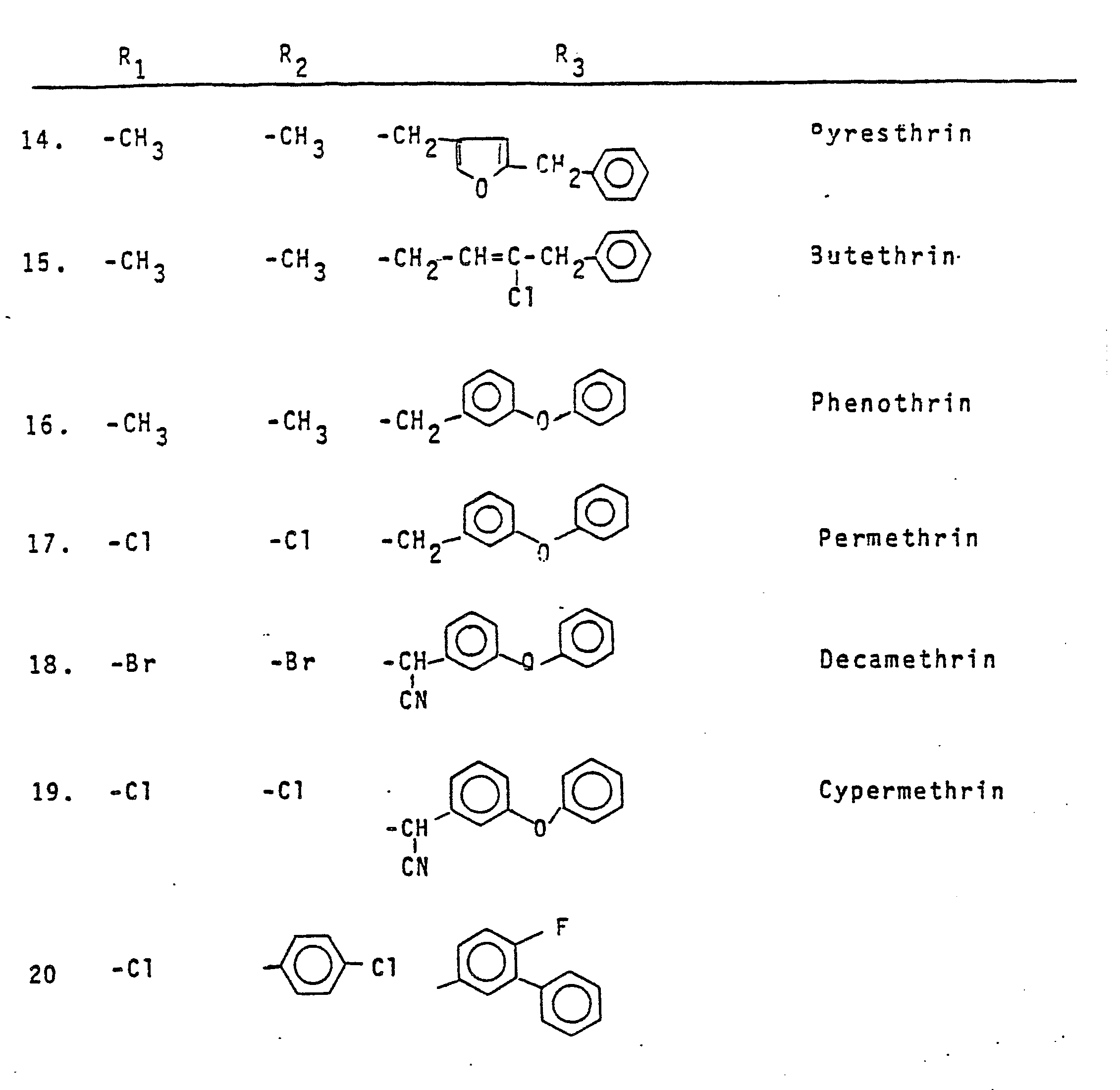
- Zur Herstellung der neuen Insektizid Formulierungen wird das entsprechende Phospholipid in einem geeigneten Lösungsmittel, wie z.B. Toluol, Essigester, Xylol, Benzin, Methanol oder Ethanol oder Gemische dieser Lösungsmittel gelöst. Die Auswahl des Lösungsmittels richtet sich nach den Lösungseigenschaften des eingesetzten Wirkstoffes. In die Phospholipid-Lösung wird.ggfs. unter Erwärmung der Wirkstoff oder eine im Handel erhältliche Formulierung aufgelöst. Nach Beendigung des Lösungsvorganges wird das Lösungsmittel im Vakuum unter Erwärmung abdestilliert. Das so erhaltene Produkt wird ggfs durch Zugabe geeigneter inerter Hilfsmittel, wie Füllstoffe, Quellmittel, Emulgatoren, Netzmittel, Versprühungsmittel zu üblichen handelsfähigen Produkten verarbeitet.
- Die neuen Insektizid-Formulierungen können auch hergestellt werden, indem der Wirkstoff oder eine handelsübliche Formulierung, das Phospholipid und die noch erwünschten Hilfsmittel zusammen im Lösungsmittel oder Lösungsmittelgemisch durch Erwärmen gelöst bzw. aufgeschlämmt werden und dann das oder die Lösungsmittel im Vakuum abgezogen werden. Erhalten wird eine fertige-Mischung, die sofort zur Anwendung bereit steht.
- Bei Wirkstoffen, die in Wasser oder Wasser-Alkohol-Mischungen löslich sind, wird vorteilhafterweise der Wirkstoff zuerst in Wasser oder Wasser-Alkohol-Mischungen gelöst und das Phospholipid oder die Phospholipidmischung unter Rühren oder durch die Anwendung von Ultraschall zu einer Lösung oder Emulsion verarbeitet. Die gegebenenfalls benötigten Emulgatoren können vor oder nach diesem Rührvorgang zugesetzt werden. Die so erhaltene Emulsion oder Lösung wird üblicherweise, wie z.B. durch Destillation, Sprühtrocknen, Lyophilisieren, von dem Lösungsmittelgemisch oder Wasser befreit. Das resultierende Produkt kann als Trockenprodukt ggfs. unter Zusatz von Hilfs- und Füllstoffen eingesetzt werden. Auch kann das Produkt wieder unter Zusatz von geeigneten Hilfsstoffen in Wasser emulgiert oder gelöst werden und als flüssiges Produkt eingesetzt werden.
- Bevorzugterweise werden Emulsionskonzentrate hergestellt, indem das Phospholipid in Gegenwart von Co-Emulgatoren in einem Lösungsmittel oder Lösungsmittelgemisch gelöst wird und das Pyrethrin unter Rühren und leichter Erwärmung zugegeben wird. Das erhaltene Konzentrat kann vor der Anwendung unter Zugabe der notwendigen Wassermenge zu üblichen Spritzbrühen verarbeitet werden.
- Trägerstoffe sind z.B. Talkum, Kaolin, Bentonit, Kieselgur, Kalk oder Gesteinsmehl. Weitere Hilfsmittel sind z.B. oberflächenaktive Verbindungen, wie Seifen (Fettsäuresalze), Fettalkoholsulfonate oder Alkylsulfonate. Als Stabilisatoren oder Schutzkoloide können Gelatine, Kasein, Albumin, Stärke oder Methylcellulose eingesetzt werden. Desweiteren können auch Spreitmittel, wie Silikonöle, Fettsäureester, Triglyceride, Fettalkohol oder Fettsäuren eingesetzt werden.
- Als übliche Synergisten für Pyrethroide können z.B. Piperonylbutoxid, Safroxan, Sesamex oder Sesamin eingesetzt werden.
- Die neuen Formulierungen können in Form von Spray, Lösungen, Emulsionen oder Suspensionen eingesetzt werden.
-
- 2,000 g Pyrethrum-Extrakt der Firma INEXA, Quito-Ecuador Lot 1041 (Pyrethringehalt ca. 59,3
- 2.105 g Phospholipid
- 1.595 g Isophoron
- 0,800 g Glycerin
- 0,265 g Cremophor EL
- 0,235 g Methanol
- Das Phospholipid wird in Isophoron-, Glycerin-, Cremophor-, Methanol-Gemisch unter Rühren gelöst und zu dieser Lösung wird das Pyrethrum-Extrakt unter Rühren und leichter Erwärmung zugemischt.
- Analog Beispiel 1 werden folgende Mischungen hergestellt:
-
- 0,40 g Permethrin
- 3,00 g Piperonylbutoxid
- 2,00 g Phospholipid
- 1,75 g Isophoron
- 0,75 g Glycerin
- 0,25 g Cremophor EL
- 0,25 g N-(2-Hydroxyethyl)-capronsäureamid
-
- 1,70 g Cypermethrin
- 1,70 g Piperonylbutoxid
- 2,00 g Phospholipid
- 1,75 g Isophoron
- 0,75 g Glycerin
- 0,25 g Cremophor EL
- 0,25 g Softigen 767
- Beispiel 4
- 0,90 g Decamethrin
- 2,50 g Piperonylbutoxid
- 2,00 g Phospholipid
- 1,75 g Isophoron
- 0,75 g Glycerin
- 0,25 g Cremophor EL
- 0,25 g Softigen 767
- Beispiel 5
- 0,20 g Permethrin
- 3,20 g Piperonylbutoxid
- 1,66 g Phospholipid
- 0,83 g Cremophor EL
- 0,065 g Triethylamin
- 1,17 g Toluol
- 1,17 g Xylol
- 0,625 g DMSO
- 0,33 g Pflanzenöl
- 0,83 g N-(2-Hydroxyethyl)-capronsäureamid
-
- 1,70 g Permethrin
- 1,70 g Piperonylbutoxid
- 1,66 g Phospholipid
- 1,66 g Isophoron
- 0,83 g Cremophor EL
- 0,83 g N-(2-Hydroxyethyl)-capronsäureamid
- 2,15 g DMSO
- 0,63 g Glycerin
- 0,18 g Methanol
- 0,33 g Pflanzenöl
- Die in den vorstehenden Beispielen 1 bis 6 verwendeten Phospholipid-Produkte hatten die folgende Zusammensetzung, wobei die angegebenen Prozente Gewichtsprozente sind:
-
- 40 % Phosphatidylcholin
- 28 % Phosphatidylethanolamin
- 27 % N-acylphosphatidylethanolamin
- 5 % sonstige Phospholipide
-
- 45 % Phosphatidylcholin
- 25 % Phosphatidylethanolamin
- 21 % N-acylphosphatidylethanolamin
- 9 % sonstige Phospholipide
-
- 42 % Phosphatidolcholin
- 25 % Phosphatidylethanolamin
- 25 % N-acylphosphatidylethanolamin
- 8 % sonstige Phospholipide
-
- 4o % Phosphatidolcholin
- 3o % Phosphatidylethanolamin
- 25 % N-acylphosphatidylethanolamin
- 5 % sonstige Phospholipide
-
- 96 % Phosphatidolcholin
- 4 % sonstige Phospholipide
-
- 30 % Phosphatidylcholin
- 16 % N-acylphosphatidylethanolamin
- 24 % Phosphatidylethanolamin
- 30 % sonstige Phospholipide
Claims (11)
1. Insektizid-Formulierungen, dadurch gekennzeichnet, daß sie aus
im Gewichtsverhältnis a : b von 1 : 20 bis 1 : 50 neben üblichen Träger-, Verdünnungs-, Lösungs-, Versprühungs-und/oder anderen inerten Hilfsmittel bestehen.
a) einem insektiziden Wirkstoff aus der Gruppe der Pyre throide
und
und
b) einem oder mehreren Phospholipiden aus der Gruppe Phosphatidylcholin, den hydrierten Phosphatidylcholi - nen, Phosphatidylethanolamin, den N-Acyl-phosphatidylethanolaminen, Phosphatidylinosit, Phosphatidylserin, Lysolecithin und Phosphatidylglycerol
im Gewichtsverhältnis a : b von 1 : 20 bis 1 : 50 neben üblichen Träger-, Verdünnungs-, Lösungs-, Versprühungs-und/oder anderen inerten Hilfsmittel bestehen.
. Formulierungen gemäß Anspruch 1, dadurch gekennzeichnet, daß als Phospholipid Mischungen aus Phosphatidylcholin und Phosphatidylethanolamin oder Mischungen aus Phosphatidylcholin, Phosphatidylethanolamin und N-Acyl-phosphatidylethanolamin eingesetzt werden.
. Formulierungen gemäß der Ansprüche 1 bis 2, dadurch gekennzeichnet, daß als Phospholipid ein Phospholipid mit einem Gehalt von 15 - 75 % Phosphatidylcholin eingesetzt wird.
4. Formulierung gemäß der Ansprüche 1-3, dadurch gekennzeichnet, daß als Pyrethroid eine Verbindung der allgemeinen Formel I

eingesetzt wird.
R1 = CH3, COOH, COOCH3, Cl, Br
R2 = CH3, Cl, Br, Aryl, Halogen subst. Aryl
R3 = subst. Cyclopenten, subst. Furylmethyl, Phthalimidomethyl, Phenoxybenzyl oder Phenalkenyl-Grupen
eingesetzt wird.
5. Formulierungen gemäß der Ansprüche 1 - 4, dadurch gekennzeichnet, daß als Pyrethroid Permethrin, Decamethrin oder Cypermethrin eingesetzt wird.
6. Verwendung der Formulierungen gemäß einem oder mehreren der Ansprüche 1 - 5 zur Bekämpfung von Insekten
7. Verfahren zur Herstellung von Formulierungen gemäß einem oder mehreren der Ansprüche 1 - 5, dadurch-gekennzeichnet, daß das Phospholipid in einem organischen Lösungsmittel bzw. Lösungsmittelgemisch gelöst wird und in diese Lösung ggfs. durch Erwärmen und/oder Rühren der Wirkstoff gelöst und anschließend das Lösungsmittel oder Lösungsmittelgemisch im Vakuum abgezogen wird und die erhaltene Mischung unter Zusatz üblicher Füll- und Hilfsmittel in eine übliche Anwendungsform überführt wird.
8. Verfahren zur Herstellung von Formulierungen gemäß einem oder mehreren der Ansprüche 1 - 5, dadurch gekennzeichnet, daß das oder die Wirkstoffe mit einem oder mehreren Phospholipiden ggfs. unter Zusatz üblicher Füll- und Hilfsmittel in einem organischen Lösungsmittel gelöst bzw. aufgeschlämmt und das Lösungsmittel danach abgezogen wird.
9. Verfahren zur Herstellung von Formulierungen gemäß einem oder mehreren der Ansprüche 1 - 5, dadurch gekennzeichnet, daß ein oder mehrere, in Wasser oder Alkohol lösliche Wirkstoffe in Wasser und Wasser-Alkohol-Mischungen zusammen mit einem oder mehreren Phospholipiden unter Rühren und/oder leichter Erwärmung und/oder Ultraschall gelöst und das Lösungsmittel bzw. Lösungsmittelgemisch abgezogen wird.
10. Verfahren zur Herstellung von Formulierungen als Emulsionskonzentrat gemäß einem oder mehreren der Ansprüche 1-5, dadurch gekennzeichnet, daß das Phospholipid in Gegenwart eines Emulgators in einem organischen Lösungsmittel bzw. Lösungsmittelgemisch gelöst wird und in diese Lösung ggfs. durch Erwärmen und/oder Rühren der Wirkstoff gelöst wird.
11. Verwendung von Emulsionskonzentraten gemäß Anspruch 10 zur Bekämpfung von Insekten, dadurch gekennzeichnet, daß das Konzentrat mit Wasser verdünnt und als Spritzbrühe eingesetzt wird.
Applications Claiming Priority (2)
| Application Number | Priority Date | Filing Date | Title |
|---|---|---|---|
| DE19823225943 DE3225943A1 (de) | 1982-07-10 | 1982-07-10 | Insektizid-formulierungen |
| DE3225943 | 1982-07-10 |
Publications (1)
| Publication Number | Publication Date |
|---|---|
| EP0099497A1 true EP0099497A1 (de) | 1984-02-01 |
Family
ID=6168195
Family Applications (1)
| Application Number | Title | Priority Date | Filing Date |
|---|---|---|---|
| EP83106402A Withdrawn EP0099497A1 (de) | 1982-07-10 | 1983-07-01 | Insektizid-Formulierungen |
Country Status (15)
| Country | Link |
|---|---|
| EP (1) | EP0099497A1 (de) |
| JP (1) | JPS5921606A (de) |
| AU (1) | AU1664783A (de) |
| BR (1) | BR8303679A (de) |
| CS (1) | CS515683A2 (de) |
| DD (1) | DD210195A5 (de) |
| DE (1) | DE3225943A1 (de) |
| DK (1) | DK316383A (de) |
| ES (1) | ES523974A0 (de) |
| FI (1) | FI832495A7 (de) |
| GR (1) | GR78653B (de) |
| NO (1) | NO832456L (de) |
| PL (1) | PL242930A3 (de) |
| PT (1) | PT77000A (de) |
| ZA (1) | ZA834879B (de) |
Families Citing this family (1)
| Publication number | Priority date | Publication date | Assignee | Title |
|---|---|---|---|---|
| RU2134967C1 (ru) * | 1997-05-30 | 1999-08-27 | Шестаков Константин Алексеевич | Способ получения микрокапсулированных препаратов, содержащих пиретроидные инсектициды |
Citations (4)
| Publication number | Priority date | Publication date | Assignee | Title |
|---|---|---|---|---|
| US1938864A (en) * | 1929-10-21 | 1933-12-12 | Firm Hanseatische Muhlenwerke | Insecticidal emulsion |
| US2006227A (en) * | 1932-10-19 | 1935-06-25 | Grasselli Chemical Co | Contact insecticide |
| US4241046A (en) * | 1978-11-30 | 1980-12-23 | Papahadjopoulos Demetrios P | Method of encapsulating biologically active materials in lipid vesicles |
| EP0068297A1 (de) * | 1981-06-27 | 1983-01-05 | A. Nattermann & Cie. GmbH | Eine insektizide Zusammensetzung, Verfahren zu deren Herstellung und Anwendung |
-
1982
- 1982-07-10 DE DE19823225943 patent/DE3225943A1/de not_active Withdrawn
-
1983
- 1983-06-29 GR GR71795A patent/GR78653B/el unknown
- 1983-07-01 EP EP83106402A patent/EP0099497A1/de not_active Withdrawn
- 1983-07-04 ZA ZA834879A patent/ZA834879B/xx unknown
- 1983-07-05 NO NO832456A patent/NO832456L/no unknown
- 1983-07-07 CS CS835156A patent/CS515683A2/cs unknown
- 1983-07-07 AU AU16647/83A patent/AU1664783A/en not_active Abandoned
- 1983-07-07 FI FI832495A patent/FI832495A7/fi not_active Application Discontinuation
- 1983-07-08 PT PT77000A patent/PT77000A/pt unknown
- 1983-07-08 DD DD83252905A patent/DD210195A5/de unknown
- 1983-07-08 JP JP58123574A patent/JPS5921606A/ja active Pending
- 1983-07-08 PL PL24293083A patent/PL242930A3/xx unknown
- 1983-07-08 ES ES523974A patent/ES523974A0/es active Granted
- 1983-07-08 DK DK316383A patent/DK316383A/da not_active Application Discontinuation
- 1983-07-08 BR BR8303679A patent/BR8303679A/pt unknown
Patent Citations (4)
| Publication number | Priority date | Publication date | Assignee | Title |
|---|---|---|---|---|
| US1938864A (en) * | 1929-10-21 | 1933-12-12 | Firm Hanseatische Muhlenwerke | Insecticidal emulsion |
| US2006227A (en) * | 1932-10-19 | 1935-06-25 | Grasselli Chemical Co | Contact insecticide |
| US4241046A (en) * | 1978-11-30 | 1980-12-23 | Papahadjopoulos Demetrios P | Method of encapsulating biologically active materials in lipid vesicles |
| EP0068297A1 (de) * | 1981-06-27 | 1983-01-05 | A. Nattermann & Cie. GmbH | Eine insektizide Zusammensetzung, Verfahren zu deren Herstellung und Anwendung |
Also Published As
| Publication number | Publication date |
|---|---|
| ZA834879B (en) | 1984-03-28 |
| NO832456L (no) | 1984-01-11 |
| ES8500006A1 (es) | 1984-10-01 |
| DK316383A (da) | 1984-01-11 |
| ES523974A0 (es) | 1984-10-01 |
| FI832495L (fi) | 1984-01-11 |
| PT77000A (en) | 1983-08-01 |
| JPS5921606A (ja) | 1984-02-03 |
| PL242930A3 (en) | 1984-07-02 |
| FI832495A0 (fi) | 1983-07-07 |
| CS515683A2 (en) | 1985-07-16 |
| GR78653B (de) | 1984-09-27 |
| DD210195A5 (de) | 1984-06-06 |
| DK316383D0 (da) | 1983-07-08 |
| BR8303679A (pt) | 1984-02-14 |
| DE3225943A1 (de) | 1984-01-12 |
| AU1664783A (en) | 1985-01-17 |
| FI832495A7 (fi) | 1984-01-11 |
Similar Documents
| Publication | Publication Date | Title |
|---|---|---|
| DE2348930B2 (de) | Insektizide Mittel auf Basis von Chrysanthemumsäureestern | |
| DE2804664A1 (de) | N- eckige klammer auf (phosphinyl) amino eckige klammer zu thio-methylcarbamate bzw. n- eckige klammer auf (phosphinothioyl) amino eckige klammer zu thio-methylcarbamate, deren verwendung in einem verfahren zur schaedlingsbekaempfung, pestizide mittel welche diese verbindungen enthalten, sowie verfahren zur herstellung dieser verbindungen und dafuer benoetigte ausgangsmaterialien | |
| DD202099A5 (de) | Insektizid-zusammensetzung | |
| EP0591768B1 (de) | Neue Tenside, Verfahren zu ihrer Herstellung, diese enthaltende Mittel und ihre Verwendung | |
| DE2804946C2 (de) | ||
| DE1201116B (de) | Fungizides Pflanzenschutzmittel | |
| DE1252962B (de) | Insektizide Zubereitung | |
| EP0099497A1 (de) | Insektizid-Formulierungen | |
| CH616311A5 (de) | ||
| EP0100440B1 (de) | Herbizid-Emulsionskonzentrate | |
| DE2061133A1 (de) | Pestizide Verbindung,Verfahren zu ihrer Herstellung und Verwendung | |
| DE2134000A1 (de) | Insektizide | |
| US2217673A (en) | Insecticide | |
| DE2605828A1 (de) | Phenoxybenzylester von spirocarbonsaeuren | |
| DE1910588C3 (de) | N-Methyl-0-(2-äthylmercapto-methyl-) phenyl-carbamin-säureester, Verfahren zu seiner Herstellung sowie seine Verwendung als Insektizid | |
| DD202379A5 (de) | Neue acarizid-zusammensetzung, verfahren zur herstellung und deren verwendung | |
| DE1618435A1 (de) | Schaedlingsbekaempfungsmittel mit Aryl- und Aralkyl-omega-alkinyl-phosphonsaeureestern als Synergist | |
| DE1180736B (de) | Verfahren zur Herstellung von ungesaettigten Thiophosphorsaeureestern | |
| DE974569C (de) | Schaedlingsbekaempfungsmittel | |
| EP0005227B1 (de) | Akarizide und insektizide Mittel sowie deren Verwendung zur Schädlingsbekämpfung | |
| DE2550957A1 (de) | Verfahren zur herstellung von tetrahydropyridincarbonsaeureestern und deren salzen und die verwendung derselben als insektizide und akarizide | |
| DE2608506A1 (de) | Neue phosphorverbindungen, ihre herstellung sowie zusammensetzungen mit diesen verbindungen | |
| AT264912B (de) | Insektizide Mischungen | |
| AT261296B (de) | Insektizide Mischungen | |
| CH540876A (de) | Verfahren zur Herstellung von neuen Carbonsäureestern und Verwendung derselben |
Legal Events
| Date | Code | Title | Description |
|---|---|---|---|
| PUAI | Public reference made under article 153(3) epc to a published international application that has entered the european phase |
Free format text: ORIGINAL CODE: 0009012 |
|
| AK | Designated contracting states |
Designated state(s): AT BE CH DE FR GB IT LI LU NL SE |
|
| 17P | Request for examination filed |
Effective date: 19840720 |
|
| STAA | Information on the status of an ep patent application or granted ep patent |
Free format text: STATUS: THE APPLICATION HAS BEEN WITHDRAWN |
|
| 18W | Application withdrawn |
Withdrawal date: 19850814 |
|
| RIN1 | Information on inventor provided before grant (corrected) |
Inventor name: GHYCZY, MIKLOS, DR. Inventor name: IMBERGE, PAUL-ROBERT Inventor name: WENDEL, ARMIN |