EP0100470A2 - Hitzebeständiges und Verschleissbeständiges Aluminiumlegierungspulver mit guten mechanischen Eigenschaften und daraus hergestellte Gegenstände - Google Patents
Hitzebeständiges und Verschleissbeständiges Aluminiumlegierungspulver mit guten mechanischen Eigenschaften und daraus hergestellte Gegenstände Download PDFInfo
- Publication number
- EP0100470A2 EP0100470A2 EP83106849A EP83106849A EP0100470A2 EP 0100470 A2 EP0100470 A2 EP 0100470A2 EP 83106849 A EP83106849 A EP 83106849A EP 83106849 A EP83106849 A EP 83106849A EP 0100470 A2 EP0100470 A2 EP 0100470A2
- Authority
- EP
- European Patent Office
- Prior art keywords
- approximately
- aluminum alloy
- weight
- resistant
- alloy powder
- Prior art date
- Legal status (The legal status is an assumption and is not a legal conclusion. Google has not performed a legal analysis and makes no representation as to the accuracy of the status listed.)
- Granted
Links
Images





Classifications
-
- F—MECHANICAL ENGINEERING; LIGHTING; HEATING; WEAPONS; BLASTING
- F02—COMBUSTION ENGINES; HOT-GAS OR COMBUSTION-PRODUCT ENGINE PLANTS
- F02F—CYLINDERS, PISTONS OR CASINGS, FOR COMBUSTION ENGINES; ARRANGEMENTS OF SEALINGS IN COMBUSTION ENGINES
- F02F7/00—Casings, e.g. crankcases
- F02F7/0085—Materials for constructing engines or their parts
-
- B—PERFORMING OPERATIONS; TRANSPORTING
- B22—CASTING; POWDER METALLURGY
- B22F—WORKING METALLIC POWDER; MANUFACTURE OF ARTICLES FROM METALLIC POWDER; MAKING METALLIC POWDER; APPARATUS OR DEVICES SPECIALLY ADAPTED FOR METALLIC POWDER
- B22F3/00—Manufacture of workpieces or articles from metallic powder characterised by the manner of compacting or sintering; Apparatus specially adapted therefor ; Presses and furnaces
- B22F3/20—Manufacture of workpieces or articles from metallic powder characterised by the manner of compacting or sintering; Apparatus specially adapted therefor ; Presses and furnaces by extruding
-
- C—CHEMISTRY; METALLURGY
- C22—METALLURGY; FERROUS OR NON-FERROUS ALLOYS; TREATMENT OF ALLOYS OR NON-FERROUS METALS
- C22C—ALLOYS
- C22C1/00—Making non-ferrous alloys
- C22C1/04—Making non-ferrous alloys by powder metallurgy
- C22C1/0408—Light metal alloys
- C22C1/0416—Aluminium-based alloys
-
- F—MECHANICAL ENGINEERING; LIGHTING; HEATING; WEAPONS; BLASTING
- F02—COMBUSTION ENGINES; HOT-GAS OR COMBUSTION-PRODUCT ENGINE PLANTS
- F02F—CYLINDERS, PISTONS OR CASINGS, FOR COMBUSTION ENGINES; ARRANGEMENTS OF SEALINGS IN COMBUSTION ENGINES
- F02F1/00—Cylinders; Cylinder heads
- F02F1/004—Cylinder liners
-
- F—MECHANICAL ENGINEERING; LIGHTING; HEATING; WEAPONS; BLASTING
- F05—INDEXING SCHEMES RELATING TO ENGINES OR PUMPS IN VARIOUS SUBCLASSES OF CLASSES F01-F04
- F05C—INDEXING SCHEME RELATING TO MATERIALS, MATERIAL PROPERTIES OR MATERIAL CHARACTERISTICS FOR MACHINES, ENGINES OR PUMPS OTHER THAN NON-POSITIVE-DISPLACEMENT MACHINES OR ENGINES
- F05C2251/00—Material properties
- F05C2251/04—Thermal properties
- F05C2251/042—Expansivity
Definitions
- the present invention relates to an aluminum alloy powder which has a high silicon content and which exhibits a high strength when used at a temperature ranging from room temperature to a high temperature of, for example, 300°C.
- the present invention also relates to a body shaped from the aluminum alloy powder.
- the present invention relates to an aluminum alloy powder and to a body shaped therefrom which can suitably be used as a mechanical part (such as a cylinder liner of an internal-combustion engine), to which a high thermal load can be applied, and which possesses a wear resistance and a scuffing resistance.
- a mechanical part such as a cylinder liner of an internal-combustion engine
- the aluminum alloy melt is poured so that a cast-iron cylinder liner is inserted into an aluminum alloy cylinder block body. If an aluminum alloy cylinder liner can be inserted, by casting, into an aluminum alloy cylinder block body, the following advantages can be attained:
- the known aluminum alloys are not satisfactory material from which to form an aluminum alloy cylinder liner, around which casting material of a cylinder block body iis poured and then solidified.
- the percentage used herein is all by weight, unless otherwise specified.
- an A 390.0 alloy stipulated in an AA-Standard (Si, 16% to 18%; Cu, 4% to 5%; Mg, 0.50% to 0.65%; Fe, 0.5%; Ti, 0.2%; Zn, 0.1%; Al, the balance) and other high silicon aluminum alloys have a great solidus--liquidus temperature range in which solid and liquid phases coexist, with the result that in order to produce sound castings, a large amount of riser is necessary. Thus, the production yield becomes low and the production cost becomes high. In addition, the coarse primary silicon crystals of the cast alloys cannot be refined very much even by means of the known refining techniques or metal-mold casting techniques. Thus, the machin ability of the cast alloys is poor.
- Another disadvantage which is more detrimental than the above-mentioned one is that in a cylinder block composed of an aluminum alloy cylinder block body and an aluminum alloy cylinder liner, the cylinder liner material softens when exposed to heat during the casting of the cylinder block body. Such softening not only causes the wear resistance to deteriorate but also is liable to cause chatter marks or tear marks to form on the machined surface and to make honing difficult.
- Japanese Unexamined Patent Publication No. 52-109415/1977 discloses a powder-metallurgy method for forming a hollow-shaped body, in which method an aluminum alloy having approximately the same composition as the A 390.0 alloy is pulverized and then hot-extruded. More specifically, according to the disclosed method, the aluminum alloy melt is rapidly cooled and then finely pulverized by means of an atomizing method and a centrifugal force granulating method, and the resultant powder is hot-extruded.
- the production yield according to the disclosed method is considerably higher than that according to a casting method for producing a hollow--shaped body.
- a hypereuteotic Al-Si alloy has an expansion coefficient lower than that of pure aluminum and also has a good heat resistance and wear resistance.
- the primary silicon crystals and eutectic silicon crystals which are dispersed in the matrix generate-a high high-temperature strength, a good wear resistance, and a good scuff resistance.
- the primary silicon crystals are frequently coarse, the elongation of and the impact strength of, as well as the machinability of, a hypereutectic cast Al-Si alloy are poor.
- the coarse primary silicon crystals may damage the opposed member.
- the primary silicon crystals are finely divided into primary silicon crystals 20 m or less in size and the disadvantages resulting from coarse primary silicon crystals are eliminated.
- a hollow-shaped body having an excellent elongation and machinability and a low friction-coefficient characteristic which is inherent in high-silicon aluminum alloys can be provided.
- Japanese Unexamined Patent Publication No. 52-109,415/1977 also discloses that an aluminum alloy which contains from 15% to 20% Si, from 1% to 5% Cu, from 0.5% to 1.5% Mg, and from 0.5% to 1.5% Ni and a powder mixture of this aluminum alloy and SiC, Sn, or graphite can be used for extrusion to produce a hollow-shaped body.
- the hollow-shaped body disclosed in Japanese Unexamined Patent Publicaton No. 52-109,415/1977 disadvantageously softens upon exposure to a high temperature, for example, the casting temperature of an aluminum alloy sheath around the hollow-shaped body.
- the present invention was completed after the present inventors conducted a tracing experiment of Japanese Unexamined Patent Publication No. 52-109,415/ 1977.
- a cylinder liner having an outer diameter of 73 mm, an inner diameter of 65 mm, and a height of 105 mm was produced by hot--extruding an aluminum alloy powder consisting of 20.0% Si, 4.0% Cu, 0.8% Mg, and 0.5% Ni, the balance being Al, and then subjecting the hot-extruded body to T 6 treatment.
- the hardness of the cylinder liner was HR B 80.
- a JIS-ADC-12 alloy melt having a temperature of 675°C was poured and then solidified around the cylinder liner by means of die-casting so as to insert the cylinder liner into the cylinder block body having a weight of 3.4 kg.
- the hardness of the cylinder liner decreased from HR 80 to approximately HR 40.
- a heat-resistant, wear-resistant, and high--strength aluminum alloy powder which contains from approximately 10.0% to approximately 30.0% of silicon and at least one element selected from the group consisting of from approximately 5.0% to approximately 15.0% of nickel, from approximately 3.0% to approximately 15.0% of iron, and from approximately 5.0% to approximately 15.0% of manganese, the silicon crystals in the aluminum alloy powder being 15 ⁇ m or less in size.
- the aluminum alloy powder may contain, if necessary, from approximately 0.5% to approximately 5.0% of copper and/or from approximately 0.2% to approximately 3.0% of magnesium.
- a shaped body which comprises heat--resistant, wear-resistant, and high-strength aluminum alloy powders, the powders containing from approximately 10.0% to approximately 30.0% of silicon and at least one element selected from the group consisting of from approximately 5.0% to approximately 15.0% of nickel, from approximately 3.0% to approximately 15.0% of iron, and from approximately 5.0% to approximately 15.0% of manganese, the silicon crystals in the shaped body being 15 pm or less in size, and the intermetallic compounds 20 pm or less in size comprising at least one selected element being finely distributed in the shaped body.
- the aluminum alloy powder may contain, if necessary, from approximately 0.5% to approximately 5.0% of copper and/or from approximately 0.2% to approximately 3.0% of magnesium.
- the shaped body may further contain from approximately 0.2% to approximately 5.0% of at least one solid lubricant selected from the group consisting of graphite, molybdenum disulphide (MoS 2 ), and boron nitride (BN).
- the composition of the heat-resistant, wear--resistant, and high-strength aluminum alloy powder (hereinafter referred to as the aluminum alloy powder) is now explained.
- Silicon is the element which crystallizes in the aluminum alloy powder.
- the primary and eutectic silicon crystals are dispersed in the matrix and provides the aluminum alloy powder with a good heat resistance and wear resistance. If the silicon content is less than 10%, since a hypoeutectic aluminum alloy is obtained, a hypoeutectic structure rather than primary silicon crystals is formed in the aluminum alloy powder. If the silicon content is more than 30%, the amount of primary silicon crystals becomes large, and the silicon crystals cannot be 15 ⁇ m or less in size even by means of rapid cooling the molten metal.
- the thermal expansion coefficient which decreases in accordance with an increase in the silicon content, is too low to maintain a good tight contact between the cylinder liner and the cylinder block body and to maintain a small clearance between the cylinder liner and the piston.
- a preferable silicon content is from 15.0% to 25.0%.
- Nickel, iron, and manganese are important elements which form intermetallic compounds and which enhance the heat resistance and wear resistance of a hypereutectic Al-Si alloy in the form of a powder.
- the intermetallic compounds are Ni-Si, Al-Ni-Si, Al-Fe-Si, Al-Mn-Si, Ni-Al, and Al-Mn-Fe-Si compounds and the like.
- Nickel has a relatively high solubility limit in an Al-Si matrix.
- the nickel content effective for forming intermetallic compounds is at least approximately 5%.
- the intermetallic compounds comprising nickel is stable at a high temperature. If the nickel content is more than approximately 15%, the solubility limit of the silicon in an Al-Ni matrix is low and a large amount of silicon crystallizes in the aluminum alloy powder as coarse primary silicon crystals.
- Iron and manganese have a relatively low solubility limit in an Al-Si matrix and a low diffusion speed in aluminum. Therefore, iron and manganese are liable to crystallize in the aluminum alloy powder as fine intermetallic compounds.
- the amount of primary silicon crystals is decreased and the amount of intermetallic compounds is increased in accordance with an increase in the iron and/or manganese content.
- the iron content and the manganese content effective for forming intermetallic compounds is at least approximately 3% and at least approximately 5%, respectively.
- the powder--metallurgical characteristics of the aluminum alloy powder are impaired. That is, during hot-extrusion of the aluminum alloy powder, the powder is not compressed in a desired manner and, therefore, the force required for extrusion is great.
- nickel, iron, and manganese may be contained in the aluminum alloy powder. If two of these elements are used, the total content thereof should be from approximately 3% to approximately 15%. If all three are used, the total content thereof should be from approximately 6% to approximately 15%. If nickel is used in addition to iron and/or manganese, the decrease in the amount of primary silicon crystals due to the use of iron and/or manganese can be compensated for, that is, the amount of primary silicon crystals is increased due to the use of nickel. Therefore, not only a good heat resistance and wear resistance but also a considerably high scuffing resistance can be realized. Within the above-mentioned ranges of from approximately 3% to approximately 15% and from approximately 6% to approximately 15%, it is possible to attain a high high-temperature strength, a high hardness, a high wear resistance, and good powder--metallurgical characteristics.
- the aluminum alloy powder may contain, if necessary, from approximately 0.5% to approximately 5.0% of copper and/or from approximately 0.2% to approximately 3.0% of magnesium, the copper and magnesium being known to be elements which render the aluminum alloys age-hardenable.
- the copper content and the magnesium content should be within the solubility limit at the solutioning temperature. If a shaped body is subjected to solutioning and aging, it can be effectively strengthened.
- the aluminum alloy powder may contain, if necessary, titanium, zirconium, molybdenum, vanadium, and cobalt so as to further enhance the high-temperature strength thereof.
- titanium and the like when used in a large amount, enhance the melting temperature of the aluminum alloy and make it difficult to control the aluminum composition. As a result, the aluminum alloy powder is difficult to produce.
- the silicon crystals in the aluminum alloy powder are primary crystals and eutectic crystals, the eutectic crystals being considerably smaller in size than the primary crystals.
- the primary silicon crystals must be approximately 15 ⁇ m or less in size so that: (1) the powder-metallurgical characteristics mentioned above are good, (2) the extrusion dies are not liable to quickly wear out, (3) the properties of the aluminum alloy powder do not become similar to those of a hypereutectic cast Al-Si alloy, (4) a low friction coefficient is obtained, and (5) excellent properties of the aluminum alloy powder enabling it to be used as a cylinder liner are provided.
- the primary silicon crystals have a nodular or square shape.
- the intermetallic compounds are finely, acicular, or have a fine rod-like shape, which shape is a novel characteristic of the aluminum alloy powder and which is not attained with cast or crushed powder.
- the intermetallic compounds are easily finely divided by a shaping process, such as a hot-extrusion process.
- the matrix of the aluminum alloy powder is a solid solution in which silicon, copper, magnesium, iron, manganese, and/or nickel are supersaturated.
- the methods for forming the aluminum alloy powder are now described.
- the powder can be formed by means of a dispersion method, a rapid-cooling method, and a method for solidifying the aluminum alloy melt, such as an atomizing method or a centrifugal-force granulating method.
- a method for solidifying the aluminum alloy melt such as an atomizing method or a centrifugal-force granulating method.
- the structure of the aluminum alloy powder according to the present invention cannot be formed by a known casting and crushing methods. It should be noted that the present invention is not restricted to an atomizing or a centrifugal-force granulating method.
- the particles of the resultant aluminum alloy powder are usually 0.5 mm or less in diameter.
- the shaped body according to the present invention is now described.
- the shaped body is characterized by the properties of the aluminum alloy powder and by fine intermetallic compounds, i.e., intermetallic compounds 20 m or less in size. These intermetallic compounds are obtained by finely dividing the intermetallic compounds in the aluminum alloy powder and are finely dispersed in the matrix. The fine intermetallic compounds are stable and are not liable to grow at a high temperature.
- the strength of the shaped body is not appreciably decreased upon exposure to a high temperature for a long period of time.
- the strength of the shaped body does not appreciably decrease.
- the cylinder liner is highly wear resistant even after being inserted into the cast aluminum cylinder block body.
- Fine intermetallic compounds cannot be formed in a shaped body formed from a cast and crushed aluminum alloy powder and subjected to hot-extrusion because the intermetallic compounds therein are very coarse. Also, fine intermetallic compounds cannot be formed in a shaped body if the manganese content, the nickel content, and/or the iron content are more than the above-described values.
- the intermetallic compounds are preferably 5 ⁇ m or less in size. Usually, the majority of the intermetallic compounds are 5 ⁇ m or less in size and the remainder of the intermetallic compounds are 20 ⁇ m in size.
- the intermetallic compounds are finely dispersed in the shaped body.
- the silicon crystals i.e., the primary and eutectic silicon crystals, are not appreciably finely divided by hot-extrusion and are 15 ⁇ m or less in size in the shaped body.
- the excellent properties of the aluminum alloy powder are attained due to fine primary silicon crystals and, the machinability of and the elongation of the shaped body are improved over those of the known shaped bodies.
- hot-extrusion is generally carried out, hot-rolling, hot-pressing, hot-forging, and the like may be carried out to densely compact the particles of the alloy powder and finely divide the intermetallic ' compounds, thereby providing a shaped body.
- a green compact is first formed by means of hot pressing prior to hot-extrusion.
- the aluminum alloy powder is heated to a temperature of from 200°C to 350°C.
- a non-oxidizing protective gas such as N 2 gas or Ar gas, is desirably used at a temperature above 300°C so as to prevent oxidation of the aluminum alloy powder.
- a pressure of from approximately 0.5 to approximately 3 tons/cm 2 is applied thereto.
- a green compact desirably has a density of 70% or more, based on the theoretical density of the aluminum alloy, so as to facilitate the handling thereof.
- the hot-extrusion temperature is 350°C or more, preferably in the range of from 400°C to 470°C.
- a green compact is heated to 350°C or more in ambient air or in a non-oxidizing protective gas and is then loaded into a container which is heated to approximately the same temperature.
- the extrusion ratio is preferably 10 or more so that there are no pores in the shaped body and so as to diffusion-bond the particles of the aluminum alloy powder.
- the shaped body may additionally comprise a solid lubricant which renders the shaped body self-lubricating.
- Graphite, molybdenum disulphide, and boron nitride are stable at a high temperature and maintain their lubricating property at a high temperature. Therefore, they are suitable for use as a solid lubricant in a cylinder liner and the like.
- the solid lubricant should be in a powder form and should be dispersed in the matrix of the shaped body so that under a severe sliding condition in which a lubricating oil film is discontinuous over the surface of the shaped body, the solid lubricant can prevent scuffing.
- the matrix of the shaped body consists of aluminum alloy powder and since the aluminum alloy powder exhibits a high strength at a high temperature, the solid lubricant can be reliably retained in the matrix of the shaped body and exposed on the surface of the shaped body and the matrix does not plastically flow during the sliding of, for example, the cylinder liner, which sliding generates a friction heat.
- the solid lubricant may be covered by the matrix.
- the amount of solid lubricant effective for improving the sliding characteristic is at least approximately 0.2%. If the amount of solid lubricant is more than 5.0%, cracks may be generated during hot-extrusion of the aluminum alloy powder.
- Graphite, molybdenum disulphide, and boron nitride exhibit virtually the same lubricating properties. However, molybdenum disulphide is the least stable thermally, and boron nitride is the most stable thermally. Either graphite, molybdenum disulphide, or boron nitride should, therefore, be selected depending upon the temperature to which, for example, a cylinder liner is exposed.
- the silicon primary crystals were very fine in the aluminum alloy powders (Fig. 1, 3, 6 and 7) and were coarse and polygonal in the cast aluminum alloys (Fig. 2, 8, and 9).
- Al-Ni-based intermetallic compounds were coarse and rod-like in the cast aluminum alloy (Fig. 2) and were fine and rod-like in the aluminum alloy powder (Fig. 1).
- the silicon crystals in the known aluminum alloy powders are primary and eutectic silicon crystals.
- the aluminum alloy powder according to the present invention is, therefore, structurally distinct from other aluminum alloy powders due to the fine nodular primary silicon crystals and fine intermetallic compounds.
- the shaped body according to the present invention includes dark primary silicon crystals and light eutectic silicon crystals and intermetallic compounds.
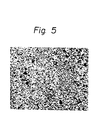
- the fine primary silicon crystals, the fine eutectic silicon crystals, and the fine intermetallic compounds are very finely dispersed in an intricate manner, which is a structural feature of the shaped body according to the present invention. From a comparison of Fig. 4 and Fig. 5, it would be understood that, although the distribution of the silicon crystals are the same in both figures, the intermetallic compounds are not formed in the shaped body according to a prior art (Fig. 5) are formed in the shaped body according to the present invention (Fig. 4).
- the shaped body of the aluminum alloy powder containing an element selected from the group consisting of manganese and iron had virtually the same structure as that of Fig. 4.
- a hot-extruded shaped body contains a solid lubricant
- the solid lubricant is elongated in the extrusion direction.
- the solid lubricant is not fused during the hot extrusion.
- High Si-aluminum alloy melts having the compositions given in Table 1 were atomized with inert gas to obtain aluminum alloy powders -48 mesh in size.
- the aluminum alloy powders were preheated to 250°C and then were loaded into a metal die which was heated to and held at 250°C.
- the aluminum alloy powders were compacted under a pressure of 1.5 tons/cm 2 to produce green compacts having a diameter of 100 mm and a length of 200 mm.
- the green compacts were heated to 450°C and then were loaded into a container 104 mm in diameter, and the container was heated to and held at 450°C.
- the container was then subjected to indirect extrusion at an extrusion ratio of 12, using a die 30 mm in diameter, so as to obtain shaped bodies.
- Example Nos. 1 through 10 To compare the shaped bodies (Sample Nos. 1 through 10) with a cast body, an A 309.0 alloy was cast in a metal mold, and the obtained cast body was heated to 500°C and held there for ten hours. Then the cast body was water-cooled and was subjected to aging at 175°C for ten hours. This sample is listed in Table 1 as "Comparative Sample (Casting)".
- the tensile strength, elongation, and hardness at room temperature, 200°C and 250°C of all of the samples were measured.
- the gauge length of and the diameter of a parallel portion of the specimens in which tensile strength and elongation were measured were 50 mm and 6 mm, respectively.
- the specimens were held at 200°C and 250°C for 100 hours and then a tensile force was applied thereto.
- the hardness at the gripped end portion of each specimen was measured after the tensile strength and elongation were measured.
- the shaped bodies according to the present invention had a high-temperature strength higher than the high-temperature strength of the comparative shaped bodies (Sample Nos. 1 through 6) and the Comparative Sample (Casting).
- the hardness i.e., the hardness measured after holding the samples at 200°C and 250°C, was higher in the present invention than in the Comparative Samples and the Comparative Sample (Casting).
- the shaped bodies which were formed by means of the procedure described above were cut and then hot-forged to produce discs approximately 70 mm in diameter and approximately 10 mm in thickness.
- the discs were machined to produce specimens for measuring the scuffing resistance, the wear resistance, and the friction coefficient.
- the scuffing tester used is schematically illustrated in Figs. 13 and 14.
- a specimen 5 in the form of a disc 70 mm in diameter is detachably mounted on a stator 4.
- Lubricating oil is supplied at a predetermined rate, via an oil orifice 6 and a central aperture, to the specimen 5.
- the stator 4 is operably connected with a hydraulic means (not shown) so that a predetermined pressure P can be applied in the direction of a rotor 7.
- the rotor 7 is arranged opposite the specimen 5, and a rotation of a predetermined velocity is imparted to the rotor 7 by means of a driving means (not shown).
- Four opposed-member samples 8 in the form of a four-sided prism 5 mm x 5 mm x 10 mm in size are detachably mounted on a holding jig 7a secured to the circumferential end of the rotor 7.
- the four opposed-member samples 8 are arranged equidistantly from each other on a circular line, and the square end portions thereof, which are 5 mm x 5 mm in size, are slidably in contact with the specimen 5 under the presence of lubricating oil between the opposed-member samples 8 and the specimen 5. Since friction is generated between the opposed-member samples 8 and the specimen 5 due to the rotation of the rotor 7, a torque T is generated in the stator 4. The torque T is imparted, via a spindle 9, to a load cell 10. A recorder 12 is connected, via a dynamic strain gauge 11, to the load cell 10.
- the pressure P is stepwise increased hourly, and a change in the torque T is detected by the dynamic strain gauge 11 and is recorded by the recorder 12. An abrupt increase in the torque T indicates the generation of scuffing.
- the pressure P at this time is given in Table 2 as the scuffing surface pressure.
- a high scuffing surface pressure denotes a high scuffing resistance.
- samples (A) and samples (B) were combined to determine the influence of the different kinds of material of the opposed-member samples on the scuff resistance.
- the heat treatment to which these samples were subjected was not the one described above but was one carried out at 300°C for 100 hours.
- the heat-treated samples were grounded.
- the square end portion (5 mm x 5 mm in size) of the nodular graphite cast iron used as the opposed-member samples 8 was plated with hard chromium.
- the Fe-plated SiC-dispersing body contained from 15 area % to 20 area % of SiC (averaging 0.8 ⁇ min size) and was iron-plated on the square end portion (5 mm x 5 mm in size) thereof.
- Gray cast iron used as the specimen 5 and hard chromium-plated nodular graphite cast iron used as the opposed-member sample 8 are frequently used in conventional gasoline engines.
- the testing conditions were as follows:
- the scuff resistance of the shaped bodies according to the present invention was high and the difference in the scuffing seizure pressure, depending upon the material of the opposed members, was great in the Comparative Samples (Sample Nos. 1 and 2, the A 390.0 alloy, and the gray cast iron).
- the difference in the scuffing surface resistance was small and the scuff resistance against hard chromium-plated nodular graphite cast iron was relatively high and was comparable to that against the sample plated with SiC-dispersing iron.
- the above-described high scuff resistance according to the present invention seemed to be due to a large amount of hard dispersion phases in the Al matrix, which phases formed minute unevennesses suitable for retaining lubricating oil and dispersion-hardened the Al matrix so that it did not plastically flow and did not adhere to the opposed member when friction was generated.
- the scuff tester used in the scuff resistance test was also used for measuring the wear amount and the friction coefficient.
- Samples (A) and samples (B) were combined to determine the influence of the different kinds of material of the opposed-member samples on the wear amount and the friction coefficient.
- the samples were heat-treated at 300°C for 100 hours and then were grounded.
- the heat treatment corresponded to a heat cycle to which an aluminum cylinder liner is subjected when it is inserted into an aluminum alloy cylinder block body during casting.
- Opposed-member Samples 8 One nodular graphite cast iron body and one plated with SiC-dispersing iron.
- the opposed member samples 8 having square end portions 5 mm x 5 mm in size were a hard chromium plated nodular graphite castiron and the sample plated with SiC--dispersing iron containing from 15 area% to 20 area% of SiC (averaging 0.8 ⁇ m in size).
- the testing conditions were as follows:
- the wear amount was measured by the following procedure.
- a probe was displaced on the flat surface of the samples in four directions, the directions being traverse to the sliding direction and intersecting each other by 90°, in such a manner that it tracked the worn out traces, i.e., the concavities, formed due to the test.
- the tracing was recorded on a chart.
- the surface area of the concavities was measured, and thereby the wear amount of the samples was obtained.
- the wear amount of the samples is not expressed by an absolute value but is expressed by a relative value based on the wear amount at a sliding speed of 5 m/sec, using gray cast iron as the opposed-member specimens.
- the friction coefficient was determined by measuring the torque with the recorder 12 (Fig. 14) when the sliding length was 200 km.
- the friction coefficient of the shaped bodies according to the present invention i.e., Sample Nos. 7, 9, and 10 was considerably less than that of the gray cast iron.
- the wear amount of the shaped bodies according to the present invention was considerably less than that of the comparative shaped body (Sample No. 1) and was equal to or less than that of the gray cast iron, indicating that the shaped bodies according to the present invention had a high heat resistance and a high wear resistance which were not deteriorated under a thermal load.
- the wear amount of the shaped bodies according to the present invention was not influenced by the type of surface treatment of the opposed-member samples.
- Example 1 The procedure of Example 1 was repeated to produce the samples given in Table 4. However, the heat treatments to which the samples in which the tensile strength and elongation were measured were T 6 treatment and O treatment (300°C x 10 hours) as given in Table 4. Sample No. 19 was forged (F), i.e., was not heat-treated.
- Table 4 is similar to Table 1.
- Comparative Samples 1 through 6 is again given and denoted as Samples 11 through 16, respectively.
- the shaped bodies according to the present invention had a high-temperature strength higher than the high-temperature strength of the comparative shaped bodies (Sample Nos. 11 through 16) and Comparative Sample (Casting).
- the hardness i.e., the hardness measured after holding the samples at 200°C and 250°C, was higher in the present invention than in the comparative samples and the Comparative Sample (Casting).
- Table 5 which is similar to Table 2, illustrates the results of the scuff resistance test. The results were essentially the same as those illustrated in Table 2.
- Table 6 is similar to Table 3 and illustrates the results of measurement of the wear amount and the friction coefficient. The results were essentially the same as those in Table 3.
- High-Si aluminum alloy melts having the composition given in Table 7 were atomized with gas to obtain starting material powders -48 mesh in size.
- a solid lubricant or lubricants in the amount(s) given in Table 7 were added to the starting material powders and were homogeneously mixed therewith with a V-type cone mixer so as to prepare a powder mixture for use in the preparation of Sample Nos. 30, 32, 33, 34, and 35. Nitrogen gas was introduced into V-type cone mixer so as to prevent oxidation of the powder mixture.
- the solid lubricants were graphite powders 15 ⁇ m or less in size (trade name, KS-15; produced by LONZA Co., Ltd.), boron nitride powders 44 pm or less in size (trade name, UHP; produced by Showa Denko), and molybdenum disulfide powders 44 ⁇ m or less in size (produced by Nippon Molybdenum).
- the mixed powders (Sample Nos. 30 and 32 through 35) and the starting material powders (Sample No. 31) were preheated to a temperature of 250°C, were loaded into a metal die which was heated to and held at 250°C, and were compacted under a pressure of 1.5 tons/cm 2 to produce green compacts 90 mm in diameter and 200 mm in length.
- Each green compact was inserted into a cylinder made of 5051 alloy and having an outer diameter of 100 mm, an inner diameter of 90 mm, and a length of 205 mm.
- An end cover having a diameter of 90 mm and a thickness of 5 mm was fitted onto one end of the cylinder, and the joint portion between the end cover and the cylinder was caulked to prevent displacement of the end cover, thereby producing an intermediate billet (shown in Fig. 12).
- reference numerals 1, 2, and 3 denote a green compact, a cylinder, and an end cover, respectively.
- the billets for producing Sample Nos. 30 through 35 were hot-extruded by the following procedure. Each billet was heated to 450°C and then was inserted into a container in such a manner that the end cover 3 was positioned to ward the forward end of the cylinder, i.e., the end of the cylinder next to the die.
- the cylinder had an inner diameter of 90 mm and was heated to and held at approximately 450°C. Indirect extrusion was carried out at an extrusion ratio of 12 mm, using a die 30 mm diameter.
- the shaped bodies formed by indirect extrusion were subjected to tensile strength and elongation tests under the same procedures and the same conditions as in
- the high-temperature strength of the shaped bodies according to the present invention (Sample Nos. 32 through 35) is not low although they contain a solid lubricant.
- the room temperature hardness was higher in the present invention than in the comparative samples.
- the microscopic structure of Sample Nos. 32 through 35 was observed with respect to the cross sections thereof parallel to and perpendicular to the extrusion direction.
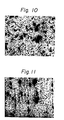
- the microscopic structure (containing BN) of Sample No. 32 perpendicular to the extrusion direction is shown in Fig. 10, and that parallel to the extrusion direction is shown in Fig. 11.
- the deeply dark phases consist of a solid lubricant and somewhat consist of dark phases consisting of intermetallic compounds containing nickel.
- the silicon crystals appear as white particles.
- the intermetallic compounds and silicon crystals were very finely and uniformly distributed as seen in both a direction perpendicular to and a direction parallel to the extrusion direction.
- the solid lubricant was uniformly dispersed as seen in a direction perpendicular to the extrusion direction and was elongated as seen in a direction parallel to the extrusion direction.
- Example 3 The procedure in Example 3 was repeated to produce the samples given in Table 10.
- Table 11 is similar to Table 8.
- Table 11 the tensile strength, the elongation, and the hardness of the shaped bodies according to the present invention are essentially the same as those in Table 8.
- Table 12 is similar to Table 9.
- the scuffing resistance of the shaped bodies according to the present invention is virtually the same as those shown in Table 9.
Landscapes
- Engineering & Computer Science (AREA)
- Chemical & Material Sciences (AREA)
- Mechanical Engineering (AREA)
- Combustion & Propulsion (AREA)
- General Engineering & Computer Science (AREA)
- Materials Engineering (AREA)
- Metallurgy (AREA)
- Organic Chemistry (AREA)
- Manufacturing & Machinery (AREA)
- Powder Metallurgy (AREA)
- Pistons, Piston Rings, And Cylinders (AREA)
Applications Claiming Priority (8)
| Application Number | Priority Date | Filing Date | Title |
|---|---|---|---|
| JP57119902A JPS5913041A (ja) | 1982-07-12 | 1982-07-12 | 耐熱耐摩耗性高力アルミニウム合金粉末成形体およびその製造方法 |
| JP57119901A JPS5913040A (ja) | 1982-07-12 | 1982-07-12 | 耐熱耐摩耗性高力アルミニウム合金粉末成形体およびその製造方法 |
| JP119901/82 | 1982-07-12 | ||
| JP119902/82 | 1982-07-12 | ||
| JP57167578A JPS5959856A (ja) | 1982-09-28 | 1982-09-28 | 潤滑性に優れた耐熱耐摩耗性高力アルミニウム合金粉末成形体 |
| JP16757782A JPS5959855A (ja) | 1982-09-28 | 1982-09-28 | 潤滑性に優れた耐熱耐摩耗性高力アルミニウム合金粉末成形体およびその製造方法 |
| JP167578/82 | 1982-09-28 | ||
| JP167577/82 | 1982-09-28 |
Publications (3)
| Publication Number | Publication Date |
|---|---|
| EP0100470A2 true EP0100470A2 (de) | 1984-02-15 |
| EP0100470A3 EP0100470A3 (en) | 1985-11-21 |
| EP0100470B1 EP0100470B1 (de) | 1990-05-23 |
Family
ID=27470634
Family Applications (1)
| Application Number | Title | Priority Date | Filing Date |
|---|---|---|---|
| EP83106849A Expired EP0100470B1 (de) | 1982-07-12 | 1983-07-12 | Hitzebeständiges und Verschleissbeständiges Aluminiumlegierungspulver mit guten mechanischen Eigenschaften und daraus hergestellte Gegenstände |
Country Status (4)
| Country | Link |
|---|---|
| US (1) | US4938810A (de) |
| EP (1) | EP0100470B1 (de) |
| CA (1) | CA1230761A (de) |
| DE (1) | DE3381592D1 (de) |
Cited By (17)
| Publication number | Priority date | Publication date | Assignee | Title |
|---|---|---|---|---|
| EP0133144A1 (de) * | 1983-07-21 | 1985-02-13 | Cegedur Societe De Transformation De L'aluminium Pechiney | Verfahren zur Herstellung von stranggepresstem Halbzeug aus Aluminiumpulver hoher Festigkeit |
| US4537167A (en) * | 1982-12-09 | 1985-08-27 | Cegedur Societe de Transformation de L'Aluminim Pechiney | Engine cylinder liners based on aluminum alloys and intermetallic compounds, and methods of obtaining them |
| EP0112787B1 (de) * | 1982-12-08 | 1986-04-16 | Cegedur Societe De Transformation De L'aluminium Pechiney | Einsetzstück für Dieselbrennkraftmaschinen, aus Aluminium-Silizium-Legierung mit Wärmewiderstand und verbesserter Bearbeitbarkeit |
| EP0147769A3 (en) * | 1983-12-19 | 1987-03-25 | Sumitomo Electric Industries Limited | Dispersion-strengthened heat- and wear-resistant aluminum alloy and process for producing same |
| US4702885A (en) * | 1983-12-02 | 1987-10-27 | Sumitomo Electric Industries, Ltd. | Aluminum alloy and method for producing the same |
| FR2604186A1 (fr) * | 1986-09-22 | 1988-03-25 | Peugeot | Procede de fabrication de pieces en alliage d'aluminium hypersilicie obtenu a partir de poudres refroidies a tres grande vitesse de refroidissement |
| EP0341714A1 (de) * | 1988-05-12 | 1989-11-15 | Sumitomo Electric Industries, Ltd. | Verfahren zur Verformung eines grossen Produktes aus Aluminiumlegierung |
| EP0366134A1 (de) * | 1988-10-27 | 1990-05-02 | Toyo Aluminium Kabushiki Kaisha | Aluminium-Legierung, verwendbar im Pulvermetallurgieverfahren |
| EP0367229A1 (de) * | 1988-10-31 | 1990-05-09 | Sumitomo Electric Industries, Ltd. | Wärmebeständige, verschleissbeständige und hochfeste Al-Si-Legierung und ihre Verwendung für Zylinderbuchsen |
| US4959195A (en) * | 1988-05-12 | 1990-09-25 | Sumitomo Electric Industries, Ltd. | Method of forming large-sized aluminum alloy product |
| EP0566098A3 (en) * | 1992-04-16 | 1993-11-24 | Toyota Motor Co Ltd | Heat resistant aluminum alloy powder, heat resistant aluminum alloy and heat and wear resistant aluminum alloy-based composite material |
| EP0622469A1 (de) * | 1993-04-30 | 1994-11-02 | Toyota Jidosha Kabushiki Kaisha | Aluminium-Legierung und ihre Verwendung als Pulver für Gleitkörper |
| US5374295A (en) * | 1992-03-04 | 1994-12-20 | Toyota Jidosha Kabushiki Kaisha | Heat resistant aluminum alloy powder, heat resistant aluminum alloy and heat and wear resistant aluminum alloy-based composite material |
| US5409661A (en) * | 1991-10-22 | 1995-04-25 | Toyota Jidosha Kabushiki Kaisha | Aluminum alloy |
| US5614036A (en) * | 1992-12-03 | 1997-03-25 | Toyota Jidosha Kabushiki Kaisha | High heat resisting and high abrasion resisting aluminum alloy |
| US6086819A (en) * | 1995-09-01 | 2000-07-11 | Erbsloh Aktiengesellschaft | Process for manufacturing thin-walled pipes |
| US6136106A (en) * | 1995-09-01 | 2000-10-24 | Erbsloh Aktiengesellschaft | Process for manufacturing thin pipes |
Families Citing this family (19)
| Publication number | Priority date | Publication date | Assignee | Title |
|---|---|---|---|---|
| US5198137A (en) * | 1989-06-12 | 1993-03-30 | Hoeganaes Corporation | Thermoplastic coated magnetic powder compositions and methods of making same |
| US5306524A (en) * | 1989-06-12 | 1994-04-26 | Hoeganaes Corporation | Thermoplastic coated magnetic powder compositions and methods of making same |
| JPH072980B2 (ja) * | 1990-09-20 | 1995-01-18 | 大同メタル工業株式会社 | 複合摺動材料 |
| EP0657553A1 (de) * | 1993-11-10 | 1995-06-14 | Sumitomo Electric Industries, Ltd. | Stickstoffhaltige Aluminium-Silizium pulvermetallurgische Legierung |
| US5545487A (en) * | 1994-02-12 | 1996-08-13 | Hitachi Powdered Metals Co., Ltd. | Wear-resistant sintered aluminum alloy and method for producing the same |
| DE19523484C2 (de) * | 1995-06-28 | 2002-11-14 | Daimler Chrysler Ag | Verfahren zum Herstellen einer Zylinderlaufbüchse aus einer übereutektischen Aluminium/Silizium-Legierung zum Eingießen in ein Kurbelgehäuse einer Hubkolbenmaschine und danach hergestellte Zylinderlaufbüchse |
| DE4438550C2 (de) * | 1994-10-28 | 2001-03-01 | Daimler Chrysler Ag | Verfahren zur Herstellung einer in ein Kurbelgehäuse einer Hubkolbenmaschine eingegossenen Zylinderlaufbüchse aus einer übereutektischen Aluminium-Silizium-Legierung |
| DE19532244C2 (de) * | 1995-09-01 | 1998-07-02 | Peak Werkstoff Gmbh | Verfahren zur Herstellung von dünnwandigen Rohren (I) |
| US5916390A (en) * | 1995-10-30 | 1999-06-29 | Mercedes-Benz Ag | Cylinder liner comprising a supereutectic aluminum/silicon alloy for sealing into a crankcase of a reciprocating piston engine and method of producing such a cylinder liner |
| JP3173452B2 (ja) * | 1997-02-28 | 2001-06-04 | 株式会社豊田中央研究所 | 耐摩耗性被覆部材及びその製造方法 |
| US6332906B1 (en) * | 1998-03-24 | 2001-12-25 | California Consolidated Technology, Inc. | Aluminum-silicon alloy formed from a metal powder |
| US5965829A (en) * | 1998-04-14 | 1999-10-12 | Reynolds Metals Company | Radiation absorbing refractory composition |
| US6962673B2 (en) * | 2001-03-23 | 2005-11-08 | Sumitomo Electric Sintered Alloy, Ltd. | Heat-resistant, creep-resistant aluminum alloy and billet thereof as well as methods of preparing the same |
| JP3940022B2 (ja) * | 2002-05-14 | 2007-07-04 | 日立粉末冶金株式会社 | 焼結アルミニウム合金の製造方法 |
| JP3945455B2 (ja) * | 2002-07-17 | 2007-07-18 | 株式会社豊田中央研究所 | 粉末成形体、粉末成形方法、金属焼結体およびその製造方法 |
| US6837915B2 (en) * | 2002-09-20 | 2005-01-04 | Scm Metal Products, Inc. | High density, metal-based materials having low coefficients of friction and wear rates |
| JP4954644B2 (ja) * | 2006-08-31 | 2012-06-20 | 日本ピストンリング株式会社 | シリンダライナとピストンリングの組み合わせ |
| CN117144204A (zh) * | 2023-09-13 | 2023-12-01 | 济南大学 | 铝活塞合金 |
| CN119549712B (zh) * | 2024-11-27 | 2025-09-19 | 中国航发北京航空材料研究院 | 一种提高强度及获得内聚力微观结构的粉末冶金方法 |
Family Cites Families (5)
| Publication number | Priority date | Publication date | Assignee | Title |
|---|---|---|---|---|
| DE1160194B (de) * | 1957-07-18 | 1963-12-27 | Metallgesellschaft Ag | Verwendung von Aluminium-Sinter-Werkstoffen fuer auf Gleitung beanspruchte Maschinenteile |
| US3325279A (en) * | 1965-12-03 | 1967-06-13 | Dow Chemical Co | Aluminum-high silicon alloys |
| GB1431895A (en) * | 1972-06-30 | 1976-04-14 | Alcan Res & Dev | Production of aluminium alloy products |
| FR2343895A1 (fr) * | 1976-03-10 | 1977-10-07 | Pechiney Aluminium | Procede de fabrication de corps creux en alliages d'aluminium au silicium par filage de grenailles |
| US4135922A (en) * | 1976-12-17 | 1979-01-23 | Aluminum Company Of America | Metal article and powder alloy and method for producing metal article from aluminum base powder alloy containing silicon and manganese |
-
1983
- 1983-07-07 CA CA000432033A patent/CA1230761A/en not_active Expired
- 1983-07-12 EP EP83106849A patent/EP0100470B1/de not_active Expired
- 1983-07-12 DE DE8383106849T patent/DE3381592D1/de not_active Expired - Lifetime
-
1988
- 1988-10-18 US US07/259,402 patent/US4938810A/en not_active Expired - Lifetime
Cited By (22)
| Publication number | Priority date | Publication date | Assignee | Title |
|---|---|---|---|---|
| EP0112787B1 (de) * | 1982-12-08 | 1986-04-16 | Cegedur Societe De Transformation De L'aluminium Pechiney | Einsetzstück für Dieselbrennkraftmaschinen, aus Aluminium-Silizium-Legierung mit Wärmewiderstand und verbesserter Bearbeitbarkeit |
| US4537167A (en) * | 1982-12-09 | 1985-08-27 | Cegedur Societe de Transformation de L'Aluminim Pechiney | Engine cylinder liners based on aluminum alloys and intermetallic compounds, and methods of obtaining them |
| EP0133144A1 (de) * | 1983-07-21 | 1985-02-13 | Cegedur Societe De Transformation De L'aluminium Pechiney | Verfahren zur Herstellung von stranggepresstem Halbzeug aus Aluminiumpulver hoher Festigkeit |
| US4702885A (en) * | 1983-12-02 | 1987-10-27 | Sumitomo Electric Industries, Ltd. | Aluminum alloy and method for producing the same |
| EP0144898B1 (de) * | 1983-12-02 | 1990-02-07 | Sumitomo Electric Industries Limited | Aluminiumlegierungen und Verfahren zu ihrer Herstellung |
| EP0147769A3 (en) * | 1983-12-19 | 1987-03-25 | Sumitomo Electric Industries Limited | Dispersion-strengthened heat- and wear-resistant aluminum alloy and process for producing same |
| FR2604186A1 (fr) * | 1986-09-22 | 1988-03-25 | Peugeot | Procede de fabrication de pieces en alliage d'aluminium hypersilicie obtenu a partir de poudres refroidies a tres grande vitesse de refroidissement |
| EP0265307A1 (de) * | 1986-09-22 | 1988-04-27 | Automobiles Peugeot | Verfahren zur Herstellung von Gegenständen aus hypereutektischen Aluminium-Siliziumlegierungen, hergestellt aus extrem rasch abgekühlten Pulvern |
| US4959195A (en) * | 1988-05-12 | 1990-09-25 | Sumitomo Electric Industries, Ltd. | Method of forming large-sized aluminum alloy product |
| EP0341714A1 (de) * | 1988-05-12 | 1989-11-15 | Sumitomo Electric Industries, Ltd. | Verfahren zur Verformung eines grossen Produktes aus Aluminiumlegierung |
| EP0366134A1 (de) * | 1988-10-27 | 1990-05-02 | Toyo Aluminium Kabushiki Kaisha | Aluminium-Legierung, verwendbar im Pulvermetallurgieverfahren |
| EP0367229A1 (de) * | 1988-10-31 | 1990-05-09 | Sumitomo Electric Industries, Ltd. | Wärmebeständige, verschleissbeständige und hochfeste Al-Si-Legierung und ihre Verwendung für Zylinderbuchsen |
| US4959276A (en) * | 1988-10-31 | 1990-09-25 | Sumitomo Electric Industries, Ltd. | Heat-resistant, wear-resistant and high-strength Al-Si alloy, and cylinder liner employing same |
| US5409661A (en) * | 1991-10-22 | 1995-04-25 | Toyota Jidosha Kabushiki Kaisha | Aluminum alloy |
| US5374295A (en) * | 1992-03-04 | 1994-12-20 | Toyota Jidosha Kabushiki Kaisha | Heat resistant aluminum alloy powder, heat resistant aluminum alloy and heat and wear resistant aluminum alloy-based composite material |
| EP0566098A3 (en) * | 1992-04-16 | 1993-11-24 | Toyota Motor Co Ltd | Heat resistant aluminum alloy powder, heat resistant aluminum alloy and heat and wear resistant aluminum alloy-based composite material |
| US5464463A (en) * | 1992-04-16 | 1995-11-07 | Toyota Jidosha Kabushiki Kaisha | Heat resistant aluminum alloy powder heat resistant aluminum alloy and heat and wear resistant aluminum alloy-based composite material |
| US5614036A (en) * | 1992-12-03 | 1997-03-25 | Toyota Jidosha Kabushiki Kaisha | High heat resisting and high abrasion resisting aluminum alloy |
| EP0622469A1 (de) * | 1993-04-30 | 1994-11-02 | Toyota Jidosha Kabushiki Kaisha | Aluminium-Legierung und ihre Verwendung als Pulver für Gleitkörper |
| US5478418A (en) * | 1993-04-30 | 1995-12-26 | Toyota Jidosha Kabushiki Kaisha | Aluminum alloy powder for sliding members and aluminum alloy therefor |
| US6086819A (en) * | 1995-09-01 | 2000-07-11 | Erbsloh Aktiengesellschaft | Process for manufacturing thin-walled pipes |
| US6136106A (en) * | 1995-09-01 | 2000-10-24 | Erbsloh Aktiengesellschaft | Process for manufacturing thin pipes |
Also Published As
| Publication number | Publication date |
|---|---|
| EP0100470A3 (en) | 1985-11-21 |
| EP0100470B1 (de) | 1990-05-23 |
| DE3381592D1 (de) | 1990-06-28 |
| US4938810A (en) | 1990-07-03 |
| CA1230761A (en) | 1987-12-29 |
Similar Documents
| Publication | Publication Date | Title |
|---|---|---|
| EP0100470B1 (de) | Hitzebeständiges und Verschleissbeständiges Aluminiumlegierungspulver mit guten mechanischen Eigenschaften und daraus hergestellte Gegenstände | |
| EP0144898B1 (de) | Aluminiumlegierungen und Verfahren zu ihrer Herstellung | |
| US4099314A (en) | Method of producing hollow bodies in aluminum-silicon alloys by powder-extrusion | |
| JPS61291941A (ja) | Si含有量が高いAl鋳造合金 | |
| US5976214A (en) | Slide member of sintered aluminum alloy and method of manufacturing the same | |
| JPH0118982B2 (de) | ||
| US5494540A (en) | Abrasion-resistant aluminum alloy and method of preparing the same | |
| EP1943039B1 (de) | Verfahren zur herstellung einer verschleissbeständigen aluminiumlegierung, nach dem verfahren erhaltene aluminiumlegierung und deren verwendung | |
| JPH0137464B2 (de) | ||
| JPS6050138A (ja) | 硬質粒子分散型耐熱耐摩耗性高力アルミニウム合金部材とその製造方法 | |
| US4155756A (en) | Hollow bodies produced by powder extrusion of aluminum-silicon alloys | |
| JPS5913040A (ja) | 耐熱耐摩耗性高力アルミニウム合金粉末成形体およびその製造方法 | |
| JPS6050137A (ja) | 硬質粒子分散型耐熱耐摩耗性高力アルミニウム合金部材 | |
| JPH029099B2 (de) | ||
| JPH0118983B2 (de) | ||
| JP3897416B2 (ja) | 粉末アルミ合金製シリンダーライナ | |
| JPS5966918A (ja) | アルミニウム合金製複層構造中空部材 | |
| JPS63266004A (ja) | 耐熱耐摩耗性高力アルミニウム合金粉末 | |
| JPS61295301A (ja) | 耐熱性高カアルミニウム合金粉末およびその成形体 | |
| JPS5959856A (ja) | 潤滑性に優れた耐熱耐摩耗性高力アルミニウム合金粉末成形体 | |
| JPS61257450A (ja) | 耐熱アルミニウム合金 | |
| JPH01132736A (ja) | 潤滑性に優れた耐熱耐摩耗性高力アルミニウム合金粉末成形体およびその製造方法 | |
| JPH01243A (ja) | 耐熱・耐摩耗アルミニウム合金 | |
| JP2000088102A (ja) | 耐摩環 | |
| JPH01132727A (ja) | 潤滑性に優れた耐熱耐摩耗性高力アルミニウム合金粉末成形体の製造方法 |
Legal Events
| Date | Code | Title | Description |
|---|---|---|---|
| PUAI | Public reference made under article 153(3) epc to a published international application that has entered the european phase |
Free format text: ORIGINAL CODE: 0009012 |
|
| AK | Designated contracting states |
Designated state(s): DE FR GB IT |
|
| PUAL | Search report despatched |
Free format text: ORIGINAL CODE: 0009013 |
|
| AK | Designated contracting states |
Designated state(s): DE FR GB IT |
|
| 17P | Request for examination filed |
Effective date: 19860514 |
|
| 17Q | First examination report despatched |
Effective date: 19870324 |
|
| GRAA | (expected) grant |
Free format text: ORIGINAL CODE: 0009210 |
|
| AK | Designated contracting states |
Kind code of ref document: B1 Designated state(s): DE FR GB IT |
|
| ITF | It: translation for a ep patent filed | ||
| REF | Corresponds to: |
Ref document number: 3381592 Country of ref document: DE Date of ref document: 19900628 |
|
| ET | Fr: translation filed | ||
| PLBE | No opposition filed within time limit |
Free format text: ORIGINAL CODE: 0009261 |
|
| STAA | Information on the status of an ep patent application or granted ep patent |
Free format text: STATUS: NO OPPOSITION FILED WITHIN TIME LIMIT |
|
| 26N | No opposition filed | ||
| ITTA | It: last paid annual fee | ||
| PGFP | Annual fee paid to national office [announced via postgrant information from national office to epo] |
Ref country code: DE Payment date: 20010702 Year of fee payment: 19 |
|
| PGFP | Annual fee paid to national office [announced via postgrant information from national office to epo] |
Ref country code: GB Payment date: 20010711 Year of fee payment: 19 |
|
| PGFP | Annual fee paid to national office [announced via postgrant information from national office to epo] |
Ref country code: FR Payment date: 20010712 Year of fee payment: 19 |
|
| REG | Reference to a national code |
Ref country code: GB Ref legal event code: IF02 |
|
| PG25 | Lapsed in a contracting state [announced via postgrant information from national office to epo] |
Ref country code: GB Free format text: LAPSE BECAUSE OF NON-PAYMENT OF DUE FEES Effective date: 20020712 |
|
| PG25 | Lapsed in a contracting state [announced via postgrant information from national office to epo] |
Ref country code: DE Free format text: LAPSE BECAUSE OF NON-PAYMENT OF DUE FEES Effective date: 20030201 |
|
| GBPC | Gb: european patent ceased through non-payment of renewal fee |
Effective date: 20020712 |
|
| PG25 | Lapsed in a contracting state [announced via postgrant information from national office to epo] |
Ref country code: FR Free format text: LAPSE BECAUSE OF NON-PAYMENT OF DUE FEES Effective date: 20030331 |
|
| REG | Reference to a national code |
Ref country code: FR Ref legal event code: ST |