EP0100833A2 - Procédé et installation pour la préparation de jus d'agrumes et de boissons à base de jus d'agrumes et de pulpe de fruit - Google Patents
Procédé et installation pour la préparation de jus d'agrumes et de boissons à base de jus d'agrumes et de pulpe de fruit Download PDFInfo
- Publication number
- EP0100833A2 EP0100833A2 EP83105591A EP83105591A EP0100833A2 EP 0100833 A2 EP0100833 A2 EP 0100833A2 EP 83105591 A EP83105591 A EP 83105591A EP 83105591 A EP83105591 A EP 83105591A EP 0100833 A2 EP0100833 A2 EP 0100833A2
- Authority
- EP
- European Patent Office
- Prior art keywords
- product
- arrangement according
- vacuum
- degasser
- vacuum degasser
- Prior art date
- Legal status (The legal status is an assumption and is not a legal conclusion. Google has not performed a legal analysis and makes no representation as to the accuracy of the status listed.)
- Granted
Links
Images
Classifications
-
- A—HUMAN NECESSITIES
- A23—FOODS OR FOODSTUFFS; TREATMENT THEREOF, NOT COVERED BY OTHER CLASSES
- A23L—FOODS, FOODSTUFFS OR NON-ALCOHOLIC BEVERAGES, NOT OTHERWISE PROVIDED FOR; PREPARATION OR TREATMENT THEREOF
- A23L2/00—Non-alcoholic beverages; Dry compositions or concentrates therefor; Preparation or treatment thereof
- A23L2/02—Non-alcoholic beverages; Dry compositions or concentrates therefor; Preparation or treatment thereof containing fruit or vegetable juices
- A23L2/04—Extraction of juices
- A23L2/06—Extraction of juices from citrus fruits
-
- B—PERFORMING OPERATIONS; TRANSPORTING
- B01—PHYSICAL OR CHEMICAL PROCESSES OR APPARATUS IN GENERAL
- B01F—MIXING, e.g. DISSOLVING, EMULSIFYING OR DISPERSING
- B01F27/00—Mixers with rotary stirring devices in fixed receptacles; Kneaders
- B01F27/05—Stirrers
- B01F27/11—Stirrers characterised by the configuration of the stirrers
- B01F27/113—Propeller-shaped stirrers for producing an axial flow, e.g. shaped like a ship or aircraft propeller
- B01F27/1132—Propeller-shaped stirrers for producing an axial flow, e.g. shaped like a ship or aircraft propeller with guiding tubes or tubular segments fixed to and surrounding the tips of the propeller blades, e.g. for supplementary mixing
Definitions
- the invention relates to a method for producing citrus fruit juices and beverages based on citrus fruit juices with pulp according to the preamble of claim 1.
- the invention further relates to an arrangement for carrying out the manufacturing method according to the invention.
- pulp juices, nectars and fruit juice drinks contain pulp as more or less fine floating particles that are obtained during the pressing process of the fruit.
- Attempts have also been made to produce fruit juices, nectars and fruit juice drinks that contain long-fiber pulp - called fruit pulp - in size, appearance and distribution similar to that of a freshly squeezed juice.
- the processing of the necessary raw materials causes considerable difficulties due to the long-fiber components; There are blockages in parts of the manufacturing systems such as pipes, fittings, system units, plate heaters, pumps.
- the object of the invention is to avoid a method and an arrangement while avoiding the above disadvantages for the production and hot filling of still citrus fruit juices and beverages based on citrus fruit juices on an industrial scale, in which a product is obtained from common raw materials that has a consistently high content of long-fiber pulp in size, appearance and distribution similar to that of a freshly pressed one Juice has, without it during product mixing, pasteurization, degassing and filling to product separation, change in the pulp structure or plug formation in the packaging during or after filling.
- the citrus fruit juices should in particular have a high content of long-fiber pulp from the edible part of the fruit. This means a content of 3 to 5 percent by volume of pulp.
- the long-fiber pulp should have a length of up to 20 mm.
- the process according to the invention enables the production of practically gas-free (oxygen, carbon dioxide, nitrogen) fruit juices, nectars or fruit juice drinks which, in addition to the usual fruit juice containing fine turbidity components, contain a defined and clearly visible content of relatively large vesicles and pulp fibers from the endocarp of the fruit.
- These long-fiber components are separated in conventional production processes for fruit juices, for example using so-called finishers, and should be preserved as completely as possible; ie they are extracted as gently as possible.
- finishers so-called finishers
- the process measures used according to the invention also serve the purpose of those originally present when the raw materials are mixed The pulp structure cannot be changed during the processing process.
- the raw materials for the process according to the invention e.g. Fruit juices, fruit juice concentrates with or without pulp, long-fiber pulp, vesicles, fruit juice flavors can be produced using conventional methods. Frozen raw materials are preferably used, which are then mixed with hot water according to the desired recipe and faster thawing. If necessary, conventional additives can also be added, e.g. Sugar, vitamins and preservatives.
- the homogeneous and, optionally pasteurized product is constant under reduced pressure, preferably 500-600 mbar, at a temperature of, for example, 90-95 0 C and 120-200 mbar degassed 50-60 0 C at a temperature of eg.
- the residence time in the degasser is usually 30-120 seconds and can be varied depending on the desired or necessary degassing intensity by changing the average filling quantity.
- the vaporous mixture escaping during the degassing is preferably condensed in two stages by means of fresh water and refrigerant, and the aromatic condensate recovered is fed back continuously and in a quantitatively equivalent amount into the degassed product stream.
- the product which is mixed gently in the mixing stage and without the influence of air, can, depending on the desired degassing intensity can be pasteurized before or after degassing. Because of the risk of clogging, pasteurization is not carried out in conventional plate heat exchangers, but is carried out in a product-friendly manner in double-tube heat exchangers which belong to the arrangement according to the invention.
- the pasteurization temperature is usually 90-95 ° C because of the pulp content, the throughput time in the double-tube heat exchanger, in its second heating stage to be described, about 110 seconds. In the case of high-temperature degassing in the vacuum degasser to be described, the throughput time is 30-120 seconds, which also serves to extend the pasteurization time.
- the vacuum degassed and pasteurized product is finally fed to a filling device, e.g. a so-called vacuum filler, and there in suitable.
- a filling device e.g. a so-called vacuum filler
- Containers e.g. Bottles, cans, cardboard packaging filled hot.
- the product is preferably also stirred during these processes, and at a reduced speed compared to the previous mixing process, so that it does not cause air hammering and injury, fragmentation or Shortening of the flesh comes.
- So-called jet mixers are preferably used as stirrers, each having a rotor which can be rotated in a slotless stator welded to a stator tube.
- the guide jet mixer is preferably designed with a slotless stator tube with an outside diameter of 350 mm and operated at a speed (minimum speed) of 300 to 700 rpm acting on the rotor.
- the mixing speed or stirring speed is level-controlled and can be switched depending on the level of the product. This means that the product can be thoroughly mixed at high speed during the actual mixing process when the level is high. During the subsequent emptying of the mixing tank, when the level drops, on the other hand, the stirrer is switched to a lower speed, which is sufficient to keep the mixture components, in particular the long-fiber pulp in suspension.
- the speed can be adjusted by pole-changing electric motors or by a continuously variable transmission.
- the characteristics of the jet mixer and its mixing speed as well as its installation depth and installation angle are adapted to the shape of the container in such a way that injury or fragmentation of the pulp is reliably avoided.
- an installation depth of 900 mm and an installation angle of 55 ° to the vertical tank wall have proven to be advantageous.
- the bottom shape of the mixing tank or another container in which the stirrer is arranged here has good suspension retention, preferably an asymmetrical shape.
- the degasser essentially consists of a vacuum chamber connected to a vacuum pump. In this homogeneously mixed and optionally already pasteurized product through a 45 0- Kegeleinüse is around a radius of 360 0 sprayed.
- the degasser is preferably designed as a high-temperature degasser.
- At least one double-tube heat exchanger provided with a flow vessel is used for pasteurization, which is located between the mixing tank and the Degasser is switched.
- a two-stage double-tube heat exchanger is provided for pasteurization and product-dependent degassing, the first stage of which is connected upstream of the degasser and the second stage of which is either either connected upstream of the degasser or is arranged behind the outlet of the degasser.
- a stronger degassing takes place; it is preferably used for products containing pulp.
- a filling device is arranged in which the product e.g. is filled hot on bottles, cans, cardboard packaging.
- heat recovery is used advantageously according to claim 11, wherein first a BlackBerryan maybermung to 50-60 0 C takes place.
- the heated water resulting from the container or package recooling by means of water sprinkling and / or spraying in the recooler is pumped with the recuperation pump to the steam-heated countercurrent apparatus, in which only the water reheating necessary for juice heating takes place.
- the last product heating to pasteurization temperature of e.g. 95 ° C in the second stage by means of temperature-controlled hot water secondary circuit (via counterflow apparatus).
- the undesirable effect of aroma evaporation in the effective part of the system Evaporator undone is charged with fresh water at approx. 10-15 ° C and with a refrigerant at approx. -5 ° C.
- the plant part is designed in such a way that, depending on the product degassing effect to be achieved, alternatively, degassing can be carried out at, for example, 50-60 ° C or at, for example, 90-95 ° C under vacuum and still with the latter high-temperature degassing the full desired liquid aroma recuperation is guaranteed.
- a more intensive degassing is achieved by the stirrer arranged in the degasser according to claim 14, and sedimentation of the pulp is avoided.
- the speed of the stirrer is level-controlled so that there is no gas impact.
- the preferred embodiment of the arrangement according to claim 15 avoids a harmful effect of an excessive temperature increase in the degasser. This effect means that if the temperature is too high, the product loses too much aroma, which cannot be fully recovered by condensation. To avoid this /, when the discharge temperature of the degassed product exceeds a preset value to the thermostat, the pressure in the degasser by supply of fluid under atmospheric pressure air lifted. As a result, the negative pressure largely breaks down and there is therefore no boiling out of the product. If the temperature falls below the maximum temperature again, the solenoid valve closes and the specified vacuum can be restored.
- a given vacuum remains pressure degasser in the bottom preferably constant.
- a vacuum holding valve is provided on the degasser according to claim 16. This vacuum holding valve is in particular provided with a pressure setting scale which can be adjusted by spring force. The negative pressure is thus maintained over the entire degassing time or operating time of the degasser, regardless of the product temperature prevailing in the degasser.
- the pressure relief valve permits pressure sterilization, for example at 120 ° C., while the cleaning spray ball is provided for cleaning the degasser interior in a continuous process in a closed system.
- the pipe probe built into the degasser's product drain line which switches off the suction pump without delay, ensures that the suction pump is protected against dry running and avoids air and / or gas impacts in the pipe system.
- a packaging inlet stopper of the filling device is advantageously actuated by an electrical pulse generated by the tube probe, as a result of which the filling device is emptied of packaging that is still in it.
- the suction pump can advantageously only be switched on to a normal level after the degasifier has been refilled, which is initiated by a built-in float switch.
- control valve is not only used to automatically set the level in the vacuum degasser in conjunction with the float switch to a desired level to be regulated by regulating the product inflow. Rather, the control valve, operated by hand control, is also used to control the product inflow in the juice start-up and shutdown mode in such a way that there is no mixing with the water previously flowing through the system, in particular the vacuum degasser, for cleaning. For this purpose, a sight glass arranged in the product supply line upstream of the control valve is observed.
- the product can be returned to the flow vessel instead of the filling device, so that no impairment of system parts by dry running can occur.
- This cycle is maintained until a maximum probe likewise arranged in the flow vessel signals that the product has reached a predetermined fill level.
- a packaging inlet stopper of the filling device can be activated by an electrical pulse emitted by the minimum level probe, so that the filling device is still empty from the packaging inside.
- an optical and acoustic signal can indicate the fault.
- a level-controlled stirrer is advantageously provided in the filling device, the speed of which can also be adapted to a fluctuating liquid level, on the one hand to avoid sedimentation or segregation, but on the other hand also to prevent air from entering and no destruction of the pulp.
- stirrers in the flow vessel, the degasser and the filling device similarly to the stirrer in the mixing tank, are advantageously designed as a jet mixer.
- the vacuum degasser advantageously also acts as a hot holder for the product brought to pasteurization temperature.
- the prolongation of the product pasteurization time caused thereby in addition to the pasteurization time in the double tube heat exchanger to about 30 to 120 seconds is reliably killed by microorganisms which are increasingly carried in by pulp.
- degassing is improved. An additional tube hot holder is saved and the product drain line of the vacuum degasser is connected directly to the filling device.
- the temperature-controlled recooling takes place with fresh water, whereby the hot water can be used for heat recovery.
- the suction recovery pump starts, which draws the product out of the filler kettle at a lower capacity than the filling capacity.
- the product flows through the cooling double-tube heat exchanger by cooling it back in a temperature-controlled manner before re-entry into the flow vessel, into this flow vessel and can flow from there to pasteurize again.
- a further measure to avoid inadequate pasteurization is specified in claim 30.
- the product is then circulated until the product temperature is raised to the desired pasteurization temperature.
- the packaging inlet stopper can be actuated in synchronism with the changeover of the product cycle, as a result of which the filling device of packaging still in it is emptied.
- conveyor devices for conveying the product between the individual system parts are designed for product-friendly transport, i.e. so that no injuries, dismemberment or shortening of the pulp occur to any significant degree.
- the centrifugal pumps or self-priming rotary piston pumps are preferably operated at a speed which is lower than their nominal speed and with open impellers.
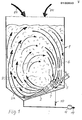
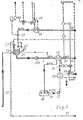
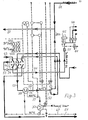
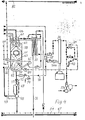
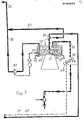
- FIGS. 1-5 product lines are shown with thick lines, lines for water and cleaning agent with thin lines, lines for steam and condensate with broken lines, lines for air and vacuum vapors additionally marked with dots and lines with thin cross lines Lines of electrical lines.
- 1 denotes a mixing tank, which is part of a plant for the production of an orange juice.
- the mixing tank has an asymmetrical bottom with a relatively flat section 2 and a relatively steep section 2a. From the deepest point of the floor between sections 2, 2a, a product drain line 3 starts, which leads to a centrifugal pump 4 with a free-flow impeller. The pump is operated at a lower speed than the nominal speed.
- a stirrer 5 Adjacent to the flatter section 2 of the base is a stirrer 5 designed as a guide jet mixer, which is aligned at an angle of 55 ° to a vertical wall of the mixing tank.
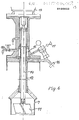
- the stirrer designed as a jet mixer has a slotless stator basket 7 with an outside diameter of preferably 300 mm, which is held in the vertical wall 6 by a stator tube 8 with an outside diameter of preferably 76 mm. Further details of the jet mixer are discussed below with reference to FIG. 6.
- the guide jet mixer or stirrer 5 is designed as a whole and arranged in the mixing tank in such a way that it generates the flow of the product indicated by the arrows 9, the mixed product also when the product is falling Although the liquid level is moved intensively, a vortex formation and air impact can be avoided.
- the mixer is level-controlled by means not shown, so that the stirrer is switched off when the product falls below a certain minimum level in the mixing tank.
- the residual amount in the mixing tank, which can no longer be moved without air impact, is so small that it can be filled in a few minutes.
- the product is fed to a flow vessel 20 via the centrifugal pump 4, line 19 and a float shut-off valve 22 leads.
- a float closing valve 22 for filling level regulation and a maximum level probe 23 extend into the flow vessel.
- These probes serve, in a manner to be described, to return the product in a closed product circuit to the supply vessel when the product level drops to a minimum and only supply the product to a vacuum degasser only in the case of high-temperature degassing and a filling device when the maximum of the product level in the flow vessel is reached.
- a heat exchanger that cools the product is designated as 24, which regulates the product, which may be returned to the flow vessel, in a circuit controlled by a temperature sensor 25 and a control valve 26 to a temperature of less than 40 °.
- the first stage 27 in FIG. 2 and the second stage 28 in FIG. 3 belong to a two-stage double-tube heat exchanger, which is provided as an essential component of a pasteurization system.
- Each stage of the double-tube heat exchanger includes a steam-heated countercurrent apparatus 29 or 30 29 guided line 31 also opens a cooling water line 32 which goes from a first stage 33 of a two-stage condensation device with stages 33 and 34 in Figure 4.
- the second stage of the condensation device is designated by 34.
- the cooling water line 32 opens into the line 31 in FIG. 2 in front of a recuperation pump 35. This means that part of the heat of condensation is recovered and in that for level control ** only with high-temperature degassing
- Both stages 27 and 28 of the double tube heat exchanger are equipped with temperature monitoring devices, each with a temperature sensor 36 or 37 and a valve 38 or 39, with which the temperature in the secondary circuit of the respective stage of the double tube heat exchanger by regulating the steam supply to the associated counterflow apparatus 29 or 30 is limited.
- the second stage 28 can be connected upstream of the vacuum degasser 41 in FIG. 4 by means of swivel bends 40 in series with the first stage or else at the bottom end 42 of the vacuum degasser can be connected downstream.
- the degassing in the vacuum degasser can take place depending on the product either at 50 - 60 ° C if the second stage of the double-tube heat exchanger is connected downstream of it, or take place at about 95 0 C if the second stage 28 of the double-tube heat exchanger Vacuum degasser is connected upstream.
- the degassing at 95 ° C is preferably carried out for products containing pulp and depends on the dissolved gas content in the mixed product. Products that do not contain pulp are preferably degassed at 50 - 60 ° C.
- FIG. 3 the positions of the swivel bends for degassing the product in the vacuum degasser 41 at approximately 50 ° C. are shown at 40a, while the position of the swivel bends at 40b enables degassing at approximately 90-95 ° C.
- the product flows via a line 43, a line section 44 and a control valve 45 for flow control or level control in the vacuum degasser 41 via a line 46 into the head end of the vacuum degasser.
- a product drain line leads via a suction pump 48, via a line 49 and swivel bends to the second stage 28 of the double tube heat exchanger. From the exit of the second stage 28, the pasteurized product is routed to a filling device 52 via a multi-way valve 50, usually via swivel bends in a line 51, see FIG. 5.
- the product flows from the first stage of the double-tube heat exchanger via line 43, a line section 53, a centrifugal pump 54 with a two-channel impeller, via a line section 55 into the second stage of the double-tube heat exchanger and from there in turn to the multi-way valve 50 and line 46 at the top of the vacuum degasser.
- the line 49 which connects to the product outlet line 47, is connected directly to the line 51 to the filling device 52 via swivel bends.
- temperature sensors 57 and 58 are arranged in lines 43 and 56 for temperature monitoring of the product to be heated or pasteurized, which are also equipped with valves 38 and 39 for regulating the steam supply via unidentified Temperature controllers are connected.
- FIG. 3 shows a sight glass 57 in the line section 44 for observing the product supply or observing cleaning liquid.
- the in Figure 4 shown vacuum degasser 41 is designed as a high temperature degasser. It has a 45 0 cone inlet nozzle 58, which sprays the incoming product in a thin layer of constant film thickness and spray radius.
- the vacuum is generated with a vacuum pump 59.
- the vacuum pump is connected to the head of the vacuum gasifier via the two-stage condensation device 33, 34.
- the vacuum in the vacuum degasser is set by a vacuum valve 43 and maintained regardless of the product temperature.
- two cleaning spray balls 61 and 62 are installed in the vacuum degasser, which permit cleaning in a continuous process.
- the level in the vacuum degasser is regulated by means of a level sensor 63 via a control line 64, which acts on the control valve 45. This means that a product-specific hot holding time and an optimal degassing time required for pasteurization can be observed.
- a stirrer 65 designed as a guide jet mixer is installed in the vacuum degasser, which is switched off by a further fill level transmitter 66 when the fill level falls below a predetermined level. Despite sufficient suspension of fruit parts in the vacuum degasser, this avoids gas being hammered into the product and the fruit particles being impaired, in particular being reduced in size.
- the fill level sensor 66 also controls via a control line 67, and a packaging inlet stop 68 in FIG. 5 is stopped.
- the suction pump 48 is switched off without delay by a tube probe 69 in the product drain line 47 when the vacuum degasser is almost completely emptied, as a result of which the pump runs dry and gas is prevented from entering the pipeline system.
- a control pulse arrives via the control line 67 to the packaging inlet stop 68 in order to empty only the packages located in the filling device 52.
- the two-stage condensation device 33, 34 connected to the head end of the vacuum degasser is connected to the product drain line 47 via an injector 70 and a sight glass 71.
- an injector 70 and a sight glass 71 As a result, the aroma obtained from the vapor vapors can again be metered into the degassed product.
- FIG. 5 shows how a filling device working according to the low vacuum principle is designed and arranged.
- the filling device has a filler tank 75, in which a level-controlled stirrer 76 is in turn arranged.
- the external filling valves of the filling device are designated 77, they can be brought into engagement with the packaging or containers 78. With the filling valves, the product with high solids content can be filled smoothly.
- the stirrer 76 which is preferably also controlled in speed depending on the level, prevents the product from segregating in the filler kettle, although its content is small in relation to the filler output, in particular 1: 120.
- a vapor line 79 preferably further degasses the product in the filler tank. Vapor line 79 is connected to vacuum pump 89.
- a minimum-maximum thermal sensor 80 actuates a regenerative pump 81 via a controller if the temperature of the degassed product falls below a minimum value, as a result of which the packaging could no longer be safely disinfected.
- the regenerative pump pumps with reduced power, the degassed product ⁇ he üb a conduit 82 through the cooling double-tube heat exchanger 24 into the feed tank 20 back, so that the product can pass through degasser vacuum a new pass through the stages of the double-pipe heat exchanger of the pasteurizing plant and the.
- the degassed product is supplied to the filling device with a reduced flow, the excess amount of product likewise being returned via a line 83 and line 82 to the flow vessel.
- the raw materials for orange juice production with the arrangement according to FIGS. 1-5 are orange juice concentrate delivered at -18-20 ° C., deep-frozen long-fiber fruit pulp and orange juice aroma and water.
- the components mentioned are introduced into the mixing tank, as indicated by the arrows 84, after they have been thawed by storage at room temperature to such an extent that container emptying into the mixing tank 1 is possible.
- warm water of 60-90 ° C. is placed in the mixing tank depending on the fruit pulp quantity and temperature.
- the water temperature is chosen so that after Dissolving the components and adjusting to the desired extract content a mixture temperature of approx. 10 ° C is reached.
- the components of the orange juice are mixed homogeneously in the mixing tank, avoiding air pockets and impairments, in particular cuts in the long-fiber pulp.
- the mixed product is fed to the flow vessel via the centrifugal pump 4 and is conveyed from there to the first stage 27 of the two-stage double-tube heat exchanger. A separation in this flow vessel is excluded by the stirrer 21, and there is also no injury to the fruit pulp.
- the mixed product is fed to the first stage of the double-tube heat exchanger by a centrifugal pump 21a with both possible settings of the swivel bends 40a and 40b.
- the product preheated to approx. 50 ° C arrives immediately, i.e. without further heating for degassing into the vacuum degasser 41 and from there into the second stage 28 of the double-tube heat exchanger for pasteurization.
- both stages of the double tube heat exchanger are connected in series, so that the product is heated to 90-95 ° C and pumped into the vacuum degasser. A further pasteurization takes place in the vacuum degasser during the holding period until the degassed product flows out of the bottom end 82 through the product drain line 47.
- the vacuum pump 59 is preceded by the two-stage condensation device with stages 33 and 34, to which fresh water - stage 33 - and refrigerant - stage 34 - are applied.
- the recovered aromatic condensate is injected via line 70 into the drain line.
- a homogeneous mixing of the product removed from the vacuum degasser is also ensured here by the stirrer 65.
- the suction pump 48 either conveys the ready-to-fill hot product to the filling device 52 or, before conveying it to the filling device, only introduces it into the second stage 28 of the double-tube heat exchanger, pasteurizes it and then pumps it to the filling device.
- the process parameters of the production process can be varied flexibly with the system discussed, which makes the system shown generally suitable for producing fruit juices, nectars and fruit juice drinks, for example from the known citrus fruits.
- Mixed fruit juices, mixed fruit nectars and mixed fruit juice beverages can also be produced, the juice content of which does not only consist of citrus juice content.
Landscapes
- Chemical & Material Sciences (AREA)
- Engineering & Computer Science (AREA)
- Health & Medical Sciences (AREA)
- Nutrition Science (AREA)
- Life Sciences & Earth Sciences (AREA)
- Food Science & Technology (AREA)
- Polymers & Plastics (AREA)
- Aviation & Aerospace Engineering (AREA)
- Chemical Kinetics & Catalysis (AREA)
- Non-Alcoholic Beverages (AREA)
- Food Preservation Except Freezing, Refrigeration, And Drying (AREA)
Priority Applications (1)
| Application Number | Priority Date | Filing Date | Title |
|---|---|---|---|
| AT83105591T ATE24099T1 (de) | 1982-06-07 | 1983-06-07 | Verfahren und anordnung zur herstellung von citrusfruchtsaeften und getraenken auf der grundlage von citrusfruchtsaeften mit fruchtfleisch. |
Applications Claiming Priority (2)
| Application Number | Priority Date | Filing Date | Title |
|---|---|---|---|
| DE19823221509 DE3221509A1 (de) | 1982-06-07 | 1982-06-07 | Verfahren und anordnung zur herstellung von citrusfruchtsaeften und getraenken auf der grundlage von citrusfruchsaeften mit fruchtfleisch |
| DE3221509 | 1982-06-07 |
Publications (3)
| Publication Number | Publication Date |
|---|---|
| EP0100833A2 true EP0100833A2 (fr) | 1984-02-22 |
| EP0100833A3 EP0100833A3 (en) | 1984-11-07 |
| EP0100833B1 EP0100833B1 (fr) | 1986-12-10 |
Family
ID=6165574
Family Applications (1)
| Application Number | Title | Priority Date | Filing Date |
|---|---|---|---|
| EP83105591A Expired EP0100833B1 (fr) | 1982-06-07 | 1983-06-07 | Procédé et installation pour la préparation de jus d'agrumes et de boissons à base de jus d'agrumes et de pulpe de fruit |
Country Status (3)
| Country | Link |
|---|---|
| EP (1) | EP0100833B1 (fr) |
| AT (1) | ATE24099T1 (fr) |
| DE (2) | DE3221509A1 (fr) |
Cited By (4)
| Publication number | Priority date | Publication date | Assignee | Title |
|---|---|---|---|---|
| EP0395140A3 (fr) * | 1989-04-28 | 1992-02-26 | The Procter & Gamble Company | Procédé de désaération pour la fabrication de jus de fruits |
| RU2140174C1 (ru) * | 1998-12-17 | 1999-10-27 | Общество с ограниченной ответственностью "Ассоциация БИС" | Апельсиновый безалкогольный напиток |
| DE102005037005A1 (de) * | 2005-08-05 | 2007-02-15 | Kurt Mohr | Verfahren und Vorrichtung zur Herstellung von Frucht-oder Gemüsesaft |
| WO2009149811A1 (fr) * | 2008-06-10 | 2009-12-17 | Khs Ag | Installation de pasteurisation |
Families Citing this family (4)
| Publication number | Priority date | Publication date | Assignee | Title |
|---|---|---|---|---|
| EP0350523B1 (fr) * | 1988-07-14 | 1992-03-25 | Deutsche Granini GmbH & Co. KG. | Procédé pour la production d'une boisson à base de jus de fruits |
| DE102014011880A1 (de) * | 2014-08-11 | 2016-02-11 | Remmers Baustofftechnik Gmbh | Verfahren und Vorrichtung zur Herstellung von Farben und Lacken |
| DE102016103968B4 (de) * | 2016-03-04 | 2019-01-17 | Alexander Westphal | Rührer, insbesondere Leitstrahlmischer und Rühreinrichtung umfassend einen Rührer |
| IT201900005090A1 (it) * | 2019-04-04 | 2020-10-04 | Navhetec S R L | Procedimento per la produzione di vescicole da succo di agrumi |
Family Cites Families (6)
| Publication number | Priority date | Publication date | Assignee | Title |
|---|---|---|---|---|
| CH87380A (fr) * | 1919-11-11 | 1920-12-01 | John G F Hieber | Procédé pour la stérilisation et l'emmagasinage des jus de fruits. |
| GB367105A (en) * | 1930-07-28 | 1932-02-18 | Tropical Vitamin Company Inc | Improvements in or relating to the production of citrus fruit concentrates |
| DE696796C (de) * | 1936-06-23 | 1940-09-30 | Ramesohl & Schmidt Akt Ges | Schleuder zum Entlueften, Klaeren und Impraegnieren von Fruchtsaeften mit Kohlensaeure |
| US2628168A (en) * | 1951-07-31 | 1953-02-10 | Gen Foods Corp | Process for heat-treating citrus juices |
| FR1497305A (fr) * | 1966-10-21 | 1967-10-06 | Citrus Equipment Corp | Appareil d'extraction de jus d'agrumes muni d'un dispositif séparant leur écorce de leur pulpe |
| DE2604009A1 (de) * | 1976-02-03 | 1977-08-11 | Holstein & Kappert Maschf | Verfahren zum sterilisieren und rueckkuehlen von in geschlossenen behaeltern befindlichen fluessigkeiten |
-
1982
- 1982-06-07 DE DE19823221509 patent/DE3221509A1/de not_active Withdrawn
-
1983
- 1983-06-07 DE DE8383105591T patent/DE3368185D1/de not_active Expired
- 1983-06-07 AT AT83105591T patent/ATE24099T1/de not_active IP Right Cessation
- 1983-06-07 EP EP83105591A patent/EP0100833B1/fr not_active Expired
Cited By (7)
| Publication number | Priority date | Publication date | Assignee | Title |
|---|---|---|---|---|
| EP0395140A3 (fr) * | 1989-04-28 | 1992-02-26 | The Procter & Gamble Company | Procédé de désaération pour la fabrication de jus de fruits |
| RU2140174C1 (ru) * | 1998-12-17 | 1999-10-27 | Общество с ограниченной ответственностью "Ассоциация БИС" | Апельсиновый безалкогольный напиток |
| DE102005037005A1 (de) * | 2005-08-05 | 2007-02-15 | Kurt Mohr | Verfahren und Vorrichtung zur Herstellung von Frucht-oder Gemüsesaft |
| WO2009149811A1 (fr) * | 2008-06-10 | 2009-12-17 | Khs Ag | Installation de pasteurisation |
| US20110085946A1 (en) * | 2008-06-10 | 2011-04-14 | Khs Gmbh | Pasteurization installation |
| US8795604B2 (en) | 2008-06-10 | 2014-08-05 | Khs Gmbh | Pasteurization installation |
| EP2299853B1 (fr) | 2008-06-10 | 2016-06-29 | KHS GmbH | Installation de pasteurisation |
Also Published As
| Publication number | Publication date |
|---|---|
| EP0100833B1 (fr) | 1986-12-10 |
| ATE24099T1 (de) | 1986-12-15 |
| DE3221509A1 (de) | 1983-12-08 |
| EP0100833A3 (en) | 1984-11-07 |
| DE3368185D1 (en) | 1987-01-22 |
Similar Documents
| Publication | Publication Date | Title |
|---|---|---|
| DE69121409T2 (de) | Sprühautoklav | |
| DE102007039010B4 (de) | Dosier- und Versorgungssystem für Vorrichtungen zum H2O2-Sterilisieren von Packmitteln sowie Verfahren hierzu | |
| EP0499041B1 (fr) | Procédé et dispositif de préparation d'aliment pompable, en particulier de fromage fondu | |
| DE2556067C3 (de) | Mischeinrichtung in einem Getrankeausgabegerät und Verfahren bei der Verwendung dieser Mischeinrichtung | |
| EP2571372B1 (fr) | Installation et procédé de pasteurisation d'au moins un liquide | |
| DE3781535T2 (de) | Verfahren und vorrichtung zur aseptischen behandlung von lebensmitteln. | |
| DE2614763C3 (de) | Vorrichtung zum Reinigen von mit Sterilisierungsmittel vermischter Luft für eine Verpackungsmaschine | |
| DE3414747C2 (de) | Abfüllverfahren und -vorrichtung | |
| EP3335568B1 (fr) | Dispositif et procédé de fabrication d'un denrée alimentaire liquide ou semi-liquide | |
| EP0100833B1 (fr) | Procédé et installation pour la préparation de jus d'agrumes et de boissons à base de jus d'agrumes et de pulpe de fruit | |
| EP0063163B1 (fr) | Procédé et appareil pour la stérilisation des noyaux de fruits oleagineux broyés tels que masses de cacao, pâtes d'arachides, de noix et de soja et produits semblables | |
| DE60103845T2 (de) | Verfahren und Anlage zur Konzentration verarbeiteter Gemüse- und Obstprodukte durch Umkehrosmose | |
| DE3930934C2 (fr) | ||
| US2035619A (en) | Process of treating fruit juices | |
| AU2804795A (en) | Process for continuous production of processed cheese | |
| DE602005000706T2 (de) | Vorrichtung zum Spülen des Leerraums eines Behälters | |
| DE595727C (de) | Verfahren zum Eindicken von Kautschukmilchsaeften durch Eindampfen | |
| DE69727139T2 (de) | Zwischengeschaltete entgasungsvorrichtung in thermischen behandlungssystemen | |
| DE3716942C2 (de) | Vorrichtung zur Behandlung von Eierprodukten | |
| EP0447760B1 (fr) | Procédé de préparation de boissons à partir de jus concentrés de fruits | |
| EP4292441A1 (fr) | Dispositif et procédé de conservation de boissons | |
| DE102014001574A1 (de) | Verfahren und Vorrichtung zur kontinuierlichen Dosierung von wenigstens einer festkörperartigen, kleinstückigen Beimengung in eine Trägerflüssigkeit | |
| DE3111352A1 (de) | Verfahren und einrichtung zur mechanisch/thermischen behandlung einschliesslich sterilisation bzw. pasteurisation fluider massen | |
| DE3785930T2 (de) | Verfahren und vorrichtung zur schnellen rehydratation von gemuesen und dergleichen. | |
| DE102008027492A1 (de) | Pasteurisierungsanlage |
Legal Events
| Date | Code | Title | Description |
|---|---|---|---|
| PUAI | Public reference made under article 153(3) epc to a published international application that has entered the european phase |
Free format text: ORIGINAL CODE: 0009012 |
|
| AK | Designated contracting states |
Designated state(s): AT BE CH DE FR GB LI LU NL |
|
| PUAL | Search report despatched |
Free format text: ORIGINAL CODE: 0009013 |
|
| AK | Designated contracting states |
Designated state(s): AT BE CH DE FR GB LI LU NL |
|
| 17P | Request for examination filed |
Effective date: 19841201 |
|
| GRAA | (expected) grant |
Free format text: ORIGINAL CODE: 0009210 |
|
| AK | Designated contracting states |
Kind code of ref document: B1 Designated state(s): AT BE CH DE FR GB LI LU NL |
|
| REF | Corresponds to: |
Ref document number: 24099 Country of ref document: AT Date of ref document: 19861215 Kind code of ref document: T |
|
| ET | Fr: translation filed | ||
| REF | Corresponds to: |
Ref document number: 3368185 Country of ref document: DE Date of ref document: 19870122 |
|
| PG25 | Lapsed in a contracting state [announced via postgrant information from national office to epo] |
Ref country code: LU Free format text: LAPSE BECAUSE OF NON-PAYMENT OF DUE FEES Effective date: 19870630 |
|
| PGFP | Annual fee paid to national office [announced via postgrant information from national office to epo] |
Ref country code: NL Payment date: 19870630 Year of fee payment: 5 |
|
| PLBI | Opposition filed |
Free format text: ORIGINAL CODE: 0009260 |
|
| 26 | Opposition filed |
Opponent name: PROCTER & GAMBLE E.T.C. Effective date: 19870905 |
|
| NLR1 | Nl: opposition has been filed with the epo |
Opponent name: PROCTER & GAMBLE E.T.C. |
|
| RDAG | Patent revoked |
Free format text: ORIGINAL CODE: 0009271 |
|
| STAA | Information on the status of an ep patent application or granted ep patent |
Free format text: STATUS: PATENT REVOKED |
|
| GBPR | Gb: patent revoked under art. 102 of the ep convention designating the uk as contracting state | ||
| 27W | Patent revoked |
Effective date: 19880428 |
|
| REG | Reference to a national code |
Ref country code: CH Ref legal event code: PL |
|
| NLR2 | Nl: decision of opposition | ||
| BERE | Be: lapsed |
Owner name: FIRMA PETER ECKES Effective date: 19880630 |