EP0100862A1 - 2-Acylierte Dihydro-1,3-dioxepine, Verfahren zu ihrer Herstellung und ihre Verwendung als Photoinitiatoren - Google Patents
2-Acylierte Dihydro-1,3-dioxepine, Verfahren zu ihrer Herstellung und ihre Verwendung als Photoinitiatoren Download PDFInfo
- Publication number
- EP0100862A1 EP0100862A1 EP83106533A EP83106533A EP0100862A1 EP 0100862 A1 EP0100862 A1 EP 0100862A1 EP 83106533 A EP83106533 A EP 83106533A EP 83106533 A EP83106533 A EP 83106533A EP 0100862 A1 EP0100862 A1 EP 0100862A1
- Authority
- EP
- European Patent Office
- Prior art keywords
- dihydro
- benzil
- photoinitiators
- compounds
- preparation
- Prior art date
- Legal status (The legal status is an assumption and is not a legal conclusion. Google has not performed a legal analysis and makes no representation as to the accuracy of the status listed.)
- Granted
Links
- 238000002360 preparation method Methods 0.000 title claims description 10
- 238000000034 method Methods 0.000 title claims description 8
- 150000001875 compounds Chemical class 0.000 claims description 20
- WURBFLDFSFBTLW-UHFFFAOYSA-N benzil Chemical compound C=1C=CC=CC=1C(=O)C(=O)C1=CC=CC=C1 WURBFLDFSFBTLW-UHFFFAOYSA-N 0.000 claims description 14
- ORTVZLZNOYNASJ-UPHRSURJSA-N (z)-but-2-ene-1,4-diol Chemical compound OC\C=C/CO ORTVZLZNOYNASJ-UPHRSURJSA-N 0.000 claims description 10
- -1 alkyl radical Chemical class 0.000 claims description 8
- 125000005843 halogen group Chemical group 0.000 claims description 6
- 238000006317 isomerization reaction Methods 0.000 claims description 6
- 125000004435 hydrogen atom Chemical group [H]* 0.000 claims description 3
- 229910052801 chlorine Inorganic materials 0.000 claims description 2
- 125000001309 chloro group Chemical group Cl* 0.000 claims description 2
- WCYWZMWISLQXQU-UHFFFAOYSA-N methyl Chemical compound [CH3] WCYWZMWISLQXQU-UHFFFAOYSA-N 0.000 claims description 2
- 238000004383 yellowing Methods 0.000 abstract description 5
- FYSNRJHAOHDILO-UHFFFAOYSA-N thionyl chloride Chemical compound ClS(Cl)=O FYSNRJHAOHDILO-UHFFFAOYSA-N 0.000 description 18
- KFZMGEQAYNKOFK-UHFFFAOYSA-N Isopropanol Chemical compound CC(C)O KFZMGEQAYNKOFK-UHFFFAOYSA-N 0.000 description 14
- JOXIMZWYDAKGHI-UHFFFAOYSA-N toluene-4-sulfonic acid Chemical compound CC1=CC=C(S(O)(=O)=O)C=C1 JOXIMZWYDAKGHI-UHFFFAOYSA-N 0.000 description 12
- 238000006243 chemical reaction Methods 0.000 description 11
- 239000003085 diluting agent Substances 0.000 description 11
- OKKJLVBELUTLKV-UHFFFAOYSA-N Methanol Chemical compound OC OKKJLVBELUTLKV-UHFFFAOYSA-N 0.000 description 9
- YXFVVABEGXRONW-UHFFFAOYSA-N Toluene Chemical compound CC1=CC=CC=C1 YXFVVABEGXRONW-UHFFFAOYSA-N 0.000 description 9
- 239000011541 reaction mixture Substances 0.000 description 9
- 239000000203 mixture Substances 0.000 description 8
- PFAAVSYPOCHLSJ-UHFFFAOYSA-N phenyl-(2-phenyl-4,7-dihydro-1,3-dioxepin-2-yl)methanone Chemical compound O1CC=CCOC1(C=1C=CC=CC=1)C(=O)C1=CC=CC=C1 PFAAVSYPOCHLSJ-UHFFFAOYSA-N 0.000 description 8
- 239000000047 product Substances 0.000 description 8
- XLYOFNOQVPJJNP-UHFFFAOYSA-N water Substances O XLYOFNOQVPJJNP-UHFFFAOYSA-N 0.000 description 8
- 229960004592 isopropanol Drugs 0.000 description 7
- YMWUJEATGCHHMB-UHFFFAOYSA-N Dichloromethane Chemical compound ClCCl YMWUJEATGCHHMB-UHFFFAOYSA-N 0.000 description 6
- RTZKZFJDLAIYFH-UHFFFAOYSA-N Diethyl ether Chemical compound CCOCC RTZKZFJDLAIYFH-UHFFFAOYSA-N 0.000 description 6
- PPBRXRYQALVLMV-UHFFFAOYSA-N Styrene Chemical compound C=CC1=CC=CC=C1 PPBRXRYQALVLMV-UHFFFAOYSA-N 0.000 description 6
- 239000011230 binding agent Substances 0.000 description 6
- 239000003054 catalyst Substances 0.000 description 6
- 239000007795 chemical reaction product Substances 0.000 description 6
- BWHMMNNQKKPAPP-UHFFFAOYSA-L potassium carbonate Chemical compound [K+].[K+].[O-]C([O-])=O BWHMMNNQKKPAPP-UHFFFAOYSA-L 0.000 description 6
- KWVGIHKZDCUPEU-UHFFFAOYSA-N 2,2-dimethoxy-2-phenylacetophenone Chemical group C=1C=CC=CC=1C(OC)(OC)C(=O)C1=CC=CC=C1 KWVGIHKZDCUPEU-UHFFFAOYSA-N 0.000 description 5
- LFQSCWFLJHTTHZ-UHFFFAOYSA-N Ethanol Chemical compound CCO LFQSCWFLJHTTHZ-UHFFFAOYSA-N 0.000 description 5
- 125000004432 carbon atom Chemical group C* 0.000 description 5
- 239000013078 crystal Substances 0.000 description 5
- 229920000728 polyester Polymers 0.000 description 5
- NIXOWILDQLNWCW-UHFFFAOYSA-M Acrylate Chemical compound [O-]C(=O)C=C NIXOWILDQLNWCW-UHFFFAOYSA-M 0.000 description 4
- ZJCCRDAZUWHFQH-UHFFFAOYSA-N Trimethylolpropane Chemical class CCC(CO)(CO)CO ZJCCRDAZUWHFQH-UHFFFAOYSA-N 0.000 description 4
- 238000004519 manufacturing process Methods 0.000 description 4
- UHOVQNZJYSORNB-UHFFFAOYSA-N Benzene Chemical compound C1=CC=CC=C1 UHOVQNZJYSORNB-UHFFFAOYSA-N 0.000 description 3
- LYCAIKOWRPUZTN-UHFFFAOYSA-N Ethylene glycol Chemical compound OCCO LYCAIKOWRPUZTN-UHFFFAOYSA-N 0.000 description 3
- CERQOIWHTDAKMF-UHFFFAOYSA-N Methacrylic acid Chemical compound CC(=C)C(O)=O CERQOIWHTDAKMF-UHFFFAOYSA-N 0.000 description 3
- DNIAPMSPPWPWGF-UHFFFAOYSA-N Propylene glycol Chemical compound CC(O)CO DNIAPMSPPWPWGF-UHFFFAOYSA-N 0.000 description 3
- 239000002253 acid Substances 0.000 description 3
- 125000003118 aryl group Chemical group 0.000 description 3
- 238000000576 coating method Methods 0.000 description 3
- 238000001816 cooling Methods 0.000 description 3
- MTHSVFCYNBDYFN-UHFFFAOYSA-N diethylene glycol Chemical compound OCCOCCO MTHSVFCYNBDYFN-UHFFFAOYSA-N 0.000 description 3
- 239000004922 lacquer Substances 0.000 description 3
- MGPMSBKIJHDBIP-UHFFFAOYSA-N phenyl-(2-phenyl-4,5-dihydro-1,3-dioxepin-2-yl)methanone Chemical compound O1CCC=COC1(C=1C=CC=CC=1)C(=O)C1=CC=CC=C1 MGPMSBKIJHDBIP-UHFFFAOYSA-N 0.000 description 3
- 229910000027 potassium carbonate Inorganic materials 0.000 description 3
- 230000009257 reactivity Effects 0.000 description 3
- 238000003756 stirring Methods 0.000 description 3
- 239000000725 suspension Substances 0.000 description 3
- BJCYYKSCAPYLHE-UHFFFAOYSA-N (4-chlorophenyl)-[2-(4-chlorophenyl)-4,7-dihydro-1,3-dioxepin-2-yl]methanone Chemical compound C1=CC(Cl)=CC=C1C(=O)C1(C=2C=CC(Cl)=CC=2)OCC=CCO1 BJCYYKSCAPYLHE-UHFFFAOYSA-N 0.000 description 2
- ACPNIWDXDSPQMJ-UHFFFAOYSA-N (4-methylphenyl)-[2-(4-methylphenyl)-4,7-dihydro-1,3-dioxepin-2-yl]methanone Chemical compound C1=CC(C)=CC=C1C(=O)C1(C=2C=CC(C)=CC=2)OCC=CCO1 ACPNIWDXDSPQMJ-UHFFFAOYSA-N 0.000 description 2
- MYRTYDVEIRVNKP-UHFFFAOYSA-N 1,2-Divinylbenzene Chemical compound C=CC1=CC=CC=C1C=C MYRTYDVEIRVNKP-UHFFFAOYSA-N 0.000 description 2
- BCWCEHMHCDCJAD-UHFFFAOYSA-N 1,2-bis(4-methylphenyl)ethane-1,2-dione Chemical compound C1=CC(C)=CC=C1C(=O)C(=O)C1=CC=C(C)C=C1 BCWCEHMHCDCJAD-UHFFFAOYSA-N 0.000 description 2
- SMZOUWXMTYCWNB-UHFFFAOYSA-N 2-(2-methoxy-5-methylphenyl)ethanamine Chemical compound COC1=CC=C(C)C=C1CCN SMZOUWXMTYCWNB-UHFFFAOYSA-N 0.000 description 2
- NIXOWILDQLNWCW-UHFFFAOYSA-N 2-Propenoic acid Natural products OC(=O)C=C NIXOWILDQLNWCW-UHFFFAOYSA-N 0.000 description 2
- KZMGYPLQYOPHEL-UHFFFAOYSA-N Boron trifluoride etherate Chemical compound FB(F)F.CCOCC KZMGYPLQYOPHEL-UHFFFAOYSA-N 0.000 description 2
- KAKZBPTYRLMSJV-UHFFFAOYSA-N Butadiene Chemical compound C=CC=C KAKZBPTYRLMSJV-UHFFFAOYSA-N 0.000 description 2
- OKTJSMMVPCPJKN-UHFFFAOYSA-N Carbon Chemical compound [C] OKTJSMMVPCPJKN-UHFFFAOYSA-N 0.000 description 2
- RRHGJUQNOFWUDK-UHFFFAOYSA-N Isoprene Chemical compound CC(=C)C=C RRHGJUQNOFWUDK-UHFFFAOYSA-N 0.000 description 2
- NBIIXXVUZAFLBC-UHFFFAOYSA-N Phosphoric acid Chemical compound OP(O)(O)=O NBIIXXVUZAFLBC-UHFFFAOYSA-N 0.000 description 2
- ATUOYWHBWRKTHZ-UHFFFAOYSA-N Propane Chemical compound CCC ATUOYWHBWRKTHZ-UHFFFAOYSA-N 0.000 description 2
- WQDUMFSSJAZKTM-UHFFFAOYSA-N Sodium methoxide Chemical compound [Na+].[O-]C WQDUMFSSJAZKTM-UHFFFAOYSA-N 0.000 description 2
- QAOWNCQODCNURD-UHFFFAOYSA-N Sulfuric acid Chemical compound OS(O)(=O)=O QAOWNCQODCNURD-UHFFFAOYSA-N 0.000 description 2
- LSNNMFCWUKXFEE-UHFFFAOYSA-N Sulfurous acid Chemical class OS(O)=O LSNNMFCWUKXFEE-UHFFFAOYSA-N 0.000 description 2
- 150000001298 alcohols Chemical class 0.000 description 2
- 150000001336 alkenes Chemical class 0.000 description 2
- 238000001914 filtration Methods 0.000 description 2
- 239000011521 glass Substances 0.000 description 2
- ZXEKIIBDNHEJCQ-UHFFFAOYSA-N isobutanol Chemical compound CC(C)CO ZXEKIIBDNHEJCQ-UHFFFAOYSA-N 0.000 description 2
- 238000002844 melting Methods 0.000 description 2
- 230000008018 melting Effects 0.000 description 2
- 238000001953 recrystallisation Methods 0.000 description 2
- 239000000126 substance Substances 0.000 description 2
- KSBAEPSJVUENNK-UHFFFAOYSA-L tin(ii) 2-ethylhexanoate Chemical compound [Sn+2].CCCCC(CC)C([O-])=O.CCCCC(CC)C([O-])=O KSBAEPSJVUENNK-UHFFFAOYSA-L 0.000 description 2
- 229910000045 transition metal hydride Inorganic materials 0.000 description 2
- 229920006305 unsaturated polyester Polymers 0.000 description 2
- OZCRKDNRAAKDAN-IWQZZHSRSA-N (z)-but-1-ene-1,4-diol Chemical compound OCC\C=C/O OZCRKDNRAAKDAN-IWQZZHSRSA-N 0.000 description 1
- XMAWUPHYEABFDR-UHFFFAOYSA-N 1,2-bis(4-chlorophenyl)ethane-1,2-dione Chemical compound C1=CC(Cl)=CC=C1C(=O)C(=O)C1=CC=C(Cl)C=C1 XMAWUPHYEABFDR-UHFFFAOYSA-N 0.000 description 1
- HTSGKJQDMSTCGS-UHFFFAOYSA-N 1,4-bis(4-chlorophenyl)-2-(4-methylphenyl)sulfonylbutane-1,4-dione Chemical compound C1=CC(C)=CC=C1S(=O)(=O)C(C(=O)C=1C=CC(Cl)=CC=1)CC(=O)C1=CC=C(Cl)C=C1 HTSGKJQDMSTCGS-UHFFFAOYSA-N 0.000 description 1
- GLDXCBVHFHZTKV-UHFFFAOYSA-N 1-(3-methoxyphenyl)-2-phenylethane-1,2-dione Chemical compound COC1=CC=CC(C(=O)C(=O)C=2C=CC=CC=2)=C1 GLDXCBVHFHZTKV-UHFFFAOYSA-N 0.000 description 1
- QDCKVAZDINMMHO-UHFFFAOYSA-N 1-(4-chlorophenyl)-2-phenylethane-1,2-dione Chemical compound C1=CC(Cl)=CC=C1C(=O)C(=O)C1=CC=CC=C1 QDCKVAZDINMMHO-UHFFFAOYSA-N 0.000 description 1
- QKFICTUTRIMBEX-UHFFFAOYSA-N 1-(4-methylphenyl)-2-phenylethane-1,2-dione Chemical compound C1=CC(C)=CC=C1C(=O)C(=O)C1=CC=CC=C1 QKFICTUTRIMBEX-UHFFFAOYSA-N 0.000 description 1
- OZCMOJQQLBXBKI-UHFFFAOYSA-N 1-ethenoxy-2-methylpropane Chemical compound CC(C)COC=C OZCMOJQQLBXBKI-UHFFFAOYSA-N 0.000 description 1
- OVGRCEFMXPHEBL-UHFFFAOYSA-N 1-ethenoxypropane Chemical compound CCCOC=C OVGRCEFMXPHEBL-UHFFFAOYSA-N 0.000 description 1
- JZODKRWQWUWGCD-UHFFFAOYSA-N 2,5-di-tert-butylbenzene-1,4-diol Chemical compound CC(C)(C)C1=CC(O)=C(C(C)(C)C)C=C1O JZODKRWQWUWGCD-UHFFFAOYSA-N 0.000 description 1
- OEPOKWHJYJXUGD-UHFFFAOYSA-N 2-(3-phenylmethoxyphenyl)-1,3-thiazole-4-carbaldehyde Chemical compound O=CC1=CSC(C=2C=C(OCC=3C=CC=CC=3)C=CC=2)=N1 OEPOKWHJYJXUGD-UHFFFAOYSA-N 0.000 description 1
- OMIGHNLMNHATMP-UHFFFAOYSA-N 2-hydroxyethyl prop-2-enoate Chemical compound OCCOC(=O)C=C OMIGHNLMNHATMP-UHFFFAOYSA-N 0.000 description 1
- FKZHHBXSHRSSHO-UHFFFAOYSA-N 4,5-dihydro-1,3-dioxepine Chemical compound C1CC=COCO1 FKZHHBXSHRSSHO-UHFFFAOYSA-N 0.000 description 1
- BAKUAUDFCNFLBX-UHFFFAOYSA-N 4,7-dihydro-1,3-dioxepine Chemical compound C1OCC=CCO1 BAKUAUDFCNFLBX-UHFFFAOYSA-N 0.000 description 1
- HRPVXLWXLXDGHG-UHFFFAOYSA-N Acrylamide Chemical compound NC(=O)C=C HRPVXLWXLXDGHG-UHFFFAOYSA-N 0.000 description 1
- 239000004641 Diallyl-phthalate Substances 0.000 description 1
- 239000004593 Epoxy Substances 0.000 description 1
- VGGSQFUCUMXWEO-UHFFFAOYSA-N Ethene Chemical compound C=C VGGSQFUCUMXWEO-UHFFFAOYSA-N 0.000 description 1
- JOYRKODLDBILNP-UHFFFAOYSA-N Ethyl urethane Chemical compound CCOC(N)=O JOYRKODLDBILNP-UHFFFAOYSA-N 0.000 description 1
- 239000005977 Ethylene Substances 0.000 description 1
- IAYPIBMASNFSPL-UHFFFAOYSA-N Ethylene oxide Chemical compound C1CO1 IAYPIBMASNFSPL-UHFFFAOYSA-N 0.000 description 1
- VEXZGXHMUGYJMC-UHFFFAOYSA-N Hydrochloric acid Chemical compound Cl VEXZGXHMUGYJMC-UHFFFAOYSA-N 0.000 description 1
- 239000005058 Isophorone diisocyanate Substances 0.000 description 1
- OFOBLEOULBTSOW-UHFFFAOYSA-N Malonic acid Chemical compound OC(=O)CC(O)=O OFOBLEOULBTSOW-UHFFFAOYSA-N 0.000 description 1
- 238000005481 NMR spectroscopy Methods 0.000 description 1
- CDBYLPFSWZWCQE-UHFFFAOYSA-L Sodium Carbonate Chemical compound [Na+].[Na+].[O-]C([O-])=O CDBYLPFSWZWCQE-UHFFFAOYSA-L 0.000 description 1
- PMZURENOXWZQFD-UHFFFAOYSA-L Sodium Sulfate Chemical compound [Na+].[Na+].[O-]S([O-])(=O)=O PMZURENOXWZQFD-UHFFFAOYSA-L 0.000 description 1
- XTXRWKRVRITETP-UHFFFAOYSA-N Vinyl acetate Chemical compound CC(=O)OC=C XTXRWKRVRITETP-UHFFFAOYSA-N 0.000 description 1
- BZHJMEDXRYGGRV-UHFFFAOYSA-N Vinyl chloride Chemical compound ClC=C BZHJMEDXRYGGRV-UHFFFAOYSA-N 0.000 description 1
- QYKIQEUNHZKYBP-UHFFFAOYSA-N Vinyl ether Chemical class C=COC=C QYKIQEUNHZKYBP-UHFFFAOYSA-N 0.000 description 1
- 239000003377 acid catalyst Substances 0.000 description 1
- 230000002378 acidificating effect Effects 0.000 description 1
- 150000001252 acrylic acid derivatives Chemical class 0.000 description 1
- 125000003647 acryloyl group Chemical group O=C([*])C([H])=C([H])[H] 0.000 description 1
- 229910000147 aluminium phosphate Inorganic materials 0.000 description 1
- 150000001408 amides Chemical class 0.000 description 1
- 150000008064 anhydrides Chemical class 0.000 description 1
- 230000015572 biosynthetic process Effects 0.000 description 1
- JQRRFDWXQOQICD-UHFFFAOYSA-N biphenylen-1-ylboronic acid Chemical compound C12=CC=CC=C2C2=C1C=CC=C2B(O)O JQRRFDWXQOQICD-UHFFFAOYSA-N 0.000 description 1
- KUXMPPPSUQZGRR-UHFFFAOYSA-N bis(2-ethenylphenyl) carbonate Chemical class C=CC1=CC=CC=C1OC(=O)OC1=CC=CC=C1C=C KUXMPPPSUQZGRR-UHFFFAOYSA-N 0.000 description 1
- ZPOLOEWJWXZUSP-AATRIKPKSA-N bis(prop-2-enyl) (e)-but-2-enedioate Chemical compound C=CCOC(=O)\C=C\C(=O)OCC=C ZPOLOEWJWXZUSP-AATRIKPKSA-N 0.000 description 1
- QUDWYFHPNIMBFC-UHFFFAOYSA-N bis(prop-2-enyl) benzene-1,2-dicarboxylate Chemical compound C=CCOC(=O)C1=CC=CC=C1C(=O)OCC=C QUDWYFHPNIMBFC-UHFFFAOYSA-N 0.000 description 1
- JKJWYKGYGWOAHT-UHFFFAOYSA-N bis(prop-2-enyl) carbonate Chemical compound C=CCOC(=O)OCC=C JKJWYKGYGWOAHT-UHFFFAOYSA-N 0.000 description 1
- 229910002114 biscuit porcelain Inorganic materials 0.000 description 1
- 238000009835 boiling Methods 0.000 description 1
- 244000309464 bull Species 0.000 description 1
- 150000004649 carbonic acid derivatives Chemical class 0.000 description 1
- YACLQRRMGMJLJV-UHFFFAOYSA-N chloroprene Chemical compound ClC(=C)C=C YACLQRRMGMJLJV-UHFFFAOYSA-N 0.000 description 1
- 238000009833 condensation Methods 0.000 description 1
- 230000005494 condensation Effects 0.000 description 1
- 239000012043 crude product Substances 0.000 description 1
- 230000008025 crystallization Effects 0.000 description 1
- 125000004122 cyclic group Chemical group 0.000 description 1
- 150000001990 dicarboxylic acid derivatives Chemical class 0.000 description 1
- 150000001993 dienes Chemical class 0.000 description 1
- 125000004177 diethyl group Chemical group [H]C([H])([H])C([H])([H])* 0.000 description 1
- 229940028356 diethylene glycol monobutyl ether Drugs 0.000 description 1
- 125000000118 dimethyl group Chemical group [H]C([H])([H])* 0.000 description 1
- 238000004821 distillation Methods 0.000 description 1
- 150000002148 esters Chemical class 0.000 description 1
- UIWXSTHGICQLQT-UHFFFAOYSA-N ethenyl propanoate Chemical compound CCC(=O)OC=C UIWXSTHGICQLQT-UHFFFAOYSA-N 0.000 description 1
- UHESRSKEBRADOO-UHFFFAOYSA-N ethyl carbamate;prop-2-enoic acid Chemical compound OC(=O)C=C.CCOC(N)=O UHESRSKEBRADOO-UHFFFAOYSA-N 0.000 description 1
- 238000001704 evaporation Methods 0.000 description 1
- 238000001640 fractional crystallisation Methods 0.000 description 1
- 238000004508 fractional distillation Methods 0.000 description 1
- 239000007789 gas Substances 0.000 description 1
- 238000004817 gas chromatography Methods 0.000 description 1
- 238000010438 heat treatment Methods 0.000 description 1
- IXCSERBJSXMMFS-UHFFFAOYSA-N hydrogen chloride Substances Cl.Cl IXCSERBJSXMMFS-UHFFFAOYSA-N 0.000 description 1
- 229910000041 hydrogen chloride Inorganic materials 0.000 description 1
- 239000003999 initiator Substances 0.000 description 1
- 150000002500 ions Chemical class 0.000 description 1
- NIMLQBUJDJZYEJ-UHFFFAOYSA-N isophorone diisocyanate Chemical compound CC1(C)CC(N=C=O)CC(C)(CN=C=O)C1 NIMLQBUJDJZYEJ-UHFFFAOYSA-N 0.000 description 1
- 238000005907 ketalization reaction Methods 0.000 description 1
- 239000007788 liquid Substances 0.000 description 1
- FPYJFEHAWHCUMM-UHFFFAOYSA-N maleic anhydride Chemical compound O=C1OC(=O)C=C1 FPYJFEHAWHCUMM-UHFFFAOYSA-N 0.000 description 1
- 229910052751 metal Inorganic materials 0.000 description 1
- 239000002184 metal Substances 0.000 description 1
- 230000007935 neutral effect Effects 0.000 description 1
- 150000002825 nitriles Chemical class 0.000 description 1
- 239000012299 nitrogen atmosphere Substances 0.000 description 1
- 230000009965 odorless effect Effects 0.000 description 1
- JCGNDDUYTRNOFT-UHFFFAOYSA-N oxolane-2,4-dione Chemical compound O=C1COC(=O)C1 JCGNDDUYTRNOFT-UHFFFAOYSA-N 0.000 description 1
- 239000003208 petroleum Substances 0.000 description 1
- 238000006068 polycondensation reaction Methods 0.000 description 1
- 238000006116 polymerization reaction Methods 0.000 description 1
- 229920000193 polymethacrylate Polymers 0.000 description 1
- 229920005862 polyol Polymers 0.000 description 1
- 150000003077 polyols Chemical class 0.000 description 1
- LPNYRYFBWFDTMA-UHFFFAOYSA-N potassium tert-butoxide Chemical compound [K+].CC(C)(C)[O-] LPNYRYFBWFDTMA-UHFFFAOYSA-N 0.000 description 1
- 239000002244 precipitate Substances 0.000 description 1
- 239000001294 propane Substances 0.000 description 1
- 150000003254 radicals Chemical class 0.000 description 1
- JDNQPKBFOBQRBN-UHFFFAOYSA-N ruthenium monohydride Chemical compound [RuH] JDNQPKBFOBQRBN-UHFFFAOYSA-N 0.000 description 1
- 230000003678 scratch resistant effect Effects 0.000 description 1
- 239000002002 slurry Substances 0.000 description 1
- 239000002904 solvent Substances 0.000 description 1
- 238000003860 storage Methods 0.000 description 1
- 238000003786 synthesis reaction Methods 0.000 description 1
- 238000004809 thin layer chromatography Methods 0.000 description 1
- YODZTKMDCQEPHD-UHFFFAOYSA-N thiodiglycol Chemical compound OCCSCCO YODZTKMDCQEPHD-UHFFFAOYSA-N 0.000 description 1
- 229950006389 thiodiglycol Drugs 0.000 description 1
- CNHDIAIOKMXOLK-UHFFFAOYSA-N toluquinol Chemical compound CC1=CC(O)=CC=C1O CNHDIAIOKMXOLK-UHFFFAOYSA-N 0.000 description 1
- 229920006337 unsaturated polyester resin Polymers 0.000 description 1
- 229920001567 vinyl ester resin Polymers 0.000 description 1
- 125000000391 vinyl group Chemical group [H]C([*])=C([H])[H] 0.000 description 1
Classifications
-
- G—PHYSICS
- G03—PHOTOGRAPHY; CINEMATOGRAPHY; ANALOGOUS TECHNIQUES USING WAVES OTHER THAN OPTICAL WAVES; ELECTROGRAPHY; HOLOGRAPHY
- G03F—PHOTOMECHANICAL PRODUCTION OF TEXTURED OR PATTERNED SURFACES, e.g. FOR PRINTING, FOR PROCESSING OF SEMICONDUCTOR DEVICES; MATERIALS THEREFOR; ORIGINALS THEREFOR; APPARATUS SPECIALLY ADAPTED THEREFOR
- G03F7/00—Photomechanical, e.g. photolithographic, production of textured or patterned surfaces, e.g. printing surfaces; Materials therefor, e.g. comprising photoresists; Apparatus specially adapted therefor
- G03F7/004—Photosensitive materials
- G03F7/027—Non-macromolecular photopolymerisable compounds having carbon-to-carbon double bonds, e.g. ethylenic compounds
- G03F7/028—Non-macromolecular photopolymerisable compounds having carbon-to-carbon double bonds, e.g. ethylenic compounds with photosensitivity-increasing substances, e.g. photoinitiators
- G03F7/031—Organic compounds not covered by group G03F7/029
-
- C—CHEMISTRY; METALLURGY
- C07—ORGANIC CHEMISTRY
- C07D—HETEROCYCLIC COMPOUNDS
- C07D321/00—Heterocyclic compounds containing rings having two oxygen atoms as the only ring hetero atoms, not provided for by groups C07D317/00 - C07D319/00
- C07D321/02—Seven-membered rings
- C07D321/04—Seven-membered rings not condensed with other rings
- C07D321/06—1,3-Dioxepines; Hydrogenated 1,3-dioxepines
-
- C—CHEMISTRY; METALLURGY
- C08—ORGANIC MACROMOLECULAR COMPOUNDS; THEIR PREPARATION OR CHEMICAL WORKING-UP; COMPOSITIONS BASED THEREON
- C08F—MACROMOLECULAR COMPOUNDS OBTAINED BY REACTIONS ONLY INVOLVING CARBON-TO-CARBON UNSATURATED BONDS
- C08F299/00—Macromolecular compounds obtained by interreacting polymers involving only carbon-to-carbon unsaturated bond reactions, in the absence of non-macromolecular monomers
- C08F299/02—Macromolecular compounds obtained by interreacting polymers involving only carbon-to-carbon unsaturated bond reactions, in the absence of non-macromolecular monomers from unsaturated polycondensates
- C08F299/04—Macromolecular compounds obtained by interreacting polymers involving only carbon-to-carbon unsaturated bond reactions, in the absence of non-macromolecular monomers from unsaturated polycondensates from polyesters
- C08F299/0407—Processes of polymerisation
- C08F299/0421—Polymerisation initiated by wave energy or particle radiation
- C08F299/0428—Polymerisation initiated by wave energy or particle radiation by ultraviolet or visible light
- C08F299/0435—Polymerisation initiated by wave energy or particle radiation by ultraviolet or visible light with sensitising agents
-
- C—CHEMISTRY; METALLURGY
- C08—ORGANIC MACROMOLECULAR COMPOUNDS; THEIR PREPARATION OR CHEMICAL WORKING-UP; COMPOSITIONS BASED THEREON
- C08F—MACROMOLECULAR COMPOUNDS OBTAINED BY REACTIONS ONLY INVOLVING CARBON-TO-CARBON UNSATURATED BONDS
- C08F299/00—Macromolecular compounds obtained by interreacting polymers involving only carbon-to-carbon unsaturated bond reactions, in the absence of non-macromolecular monomers
- C08F299/02—Macromolecular compounds obtained by interreacting polymers involving only carbon-to-carbon unsaturated bond reactions, in the absence of non-macromolecular monomers from unsaturated polycondensates
- C08F299/06—Macromolecular compounds obtained by interreacting polymers involving only carbon-to-carbon unsaturated bond reactions, in the absence of non-macromolecular monomers from unsaturated polycondensates from polyurethanes
- C08F299/065—Macromolecular compounds obtained by interreacting polymers involving only carbon-to-carbon unsaturated bond reactions, in the absence of non-macromolecular monomers from unsaturated polycondensates from polyurethanes from polyurethanes with side or terminal unsaturations
Definitions
- the invention relates to dihydro-1,3-dioxepines acylated in the 2-position, a process for their preparation by reacting 2-butene-1,4-diol with a benzil or with a benzil monoketal and the use of these dihydro-1,3-dioxepines as Photoinitiators.
- the object of the invention was therefore to provide low-yellowing photoinitiators which at least achieve the reactivity of the benzil dimethyl ketal, but if possible exceed it.
- 2-acylated dihydro-1,3-dioxepines of the formulas are highly reactive initiators that allow the production of photo-hardened coatings with a significantly reduced tendency to yellowing.
- the reaction is preferably carried out in the presence of an acid catalyst, but in particular in the presence of thionyl chloride and a diluent.
- the compounds II according to the invention can be prepared from the compounds I by isomerization. Strong bases or transition metal hydrides can be used as isomerization catalysts.
- the invention furthermore relates to the use of the compounds V as photoinitiators, preferably in the UV range from 200-500 nm, in particular 300-450 nm.
- Preferred 1,2-diketones III are benzil, 4,4'-dimethylbenzil, 4,4'-dichlorobenzil, 4-methylbenzil, 3-methoxybenzil, 4-chlorobenzil.
- Preferred monoketals IV are benzil dimethyl ketal, benzyl diethyl ketal, benzyl dipropyl ketal, 4,4'-dimethyl benzil dimethyl ketal, 4,4'-dichlorobenzyl dimethyl ketal and 4-chlorobenzyl dimethyl ketal. Since ethanol and especially methanol can be removed particularly easily from the reaction mixture, it is advisable to use the respective dimethyl or diethyl ketals.
- the process according to the invention can be carried out in a diluent, which optionally also serves as entrainer for the water of reaction formed.
- a diluent which optionally also serves as entrainer for the water of reaction formed.
- Preferred diluents are e.g. Benzene, toluene, methanol, ethanol, isopropanol, isobutanol and excess cis-2-butene-1,4-diol. If cis-butene-1,4-diol is used as the diluent, it is advisable to carry out the reaction under reduced pressure to remove volatile reaction products (water, alcohols) from the reaction mixture.
- benzil III or monoketal IV is combined with cis-2-butene-1,4-diol, optionally with the addition of a diluent and / or a catalyst.
- Suitable catalysts for the process according to the invention starting from benzil III are, above all, thionyl chloride and p-toluenesulfonic acid, starting from monoketal IV, especially sulfuric acid, p-toluenesulfonic acid, phosphoric acid, hydrogen chloride, boron trifluoride etherate, thionyl chloride and acidic ion exchangers (cf. "Methods of Organic Chemistry "(Houben-Weyl), Vol. VI / 3, pp. 203 ff., In particular pp. 207 and 215, Georg Thieme Verlag, Stuttgart 1965).
- the catalysts are generally used in amounts of 0.1 to 5% by weight, based on starting product III or IV.
- the reactions catalyzed with thionyl chloride are generally carried out at -20 to + 20 ° C.
- the reactions accelerated with other catalysts are generally carried out by heating to temperatures from 40 to 110, preferably from 50 to 80.
- the progress of the reaction can be followed by thin-layer chromatography.
- the reaction mixture is neutralized and, if a water-insoluble diluent is used, the reaction mixture is stripped off; in the case of a water-soluble diluent, the reaction product precipitates with water. If the crude product obtained is to be further purified, distillation or recrystallization can be carried out.
- Preferred isomerization catalysts are strong bases, e.g. Potassium tert-butoxide and transition metal hydrides such as e.g. Ruthenium hydride.
- Suitable substances whose polymerization can be initiated by the compounds V according to the invention are all radical-polymerizable compounds or mixtures, e.g. thus olefins such as ethylene, conjugated dienes such as butadiene, isoprene, chloroprene; Vinyl chloride, vinylidene chloride; aromatic vinyl compounds such as styrene, divinylbenzene; Vinyl esters, especially vinyl acetate and vinyl propionate; Vinyl ethers such as vinyl propyl ether, vinyl isobutyl ether; Acrylic acid and methacrylic acid and their derivatives such as esters, in particular with aliphatic alcohols with 1 to 5 carbon atoms, nitriles, amides, etc .; Di (vinylphenyl) carbonates; Diallyl phthalate, diallyl carbonate, diallyl fumarate; Di (allylphenyl) carbonates; Polyol poly (meth) acrylates; N, N'-methylene bis (me
- Particularly preferred substances to be polymerized are prepolymers containing (meth) acryloyl groups, such as, for example, polyester (meth) acrylate, epoxy (meth) acrylate, urethane (meth) acrylate, and unsaturated polyesters, which are optionally diluted with reactive diluents, such as (meth) acrylic acid esters or styrene could be.
- (meth) acrylate means both acrylic acid derivatives, methacrylic acid derivatives and mixtures of these components.
- Preferred ⁇ , B-ethylenically unsaturated polyesters are the usual polycondensation products of at least one ⁇ , ⁇ -ethylenically unsaturated dicarboxylic acid with generally 4 or 5 C atoms or their ester-forming derivatives, e.g.
- anhydrides optionally in a mixture with up to 200 mol%, based on the unsaturated acid components, of at least one aliphatic saturated dicarboxylic acid with 4 to 10 C atoms or a cycloaliphatic or aromatic dicarboxylic acid with 8-10 C atoms or their ester-forming derivatives with at least one polyhydroxy compound, in particular dihydroxy compound, with 2 to 8 carbon atoms - ie polyester, as described in J. Björksten et al., "Polyesters and their Applications", Reinhold Publishing, Corp., New York 1956.
- polyester with an acid number of 15-20 was prepared by melt condensation.
- the polyester obtained was diluted with styrene to give a 70% strength by weight solution (binder 2).
- a radiation-curable lacquer consisting of 150 parts of binder 1, 112.5 parts of hexanediol-1,6-bisacrylate, 77.5 parts of reactive diluent according to A 2 II and 8.5 parts of the photoinitiators given in Table 1 was made into a by means of a wire-wrapped metal rod 8 ⁇ m thick film on art paper.
- the coated samples were then carried out on a controllable conveyor belt under a Hanovia UV lamp (80 W / cm, distance 8 cm). Table 1 lists the speeds that led to scratch-resistant, solvent-resistant coatings.
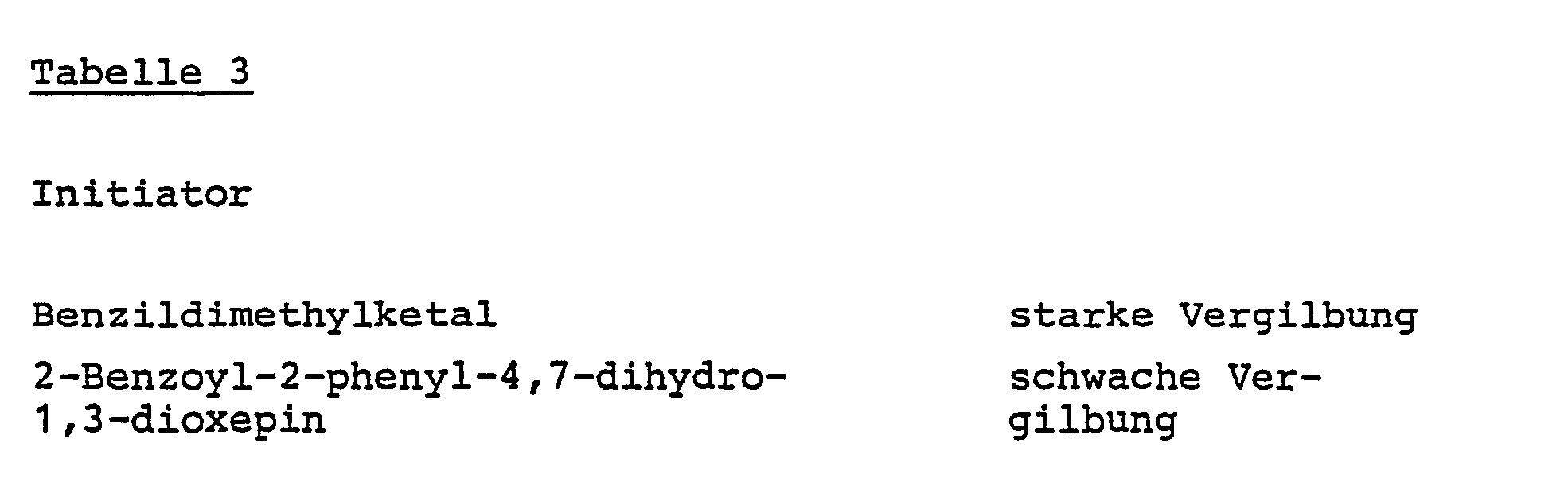
- a radiation-curable lacquer consisting of 100 parts of binder 2 and 2.5 parts of the photoinitiators given in Table 2, was applied to a 50 ⁇ m or 250 ⁇ m thick film on a glass plate and immediately at a belt speed of 5 m / min under a UV burner hardened. After storage for 2 hours, the pendulum hardness was determined in accordance with DIN 53 157. To test the yellowing, the samples listed in Table 2 in the case of benzil dimethyl ketal and 2-benzoyl-2-phenyl-4,7-dihydro-1,3-dioxepine were covered on one side and then again with 3 passages at 5 m / min under one UV burner exposed. The results of this yellowing test are shown in Table 3.
- a radiation-curable lacquer consisting of 100 parts of binder 2 and 2.5 parts of the photoinitiators given in Table 4, was applied to a 50 ⁇ m or 250) ⁇ m thick film on a glass plate and immediately at 5 m / min belt speed under a UV Burner hardened.
Landscapes
- Chemical & Material Sciences (AREA)
- Organic Chemistry (AREA)
- Health & Medical Sciences (AREA)
- Chemical Kinetics & Catalysis (AREA)
- Medicinal Chemistry (AREA)
- Polymers & Plastics (AREA)
- Physics & Mathematics (AREA)
- General Physics & Mathematics (AREA)
- Spectroscopy & Molecular Physics (AREA)
- Organic Low-Molecular-Weight Compounds And Preparation Thereof (AREA)
- Polymerisation Methods In General (AREA)
- Adhesives Or Adhesive Processes (AREA)
- Paints Or Removers (AREA)
- Saccharide Compounds (AREA)
- Preparation Of Compounds By Using Micro-Organisms (AREA)
- Heterocyclic Carbon Compounds Containing A Hetero Ring Having Oxygen Or Sulfur (AREA)
Abstract
Description
- Die Erfindung betrifft in 2-Stellung acylierte Dihydro-1.3-dioxepine, ein Verfahren zu ihrer Herstellung durch Umsetzung von 2-Buten-1,4-diol mit einem Benzil oder mit einem Benzilmonoketal sowie die Verwendung dieser Dihydro-1,3-dioxepine als Photoinitiatoren.
- Die Verwendung von lichtempfindlichen Verbindungen, die bei Bestrahlung Radikale bilden, als Photoinitiatoren ist lange bekannt (Übersicht: J. Kosar, Light-Sensitive Systems, Wiley, New York 1965). Einer der Photoinitiatoren, die auch Eingang in den Markt gefunden haben, ist Benzildimethylketal. Seine hohe Reaktivität wird sehr geschätzt; nachteilig wird empfunden, daß damit hergestellte Überzüge unter Lichteinfluß vergilben.
- Aufgabe der Erfindung war es daher, vergilbungsärmere Photoinitiatoren bereitzustellen, die die Reaktivität des Benzildimethylketals mindestens erreichen, möglichst aber übertreffen.
- Überraschenderweise wurde gefunden, daß 2-acylierte Di- hydro-1,3-dioxepine der Formeln

- Die erfindungsgemäßen Verbindungen I lassen sich durch Umsetzung von cis-2-Buten-1,4-diol mit Benzilen der Formel


- R 1 und R2 unabhängig voneinander ein Wasserstoffatom, einen C1-C4-Alkoxy- oder Alkylrest oder ein Halogenatom und
- R 3 und R 4 unabhängig voneinander einen C1-C4-Alkylrest bedeuten.
- Die Reaktion wird vorzugsweise in Gegenwart eines sauren Katalysators, insbesondere aber in Gegenwart von Thionylchlorid und einem Verdünnungsmittel, durchgeführt.
- Die erfindungsgemäßen Verbindungen II lassen sich durch Isomerisierung aus den Verbindungen I herstellen. Als Isomerisierungskatalysatoren können starke Basen oder Ubergangsmetallhydride verwendet werden.
- Es ist zwar bekannt, aromatische 1,2-Diketone mit primären einwertigen Alkoholen in Gegenwart eines Derivats der schwefligen Säure, z.B. Dialkylsulfit, Thionylchlorid, zu den entsprechenden Monoketalen umzusetzen (DE-AS 23 37 813); eine technisch brauchbare Einstufensynthese cyclischer Monoketale aromatischer 1,2-Diketone ist unseres Wissens bisher nicht bekannt gewesen. Das erfindungsgemäße Herstellungsverfahren ist umso überraschender als beispielsweise Benzil protonenkatalysiert selbst mit geringen Mengen Ethylenglykol zum Bisketal reagiert (Rec. Trav. Chim. 57, 133 (1938)). Überraschend ist aber auch, daß unter den Reaktionsbedingungen das cis-2-Buten-1,4-diol nicht nennenswert dehydratisiert wird (vgl. Compt. rend. 223, 907 (1946); J. Amer. Chem. Soc. 54, 4385 (1932)). Bei der Ketalisierung in Gegenwart von Thionylchlorid erscheint überraschend, daß keine Umsetzung des Thionylchlorids mit dem 2-Buten-1,4-diol zu beobachten ist (vgl. z.B. J. Org. Chem. 39, 848 (1974); Bull. Inst. Chem. Res., Kyoto Univ. 1971, 49(3), 179-99).
- Gegenstand der Erfindung sind also Verbindungen der Formel
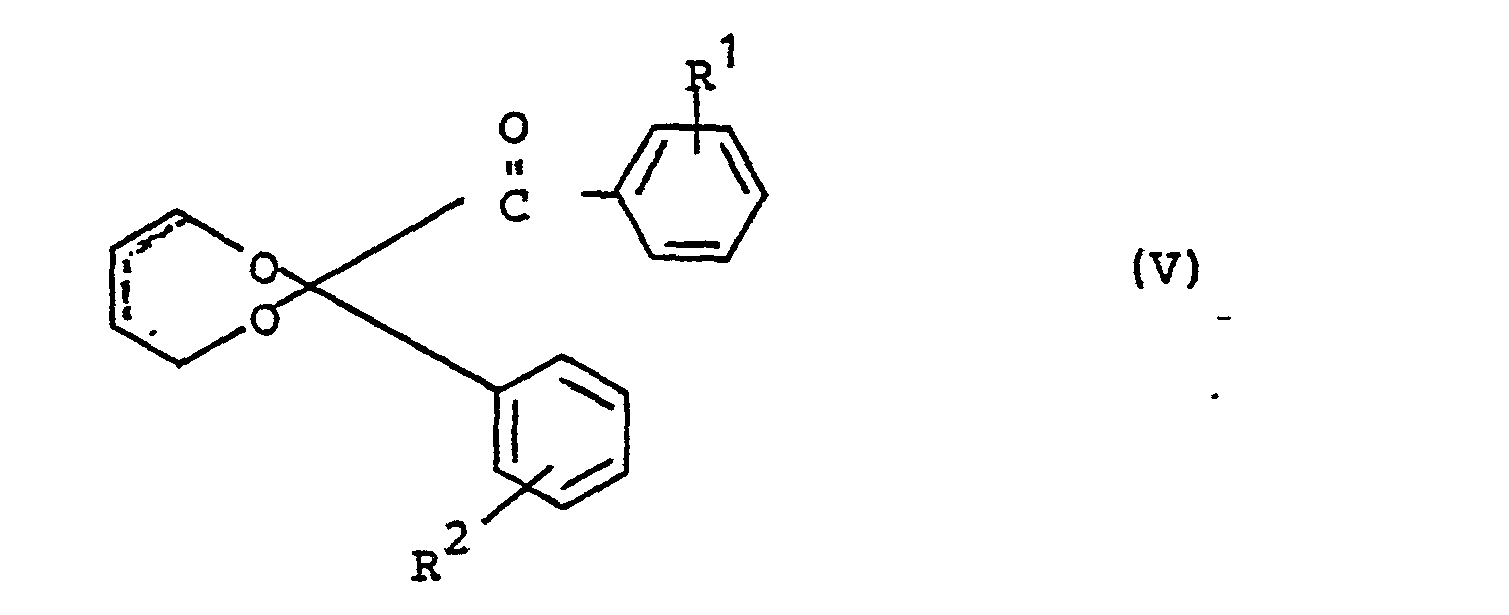
- R1 und R2 unabhängig voneinander ein Wasserstoffatom, einen C1-C4-Alkoxy- oder Alkylrest, vorzugsweise einen Methylrest, oder ein Halogenatom, vorzugsweise ein Chloratom, bedeuten.
- Weiterer Gegenstand der Erfindung ist ein Verfahren zur Herstellung der Verbindungen V durch Umsetzung von cis-2-Buten-1,4-diol mit einem Benzil der Formel

-

- R3 und R4 unabhängig voneinander einen C1-C4-Alkylrest bedeuten,
- Weiterer Gegenstand der Erfindung ist die Verwendung der Verbindungen V als Photoinitiatoren, vorzugsweise im UV-Bereich von 200-500 nm, insbesondere 300-450 nm.
- Bevorzugte 1,2-Diketone III sind Benzil, 4,4'-Dimethylbenzil, 4,4'-Dichlorbenzil, 4-Methylbenzil, 3-Methoxybenzil, 4-Chlorbenzil.
- Bevorzugte Monoketale IV sind Benzildimethylketal, Benzildiethylketal, Benzildipropylketal, 4,4'-Dimethylbenzildimethylketal, 4,4'-Dichlorbenzildimethylketal und 4-Chlorbenzildimethylketal. Da Ethanol und vor allem Methanol besonders leicht aus dem Reaktionsgemisch entfernt werden können, empfiehlt es sich, die jeweiligen Dimethyl- oder Diethylketale einzusetzen.
- Das erfindungsgemäße Verfahren kann in einem Verdünnungsmittel, das gegebenenfalls gleichzeitig als Schleppmittel für das entstehende Reaktionswasser dient, durchgeführt werden. Bevorzugte Verdünnungsmittel sind z.B. Benzol, Toluol, Methanol, Ethanol, Isopropanol, Isobutanol und überschüssiges cis-2-Buten-1,4-diol. Wird cis-Buten-1,4-diol als Verdünnungsmittel verwendet, so empfiehlt sich, zur Entfernung flüchtiger Reaktionsprodukte (Wasser, Alkohole) aus der Reaktionsmischung die Reaktion unter vermindertem Druck auszuführen.
- Zur Durchführung des erfindungsgemäßen Verfahrens vereinigt man das Benzil III bzw. das Monoketal IV mit cis-2-Buten-1,4-diol, gegebenenfalls unter Zusatz eines Verdünnungsmittels und/oder eines Katalysators.
- Als Katalysatoren für das erfindungsgemäße Verfahren ausgehend vom Benzil III eignen sich vor allen Thionylchlorid und p-Toluolsulfonsäure, ausgehend vom Monoketal IV vor allem Schwefelsäure, p-Toluolsulfonsäure, Phosphorsäure, Chlorwasserstoff, Bortrifluoridetherat, Thionylchlorid und saure Ionenaustauscher (vgl. "Methoden der Organischen Chemie" (Houben-Weyl), Bd. VI/3, S. 203 ff., insbesondere S. 207 und 215, Georg Thieme Verlag, Stuttgart 1965). Die Katalysatoren werden in der Regel in Mengen von 0,1 bis 5 Gew.-%, bezogen auf Ausgangsprodukt III bzw. IV, eingesetzt.
- Während man die mit Thionylchlorid katalysierten Reaktionen in der Regel bei -20 bis +20°C durchführt, werden die mit anderen Katalysatoren beschleunigten Reaktionen im allgemeinen durch Erwärmen auf Temperaturen von 40 bis 110, vorzugsweise von 50 bis 80, durchgeführt. Der Fortgang der Reaktion kann dünnschichtchromatographisch verfolgt werden.=In der Regel wird man die Reaktionsmischung neutralisieren und bei Verwendung eines wasserunlöslichen Verdünnungsmittels dieses abziehen, im Falle eines wasserlöslichen Verdünnungsmittels das Reaktionsprodukt mit Wasser ausfällen. Falls das erhaltene Rohprodukt weiter gereinigt werden soll, kann man eine Destillation oder Umkristallisation anschließen.
- Zur Isomerisierung der 4,7-Dihydro-1,3-dioxepine I zu 4,5-Dihydro-1,3-dioxepinen II kann man gemäß Chem. Ber. 113, 1472 (1980) oder nach H. Suzuki et al., Tetrahedron Letters 1980, 4927, verfahren. Bevorzugte Isomerisierungskatalysatoren sind starke Basen, wie z.B. Kalium-tert.-butylat, und Übergangsmetallhydride, wie z.B. Rutheniumhydrid.
- Beispiele für Verbindungen der Formel V sind:
- 2-Benzoyl-2-phenyl-4,7-dihydro-1,3-dioxepin,
- 2-Benzoyl-2-phenyl-4,5-dihydro-1,3-dioxepin,
- 2-(4-Methylbenzoyl)-2-(4-methylphenyl)-4,7-dihydro-1,3-dioxepin,
- 2-(4-Chlorbenzoyl)-2-(4-chlorphenyl)-4,7-dihydro-1,3-dioxepin.
- Als Substanzen, deren Polymerisation durch die erfindungsgemäßen Verbindungen V initiiert werden kann, kommen alle radikalisch polymerisierbaren Verbindungen oder Gemische in Betracht, z.B. also Olefine wie Ethylen, konjugierte Diene wie Butadien, Isopren, Chloropren; Vinylchlorid, Vinylidenchlorid; aromatische Vinylverbindungen wie Styrol, Divinylbenzol; Vinylester, insbesondere Vinylacetat und Vinylpropionat; Vinylether wie Vinylpropylether, Vinylisobutylether; Acrylsäure und Methacrylsäure und deren Derivate wie Ester, insbesondere mit aliphatischen Alkoholen mit 1 bis 5 C-Atomen, Nitrile, Amide usw.; Di(vinylphenyl)carbonate; Diallylphthalat, Diallylcarbonat, Diallylfumarat; Di-(allylphenyl)carbonate; Polyol-poly(meth)acrylate; N,N'-Methylen-bis-(meth)acrylamid.
- Besonders bevorzugte zu polymerisierende Substanzen sind (meth)acryloylgruppenhaltige Präpolymere, wie z.B. Polyester(meth)acrylat, Epoxy(meth)acrylat, Urethan(meth)-acrylat sowie ungesättigte Polyester, die gegebenenfalls mit Reaktivverdünnern, wie z.B. (Meth)Acrylsäureestern oder Styrol verdünnt sein können. Hierbei umfaßt der Begriff "(Meth)Acrylat" sowohl Acrylsäurederivate, Methacrylsäurederivate als auch Mischungen dieser Komponenten.
- Bevorzugte α,B-ethylenisch ungesättigte Polyester sind die üblichen Polykondensationsprodukte mindestens einer α,ß-ethylenisch ungesättigten Dicarbonsäure mit in der Regel 4 oder 5 C-Atomen oder deren esterbildenden Derivate, z.B. ihren,Anhydriden, gegebenenfalls in Abmischung mit bis zu 200 Mol-%, bezogen auf die ungesättigten Säurekomponenten, mindestens einer aliphatischen gesättigten Dicarbonsäure mit 4 bis 10 C-Atomen oder einer cycloaliphatischen oder aromatischen Dicarbonsäure mit 8-10 C-Atomen oder deren esterbildenden Derivate mit mindestens einer Polyhydroxyverbindung, insbesondere Dihydroxyverbindung, mit 2 bis 8 C-Atomen - also Polyester, wie sie bei J. Björksten et al., "Polyesters and their Applications", Reinhold Publishing.Corp., New York 1956, beschrieben sind.
- Weitere Systeme, die mit den erfindungsgemäßen Verbindungen V gehärtet werden können, sind z.B. in den DE-OS 27 37 406 und 28 41 880 beschrieben.
- 1065.6 g Isophorondiisocyanat, 0,11 g Zinnoctoat und 0,53 g 2,5-Di-tert.-butylhydrochinon wurden auf 50-60°C erwärmt und unter Rühren und Überleiten von trockener Luft 445,4 g Hydroxyethylacrylat zugetropft. Nach Erreichen eines NCO-Wertes von 16,1 Gew.-% wurden 3,1 g Zinnoctoat hinzugefügt und unter Beibehaltung der Temperatur 74.88 g Thiodiglykol und 1080 g eines ethoxylierten Trimethylolpropans mit einer OH-Zahl von 250 zugesetzt. Der Ansatz wurde mit 1120 g Hexan- diol-1,6-bisacrylat gemischt und solange bei 65°C gerührt, bis der NCO-Wert unter 0,1 Gew.-% sank (Bindemittel 1).
- Aus 2157 g Maleinsäureanhydrid, 451 g Propylenglykol, 1441 g Diethylenglykol, 941,3 g Trimethylolpropandiallylether und 428,3 g Diethylenglykolmonobutylether wurde durch Schmelzkondensation ein Polyester mit einer Säurezahl von 15-20 hergestellt. Der erhaltene Polyester wurde mit Styrol zu einer 70 gew.-%igen Lösung verdünnt (Bindemittel 2).
- 402 g Trimethylolpropan wurden in einem Kolben, der mit Gaseinleitungsrohr, Rührer und Thermometer ausgestattet war, mit 1 g Natriummethylat versetzt und auf 100°C erwärmt. Es wurden langsam 495 g Ethylenoxid eingeleitet. Nach Beendigung der Reaktion wurde der Kolben kurzzeitig evakuiert und dann abgekühlt. Es resultierte ein farbloses Produkt mit einer OH-Zahl von 550 und einer Viskosität von 500 cP bei 20°C im Höppler-Viskosimeter.
- Wie durch Gaschromatographie bestimmt wurde, besaß das Produkt folgende Zusammensetzung:

- 300 g des nach I) erhaltenen oxethylierten Trimethylolpropans mit einem Oxethylierungsgrad von 3,75 wurden in 50 ml Toluol mit 216 g Acrylsäure in Gegenwart von 2,5 g p-Toluolsulfonsäure und 0,2 g Toluhydrochinon azeotrop verestert,.bis kein Wasser mehr isoliert werden konnte. Nach Beendigung der Reaktion wurde mit der äquivalenten Menge Soda, bezogen auf p-Toluolsulfonsäure, neutralisiert, das Toluol im Vakuum abdestilliert (Enddruck 1 Torr, Endtemperatur des Reaktionsgutes 100°C) und das Produkt filtriert. Es resultierte eine hellgelbe geruchlose Flüssigkeit mit einer Viskosität von 102 cP (20°C Höppler Viskosimeter), einem Brechungsindex n20 D=1.4738, einer OH-Zahl von 13 und Säurezahl 0,8. Das erhaltene Produkt wurde als Reaktivverdünner für Beispiel 6 eingesetzt.
- Zu einer Suspension von 77 g (0,3 Mol) Benzildimethylketal in 160 g (~1,8 Mol) cis-2-Buten-1.,4-diol gab man 1 g p-Toluolsulfonsäure und erwärmte unter einem Druck von 10-15 Torr auf 50-60°C.. Nach 45 Minuten erhielt man eine klare Lösung, deren Temperatur auf 65-70°C anstieg. Nach weiteren 45 Minuten war die Reaktionsmischung zu einem Kristallbrei erstarrt. Nach insgesamt 4 Stunden kristallisierte man aus Isopropanol um und erhielt 80 g (96 %) 2-Benzoyl-2-phenyl-4,7-dihydro-1,3-dioxepin als farblose Kristalle vom Schmp. 118-119°C.
- (~ 0,6 Mol) cis-2-Buten-1,4-diol und 0,5 g p-Toluolsulfonsäure wurde bei 50-60°C und einem Druck von 10-13 Torr 9 Stunden lang gerührt. Das Reaktionsprodukt löste man in Dichlormethan, wusch mit Wasser bis zur Neutralreaktion, trocknete die Dichlormethanphase über wasserfreiem Natriumsulfat und erhielt nach Eindampfen der filtrierten Lösung 26,7 g gelbgefärbte Kristalle, die lt. NMR-Analyse zu 70 % aus 2-Benzoyl-2-phenyl-4,7-dihydro-1,3-dioxepin bestanden. Fraktionierende Destillation und Kristallisieren der bei 162 bis 168°C/0,4 Torr siedenden Fraktion lieferten 9,9 g farbloses 2-Benzoyl-2-phenyl-4,7-dihydro-1,3-dioxepin vom Schmp. 118-119°C.
- Zu einer Suspension von 105 g (0,5 Mol) Benzil in 107,1 g (0,9 Mol) Thionylchlorid gab man unter Rühren und Kühlen auf eine Temperatur unter 10°C 60,8 g (1,9 Mol) Methanol. Man rührte zunächst bis zum Erreichen der Raumtemperatur, dann 2 Stunden bei 50°C. Zu der klaren, schwach gelb gefärbten Lösung gab man 52,8 g (0,6 Mol) cis-2-Buten-1,4-diol und destillierte flüchtige Produkte bei 10 Torr und 50°C ab. Man rührte 3 Stunden bei 60-65°C unter Normaldruck nach, setzte 15 g Kaliumcarbonat und 200 ml Isopropanol zu und fällte das Reaktionsprodukt durch Zutropfen von 100 ml Wasser. Man erhielt 110,4 g 2-Benzoyl-2-phenyl-4,7-dihydro-1,3-dioxepin vom Schmp. 115-119°C. Nach Umkristallisieren aus Isopropanol betrug der Schmp. 118-119°C.
- Zu einer Suspension von 105 g (0,5 Mol) Benzil in 119 g (1 Mol) Thionylchlorid tropfte man bei 0-5°C die Lösung von 52,8 g (0,6 Mol) cis-2-Buten-1,4-diol- in 36 g Isopropanol. Man ließ die Reaktionsmischung sich auf Raumtemperatur erwärmen, rührte darauf 3 Stunden bei 50°C, destillierte bei 10 Torr/50°C flüchtige Reaktionsprodukte ab und hielt anschließend die Reaktionsmischung 2 Stunden auf einer Temperatur von 50-60°C. Nach Zugabe von 10 g Kaliumcarbonat und 200 ml Isopropanol fällte man das Reaktionsprodukt durch Eintropfen von 100 ml Wasser. Man erhielt 95,3 g ockerfarbene Kristalle, die aus Isopropanol umkristallisiert wurden; Schmp. 112-116°C.
- Unter Stickstoffatmosphäre wurden 500 mg H 2 Ru [P(C6H5)3]4 zu 15 g 2-Benzoyl-2-phenyl-4,7-dihydro-1,3-dioxepin gegeben. Die Reaktionsmischung wurde bei 140°C gehalten und gerührt. Nach 2 Stunden wurden weitere 250 mg H2Ru[P(C6H5)3]4 zugegeben, und das Rühren wurde 2 Stunden fortgesetzt. Nach dem Abkühlen auf 20°C wurden 200 ml Ether zugegeben. Die Etherschicht wurde zweimal mit je 100 ml Wasser gewaschen und über Kaliumcarbonat getrocknet. Nach dem Filtrieren wurden 2,0 g Aktivkohle zugesetzt, und die Lösung wurde 1/2 Stunde am Rückfluß gekocht. Nach erneutem Filtrieren wurde die Lösung auf ca. 100 ml eingeengt und 50 ml Petrolether zugegeben. Beim Abkühlen bildeten sich farblose Kristalle von 2-Benzoyl-2-phenyl-4,5-dihydro-1,3-dioxepin vom Schmp. 78-79°C.
- Die nachfolgend angegebenen Teile sind Gewichtsteile.
- Ein strahlenhärtbarer Lack, bestehend aus 150 Teilen Bindemittel 1, 112,5 Teilen Hexandiol-1,6-bisacrylat, 77,5 Teilen Reaktivverdünner nach A 2 II und 8,5 Teilen der in Tabelle 1 angegebenen Photoinitiatoren wurde mittels eines drahtumwickelten Metallstabes zu einem 8 µm dicken Film auf Kunstdruckpapier aufgezogen.
- Die beschichteten Proben wurden anschließend auf einem regelbaren Transportband unter einem Hanovia-UV-Strahler (80 W/cm, Abstand 8 cm) durchgeführt. In Tabelle 1 sind die Geschwindigkeiten aufgeführt, die zu kratzfesten, lösungsmittelfesten Lackierungen führten.

- Ein strahlenhärtbarer Lack, bestehend aus 100 Teilen Bindemittel 2 und 2,5 Teilen der in Tabelle 2 angegebenen Photoinitiatoren, wurde zu einem 50 µm bzw. 250 µm dicken Film auf eine Glasplatte aufgezogen und sofort bei 5 m/min Bandgeschwindigkeit unter einem UV-Brenner gehärtet. Nach 2-stündiger Lagerung wurden die Pendelhärten nach DIN 53 157 bestimmt.

- Reaktivitäten verschiedener 2-Benzoyl-2-phenyl-1,3-dioxaalkane bzw. -alkene
- Ein strahlenhärtbarer Lack, bestehend aus 100 Teilen Bindemittel 2 und 2,5 Teilen der in Tabelle 4 angegebenen Photoinitatoren, wurde zu einem 50 µm bzw. 250)µm dicken Film auf eine Glasplatte aufgezogen und sofort bei 5 m/min Bandgeschwindigkeit unter einem UV-Brenner gehärtet.

Claims (5)


Priority Applications (1)
| Application Number | Priority Date | Filing Date | Title |
|---|---|---|---|
| AT83106533T ATE29029T1 (de) | 1982-07-16 | 1983-07-05 | 2-acylierte dihydro-1,3-dioxepine, verfahren zu ihrer herstellung und ihre verwendung als photoinitiatoren. |
Applications Claiming Priority (2)
| Application Number | Priority Date | Filing Date | Title |
|---|---|---|---|
| DE3226617 | 1982-07-16 | ||
| DE19823226617 DE3226617A1 (de) | 1982-07-16 | 1982-07-16 | 2-acylierte dihydro-1,3-dioxepine, verfahren zu ihrer herstellung und ihre verwendung als photoinitiatoren |
Publications (2)
| Publication Number | Publication Date |
|---|---|
| EP0100862A1 true EP0100862A1 (de) | 1984-02-22 |
| EP0100862B1 EP0100862B1 (de) | 1987-08-19 |
Family
ID=6168572
Family Applications (1)
| Application Number | Title | Priority Date | Filing Date |
|---|---|---|---|
| EP83106533A Expired EP0100862B1 (de) | 1982-07-16 | 1983-07-05 | 2-Acylierte Dihydro-1,3-dioxepine, Verfahren zu ihrer Herstellung und ihre Verwendung als Photoinitiatoren |
Country Status (9)
| Country | Link |
|---|---|
| US (1) | US4485249A (de) |
| EP (1) | EP0100862B1 (de) |
| JP (1) | JPS5921677A (de) |
| AT (1) | ATE29029T1 (de) |
| CA (1) | CA1196649A (de) |
| DD (1) | DD210133A5 (de) |
| DE (2) | DE3226617A1 (de) |
| ES (1) | ES524159A0 (de) |
| SU (1) | SU1200860A3 (de) |
Cited By (1)
| Publication number | Priority date | Publication date | Assignee | Title |
|---|---|---|---|---|
| KR100802219B1 (ko) * | 2000-12-07 | 2008-02-11 | 킴벌리-클라크 월드와이드, 인크. | 생분해성 통기성 필름 및 라미네이트 |
Family Cites Families (1)
| Publication number | Priority date | Publication date | Assignee | Title |
|---|---|---|---|---|
| US3134788A (en) * | 1962-03-05 | 1964-05-26 | Dow Chemical Co | 4,7-dihydro-(2-acetonyl and 2-methyl-2 acetyl)-1,3-dioxepins |
-
1982
- 1982-07-16 DE DE19823226617 patent/DE3226617A1/de not_active Withdrawn
-
1983
- 1983-06-29 SU SU833612602A patent/SU1200860A3/ru active
- 1983-07-05 AT AT83106533T patent/ATE29029T1/de not_active IP Right Cessation
- 1983-07-05 DE DE8383106533T patent/DE3373095D1/de not_active Expired
- 1983-07-05 EP EP83106533A patent/EP0100862B1/de not_active Expired
- 1983-07-07 US US06/511,538 patent/US4485249A/en not_active Expired - Fee Related
- 1983-07-12 JP JP58125628A patent/JPS5921677A/ja active Pending
- 1983-07-14 CA CA000432430A patent/CA1196649A/en not_active Expired
- 1983-07-14 DD DD83253083A patent/DD210133A5/de unknown
- 1983-07-15 ES ES524159A patent/ES524159A0/es active Granted
Non-Patent Citations (1)
| Title |
|---|
| Keine Entgegenhaltungen * |
Cited By (1)
| Publication number | Priority date | Publication date | Assignee | Title |
|---|---|---|---|---|
| KR100802219B1 (ko) * | 2000-12-07 | 2008-02-11 | 킴벌리-클라크 월드와이드, 인크. | 생분해성 통기성 필름 및 라미네이트 |
Also Published As
| Publication number | Publication date |
|---|---|
| US4485249A (en) | 1984-11-27 |
| EP0100862B1 (de) | 1987-08-19 |
| DE3226617A1 (de) | 1984-01-19 |
| ES8403948A1 (es) | 1984-04-16 |
| JPS5921677A (ja) | 1984-02-03 |
| ATE29029T1 (de) | 1987-09-15 |
| DD210133A5 (de) | 1984-05-30 |
| ES524159A0 (es) | 1984-04-16 |
| SU1200860A3 (ru) | 1985-12-23 |
| DE3373095D1 (en) | 1987-09-24 |
| CA1196649A (en) | 1985-11-12 |
Similar Documents
| Publication | Publication Date | Title |
|---|---|---|
| EP0217205B1 (de) | Copolymerisierbare Fotoinitiatoren | |
| EP0377191B1 (de) | Strahlungsempfindliches, ethylenisch ungesättigte, copolymerisierbare Verbindungen und Verfahren zu deren Herstellung | |
| US4161596A (en) | Process for preparing carbamoyloxy acrylates | |
| EP0586849B1 (de) | Aminoacrylate, ein Verfahren zu ihrer Herstellung und ihre Verwendung | |
| EP0126341B1 (de) | Verfahren zur Herstellung von (Meth)-acrylsäureestern und deren Verwendung | |
| CH648016A5 (de) | Aromatisch-aliphatische ketone und ihre verwendung als photoinitiatoren. | |
| EP0755949B1 (de) | Strahlungshärtbare Massen mit kovalent gebundenen Photoinitiatoren | |
| EP0254950A2 (de) | (Meth)-acrylsäureester | |
| EP0686621B1 (de) | Verfahren zur Herstellung von strahlungshärtbaren Acrylaten und durch das Verfahren erhältliche Acrylate | |
| DE69911050T2 (de) | Für die photopolymerisation geeignete bifunktionelle photoinitiatoren und diese enthaltende photopolymerisierbare systeme | |
| EP0346788B1 (de) | Strahlungsempfindliche, ethylenisch ungesättigte, copolymerisierbare Verbindungen und Verfahren zu deren Herstellung | |
| EP0752408B1 (de) | Strahlungshärtbare Acrylate mit eingebauten Photoinitiatoren | |
| DE3040247A1 (de) | Neue urethanacrylate und durch bestrahlung haertbare zusammensetzungen | |
| EP0328150A2 (de) | Cyclocarbonathaltige Ester und Verfahren zu ihrer Herstellung | |
| EP0590399A2 (de) | Acryloylgruppen aufweisende Polyurethane, ein Verfahren zu ihrer Herstellung und ihre Verwendung als Bindemittel für Überzugsmassen | |
| EP0775687B1 (de) | Verfahren zur Herstellung von (Meth)acrylsäureestern | |
| EP0100862B1 (de) | 2-Acylierte Dihydro-1,3-dioxepine, Verfahren zu ihrer Herstellung und ihre Verwendung als Photoinitiatoren | |
| EP0447845A2 (de) | Strahlungshärtbare Amin- und Harnstoffgruppen enthaltende Urethanacrylatverbindungen | |
| DE4325846C1 (de) | Verwendung von Furan-modifizierten aromatischen Pinakolderivaten als Initiatoren und Furan-modifizierte aromatische Pinakolderivate als solche | |
| DE2328544A1 (de) | 4,4'-bis(alkoxycarbonyl)benzoinaether, sowie verfahren zu ihrer herstellung | |
| DE2150769B2 (de) | Härtbare Mischung aus polymerisierbaren Verbindungen | |
| EP0770608B1 (de) | Strahlungshärtung von Dihydrofuranderivaten | |
| US4287367A (en) | Manufacture of symmetrical or unsymmetrical monoacetals of aromatic 1,2-diketones | |
| EP0317913A2 (de) | Neue Di(meth)acrylate, Verfahren zu deren Herstellung und deren Verwendung | |
| EP0358074B1 (de) | Neue Bisester ungesättigter Carbonsäuren, ihre Herstellung und Verwendung in härtbaren Gemischen |
Legal Events
| Date | Code | Title | Description |
|---|---|---|---|
| PUAI | Public reference made under article 153(3) epc to a published international application that has entered the european phase |
Free format text: ORIGINAL CODE: 0009012 |
|
| 17P | Request for examination filed |
Effective date: 19830705 |
|
| AK | Designated contracting states |
Designated state(s): AT BE CH DE FR GB IT LI NL |
|
| RAP1 | Party data changed (applicant data changed or rights of an application transferred) |
Owner name: CIBA-GEIGY AG |
|
| GRAA | (expected) grant |
Free format text: ORIGINAL CODE: 0009210 |
|
| AK | Designated contracting states |
Kind code of ref document: B1 Designated state(s): AT BE CH DE FR GB IT LI NL |
|
| REF | Corresponds to: |
Ref document number: 29029 Country of ref document: AT Date of ref document: 19870915 Kind code of ref document: T |
|
| REF | Corresponds to: |
Ref document number: 3373095 Country of ref document: DE Date of ref document: 19870924 |
|
| ITF | It: translation for a ep patent filed | ||
| ET | Fr: translation filed | ||
| PLBE | No opposition filed within time limit |
Free format text: ORIGINAL CODE: 0009261 |
|
| STAA | Information on the status of an ep patent application or granted ep patent |
Free format text: STATUS: NO OPPOSITION FILED WITHIN TIME LIMIT |
|
| PG25 | Lapsed in a contracting state [announced via postgrant information from national office to epo] |
Ref country code: GB Effective date: 19880705 Ref country code: AT Effective date: 19880705 |
|
| PG25 | Lapsed in a contracting state [announced via postgrant information from national office to epo] |
Ref country code: LI Effective date: 19880731 Ref country code: CH Effective date: 19880731 Ref country code: BE Effective date: 19880731 |
|
| 26N | No opposition filed | ||
| BERE | Be: lapsed |
Owner name: CIBA-GEIGY A.G. Effective date: 19880731 |
|
| PG25 | Lapsed in a contracting state [announced via postgrant information from national office to epo] |
Ref country code: NL Effective date: 19890201 |
|
| NLV4 | Nl: lapsed or anulled due to non-payment of the annual fee | ||
| GBPC | Gb: european patent ceased through non-payment of renewal fee | ||
| PG25 | Lapsed in a contracting state [announced via postgrant information from national office to epo] |
Ref country code: FR Free format text: LAPSE BECAUSE OF NON-PAYMENT OF DUE FEES Effective date: 19890331 |
|
| REG | Reference to a national code |
Ref country code: CH Ref legal event code: PL |
|
| PG25 | Lapsed in a contracting state [announced via postgrant information from national office to epo] |
Ref country code: DE Effective date: 19890401 |
|
| REG | Reference to a national code |
Ref country code: FR Ref legal event code: ST |