EP0101383A1 - Dérivés d'amino-14 stéroides, application en thérapeutique, et procédé de préparation - Google Patents
Dérivés d'amino-14 stéroides, application en thérapeutique, et procédé de préparation Download PDFInfo
- Publication number
- EP0101383A1 EP0101383A1 EP83401644A EP83401644A EP0101383A1 EP 0101383 A1 EP0101383 A1 EP 0101383A1 EP 83401644 A EP83401644 A EP 83401644A EP 83401644 A EP83401644 A EP 83401644A EP 0101383 A1 EP0101383 A1 EP 0101383A1
- Authority
- EP
- European Patent Office
- Prior art keywords
- amino
- group
- hydrogen atom
- steroids
- general formula
- Prior art date
- Legal status (The legal status is an assumption and is not a legal conclusion. Google has not performed a legal analysis and makes no representation as to the accuracy of the status listed.)
- Granted
Links
- 238000000034 method Methods 0.000 title claims description 19
- 238000002360 preparation method Methods 0.000 title claims description 8
- 230000001225 therapeutic effect Effects 0.000 title description 2
- 125000004435 hydrogen atom Chemical group [H]* 0.000 claims abstract description 32
- 150000003431 steroids Chemical class 0.000 claims abstract description 30
- 125000002887 hydroxy group Chemical group [H]O* 0.000 claims abstract description 17
- 125000000217 alkyl group Chemical group 0.000 claims abstract description 10
- 125000004432 carbon atom Chemical group C* 0.000 claims abstract description 9
- 150000003839 salts Chemical class 0.000 claims abstract description 9
- 239000003814 drug Substances 0.000 claims abstract description 7
- 229910052739 hydrogen Inorganic materials 0.000 claims abstract description 5
- 239000001257 hydrogen Substances 0.000 claims abstract description 5
- UFHFLCQGNIYNRP-UHFFFAOYSA-N Hydrogen Chemical compound [H][H] UFHFLCQGNIYNRP-UHFFFAOYSA-N 0.000 claims abstract description 4
- 125000004429 atom Chemical group 0.000 claims abstract 2
- 238000006640 acetylation reaction Methods 0.000 claims description 6
- 125000002777 acetyl group Chemical group [H]C([H])([H])C(*)=O 0.000 claims description 5
- 230000021736 acetylation Effects 0.000 claims description 5
- 125000002496 methyl group Chemical group [H]C([H])([H])* 0.000 claims description 5
- 229910015900 BF3 Inorganic materials 0.000 claims description 3
- WTEOIRVLGSZEPR-UHFFFAOYSA-N boron trifluoride Substances FB(F)F WTEOIRVLGSZEPR-UHFFFAOYSA-N 0.000 claims description 3
- 238000009903 catalytic hydrogenation reaction Methods 0.000 claims description 3
- 229910052987 metal hydride Inorganic materials 0.000 claims description 3
- 150000004681 metal hydrides Chemical class 0.000 claims description 3
- 229940079593 drug Drugs 0.000 claims 4
- 206010019280 Heart failures Diseases 0.000 abstract description 4
- XEKOWRVHYACXOJ-UHFFFAOYSA-N Ethyl acetate Chemical compound CCOC(C)=O XEKOWRVHYACXOJ-UHFFFAOYSA-N 0.000 description 24
- UHOVQNZJYSORNB-UHFFFAOYSA-N Benzene Chemical compound C1=CC=CC=C1 UHOVQNZJYSORNB-UHFFFAOYSA-N 0.000 description 21
- YMWUJEATGCHHMB-UHFFFAOYSA-N Dichloromethane Chemical compound ClCCl YMWUJEATGCHHMB-UHFFFAOYSA-N 0.000 description 12
- OKKJLVBELUTLKV-UHFFFAOYSA-N Methanol Chemical compound OC OKKJLVBELUTLKV-UHFFFAOYSA-N 0.000 description 12
- WYURNTSHIVDZCO-UHFFFAOYSA-N Tetrahydrofuran Chemical compound C1CCOC1 WYURNTSHIVDZCO-UHFFFAOYSA-N 0.000 description 12
- 239000000203 mixture Substances 0.000 description 11
- 238000002844 melting Methods 0.000 description 10
- 230000008018 melting Effects 0.000 description 10
- WFDIJRYMOXRFFG-UHFFFAOYSA-N Acetic anhydride Chemical compound CC(=O)OC(C)=O WFDIJRYMOXRFFG-UHFFFAOYSA-N 0.000 description 9
- KZMGYPLQYOPHEL-UHFFFAOYSA-N Boron trifluoride etherate Chemical compound FB(F)F.CCOCC KZMGYPLQYOPHEL-UHFFFAOYSA-N 0.000 description 8
- VYPSYNLAJGMNEJ-UHFFFAOYSA-N Silicium dioxide Chemical compound O=[Si]=O VYPSYNLAJGMNEJ-UHFFFAOYSA-N 0.000 description 8
- 239000002253 acid Substances 0.000 description 8
- 239000000047 product Substances 0.000 description 8
- RTZKZFJDLAIYFH-UHFFFAOYSA-N Diethyl ether Chemical compound CCOCC RTZKZFJDLAIYFH-UHFFFAOYSA-N 0.000 description 6
- CDBYLPFSWZWCQE-UHFFFAOYSA-L Sodium Carbonate Chemical compound [Na+].[Na+].[O-]C([O-])=O CDBYLPFSWZWCQE-UHFFFAOYSA-L 0.000 description 6
- 150000001875 compounds Chemical class 0.000 description 6
- 238000002425 crystallisation Methods 0.000 description 6
- 230000008025 crystallization Effects 0.000 description 6
- YLQBMQCUIZJEEH-UHFFFAOYSA-N tetrahydrofuran Natural products C=1C=COC=1 YLQBMQCUIZJEEH-UHFFFAOYSA-N 0.000 description 6
- XLYOFNOQVPJJNP-UHFFFAOYSA-N water Substances O XLYOFNOQVPJJNP-UHFFFAOYSA-N 0.000 description 6
- 238000001704 evaporation Methods 0.000 description 5
- 230000008020 evaporation Effects 0.000 description 5
- QGZKDVFQNNGYKY-UHFFFAOYSA-N Ammonia Chemical compound N QGZKDVFQNNGYKY-UHFFFAOYSA-N 0.000 description 4
- HEDRZPFGACZZDS-UHFFFAOYSA-N Chloroform Chemical compound ClC(Cl)Cl HEDRZPFGACZZDS-UHFFFAOYSA-N 0.000 description 4
- VEXZGXHMUGYJMC-UHFFFAOYSA-N Hydrochloric acid Chemical compound Cl VEXZGXHMUGYJMC-UHFFFAOYSA-N 0.000 description 4
- JUJWROOIHBZHMG-UHFFFAOYSA-N Pyridine Chemical compound C1=CC=NC=C1 JUJWROOIHBZHMG-UHFFFAOYSA-N 0.000 description 4
- 238000006243 chemical reaction Methods 0.000 description 4
- 238000004587 chromatography analysis Methods 0.000 description 4
- 150000004678 hydrides Chemical class 0.000 description 4
- 239000012280 lithium aluminium hydride Substances 0.000 description 4
- -1 lithium aluminum hydride Chemical compound 0.000 description 4
- 238000006722 reduction reaction Methods 0.000 description 4
- 239000000377 silicon dioxide Substances 0.000 description 4
- CSCPPACGZOOCGX-UHFFFAOYSA-N Acetone Chemical compound CC(C)=O CSCPPACGZOOCGX-UHFFFAOYSA-N 0.000 description 3
- ZOXJGFHDIHLPTG-UHFFFAOYSA-N Boron Chemical compound [B] ZOXJGFHDIHLPTG-UHFFFAOYSA-N 0.000 description 3
- 241000700199 Cavia porcellus Species 0.000 description 3
- LFQSCWFLJHTTHZ-UHFFFAOYSA-N Ethanol Chemical compound CCO LFQSCWFLJHTTHZ-UHFFFAOYSA-N 0.000 description 3
- PEDCQBHIVMGVHV-UHFFFAOYSA-N Glycerine Chemical compound OCC(O)CO PEDCQBHIVMGVHV-UHFFFAOYSA-N 0.000 description 3
- WHXSMMKQMYFTQS-UHFFFAOYSA-N Lithium Chemical compound [Li] WHXSMMKQMYFTQS-UHFFFAOYSA-N 0.000 description 3
- MUBZPKHOEPUJKR-UHFFFAOYSA-N Oxalic acid Chemical compound OC(=O)C(O)=O MUBZPKHOEPUJKR-UHFFFAOYSA-N 0.000 description 3
- DNIAPMSPPWPWGF-UHFFFAOYSA-N Propylene glycol Chemical compound CC(O)CO DNIAPMSPPWPWGF-UHFFFAOYSA-N 0.000 description 3
- HEMHJVSKTPXQMS-UHFFFAOYSA-M Sodium hydroxide Chemical compound [OH-].[Na+] HEMHJVSKTPXQMS-UHFFFAOYSA-M 0.000 description 3
- YXFVVABEGXRONW-UHFFFAOYSA-N Toluene Chemical compound CC1=CC=CC=C1 YXFVVABEGXRONW-UHFFFAOYSA-N 0.000 description 3
- 125000003277 amino group Chemical group 0.000 description 3
- 229910052796 boron Inorganic materials 0.000 description 3
- 239000003638 chemical reducing agent Substances 0.000 description 3
- KRKNYBCHXYNGOX-UHFFFAOYSA-N citric acid Chemical compound OC(=O)CC(O)(C(O)=O)CC(O)=O KRKNYBCHXYNGOX-UHFFFAOYSA-N 0.000 description 3
- 238000001914 filtration Methods 0.000 description 3
- 230000007062 hydrolysis Effects 0.000 description 3
- 238000006460 hydrolysis reaction Methods 0.000 description 3
- 238000002329 infrared spectrum Methods 0.000 description 3
- 229910052744 lithium Inorganic materials 0.000 description 3
- DVSDBMFJEQPWNO-UHFFFAOYSA-N methyllithium Chemical compound C[Li] DVSDBMFJEQPWNO-UHFFFAOYSA-N 0.000 description 3
- 230000009090 positive inotropic effect Effects 0.000 description 3
- 229910000029 sodium carbonate Inorganic materials 0.000 description 3
- 239000002904 solvent Substances 0.000 description 3
- 239000003826 tablet Substances 0.000 description 3
- PBXJGQQGODZSQR-WQBJWTDHSA-N (5s,8r,9s,10s,13s,14s,17s)-10,13-dimethyl-2,3,4,5,6,7,8,9,11,12,14,15,16,17-tetradecahydro-1h-cyclopenta[a]phenanthrene-17-carboxylic acid Chemical compound C1CCC[C@]2(C)[C@H]3CC[C@](C)([C@H](CC4)C(O)=O)[C@@H]4[C@@H]3CC[C@@H]21 PBXJGQQGODZSQR-WQBJWTDHSA-N 0.000 description 2
- VHYFNPMBLIVWCW-UHFFFAOYSA-N 4-Dimethylaminopyridine Chemical compound CN(C)C1=CC=NC=C1 VHYFNPMBLIVWCW-UHFFFAOYSA-N 0.000 description 2
- QZLYKIGBANMMBK-UGCZWRCOSA-N 5α-Androstane Chemical compound C([C@@H]1CC2)CCC[C@]1(C)[C@@H]1[C@@H]2[C@@H]2CCC[C@@]2(C)CC1 QZLYKIGBANMMBK-UGCZWRCOSA-N 0.000 description 2
- JWMFYGXQPXQEEM-NUNROCCHSA-N 5β-pregnane Chemical compound C([C@H]1CC2)CCC[C@]1(C)[C@@H]1[C@@H]2[C@@H]2CC[C@H](CC)[C@@]2(C)CC1 JWMFYGXQPXQEEM-NUNROCCHSA-N 0.000 description 2
- ZAFNJMIOTHYJRJ-UHFFFAOYSA-N Diisopropyl ether Chemical compound CC(C)OC(C)C ZAFNJMIOTHYJRJ-UHFFFAOYSA-N 0.000 description 2
- VZCYOOQTPOCHFL-OWOJBTEDSA-N Fumaric acid Chemical compound OC(=O)\C=C\C(O)=O VZCYOOQTPOCHFL-OWOJBTEDSA-N 0.000 description 2
- KFZMGEQAYNKOFK-UHFFFAOYSA-N Isopropanol Chemical compound CC(C)O KFZMGEQAYNKOFK-UHFFFAOYSA-N 0.000 description 2
- NBIIXXVUZAFLBC-UHFFFAOYSA-N Phosphoric acid Chemical compound OP(O)(O)=O NBIIXXVUZAFLBC-UHFFFAOYSA-N 0.000 description 2
- ZLMJMSJWJFRBEC-UHFFFAOYSA-N Potassium Chemical compound [K] ZLMJMSJWJFRBEC-UHFFFAOYSA-N 0.000 description 2
- KEAYESYHFKHZAL-UHFFFAOYSA-N Sodium Chemical compound [Na] KEAYESYHFKHZAL-UHFFFAOYSA-N 0.000 description 2
- 239000000654 additive Substances 0.000 description 2
- 230000000996 additive effect Effects 0.000 description 2
- AZDRQVAHHNSJOQ-UHFFFAOYSA-N alumane Chemical compound [AlH3] AZDRQVAHHNSJOQ-UHFFFAOYSA-N 0.000 description 2
- 229910052782 aluminium Inorganic materials 0.000 description 2
- XAGFODPZIPBFFR-UHFFFAOYSA-N aluminium Chemical compound [Al] XAGFODPZIPBFFR-UHFFFAOYSA-N 0.000 description 2
- 229910021529 ammonia Inorganic materials 0.000 description 2
- 239000008346 aqueous phase Substances 0.000 description 2
- 244000309464 bull Species 0.000 description 2
- 239000003054 catalyst Substances 0.000 description 2
- 238000001035 drying Methods 0.000 description 2
- 238000000605 extraction Methods 0.000 description 2
- 239000000706 filtrate Substances 0.000 description 2
- 210000002837 heart atrium Anatomy 0.000 description 2
- 238000010438 heat treatment Methods 0.000 description 2
- JVTAAEKCZFNVCJ-UHFFFAOYSA-N lactic acid Chemical compound CC(O)C(O)=O JVTAAEKCZFNVCJ-UHFFFAOYSA-N 0.000 description 2
- HQKMJHAJHXVSDF-UHFFFAOYSA-L magnesium stearate Chemical compound [Mg+2].CCCCCCCCCCCCCCCCCC([O-])=O.CCCCCCCCCCCCCCCCCC([O-])=O HQKMJHAJHXVSDF-UHFFFAOYSA-L 0.000 description 2
- BDAGIHXWWSANSR-UHFFFAOYSA-N methanoic acid Natural products OC=O BDAGIHXWWSANSR-UHFFFAOYSA-N 0.000 description 2
- LNOPIUAQISRISI-UHFFFAOYSA-N n'-hydroxy-2-propan-2-ylsulfonylethanimidamide Chemical compound CC(C)S(=O)(=O)CC(N)=NO LNOPIUAQISRISI-UHFFFAOYSA-N 0.000 description 2
- 239000002547 new drug Substances 0.000 description 2
- 125000002524 organometallic group Chemical group 0.000 description 2
- 230000000144 pharmacologic effect Effects 0.000 description 2
- 239000011591 potassium Substances 0.000 description 2
- 229910052700 potassium Inorganic materials 0.000 description 2
- AQHHHDLHHXJYJD-UHFFFAOYSA-N propranolol Chemical compound C1=CC=C2C(OCC(O)CNC(C)C)=CC=CC2=C1 AQHHHDLHHXJYJD-UHFFFAOYSA-N 0.000 description 2
- UMJSCPRVCHMLSP-UHFFFAOYSA-N pyridine Natural products COC1=CC=CN=C1 UMJSCPRVCHMLSP-UHFFFAOYSA-N 0.000 description 2
- 239000011541 reaction mixture Substances 0.000 description 2
- 238000010992 reflux Methods 0.000 description 2
- 239000012312 sodium hydride Substances 0.000 description 2
- 229910000104 sodium hydride Inorganic materials 0.000 description 2
- 239000007858 starting material Substances 0.000 description 2
- 239000006188 syrup Substances 0.000 description 2
- 235000020357 syrup Nutrition 0.000 description 2
- 238000002560 therapeutic procedure Methods 0.000 description 2
- JOXIMZWYDAKGHI-UHFFFAOYSA-N toluene-4-sulfonic acid Chemical compound CC1=CC=C(S(O)(=O)=O)C=C1 JOXIMZWYDAKGHI-UHFFFAOYSA-N 0.000 description 2
- VZCYOOQTPOCHFL-UHFFFAOYSA-N trans-butenedioic acid Natural products OC(=O)C=CC(O)=O VZCYOOQTPOCHFL-UHFFFAOYSA-N 0.000 description 2
- 238000005406 washing Methods 0.000 description 2
- ZIVXCALGIDLFTA-ZVTSNWGQSA-N (3R,5R,8R,9S,10S,13S,14S,17R)-16-amino-17-[(1S)-1-hydroxyethyl]-10,13-dimethyl-2,3,4,5,6,7,8,9,11,12,14,15,16,17-tetradecahydro-1H-cyclopenta[a]phenanthren-3-ol Chemical compound NC1[C@@H]([C@]2(CC[C@@H]3[C@]4(CC[C@H](C[C@H]4CC[C@H]3[C@@H]2C1)O)C)C)[C@H](C)O ZIVXCALGIDLFTA-ZVTSNWGQSA-N 0.000 description 1
- AZUYLZMQTIKGSC-UHFFFAOYSA-N 1-[6-[4-(5-chloro-6-methyl-1H-indazol-4-yl)-5-methyl-3-(1-methylindazol-5-yl)pyrazol-1-yl]-2-azaspiro[3.3]heptan-2-yl]prop-2-en-1-one Chemical compound ClC=1C(=C2C=NNC2=CC=1C)C=1C(=NN(C=1C)C1CC2(CN(C2)C(C=C)=O)C1)C=1C=C2C=NN(C2=CC=1)C AZUYLZMQTIKGSC-UHFFFAOYSA-N 0.000 description 1
- ZQXCQTAELHSNAT-UHFFFAOYSA-N 1-chloro-3-nitro-5-(trifluoromethyl)benzene Chemical compound [O-][N+](=O)C1=CC(Cl)=CC(C(F)(F)F)=C1 ZQXCQTAELHSNAT-UHFFFAOYSA-N 0.000 description 1
- BMYNFMYTOJXKLE-UHFFFAOYSA-N 3-azaniumyl-2-hydroxypropanoate Chemical compound NCC(O)C(O)=O BMYNFMYTOJXKLE-UHFFFAOYSA-N 0.000 description 1
- OSWFIVFLDKOXQC-UHFFFAOYSA-N 4-(3-methoxyphenyl)aniline Chemical compound COC1=CC=CC(C=2C=CC(N)=CC=2)=C1 OSWFIVFLDKOXQC-UHFFFAOYSA-N 0.000 description 1
- GUBGYTABKSRVRQ-XLOQQCSPSA-N Alpha-Lactose Chemical compound O[C@@H]1[C@@H](O)[C@@H](O)[C@@H](CO)O[C@H]1O[C@@H]1[C@@H](CO)O[C@H](O)[C@H](O)[C@H]1O GUBGYTABKSRVRQ-XLOQQCSPSA-N 0.000 description 1
- 208000023275 Autoimmune disease Diseases 0.000 description 1
- 0 CC(CCC1(C)C2C(CC3)C(*)(CCC4*)C4(C)C(*)C2)CC13N=C Chemical compound CC(CCC1(C)C2C(CC3)C(*)(CCC4*)C4(C)C(*)C2)CC13N=C 0.000 description 1
- 229920002134 Carboxymethyl cellulose Polymers 0.000 description 1
- FBPFZTCFMRRESA-KVTDHHQDSA-N D-Mannitol Chemical compound OC[C@@H](O)[C@@H](O)[C@H](O)[C@H](O)CO FBPFZTCFMRRESA-KVTDHHQDSA-N 0.000 description 1
- FEWJPZIEWOKRBE-JCYAYHJZSA-N Dextrotartaric acid Chemical compound OC(=O)[C@H](O)[C@@H](O)C(O)=O FEWJPZIEWOKRBE-JCYAYHJZSA-N 0.000 description 1
- WDJUZGPOPHTGOT-OAXVISGBSA-N Digitoxin Natural products O([C@H]1[C@@H](C)O[C@@H](O[C@@H]2C[C@@H]3[C@@](C)([C@@H]4[C@H]([C@]5(O)[C@@](C)([C@H](C6=CC(=O)OC6)CC5)CC4)CC3)CC2)C[C@H]1O)[C@H]1O[C@@H](C)[C@H](O[C@H]2O[C@@H](C)[C@@H](O)[C@@H](O)C2)[C@@H](O)C1 WDJUZGPOPHTGOT-OAXVISGBSA-N 0.000 description 1
- LTMHDMANZUZIPE-AMTYYWEZSA-N Digoxin Natural products O([C@H]1[C@H](C)O[C@H](O[C@@H]2C[C@@H]3[C@@](C)([C@@H]4[C@H]([C@]5(O)[C@](C)([C@H](O)C4)[C@H](C4=CC(=O)OC4)CC5)CC3)CC2)C[C@@H]1O)[C@H]1O[C@H](C)[C@@H](O[C@H]2O[C@@H](C)[C@H](O)[C@@H](O)C2)[C@@H](O)C1 LTMHDMANZUZIPE-AMTYYWEZSA-N 0.000 description 1
- DGAQECJNVWCQMB-PUAWFVPOSA-M Ilexoside XXIX Chemical compound C[C@@H]1CC[C@@]2(CC[C@@]3(C(=CC[C@H]4[C@]3(CC[C@@H]5[C@@]4(CC[C@@H](C5(C)C)OS(=O)(=O)[O-])C)C)[C@@H]2[C@]1(C)O)C)C(=O)O[C@H]6[C@@H]([C@H]([C@@H]([C@H](O6)CO)O)O)O.[Na+] DGAQECJNVWCQMB-PUAWFVPOSA-M 0.000 description 1
- GUBGYTABKSRVRQ-QKKXKWKRSA-N Lactose Natural products OC[C@H]1O[C@@H](O[C@H]2[C@H](O)[C@@H](O)C(O)O[C@@H]2CO)[C@H](O)[C@@H](O)[C@H]1O GUBGYTABKSRVRQ-QKKXKWKRSA-N 0.000 description 1
- 229930195725 Mannitol Natural products 0.000 description 1
- KDLHZDBZIXYQEI-UHFFFAOYSA-N Palladium Chemical compound [Pd] KDLHZDBZIXYQEI-UHFFFAOYSA-N 0.000 description 1
- YWYQTGBBEZQBGO-BERLURQNSA-N Pregnanediol Chemical compound C([C@H]1CC2)[C@H](O)CC[C@]1(C)[C@@H]1[C@@H]2[C@@H]2CC[C@H]([C@@H](O)C)[C@@]2(C)CC1 YWYQTGBBEZQBGO-BERLURQNSA-N 0.000 description 1
- OFOBLEOULBTSOW-UHFFFAOYSA-N Propanedioic acid Natural products OC(=O)CC(O)=O OFOBLEOULBTSOW-UHFFFAOYSA-N 0.000 description 1
- PMZURENOXWZQFD-UHFFFAOYSA-L Sodium Sulfate Chemical compound [Na+].[Na+].[O-]S([O-])(=O)=O PMZURENOXWZQFD-UHFFFAOYSA-L 0.000 description 1
- 229920002472 Starch Polymers 0.000 description 1
- FEWJPZIEWOKRBE-UHFFFAOYSA-N Tartaric acid Natural products [H+].[H+].[O-]C(=O)C(O)C(O)C([O-])=O FEWJPZIEWOKRBE-UHFFFAOYSA-N 0.000 description 1
- XSTXAVWGXDQKEL-UHFFFAOYSA-N Trichloroethylene Chemical compound ClC=C(Cl)Cl XSTXAVWGXDQKEL-UHFFFAOYSA-N 0.000 description 1
- YWYQTGBBEZQBGO-UHFFFAOYSA-N UC1011 Natural products C1CC2CC(O)CCC2(C)C2C1C1CCC(C(O)C)C1(C)CC2 YWYQTGBBEZQBGO-UHFFFAOYSA-N 0.000 description 1
- 230000002378 acidificating effect Effects 0.000 description 1
- 230000007059 acute toxicity Effects 0.000 description 1
- 231100000403 acute toxicity Toxicity 0.000 description 1
- 230000001800 adrenalinergic effect Effects 0.000 description 1
- 229930013930 alkaloid Natural products 0.000 description 1
- 229910000147 aluminium phosphate Inorganic materials 0.000 description 1
- 150000001441 androstanes Chemical class 0.000 description 1
- 239000003963 antioxidant agent Substances 0.000 description 1
- 230000003078 antioxidant effect Effects 0.000 description 1
- 239000012298 atmosphere Substances 0.000 description 1
- IVRMZWNICZWHMI-UHFFFAOYSA-N azide group Chemical group [N-]=[N+]=[N-] IVRMZWNICZWHMI-UHFFFAOYSA-N 0.000 description 1
- 239000002775 capsule Substances 0.000 description 1
- 239000001768 carboxy methyl cellulose Substances 0.000 description 1
- 235000010948 carboxy methyl cellulose Nutrition 0.000 description 1
- 239000008112 carboxymethyl-cellulose Substances 0.000 description 1
- 230000000747 cardiac effect Effects 0.000 description 1
- 239000000496 cardiotonic agent Substances 0.000 description 1
- 239000001913 cellulose Substances 0.000 description 1
- 229920002678 cellulose Polymers 0.000 description 1
- 239000003153 chemical reaction reagent Substances 0.000 description 1
- 239000011248 coating agent Substances 0.000 description 1
- 238000000576 coating method Methods 0.000 description 1
- 230000008602 contraction Effects 0.000 description 1
- 230000007812 deficiency Effects 0.000 description 1
- 230000003111 delayed effect Effects 0.000 description 1
- 230000001079 digestive effect Effects 0.000 description 1
- 229960000648 digitoxin Drugs 0.000 description 1
- WDJUZGPOPHTGOT-XUDUSOBPSA-N digitoxin Chemical compound C1[C@H](O)[C@H](O)[C@@H](C)O[C@H]1O[C@@H]1[C@@H](C)O[C@@H](O[C@@H]2[C@H](O[C@@H](O[C@@H]3C[C@@H]4[C@]([C@@H]5[C@H]([C@]6(CC[C@@H]([C@@]6(C)CC5)C=5COC(=O)C=5)O)CC4)(C)CC3)C[C@@H]2O)C)C[C@@H]1O WDJUZGPOPHTGOT-XUDUSOBPSA-N 0.000 description 1
- 229960005156 digoxin Drugs 0.000 description 1
- LTMHDMANZUZIPE-PUGKRICDSA-N digoxin Chemical compound C1[C@H](O)[C@H](O)[C@@H](C)O[C@H]1O[C@@H]1[C@@H](C)O[C@@H](O[C@@H]2[C@H](O[C@@H](O[C@@H]3C[C@@H]4[C@]([C@@H]5[C@H]([C@]6(CC[C@@H]([C@@]6(C)[C@H](O)C5)C=5COC(=O)C=5)O)CC4)(C)CC3)C[C@@H]2O)C)C[C@@H]1O LTMHDMANZUZIPE-PUGKRICDSA-N 0.000 description 1
- LTMHDMANZUZIPE-UHFFFAOYSA-N digoxine Natural products C1C(O)C(O)C(C)OC1OC1C(C)OC(OC2C(OC(OC3CC4C(C5C(C6(CCC(C6(C)C(O)C5)C=5COC(=O)C=5)O)CC4)(C)CC3)CC2O)C)CC1O LTMHDMANZUZIPE-UHFFFAOYSA-N 0.000 description 1
- 239000003085 diluting agent Substances 0.000 description 1
- 239000012154 double-distilled water Substances 0.000 description 1
- 239000008298 dragée Substances 0.000 description 1
- 239000003937 drug carrier Substances 0.000 description 1
- 230000008030 elimination Effects 0.000 description 1
- 238000003379 elimination reaction Methods 0.000 description 1
- 239000003480 eluent Substances 0.000 description 1
- UREBWPXBXRYXRJ-UHFFFAOYSA-N ethyl acetate;methanol Chemical compound OC.CCOC(C)=O UREBWPXBXRYXRJ-UHFFFAOYSA-N 0.000 description 1
- 125000001495 ethyl group Chemical group [H]C([H])([H])C([H])([H])* 0.000 description 1
- 238000002474 experimental method Methods 0.000 description 1
- 239000006260 foam Substances 0.000 description 1
- 235000003599 food sweetener Nutrition 0.000 description 1
- 235000019253 formic acid Nutrition 0.000 description 1
- 239000001530 fumaric acid Substances 0.000 description 1
- 235000011087 fumaric acid Nutrition 0.000 description 1
- 235000011167 hydrochloric acid Nutrition 0.000 description 1
- 238000005984 hydrogenation reaction Methods 0.000 description 1
- 230000001024 immunotherapeutic effect Effects 0.000 description 1
- 238000000338 in vitro Methods 0.000 description 1
- 229940102223 injectable solution Drugs 0.000 description 1
- 229910052500 inorganic mineral Inorganic materials 0.000 description 1
- 230000000297 inotrophic effect Effects 0.000 description 1
- 125000001449 isopropyl group Chemical group [H]C([H])([H])C([H])(*)C([H])([H])[H] 0.000 description 1
- 150000002576 ketones Chemical class 0.000 description 1
- 239000004310 lactic acid Substances 0.000 description 1
- 235000014655 lactic acid Nutrition 0.000 description 1
- 239000008101 lactose Substances 0.000 description 1
- 210000004698 lymphocyte Anatomy 0.000 description 1
- 235000019359 magnesium stearate Nutrition 0.000 description 1
- VZCYOOQTPOCHFL-UPHRSURJSA-N maleic acid Chemical compound OC(=O)\C=C/C(O)=O VZCYOOQTPOCHFL-UPHRSURJSA-N 0.000 description 1
- 239000011976 maleic acid Substances 0.000 description 1
- 239000000594 mannitol Substances 0.000 description 1
- 235000010355 mannitol Nutrition 0.000 description 1
- 238000001819 mass spectrum Methods 0.000 description 1
- 239000011707 mineral Substances 0.000 description 1
- 150000007522 mineralic acids Chemical class 0.000 description 1
- 238000002156 mixing Methods 0.000 description 1
- 230000002107 myocardial effect Effects 0.000 description 1
- 230000007935 neutral effect Effects 0.000 description 1
- 239000012299 nitrogen atmosphere Substances 0.000 description 1
- 229940100688 oral solution Drugs 0.000 description 1
- 150000007524 organic acids Chemical class 0.000 description 1
- 238000006053 organic reaction Methods 0.000 description 1
- 239000003960 organic solvent Substances 0.000 description 1
- 235000006408 oxalic acid Nutrition 0.000 description 1
- 230000021962 pH elevation Effects 0.000 description 1
- 239000012071 phase Substances 0.000 description 1
- 235000011007 phosphoric acid Nutrition 0.000 description 1
- 239000011118 polyvinyl acetate Substances 0.000 description 1
- 229920002689 polyvinyl acetate Polymers 0.000 description 1
- 239000001267 polyvinylpyrrolidone Substances 0.000 description 1
- 229920000036 polyvinylpyrrolidone Polymers 0.000 description 1
- 235000013855 polyvinylpyrrolidone Nutrition 0.000 description 1
- 239000000843 powder Substances 0.000 description 1
- 239000002244 precipitate Substances 0.000 description 1
- 150000003128 pregnanes Chemical class 0.000 description 1
- 239000003755 preservative agent Substances 0.000 description 1
- 230000002335 preservative effect Effects 0.000 description 1
- 229960003712 propranolol Drugs 0.000 description 1
- 229960004063 propylene glycol Drugs 0.000 description 1
- 235000013772 propylene glycol Nutrition 0.000 description 1
- 230000001681 protective effect Effects 0.000 description 1
- 239000011734 sodium Substances 0.000 description 1
- 229910052708 sodium Inorganic materials 0.000 description 1
- 229910052938 sodium sulfate Inorganic materials 0.000 description 1
- 235000011152 sodium sulphate Nutrition 0.000 description 1
- 239000007787 solid Substances 0.000 description 1
- 238000001228 spectrum Methods 0.000 description 1
- 239000008107 starch Substances 0.000 description 1
- 235000019698 starch Nutrition 0.000 description 1
- 230000003637 steroidlike Effects 0.000 description 1
- 238000003756 stirring Methods 0.000 description 1
- 239000000829 suppository Substances 0.000 description 1
- 239000003765 sweetening agent Substances 0.000 description 1
- 239000000454 talc Substances 0.000 description 1
- 229910052623 talc Inorganic materials 0.000 description 1
- 235000012222 talc Nutrition 0.000 description 1
- 239000011975 tartaric acid Substances 0.000 description 1
- 235000002906 tartaric acid Nutrition 0.000 description 1
- 230000002110 toxicologic effect Effects 0.000 description 1
- 231100000027 toxicology Toxicity 0.000 description 1
- 230000001131 transforming effect Effects 0.000 description 1
Classifications
-
- C—CHEMISTRY; METALLURGY
- C07—ORGANIC CHEMISTRY
- C07J—STEROIDS
- C07J3/00—Normal steroids containing carbon, hydrogen, halogen or oxygen, substituted in position 17 beta by one carbon atom
- C07J3/005—Normal steroids containing carbon, hydrogen, halogen or oxygen, substituted in position 17 beta by one carbon atom the carbon atom being part of a carboxylic function
-
- C—CHEMISTRY; METALLURGY
- C07—ORGANIC CHEMISTRY
- C07J—STEROIDS
- C07J41/00—Normal steroids containing one or more nitrogen atoms not belonging to a hetero ring
- C07J41/0005—Normal steroids containing one or more nitrogen atoms not belonging to a hetero ring the nitrogen atom being directly linked to the cyclopenta(a)hydro phenanthrene skeleton
- C07J41/0011—Unsubstituted amino radicals
-
- C—CHEMISTRY; METALLURGY
- C07—ORGANIC CHEMISTRY
- C07J—STEROIDS
- C07J7/00—Normal steroids containing carbon, hydrogen, halogen or oxygen substituted in position 17 beta by a chain of two carbon atoms
- C07J7/0005—Normal steroids containing carbon, hydrogen, halogen or oxygen substituted in position 17 beta by a chain of two carbon atoms not substituted in position 21
- C07J7/0065—Normal steroids containing carbon, hydrogen, halogen or oxygen substituted in position 17 beta by a chain of two carbon atoms not substituted in position 21 substituted in position 20 by an OH group free esterified or etherified
- C07J7/007—Normal steroids containing carbon, hydrogen, halogen or oxygen substituted in position 17 beta by a chain of two carbon atoms not substituted in position 21 substituted in position 20 by an OH group free esterified or etherified not substituted in position 17 alfa
-
- C—CHEMISTRY; METALLURGY
- C07—ORGANIC CHEMISTRY
- C07J—STEROIDS
- C07J7/00—Normal steroids containing carbon, hydrogen, halogen or oxygen substituted in position 17 beta by a chain of two carbon atoms
- C07J7/0005—Normal steroids containing carbon, hydrogen, halogen or oxygen substituted in position 17 beta by a chain of two carbon atoms not substituted in position 21
- C07J7/0065—Normal steroids containing carbon, hydrogen, halogen or oxygen substituted in position 17 beta by a chain of two carbon atoms not substituted in position 21 substituted in position 20 by an OH group free esterified or etherified
- C07J7/0075—Normal steroids containing carbon, hydrogen, halogen or oxygen substituted in position 17 beta by a chain of two carbon atoms not substituted in position 21 substituted in position 20 by an OH group free esterified or etherified substituted in position 17 alfa
Definitions
- the present invention carried out in the laboratories of CERES - European Center for Scientific Research - relates to new amino-14 steroids, their application in therapy, as well as a process for their preparation.
- French patent application 2,464,270 describes compounds of the amino-14 steroid type, and in particular hydroxylated derivatives of amino-14 androstane and amino-14 nor-21 pregnane. Also known are steroidal alkaloids of the pregnane and androstane series substituted in position 14 with an amino group, and for example the amino-14 ⁇ pregnanediol-3 ⁇ , 20 ⁇ is described by A. Astier et al, Bull. Soc. Chim. ' n ° 9-10, p.1581-1582 (1976); other amino-14 ⁇ pregnanes and amino-14 ⁇ androstanes are also described by A. Astier et al., Tetrahedron vol.34, p.1481-1486, (1978). However, no pharmacological property nor any therapeutic application of these derivatives has been described.
- French patent application 2,494,697 describes amino-3 (5a) pregnanediol-17a, 20 and amino-3 (5a) nor-19 pregnanol-20, presented as having immunotherapeutic properties allowing their application as medicaments for treatment of autoimmune diseases resulting from a deficiency in certain lymphocytes.
- amino-14 steroids and more particularly derivatives of the pregnanediol-3,20 and pregnanetriol-3,12,20 type substituted in position 14 by an amino group, have positive inotropic properties.
- the present invention therefore relates to new drugs based on amino-14 steroids, having in particular a positive inotropic activity allowing their application as cardiotonic drugs for the treatment of heart failure.
- a subject of the invention is also, as new products, amino-14 steroids of the amino-14 series pregnanediol-3,20, amino-14 pregnanetriol-3,12,20 and amino-14 nor-21 pregnanetriol-3,12,20, as well as a process for their preparation.
- the new drugs according to the present invention contain, as active principle, an amino-14 steroid represented by the general formula (I) below: in which R represents a hydrogen atom or a lower alkyl group. laughing, having 1 to 4 carbon atoms, for example a methyl group, an ethyl group or an isopropyl group, and R 1 represents a hydrogen atom or a hydroxyl group.
- R represents a hydrogen atom or a lower alkyl group. laughing, having 1 to 4 carbon atoms, for example a methyl group, an ethyl group or an isopropyl group
- R 1 represents a hydrogen atom or a hydroxyl group.
- the invention also relates to the pharmaceutically acceptable salts of the amino-14 steroids of general formula (I) obtained by the action of a mineral or organic acid, according to the usual methods of the art.
- the acid used can be chosen from hydrochloric acid, oxalic acid, tartaric acid, fumaric acid, lactic acid, phosphoric acid, p-toluenesulfonic acid, formic acid, hydrobromic acid, maleic acid, sulfamic acid, etc.
- the invention also relates to the new amino-14 steroids, represented by the general formula (I) above in which R represents a hydrogen atom or a lower alkyl group of 1 to 4 carbon atoms, and R 1 is a hydrogen atom or a hydroxyl group, R and R l not being simultaneously a hydrogen atom, as well as their acid salts.
- the amino-14 steroids of general formula (I) have in their molecule several asymmetric carbon atoms, in particular the carbons in positions 3, 5, 14, 17 and 21, and can therefore exist in various stereoisomeric forms, it being understood that the new compounds according to the invention can be any one of these stereoisomers in the case where R 1 is a hydroxyl group, while, in the case where R 1 is a hydrogen atom, they are constituted by the stereoisomers for which, when the OH group in position 3 and the NH 2 group in position 14 have the ⁇ configuration, and when the hydrogen atom in position 17 has the ⁇ configuration, regardless of the a or ⁇ configuration of the hydrogen atom in position 5, the OH group in position 20 has the ⁇ configuration
- the invention relates more particularly to the amino-14 steroids represented by the general formula (I) above in which R is a methyl group.
- the group -NH 2 in position 14 and the hydrogen atom in position 5 can be in a or in ⁇ , and preferably in ⁇ .
- the group -CHROH in position 17 can have the configuration 17 ⁇ or 17 ⁇ .
- the -OH group in position 3 and the -OH group represented by R 1 preferably have the ⁇ configuration.
- R is not a hydrogen atom
- the -OH group in position 20 may be in the a or ⁇ configuration, and preferably in the ⁇ configuration in the case where R 1 is a hydrogen atom.
- the invention naturally relates to these various isomers, individually or as a mixture. According to the usual nomenclature, in the examples below the hydrogen atoms at 5 and 17 occupy the configuration a unless otherwise indicated.
- the compounds of general formula (I) can be prepared from the dihydroxy-3,14 steroids of general formula (II) below: wherein R represents a hydrogen atom or a lower alkyl group of 1 to 4 carbon atoms and R 1 represents a hydrogen atom or a hydroxy group, by reduction reaction followed by acetylation to form the tri-hydroxy -3,14,20 0-acetylated steroids in 3 and 20, and in 12 when R 1 is a hydroxy group, of general formula (III) below: in which R is a hydrogen atom or a lower alkyl group of 1 to 4 carbon atoms, R 1 is a hydrogen atom or an acetyl group, and Ac is an acetyl group, and by causing an azothydric acid complex to act -boron trifluoride to form the corresponding azido-14 derivative, then by carrying out a reduction with a metal hydride or by catalytic hydrogenation.
- R represents a hydrogen atom or a lower alkyl group of 1 to 4
- the first step consisting in carrying out a reduction followed by an acetylation, to form a di-O-acetylated steroid trihydroxy when R 1 is a hydrogen atom, or a tri-O-acetylated steroid tetrahydroxy when R 1 is a group hydroxy
- a hydride according to the technique described by J. Fried and JA Edvards, "Organic Reactions in Steroid Chemistry” Ed. Van Nostrand Reinhold (1972). It is possible, for example, to use mixed hydrides of aluminum or boron, such as mixed hydride of sodium and boron or mixed hydride of lithium and aluminum, or else other reducing agents such as hydrogen in presence of catalysts.
- the acetylation reaction which makes it possible to obtain the acetylated steroid of general formula (III) can be carried out according to the usual techniques, for example by the action of acetic anhydride in an organic solvent.
- the derivative of general formula (III) is transformed into the corresponding azido-14 derivative by the action of an azothydric acid-boron trifluoride complex in solution in benzene.
- the replacement of the hydroxyl group in position 14 with a tertiary azide group is carried out with good yield, the other hydroxyl groups in positions 3, 12 if necessary, and 20 having been previously protected by acetylation.
- the third step consisting in transforming the azido-14 derivative into the corresponding amino-14 derivative, can be carried out by catalytic hydrogenation followed by elimination of the protective acetyl groups, or by the action of a reducing agent such as a metal hydride, and more particularly the mixed lithium and aluminum hydride, to form the amino-14 steroid of formula (I).
- a reducing agent such as a metal hydride, and more particularly the mixed lithium and aluminum hydride
- the starting ketones represented by the general formula (II) can be prepared by applying the method described by N. Danielli et al. Tetrahedron 22 p.3189 (1966).
- R 1 is a hydroxy group
- a diacetoxy-3,12 hydroxy-14 etianic acid can be treated with an organometallic such as methyl lithium; it may be advantageous to operate by gradually adding a solution of methyl lithium in ether, at a temperature below 10 ° C., to a solution of diacetoxy-3,12 hydroxy-14 5S-etianic acid in tetrahydrofuran in the presence of sodium hydride.
- amino-14 steroids of general formula (I) in which R and R 1 represent a hydrogen atom can also be prepared by the process described in French patent 2,464,270. Likewise, the preparation method described by Astier et al. Bull. Soc. Chim. No. 9-10, p.1581-1582 (1976) to obtain the amino-14 steroids of general formula (I) where R is a lower alkyl group and more precisely a methyl group.
- the process according to the present invention makes it possible to prepare, under satisfactory conditions, the various stereoisomeric forms of the amino-14 steroid derivatives represented by the general formula (I) and in particular the derivatives where the hydroxyl groups in positions 3 and 12 where appropriate. , and the hydrogen atom in position 5 have the ⁇ configuration, the amino group in position 14 preferably having the ⁇ configuration, while the hydroxyl group in position 20 can have either of the configurations ⁇ and when R is an alkyl group.
- Example 1 The procedure is as indicated in Example 1.
- the desired product is isolated from its amino-14 ⁇ pregnane-5 ⁇ diol-3 ⁇ , 20 ⁇ isomer by chromatography on a silica column of the mother liquors of crystallization of the main product.
- the crystallization is carried out in a mixture of ethyl acetate and methanol.
- Example 2 The procedure is as in Example 2. The desired product is isolated by chromatography on a silica column from the mother liquors for crystallization of the amino-14 ⁇ isomer pregnane-5S diol-3 ⁇ , 20 ⁇ .
- the product is crystallized from isopropanol.
- oxo-20 pregnane-5 ⁇ , 17 ⁇ H diol-3 ⁇ , 14 ⁇ is reduced with 120 mg of potassium borohydride in 3 ml of methanol.
- acetylation is carried out with acetic anhydride in pyridine according to the usual technique, in order to obtain, with a yield of 95%, di-0-acetyl pregnane-5 ⁇ , 17 ⁇ H triol-3 ⁇ , 14 ⁇ , 20 ⁇ .
- Example 2 After treatment and reduction with mixed lithium and aluminum hydride as in Example 1, the residue is taken up in ethyl acetate and then washed with a 10% hydrochloric acid solution. The ethyl acetate is removed by evaporation and the acid phases are neutralized with sodium carbonate and extracted with chloroform. After filtration, the filtrate is dried and provides, after crystallization from ethyl acetate, amino-14 ⁇ pregnane-5 ⁇ diol-3 ⁇ , 20 ⁇ with a yield greater than 50%.
- Example 1a The procedure is as in Example 1a) from the 5a isomer of pregnanediol starting material, and the 208 isomer of the diacetyltriol obtained is isolated.
- Example 1b The same treatment is then applied as in Example 1b), and the amino-14 ⁇ pregnane-5 ⁇ diol-3 ⁇ , 20 ⁇ is thus obtained which is recrystallized from diisopropyl ether.
- lithium aluminum hydride 1.1 g are added, keeping the temperature at 0 ° C, to a solution of 130 ml of tetrahydrofuran containing 8 g of a mixture of 20-pregnane-5 ⁇ -triol-3 ⁇ , 12 ⁇ , 14 ⁇ and corresponding 0-acetylated derivatives, obtained by causing methyl lithium to act, in solution in ether, on diacetoxy-3 ⁇ , 12 ⁇ hydroxy-14 ⁇ 5 ⁇ -etianic acid in tetrahydrofuran in the presence of sodium hydride, at a temperature below about 10 ° C, under a nitrogen atmosphere.
- Ethyl acetate is added cold, then a mixture of tetrahydrofuran and water. After filtration and evaporation of the solvent, 7.6 g of pregnane-5 tetrol-3 ⁇ , 12 ⁇ , 14 ⁇ , 20 ⁇ are collected in the form of a colorless powder.
- the two isomers 20a and 20 ⁇ are separated by chromatography on Merck H60 silica using as eluent a mixture of methylene chloride and acetone (96.5 / 3.5).
- the catalyst is removed by filtration and the filtrate is evaporated to dryness to provide 5.5 g of a colorless foam which is dissolved in toluene.
- amino-14 steroids according to the invention represented by the general formula (I) above, have interesting pharmacological properties, and more particularly, they have a positive inotropic activity.
- the inotropic effect was demonstrated in vitro on the isolated guinea pig heart according to the Langendorff method and on the isolated guinea pig atrium. The results obtained demonstrate the possibility of application for the treatment of heart failure.
- the isolated heart test perfused according to Langendorff shows an increase in cardiac output of about 30 to 40% for doses from 1 to 30ug / ml.
- the test on the isolated guinea pig atrium for a concentration of 10 "g / 1, an increase in the contraction force is observed of approximately 150% compared to the control value.
- the derivatives of general formula (I) and their pharmaceutically acceptable salts can be administered in the usual forms, the active principle being diluted in a pharmaceutically acceptable carrier suitably chosen, for example in the form of tablet, capsule, dragee, suppository, injectable solution or syrup.
- the tablets can be prepared by mixing the derivative of general formula (I) or one of its salts, with one or more solid diluents such as lactose, mannitol, starch, polyvinylpyrrolidone, magnesium stearate, talc, etc.
- tablets may comprise several layers superimposed around a core, according to the usual techniques, to ensure a gradual release or a delayed effect of the active principle.
- the coating may for example consist of one or more layers of polyvinyl acetate, carboxymethylcellulose or cellulose acetophthalate.
- the derivative according to the invention can also be administered in the form of a syrup or an oral solution obtained by dissolving the derivative of formula (I) or one of its pharmaceutically acceptable salts, in water or glycerol, by example, and if necessary adding a usual additive such as a sweetener and an antioxidant.
- Injectable solutions can be prepared according to well-known techniques and consist, for example, of a solute containing a derivative of formula (I) or one of its pharmaceutically acceptable salts, dissolved in double-distilled water, an aqueous-alcoholic solution, propy- leneglycol, etc., or a mixture of these solvents. If necessary, a suitable additive such as a preservative can be added.
- the doses administered are determined by the doctor according to the mode of administration chosen, the level of the condition treated, the duration of treatment, etc.
- the doses can be between 0.005 and 5 mg / kg.
Landscapes
- Chemical & Material Sciences (AREA)
- Organic Chemistry (AREA)
- Health & Medical Sciences (AREA)
- General Health & Medical Sciences (AREA)
- Steroid Compounds (AREA)
Abstract
Description
- La présente invention, réalisée dans les laboratoires du CERES - Centre Européen de Recherche Scientifique - concerne de nouveaux amino-14 stéroides, leur application en thérapeutique, ainsi qu'un procédé pour leur préparation.
- La demande de brevet français 2.464.270 décrit des composés du type amino-14 stéroides, et notamment des dérivés hydroxylés de l'amino-14 androstane et de l'amino-14 nor-21 pregnane. On connaît également des alcaloïdes stéroidiques de la série du pregnane et de l'androstane substitués en position 14 par un groupe amino, et par exemple l'amino-14 β pregnanediol-3β,20α est décrit par A. Astier et al, Bull. Soc. Chim. 'n° 9-10, p.1581-1582 (1976); d'autres amino-14β pregnanes et amino-14β androstanes sont également décrits par A. Astier et al., Tetrahedron vol.34, p.1481-1486, (1978). Toutefois aucune propriété pharmacologique ni aucune application thérapeutique de ces dérivés n'a été décrite.
- La demande de brevet français 2.494.697 décrit des amino-3 (5a) pregnanediol-17a,20 et amino-3 (5a) nor-19 pregnanol-20, présentés comme possédant des propriétés immunothérapeutiques permettant leur application à titre de médicaments pour le traitement des maladies autoimmunes résultant d'une déficience en certains lymphocytes.
- Les travaux réalisés par la demanderesse ont permis de constater de manière surprenante que des amino-14 stéroïdes, et plus particulièrement des dérivés du type pregnanediol-3,20 et pregnanetriol-3,12,20 substitués en position 14 par un groupe amino, possédent des propriétés inotropes positives.
- La présente invention a donc pour objet de nouveaux médicaments à base d'amino-14 stéroïdes, présentant notamment une activité inotrope positive permettant leur application comme médicaments cardiotoniques pour le traitement des insuffisances cardiaques.
- L'invention a également pour objet, à titre de produits nouveaux, des amino-14 stéroides de la série de l'amino-14 pregnanediol-3,20, l'amino-14 pregnanetriol-3,12,20 et l'amino-14 nor-21 pregnanetriol-3,12,20, ainsi qu'un procédé pour leur préparation.
- Les nouveaux médicaments suivant la présente invention contiennent, à titre de principe actif, un amino-14 stéroïde représenté par la formule générale (I) ci-après:

- L'invention concerne aussi les sels pharmaceutiquement acceptables des amino-14 stéroïdes de formule générale (I) obtenus par action d'un acide minéral ou organique, suivant les méthodes usuelles de la technique. L'acide utilisé peut être choisi parmi l'acide chlorhydrique, l'acide oxalique, l'acide tartrique, l'acide fumarique, l'acide lactique, l'acide phosphorique, l'acide p-toluènesulfonique, l'acide formique, l'acide bromhydrique, l'acide maléique, l'acide sulfamique, etc.
- L'invention concerne également les nouveaux amino-14 stéroïdes, représentés par la formule générale (I) ci-dessus dans laquelle R représente un atome d'hydrogène ou un groupe alkyle inférieur de 1 à 4 atomes de carbone, et R1 est un atome d'hydrogène ou un groupe hydroxyle, R et Rl n'étant pas simultanément un atome d'hydrogène, ainsi que leurs sels d'acides.
- Les amino-14 stéroides de formule générale (I) comportent dans leur molécule plusieurs atomes de carbone asymétriques, en particulier les carbones en positions 3, 5, 14, 17 et 21, et peuvent donc exister sous diverses formes stéréoisomères, étant entendu que les nouveaux composés suivant l'invention peuvent être l'un quelconque de ces stéréoisomères dans le cas où R1 est un groupe hydroxyle, tandis que, dans le cas ou R1 est un atome d'hydrogène, ils sont constitués par les stéréoisomères pour lesquels, lorsque le groupe OH en position 3 et le groupe NH2 en position 14 ont la configuration β, et lorsque l'atome d'hydrogène en position 17 possède la configuration α, quelle que soit la configuration a ou β de l'atome d'hydrogène en position 5, le groupe OH en position 20 a la configuration β
- L'invention concerne plus particulièrement les amino-14 stéroides représentés par la formule générale (I) ci-dessus dans laquelle R est un groupe méthyle. Dans cette formule, le groupe -NH2 en position 14 et l'atome d'hydrogène en position 5 peuvent être en a ou en β, et de préférence en β. De même, le groupe -CHROH en position 17 peut avoir la configuration 17 α ou 17β. Le groupe -OH en position 3 et le groupe -OH représenté par R1 ont de préférence la configuration β. Lorsque R n'est pas un atome d'hydrogène, le groupe -OH en position 20 peut être en configuration a ou β, et de préférence en configuration β dans le cas où R1 est un atome d'hydrogène. L'invention concerne bien entendu ces divers isomères, isolément ou en mélange. Suivant la nomenclature usuelle, dans les exemples ci-après les atomes d'hydrogène en 5 et en 17 occupent la configuration a sauf indication contraire.
- Les composés de formule générale (I) peuvent être préparés à partir des dihydroxy-3,14 stéroïdes de formule générale (II) ci-après:

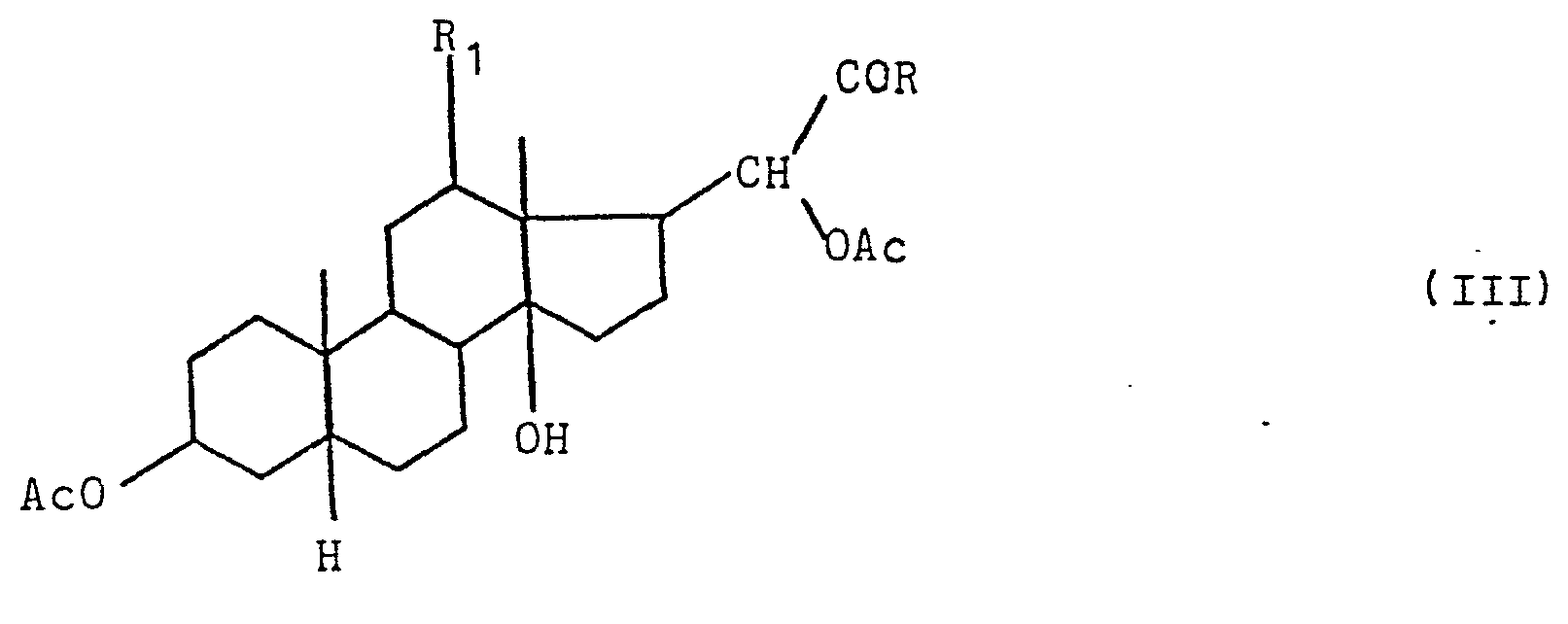
- La première étape, consistant à effectuer une réduction suivie d'une acétylation, pour former un trihydroxy stéroïde di-O-acëtylé quand R1 est un atome d'hydrogène, ou un tétrahydroxy stéroïde tri-O-acétylé quand R1 est un groupe hydroxy, peut s'effectuer par exemple au moyen d'un hydrure suivant la technique décrite par J. Fried et J.A. Edvards, "Organic Reactions in Steroïd Chemistry" Ed. Van Nostrand Reinhold (1972). On peut utiliser par exemple des hydrures mixtes d'aluminium ou de bore, tels que l'hydrure mixte de sodium et de bore ou l'hydrure mixte de lithium et d'aluminium, ou encore d'autres réducteurs tels que l'hydrogène en présence de catalyseurs.
- La réaction d'acétylation permettant d'obtenir le stéroïde acétylé de formule générale (III) peut s'effectuer suivant les techniques usuelles, par exemple par action de l'anhydride acétique dans un solvant organique.
- Dans la deuxième étape, le dérivé de formule générale (III) est transformé en dérivé azido-14 correspondant par action d'un complexe acide azothydrique-trifluorure de bore en solution dans le benzène. Le remplacement du groupe hydroxyle en position 14 par un groupe azide tertiaire s'effectue avec un bon rendement, les autres groupes hydroxyles en positions 3, 12 le cas échéant, et 20 ayant été préalablement protégés par acétylation.
- La troisième étape, consistant à transformer le dérivé azido-14 en dérivé amino-14 correspondant, peut s'effectuer par hydrogénation catalytique suivie d'une élimination des groupes acétyles protecteurs, ou par action d'un réducteur tel qu'un hydrure métallique, et plus particulièrement l'hydrure mixte de lithium et d'aluminium, pour former l'amino-14 stéroide de formule (I).
- Les cétones de départ, représentées par la formule générale (II) peuvent être préparées en appliquant la méthode décrite par N. Danielli et al. Tetrahedron 22 p.3189 (1966). Par exemple,lorsque R1 est un groupe hydroxy, on peut traiter un acide diacétoxy-3,12 hydroxy-14 étianique par un organométallique tel que le méthyl-lithium; il peut être avantageux d'opérer en ajoutant progressivement une solution de méthyl-lithium dans l'éther, à une température inférieure à 10°C, à une solution d'acide diacétoxy-3,12 hydroxy-14 5S-étianique dans le tétrahydrofuranne en présence d'hydrure de sodium. On peut également faire agir directement un réducteur tel que l'hydrure de lithium aluminium, dans le cas de la préparation des dérivés où R est l'hydrogène. Le dérivé d'acide étianique utilisé comme produit de départ est décrit dans la littérature (D.Taylor, J. Chem. Soc. 1953, p.3325).Lorsque R1 est un atome d'hydrogène, on traite de la même façon un acide acétoxy-3 hydroxy-14 étianique par un organométallique.
- Les amino-14 stéroîdes de formule générale (I) dans laquelle R et R1 représentent un atome d'hydrogène peuvent également être préparés par le procédé décrit au brevet français 2.464.270. De même, on peut appliquer la méthode de préparation décrite par Astier et al. Bull. Soc. Chim. n° 9-10, p.1581-1582 (1976) pour obtenir les amino-14 stéroïdes de formule générale (I) où R est un groupe alkyle inférieur et plus précisément un groupe méthyle.
- Le procédé conforme à la présente invention permet de préparer dans des conditions satisfaisantes les diverses formes stéréoisomères des dérivés d'amino-14 stéroïdes représentés par la formule générale (I) et notamment les dérivés où les groupes hydroxyles en positions 3 et 12 le cas échéant, et l'atome d'hydrogène en position 5 ont la configuration β, le groupe amino en position 14 possédant de préférence la configuration β, tandis que le groupe hydroxyle en position 20 peut avoir l'une ou l'autre des configurations α et quand R est un groupe alkyle.
- Les exemples décrits ci-après illustrent l'invention sans en limiter la portée. Les structures des produits obtenus ont été vérifiées par spectre infra-rouge, spectre de RNM et spectre de masse.
- On dissout 6g d'oxo-20 pregnane-5β diol-3β,14β obtenu par la méthode de N. Danielli et al. (précité) dans 30m1 de méthanol, puis on ajoute 1,5g de borohydrure de potassium par fractions, et on laisse réagir pendant 30mn environ. On élimine le méthanol par évaporation, on extrait à l'acétate d'éthyle et on lave. Le résidu est traité par 16,5ml d'anhydride acétique dans 35ml de pyridine pendant une nuit. Après hydrolyse, lavage à l'acide citrique et à l'eau, on obtient un résidu (7g soit un rendement de 95%) comprenant les deux isomères 20 a et 20β que l'on sépare par chromatographie sur colonne de silice.
- On dissout 210mg d'isomère 20 a du diacétyltriol obtenu comme indiqué ci-dessus dans 16,5 ml d'acide azothydrique en solution benzénique, et on maintient sous agitation pendant 5mn, puis on ajoute 0,4 ml de réactif éthérate de trifluorure de bore fraîchement distillé. Après 10mn de réaction, le mélange réactionnel est versé sur un mélange de glace pilée et d'ammoniaque.
- On extrait au benzène, on lave, on sèche, puis on dissout le résidu de 20 ml de tétrahydrofuranne et on ajoute 54mg d'hydrure mixte de lithium et d'aluminium. Après chauffage à reflux pendant 1 heure, on hydrolyse et on extrait une fraction neutre de 80mg et une fraction basique de 77mg d'aminopregnanediol (rendement 49%).
- Point de fusion F = 258°C
- On dissout 9g de l'isomère 20β du diacétyltriol préparé comme indiqué dans l'exemple 1 a), dans 600ml d'une solution benzénique d'acide azothydrique, puis on ajoute, après 5mn de réaction, l'éthérate de trifluorure de bore, en effectuant le même traitement que dans l'exemple 1 b).
- On obtient ainsi 2,3g d'amino-14βpregnane-5β diol-3β,20β (rendement 32%). La cristallisation est effectuée dans l'acétate d'éthyle.
- Point de fusion F = 196°C Spectre IR (Nujol) v = 3600 à 2100, 1585, 1030 cm-1
- On procède comme indiqué dans l'exemple 1. Le produit recherché est isolé de son isomère amino-14β pregnane-5β diol-3β,20α par chromatographie sur colonne de silice des eaux-mères de cristallisation du produit principal. La cr-istallisation est effectuée dans un mélange d'acétate d'éthyle et'de méthanol.
- Point de fusion F = 188°C
- On procède comme dans l'exemple 2. Le produit recherché est isolé par chromatographie sur colonne de silice des eaux-mères de cristallisation de l'isomère amino-14β pregnane-5S diol-3β,20β.
- Le produit est cristallisé dans l'isopropanol.
- Point de fusion F = 216°C
- On réduit 0,5g d'oxo-20 pregnane-5β,17βH diol-3β,14β par 120 mg de borohydrure de potassium dans 3m1 de méthanol. Après réaction, on effectue une acétylation par l'anhydride acétique dans la pyridine suivant la technique usuelle, pour obtenir avec un rendement de 95% le di-0-acétyl pregnane-5β,17βH triol-3β, 14β, 20α.
- On dissout 0,4g du diacétyltriol obtenu comme indiqué ci-dessus dans 30ml d'une solution benzénique d'acide azothydrique, puis on ajoute 0,6ml d'éthérate de trifluorure de bore. Après traitement comme dans l'exemple 1, on fait agir O,lg d'hydrure mixte de lithium et d'aluminium sur le résidu dans 10ml de tétrahydrofuranne. Après hydrolyse, extraction et cristallisation dans l'acétate d'éthyle on obtient 0,25g (rendement 80%) d'amino-14β pregnane-5β,17βH diol-3β,20α.
- Point de fusion F = 200-201°C.
- On procède comme dans l'exemple 1 avec l'isomère 5α en laissant agir l'éthérate de trifluorure de bore environ 5 heures.
- Après traitement et réduction par l'hydrure mixte de lithium et d'aluminium comme dans l'exemple 1, le résidu est repris dans l'acétate d'éthyle puis lavé par une solution d'acide chlorhydrique à 10%. L'acétate d'éthyle est éliminé par évaporation et les phases acides sont neutralisées par du carbonate de sodium et extraites au chloroforme. Après filtration, le filtrat est séché et fournit après cristallisation dans l'acétate d'éthyle, l'amino-14β pregnane-5α diol-3β,20α avec un rendement supérieur à 50%.
- Point de fusion F = 246°C.
- On procède comme dans l'exemple la) à partir de l'isomère 5 a du pregnanediol de départ, et on isole l'isomère 208 du diacétyltriol obtenu.
- On applique ensuite le même traitement que dans l'exemple 1b), et on obtient ainsi l'amino-14 β pregnane-5 α diol-3β,20β que l'on recristallise dans l'éther diisopropylique.
- Point de fusion F = 213°C
- Ce composé est préparé comme indiqué dans l'exemple 6 du brevet français 2.464.270 au nom de la demanderesse.
- On ajoute 1,1g d'hydrure de lithium aluminium, en maintenant la température à 0°C, à une solution de 130ml de tétrahydrofuranne contenant 8g d'un mélange d'oxo-20 pregnane-5βtriol-3β,12β,14β et de dérivés 0-acétylés correspondants, obtenu en faisant agir du méthyl lithium, en solution dans l'éther, sur l'acide diacétoxy-3β,12β hydroxy-14β 5β-étianique dans le tétrahydrofuranne en présence d'hydrure de sodium, à une température inférieure à 10°C environ, sous atmosphère d'azote.
- On ajoute à froid de l'acétate d'éthyle, puis un mélange de tétrahydrofuranne et d'eau. Après filtration et évaporation du solvant, on recueille 7,6g de pregnane-5 tétrol-3β,12β,14β,20β sous forme de poudre incolore.
- Le produit ci-dessus est dissous dans 120ml de chlorure de méthylène et on ajoute à. la solution 9,2ml d'anydride acétique et 1,2g de diméthylamino-4 pyridine. On maintient le mélange réactionnel sous agitation pendant quelques heures puis on lave par une solution de carbonate de sodium et on extrait la phase aqueuse avec du chlorure de méthylène. Après séchage, on obtient 9,3g de tri-0-acétyl-3,12,20 pregnane-5β tétrol-3β,12β,14β,20β.
- Les deux isomères 20 a et 20βsont séparés par chromatographie sur silice Merck H60 en utilisant comme éluant un mélange de chlorure de méthylène et d'acétone (96,5/3,5).
- Le tri-O-acétyl-3,12,20 pregnane-5β tétrol-3β ,12β,14β,20β est recristallisé dans l'éther (point de fusion F = 216°C). On en dissout 5,7g dans 330ml d'une solution benzénique d'acide azothydrique environ 10M, puis on ajoute 7,3ml d'éthérate de trifluorure de bore fraichement distillé et on maitient sous agitation pendant environ 25mn.
- Après alcalinisation par un mélange d'ammoniaque et de glace pilée, extraction au benzène, lavage à l'eau , séchage sur sulfate de sodium et évaporation, on obtient 5,8g d'un résidu que l'on dissout dans 300ml d'éthanol. On effectue une hydrogénation à température' ambiante sous atmosphère d'hydrogène pendant 48 heures en présence de 2,9g de palladium sur carbonate de calcium (5%).
- Le catalyseur est éliminé par filtration et le filtrat est évaporé à sec pour fournir 5,5g d'une mousse incolore que l'on dissout dans le toluène.
- On lave plusieurs fois avec une solution d'acide sulfamique à 5%. Le précipité formé est filtré et purifié pour fournir 0,5g de tri-O-acétyl-3,12,20 amino-14β pregnane-5β triol-3β,12β,20β. Les phases aqueuses acides sont alcalinisées au carbonate de sodium et extraites au chlorure de méthylène pour procurer 0,75g du même produit.
- Point de fusion F = 211°C (éther isopropylique).
- On saponifie 0,2g de tri-O-acétyl-3,12,20 amino-14β pregnane-5β triol-3β,12β,20β, obtenu comme indiqué ci-dessus dans 150m1 de soude méthanolique 1N en agitant la suspension pendant 2 heures à température ambiante, puis en chauffant à reflux pendant 30mn.
- Après évaporation du solvant, le résidu est extrait par le chloroforme. On obtient ainsi 0,15g d'amino-14β pregnane-5β triol-3β,12β,20β, que l'on peut faire recristalliser dans le mélange acétate d'éthyle-méthanol.
- Point de fusion F = 238°C Spectre IR (Nujol) v = 3400, 3330, 3270, 3180, 3100, 2660, 1615, 1600cm-1.
- Les amino-14 stéroîdes conformes à l'invention, représentés par la formule générale (I) ci-dessus, possèdent d'intéressantes propriétés pharmacologiques, et plus particulièrement, ils possèdent une activité inotrope positive.
- Ces propriétés, illustrées ci-après, montrent que les amino-14 stéroïdes de formule générale (I) ainsi que leurs sels pharmaceutiquement acceptables, peuvent être utilisés en thérapeutique humaine et vétérinaire comme médicaments destinés au traitement de l'insuffisance cardiaque.
- Les expérimentations toxicologiques effectuées ont montré que la toxicité aigüe des amino-14 stéroides suivant l'invention est relativement faible, et en particulier nettement plus faible que celle des composés digi- taliques usuels tels que la digitoxine et la digoxine.
- La mise en évidence de l'effet inotrope in vitro a été faite sur le coeur isolé de cobaye selon la méthode de Langendorff et sur l'oreillette isolée de cobaye. Les résultats obtenus démontrent la possibilité d'application pour le traitement de l'insuffisance cardiaque.
- A titre d'exemple, dans le cas de 1'amino-14β pregnane-5β triol--3β,12β,20β, le test du coeur isolé perfusé selon Langendorff fait apparaître une augmentation du débit cardiaque de 30 à 40% environ pour des doses de 1 à 30ug/ml. Dans le test sur l'oreillette isolée de cobaye, pour une concentration de 10" g/1 on constate une augmentation de la force de contraction de 150% environ par rapport à la valeur contrôle. Ces résultats sont confirmés en faisant varier les conditions expérimentales, après administration de propranolol, apportant la preuve de l'action myocardique directe du composé et en éliminant une médiation adrénergique.
- Des résultats comparables sont obtenus avec l'amino-14β-nor-21 pregnane-5S diol-3β,20.
- Les dérivés de formule générale (I) et leurs sels pharmaceutiquement acceptables peuvent être administrés sous les formes usuelles, le principe actif étant dilué dans un support pharmaceutiquement acceptable convenablement choisi, par exemple sous forme de comprimé, gélule, dragée, suppositoire, soluté injectable ou sirop.
- A titre d'exemple, les comprimés peuvent être préparés en mélangeant le dérivé de formule générale (I) ou un de ses sels, avec un ou plusieurs diluants solides tels que le lactose, le mannitol, l'amidon, la polyvinyl- pyrrolidone, le stéarate de magnésium, le talc, etc. Le cas échéant, les comprimés peuvent comporter plusieurs couches superposées autour d'un noyau, suivant les techniques usuelles, pour assurer une libération progressive ou un effet retardé du principe actif. L'enrobage peut par exemple être constitué d'une ou plusieurs couches d'acétate de polyvinyle, de carboxyméthylcellulose ou d'acétophtalate de cellulose.
- On peut également administrer le dérivé suivant l'invention sous forme d'un sirop ou d'un soluté buvable obtenu en dissolvant le dérivé de formule (I) ou un de ses sels pharmaceutiquement acceptables, dans de l'eau ou du glycérol, par exemple, et en ajoutant le cas échéant un additif usuel tel qu'un édulcorant et un antioxydant.
- Des solutions injectables peuvent être préparées suivant les techniques bien connues et sont constituées par exemple par un soluté contenant un dérivé de formule (I) ou un de ses sels pharmaceutiquement acceptables, dissous dans de l'eau bidistillée, une solution hydroalcoolique, du propy- lèneglycol, etc., ou un mélange de ces solvants. Le cas échéant, un additif approprié tel qu'un conservateur peut être ajouté.
- Les doses administrées sont déterminées par le médecin en fonction du mode d'administration choisi, le niveau de l'affection traitée, la durée du traitement, etc. Par exemple, dans le cas de l'administration par voie orale chez l'homme, les doses peuvent être comprises entre 0,005et 5mg/kg.
Claims (7)


Priority Applications (1)
| Application Number | Priority Date | Filing Date | Title |
|---|---|---|---|
| AT83401644T ATE23539T1 (de) | 1982-08-12 | 1983-08-10 | 14-aminosteroidderivate, ihre therapeutische anwendung und verfahren zu ihrer herstellung. |
Applications Claiming Priority (4)
| Application Number | Priority Date | Filing Date | Title |
|---|---|---|---|
| FR8214038 | 1982-08-12 | ||
| FR8214038A FR2531715B1 (fr) | 1982-08-12 | 1982-08-12 | Amino-14 steroides, application en therapeutique, et procede de preparation |
| FR8310031A FR2548191B1 (fr) | 1983-06-17 | 1983-06-17 | Amino-14 steroides, application en therapeutique et procede de preparation |
| FR8310031 | 1983-06-17 |
Publications (2)
| Publication Number | Publication Date |
|---|---|
| EP0101383A1 true EP0101383A1 (fr) | 1984-02-22 |
| EP0101383B1 EP0101383B1 (fr) | 1986-11-12 |
Family
ID=26223042
Family Applications (1)
| Application Number | Title | Priority Date | Filing Date |
|---|---|---|---|
| EP83401644A Expired EP0101383B1 (fr) | 1982-08-12 | 1983-08-10 | Dérivés d'amino-14 stéroides, application en thérapeutique, et procédé de préparation |
Country Status (8)
| Country | Link |
|---|---|
| US (1) | US4584289A (fr) |
| EP (1) | EP0101383B1 (fr) |
| CA (1) | CA1216283A (fr) |
| DE (1) | DE3367598D1 (fr) |
| DK (1) | DK167442B1 (fr) |
| ES (1) | ES8404693A1 (fr) |
| GR (1) | GR78920B (fr) |
| IE (1) | IE55630B1 (fr) |
Cited By (3)
| Publication number | Priority date | Publication date | Assignee | Title |
|---|---|---|---|---|
| WO1998046243A3 (fr) * | 1997-04-15 | 1999-02-25 | Csir | Compositions pharmaceutiques dotees d'une activite coupe-faim |
| US7033616B2 (en) | 2000-06-30 | 2006-04-25 | Phytopharm Plc | Extracts, compounds and pharmaceutical compositions having anti-diabetic activity and their use |
| US7501135B2 (en) | 1999-10-27 | 2009-03-10 | Conopco, Inc. | Gastric acid secretion |
Families Citing this family (4)
| Publication number | Priority date | Publication date | Assignee | Title |
|---|---|---|---|---|
| CZ331094A3 (en) * | 1992-06-26 | 1995-09-13 | Pfizer | Steroidal glycosides and their use for treating hypercholesterolemia and atherosclerosis |
| US5922703A (en) * | 1993-09-24 | 1999-07-13 | The Procter & Gamble Company | Urethane-containing aminosteroid compounds |
| CZ86796A3 (en) * | 1993-09-24 | 1996-10-16 | Procter & Gamble | Novel deoxy and on oxygen substituted sugar derivatives of aminosteroidal compounds |
| BR9407612A (pt) * | 1993-09-24 | 1997-01-14 | Procter & Gamble | Novos compostos de 14-aminoesteróides contendo oligossacarideos e nova química de processo de aminoesteróide diastereosseletivo |
Citations (2)
| Publication number | Priority date | Publication date | Assignee | Title |
|---|---|---|---|---|
| DD138983A1 (de) * | 1978-09-26 | 1979-12-05 | Schmidt Hans Joerg | Verfahren zur herstellung von neuen n-funktionellen cardenolidderivaten |
| EP0024983A2 (fr) * | 1979-08-31 | 1981-03-11 | Etablissements Nativelle S.A. | Dérivés d'amino-14 stéroides et procédé pour leur préparation |
-
1983
- 1983-07-30 ES ES524614A patent/ES8404693A1/es not_active Expired
- 1983-08-08 GR GR72160A patent/GR78920B/el unknown
- 1983-08-10 DK DK364483A patent/DK167442B1/da not_active IP Right Cessation
- 1983-08-10 EP EP83401644A patent/EP0101383B1/fr not_active Expired
- 1983-08-10 DE DE8383401644T patent/DE3367598D1/de not_active Expired
- 1983-08-11 IE IE1887/83A patent/IE55630B1/en not_active IP Right Cessation
- 1983-08-11 CA CA000434379A patent/CA1216283A/fr not_active Expired
- 1983-08-12 US US06/522,957 patent/US4584289A/en not_active Expired - Lifetime
Patent Citations (2)
| Publication number | Priority date | Publication date | Assignee | Title |
|---|---|---|---|---|
| DD138983A1 (de) * | 1978-09-26 | 1979-12-05 | Schmidt Hans Joerg | Verfahren zur herstellung von neuen n-funktionellen cardenolidderivaten |
| EP0024983A2 (fr) * | 1979-08-31 | 1981-03-11 | Etablissements Nativelle S.A. | Dérivés d'amino-14 stéroides et procédé pour leur préparation |
Non-Patent Citations (2)
| Title |
|---|
| BULLETIN DE LA SOCIETE CHIMIQUE DE FRANCE, no. 9-10, septembre-octobre 1976, pages 1581-1582, Paris, FR. * |
| TETRAHEDRON, vol. 34, no. 10, 1978, pages 1481-1486, Pergamon Press Ltd., Oxford, GB. * |
Cited By (11)
| Publication number | Priority date | Publication date | Assignee | Title |
|---|---|---|---|---|
| WO1998046243A3 (fr) * | 1997-04-15 | 1999-02-25 | Csir | Compositions pharmaceutiques dotees d'une activite coupe-faim |
| GB2338235A (en) * | 1997-04-15 | 1999-12-15 | Csir | Pharmaceutical compositions having appetite suppressant activity |
| GB2360519A (en) * | 1997-04-15 | 2001-09-26 | Csir | Steroidal glycosides |
| GB2338235B (en) * | 1997-04-15 | 2001-11-14 | Csir | Appetite suppressing plant extracts |
| GB2360519B (en) * | 1997-04-15 | 2001-11-28 | Csir | Appetite suppressant steroidal glycosides |
| US6376657B1 (en) | 1997-04-15 | 2002-04-23 | Csir | Pharmaceutical compositions having appetite suppressant activity |
| EP1213020A3 (fr) * | 1997-04-15 | 2005-03-09 | Csir | Compositions pharmaceutiques dotées d'une activité coupe-faim |
| US7166611B2 (en) | 1997-04-15 | 2007-01-23 | Csir | Pharmaceutical compositions having appetite suppressant activity |
| US7501135B2 (en) | 1999-10-27 | 2009-03-10 | Conopco, Inc. | Gastric acid secretion |
| US7033616B2 (en) | 2000-06-30 | 2006-04-25 | Phytopharm Plc | Extracts, compounds and pharmaceutical compositions having anti-diabetic activity and their use |
| US7416744B2 (en) | 2000-06-30 | 2008-08-26 | Conopco, Inc. | Extracts, compounds and pharmaceutical compositions having anti-diabetic activity and their use |
Also Published As
| Publication number | Publication date |
|---|---|
| EP0101383B1 (fr) | 1986-11-12 |
| DE3367598D1 (en) | 1987-01-02 |
| US4584289A (en) | 1986-04-22 |
| GR78920B (fr) | 1984-10-02 |
| CA1216283A (fr) | 1987-01-06 |
| DK364483A (da) | 1984-02-13 |
| ES524614A0 (es) | 1984-05-01 |
| ES8404693A1 (es) | 1984-05-01 |
| DK167442B1 (da) | 1993-11-01 |
| DK364483D0 (da) | 1983-08-10 |
| IE55630B1 (en) | 1990-12-05 |
| IE831887L (en) | 1984-02-12 |
Similar Documents
| Publication | Publication Date | Title |
|---|---|---|
| LU87414A1 (fr) | Derives de l'adenosine | |
| EP0310519B1 (fr) | Nouveaux esters d'acide androstane 17-carboxylique, procédé pour leur préparation et médicament les contenant | |
| EP0073161B1 (fr) | Nouveaux dérivés de la pyrazine actifs sur le système nerveux central | |
| EP0101383B1 (fr) | Dérivés d'amino-14 stéroides, application en thérapeutique, et procédé de préparation | |
| EP0004494B1 (fr) | Nouveaux dérivés de 1,3-dihydro 3-(1-(2-(2,3-dihydro 1,4-benzo-dioxin-2-yl)2-hydroxy éthyl)pipéridin-4-yl)2H-indol 2-one, leur procédé de préparation, leur application comme médicaments et les compositions pharmaceutiques les renfermant | |
| EP0101659B1 (fr) | Nouveaux dérivés d'amino-14 stéroides, procédé pour leur préparation, et application en thérapeutique | |
| CH627648A5 (fr) | Nouveaux derives de 20,21-dinoreburnamenine, procede de preparation et compositions pharmaceutiques. | |
| EP0001021B1 (fr) | Nouveaux dérivés d'alcaloides pentacycliques, procédé de préparation, application à la synthèse de produits du groupe de l'éburnamonine et compositions pharmaceutiques | |
| EP0443957B1 (fr) | Nouveaux produits stéroides comportant un radical spiro en position 17, leur procédé de préparation et les intermédiaires de ce procédé, leur application à titre de médicaments et les compositions pharmaceutiques les renfermant | |
| CH650515A5 (fr) | Derives steroides 3-amines et leurs sels, procedes de preparation, ainsi que les medicaments et compositions les renfermant. | |
| CH620688A5 (en) | Process for the preparation of new lactones derived from cyclopentanol | |
| FR2548191A1 (fr) | Amino-14 steroides, application en therapeutique et procede de preparation | |
| EP0003455B1 (fr) | Amino-3-cardénolides, procédé pour leur préparation, et médicaments les contenant | |
| CA1202631A (fr) | Derives de la quinidine, procede de preparation et application en therapeutique | |
| EP0012072A2 (fr) | Bêta-lactones dérivées de l'acide 2-hydroxy cyclopentane carboxylique, procédé pour leur préparation et compositions pharmaceutiques les renfermant | |
| FR2487359A1 (fr) | 11a-amino-androstanes, leur preparation et compositions en contenant | |
| US3975412A (en) | Mono-acylation of 17-hydroxy-3-alkoxygona-2,5-(10)dienes | |
| EP0032889B1 (fr) | Nouveaux dérivés du type diméthyl-1,10 oxayohimbane et médicaments les contenant | |
| FR2531715A1 (fr) | Amino-14 steroides, application en therapeutique, et procede de preparation | |
| FR2531964A1 (fr) | Derives d'amino-14 steroides, procede de preparation, et application en therapeutique | |
| FR2547586A1 (fr) | Derives d'amino-14 steroides, procede de preparation et application en therapeutique | |
| BE889639A (fr) | 11-alpha-amino-androstanes, leur preparation et compositions en contenant | |
| BE887147A (fr) | Nouveaux composes heterocycliques utiles comme agents antiallergiques | |
| CH598285A5 (en) | Steroid 21-(4-acetamidomethylcyclohexane carboxylates) | |
| BE552152A (fr) |
Legal Events
| Date | Code | Title | Description |
|---|---|---|---|
| PUAI | Public reference made under article 153(3) epc to a published international application that has entered the european phase |
Free format text: ORIGINAL CODE: 0009012 |
|
| AK | Designated contracting states |
Designated state(s): AT BE CH DE FR GB IT LI LU NL SE |
|
| 17P | Request for examination filed |
Effective date: 19840716 |
|
| GRAA | (expected) grant |
Free format text: ORIGINAL CODE: 0009210 |
|
| ITF | It: translation for a ep patent filed | ||
| AK | Designated contracting states |
Kind code of ref document: B1 Designated state(s): AT BE CH DE FR GB IT LI LU NL SE |
|
| REF | Corresponds to: |
Ref document number: 23539 Country of ref document: AT Date of ref document: 19861115 Kind code of ref document: T |
|
| REF | Corresponds to: |
Ref document number: 3367598 Country of ref document: DE Date of ref document: 19870102 |
|
| PLBE | No opposition filed within time limit |
Free format text: ORIGINAL CODE: 0009261 |
|
| STAA | Information on the status of an ep patent application or granted ep patent |
Free format text: STATUS: NO OPPOSITION FILED WITHIN TIME LIMIT |
|
| 26N | No opposition filed | ||
| ITTA | It: last paid annual fee | ||
| EPTA | Lu: last paid annual fee | ||
| EAL | Se: european patent in force in sweden |
Ref document number: 83401644.6 |
|
| PGFP | Annual fee paid to national office [announced via postgrant information from national office to epo] |
Ref country code: NL Payment date: 20000620 Year of fee payment: 18 |
|
| PGFP | Annual fee paid to national office [announced via postgrant information from national office to epo] |
Ref country code: GB Payment date: 20000703 Year of fee payment: 18 Ref country code: AT Payment date: 20000703 Year of fee payment: 18 |
|
| PGFP | Annual fee paid to national office [announced via postgrant information from national office to epo] |
Ref country code: SE Payment date: 20000802 Year of fee payment: 18 |
|
| PGFP | Annual fee paid to national office [announced via postgrant information from national office to epo] |
Ref country code: LU Payment date: 20000803 Year of fee payment: 18 Ref country code: FR Payment date: 20000803 Year of fee payment: 18 |
|
| PGFP | Annual fee paid to national office [announced via postgrant information from national office to epo] |
Ref country code: DE Payment date: 20000830 Year of fee payment: 18 |
|
| PGFP | Annual fee paid to national office [announced via postgrant information from national office to epo] |
Ref country code: BE Payment date: 20000915 Year of fee payment: 18 |
|
| PGFP | Annual fee paid to national office [announced via postgrant information from national office to epo] |
Ref country code: CH Payment date: 20001013 Year of fee payment: 18 |
|
| PG25 | Lapsed in a contracting state [announced via postgrant information from national office to epo] |
Ref country code: LU Free format text: LAPSE BECAUSE OF NON-PAYMENT OF DUE FEES Effective date: 20010810 Ref country code: GB Free format text: LAPSE BECAUSE OF NON-PAYMENT OF DUE FEES Effective date: 20010810 Ref country code: AT Free format text: LAPSE BECAUSE OF NON-PAYMENT OF DUE FEES Effective date: 20010810 |
|
| PG25 | Lapsed in a contracting state [announced via postgrant information from national office to epo] |
Ref country code: SE Free format text: LAPSE BECAUSE OF NON-PAYMENT OF DUE FEES Effective date: 20010811 |
|
| PG25 | Lapsed in a contracting state [announced via postgrant information from national office to epo] |
Ref country code: LI Free format text: LAPSE BECAUSE OF NON-PAYMENT OF DUE FEES Effective date: 20010831 Ref country code: CH Free format text: LAPSE BECAUSE OF NON-PAYMENT OF DUE FEES Effective date: 20010831 Ref country code: BE Free format text: LAPSE BECAUSE OF NON-PAYMENT OF DUE FEES Effective date: 20010831 |
|
| BERE | Be: lapsed |
Owner name: ETABLISSEMENTS NATIVELLE S.A. Effective date: 20010831 |
|
| PG25 | Lapsed in a contracting state [announced via postgrant information from national office to epo] |
Ref country code: NL Free format text: LAPSE BECAUSE OF NON-PAYMENT OF DUE FEES Effective date: 20020301 |
|
| EUG | Se: european patent has lapsed |
Ref document number: 83401644.6 |
|
| GBPC | Gb: european patent ceased through non-payment of renewal fee |
Effective date: 20010810 |
|
| REG | Reference to a national code |
Ref country code: CH Ref legal event code: PL |
|
| PG25 | Lapsed in a contracting state [announced via postgrant information from national office to epo] |
Ref country code: FR Free format text: LAPSE BECAUSE OF NON-PAYMENT OF DUE FEES Effective date: 20020430 |
|
| NLV4 | Nl: lapsed or anulled due to non-payment of the annual fee |
Effective date: 20020301 |
|
| PG25 | Lapsed in a contracting state [announced via postgrant information from national office to epo] |
Ref country code: DE Free format text: LAPSE BECAUSE OF NON-PAYMENT OF DUE FEES Effective date: 20020501 |
|
| REG | Reference to a national code |
Ref country code: FR Ref legal event code: ST |