EP0101853A2 - Einrichtung zur potentialgetrennten Signalausgabe bei einem Steuerwerk - Google Patents
Einrichtung zur potentialgetrennten Signalausgabe bei einem Steuerwerk Download PDFInfo
- Publication number
- EP0101853A2 EP0101853A2 EP83106800A EP83106800A EP0101853A2 EP 0101853 A2 EP0101853 A2 EP 0101853A2 EP 83106800 A EP83106800 A EP 83106800A EP 83106800 A EP83106800 A EP 83106800A EP 0101853 A2 EP0101853 A2 EP 0101853A2
- Authority
- EP
- European Patent Office
- Prior art keywords
- converter
- output
- control system
- optocouplers
- identification signal
- Prior art date
- Legal status (The legal status is an assumption and is not a legal conclusion. Google has not performed a legal analysis and makes no representation as to the accuracy of the status listed.)
- Granted
Links
- 238000002955 isolation Methods 0.000 claims description 3
- 238000012545 processing Methods 0.000 abstract description 8
- 238000000034 method Methods 0.000 abstract description 4
- 238000011143 downstream manufacturing Methods 0.000 abstract 1
- 238000000926 separation method Methods 0.000 abstract 1
- 238000004804 winding Methods 0.000 description 4
- 230000006399 behavior Effects 0.000 description 2
- 239000003990 capacitor Substances 0.000 description 2
- 238000013461 design Methods 0.000 description 2
- 238000012544 monitoring process Methods 0.000 description 2
- 238000010586 diagram Methods 0.000 description 1
- 230000007257 malfunction Effects 0.000 description 1
- 230000005693 optoelectronics Effects 0.000 description 1
- 230000005855 radiation Effects 0.000 description 1
- 238000012546 transfer Methods 0.000 description 1
Images
Classifications
-
- H—ELECTRICITY
- H04—ELECTRIC COMMUNICATION TECHNIQUE
- H04B—TRANSMISSION
- H04B10/00—Transmission systems employing electromagnetic waves other than radio-waves, e.g. infrared, visible or ultraviolet light, or employing corpuscular radiation, e.g. quantum communication
- H04B10/80—Optical aspects relating to the use of optical transmission for specific applications, not provided for in groups H04B10/03 - H04B10/70, e.g. optical power feeding or optical transmission through water
- H04B10/801—Optical aspects relating to the use of optical transmission for specific applications, not provided for in groups H04B10/03 - H04B10/70, e.g. optical power feeding or optical transmission through water using optical interconnects, e.g. light coupled isolators, circuit board interconnections
- H04B10/802—Optical aspects relating to the use of optical transmission for specific applications, not provided for in groups H04B10/03 - H04B10/70, e.g. optical power feeding or optical transmission through water using optical interconnects, e.g. light coupled isolators, circuit board interconnections for isolation, e.g. using optocouplers
-
- H—ELECTRICITY
- H03—ELECTRONIC CIRCUITRY
- H03K—PULSE TECHNIQUE
- H03K17/00—Electronic switching or gating, i.e. not by contact-making and –breaking
- H03K17/51—Electronic switching or gating, i.e. not by contact-making and –breaking characterised by the components used
- H03K17/78—Electronic switching or gating, i.e. not by contact-making and –breaking characterised by the components used using opto-electronic devices, i.e. light-emitting and photoelectric devices electrically- or optically-coupled
- H03K17/795—Electronic switching or gating, i.e. not by contact-making and –breaking characterised by the components used using opto-electronic devices, i.e. light-emitting and photoelectric devices electrically- or optically-coupled controlling bipolar transistors
- H03K17/7955—Electronic switching or gating, i.e. not by contact-making and –breaking characterised by the components used using opto-electronic devices, i.e. light-emitting and photoelectric devices electrically- or optically-coupled controlling bipolar transistors using phototransistors
Definitions
- the invention relates to a device for potential-separated signal output with the aid of optocouplers consisting of input and output elements in a control unit fed by a power supply device, which delivers a characteristic signal indicating this only when operated properly.
- control units including process computer systems, in technical systems with high security requirements, e.g. B. railway safety systems
- monitoring the control units for proper operation is required. If the control unit malfunctions, the respective technical process must be influenced on the safe side. Monitoring can take place, for example, in the form of a self-check of the control unit by using redundant, mutually comparing systems. Proper operation of the control unit is expediently indicated by an ongoing identification signal. The output signals of the control unit can only be passed on without hesitation when this identification signal is present. Therefore, the identification signal would have to be combined with each signal to be output by a safe AND gate. Such measures require however, a not inconsiderable technical effort.
- the object of the invention is to design a device of the type mentioned at the outset in such a way that a reliable link between the output-side signals of the control unit and the identification signal is achieved with little technical outlay.
- this object is achieved in that a galvanically isolating converter which can be fed by the identification signal of the control unit is provided for the power supply of the output elements of all optocouplers.
- the galvanic isolation prevents interlinking between the elements to be controlled by the signal output and the control unit.
- Analog signals can also be transmitted via the optocouplers.
- the converter can be designed such that the size of the output voltage depends on the energy and / or the quality of the identification signal.
- An advantageous embodiment of the invention is characterized in that a converter with "fail-safe" behavior is used. This ensures that when the identification signal is switched off, no supply voltage reaches the output elements of the optocouplers.
- a further embodiment of the device according to the invention provides that the electrical isolation in the converter takes place via a magnetic field. This enables a relatively loss-free energy transfer.
- Another advantageous embodiment of the invention is characterized in that an amplifier is provided for the identification signal. This is an adjustment of the strength ke of the identification signal to the energy requirements of the opto coupler easily possible.
- a discharge resistor can be connected in parallel to the output of the converter and / or the output of each optocoupler, it is ensured that no signal distortions are caused by capacitors in the converter or in the processing devices connected downstream of the optocouplers.
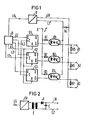
- FIG. 1 shows a data processing system D as a control unit. This outputs data via lines L1, L2 and L3 to the D inputs of three memory elements S1, S2 and S3 - each in the manner of a D flip-flop. The data are prompted in each case by a positive clock edge on a line L4 into the memory elements S1, S2 and S3.
- a logic “0” can be used to set each storage element S1, S2 or S3 to a basic position via a line L5.
- a identification signal is supplied to a converter U via a line L6.
- the converter U forms from this Identification signal a DC voltage.
- the input and the output of the converter U are electrically isolated from one another.
- the converter U exhibits "fail-safe" behavior, ie a failure of the identification signal leads to a voltage-free state at the output of the converter U.
- the positive potential of the output voltage from the converter U reaches the collector of phototransistors of the optocouplers 01 via line L7, 02 and 03.
- the emitters of these phototransistors lead to first poles of outputs A1, A2 and A3, which lead to processing devices which are not shown for the sake of clarity.
- the second pole of each of these outputs A1, A2 and A3 is given by the negative potential of the output voltage of the converter U. This potential is supplied via a line L8.
- a discharge resistor R4 is connected in parallel to the output of converter U, and a discharge resistor R5, R6 and R7 is connected in parallel to the output of each optocoupler 01, 02 and 03, respectively. If positive logic is assumed, due to the presence of a signal logic "1" at an input E, a positive voltage is constantly fed to the anode via a current-limiting series resistor R1, R2 and R3, in each case one of the luminance diodes assigned to one of the optocouplers 01, 02 or 03. The cathodes of these luminance diodes are each assigned to an inverting output of one of the memory elements S1, S2 or S3.
- the illustration according to FIG. 2 shows a special design of the converter U.
- the converter U receives the identification signal via the line L6, which is amplified in a switching amplifier SV.
- the power supply of the switching amplifier SV which also takes over the power supply of the data processing system D and the memory elements S1, S2 and S3, and supplies the input E with voltage, is not shown for the sake of clarity.
- the amplified identification signal, a clock signal reaches a primary winding of a transformer T, the secondary winding of which is galvanically separated from the primary winding.
- the transformed characteristic signal present at the secondary winding is rectified by an arrangement of a diode D and a capacitor C.
- the direct signal is forwarded via lines L7 and L8.
Landscapes
- Physics & Mathematics (AREA)
- Electromagnetism (AREA)
- Engineering & Computer Science (AREA)
- Computer Networks & Wireless Communication (AREA)
- Signal Processing (AREA)
- Analogue/Digital Conversion (AREA)
- Electronic Switches (AREA)
- Oscillators With Electromechanical Resonators (AREA)
- Semiconductor Integrated Circuits (AREA)
- Power Conversion In General (AREA)
- Cash Registers Or Receiving Machines (AREA)
- Safety Devices In Control Systems (AREA)
- Electric Propulsion And Braking For Vehicles (AREA)
- Dc-Dc Converters (AREA)
- Massaging Devices (AREA)
- Peptides Or Proteins (AREA)
- Electrotherapy Devices (AREA)
Abstract
Description
- Die Erfindung bezieht sich auf eine Einrichtung zur potentialgetrennten Signalausgabe mit Hilfe von aus Ein-und Ausgangselementen bestehenden Optokopplern in einem durch eine Stromversorgungseinrichtung gespeisten Steuerwerk, das nur bei ordnungsgerechtem Betrieb ein diesen anzeigendes Kennsignal liefert.
- Aus dem Buch "Optoelektronik kurz und bündig", Vogel-Verlag 1975, Kapitel 6.1.2 ist es bekannt, Optokoppler zur potentialgetrennten Signalausgabe in Prozeßrechnersystemen zu verwenden.
- Wenn Steuerwerke, u. a. Prozeßrechnersysteme, in technischen Anlagen mit hohen Sicherheitsanforderungen, z. B. Eisenbahnsicherungsanlagen, eingesetzt werden, ist eine Überwachung der Steuerwerke auf ordnungsgerechten Betrieb erforderlich. Bei einer Fehlfunktion des Steuerwerkes muß der jeweilige technische Prozeß zur sicheren Seite hin beeinflußt werden. Die Überwachung kann beispielsweise in Form einer Selbstprüfung des Steuerwerkes durch Einsatz redundanter, sich gegenseitig vergleichender Systeme erfolgen. Ein ordnungsgerechter Betrieb des Steuerwerkes wird in jedem Fall zweckmäßigerweise durch ein andauerndes Kennsignal angezeigt. Nur beim Vorliegen dieses Kennsignales können die Ausgangssignale des Steuerwerkes bedenkenlos weitergeleitet werden. Daher müßte das Kennsignal mit jedem auszugebenden Signal durch ein sicheres UND-Glied kombiniert werden. Derartige Maßnahmen bedingen jedoch einen nicht unerheblichen technischen Aufwand.
- Aufgabe der Erfindung ist es, eine Einrichtung der eingangs genannten Gattung derart auszubilden, daß mit geringem technischen Aufwand eine sichere Verknüpfung zwischen den ausgangsseitigen Signalen des Steuerwerkes und dem Kennsignal erzielt wird.
- Gemäß der Erfindung wird diese Aufgabe dadurch gelöst, daß zur Stromversorgung der Ausgangselemente aller Optokoppler ein galvanisch trennender, vom Kennsignal des Steuerwerkes speisbarer Umsetzer vorgesehen ist. Die galvanische Trennung verhindert dabei Verkettungen zwischen den von der Signalausgabe anzusteuernden Elementen und dem Steuerwerk. Dabei sind über die Optokoppler auch Analogsignale übertragbar. Der Umsetzer kann so ausgebildet sein, daß die Größe der Ausgangsspannung abhängig von der Energie und/oder der Qualität des Kennsignales ist.
- Eine vorteilhafte Ausbildung der Erfindung ist dadurch gekennzeichnet, daß ein Umsetzer mit "fail-safe"-Verhalten verwendet ist. Dadurch wird erreicht, daß bei abgeschaltetem Kennsignal keine Versorgungsspannung an die Ausgangselemente der Optokoppler gelangt.
- Eine weitere Ausbildung der erfindungsgemäßen Einrichtung sieht vor, daß die galvanische Trennung im Umsetzer über ein magnetisches Feld erfolgt. Damit ist eine relativ verlustfreie Energieübertragung möglich.
- Eine weitere vorteilhafte Ausbildung der Erfindung ist dadurch gekennzeichnet, daß ein Verstärker für das Kennsignal vorgesehen ist. Damit ist eine Anpassung der Stärke des Kennsignales an den Energiebedarf der Optpkoppler leicht möglich.
- Wenn dem Ausgang des Umsetzers und/oder dem Ausgang jedes Optokopplers jeweils ein Entladewiderstand parallelschaltbar ist, ist sichergestellt, daß durch Kondensatoren im Umsetzer oder in den den Optokopplern nachgeschalteten Verarbeitungseinrichtungen keine Signalverfälschungen bewirkt werden.
- Ein Ausführungsbeispiel der Erfindung ist in der Zeichnung dargestellt und wird im folgenden näher erläutert.
- Dabei zeigen:
- Figur 1 ein Blockschaltbild und
- Figur 2 einen galvanisch trennenden Umsetzer.
- Die Darstellung gemäß Figur 1 zeigt als Steuerwerk eine Datenverarbeitungsanlage D. Diese gibt über Leitungen L1, L2 und L3 Daten an die D-Eingänge von drei Speichergliedern S1, S2 und S3 - jeweils nach Art eines D-FlipFlops - . Die Daten werden dabei jeweils veranlaßt durch eine positive Taktflanke auf einer Leitung L4 in die Speicherglieder S1, S2 bzw. S3 übernommen. Über eine Leitung L5 kann bei Betriebsbeginn der Datenverarbeitungsanlage D aufgrund eines Signales logisch "0" jedes Speicherglied S1, S2 bzw. S3 in eine Grundstellung gesetzt werden.
- Über eine Leitung L6 wird beim ordnungsgerechten Betrieb der Datenverarbeitungsanlage D ein Kennsignal an einen Umsetzer U geliefert. Der Umsetzer U formt aus diesem Kennsignal eine Gleichspannung. Der Ein- und der Ausgang des Umsetzers U sind dabei galvanisch voneinander getrennt. Der Umsetzer U weist "fail-safe"-Verhalten auf, d. h. ein Ausfall des Kennsignales führt zu einer Spannungsfreiheit am Ausgang des_Umsetzers U. Das positive Potential der Ausgangsspannung vom Umsetzer U gelangt über eine Leitung L7 jeweils an den Kollektor von Fototransistoren der Optokoppler 01, 02 bzw. 03. Die Emitter dieser Fototransistoren führen an erste Pole von Ausgängen A1, A2 bzw. A3, die zu der Übersichtlichkeit halber nicht dargestellten Verarbeitungseinrichtungen führen. Der jeweils zweite Pol jedes dieser Ausgänge A1, A2 bzw. A3 ist durch das negative Potential der Ausgangsspannung des Umsetzers U gegeben. Die Zuführung dieses Potentiales erfolgt über.eine Leitung L8.
- Dem Ausgang des Umsetzers U ist ein Entladewiderstand R4 parallelgeschaltet, dem Ausgang jedes Optokopplers 01, 02 bzw. 03 ist jeweils ein Entladewiderstand R5, R6 bzw. R7 parallelgeschaltet. Bei angenommener positiver Logik wird aufgrund des Vorliegens eines Signales logisch "1" an einem Eingang E jeweils über strombegrenzende Vorwiderstände R1, R2 und R3 ständig eine positive Spannung an die Anode jeweils einer jeweils einem der Optokoppler 01, 02 bzw. 03 zugeordneten Luminizenzdiode zugeleitet. Die Kathoden dieser Luminizenzdioden sind jeweils einem invertierenden Ausgang eines der Speicherglieder S1, S2 bzw. S3 zugeordnet. Damit fließt jeweils bei gesetztem Speicherglied S1, S2 bzw. S3 - logischer Zustand "0" am jeweiligen invertierenden Ausgang - ein Strom über die jeweilige Luminizenzdiode des Optokopplers 01, 02 bzw. 03. Durch die Bestrahlung werden die zugeordneten Fototransistoren in den Optokopplern 01, 02 bzw. 03 leitend und am zugeordneten Ausgang A1, A2 bzw. A3 liegt bei ordnungsgemäßem Betriebszustand der Datenverarbeitungsanlage D ein Ausgangssignal vor.
- Die Darstellung gemäß Figur 2 zeigt eine spezielle Ausbildung des Umsetzers U. Dieser erhält über die Leitung L6 das Kennsignal, das in einem Schaltverstärker SV verstärkt wird. Die Stromversorgung des Schaltverstärkers SV, die auch die Stromversorgung der Datenverarbeitungsanlage D und der Speicherglieder S1, S2 und S3 übernimmt, sowie den Eingang E mit Spannung versorgt, ist der Übersichtlichkeit halber nicht dargestellt. Das verstärkte Kennsignal, ein Taktsignal, gelangt an eine Primärwicklung eines Transformators T, dessen Sekundärwicklung galvanisch von der Primärwicklung getrennt ist. Das an der Sekundärwicklung anstehende transformierte Kennsignal wird durch eine Anordnung einer Diode D und eines Kondensators C gleichgerichtet. Die Weiterleitung des Gleichsignales erfolgt über die Leitungen L7 und L8.
Claims (6)
Priority Applications (1)
| Application Number | Priority Date | Filing Date | Title |
|---|---|---|---|
| AT83106800T ATE59241T1 (de) | 1982-07-21 | 1983-07-11 | Einrichtung zur potentialgetrennten signalausgabe bei einem steuerwerk. |
Applications Claiming Priority (2)
| Application Number | Priority Date | Filing Date | Title |
|---|---|---|---|
| DE19823227290 DE3227290A1 (de) | 1982-07-21 | 1982-07-21 | Einrichtung zur potentialgetrennten signalausgabe bei einem steuerwerk |
| DE3227290 | 1982-07-21 |
Publications (3)
| Publication Number | Publication Date |
|---|---|
| EP0101853A2 true EP0101853A2 (de) | 1984-03-07 |
| EP0101853A3 EP0101853A3 (en) | 1987-10-14 |
| EP0101853B1 EP0101853B1 (de) | 1990-12-19 |
Family
ID=6168976
Family Applications (1)
| Application Number | Title | Priority Date | Filing Date |
|---|---|---|---|
| EP83106800A Expired - Lifetime EP0101853B1 (de) | 1982-07-21 | 1983-07-11 | Einrichtung zur potentialgetrennten Signalausgabe bei einem Steuerwerk |
Country Status (4)
| Country | Link |
|---|---|
| EP (1) | EP0101853B1 (de) |
| AT (1) | ATE59241T1 (de) |
| DE (2) | DE3227290A1 (de) |
| ZA (1) | ZA835268B (de) |
Cited By (2)
| Publication number | Priority date | Publication date | Assignee | Title |
|---|---|---|---|---|
| EP0433965B1 (de) * | 1989-12-21 | 1996-06-19 | Bosch-Siemens HausgerÀ¤te GmbH | Elektrisches Haushaltgerät oder dergleichen |
| EP0816746A1 (de) * | 1996-06-28 | 1998-01-07 | Elan Schaltelemente GmbH | Sicherheitsschaltungsanordnung |
Families Citing this family (1)
| Publication number | Priority date | Publication date | Assignee | Title |
|---|---|---|---|---|
| DK161227C (da) * | 1986-01-27 | 1991-11-25 | Antonson Security Denmark Aps | Apparat til synkronisering af tyveridetektorer |
Family Cites Families (3)
| Publication number | Priority date | Publication date | Assignee | Title |
|---|---|---|---|---|
| FR2222922A5 (en) * | 1973-03-22 | 1974-10-18 | Otic Fischer & Porter | Safety control system for explosive environments - using light waves to transmit control signals to hazardous area |
| CH594340A5 (en) * | 1975-07-10 | 1978-01-13 | Erni & Co Elektro Ind | Arrangement to isolate potentially interfering circuits |
| FR2381075A1 (fr) * | 1977-02-18 | 1978-09-15 | Lille Communaute Urbaine | Dispositif de commande de feux de circulation avec memoire |
-
1982
- 1982-07-21 DE DE19823227290 patent/DE3227290A1/de not_active Withdrawn
-
1983
- 1983-07-11 DE DE8383106800T patent/DE3382067D1/de not_active Expired - Lifetime
- 1983-07-11 EP EP83106800A patent/EP0101853B1/de not_active Expired - Lifetime
- 1983-07-11 AT AT83106800T patent/ATE59241T1/de not_active IP Right Cessation
- 1983-07-20 ZA ZA835268A patent/ZA835268B/xx unknown
Cited By (2)
| Publication number | Priority date | Publication date | Assignee | Title |
|---|---|---|---|---|
| EP0433965B1 (de) * | 1989-12-21 | 1996-06-19 | Bosch-Siemens HausgerÀ¤te GmbH | Elektrisches Haushaltgerät oder dergleichen |
| EP0816746A1 (de) * | 1996-06-28 | 1998-01-07 | Elan Schaltelemente GmbH | Sicherheitsschaltungsanordnung |
Also Published As
| Publication number | Publication date |
|---|---|
| EP0101853B1 (de) | 1990-12-19 |
| EP0101853A3 (en) | 1987-10-14 |
| ATE59241T1 (de) | 1991-01-15 |
| DE3227290A1 (de) | 1984-01-26 |
| ZA835268B (en) | 1984-03-28 |
| DE3382067D1 (de) | 1991-01-31 |
Similar Documents
| Publication | Publication Date | Title |
|---|---|---|
| EP0033436B1 (de) | Zweikanalige Datenverarbeitungsanordnung für Eisenbahnsicherungszwecke | |
| DE2458302A1 (de) | Netzteil mit einem sperrwandler fuer einen fernsehempfaenger mit ultraschallfernbedienung | |
| EP0268930A1 (de) | Schaltungsanordnung eines sich selbst schützenden Leistungsschalters | |
| DE2555603A1 (de) | Anordnung fuer positive sicherheit | |
| DE3112239A1 (de) | "schaltungsanordnung zur symmetrieregelung eines nach dem gegentaktprinzip arbeitenden gleichstromversorgungsgeraetes" | |
| CH634672A5 (de) | Digitale datenverarbeitungsanordnung, insbesondere fuer die eisenbahnsicherungstechnik. | |
| EP0101853B1 (de) | Einrichtung zur potentialgetrennten Signalausgabe bei einem Steuerwerk | |
| DE2806294A1 (de) | Einrichtung zur kontrolle des elektrischen leitungszustandes eines elektromechanischen schaltkontakts | |
| EP0198263A2 (de) | Schaltungsanordnung zur erdfreien Übertragung digitaler Signale über Trennstellen | |
| DE102019207968A1 (de) | Vorrichtung zur induktiven Übertragung elektrischer Energie | |
| DE2826897C2 (de) | Schaltungsanordnung zur erdfreien Übertragung von Signalen über Trennstellen in Fernmeldeanlagen | |
| EP0569883A2 (de) | Schaltungsanordnung zur Begrenzung des Einschaltstroms in einer elektronischen Baugruppe | |
| DE2555594A1 (de) | Anordnung zur steuerung mit positiver sicherheit | |
| DE3942427A1 (de) | Schaltungsanordnung zum aufbau unterbrechungsfreier stromversorgungseinheiten | |
| EP0292817A2 (de) | Schaltungsanordnung zur Erzeugung bipolarer digitaler Datensignale | |
| DE1073617B (de) | Schutzschaltung für Transistoren im Wechselrichterbetrieb | |
| DE2544427C2 (de) | Schaltungsanordnung zur Realisierung von logischen Funktionen | |
| DE2247276A1 (de) | Antivalenzkontrolleinrichtung fuer ein zweikanaliges schaltwerk | |
| DE3427221A1 (de) | Schaltungsanordnung fuer primaer getaktete schaltnetzteile | |
| DE2545469A1 (de) | Schaltungsanordnung zur logischen verknuepfung wechselspannungsfoermiger eingangssignale | |
| DE3330465A1 (de) | Spannungswandler | |
| DE2212832C3 (de) | Verfahren und Vorrichtung zur Überwachung und zum Schutz eines Parallelschwingkreiswechselrichters | |
| DE2900631B1 (de) | Sicherheits-Ausgabeschaltung | |
| DE2264360C3 (de) | Fehlersicherer Ausgabeverstärker | |
| AT334985B (de) | Schaltungsanordnung in fernmelde-, insbesondere fernsprechanlagen zur anschaltung einer signalwechselspannung an eine fernmelde-, insbesondere fernsprechleitung, oder an mehrere derartige leitungen |
Legal Events
| Date | Code | Title | Description |
|---|---|---|---|
| PUAI | Public reference made under article 153(3) epc to a published international application that has entered the european phase |
Free format text: ORIGINAL CODE: 0009012 |
|
| AK | Designated contracting states |
Designated state(s): AT CH DE FR GB LI NL SE |
|
| 17P | Request for examination filed |
Effective date: 19841119 |
|
| PUAL | Search report despatched |
Free format text: ORIGINAL CODE: 0009013 |
|
| AK | Designated contracting states |
Kind code of ref document: A3 Designated state(s): AT CH DE FR GB LI NL SE |
|
| 17Q | First examination report despatched |
Effective date: 19890331 |
|
| GRAA | (expected) grant |
Free format text: ORIGINAL CODE: 0009210 |
|
| AK | Designated contracting states |
Kind code of ref document: B1 Designated state(s): AT CH DE FR GB LI NL SE |
|
| REF | Corresponds to: |
Ref document number: 59241 Country of ref document: AT Date of ref document: 19910115 Kind code of ref document: T |
|
| REF | Corresponds to: |
Ref document number: 3382067 Country of ref document: DE Date of ref document: 19910131 |
|
| ET | Fr: translation filed | ||
| GBT | Gb: translation of ep patent filed (gb section 77(6)(a)/1977) | ||
| PLBE | No opposition filed within time limit |
Free format text: ORIGINAL CODE: 0009261 |
|
| STAA | Information on the status of an ep patent application or granted ep patent |
Free format text: STATUS: NO OPPOSITION FILED WITHIN TIME LIMIT |
|
| 26N | No opposition filed | ||
| EAL | Se: european patent in force in sweden |
Ref document number: 83106800.2 |
|
| PGFP | Annual fee paid to national office [announced via postgrant information from national office to epo] |
Ref country code: SE Payment date: 19970711 Year of fee payment: 15 |
|
| PGFP | Annual fee paid to national office [announced via postgrant information from national office to epo] |
Ref country code: NL Payment date: 19970714 Year of fee payment: 15 |
|
| PG25 | Lapsed in a contracting state [announced via postgrant information from national office to epo] |
Ref country code: SE Free format text: LAPSE BECAUSE OF NON-PAYMENT OF DUE FEES Effective date: 19980712 |
|
| PG25 | Lapsed in a contracting state [announced via postgrant information from national office to epo] |
Ref country code: NL Free format text: LAPSE BECAUSE OF NON-PAYMENT OF DUE FEES Effective date: 19990201 |
|
| EUG | Se: european patent has lapsed |
Ref document number: 83106800.2 |
|
| NLV4 | Nl: lapsed or anulled due to non-payment of the annual fee |
Effective date: 19990201 |
|
| PGFP | Annual fee paid to national office [announced via postgrant information from national office to epo] |
Ref country code: AT Payment date: 19990616 Year of fee payment: 17 |
|
| PGFP | Annual fee paid to national office [announced via postgrant information from national office to epo] |
Ref country code: GB Payment date: 19990709 Year of fee payment: 17 |
|
| PGFP | Annual fee paid to national office [announced via postgrant information from national office to epo] |
Ref country code: FR Payment date: 19990723 Year of fee payment: 17 |
|
| PGFP | Annual fee paid to national office [announced via postgrant information from national office to epo] |
Ref country code: DE Payment date: 19990917 Year of fee payment: 17 |
|
| PGFP | Annual fee paid to national office [announced via postgrant information from national office to epo] |
Ref country code: CH Payment date: 19991015 Year of fee payment: 17 |
|
| PG25 | Lapsed in a contracting state [announced via postgrant information from national office to epo] |
Ref country code: GB Free format text: LAPSE BECAUSE OF NON-PAYMENT OF DUE FEES Effective date: 20000711 Ref country code: AT Free format text: LAPSE BECAUSE OF NON-PAYMENT OF DUE FEES Effective date: 20000711 |
|
| PG25 | Lapsed in a contracting state [announced via postgrant information from national office to epo] |
Ref country code: LI Free format text: LAPSE BECAUSE OF NON-PAYMENT OF DUE FEES Effective date: 20000731 Ref country code: CH Free format text: LAPSE BECAUSE OF NON-PAYMENT OF DUE FEES Effective date: 20000731 |
|
| GBPC | Gb: european patent ceased through non-payment of renewal fee |
Effective date: 20000711 |
|
| REG | Reference to a national code |
Ref country code: CH Ref legal event code: PL |
|
| PG25 | Lapsed in a contracting state [announced via postgrant information from national office to epo] |
Ref country code: FR Free format text: LAPSE BECAUSE OF NON-PAYMENT OF DUE FEES Effective date: 20010330 |
|
| REG | Reference to a national code |
Ref country code: FR Ref legal event code: ST |
|
| PG25 | Lapsed in a contracting state [announced via postgrant information from national office to epo] |
Ref country code: DE Free format text: LAPSE BECAUSE OF NON-PAYMENT OF DUE FEES Effective date: 20010501 |