EP0102437B1 - Découpeur d'ensilage et outil agricole classique muni d'un tel découpeur d'ensilage - Google Patents
Découpeur d'ensilage et outil agricole classique muni d'un tel découpeur d'ensilage Download PDFInfo
- Publication number
- EP0102437B1 EP0102437B1 EP82810368A EP82810368A EP0102437B1 EP 0102437 B1 EP0102437 B1 EP 0102437B1 EP 82810368 A EP82810368 A EP 82810368A EP 82810368 A EP82810368 A EP 82810368A EP 0102437 B1 EP0102437 B1 EP 0102437B1
- Authority
- EP
- European Patent Office
- Prior art keywords
- cutter according
- silage cutter
- silage
- blade
- support element
- Prior art date
- Legal status (The legal status is an assumption and is not a legal conclusion. Google has not performed a legal analysis and makes no representation as to the accuracy of the status listed.)
- Expired
Links
Images



Classifications
-
- A—HUMAN NECESSITIES
- A01—AGRICULTURE; FORESTRY; ANIMAL HUSBANDRY; HUNTING; TRAPPING; FISHING
- A01F—PROCESSING OF HARVESTED PRODUCE; HAY OR STRAW PRESSES; DEVICES FOR STORING AGRICULTURAL OR HORTICULTURAL PRODUCE
- A01F25/00—Storing agricultural or horticultural produce; Hanging-up harvested fruit
- A01F25/16—Arrangements in forage silos
- A01F25/20—Unloading arrangements
- A01F25/2027—Unloading arrangements for trench silos
- A01F25/2036—Cutting or handling arrangements for silage blocks
-
- B—PERFORMING OPERATIONS; TRANSPORTING
- B26—HAND CUTTING TOOLS; CUTTING; SEVERING
- B26D—CUTTING; DETAILS COMMON TO MACHINES FOR PERFORATING, PUNCHING, CUTTING-OUT, STAMPING-OUT OR SEVERING
- B26D1/00—Cutting through work characterised by the nature or movement of the cutting member or particular materials not otherwise provided for; Apparatus or machines therefor; Cutting members therefor
- B26D1/01—Cutting through work characterised by the nature or movement of the cutting member or particular materials not otherwise provided for; Apparatus or machines therefor; Cutting members therefor involving a cutting member which does not travel with the work
- B26D1/547—Cutting through work characterised by the nature or movement of the cutting member or particular materials not otherwise provided for; Apparatus or machines therefor; Cutting members therefor involving a cutting member which does not travel with the work having a wire-like cutting member
-
- B—PERFORMING OPERATIONS; TRANSPORTING
- B26—HAND CUTTING TOOLS; CUTTING; SEVERING
- B26D—CUTTING; DETAILS COMMON TO MACHINES FOR PERFORATING, PUNCHING, CUTTING-OUT, STAMPING-OUT OR SEVERING
- B26D7/00—Details of apparatus for cutting, cutting-out, stamping-out, punching, perforating, or severing by means other than cutting
- B26D7/01—Means for holding or positioning work
Definitions
- the invention relates to a silage cutter according to the first part of claim 1 and to an agricultural device provided with a receiving member having such a silage cutter.
- the invention is based on the object of providing a silage cutter which, with a relatively simple construction, forms a smaller cutting width into the silage and the forces exerted on the frame are smaller.
- each knife element assigned to a side leg is coupled to one end of the knife element assigned to the center leg by a flexible connecting element guided over the associated corner of the supporting element, and in that at least one drive means is connected exclusively to the second end of at least one attacks a knife element associated with a side leg.
- the support member with the knife elements needs to be moved downward through the silage, as far as the drive means engages the free ends of the cutter member and can therefore be arranged outside the space for the silage block to be cut out.
- the required cutting width is therefore small in the silage cutter according to the invention.
- the forces exerted on the frame during the downward movement are substantially smaller, as a result of which the wear of the frame is low and an advantageous lifespan of the silage cutter is achieved.
- the invention further relates to an agricultural device provided with a receiving member, which is characterized in that this receiving member has a silage cutter according to the invention.
- FIG. 1 shows an exemplary embodiment of a cutting device of the silage cutter according to the invention for cutting cattle feed or the like.
- This cutting device comprises a support element 1 which can be moved up and down at least approximately vertically and which supports a knife element 3 designed with teeth 2.
- This knife member 3 is at least approximately horizontally reciprocable relative to the support member 1.
- the support member 1 has lower retaining teeth 4, which project lower than the knife teeth 2 down.
- a silage cutter with such a support member is the subject of priority European patent application No. 84201442.5, published as EP-A No. 0140433.
- the knife member 3 is also preferably arranged on the outside of the support member 1.
- the distance between the tips the knife teeth 2 is preferably smaller than the distance between the tips of the following holding teeth 4 of the support member 1, while the height of the knife teeth 2 is smaller than the height of the holding teeth 4 of the support member 1.
- the flanks of the knife teeth 2 form a smaller angle with the connecting line of their tooth tips than the angle enclosed by the flanks of the retaining teeth 4 of the support member 1 with the connecting line of their tooth tips.
- flanks of the knife teeth 2 are straight and form an angle with the connecting line of the tooth tips which is less than 50 ° and preferably less than or equal to 30 °.
- flanks of the knife teeth 2 can also be curved inwards.
- the retaining teeth 4 of the support member 1 run downwards obliquely in the direction of the knife member 3, while the knife teeth 2 run downwards obliquely in the direction of the support member 1 (FIG. 2).
- the support member 1 is also designed with an upper support edge 5 for the knife member 3, along which the upper edge of the knife member 3 is adjustable to and fro.
- This support edge 5 carries downwardly projecting sealing lips 6, the knife element 3 being enclosed between these sealing lips 6 and the supporting element 1 so as to be able to oscillate back and forth.
- the support member 1 and the knife member 3 are held against one another by a guide member, which in the exemplary embodiment according to FIGS. 2 and 2 consists of one or more slots 7 in the knife member 3, which are passed through by pins protruding from the support member 1. Upwards from the knife member 3, the pins carry a closing plate 7 ', a nut or the like.
- the knife element may carry 3 pins which pass through the slots in the support element 1 in a suitable manner.
- the stroke of the reciprocating oscillating movement of the knife element 3 is generally greater than the distance between the tips of subsequent knife teeth of the knife element 3.
- the support member 1 and the knife member 3 are plate-shaped.
- the knife element 3 can also consist, for example, of a chain or the like which is designed with teeth.
- a plate-shaped knife member 3 is preferred because it is easier to lock against an upward adjustment relative to the support member 1.
- the support member 1 can be designed in the form of a profile or box instead of a plate.
- the support member 1 cooperates with only one knife member 3, the support member 1 can also support a further tooth member 3 ′ in the manner shown in FIGS. 5 to 10, which parallel runs to the knife member 3 shown and which is preferably at least approximately horizontally adjustable back and forth relative to the support member 1, the teeth of the knife members 3, 3 'being reciprocatingly reciprocable.
- a further knife element 3 ' is shown in FIGS. 5 to 10, a number of further knife elements 3' can of course also be used.
- the support member 1 is designed without lower retaining teeth, but as an alternative, retaining teeth 4 can also be used in these embodiments.
- the flanks of the knife teeth of the (each) further knife member 3 ' form a smaller angle with the connecting line of their tooth tips than the angle enclosed by the flanks of the retaining teeth with the connecting line of their tooth tips.
- the further knife element 3 ′ forms the mirror image of the knife element 3.
- the support member 1 and the knife members 3, 3 ' are held against each other by pins on the support member 1, the slots 7 in the knife members 3, 3' pass. Away from the knife member 3 ', the pins carry a sealing plate 7', a nut or the like.
- the flanks of the knife teeth of the (each) knife member 3, 3 ' are straight in the exemplary embodiment according to FIGS. 5 to 7 and form an angle with the connecting line of the tooth tips which is less than 50 ° and preferably less than or equal to 30 ° .
- the exemplary embodiment of the cutting device according to FIGS. 8 to 10 differs only from the exemplary embodiment according to FIGS. 5 to 7 in that the flanks of the knife teeth of the (each) further knife element 3 'are bent inwards.
- the downward or upward adjustment of the support member 1 can take place continuously, but as an alternative it is also possible that the downward adjustment of the support member 1 is intermittent and the upward adjustment of the support member 1 is continuous.
- the support member 1 can be L-shaped and cooperate with an L-shaped knife member 3 made of flexible material.
- the L-shaped support member 1 interacts with at least one knife set consisting of two knife elements 3, which together form an L-shaped knife member 3.
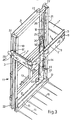
- the support member 1 is U-shaped (see FIGS. 3 and 11).
- the three knife elements 3, which together form a U-shaped knife element, are coupled to one another and interact with drive elements, which are described in more detail below and which engage the free ends of the two lateral knife elements 3.
- the adjacent ends of subsequent knife elements 3 are coupled to one another by an at least approximately horizontal chain 8, band or the like, the ends of which are fastened to the relevant knife elements 3, which are fastened to the respective corner by the support element 1 supported Leitrol le 9 is guided with at least approximately vertical longitudinal axis.
- a conical protective piece 10 runs above and below the guide roller 9.
- the middle leg 1 'of the U-shaped support member 1 runs further upwards than the two side legs 1 "in order to prevent loosened crop from falling downwards over this side.
- FIG. 4 While the coupling between the adjacent ends of subsequent knife elements 3 is shown in FIG. 4, the coupling between the adjacent ends of subsequent knife elements 3 and knife elements 3 'is shown in FIGS. 7 and 10.
- Two horizontal chains 8, belts or the like are used, both of which are guided over the guide roller 9.
- the silage cutter 11 shown in FIGS. 3 and 11, on which the cutting device described above is arranged, has a frame 12 which is provided with attachment points 13 for coupling the silage cutter 11 to the lifting device of a tractor.
- the frame 12 comprises an upright frame part 14, behind which a horizontal cross bar 15 extends, to which a plurality of parallel, at least approximately horizontal support prongs 16 are fastened.
- the crossbar 15 is rigidly connected to the upright frame part 14 in the embodiment of FIG. 3.
- the upward and downward adjustment of the U-shaped support member 1 is accomplished with the aid of adjustment members carried by the frame 12.
- these consist of an upright cylinder-piston unit 19 supported by the frame 12, the piston rod 19 'of which carries a disk block 20.
- the support member 1 is adjustable up and down.
- cylinder-piston units 26 which are double-acting in this exemplary embodiment, are actuated via a hydraulic changeover valve and check valves (not shown) in such a way that the piston rods 26 ′ of the two cylinder-piston units 26 are always adjusted in the opposite direction, as a result of which the knife elements 3 get a reciprocating motion.
- the two double-acting cylinder-piston units 26 are hydraulically coupled to the upright cylinder-piston unit 19, which supplies the upward and downward movement of the support member 1.
- the support member 1 will step adjusted wisely, each step coinciding with a reciprocating movement of the knife elements 3.
- a silage cutter 11 is shown, in which the upward and downward adjustment of the U-shaped support member 1 is accomplished in a different manner, with the aid of chains 23 or the like acting on the ends of the side legs 1 "of the support member 1
- the lower guide wheels are mounted in the upright frame part 14, while the upper drive wheels are fastened to a drive shaft 24, which is mounted in the upright frame part 14 and which is connected via a drive wheel 25 by means of a chain by a hydraulic motor or
- the top and bottom position of the support member 1 is determined by reversing members (not shown) which can supply the reversal of the direction of rotation of the hydraulic motor.
- the drive means for the reciprocating movement of the knife elements 3 again consist of cylinder-piston units 26 which engage the free ends of the two lateral knife members 3.
- the silage cutter 11 according to FIG. 11 is designed with an upper throwing member 27 with which a block of silage can be distributed regularly after it has been transferred to a cattle shed by means of the silage cutter 11 coupled behind a tractor.
- the upper ejector member 27, which is supported by the upright frame part 14, comprises a discharge conveyor 28, which consists of chains (not shown) which can be driven by a drive and which engage at the ends of scraper bars 30 provided with pins 29 or the like, which act in the lower one Run of the discharge conveyor 28 can act on the silage.
- the upright frame part 14 instead of U-profiles 18, I-profiles 31, while the crossbeam 15 is not rigidly connected to the upstanding frame part 14, but carries guide rollers 32, guide blocks or the like, which engages with the inside of this first - Profiles 31 are available.
- These I-profiles 31 are on the outside, in a manner corresponding to the U-profiles 18 in Fig. 3, with the guide rollers 17 supported by the free ends of the U-shaped support member 1 guide blocks or the like.
- the up and down adjustment of the cross bar 15 can, for example, in a manner corresponding to the up and down adjustment of the support member 1 of the cutting device, by means of the cross bar 15 coupled, guided by drive wheels, endless chains or the like (not shown) or one in vertical piston cylinder unit (not shown) carried by the frame 12 can be realized.
- a central, at least approximately horizontal knife 33 with lower cutting teeth interacts with the discharge conveyor 28 and lies at least approximately in the central plane of the transverse beam 15.
- This knife 33 can be driven back and forth in its longitudinal direction by a drive element, such as the cylinder-piston unit 34 shown in FIG. 11, which is supported by the frame 12.
- central knife 33 it is also possible to use a plurality of drivable, parallel, at least approximately horizontal knives with lower cutting teeth that run alongside one another at a distance.
- the cutting device is in its highest position, just below the discharge conveyor 28 and surrounds the knife 33 and the upper part of the block of silage just below it.
- the use of the knife 33 (the knife) is particularly important if the silage has a fiber structure, since the long fibers are cut and divided by the knife 33 (the knife) before being discharged by the discharge conveyor 28, thereby ensuring even removal of the silage is very challenged.
- the discharge conveyor 28 is adjustable to and fro in the longitudinal direction of the crossbar 15, the knife 33 (the knives) maintaining its position relative to the frame 12.
- This adjustment option is important, since in a so-called driving silo there are usually two side walls on both sides of the silage pile. If the silage cutter 11 has to cut the first block of silage along one wall, the discharge conveyor 28, which is always longer than the width of the block of silage, since otherwise the crop cannot be poured over the side edge of the block of silage, into its position remote from this wall brought, while when cutting the last silage block along the opposite wall of the discharge conveyor 28 is adjusted to its other end position.
- the crossbeam 15 can be locked in its lower position relative to the frame 12, which is important when the carrying tines 16 move into the silage.
- a stop for which the crossbar 15 is used in the silage cutter 11 according to FIG. 11, limits the depth of penetration into the silage of the support tines 16 fastened to the crossbar 15 such that the upright frame part 14 after the support tines 16 are guided into the silage, remains at some distance, for example about 5 cm, from the silage.
- the corners of the U-shaped support member 1 facing away from the upright frame part 14 are somewhat larger than 90 °, and preferably approximately 94 ° (FIGS. 16 and 17).
- the support member 1 with the knife elements 3 has started the cutting action.
- the support tines 16 and / or the frame 12 of the silage cutter 11 are dimensioned such that a deformation of the support tines 16 and / or the frame 12 occurs under the influence of the cutting force.
- the frame 12 is slightly raised from the ground under the influence of the cutting force exerted, the supporting tines 16 and, if necessary. the frame 12 are bent.
- Fig. 14 the cutting device has reached its lower position, in which the holding teeth 4 of the support member 1 have come into contact with the ground, while the tips of the knife teeth 2 lie a short distance above the ground.
- the cutting device is adjusted to its uppermost end position and the silage cutter 11 is raised (FIG. 15), after which it can be driven by the tractor to the cattle shed.
- the block of silage is gradually moved upwards by the upward adjustment of the crossbeam 15 and the carrying tines 16 (FIG. 15) and brought into engagement with the knife 33 (the knives) and also with the discharge conveyor 28 in order to be regularly discarded.
- the scantling movement can also be accomplished with the help of a special scantling organ.
- silage cutter 11 an embodiment of a silage cutter 11 is shown, in which the ends of the two side legs 1 "of the support member 1 each have an upward extension 36, in which two guide rollers 37 or the like are supported one above the other, which in the associated Profile 38 of the upright frame part 14 are guided appropriately.
- the lower of the two guide rollers 37 engages on both sides by means of an eccentric 39 on the relevant side leg 1 ′′ of the support element 1.
- Each eccentric 39 is connected to an actuating element 40 with which the eccentric 39 can be rotated between two drawn in FIG Lines and positions shown in dashed lines, the position of the eccentric 39 and the support member 1 shown in solid lines being the working position in which the knife elements not shown in FIGS.
- the U-shaped support member 1 supports only one knife set consisting of three knife elements 3, it is clear that in combination therewith one or more knife sets consisting of three knife elements 3 ', can be used.
- the different sets of knives each have their own drive means, such as the cylinder-piston units 26, which are shown in FIGS. 7 and 10.
Landscapes
- Life Sciences & Earth Sciences (AREA)
- Forests & Forestry (AREA)
- Engineering & Computer Science (AREA)
- Mechanical Engineering (AREA)
- Environmental Sciences (AREA)
- Harvester Elements (AREA)
- Threshing Machine Elements (AREA)
- Cultivation Receptacles Or Flower-Pots, Or Pots For Seedlings (AREA)
- Cultivation Of Plants (AREA)
- Fodder In General (AREA)
- Details Of Cutting Devices (AREA)
- Turning (AREA)
- Electrical Discharge Machining, Electrochemical Machining, And Combined Machining (AREA)
Claims (42)
Priority Applications (8)
| Application Number | Priority Date | Filing Date | Title |
|---|---|---|---|
| EP82810368A EP0102437B2 (fr) | 1982-09-03 | 1982-09-03 | Découpeur d'ensilage et outil agricole classique muni d'un tel découpeur d'ensilage |
| AT82810368T ATE17300T1 (de) | 1982-09-03 | 1982-09-03 | Silagegutschneider, sowie landwirtschaftliches geraet das einen solchen silagegutschneider aufweist. |
| DE8282810368T DE3268418D1 (en) | 1982-09-03 | 1982-09-03 | Silage cutter and conventional agricultural implement with such silage cutter |
| DE8484201442T DE3279384D1 (en) | 1982-09-03 | 1982-09-03 | Silage cutter and an agricultural machine having a loader implement including a similar silage cutter |
| DK399583A DK399583A (da) | 1982-09-03 | 1983-09-01 | Skaereapparat til skaering af kreatur-groentfoder eller tilsvarende plantevaekst, samt en ensilageskaeremekanisme eller andet landbrugsredskab, der er forsynet med et gribeelement, som er konstrueret med et saadan skaereapparat |
| AU18673/83A AU1867383A (en) | 1982-09-03 | 1983-09-02 | A cutting apparatus for fodder |
| DD83254485A DD213583B5 (de) | 1982-09-03 | 1983-09-02 | Silagegutschneider |
| ES525313A ES525313A0 (es) | 1982-09-03 | 1983-09-02 | Aparato para el corte de bloques de pienso |
Applications Claiming Priority (1)
| Application Number | Priority Date | Filing Date | Title |
|---|---|---|---|
| EP82810368A EP0102437B2 (fr) | 1982-09-03 | 1982-09-03 | Découpeur d'ensilage et outil agricole classique muni d'un tel découpeur d'ensilage |
Related Child Applications (1)
| Application Number | Title | Priority Date | Filing Date |
|---|---|---|---|
| EP84201442.5 Division-Into | 1984-10-09 |
Publications (3)
| Publication Number | Publication Date |
|---|---|
| EP0102437A1 EP0102437A1 (fr) | 1984-03-14 |
| EP0102437B1 true EP0102437B1 (fr) | 1986-01-08 |
| EP0102437B2 EP0102437B2 (fr) | 1992-04-29 |
Family
ID=8190076
Family Applications (1)
| Application Number | Title | Priority Date | Filing Date |
|---|---|---|---|
| EP82810368A Expired - Lifetime EP0102437B2 (fr) | 1982-09-03 | 1982-09-03 | Découpeur d'ensilage et outil agricole classique muni d'un tel découpeur d'ensilage |
Country Status (7)
| Country | Link |
|---|---|
| EP (1) | EP0102437B2 (fr) |
| AT (1) | ATE17300T1 (fr) |
| AU (1) | AU1867383A (fr) |
| DD (1) | DD213583B5 (fr) |
| DE (2) | DE3279384D1 (fr) |
| DK (1) | DK399583A (fr) |
| ES (1) | ES525313A0 (fr) |
Cited By (2)
| Publication number | Priority date | Publication date | Assignee | Title |
|---|---|---|---|---|
| DE3644876A1 (de) * | 1986-04-23 | 1987-10-29 | Fella Werke Gmbh | Vorrichtung zum schneiden von silagebloecken |
| DE3712021A1 (de) * | 1987-04-09 | 1988-10-20 | Lengerich Maschf | Geraet zum entnehmen von silagegut |
Families Citing this family (11)
| Publication number | Priority date | Publication date | Assignee | Title |
|---|---|---|---|---|
| DE338653T1 (de) * | 1984-06-25 | 1990-03-22 | Etablissements Lucas G., La Gaubretiere | Ladegeraet mit einer seitlich schneidenden vorrichtung fuer siloentnahme- und verteilergeraete. |
| DE3430037A1 (de) * | 1984-08-16 | 1986-02-27 | M.A.N. Maschinenfabrik Augsburg-Nürnberg AG, 8500 Nürnberg | Waagrecht liegendes, hydraulisches zylinderaggregat |
| DE3537475A1 (de) * | 1985-10-22 | 1987-04-23 | Poettinger Alois Landmasch | Verfahren und vorrichtung fuer den transport und das aufloesen eines futterblockes und zum zerkleinern und abgeben des futters auf einen futterplatz |
| FR2591421B1 (fr) * | 1985-12-18 | 1989-04-28 | Audureau Sa | Couteau, notamment pour desileuse, et desi- leuse le comportant |
| DE3601112A1 (de) * | 1986-01-16 | 1987-07-23 | Lengerich Maschf | Vorrichtung zum entnehmen von silagegut |
| DE3613647A1 (de) * | 1986-04-23 | 1987-11-05 | Fella Werke Gmbh | Vorrichtung zum schneiden von silagebloecken |
| DE3811924A1 (de) * | 1988-04-09 | 1989-10-19 | Hans Von Der Heide | Silagegutschneidegeraet mit u-foermigem tragerahmen |
| EP0411724B2 (fr) | 1988-05-09 | 2000-06-07 | Litech B.V. | Dispositif pour enlever de l'ensilage d'un silo |
| FR2695292A1 (fr) * | 1992-09-09 | 1994-03-11 | Laborie Jacques | Machine à diviser les balles rondes de paille ou de fourrage. |
| DE202015106267U1 (de) * | 2015-11-18 | 2015-11-30 | Fliegl Agro-Center GmbH | Schneidvorrichtung zum Abtrennen von Silage |
| CN112753391A (zh) * | 2021-01-04 | 2021-05-07 | 刘怀丹 | 一种青贮料切割搬运装置 |
Family Cites Families (7)
| Publication number | Priority date | Publication date | Assignee | Title |
|---|---|---|---|---|
| FR2216904B1 (fr) * | 1973-02-15 | 1977-09-02 | Fournier Louis | |
| FR2323608A1 (fr) * | 1975-09-12 | 1977-04-08 | Sudrie Jean | Appareil de desilage pour silo-tranchee ou silo-couloir |
| DE2752234A1 (de) * | 1977-11-23 | 1979-06-07 | Bosch Gmbh Robert | Heckenschere |
| DE2817901C3 (de) * | 1978-04-24 | 1980-11-06 | Gerhard Duecker Kg, Landmaschinenfabrik, 4424 Stadtlohn | Gerät zum Entnehmen von Futterportionen aus Silos |
| DE2918650A1 (de) * | 1979-05-09 | 1980-11-20 | Strautmann & Soehne | Geraet zum entnehmen von futterportionen aus silos |
| US4280276A (en) * | 1980-01-18 | 1981-07-28 | The Toro Company | Reciprocating cutter |
| DE3023986A1 (de) * | 1980-06-26 | 1982-01-14 | Heinrich 3013 Barsinghausen Bleinroth | Geraet zur entnahme von silage |
-
1982
- 1982-09-03 DE DE8484201442T patent/DE3279384D1/de not_active Expired
- 1982-09-03 EP EP82810368A patent/EP0102437B2/fr not_active Expired - Lifetime
- 1982-09-03 AT AT82810368T patent/ATE17300T1/de not_active IP Right Cessation
- 1982-09-03 DE DE8282810368T patent/DE3268418D1/de not_active Expired
-
1983
- 1983-09-01 DK DK399583A patent/DK399583A/da not_active Application Discontinuation
- 1983-09-02 ES ES525313A patent/ES525313A0/es active Granted
- 1983-09-02 DD DD83254485A patent/DD213583B5/de not_active IP Right Cessation
- 1983-09-02 AU AU18673/83A patent/AU1867383A/en not_active Abandoned
Cited By (2)
| Publication number | Priority date | Publication date | Assignee | Title |
|---|---|---|---|---|
| DE3644876A1 (de) * | 1986-04-23 | 1987-10-29 | Fella Werke Gmbh | Vorrichtung zum schneiden von silagebloecken |
| DE3712021A1 (de) * | 1987-04-09 | 1988-10-20 | Lengerich Maschf | Geraet zum entnehmen von silagegut |
Also Published As
| Publication number | Publication date |
|---|---|
| ATE17300T1 (de) | 1986-01-15 |
| DD213583B5 (de) | 1993-06-09 |
| ES8406147A1 (es) | 1984-08-01 |
| EP0102437A1 (fr) | 1984-03-14 |
| DK399583D0 (da) | 1983-09-01 |
| AU1867383A (en) | 1985-03-07 |
| ES525313A0 (es) | 1984-08-01 |
| EP0102437B2 (fr) | 1992-04-29 |
| DE3279384D1 (en) | 1989-03-02 |
| DK399583A (da) | 1984-03-04 |
| DD213583A5 (de) | 1984-09-19 |
| DE3268418D1 (en) | 1986-02-20 |
Similar Documents
| Publication | Publication Date | Title |
|---|---|---|
| EP0102437B2 (fr) | Découpeur d'ensilage et outil agricole classique muni d'un tel découpeur d'ensilage | |
| DE2138186C3 (de) | Gerät zum mechanischen Ausschneiden und zum Transport von Silage | |
| DE1507384A1 (de) | Dreschmaschine | |
| DE8807242U1 (de) | Mähvorrichtung, verstopfungshemmend, dynamisch ausgeglichen | |
| DE2657125A1 (de) | Vorrichtung zum mechanischen ernten von trauben | |
| EP0140433B2 (fr) | Désileuse à couteau ainsi que machine agricole comportant un organe de prélèvement pourvu d'une désileuse similaire | |
| DE2902521C3 (de) | Vorrichtung zur Entnahme von Futter aus einem Flachsilo | |
| EP0090906A1 (fr) | Dispositif de coupe pour un produit ensilé | |
| DE7920491U1 (de) | Vorrichtung zum entnehmen von gaerfutter aus fahrsilos | |
| DE2724322C2 (de) | Vorrichtung zum Zuschneiden und Transportieren eines Silageblockes | |
| DE3023986A1 (de) | Geraet zur entnahme von silage | |
| DE8428246U1 (de) | Schneidvorrichtung zum schneiden von viehfutter oder dergleichen gewaechs | |
| EP0068305B1 (fr) | Dispositif de prélèvement de portions de fourrage d'un silo plat ou d'un silo couloir | |
| DE1800498B2 (de) | Aufsammelpresse | |
| EP0176748B1 (fr) | Méthode et appareil pour couper en particulier de la récolte comprimée ou du silage | |
| DE715927C (de) | Vorrichtung zum maschinellen Aufschneiden flottierender Kettfaeden | |
| DE3232284A1 (de) | Geraet zum entnehmen von futterportionen aus flach- oder fahrsilos | |
| DE3024057C2 (de) | Silofräse | |
| DE2004891A1 (de) | Mähwerk | |
| DE2037293A1 (de) | Vorrichtung zum Beschneiden von Wein stocken | |
| DE2918650A1 (de) | Geraet zum entnehmen von futterportionen aus silos | |
| DE3004987C2 (fr) | ||
| DE3932020A1 (de) | Vorrichtung zum schneiden von hecken | |
| DE1910645A1 (de) | Verfahren und Vorrichtung zum Ernten von Beeren,vorzugsweise von Weinbeeren | |
| DE8020425U1 (de) | Vorrichtung zum schneiden von hecken, bueschen und insbesondere von triebspitzen an weinstoecken |
Legal Events
| Date | Code | Title | Description |
|---|---|---|---|
| PUAI | Public reference made under article 153(3) epc to a published international application that has entered the european phase |
Free format text: ORIGINAL CODE: 0009012 |
|
| AK | Designated contracting states |
Designated state(s): AT BE CH DE FR GB IT LI LU NL SE |
|
| TCNL | Nl: translation of patent claims filed | ||
| 17P | Request for examination filed |
Effective date: 19840329 |
|
| R17P | Request for examination filed (corrected) |
Effective date: 19840329 |
|
| RAP1 | Party data changed (applicant data changed or rights of an application transferred) |
Owner name: TRIOLIET MULLOS B.V. |
|
| GRAA | (expected) grant |
Free format text: ORIGINAL CODE: 0009210 |
|
| AK | Designated contracting states |
Kind code of ref document: B1 Designated state(s): AT BE CH DE FR GB IT LI LU NL SE Designated state(s): AT BE CH DE FR GB IT LI LU NL SE |
|
| REF | Corresponds to: |
Ref document number: 17300 Country of ref document: AT Date of ref document: 19860115 Kind code of ref document: T |
|
| ITF | It: translation for a ep patent filed | ||
| REF | Corresponds to: |
Ref document number: 3268418 Country of ref document: DE Date of ref document: 19860220 |
|
| ET | Fr: translation filed | ||
| PLBI | Opposition filed |
Free format text: ORIGINAL CODE: 0009260 |
|
| PLBI | Opposition filed |
Free format text: ORIGINAL CODE: 0009260 |
|
| 26 | Opposition filed |
Opponent name: BERNARD VAN LENGERICH MASCHINENFABRIK GMBH & CO. K Effective date: 19860208 |
|
| NLR1 | Nl: opposition has been filed with the epo |
Opponent name: BERNARD VAN LENGERICH MASCHINENFABRIK GMBH & CO. K |
|
| 26 | Opposition filed |
Opponent name: FELLA-WERKE GMBH Effective date: 19860325 |
|
| NLR1 | Nl: opposition has been filed with the epo |
Opponent name: FELLA-WERKE GMBH |
|
| PLBI | Opposition filed |
Free format text: ORIGINAL CODE: 0009260 |
|
| PLBI | Opposition filed |
Free format text: ORIGINAL CODE: 0009260 |
|
| 26 | Opposition filed |
Opponent name: EMIL HEGEMANN Effective date: 19861003 |
|
| NLR1 | Nl: opposition has been filed with the epo |
Opponent name: EMIL HEGEMANN |
|
| 26 | Opposition filed |
Opponent name: C. VAN DER LELY N.V. Effective date: 19861006 |
|
| NLR1 | Nl: opposition has been filed with the epo |
Opponent name: C. VAN DER LELY N.V. |
|
| PUAH | Patent maintained in amended form |
Free format text: ORIGINAL CODE: 0009272 |
|
| STAA | Information on the status of an ep patent application or granted ep patent |
Free format text: STATUS: PATENT MAINTAINED AS AMENDED |
|
| 27A | Patent maintained in amended form |
Effective date: 19920429 |
|
| AK | Designated contracting states |
Kind code of ref document: B2 Designated state(s): AT BE CH DE FR GB IT LI LU NL SE |
|
| REG | Reference to a national code |
Ref country code: CH Ref legal event code: AEN |
|
| NLR2 | Nl: decision of opposition | ||
| NLR3 | Nl: receipt of modified translations in the netherlands language after an opposition procedure | ||
| PGFP | Annual fee paid to national office [announced via postgrant information from national office to epo] |
Ref country code: CH Payment date: 19920731 Year of fee payment: 11 |
|
| ET3 | Fr: translation filed ** decision concerning opposition | ||
| PGFP | Annual fee paid to national office [announced via postgrant information from national office to epo] |
Ref country code: LU Payment date: 19920820 Year of fee payment: 11 |
|
| PGFP | Annual fee paid to national office [announced via postgrant information from national office to epo] |
Ref country code: SE Payment date: 19920918 Year of fee payment: 11 |
|
| PGFP | Annual fee paid to national office [announced via postgrant information from national office to epo] |
Ref country code: AT Payment date: 19920930 Year of fee payment: 11 |
|
| EPTA | Lu: last paid annual fee | ||
| PG25 | Lapsed in a contracting state [announced via postgrant information from national office to epo] |
Ref country code: LU Free format text: LAPSE BECAUSE OF NON-PAYMENT OF DUE FEES Effective date: 19930903 Ref country code: AT Effective date: 19930903 |
|
| PG25 | Lapsed in a contracting state [announced via postgrant information from national office to epo] |
Ref country code: SE Effective date: 19930904 |
|
| PGFP | Annual fee paid to national office [announced via postgrant information from national office to epo] |
Ref country code: DE Payment date: 19930908 Year of fee payment: 12 |
|
| PG25 | Lapsed in a contracting state [announced via postgrant information from national office to epo] |
Ref country code: LI Effective date: 19930930 Ref country code: CH Effective date: 19930930 |
|
| REG | Reference to a national code |
Ref country code: CH Ref legal event code: PL |
|
| EUG | Se: european patent has lapsed |
Ref document number: 82810368.9 Effective date: 19940410 |
|
| PG25 | Lapsed in a contracting state [announced via postgrant information from national office to epo] |
Ref country code: DE Effective date: 19950601 |
|
| APAC | Appeal dossier modified |
Free format text: ORIGINAL CODE: EPIDOS NOAPO |
|
| APAC | Appeal dossier modified |
Free format text: ORIGINAL CODE: EPIDOS NOAPO |
|
| PGFP | Annual fee paid to national office [announced via postgrant information from national office to epo] |
Ref country code: GB Payment date: 19980901 Year of fee payment: 17 |
|
| PGFP | Annual fee paid to national office [announced via postgrant information from national office to epo] |
Ref country code: FR Payment date: 19980909 Year of fee payment: 17 |
|
| PG25 | Lapsed in a contracting state [announced via postgrant information from national office to epo] |
Ref country code: GB Free format text: LAPSE BECAUSE OF NON-PAYMENT OF DUE FEES Effective date: 19990903 |
|
| GBPC | Gb: european patent ceased through non-payment of renewal fee |
Effective date: 19990903 |
|
| PG25 | Lapsed in a contracting state [announced via postgrant information from national office to epo] |
Ref country code: FR Free format text: LAPSE BECAUSE OF NON-PAYMENT OF DUE FEES Effective date: 20000531 |
|
| REG | Reference to a national code |
Ref country code: FR Ref legal event code: ST |
|
| PGFP | Annual fee paid to national office [announced via postgrant information from national office to epo] |
Ref country code: NL Payment date: 20011129 Year of fee payment: 20 |
|
| PGFP | Annual fee paid to national office [announced via postgrant information from national office to epo] |
Ref country code: BE Payment date: 20020117 Year of fee payment: 20 |
|
| PG25 | Lapsed in a contracting state [announced via postgrant information from national office to epo] |
Ref country code: NL Free format text: LAPSE BECAUSE OF EXPIRATION OF PROTECTION Effective date: 20020903 |
|
| BE20 | Be: patent expired |
Owner name: *TRIOLIET MULLOS B.V. Effective date: 20020903 |
|
| NLV7 | Nl: ceased due to reaching the maximum lifetime of a patent |
Effective date: 20020903 |
|
| APAH | Appeal reference modified |
Free format text: ORIGINAL CODE: EPIDOSCREFNO |
|
| PLAB | Opposition data, opponent's data or that of the opponent's representative modified |
Free format text: ORIGINAL CODE: 0009299OPPO |
|
| PLAB | Opposition data, opponent's data or that of the opponent's representative modified |
Free format text: ORIGINAL CODE: 0009299OPPO |
|
| PLAB | Opposition data, opponent's data or that of the opponent's representative modified |
Free format text: ORIGINAL CODE: 0009299OPPO |