EP0102696A2 - Dynamische Halbleiterspeicher und Verfahren zu seiner Herstellung - Google Patents
Dynamische Halbleiterspeicher und Verfahren zu seiner Herstellung Download PDFInfo
- Publication number
- EP0102696A2 EP0102696A2 EP83303603A EP83303603A EP0102696A2 EP 0102696 A2 EP0102696 A2 EP 0102696A2 EP 83303603 A EP83303603 A EP 83303603A EP 83303603 A EP83303603 A EP 83303603A EP 0102696 A2 EP0102696 A2 EP 0102696A2
- Authority
- EP
- European Patent Office
- Prior art keywords
- layer
- substrate
- conductive layer
- semiconductor layer
- conductivity type
- Prior art date
- Legal status (The legal status is an assumption and is not a legal conclusion. Google has not performed a legal analysis and makes no representation as to the accuracy of the status listed.)
- Granted
Links
Images


Classifications
-
- H—ELECTRICITY
- H10—SEMICONDUCTOR DEVICES; ELECTRIC SOLID-STATE DEVICES NOT OTHERWISE PROVIDED FOR
- H10B—ELECTRONIC MEMORY DEVICES
- H10B12/00—Dynamic random access memory [DRAM] devices
- H10B12/01—Manufacture or treatment
- H10B12/02—Manufacture or treatment for one transistor one-capacitor [1T-1C] memory cells
- H10B12/03—Making the capacitor or connections thereto
-
- H—ELECTRICITY
- H10—SEMICONDUCTOR DEVICES; ELECTRIC SOLID-STATE DEVICES NOT OTHERWISE PROVIDED FOR
- H10B—ELECTRONIC MEMORY DEVICES
- H10B12/00—Dynamic random access memory [DRAM] devices
- H10B12/30—DRAM devices comprising one-transistor - one-capacitor [1T-1C] memory cells
-
- H—ELECTRICITY
- H10—SEMICONDUCTOR DEVICES; ELECTRIC SOLID-STATE DEVICES NOT OTHERWISE PROVIDED FOR
- H10D—INORGANIC ELECTRIC SEMICONDUCTOR DEVICES
- H10D89/00—Aspects of integrated devices not covered by groups H10D84/00 - H10D88/00
- H10D89/60—Integrated devices comprising arrangements for electrical or thermal protection, e.g. protection circuits against electrostatic discharge [ESD]
- H10D89/601—Integrated devices comprising arrangements for electrical or thermal protection, e.g. protection circuits against electrostatic discharge [ESD] for devices having insulated gate electrodes, e.g. for IGFETs or IGBTs
- H10D89/611—Integrated devices comprising arrangements for electrical or thermal protection, e.g. protection circuits against electrostatic discharge [ESD] for devices having insulated gate electrodes, e.g. for IGFETs or IGBTs using diodes as protective elements
Definitions
- the present invention relates generally to a semiconductor memory device and, more particularly, to a semiconductor memory device with dynamic memory cells and a manufacturing method thereof.
- a conventional dynamic random access memory having a plurality of dynamic memory cells each of which comprises a transistor element and a capacitor element has been widely used in the field of dynamic semiconductor memory devices.
- the dynamic memory cells have word lines and bit lines which are connected in a matrix form.
- the capacitor included in each of the memory cells comprises a MOS capacitor.
- the thickness of a gate insulating film of the 0 capacitor is about 300 to 500 A in a 64K-bit dynamic 0 RAM (dRAM), about 200 A in a 256K-bit dRAM, and about 0 100 A or less in a 1M-bit dRAM.
- dRAM 64K-bit dynamic 0 RAM
- the frequency of film- isolation breakage is one of the most important factors in determining the yield of the device.
- An insufficient breakdown voltage of the insulating film of the MOS capacitor may result from the fact that impurities are introduced during the process of forming the insulating film, or that the insulating film itself is defective.
- electrostatic breakdown occurring during the manufacturing process is an important reason for an insufficient dielectric breakdown voltage.
- RIE reactive ion etching
- electrostatic breakdown of the insulating film during the etching process is a very important factor in the above drawback.
- electrostatic breakdown may also occur from a noise component mixed in a power source line during the operation of the circuit. The above problem is serious and typically occurs when the 0 gate insulating film is 100 to 200 A or less.
- an electrical conductive layer such as a polycrystalline semiconductor layer, which corresponds to a gate electrode and which is connected to the thin insulating film formed on a semiconductive substrate, is connected to the substrate either through a p-n junction of the diode element or through a semiconductor layer formed in the surface layer of the substrate so as to have the same conductivity type as that of the substrate.
- Abnormal charges are discharged to the substrate so as to attain the object of the present invention. It should be noted that these abnormal charges include the charge of the conductive layer arising during the manufacturing process and/or the charge of the conductive layer arising from a surge voltage applied from an external source through the voltage source line.
- a reference numeral 10 denotes a silicon substrate 10 having one conductivity type, for example, p-type, in and on which field insulating layers 12 for element isolation are formed so as to provide prospective element formation regions.
- Thin gate insulating films 14a, 14b,... are formed among the layers 12 on the silicon substrate 10 so as to form capacitor elements one of which is included in each memory cell of the dRAM.
- Each of the gate insulating films 14a, 14b,.... has a thickness of about 0 100 A. Any type of electrically insulating film selected from a thermal oxide film, a thermal deposited nitride film and any combinations of these films may be used as the gate insulating films 14a, 14b,....
- Fig. lB some of the gate insulating films 14a, 14b,... formed on the substrate 10 (e.g., the gate insulating film 14a) are removed.
- a photoresist pattern is formed by a known technique on the structure shown in Fig. lA to etch away the gate insulating film 14a.
- a polycrystalline silicon layer 16 is deposited on the exposed portion of the substrate 10, the field insulating layers 12 and the gate insulating films 14b,....
- the polycrystalline silicon layer 16 serves as a gate electrode.
- the obtained structure is then placed in a POCl 3 atmosphere for diffusion.
- An n-type impurity such as phosphorus is diffused in the polycrystalline silicon layer 16.
- a sheet resistance of the phosphorus-doped polycrystalline silicon layer 16 is decreased to 20 to 50 ⁇ / ⁇ .
- An n +- type diffusion layer 18 is formed by phosphorus diffusion in a surface region S of the substrate 10 which corresponds to a region of the etched gate insulating film 14a, as shown in Fig. 1C. Therefore, a p-n junction is formed between the p-type silicon substrate 10 and the n +- type diffusion layer 18.
- the electrode layer l6 is connected to the silicon substrate 10 through an equivalent diode.
- a photoresist film 20 is deposited on the polycrystalline silicon layer 16.
- the photoresist film 20 is photoetched by a known technique to have a desired mask pattern (not shown).
- the polycrystalline silicon layer 16 is then subjected to a known selective etching using the photoresist pattern.
- reactive ion etching RIE
- RIE reactive ion etching
- an insulating layer 22 having an opening corresponding to a contact hole 24 is formed on an etched polycrystalline silicon layer 16', as illustrated in Fig. lE.
- a wiring pattern 26 of an electrically conductive material such as aluminum, aluminum based alloys or platinum is formed so as to be electrically connected with the polycrystalline silicon layer 16' through the contact hole 24 formed in the insulating layer 22.
- Capacitor elements thus obtained and transistor elements (not shown) constitute dynamic memory cells.
- a power source voltage V DD e.g., 5 V
- a ground voltage V SS is applied to the At wiring pattern 26.'
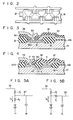
- Fig. 2 schematically shows the plan-view structure of the dynamic memory cell arrangement prepared in the manner described above. It is apparent from Fig. 2 that the polycrystalline silicon layer 16' is completely formed over the n +- type diffusion layer 18 in the surface region S of the silicon substrate 10. This is because overetching of the silicon substrate 10 is prevented with this structure when the layer 16' is etched by the RIE method.
- the occurrence of electrostatic dielectric breakdown generated at the gate insulating layer 14 during the manufacturing process can be prevented for the following reason.
- the ion components such as Cl + , Cl 2 + , F and the like contained in the etchant are left in the layer 16.
- a high intensity of electric field is generated by the remaining ion components in the thin layer 16.
- the gate electrode layer 16' is electrically and completely insulated from the silicon substrate 10.
- the ion components_ left in the gate electrode 16' cannot be removed therefrom.
- 30% to 50% overetching may occur and the number of ion components left in the gate electrode 16' further increases to cause the intensity of the electric field in the thin insulating film 14 to be further increased.
- the gate insulating film 14 is subjected to electrostatic dielectric breakdown, and electrical insulation becomes incomplete.
- the ions in the gate electrode 16' tend to flow concentrically to a portion of the film 14 at which the dielectric breakdown voltage is relatively low. Therefore, the physical characteristics in this portion are greatly degraded, thereby degrading the yield of the memory devices.
- part of the gate electrode layer 16' comprising polycrystalline silicon is directly connected to the n +- type diffusion layer 18 formed in part of the p-type silicon substrate 10.
- the layer 16' is diode-connected to the silicon substrate 10.
- the diode connection between the layer 16' and the silicon substrate 10 results in forward bias for the abnormal ions (positive charge in the first embodiment) which are produced during the manufacturing process of the memory device and are stored in the layer 16'. Therefore, the abnormal ions are immediately discharged from the gate electrode layer 16' to the p-type silicon substrate 10 through the n +- type diffusion layer 18 as junction leakage current or junction breakdown current.
- the electric field in the thin insulating film 14 does not increase abnormally, thereby preventing the film 14 from being damaging by electrostatic dielectric breakdown.
- the conventional problem is thus solved.
- the yield of memory devices such as a dRAM can be greatly improved.
- the gate electrode layer 16' of polycrystalline silicon is connected to the n-type region of the p-n junction. If the gate electrode is negatively charged with respect to the silicon substrate 10, the p-n junction is forward biased, so that the charge is readily discharged to the silicon substrate 10. On the other hand, when the gate electrode is positively charged with respect to the silicon substrate 10, the p-n junction is reverse biased. However, a current of 10 -12 to 10 -13 A flows by a small reverse bias voltage, so that it is sufficient to discharge the charge generated during etching to the silicon substrate 10. It should be noted that, in order to further improve reliability of the etching process, the reverse voltage at the p-n junction must be set lower than that of the gate insulating film 14.
- the oxide film has a dielectric withstand voltage of about 10 V.
- the reverse withstand voltage at the p-n junction must be set to be a voltage (e.g., 8 V) of lower than 10 V.
- the dielectric withstand voltage characteristics described above can be achieved wherein the depth of the p-n junction decreases when the n +- type diffusion layer 18 is formed.
- Figs. 3 and 4 are partial sectional views showing n +- type diffusion layers 18 and their peripheral structures of modifications of the dRAM of the first embodiment, respectively.
- the same reference numerals used in Fig. 1 denote the same parts in Figs. 3 and 4, and a detailed description thereof will be omitted.
- a polycrystalline silicon layer 30 serving as the gate electrode is etched to extend at the intermediate portion of the top surface of an n +- type diffusion layer 18 formed on and in a silicon substrate 10.
- the polycrystalline silicon layer 30 partially overlaps the n +- type diffusion layer 18 so as to partially expose the top surface of the n + -type diffusion layer 18.
- An electrically insulating layer 32 is formed on the obtained structure.
- the insulating layer 32 is etched by a known technique to have a contact hole 34 which is formed on an exposed surface 18a of the n +- type diffusion layer 18.
- a metal layer 36 such as an At layer serving as a wiring pattern for memory cells of the dRAM is deposited on part of the insulating layer 32 so as to fill the contact hole 34.
- the Al metal layer 36 directly contacts, through the contact hole 34 in the insulating layer 32, the exposed surface 18a of the n +- type diffusion layer 18 formed on the silicon substrate 10.
- Fig. 4 is a partial sectional view of a portion of the dRAM which is not illustrated in Fig. 1 and which extends to the left of the substrate region S which has the n +- type diffusion layer 18 therein shown in Fig. 1.
- the field insulating layers 12 are designated as 12-1, 12-2 and 12-3 for illustrative convenience.
- An n -type diffusion layer 40 formed on the surface region S of the silicon substrate 10 between the insulating layers 12-1 and 12-2 extends downward under the insulating layer 12-2 and reaches a surface region S' of the substrate 10 which is sandwiched between the field insulating layers 12-2 and 12-3.
- n +- type diffusion layer 40 extending between the surface regions S and S' through a portion under the insulating layer 12-2 is clearly illustrated in Fig. 4.
- An insulating layer 42 is formed to cover a thin gate insulating film 14c formed on the surface region S' of the silicon substrate 10.
- a contact hole 44 is formed in portions of the insulating film 14c and the insulating layer 42 formed thereon.
- An At layer 46 is deposited on the insulating layer 44 so as to fill the contact hole 44 with aluminum. The At layer 46 directly contacts the n +- type diffusion layer 40 through the contact hole 44 formed in the insulating layer 42 and the thin gate insulating film 14c.
- ion implantation or diffusion must be performed to form a portion of the n +- type diffusion layer 40 which is formed under the layer 12-2 and which is formed in the surface region S'.
- the gate insulating film 14 of the capacitor element is protected against dielectric breakdown caused by the surge voltage component applied from an external source through the power source line in accordance with the following reason.
- the n +- type diffusion layer 18 ohmically contacts the gate electrode layer 16' and the gate electrode layer 16' ohmically contacts the At layer 26, so that contact resistances are present therebetween. If the contact resistance between the N + layer 18 and the gate electrode layer 16' and the contact resistance between the gate electrode layer 16' and the At layer 26 are given as rand r c ', respectively, the equivalent circuit of the main part of the first embodiment in Fig. 1 is shown in Fig. 5A.
- the upper limit of the voltage applied to the gate electrode 30 may not exceed the reverse dielectric withstand voltage of the p-n junction arrangement (or diode) of the p-type silicon substrate 10 and the n +- type diffusion layer 18. Therefore, when the reverse dielectric withstand voltage at the p-n junction is set lower than that of the gate insulating film 14, the gate insulating film 14 of the memory capacitor is not damaged preventing a dielectric breakdown by the external surge voltage applied to the Al layer 36 through the power source line.
- the present invention which has an insulating layer with a unique structure, the dielectric breakdown of the insulating film of the memory cell is further decreased, thereby improving the element reliability.
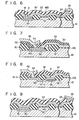
- Fig. 6 is a partial sectional view showing the main part of a dRAM according to a second embodiment of the present invention.
- a p +- type diffusion layer 50 is additionally formed in a portion of a p-type silicon substrate 10 where an n +- type diffusion layer 18 is formed in a surface region S of the silicon substrate 10.
- the diffusion layer 50 has a conductivity type opposite to that of the n +- type diffusion layer 18 and has the same conductivity type as that of the silicon substrate 10.
- the junction region between the n +- type diffusion layer 18 and the p-type silicon substrate 10 is constituted by a high-impurity p +- type diffusion layer.
- a gate insulating film (corresponding to the film 14a in Fig. 1) located in the surface region S is removed.
- a p-type impurity such as boron (B) is ion-implanted in the exposed portion of the p-type silicon substrate 10 which corresponds to the surface region S at a dose of 1 x 10 16 cm -2 and at an acceleration voltage of 50 keV.
- a high-impurity p-type layer (corresponding to the diffusion layer 50 shown in Fig. 6) is formed in the p-type silicon substrate 10.
- a polycrystalline silicon layer having no impurity is then deposited to cover the entire surface of the obtained structure to a ° thickness of 3,000 A.
- An impurity such as arsenic (As) is ion-implanted in the polycrystalline silicon layer at a dose of 5 x 10 15 cm -2 and at an acceleration voltage of 50 keV.
- the arsenic-doped structure is annealed in an atmosphere at a temperature of 1,000°C for about 10 minutes. Annealing is performed to activate the doped impurity. If an impurity-doped polycrystalline silicon layer is deposited, annealing need not be performed. Alternatively, immediately after boron ions are implanted, annealing may be performed.
- annealing need not be performed to guarantee prevention of dielectric breakdown of the insulating film. If annealing is not performed, a high reverse leakage current flows through the p-n junction, so that the polycrystalline silicon electrode 15 may not be charged. From this viewpoint, annealing may be omitted.
- the bilayer structure having the diffusion layers 18 and 50 shown in Fig. 6 is basically formed in the silicon substrate 10. Other manufacturing steps of this embodiment are the same as those of the first embodiment.
- the gate electrode layer 16' of polycrystalline silicon directly contacts the n +- type diffusion layer 18, and the p-type silicon substrate 10 is connected to the n +- type diffusion layer 18 through the p +- type diffusion layer 50. Therefore, the reverse dielectric withstand voltage level of the p-n junction arrangement corresponding to the diode can be decreased to about 3 to 4 V. Therefore, when the reverse bias voltage is applied to the p-n junction due to abnormal charging and reaches about 3 to 4 V, the p-n junction is subjected to avalanche breakdown, whereby the abnormal charge further flows to the silicon substrate 10 in the polycrystalline silicon layer of the gate electrode layer 16.
- the dielectric withstand voltage of the thin oxide (insulating) film 14 having a 0 thickness of about 100 A is about 10 V
- the reverse dielectric withstand voltage of about 3 to 4 V at the p-n junction is a sufficient value for preventing electrostatic dielectric breakdown of the memory cell capacity.
- Figs. 7 and 8 show modifications of the second embodiment shown in Fig. 6. These modifications are obtained by adding the structural feature (i.e., a p +- type layer) of the second embodiment to the modifications shown in Figs. 3 and 4, respectively. Therefore, both the effect obtained with reference to the modifications shown in Figs. 3 and 4 and the'effect obtained by the second embodiment shown in Fig. 6 are obtained by the modifications shown in Figs. 7 and 8. More specifically, in the modification shown in Fig. 7 (or Fig. 8), a p +- type layer 52 (54) is formed in the region of a p-type silicon substrate 10 under an n +- type diffusion layer 18 (40). Referring to Fig.
- an At layer 36 is connected to a p-type silicon substrate 10 through an n +- type diffusion layer 18 and a p +- type layer 52.
- an n +- type diffusion layer 40 connected to an At layer 46 is connected to a p-type silicon substrate 10 through at least part of a p + -type layer 54. Therefore, the voltage level applied to the gate electrode layer 30 or 16' cannot exceed the reduced reverse dielectric withstand voltage at the p-n junction. Therefore, the memory cell is further protected against dielectric breakdown caused by the surge voltage applied from the external source through the power source line and the At layer 36 or 46.
- the part of the polycrystalline silicon layer directly connected to the n +- type diffusion layer 18 may be cut from any other portion thereof which constitutes the memory cell capacitor, as shown in Fig. 9.
- isotropic plasma etching is preferred using an etching solution which has a small charging effect.
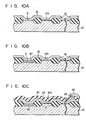
- a third embodiment of the present invention will be described with reference to Figs. 10A to 10C.
- a thin film located in a surface region S of the p-type silicon substrate 10 is removed, thereby obtaining a structure shown in Fig. 10A.
- a p-type impurity such as boron (B) is ion-implanted in the polycrystalline silicon layer which then serves as a gate electrode layer 16 at a dose of 5 x 10 15 cm -2 and at an acceleration voltage of 60 keV.
- This impurity has the same conductivity type as that of the silicon substrate 10.
- the obtained structure is annealed at a temperature of 1,000°C for about 20 minutes.
- the sheet resistance of the gate electrode layer 16 is decreased to 50 to 80 ⁇ / ⁇ .
- boron ions are diffused in the surface region S of the silicon substrate 10 which is exposed by removal of the gate insulating film, so that a p +- type diffusion layer 60 is formed as shown in Fig. 10B.
- a photoresist pattern (corresponding to the pattern 20 in Fig. 1D) is formed on the gate electrode layer 16, and the gate electrode layer 16 is selectively etched using the photoresist pattern as a mask.
- the RIE method is used using a gas containing chlorine in a form such as Cl 2 or C X F y Cl 2 in the same manner as in Fig. 1D.
- the photoresist pattern is removed.
- an insulating layer 22 and an At layer 26 as a wiring pattern are formed in the same manner as in Fig. lE.
- a gate electrode layer 16' is connected to the p-type silicon substrate 10 through the p +- type diffusion layer 60.
- the gate electrode layer 16' ohmically contacts the silicon substrate 10 through the p +- type diffusion layer 60 having the same conductivity type as that of the silicon substrate 10. Therefore, the gate electrode layer 16' has substantially the same potential as that of the silicon substrate 10. Even if the gate electrode layer of polycrystalline silicon is charged negatively or positively with respect to the silicon substrate at the time of etching by the externally applied charge, the charge can be easily removed from the gate electrode layer to the silicon substrate. Therefore, the dielectric breakdown (caused by abnormal charging in the manufacturing process of the dRAM) of the thin insulating film 14 of the memory cell capacitor can be effectively prevented.
- the capacitor gate electrode of the dRAM thus prepared has the same potential (i.e., ground potential) as that of the silicon substrate.
- V DD power source voltage
- the capacitor gate electrode cannot be used without modification. In order to solve this problem, modifications of the present invention will be described hereinafter.
- the polycrystalline silicon layer is selectively etched to be divided into layer components 16'-1 and 16'-2 before the layers 22 and 26 are deposited in the process with reference to Fig. 10C.
- the layer component 16'-1 of the polycrystalline silicon layer which is directly connected to the p +- type diffusion layer 60 formed in the substrate 10 is electrically insulated or separated from the layer component 16'-2.
- the polycrystalline silicon layer is etched using an etching solution or by isotropic dry etching each of which has a small charging effect. According to the obtained structure shown in Fig. ll, electrostatic dielectric breakdown of the memory cell capacitor which is caused by the abnormal charge of a positive or negative polarity during the manufacturing process is effectively prevented.
- the layer component 16'-2 which serves as the gate electrode is electrically separated from the silicon substrate 10. Therefore, the above manufacturing step can be applied to the conventional memory cell structure.
- the above polycrystalline silicon layer-etching process may be performed at the final step included in the manufacturing process of the dRAM, whereby the electrostatic dielectric breakdown of the memory cell capacitor can be more effectively prevented during the whole manufacturing process.
- Figs. 12 and 13 modifications are illustrated wherein the above-mentioned electric separation of the polycrystalline silicon gate electrode layer is greatly improved.
- part of the gate electrode layer which directly contacts the p +- type diffusion layer 60 is oxidized to form an oxide layer 64.
- the remaining electrode layer component 16' and the p +- type diffusion layer 60 are effectively and electrically insulated by the oxide layer 64.
- selective oxidation is performed using a silicon nitride film 66 formed on the layer 16'.
- a region of the polycrystalline silicon gate electrode layer which is subjected to oxidation is further narrowed.
- the layer component 16'-1 directly connected to the p +- type diffusion layer 60 is effectively and electrically insulated by a silicon oxide layer 68 from the layer component 16'-2.
- a modification is illustrated wherein a p-n junction is formed in the polycrystalline silicon gate electrode layer 16'.
- An n-type impurity such as arsenic (As) is ion-implanted in a portion 70 which is directly connected to a p +- type diffusion layer 60 in the p-type silicon substrate 10.
- the portion 70 is changed to have a n-type conductivity type, while the other layer portion 72 is left to have the p-type.
- the region of the layer 16' which serves as a prospective memory cell capacitor region is separated from the substrate 10 by the p-n junction diode.
- the reverse dielectric withstand voltage level of the diode can be decreased compared with the case (Fig. 1) in which the p-n junction is formed in the silicon substrate 10.
- the n +- type diffusion layer need not be formed before the polycrystalline silicon layer is etched.
- the n +- type diffusion layer may be etched after the polycrystalline silicon layer is etched.
- the impurity is doped in the atmosphere of POCt 3 .
- ion implantation may be performed or an impurity-doped polycrystalline silicon layer may also be used.
- each memory cell comprises one transistor element and one capacitor element.
- the arrangement of the memory cell need not be limited to the above arrangement.
- the present invention can be, of course, applied to various memory cells which use MOS capacitors. The techniques used in the manufacturing process of the present invention may be changed and modified within the spirit and scope of the present invention.
Landscapes
- Engineering & Computer Science (AREA)
- Manufacturing & Machinery (AREA)
- Semiconductor Memories (AREA)
- Semiconductor Integrated Circuits (AREA)
Applications Claiming Priority (6)
| Application Number | Priority Date | Filing Date | Title |
|---|---|---|---|
| JP112970/82 | 1982-06-30 | ||
| JP57112970A JPS594070A (ja) | 1982-06-30 | 1982-06-30 | 半導体記憶装置及びその製造方法 |
| JP57227429A JPS59121869A (ja) | 1982-12-28 | 1982-12-28 | 半導体記憶装置及びその製造方法 |
| JP227429/82 | 1982-12-28 | ||
| JP57227402A JPS59121867A (ja) | 1982-12-28 | 1982-12-28 | 半導体記憶装置の製造方法 |
| JP227402/82 | 1982-12-28 |
Publications (3)
| Publication Number | Publication Date |
|---|---|
| EP0102696A2 true EP0102696A2 (de) | 1984-03-14 |
| EP0102696A3 EP0102696A3 (en) | 1986-03-19 |
| EP0102696B1 EP0102696B1 (de) | 1989-09-13 |
Family
ID=27312392
Family Applications (1)
| Application Number | Title | Priority Date | Filing Date |
|---|---|---|---|
| EP83303603A Expired EP0102696B1 (de) | 1982-06-30 | 1983-06-22 | Dynamische Halbleiterspeicher und Verfahren zu seiner Herstellung |
Country Status (3)
| Country | Link |
|---|---|
| US (1) | US4543597A (de) |
| EP (1) | EP0102696B1 (de) |
| DE (1) | DE3380582D1 (de) |
Cited By (4)
| Publication number | Priority date | Publication date | Assignee | Title |
|---|---|---|---|---|
| EP0110656A3 (en) * | 1982-11-19 | 1986-03-19 | Nec Corporation | Semiconductor device and method of manufacturing the same |
| EP0198468A3 (en) * | 1985-04-15 | 1987-04-22 | Nec Corporation | Protective device for integrated circuit |
| EP0622850A1 (de) * | 1993-04-30 | 1994-11-02 | International Business Machines Corporation | Schutzdiode gegen elektrostatische Entladungen in der Silizium-auf-Insulator-Technologie |
| EP0657933A1 (de) * | 1993-12-13 | 1995-06-14 | Consorzio per la Ricerca sulla Microelettronica nel Mezzogiorno - CoRiMMe | Integrierte aktive Klammerungsstruktur für den Schutz von Leistungshalbleiterbauelementen gegen Überspannungen |
Families Citing this family (21)
| Publication number | Priority date | Publication date | Assignee | Title |
|---|---|---|---|---|
| US5610089A (en) * | 1983-12-26 | 1997-03-11 | Hitachi, Ltd. | Method of fabrication of semiconductor integrated circuit device |
| US5276346A (en) * | 1983-12-26 | 1994-01-04 | Hitachi, Ltd. | Semiconductor integrated circuit device having protective/output elements and internal circuits |
| US4708767A (en) * | 1984-10-05 | 1987-11-24 | Signetics Corporation | Method for providing a semiconductor device with planarized contacts |
| JPS61263254A (ja) * | 1985-05-17 | 1986-11-21 | Nec Corp | 入力保護装置 |
| US5219485A (en) * | 1985-10-11 | 1993-06-15 | Applied Materials, Inc. | Materials and methods for etching silicides, polycrystalline silicon and polycides |
| US4789426A (en) * | 1987-01-06 | 1988-12-06 | Harris Corp. | Process for performing variable selectivity polysilicon etch |
| US4941028A (en) * | 1988-08-10 | 1990-07-10 | Actel Corporation | Structure for protecting thin dielectrics during processing |
| JP2776599B2 (ja) * | 1990-01-25 | 1998-07-16 | 日本電気株式会社 | Mos型dram装置 |
| US5371396A (en) * | 1993-07-02 | 1994-12-06 | Thunderbird Technologies, Inc. | Field effect transistor having polycrystalline silicon gate junction |
| US5994742A (en) * | 1995-12-08 | 1999-11-30 | Texas Instruments Incorporated | Plasma emission triggered protection device for protecting against charge-induced damage |
| US6087264A (en) * | 1996-05-15 | 2000-07-11 | Samsung Electronics Co., Ltd. | Methods for patterning microelectronic structures using chlorine and oxygen |
| US6159811A (en) * | 1996-05-15 | 2000-12-12 | Samsung Electronics Co., Ltd. | Methods for patterning microelectronic structures using chlorine, oxygen, and fluorine |
| JP2924832B2 (ja) * | 1996-11-28 | 1999-07-26 | 日本電気株式会社 | 半導体装置の製造方法 |
| US5757693A (en) * | 1997-02-19 | 1998-05-26 | International Business Machines Corporation | Gain memory cell with diode |
| JP3273001B2 (ja) * | 1997-11-25 | 2002-04-08 | 株式会社東芝 | 半導体記憶装置とその製造方法 |
| US6020237A (en) * | 1998-02-04 | 2000-02-01 | Alliance Semiconductor Corporation | Method of reducing dielectric damage due to charging in the fabrication of stacked gate structures |
| US6013927A (en) | 1998-03-31 | 2000-01-11 | Vlsi Technology, Inc. | Semiconductor structures for suppressing gate oxide plasma charging damage and methods for making the same |
| DE10201058A1 (de) * | 2002-01-14 | 2003-07-31 | Infineon Technologies Ag | Verfahren zur Herstellung einer dielektrischen Schicht |
| WO2009003044A1 (en) | 2007-06-26 | 2008-12-31 | Avalon Laboratories, Llc | Coaxial venal cannula |
| GB0803701D0 (en) * | 2008-02-28 | 2008-04-09 | Statoilhydro Asa | Improved interferometric methods and apparatus for seismic exploration |
| KR102576349B1 (ko) * | 2016-08-24 | 2023-09-07 | 삼성전자주식회사 | 이미지 센서 |
Family Cites Families (17)
| Publication number | Priority date | Publication date | Assignee | Title |
|---|---|---|---|---|
| US3413497A (en) * | 1966-07-13 | 1968-11-26 | Hewlett Packard Co | Insulated-gate field effect transistor with electrostatic protection means |
| US3999212A (en) * | 1967-03-03 | 1976-12-21 | Hitachi, Ltd. | Field effect semiconductor device having a protective diode |
| US3555374A (en) * | 1967-03-03 | 1971-01-12 | Hitachi Ltd | Field effect semiconductor device having a protective diode |
| US4044373A (en) * | 1967-11-13 | 1977-08-23 | Hitachi, Ltd. | IGFET with gate protection diode and antiparasitic isolation means |
| US3512058A (en) * | 1968-04-10 | 1970-05-12 | Rca Corp | High voltage transient protection for an insulated gate field effect transistor |
| US3558366A (en) * | 1968-09-17 | 1971-01-26 | Bell Telephone Labor Inc | Metal shielding for ion implanted semiconductor device |
| JPS5410836B1 (de) * | 1970-06-26 | 1979-05-10 | ||
| US3728591A (en) * | 1971-09-03 | 1973-04-17 | Rca Corp | Gate protective device for insulated gate field-effect transistors |
| FR2289051A1 (fr) * | 1974-10-22 | 1976-05-21 | Ibm | Dispositifs a semi-conducteur du genre transistors a effet de champ et a porte isolee et circuits de protection cotre les surtensions |
| JPS5232270A (en) * | 1975-09-05 | 1977-03-11 | Hitachi Ltd | Passivation film formaion by sputtering |
| US4240092A (en) * | 1976-09-13 | 1980-12-16 | Texas Instruments Incorporated | Random access memory cell with different capacitor and transistor oxide thickness |
| US4102714A (en) * | 1976-04-23 | 1978-07-25 | International Business Machines Corporation | Process for fabricating a low breakdown voltage device for polysilicon gate technology |
| JPS53101294A (en) * | 1977-02-16 | 1978-09-04 | Toshiba Corp | Manufacture of composite superconductive wire material |
| JPS55165681A (en) * | 1979-06-11 | 1980-12-24 | Mitsubishi Electric Corp | Preparation of semiconductor device |
| JPS56966A (en) * | 1979-06-14 | 1981-01-08 | Shin Meiwa Ind Co Ltd | Cylindrical open showcase |
| JPS5775463A (en) * | 1980-10-28 | 1982-05-12 | Nec Corp | Manufacture of semiconductor device |
| US4455739A (en) * | 1982-04-19 | 1984-06-26 | Texas Instruments Incorporated | Process protection for individual device gates on large area MIS devices |
-
1983
- 1983-06-22 EP EP83303603A patent/EP0102696B1/de not_active Expired
- 1983-06-22 US US06/506,593 patent/US4543597A/en not_active Expired - Lifetime
- 1983-06-22 DE DE8383303603T patent/DE3380582D1/de not_active Expired
Cited By (5)
| Publication number | Priority date | Publication date | Assignee | Title |
|---|---|---|---|---|
| EP0110656A3 (en) * | 1982-11-19 | 1986-03-19 | Nec Corporation | Semiconductor device and method of manufacturing the same |
| EP0198468A3 (en) * | 1985-04-15 | 1987-04-22 | Nec Corporation | Protective device for integrated circuit |
| EP0622850A1 (de) * | 1993-04-30 | 1994-11-02 | International Business Machines Corporation | Schutzdiode gegen elektrostatische Entladungen in der Silizium-auf-Insulator-Technologie |
| EP0657933A1 (de) * | 1993-12-13 | 1995-06-14 | Consorzio per la Ricerca sulla Microelettronica nel Mezzogiorno - CoRiMMe | Integrierte aktive Klammerungsstruktur für den Schutz von Leistungshalbleiterbauelementen gegen Überspannungen |
| US5530271A (en) * | 1993-12-13 | 1996-06-25 | Consorzio Per La Ricerca Sulla Microelettronica Nel Mezzogiorno | Integrated structure active clamp for the protection of power semiconductor devices against overvoltages |
Also Published As
| Publication number | Publication date |
|---|---|
| US4543597A (en) | 1985-09-24 |
| DE3380582D1 (en) | 1989-10-19 |
| EP0102696A3 (en) | 1986-03-19 |
| EP0102696B1 (de) | 1989-09-13 |
Similar Documents
| Publication | Publication Date | Title |
|---|---|---|
| US4543597A (en) | Dynamic semiconductor memory and manufacturing method thereof | |
| US4933739A (en) | Trench resistor structures for compact semiconductor memory and logic devices | |
| EP0186889B1 (de) | Halbleiterspeichermatrix mit mehreren verbundenen Treibertransistoren | |
| JPH0629485A (ja) | 半導体装置およびその製造方法 | |
| US5383152A (en) | Semiconductor memory device and its fabrication method | |
| US6211007B1 (en) | Process for enhancing refresh in dynamic random access memory devices | |
| US5508215A (en) | Current leakage reduction at the storage node diffusion region of a stacked-trench dram cell by selectively oxidizing the floor of the trench | |
| JPH0648719B2 (ja) | 半導体記憶装置 | |
| EP0030147A1 (de) | Verfahren zur Herstellung einer integrierten Halbleiter-Schaltung | |
| US6410964B1 (en) | Semiconductor device capable of preventing gate oxide film from damage by plasma process and method of manufacturing the same | |
| KR900002913B1 (ko) | 반도체 기억장치의 제조방법 | |
| US5686338A (en) | Process for fabricating high-resistance load resistors using dummy polysilicon in four-transistor SRAM devices | |
| US6531778B1 (en) | Semiconductor device and method of production thereof | |
| US5939757A (en) | Semiconductor device having triple well structure | |
| US6277694B1 (en) | Fabrication method for a metal oxide semiconductor having a double diffused drain | |
| JPH11121630A (ja) | Soi構造を有する半導体メモリ装置及びその製造方法 | |
| JP3424091B2 (ja) | 半導体素子の製造方法 | |
| US5348907A (en) | Method of fabricating of semiconductor device by forming two electrically insulated wells of the same type electroconductivity on semiconductor substrate | |
| US4713357A (en) | Method of making a capacitor with reduced dielectric breakdown | |
| US5885863A (en) | Method of making a contact for contacting an impurity region formed in a semiconductor substrate | |
| US6541325B2 (en) | Method for fabricating a capacitor device with BiCMOS process and the capacitor device formed thereby | |
| JPH06120449A (ja) | 半導体装置およびその製造方法 | |
| JPH0450751B2 (de) | ||
| KR940008727B1 (ko) | 반도체장치 | |
| JP2593911B2 (ja) | 半導体集積回路装置 |
Legal Events
| Date | Code | Title | Description |
|---|---|---|---|
| PUAI | Public reference made under article 153(3) epc to a published international application that has entered the european phase |
Free format text: ORIGINAL CODE: 0009012 |
|
| 17P | Request for examination filed |
Effective date: 19830704 |
|
| AK | Designated contracting states |
Designated state(s): DE FR GB IT NL |
|
| RAP1 | Party data changed (applicant data changed or rights of an application transferred) |
Owner name: KABUSHIKI KAISHA TOSHIBA |
|
| PUAL | Search report despatched |
Free format text: ORIGINAL CODE: 0009013 |
|
| AK | Designated contracting states |
Kind code of ref document: A3 Designated state(s): DE FR GB IT NL |
|
| 17Q | First examination report despatched |
Effective date: 19870929 |
|
| GRAA | (expected) grant |
Free format text: ORIGINAL CODE: 0009210 |
|
| AK | Designated contracting states |
Kind code of ref document: B1 Designated state(s): DE FR GB IT NL |
|
| ITF | It: translation for a ep patent filed | ||
| REF | Corresponds to: |
Ref document number: 3380582 Country of ref document: DE Date of ref document: 19891019 |
|
| ET | Fr: translation filed | ||
| PLBE | No opposition filed within time limit |
Free format text: ORIGINAL CODE: 0009261 |
|
| STAA | Information on the status of an ep patent application or granted ep patent |
Free format text: STATUS: NO OPPOSITION FILED WITHIN TIME LIMIT |
|
| 26N | No opposition filed | ||
| ITTA | It: last paid annual fee | ||
| PGFP | Annual fee paid to national office [announced via postgrant information from national office to epo] |
Ref country code: FR Payment date: 19930609 Year of fee payment: 11 |
|
| PGFP | Annual fee paid to national office [announced via postgrant information from national office to epo] |
Ref country code: GB Payment date: 19930611 Year of fee payment: 11 |
|
| PGFP | Annual fee paid to national office [announced via postgrant information from national office to epo] |
Ref country code: NL Payment date: 19930630 Year of fee payment: 11 Ref country code: DE Payment date: 19930630 Year of fee payment: 11 |
|
| PG25 | Lapsed in a contracting state [announced via postgrant information from national office to epo] |
Ref country code: GB Effective date: 19940622 |
|
| PG25 | Lapsed in a contracting state [announced via postgrant information from national office to epo] |
Ref country code: NL Effective date: 19950101 |
|
| GBPC | Gb: european patent ceased through non-payment of renewal fee |
Effective date: 19940622 |
|
| NLV4 | Nl: lapsed or anulled due to non-payment of the annual fee | ||
| PG25 | Lapsed in a contracting state [announced via postgrant information from national office to epo] |
Ref country code: FR Effective date: 19950228 |
|
| PG25 | Lapsed in a contracting state [announced via postgrant information from national office to epo] |
Ref country code: DE Effective date: 19950301 |
|
| REG | Reference to a national code |
Ref country code: FR Ref legal event code: ST |