EP0103140A2 - Procédé pour la fabrication d'une structure textile à poils - Google Patents
Procédé pour la fabrication d'une structure textile à poils Download PDFInfo
- Publication number
- EP0103140A2 EP0103140A2 EP83107672A EP83107672A EP0103140A2 EP 0103140 A2 EP0103140 A2 EP 0103140A2 EP 83107672 A EP83107672 A EP 83107672A EP 83107672 A EP83107672 A EP 83107672A EP 0103140 A2 EP0103140 A2 EP 0103140A2
- Authority
- EP
- European Patent Office
- Prior art keywords
- melting
- low
- textile structure
- composite
- thermoplastic resin
- Prior art date
- Legal status (The legal status is an assumption and is not a legal conclusion. Google has not performed a legal analysis and makes no representation as to the accuracy of the status listed.)
- Granted
Links
- 239000004753 textile Substances 0.000 title claims abstract description 102
- 238000000034 method Methods 0.000 title claims description 20
- 230000008569 process Effects 0.000 title claims description 19
- 238000004519 manufacturing process Methods 0.000 title claims description 8
- 238000002844 melting Methods 0.000 claims abstract description 117
- 239000002131 composite material Substances 0.000 claims abstract description 63
- 239000000463 material Substances 0.000 claims abstract description 61
- 229920005992 thermoplastic resin Polymers 0.000 claims abstract description 55
- 229920005989 resin Polymers 0.000 claims abstract description 14
- 239000011347 resin Substances 0.000 claims abstract description 14
- 239000000835 fiber Substances 0.000 claims description 42
- 238000010438 heat treatment Methods 0.000 claims description 35
- 230000008018 melting Effects 0.000 claims description 29
- 239000000203 mixture Substances 0.000 claims description 5
- 239000004745 nonwoven fabric Substances 0.000 description 17
- -1 polypropylene Polymers 0.000 description 15
- 238000002360 preparation method Methods 0.000 description 9
- 229940090046 jet injector Drugs 0.000 description 8
- 239000004744 fabric Substances 0.000 description 7
- 239000011295 pitch Substances 0.000 description 7
- 239000004698 Polyethylene Substances 0.000 description 6
- 229920000573 polyethylene Polymers 0.000 description 6
- 230000006378 damage Effects 0.000 description 5
- 230000004927 fusion Effects 0.000 description 5
- 229920000139 polyethylene terephthalate Polymers 0.000 description 5
- 239000005020 polyethylene terephthalate Substances 0.000 description 5
- 239000004743 Polypropylene Substances 0.000 description 4
- 239000011248 coating agent Substances 0.000 description 4
- 238000000576 coating method Methods 0.000 description 4
- 229920001155 polypropylene Polymers 0.000 description 4
- 230000015572 biosynthetic process Effects 0.000 description 3
- 239000007788 liquid Substances 0.000 description 3
- 239000000155 melt Substances 0.000 description 3
- 239000002184 metal Substances 0.000 description 3
- 239000004952 Polyamide Substances 0.000 description 2
- 230000002542 deteriorative effect Effects 0.000 description 2
- 239000003063 flame retardant Substances 0.000 description 2
- 238000010030 laminating Methods 0.000 description 2
- 229920002647 polyamide Polymers 0.000 description 2
- 229920000728 polyester Polymers 0.000 description 2
- 229920000098 polyolefin Polymers 0.000 description 2
- 238000009987 spinning Methods 0.000 description 2
- 238000003892 spreading Methods 0.000 description 2
- 230000007480 spreading Effects 0.000 description 2
- 238000012360 testing method Methods 0.000 description 2
- 238000009941 weaving Methods 0.000 description 2
- RNFJDJUURJAICM-UHFFFAOYSA-N 2,2,4,4,6,6-hexaphenoxy-1,3,5-triaza-2$l^{5},4$l^{5},6$l^{5}-triphosphacyclohexa-1,3,5-triene Chemical compound N=1P(OC=2C=CC=CC=2)(OC=2C=CC=CC=2)=NP(OC=2C=CC=CC=2)(OC=2C=CC=CC=2)=NP=1(OC=1C=CC=CC=1)OC1=CC=CC=C1 RNFJDJUURJAICM-UHFFFAOYSA-N 0.000 description 1
- VEXZGXHMUGYJMC-UHFFFAOYSA-M Chloride anion Chemical compound [Cl-] VEXZGXHMUGYJMC-UHFFFAOYSA-M 0.000 description 1
- 229920000742 Cotton Polymers 0.000 description 1
- VGGSQFUCUMXWEO-UHFFFAOYSA-N Ethene Chemical compound C=C VGGSQFUCUMXWEO-UHFFFAOYSA-N 0.000 description 1
- 239000005977 Ethylene Substances 0.000 description 1
- 229910018487 Ni—Cr Inorganic materials 0.000 description 1
- 239000004793 Polystyrene Substances 0.000 description 1
- XTXRWKRVRITETP-UHFFFAOYSA-N Vinyl acetate Chemical compound CC(=O)OC=C XTXRWKRVRITETP-UHFFFAOYSA-N 0.000 description 1
- 230000002411 adverse Effects 0.000 description 1
- ADCOVFLJGNWWNZ-UHFFFAOYSA-N antimony trioxide Inorganic materials O=[Sb]O[Sb]=O ADCOVFLJGNWWNZ-UHFFFAOYSA-N 0.000 description 1
- 239000011230 binding agent Substances 0.000 description 1
- 238000009960 carding Methods 0.000 description 1
- 230000008859 change Effects 0.000 description 1
- 229920001577 copolymer Polymers 0.000 description 1
- WHHGLZMJPXIBIX-UHFFFAOYSA-N decabromodiphenyl ether Chemical compound BrC1=C(Br)C(Br)=C(Br)C(Br)=C1OC1=C(Br)C(Br)=C(Br)C(Br)=C1Br WHHGLZMJPXIBIX-UHFFFAOYSA-N 0.000 description 1
- 238000001035 drying Methods 0.000 description 1
- 239000000428 dust Substances 0.000 description 1
- 230000000694 effects Effects 0.000 description 1
- 238000004924 electrostatic deposition Methods 0.000 description 1
- 230000005484 gravity Effects 0.000 description 1
- 229920006262 high density polyethylene film Polymers 0.000 description 1
- 238000002347 injection Methods 0.000 description 1
- 239000007924 injection Substances 0.000 description 1
- 230000001788 irregular Effects 0.000 description 1
- 238000003475 lamination Methods 0.000 description 1
- 229920000092 linear low density polyethylene Polymers 0.000 description 1
- 239000004707 linear low-density polyethylene Substances 0.000 description 1
- 239000012860 organic pigment Substances 0.000 description 1
- 239000008188 pellet Substances 0.000 description 1
- 230000035515 penetration Effects 0.000 description 1
- 230000002093 peripheral effect Effects 0.000 description 1
- 230000035699 permeability Effects 0.000 description 1
- IEQIEDJGQAUEQZ-UHFFFAOYSA-N phthalocyanine Chemical compound N1C(N=C2C3=CC=CC=C3C(N=C3C4=CC=CC=C4C(=N4)N3)=N2)=C(C=CC=C2)C2=C1N=C1C2=CC=CC=C2C4=N1 IEQIEDJGQAUEQZ-UHFFFAOYSA-N 0.000 description 1
- 239000000049 pigment Substances 0.000 description 1
- 229920002223 polystyrene Polymers 0.000 description 1
- 229920000915 polyvinyl chloride Polymers 0.000 description 1
- 239000004800 polyvinyl chloride Substances 0.000 description 1
- 230000002940 repellent Effects 0.000 description 1
- 239000005871 repellent Substances 0.000 description 1
- 238000000926 separation method Methods 0.000 description 1
- 238000010008 shearing Methods 0.000 description 1
- 238000005507 spraying Methods 0.000 description 1
- 239000003381 stabilizer Substances 0.000 description 1
- 238000010998 test method Methods 0.000 description 1
- YEAUATLBSVJFOY-UHFFFAOYSA-N tetraantimony hexaoxide Chemical compound O1[Sb](O2)O[Sb]3O[Sb]1O[Sb]2O3 YEAUATLBSVJFOY-UHFFFAOYSA-N 0.000 description 1
- XLYOFNOQVPJJNP-UHFFFAOYSA-N water Substances O XLYOFNOQVPJJNP-UHFFFAOYSA-N 0.000 description 1
- 239000002759 woven fabric Substances 0.000 description 1
Images

Classifications
-
- D—TEXTILES; PAPER
- D04—BRAIDING; LACE-MAKING; KNITTING; TRIMMINGS; NON-WOVEN FABRICS
- D04H—MAKING TEXTILE FABRICS, e.g. FROM FIBRES OR FILAMENTARY MATERIAL; FABRICS MADE BY SUCH PROCESSES OR APPARATUS, e.g. FELTS, NON-WOVEN FABRICS; COTTON-WOOL; WADDING ; NON-WOVEN FABRICS FROM STAPLE FIBRES, FILAMENTS OR YARNS, BONDED WITH AT LEAST ONE WEB-LIKE MATERIAL DURING THEIR CONSOLIDATION
- D04H11/00—Non-woven pile fabrics
- D04H11/08—Non-woven pile fabrics formed by creation of a pile on at least one surface of a non-woven fabric without addition of pile-forming material, e.g. by needling, by differential shrinking
-
- Y—GENERAL TAGGING OF NEW TECHNOLOGICAL DEVELOPMENTS; GENERAL TAGGING OF CROSS-SECTIONAL TECHNOLOGIES SPANNING OVER SEVERAL SECTIONS OF THE IPC; TECHNICAL SUBJECTS COVERED BY FORMER USPC CROSS-REFERENCE ART COLLECTIONS [XRACs] AND DIGESTS
- Y10—TECHNICAL SUBJECTS COVERED BY FORMER USPC
- Y10T—TECHNICAL SUBJECTS COVERED BY FORMER US CLASSIFICATION
- Y10T428/00—Stock material or miscellaneous articles
- Y10T428/23907—Pile or nap type surface or component
- Y10T428/2395—Nap type surface
-
- Y—GENERAL TAGGING OF NEW TECHNOLOGICAL DEVELOPMENTS; GENERAL TAGGING OF CROSS-SECTIONAL TECHNOLOGIES SPANNING OVER SEVERAL SECTIONS OF THE IPC; TECHNICAL SUBJECTS COVERED BY FORMER USPC CROSS-REFERENCE ART COLLECTIONS [XRACs] AND DIGESTS
- Y10—TECHNICAL SUBJECTS COVERED BY FORMER USPC
- Y10T—TECHNICAL SUBJECTS COVERED BY FORMER US CLASSIFICATION
- Y10T428/00—Stock material or miscellaneous articles
- Y10T428/23907—Pile or nap type surface or component
- Y10T428/23957—Particular shape or structure of pile
-
- Y—GENERAL TAGGING OF NEW TECHNOLOGICAL DEVELOPMENTS; GENERAL TAGGING OF CROSS-SECTIONAL TECHNOLOGIES SPANNING OVER SEVERAL SECTIONS OF THE IPC; TECHNICAL SUBJECTS COVERED BY FORMER USPC CROSS-REFERENCE ART COLLECTIONS [XRACs] AND DIGESTS
- Y10—TECHNICAL SUBJECTS COVERED BY FORMER USPC
- Y10T—TECHNICAL SUBJECTS COVERED BY FORMER US CLASSIFICATION
- Y10T428/00—Stock material or miscellaneous articles
- Y10T428/23907—Pile or nap type surface or component
- Y10T428/23979—Particular backing structure or composition
Definitions
- the present invention relates to a flocked textile structure formed with piles of thermoplastic resin and a process for the production of the same.
- flocked textile structures have been formed of spinning and weaving of fibers, followed by raising and shearing. Alternatively, they have been prepared by flocking adhesives- bearing backing fabrics with short fibers by means of spreading, spraying, vibration, electro-static deposition using high voltages, etc.
- flocked textile structures have imposed limitations upon the type of fibers used for flocking, and been used in only limited fields. Furthermore, they have required large-sized apparatus involving time-consuming steps, thus leading to rise in the production costs.
- the flocked textile structures are not practically used, although they have been found to possess some advantages;they may be used as filters or diapers' linings or facings. For instance, if they are used as filter, the collection efficiency would be improved by affording a density gradient thereto, and the accumulated dust would easily be removed by vibration. Having their softness, they would be best-suited for diaper materials.
- a flocked textile structure comprising a composite characterized in that a low-melting, thermoplastic resin material is fuesed to a backing material of an air-permeable textile structure which is not softened and thus remains substantially intact upon heated at a given temperature, and in that piles are ramified from said resin material in a fibrous form.
- a process for the production of a flocked textile structure characterized by comprising the steps of preparing a composite comprising a backing material of an air-permeable textile structure which is not softened and thus remains substantially intact upon heated at a given temperature and a low-melting, thermoplastic resin material fused to one side of said backing material, said resin material being molten by heating at a given temperature;heating said composite at said given temperature to melt said resin material;and injecting an air jet through said heated composite from said textile structure, whereby said resin material is ramified in the fibrous form to obtain piling.
- a process for the preparation of a flocked textile structure characterized by the steps of preparing a composite comprising an air-permeable backing material made of a high-melting linear mass, which formes part of an air-permeable textile structure, and is not softened and remains substantially intact upon heated at a given temperaure, and a low-melting, thermoplastic resin material made of a low -melting, linear mass, which forms another part of said textile structure, and is molten by heating at said given temperature;heating said composite to said given temperature to melt said resin material;and injecting air jet through said heated composite from its one side to its other side, whereby said resin material is ramified in a fibrous form to obtain piles.
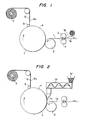
- FIG. 1 illustrating the preparation of a composite comprised of a textile structure on which laminated is a low-melting, thermoplastic resin film
- Fig. 2 illustrating the preparation of a composite comprised of a textile structure on which coated is a low-melting, thermoplastic resin in the molten state
- Fig. 3 illustrating the preparation of a composite formed of a textile structure per se
- Fig. 4 being a general perspective view showing one embodiment of the apparatus for the simultaneous preparation of a textile structure and a flocked textile structure by heat or thermal fusion.
- textile structure referred to hereinbefore and hereinafter is understood to indicate any substantially flat structures such as woven fabrics, knitted fabrics, unwoven fabrics, webs, etc.
- the textile structure should have a suitable air-permeability which varies depending upon the application and flocked state of the flocked textile structure as well as the type of the low-melting, thermoplastic resin used in the production process thereof and the degree of injection of the air jet applied.
- the air-permeability should preferably be about 50 cm 3 /cm 2 as measured with an air-permeability testing machine designated in JIS L 1004 (Test method for cotton fabrics).(In what follows, the permeability will be given in terms of'values obtained with the same machine).
- the low-melting, thermoplastic resin used for the formation of piles may be selected, on the basis given later, from the groups consisting of polyolefines such as polypropylene and polyethylene, polyesters such as polyethylene terephthalate, polyamides, polyvinyl chloride and polystyrene, or modified products thereof, or mixtures thereof. It is noted, however, that the low-melting, thermoplastic resin may include any pigments, inorganics, anti-statics, stabilizers, flame retardants etc., as long as they have no adverse influence upon the effect of the present invention.
- the portion of the textile structure referred to as the backing material.in the present invention maintains air-permeability, even when it is heated to a given temperature (to be defined later).
- the first type of textile structure is entirely formed of fibers which are not softened by heating at the said given temperature.
- such a textile structure forms the backing material as such, since it remains substantially intact (i.e., unchanged in respect of its structure) upon heated to the said given temperaure.
- such a textile structure may be called the unsoftening textile structure.
- the second type of textile structure is partly formed of a high-melting linear mass undergoing no softening by heating at the said given temperature with the remaining part being formed of a low-melting linear mass undergoind melting by heating at the said given temperature.
- the backing materail is then provided by the high-melting linear mass, since, when heated to the said given temperature, the high-melting linear mass remains substantially intact, while the low-melting linear mass melts and changes in its shape.
- the second textile structure may be called the partly melting textile structure.
- the partly melting textile structure is further broken down into two types, as will be explained below.
- the first type of the partly melting textile structure is formed-of a mixture of high-melting fibers undergoing no softening by heating to the said given temperature as a high- , melting linear mass, and low-melting fibers undergoing melting by heating to the said given temperature as a low-melting linear mass.
- the backing material is then provided by at least the high-melting fibers, since, when heated to the said given temperature, the high-melting fibers do not soften and remain substantially intac, while the low-melting fibers melt with the fibers changing in shape.
- that first type of the partly melting textile structure may be called the mixed fiber textile structrue.
- the second type of the partly melting textile structure refers to the partly melting textile structure modified in such a manner that is composed partly or wholly of composite fibers which comprise a high-melting component undergoing no softening at the said given temperature and a low-melting, thermoplastic resin component undergoing melting at the said given temperature, and in which the surface of the composite fibers is at least partly provided with the low-melting component.
- the high-melting component forms the high-melting linear mass
- the low-melting component forms the low-melting linear mass
- the low-melting component of the respective composite fibers melts, while the high-melting component thereof will not soften with the fibers remaining substantially intact, so that the textile structure remains substantially intact.
- the backing material is then provided by at least the high-melting component.
- the second type of the partly melting textile structure includes fibers which neither soften nor change in quality by heating at the said given temperature, that fibers form a part of the backing material.
- the second type of the partly melting textile structure may be called the composite fiber textile structure.
- the low-melting, thermoplastic resin as exemplified is fused to the backing material to form a composite.
- the low-melting, thermoplastic resin is ramified into firous piles from the surface of the backing matrial to which it is fused. In other words, the base of this fibrous piles is fused to the backing materail in spread base, and then there is no removal of piles.
- the fibrous piles are formed by a separate thermoplastic resin.
- the partly melting textile structure such as the mixed fiber textile structure or composite fiber textile structure
- thermoplastic resin To ensure that the fibrous piles of the low-melting, thermoplastic resin is fused to the backing material, it is required that only the low-melting, thermoplastic resin melt without causing softening in the backing material, viz., with the backing material remaining substantially intact. In other words, it is required that the melting point of the pile-forming low-melting, thermoplastic resin be lower than the sofening or deteriorating point of the backing material.
- softening or deteriorating point may be called the destruction point.
- the term "given temperature” is understood to indicated a temperature higher than the melting point of the low-melting,thermoplastic resin and-lower than the destruction point of the backing material, i.e., between both points.
- thermoplastic resin materials having a melting point that is lower than the destruction point of the backing material. Better results will be obtained, when a difference between both points is larger.
- Various materials may be used as the backing materail;however, thermoplastic resins are preferable, since to them are well fused the pile-forming low-melting, thermoplastic resin.
- thermoplastic resins include polyamides, polyesters, polyolefines, polyvinyle chloride, etc.
- the above-mentioned essential two or three textile structures may be used alone or in combination. If required, the piles may be formed by the additional use of separate thermoplastic resins.
- the process of the present invention generally involves the steps of forming a composite, heating the composite and injectiong an air jet through the composite. These steps may be taken uncontinuously;though they are preferably taken in a continuous manner.
- a composite 1 it is substantially flat and formed partly or wholly of an air-permeable textile structure la.
- the composite is comprised of a backing material and a low-melting, thermoplastic resin material for the flocking purpose.
- the textile structure la is the unsoftening textile structure, a separate low-melting, thermoplastic resin material is required.
- the textile structure la is the partly melting textile structure such as the mixed fiber textile structure or the composite fiber textilel structure, it is possible to use the structure la per se as the composite 1.
- no separate low-melting, thermoplastic resin material is required, it may be possible to prepare another composite by the addition of it.
- the texile structure la is fed between laminating rolls 2, where a low-melting, thermoplastic resin film Ib is laminated thereto, as illustrated in Fig. 1.
- a low-melting thermoplastic resin pellet lc for the coating purpose is fed to a melt extruder 10, and the resultant low-melting, thermoplastic resin 1c for the coating purpose is applied over a heating roll 4 in the molten state, and the moving textile structure 1a is brought into contact and coated with the molten resins to form the composite 1.
- the low-melting, thermoplastic resin may be charged without any coating or laminating treatment.
- the thus formed composite 1 is fed in between a nip roll 3 and the heating roll 4, both rotating, and moved while it comes into contact with the surface of the heating roll 4.
- the surface of the heating roll 4 is then maintained at a temperature above the melting point of the low-melting, thermoplastic resin and below the destruction point of the backing material.
- the composite 1 is heated on the surface of the heating roll 4, whereby the low-melting, thermoplastic resin materail is molten, while the backing materail remains substantially intact without any destruction.
- heating maintains the molten state of the coated low-melting, thermoplastic resin and thus improves the coating state thereof.
- the composite 1 having its low-melting, thermoplastic resin molten reaches an air jet injector 5, and is separated from the heating roll 4.
- an air jet is injected through the composite 1.
- the air jet is injected through the composite 1 from the side of the textile structure la.
- the air jet may be injected through the composite from either side.
- the heating roll 4 provides a heat source, the air jet is injected through the composite in such manner that it escapes from the side thereof to come into contact with the heating roll 4.
- the air jet injector 5 comprises a tube having an inner diameter of 8 to 20 mm which is closed at one end and provided with apertures of 0.1 to 2 mm in diameter at constant pitches.
- Compressed air of 1 to 20 Kg/cm 2 G (G indicates gauge pressure) is passed through the air jet infector 5 from its open end, whereby it is jetted through composite 1 via the apertures.
- the low-melting, thermoplastic resin in a molten state is ramified into fibrous piles 6a on the side of the composite 1 which the air leaves.
- the optimum conditions should preferably be determined through preliminary testing.
- a flocked textile structure 6 of a lengthwisely striped pattern may be obtained by varying the jetting pressure of compressed air, as viewed widthwise of the composite 1. This is achieved by an irregular arrangement of the apertures.
- a flocked textile structure 6 of a crosswisely stripped pattern may be obtained by intermittent jetting of compressed air.
- the thus obtained flocked textile structure 6 is rolled around a take-up machine 7.
- the present invention can be carried out by simple means, using the textile structure la produced in a separate step.
- Fig. 4 shows one embodiment of the apparatus used for the simultaneous preparation of the textile structure la and the flocked textile structure 6, with which the present invention can be carried out in a simpler manner.
- the fibers for the partly melting textile structures such as the mixed fiber textile structure or composite fiber textile structure are formed into wet process webs having a given weight with a paper machine.
- the webs are then carried to a Yankee drier 8 of Fig. 4 where they are heated to the said given temperature, so that wet process non-woven fabric la' is obtained through the heat fusion of the low-melting, thermoplastic resin forming the low-melting linear mass (see Japanese Patent Application Laid-open No.54-2,479 specification).
- the thus'obtained wet process non-woven fabric is then separated from the Yankee drier 8 by means of a doctor knife 9, and air jets are immediately injected therethrough from the air jet injector 5.
- flocked textile structure do not separate from the backing material, since they are ramified from the backing material to which they are fused in spread base.
- a variety of flocked textile structures are obtained by applying various combinations of textile structures and low-melting, thermoplastic resins and modifying the air jetting conditions at low costs with the aid of the simpler apparatus involving reduced steps.
- ES non-woven fabric heat fusion type non-woven fabric
- composite fibers marketed by Chisso Corporation under the tradename of "ES" fiber
- the polyethylene had a melting point of 135°C
- ES non-woven fabric had a weight of 30 g/m 2 and an air-permeability of 240 cm 3 /cm 2 sec.
- thermoplastic resin a copolymer of ethylene and vinyl acetate (referred to as the EVA) - vinyl acetate content: 10 mole %, melt index: 25, melting point: 105 C - was used.
- the EVA was coated to a thickness of 2 mm onto the heating roll of 130°C (a metal roll plated with Cr), and the ES non-woven fabric was fed in between the heating roll and the nip roll, whereby the EVA was coated onto the non-woven fabric to form a composite.
- the composite was separated from the hearing roll"- and an air jet was immediately injected through the ES non-woven fabric.
- the air jet injector used comprised a tube having an inner diamter of 11.5 mm and a plurality of apertures of 1 mm in diameter at a pitch of 2.5 mm, and generated air jets of 5 Kg/cm 2 G.
- the thus formed piles had a mean length of 3 mm and a mean denier of 0.06 D/F (D: denier, F: filament).
- D denier
- F filament
- the obtained flocked textile structure has been found to be suitable for use in the facing material for diapers, and soft to the touch. Since the materials were all composed of water repellent materials, the textile structure has been found to show good spot penetration of liquid, in other words the textile structure prevents the liquid from spreading in the facing material and make the liquid penetrate into the wadding of the diaper.
- the apparatus of Fig. 1 was employed.
- the textile structure use was made of fabric (weight: 300 g/m 2 , air-permeability: 50cm 3 /cm 2 sec.) obtained by weaving polyethylene terephthalate fibers of 1/20'S, and as the low-melting, thermoplastic resin film, use was made of a 100 p-thick high-density polyethylene film colored with phthalocyanine green (specific gravity : 0.960, melt index: 10, melting point: 130 C). Lamination was effected to obtain a composite. The composite was supplied to the heating roll 4 of 150 o C (a metal roll plated with Cr) to melt the film at a contact pressure of 6 Kg/cm.
- 150 o C a metal roll plated with Cr
- the composite was separated from the roll, and air jets were immediately injected through the composite from the side of the fabric.
- the air jet injector used had an inner diameter of 20 mm and was provided with a plurality of apertures of 2 mm in diameter at a pitch of 5 mm. This injector was generated air jets of 10 Kg/cm2.
- the thus obtained flocked textile structure having film-like piles with a mean length of 15 mm and a mean thickness of 15 microns has been found to show good resistance to light and good cushioning properties, and be suitable for use in artificial lawn to be laid by pool sides.
- the apparatus of Fig. 3 was employed.
- a card web was supplied to the heating roll of 130°C, which comprised a 2:1 mixture of polyethylene terephthalate base sheath- core type heat fusible composite fiber (sold by Unichika under the tradename of MELTY, meltinq point of the low-melting component: 90°C) (4 D x 51 mm) and polyethylene terephthalate fibers (melting point: 250°C) (2 D x 51 mm), and the low-melting part thereof was fused at a contact pressure of 4 Kg/cm2 to obtain non-woven fabric.
- the non-woven fabric was separated from the heating roll, and air jets were immediately injected therethrough.
- the air jet having an inner diameter of 10 mm was provided with a plurality of apertures of 0.5 mm in diameter at a pitch of 1.5 mm, and generated air jets of 2 Kg/cm 2 .
- the thus obtained textile structure having piles with a mean length of 2 mm and a mean denier of 0.02 D/F has been found to be suitable for use in the liner material for diaper.
- the apparatus as illustrated in Fig. 2 was employed, and the heating roll of 230 o C (a metal roll plated with Ni-Cr) as adapted to rotate at a peripheral speed of 6 m/min. To this roll was coated at a thickness of about 3 mm polyprophylene mixed witn a flame retardant (a 2:1 mixture of decabromodiphenyl oxide and Sb 2 O 3 ) and a beige organic pigment.
- a flame retardant a 2:1 mixture of decabromodiphenyl oxide and Sb 2 O 3
- the thus obtained flocked textile structure having polypropylene piles with a mean length of 5 mm at an interval of 10 mm had been found to excel in flame retardancy and durability as well as in design from its lattice pattern and color.
- This textile structure is best-suited-for use in textile wall materials.
- Fig. 4 The apparatus of Fig. 4 was employed. Polyethylene fibers (3 D x 10 mm) prepared by spinning of a linear low- density polyethylene having a melting point of 125°C were mixed with polyethylene terephthalate fibers (2 D x 6 mm) in a proportion of 60 : 40 to form a wet process web having a dry weight of ca.30g/m 2 . In a way similar to that for the production of wet process non-woven fabrics using polyethylene fibers as a binder, the wet process was carried to the Yankee drier of 140 0 for heat fusion.
- the thus obtained wet process non-woven fabric was separated from the drier by a doctor knife, and air jets were immediately injected therethrough.
- the air jet injector having an inner diameter of 20 mm was provided with a plurality of apertures of 1 mm in diameter at a pitch of 2 mm and generated air jets of 7 Kg/cm 2 G.
- the thus formed textile structure having fine and soft polyethylene piles with a mean length of 1 mm has been found to possess heat sealable properties and high grade feeling. Thus, this textile structure has been found to be suitable for wrapping of cakes.
Landscapes
- Engineering & Computer Science (AREA)
- Textile Engineering (AREA)
- Nonwoven Fabrics (AREA)
- Treatment Of Fiber Materials (AREA)
- Knitting Of Fabric (AREA)
- Woven Fabrics (AREA)
- Laminated Bodies (AREA)
Applications Claiming Priority (2)
| Application Number | Priority Date | Filing Date | Title |
|---|---|---|---|
| JP57141731A JPS5936744A (ja) | 1982-08-17 | 1982-08-17 | 立毛繊維構造物及びその製造方法 |
| JP141731/82 | 1982-08-17 |
Publications (3)
| Publication Number | Publication Date |
|---|---|
| EP0103140A2 true EP0103140A2 (fr) | 1984-03-21 |
| EP0103140A3 EP0103140A3 (en) | 1985-03-27 |
| EP0103140B1 EP0103140B1 (fr) | 1987-07-15 |
Family
ID=15298894
Family Applications (1)
| Application Number | Title | Priority Date | Filing Date |
|---|---|---|---|
| EP83107672A Expired EP0103140B1 (fr) | 1982-08-17 | 1983-08-03 | Procédé pour la fabrication d'une structure textile à poils |
Country Status (4)
| Country | Link |
|---|---|
| US (1) | US4495133A (fr) |
| EP (1) | EP0103140B1 (fr) |
| JP (1) | JPS5936744A (fr) |
| DE (1) | DE3372505D1 (fr) |
Families Citing this family (8)
| Publication number | Priority date | Publication date | Assignee | Title |
|---|---|---|---|---|
| SE501455C2 (sv) * | 1992-05-21 | 1995-02-20 | Moelnlycke Ab | Förfarande för tillverkning av ett material lämpligt som toppskikt i en absorberande engångsartikel samt ett sådant material |
| US6562170B2 (en) | 2001-02-07 | 2003-05-13 | Tredegar Film Products Corporation | Method of producing film having a cloth-like look and feel |
| US7431975B2 (en) * | 2002-11-29 | 2008-10-07 | Dzs, L.L.C. | Textured composite material |
| US6964726B2 (en) * | 2002-12-26 | 2005-11-15 | Kimberly-Clark Worldwide, Inc. | Absorbent webs including highly textured surface |
| US20050010701A1 (en) * | 2003-06-30 | 2005-01-13 | Intel Corporation | Frequency translation techniques |
| US7622408B2 (en) | 2003-07-01 | 2009-11-24 | Dzs, Llc | Fabric-faced composites and methods for making same |
| NL2007720C2 (nl) * | 2011-11-04 | 2013-05-08 | Desso Sports Systems N V | Kunstgrasveld. |
| CN116288910A (zh) * | 2023-02-24 | 2023-06-23 | 惠州家和新材料科技有限公司 | 持久阻燃预氧丝纤维床内套布 |
Family Cites Families (5)
| Publication number | Priority date | Publication date | Assignee | Title |
|---|---|---|---|---|
| GB1378639A (en) * | 1970-11-20 | 1974-12-27 | Ici Ltd | Apparatus for the production of pile surfaced products |
| GB1378640A (en) * | 1970-11-20 | 1974-12-27 | Ici Ltd | Apparatus for the production of pile surfaced products |
| GB1378638A (en) * | 1970-11-20 | 1974-12-27 | Ici Ltd | Production of pilesurfaced products |
| GB1451313A (en) * | 1972-12-04 | 1976-09-29 | Ici Ltd | Apparatus and process for the production of pile surfaced materials |
| US4065245A (en) * | 1973-08-21 | 1977-12-27 | Metzeler Schaum Gmbh | Apparatus for producing sheeting having a fibrous surface |
-
1982
- 1982-08-17 JP JP57141731A patent/JPS5936744A/ja active Granted
-
1983
- 1983-08-03 DE DE8383107672T patent/DE3372505D1/de not_active Expired
- 1983-08-03 EP EP83107672A patent/EP0103140B1/fr not_active Expired
- 1983-08-16 US US06/523,671 patent/US4495133A/en not_active Expired - Lifetime
Also Published As
| Publication number | Publication date |
|---|---|
| DE3372505D1 (en) | 1987-08-20 |
| EP0103140A3 (en) | 1985-03-27 |
| JPH0314939B2 (fr) | 1991-02-27 |
| EP0103140B1 (fr) | 1987-07-15 |
| US4495133A (en) | 1985-01-22 |
| JPS5936744A (ja) | 1984-02-29 |
Similar Documents
| Publication | Publication Date | Title |
|---|---|---|
| EP0721520B1 (fr) | Etoffes non tissees liees par des motifs | |
| US3509009A (en) | Non-woven fabric | |
| US4151023A (en) | Method for the production of a nonwoven fabric | |
| US5124194A (en) | Hot-melt-adhesive, micro-fiber-generating conjugate fibers and a woven or non-woven fabric using the same | |
| US4131704A (en) | Nonwoven fabric comprising needled and selectively fused fine and coarse filaments having differing softening temperatures which is useful as a backing in the production of tufted materials | |
| EP0619849B1 (fr) | Procede de fabrication de tapis en polyolefine tufte moulable | |
| US4961974A (en) | Laminated filters | |
| EP0164740B1 (fr) | Etoffes non-tissées à trous | |
| DE69419413T2 (de) | Gemusterter, geprägter vliesstoff, textilartige sperrschicht für flüssigkeiten und verfahren zu seiner herstellung | |
| US4647492A (en) | Textile interlining material having anisotropic properties | |
| US3788936A (en) | Nonwoven laminate containing bonded continuous filament web | |
| US4894280A (en) | Flexible, tear resistant composite sheet material and a method for producing the same | |
| EP0582568A4 (fr) | Tissus composites composes de filaments continus maintenus en position par des fibres entrelacees soufflees a chaud, et procedes et appareil de fabrication. | |
| GB1339952A (en) | Non-woven material | |
| DE3940264A1 (de) | Zwei- oder mehrschichtiges vliesstoffmaterial, insbesondere mit langzeitfiltereigenschaften, sowie verfahren zu seiner herstellung | |
| US3697347A (en) | Process of preparing air-pervious spot-bonded nonwoven fabrics | |
| US3286007A (en) | Process of manufacturing a polyolefin fiber-containing non-woven fabric | |
| US4495133A (en) | Process for the production of pile-surfaced textile structures | |
| GB2127865A (en) | Patterned belt bonded material and method for making the same | |
| US3705063A (en) | Method of producing high-loft,nonwoven paneling material and covering | |
| US3748216A (en) | Soft continuous filament webs containing encapsulated filaments | |
| US3684601A (en) | Method of producing a soft outer surface of fine denier fiber on a nonwoven fabric | |
| US3709768A (en) | High-loft,nonwoven fabric | |
| JP3659433B2 (ja) | タフテッドカーペット成形品 | |
| JPH0149821B2 (fr) |
Legal Events
| Date | Code | Title | Description |
|---|---|---|---|
| PUAI | Public reference made under article 153(3) epc to a published international application that has entered the european phase |
Free format text: ORIGINAL CODE: 0009012 |
|
| AK | Designated contracting states |
Designated state(s): DE FR GB |
|
| PUAL | Search report despatched |
Free format text: ORIGINAL CODE: 0009013 |
|
| AK | Designated contracting states |
Designated state(s): DE FR GB |
|
| 17P | Request for examination filed |
Effective date: 19850703 |
|
| 17Q | First examination report despatched |
Effective date: 19860522 |
|
| GRAA | (expected) grant |
Free format text: ORIGINAL CODE: 0009210 |
|
| AK | Designated contracting states |
Kind code of ref document: B1 Designated state(s): DE FR GB |
|
| REF | Corresponds to: |
Ref document number: 3372505 Country of ref document: DE Date of ref document: 19870820 |
|
| ET | Fr: translation filed | ||
| PLBE | No opposition filed within time limit |
Free format text: ORIGINAL CODE: 0009261 |
|
| STAA | Information on the status of an ep patent application or granted ep patent |
Free format text: STATUS: NO OPPOSITION FILED WITHIN TIME LIMIT |
|
| 26N | No opposition filed | ||
| PGFP | Annual fee paid to national office [announced via postgrant information from national office to epo] |
Ref country code: DE Payment date: 19971030 Year of fee payment: 15 |
|
| PGFP | Annual fee paid to national office [announced via postgrant information from national office to epo] |
Ref country code: GB Payment date: 19980727 Year of fee payment: 16 |
|
| PGFP | Annual fee paid to national office [announced via postgrant information from national office to epo] |
Ref country code: FR Payment date: 19980814 Year of fee payment: 16 |
|
| PG25 | Lapsed in a contracting state [announced via postgrant information from national office to epo] |
Ref country code: GB Free format text: LAPSE BECAUSE OF NON-PAYMENT OF DUE FEES Effective date: 19990803 Ref country code: DE Free format text: LAPSE BECAUSE OF NON-PAYMENT OF DUE FEES Effective date: 19990803 |
|
| GBPC | Gb: european patent ceased through non-payment of renewal fee |
Effective date: 19990803 |
|
| PG25 | Lapsed in a contracting state [announced via postgrant information from national office to epo] |
Ref country code: FR Free format text: LAPSE BECAUSE OF NON-PAYMENT OF DUE FEES Effective date: 20000428 |
|
| REG | Reference to a national code |
Ref country code: FR Ref legal event code: ST |