EP0103144A2 - Procédé pour la production d'ozone - Google Patents
Procédé pour la production d'ozone Download PDFInfo
- Publication number
- EP0103144A2 EP0103144A2 EP83107691A EP83107691A EP0103144A2 EP 0103144 A2 EP0103144 A2 EP 0103144A2 EP 83107691 A EP83107691 A EP 83107691A EP 83107691 A EP83107691 A EP 83107691A EP 0103144 A2 EP0103144 A2 EP 0103144A2
- Authority
- EP
- European Patent Office
- Prior art keywords
- ozone
- oxygen
- adsorption
- injector
- flowing medium
- Prior art date
- Legal status (The legal status is an assumption and is not a legal conclusion. Google has not performed a legal analysis and makes no representation as to the accuracy of the status listed.)
- Withdrawn
Links
Images

Classifications
-
- C—CHEMISTRY; METALLURGY
- C01—INORGANIC CHEMISTRY
- C01B—NON-METALLIC ELEMENTS; COMPOUNDS THEREOF; METALLOIDS OR COMPOUNDS THEREOF NOT COVERED BY SUBCLASS C01C
- C01B13/00—Oxygen; Ozone; Oxides or hydroxides in general
- C01B13/10—Preparation of ozone
Definitions
- the invention relates to a method for treating substances with ozone, in which the ozone is obtained from oxygen in an ozone generator and is separated from the oxygen in an adsorption system.
- Ozone is a very strong and excellent oxidizing agent for organic substances and also for inorganic compounds that contain elements with several oxidation levels. Ozone has been used for water treatment for a long time, because the ozone detoxifies the unwanted water constituents by oxidation or makes them more biodegradable, or it also makes the water constituents easier to flocculate, sediment or filter. Ozone is also a reactant to many chemicals, e.g. for the production of aldehydes or acids.
- the fibers of pulp are changed or bleached by reaction with ozone.
- Ozone is also used to react with plastics, e.g. in the form of foams, granules, foils or pressed or drawn sheets.
- the reaction with ozone changes the surfaces e.g. to improve adhesion with other plastics or paints.
- Ozone for large-scale applications is obtained in ozone generators by silent electrical discharges from air or pure oxygen. Only a small part of the oxygen supplied to the ozone generator is converted into ozone. However, when pure oxygen is used as the starting gas, the percentage of ozone obtained is considerably greater than when using air as the starting gas. However, this advantage is largely negated by the cost of pure oxygen. The generation of ozone from pure oxygen is therefore only economical if the unreacted oxygen is separated from the ozone and fed back to the ozone generator.
- Oxygen separation and recovery can be done in a number of ways.
- a method for water treatment with ozone is known from German Patent No. 2,827,151, in which the ozone-oxygen mixture is introduced into the water and the undissolved oxygen is separated off.
- the separated oxygen must be freed from the disturbing moisture and in many cases from other substances, for example carbon dioxide and nitrogen, which are degassed from the water. Only after such cleaning can the oxygen be returned to the ozone generator. This cleaning incurs additional costs.
- the costs of cleaning the oxygen to be returned to the ozone generator can be avoided if the separation of the ozone from the oxygen is carried out immediately after the ozone generator and the separated ozone is fed to the substance treatment with a carrier gas.
- the separation is carried out in adsorption vessels which are filled with silica gel as the adsorption material.
- a slightly increased pressure which corresponds approximately to the working pressure of the ozone generator, the ozone is completely adsorbed, while the oxygen passes unhindered through the adsorber and flows back to the ozone generator.
- the ozone is then desorbed at a somewhat reduced pressure with the aid of a desorption gas, for example air or nitrogen.
- the invention has for its object to provide a method for producing ozone from oxygen using an adsorption system, which allows great economy, safety and simplicity, the ozone in any concentration, i.e. above all, highly concentrated to feed the fabric treatment.
- the idea of the invention is therefore to first desorb the ozone in a highly concentrated form from the adsorption system solely by means of negative pressure and only then to mix or dissolve it with a liquid or gaseous medium.
- the liquid or gaseous medium is used in conjunction with a machine that generates negative pressure to generate the subatmospheric desorption pressure.
- An injector flowed through by the flowing medium is preferred as the machine producing negative pressure, since it has no moving parts and can therefore be made easily wear-resistant with respect to ozone.
- other machines for example fans, diaphragm pumps, water ring compressors or metal diaphragm compressors, can also be used, which simultaneously suck in a gaseous medium and the desorbed ozone.
- the desired complete desorption of the ozone at negative pressure and room temperature can be achieved easily and safely if the volume of the adsorption vessel and the pipeline between the adsorption vessel and the vacuum-producing machine is designed so that the ozone concentration in this volume 160 g during the desorption phase / m 3 does not exceed.
- the oxygen is removed from an oxygen supply station 1 and supplied to the ozone generator 2, to which a high voltage is applied, under a pressure of approximately 1.2 bar.
- the ozone-oxygen mixture formed in the ozone generator 2 is led to the adsorption system 3, which consists of at least one container for ozone adsorption and at least one container for ozone desorption, which are switched alternately. The switching takes place with the switching valves 4 and 5.
- the adsorption containers are filled with silica gel. It is preferably pure silica gel granulate with very little iron content and a specific surface area of 750 m 2 / g.
- the residence time of the ozone-containing gas in the ozone adsorber is 14-72 seconds.
- the total time for loading and unloading the ozone can be up to 5 minutes.
- the oxygen used for ozone extraction must be pure, ie it must not contain foreign substances such as water, additional air or oil.
- the non-adsorbed oxygen leaves the adsorption system 3 via the changeover valve 5, the monitoring system 6 and the circulating fan 7. Then it flows again into the ozone generator 2.
- the circulating fan 7 serves to compensate for the pressure losses in the oxygen-ozone circuit.
- the monitoring system 6 consists of a container which is filled with mixed metal oxides, in which ozone is catalytic disintegrates while generating heat. Any temperature increase in the monitoring system 6 is monitored with a temperature sensor. If, for example, the adsorption system 3 is exhausted or switched incorrectly, the temperature in the monitoring system 6 rises because the ozone is no longer adsorbed to a sufficient extent. If the temperature exceeds a specified maximum limit value, the power supply for the ozone generator 2 is interrupted and the ozone production is thereby stopped.
- this additional medium is water, which is pumped out of the water tank 8 with the pump 9 through the injector 10.
- the gas connection of the injector 10 is connected through line 11 to the switching valve 4 and thus to the adsorption system 3.
- the flowing water creates a negative pressure in the injector 10 on its gas side, with the aid of which the ozone is desorbed from the silica gel.
- the desorbed ozone is mixed with the water and dissolved in it.
- the amount of flowing water, its pressure and the size of the injector 10 are variable within wide limits, so that an optimal adaptation of the amount of flowing water to the desorbed amount of ozone is possible. For example, achieved that the amount of water is just sufficient for a complete solution of the ozone.
- the ozone-water mixture from the injector 10 is then fed to the material treatment, in this case water treatment.
- the substance treatment begins immediately after leaving the injector 10. In general, however, only a partial flow of the water to be treated is pumped by the injector 10 and this is loaded with ozone Partial stream is fed to the actual ozone treatment plant.
- the intended substance treatment can also be carried out easily under increased pressure by compressing the mixture of ozone and the flowing medium to the required pressure. It is therefore not necessary to compress the ozone alone.
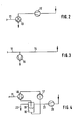
- FIGS. 2-4 show further possible embodiments of the method according to the invention.
- the ozone generation corresponds to that shown in FIG. 1, and has therefore been omitted in FIGS. 2-4.
- the method according to FIG. 2 differs from the method according to FIG. 1 only in that air is used as the flowing medium instead of water.
- the air is compressed in the compressor 12 and sent through the injector 13.
- a negative pressure is generated in the injector 13, through which the ozone is desorbed via the line 11.
- the ozone-air ratio can be set as desired within wide limits and the ozone-air mixture can be compressed to the desired treatment pressure.
- Injectors are admittedly particularly advantageous for the method according to the invention, since they can be made corrosion-resistant against the aggressive ozone without difficulty.
- the method according to the invention can, however, also be carried out with other machines producing negative pressure.
- FIG. 3 Such a possibility is shown in FIG. 3, in which the flowing medium is air, which is conveyed through line 14 a diaphragm pump 15 is sucked.
- the line 11 from the adsorption system 3 is also connected to the input of the diaphragm pump 15.
- the sucked-in gases are mixed and fed to the material treatment.
- FIG. 4 shows a procedure in which the ozone is drawn off from the desorption system 3 by means of a liquid flowing medium, but the gas stream supplied to the substance treatment is gaseous.
- water is sent from the container 16 through the injector 18 by means of the pump 17.
- ozone is desorbed, passes through the line 11 into the injector 18 and is mixed with the water.
- the liquid volume is chosen so small that most of the ozone is not dissolved, but is only carried away by the water.
- the ozone-water mixture is returned to the closed container 16, where the ozone degasses from the water. It collects in the gas space 19 of the container 16 and is mixed by air which is compressed by the compressor 20 to the required pressure.
- the compressed air enters the gas space 19 of the container 16 through the line 21, the ozone-air mixture leaves the gas space 19 via the line 22.
- the method according to the invention takes full advantage of the advantages that ozone generation from oxygen offers. Compared to the generation of ozone from air, there is no complex gas treatment, i.e. the removal of moisture, oil and dust, necessary. Ozone can be generated in a high gas concentration with half the electrical energy required to generate it from air.
- the ozone is completely released into the environment without the emission of exhaust gases.
- the oxygen which has not been converted into ozone does not take part in the substance treatment, and can therefore be returned to the ozone generator without further notice, in particular without further treatment.
- a particular advantage of the process according to the invention is that the gas volume, which essentially consists of ozone and small oxygen residues resulting from the switchover of the adsorption system and is offered for reaction, is smaller than in known processes in which the ozone is mixed with desorption gas is mixed. This means that for the complete dissolution of the ozone in a liquid, less liquid is necessary in the process according to the invention, or the ozone is dissolved more completely with the liquid volume remaining the same.
Landscapes
- Chemical & Material Sciences (AREA)
- Organic Chemistry (AREA)
- Inorganic Chemistry (AREA)
- Oxygen, Ozone, And Oxides In General (AREA)
- Separation Of Gases By Adsorption (AREA)
- Treatment Of Water By Oxidation Or Reduction (AREA)
Applications Claiming Priority (2)
| Application Number | Priority Date | Filing Date | Title |
|---|---|---|---|
| DE19823230922 DE3230922A1 (de) | 1982-08-20 | 1982-08-20 | Verfahren zur behandlung von stoffen mit ozon |
| DE3230922 | 1982-08-20 |
Publications (2)
| Publication Number | Publication Date |
|---|---|
| EP0103144A2 true EP0103144A2 (fr) | 1984-03-21 |
| EP0103144A3 EP0103144A3 (fr) | 1986-12-10 |
Family
ID=6171257
Family Applications (1)
| Application Number | Title | Priority Date | Filing Date |
|---|---|---|---|
| EP83107691A Withdrawn EP0103144A3 (fr) | 1982-08-20 | 1983-08-04 | Procédé pour la production d'ozone |
Country Status (2)
| Country | Link |
|---|---|
| EP (1) | EP0103144A3 (fr) |
| DE (1) | DE3230922A1 (fr) |
Cited By (9)
| Publication number | Priority date | Publication date | Assignee | Title |
|---|---|---|---|---|
| FR2580271A1 (fr) * | 1985-04-16 | 1986-10-17 | Air Liquide | Procede de production d'ozone |
| EP0178415A3 (fr) * | 1984-09-18 | 1986-12-30 | Messer Griesheim Gmbh | Procédé de préparation de l'ozone |
| EP0299289A1 (fr) * | 1987-07-08 | 1989-01-18 | Henkel Kommanditgesellschaft auf Aktien | Procédé d'ozonisation continue de composés organiques insaturés |
| EP0719729A1 (fr) | 1994-12-27 | 1996-07-03 | L'air Liquide, Societe Anonyme Pour L'etude Et L'exploitation Des Procedes Georges Claude | Procédé et installation de traitement d'un mélange gazeux comprenant de l'ozone |
| EP0893400A1 (fr) * | 1997-07-24 | 1999-01-27 | Mitsubishi Denki Kabushiki Kaisha | Dispositif d'alimentation d'ozone |
| EP0893402A1 (fr) * | 1997-07-24 | 1999-01-27 | Mitsubishi Denki Kabushiki Kaisha | Dispositif d'alimentation d'ozone |
| EP2088121A1 (fr) | 2008-02-08 | 2009-08-12 | "Oxy 3" Egger KEG | Unité transportable pour la production d'ozone |
| WO2011128073A2 (fr) | 2010-04-12 | 2011-10-20 | Durtec Gmbh | Utilisation de granulés minéraux naturels comme adsorbeurs de gaz pour l'élimination de composants toxiques gazeux |
| GB2545759A (en) * | 2015-12-21 | 2017-06-28 | Linde Ag | Methods for producing ozone |
Families Citing this family (5)
| Publication number | Priority date | Publication date | Assignee | Title |
|---|---|---|---|---|
| DE3603900A1 (de) * | 1985-02-13 | 1986-08-21 | Mitsubishi Denki K.K., Tokio/Tokyo | Trinkwasserreinigungseinrichtung |
| DE3632937A1 (de) * | 1986-09-27 | 1988-03-31 | Bbc Brown Boveri & Cie | Verfahren zur erzeugung von ozon |
| AT392256B (de) * | 1989-06-26 | 1991-02-25 | Voest Alpine Ind Anlagen | Verfahren zur herstellung von sauerstoff und/oder ozon |
| DE4015029A1 (de) * | 1990-05-10 | 1991-11-14 | Guetling Gmbh | Vorrichtung und verfahren zur behandlung von abwaessern |
| CN120550570B (zh) * | 2025-06-19 | 2026-01-16 | 青岛派尼尔环保技术有限公司 | 一种将臭氧和氧气分离生成高浓度臭氧的氧气回收设备 |
Family Cites Families (9)
| Publication number | Priority date | Publication date | Assignee | Title |
|---|---|---|---|---|
| DE1062394B (de) * | 1958-03-11 | 1959-07-30 | Franz Herberich | Verfahren und Vorrichtung zum Geruchfreimachen von Luft, insbesondere von industriellen Abgasen mittels Ozon |
| US3719573A (en) * | 1970-01-26 | 1973-03-06 | Environment One Corp | Periodically reversed gas flow ozone production method and apparatus |
| US3970567A (en) * | 1975-04-17 | 1976-07-20 | W. R. Grace & Co. | Ozonizer with absorption of ozone |
| US4124467A (en) * | 1975-12-30 | 1978-11-07 | Pincon Andrew J | Method and apparatus for producing ozone |
| JPS5932401B2 (ja) * | 1977-12-13 | 1984-08-08 | 三菱電機株式会社 | オゾン発生装置 |
| FR2432483A1 (fr) * | 1978-08-02 | 1980-02-29 | Rhone Poulenc Ind | Traitement des eaux |
| JPS6012962B2 (ja) * | 1978-11-01 | 1985-04-04 | 三菱電機株式会社 | オゾン水製造装置 |
| DE2854060A1 (de) * | 1978-12-14 | 1980-07-03 | Linde Ag | Verfahren zum bereitstellen eines einsatzgases fuer eine chemische reaktion und zum abtrennen eines gasfoermigen reaktionsproduktes |
| US4453953A (en) * | 1981-05-12 | 1984-06-12 | Mitsubishi Denki Kabushiki Kaisha | Intermittent ozone feeding apparatus |
-
1982
- 1982-08-20 DE DE19823230922 patent/DE3230922A1/de not_active Withdrawn
-
1983
- 1983-08-04 EP EP83107691A patent/EP0103144A3/fr not_active Withdrawn
Cited By (16)
| Publication number | Priority date | Publication date | Assignee | Title |
|---|---|---|---|---|
| EP0178415A3 (fr) * | 1984-09-18 | 1986-12-30 | Messer Griesheim Gmbh | Procédé de préparation de l'ozone |
| FR2580271A1 (fr) * | 1985-04-16 | 1986-10-17 | Air Liquide | Procede de production d'ozone |
| WO1986006056A1 (fr) * | 1985-04-16 | 1986-10-23 | L'air Liquide, Societe Anonyme Pour L'etude Et L'e | Procede et appareil de production d'ozone |
| US4786489A (en) * | 1985-04-16 | 1988-11-22 | L'air Liquide, Societe Anonyme Pour L'etude Et L'exploitation Des Procedes Georges Claude | Ozone-producing process |
| EP0299289A1 (fr) * | 1987-07-08 | 1989-01-18 | Henkel Kommanditgesellschaft auf Aktien | Procédé d'ozonisation continue de composés organiques insaturés |
| EP0719729A1 (fr) | 1994-12-27 | 1996-07-03 | L'air Liquide, Societe Anonyme Pour L'etude Et L'exploitation Des Procedes Georges Claude | Procédé et installation de traitement d'un mélange gazeux comprenant de l'ozone |
| US6083464A (en) * | 1997-07-24 | 2000-07-04 | Mitsubishi Denki Kabushiki Kaisha | Ozone supplying apparatus with fluid purification and recycling |
| EP0893402A1 (fr) * | 1997-07-24 | 1999-01-27 | Mitsubishi Denki Kabushiki Kaisha | Dispositif d'alimentation d'ozone |
| EP0893400A1 (fr) * | 1997-07-24 | 1999-01-27 | Mitsubishi Denki Kabushiki Kaisha | Dispositif d'alimentation d'ozone |
| US6228331B1 (en) | 1997-07-24 | 2001-05-08 | Mitsubishi Denki Kabushiki Kaisha | Ozone supplying apparatus |
| EP1253110A3 (fr) * | 1997-07-24 | 2010-07-14 | Mitsubishi Denki Kabushiki Kaisha | Dispositif d'alimentation d'ozone |
| EP1419993A3 (fr) * | 1997-07-24 | 2011-08-17 | Mitsubishi Denki Kabushiki Kaisha | Dispositif d'alimentation d'ozone |
| EP2088121A1 (fr) | 2008-02-08 | 2009-08-12 | "Oxy 3" Egger KEG | Unité transportable pour la production d'ozone |
| WO2011128073A2 (fr) | 2010-04-12 | 2011-10-20 | Durtec Gmbh | Utilisation de granulés minéraux naturels comme adsorbeurs de gaz pour l'élimination de composants toxiques gazeux |
| GB2545759A (en) * | 2015-12-21 | 2017-06-28 | Linde Ag | Methods for producing ozone |
| US11027232B2 (en) | 2015-12-21 | 2021-06-08 | Messer Industries Usa, Inc. | Methods for producing ozone |
Also Published As
| Publication number | Publication date |
|---|---|
| EP0103144A3 (fr) | 1986-12-10 |
| DE3230922A1 (de) | 1984-02-23 |
Similar Documents
| Publication | Publication Date | Title |
|---|---|---|
| EP0103144A2 (fr) | Procédé pour la production d'ozone | |
| DE2316831C3 (de) | Verfahren und Anlage zur Behandlung von Abgasen, die radioaktive Verunreinigungen, insbesondere Krypton- und Xenonnuklide, enthalten | |
| DE3434169C2 (de) | Verfahren zur Gewinnung von Ozon | |
| DE60119446T2 (de) | Vorrichtung zur Gastrennung | |
| DE3149681A1 (de) | Vorrichtung zur intermittierenden ozoneinspeisung | |
| DE69200250T2 (de) | Verfahren zur verlängerung der gaslebensdauer von excimer-lasern. | |
| DE3302402C2 (fr) | ||
| AT394707B (de) | Verfahren und vorrichtung zur herstellung von ozonhaeltigen loesungen und gasen | |
| DE3632937A1 (de) | Verfahren zur erzeugung von ozon | |
| DE2803789A1 (de) | Verfahren zum entfernen geloester organischer verunreinigungen aus abwasserstroemen | |
| EP0075663A2 (fr) | Procédé et dispositif pour la production d'azote à pureté élevée | |
| DE2210264A1 (de) | Verfahren zur abtrennung und gewinnung von krypton- und xenonnukliden aus solche enthaltenden abgasen | |
| DE3146189A1 (de) | Verfahren zum betrieb einer druckwechselanlage und nach diesem verfahren arbeitende druckwechselanlage | |
| DE69706480T2 (de) | Kryptonanreicherung in einer Sauerstoff/Stickstoff-Gasmischung | |
| EP0049782A1 (fr) | Procédé pour la désorption cyclique d'adsorbants, chargés cycliquement d'adsorbats | |
| DE69306831T2 (de) | Behandlung von Flüssigkeiten | |
| DE69718145T2 (de) | Vorrichtung und Verfahren zur Behandlung der in einem Innenraum eingeschossenen Atmosphäre | |
| JP2772362B2 (ja) | 液体中の溶存炭酸ガス除去装置 | |
| DE3235564A1 (de) | Vorrichtung zum abschneiden von kohlendioxid aus der raumluft | |
| DE2011300B2 (de) | Verfahren und Vorrichtung zum Regenerieren der Abluft von Trockenreinigungsmaschinen | |
| DE3935445C2 (de) | Verfahren zur Reinigung von Wasser | |
| DE2443261C2 (de) | Sauerstoffaufbereitungsanlage | |
| DE19941057C1 (de) | Ein-Bett-Druckwechseladsorptionsverfahren sowie -system | |
| DE102024127680A1 (de) | Vorrichtung und Verfahren zum Extrahieren von CO2 aus Luft | |
| DE102024127681A1 (de) | Vorrichtung und Verfahren zum Extrahieren von CO2 aus Luft |
Legal Events
| Date | Code | Title | Description |
|---|---|---|---|
| PUAI | Public reference made under article 153(3) epc to a published international application that has entered the european phase |
Free format text: ORIGINAL CODE: 0009012 |
|
| AK | Designated contracting states |
Designated state(s): AT BE CH FR IT LI NL |
|
| PUAL | Search report despatched |
Free format text: ORIGINAL CODE: 0009013 |
|
| AK | Designated contracting states |
Kind code of ref document: A3 Designated state(s): AT BE CH FR IT LI NL |
|
| STAA | Information on the status of an ep patent application or granted ep patent |
Free format text: STATUS: THE APPLICATION IS DEEMED TO BE WITHDRAWN |
|
| 18D | Application deemed to be withdrawn |
Effective date: 19870611 |
|
| RIN1 | Information on inventor provided before grant (corrected) |
Inventor name: FRIEGES, MICHAEL Inventor name: WOLF, EWALD Inventor name: LEITZKE, ORTWIN, DR. Inventor name: GIETMANN, ARNOLD |