EP0103388A2 - Kernmagnetische Resonanzmethode und Vorrichtung - Google Patents
Kernmagnetische Resonanzmethode und Vorrichtung Download PDFInfo
- Publication number
- EP0103388A2 EP0103388A2 EP83304483A EP83304483A EP0103388A2 EP 0103388 A2 EP0103388 A2 EP 0103388A2 EP 83304483 A EP83304483 A EP 83304483A EP 83304483 A EP83304483 A EP 83304483A EP 0103388 A2 EP0103388 A2 EP 0103388A2
- Authority
- EP
- European Patent Office
- Prior art keywords
- slice
- magnetic resonance
- nuclear magnetic
- region
- period
- Prior art date
- Legal status (The legal status is an assumption and is not a legal conclusion. Google has not performed a legal analysis and makes no representation as to the accuracy of the status listed.)
- Granted
Links
- 238000001225 nuclear magnetic resonance method Methods 0.000 title 1
- 238000005481 NMR spectroscopy Methods 0.000 claims abstract description 29
- 238000000034 method Methods 0.000 claims abstract description 24
- 239000007788 liquid Substances 0.000 claims abstract description 16
- 230000006698 induction Effects 0.000 claims abstract description 5
- 230000005284 excitation Effects 0.000 claims 1
- 239000008280 blood Substances 0.000 description 14
- 210000004369 blood Anatomy 0.000 description 14
- 125000004435 hydrogen atom Chemical group [H]* 0.000 description 9
- 239000011343 solid material Substances 0.000 description 8
- 238000009826 distribution Methods 0.000 description 4
- 238000001208 nuclear magnetic resonance pulse sequence Methods 0.000 description 4
- 238000004458 analytical method Methods 0.000 description 2
- 210000004204 blood vessel Anatomy 0.000 description 2
- 239000006185 dispersion Substances 0.000 description 2
- 238000005259 measurement Methods 0.000 description 2
- 238000012545 processing Methods 0.000 description 2
- 239000000126 substance Substances 0.000 description 2
- 0 C[C@@](CCCC1[C@](C)NC1)[C@@](C)**CI Chemical compound C[C@@](CCCC1[C@](C)NC1)[C@@](C)**CI 0.000 description 1
- 210000001367 artery Anatomy 0.000 description 1
- 230000017531 blood circulation Effects 0.000 description 1
- 238000012937 correction Methods 0.000 description 1
- 230000000694 effects Effects 0.000 description 1
- 238000002474 experimental method Methods 0.000 description 1
- 230000003993 interaction Effects 0.000 description 1
- 238000002075 inversion recovery Methods 0.000 description 1
- 239000000463 material Substances 0.000 description 1
- 230000002093 peripheral effect Effects 0.000 description 1
- 239000000523 sample Substances 0.000 description 1
- 238000003325 tomography Methods 0.000 description 1
- 210000003462 vein Anatomy 0.000 description 1
Images

Classifications
-
- G—PHYSICS
- G01—MEASURING; TESTING
- G01R—MEASURING ELECTRIC VARIABLES; MEASURING MAGNETIC VARIABLES
- G01R33/00—Arrangements or instruments for measuring magnetic variables
- G01R33/20—Arrangements or instruments for measuring magnetic variables involving magnetic resonance
- G01R33/44—Arrangements or instruments for measuring magnetic variables involving magnetic resonance using nuclear magnetic resonance [NMR]
- G01R33/48—NMR imaging systems
- G01R33/54—Signal processing systems, e.g. using pulse sequences ; Generation or control of pulse sequences; Operator console
- G01R33/56—Image enhancement or correction, e.g. subtraction or averaging techniques, e.g. improvement of signal-to-noise ratio and resolution
- G01R33/563—Image enhancement or correction, e.g. subtraction or averaging techniques, e.g. improvement of signal-to-noise ratio and resolution of moving material, e.g. flow contrast angiography
- G01R33/56308—Characterization of motion or flow; Dynamic imaging
-
- A—HUMAN NECESSITIES
- A61—MEDICAL OR VETERINARY SCIENCE; HYGIENE
- A61B—DIAGNOSIS; SURGERY; IDENTIFICATION
- A61B5/00—Measuring for diagnostic purposes; Identification of persons
- A61B5/02—Detecting, measuring or recording for evaluating the cardiovascular system, e.g. pulse, heart rate, blood pressure or blood flow
- A61B5/026—Measuring blood flow
- A61B5/0263—Measuring blood flow using NMR
-
- G—PHYSICS
- G01—MEASURING; TESTING
- G01F—MEASURING VOLUME, VOLUME FLOW, MASS FLOW OR LIQUID LEVEL; METERING BY VOLUME
- G01F1/00—Measuring the volume flow or mass flow of fluid or fluent solid material wherein the fluid passes through a meter in a continuous flow
- G01F1/704—Measuring the volume flow or mass flow of fluid or fluent solid material wherein the fluid passes through a meter in a continuous flow using marked regions or existing inhomogeneities within the fluid stream, e.g. statistically occurring variations in a fluid parameter
- G01F1/708—Measuring the time taken to traverse a fixed distance
- G01F1/716—Measuring the time taken to traverse a fixed distance using electron paramagnetic resonance [EPR] or nuclear magnetic resonance [NMR]
Definitions
- This invention relates to methods and apparatus for determining the rate of flow of a liquid in a selected region of a body by nuclear magnetic resonance (NMR) techniques. It has particular relevance to techniques for measuring relatively low rate of flow.
- NMR nuclear magnetic resonance
- NMR techniques have been used for the chemical analysis of material for many years. More recently NMR techniques have been used to obtain images representing the distribution over a selected cross-sectional slice or volume of a body of a chosen quantity, e.g. the density of chosen nuclei, for example hydrogen protons, or of NMR spin relaxation time constants. Such distributions are similar to, although of different significance from, the distribution of X-ray attenuation provided by computerised tomography systems. IN some applications it would be useful to obtain additional information relating to the flow rates of a liquid within a selected region of the body, e.g. blood flow in selected veins and arteries of a human body, using NMR techniques.
- a method of determining the rate of flow of a liquid in a region of a body comprises: exciting nuclear magnetic resonance preferentially in a slice of said body which includes said region; subsequently exciting nuclear magnetic resonance substantially over the whole of said body; waiting a period of time and then again exciting nuclear magnetic resonance preferentially in said slice; measuring the resultant .free induction decay signal; and relating said signal to the rate of flow of said liquid through said slice.
- the invention also provides an apparatus arranged to determine the rate of flow of a liquid in a region of a body, comprising: means arranged to excite nuclear magnetic resonance preferentially in a slice of said body which includes said region; means arranged to subsequently excite nuclear magnetic resonance substantially over the whole of said body; means arranged to wait a period of time and then again excite nuclear magnetic resonance preferentially in said slice; means arranged to measure the resultant free induction decay signal; and means arranged to relate said signal to the rate of flow of said liquid through said slice.
- the method is performed using an apparatus essentially identical to that described in U.K. Patent Specification No. 1,578,910 or No. 2,056,078 to which reference should be made for a fuller description, appropriately programmed to apply a sequence of magnetic field gradient and RF pulses and analyse the resulting signals as hereafter described.
- the first coil system comprises coils 1 capable of providing a steady uniform magnetic field in the Z direction; coils 3 capable of providing a magnetic field gradient in the X direction, coils 5 capable of providing a magnetic field gradient in the Y direction; and coils 7 capable of providing a magnetic field gradient in the Z direction.
- the apparatus includes a second coil system 9 whereby RF magnetic fields can be applied to the body under examination in a plane normal to the direction of the steady uniform magnetic field produced by the first coil system, and whereby RF magnetic fields resulting from nuclei in the body under examination which have been excited to nuclear magnetic resonance with a spin vector component other than in the Z direction can be detected.
- the various coils 1, 3, 5, 7 and 9 are driven by drive amplifiers 11, 12, 13, 15, 17 and 19 respectively, controlled by control circuits 21, 23, 25 and 27 respectively.
- These circuits may take various forms which are well known to those with experience of NMR equipment and other apparatus using coil induced magnetic fields.
- the circuits 21, 23, 25 and 27 are controlled by a central processing and control unit 29 with which are associated inputs and other peripherals 31, for the provision of commands and instructions to the apparatus, and a display 33.
- the NMR signals detected by the coils 9 are applied via an amplifier 35 to a signal handling system 37.
- the signal handling system is arranged to make any appropriate calibration and correction of the signals, but essentially transmits the signals to the processing and control unit 29 wherein the signals are processed for application to the display to produce an image representing the distribution of an NMR quantity in the body being examined.
- the signal handling system 37 may conveniently form part of the unit 29.
- the apparatus also includes field measurement and error signal circuits 39 which receive signals via amplifiers 41 from field probes X 1 , X 2 , Y 1 and Y 2 which are disposed at suitable positions in relation to a slice 43 of the body being examined, as illustrated in Figure 2, to monitor the applied magnetic fields.
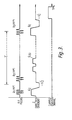
- a steady uniform magnetic field Bo is applied to the body under examination in the Z direction.
- This field serves to define the equilibrium axis of magnetic alignment of the nuclei in the body i.e. along the Z direction, and remains constant throughout the examination procedure.
- a magnetic field gradient Gz along the Z direction is then applied to the body, together with an RF magnetic field pulse denoted B 1 (90 0 ), for reasons explained hereafter.
- the frequency of the RF field is chosen to be the Larmor frequency for protons in a slice 43 of the body, normal to the Z direction, the slice being defined by a particular magnetic field along the Z direction, such that protons within the slice are preferentially excited, the slice consisting of an area of substantially solid material through which a series of blood vessels extend.
- the integral of the RF pulse is such that the pulse is just sufficient to tip the spins of the excited protons into the X-Y plane, and is thus referred to as a 90 0 pulse, the spins then precessing in the X-Y plane round the Z axis.
- the field gradient Gz is then removed, and replaced by a gradient in the opposite sense - Gz .
- This causes the rephasing of the spins which have been selectively excited by the combination of the RF pulse B 1 (90°), Bo and the field gradient Gz, the dephasing having been caused by the gradient through the slice.
- the magnitude of - Gz is adjusted so that the spins are rephased at the time at which this gradient is switched off as described, for example, in the above mentioned UK Patent Specification No. 1,578,910.
- a second RF magnetic field pulse B 2 (90 0 ) having the same characteristics as the B 1 (90°) pulse is applied.
- a period of time, ⁇ is then allowed to elapse, during which time the excited spins throughout the body relax back towards.the positive Z direction.
- a number of pulsed magnetic field gradients Gzd may be imposed along the Z direction, these pulses causing phase dispersion of spins lying in the X-Y plane in addition to the phase dispersion of the spins which naturally occurs, due to spin-spin interaction (T 2 effects).
- the gradients Gzd do not however affect spins in the Z directions.
- these pulses reduce the signal which would be induced in the second coil system by spins outside the selected slice which have remained in the X-Y plane although for long values of ⁇ this signal would in any case be small.
- a third RF magnetic field pulse B 3 (90°) again having the same characteristics as the B 1 (90°) pulse is applied in the presence of the magnetic field gradient to selectively excite the protons within the slice as before, this sequence again being followed by the rephasing gradient - Gz'.
- the signal induced in the second coil signal by these spins, i.e. the Free Induction Decay (F.I.D.) system 9 is then recorded, the spins outside the slice which remain in the XY plane after the period having been dephased as explained herebefore, and thus not contributing significantly to the measured signal.
- the magnitude of the measured F.I.D. signal is related to the density of protons within the slice, and will consist of contributions from hydrogen protons in three different circumstances: (1) protons in the solid material in the slice; (2) protons in the blood which has remained in the slice during the period from the B1(900) and B 2 )90 0 ) pulses to the recording of the F.I.D. signal, i.e. a period substantially equal to ⁇ ; and (3) hydrogen protons in the 'new' blood which has flowed into the slice during the period.
- A is the cross sectional area of the blood vessels through the slice.
- v is the velocity of the blood through the vessels.
- ⁇ OS , ⁇ OB and A can be estimated it will, of course only be necessary to perform the pulse sequence once although it might be advantageous to average the signal over several measurements to improve the signal to noise ratio.
- the choice of the time ⁇ is determined by the values of the spin-lattice relaxation times T 1S and T 1B . As these times can for many tissues be relatively long, in the order of 400 m.secs, relatively slow flow rates can readily be monitored by this method. Due to the long time periods available the magnitude of the applied gradients can be minimised, and thus the resonance signal from excited spins within the body are dispersed relatively slowly. The F.I.D. signal will then persist above noise levels for longer, and also sharp resonance lines will be maintained. This is particularly advantageous where it is desired to also measure the chemical shift in the Larmor frequency between for example, protons in the blood and protons in.the solid material in the slice.
Landscapes
- Health & Medical Sciences (AREA)
- Physics & Mathematics (AREA)
- Life Sciences & Earth Sciences (AREA)
- Engineering & Computer Science (AREA)
- Nuclear Medicine, Radiotherapy & Molecular Imaging (AREA)
- General Physics & Mathematics (AREA)
- General Health & Medical Sciences (AREA)
- Animal Behavior & Ethology (AREA)
- Fluid Mechanics (AREA)
- Biomedical Technology (AREA)
- Heart & Thoracic Surgery (AREA)
- Medical Informatics (AREA)
- Molecular Biology (AREA)
- Surgery (AREA)
- Biophysics (AREA)
- Physiology (AREA)
- Public Health (AREA)
- Veterinary Medicine (AREA)
- Pathology (AREA)
- Cardiology (AREA)
- Hematology (AREA)
- Vascular Medicine (AREA)
- Radiology & Medical Imaging (AREA)
- Signal Processing (AREA)
- High Energy & Nuclear Physics (AREA)
- Condensed Matter Physics & Semiconductors (AREA)
- Magnetic Resonance Imaging Apparatus (AREA)
- Measuring Volume Flow (AREA)
Applications Claiming Priority (2)
| Application Number | Priority Date | Filing Date | Title |
|---|---|---|---|
| GB8223862 | 1982-08-19 | ||
| GB8223862 | 1982-08-19 |
Publications (3)
| Publication Number | Publication Date |
|---|---|
| EP0103388A2 true EP0103388A2 (de) | 1984-03-21 |
| EP0103388A3 EP0103388A3 (en) | 1986-05-14 |
| EP0103388B1 EP0103388B1 (de) | 1988-11-17 |
Family
ID=10532396
Family Applications (1)
| Application Number | Title | Priority Date | Filing Date |
|---|---|---|---|
| EP83304483A Expired EP0103388B1 (de) | 1982-08-19 | 1983-08-03 | Kernmagnetische Resonanzmethode und Vorrichtung |
Country Status (5)
| Country | Link |
|---|---|
| US (1) | US4587488A (de) |
| EP (1) | EP0103388B1 (de) |
| JP (1) | JPS5960262A (de) |
| DE (1) | DE3378495D1 (de) |
| GB (1) | GB2125562B (de) |
Cited By (5)
| Publication number | Priority date | Publication date | Assignee | Title |
|---|---|---|---|---|
| EP0109238A3 (en) * | 1982-11-10 | 1985-05-29 | Picker International Limited | Nuclear magnetic resonance method and apparatus |
| EP0115642A3 (en) * | 1983-01-04 | 1985-06-26 | Wisconsin Alumni Research Foundation | Nmr scanner with motion zeugmatography |
| EP0182481A3 (de) * | 1984-10-22 | 1986-10-15 | The Board Of Trustees Of The Leland Stanford Junior University | Verfahren und Vorrichtung zur Bestimmung der Bewegung von Fluiden unter Verwendung von kernmagnetischer Resonanz |
| EP0215592A3 (de) * | 1985-09-02 | 1989-01-25 | Picker International Limited | Apparat und Verfahren zur Bilderzeugung mittels magnetischer Kernresonanz |
| RU2256931C1 (ru) * | 2004-02-24 | 2005-07-20 | Открытое акционерное общество "Альметьевский завод "Радиоприбор" | Устройство для измерения состава и расхода многокомпонентной жидкости на основе ядерного магнитного резонанса (варианты) |
Families Citing this family (9)
| Publication number | Priority date | Publication date | Assignee | Title |
|---|---|---|---|---|
| JPS6039539A (ja) * | 1983-08-15 | 1985-03-01 | Hitachi Ltd | 核磁気共鳴を用いた検査装置 |
| US4697149A (en) * | 1985-11-04 | 1987-09-29 | Wisconsin Alumni Research Foundation | NMR flow imaging using a composite excitation field and magnetic field gradient sequence |
| IL79076A (en) * | 1986-06-10 | 1989-10-31 | Elscint Ltd | Restricted volume imaging |
| FI874419L (fi) * | 1987-10-08 | 1989-04-09 | Instrumentarium Oy | Anordning och foerfarande foer undersoekning av ett objekts egenskaper. |
| IL84152A (en) * | 1987-10-12 | 1991-06-10 | Elscint Ltd | Magnetic resonance spectroscopic measurements of restricted volumes |
| US6272370B1 (en) | 1998-08-07 | 2001-08-07 | The Regents Of University Of Minnesota | MR-visible medical device for neurological interventions using nonlinear magnetic stereotaxis and a method imaging |
| US6463317B1 (en) | 1998-05-19 | 2002-10-08 | Regents Of The University Of Minnesota | Device and method for the endovascular treatment of aneurysms |
| RU2544360C1 (ru) * | 2013-12-04 | 2015-03-20 | Федеральное государственное бюджетное образовательное учреждение высшего профессионального образования "Казанский государственный энергетический университет" (ФГБОУ ВПО "КГЭУ") | Устройство для измерения состава и расхода многокомпонентных жидкостей методом ядерного магнитного резонанса |
| CN103969604B (zh) * | 2014-05-30 | 2017-03-15 | 华南师范大学 | 射频原子磁力仪及其测量核磁共振信号的方法 |
Family Cites Families (6)
| Publication number | Priority date | Publication date | Assignee | Title |
|---|---|---|---|---|
| JPS49103693A (de) * | 1973-02-02 | 1974-10-01 | ||
| US4458203A (en) * | 1980-12-11 | 1984-07-03 | Picker International Limited | Nuclear magnetic resonance imaging |
| US4528985A (en) * | 1981-12-21 | 1985-07-16 | Albert Macovski | Blood vessel imaging system using nuclear magnetic resonance |
| EP0103372A3 (de) * | 1982-08-11 | 1986-05-07 | Picker International Limited | Kernmagnetische Resonanzmethode und -Vorrichtung |
| US4516075A (en) * | 1983-01-04 | 1985-05-07 | Wisconsin Alumni Research Foundation | NMR scanner with motion zeugmatography |
| US4516582A (en) * | 1983-05-02 | 1985-05-14 | General Electric Company | NMR blood flow imaging |
-
1983
- 1983-08-03 US US06/519,832 patent/US4587488A/en not_active Expired - Fee Related
- 1983-08-03 GB GB08320946A patent/GB2125562B/en not_active Expired
- 1983-08-03 EP EP83304483A patent/EP0103388B1/de not_active Expired
- 1983-08-03 DE DE8383304483T patent/DE3378495D1/de not_active Expired
- 1983-08-19 JP JP58151464A patent/JPS5960262A/ja active Pending
Cited By (5)
| Publication number | Priority date | Publication date | Assignee | Title |
|---|---|---|---|---|
| EP0109238A3 (en) * | 1982-11-10 | 1985-05-29 | Picker International Limited | Nuclear magnetic resonance method and apparatus |
| EP0115642A3 (en) * | 1983-01-04 | 1985-06-26 | Wisconsin Alumni Research Foundation | Nmr scanner with motion zeugmatography |
| EP0182481A3 (de) * | 1984-10-22 | 1986-10-15 | The Board Of Trustees Of The Leland Stanford Junior University | Verfahren und Vorrichtung zur Bestimmung der Bewegung von Fluiden unter Verwendung von kernmagnetischer Resonanz |
| EP0215592A3 (de) * | 1985-09-02 | 1989-01-25 | Picker International Limited | Apparat und Verfahren zur Bilderzeugung mittels magnetischer Kernresonanz |
| RU2256931C1 (ru) * | 2004-02-24 | 2005-07-20 | Открытое акционерное общество "Альметьевский завод "Радиоприбор" | Устройство для измерения состава и расхода многокомпонентной жидкости на основе ядерного магнитного резонанса (варианты) |
Also Published As
| Publication number | Publication date |
|---|---|
| EP0103388B1 (de) | 1988-11-17 |
| EP0103388A3 (en) | 1986-05-14 |
| US4587488A (en) | 1986-05-06 |
| JPS5960262A (ja) | 1984-04-06 |
| DE3378495D1 (en) | 1988-12-22 |
| GB2125562A (en) | 1984-03-07 |
| GB2125562B (en) | 1985-11-20 |
| GB8320946D0 (en) | 1983-09-07 |
Similar Documents
| Publication | Publication Date | Title |
|---|---|---|
| US4563647A (en) | Nuclear magnetic resonance methods and apparatus | |
| US4520828A (en) | Nuclear magnetic resonance method and apparatus | |
| EP0103388B1 (de) | Kernmagnetische Resonanzmethode und Vorrichtung | |
| EP0100183B1 (de) | Kernmagnetische Resonanzmethode und Vorrichtung | |
| US4558278A (en) | Nuclear magnetic resonance methods and apparatus | |
| US4733183A (en) | Nuclear magnetic resonance methods and apparatus | |
| US4642568A (en) | Nuclear magnetic resonance methods and apparatus | |
| US4564813A (en) | Nuclear magnetic resonance method and apparatus | |
| US4631480A (en) | Nuclear magnetic resonance method and apparatus | |
| US4862080A (en) | Method of deriving a spin resonance signal from a moving fluid, and device for performing this method | |
| EP0106472B1 (de) | Magnetische Kernresonanzmethode und -vorrichtung | |
| EP0217578B1 (de) | Verfahren und Apparatur zur kernmagnetischen Resonanz | |
| GB2127155A (en) | Flow determination by nuclear magnetic resonance | |
| US4703269A (en) | Nuclear magnetic resonance imaging methods and apparatus | |
| EP0129356A2 (de) | Magnetische Kernresonanzmethode und Vorrichtung | |
| Burl et al. | Nuclear magnetic resonance method and apparatus | |
| Young | Nuclear magnetic resonance method and apparatus |
Legal Events
| Date | Code | Title | Description |
|---|---|---|---|
| PUAI | Public reference made under article 153(3) epc to a published international application that has entered the european phase |
Free format text: ORIGINAL CODE: 0009012 |
|
| AK | Designated contracting states |
Designated state(s): DE FR NL |
|
| PUAL | Search report despatched |
Free format text: ORIGINAL CODE: 0009013 |
|
| AK | Designated contracting states |
Kind code of ref document: A3 Designated state(s): DE FR NL |
|
| 17P | Request for examination filed |
Effective date: 19860616 |
|
| 17Q | First examination report despatched |
Effective date: 19880222 |
|
| GRAA | (expected) grant |
Free format text: ORIGINAL CODE: 0009210 |
|
| AK | Designated contracting states |
Kind code of ref document: B1 Designated state(s): DE FR NL |
|
| REF | Corresponds to: |
Ref document number: 3378495 Country of ref document: DE Date of ref document: 19881222 |
|
| ET | Fr: translation filed | ||
| PLBE | No opposition filed within time limit |
Free format text: ORIGINAL CODE: 0009261 |
|
| STAA | Information on the status of an ep patent application or granted ep patent |
Free format text: STATUS: NO OPPOSITION FILED WITHIN TIME LIMIT |
|
| 26N | No opposition filed | ||
| PGFP | Annual fee paid to national office [announced via postgrant information from national office to epo] |
Ref country code: FR Payment date: 19950717 Year of fee payment: 13 |
|
| PGFP | Annual fee paid to national office [announced via postgrant information from national office to epo] |
Ref country code: NL Payment date: 19950830 Year of fee payment: 13 |
|
| PGFP | Annual fee paid to national office [announced via postgrant information from national office to epo] |
Ref country code: DE Payment date: 19951025 Year of fee payment: 13 |
|
| PG25 | Lapsed in a contracting state [announced via postgrant information from national office to epo] |
Ref country code: NL Effective date: 19970301 |
|
| PG25 | Lapsed in a contracting state [announced via postgrant information from national office to epo] |
Ref country code: FR Effective date: 19970430 |
|
| NLV4 | Nl: lapsed or anulled due to non-payment of the annual fee |
Effective date: 19970301 |
|
| PG25 | Lapsed in a contracting state [announced via postgrant information from national office to epo] |
Ref country code: DE Effective date: 19970501 |
|
| REG | Reference to a national code |
Ref country code: FR Ref legal event code: ST |