EP0103507B1 - Sportschuhsohle mit darunterliegenden abfedernden Eigenschaften auf Boden, besonders für Fussball, Rugby, Feldhockey oder ähnliches - Google Patents
Sportschuhsohle mit darunterliegenden abfedernden Eigenschaften auf Boden, besonders für Fussball, Rugby, Feldhockey oder ähnliches Download PDFInfo
- Publication number
- EP0103507B1 EP0103507B1 EP19830401668 EP83401668A EP0103507B1 EP 0103507 B1 EP0103507 B1 EP 0103507B1 EP 19830401668 EP19830401668 EP 19830401668 EP 83401668 A EP83401668 A EP 83401668A EP 0103507 B1 EP0103507 B1 EP 0103507B1
- Authority
- EP
- European Patent Office
- Prior art keywords
- sole
- tapped
- lips
- bosses
- ground
- Prior art date
- Legal status (The legal status is an assumption and is not a legal conclusion. Google has not performed a legal analysis and makes no representation as to the accuracy of the status listed.)
- Expired
Links
- 239000000463 material Substances 0.000 claims description 5
- 238000005299 abrasion Methods 0.000 claims description 3
- 230000007935 neutral effect Effects 0.000 claims description 3
- 244000025254 Cannabis sativa Species 0.000 claims description 2
- 239000004952 Polyamide Substances 0.000 claims description 2
- 239000004721 Polyphenylene oxide Substances 0.000 claims description 2
- 239000004033 plastic Substances 0.000 claims description 2
- 229920003023 plastic Polymers 0.000 claims description 2
- 229920002647 polyamide Polymers 0.000 claims description 2
- 229920000728 polyester Polymers 0.000 claims description 2
- 229920000570 polyether Polymers 0.000 claims description 2
- 239000004433 Thermoplastic polyurethane Substances 0.000 claims 1
- 229920001971 elastomer Polymers 0.000 claims 1
- 239000000806 elastomer Substances 0.000 claims 1
- 229920002803 thermoplastic polyurethane Polymers 0.000 claims 1
- 241000909536 Gobiesocidae Species 0.000 description 2
- 239000000835 fiber Substances 0.000 description 2
- 239000002184 metal Substances 0.000 description 2
- 230000002093 peripheral effect Effects 0.000 description 2
- 238000005070 sampling Methods 0.000 description 2
- 229920002614 Polyether block amide Polymers 0.000 description 1
- 230000001174 ascending effect Effects 0.000 description 1
- 230000007547 defect Effects 0.000 description 1
- 230000002349 favourable effect Effects 0.000 description 1
- 230000004048 modification Effects 0.000 description 1
- 238000012986 modification Methods 0.000 description 1
- 239000002991 molded plastic Substances 0.000 description 1
- 230000035515 penetration Effects 0.000 description 1
- 239000011295 pitch Substances 0.000 description 1
- 229920002635 polyurethane Polymers 0.000 description 1
- 239000004814 polyurethane Substances 0.000 description 1
- 229920003225 polyurethane elastomer Polymers 0.000 description 1
- 230000001737 promoting effect Effects 0.000 description 1
- 229920002725 thermoplastic elastomer Polymers 0.000 description 1
- 210000002105 tongue Anatomy 0.000 description 1
- 238000005303 weighing Methods 0.000 description 1
Images
Classifications
-
- A—HUMAN NECESSITIES
- A43—FOOTWEAR
- A43C—FASTENINGS OR ATTACHMENTS OF FOOTWEAR; LACES IN GENERAL
- A43C15/00—Non-skid devices or attachments
- A43C15/16—Studs or cleats for football or like boots
- A43C15/161—Studs or cleats for football or like boots characterised by the attachment to the sole
-
- A—HUMAN NECESSITIES
- A43—FOOTWEAR
- A43B—CHARACTERISTIC FEATURES OF FOOTWEAR; PARTS OF FOOTWEAR
- A43B13/00—Soles; Sole-and-heel integral units
- A43B13/14—Soles; Sole-and-heel integral units characterised by the constructive form
- A43B13/22—Soles made slip-preventing or wear-resisting, e.g. by impregnation or spreading a wear-resisting layer
- A43B13/24—Soles made slip-preventing or wear-resisting, e.g. by impregnation or spreading a wear-resisting layer by use of insertions
- A43B13/26—Soles made slip-preventing or wear-resisting, e.g. by impregnation or spreading a wear-resisting layer by use of insertions projecting beyond the sole surface
Definitions
- the present invention relates to an improved sole for sports shoes, with underlying projections for holding on the ground, for the practice in particular of football, rugby, field hockey or others.
- Some soles are fitted with interchangeable metal studs of different heights (6 to 8) and are suitable for oily or tender lawns.
- Other soles are provided with molded crampons (12 to 20) and are differentiated according to a sampling adapted to soft to hard lawns or stabilized grounds.
- Still other soles have a very large number of small studs distributed as close as possible to each other for playing on synthetic pitches or in indoor courts.
- the object of the present invention is to remedy these drawbacks by proposing a multi-purpose sole, the underlying projections of which may be suitable, subject to the interchangeability of some, practically a very satisfactory clearance on all terrains, this sole being in besides light and very resistant to wear, more flexible than so far and yet sufficiently rigid locally so that the player's foot does not feel the projections through the sole itself.
- the sole projecting, in combination with the threaded bosses cooperating selectively with a diversified sampling of studs, projecting lips elastically deformable and tending when the sole is flattened, the projecting lips concentrically surrounding at least some of the threaded bosses; each thins from its base towards its free end, its neutral fiber leaning from the side where it must flatten, opposite to the threaded boss.
- French patent 2,220,128 provides not spikes, but spikes whose penetration into the ground is limited. These points cooperate in the first place with recesses which could be assimilated to suction cups but whose edges do not project from the sole and therefore cannot behave like the deformable lips according to the invention.
- Said tips also cooperate with two types of projections called in the patent "first and second projections"; these projections (21 and 22, for example) do not at all resemble those of the invention because they are peduncles spaced from each other and arranged around the corresponding tip; these peduncles have in most cases the shape of small cylindrical lugs (21) or small points (22) or small notched bars (122); in any case, these projections seem rigid and undeformable instead of being flexible and flattenable as are the lips of the present invention.
- first and second projections these projections (21 and 22, for example) do not at all resemble those of the invention because they are peduncles spaced from each other and arranged around the corresponding tip; these peduncles have in most cases the shape of small cylindrical lugs (21) or small points (22) or small notched bars (122); in any case, these projections seem rigid and undeformable instead of being flexible and flattenable as are the lips of the present invention.
- the model used 8 022 761 describes a sole with roughness which seems intended to place "cutting edges" 16 to 21 at a sufficient distance from the sole.
- These asperities are rigid because the flexibility, when it is mentioned in the description, concerns the sole and the spaces which separate said asperities. In other words, these asperities absolutely do not resemble the deformable and flattenable lips of the present invention. In addition, the asperities are parallel to each other and do not cooperate with studs.
- the sole 1 is molded plastic.
- this material is a polyurethane elastomer chosen for example from the thermoplastic elastomers offered for sale by Bayer, BASF, Europolymers, Goodich ...; it can also be selected from the products of the new generation of polyether or polyester copolymers with polyamides, one of these products being marketed by ATO under the name Pebax.
- the choice of these materials is dictated by their particularly advantageous properties which the invention proposes to exploit. They have remarkable resistance to abrasion and are easily moldable in small thicknesses; therefore, the sole can be used on any terrain, including those that are significantly abrasive, and it can be very light.
- the sole is very flexible and comfortable, a property which, combined with lightness, improves the quality of the game, reduces player fatigue and makes wearing the shoe neither painful nor restrictive; on the other hand, this sole lacks rigidity at the place where, as indicated below, inserts, preferably metallic and sometimes made of plastic, are taken captive and to eliminate this defect, thus avoiding these inserts do not take off and they are not sensitive to the player's foot during violent contact with the sole on the ground, an extra thickness of said sole is provided at least at these locations.
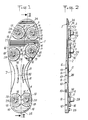
- the sole 1 has an underside 2 (FIGS. 1 and 2) substantially planar, the contour of which is adapted to that of the foot in the anterior 3 and posterior parts 4, while, in the intermediate part 5 corresponding substantially to the camber, this contour s '' gradually thins in width; the thinned outline of the bottom is connected to the normal outline of the top 6, the width of which is that of the foot, by lateral parts with a rounded upward slope 7, 8.
- This upper 6 (FIG. 2) is gradually ascending in the intermediate part 5 so that the relatively thin anterior part 3 is at the level of the end of the foot in normal rest support on the ground, that the generally thicker posterior part 4 is at the level of the heel in this least tiring rest position and that the intermediate part 5 is shaped according to the camber of the foot.
- the latter has longitudinal 9 and transverse ribs 10 suitably arranged and distributed to receive the first mounting without the latter deforming in use and transmitting to the foot the geometry of the ribbing to which said foot must be insensitive.
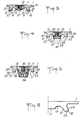
- Each boss 11 (FIGS. 3 to 5) is surrounded by an annular groove 13 and its threaded insert 12 opens onto a central circular face 14 connected to the groove by a shouldered and notched coronal shoulder 15.
- Each boss cooperates with projecting lips 16 which are elastically deformable and tend to flatten, as appears in FIG. 3 by comparing the rest position shown in solid lines with one of the stress positions illustrated in dotted lines.
- the lips 16 combined with the same boss are arcuate concentrically thereto.
- each one has an angular sector, substantially equal to 90; they are separated from each other, on the side of the median axis of the sole, by slots 17 and, on the periphery side, by a very large recess 18 so that the boss 11 and the two lips which are attached to it diametrically opposite are located closest to the edge of the sole.
- said lips (16) are only two in number and are separated from each other for the two bosses by perepherical recesses 18 and a common median recess 19. Thus, these lips are located as close as possible to the edges of the sole and occupy the largest surface.
- each lip 16 is delimited by an external wall 20 perpendicular to the sole, by an internal wall 21 curved in inclination towards the outside of the corresponding boss 11 and in s 'deviating from below 2 of the sole and by a rounded ridge 22.
- the ideal way to promote this deflection and its orientation is for the profile of each lip to be that shown in FIG. 6; in this case, the lip is also delimited by an outer wall 23 in a curved slope like the interior wall 21.
- the elastic flattening of the lips takes place in good conditions, they protrude from the underside 2 of the sole beyond the free face 14 of the corresponding bosses 11; preferably, the distance d from the crest 22 of the lips to the face 14 of the bosses, when these lips are at rest, is between 2 and 5 mm.
- the sole 1 may have projecting on its underside 2 transverse retaining notches 24 and 25 preferably located at the front end and respectively at the rear end; in addition, it may include longitudinal curved tongues 26 projecting from the intermediate part 5 from below 2; it may also have hollow transverse grooves 27 promoting the folding of the sole in correspondence with the articulation of the end of the foot.
- the player normally has a sample of studs and, in this case, this is necessary to equip the threaded bosses 11 according to the nature of the terrain.
- the player mounts metal cleats intended to penetrate more or less into the ground, while allowing the lips 16 to flatten more or less.
- he chooses short spikes 28 or medium spikes 29 or else high spikes 30 ( Figure 4); the selected studs are screwed by their threaded tail 31 into the corresponding insert 12 until the bottom 32 of the base cup of their head abuts against the face 14 of the conjugate boss 11 and that the basic peripheral annular collar 33 of their head crushes the notches of the shoulder 15 of this boss.
- the player mounts large diameter spikes 34 in polyurethane, providing a contact surface with the ground large enough so that the lips 16 do not flatten (FIG. 5).
- the threaded tail 35 of these studs is then screwed into the corresponding insert 12 until the projecting peripheral flange 36 of these studs is crushed and bears firmly against the bottom of the annular groove 13 surrounding the conjugate boss 11 .
Landscapes
- Footwear And Its Accessory, Manufacturing Method And Apparatuses (AREA)
Claims (5)
Applications Claiming Priority (2)
| Application Number | Priority Date | Filing Date | Title |
|---|---|---|---|
| FR8214809 | 1982-08-30 | ||
| FR8214809A FR2532159B1 (fr) | 1982-08-30 | 1982-08-30 | Semelle perfectionnee pour chaussure de sport, a saillies sous-jacentes de tenue sur le terrain, pour la pratique notamment du football, du rugby, du hockey sur gazon ou autres |
Publications (2)
| Publication Number | Publication Date |
|---|---|
| EP0103507A1 EP0103507A1 (de) | 1984-03-21 |
| EP0103507B1 true EP0103507B1 (de) | 1985-11-13 |
Family
ID=9277118
Family Applications (1)
| Application Number | Title | Priority Date | Filing Date |
|---|---|---|---|
| EP19830401668 Expired EP0103507B1 (de) | 1982-08-30 | 1983-08-17 | Sportschuhsohle mit darunterliegenden abfedernden Eigenschaften auf Boden, besonders für Fussball, Rugby, Feldhockey oder ähnliches |
Country Status (4)
| Country | Link |
|---|---|
| EP (1) | EP0103507B1 (de) |
| DE (1) | DE3361235D1 (de) |
| ES (1) | ES269233Y (de) |
| FR (1) | FR2532159B1 (de) |
Cited By (5)
| Publication number | Priority date | Publication date | Assignee | Title |
|---|---|---|---|---|
| USD291943S (en) | 1987-01-29 | 1987-09-22 | Avia Group International, Inc. | Shoe sole |
| US6957503B2 (en) | 2002-09-05 | 2005-10-25 | Adidas International Marketing, B.V. | Magnetically operable studs for footwear |
| US8984774B2 (en) | 2011-09-16 | 2015-03-24 | Nike, Inc. | Cut step traction element arrangement for an article of footwear |
| US9149088B2 (en) | 2011-09-16 | 2015-10-06 | Nike, Inc. | Medial rotational traction element arrangement for an article of footwear |
| US9173450B2 (en) | 2011-09-16 | 2015-11-03 | Nike, Inc. | Medial rotational traction element arrangement for an article of footwear |
Families Citing this family (9)
| Publication number | Priority date | Publication date | Assignee | Title |
|---|---|---|---|---|
| GB8419182D0 (en) * | 1984-07-27 | 1984-08-30 | Triman Ltd | Studs for footwear |
| AU582694B2 (en) * | 1987-07-21 | 1989-04-06 | Wen-Shown Lo | An improved sole structure for golf shoes |
| WO1989001302A1 (fr) * | 1987-08-11 | 1989-02-23 | Aotani, Tetsuya | Chaussures polyvalentes |
| GB2223394B (en) * | 1988-08-27 | 1991-08-07 | Crook And Sons Limited Benjami | Sports shoe |
| GB2285569A (en) * | 1994-01-13 | 1995-07-19 | Moss Hayes Richard Vere | Twin grip trainer soles |
| DE4417563A1 (de) * | 1994-05-19 | 1995-11-23 | Uhl Sportartikel Karl | Fußballschuh |
| US7941945B2 (en) * | 2007-10-17 | 2011-05-17 | Nike, Inc. | Article of footwear with heel traction elements |
| US9314065B2 (en) | 2012-06-15 | 2016-04-19 | Nike, Inc. | Article of footwear with base plate having structure and studs |
| US20150135557A1 (en) * | 2013-11-19 | 2015-05-21 | Cleats Llc | Buttress for Removable Cleats |
Family Cites Families (4)
| Publication number | Priority date | Publication date | Assignee | Title |
|---|---|---|---|---|
| CH277281A (de) * | 1949-06-16 | 1951-08-31 | Wyler Zuercher Gottfried | Beschlag an Schuhsohlen. |
| GB1434282A (en) * | 1972-05-24 | 1976-05-05 | Dassler A | Gripper elements for sports shoes |
| CA980112A (en) * | 1973-01-31 | 1975-12-23 | Onitsuka Co. | Sport shoe |
| DE8022761U1 (de) * | 1980-08-27 | 1980-12-04 | Puma-Sportschuhfabriken Rudolf Dassler Kg, 8522 Herzogenaurach | Sportschuh, insbesondere Joggingschuh |
-
1982
- 1982-08-30 FR FR8214809A patent/FR2532159B1/fr not_active Expired
- 1982-12-15 ES ES1982269233U patent/ES269233Y/es not_active Expired
-
1983
- 1983-08-17 EP EP19830401668 patent/EP0103507B1/de not_active Expired
- 1983-08-17 DE DE8383401668T patent/DE3361235D1/de not_active Expired
Cited By (6)
| Publication number | Priority date | Publication date | Assignee | Title |
|---|---|---|---|---|
| USD291943S (en) | 1987-01-29 | 1987-09-22 | Avia Group International, Inc. | Shoe sole |
| US6957503B2 (en) | 2002-09-05 | 2005-10-25 | Adidas International Marketing, B.V. | Magnetically operable studs for footwear |
| US7481009B2 (en) | 2002-09-05 | 2009-01-27 | Adidas International Marketing B.V. | Magnetically operable studs for footwear |
| US8984774B2 (en) | 2011-09-16 | 2015-03-24 | Nike, Inc. | Cut step traction element arrangement for an article of footwear |
| US9149088B2 (en) | 2011-09-16 | 2015-10-06 | Nike, Inc. | Medial rotational traction element arrangement for an article of footwear |
| US9173450B2 (en) | 2011-09-16 | 2015-11-03 | Nike, Inc. | Medial rotational traction element arrangement for an article of footwear |
Also Published As
| Publication number | Publication date |
|---|---|
| ES269233Y (es) | 1984-01-16 |
| FR2532159A1 (fr) | 1984-03-02 |
| ES269233U (es) | 1983-06-16 |
| EP0103507A1 (de) | 1984-03-21 |
| FR2532159B1 (fr) | 1985-07-26 |
| DE3361235D1 (en) | 1985-12-19 |
Similar Documents
| Publication | Publication Date | Title |
|---|---|---|
| EP0103507B1 (de) | Sportschuhsohle mit darunterliegenden abfedernden Eigenschaften auf Boden, besonders für Fussball, Rugby, Feldhockey oder ähnliches | |
| EP0991334B1 (de) | Schuh mit verformbarer besohlung | |
| EP1222868B1 (de) | Zwischensohle und Schuh mit dieser Sohle | |
| US8225536B2 (en) | Removable footwear cleat with cushioning | |
| JP4435415B2 (ja) | 多層アウトソール | |
| FR2864882A1 (fr) | Chaussure a semelle interchangeable | |
| US9861166B2 (en) | Footwear cleat with cushioning | |
| EP2198729B1 (de) | Schuh mit verbessertem Schuhboden | |
| CH672399A5 (de) | ||
| FR2475371A1 (fr) | Semelle pour chaussure de sport a cramponnage oblique | |
| EP0334781A1 (de) | Schuhsohle für Sport und ähnliche Aktivitäten | |
| FR2483196A1 (fr) | Chaussure pour la pratique du golf | |
| FR2786371A1 (fr) | Chaussure souple pour sport de glisse | |
| FR2967874A1 (fr) | Chaussure de sport de type a crampons | |
| EP0560698B1 (de) | Sportschuh | |
| US4974347A (en) | Baseball shoe sole | |
| WO2007017594A1 (fr) | Ensemble chaussant compose d7une chaussure et d'une gamme de semelles de proprete interchangeables munies de protuberances amortissantes | |
| EP3873630B1 (de) | Schneeschuh mit zackenflächen auf der sohle | |
| FR2742637A1 (fr) | Semelle de securite moulee et insert pour une telle semelle | |
| EP0022716B1 (de) | Sohle für Athletikschuh | |
| BE1007819A3 (fr) | Chaussures de sport perfectionnees avec un systeme de controle de retropied. | |
| WO2016050658A1 (fr) | Semelle de chaussure anti-glissement | |
| CH231484A (fr) | Semelle en caoutchouc de chaussure de sport. | |
| FR2831029A1 (fr) | Semelle de chaussure pour la marche et le ski |
Legal Events
| Date | Code | Title | Description |
|---|---|---|---|
| PUAI | Public reference made under article 153(3) epc to a published international application that has entered the european phase |
Free format text: ORIGINAL CODE: 0009012 |
|
| AK | Designated contracting states |
Designated state(s): BE DE GB IT NL SE |
|
| 17P | Request for examination filed |
Effective date: 19840622 |
|
| ITF | It: translation for a ep patent filed | ||
| GRAA | (expected) grant |
Free format text: ORIGINAL CODE: 0009210 |
|
| AK | Designated contracting states |
Designated state(s): BE DE GB IT NL SE |
|
| REF | Corresponds to: |
Ref document number: 3361235 Country of ref document: DE Date of ref document: 19851219 |
|
| PLBE | No opposition filed within time limit |
Free format text: ORIGINAL CODE: 0009261 |
|
| STAA | Information on the status of an ep patent application or granted ep patent |
Free format text: STATUS: NO OPPOSITION FILED WITHIN TIME LIMIT |
|
| 26N | No opposition filed | ||
| ITPR | It: changes in ownership of a european patent |
Owner name: CESSIONE;PATRICK INTERNATIONAL |
|
| NLS | Nl: assignments of ep-patents |
Owner name: PATRICK INTERNATIONAL TE POUZAUGES, FRANKRIJK. |
|
| PGFP | Annual fee paid to national office [announced via postgrant information from national office to epo] |
Ref country code: SE Payment date: 19910815 Year of fee payment: 9 |
|
| PGFP | Annual fee paid to national office [announced via postgrant information from national office to epo] |
Ref country code: BE Payment date: 19910828 Year of fee payment: 9 |
|
| PGFP | Annual fee paid to national office [announced via postgrant information from national office to epo] |
Ref country code: NL Payment date: 19910831 Year of fee payment: 9 |
|
| REG | Reference to a national code |
Ref country code: GB Ref legal event code: 732 |
|
| PG25 | Lapsed in a contracting state [announced via postgrant information from national office to epo] |
Ref country code: SE Effective date: 19920818 |
|
| PG25 | Lapsed in a contracting state [announced via postgrant information from national office to epo] |
Ref country code: BE Effective date: 19920831 |
|
| BERE | Be: lapsed |
Owner name: S.A. PATRICK INTERNATIONAL Effective date: 19920831 |
|
| PG25 | Lapsed in a contracting state [announced via postgrant information from national office to epo] |
Ref country code: NL Effective date: 19930301 |
|
| NLV4 | Nl: lapsed or anulled due to non-payment of the annual fee | ||
| ITTA | It: last paid annual fee | ||
| EUG | Se: european patent has lapsed |
Ref document number: 83401668.5 Effective date: 19930307 |
|
| PGFP | Annual fee paid to national office [announced via postgrant information from national office to epo] |
Ref country code: GB Payment date: 19950811 Year of fee payment: 13 |
|
| PGFP | Annual fee paid to national office [announced via postgrant information from national office to epo] |
Ref country code: DE Payment date: 19950821 Year of fee payment: 13 |
|
| PG25 | Lapsed in a contracting state [announced via postgrant information from national office to epo] |
Ref country code: GB Effective date: 19960817 |
|
| GBPC | Gb: european patent ceased through non-payment of renewal fee |
Effective date: 19960817 |
|
| PG25 | Lapsed in a contracting state [announced via postgrant information from national office to epo] |
Ref country code: DE Effective date: 19970501 |