EP0103965A2 - Appareil à électrofocaliser - Google Patents
Appareil à électrofocaliser Download PDFInfo
- Publication number
- EP0103965A2 EP0103965A2 EP83304426A EP83304426A EP0103965A2 EP 0103965 A2 EP0103965 A2 EP 0103965A2 EP 83304426 A EP83304426 A EP 83304426A EP 83304426 A EP83304426 A EP 83304426A EP 0103965 A2 EP0103965 A2 EP 0103965A2
- Authority
- EP
- European Patent Office
- Prior art keywords
- gradient
- mixture
- electrodes
- outlets
- different
- Prior art date
- Legal status (The legal status is an assumption and is not a legal conclusion. Google has not performed a legal analysis and makes no representation as to the accuracy of the status listed.)
- Withdrawn
Links
Images

Classifications
-
- G—PHYSICS
- G01—MEASURING; TESTING
- G01N—INVESTIGATING OR ANALYSING MATERIALS BY DETERMINING THEIR CHEMICAL OR PHYSICAL PROPERTIES
- G01N27/00—Investigating or analysing materials by the use of electric, electrochemical, or magnetic means
- G01N27/26—Investigating or analysing materials by the use of electric, electrochemical, or magnetic means by investigating electrochemical variables; by using electrolysis or electrophoresis
- G01N27/416—Systems
- G01N27/447—Systems using electrophoresis
- G01N27/44756—Apparatus specially adapted therefor
- G01N27/44795—Isoelectric focusing
-
- G—PHYSICS
- G01—MEASURING; TESTING
- G01N—INVESTIGATING OR ANALYSING MATERIALS BY DETERMINING THEIR CHEMICAL OR PHYSICAL PROPERTIES
- G01N27/00—Investigating or analysing materials by the use of electric, electrochemical, or magnetic means
- G01N27/26—Investigating or analysing materials by the use of electric, electrochemical, or magnetic means by investigating electrochemical variables; by using electrolysis or electrophoresis
- G01N27/416—Systems
- G01N27/447—Systems using electrophoresis
- G01N27/44704—Details; Accessories
- G01N27/44747—Composition of gel or of carrier mixture
-
- G—PHYSICS
- G01—MEASURING; TESTING
- G01N—INVESTIGATING OR ANALYSING MATERIALS BY DETERMINING THEIR CHEMICAL OR PHYSICAL PROPERTIES
- G01N27/00—Investigating or analysing materials by the use of electric, electrochemical, or magnetic means
- G01N27/26—Investigating or analysing materials by the use of electric, electrochemical, or magnetic means by investigating electrochemical variables; by using electrolysis or electrophoresis
- G01N27/416—Systems
- G01N27/447—Systems using electrophoresis
- G01N27/44756—Apparatus specially adapted therefor
- G01N27/44769—Continuous electrophoresis, i.e. the sample being continuously introduced, e.g. free flow electrophoresis [FFE]
Definitions
- This invention relates to electrofocusing apparatus for separating zwitter ions such as proteins from mixtures thereof.
- Electrofocusing is a separation technique which is basically electrophoresis carried out in a stable pH gradient increasing from anode to cathode, and to effect separation it relies on the separable species of zwitter ions having different isoelectric points, pI.
- This technique is now a commercially established technique for separating mixtures of proteins, and so the present invention will be explained mainly by reference to proteins.
- Proteins have both amino and carboxylic acid groups which vary in number and proportion from one protein to another. In low pH solutions the amino groups tend to become positively charged and the acid groups neutral, giving the proteins a net positive charge. If the pH is gradually increased, increasing numbers of the acid groups lose protons and become negatively charged, and the amine groups become neutral. Thus in high pH solutions the protein has an overall net negative charge. Between those two extremes is a p H at which the protein has a net charge of zero, this being its isoelectric point, pI. During isoelectric focusing, each protein molecule is attracted to one or other electrode according to its net charge.
- pH gradients can be set up using D olyion mixtures, and a known commercial way of achieving this is to use a mixture of ampholytes (such as those available under the name "Ampholine”) in aqueous solution.
- Ampholine ampholytes
- These are long chain buffers having both amine and acidic groups in various proportions so as to provide a spectrum of p Is.
- the ampholytes migrate according to their individual net charges, and mutually interact to produce a pH gradient, low at the anode and high at the cathode.
- the mixture of proteins to be separated can then be injected into the apparatus and left to migrate to their individual equilibrium positions, or they can be introduced with the ampholytes, the latter generally being of relatively low molecular weights and establishing the required pH gradient before substantial migration of the proteins takes place.
- the various separated fractions can then be removed together with their carrier ampholytes, generally either by running the various zones sequential from the bottom of a vertically separating column, or by digging out the various zones of proteins and carrier ampholytes from a solidified mass. In both cases .it is then necessary to separate the protein fractions from their associated carrier ampholytes.
- an electrofocusing apparatus comprises a cell having spaced electrodes and a polyion mixture for producing a pH gradient between the electrodes, characterised in that the cell has at least one inlet and a plurality of outlets placed on opposite sides of the polyion mixture such that a flowpath for liquid is provided through the cell from the inlet(s), through the polyion mixture to the outlets, the flowpath being transverse to the electric field and to the pH gradient and the outlets being spread along said electric field and pH gradient, the polyions being positioned and immobilised to provide and maintain a pK gradient from one electrode to the other, so that when immersed in an aqueous medium, application of an electrical field by the electrodes will cause migration of protons to give the pH gradient between the electrodes corresponding to the pK gradient, whereby when an aqueous mixture of separable components is caused to flow through the apparatus it may be at least partially divided by the electric field and pH gradient into its different components which leave the apparatus by different outlets.
- an apparatus suitable for example for separating a single protein from an extract of animal tissues, may have a single outlet positioned to collect the required protein and a waste outlet to discharge the remainder.
- a multioutlet apparatus e.g. having at least five outlets, each outlet being positioned to collect a different fraction of the mixture.
- Ampholytes may be used as the polyions of the present apparatus, but instead of a mixture of ampholytes being free to diffuse throughout the apparatus as previously, the polyions comprise a plurality of different ampholytes or groups of ampholytes having different pK values positioned and immobilised between the electrodes so as to provide and maintain the pK gradient.
- Ampholytes may be immobilised by reacting with a reactive polymerisable material, e.g. an acid group with hydroxy ethyl methacrylate or a basic group with the acid chloride of acrylic acid, applying an electric field to form them into a pH gradient, and then polymerising the material, preferable by photopolymerisation, and where appropriate in the presence of a comonomer.
- a reactive polymerisable material e.g. an acid group with hydroxy ethyl methacrylate or a basic group with the acid chloride of acrylic acid
- One preferred immobilised polyion mixture comprises a buffering mixture of acidic and basic ion exchange resins, the proportions of acidic to basic resins varying across the apparatus from one electrode to the other thereby to provide the pK gradient.
- Commercial ion exchange resins generally consist essentially of an immobilising inert body carrying free carboxylic acid or amino groups, the former providing an equilibrium between negatively charged -COO groups and uncharged carboxylic acids -COOH and the latter providing an equilibrium between uncharged amino -NH 2 and positively charged protonated ions -NH3+.
- the net pK of the mixture is dependent on the ratio of the two types of resin, and by varying the ratio of mixed resins sequentially across the apparatus, a pK gradient can be obtained.
- Some commercial resins are supplied as moist beads eg of crosslinked polystyrene carrying anchored carboxylate or amino groups to give the acidic and basic resins respectively.
- the apparatus can readily be filled with a plurality of strips parallel to the electrodes and in line with the direction of flow, each strip comprising a mixture of resin proportions different from the other strips. Although this gives a stepwise pK gradient, there is no barrier between adjacent strips and in a flowing protein containing liquid, hydrogen ions can flow from one strin to another without hindrence, thereby smoothing out the steps in the produced pH gradient.
- This use of ion-exchange resins to provide the pK gradient we have found to be very effective and much less expensive than the equivalent use of ampholytes.
- the pH gradient may be of constant slope from one electrode to the other.
- the present apparatus enables the slope of the pH gradient readily to be varied from one position to another
- the slope of the pH gradient may be made steeper at one end than the other when the pI values of the mixture's constituents are more widely spaced at that end than the other, thereby providing more evenly spaced peaks in the outflowing liquids.
- the sharpness of the peaks depends on the matching of the apparatus to the separation required, and how well mixing of the separated streams can be prevented.
- the apparatus can be capable of covering a wide range of pH, where the requirement is for the separation of two proteins of similar pI, a much smaller range of pH from anode to cathode is preferred,
- the length of apparatus and fluid flow rates can also be varied according to requirements.
- a broad flat cell is preferred, so that the solution flows through as a thin sheet with the electrodes along the edges.
- an electrofocusing method of separating zwitter ions from a mixture of zwitter ions having different isoelectric points comprises causing an aqueous solution of the mixture to flow through an apparatus having immobilised oolyion mixture arranged between a pair of spaced electrodes to induce in the flowing solution a pH gradient transverse to the fluid flow and extending-substantially from one electrode to the other and thereafter dividing the flowing liquid into at least two portions of different pH.
- the apparatus comprises a flat cell 1 formed from two transparent acrylic sheets about 20 cm square, separated by a 2 mm thick gasket 2 around the edges. Down each side within the cell is an electrode 3,4 connected to provide an anode and cathode respectively. Near the top 5 of the cell is a porous barrier 6 providing an enclosed chamber 7 above it. At the lower end the cell is divided into ten short channels 10 from each of which emerges a flexible pipe 11 passing through a peristaltic pump (not shown).
- the cell is filled with various mixtures of two ion exchange resins, the mixtures being arranged in vertical strips with the proportions varying stepwise from one electrode to the other.
- Adjacent to the cathode is a strip packed with polystyrene beads carrying free carbo ylate groups.
- Adjacent to the anode is a strip packed with beads carrying free amino groups.
- Intermediate strips contain mixtures of the two resins such that the compositions change progressively, strip by strip, from the anode strip to the.cathode.strip. There is no formal division between adjacent strips, the cell having been filled from one side to the other, each strip having been laid onto an adjacent strip laid before it.
- a sample reservoir 14 For supplying liquids to the cell, are three reservoirs. These are a sample reservoir 14 and reservoirs 1 5 & 16 of dilute acid and base solutions repectively.
- the sample reservoir is connected to the chamber 7 where the liquid containing the mixture to be separated, ⁇ can distribute itself across the width of the cell.
- the other two reservoirs are for supplying acidic and basic environments respectively for the two electrodes and tubes from them open into the cell adjacent to the tops of the two electrodes. Gas vents 18 are provided above the electrode regions.
- the cell In use the cell is filled with aqueous liquid and the electric field is activated by connecting the electrodes to an electrical source.
- the pK gradient im ⁇ obilised in the ion exchange resin mixture produces a pH gradient rising from the anode to the cathode.
- the peristaltic pump is operated to draw liquid through all ten outlet tubes simultaneously, and thereby provide a sheet of liquid moving uniformly down through the resin-filled cell, with the electric field and pH gradient both transverse to the flow ; although in practice we have tended to have. some unintentional non-uniformity in the flow at the edges.
- the solution of mixed proteins (or other separable species) is supplied from the sample reservoir 14, and by utilising the chamber 7 the sample liquid can be drawn from the chamber over substantially the whole width of the resin mixtures.
- the proteins become focused into specific pH zones in the manner described above. Analysis of the ten outlets should show progressively increasing pH from the anode side to the cathode side, with the proteins distributed to peak in specific outlets corresponding to their pI values, the fewer the number of outlets through which each appears (i.e. the sharper the distribution peaks), the more efficient the separation.
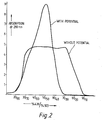
- the invention is further illustrated by the following experimental results obtained in an apparatus essentially similar to that shown in the drawing, except that no gas vents 18 were provided and the cell was used horizonally.
- the purpose was to determine whether a pH gradient became established in the liquid flowing through the cell, and whether a protein would become focused.
- the protein used was a commercial grade of bovine serum albumen and this was measured by optical absorption at 280 nm in a 1 mm UV spectrometer cell.
- the resins used were a Duolite No C436 and Duolite No. A303 marketed bv BDH Chemicals.
- the protein should be distributed evenly across the cell in the absence of any focusing potential.
- the graph obtained without an applied potential should then be a straight line indicating a constant absorption across the width of the cell.
- significant focusing was obtained, as is clearly shown by comparison of the graph labelled "with potential" with that obtained in the control experiment without the field.
- a sharp peak was obtained at a pH of about 5,3.
Landscapes
- Health & Medical Sciences (AREA)
- Life Sciences & Earth Sciences (AREA)
- Chemical & Material Sciences (AREA)
- Molecular Biology (AREA)
- Biochemistry (AREA)
- Immunology (AREA)
- Physics & Mathematics (AREA)
- Analytical Chemistry (AREA)
- Chemical Kinetics & Catalysis (AREA)
- General Health & Medical Sciences (AREA)
- General Physics & Mathematics (AREA)
- Electrochemistry (AREA)
- Pathology (AREA)
- Dispersion Chemistry (AREA)
- Separation Using Semi-Permeable Membranes (AREA)
- Water Treatment By Electricity Or Magnetism (AREA)
- Graft Or Block Polymers (AREA)
- Peptides Or Proteins (AREA)
Applications Claiming Priority (2)
| Application Number | Priority Date | Filing Date | Title |
|---|---|---|---|
| GB8224056 | 1982-08-20 | ||
| GB8224056 | 1982-08-20 |
Publications (1)
| Publication Number | Publication Date |
|---|---|
| EP0103965A2 true EP0103965A2 (fr) | 1984-03-28 |
Family
ID=10532445
Family Applications (1)
| Application Number | Title | Priority Date | Filing Date |
|---|---|---|---|
| EP83304426A Withdrawn EP0103965A2 (fr) | 1982-08-20 | 1983-08-01 | Appareil à électrofocaliser |
Country Status (2)
| Country | Link |
|---|---|
| EP (1) | EP0103965A2 (fr) |
| JP (1) | JPS5962319A (fr) |
Cited By (6)
| Publication number | Priority date | Publication date | Assignee | Title |
|---|---|---|---|---|
| US5082548A (en) * | 1987-04-11 | 1992-01-21 | Ciba-Geigy Corporation | Isoelectric focusing apparatus |
| WO2003060503A1 (fr) * | 2002-01-21 | 2003-07-24 | Tecan Trading Ag | Dispositif, utilisation associee et agent de separation pour separer des particules par electrophorese libre |
| WO2003060504A1 (fr) * | 2002-01-21 | 2003-07-24 | Tecan Trading Ag | Procede et dispositif correspondant et moyen de separation destine a la separation de particules par une electrophorese a ecoulement libre |
| US7169275B2 (en) | 2002-01-21 | 2007-01-30 | Tecan Trading Ag | Method for separating particles in free flow electrophoresis |
| US7169278B2 (en) | 2002-01-21 | 2007-01-30 | Tecan Trading Ag | Apparatus and separation media for separating particles in free-flow electrophoresis |
| US9429572B2 (en) * | 2005-09-02 | 2016-08-30 | Wako Pure Chemical Industries, Ltd. | Complex formation method and separation method |
-
1983
- 1983-08-01 EP EP83304426A patent/EP0103965A2/fr not_active Withdrawn
- 1983-08-20 JP JP15235783A patent/JPS5962319A/ja active Pending
Cited By (6)
| Publication number | Priority date | Publication date | Assignee | Title |
|---|---|---|---|---|
| US5082548A (en) * | 1987-04-11 | 1992-01-21 | Ciba-Geigy Corporation | Isoelectric focusing apparatus |
| WO2003060503A1 (fr) * | 2002-01-21 | 2003-07-24 | Tecan Trading Ag | Dispositif, utilisation associee et agent de separation pour separer des particules par electrophorese libre |
| WO2003060504A1 (fr) * | 2002-01-21 | 2003-07-24 | Tecan Trading Ag | Procede et dispositif correspondant et moyen de separation destine a la separation de particules par une electrophorese a ecoulement libre |
| US7169275B2 (en) | 2002-01-21 | 2007-01-30 | Tecan Trading Ag | Method for separating particles in free flow electrophoresis |
| US7169278B2 (en) | 2002-01-21 | 2007-01-30 | Tecan Trading Ag | Apparatus and separation media for separating particles in free-flow electrophoresis |
| US9429572B2 (en) * | 2005-09-02 | 2016-08-30 | Wako Pure Chemical Industries, Ltd. | Complex formation method and separation method |
Also Published As
| Publication number | Publication date |
|---|---|
| JPS5962319A (ja) | 1984-04-09 |
Similar Documents
| Publication | Publication Date | Title |
|---|---|---|
| USRE37606E1 (en) | Capillary electrophoresis using replaceable gels | |
| FI97893C (fi) | Isoelektrinen fokusointimenetelmä ja laite mainitun menetelmän suorittamiseksi | |
| US4305799A (en) | Method and apparatus for performing uni- and bi-dimensional micro-gel electrophoresis | |
| CA2176317C (fr) | Dispositif et methode d'echantillonnage rapides pour electrophorese capillaire | |
| US5151165A (en) | Methods and apparatuses for preparative electrophoresis | |
| EP0979403A1 (fr) | Support membranaire pour electrophorese sur gel | |
| EP0630473A1 (fr) | Appareil de separation electrique et procede de focalisation d'un gradient en contre-courant | |
| US6923896B2 (en) | Electrophoresis apparatus and method | |
| KR100958165B1 (ko) | 비젤방식의 2차원 단백질분리용 다중채널장치 | |
| GB2118975A (en) | Method and apparatus for continuously separating high molecular weight amphoteric electrolytes by electrophoresis | |
| AU2006264401A1 (en) | Electrophoretic separation of analytes by molecular mass | |
| US3655541A (en) | CONTINUOUS ELECTROPHORESIS CELL WITH LATERAL pH GRADIENT | |
| JPS5962319A (ja) | 双性イオン分離用電気焦点化装置 | |
| US4297198A (en) | Concentrating electrophoresis apparatus | |
| EP0871870A1 (fr) | Element de chargement a membrane pour electrophorese sur gel | |
| JPH0625750B2 (ja) | 荷電物質の分離装置 | |
| Righetti et al. | [10] Isoelectric focusing in immobilized pH gradients | |
| US20060049050A1 (en) | Separation of molecules | |
| DE2616887A1 (de) | Vorrichtung zur isoelektrischen fokussierung | |
| Bodhe et al. | Simplified techniques for elution of proteins from polyacrylamide gel, staining, destaining, and isoelectric focusing | |
| US20100059442A1 (en) | Method and system for separating analytes | |
| IE52276B1 (en) | Apparatus for the fractionation of a solution by electrophoresis | |
| Vande Woude et al. | Barrier electrophoresis: A new electrophoretic technique | |
| US5527680A (en) | Method for extracting solutes from gel plugs | |
| JPS5952743A (ja) | 無担体薄層流等電点電気泳動における水素イオン濃度勾配付与、泳動、分取の方法及び装置 |
Legal Events
| Date | Code | Title | Description |
|---|---|---|---|
| PUAI | Public reference made under article 153(3) epc to a published international application that has entered the european phase |
Free format text: ORIGINAL CODE: 0009012 |
|
| AK | Designated contracting states |
Designated state(s): DE GB SE |
|
| STAA | Information on the status of an ep patent application or granted ep patent |
Free format text: STATUS: THE APPLICATION IS DEEMED TO BE WITHDRAWN |
|
| 18D | Application deemed to be withdrawn |
Effective date: 19860303 |
|
| RIN1 | Information on inventor provided before grant (corrected) |
Inventor name: BURGESS, ANDREW NIGEL |