EP0104121A2 - Verfahren und Vorrichtung zur Extraktion von natürlichen Aromas aus pflanzlichen Produkten und die so erhaltenen Produkte - Google Patents
Verfahren und Vorrichtung zur Extraktion von natürlichen Aromas aus pflanzlichen Produkten und die so erhaltenen Produkte Download PDFInfo
- Publication number
- EP0104121A2 EP0104121A2 EP83401831A EP83401831A EP0104121A2 EP 0104121 A2 EP0104121 A2 EP 0104121A2 EP 83401831 A EP83401831 A EP 83401831A EP 83401831 A EP83401831 A EP 83401831A EP 0104121 A2 EP0104121 A2 EP 0104121A2
- Authority
- EP
- European Patent Office
- Prior art keywords
- solvent
- temperature
- reactor
- aroma
- plant products
- Prior art date
- Legal status (The legal status is an assumption and is not a legal conclusion. Google has not performed a legal analysis and makes no representation as to the accuracy of the status listed.)
- Granted
Links
Images
Classifications
-
- A—HUMAN NECESSITIES
- A23—FOODS OR FOODSTUFFS; TREATMENT THEREOF, NOT COVERED BY OTHER CLASSES
- A23F—COFFEE; TEA; THEIR SUBSTITUTES; MANUFACTURE, PREPARATION, OR INFUSION THEREOF
- A23F5/00—Coffee; Coffee substitutes; Preparations thereof
- A23F5/46—Coffee flavour; Coffee oil; Flavouring of coffee or coffee extract
- A23F5/48—Isolation or recuperation of coffee flavour or coffee oil
- A23F5/483—Isolation or recuperation of coffee flavour or coffee oil by solvent extraction of the beans, ground or not
-
- A—HUMAN NECESSITIES
- A23—FOODS OR FOODSTUFFS; TREATMENT THEREOF, NOT COVERED BY OTHER CLASSES
- A23L—FOODS, FOODSTUFFS OR NON-ALCOHOLIC BEVERAGES, NOT OTHERWISE PROVIDED FOR; PREPARATION OR TREATMENT THEREOF
- A23L27/00—Spices; Flavouring agents or condiments; Artificial sweetening agents; Table salts; Dietetic salt substitutes; Preparation or treatment thereof
- A23L27/10—Natural spices, flavouring agents or condiments; Extracts thereof
- A23L27/115—Natural spices, flavouring agents or condiments; Extracts thereof obtained by distilling, stripping, or recovering of volatiles
Definitions
- the present invention relates to a process for the extraction of natural flavors from plant products, such as fruits, vegetables, seeds or aromatic plants.
- Natural flavors generally contain a wide variety of very volatile and very fragile materials which it is difficult to isolate economically, without harming the quality of the aroma obtained. It is therefore completely excluded to extract the aroma by distilling the paste obtained after grinding the fruit, because at the distillation temperature, the desired aromas would certainly be volatilized, degraded or transformed, at least partially.
- Another known method is to add a demulsifier to the liquid phase, but avoid using this product because it is expensive and because it may affect the flavor and purity of the aromas.
- the solvent could still be extracted by centrifugation, but this process is too expensive and would necessarily result in an increase in the cost price of the flavor.
- the present invention provides a process for extracting natural aromas of plant origin, in particular from fruits, vegetables, seeds or aromatic plants, which makes it possible to obtain, in an economical manner, aromas whose organoleptic properties are preserved.
- the basic idea of the invention is to remove water from the liquid phase in order to break the emulsions due in particular to the presence of pectins and water.
- the solvent used must form a heterogeneous azeotropic mixture with the water, so that it can be eliminated during the decantation phase in the separate container.
- the separation of the core and the solvent can be carried out by distillation of the extract obtained at the outlet of the reactor, or by using a entrainment technique using an inert gas, called stripping, or again by the combination of distillation and stripping.
- the invention allows the choice and the implementation of a specific solvent type of the desired flavor, since the boiling point of such a solvent can now be chosen as close as possible to the limit temperature of stability of the aromatic extract.
- the distillation step is carried out at atmospheric pressure, it is possible to select solvents which give azeotropic mixtures with water and whose boiling point will be only a few degrees lower than said temperature.
- this step is carried out under reduced pressure, it is possible to select solvents whose boiling point will, for its part, be a few degrees higher than said stability limit temperature.
- the Applicant has thus been able to obtain, in a particularly economical manner, natural aromas of very high quality, by carrying out the extraction with solvents giving azeotropic mixtures with water and whose boiling point, optionally under reduced pressure, differs by at most 10 ° C from the limit temperature of stability of the main essences constituting the flavor, for example with n-heptane (boiling temperature of azeotrope 78 ° C).
- solvents giving a mixture azeotropic heterogeneous with water the boiling point of which is lower than the limit temperature for stability of the flavor to be extracted.
- the separation of the flavor and the solvent can be carried out either by distilling the extract, or by stripping, or by the combination of these two operations. This latter process is used when, in a distillation step, the boiling temperature of the extract risks exceeding that of the solvent.
- This process is characterized in that it consists in carrying out a partial separation by distillation of the solvent contained in the extract from the extraction step, to stop this distillation when the concentration of the aroma in said extract becomes such that the boiling temperature of the solution risks exceeding that of the solvent, and then to submit the residual solution is stripped by an inert gas, in order to eliminate the rest of the solvent and to recover the natural flavor in a substantially pure state.
- the present invention therefore makes it possible, thanks to the choice of the most appropriate specific solvent, to obtain an aromatic extract of which the purity and the organoleptic properties are quite remarkable, while ensuring an excellent yield of aromatic extract compared to the other methods. of aromas of plant origin.
- the invention also relates to an installation for the extraction of natural flavors from plant products, by the process which has just been described.
- the natural flavor extraction installation is characterized in that it comprises a grinder for reducing the plant products into a fine slurry, a reactor in which the slurry is intimately mixed with a solvent in selected proportions so that it forms with the water contained in the slurry an azeotropic mixture, heating means intended to bring the temperature of said azeotropic mixture to its boiling point, a condenser in which the distillate of the azeotropic mixture settles and settles separates in water and in solvent, a line for recycling the solvent to the reactor, temperature monitoring means intended to detect when the water in the slurry has been completely removed from the reactor, a filter press in which the porridge freed from its water is separated into solid matter and solvent containing the aroma, and suitable means for the separation of the aroma and the solvent.
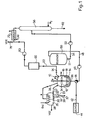
- the aroma extraction installation illustrated in FIG. 1 comprises a grinder, not shown, in which the plant products from which the aromas are to be extracted are finely ground into a fine slurry, which is then poured through an orifice 10, in a reactor 12 fitted with a scraper 14, an agitator 16 driven by a motor and heating means 18 constituted for example by an electric oil radiator enveloping the reactor.
- the reactor 12 is also supplied with solvent from a reservoir 20 via a line 22 provided with a valve 24.
- the vapor of the azeotropic mixture is supplied, via a conduit 26, to a condenser 28.
- This vapor is cooled by contact with a heat exchanger 30 and is thereby condensed by separating into water 31 which, due of its density, descends into a pot 33 fixed to the lower part of the condenser, and into solvent 35 containing the aroma, which floats above water in the case where this solvent is less dense than water.
- the water thus collected is eliminated by a pipe 37 fitted with a valve 39.
- the solvent 35 it is recycled to the reactor 12 via the pipe 32.
- the slurry is gradually rid of its water.
- the temperature in the reactor detected by the thermocouple 34, remains constant and equal to the boiling point of the azeotropic mixture. As soon as all the water in the spray mixture has been removed, the temperature rises sharply.
- the slurry remaining after the dehydration is evacuated to a filter press 38 by a conduit 36 opening into the bottom of the reactor.
- the filter press separates the solid material, which is conveyed by a conduit 42 to a dryer 44, from the extract containing the aroma which is conveyed by a pump 46, using a conduit 48 to a storage tank 50.
- An adjustable flow rate of this extract can be withdrawn from the tank, by opening a valve 51 mounted on an outlet pipe 54 connecting to the bottom of the tank.
- This flow extract is circulated by a pump 52 which brings it to a separation unit 56.
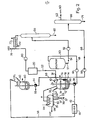
- This separation unit can be constituted by a distillation column or by a stripping column or by all of the two.
- the column 56 is a stripping column.
- An inert gas such as nitrogen, possibly a pressure lower than atmospheric pressure, is blown against the current in the bottom of the co onne 56, and thus causes the solvent in vapor form to a refrigerated condenser 72.
- the solvent separates from the inert gas and is brought by a pump 80 to the tank 20 while the inert gas is sucked in by a vacuum source 78.
- the aroma it is collected at the outlet 82 of the column .
- the solid material leaving the dryer 44 is brought by a conduit 58 to a second reactor 60 of the same structure, but smaller than the reactor 12.
- the solvent used in this reactor can be constituted, without limitation, by an alcohol (conduit 62).
- the slurry thus obtained is heated and after a sufficient contact time, it is again pressed in a second filter press 64, which gives a flavored matter which can therefore be eliminated (outlet 65), and an extract containing a certain amount upgradeable aroma.
- This extract is conveyed by a pump 66 and by means of a conduit 68 to a separation unit 69, which can be a distillation column or a stripping column or all of the two.
- the aroma is collected at the outlet 71 of the column, while the alcohol is recycled to the reactor 60 (line 62).
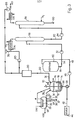
- FIG. 3 illustrates a process for separating the flavor from its solvent in a distillation column 56, then in a stripping column 86.
- certain distillation temperatures cannot be exceeded without the aromas volatilize or degrade, the solvent contained in the extract is eliminated by combining the distillation technique which is carried out in a first separation column and the stripping technique which is carried out in a second column.
- this distillation is interrupted when the concentration of the aroma in said solution becomes such that the boiling point of the solution risks exceeding that solvent, and the residual solution is then sent to a stripping column with an inert gas, with a view to eliminating the rest of the solvent and recovering the natural flavor in a substantially pure state, without additional supply of calories.
- FIG. 3 which is a variant of the installation of FIG. 1, the aroma-concentrated distillation residue which is collected at the outlet 82 of the separation column 56 is brought by a pump 84 to a stripping column. 86 in which the aroma is freed from the residual solvent. This is recycled by a pump 88 to the tank 20, and at the outlet 90 of the column 86, a practically pure and excellent quality aroma is collected.
- 3,837 grams of good quality asparagus are finely ground and poured into a reactor having a capacity of 25 liters.
- the asparagus porridge containing in particular the aroma and the pectins is mixed with the same weight of heptane, under atmospheric pressure.
- the heptane then forms with the slurry water an azeotropic mixture whose boiling point, taking into account the proportions of the mixture and the pressure in the reactor, is 78 ° C.
- the slurry is evaporated by bringing the temperature in the reactor to 78 ° C and the distillation of the azeotropic mixture is complete when the temperature in the reactor rises and reaches 98 ° C, boiling temperature of heptane.
- the decantation of the distillate in a separator maintained at room temperature makes it possible to remove 3,383 grams of water, or 88.17% by weight of the asparagus and to collect an extract containing the flavors.
- the solid materials collected on a filter press at the outlet of the reactor are transferred, after drying with hot air, into a second reactor with a capacity of 1 liter where they are mixed with 1,800 grams of ethanol at 96 °.
- the mixture is stirred for 1 hour at 78 ° C. under reflux of alcohol and then filtered. 226.2 grams of dry matter are thus obtained, ie 5.90% by weight and 1,888.5 grams of alcoholic extract.
- This alcoholic extract is distilled and freed of its solvent in a stripping column, which makes it possible to collect 57.8 grams of oleoresin.
- the 398 grams of dry matter are extracted in a 1 liter reactor under reflux of alcohol at 96 ° for about half an hour.
- the alcoholic extract collected by filtration is distilled, which allows to isolate 61.7 grams of onion flavor, a yield of 1.54% of the weight of the onions used.
- Example IV As in Example IV, 4 kg of onions are extracted with 8 kg of heptane, but this time the azeotropic dehydration is carried out at atmospheric pressure. After the same operations, and to summarize, 100 g of onions used provide:
- the aromas thus obtained have an excellent onion taste
- an aromatic powder is prepared from 300 grams of onions which are ground and mixed with 300 grams of heptane in a 1 liter reactor. After three hours of contact, the azeotropic dehydration of the mixture is carried out at 78 ° C. under atmospheric pressure. 265.2 grams of water are thus collected, or 88.4%. After complete evaporation of the solvent, 33 grams of flavored dry matter remain, corresponding to a yield of 11% by weight relative to that of the crushed onions. The powder obtained has an excellent onion taste.
- Example IV azeotropic dehydration of 4721 grams of ground lemons is carried out with 5000 grams of heptane in a 25 liter reactor at a pressure of 140 mm of mercury and at 40 ° C.
- the solids are extracted under reflux of ethanol at 96 ° C for 1 hour in a 1 liter reactor.
- the alcoholic extract collected is distilled under vacuum and stripped, which allows 230.5 grams of aromas to be isolated, giving a yield of 4.88% by weight of the lemons involved.
Landscapes
- Chemical & Material Sciences (AREA)
- Life Sciences & Earth Sciences (AREA)
- Engineering & Computer Science (AREA)
- Food Science & Technology (AREA)
- Polymers & Plastics (AREA)
- Oil, Petroleum & Natural Gas (AREA)
- Health & Medical Sciences (AREA)
- Nutrition Science (AREA)
- Seasonings (AREA)
- Fats And Perfumes (AREA)
- Extraction Or Liquid Replacement (AREA)
- Organic Low-Molecular-Weight Compounds And Preparation Thereof (AREA)
Applications Claiming Priority (2)
| Application Number | Priority Date | Filing Date | Title |
|---|---|---|---|
| FR8215775A FR2533118A1 (fr) | 1982-09-20 | 1982-09-20 | Procede et installation pour l'extraction d'aromes naturels de produits vegetaux et produits ainsi obtenus |
| FR8215775 | 1982-09-20 |
Publications (3)
| Publication Number | Publication Date |
|---|---|
| EP0104121A2 true EP0104121A2 (de) | 1984-03-28 |
| EP0104121A3 EP0104121A3 (en) | 1984-05-02 |
| EP0104121B1 EP0104121B1 (de) | 1985-08-21 |
Family
ID=9277561
Family Applications (1)
| Application Number | Title | Priority Date | Filing Date |
|---|---|---|---|
| EP83401831A Expired EP0104121B1 (de) | 1982-09-20 | 1983-09-20 | Verfahren und Vorrichtung zur Extraktion von natürlichen Aromas aus pflanzlichen Produkten und die so erhaltenen Produkte |
Country Status (11)
| Country | Link |
|---|---|
| EP (1) | EP0104121B1 (de) |
| AU (1) | AU562180B2 (de) |
| CA (1) | CA1195873A (de) |
| DE (2) | DE3360616D1 (de) |
| ES (1) | ES525728A0 (de) |
| FR (1) | FR2533118A1 (de) |
| GR (1) | GR79377B (de) |
| IN (1) | IN161722B (de) |
| OA (1) | OA07533A (de) |
| TR (1) | TR21672A (de) |
| ZA (1) | ZA836829B (de) |
Cited By (3)
| Publication number | Priority date | Publication date | Assignee | Title |
|---|---|---|---|---|
| ES2131488A1 (es) * | 1997-02-25 | 1999-07-16 | Vinzenzo Guglieri | Metodo de deshumidificacion de productos oleaginosos en presencia de un disolvente destinado a la extraccion de materias grasas. |
| CN114247319A (zh) * | 2021-12-28 | 2022-03-29 | 童守国 | 一种便携式植物精华液提取装置 |
| WO2022079171A1 (fr) * | 2020-10-16 | 2022-04-21 | L'oreal | Concrete et absolue de parfum obtenues par extraction de solvant heterocyclique a partir de matieres naturelles solides |
Families Citing this family (1)
| Publication number | Priority date | Publication date | Assignee | Title |
|---|---|---|---|---|
| AU571341B2 (en) * | 1984-11-06 | 1988-04-14 | William Grant & Sons Limited | Beverage flavouring |
Family Cites Families (5)
| Publication number | Priority date | Publication date | Assignee | Title |
|---|---|---|---|---|
| GB1419958A (en) * | 1972-07-19 | 1975-12-31 | Brooke Bond Liebig Ltd | Extraction of flavour and fragrance components from plant material |
| CH590616A5 (de) * | 1974-11-11 | 1977-08-15 | Nestle Sa | |
| CH609215A5 (de) * | 1976-03-09 | 1979-02-28 | Nestle Sa | |
| FR2453893A1 (fr) * | 1979-04-10 | 1980-11-07 | Eysseric Denis | Installation de distillation de plantes aromatiques |
| FR2483454A1 (fr) * | 1980-05-29 | 1981-12-04 | Eysseric Denis | Installation de distillation de plantes aromatiques |
-
1982
- 1982-09-20 FR FR8215775A patent/FR2533118A1/fr active Granted
-
1983
- 1983-09-14 ZA ZA836829A patent/ZA836829B/xx unknown
- 1983-09-17 IN IN1137/CAL/83A patent/IN161722B/en unknown
- 1983-09-19 ES ES525728A patent/ES525728A0/es active Granted
- 1983-09-19 AU AU19261/83A patent/AU562180B2/en not_active Ceased
- 1983-09-19 CA CA000437010A patent/CA1195873A/fr not_active Expired
- 1983-09-20 DE DE8383401831T patent/DE3360616D1/de not_active Expired
- 1983-09-20 GR GR72480A patent/GR79377B/el unknown
- 1983-09-20 OA OA58102A patent/OA07533A/xx unknown
- 1983-09-20 EP EP83401831A patent/EP0104121B1/de not_active Expired
- 1983-09-20 DE DE198383401831T patent/DE104121T1/de active Pending
- 1983-09-21 TR TR21672A patent/TR21672A/xx unknown
Cited By (4)
| Publication number | Priority date | Publication date | Assignee | Title |
|---|---|---|---|---|
| ES2131488A1 (es) * | 1997-02-25 | 1999-07-16 | Vinzenzo Guglieri | Metodo de deshumidificacion de productos oleaginosos en presencia de un disolvente destinado a la extraccion de materias grasas. |
| WO2022079171A1 (fr) * | 2020-10-16 | 2022-04-21 | L'oreal | Concrete et absolue de parfum obtenues par extraction de solvant heterocyclique a partir de matieres naturelles solides |
| FR3115292A1 (fr) * | 2020-10-16 | 2022-04-22 | L'oreal | Concrete et absolue de parfum obtenues par extraction de solvant heterocyclique a partir de matieres naturelles solides |
| CN114247319A (zh) * | 2021-12-28 | 2022-03-29 | 童守国 | 一种便携式植物精华液提取装置 |
Also Published As
| Publication number | Publication date |
|---|---|
| ES8405254A1 (es) | 1984-06-01 |
| AU562180B2 (en) | 1987-06-04 |
| IN161722B (de) | 1988-01-23 |
| FR2533118A1 (fr) | 1984-03-23 |
| EP0104121B1 (de) | 1985-08-21 |
| ZA836829B (en) | 1984-05-30 |
| DE3360616D1 (en) | 1985-09-26 |
| OA07533A (fr) | 1985-03-31 |
| TR21672A (tr) | 1985-01-22 |
| AU1926183A (en) | 1984-03-29 |
| EP0104121A3 (en) | 1984-05-02 |
| FR2533118B1 (de) | 1985-04-05 |
| GR79377B (de) | 1984-10-22 |
| ES525728A0 (es) | 1984-06-01 |
| CA1195873A (fr) | 1985-10-29 |
| DE104121T1 (de) | 1984-09-27 |
Similar Documents
| Publication | Publication Date | Title |
|---|---|---|
| EP0092680B1 (de) | Verfahren zur Herstellung von Antioxydantien und ihre Verwendung | |
| US10428040B2 (en) | Processes for the isolation of a cannabinoid extract and product from Cannabis plant material | |
| EP0238527B1 (de) | Verfahren und anlage zur extraktion mit einem superkritischen gas oder mit einer unter druck stehenden flüssigkeit | |
| EP0377686A1 (de) | Verfahren zur extraktion verdampfbarer verbindungen mit überkritischem kohlendioxid und dadurch hergestellte verbindungen | |
| EP0104121B1 (de) | Verfahren und Vorrichtung zur Extraktion von natürlichen Aromas aus pflanzlichen Produkten und die so erhaltenen Produkte | |
| EP2694179B1 (de) | Verfahren zur extraktion eines duftextrakts mit einem gegenüber herkömmlichen lösungmsitteln alternativen lösungsmittels | |
| EP0077745B1 (de) | Veränderung der Zusammensetzung von durch Obstvergärung hergestellten alkoholischen Getränken mittels flüssigem Kohlenstoffdioxid | |
| EP0499023B1 (de) | Verfahren zur Herstellung von löslichem Instant-Kaffeepulver mit verbessertem Aroma | |
| EP0071497B1 (de) | Verfahren zur Extraktion, Konzentration und Reinigung von natürlichen Aromas pflanzlichen Ursprungs, und seine Anwendung | |
| CA1098369A (fr) | Procede de preparation d'un extrait aromatique d'epices | |
| CH639826A5 (fr) | Procede de decafeination d'un extrait de the contenant de la cafeine. | |
| FR2543155A1 (fr) | Procede de fabrication d'aromes purs a partir d'huiles essentielles et aromes obtenus | |
| EP0779088B1 (de) | Vorrichtung und Verfahren zur gleichzeitigen Destillierung und Extraktion | |
| US12343367B1 (en) | Preservation and closed-loop processing for oil extraction of fresh plant materials | |
| FR2563702A1 (fr) | Procede d'extraction de bourgeons de cassis par co2 supercritique | |
| CH641829A5 (en) | Process for the preparation of antioxygen substances | |
| FR2790481A1 (fr) | Procede de reduction de la teneur en methanol d'une eau-de-vie | |
| BE874137A (fr) | Procede pour decafeiner du cafe | |
| BE704534A (de) | ||
| BE497340A (de) | ||
| CH516283A (fr) | Procédé de préparation d'un extrait concentré de café ou de thé | |
| BE556517A (de) | ||
| CH291200A (fr) | Procédé de séparation des essences aromatiques et des huiles essentielles de leurs supports naturels. | |
| CH656780A5 (en) | Water-soluble pulverulent composition for the preparation of beverages, especially carbonated beverages | |
| WO1991013135A1 (fr) | Procede de preparation d'une essence aromatique vegetale hydrosoluble de haute qualite organoleptique, stable dans le temps et son utilisation dans des boissons et compositions diverses |
Legal Events
| Date | Code | Title | Description |
|---|---|---|---|
| PUAI | Public reference made under article 153(3) epc to a published international application that has entered the european phase |
Free format text: ORIGINAL CODE: 0009012 |
|
| PUAL | Search report despatched |
Free format text: ORIGINAL CODE: 0009013 |
|
| AK | Designated contracting states |
Designated state(s): CH DE FR GB IT LI |
|
| AK | Designated contracting states |
Designated state(s): CH DE FR GB IT LI |
|
| ITCL | It: translation for ep claims filed |
Representative=s name: BARZANO' E ZANARDO MILANO S.P.A. |
|
| 17P | Request for examination filed |
Effective date: 19840526 |
|
| DET | De: translation of patent claims | ||
| ITF | It: translation for a ep patent filed | ||
| GRAA | (expected) grant |
Free format text: ORIGINAL CODE: 0009210 |
|
| AK | Designated contracting states |
Designated state(s): CH DE FR GB IT LI |
|
| REF | Corresponds to: |
Ref document number: 3360616 Country of ref document: DE Date of ref document: 19850926 |
|
| PLBE | No opposition filed within time limit |
Free format text: ORIGINAL CODE: 0009261 |
|
| STAA | Information on the status of an ep patent application or granted ep patent |
Free format text: STATUS: NO OPPOSITION FILED WITHIN TIME LIMIT |
|
| 26N | No opposition filed | ||
| PG25 | Lapsed in a contracting state [announced via postgrant information from national office to epo] |
Ref country code: GB Effective date: 19890920 |
|
| PG25 | Lapsed in a contracting state [announced via postgrant information from national office to epo] |
Ref country code: LI Effective date: 19890930 Ref country code: CH Effective date: 19890930 |
|
| GBPC | Gb: european patent ceased through non-payment of renewal fee | ||
| PG25 | Lapsed in a contracting state [announced via postgrant information from national office to epo] |
Ref country code: FR Effective date: 19900531 |
|
| REG | Reference to a national code |
Ref country code: CH Ref legal event code: PL |
|
| PG25 | Lapsed in a contracting state [announced via postgrant information from national office to epo] |
Ref country code: DE Effective date: 19900601 |
|
| REG | Reference to a national code |
Ref country code: FR Ref legal event code: ST |