EP0105512A1 - Procédé pour la production d'oléfines légères - Google Patents
Procédé pour la production d'oléfines légères Download PDFInfo
- Publication number
- EP0105512A1 EP0105512A1 EP83109860A EP83109860A EP0105512A1 EP 0105512 A1 EP0105512 A1 EP 0105512A1 EP 83109860 A EP83109860 A EP 83109860A EP 83109860 A EP83109860 A EP 83109860A EP 0105512 A1 EP0105512 A1 EP 0105512A1
- Authority
- EP
- European Patent Office
- Prior art keywords
- sapo
- grams
- silicoaluminophosphate
- product
- water
- Prior art date
- Legal status (The legal status is an assumption and is not a legal conclusion. Google has not performed a legal analysis and makes no representation as to the accuracy of the status listed.)
- Granted
Links
- 150000001336 alkenes Chemical class 0.000 title claims abstract description 57
- 238000004519 manufacturing process Methods 0.000 title abstract description 13
- 239000000203 mixture Substances 0.000 claims abstract description 197
- OKKJLVBELUTLKV-UHFFFAOYSA-N Methanol Chemical compound OC OKKJLVBELUTLKV-UHFFFAOYSA-N 0.000 claims abstract description 135
- 238000000034 method Methods 0.000 claims abstract description 121
- 230000008569 process Effects 0.000 claims abstract description 102
- LFQSCWFLJHTTHZ-UHFFFAOYSA-N Ethanol Chemical compound CCO LFQSCWFLJHTTHZ-UHFFFAOYSA-N 0.000 claims abstract description 40
- 239000002808 molecular sieve Substances 0.000 claims abstract description 36
- URGAHOPLAPQHLN-UHFFFAOYSA-N sodium aluminosilicate Chemical compound [Na+].[Al+3].[O-][Si]([O-])=O.[O-][Si]([O-])=O URGAHOPLAPQHLN-UHFFFAOYSA-N 0.000 claims abstract description 36
- LCGLNKUTAGEVQW-UHFFFAOYSA-N Dimethyl ether Chemical compound COC LCGLNKUTAGEVQW-UHFFFAOYSA-N 0.000 claims abstract description 32
- RTZKZFJDLAIYFH-UHFFFAOYSA-N Diethyl ether Chemical compound CCOCC RTZKZFJDLAIYFH-UHFFFAOYSA-N 0.000 claims abstract description 27
- 229910001868 water Inorganic materials 0.000 claims description 124
- XLYOFNOQVPJJNP-UHFFFAOYSA-N water Substances O XLYOFNOQVPJJNP-UHFFFAOYSA-N 0.000 claims description 104
- 239000011148 porous material Substances 0.000 claims description 65
- 238000000634 powder X-ray diffraction Methods 0.000 claims description 63
- VYPSYNLAJGMNEJ-UHFFFAOYSA-N Silicium dioxide Chemical compound O=[Si]=O VYPSYNLAJGMNEJ-UHFFFAOYSA-N 0.000 claims description 62
- 238000001179 sorption measurement Methods 0.000 claims description 61
- OAICVXFJPJFONN-UHFFFAOYSA-N Phosphorus Chemical compound [P] OAICVXFJPJFONN-UHFFFAOYSA-N 0.000 claims description 45
- 229910052698 phosphorus Inorganic materials 0.000 claims description 45
- 239000011574 phosphorus Substances 0.000 claims description 45
- 229910052782 aluminium Inorganic materials 0.000 claims description 40
- XUIMIQQOPSSXEZ-UHFFFAOYSA-N Silicon Chemical compound [Si] XUIMIQQOPSSXEZ-UHFFFAOYSA-N 0.000 claims description 39
- 229910052710 silicon Inorganic materials 0.000 claims description 39
- 239000010703 silicon Substances 0.000 claims description 39
- XAGFODPZIPBFFR-UHFFFAOYSA-N aluminium Chemical compound [Al] XAGFODPZIPBFFR-UHFFFAOYSA-N 0.000 claims description 38
- 238000010586 diagram Methods 0.000 claims description 30
- 239000003795 chemical substances by application Substances 0.000 claims description 24
- 229930195733 hydrocarbon Natural products 0.000 claims description 20
- 150000002430 hydrocarbons Chemical class 0.000 claims description 20
- 239000004215 Carbon black (E152) Substances 0.000 claims description 17
- NNPPMTNAJDCUHE-UHFFFAOYSA-N isobutane Chemical compound CC(C)C NNPPMTNAJDCUHE-UHFFFAOYSA-N 0.000 claims description 16
- VLKZOEOYAKHREP-UHFFFAOYSA-N n-Hexane Chemical compound CCCCCC VLKZOEOYAKHREP-UHFFFAOYSA-N 0.000 claims description 14
- 229910052757 nitrogen Inorganic materials 0.000 claims description 14
- 239000003085 diluting agent Substances 0.000 claims description 12
- IJGRMHOSHXDMSA-UHFFFAOYSA-N nitrogen Substances N#N IJGRMHOSHXDMSA-UHFFFAOYSA-N 0.000 claims description 11
- 125000004432 carbon atom Chemical group C* 0.000 claims description 8
- 239000001282 iso-butane Substances 0.000 claims description 8
- 239000012808 vapor phase Substances 0.000 claims description 5
- QVGXLLKOCUKJST-UHFFFAOYSA-N atomic oxygen Chemical compound [O] QVGXLLKOCUKJST-UHFFFAOYSA-N 0.000 claims description 3
- 239000007791 liquid phase Substances 0.000 claims description 3
- 239000001301 oxygen Substances 0.000 claims description 3
- 229910052760 oxygen Inorganic materials 0.000 claims description 3
- 229910052734 helium Inorganic materials 0.000 claims description 2
- 239000001307 helium Substances 0.000 claims description 2
- SWQJXJOGLNCZEY-UHFFFAOYSA-N helium atom Chemical compound [He] SWQJXJOGLNCZEY-UHFFFAOYSA-N 0.000 claims description 2
- QJGQUHMNIGDVPM-UHFFFAOYSA-N nitrogen group Chemical group [N] QJGQUHMNIGDVPM-UHFFFAOYSA-N 0.000 claims description 2
- 229910052724 xenon Inorganic materials 0.000 claims description 2
- FHNFHKCVQCLJFQ-UHFFFAOYSA-N xenon atom Chemical compound [Xe] FHNFHKCVQCLJFQ-UHFFFAOYSA-N 0.000 claims description 2
- 150000001491 aromatic compounds Chemical class 0.000 claims 1
- 239000012188 paraffin wax Substances 0.000 claims 1
- 239000000047 product Substances 0.000 description 169
- 239000011541 reaction mixture Substances 0.000 description 70
- NBIIXXVUZAFLBC-UHFFFAOYSA-N Phosphoric acid Chemical compound OP(O)(O)=O NBIIXXVUZAFLBC-UHFFFAOYSA-N 0.000 description 56
- HNPSIPDUKPIQMN-UHFFFAOYSA-N dioxosilane;oxo(oxoalumanyloxy)alumane Chemical compound O=[Si]=O.O=[Al]O[Al]=O HNPSIPDUKPIQMN-UHFFFAOYSA-N 0.000 description 55
- 238000006243 chemical reaction Methods 0.000 description 49
- 239000010457 zeolite Substances 0.000 description 40
- 239000000463 material Substances 0.000 description 37
- PNEYBMLMFCGWSK-UHFFFAOYSA-N aluminium oxide Inorganic materials [O-2].[O-2].[O-2].[Al+3].[Al+3] PNEYBMLMFCGWSK-UHFFFAOYSA-N 0.000 description 35
- 229910000323 aluminium silicate Inorganic materials 0.000 description 32
- 239000003054 catalyst Substances 0.000 description 31
- 229910052593 corundum Inorganic materials 0.000 description 31
- JRZJOMJEPLMPRA-UHFFFAOYSA-N olefin Natural products CCCCCCCC=C JRZJOMJEPLMPRA-UHFFFAOYSA-N 0.000 description 31
- 229910001845 yogo sapphire Inorganic materials 0.000 description 31
- 229910021536 Zeolite Inorganic materials 0.000 description 30
- 239000007787 solid Substances 0.000 description 29
- -1 i.e. Chemical class 0.000 description 28
- 238000004458 analytical method Methods 0.000 description 27
- 239000013078 crystal Substances 0.000 description 27
- 230000015572 biosynthetic process Effects 0.000 description 24
- VNWKTOKETHGBQD-UHFFFAOYSA-N methane Chemical compound C VNWKTOKETHGBQD-UHFFFAOYSA-N 0.000 description 24
- 239000000126 substance Substances 0.000 description 24
- ZMANZCXQSJIPKH-UHFFFAOYSA-N Triethylamine Chemical compound CCN(CC)CC ZMANZCXQSJIPKH-UHFFFAOYSA-N 0.000 description 22
- 235000011007 phosphoric acid Nutrition 0.000 description 22
- 239000007795 chemical reaction product Substances 0.000 description 21
- 229910001220 stainless steel Inorganic materials 0.000 description 18
- 239000010935 stainless steel Substances 0.000 description 18
- 229910052799 carbon Inorganic materials 0.000 description 17
- 239000000243 solution Substances 0.000 description 17
- 238000002441 X-ray diffraction Methods 0.000 description 14
- 150000001768 cations Chemical class 0.000 description 13
- KKCBUQHMOMHUOY-UHFFFAOYSA-N Na2O Inorganic materials [O-2].[Na+].[Na+] KKCBUQHMOMHUOY-UHFFFAOYSA-N 0.000 description 12
- HEMHJVSKTPXQMS-UHFFFAOYSA-M Sodium hydroxide Chemical compound [OH-].[Na+] HEMHJVSKTPXQMS-UHFFFAOYSA-M 0.000 description 12
- SMZOGRDCAXLAAR-UHFFFAOYSA-N aluminium isopropoxide Chemical compound [Al+3].CC(C)[O-].CC(C)[O-].CC(C)[O-] SMZOGRDCAXLAAR-UHFFFAOYSA-N 0.000 description 12
- 229910052681 coesite Inorganic materials 0.000 description 12
- 229910052906 cristobalite Inorganic materials 0.000 description 12
- 238000001914 filtration Methods 0.000 description 12
- CRSOQBOWXPBRES-UHFFFAOYSA-N neopentane Chemical compound CC(C)(C)C CRSOQBOWXPBRES-UHFFFAOYSA-N 0.000 description 12
- 239000000377 silicon dioxide Substances 0.000 description 12
- 229910052682 stishovite Inorganic materials 0.000 description 12
- 238000003786 synthesis reaction Methods 0.000 description 12
- 229910052905 tridymite Inorganic materials 0.000 description 12
- 229920001343 polytetrafluoroethylene Polymers 0.000 description 11
- 239000004810 polytetrafluoroethylene Substances 0.000 description 11
- 229940073455 tetraethylammonium hydroxide Drugs 0.000 description 11
- PAFZNILMFXTMIY-UHFFFAOYSA-N cyclohexylamine Chemical compound NC1CCCCC1 PAFZNILMFXTMIY-UHFFFAOYSA-N 0.000 description 10
- LRGJRHZIDJQFCL-UHFFFAOYSA-M tetraethylazanium;hydroxide Chemical compound [OH-].CC[N+](CC)(CC)CC LRGJRHZIDJQFCL-UHFFFAOYSA-M 0.000 description 10
- 229910052783 alkali metal Inorganic materials 0.000 description 9
- 239000007864 aqueous solution Substances 0.000 description 9
- 239000012071 phase Substances 0.000 description 9
- VGGSQFUCUMXWEO-UHFFFAOYSA-N Ethene Chemical compound C=C VGGSQFUCUMXWEO-UHFFFAOYSA-N 0.000 description 8
- 239000005977 Ethylene Substances 0.000 description 8
- MXRIRQGCELJRSN-UHFFFAOYSA-N O.O.O.[Al] Chemical compound O.O.O.[Al] MXRIRQGCELJRSN-UHFFFAOYSA-N 0.000 description 8
- 238000005119 centrifugation Methods 0.000 description 8
- 150000001875 compounds Chemical class 0.000 description 8
- 230000000694 effects Effects 0.000 description 8
- 229910021485 fumed silica Inorganic materials 0.000 description 8
- BHEPBYXIRTUNPN-UHFFFAOYSA-N hydridophosphorus(.) (triplet) Chemical compound [PH] BHEPBYXIRTUNPN-UHFFFAOYSA-N 0.000 description 8
- 239000008240 homogeneous mixture Substances 0.000 description 7
- 238000003756 stirring Methods 0.000 description 7
- LPSKDVINWQNWFE-UHFFFAOYSA-M tetrapropylazanium;hydroxide Chemical compound [OH-].CCC[N+](CCC)(CCC)CCC LPSKDVINWQNWFE-UHFFFAOYSA-M 0.000 description 7
- OKTJSMMVPCPJKN-UHFFFAOYSA-N Carbon Chemical compound [C] OKTJSMMVPCPJKN-UHFFFAOYSA-N 0.000 description 6
- CURLTUGMZLYLDI-UHFFFAOYSA-N Carbon dioxide Chemical compound O=C=O CURLTUGMZLYLDI-UHFFFAOYSA-N 0.000 description 6
- 229910052910 alkali metal silicate Inorganic materials 0.000 description 6
- VXAUWWUXCIMFIM-UHFFFAOYSA-M aluminum;oxygen(2-);hydroxide Chemical compound [OH-].[O-2].[Al+3] VXAUWWUXCIMFIM-UHFFFAOYSA-M 0.000 description 6
- 238000002425 crystallisation Methods 0.000 description 6
- 230000008025 crystallization Effects 0.000 description 6
- 229960004132 diethyl ether Drugs 0.000 description 6
- 238000002474 experimental method Methods 0.000 description 6
- 239000007788 liquid Substances 0.000 description 6
- 239000003208 petroleum Substances 0.000 description 6
- 239000004033 plastic Substances 0.000 description 6
- 229920003023 plastic Polymers 0.000 description 6
- SBYHFKPVCBCYGV-UHFFFAOYSA-N quinuclidine Chemical compound C1CC2CCN1CC2 SBYHFKPVCBCYGV-UHFFFAOYSA-N 0.000 description 6
- WGTYBPLFGIVFAS-UHFFFAOYSA-M tetramethylammonium hydroxide Chemical compound [OH-].C[N+](C)(C)C WGTYBPLFGIVFAS-UHFFFAOYSA-M 0.000 description 6
- 229910019142 PO4 Inorganic materials 0.000 description 5
- 239000002253 acid Substances 0.000 description 5
- 239000002156 adsorbate Substances 0.000 description 5
- 238000001354 calcination Methods 0.000 description 5
- 238000004587 chromatography analysis Methods 0.000 description 5
- 238000005216 hydrothermal crystallization Methods 0.000 description 5
- 239000012535 impurity Substances 0.000 description 5
- 238000002156 mixing Methods 0.000 description 5
- 235000021317 phosphate Nutrition 0.000 description 5
- QQONPFPTGQHPMA-UHFFFAOYSA-N propylene Natural products CC=C QQONPFPTGQHPMA-UHFFFAOYSA-N 0.000 description 5
- 125000004805 propylene group Chemical group [H]C([H])([H])C([H])([*:1])C([H])([H])[*:2] 0.000 description 5
- RMAQACBXLXPBSY-UHFFFAOYSA-N silicic acid Chemical compound O[Si](O)(O)O RMAQACBXLXPBSY-UHFFFAOYSA-N 0.000 description 5
- 150000001340 alkali metals Chemical class 0.000 description 4
- 238000000151 deposition Methods 0.000 description 4
- 239000012153 distilled water Substances 0.000 description 4
- 239000007789 gas Substances 0.000 description 4
- JJWLVOIRVHMVIS-UHFFFAOYSA-N isopropylamine Chemical compound CC(C)N JJWLVOIRVHMVIS-UHFFFAOYSA-N 0.000 description 4
- NBIIXXVUZAFLBC-UHFFFAOYSA-K phosphate Chemical compound [O-]P([O-])([O-])=O NBIIXXVUZAFLBC-UHFFFAOYSA-K 0.000 description 4
- 239000010452 phosphate Substances 0.000 description 4
- 239000002244 precipitate Substances 0.000 description 4
- 238000002360 preparation method Methods 0.000 description 4
- 230000008929 regeneration Effects 0.000 description 4
- 238000011069 regeneration method Methods 0.000 description 4
- 238000006467 substitution reaction Methods 0.000 description 4
- VDZOOKBUILJEDG-UHFFFAOYSA-M tetrabutylammonium hydroxide Chemical compound [OH-].CCCC[N+](CCCC)(CCCC)CCCC VDZOOKBUILJEDG-UHFFFAOYSA-M 0.000 description 4
- UHOVQNZJYSORNB-UHFFFAOYSA-N Benzene Chemical compound C1=CC=CC=C1 UHOVQNZJYSORNB-UHFFFAOYSA-N 0.000 description 3
- WSFSSNUMVMOOMR-UHFFFAOYSA-N Formaldehyde Chemical compound O=C WSFSSNUMVMOOMR-UHFFFAOYSA-N 0.000 description 3
- RWRDLPDLKQPQOW-UHFFFAOYSA-N Pyrrolidine Chemical compound C1CCNC1 RWRDLPDLKQPQOW-UHFFFAOYSA-N 0.000 description 3
- YXFVVABEGXRONW-UHFFFAOYSA-N Toluene Chemical compound CC1=CC=CC=C1 YXFVVABEGXRONW-UHFFFAOYSA-N 0.000 description 3
- 125000000217 alkyl group Chemical group 0.000 description 3
- 229910000147 aluminium phosphate Inorganic materials 0.000 description 3
- VSCWAEJMTAWNJL-UHFFFAOYSA-K aluminium trichloride Chemical compound Cl[Al](Cl)Cl VSCWAEJMTAWNJL-UHFFFAOYSA-K 0.000 description 3
- 229910052908 analcime Inorganic materials 0.000 description 3
- 150000001450 anions Chemical class 0.000 description 3
- 125000004429 atom Chemical group 0.000 description 3
- 230000009286 beneficial effect Effects 0.000 description 3
- DYJJOXPTDCNLEF-UHFFFAOYSA-N bicyclo[4.1.0]heptan-7-amine Chemical compound C1CCCC2C(N)C21 DYJJOXPTDCNLEF-UHFFFAOYSA-N 0.000 description 3
- 229910002092 carbon dioxide Inorganic materials 0.000 description 3
- 239000001569 carbon dioxide Substances 0.000 description 3
- 230000003197 catalytic effect Effects 0.000 description 3
- 230000008021 deposition Effects 0.000 description 3
- WEHWNAOGRSTTBQ-UHFFFAOYSA-N dipropylamine Chemical compound CCCNCCC WEHWNAOGRSTTBQ-UHFFFAOYSA-N 0.000 description 3
- 239000000499 gel Substances 0.000 description 3
- 238000010438 heat treatment Methods 0.000 description 3
- 229920001903 high density polyethylene Polymers 0.000 description 3
- 239000001257 hydrogen Substances 0.000 description 3
- 229910052739 hydrogen Inorganic materials 0.000 description 3
- 238000005470 impregnation Methods 0.000 description 3
- 238000010348 incorporation Methods 0.000 description 3
- 239000000395 magnesium oxide Substances 0.000 description 3
- CPLXHLVBOLITMK-UHFFFAOYSA-N magnesium oxide Inorganic materials [Mg]=O CPLXHLVBOLITMK-UHFFFAOYSA-N 0.000 description 3
- 229910044991 metal oxide Inorganic materials 0.000 description 3
- 150000004706 metal oxides Chemical class 0.000 description 3
- 239000000843 powder Substances 0.000 description 3
- 150000003839 salts Chemical class 0.000 description 3
- 229910001388 sodium aluminate Inorganic materials 0.000 description 3
- 239000002689 soil Substances 0.000 description 3
- 238000005406 washing Methods 0.000 description 3
- RXYPXQSKLGGKOL-UHFFFAOYSA-N 1,4-dimethylpiperazine Chemical compound CN1CCN(C)CC1 RXYPXQSKLGGKOL-UHFFFAOYSA-N 0.000 description 2
- ZOAMZFNAPHWBEN-UHFFFAOYSA-N 2-$l^{1}-oxidanylpropane Chemical compound CC(C)[O] ZOAMZFNAPHWBEN-UHFFFAOYSA-N 0.000 description 2
- BSKHPKMHTQYZBB-UHFFFAOYSA-N 2-methylpyridine Chemical compound CC1=CC=CC=N1 BSKHPKMHTQYZBB-UHFFFAOYSA-N 0.000 description 2
- XKRFYHLGVUSROY-UHFFFAOYSA-N Argon Chemical compound [Ar] XKRFYHLGVUSROY-UHFFFAOYSA-N 0.000 description 2
- RYGMFSIKBFXOCR-UHFFFAOYSA-N Copper Chemical compound [Cu] RYGMFSIKBFXOCR-UHFFFAOYSA-N 0.000 description 2
- XDTMQSROBMDMFD-UHFFFAOYSA-N Cyclohexane Chemical compound C1CCCCC1 XDTMQSROBMDMFD-UHFFFAOYSA-N 0.000 description 2
- NQRYJNQNLNOLGT-UHFFFAOYSA-N Piperidine Chemical compound C1CCNCC1 NQRYJNQNLNOLGT-UHFFFAOYSA-N 0.000 description 2
- UIIMBOGNXHQVGW-UHFFFAOYSA-M Sodium bicarbonate Chemical compound [Na+].OC([O-])=O UIIMBOGNXHQVGW-UHFFFAOYSA-M 0.000 description 2
- MCMNRKCIXSYSNV-UHFFFAOYSA-N ZrO2 Inorganic materials O=[Zr]=O MCMNRKCIXSYSNV-UHFFFAOYSA-N 0.000 description 2
- 150000007513 acids Chemical class 0.000 description 2
- 239000000654 additive Substances 0.000 description 2
- 239000003513 alkali Substances 0.000 description 2
- 125000002877 alkyl aryl group Chemical group 0.000 description 2
- 239000004411 aluminium Substances 0.000 description 2
- ANBBXQWFNXMHLD-UHFFFAOYSA-N aluminum;sodium;oxygen(2-) Chemical compound [O-2].[O-2].[Na+].[Al+3] ANBBXQWFNXMHLD-UHFFFAOYSA-N 0.000 description 2
- 150000001412 amines Chemical class 0.000 description 2
- 125000003118 aryl group Chemical group 0.000 description 2
- 229910052810 boron oxide Inorganic materials 0.000 description 2
- UNYSKUBLZGJSLV-UHFFFAOYSA-L calcium;1,3,5,2,4,6$l^{2}-trioxadisilaluminane 2,4-dioxide;dihydroxide;hexahydrate Chemical compound O.O.O.O.O.O.[OH-].[OH-].[Ca+2].O=[Si]1O[Al]O[Si](=O)O1.O=[Si]1O[Al]O[Si](=O)O1 UNYSKUBLZGJSLV-UHFFFAOYSA-L 0.000 description 2
- 239000003575 carbonaceous material Substances 0.000 description 2
- 229910052676 chabazite Inorganic materials 0.000 description 2
- 230000008859 change Effects 0.000 description 2
- 239000011248 coating agent Substances 0.000 description 2
- 238000000576 coating method Methods 0.000 description 2
- 229910052802 copper Inorganic materials 0.000 description 2
- 239000010949 copper Substances 0.000 description 2
- 230000002596 correlated effect Effects 0.000 description 2
- 230000000875 corresponding effect Effects 0.000 description 2
- 238000013461 design Methods 0.000 description 2
- JKWMSGQKBLHBQQ-UHFFFAOYSA-N diboron trioxide Chemical compound O=BOB=O JKWMSGQKBLHBQQ-UHFFFAOYSA-N 0.000 description 2
- JQVDAXLFBXTEQA-UHFFFAOYSA-N dibutylamine Chemical compound CCCCNCCCC JQVDAXLFBXTEQA-UHFFFAOYSA-N 0.000 description 2
- 239000006185 dispersion Substances 0.000 description 2
- 238000011065 in-situ storage Methods 0.000 description 2
- AXZKOIWUVFPNLO-UHFFFAOYSA-N magnesium;oxygen(2-) Chemical compound [O-2].[Mg+2] AXZKOIWUVFPNLO-UHFFFAOYSA-N 0.000 description 2
- 230000004048 modification Effects 0.000 description 2
- 238000012986 modification Methods 0.000 description 2
- 150000002903 organophosphorus compounds Chemical class 0.000 description 2
- 238000003822 preparative gas chromatography Methods 0.000 description 2
- 150000003856 quaternary ammonium compounds Chemical class 0.000 description 2
- 230000005855 radiation Effects 0.000 description 2
- 239000002994 raw material Substances 0.000 description 2
- 239000004576 sand Substances 0.000 description 2
- 235000012239 silicon dioxide Nutrition 0.000 description 2
- 239000011734 sodium Substances 0.000 description 2
- 239000002904 solvent Substances 0.000 description 2
- LXMSZDCAJNLERA-ZHYRCANASA-N spironolactone Chemical compound C([C@@H]1[C@]2(C)CC[C@@H]3[C@@]4(C)CCC(=O)C=C4C[C@H]([C@@H]13)SC(=O)C)C[C@@]21CCC(=O)O1 LXMSZDCAJNLERA-ZHYRCANASA-N 0.000 description 2
- CBXCPBUEXACCNR-UHFFFAOYSA-N tetraethylammonium Chemical compound CC[N+](CC)(CC)CC CBXCPBUEXACCNR-UHFFFAOYSA-N 0.000 description 2
- MYXKPFMQWULLOH-UHFFFAOYSA-M tetramethylazanium;hydroxide;pentahydrate Chemical compound O.O.O.O.O.[OH-].C[N+](C)(C)C MYXKPFMQWULLOH-UHFFFAOYSA-M 0.000 description 2
- YFTHZRPMJXBUME-UHFFFAOYSA-N tripropylamine Chemical compound CCCN(CCC)CCC YFTHZRPMJXBUME-UHFFFAOYSA-N 0.000 description 2
- XDIAMRVROCPPBK-UHFFFAOYSA-N 2,2-dimethylpropan-1-amine Chemical compound CC(C)(C)CN XDIAMRVROCPPBK-UHFFFAOYSA-N 0.000 description 1
- BFSVOASYOCHEOV-UHFFFAOYSA-N 2-diethylaminoethanol Chemical compound CCN(CC)CCO BFSVOASYOCHEOV-UHFFFAOYSA-N 0.000 description 1
- JEGMWWXJUXDNJN-UHFFFAOYSA-N 3-methylpiperidine Chemical compound CC1CCCNC1 JEGMWWXJUXDNJN-UHFFFAOYSA-N 0.000 description 1
- SVSQGEGDCXDOOC-UHFFFAOYSA-N 3-methylpyridine;4-methylpyridine Chemical compound CC1=CC=NC=C1.CC1=CC=CN=C1 SVSQGEGDCXDOOC-UHFFFAOYSA-N 0.000 description 1
- 239000010963 304 stainless steel Substances 0.000 description 1
- MOMKYJPSVWEWPM-UHFFFAOYSA-N 4-(chloromethyl)-2-(4-methylphenyl)-1,3-thiazole Chemical compound C1=CC(C)=CC=C1C1=NC(CCl)=CS1 MOMKYJPSVWEWPM-UHFFFAOYSA-N 0.000 description 1
- HFGHRUCCKVYFKL-UHFFFAOYSA-N 4-ethoxy-2-piperazin-1-yl-7-pyridin-4-yl-5h-pyrimido[5,4-b]indole Chemical compound C1=C2NC=3C(OCC)=NC(N4CCNCC4)=NC=3C2=CC=C1C1=CC=NC=C1 HFGHRUCCKVYFKL-UHFFFAOYSA-N 0.000 description 1
- NLXLAEXVIDQMFP-UHFFFAOYSA-N Ammonia chloride Chemical compound [NH4+].[Cl-] NLXLAEXVIDQMFP-UHFFFAOYSA-N 0.000 description 1
- USFZMSVCRYTOJT-UHFFFAOYSA-N Ammonium acetate Chemical compound N.CC(O)=O USFZMSVCRYTOJT-UHFFFAOYSA-N 0.000 description 1
- 239000005695 Ammonium acetate Substances 0.000 description 1
- OYPRJOBELJOOCE-UHFFFAOYSA-N Calcium Chemical group [Ca] OYPRJOBELJOOCE-UHFFFAOYSA-N 0.000 description 1
- UGFAIRIUMAVXCW-UHFFFAOYSA-N Carbon monoxide Chemical compound [O+]#[C-] UGFAIRIUMAVXCW-UHFFFAOYSA-N 0.000 description 1
- XBPCUCUWBYBCDP-UHFFFAOYSA-N Dicyclohexylamine Chemical compound C1CCCCC1NC1CCCCC1 XBPCUCUWBYBCDP-UHFFFAOYSA-N 0.000 description 1
- PIICEJLVQHRZGT-UHFFFAOYSA-N Ethylenediamine Chemical compound NCCN PIICEJLVQHRZGT-UHFFFAOYSA-N 0.000 description 1
- UFHFLCQGNIYNRP-UHFFFAOYSA-N Hydrogen Chemical compound [H][H] UFHFLCQGNIYNRP-UHFFFAOYSA-N 0.000 description 1
- DGAQECJNVWCQMB-PUAWFVPOSA-M Ilexoside XXIX Chemical compound C[C@@H]1CC[C@@]2(CC[C@@]3(C(=CC[C@H]4[C@]3(CC[C@@H]5[C@@]4(CC[C@@H](C5(C)C)OS(=O)(=O)[O-])C)C)[C@@H]2[C@]1(C)O)C)C(=O)O[C@H]6[C@@H]([C@H]([C@@H]([C@H](O6)CO)O)O)O.[Na+] DGAQECJNVWCQMB-PUAWFVPOSA-M 0.000 description 1
- UEEJHVSXFDXPFK-UHFFFAOYSA-N N-dimethylaminoethanol Chemical compound CN(C)CCO UEEJHVSXFDXPFK-UHFFFAOYSA-N 0.000 description 1
- XTUVJUMINZSXGF-UHFFFAOYSA-N N-methylcyclohexylamine Chemical compound CNC1CCCCC1 XTUVJUMINZSXGF-UHFFFAOYSA-N 0.000 description 1
- PAMIQIKDUOTOBW-UHFFFAOYSA-N N-methylcyclohexylamine Natural products CN1CCCCC1 PAMIQIKDUOTOBW-UHFFFAOYSA-N 0.000 description 1
- OPKOKAMJFNKNAS-UHFFFAOYSA-N N-methylethanolamine Chemical compound CNCCO OPKOKAMJFNKNAS-UHFFFAOYSA-N 0.000 description 1
- ZLMJMSJWJFRBEC-UHFFFAOYSA-N Potassium Chemical compound [K] ZLMJMSJWJFRBEC-UHFFFAOYSA-N 0.000 description 1
- 229910000589 SAE 304 stainless steel Inorganic materials 0.000 description 1
- 239000004115 Sodium Silicate Substances 0.000 description 1
- FAPWRFPIFSIZLT-UHFFFAOYSA-M Sodium chloride Chemical class [Na+].[Cl-] FAPWRFPIFSIZLT-UHFFFAOYSA-M 0.000 description 1
- GSEJCLTVZPLZKY-UHFFFAOYSA-N Triethanolamine Chemical compound OCCN(CCO)CCO GSEJCLTVZPLZKY-UHFFFAOYSA-N 0.000 description 1
- ODUIXUGXPFKQLG-QWRGUYRKSA-N [2-(4-chloro-2-fluoroanilino)-5-methyl-1,3-thiazol-4-yl]-[(2s,3s)-2,3-dimethylpiperidin-1-yl]methanone Chemical compound C[C@H]1[C@@H](C)CCCN1C(=O)C1=C(C)SC(NC=2C(=CC(Cl)=CC=2)F)=N1 ODUIXUGXPFKQLG-QWRGUYRKSA-N 0.000 description 1
- 238000005299 abrasion Methods 0.000 description 1
- 230000032683 aging Effects 0.000 description 1
- 238000013019 agitation Methods 0.000 description 1
- 150000001298 alcohols Chemical class 0.000 description 1
- 229910052784 alkaline earth metal Inorganic materials 0.000 description 1
- 150000001342 alkaline earth metals Chemical class 0.000 description 1
- 150000004703 alkoxides Chemical class 0.000 description 1
- ILRRQNADMUWWFW-UHFFFAOYSA-K aluminium phosphate Chemical compound O1[Al]2OP1(=O)O2 ILRRQNADMUWWFW-UHFFFAOYSA-K 0.000 description 1
- 229940043376 ammonium acetate Drugs 0.000 description 1
- 235000019257 ammonium acetate Nutrition 0.000 description 1
- 229910052787 antimony Inorganic materials 0.000 description 1
- WATWJIUSRGPENY-UHFFFAOYSA-N antimony atom Chemical compound [Sb] WATWJIUSRGPENY-UHFFFAOYSA-N 0.000 description 1
- 229910052786 argon Inorganic materials 0.000 description 1
- 150000004945 aromatic hydrocarbons Chemical class 0.000 description 1
- 229910052785 arsenic Inorganic materials 0.000 description 1
- RQNWIZPPADIBDY-UHFFFAOYSA-N arsenic atom Chemical compound [As] RQNWIZPPADIBDY-UHFFFAOYSA-N 0.000 description 1
- 239000011230 binding agent Substances 0.000 description 1
- 229910001593 boehmite Inorganic materials 0.000 description 1
- 229910052796 boron Inorganic materials 0.000 description 1
- 239000006227 byproduct Substances 0.000 description 1
- 229910052791 calcium Inorganic materials 0.000 description 1
- 239000011575 calcium Substances 0.000 description 1
- 238000004364 calculation method Methods 0.000 description 1
- 150000001720 carbohydrates Chemical class 0.000 description 1
- 235000014633 carbohydrates Nutrition 0.000 description 1
- 229910002091 carbon monoxide Inorganic materials 0.000 description 1
- 150000007942 carboxylates Chemical class 0.000 description 1
- 238000006555 catalytic reaction Methods 0.000 description 1
- 239000003153 chemical reaction reagent Substances 0.000 description 1
- OEYIOHPDSNJKLS-UHFFFAOYSA-N choline Chemical compound C[N+](C)(C)CCO OEYIOHPDSNJKLS-UHFFFAOYSA-N 0.000 description 1
- 229960001231 choline Drugs 0.000 description 1
- 239000003245 coal Substances 0.000 description 1
- 238000004939 coking Methods 0.000 description 1
- 239000008119 colloidal silica Substances 0.000 description 1
- 238000002485 combustion reaction Methods 0.000 description 1
- 238000010961 commercial manufacture process Methods 0.000 description 1
- 238000010960 commercial process Methods 0.000 description 1
- 239000002131 composite material Substances 0.000 description 1
- 239000002178 crystalline material Substances 0.000 description 1
- 230000006378 damage Effects 0.000 description 1
- 230000003247 decreasing effect Effects 0.000 description 1
- 230000002950 deficient Effects 0.000 description 1
- 238000009795 derivation Methods 0.000 description 1
- 238000003795 desorption Methods 0.000 description 1
- JYIMWRSJCRRYNK-UHFFFAOYSA-N dialuminum;disodium;oxygen(2-);silicon(4+);hydrate Chemical compound O.[O-2].[O-2].[O-2].[O-2].[O-2].[O-2].[Na+].[Na+].[Al+3].[Al+3].[Si+4] JYIMWRSJCRRYNK-UHFFFAOYSA-N 0.000 description 1
- 230000004069 differentiation Effects 0.000 description 1
- 230000029087 digestion Effects 0.000 description 1
- XXBDWLFCJWSEKW-UHFFFAOYSA-N dimethylbenzylamine Chemical compound CN(C)CC1=CC=CC=C1 XXBDWLFCJWSEKW-UHFFFAOYSA-N 0.000 description 1
- 239000000839 emulsion Substances 0.000 description 1
- 229910052675 erionite Inorganic materials 0.000 description 1
- 150000002148 esters Chemical class 0.000 description 1
- ZYBWTEQKHIADDQ-UHFFFAOYSA-N ethanol;methanol Chemical compound OC.CCO ZYBWTEQKHIADDQ-UHFFFAOYSA-N 0.000 description 1
- 238000000855 fermentation Methods 0.000 description 1
- 230000004151 fermentation Effects 0.000 description 1
- 239000003517 fume Substances 0.000 description 1
- 229910001679 gibbsite Inorganic materials 0.000 description 1
- 239000010439 graphite Substances 0.000 description 1
- 229910002804 graphite Inorganic materials 0.000 description 1
- 150000004820 halides Chemical class 0.000 description 1
- 229910001690 harmotome Inorganic materials 0.000 description 1
- 230000007062 hydrolysis Effects 0.000 description 1
- 238000006460 hydrolysis reaction Methods 0.000 description 1
- 238000001027 hydrothermal synthesis Methods 0.000 description 1
- 150000004679 hydroxides Chemical class 0.000 description 1
- 125000002887 hydroxy group Chemical group [H]O* 0.000 description 1
- YAMHXTCMCPHKLN-UHFFFAOYSA-N imidazolidin-2-one Chemical compound O=C1NCCN1 YAMHXTCMCPHKLN-UHFFFAOYSA-N 0.000 description 1
- 239000003701 inert diluent Substances 0.000 description 1
- 229910010272 inorganic material Inorganic materials 0.000 description 1
- 239000011147 inorganic material Substances 0.000 description 1
- 239000000543 intermediate Substances 0.000 description 1
- 238000005342 ion exchange Methods 0.000 description 1
- 238000005259 measurement Methods 0.000 description 1
- 230000007246 mechanism Effects 0.000 description 1
- 239000005300 metallic glass Substances 0.000 description 1
- CRVGTESFCCXCTH-UHFFFAOYSA-N methyl diethanolamine Chemical compound OCCN(C)CCO CRVGTESFCCXCTH-UHFFFAOYSA-N 0.000 description 1
- 239000012452 mother liquor Substances 0.000 description 1
- JACMPVXHEARCBO-UHFFFAOYSA-N n-pentylpentan-1-amine Chemical compound CCCCCNCCCCC JACMPVXHEARCBO-UHFFFAOYSA-N 0.000 description 1
- 239000003345 natural gas Substances 0.000 description 1
- 238000006386 neutralization reaction Methods 0.000 description 1
- 150000002823 nitrates Chemical class 0.000 description 1
- 238000010899 nucleation Methods 0.000 description 1
- 239000003921 oil Substances 0.000 description 1
- 239000011368 organic material Substances 0.000 description 1
- 230000003647 oxidation Effects 0.000 description 1
- 238000007254 oxidation reaction Methods 0.000 description 1
- 125000004430 oxygen atom Chemical group O* 0.000 description 1
- 230000000737 periodic effect Effects 0.000 description 1
- 239000003209 petroleum derivative Substances 0.000 description 1
- 125000002467 phosphate group Chemical group [H]OP(=O)(O[H])O[*] 0.000 description 1
- 150000003013 phosphoric acid derivatives Chemical class 0.000 description 1
- 150000003017 phosphorus Chemical class 0.000 description 1
- 229910001392 phosphorus oxide Inorganic materials 0.000 description 1
- 229910052700 potassium Inorganic materials 0.000 description 1
- 239000011591 potassium Substances 0.000 description 1
- 239000010453 quartz Substances 0.000 description 1
- 150000003242 quaternary ammonium salts Chemical class 0.000 description 1
- 239000012429 reaction media Substances 0.000 description 1
- 229930195734 saturated hydrocarbon Natural products 0.000 description 1
- 238000000926 separation method Methods 0.000 description 1
- 229910002027 silica gel Inorganic materials 0.000 description 1
- 239000000741 silica gel Substances 0.000 description 1
- 239000002002 slurry Substances 0.000 description 1
- 229910052665 sodalite Inorganic materials 0.000 description 1
- 229910052708 sodium Inorganic materials 0.000 description 1
- 229910000030 sodium bicarbonate Inorganic materials 0.000 description 1
- 235000019983 sodium metaphosphate Nutrition 0.000 description 1
- NTHWMYGWWRZVTN-UHFFFAOYSA-N sodium silicate Chemical compound [Na+].[Na+].[O-][Si]([O-])=O NTHWMYGWWRZVTN-UHFFFAOYSA-N 0.000 description 1
- 229910052911 sodium silicate Inorganic materials 0.000 description 1
- 239000012265 solid product Substances 0.000 description 1
- 239000007858 starting material Substances 0.000 description 1
- 150000003467 sulfuric acid derivatives Chemical class 0.000 description 1
- 238000004381 surface treatment Methods 0.000 description 1
- YBRBMKDOPFTVDT-UHFFFAOYSA-N tert-butylamine Chemical compound CC(C)(C)N YBRBMKDOPFTVDT-UHFFFAOYSA-N 0.000 description 1
- RKHXQBLJXBGEKF-UHFFFAOYSA-M tetrabutylphosphanium;bromide Chemical compound [Br-].CCCC[P+](CCCC)(CCCC)CCCC RKHXQBLJXBGEKF-UHFFFAOYSA-M 0.000 description 1
- QEMXHQIAXOOASZ-UHFFFAOYSA-N tetramethylammonium Chemical compound C[N+](C)(C)C QEMXHQIAXOOASZ-UHFFFAOYSA-N 0.000 description 1
- 125000000383 tetramethylene group Chemical group [H]C([H])([*:1])C([H])([H])C([H])([H])C([H])([H])[*:2] 0.000 description 1
- VSAISIQCTGDGPU-UHFFFAOYSA-N tetraphosphorus hexaoxide Chemical compound O1P(O2)OP3OP1OP2O3 VSAISIQCTGDGPU-UHFFFAOYSA-N 0.000 description 1
- OSBSFAARYOCBHB-UHFFFAOYSA-N tetrapropylammonium Chemical compound CCC[N+](CCC)(CCC)CCC OSBSFAARYOCBHB-UHFFFAOYSA-N 0.000 description 1
- 238000007725 thermal activation Methods 0.000 description 1
- GWEVSGVZZGPLCZ-UHFFFAOYSA-N titanium dioxide Inorganic materials O=[Ti]=O GWEVSGVZZGPLCZ-UHFFFAOYSA-N 0.000 description 1
- 229910052723 transition metal Inorganic materials 0.000 description 1
- 150000003624 transition metals Chemical class 0.000 description 1
- DQWPFSLDHJDLRL-UHFFFAOYSA-N triethyl phosphate Chemical compound CCOP(=O)(OCC)OCC DQWPFSLDHJDLRL-UHFFFAOYSA-N 0.000 description 1
- IMNIMPAHZVJRPE-UHFFFAOYSA-N triethylenediamine Chemical compound C1CN2CCN1CC2 IMNIMPAHZVJRPE-UHFFFAOYSA-N 0.000 description 1
- 239000011800 void material Substances 0.000 description 1
- 239000008096 xylene Substances 0.000 description 1
- 150000003738 xylenes Chemical class 0.000 description 1
Images

Classifications
-
- C—CHEMISTRY; METALLURGY
- C07—ORGANIC CHEMISTRY
- C07C—ACYCLIC OR CARBOCYCLIC COMPOUNDS
- C07C1/00—Preparation of hydrocarbons from one or more compounds, none of them being a hydrocarbon
- C07C1/20—Preparation of hydrocarbons from one or more compounds, none of them being a hydrocarbon starting from organic compounds containing only oxygen atoms as heteroatoms
-
- B—PERFORMING OPERATIONS; TRANSPORTING
- B01—PHYSICAL OR CHEMICAL PROCESSES OR APPARATUS IN GENERAL
- B01J—CHEMICAL OR PHYSICAL PROCESSES, e.g. CATALYSIS OR COLLOID CHEMISTRY; THEIR RELEVANT APPARATUS
- B01J29/00—Catalysts comprising molecular sieves
- B01J29/82—Phosphates
- B01J29/84—Aluminophosphates containing other elements, e.g. metals, boron
- B01J29/85—Silicoaluminophosphates [SAPO compounds]
-
- C—CHEMISTRY; METALLURGY
- C01—INORGANIC CHEMISTRY
- C01B—NON-METALLIC ELEMENTS; COMPOUNDS THEREOF; METALLOIDS OR COMPOUNDS THEREOF NOT COVERED BY SUBCLASS C01C
- C01B37/00—Compounds having molecular sieve properties but not having base-exchange properties
- C01B37/06—Aluminophosphates containing other elements, e.g. metals, boron
- C01B37/08—Silicoaluminophosphates [SAPO compounds], e.g. CoSAPO
-
- C—CHEMISTRY; METALLURGY
- C07—ORGANIC CHEMISTRY
- C07C—ACYCLIC OR CARBOCYCLIC COMPOUNDS
- C07C1/00—Preparation of hydrocarbons from one or more compounds, none of them being a hydrocarbon
- C07C1/20—Preparation of hydrocarbons from one or more compounds, none of them being a hydrocarbon starting from organic compounds containing only oxygen atoms as heteroatoms
- C07C1/24—Preparation of hydrocarbons from one or more compounds, none of them being a hydrocarbon starting from organic compounds containing only oxygen atoms as heteroatoms by elimination of water
-
- C—CHEMISTRY; METALLURGY
- C07—ORGANIC CHEMISTRY
- C07C—ACYCLIC OR CARBOCYCLIC COMPOUNDS
- C07C2529/00—Catalysts comprising molecular sieves
- C07C2529/82—Phosphates
- C07C2529/84—Aluminophosphates containing other elements, e.g. metals, boron
- C07C2529/85—Silicoaluminophosphates (SAPO compounds)
-
- Y—GENERAL TAGGING OF NEW TECHNOLOGICAL DEVELOPMENTS; GENERAL TAGGING OF CROSS-SECTIONAL TECHNOLOGIES SPANNING OVER SEVERAL SECTIONS OF THE IPC; TECHNICAL SUBJECTS COVERED BY FORMER USPC CROSS-REFERENCE ART COLLECTIONS [XRACs] AND DIGESTS
- Y02—TECHNOLOGIES OR APPLICATIONS FOR MITIGATION OR ADAPTATION AGAINST CLIMATE CHANGE
- Y02P—CLIMATE CHANGE MITIGATION TECHNOLOGIES IN THE PRODUCTION OR PROCESSING OF GOODS
- Y02P30/00—Technologies relating to oil refining and petrochemical industry
- Y02P30/20—Technologies relating to oil refining and petrochemical industry using bio-feedstock
-
- Y—GENERAL TAGGING OF NEW TECHNOLOGICAL DEVELOPMENTS; GENERAL TAGGING OF CROSS-SECTIONAL TECHNOLOGIES SPANNING OVER SEVERAL SECTIONS OF THE IPC; TECHNICAL SUBJECTS COVERED BY FORMER USPC CROSS-REFERENCE ART COLLECTIONS [XRACs] AND DIGESTS
- Y02—TECHNOLOGIES OR APPLICATIONS FOR MITIGATION OR ADAPTATION AGAINST CLIMATE CHANGE
- Y02P—CLIMATE CHANGE MITIGATION TECHNOLOGIES IN THE PRODUCTION OR PROCESSING OF GOODS
- Y02P30/00—Technologies relating to oil refining and petrochemical industry
- Y02P30/40—Ethylene production
Definitions
- the present invention relates to a new catalytic process for the production of light olefins, i.e., olefins having not more than four carbon atoms, from a feedstock comprising methanol, ethanol, dimethyl ether, diethyl ether or mixtures thereof in the presence of a silicoaluminophosphate molecular sieve catalyst.
- a feedstock comprising methanol, ethanol, dimethyl ether, diethyl ether or mixtures thereof in the presence of a silicoaluminophosphate molecular sieve catalyst.
- Such'readily available sources are methanol, ethanol and their derivatives which may be manufactured from non-petroleum sources such as by fermentation or from synthesis gas, i.e. a mixture of oxides of carbon and hydrogen.
- Synthesis gas may be derived by the combustion of any carbonaceous material including coal, or any organic material, such as hydrocarbons, carbohydrates and the like.
- synthesis gas may be derived by the combustion of any carbonaceous material including coal, or any organic material, such as hydrocarbons, carbohydrates and the like.
- German Offen. 2,909,928 discloses a 95-100 percent conversion with 5.2 weight percent of the product as ethylene
- publication Angew. Chem. Int. Ed., 19, 2 (1980) discloses a conversion of about 82 percent with 35.7 weight percent of the product as ethylene.
- U.S. Patent No. 4,062,905 discloses a process for the conversion of methanol, dimethyl ether or mixtures thereof to hydrocarbon products rich in ethylene and propylene using a catalyst comprising a crystalline aluminosilicate zeolite characterized by pores, the major dimension of which, are less than 6 Angstroms, the pores being further characterized by pore windows of about a size as would be provided by 8-membered rings of oxygen atoms.
- the process is alleged to have the capability under certain conditions of producing less than 20 weight percent methane by weight of the hydrocarbon product.
- the claimed correlation in the patent between pore size, process conditions and the level of methane production is admittedly specifically limited to the crystalline aluminosilicate zeolites, see the quote below.
- U.S Patent No. 3,911,041 describes the conversion of methanol or-dimethyl ether by contacting them with a crystalline aluminosilicate zeolite having a silica to alumina ratio of at least about 12, a constraint index of about 1 to 12, and containing phosphorous deposited on the crystal structure thereof in an amount of at least about 0.78 percent by weight.
- the phosphorous is disclosed as not in the framework of the crystalline aluminosilicate, as can be determined from the preparation procedure beginning at column 7, line 56 of the patent.
- the procedure set forth in the patent details that the crystalline aluminosilicate zeolite is formed prior to the addition of the phosphorus-containing compound, after which the phosphorous-containing compound is "reacted" with the surface sites of the zeolite to provide a surface treated material. Further, X-ray diffraction analyses of the zeolite before and after treatment with a phosphorus- containing compound showed substantially identical interplanar spacings (see Column 8, lines 54 to 64) indicating that no phosphorus was present in the framework. The surface treatment of the crystalline aluminosilicates is predicated on the patentees' belief that the number and strength of the aluminosilicates acid sites is related to the activity.
- U.S. Patent No. 4,049,573 describes a crystalline aluminosilicate zeolite having a silica to alumina ratio of at least 12 and a constraint index within the approximate range of 1 to 12, and having deposited thereon (as one of several possibilities) between about 0.25 and about 10 percent by weight of phosphorus oxide in combination with between about 0..25 and about 5 percent by weight of boron oxide and between about 2 and about 15 percent by weight of magnesium oxide.
- a crystalline aluminosilicate zeolite having a silica to alumina ratio of at least 12 and a constraint index within the approximate range of 1 to 12, and having deposited thereon (as one of several possibilities) between about 0.25 and about 10 percent by weight of phosphorus oxide in combination with between about 0..25 and about 5 percent by weight of boron oxide and between about 2 and about 15 percent by weight of magnesium oxide.
- the phosphorous oxide, boron oxide and magnesium oxide are not incorporated into the zeolite framework but, instead, are added to the zeolite after the framework of the aluminosilicate zeolite has been formed, i.e. are provided as a post treatment of the aluminosilicate zeolite, apparently for the same reason.
- McConnell reported an elemental composition of: 5 CaO 5 Al 2 O 3 . 3 Si0 2 3P 2 O 5 . n H 2 0.
- U.S Patent No. 3,443,892 discloses a process for making Zeolite X by mixing aluminum phosphate with hot sodium silicate to give an as-synthesized product having the general formula:
- Type L zeolite, and Type B (P) zeolite These compositions were reported to contain between 5 and 25 percent by weight P 2 O 5 incorporated into the zeolite-type frameworks.
- the substitution of phosphorus for silicon did not appear to impart beneficial properties to the compositions not - possessed by analogous aluminosilicate compositions, although differences were reported in some of the compositions, e.g. reduced adsorption capacity and reduced thermal stability on thermal activation. Many of the physical and chemical properties of the phosphorus-substituted analoques were inferior to those of the unsubstituted species.
- This invention comprises a process for the catalytic conversion of a feedstock comprising one or more of methanol, ethanol, dimethyl ether, diethyl ether or mixtures thereof to a hydrocarbon product containing light olefinic products, i.e., C 2 , C 3 and/or C 4 olefins.
- the feedstock is contacted with a silicoaluminophosphate molecular sieve at effective process conditions to produce light olefins.
- Silicoaluminophosphate molecular. sieves which produce light olefins are generally employable in the instant process. Illustrative of preferred silicoaluminophosphates are those described in copending application U.S. Serial No. 400,438, filed July 26, 1982, and commonly assigned. Silicoaluminophosphate molecular sieves employable in the instant process are more fully described hereinafter.
- silicoaluminophosphate molecular sieves are extremely efficient catalysts for the conversion of a feedstock comprising methanol, ethanol, dimethyl ether, diethyl ether or mixtures thereof to light olefins and that the two carbon, three carbon, and four carbon (C 2 -C 4 ) light.
- olefin product content of the hydrocarbon reaction products generally comprises a major portion of the hydrocarbon products while methane and aromatics typically comprise a minor portion thereof.
- the instant process relates to making light olefins containing 2 to 4 carbon atoms wherein said process comprises contacting a feedstock with a silicoaluminophosphate molecular sieve comprising a molecular framework of [A10 2 ], [P0 2 ] and [Si0 2 ] tetrahedral units, at effective process conditions to produce such light olefin products.
- a silicoaluminophosphate molecular sieve comprising a molecular framework of [A10 2 ], [P0 2 ] and [Si0 2 ] tetrahedral units, at effective process conditions to produce such light olefin products.
- the [AlO 2 ] tetrahedral unit has a net negative charge
- the [PO 2 ] tetrahedral unit has a net positive charge, although such are not designated herein as such.
- light olefins will be used hereinafter to refer to olefins having two to four carbon atoms, inclusive. Although other hydrocarbon products are formed, the products of particular interest herein are the light olefins and they are preferably produced as the major hydrocarbon products i.e., over 50 mole percent of the hydrocarbon product is light olefins.
- silicoaluminophosphate molecular sieves to catalytically provide for the formation of light olefins, preferably as the major portion of the hydrocarbon product, has not heretofore been reported or suggested. Silicoalumionophosphate molecular sieves employable in the instant process will be more fully discussed hereinafter.
- high molar conversions i.e., perferably at least about 70 percent and most preferably at least about 90 percent, based on the moles of feestock to products, may be obtained while forming a minimum molar amount of methane (less than about 10 molar percent and preferably less than about 5 molar percent) and while forming only minor amounts of saturated hydrocarbons and C 5 and higher hydrocarbons (typically less than about 10 molar percent).
- methane less than about 10 molar percent and preferably less than about 5 molar percent
- saturated hydrocarbons and C 5 and higher hydrocarbons typically less than about 10 molar percent
- the process is preferably carried out in the vapor phase such that the feedstock is contacted in a vapor phase in a reaction zone with a silicoaluminophosphate molecular sieve at effective process conditions such as to produce light olefins, i.e., an effective temperature, pressure, WHSV (Weight Hourly Space Velocity) and, optionally, an effective amount of diluent, correlated to produce light olefins.
- the process may be carried out in a liquid phase.
- the process When the process is carried out in the liquid phase the process necessarily involves the separation of products formed in a liquid reaction media and can result in different conversions and selectivities of feedstock to product with respect to the relative ratios of the light olefin products as compared to that formed by the vapor phase process.
- the temperature which may be employed in the process may vary over a wide range depending, at least in part, on the selected silicoaluminophosphate catalyst.
- the process can be conducted at an effective temperature between 2 0 0°C and - 700°C preferably between 250°C and 600°C., and most preferably between 300°C and - 500°C. Temperatures outside the stated.range are not excluded from the scope of this invention, although such do not fall within certain desirable embodiments of the invention.
- the formation of the desired light olefin products may become markedly slow.
- the process may not form an optimum amount of light olefin products. Notwithstanding these factors, the reaction will still occur and the feedstock, at least in part, can be converted to the desired light olefin products at temperatures outside the range between 200°C and 700°C
- the process is effectively carried out over a wide range of pressures including autogenous pressures. At pressures between 0.001 baf and 1000 bar formation of light olefin products will be effected although the'optimum amount of product will not necessarily form at all pressures. The preferred pressure is between 0.01 bar and 100 bar.
- the pressures referred to herein for the process are exclusive'of the inert diluent, if any is present, and refer to the partial pressure of the feedstock as it relates to methanol, ethanol, dimethylether, diethyl ether or mixtures thereof. Pressures outside the stated range are not excluded from the scope of this invention, although such do not fall within certain desirable embodiments of the invention. At the lower and upper end of the pressure range, and beyond, the selectivities, conversions and/or rates to light olefin products may not occur at the optimum although light olefin products can be formed.
- the process is effected for a period of time sufficient to produce the desired light olefin products.
- the residence time employed to produce the desired product can vary from seconds to a number of hours. It will be readily appreciated by one skilled in the art that the residence time will be determined to a significant extent by the reaction temperature, the silicoaluminophosphate molecular sieve selected, the WHSV, the phase (liquid or vapor) selected, and, perhaps, selected process design characteristics.
- the process is effectively carried out over a wide range of WHSV for the feedstock and is generally between 0.01 h -1 and 100 h -1 and preferably between 0.1 h -1 and
- the instant process is most preferably carried out under process conditions comprising a temperature between . 300°C and 500°C, a pressure between 0.1 bar to 100 bar, utilizing a WHSV expressed in h for each component of the feedstock having a value between . 0.1 and . 40.
- the temperature, pressure, and WHSV are each selected such that the effective process conditions, i.e., the effective temperature, pressure, and WHSV, are employed in conjunction, i..e. correlated, with the selected silicoaluminophosphate molecular sieve and selected feedstock such that light olefin products are produced.
- a diluent may be present in the feedstock in-an amount between 1 and
- Typical of the diluents wnich may be employed in the instant process are helium, argon, nitrogen, carbon monoxide, carbon dioxide, - hydrogen, water(steam), paraffins, hydrocarbons (such as methane and the like), aromatics (sucn as benzene, toluene, xylenes and the like), mixtures thereof, and the like.
- the instant process may be carried out in a batch, semi-continuous, or continuous fashion.
- the process can be conducted in a single reaction zone or a number of reaction zones arranged in series or in parallel, or it may be conducted intermittently or continuously in an elongated tubular zone or a number of such zones.
- it may be advantageous to employ one or more of such silicoaluminophosphate molecular sieves in series to provide for a desired product mixture.
- it may be desirous to carry out the instant process by use of the silicoaluminophosphates in a dynamic (e.g. fluidized or moving) bed system or any system of a variety of transport beds rather than in a fixed bed system.
- Such systems would readily provide for any regeneration (if required) of the silicoaluminophosphate molecular sieve catalyst after a given period of time.
- the silicoaluminophosphate molecular sieve catalyst can be continuously introduced as a moving bed to a regeneration zone where it can be regenerated, such as for example by removing carbonaceous materials by oxidation in an oxygen-containing atmosphere
- the catalyst will be subject to a regeneration step by burning off carbonaceous deposits accumulated during reactions.
- the selection of the silicoaluminophosphate molecular sieve catalysts for the instant process is preferably related, in part, to the desired product mixture sought to be obtained.
- the selected silicoaluminophosphate molecular sieve desirably has a kinetic pore diameter (average kinetic diameter in nm) such that the selectivity to the light olefin products is greater than 50 molar percent.
- At least a portion, preferably a major portion, of the pores have an average kinetic diameter characterized such that the adsorption capacity (as measured by'the standard McBain-Bakr gravimetric adsorption method using given adsorbate molecules) shows adsorption of oxygen (average kinetic diameter of about 0,346 nm and negligible adsorption of isobutane (average kinetic diameter of about 0,5 nm.
- the average kinetic diameter is characterized by adsorption of Xenon (average kinetic diameter of about 0.4 nm)and negligible adsorption of isobutane and most preferably by adsorption of n-hexane (average kinetic diameter of about 0.43 nm) negligible adsorption of isobutane.
- Negligible adsorption of a given adsorbate is adsorption of less than three percent by weight of the adsorbate based on the weight of the silicoaluminophosphate and adsorption of the adsorbate is over three percent by weight of the adsorbate based on the weight of the silicoaluminophosphate.
- silicoaluminophosphate may not have a kinetic pore diameter within the desired or preferred range the silicoaluminophosphate may be modified by depositing or impregnating such with cations, anions, salts and/or compounds that occlude or otherwise result in the modification of a silicoaluminophospnates having a large pore size to one having a kinetic pore diameter(s) within the desired or preferred range.
- Such procedures generally involve the introduction to a pore of a pore size restricting material and may involve such procedures as (1) impregnating the silicoaluminophosphate witn a solution comprising a solvent.or solubilizing agent for such a pore restricting material (one or more) in an amount sufficient to deposit the desired weight of such pore restricting material to the silicoaluminophosphate such that the desired pore size is obtained and/or ('2) exchanging the silicoaluminophosphate with a solution containing the pore size restricting material.
- the impregnation or deposition of the pore restricting materials may be generally accomplished by heating the silicoaluminophosphate at an elevated temperature to evaporate any liquid present to effect deposition or impregnation of the pore restricting material into the--interior and/or onto the exterior surface of the silicoaluminophosphate, or by the exchange of cations present in the silicoaluminophosphate with.cations or anions that provide .for the desired kinetic pore size.
- the pore restricting material may be formed on the silicoaluminophosphate from an emulsion or slurry containing the pore restricting material by heating the silicoaluminophosphate as described above.
- Impregnation and exchange procedures are generally the preferred techniques because they utilize and introduce the pore restricting material more efficiently than other procedures such as coating procedures since a coating procedure is generally hot able to effect substantial introduction of the pore restricting material-onto the interior surfaces of the silicoaluminophosphate.
- coated materials are more generally susceptible to the loss of the pore restricting materials by abrasion.
- Suitable pore restricting materials include alkali metal, alkaline earth metals, transition metals and the salts thereof including inorganic and organic salts of such alkali metals, such as: nitrates, halides, hydroxides, sulfates and carboxylates. - Otner pore restricting materials generally employed in the art for such are also believed to be employable herein.
- the silicoaluminophosphate molecular sieves may be admixed (blended) or provided sequential to other materials which may provide some property which is beneficial under process conditions, such as improved temperature resistance or improved catalyst life by minimization of coking or which is simply inert under process conditions.
- materials may include synthetic or naturally occurring substances as well as inorganic material such as clays, silicas, aluminas, crystalline aluminosilicate zeolites, metal oxides and mixtures thereof.
- the silicoaluminophosphate molecular sieves may be formed With materials such as silica, alumina, silica-alumina, silica-magnesia, silico-zirconia, silica-thoria, silica-berylia, silica-titania, as well as ternary compositions-, such as silica-alumina-thoria, silica-alumina-zirconia and clays present as binders.
- the relative proportions of the above materials and the silicoaluminophosphate may vary widely with silicoaluminophosphate.content ranging between about 1 and about 99 percent by weight of the composite.
- SAPO silicoaluminophosphate molecular sieves
- SAPOs silicoaluminophosphate molecular sieves
- SAPOs silicoaluminophosphate
- Tne preferred SAPO's are characterized as comprising a three-dimensional microporous crystal framework structure of [SiO 2 ), [AlO 2 ) and [P0 2 ] tetrahedral units which has a unit empirical formula on an anhydrous basis of: wherein R represents at least one organic templating agent (hereinafter also referred to as "template") present in the intracrystalline pore -system; m represents the moles of "R' present per mole of (Si X Al y P z )O 2 and has a value from zero (0) to 0.3, with the maximum value of m being related, at least in part, to the molecular dimensions of the template and the void volume of the intracrystalline pore system of the particular SAPO; x y ana z represent the mole fractions of silicon, aluminum and phosphorus, respectively, present as tetrahedral oxide units, said mole fractions being within the pentagonal compositional area defined by points A, B, C, D and
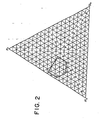
- a preferred sub-class of the SAPOs of Formula (1), above, have a minimum value for m of 0..02 in the as-synthesized form and have values for "x", y and z within the pentagonal compositional area defined by the points a, b, c, d and e of the ternary diagram which is FIG. 2 of the drawings, wherein said points a, b, c, d and e are represented by the following values for x, y and z :
- unit empirical formula is used herein according to its common meaning to designate the simplest formula which gives the relative number of atoms of silicon, aluminum and phosphorus which form a [PO 2 ], [AlO 2 ] and [SiO 2 ] tetrahedral unit within a silicoaluminophosphate molecular sieve and which forms the molecular framework of the SAPO composition(s).
- the unit empirical formula is given in terms of silicon, aluminum and phosphorus as shown in Formula (1), above, and does not include other compounds, cations or anions.which may be present as a result of the SAPO's preparation or the existence of other impurities or materials in the bulk composition not containing the aforementioned tetrahedral unit as the molecular framework.
- the amount of template R is reported as part of the composition when the as-synthesized unit empirical formula is given, and water may also be reported unless such is defined as the anhydrous form.
- coefficient m for template 'R' is reported as a value that is normalized by dividing the number of moles of R by the total number of moles of silicon, phosphorus and aluminum.
- the unit empirical formula for a SAPO may be given on an "as-synthesized” basis or may be given after an "as-synthesized” SAPO composition has been subjected to some post. treatment process, e.g., calcined.
- the term "as-synthesized” herein shall be used to refer to the SAPO composition(s) formed as a result of the hydrothermal crystallization but before the SAPO composition has been subjected to post treatment to remove any volatile components present therein.
- m for a post-treated SAPO will depend on several factors (including: the particular SAPO, template, severity of the post-treatment in terms of its ability to remove the template from the SAPO, the proposed application of the SAPO composition, and etc.) and the value for 'm' can be within the range of values as defined for the as-synthesized SAPO compositions although such is generally less than the as-synthesized SAPO unless such post-treatment process adds template to the SAPO so treated.
- a SA P O composition which is in the calcined or other post-treated form generally has an empirical formula represented by Formula (1), except that the value of m is generally less than about 0.02. Under sufficiently severe post-treatment conditions, e.g. roasting in air at high temperature for long periods (over 1 h...), the value of m may be zero (0) or, in any event, the template, R, is undetectable by normal analytical procedures.
- the above silicoaluminophosphates are generally synthesized by hydrothermal crystallization from a reaction mixture comprising reactive sources of silicon, aluminum and phosphorus, and one or more organic templating agents.
- alkali metal(s) may be present in the reaction mixture.
- the reaction mixture is placed in a sealed pressure vessel, preferably lined with an inert plastic material, such as polytetrafluoroethylene, and heated, preferably under autogenous pressure at a temperature of at least about 100°C, and preferably between 100°C and 250°C, until crystals of the silicoaluminophosphate product are obtained, usually for a period of from 2 hours to 2 weeks.
- the SAPO may be isolated and washed with water and dried in air.
- the as-synthesized SAPO contains within its intracrystalline-pore system at least one form of the template employed in its formation.
- the template is a molecular species, but it is possible, steric considerations permitting, that at least some of the template is present as a charge-balancing cation.
- the template is too large to move freely through the intracrystalline pore system of the formed SAPO and may be removed by a post-treatment process, such as by calcining the SAPO at temperatures of between about 200°C and to about.
- the pores of the SAPO are sufficiently large to permit transport of the template, and, accordingly, complete or partial removal thereof can be accomplished by conventional desorption procedures such as carried out in the case of zeolites.
- the SAPOs are preferably formed from a reaction mixture having a mole fraction of. alkali metal cation which is sufficiently low that it does not interefere with the formation of the SAPO. composition. Although the SAPO compositions will form if higher concentrations of alkali metal cation are present, such reaction mixtures are'not generally preferred.
- a reaction mixture expressed in terms of molar oxide ratios, having the following bulk composition is preferred: wherein R is a template; 'a' has a value great enough to constitute an effective concentration of 'R and is within the range of from greater than zero (0) to about 3; b has a value of from zero to 500; x' , y and z represent the mole fractions, respectively of silicon, aluminum and phosphorus wherein x, y and z each have a value of at least 0.01.
- the reaction mixture is preferably formed by combining at least a portion of the reactive aluminum and phosphorus sources in the substantial absence of the silicon source and thereafter combining the resulting reaction mixture comprising the aluminium and phosphorus.sources with the silicon source.
- the value of m in Formula (1) is generally above about 0.02
- alkali metal cations are not preferred, when they are present in the reaction mixture it is preferred to first admix at least a portion (e..g.- at least about 10 weight percent) of each of the aluminum and phosphorus sources in the substantial absence (e.g. preferbly less than about 20 percent of the total weight of the aluminum source and silicon source) of the silicon source.
- This procedure avoids adding the phosphorus source to a highly basic reaction mixture containing the silicon and aluminum source, (as was done in most of the published attempts to substitute isomorphously [PO 2 ] tetrahedra for [SiO 2 ] tetrahedra in zeolite structures).
- the function of the template may be to favor the incorporation of [PO 2] and [AlO 2 ] tetrahedra in the framework structures of the crystalline products with [SiO 2 ] tetrahedra isomorphously replacing [P0 2] tetrahedra.
- the reaction mixture from which these SAPOs are formed contain one or more organic templating agents (templates) which can be most any of those heretofore proposed for use in the synthesis of aluminosilicates and aluminophosphates.
- the template preferably contains at least one element of Group V B of the Periodic Table, particularly nitrogen, phosphorus, arsenic and/or antimony, more preferably nitrogen or phosphorus and most preferably nitrogen.
- the template contains at least one alkyl, aryl, araalkyl, or alkylaryl group.
- the template preferably contains from 1 to 8 carbon atoms, although more than eight carbon atoms may be present in the template.
- Nitrogen-containing templates are preferred, including amines and quaternary ammonium compounds, the latter being represented generally by the formula R 4 N + wherein each R' is an alkyl, aryl, alkylaryl, or araalkyl group; wherein R' preferably contains from 1 to 8 carbon atoms or higher when R' is alkyl and greater than 6 carbon atoms when R' is otherwise, as hereinbefore discussed.
- Polymeric.quaternary ammonium salts such as [(C 14 H 32 N 2 ) (OH) 2 ] x wherein x' has a value of at least 2 may also be employed.
- the mono-, di- and, tri-amines, including mixed amines, may also be employed as templates either alone or in combination with a quaternary ammonium compound or another template.
- the exact relationship of various templates when concurrently employed is not clearly understood.
- Mixtures of two or more templating agents can produce either mixtures of SAPOs or in the instance where one template is more strongly directing than another template the more strongly directing template may control the course of the hydrothermal crystallization wherein with the other template serving primarily to establish the pH conditions of the reaction mixture.
- Representative templates include tetramethylammonium, tetraethylammonium, tetrapropylammonium or tetrabutylammonium ions; di-n-propylamine; tripropylamine; triethylamine; triethanolamine; piperidine; cyclohexylamine; 2-methylpyridine; N,N-dimethylbenzylamine; N,N-diethylethanolamine; dicyclohexylamine; N,N-dimethylethanolamine; choline; N,N'-dimethylpiperazine; 1,4-diazabicyclo (2,2,2) octane; N-methyldiethanolamine, N-methylethanolamine; N-methylpipesidine; 3-methylpiperidine; N-methylcyclohexylamine; 3-methylpyridine; 4-methylpyridine; quinuclidine; N,N'-dimethyl-1,4-diazabicyclo (2,2,2) octane
- the corresponding alcohol is necessarily present in the reaction mixture since it is a hydrolysis product of the alkoxide. It has not as yet been determined whether this alcohol participates in the synthesis process as a templating agent, or in some other function and, accordingly, is not reported as a template in the unit formula of the SAPOs, although such may be acting as templates.
- Alkali metal cations in the reaction mixture may facilitate the crystallization of certain SAPO phases, although the exact function of such cations in crystallization, if any, is not presently known.
- Alkali cations present in the reaction mixture generally appear in the'formed SAPO composition, either as occluded (extraneous) cations and/or as structural cations balancing net negative charges at various sites in the crystal lattice. It. should be understood that although the unit formula for the SAPOs does not specifically recite the -presence of alkali cations they are not excluded in the same sense that hydrogen cations and/or hydroxyl groups are not specifically provided for in the traditional formulae for zeolitic aluminosilicates.
- any reactive phosphorus source may be employed herein such that [PO 2 ] tetrahedra are provided for in the SAPO framework.
- Phosporic acid is the most suitable phosphorus source employed to date. Accordingly, other acids of phosphorus are generally believed to be suitable phosphorus sources for use herein.
- Organic phosphates such as triethyl phosphate have been found satisfactory, and so also have crystalline or amorphous aluminophospates such as the AlPO 4 compositions of U.S.P. 4,310,440.
- Organo-phosphorus compounds such as tetrabutylphosphonium bromide have not, apparently, served as reactive sources of phosphorus, but-these compounds do function as templating agents and may also be capable of being suitable phosphorus sources under proper process conditions (yet to be ascertained).
- Organic phosphorus compounds e.g. esters, are believed to be generally suitable since they can generate acids of phosphorus in situ.
- Conventional phosphorus salts, such as sodium metaphosphate may be used, at least in part as the phosphorus source, but they are not preferred.
- any reactive aluminum source may be employed herein such that [AlP 2 ] tetrahedra are provided for incorporation in the SAPO framework.
- the preferred reactive aluminum sources include aluminum alkoxides, such as aluminum isoproproxide, and pseudoboehmite. Crystalline or amorphous aluminophosphates which are a suitable source of phosphorus are, of course, also suitable sources of aluminum.
- Other sources of aluminum used in zeolite synthesis, such as gibbsite, sodium aluminate and aluminum trichloride, can be employed but are generally not preferred.'
- any reactive silicon source' may be employed herein such that [SiO 2 ] tetrahedra are provided for incorporation in the SAPO framework.
- Silicon is preferably introduced into the reaction system as either a silica sol or as fumed silica, but other conventional sources of silicon used in zeolite synthesis procedures can be employed.
- a reactive solid amorphous precipitated silica, silica gel, silicic acid or alkali metal silicate may be employed as the silicon source with the last two named not being preferred.
- the silicon source material is preferably not an alkali metal silicate owing to the high pH conditions necessarily imparted to reaction mixtures by such alkali metal silicates where high molar SiO 2 /Al 2 O 3 ratios are desired, since such result in a marked tendency to produce extraneous aluminophosphates compositions. While the high pH conditions can be avoided by in situ neutralization with an acid and the consequent formation of a precipitated silica, this is, in effect, the use of silica as the reactive silicon source rather than an alkali metal silicate.
- alkali metal silicate is employed as a reagent, it is preferably used in conjunction with another source of reactive silicon and the alkali metal silicate comprises a minor proportion (less than 50 percent by weight) of the overall reactive silicon source with the reaction mixture having the same composition, expressed in terms of mole ratios of oxides, as set forth hereinabove for the process wherein such alkali metals present in the reaction mixture.
- SAPO compositions employable in present invention were prepared as follows and as set forth in Examples 1 to 24:
- SAPO-5 comprises a silicoaluminophosphate material having a three-dimensional microporous crystal framework structure of [PP 2 ], [AlO 2 ] and [SiO 2 ] tetrehedral units whose unit empirical formula on an anhydrous basis is: wherein 'R represents at least one organic templating agent present in the intracrystalline pore system; m represents the moles of R present per mole of (Si x AI y P z )O 2 and has a value from zero to 0.3; x y and z represent, respectively, the mole fractions of silicon, aluminum and phosphorus, said mole fractions being within the compositional area bounded by points A, B, C, D and E on the ternary diagram which is FIG.
- m preferably has a value of from 0.02 to 0..3.
- SAPO-5 was prepared by combining 7.69 grams of 85 wt.% orthophosphoric acid (H 3 PO 4 ) with 33.29 grams of water. To this mixture 4..58 grams of a hydrated aluminum oxide was added, (a psuedo-boehmite phase, 74..2 wt..% Al 2 O 3 and 25.8 wt.% H 2 0) and the resulting mixture was stirred until homogeneous. To this mixture was added, sequentially, 1..08 gram of 37 wt..% HCl, and 2.16 grams of a fumed silica (92.8 wt.% SiO 2 and 7.2 wt.% H 2 O) and the resulting mixture was stirred until homogeneous..
- reaction mixture A portion of this reaction mixture was sealed in a stainless steel pressure vessel lined with polytetrafluoroethylene (inert liner) and heated in an oven at 150°C at the autogenous pressure for 168 hours.
- the solid reaction product was recovered by filtration, washed with water, and dried in air overnight at ambient temperature.
- the composition of the as-synthesized solid product was determined in accordance with the law of mass balance using data derived from the chemical analysis of the mother liquor and was calculated to be as follows:
- the (TEA) 2 0 content was calculated from the carbon analysis, and the H 2 0 content was determined by differences.
- SAPO-5 composition A portion of the SAPO-5 composition was analyzed chemically and found to contain: 6.9 wt.% C; 1.0 wt.% N; 16.3 wt.% SiO 2 ; 28.9 wt.% A1 2 O 3 ; 38.3 wt.% P 2 O 5 ; and 14.4 wt.% LO I
- the template is reported here and may be reported in the remaining examples as the cation as associated in the oxide form or as the cation.
- the TEA corresponds to the tetraethylammonium cation. Similar designations are employed in the.other preparative examples.
- This X-ray pattern and all other X-ray patterns appearing hereinafter were obtained using standard X-ray powder diffraction techniques.
- the radiation source was a high-intensity, copper target, X-ray tube operated at 50 kV and 40 mA.
- the diffraction pattern from the copper K radiation and graphite monochromator is suitably recorded by an .
- X-ray spectrometer scintillation counter, pulse height analyzer and strip chart recorder Flat compressed powder samples are scanned at 2 ⁇ (2 theta) per minute, using a two second time constant.
- Interplanar spacings (d) in Angstrom units are obtained from the position of the diffraction peaks expressed as 20 (theta) where theta is the Bragg angle as observed on the strip chart. Intensities were determined from the heights of diffraction peaks after subtracting background, I o being the intensity of the strongest line or peak, and -I being the intensity of each of the other peaks.
- the determination of the parameter 2 theta is subject to both human and mechanical error, which in combination, can impose an uncertainty of about +0.4° on each reported value of 2 theta.
- This uncertainty is, of course, also manifested in the reported values of the d-spacings, which are calulated from the 2 theta values.
- This imprecision is general throughout the art and is not sufficient to preclude the differentiation of the present crystalline materials from each other and from the compositions of the prior art.
- the relative intensities of the d-spacings are indicated by the notations vs, s, m, w and vw which represent very strong, strong, medium, weak and very weak, respectively.
- SAPO-5 was prepared by combining 18:44 grams of 85 wt. % orthophosphoric acid (H 3 pO 4 ) and 11.56 grams of water, to which was added 11.04 grams of hydrated aluminum oxide (a pseudo-boehmite phase, 74.2 wt. % A1 2 0 3 and 25.8 wt. % H 2 O), and stirred until homogeneous. To this mixture was added a dispersion of 2.08 grams of a fumed silica (92.8 wt. % SiO 2 and 7.2 wt.
- reaction mixture A portion of the reaction mixture was sealed in a stainless steel pressure vessel lined with an inert plastic material and heated in an oven at 225"C at autogeneous pressure for 24 hours.
- the solid reaction product was recovered by centrifuging and washing with water, and dried in air at room temperature.
- the above product has an X-ray powder diffraction pattern characterized by the-following data:
- the pore size of the calcined product was thus determined to be greater than about 0.62 nm,as shown by adsorption of neopentane which has a kinetic diameter of 0.62 nm.
- SAPO-11 as referred to herein, comprises a silicoaluminophosphate material having a three-dimensional microporous crystal framework structure of [PO 2 ] , [AlO 2 ] and [SiO 2 ] tetrahedral units whase unit empirical formula on an anhydrous basis is:
- SAPO 11 was prepared by forming a reaction mixture by combining 160 grams of water and 90.7 grams of aluminum isopropoxide (Al(i-OC 3 H 7 ) 3 ) to which was added 51.3 grams of 85 wt. % orthophosphoric acid (H 3 PO 4 ) with stirring. To this mixture was added 1.4 grams of a fumed silica (95 wt. % SiO 2 and 5 wt. % H 2 0) and then, after stirring, 7.4 grams of di-n-propylamine (Pr 2 NH) was added to one-third by weight of the above mixture. The final mixture was stirred until homogeneous. The composition of the final reaction mixture in molar oxide ratios was:
- reaction mixture in terms of molar proportions, in which the silicon, aluminum and phosphorus sources are expressed as To 2 , i.e., (Si x Al y P z )O 2 , units, the reaction mixture can be expressed as:
- the reaction mixture was sealed in a stainless steel pressure vessel lined with polytetrafluoroethylene and heated in an oven at 150°C at the autogenous pressure for 133 hours.
- the solid reaction product . was recovered by centrifugation, washed with water, and dried in air at room temperature.
- Chemical analysis established the composition comprised: 3.5 wt.% C; 0.65 wt.% N; 38.2 wt.% Al 2 O 3 ; 35.9 wt.% P 2 O 5 ; 2.9 wt.% Si0 2 ; 17.7 wt.% LOI; and this gave a product composition.(anhydrous basis) for the SAPO-11 as follows: or, in terms of mole ratios of oxides:
- the pore size of-the calcined product was - determined to be between 0.6 and 0.62 nm as shown by adsorption of cyclohexane, kinetic diameter of 0,6nm and negligible adsorption of neopentane., kinetic diameter of 0.62 nm.-SAPO-16
- SAPO-16 comprises a silicoaluminophosphate material having a three-dimensional microporous crystal framework structure of [PO 2 ], [Al0 2 ] and [SiO 2 ] tetrahedral units whose unit empirical formula on an anhydrous basis is: wherein R represents at least one organic templating agent present in the intracrystalline pore system; m represents the moles of R present per mole of (Si x Al y P z )O 2 and has a value of from zero to about 0.3, x, y and z represent respectively, the mole fractions of silicon, aluminum and phosphorus, said mole fractions being within the compositional area bounded by points A, B , C, D and E on the ternary diagram which is FIG.
- SAPO. having a characteristic X-ray powder diffraction pattern (as-synthesized and calcined) which contains at least the d-spacings set forth below in Table V.
- m preferably has a value of from 0.02 to 0..3.
- SAPC 16 was prepared by combining 46..0 grams of 85 wt. % orthophosphoric acid and 100 grams of water which was added to 81.7 grams of aluminum isopropoxide (Al(i-OC 3 H 7 ) 3 ) and 5.0 grams of water and the mixture stirred well. To the above mixture were added 12.0 grams of an aqueous sol containing 30 wt.% Si0 2 , and 5..0 additional grams of water, and the mixture stirred until homogeneous. To one-half (by weight) of this mixture were added 11.1 grams of quinuclidine, C 7 H 13 N,(ON) and 21.9 grams of water, and the mixture stirred until homogeneous. The composition of the final reaction mixture in molar oxide ratios was:
- the reaction mixture was sealed in a stainless steel pressure vessel having an inert plastic liner and heated in an oven at 200°C at autogenous pressure for 48 hours.
- the solid reaction product, denominated SAPO-16 was recovered by centrifugation, washed with water, and dried in air at 100°C.
- X-ray analysis was performed on a portion of the solids which passed through a 100
- the SAPO-16 product had an X-ray powder diffraction pattern characterized by the following data:
- A. silicoaluminophosphate molecular sieve was prepared by forming a mixture by adding 132.8 grams of aluminum isopropoxide [Al(i-C 3 H 7 O)] to a solution containing 57..7 grams of orthophosphoric acid (85 weight percent H 3 PO 4 ), 177.1 grams of water and Ludox LS (30.1 grams). The mixture was stirred until a homogeneous mixture was observed. To this mixture was added 27.8 grams of quinuclidine (QN) in 50.0 grams of water. The resulting mixture was stirred until a homogenous mixture was observed.
- the composition of the final reaction mixture expressed in terms of molar ratios was, of:
- reaction mixture was sealed in a stainless steel pressure vessel lined with polytetrafluoroethylene. The mixture was then heated in an oven at 200°C at the autogenous pressure for about 48 hours.
- the silicoaluminophosphate product i.e,.- the solid reaction product
- the as-synthesized and calcined product had an X-ray powder diffraction pattern characterized by the general diffraction X-ray pattern set forth in Table VII.
- R 1 represents at least one organic templating agent present in the intracrystalline pore system
- m represents the moles of "R" present per mole of (Si x AI y P z )O 2 and has a value of from zer 9 to 0..3, x, y and z represent respectively, the mole fractions of silicon, aluminum and phosphorous said mole fractions being within the compositional area bounded by points A, B, C, D and E on the ternary diagram which is FIG. 1, or preferably within the area bounded by points a,. b, c, d and e on the ternary diagram which is FI G.
- said silicoaluminophosphate having a characteristic X-ray powder diffraction pattern (as-synthesized ad calcined) which contains at least the d-spacings set forth below in Table VIII.
- m preferably has a value of from 0..02 to 0.30..
- SAPO-17 was formed from a reaction mixture formed by combining 57.7 grams of 85 wt. % orthophosphoric acid and 130.0 grams of water with 132.8 grams of aluminum isopropoxide (Al(i-OC 3 H 7 ) 3 ) and mixing well. To this mixture were added 47.0 grams of water and 30.1 grams of an aqueous sol containing 30 wt. % SiO 2 , and the mixture stirred until homogeneous. To this mixture was added a solution of 27.8 grams of quinuclidine, C 7 H 13 N, (QN) in 5'0.0 grams of water, and the mixture stirred until homogeneous.
- Al(i-OC 3 H 7 ) 3 aluminum isopropoxide
- the composition of the final reaction mixture in molar.oxide ratios was: Part of the reaction mixture was placed in a stainless steel pressure vessel lined with an inert material and heated in.an oven at 200°C.at autogenous pressure for 338 hours. The solid reaction product was recovered by centrifugation, washed with water, and dried in air. at 100°C.
- the SAPO-17 product had an X-ray powder diffraction pattern characterized by the following data:
- SAPO-17 was prepared using cyclohexylamine (instead of the quinuclidine of Ex. 6) as the templating agent and decreasing the relative proportion of silica. in the gel.
- SAhO-17 was prepared by combining 81.7 grams of-aluminum isopropoxide [Al-(i-OC 3 H 7 ) 3 ] with a solution of 46.1 grams of 85 wt.. % orthophosphoric acid (H 3 PO 4 ) in 159.6 grams of H 2 O, stirring until homogeneous, and then adding 4.0 grams of an aqueous silica sol containing 30 wt.% Si0 2 . The resulting mixture was stirred until it was homogeneous.
- composition of the product was found to be: 9.5 wt.% C; 1..6 wt.% SiO 2 ; 37.8 wt.%Al 2 O 3 ; 39.9 wt.% P 2 O 5 ; and 19.8 wt..% LOI; corresponding to the formula (anhydrous basis): or in terms of molar oxide ratios:
- the SAPO-17 product contained impurities and had an X -ray powder diffraction pattern characterized by the following data:
- the pore size of-the calcined product was determined to be above about 0.43nm as , indicated by adsorption of n-hexane and below about 0,5 nm as shown by neglible adsorption of isobutane.
- SAPO-20 comprises a silicoaluminophosphate material having a three-dimensional microporous. Crystal framework structure of [PO 2 ], [AlO 2 ] and [SiO 2 ] tetrahedral units whose unit empirical formula on an anhydrous basis is: wherein R represents at least one organic templating agent present in the intracrystalline pore system; m represents the moles of R present per mole of (Si x Al y P z )O 2 and has a value of x y from zero to 0.3, x, y and z represent respectively, the mole fractions of silicon, aluminum and phosphorus present as tetrahedral units, said mole fractions being within the compositional area bounded by points A, B, C, D and E on the ternary diagram which is Fig.
- said silicoaluminophosphate having a characteristic X-ray powder diffraction pattern (as synthesized and- calcined) which contains at least the d-spacings set forth below in Table X.
- m preferably has a value of from 0..02 to 0.3.
- SAPO-20 was prepared by adding 1.09 grams of a reactive amorphous precipitated silica (91.4 wt.% Si0 2 and 8.6 wt.% H 2 0) to a solution of 14.50 grams of tetramethylammonium hydroxide pentahydrate (TMAOH°5 H 2 0) in 20.0 grams of water. The mixture was mixed until homogeneous. To this mixture were added 6..12 grams of a hydrated aluminum oxide (a pseudoboehmite phase, 74.2 wt..% Al 2 0 3 and 25.8 wt.% H 2 0) and 9.55 grams of 85% orthophosphoric acid (H 3 PO 4 ) and 6.21 grams of water and the mixture stirred until homogeneous.
- a reactive amorphous precipitated silica (91.4 wt.% Si0 2 and 8.6 wt.% H 2 0)
- TMAOH°5 H 2 0 tetramethylammonium hydroxide pentahydrate
- the composition of the final reaction mixture in molar oxide ratios was: Part of the reaction mixture was placed, in a stainless steel pressure vessel with an inert plastic. liner and heated in an oven at 200°C at autogeneous pressure for 24 hours. The solid reaction product was recovered by filtering, washed with water, and dr.ied in air at room temperature.
- the SAPO-20 product had an x-ray powder diffraction pattern characterized by the following data:
- the pore size of the calcined product is greater than 0.265nm as shown by adsorption of H 2 O, kinetic diameter 0.265nm and less than 0.346nm as shown by no adsorption of O 2 , kinetic diameter 0.346 nm.
- SAPO-34 comprises a silicoaluminophosphate material having a three-dimensional microporous crystal framework structure of [PO 2 ] ; [A1O 2 ] and [SiO 2 ] tetrahedral units, and whose unit empirical formula on an.anhydrous basis is: wherein R represents at least one organic templating agent present in the intracrystalline pore system; m represents the moles of R present per mole of (Si x Al y P z )O 2 and has a value of from zero to 0.3, preferably from 0.02 to 0.3, x, y and z represent respectively, the mole fractions of silicon, aluminum and phosphorus, said- mole fractions being within the compositional area bounded by points A, B, C, D and E on the ternary diagram which is FIG.
- said silicoaluminophosphate having a characteristic X -ray powder diffraction pattern (as-synthesized and calcined) which contains at least the d-spacings set forth below in Table XIII.
- SAPO-34 was prepared by forming a reaction mixture by combining 28.8 grams of 85 wt.% orthophosphoric acid (H 3 PO 4 ) with a mixture of 17.2 grams of a hydrated aluminum oxide (a pseudo-boehmite phase, 74.2.wt.% Al 2 O 3 , 25.8 . w.t..% H 2 0) in 18.4 grams of water. To this mixture was added 151.7 grams of an aqueous solution of 40.7 wt.% tetraethylammonium hydroxide (TEAOH) and the mixture stirred until homogeneous.
- TEAOH tetraethylammonium hydroxide
- SAPO-34 was prepared by combining 81.7 grams of aluminum isopropoxide (A1(i-OC 3 H 7 ) 3 ) with a solution of 46.1. grams of 85 wt.% orthophosphoric acid in 104..9 grams of water, while stirring. To this mixture were added 12 grams of an aqueous sol of 30 wt.%-SiO 2 and 5 grams of water, and the mixture stirred until homogeneous. To this mixture was added 73.7 grams of an aqueous solution of 40 wt.% tetraethylammonium hydroxide (TEAOH). One half by weight of this mixture was combined with 36.8 grams of 40% TEAOH, and the mixture stirred until homogeneous. The composition of the final reaction mixture in molar oxide ratios was:
- the reaction mixture was placed in a stainless steel pressure vessel lined with an inert plastic material (polytetrafluoroethylene) and heated in an oven at 200°C at autogeneous pressure for 120 hours.
- the solid reaction product (SAPO-34) was recovered by centrifugation, washed with water, and dried in air at 100°C.
- the product was established to comprise 10.5 wt.% C; 1.6 wt.% N; 34.1 wt.% Al 2 O 3 ; 39.2 wt.% -P 2 O 5 ; -6.8 wt.% SiO 2 ; and 19.2 wt.% LOI; which gave a product composition in molar oxide ratios of: which corresponds to the formula (anhydrous basis):
- the above product had an X-ray powder diffraction pattern which identified it as SA PO -34.
- the pore size of the calcined product was determined to be greater than 0.43nm as shown by adsorption of n-hexane which has a kinetic diameter of 0.43 nm..
- SAPO-34 was prepared by forming a mixture by adding 68.1 grams of aluminum isopropoxide (Al(i-C 3 H 7 O) 3 ] to a solution containing 38.4 grams of orthophosphoric acid (85 weight percent H 3 PO 4 ) in 120.1 grams of water.
- Cab-0-Sil EH5 (Trademark of Cabot Corporation, Boston, Mass, for a pyrogenic silica having 92.8 weight percent SiO 2 in water) was added (1.0 gram) to this mixture and the mixture was stirred until a homogeneous mixture was observed.
- the reaction mixture was sealed in a stainless steel pressure vessel lined with polytetrafluoroethylene.
- The-mixture was then heated in an oven at a temperature of 150°C at the autogenous pressure for a period of about 89 hours.
- the silicoaluminophosphate product i.e. , the solid reaction product
- the calcined product had X-ray pattern characterized by the general X-ray diffraction pattern set forth in Table XV.
- SAPO-34 was crystallized from a reaction system containing both sodium and TEA ions prepared by combining 66.4 grams of aluminum isopropoxide with a solution of 28.8 grams of 85 wt-% orthophosphoric acid in 70.1 grams of H 2 0. To this mixture was added a mixture of 15.0 grams of an aqueous silica sol (30 wt.-% Si0 2 ) and a solution of 3.0 grams of NaOH in 10.0 grams H 2 0. Thereafter 46.0 grams of an aqueous solution of 40 wt.-% tetraethylammonium hydroxide was added and the mixture stirred until homogeneous. The composition of the final mixture was:
- SAPO-34 was prepared by forming a mixture by adding 204.4 grams of aluminum isopropoxide [Al(i-C 3 H 7 O 3 )] to a solution containing 115.3 grams of orthophosphoric acid (85 weight percent H 3 P0 4 ) in 225 grams of water.
- the aluminum isopropoxide container was washed with 25 grams of water and that wash water was added to the mixture.
- Ludox LS and water (30.05 grams and 10.0 grams, respectively) were added to this mixture and the mixture was stirred until a homogenous mixture was observed.
- TEAOH tetraethylammonium hydroxide
- the reaction mixture was sealed in a stainless steel pressure vessel lined with polytetrafluoroethylene. The mixture was then heated in an oven at 200°C at the autogenous pressure for about 120 hours.
- the silicoaluminophosphate product i.e., the solid reaction product
- the calcined product had an X-ray powder diffraction pattern characterized by the general X-ray powder diffraction pattern set forth in Table XVI.
- Example 14 was repeated and the SAPO prepared was identified as SAPO-34.
- SAPO-35 comprises a silicoaluminophosphate material having a three-dimensional microporous crystal framework structure of [PO 2 ] , [AlO 2 ] and [SiO 2 ] tetrahedral units; and whose unit empirical formula on an anhydrous basis is: wherein R represents at least one organic templating agent present in the intracrystalline pore system; m represents the moles of R present per mole of (Si x Al y P z )O 2 and has a value of y z from zero to 0.3, x, y and z' represent respectively, the mole fractions of silicon, aluminum and phosphorus, said mole fractions being within the compositional area bounded by points A, B , C, D.and E on the ternary diagram which is FIG.
- said silicoaluminophosphate having a characteristic X-ray powder diffraction pattern (as-synthesized and calcined) which contains at least the d-spacings set forth below in Table XVII.
- m preferably has a value of from 0.02 to 0.3.
- SAPO-35 was prepared by combining 132 grams of water with 132.8 grams of aluminum isopropoxide (A1(i-OC 3 H 7 ) 3 ) and then adding 30.1 grams of an aqueous sol containing 30 wt.% SiO 2 and 45 grams of water. To this mixture was added 57.7 grams of 85 wt.% orthophosphoric acid (H 3 PO 4 ) and the mixture stirred until homogeneous. To this mixture was added a solution of 27.8 grams of quinuclidine, C 7 H 13 N, (QN) in 50 grams of water, and the mixture stirred until homogeneous. The composition of the final reaction mixture in molar oxide ratios was:
- the reaction mixture was sealed in a stainless steel pressure vessel lined with polytetrafluoroethylene. The mixture was then heated in an oven at a temperature of 200°C at the autogenous pressure for a period of about 168 hours.
- the silicoaluminophosphate product i.e., the solid reaction product
- the molecular sieve product was then calcined in air at 550°C for a period of about 3 hours.
- the calcined product had an X-ray powder diffraction pattern characterized by the following general X-ray powder diffraction pattern.
- SAPO-37 comprises a silicoaluminophosphate having a microporous crystalline framework structure and whose unit empirical formula on an anhydrous basis is: wherein R represents at least one organic templating agent present in the intracrystalline pore system, 'm has a value of from zero to 0.3, preferably from 0.02 to 0.3, x, y and z represent, respectively, the mole fraction of silicon, aluminum and phosphorus, the value of x, y and z being within the compositional area bounded by points A, B, C, D and E on the ternary diagram which is FIG.
- said silicoaluminophosphate having a characteristic X-ray powder diffraction pattern (as synthesized and calcined) which contains at least the d-spacings set forth below in Table XX:
- SAPO-37 was formed by combining 27.7 grams of 85 wt..% orthophosphoric acid (H 3 pO 4 ) and 30 ' ..5 grams of water, to which was added 16.6 grams of hydrated aluminum oxide (a pseudo-boehmite phase, 74..2 wt.% A1 2 O 3 , 25.8 wt.% H 2 O) , and stirred until homogeneous. To this mixture was added a dispersion of 3.1 grains of a fumed silica.
- reaction mixture A portion of the reaction mixture was placed in a stainless steel pressure vessel lined with polytetrafluoroethylene and heated in an oven at 200°C at autogenous pressure for 24 hours.
- the solid reaction product was recovered by centrifuging and washing with water, and dried in air at 100°C.
- the above product had an X-ray powder diffraction pattern characterized by t h e.following data:
- the chemical composition of the SAPO-37 product was determined to be: 31.8 wt.% A1 2 O 3 ; 31.4 wt.% F 2 O 5 ; 9.2 wt.% SiO 2 ; 14.2 wt.% C; 1.8 wt.% N; and 26.1 wt.% LOI, which corresponds to a product composition in molar oxide ratios of:
- the pore size of the calcined product is greater than 0.62nm as shown by adsorption of neopentane which has a kinetic diameter of about greater than 0.62 nm.
- SAPO-40 as referred to herein, comprises a silicoaluminophosphate material having a three-dimensional microporous crystal framework structure of [PO 2 ], [AlO 2 ] and [SiO 2 ] tetrahedral units, and whose unit empirical formula on an anhydrous basis is:
- (a) SAPO-40 was produced by crystallizing at 200°C for 96 hours under autogenous pressure a reaction mixture containing both sodium hydroxide and TPAOH in addition to phosphoric acid, a hydrated aluminum oxide, water and a fumed silica in proportions such that the reaction mixture had the composition:
- the pore size of the calcined product was determined to be greater than 0.62 nm as shown by adsorption of neopentane, kinetic diameter 0.62 nm. It should be noted, however., that the sample contained substantial amounts of SAPO-5, which adsorbs molecules as large as neopentane.
- A.reaction mixture was prepared by combining, in a manner to obtain a homogeneous composition, 6.90 grams of a hydrated aluminum oxide (74.2 wt..-% Al 2 O 3 , 25.8 wt.-% H 2 0) with 11.53 grams of 85% orthophosphoric acid, and a solution of 0.38 gram ammonium acetate (NH 4 Ac) in 11.16 grams H 2 0, and finally with a mixture of 1.30 grams of a fumed silica (92.8 wt.-% SiO 2 ) in 50.9 grams of 40% aqueous tetra-n-propylammonium hydroxide solution (TPAOH).
- the composition of the reaction mixture was:
- SAPO-42 as referred to herein, comprises a silicoaluminophosphate having a microporous crystalline framework structure of (PO 2 ],[A10 2 ] and (SiO 2 ] tetrahedral units and whose unit empirical formula on an anhydrous basis is: wherein R represents at least one organic templating agent present in the intracrystalline pore system, 'm' has a value of from zero to 0..3, preferably from .
- x , y and z represent, tespectively, the mole fraction of silicon, aluminum and phosphorus, the value of -x, y and z being within the compositional area bounded by points A, B, C, D and E on the ternary diagram which is FIG. 1, or preferably within the area bounded by points a, b, c, d and e on tne ternary diagram which is FIG. 2.., said silicoaluminophosphate having a characteristic X-ray powder diftraction pattern (as-synthesized and calcined) which contains at least the d-spacings set forth below in Table XXIV:
- SAPO-42 which appears to be structurally similar to the aluminosilicate zeolite A, is found to be produced by the extended aging at lower temperatures of a gel composition which otherwise yields SAPO-20, a silicoaluminophosphate which has structural similarity to the aluminosilicate sodalite.
- a composition was prepared having the following molar oxide ratios of: 1.2 Na 2 O ⁇ 1,1(TMA) 2 O ⁇ 4.0 SiO 2 ⁇ 1.66 Al 2 O 3 ⁇ 0.66 P 2 O 5 ⁇ 95 H 2 0 Part of the reaction mixture was placed in a sealed inert plastic container and heated in an oven at 100°C at autogenous pressure for 480 hours. The solid reaction product was recovered by centrifugation, washed with water, and dried in air at 100°C. The above product had an X-ray powder diffraction pattern characterizea by the following data:
- the composition of the crystalline product was found to be 11.3 wt.% Na 2 O, 38.3 wt.% Si02; 25.6 wt.% Al 2 O 3 ; 1.6 wt.-% C; 0.43 w t- % N ; 4 .. 4 .wt.% p 2 O 5 ; and 19.9 wt.% LOI; which gave a product composition in molar oxide ratios of:
- the pore size of the calcined product was determined to be greater than about 4.3A, as shown by the adsorption of n-hexane and less than about 5.0A, as shown by the negligible adsorption of isobutane.
- SAPO-44 as referred to herein, comprises a silicoaluminophosphate material having a three-dimensional microporous crystal framework of [PO 2 ], (A10 2 ] and [SiO 2 ] tetrahedral units whose unit empirical formula on an anhydrous basis is:
- R represents at least one organic templating agent present in the intracrystalline pore system
- m represents the moles of "R" present per mole of (Si x Al y P z )O 2 and has a value of from zero to 0.3
- x, y, and z represent respectively, the mole fractions of silicon, aluminum and phosphorus, said mole fractions being within the compositional area bounded by points A, B, C, D and E on the ternary diagram whicn is FIG. l, or preferably within the area bounded by points a, b, c, d and e on the ternary diagram which is FIG.
- said silicoaluminophosphate having a characteristic X-ray powder diffraction pattern (as-synthesized and calcined) which contains at least the d-spacings set forth below in Table XX VI .
- SAPO-44 is in the as-synthesized form "m" preferably has a value of from 0.02 to 0.3.
- SAPO-44 was prepared by mixing 23.1 grams of 85 wt.% orthophosphoric acid (H 3 PO 4 ) and 57.8 grams of water with 40.9 grams of aluminum isopropoxide (Al(i-OC 3 H 7 ) 3 ) and 5.0 grams of water and the mixture stirred until homogeneous. To this mixture were added 12.0 grams of an aqueous sol of 30 wt.% SiO 2 and 5.0 grams of water and the mixture stirred until homogenous. To this mixture were added 9.9 grams of cyclohexylamine (C 6 H 11 NH 2 ) and 5.0 grams of water, and the mixture stirred until homogenous.
- H 3 PO 4 85 wt.% orthophosphoric acid
- Al(i-OC 3 H 7 ) 3 aluminum isopropoxide
- the composition of the final reaction mixture in molar oxide ratios was: Part of the reaction mixture was placed in a stainless steel pressure vessel. lined with an inert plastic material- and heated in an oven at 200°C at autogenous pressure for 52 hours. The solid reaction product was recovered by centrifugation, washed with water, and dried in air at 100°C. The above product was impure but the major product (SAPO-44) had an X-ray powder diffraction pattern characterized by the following data:
- the pore size of the calcined product is between about 0.43nmand about 0.5nm as shown by adsorption of n-hexane, kinetic diameter of 0.43nmand negligible adsorption of isobutane, kinetic diameter of 0.5 nm.
- SAPO-31 comprises a silicoaluminophosphate having a three-dimensional microporous crystal.
- said silicoaluminophosphate having a characteristic X-ray powder diffraction pattern (as-synthesized and calcined) which contains at least the d-spacings set forth below in Table XXVIII.
- SAPO-31 is in the as-synthesized form m preferably has a value of from 0.02 to 0.3.
- A11 of the as-synthesized SAPO-31 compositions for which X-ray powder diffraction data have presently been obtained have patterns which are within the generalized pattern of Table XXIX below.
- SAPO-31 was crystallized from a reaction mixture prepared by combining 81.7 grams of aluminum isopropoxide (Al(i-OC 3 H 7 ) 3 ) with 46.1 grams of 85 wt. % orthophosphoric acid (H 3 PO 4 ) and 85.0 grams of water and stirring until homogeneous. To this mixture were added 24.0 grams of an aqueous sol of 30 wt. % SiO 2 and 42.8 grams of.water, and the mixture.stirred until homogeneous. To this mixture were added 20.2 grams of di-n-propylamine (Pr 2 NH) and 34.0 grams of water, and the mixture stirred until homogeneous.
- Al(i-OC 3 H 7 ) 3 aluminum isopropoxide
- H 3 PO 4 orthophosphoric acid
- the composition of the final reaction mixture in molar oxide ratios was: and contained 10 wt. % AlPO 4 -31 seed crystals based on the solids content.
- a portion of this reaction mixture was placed in a stainless steel pressure vessel lined with an inert.material and heated in an oven at 200°C at autogenous pressure for 24 hours.
- the solid reaction product was recovered by filtration, washed with water, and dried in air at 100°C.
- the chemical composition of the SAPO-31 product in terms of molar oxide ratios (anhydrous basis) was: which corresponds to the unit empirical formula:
- the X-ray powder diffraction pattern of the SAPO-31-containing product was characterized by the following data:
- the X-ray powder diffraction pattern of the SAPO-31-containing product after calcination in air for 7 hours at 550°C was characterized by the following data:
- SAPO-41 comprises a silicoaluminophosphate having a three-dimensional microporous crystal framework structure of [PO 2 ], [A10 2 ] and [Si0 2 ] tetrahedral units, and whose unit empirical formula on an anhydrous basis is: wherein R represents at least one organic templating agent present in the intracrystalline-pore system; m represents the moles of R present per mole of (Si x AlyP z )0 2 and has a value of from zero to 0..3; x , y and -z represent respectively, the mole fractions of silicon, aluminum and phosphorus, said mole fractions being within the compositional area bounded by points A, B, C, D and E on the ternary diagram which is FIG.
- said silicoaluminophospnate having a characteristic X-ray powder diffraction pattern (as-synthesized and calcined) which contains at least the d-spacings set forth below in Table XXX.
- m preferably has a value of from 0.02 to 0..3.
- SAPO-41 was prepared by combining 9.22 grams of 85 wt. % orthophosphoric acid (H 3 PO 4 ) and 5.78 grams of water, to which was added 5.52 grams of hydrated aluminum oxide, (a pseudo-boehmite phase, 74.2 wt. % Al 2 O 3 , 25.8 wt..% H 2 0) and stirred until homogeneous. To this mixture was added a mixture of 1.04 grams of a fume silica (92.8 wt. % SiO 2 , 7.2 wt. % H 2 0) in 41.67 grams of an aqueous solution of 25.9 wt. % tetra-n-butylammonium hydroxide (TBAOH).
- TSAOH a fume silica
- composition of the SAPO-41 was found to be 5.2 wt. % C; 38.1 wt. % Al 2 O 3 ; 41.1 wt. % P 2 O 5 ; 7.1 wt. % SiO 2 ; and by difference, LOI was 13.7 wt. %; which gave a product composition in terms of molar oxide ratios of: 0.036 (THA) 2 O ⁇ 1.0 Al 2 O 3 ⁇ 0.77 P 2 O 5 ⁇ 0.32 SiO 2 ⁇ 1.0 H 2 0 wnich corresponds to the unit empirical formula:
- the pore size of the calcined product was determined to be between about 6.0 and about 6..2A as shown by adsorption of cyclohexane, kinetic diameter of 0.6nm and negligible adsorption of neopentane, Kinetic diameter of 0.62 nm.
- the production of light olefins in the examples was carried out by mixing about 0.5 gram of a selected SAPO with 2.5 grams of quartz chips 0.59- 0.84 nm The resulting mixture (20-30 U.S. Standard mesh).6.35 mm was then placed in a 1/4 inch (outside diameter) No. 304 stainless steel tubular reactor having a wall thickness of 0.035 mm inch. The tubular reactor was immersed in a fluidized heated sand bath having electrical resistance heaters provided for maintaining the sand bath and the tubular reactor at the desired temperature. Thermocouples were provided for measurement of the reactor temperature.
- a selected feedstock was introduced to the tubular reactor by means of a Model 100 Altex Metering Pump (from Altex Corporation, a subsidiary of the Beckmann Corporation) concurrently with a stream of diluent with ni.trogen and water (steam) being employed as diluents (unless otherwise noted in the examples hereinafter).
- the pressure employed in the examples was the autogenous pressure (about one (1) to aoout two (2) atmospheres unless otherwise noted.
- the ratios of these components are reported as weight ratios.
- nitrogen was employed as a diluent it was introduced at a flow rate of about 5 cubic centimeters per minute.
- the effluent from the tubular reactor (the reaction products) was analyzed.
- the liquid component of the effluent was collected at room temperature and subsequently analyzed by vapor phase chromatography, whereas the gaseous component of the effluent was sampled and analyzed directly from the effluent stream by vapor phase chromatography.
- the Molar Conversion to total.products was 100% with the Molar Efficiency to a particular product being given as a percentage.
- ND methanol ethanol, dimethylether, diethylether or mixtures thereof.
- methane and carbon dioxide formed in the process at temperatures of about 400°C and higher are primarily derived from contact of the feedstock with the walls of the reactor these values are included since they do affect the efficiency of the overall process although their formation may be minimized by changes in the reactor design.
- the following examples are provided to exemplify the invention and are not meant to be limiting in any way.
- SAPO-17 The SAPO of Example 7 molecular sieve referred to above as SAPO-17 was employed in the instant process for the conversion of a feedstock comprising water and methanol to hydrocarbon products such including light olefin products.
- the conversion was carried out under four different sets of process conditions at the autogeneous pressure, all of which resulted in the formation of over 50 molar percent of hydrocarbon phase as light olefin products.
- the formation of dimethyl ether was not detected under these process conditions and an ethylene to propylene molar ratio of about 0.8 or greater was observed in each case.
- Table XXXII The results are set forth in Table XXXII.
- SAPO-34 The SAPO referred to above in Example 12 as SAPO-34 was employed for the conversion of methanol to light olefin products at a temperature of 375°C, atmospheric pressure, and at a WHSV (methanol) of 1.17 h -1 and a WHSV (H20) of 2.73 h, -1 .
- the results are set forth in Table XXXIII.
- SAPO-16 The SAPO referred to above in Example 5 as SAPO-16 was employed according to the Experimental Procedure for the conversion of methanol to light olefin products at temperatures of 375°C and 425°C. The results are set forth in Table XXXIV.
- WHSV (Methanol) 0..84 h -1
- WHSV (Water) 1..96 h -1 ).
- Example 16 (b) The SAPO.referred to above in Example 16 (b) was employed to produce a hydrocarbon mixture containing ethylene and propylene according to the above described Experimental Procedure.
- the results at a process temperature of 350°C and 370°C and at the autogenous pressure are set forth in Table XXXVI.
- SAPO-44 The SAPO referred to above in Example 21 as SAPO-44 was employed to convert a feedstock, comprising methanol and water according to the above described Experimental Procedure.
- the temperature was. 375°C the pressure was the autogenous pressure and the process was carried out for a. period of 1 hour.
- the WHSV for methanol.and water were - respectively 0.85 and 1.99 with the methanol conversion being 45 molar percent.
- Table XXXVII The results are set forth in Table XXXVII.
- the SAPO referred to above in Example 1.7 as a SAPO-35 was employed in the instant process to convert a molar mixture of water and methanol to light olefin products according to the above discussed Experimental Procedure.
- Three runs were carried out at varying molar amounts of methanol and both.with and without the use of a diluent and with varying amounts of water present. The temperature was 375°C and the pressure was the autogeneous pressure. The results demonstrate the increase in selectivity to light olefin products (at constant conversion) obtained when diluent is employed in the instant process.-
- the results of the three runs are set forth in Tables XXXVIII, XXXIX, and XXXX.
- the SAPO referred to above in Example 14 as a SAPO-34 was employed as the catalyst in the instant process for the conversion of methanol to light olefins at four different temperatures.
- the conversion of methanol to light olefins was carried out under the autogenous pressure at temperatures of 350°C, 375°C, 400°C and 425°C. The results at these temperatures are set forth in Table XLI.
- the SAPO referred to above in Example 14 as a SAPO-34 was employed in the instant process in the comparison of the conversion of two different feedstocks to light olefin products.
- the two feedstocks were: methanol; and dimethyl ether and water.
- This example was carried out under the autogenous pressure and at a temperature of 375°C. The results are set forth in Table XLII.
- the SAPO referred to above in Example 14 as a SAPO-34 was employed in the instant process for the conversion of methanol to light olefin products at a temperture of 3.75°C and at the autogenous pressure.
- the flow rate (WHSV) was employed at two rates to determine the effect of flow rate on light olefin production with the second flow rate being two and one nalf (2.5 X Flow) times that employed as the first flow rate (lX Flow).
- the results are set forth in Table XLIII.
- Example 15 The SAPO referred to above in Example 15 as a SAPO-34 was employed in the instant process for the conversion of ethanol to light olefins at a temperature of 400°C under the autogenous pressure and at a WHSV (ethanol) of 1.04 h -1 .
- the results are set fortn in Table XLIV.
- the SAPO referred to above in Example 15 as a SAPO-34 was employed in the instant process for the conversion of ethanol in the presence of water to light olefin products at a temperature of 400°. under the autogeneous pressure.
- the WHSV (Ethanol) was 0...87 h -1 and the WHSV (Water) was 4..90 h -1 .
- a phosphate substituted zeolite was prepared according to the following procedure as derived from example 4 of Canadian Patent No. 911,417, issued October 3, 1972.
- the substituted zeolite was prepared by mixing 24..0 grams of AlCl 3 ⁇ 6H 2 O, 10..4 grams of H 3 PO 4 (85 wt %) and about 200 milliliters of distilled water. The resulting mixture was titrated . with a concentrated solution of sodium hydroxide until the mixture had a PH of about 7.5. A precipitate was formed. This precipitate was collected by filtration and washed with about 150 milliliters of distilled water... The wet precipitate was blended with 16.0 grams of Ludox.colloidal silica sol, 4..8 grams of sodium hydroxide and then dissolved in 100 milliliters of distilled water. This reaction mixture was then placed in an autoclave with an inert plastic liner and crystallized at about 150°C at the autogenous pressure for a period of about 118 hours. The reaction mixture had the following composition, expressed in oxide-molar ratios:
- the resulting product was recovered by filtration, washed with distilled water and air dried at 110°C.
- the air dried product was ion-exchanged with potassium, analyzed by X-ray and the following X-ray powder diffraction pattern observed:
- the as-synthesized product was analyzed and found to contain: 13.6 wt. % P 2 O 5 ; 13.3 wt.% Na 2 O; 27.7 wt.% Al 2 O 3 ; 26.5 wt. % SiO 2 ; and 19.2 wt. % H 2 O; This corresponds to a composition in oxide molar ratios of:
- the as-synthesized product was tested for adsorption capacities using a standard McBain-Bakr gravimetric adsorption apparatus. The following data were obtained on a sample activated at about 350°C in vacuum.
Landscapes
- Chemical & Material Sciences (AREA)
- Organic Chemistry (AREA)
- Inorganic Chemistry (AREA)
- Engineering & Computer Science (AREA)
- Materials Engineering (AREA)
- Chemical Kinetics & Catalysis (AREA)
- Organic Low-Molecular-Weight Compounds And Preparation Thereof (AREA)
- Silicates, Zeolites, And Molecular Sieves (AREA)
- Catalysts (AREA)
- Low-Molecular Organic Synthesis Reactions Using Catalysts (AREA)
- Production Of Liquid Hydrocarbon Mixture For Refining Petroleum (AREA)
Applications Claiming Priority (2)
| Application Number | Priority Date | Filing Date | Title |
|---|---|---|---|
| US06/426,213 US4499327A (en) | 1982-10-04 | 1982-10-04 | Production of light olefins |
| US426213 | 1982-10-04 |
Publications (2)
| Publication Number | Publication Date |
|---|---|
| EP0105512A1 true EP0105512A1 (fr) | 1984-04-18 |
| EP0105512B1 EP0105512B1 (fr) | 1986-01-29 |
Family
ID=23689816
Family Applications (1)
| Application Number | Title | Priority Date | Filing Date |
|---|---|---|---|
| EP83109860A Expired EP0105512B1 (fr) | 1982-10-04 | 1983-10-03 | Procédé pour la production d'oléfines légères |
Country Status (9)
| Country | Link |
|---|---|
| US (1) | US4499327A (fr) |
| EP (1) | EP0105512B1 (fr) |
| JP (1) | JPS5984829A (fr) |
| AU (1) | AU563206B2 (fr) |
| CA (1) | CA1247656A (fr) |
| DE (1) | DE3362034D1 (fr) |
| MX (1) | MX171999B (fr) |
| NZ (1) | NZ205847A (fr) |
| ZA (1) | ZA837399B (fr) |
Cited By (9)
| Publication number | Priority date | Publication date | Assignee | Title |
|---|---|---|---|---|
| WO1986004577A1 (fr) * | 1985-02-11 | 1986-08-14 | Union Carbide Corporation | Production d'olefines legeres a partir de composes hetero aliphatiques |
| EP0357831A1 (fr) * | 1987-07-07 | 1990-03-14 | Union Carbide Corporation | Procédé de conversion chimique |
| EP0359843A1 (fr) * | 1987-07-07 | 1990-03-28 | Uop | Procédé de conversion chimique |
| EP0359842A1 (fr) * | 1987-07-07 | 1990-03-28 | Union Carbide Corporation | Procédé de conversion chimique |
| US5475182A (en) * | 1992-05-27 | 1995-12-12 | Exxon Chemical Patents Inc. | Acid extraction of molecular sieve catalysts to improve ethylene yield |
| WO1998029519A1 (fr) * | 1996-12-31 | 1998-07-09 | Exxon Chemical Patents Inc. | Conversion de composes oxygenes en hydrocarbures au moyen de catalyseurs non zeolitiques a tamis moleculaire et a support monolithique |
| CN1048429C (zh) * | 1994-02-05 | 2000-01-19 | 中国科学院大连化学物理研究所 | 以双模板剂合成磷酸硅铝分子筛的方法 |
| US6153798A (en) * | 1997-07-23 | 2000-11-28 | Mitsubishi Gas Chemical Co., Ltd. | Catalysts for methanol conversion reactions |
| EP1790627A1 (fr) * | 2005-11-29 | 2007-05-30 | BP Chemicals Limited | Procédé de production d'oléfines |
Families Citing this family (218)
| Publication number | Priority date | Publication date | Assignee | Title |
|---|---|---|---|---|
| US4677242A (en) * | 1982-10-04 | 1987-06-30 | Union Carbide Corporation | Production of light olefins |
| US4512875A (en) * | 1983-05-02 | 1985-04-23 | Union Carbide Corporation | Cracking of crude oils with carbon-hydrogen fragmentation compounds over non-zeolitic catalysts |
| US4859314A (en) * | 1983-05-02 | 1989-08-22 | Uop | Catalytic cracking catalysts and cracking process using non-zeolitic molecular sieves |
| US4803184A (en) * | 1983-05-02 | 1989-02-07 | Uop | Conversion of crude oil feeds |
| US4914067A (en) * | 1983-05-02 | 1990-04-03 | Uop | Catalytic cracking catalysts and cracking process using mixed catalyst system |
| NZ210463A (en) * | 1983-12-19 | 1988-04-29 | Mobil Oil Corp | Crystalline silicophosphoaluminate and its use as a catalyst |
| US4654138A (en) * | 1983-12-19 | 1987-03-31 | Mobil Oil Corporation | Catalytic process for modifying organic compounds |
| US4801309A (en) * | 1984-04-13 | 1989-01-31 | Uop | Titanium-aluminum-phosphorus-silicon-oxide molecular sieves |
| US4734185A (en) * | 1984-11-27 | 1988-03-29 | Union Carbide Corporation | Cracking process using zeolite and silicoaluminophosphate molecular sieve |
| US4913798A (en) * | 1984-12-18 | 1990-04-03 | Uop | Hydrocracking catalyts and processes employing silicoaluminophosphate molecular sieves |
| US4818739A (en) * | 1984-12-18 | 1989-04-04 | Uop | Hydrocracking catalysts and processes employing non-zeolitic molecular sieves |
| CA1275400C (fr) * | 1984-12-18 | 1990-10-23 | Frank Peter Gortsema | Catalyseurs et procedes de deparaffinage faisant appel a des tamis moleculaires non-zeolitiques |
| US4857495A (en) * | 1984-12-18 | 1989-08-15 | Uop | Hydrocracking catalysts and processes employing silicoaluminophosphate molecular sieves |
| US4960504A (en) * | 1984-12-18 | 1990-10-02 | Uop | Dewaxing catalysts and processes employing silicoaluminophosphate molecular sieves |
| US4752651A (en) * | 1986-06-16 | 1988-06-21 | Union Carbide Corporation | Production of light olefins |
| US4814316A (en) * | 1987-06-04 | 1989-03-21 | Uop | Novel catalyst composition, and processes for making and using same |
| US4973792A (en) * | 1987-07-07 | 1990-11-27 | Uop | Chemical conversion process |
| US4861938A (en) * | 1987-07-07 | 1989-08-29 | Uop | Chemical conversion process |
| JPS6450827A (en) * | 1987-08-20 | 1989-02-27 | Agency Ind Science Techn | Production of lower olefin |
| US4849575A (en) * | 1987-11-25 | 1989-07-18 | Uop | Production of olefins |
| JPH0699328B2 (ja) * | 1988-09-29 | 1994-12-07 | ユニオン・カーバイド・コーポレーシヨン | 化学転化方法 |
| US5157181A (en) * | 1990-12-03 | 1992-10-20 | Uop | Moving bed hydrocarbon conversion process |
| US5095163A (en) * | 1991-02-28 | 1992-03-10 | Uop | Methanol conversion process using SAPO catalysts |
| US5126308A (en) * | 1991-11-13 | 1992-06-30 | Uop | Metal aluminophosphate catalyst for converting methanol to light olefins |
| US5191141A (en) * | 1991-11-13 | 1993-03-02 | Uop | Process for converting methanol to olefins using an improved metal aluminophosphate catalyst |
| DE69409463T2 (de) * | 1993-11-02 | 1998-07-30 | Nippon Catalytic Chem Ind | Verfahren zur Herstellung von Alkanolamin, Katalysator für dieses Verfahren und Verfahren zur Herstellung des Katalysators |
| US5414173A (en) * | 1993-12-22 | 1995-05-09 | The Dow Chemical Company | Process of preparing cyclopentadiene and substituted derivatives thereof |
| US5962762A (en) * | 1995-12-13 | 1999-10-05 | Sun; Hsian-Ning | Use of transition metal containing small pore molecular sieve catalysts in oxygenate conversion |
| US6040264A (en) * | 1996-04-04 | 2000-03-21 | Exxon Chemical Patents Inc. | Use of alkaline earth metal containing small pore non-zeolitic molecular sieve catalysts in oxygenate conversion |
| US6436869B1 (en) | 1996-05-29 | 2002-08-20 | Exxonmobil Chemical Patents Inc. | Iron, cobalt and/or nickel containing ALPO bound SAPO molecular sieve catalyst for producing olefins |
| US6538167B1 (en) | 1996-10-02 | 2003-03-25 | Exxonmobil Chemical Patents Inc. | Process for producing light olefins |
| US5952538A (en) * | 1996-12-31 | 1999-09-14 | Exxon Chemical Patents Inc. | Use of short contact time in oxygenate conversion |
| US5960643A (en) | 1996-12-31 | 1999-10-05 | Exxon Chemical Patents Inc. | Production of ethylene using high temperature demethanization |
| US6455747B1 (en) | 1998-05-21 | 2002-09-24 | Exxonmobil Chemical Patents Inc. | Method for converting oxygenates to olefins |
| US6552240B1 (en) | 1997-07-03 | 2003-04-22 | Exxonmobil Chemical Patents Inc. | Method for converting oxygenates to olefins |
| US6023005A (en) * | 1997-07-03 | 2000-02-08 | Exxon Chemicals Patents Inc. | Process for converting oxygenates to olefins using molecular sieve catalysts comprising desirable carbonaceous deposits |
| RO114524B1 (ro) | 1997-10-02 | 1999-05-28 | Sc Zecasin Sa | Procedeu de fabricare a oleofinelor cu greutate moleculara mica prin conversia catalitica in strat fluidizat a metanolului |
| US6162415A (en) * | 1997-10-14 | 2000-12-19 | Exxon Chemical Patents Inc. | Synthesis of SAPO-44 |
| US6137022A (en) * | 1997-12-03 | 2000-10-24 | Exxon Chemical Patents Inc | Process for increasing the selectivity of a reaction to convert oxygenates to olefins |
| US6534692B1 (en) | 1997-12-09 | 2003-03-18 | Uop Llc | Methanol to olefin process with increased selectivity to ethylene and propylene |
| US5912393A (en) * | 1997-12-09 | 1999-06-15 | Uop Llc | Metallo aluminophosphate molecular sieve with novel crystal morphology and methanol to olefin process using the sieve |
| US6207872B1 (en) | 1997-12-09 | 2001-03-27 | Uop Llc | Metallo aluminophosphate molecular sieve with cubic crystal morphology and methanol to olefin process using the sieve |
| US6141988A (en) * | 1997-12-16 | 2000-11-07 | Air Liquide America Corporation | Process for recovering olefins |
| US6187983B1 (en) | 1998-04-29 | 2001-02-13 | Exxon Chemical Patents Inc | Converting oxygenates to olefins in the presence of electromagnetic energy |
| US6482998B1 (en) | 1998-04-29 | 2002-11-19 | Exxonmobil Chemical Patents, Inc. | Process for converting oxygenates to olefins with direct product quenching for heat recovery |
| US6046373A (en) * | 1998-04-29 | 2000-04-04 | Exxon Chemical Patents Inc. | Catalytic conversion of oxygenates to olefins |
| US6121504A (en) * | 1998-04-29 | 2000-09-19 | Exxon Chemical Patents Inc. | Process for converting oxygenates to olefins with direct product quenching for heat recovery |
| US6245703B1 (en) | 1998-04-29 | 2001-06-12 | Exxon Mobil Chemical Patents Inc. | Efficient method using liquid water to regenerate oxygenate to olefin catalysts while increasing catalyst specificity to light olefins |
| US6482999B2 (en) | 1999-02-17 | 2002-11-19 | Exxonmobil Chemical Patents, Inc. | Method for improving light olefin selectivity in an oxygenate conversion reaction |
| US6444868B1 (en) | 1999-02-17 | 2002-09-03 | Exxon Mobil Chemical Patents Inc. | Process to control conversion of C4+ and heavier stream to lighter products in oxygenate conversion reactions |
| US6472569B1 (en) * | 1999-04-16 | 2002-10-29 | Phillips Petroleum Company | Silicoaluminophosphate material, a method of making such improved material and the use thereof in the conversion of oxygenated hydrocarbons to an olefin and/or an ether |
| US6559428B2 (en) * | 2001-01-16 | 2003-05-06 | General Electric Company | Induction heating tool |
| US6395674B1 (en) | 1999-06-07 | 2002-05-28 | Exxon Mobil Chemical Patents, Inc. | Heat treating a molecular sieve and catalyst |
| US6316683B1 (en) | 1999-06-07 | 2001-11-13 | Exxonmobil Chemical Patents Inc. | Protecting catalytic activity of a SAPO molecular sieve |
| US6225254B1 (en) | 1999-06-07 | 2001-05-01 | Exxon Mobil Chemical Patents Inc. | Maintaining acid catalyst sites in sapo molecular sieves |
| US6166282A (en) * | 1999-08-20 | 2000-12-26 | Uop Llc | Fast-fluidized bed reactor for MTO process |
| US6437208B1 (en) | 1999-09-29 | 2002-08-20 | Exxonmobil Chemical Patents Inc. | Making an olefin product from an oxygenate |
| WO2001025150A1 (fr) * | 1999-10-01 | 2001-04-12 | Pop, Grigore | Procede de synthese de tamis moleculaires a base de silico-aluminophosphate |
| US6303841B1 (en) | 1999-10-04 | 2001-10-16 | Uop Llc | Process for producing ethylene |
| AU2001236985A1 (en) | 2000-02-16 | 2001-08-27 | Exxonmobil Chemical Patents Inc | Treatment of molecular sieves with silicon containing compounds |
| US6531639B1 (en) | 2000-02-18 | 2003-03-11 | Exxonmobil Chemical Patents, Inc. | Catalytic production of olefins at high methanol partial pressures |
| US6743747B1 (en) | 2000-02-24 | 2004-06-01 | Exxonmobil Chemical Patents Inc. | Catalyst pretreatment in an oxgenate to olefins reaction system |
| WO2001062382A2 (fr) * | 2000-02-24 | 2001-08-30 | Exxonmobil Chemical Patents Inc. | Pretraitement de catalyseur dans un systeme de reaction transformant des produits oxygenes en olefines |
| US6506954B1 (en) | 2000-04-11 | 2003-01-14 | Exxon Mobil Chemical Patents, Inc. | Process for producing chemicals from oxygenate |
| US7102050B1 (en) | 2000-05-04 | 2006-09-05 | Exxonmobil Chemical Patents Inc. | Multiple riser reactor |
| US6613950B1 (en) * | 2000-06-06 | 2003-09-02 | Exxonmobil Chemical Patents Inc. | Stripping hydrocarbon in an oxygenate conversion process |
| US6441263B1 (en) | 2000-07-07 | 2002-08-27 | Chevrontexaco Corporation | Ethylene manufacture by use of molecular redistribution on feedstock C3-5 components |
| US6660812B2 (en) | 2000-07-13 | 2003-12-09 | Exxonmobil Chemical Patents Inc. | Production of olefin derivatives |
| US6441261B1 (en) | 2000-07-28 | 2002-08-27 | Exxonmobil Chemical Patents Inc. | High pressure oxygenate conversion process via diluent co-feed |
| US6486219B1 (en) | 2000-09-27 | 2002-11-26 | Exxonmobil Chemical Patents, Inc. | Methanol, olefin, and hydrocarbon synthesis process |
| US6444712B1 (en) | 2000-09-28 | 2002-09-03 | Exxonmobil Chemical Patents, Inc. | Methanol, olefin, and hydrocarbon synthesis process |
| US6593506B1 (en) | 2000-10-12 | 2003-07-15 | Exxonmobil Chemical Patents Inc. | Olefin recovery in a polyolefin production process |
| US6495609B1 (en) | 2000-11-03 | 2002-12-17 | Exxonmobil Chemical Patents Inc. | Carbon dioxide recovery in an ethylene to ethylene oxide production process |
| ES2307486T3 (es) | 2000-12-13 | 2008-12-01 | Uop Llc | Tamiz molecular de aluminofosfato metalico con morfologia cristalina cubica y procedimiento de conversion de metanol en olefina utilizando el tamiz. |
| US6538162B2 (en) | 2001-01-30 | 2003-03-25 | Exxonmobil Chemical Patents Inc. | Method for converting alkanes to oxygenates |
| US6441262B1 (en) | 2001-02-16 | 2002-08-27 | Exxonmobil Chemical Patents, Inc. | Method for converting an oxygenate feed to an olefin product |
| US6518475B2 (en) | 2001-02-16 | 2003-02-11 | Exxonmobil Chemical Patents Inc. | Process for making ethylene and propylene |
| US6812372B2 (en) | 2001-03-01 | 2004-11-02 | Exxonmobil Chemical Patents Inc. | Silicoaluminophosphate molecular sieve |
| US20050096214A1 (en) * | 2001-03-01 | 2005-05-05 | Janssen Marcel J. | Silicoaluminophosphate molecular sieve |
| US6953767B2 (en) * | 2001-03-01 | 2005-10-11 | Exxonmobil Chemical Patents Inc. | Silicoaluminophosphate molecular sieve |
| EA004900B1 (ru) * | 2001-03-22 | 2004-08-26 | Юоп Ллк | Металлоалюмофосфатное молекулярное сито с кубической морфологией кристаллов и способ превращения метанола в олефины с использованием этого сита |
| US20050026432A1 (en) * | 2001-04-17 | 2005-02-03 | Atwater Harry A. | Wafer bonded epitaxial templates for silicon heterostructures |
| US7238622B2 (en) * | 2001-04-17 | 2007-07-03 | California Institute Of Technology | Wafer bonded virtual substrate and method for forming the same |
| WO2002084725A1 (fr) * | 2001-04-17 | 2002-10-24 | California Institute Of Technology | Procede utilisant un transfert de la couche au germanium au si pour applications photovoltaiques, et heterostructures realisees par ce procede |
| US6673978B2 (en) | 2001-05-11 | 2004-01-06 | Exxonmobil Chemical Patents Inc. | Process for making olefins |
| ES2282488T3 (es) * | 2001-07-02 | 2007-10-16 | Exxonmobil Chemical Patents Inc. | Inhibicion de la formacion de coque en un catalizador en la fabricacion de una olefina. |
| US6797851B2 (en) | 2001-08-30 | 2004-09-28 | Exxonmobil Chemical Patents Inc. | Two catalyst process for making olefin |
| US7060866B2 (en) * | 2002-04-18 | 2006-06-13 | Exxonmobil Chemical Patents Inc. | High pressure separation of dimethyl ether from an olefin stream |
| US20030199721A1 (en) * | 2002-04-18 | 2003-10-23 | Ding Zhong Y. | Low pressure separation of dimethyl ether from an olefin stream |
| US6838587B2 (en) * | 2002-04-19 | 2005-01-04 | Exxonmobil Chemical Patents Inc. | Method of removing oxygenate contaminants from an olefin stream |
| US6855858B2 (en) * | 2001-12-31 | 2005-02-15 | Exxonmobil Chemical Patents Inc. | Method of removing dimethyl ether from an olefin stream |
| US6870072B2 (en) | 2001-10-30 | 2005-03-22 | Exxonmobil Chemical Patents Inc. | Heat recovery in an olefin production process |
| US6764602B2 (en) * | 2001-11-29 | 2004-07-20 | Exxonmobil Chemical Patents Inc. | Process of removing oxygenated contaminants from an olefin composition |
| US6660682B2 (en) * | 2001-11-30 | 2003-12-09 | Exxon Mobil Chemical Patents Inc. | Method of synthesizing molecular sieves |
| US20030130555A1 (en) * | 2001-11-30 | 2003-07-10 | Minquan Cheng | Oxygenated hydrocarbon compositions and method for recovering the compositions |
| US6685905B2 (en) | 2001-12-21 | 2004-02-03 | Exxonmobil Chemical Patents Inc. | Silicoaluminophosphate molecular sieves |
| US7227048B2 (en) * | 2001-12-31 | 2007-06-05 | Exxonmobil Chemical Patents Inc. | Converting oxygenates to olefins over a catalyst comprising acidic molecular sieve of controlled carbon atom to acid site ratio |
| US7781633B2 (en) * | 2001-12-31 | 2010-08-24 | Exxonmobil Chemical Patents Inc. | Method for converting an oxygenate feed to a light olefin |
| AU2002367007A1 (en) | 2002-01-03 | 2003-07-30 | Exxon Mobil Chemical Patents Inc. | Stabilisation of acid catalysts |
| US6906232B2 (en) * | 2002-08-09 | 2005-06-14 | Exxonmobil Chemical Patents Inc. | Molecular sieve compositions, catalysts thereof, their making and use in conversion processes |
| US7307196B2 (en) * | 2002-02-28 | 2007-12-11 | Exxonmobil Chemical Patents Inc. | Molecular sieve compositions, catalyst thereof, their making and use in conversion processes |
| US6995111B2 (en) | 2002-02-28 | 2006-02-07 | Exxonmobil Chemical Patents Inc. | Molecular sieve compositions, catalysts thereof, their making and use in conversion processes |
| US7319178B2 (en) * | 2002-02-28 | 2008-01-15 | Exxonmobil Chemical Patents Inc. | Molecular sieve compositions, catalysts thereof, their making and use in conversion processes |
| US7208442B2 (en) * | 2002-02-28 | 2007-04-24 | Exxonmobil Chemical Patents Inc. | Molecular sieve compositions, catalyst thereof, their making and use in conversion processes |
| US6872680B2 (en) * | 2002-03-20 | 2005-03-29 | Exxonmobil Chemical Patents Inc. | Molecular sieve catalyst composition, its making and use in conversion processes |
| US7271123B2 (en) * | 2002-03-20 | 2007-09-18 | Exxonmobil Chemical Patents Inc. | Molecular sieve catalyst composition, its making and use in conversion process |
| US6759360B2 (en) * | 2002-03-29 | 2004-07-06 | Exxonmobil Chemical Patent Inc. | Interior surface modifications of molecular sieves with organometallic reagents and the use thereof for the conversion of oxygenates to olefins |
| US6638892B1 (en) | 2002-04-18 | 2003-10-28 | Conocophillips Company | Syngas conversion and catalyst system employed therefor |
| US7247764B2 (en) | 2002-08-14 | 2007-07-24 | Exxonmobil Chemical Patents Inc. | Conversion process |
| US7238846B2 (en) * | 2002-08-14 | 2007-07-03 | Exxonmobil Chemical Patents Inc. | Conversion process |
| US7030284B2 (en) * | 2002-08-20 | 2006-04-18 | Exxonmobil Chemical Patents Inc. | Method and reactor system for converting oxygenate contaminants in an MTO reactor system product effluent to hydrocarbons |
| US7122160B2 (en) * | 2002-09-24 | 2006-10-17 | Exxonmobil Chemical Patents Inc. | Reactor with multiple risers and consolidated transport |
| US20040064007A1 (en) * | 2002-09-30 | 2004-04-01 | Beech James H. | Method and system for regenerating catalyst from a plurality of hydrocarbon conversion apparatuses |
| US7238848B2 (en) | 2002-09-30 | 2007-07-03 | Exxonmobil Chemical Patents Inc. | Method for separating dimethyl ether from an olefin-containing product stream |
| US7083762B2 (en) * | 2002-10-18 | 2006-08-01 | Exxonmobil Chemical Patents Inc. | Multiple riser reactor with centralized catalyst return |
| US6906233B2 (en) * | 2002-12-12 | 2005-06-14 | Exxon Mobil Chemical Patents Inc. | Modified metalloaluminophosphate molecular sieves |
| US7026267B2 (en) * | 2002-12-20 | 2006-04-11 | Exxonmobil Chemical Patents Inc. | Molecular sieve catalyst composition, its production and use in conversion processes |
| DE602004017249D1 (de) * | 2003-05-17 | 2008-12-04 | Haldor Topsoe As | Verfahren zur Umwandlung von Sauerstoff enthaltenden Kohlenwasserstoffen in Kohlenwasserstoffe und Zusammensetzung zur Verwendung darin |
| EP1638601B1 (fr) * | 2003-06-23 | 2008-11-19 | Baxter International Inc. | Proteines porteuses pour des vaccins |
| US6951830B2 (en) * | 2003-08-05 | 2005-10-04 | Exxonmobil Chemical Patents Inc. | Molecular sieve catalyst compositions, their production and use in conversion processes |
| US7241713B2 (en) * | 2003-10-02 | 2007-07-10 | Exxonmobil Chemical Patents Inc. | Molecular sieve catalyst composition, its making and use in conversion processes |
| US7241716B2 (en) | 2003-11-10 | 2007-07-10 | Exxonmobil Chemical Patents Inc. | Protecting catalytic sites of metalloaluminophosphate molecular sieves |
| US7084319B2 (en) * | 2003-12-05 | 2006-08-01 | Exxonmobil Chemical Patents Inc. | Catalyst fluidization in oxygenate to olefin reaction systems |
| US7183328B2 (en) * | 2003-12-17 | 2007-02-27 | Exxonmobil Chemical Patents Inc. | Methanol manufacture using pressure swing reforming |
| WO2005104192A2 (fr) * | 2004-04-21 | 2005-11-03 | California Institute Of Technology | Procede de fabrication de substrats virtuels lies a une plaquette de gaas/si et de substrats virtuels associes |
| US7199277B2 (en) * | 2004-07-01 | 2007-04-03 | Exxonmobil Chemical Patents Inc. | Pretreating a catalyst containing molecular sieve and active metal oxide |
| US7166757B2 (en) * | 2004-07-30 | 2007-01-23 | Exxonmobil Chemical Patents Inc. | Conversion of oxygenates to olefins |
| US20060021565A1 (en) * | 2004-07-30 | 2006-02-02 | Aonex Technologies, Inc. | GaInP / GaAs / Si triple junction solar cell enabled by wafer bonding and layer transfer |
| US7186875B2 (en) * | 2004-07-30 | 2007-03-06 | Exxon Mobil Chemical Patents Inc. | Conversion of oxygenates to olefins |
| US7199278B2 (en) * | 2004-07-30 | 2007-04-03 | Exxonmobil Chemical Patents Inc. | Conversion of oxygenates to olefins |
| US20060040821A1 (en) * | 2004-08-18 | 2006-02-23 | Pujado Peter R | Treatment of air to a catalyst regenerator to maintain catalyst activity |
| CA2582298C (fr) * | 2004-10-01 | 2010-07-13 | Exxonmobil Chemical Patents Inc. | Tamis moleculaire aluminophosphate, sa synthese et son utilisation |
| US7846759B2 (en) * | 2004-10-21 | 2010-12-07 | Aonex Technologies, Inc. | Multi-junction solar cells and methods of making same using layer transfer and bonding techniques |
| US7465845B2 (en) * | 2004-12-22 | 2008-12-16 | Exxonmobil Chemical Patents Inc. | Increasing ethylene and/or propylene production in an oxygenate to olefins reaction systems |
| US7683227B2 (en) * | 2004-12-22 | 2010-03-23 | Exxonmobil Chemical Patents Inc. | Production of aromatic hydrocarbons from methane |
| EP1846156B1 (fr) | 2005-01-31 | 2018-08-08 | ExxonMobil Chemical Patents Inc. | Composition catalytique a tamis moleculaire, sa preparation et son utilisation dans des processus de conversion |
| US10374120B2 (en) * | 2005-02-18 | 2019-08-06 | Koninklijke Philips N.V. | High efficiency solar cells utilizing wafer bonding and layer transfer to integrate non-lattice matched materials |
| US20060224032A1 (en) * | 2005-03-29 | 2006-10-05 | Janssen Marcel J | Protecting catalytic sites of activated porous molecular sieves |
| TW200707799A (en) * | 2005-04-21 | 2007-02-16 | Aonex Technologies Inc | Bonded intermediate substrate and method of making same |
| US7547812B2 (en) * | 2005-06-30 | 2009-06-16 | Uop Llc | Enhancement of molecular sieve performance |
| US8129576B2 (en) * | 2005-06-30 | 2012-03-06 | Uop Llc | Protection of solid acid catalysts from damage by volatile species |
| WO2007021394A2 (fr) * | 2005-08-18 | 2007-02-22 | Exxonmobil Chemical Patents Inc. | Conversion catalytique d'oxygenates en olefines |
| JP5330635B2 (ja) * | 2006-01-20 | 2013-10-30 | 豊田通商株式会社 | プロピレンの製造方法、触媒の再生方法、固体酸触媒 |
| US7744746B2 (en) | 2006-03-31 | 2010-06-29 | Exxonmobil Research And Engineering Company | FCC catalyst stripper configuration |
| CN101395250B (zh) | 2006-03-31 | 2013-06-05 | 埃克森美孚化学专利公司 | 气-固反应器中的产物回收 |
| US20070244348A1 (en) * | 2006-04-13 | 2007-10-18 | Michel Molinier | Process for producing olefin product from syngas |
| US20070244000A1 (en) * | 2006-04-13 | 2007-10-18 | Michel Molinier | Producing olefin product from syngas |
| US20070243703A1 (en) * | 2006-04-14 | 2007-10-18 | Aonex Technololgies, Inc. | Processes and structures for epitaxial growth on laminate substrates |
| US7335621B2 (en) * | 2006-04-19 | 2008-02-26 | Exxonmobil Chemical Patents Inc. | Catalyst compositions and preparation thereof |
| US7977519B2 (en) * | 2006-04-21 | 2011-07-12 | Exxonmobil Chemical Patents Inc. | Production of aromatic hydrocarbons from methane |
| US7544851B2 (en) * | 2006-04-25 | 2009-06-09 | Exxonmobil Chemical Patents Inc. | Method of synthesizing aluminophosphate and silicoaluminophosphate molecular sieves |
| DK2404888T3 (en) * | 2006-05-30 | 2017-02-06 | Starchem Tech Inc | METHOD OF PREPARING METHANOL |
| US20080033218A1 (en) * | 2006-08-03 | 2008-02-07 | Lattner James R | Alcohol and olefin production from syngas |
| US7595275B2 (en) * | 2006-08-15 | 2009-09-29 | Exxonmobil Chemical Patents Inc. | Catalyst compositions and their synthesis |
| US10259757B2 (en) | 2006-08-23 | 2019-04-16 | Dalian Institute Of Chemical Physics, Chinese Academy Of Sciences | Method for starting up a fluidized catalytic reaction apparatus used for producing lower olefins |
| CN101130466B (zh) * | 2006-08-23 | 2011-05-04 | 中国科学院大连化学物理研究所 | 制取低碳烯烃流态化催化反应装置的开工方法 |
| CN101279874B (zh) * | 2007-04-04 | 2011-04-27 | 中国石油化工股份有限公司 | 由甲醇或二甲醚生产低碳烯烃的方法 |
| US7732301B1 (en) | 2007-04-20 | 2010-06-08 | Pinnington Thomas Henry | Bonded intermediate substrate and method of making same |
| CN101348404B (zh) * | 2007-07-18 | 2011-11-30 | 中国石油化工股份有限公司 | 甲醇或二甲醚转化过程中提高乙烯、丙烯收率的方法 |
| US8853485B2 (en) * | 2007-07-27 | 2014-10-07 | China Mto Limited | Method for preparing polymer grade low-carbon olefin through separation of methanol pyrolysis gas |
| DE102007059129A1 (de) | 2007-12-07 | 2009-06-10 | Süd-Chemie AG | Katalysator mit erhöhter Olefinselektivität zur Umsetzung von Oxygenaten zu Olefinen |
| US20090163756A1 (en) * | 2007-12-19 | 2009-06-25 | Uop Llc, A Corporation Of The State Of Delaware | Reactor cooler |
| CN101328103B (zh) * | 2008-06-12 | 2012-06-27 | 中国石油化工股份有限公司 | 甲醇或二甲醚转化为低碳烯烃的方法 |
| CN101333142B (zh) * | 2008-07-08 | 2012-05-30 | 中国石油化工股份有限公司 | 甲醇制低碳烯烃反应-再生装置的开车方法 |
| EP2161242A1 (fr) * | 2008-08-29 | 2010-03-10 | Total Petrochemicals Research Feluy | Procédé de préparation d'un tamis moléculaire métalloaluminophosphate (MEAPO) à partir de matériaux amorphes |
| EP2161243A1 (fr) | 2008-08-29 | 2010-03-10 | Total Petrochemicals Research Feluy | Procédé de préparation de tamis moléculaires métalloaluminophosphate (MeAPO) |
| US8445740B2 (en) * | 2008-10-29 | 2013-05-21 | Lummus Technology Inc. | Absorber demethanizer for FCC process |
| US8399728B2 (en) * | 2008-10-29 | 2013-03-19 | Lummus Technology Inc. | Absorber demethanizer for methanol to olefins process |
| WO2010085708A2 (fr) | 2009-01-23 | 2010-07-29 | Signa Chemistry, Inc. | Déshydratation catalytique d'alcool en utilisant des catalyseurs hétérogènes à sites multiples et à site unique calcinés, à phase pure |
| CN101811072B (zh) * | 2009-02-19 | 2011-12-21 | 中国石油化工股份有限公司 | 甲醇制烯烃反应过程中控制再生的方法 |
| CN101811920B (zh) * | 2009-02-19 | 2012-11-14 | 中国石油化工股份有限公司 | 低碳烯烃的生产方法 |
| PL2440328T3 (pl) * | 2009-06-12 | 2017-06-30 | Albemarle Europe Sprl. | Katalizatory z sitem molekularnym sapo, ich otrzymywanie i zastosowania |
| KR101193973B1 (ko) | 2009-10-22 | 2012-10-24 | 현대엔지니어링 주식회사 | 고강도를 갖는 sapo-34 미소구형체 촉매, 이의 제조방법 및 이를 이용한 경질올레핀의 제조방법 |
| CN102190538B (zh) * | 2010-03-03 | 2014-07-02 | 中国石油化工股份有限公司 | 甲醇制烯烃工艺中碳四以上烃催化裂解方法 |
| CN102190550B (zh) * | 2010-03-03 | 2016-02-10 | 中国石油化工股份有限公司 | 低碳烯烃的生产方法 |
| CN102190548B (zh) * | 2010-03-03 | 2014-07-02 | 中国石油化工股份有限公司 | 甲醇制烯烃工艺中提高低碳烯烃收率的方法 |
| CN102276386B (zh) | 2010-06-11 | 2013-12-25 | 中国石油化工股份有限公司 | 低碳烯烃的生产方法 |
| CN102276382A (zh) * | 2010-06-11 | 2011-12-14 | 中国石油化工股份有限公司 | 甲醇转化制低碳烯烃过程中联产二甲醚的方法 |
| CN102276384B (zh) * | 2010-06-11 | 2013-12-04 | 中国石油化工股份有限公司 | 保持低碳烯烃选择性稳定的方法 |
| US8987161B2 (en) | 2010-08-13 | 2015-03-24 | Ut-Battelle, Llc | Zeolite-based SCR catalysts and their use in diesel engine emission treatment |
| US8987162B2 (en) | 2010-08-13 | 2015-03-24 | Ut-Battelle, Llc | Hydrothermally stable, low-temperature NOx reduction NH3-SCR catalyst |
| US9085501B2 (en) | 2010-11-17 | 2015-07-21 | China Petroleum & Chemical Corporation | Processes for increasing the yield of ethylene and propylene |
| CN102463137B (zh) * | 2010-11-17 | 2013-12-18 | 中国石油化工股份有限公司 | 甲醇制烯烃反应器三旋回收催化剂的处理方法 |
| CN102464532B (zh) | 2010-11-17 | 2014-07-02 | 中国石油化工股份有限公司 | 低碳烯烃的制备方法 |
| CN102466661B (zh) * | 2010-11-17 | 2014-05-28 | 中国石油化工股份有限公司 | 甲醇制烯烃流化床催化剂的评价装置 |
| US9139491B2 (en) | 2011-03-24 | 2015-09-22 | Lummus Technology Inc. | Methanol to olefins process |
| JP5733036B2 (ja) * | 2011-06-08 | 2015-06-10 | トヨタ自動車株式会社 | C2−4オレフィンの製造方法 |
| CA2839399C (fr) | 2011-06-15 | 2021-03-23 | Ut-Battelle, Llc | Conversion catalytique zeolitique d'alcools en hydrocarbures |
| US9670415B2 (en) * | 2011-09-06 | 2017-06-06 | Basf Se | Synthesis of zeolitic materials using N,N-dimethyl organotemplates |
| US8772476B2 (en) * | 2011-10-28 | 2014-07-08 | Honeywell International Inc. | Gas and liquid phase catalytic Beckmann rearrangement of oximes to produce lactams |
| CN103193574B (zh) | 2012-01-10 | 2015-01-07 | 中国石油化工股份有限公司 | 甲醇制低碳烯烃反应-再生装置的开车方法 |
| EP2841202A1 (fr) | 2012-04-27 | 2015-03-04 | Haldor Topsøe A/S | Procédé pour la synthèse directe de cu-sapo-34 |
| WO2014077998A1 (fr) | 2012-11-15 | 2014-05-22 | Lummus Technology Inc. | Récupération d'éthylène à partir d'un procédé de conversion de méthanol en oléfines |
| JP6076496B2 (ja) | 2012-12-10 | 2017-02-08 | ダーリエン インスティテュート オブ ケミカル フィジクス チャイニーズ アカデミー オブ サイエンシーズDalian Institute Of Chemical Physics, Chinese Academy Of Sciences | ジグリコールアミンをテンプレート剤としたsapo−34分子篩及びその合成方法 |
| US8895792B2 (en) * | 2012-12-28 | 2014-11-25 | Shell Oil Company | Process for the preparation of an olefinic product comprising ethylene and/or propylene |
| US9434658B2 (en) | 2013-03-06 | 2016-09-06 | Ut-Battelle, Llc | Catalytic conversion of alcohols to hydrocarbons with low benzene content |
| WO2015002922A1 (fr) | 2013-07-02 | 2015-01-08 | Ut-Battelle, Llc | Conversion catalytique d'alcools comportant au moins trois atomes de carbone en un mélange d'hydrocarbures |
| KR20160077109A (ko) | 2013-10-24 | 2016-07-01 | 더블유.알. 그레이스 앤드 캄파니-콘. | 실리코알루미노포스페이트-34 분자체의 합성 방법 |
| US9790145B2 (en) | 2013-12-06 | 2017-10-17 | Exxonmobil Chemical Patents Inc. | Production of C2+ olefins |
| US10131588B2 (en) | 2013-12-06 | 2018-11-20 | Exxonmobil Chemical Patents Inc. | Production of C2+ olefins |
| US9682899B2 (en) | 2013-12-06 | 2017-06-20 | Exxonmobil Chemical Patents Inc. | Hydrocarbon conversion |
| US9682900B2 (en) | 2013-12-06 | 2017-06-20 | Exxonmobil Chemical Patents Inc. | Hydrocarbon conversion |
| WO2015147919A1 (fr) | 2014-03-25 | 2015-10-01 | Exxonmobil Chemical Patents Inc. | Production d'aromatiques et d'oléfines c2+ |
| BR112017003715A2 (pt) | 2014-08-22 | 2017-12-05 | Grace W R & Co | método para sintetizar peneiras moleculares de silicoaluminofosfato-34 usando monoisopropanol amina |
| CA2961479C (fr) | 2014-09-19 | 2022-10-18 | Dow Global Technologies Llc | Catalyseur hybride sapo-34/zsm-5, sa preparation et son utilisation |
| CN105130730A (zh) * | 2015-09-02 | 2015-12-09 | 中国昆仑工程公司 | 连续再生移动床甲醇制轻烃工艺方法及生产系统 |
| WO2017204975A1 (fr) | 2016-05-26 | 2017-11-30 | Exxonmobil Chemical Patents Inc. | Synthèse et homologation de composés oxygénés |
| US10696606B2 (en) | 2016-06-09 | 2020-06-30 | Ut-Battelle, Llc | Zeolitic catalytic conversion of alcohols to hydrocarbon fractions with reduced gaseous hydrocarbon content |
| US9714204B1 (en) | 2016-07-28 | 2017-07-25 | Chevron Phillips Chemical Company Lp | Process for purifying ethylene produced from a methanol-to-olefins facility |
| CN111018646A (zh) | 2019-11-09 | 2020-04-17 | 洛阳维达石化工程有限公司 | 一种提高含氧化合物转化制低碳烯烃选择性的方法及其装置 |
| WO2021180150A1 (fr) | 2020-03-13 | 2021-09-16 | 中国石油化工股份有限公司 | Procédé de production d'oléfine légère à partir de composé contenant de l'oxygène |
| CN113493365B (zh) | 2020-03-19 | 2022-11-04 | 中国石油化工股份有限公司 | 降低甲醇至烯烃转化方法中催化剂跑损的方法 |
| TWI881165B (zh) * | 2020-09-14 | 2025-04-21 | 大陸商中國石油化工科技開發有限公司 | Scm-34分子篩及其製備方法和用途 |
| JP2024519843A (ja) | 2021-05-18 | 2024-05-21 | エアー カンパニー ホールディングス インコーポレイテッド | アルコールの選択的アップグレードの方法及び装置 |
| CA3248128A1 (fr) | 2022-01-11 | 2023-07-20 | Air Company Holdings, Inc. | Méthodes et catalyseurs pour la conversion de dioxyde de carbone en hydrocarbures à longue chaîne |
| CN121446391A (zh) | 2022-09-22 | 2026-02-03 | 艾尔控股公司 | 合成燃料和其产生方法和设备 |
| CN120035648A (zh) | 2022-10-14 | 2025-05-23 | 艾尔控股公司 | 用于将乙醇转化为燃料的系统和方法 |
| WO2026060277A1 (fr) | 2024-09-13 | 2026-03-19 | Virent, Inc. | Production de diesel renouvelable à consommation d'hydrogène et libération de glycérol réduites |
Citations (1)
| Publication number | Priority date | Publication date | Assignee | Title |
|---|---|---|---|---|
| US3911041A (en) * | 1974-09-23 | 1975-10-07 | Mobil Oil Corp | Conversion of methanol and dimethyl ether |
Family Cites Families (3)
| Publication number | Priority date | Publication date | Assignee | Title |
|---|---|---|---|---|
| CA911410A (en) * | 1972-10-03 | W. Grose Robert | Phosphate substituted zeolite compositions and method for preparing same | |
| US4049573A (en) * | 1976-02-05 | 1977-09-20 | Mobil Oil Corporation | Zeolite catalyst containing oxide of boron or magnesium |
| JPS6122318A (ja) * | 1984-07-11 | 1986-01-30 | Agency Of Ind Science & Technol | 集光装置 |
-
1982
- 1982-10-04 US US06/426,213 patent/US4499327A/en not_active Expired - Lifetime
-
1983
- 1983-09-23 CA CA000437384A patent/CA1247656A/fr not_active Expired
- 1983-10-03 MX MX198992A patent/MX171999B/es unknown
- 1983-10-03 EP EP83109860A patent/EP0105512B1/fr not_active Expired
- 1983-10-03 JP JP58183230A patent/JPS5984829A/ja active Granted
- 1983-10-03 DE DE8383109860T patent/DE3362034D1/de not_active Expired
- 1983-10-03 AU AU19851/83A patent/AU563206B2/en not_active Expired
- 1983-10-03 ZA ZA837399A patent/ZA837399B/xx unknown
- 1983-10-03 NZ NZ205847A patent/NZ205847A/en unknown
Patent Citations (1)
| Publication number | Priority date | Publication date | Assignee | Title |
|---|---|---|---|---|
| US3911041A (en) * | 1974-09-23 | 1975-10-07 | Mobil Oil Corp | Conversion of methanol and dimethyl ether |
Cited By (13)
| Publication number | Priority date | Publication date | Assignee | Title |
|---|---|---|---|---|
| WO1986004577A1 (fr) * | 1985-02-11 | 1986-08-14 | Union Carbide Corporation | Production d'olefines legeres a partir de composes hetero aliphatiques |
| EP0357831A1 (fr) * | 1987-07-07 | 1990-03-14 | Union Carbide Corporation | Procédé de conversion chimique |
| EP0359843A1 (fr) * | 1987-07-07 | 1990-03-28 | Uop | Procédé de conversion chimique |
| EP0359842A1 (fr) * | 1987-07-07 | 1990-03-28 | Union Carbide Corporation | Procédé de conversion chimique |
| AU612403B2 (en) * | 1987-07-07 | 1991-07-11 | Union Carbide Corporation | Chemical conversion process |
| US5475182A (en) * | 1992-05-27 | 1995-12-12 | Exxon Chemical Patents Inc. | Acid extraction of molecular sieve catalysts to improve ethylene yield |
| CN1048429C (zh) * | 1994-02-05 | 2000-01-19 | 中国科学院大连化学物理研究所 | 以双模板剂合成磷酸硅铝分子筛的方法 |
| WO1998029519A1 (fr) * | 1996-12-31 | 1998-07-09 | Exxon Chemical Patents Inc. | Conversion de composes oxygenes en hydrocarbures au moyen de catalyseurs non zeolitiques a tamis moleculaire et a support monolithique |
| US6153798A (en) * | 1997-07-23 | 2000-11-28 | Mitsubishi Gas Chemical Co., Ltd. | Catalysts for methanol conversion reactions |
| EP1790627A1 (fr) * | 2005-11-29 | 2007-05-30 | BP Chemicals Limited | Procédé de production d'oléfines |
| WO2007063282A3 (fr) * | 2005-11-29 | 2007-08-09 | Bp Chem Int Ltd | Procede de production d'olefines |
| RU2419596C2 (ru) * | 2005-11-29 | 2011-05-27 | Бп Кемикэлз Лимитед | Способ получения олефинов |
| US8440873B2 (en) | 2005-11-29 | 2013-05-14 | Bp Chemicals Limited | Process for producing olefins |
Also Published As
| Publication number | Publication date |
|---|---|
| JPS6352016B2 (fr) | 1988-10-17 |
| AU563206B2 (en) | 1987-07-02 |
| NZ205847A (en) | 1986-05-09 |
| JPS5984829A (ja) | 1984-05-16 |
| ZA837399B (en) | 1984-12-24 |
| EP0105512B1 (fr) | 1986-01-29 |
| AU1985183A (en) | 1984-04-12 |
| US4499327A (en) | 1985-02-12 |
| MX171999B (es) | 1993-11-26 |
| DE3362034D1 (en) | 1986-03-13 |
| CA1247656A (fr) | 1988-12-28 |
Similar Documents
| Publication | Publication Date | Title |
|---|---|---|
| EP0105512B1 (fr) | Procédé pour la production d'oléfines légères | |
| CA1276186C (fr) | Production d'olefines legeres | |
| EP0103117B1 (fr) | Silicoaluminophosphates cristallins | |
| US4500651A (en) | Titanium-containing molecular sieves | |
| US4677243A (en) | Production of light olefins from aliphatic hetero compounds | |
| US6162415A (en) | Synthesis of SAPO-44 | |
| AU711290B2 (en) | Use of alkaline earth metal containing small pore non-zeolitic molecular sieve catalysts in oxygenate conversion | |
| EP0043562B1 (fr) | Compositions cristallines de phosphate de métal | |
| US4677242A (en) | Production of light olefins | |
| US5888921A (en) | Binary molecular sieves having a core and shell of different structures and compositions | |
| CA1284510C (fr) | Isomerisation du xylene | |
| JPH0375488B2 (fr) | ||
| US4551236A (en) | Conversion processes with titanium-containing molecular sieves | |
| US4524234A (en) | Production of hydrocarbons with aluminophosphate molecular sieves | |
| US4605492A (en) | Separation and conversion processes with titanium-containing molecular sieves | |
| CA2787926A1 (fr) | Deshydratation catalytique d'alcool en utilisant des catalyseurs heterogenes a sites multiples et a site unique calcines, a phase pure | |
| AU729506B2 (en) | Crystalline metallophosphates | |
| AU715253B2 (en) | Crystalline metallophosphates | |
| US4734538A (en) | Process for the production of dienes | |
| US10280089B1 (en) | Crystalline metallophosphates, their method of preparation, and use | |
| Alshafei | Enhancing the Ethylene and Propylene Selectivities in the Methanol-to-Olefins Reaction by Exploiting the Intricate Relationship Between Framework Topology and Acidity | |
| Clark | The Conversion of Methanol to Olefins over Zeolite Catalysts |
Legal Events
| Date | Code | Title | Description |
|---|---|---|---|
| PUAI | Public reference made under article 153(3) epc to a published international application that has entered the european phase |
Free format text: ORIGINAL CODE: 0009012 |
|
| AK | Designated contracting states |
Designated state(s): BE DE FR GB IT NL |
|
| 17P | Request for examination filed |
Effective date: 19840511 |
|
| GRAA | (expected) grant |
Free format text: ORIGINAL CODE: 0009210 |
|
| AK | Designated contracting states |
Designated state(s): BE DE FR GB IT NL |
|
| ITF | It: translation for a ep patent filed | ||
| REF | Corresponds to: |
Ref document number: 3362034 Country of ref document: DE Date of ref document: 19860313 |
|
| ET | Fr: translation filed | ||
| PLBE | No opposition filed within time limit |
Free format text: ORIGINAL CODE: 0009261 |
|
| STAA | Information on the status of an ep patent application or granted ep patent |
Free format text: STATUS: NO OPPOSITION FILED WITHIN TIME LIMIT |
|
| 26N | No opposition filed | ||
| ITTA | It: last paid annual fee | ||
| PGFP | Annual fee paid to national office [announced via postgrant information from national office to epo] |
Ref country code: DE Payment date: 20010920 Year of fee payment: 19 |
|
| REG | Reference to a national code |
Ref country code: GB Ref legal event code: IF02 |
|
| PGFP | Annual fee paid to national office [announced via postgrant information from national office to epo] |
Ref country code: FR Payment date: 20020918 Year of fee payment: 20 |
|
| PGFP | Annual fee paid to national office [announced via postgrant information from national office to epo] |
Ref country code: NL Payment date: 20020919 Year of fee payment: 20 |
|
| PGFP | Annual fee paid to national office [announced via postgrant information from national office to epo] |
Ref country code: GB Payment date: 20020927 Year of fee payment: 20 |
|
| PGFP | Annual fee paid to national office [announced via postgrant information from national office to epo] |
Ref country code: BE Payment date: 20021023 Year of fee payment: 20 |
|
| PG25 | Lapsed in a contracting state [announced via postgrant information from national office to epo] |
Ref country code: DE Free format text: LAPSE BECAUSE OF NON-PAYMENT OF DUE FEES Effective date: 20030501 |
|
| PG25 | Lapsed in a contracting state [announced via postgrant information from national office to epo] |
Ref country code: GB Free format text: LAPSE BECAUSE OF EXPIRATION OF PROTECTION Effective date: 20031002 |
|
| PG25 | Lapsed in a contracting state [announced via postgrant information from national office to epo] |
Ref country code: NL Free format text: LAPSE BECAUSE OF EXPIRATION OF PROTECTION Effective date: 20031003 |
|
| REG | Reference to a national code |
Ref country code: GB Ref legal event code: PE20 |
|
| BE20 | Be: patent expired |
Owner name: *UNION CARBIDE CORP. Effective date: 20031003 |
|
| NLV7 | Nl: ceased due to reaching the maximum lifetime of a patent |
Effective date: 20031003 |