EP0105694A2 - Gerät zur Belichtung mittels geladenem Teilchenstrahl - Google Patents
Gerät zur Belichtung mittels geladenem Teilchenstrahl Download PDFInfo
- Publication number
- EP0105694A2 EP0105694A2 EP83305766A EP83305766A EP0105694A2 EP 0105694 A2 EP0105694 A2 EP 0105694A2 EP 83305766 A EP83305766 A EP 83305766A EP 83305766 A EP83305766 A EP 83305766A EP 0105694 A2 EP0105694 A2 EP 0105694A2
- Authority
- EP
- European Patent Office
- Prior art keywords
- signals
- beam position
- dimension
- dimensions
- position correction
- Prior art date
- Legal status (The legal status is an assumption and is not a legal conclusion. Google has not performed a legal analysis and makes no representation as to the accuracy of the status listed.)
- Granted
Links
Images


Classifications
-
- H—ELECTRICITY
- H01—ELECTRIC ELEMENTS
- H01J—ELECTRIC DISCHARGE TUBES OR DISCHARGE LAMPS
- H01J37/00—Discharge tubes with provision for introducing objects or material to be exposed to the discharge, e.g. for the purpose of examination or processing thereof
- H01J37/30—Electron-beam or ion-beam tubes for localised treatment of objects
- H01J37/3002—Details
- H01J37/3007—Electron or ion-optical systems
-
- B—PERFORMING OPERATIONS; TRANSPORTING
- B82—NANOTECHNOLOGY
- B82Y—SPECIFIC USES OR APPLICATIONS OF NANOSTRUCTURES; MEASUREMENT OR ANALYSIS OF NANOSTRUCTURES; MANUFACTURE OR TREATMENT OF NANOSTRUCTURES
- B82Y10/00—Nanotechnology for information processing, storage or transmission, e.g. quantum computing or single electron logic
-
- B—PERFORMING OPERATIONS; TRANSPORTING
- B82—NANOTECHNOLOGY
- B82Y—SPECIFIC USES OR APPLICATIONS OF NANOSTRUCTURES; MEASUREMENT OR ANALYSIS OF NANOSTRUCTURES; MANUFACTURE OR TREATMENT OF NANOSTRUCTURES
- B82Y40/00—Manufacture or treatment of nanostructures
-
- H—ELECTRICITY
- H01—ELECTRIC ELEMENTS
- H01J—ELECTRIC DISCHARGE TUBES OR DISCHARGE LAMPS
- H01J37/00—Discharge tubes with provision for introducing objects or material to be exposed to the discharge, e.g. for the purpose of examination or processing thereof
- H01J37/30—Electron-beam or ion-beam tubes for localised treatment of objects
- H01J37/304—Controlling tubes by information coming from the objects or from the beam, e.g. correction signals
-
- H—ELECTRICITY
- H01—ELECTRIC ELEMENTS
- H01J—ELECTRIC DISCHARGE TUBES OR DISCHARGE LAMPS
- H01J37/00—Discharge tubes with provision for introducing objects or material to be exposed to the discharge, e.g. for the purpose of examination or processing thereof
- H01J37/30—Electron-beam or ion-beam tubes for localised treatment of objects
- H01J37/317—Electron-beam or ion-beam tubes for localised treatment of objects for changing properties of the objects or for applying thin layers thereon, e.g. for ion implantation
- H01J37/3174—Particle-beam lithography, e.g. electron beam lithography
-
- H—ELECTRICITY
- H10—SEMICONDUCTOR DEVICES; ELECTRIC SOLID-STATE DEVICES NOT OTHERWISE PROVIDED FOR
- H10P—GENERIC PROCESSES OR APPARATUS FOR THE MANUFACTURE OR TREATMENT OF DEVICES COVERED BY CLASS H10
- H10P95/00—Generic processes or apparatus for manufacture or treatments not covered by the other groups of this subclass
-
- H—ELECTRICITY
- H01—ELECTRIC ELEMENTS
- H01J—ELECTRIC DISCHARGE TUBES OR DISCHARGE LAMPS
- H01J2237/00—Discharge tubes exposing object to beam, e.g. for analysis treatment, etching, imaging
- H01J2237/15—Means for deflecting or directing discharge
-
- H—ELECTRICITY
- H01—ELECTRIC ELEMENTS
- H01J—ELECTRIC DISCHARGE TUBES OR DISCHARGE LAMPS
- H01J2237/00—Discharge tubes exposing object to beam, e.g. for analysis treatment, etching, imaging
- H01J2237/30—Electron or ion beam tubes for processing objects
- H01J2237/304—Controlling tubes
- H01J2237/30455—Correction during exposure
-
- H—ELECTRICITY
- H01—ELECTRIC ELEMENTS
- H01J—ELECTRIC DISCHARGE TUBES OR DISCHARGE LAMPS
- H01J2237/00—Discharge tubes exposing object to beam, e.g. for analysis treatment, etching, imaging
- H01J2237/30—Electron or ion beam tubes for processing objects
- H01J2237/317—Processing objects on a microscale
- H01J2237/3175—Lithography
- H01J2237/31776—Shaped beam
Definitions
- the present invention relates to a charged particle beam exposure apparatus capable of performing exposure while changing the dimensions of the cross section of a charged particle beam in accordance with an exposure pattern.
- an exposure apparatus wherein two aperture masks respectively having a rectangular aperture are sequentially arranged in the path of the electron beam.
- the electron beam after passing the first aperture mask, is deflected in x and y directions by a beam deflector interposed between the two aperture masks.
- a beam deflector interposed between the two aperture masks.
- portions of the electron beam are cut by the edges of the second aperture mask defining its aperture.
- this apparatus allows varying of the cross-sectional area or beam spot dimensions of the electron beam bombarded against an object to be exposed.
- one pair of adjacent sides are defined by the edges of the second aperture and do not therefore change in position after beam deflection.
- the remaining two adjacent sides change in length upon beam deflection, thereby changing the dimensions of the cross section of the beam in the x and y directions. Accordingly, when a beam dimension is to be changed, it is convenient to set an intersection of two sides which do not move upon beam deflection as a reference coordinate point, and to set the beam dimensions in the x and y directions with reference to this reference coordinate point. - Then, a pattern of a wide area may be exposed at high speed with a beam of increased dimensions.
- An apparatus of this type has,a wide range of applications since it allows easy reduction in the beam dimensions as needed.
- the position of the electron beam that is, the reference coordinate point which is an intersection of the two adjacent sides of the exposure pattern corresponding to the edges of the aperture of the second aperture mask, changes.
- the rate of the positional change of the reference coordinate point with respect to the dimensional change of electron beam cross section depends on the amount of variation AI of a beam current in response to a dimensional change Ax.
- AI amount of variation AI of a beam current in response to a dimensional change Ax.
- the abovementioned rate changes in dependence with the amount of shift of the focal point of an electron lens for focusing the electron beam is shifted from the surface of an object to be exposed in the forward or backward direction, the beam position is also shifted. This will be seen in Fig. 4C later. Such shifts in beam position result in degradation in dimension and position precision of the exposure pattern.
- Such shifts in beam position are considered to be attributable to a combination of an astigmatism of an objective lens, Coulomb repulsion between electrons in an electron beam passing through each lens, focal point preset error of each lens and so on.
- Defocusing caused by Coulomb repulsion can be corrected by a correction lens.
- the lens must be driven at a high speed in accordance with the dimensions of the beam spot. This also results in a' complex manufacturing process and an expensive apparatus.
- a charged particle beam exposure apparatus having a charged particle beam source, first and second aperture masks which respectively have a rectangular aperture and are sequentially arranged on a charged particle beam path extending from the charged particle beam source to an object to be exposed, means for supplying pattern data and beam dimension and beam position signals corresponding thereto, beam deflecting means arranged between said first and second aperture masks for controlling beam dimensions, and means for scanning the charged particle beam having controlled dimensions on the object to be exposed and for drawing a predetermined pattern, characterized in that the apparatus further comprises means for generating beam position correction signals in accordance with the dimensions of the charged particle beam set by said beam deflecting means, and means for correcting a beam position on the object to be exposed in accordance with the beam position correction signals.
- the beam position correcting means and the means for supplying a beam position correction signal corresponding to the beam dimension can be of simple configuration. Thus, the manufacturing cost is not - increased, and an inexpensive charged particle beam exposure apparatus is provided.
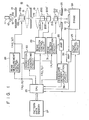
- an electron beam position indicates an intersection coordinate point (XR, YR) of two adjacent sides of an electron beam 12 corresponding to the edges of a rectangular aperture 17a of a second aperture mask 17, and an electron beam dimension includes longitudinal and transverse dimensions of the beam in the x and y-directions with reference to the coordinate point (XR, YR).
- the electron beam 12 from an electron beam source 11 irradiates a semiconductor wafer 13 as an object to be exposed, through its beam path.
- a beam dimension changing mechanism 18 is on this beam path.
- the beam dimension changing mechanism l8 has the following parts arranged from the beam source 11 to the wafer 13 in the order named: blanking plates 10, a first aperture mask 14 having a rectangular aperture 14a, a pair of x deflectors 15a for controlling beam dimensions, a pair of y deflectors 15b, a first electron lens 16, and the second aperture 17 having the rectangular aperture 17a.
- a second electron lens 19 two pairs of x scanning plates 20a, 20a', two pairs of y scanning plates 20b, 20b', a pair of x correction deflectors 21a, a pair of y correction deflectors 21b, an objective electron lens 22, and a reflected electron sensor 23 are arranged next to the beam dimension changing mechanism 18 on the beam path of the electron beam 12.
- the semiconductor wafer 13 as an object to be exposed is placed on a flat surface of a stage 24.
- the stage 24 is driven in the x and y directions and the directional position is detected by a stage control circuit 25.
- a position detection signal from the stage control circuit 25 is supplied to a CPU 26.
- the CPU 26 supplies a stage drive signal to the stage control circuit 25, and a control signal to a beam position control circuit 29.
- An exposure pattern to be drawn on the semiconductor wafer 13 by the electron'beam 12 is determined by pattern data stored in a pattern data memory 27 coupled to the CPU 26.
- the pattern data in the pattern data memory 27 is accessed by the CPU 26 and readout pattern data is fetched therein.
- the CPU 26 supplies beam dimension' data (x0, y0) included in the readout pattern data to a beam measurement control circuit 28.
- the beam measurement control circuit 28 decodes the input beam dimension.data (x0, y0) and produces proper voltage signals (x0', y0') as beam dimension signals for obtaining predetermined beam dimensions.
- the voltage signals are supplied to the x and y deflectors 15a and 15b so as to deflect the electron beam 12 in the x and y directions accordingly.
- Pattern data (X0, YO) for exposing the semiconductor wafer 13 in a predetermined pattern is decoded by the beam position control circuit 29 which.produces two voltage signals for defining the x and y beam positions corresponding to the input pattern.
- the x voltage signal from the circuit 29 is supplied to the two pairs of x scanning plates 20a, 20b, and the y voltage signal is supplied to the two pairs of y scanning plates 20b, 20b'.
- the voltage signals (x0', y0') for obtaining the predetermined beam dimensions from the beam measurement control circuit 28 are supplied to a correction signal generating circuit 30 for generating signals for beam position correction.
- the correction signal generating circuit 30 generates correction signals (X, Y) for beam position correction in the x and y directions and supplies them to a beam position correction circuit 31.
- the correction signal generating circuit 30 will be described in detail later.
- the beam position correction circuit 31 produces voltage signals for correcting the beam position in the x and y directions, and supplies them to the x and y correction deflectors 21a and 21b, respectively.
- the position and dimensions of the electron beam 12 on the wafer 13 can be detected by a known method as follows.
- a Faraday cage 32 and a beam shape sensor 33 are arranged next to the wafer 13 on the surface of the stage 24 shown in Fig. 1.
- An output signal from the Faraday cage 32 is supplied to the CPU 26 through an ' amplifier 34.
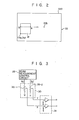
- the beam shape sensor 33 comprises, as shown in Fig. 2, a base 33a of a material having a small coefficient of electron reflection such as beryllium, and a fine particle 33b of a material having a high coefficient of electron reflection such as gold attached on the flat surface of the base 33a.
- the reflected electron sensor 23 is arranged above the fine particle 33b with its sensor surface facing the particle 33b.
- the surface of the beam shape sensor 33 is level with that of the wafer 13.
- the fine particle 33b has a small diameter of 0.1 pm to 0.3 ⁇ m.
- An output signal from the reflected electron sensor 23 is amplified by an amplifier 35 and is supplied to a waveshape memory/calculation circuit 36.
- the waveshape memory/calculation circuit 36 includes a RAM, for example, for storing a reflected electron intensity distribution which corresponds to a position and dimensions of the electron beam 12 and which is obtained from the output from the amplifier 35.
- the obtained data in the waveshape memory/calculation circuit 36 is read out upon being accessed by the CPU 26 and is supplied to the CPU 26.
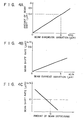
- the correction signal generating circuit 30 comprises, for example, simple potentiometers (voltage dividers) 30-1 and 30-2.
- the output signals (x0', y0') from the beam measurement control circuit 28 are supplied to one fixed end of the potentiometers 30-1 and 30-2, which supply divided voltages as correction signals (X, Y) to the beam position correction circuit 31.
- the voltage dividing ratios of the potentiometers 30-1 and 30-2 are set to equal the ratios of the beam dimensions to the amounts of shift in the beam position in corresponding directions.
- a preset voltage dividing ratio corresponding to the ratio K of the beam dimension to the amount of shift in beam position (or proportionality constant K) can be experimentally determined by measuring the amount of shift for various values of each beam dimension.
- Fig. 4A shows an example of the experiment results.
- the amount of the beam dimension variation in the x direction changes linearly with respect to the amount of shift in beam position in this direction.
- the.ratio of the amount of the beam dimension variation to the amount of shift in beam position is constant irrespective of changes in the beam dimension. If the ratio of the amount of a beam dimension variation in one direction to the amount of shift in beam position in this direction changes exponentially, a corresponding ratio K can be set.
- the correction signal generating circuit 30 may comprise multipliers 30A-1 and 30A-2 as shown in Fig. 5.
- proportionality constants Kl and K2 which are experimentally determined for the beam dimension signals (x0', y0') are produced from the CPU 26.
- Multiplication of the constants Kl, K2 by the signals (x0', y0') provides correction signals X and Y.
- Fig. 6 schematically shows changes in the shape of a cross section of the electron beam 12 while it is travelling toward the wafer 13 from-the source 11 of the embodiment shown in Fig. 1. Note that only the main components are shown in the figure.
- the electron beam 12 irradiated from the electron gun (beam source) 11 as the electron beam source has a diameter which is at least sufficiently larger than the maximum dimension of the rectangular aperture 14a of the first aperture mask 14.
- the electron beam 12 emerging from the aperture 14a has a cross section having the same shape as that of the aperture 14a, and the density of the beam current in the aperture 14a is constant.
- the electron beam 12 is then focused by the first electron lens 16 (Fig. 1) and .is deflected through predetermined angles in the x and y directions by the deflectors 15a and 15b (only the deflector 15a being shown here). As a result, the electron beam 12 is deflected to a position indicated by the broken line on the second aperture mask 17.
- the electron beam 12 emerging from the aperture 17a of the second aperture 17 has a cross sectional area P (hatched portion) corresponding to an overlapping portion of the image of the aperture 14a indicated by the broken line and the aperture 17a.
- the electron beam 12 with changed dimensions is deflected again in the x and y directions by the x and y scanning plates 20a, 20a', 20b and 20b', is position-corrected by the deflectors 21a and 21b, and is irradiated onto the wafer 13 through the second objective electron lens 22.
- the reference coordinate point (XR, YR) shifts in the x direction by about 0.4 ⁇ m from a point at which the beam dimension is set to be 0 ⁇ m, resulting in a beam shift of about 0.4 ⁇ m.
- the dimensions of an electron beam having an area P1 (xl x yl) as shown in Fig. 7 are changed to have an area P2 (x2 x yl).
- reference coordinate point (XR', YR') should have a value (XR, YR) theoretically.
- the position (XR', YR') of the electron beam 12 moves to a position (XR + ⁇ x, YR), as shown in Fig. 8B.
- XR' is larger than XR.
- the x-coordinate x2 is 5 ⁇ m
- the corresponding amount of beam shift ⁇ x is 0.4 ⁇ m as seen in Figs. 4A and 8B.
- the beam position must be corrected in the x-axis direction such that the amount of beam shift Ax remains zero irrespective of changes in the beam dimension. This is also applicable to a case wherein the reference point shift is in the y direction.
- the correction signals for obtaining a zero amount of shift in beam position in accordance with different values of the beam dimension can be easily obtained using the circuit as shown in Fig. 3 or 5.
- the sliding contacts of the potentiometers 30-1 and 30-2 are set in accordance with the slope of the line in Fig. 4A.
- the correction signals X and Y can be obtained in correspondence with the beam dimension signals x0' and y0'.
- the proportionality constants KI and K2 corresponding to the beam dimensions shown in Fig. 4A are stored in advance in the ROM (not shown) in the CPU 26. Multiplication of the signals x0' and y0' by the proportionality constants Kl and K2 readily yields the correction signals X and Y.
- the beam shape sensor 33 as shown in Fig. 2 is scanned with the electron beam 12.
- the fine gold particle 33b is scanned with the-electron beam 12
- a large number of electrons are reflected from the particle 33b.
- the reflected electron intensity output J from the sensor 23 becomes signifi - cantly high between positions xA and xB along the x in accordance with a beam dimension AB along the x direction.
- the dimension of the cross section of the electron beam 12 along the x direction can be detected by detecting the output J at a threshold value "50", for example, using the output from the sensor 23, storing this output value in the waveshape memory/calculation circuit 36, reading it out under access control of the CPU 26, and calculating (xB - xA) in association with the scanning rate of the electron beam 12.
- the dimension of the cross section of the ' electron beam 12 along the y direction can be similarly measured by longitudinally scanning the fine particle 33b.
- the position of the electron beam 12 can be determined by determining the coordinate point (XR, YR) as shown in Fig. 2.
- the coordinate point (XR, YR) is on a line which includes point B. This means the coordinate XR is the position of a reflected electron intensity distribution xB shown in Fig. 9 and stored in the waveshape memory/calculation circuit 36.
- the position of the stage 24 can be correctly measured by a known distance measuring system which uses a laser beam which is irradiated from the stage control circuit 25 onto the stage 24 and reflected back to the circuit 25.
- the beam position which changes in accordance with changes in the beam dimensions, can.be corrected.
- Such correction can be realized by adding the deflectors 21a and 21b, the correction signal generating circuit 30 and the beam position correction circuit 31 to a general electron beam exposure apparatus.
- an exposure apparatus of the present invention is simple in construction and is inexpensive to manufacture.
- the shift in the beam position is only corrected corresponding to changes in the beam dimensions.
- Such a shift in the beam position is known to be largely dependent on changes in the beam dimensions. This means that the shift in beam position can be substantially corrected by the apparatus of the embodiment described above, resulting in an extremely high pattern precision.
- Fig. 10 is a schematic block diagram of a second embodiment of the present invention.
- the same reference numerals as used in Fig. 1 denote the same parts in Fig. 10.
- the embodiment shown in Fig.-10 differs from that shown in Fig. 1 in that the correction signal generating circuit 30 in Fig. 1 is eliminated and instead the CPU 26 has a function of obtaining the correction signals X and Y.
- the CPU 26 has therein a RAM which stores the ratio of the shift in beam position to the beam dimensions, such a ratio for the embodiment shown in Fig. 1 being shown in Fig. 4A.
- Pattern data fetched in the CPU 26 from the pattern data memory 27 includes data (x0, y0) representing the beam dimensions.
- the CPU 26 multiplies the data (x0, y0) by the ratio read out from the RAM so as to obtain the correction signals X and Y.
- the correction signals X and Y thus obtained.are supplied to the beam position correction circuit 31.
- the rate of the beam position shift also changes.
- the ratio of the beam current variation rate to the rate of the beam shift in beam position, and the ratio of the amount of defocusing to the ratio of shift in beam position are measured in advance.
- the measurement data is stored in the RAM of the CPU 26.
- the ratio of the beam dimensions to the amount of shift in beam position is stored in the RAM of the CPU 26.
- data representing the amount of shift in beam position corresponding to each beam dimension can be stored in the RAM in the form of a memory table. Then, the RAM can be accessed using the beam dimension signal as an address signal from the CPU 26.
- the readout data representing the corresponding amount of shift is in the beam position used for obtaining correction signals. In order to minimize error in the correction signals; optimization of correction signals can be performed.
- the above-mentioned correction methods are all applicable in a case wherein the shift of the reference position with respect to the variation in beam dimension can be assumed to vary linearly.
- the above noted linear approximation can not be applied, because the precision of the pattern can not be maintained.
- the precision of the pattern depends upon the apparatus construction, degree of control precision of an electron optics system, nature of a material forming the exposure system, and mechanical precision.
- the following third embodiment will be suited for the above-mentioned case.
- the third embodiment of the present invention is similar to the first embodiment shown in Fig. 1. Accordingly, a detailed description thereof will be omitted, and reference to Fig. 1 will be made for descriptive purposes.
- the beam position correction signals X and Y are represented as nth-order functions of the beam dimension data (x0, y0).
- the constants kl to k10 are stored in the CPU 26.
- the correction signal generating circuit 30 incorporates therein a calculation circuit.
- the calculation circuit receives the beam dimension data (x0, y0) from the CPU 26 or the beam dimension signals (x0', y0') from the beam dimension control circuit 28, as indicated by the broken line in Fig. 1.
- the calculation circuit similarly receives the constants kl to k10 from the CPU 26 so as to perform equation (1) calculations.
- beam position correction can be performed with higher precision than in the embodiments shown in Figs. 1 and 10.
- Fig. 11 is a schematic block diagram of a fourth embodiment of the present invention.
- the fourth embodiment differs from the first embodiment of Fig. 1 in that the correction deflectors 21a and 21b and the beam position correction circuit 31 are eliminated and a data processing circuit 40 with a memory 40a is used in place of the correction signal generating circuit 30.
- the data processing circuit 40 includes a CPU which receives the beam dimension data (x0, y0) from the CPU 26 and obtains the correction signals X and Y in accordance with equation (1).
- the data processing circuit 40 produces correction signals X, Y and produces corrected beam position signals X' and Y' in accordance with the correction signals X'and Y thus obtained and the beam position signals XO and YO from the CPU 26.
- the beam position control circuit 29 receives the corrected beam position signals X' and Y' and produces the beam position setting voltages in both the x and y directions which have been corrected for the shift in beam position corresponding to a change in the beam dimensions.
- the voltages from the beam position control circuit 29 are applied to the deflecting or scanning plates 20a and 20b.
- the present invention is not limited to the particular embodiments described above. Various changes and modifications may be made within the spirit and scope of the present invention.
- the configurations of the correction signal generating circuit 30, the beam position correction circuit 31, the correction deflectors 21a and 21b, and so on are not limited to those of the embodiments described above.
- the apparatus of the present invention must essentially have a means for obtaining the amount of shift in beam position corresponding to a change in the dimension of an electron beam, and a means for correcting the beam position in accordance with the obtained amount of shift in beam position.
- another charged particle beam such as an ion beam may be used in place of the electron beam in the present invention.
Landscapes
- Chemical & Material Sciences (AREA)
- Engineering & Computer Science (AREA)
- Nanotechnology (AREA)
- Analytical Chemistry (AREA)
- Physics & Mathematics (AREA)
- Crystallography & Structural Chemistry (AREA)
- Condensed Matter Physics & Semiconductors (AREA)
- General Physics & Mathematics (AREA)
- Manufacturing & Machinery (AREA)
- Mathematical Physics (AREA)
- Theoretical Computer Science (AREA)
- Electron Beam Exposure (AREA)
Applications Claiming Priority (2)
| Application Number | Priority Date | Filing Date | Title |
|---|---|---|---|
| JP57171377A JPS5961134A (ja) | 1982-09-30 | 1982-09-30 | 荷電ビ−ム露光装置 |
| JP171377/82 | 1982-09-30 |
Publications (3)
| Publication Number | Publication Date |
|---|---|
| EP0105694A2 true EP0105694A2 (de) | 1984-04-18 |
| EP0105694A3 EP0105694A3 (en) | 1986-08-06 |
| EP0105694B1 EP0105694B1 (de) | 1988-05-04 |
Family
ID=15922046
Family Applications (1)
| Application Number | Title | Priority Date | Filing Date |
|---|---|---|---|
| EP83305766A Expired EP0105694B1 (de) | 1982-09-30 | 1983-09-27 | Gerät zur Belichtung mittels geladenem Teilchenstrahl |
Country Status (5)
| Country | Link |
|---|---|
| US (1) | US4647782A (de) |
| EP (1) | EP0105694B1 (de) |
| JP (1) | JPS5961134A (de) |
| DD (1) | DD210771A5 (de) |
| DE (1) | DE3376513D1 (de) |
Cited By (2)
| Publication number | Priority date | Publication date | Assignee | Title |
|---|---|---|---|---|
| EP0179294A1 (de) * | 1984-09-27 | 1986-04-30 | Hitachi, Ltd. | Ionenmikrostrahlvorrichtung |
| US5130550A (en) * | 1989-10-23 | 1992-07-14 | Hitachi, Ltd. | Electron beam lithography apparatus having device for correcting beam shape |
Families Citing this family (17)
| Publication number | Priority date | Publication date | Assignee | Title |
|---|---|---|---|---|
| JPS6229135A (ja) * | 1985-07-29 | 1987-02-07 | Advantest Corp | 荷電粒子ビ−ム露光方法及びこの方法を用いた荷電粒子ビ−ム露光装置 |
| JPS62172724A (ja) * | 1986-01-27 | 1987-07-29 | Toshiba Corp | 荷電ビ−ム露光方法 |
| JPS62277724A (ja) * | 1986-05-27 | 1987-12-02 | Fujitsu Ltd | 電子ビ−ム露光装置 |
| JPH0622195B2 (ja) * | 1987-02-26 | 1994-03-23 | 東芝機械株式会社 | 荷電ビ−ム描画装置 |
| JP2614884B2 (ja) * | 1988-02-04 | 1997-05-28 | 富士通株式会社 | 電子ビーム露光方法及びその装置 |
| JPH0744143B2 (ja) * | 1988-09-20 | 1995-05-15 | 株式会社日立製作所 | 電子線描画装置の外部磁気補正方法 |
| JPH0722010B2 (ja) * | 1989-09-28 | 1995-03-08 | 株式会社日立製作所 | 電子線描画装置 |
| JP2788139B2 (ja) * | 1991-09-25 | 1998-08-20 | 株式会社日立製作所 | 電子線描画装置 |
| JP3173162B2 (ja) * | 1992-08-20 | 2001-06-04 | 富士通株式会社 | 透過マスク板 |
| JP3105670B2 (ja) * | 1992-11-26 | 2000-11-06 | 富士通株式会社 | 荷電粒子ビーム露光装置及びその制御方法 |
| JP3274212B2 (ja) * | 1993-03-18 | 2002-04-15 | 株式会社日立製作所 | 電子線検出器及びそれを用いた電子線描画装置 |
| US5546319A (en) * | 1994-01-28 | 1996-08-13 | Fujitsu Limited | Method of and system for charged particle beam exposure |
| US5608215A (en) | 1994-09-16 | 1997-03-04 | Schlumberger Technology Corporation | Method and apparatus for determining density of earth formations |
| JPH11149893A (ja) * | 1997-11-18 | 1999-06-02 | Sony Corp | 電子ビーム描画装置および描画方法並びに半導体装置 |
| DE19827819C2 (de) * | 1998-06-17 | 2003-07-03 | Equicon Software Gmbh Jena | Verfahren zur Steuerung von Elektronenstrahl-Belichtungsanlagen mit Formstrahlprinzip |
| JP3940310B2 (ja) * | 2002-04-04 | 2007-07-04 | 株式会社日立ハイテクノロジーズ | 電子ビーム描画方法及び描画装置、並びにこれを用いた半導体製造方法 |
| JP2006269545A (ja) * | 2005-03-22 | 2006-10-05 | Toshiba Corp | 荷電ビーム露光装置、荷電ビーム露光方法、マスク製造方法および半導体装置の製造方法 |
Family Cites Families (9)
| Publication number | Priority date | Publication date | Assignee | Title |
|---|---|---|---|---|
| JPS6051261B2 (ja) * | 1976-05-26 | 1985-11-13 | 株式会社東芝 | 荷電粒子ビ−ム描画装置 |
| JPS5412675A (en) * | 1977-06-30 | 1979-01-30 | Jeol Ltd | Electon beam exposure method |
| DD134582A1 (de) * | 1978-01-19 | 1979-03-07 | Eberhard Hahn | Verfahren und einrichtung zur justierung einer elektronenstrahlbearbeitungsanlage |
| JPS54128680A (en) * | 1978-03-30 | 1979-10-05 | Jeol Ltd | Exposure method for electron rays |
| JPS5693318A (en) * | 1979-12-10 | 1981-07-28 | Fujitsu Ltd | Electron beam exposure device |
| JPS56147437A (en) * | 1980-04-17 | 1981-11-16 | Fujitsu Ltd | Electron beam exposure method |
| JPS58121625A (ja) * | 1981-12-28 | 1983-07-20 | Fujitsu Ltd | 電子ビ−ム露光装置 |
| US4469950A (en) * | 1982-03-04 | 1984-09-04 | Varian Associates, Inc. | Charged particle beam exposure system utilizing variable line scan |
| JPS5932128A (ja) * | 1982-08-18 | 1984-02-21 | Nippon Telegr & Teleph Corp <Ntt> | 荷電ビ−ム露光装置におけるビ−ム照射位置補正方法 |
-
1982
- 1982-09-30 JP JP57171377A patent/JPS5961134A/ja active Pending
-
1983
- 1983-09-27 EP EP83305766A patent/EP0105694B1/de not_active Expired
- 1983-09-27 DE DE8383305766T patent/DE3376513D1/de not_active Expired
- 1983-09-30 DD DD83255305A patent/DD210771A5/de not_active IP Right Cessation
-
1985
- 1985-11-25 US US06/800,918 patent/US4647782A/en not_active Expired - Lifetime
Cited By (2)
| Publication number | Priority date | Publication date | Assignee | Title |
|---|---|---|---|---|
| EP0179294A1 (de) * | 1984-09-27 | 1986-04-30 | Hitachi, Ltd. | Ionenmikrostrahlvorrichtung |
| US5130550A (en) * | 1989-10-23 | 1992-07-14 | Hitachi, Ltd. | Electron beam lithography apparatus having device for correcting beam shape |
Also Published As
| Publication number | Publication date |
|---|---|
| EP0105694B1 (de) | 1988-05-04 |
| US4647782A (en) | 1987-03-03 |
| DD210771A5 (de) | 1984-06-20 |
| DE3376513D1 (en) | 1988-06-09 |
| EP0105694A3 (en) | 1986-08-06 |
| JPS5961134A (ja) | 1984-04-07 |
Similar Documents
| Publication | Publication Date | Title |
|---|---|---|
| EP0105694B1 (de) | Gerät zur Belichtung mittels geladenem Teilchenstrahl | |
| KR100241995B1 (ko) | 하전입자빔 노광장치 | |
| US7834333B2 (en) | Charged particle beam lithography system and method for evaluating the same | |
| US4321510A (en) | Electron beam system | |
| KR102797357B1 (ko) | 하전 입자 빔 묘화 방법 및 하전 입자 빔 묘화 장치 | |
| JP3288794B2 (ja) | 荷電ビーム補正方法及びマーク検出方法 | |
| TW201539148A (zh) | 多荷電粒子射束描繪裝置及多荷電粒子射束描繪方法 | |
| KR20180098152A (ko) | 멀티 하전 입자 빔 묘화 장치 및 그 조정 방법 | |
| KR20190138583A (ko) | 하전 입자 빔 묘화 장치 및 하전 입자 빔 묘화 방법 | |
| US5831273A (en) | Charged particle beam lithography method and apparatus thereof | |
| US4891524A (en) | Charged particle beam exposure system and method of compensating for eddy current effect on charged particle beam | |
| EP0035556B1 (de) | Elektronenstrahlsystem | |
| US4264822A (en) | Electron beam testing method and apparatus of mask | |
| NL8000524A (nl) | Lithograferen door middel van een elektronenstraal. | |
| US6969853B2 (en) | Pattern width measuring apparatus, pattern width measuring method, and electron beam exposure apparatus | |
| JP3266336B2 (ja) | 電子ビーム走査装置 | |
| US11024485B2 (en) | Multi-charged-particle-beam writing apparatus and beam evaluating method for the same | |
| TW472298B (en) | Electron beam exposure apparatus, adjusting method, and block mask for adjustment | |
| TW202201458A (zh) | 聚焦離子束加工裝置 | |
| JP2834466B2 (ja) | イオンビーム装置及びその制御方法 | |
| KR102845204B1 (ko) | 피복률 산출 방법, 하전 입자 빔 묘화 방법, 피복률 산출 장치, 하전 입자 빔 묘화 장치 및 컴퓨터 판독 가능한 기록 매체에 기록된 프로그램 | |
| JPH04274341A (ja) | 断面加工観察方法 | |
| US20020038853A1 (en) | Electron beam exposure apparatus | |
| US6989536B2 (en) | Electron-beam writing device and electron-beam writing method | |
| JP3002246B2 (ja) | 荷電ビーム補正方法 |
Legal Events
| Date | Code | Title | Description |
|---|---|---|---|
| PUAI | Public reference made under article 153(3) epc to a published international application that has entered the european phase |
Free format text: ORIGINAL CODE: 0009012 |
|
| 17P | Request for examination filed |
Effective date: 19831007 |
|
| AK | Designated contracting states |
Designated state(s): DE FR GB NL |
|
| RAP1 | Party data changed (applicant data changed or rights of an application transferred) |
Owner name: KABUSHIKI KAISHA TOSHIBA |
|
| PUAL | Search report despatched |
Free format text: ORIGINAL CODE: 0009013 |
|
| AK | Designated contracting states |
Kind code of ref document: A3 Designated state(s): DE FR GB NL |
|
| 17Q | First examination report despatched |
Effective date: 19870317 |
|
| GRAA | (expected) grant |
Free format text: ORIGINAL CODE: 0009210 |
|
| AK | Designated contracting states |
Kind code of ref document: B1 Designated state(s): DE FR GB NL |
|
| REF | Corresponds to: |
Ref document number: 3376513 Country of ref document: DE Date of ref document: 19880609 |
|
| ET | Fr: translation filed | ||
| PLBE | No opposition filed within time limit |
Free format text: ORIGINAL CODE: 0009261 |
|
| STAA | Information on the status of an ep patent application or granted ep patent |
Free format text: STATUS: NO OPPOSITION FILED WITHIN TIME LIMIT |
|
| 26N | No opposition filed | ||
| PGFP | Annual fee paid to national office [announced via postgrant information from national office to epo] |
Ref country code: FR Payment date: 19970909 Year of fee payment: 15 |
|
| PGFP | Annual fee paid to national office [announced via postgrant information from national office to epo] |
Ref country code: GB Payment date: 19970918 Year of fee payment: 15 |
|
| PGFP | Annual fee paid to national office [announced via postgrant information from national office to epo] |
Ref country code: NL Payment date: 19970929 Year of fee payment: 15 |
|
| PGFP | Annual fee paid to national office [announced via postgrant information from national office to epo] |
Ref country code: DE Payment date: 19971010 Year of fee payment: 15 |
|
| PG25 | Lapsed in a contracting state [announced via postgrant information from national office to epo] |
Ref country code: GB Free format text: LAPSE BECAUSE OF NON-PAYMENT OF DUE FEES Effective date: 19980927 |
|
| PG25 | Lapsed in a contracting state [announced via postgrant information from national office to epo] |
Ref country code: NL Free format text: LAPSE BECAUSE OF NON-PAYMENT OF DUE FEES Effective date: 19990401 |
|
| GBPC | Gb: european patent ceased through non-payment of renewal fee |
Effective date: 19980927 |
|
| PG25 | Lapsed in a contracting state [announced via postgrant information from national office to epo] |
Ref country code: FR Free format text: LAPSE BECAUSE OF NON-PAYMENT OF DUE FEES Effective date: 19990531 |
|
| NLV4 | Nl: lapsed or anulled due to non-payment of the annual fee |
Effective date: 19990401 |
|
| PG25 | Lapsed in a contracting state [announced via postgrant information from national office to epo] |
Ref country code: DE Free format text: LAPSE BECAUSE OF NON-PAYMENT OF DUE FEES Effective date: 19990701 |
|
| REG | Reference to a national code |
Ref country code: FR Ref legal event code: ST |