EP0105955B1 - Chaise - Google Patents
Chaise Download PDFInfo
- Publication number
- EP0105955B1 EP0105955B1 EP82109443A EP82109443A EP0105955B1 EP 0105955 B1 EP0105955 B1 EP 0105955B1 EP 82109443 A EP82109443 A EP 82109443A EP 82109443 A EP82109443 A EP 82109443A EP 0105955 B1 EP0105955 B1 EP 0105955B1
- Authority
- EP
- European Patent Office
- Prior art keywords
- support
- plate portion
- seat support
- seat
- rear plate
- Prior art date
- Legal status (The legal status is an assumption and is not a legal conclusion. Google has not performed a legal analysis and makes no representation as to the accuracy of the status listed.)
- Expired
Links
Images

Classifications
-
- A—HUMAN NECESSITIES
- A47—FURNITURE; DOMESTIC ARTICLES OR APPLIANCES; COFFEE MILLS; SPICE MILLS; SUCTION CLEANERS IN GENERAL
- A47C—CHAIRS; SOFAS; BEDS
- A47C7/00—Parts, details, or accessories of chairs or stools
- A47C7/02—Seat parts
- A47C7/024—Seat parts with double seats
-
- A—HUMAN NECESSITIES
- A47—FURNITURE; DOMESTIC ARTICLES OR APPLIANCES; COFFEE MILLS; SPICE MILLS; SUCTION CLEANERS IN GENERAL
- A47C—CHAIRS; SOFAS; BEDS
- A47C7/00—Parts, details, or accessories of chairs or stools
- A47C7/36—Supports for the head or the back
- A47C7/40—Supports for the head or the back for the back
- A47C7/44—Supports for the head or the back for the back with elastically-mounted frame
- A47C7/443—Supports for the head or the back for the back with elastically-mounted frame with coil springs
- A47C7/444—Supports for the head or the back for the back with elastically-mounted frame with coil springs of torsion type
-
- A—HUMAN NECESSITIES
- A47—FURNITURE; DOMESTIC ARTICLES OR APPLIANCES; COFFEE MILLS; SPICE MILLS; SUCTION CLEANERS IN GENERAL
- A47C—CHAIRS; SOFAS; BEDS
- A47C1/00—Chairs adapted for special purposes
- A47C1/02—Reclining or easy chairs
- A47C1/031—Reclining or easy chairs having coupled concurrently adjustable supporting parts
- A47C1/032—Reclining or easy chairs having coupled concurrently adjustable supporting parts the parts being movably-coupled seat and back-rest
- A47C1/03261—Reclining or easy chairs having coupled concurrently adjustable supporting parts the parts being movably-coupled seat and back-rest characterised by elastic means
- A47C1/03272—Reclining or easy chairs having coupled concurrently adjustable supporting parts the parts being movably-coupled seat and back-rest characterised by elastic means with coil springs
- A47C1/03274—Reclining or easy chairs having coupled concurrently adjustable supporting parts the parts being movably-coupled seat and back-rest characterised by elastic means with coil springs of torsion type
-
- A—HUMAN NECESSITIES
- A47—FURNITURE; DOMESTIC ARTICLES OR APPLIANCES; COFFEE MILLS; SPICE MILLS; SUCTION CLEANERS IN GENERAL
- A47C—CHAIRS; SOFAS; BEDS
- A47C3/00—Chairs characterised by structural features; Chairs or stools with rotatable or vertically-adjustable seats
- A47C3/02—Rocking chairs
- A47C3/025—Rocking chairs with seat, or seat and back-rest unit, elastically mounted in a rigid frame
- A47C3/026—Rocking chairs with seat, or seat and back-rest unit, elastically mounted in a rigid frame with a central column, e.g. rocking office chairs; Tilting chairs
-
- A—HUMAN NECESSITIES
- A47—FURNITURE; DOMESTIC ARTICLES OR APPLIANCES; COFFEE MILLS; SPICE MILLS; SUCTION CLEANERS IN GENERAL
- A47C—CHAIRS; SOFAS; BEDS
- A47C7/00—Parts, details, or accessories of chairs or stools
- A47C7/02—Seat parts
- A47C7/14—Seat parts of adjustable shape; elastically mounted ; adaptable to a user contour or ergonomic seating positions
- A47C7/144—Seat parts of adjustable shape; elastically mounted ; adaptable to a user contour or ergonomic seating positions with array of movable supports
Definitions
- the invention relates to a chair with a seat support, a seat plate, which comprises a front, immovably connected to the seat support part plate and a rear, pivotable about a horizontal, transverse axis with the front connected part plate, with at least one elastic energy accumulator, which the rear part plate seeks to pivot upwards, and with a backrest that is also inclined when the rear partial plate is inclined.
- Such a chair is known from US-A-1 836 630.
- the rear partial plate and the backrest are rigidly connected to one another, so that it is not possible to adopt a sitting position that is adapted to the different posture of the respective posture.
- a chair of the type described at the outset which is characterized by a pivotally connected to the seat support, acted upon by the elastic energy accumulator and supporting a backrest, which supports the rear partial plate via a handlebar and underneath the seat plate between the pivotable mounting of the rear plate and the handlebar is mounted on the seat support.
- the support arm can be fixed in different angular positions by means of a latching device. It is advantageous if a locking cartridge is rotatably mounted on the one hand on the seat support and on the other hand on the support arm and if the locking cartridge comprises an elastic energy accumulator that tries to move the support arm into the upright position.
- the snap-in cartridge preferably has two halves which can be telescopically displaced relative to one another, the spacing of which can be fixed by a spring-loaded catch; a spring that presses the two halves apart is arranged inside the snap-in cartridge.
- Such a construction is particularly advantageous since it can be arranged in the rear part of the seat between the seat support and the support arm without taking up much space, in particular the snap-in cartridge can be immersed between two legs of the support arm.
- a spiral spring acting on the rear part plate with an upward force is arranged below the seat support.
- Such bending springs are structurally less complex than torsion bar springs, for example, and thus enable such a chair to be produced inexpensively.
- the spiral spring has in its central region at least one helical turn and two arms extending from it, one of which rests on the underside of the seat support, the other on the underside of the rear partial plate, and when one is in the turn Support surface held by the seat support protrudes.
- the two arms of the spiral spring run close to the underside of the seat plate and therefore take up very little space.
- the other arm of the spiral spring rests on the bearing shaft of a handlebar, one end of which is pivotally mounted on the rear partial plate and the other end of which is pivotally mounted on the support bracket.
- This double function of the bearing shaft eliminates the need for special support elements for the spiral spring, i.e. the construction is further simplified.
- a spiral spring is arranged on each side of the seat support and both spiral springs are connected to one another in the region of their support on the seat support via a crossbar.
- a support projecting on both sides is preferably held on the seat support, the ends of which protrude into the winding of one of the two spiral springs and form the support surface.
- the assembly of the spiral spring can therefore be carried out in the simplest way so that the two spiral springs are slightly bent apart and that the Windings of the two spiral springs are pushed from the outside over the ends of the carrier. No further fixation means are then necessary.
- the spring force for pivoting the rear part plate and the support arm is distributed over different springs, namely on two spiral springs and the spring of the locking cartridge. This allows springs to be used that are small in size, i.e. this distribution of the spring force over several spring units further reduces the space required for the pivoting mechanism below the seat surface.
- the carrier is hollow at least on one side and an actuating lever for adjusting the height of the seat carrier is arranged in it.
- This integration of the lever also saves space, so that overall a chair can be produced inexpensively with the construction according to the invention, which carries a pivoting mechanism that is not very important on the underside of the seat surface and on the other hand advantageously enables anatomically correct sitting.
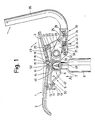
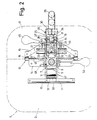
- the chair shown in Figures 1 and 2 comprises a seat plate 1, which is formed by a front partial plate 2 and a rear partial plate 3.
- the front partial plate 2, which is approximately twice as deep as the rear partial plate 3, is firmly connected to a seat support 5, which consists of a plate-shaped rail.
- This is rigidly connected by means of a horizontal region 6 to a support column 7, and this support column 7 is telescopically mounted in a receiving tube 8 of a chair foot, not shown in the drawing.
- a horizontal end area 10 adjoins the horizontal area 6 of the seat support 5 via an obliquely rising area 9, which is welded to an angle rail 11 running parallel to the front edge of the seat plate.
- the angle rail 11 lies on the underside of the front partial plate 2 approximately in the middle between the front edge and the rear edge thereof and is connected to the front partial plate 2 by means of screws 12.
- the horizontal region 6 of the seat support 5 carries, immediately behind the fastening point of the support column 7, an upwardly protruding support 13 which is welded to a flap 14 of a hinge 15 on the rear edge of the front partial plate 2.
- the tab 14 is fastened by means of screws 16 to the underside of the front partial plate 2 in such a way that a bearing shaft 17 encompassed by the tab 14 extends parallel behind the rear edge of the partial plate 2.
- the front partial plate 2 is thus held rigidly on the seat support 5 via the angle rail 11 held on the seat support and via the tab 14 connected to the support 13.
- the angle rail 11 and the tab 14 extend approximately over half the width of the seat surface, while the seat support 5, on the other hand, has only a small width (FIG. 2).
- the bearing shaft 17 protrudes laterally over the tab 14, and in this area the bearing shaft 17 is surrounded by hinge eyelets 18 which are connected to two fastening bands 19 lying flat against the underside of the rear partial plate 3.
- These fastening tapes 19 run obliquely to the rear of the rear partial plate and the center thereof and are fastened by means of screws 20 to the underside of the rear partial plate 3, so that the latter is pivotably mounted at the rear end of the front partial plate 2.
- the ends of the fastening straps 19 opposite the hinge eyelets 18 are bent vertically downward and each form a bearing 21 for a horizontal bearing shaft 22 which runs parallel to the bearing shaft 17 and is arranged at a small distance parallel to the underside of the rear partial plate 3.
- a bearing shaft 23 which runs parallel to the bearing shaft 17 and which protrudes laterally beyond the seat carrier 5, is rigidly attached.
- plate-shaped webs 24 of a U-shaped support arm 25 are pivotally mounted on both sides of the seat support, which carries at its end facing away from the bearing a curved tube 26 carrying the seat back, not shown in the drawing.
- the bearing point of the support arm 25 is located approximately between the vertical plane defined by the bearing shaft 17 and between the vertical plane defined by the bearing shaft 22.
- a link 27 rotatably mounted on the bearing shaft 22 is rotatably mounted on a further bearing shaft 28 which runs parallel to the bearing shaft 22 and is held with its ends in the two opposing webs 24 of the support arm 25.
- a snap-in cartridge 31 On a parallel to the bearing shaft 28 bearing pin 29, which is held in the web area 30 of the U-shaped support arm 25, one end of a snap-in cartridge 31 is rotatably mounted, the other end of which is rotatably mounted on a bearing pin 32, which in turn is in a U-shaped holder 33 is attached to the underside of the seat support 5.
- the snap-in cartridge 31 consists of two telescopically displaceable tube pieces 34 and 35, both of which are rotatably mounted via a bearing pin 29 and 32, respectively.
- the outer tube piece 35 is open at both ends and has in its interior an annular step 36 which serves as a stop for a snap ring 37 projecting beyond the outer circumference of the other tube piece 34 and limits the extension of the snap-in cartridge 31 by pushing the tube pieces 34 and 35 apart.
- a compression spring 38 which is supported on the one hand on the bearing pin 29 and on the other hand on a thrust washer 39 which in turn rests on the bearing pin 32.
- the thrust washer 39 also carries a mandrel 40 entering the inside of the compression spring 38.
- Parallel circumferential grooves 41 are arranged in the outer circumference of the inner tube piece 34, into which a locking lever 43 with locking projections 44 can pass through an opening 42 in the outer tube piece 35, so that the inner tube piece 34 can be fixed in its axial position relative to the outer tube piece 35.
- the locking lever 43 is pivotally mounted laterally below the locking cartridge on the outer tube piece 35 and is pivoted by means of a tension spring, not shown in the drawing, into the position in which the locking projections 44 engage in the circumferential grooves 41.
- a handle 45 By means of a handle 45, the locking lever 43 can be pivoted out of the engagement position against the action of the tension spring, so that the distance between the two tube pieces 34 and 35 and thus also the angular position of the support arm 25 relative to the seat support 5 can be changed.
- a tunnel-shaped support 46 protruding laterally above the seat support 5, the upper, rounded outer surface of which serves as a supporting surface for, for example, bending springs 47 which are essentially parallel to both sides of the seat support 5 extends to this.
- Both spiral springs 47 are completely bent around the carrier 46 and thus form a winding 48 surrounding them, from which one end 49 of each spiral spring 47 extends substantially in a straight line under the rear partial plate 3 and rests against the underside of the bearing shaft 22, specifically in a space between the downwardly bent parts of the fastening straps serving as bearings 21 and the handlebar 27.
- each spiral spring is connected to a web 50, which runs parallel to the bearing shaft 17 and lies below the horizontal end region 10 on the seat support 5 and connects the two spiral springs 47 to one another.
- the web 50 is surrounded by a sleeve 51 rotatably mounted on it, which bears on the underside of the seat support 5.
- the bearing shaft 22 in the contact area of the ends 49 of the spiral springs 47 also carries a sleeve rotatably mounted on it, against which the ends 49 of the spiral spring 42 bear.
- These sleeves prevent when pivoting the plate and the support arm that the spiral spring on the underside of the seat support or on the bearing shaft 22 slide; on the contrary, these sleeves enable a rolling movement between the support arm or bearing shaft and the spiral spring.
- An actuating lever 52 for the height adjustment of the support column 7 relative to the receiving tube 8 is arranged in the interior of the tunnel-shaped support 46, this adjustment device being located inside the support column 7.
- the actuating lever 52 protrudes laterally parallel to the bearing shaft 17 and can be actuated on the underside of the seat plate 1 by a person sitting on the chair for height adjustment.
- the support arm and the rear partial plate can be fixed in different angular positions.
Landscapes
- Health & Medical Sciences (AREA)
- Dentistry (AREA)
- General Health & Medical Sciences (AREA)
- Chairs Characterized By Structure (AREA)
- Chair Legs, Seat Parts, And Backrests (AREA)
- Chairs For Special Purposes, Such As Reclining Chairs (AREA)
Claims (10)
Priority Applications (3)
| Application Number | Priority Date | Filing Date | Title |
|---|---|---|---|
| DE8282109443T DE3269436D1 (en) | 1982-10-13 | 1982-10-13 | Chair |
| EP82109443A EP0105955B1 (fr) | 1982-10-13 | 1982-10-13 | Chaise |
| AT82109443T ATE18124T1 (de) | 1982-10-13 | 1982-10-13 | Stuhl. |
Applications Claiming Priority (1)
| Application Number | Priority Date | Filing Date | Title |
|---|---|---|---|
| EP82109443A EP0105955B1 (fr) | 1982-10-13 | 1982-10-13 | Chaise |
Publications (2)
| Publication Number | Publication Date |
|---|---|
| EP0105955A1 EP0105955A1 (fr) | 1984-04-25 |
| EP0105955B1 true EP0105955B1 (fr) | 1986-02-26 |
Family
ID=8189277
Family Applications (1)
| Application Number | Title | Priority Date | Filing Date |
|---|---|---|---|
| EP82109443A Expired EP0105955B1 (fr) | 1982-10-13 | 1982-10-13 | Chaise |
Country Status (3)
| Country | Link |
|---|---|
| EP (1) | EP0105955B1 (fr) |
| AT (1) | ATE18124T1 (fr) |
| DE (1) | DE3269436D1 (fr) |
Cited By (7)
| Publication number | Priority date | Publication date | Assignee | Title |
|---|---|---|---|---|
| DE3741472A1 (de) * | 1987-12-08 | 1989-06-22 | Simon Desanta | Stuhl |
| DE3930361A1 (de) * | 1989-09-12 | 1991-03-21 | Simon Desanta | Stuhl, insbesondere buerostuhl |
| DE4303324A1 (de) * | 1993-02-05 | 1994-08-11 | Bock Martin Kunststoff | Sitzmöbel, insbesondere Bürostuhl |
| DE4305841A1 (de) * | 1993-02-26 | 1994-09-01 | Ver Spezialmoebel Verwalt | Stuhl mit in der Höhe verstellbarem Sitz |
| US6386634B1 (en) | 1992-06-15 | 2002-05-14 | Herman Miller, Inc. | Office chair |
| US7815257B2 (en) | 2007-04-06 | 2010-10-19 | L & P Property Management Company | Adjustment device for adjustable chairs |
| US7866749B2 (en) | 2007-04-06 | 2011-01-11 | L & P Property Management Company | Adjustment device for a reclining chair |
Families Citing this family (15)
| Publication number | Priority date | Publication date | Assignee | Title |
|---|---|---|---|---|
| US5567012A (en) * | 1986-04-10 | 1996-10-22 | Steelcase, Inc. | Chair control |
| DE8614186U1 (de) * | 1986-05-26 | 1986-07-17 | Drabert Söhne GmbH & Co, 4950 Minden | Stuhl |
| NL8602506A (nl) * | 1986-10-06 | 1988-05-02 | Ahrend Groep Nv | Stoel met beweegbare zitting en rugleuning. |
| NO174135C (no) * | 1990-09-05 | 1994-03-23 | Staal & Stil As | Arbeidsstol |
| JP3330145B2 (ja) * | 1991-05-21 | 2002-09-30 | 株式会社イトーキ | 椅子の背,座部の連動支持機構 |
| DE9211244U1 (de) * | 1992-08-21 | 1992-10-29 | Friedrich W. Dauphin GmbH & Co, Entwicklungs- und Beteiligungs-KG, 8561 Offenhausen | Stuhl |
| GB2270622A (en) * | 1992-09-22 | 1994-03-23 | Walker And Homer Group Plc | Resiliently supported seat |
| US5782536A (en) * | 1995-02-17 | 1998-07-21 | Steelcase Inc. | Modular chair construction and method of assembly |
| RU2226975C2 (ru) * | 2001-08-06 | 2004-04-20 | Гаврюшов Александр Васильевич | Одиночное кресло с переменными частями сиденья |
| DE10200355A1 (de) * | 2002-01-08 | 2003-07-17 | Dauphin Friedrich W Gmbh | Stuhl |
| US8113586B2 (en) * | 2009-01-23 | 2012-02-14 | Chen Yung-Hua | Apparatus for adjusting the seat back angle |
| SE533619C2 (sv) * | 2009-03-06 | 2010-11-09 | Biomekanisk sittkonstruktion | |
| JP5514509B2 (ja) * | 2009-10-26 | 2014-06-04 | 株式会社イトーキ | ロッキング椅子 |
| CN108371436B (zh) * | 2018-04-25 | 2023-10-27 | 严澄宇 | 弹力跷跷板式的自由倾仰机构及自由调节转椅 |
| DE102021104004B4 (de) * | 2021-02-19 | 2026-05-07 | Eb-Invent Gmbh | Sitzmöbel |
Family Cites Families (3)
| Publication number | Priority date | Publication date | Assignee | Title |
|---|---|---|---|---|
| US1836630A (en) * | 1928-07-16 | 1931-12-15 | Thum Martin | Chair |
| US2321385A (en) * | 1941-06-16 | 1943-06-08 | Sikes Company | Tilting chair |
| DE1258045B (de) * | 1962-10-30 | 1968-01-04 | Hans Joachim Schneider Dr Med | Sitz mit Untergestell und Sitzkeil |
-
1982
- 1982-10-13 DE DE8282109443T patent/DE3269436D1/de not_active Expired
- 1982-10-13 AT AT82109443T patent/ATE18124T1/de not_active IP Right Cessation
- 1982-10-13 EP EP82109443A patent/EP0105955B1/fr not_active Expired
Cited By (8)
| Publication number | Priority date | Publication date | Assignee | Title |
|---|---|---|---|---|
| DE3741472A1 (de) * | 1987-12-08 | 1989-06-22 | Simon Desanta | Stuhl |
| DE3930361A1 (de) * | 1989-09-12 | 1991-03-21 | Simon Desanta | Stuhl, insbesondere buerostuhl |
| US6386634B1 (en) | 1992-06-15 | 2002-05-14 | Herman Miller, Inc. | Office chair |
| DE4303324A1 (de) * | 1993-02-05 | 1994-08-11 | Bock Martin Kunststoff | Sitzmöbel, insbesondere Bürostuhl |
| DE4305841A1 (de) * | 1993-02-26 | 1994-09-01 | Ver Spezialmoebel Verwalt | Stuhl mit in der Höhe verstellbarem Sitz |
| DE4305841B4 (de) * | 1993-02-26 | 2008-07-31 | VS Vereinigte Spezialmöbelfabriken GmbH & Co. KG | Stuhl mit in der Höhe verstellbarem Sitz |
| US7815257B2 (en) | 2007-04-06 | 2010-10-19 | L & P Property Management Company | Adjustment device for adjustable chairs |
| US7866749B2 (en) | 2007-04-06 | 2011-01-11 | L & P Property Management Company | Adjustment device for a reclining chair |
Also Published As
| Publication number | Publication date |
|---|---|
| ATE18124T1 (de) | 1986-03-15 |
| DE3269436D1 (en) | 1986-04-03 |
| EP0105955A1 (fr) | 1984-04-25 |
Similar Documents
| Publication | Publication Date | Title |
|---|---|---|
| EP0105955A1 (fr) | Chaise | |
| EP0179357B1 (fr) | Chaise | |
| EP0635227B1 (fr) | Chaise, notamment chaise de bureau | |
| DE69014936T2 (de) | Mechanismen zum Einstellen der Höhe und der Neigung eines Stuhls. | |
| DE3637362C2 (fr) | ||
| EP0079530A2 (fr) | Dispositif à bascule verrouillable pour sièges de meubles d'assise | |
| EP0159562A2 (fr) | Fauteuil élévateur | |
| DE19756723C1 (de) | Kindersitz mit klappbarer Rückenlehne | |
| DE4213206A1 (de) | Abgefedertes sitzgestell fuer einen sitz | |
| DE3533324C2 (fr) | ||
| DE3443835A1 (de) | Schwenkbares rad und insbesondere verbesserungen zum vereinfachen der bauart eines schwenkrades mit abfedernder wirkung | |
| DE2232117C3 (de) | Höhen- und neigungsverstellbarer Fahrzeugsitz | |
| DE7739993U1 (de) | Kopfstuetze fuer fahrzeuge | |
| EP0582818A1 (fr) | Chaise, notamment chaise de bureau | |
| DE3510274C2 (fr) | ||
| DE2307771C2 (de) | Sitzmöbel mit einem begrenzt kippbaren Sitz- oder Rückenlehnenteil | |
| EP0633845B1 (fr) | Siege, notamment de vehicle | |
| DE2206958A1 (de) | Fahrzeugsitz | |
| DE2721539A1 (de) | Fahrzeugsitz | |
| DE3619944A1 (de) | Der rueckenlehne eines kraftfahrzeugsitzes zugeordnete armlehne | |
| DE3130444C2 (de) | Fahrzeugsitz | |
| WO2001091613A1 (fr) | Chaise | |
| DE102010026787B4 (de) | Mechanik für einen Bürostuhl | |
| DE895855C (de) | Laengs verschiebbarer Sitz, insbesondere fuer Kraftfahrzeuge | |
| DE69714910T2 (de) | Verstellvorrichtung |
Legal Events
| Date | Code | Title | Description |
|---|---|---|---|
| PUAI | Public reference made under article 153(3) epc to a published international application that has entered the european phase |
Free format text: ORIGINAL CODE: 0009012 |
|
| 17P | Request for examination filed |
Effective date: 19830818 |
|
| AK | Designated contracting states |
Designated state(s): AT BE CH DE FR GB IT LI NL |
|
| ITF | It: translation for a ep patent filed | ||
| GRAA | (expected) grant |
Free format text: ORIGINAL CODE: 0009210 |
|
| AK | Designated contracting states |
Designated state(s): AT BE CH DE FR GB IT LI NL |
|
| REF | Corresponds to: |
Ref document number: 18124 Country of ref document: AT Date of ref document: 19860315 Kind code of ref document: T |
|
| ET | Fr: translation filed | ||
| REF | Corresponds to: |
Ref document number: 3269436 Country of ref document: DE Date of ref document: 19860403 |
|
| PLBE | No opposition filed within time limit |
Free format text: ORIGINAL CODE: 0009261 |
|
| STAA | Information on the status of an ep patent application or granted ep patent |
Free format text: STATUS: NO OPPOSITION FILED WITHIN TIME LIMIT |
|
| 26N | No opposition filed | ||
| ITTA | It: last paid annual fee | ||
| PGFP | Annual fee paid to national office [announced via postgrant information from national office to epo] |
Ref country code: FR Payment date: 19920914 Year of fee payment: 11 |
|
| PGFP | Annual fee paid to national office [announced via postgrant information from national office to epo] |
Ref country code: CH Payment date: 19920918 Year of fee payment: 11 |
|
| PGFP | Annual fee paid to national office [announced via postgrant information from national office to epo] |
Ref country code: BE Payment date: 19920921 Year of fee payment: 11 |
|
| PGFP | Annual fee paid to national office [announced via postgrant information from national office to epo] |
Ref country code: GB Payment date: 19921002 Year of fee payment: 11 |
|
| PGFP | Annual fee paid to national office [announced via postgrant information from national office to epo] |
Ref country code: AT Payment date: 19921012 Year of fee payment: 11 |
|
| PGFP | Annual fee paid to national office [announced via postgrant information from national office to epo] |
Ref country code: NL Payment date: 19921031 Year of fee payment: 11 |
|
| PGFP | Annual fee paid to national office [announced via postgrant information from national office to epo] |
Ref country code: DE Payment date: 19921106 Year of fee payment: 11 |
|
| PG25 | Lapsed in a contracting state [announced via postgrant information from national office to epo] |
Ref country code: GB Effective date: 19931013 Ref country code: AT Effective date: 19931013 |
|
| PG25 | Lapsed in a contracting state [announced via postgrant information from national office to epo] |
Ref country code: LI Effective date: 19931031 Ref country code: CH Effective date: 19931031 Ref country code: BE Effective date: 19931031 |
|
| BERE | Be: lapsed |
Owner name: MARTIN STOLL G.M.B.H. Effective date: 19931031 |
|
| PG25 | Lapsed in a contracting state [announced via postgrant information from national office to epo] |
Ref country code: NL Effective date: 19940501 |
|
| GBPC | Gb: european patent ceased through non-payment of renewal fee |
Effective date: 19931013 |
|
| NLV4 | Nl: lapsed or anulled due to non-payment of the annual fee | ||
| PG25 | Lapsed in a contracting state [announced via postgrant information from national office to epo] |
Ref country code: FR Effective date: 19940630 |
|
| REG | Reference to a national code |
Ref country code: CH Ref legal event code: PL |
|
| PG25 | Lapsed in a contracting state [announced via postgrant information from national office to epo] |
Ref country code: DE Effective date: 19940701 |
|
| REG | Reference to a national code |
Ref country code: FR Ref legal event code: ST |