EP0106169B1 - Substituierte 2-(2,6-Di-t-butyl-4-alkylphenoxy)4H-1,3,2-benzodioxaphosphorine und Zusammensetzungen, die sie enthalten - Google Patents
Substituierte 2-(2,6-Di-t-butyl-4-alkylphenoxy)4H-1,3,2-benzodioxaphosphorine und Zusammensetzungen, die sie enthalten Download PDFInfo
- Publication number
- EP0106169B1 EP0106169B1 EP83109126A EP83109126A EP0106169B1 EP 0106169 B1 EP0106169 B1 EP 0106169B1 EP 83109126 A EP83109126 A EP 83109126A EP 83109126 A EP83109126 A EP 83109126A EP 0106169 B1 EP0106169 B1 EP 0106169B1
- Authority
- EP
- European Patent Office
- Prior art keywords
- hydrogen
- carbon atoms
- radical containing
- alkyl radical
- butyl
- Prior art date
- Legal status (The legal status is an assumption and is not a legal conclusion. Google has not performed a legal analysis and makes no representation as to the accuracy of the status listed.)
- Expired
Links
- 239000000203 mixture Substances 0.000 title claims description 20
- LTDGMPIAAYLJJM-UHFFFAOYSA-N 4h-1,3,2-benzodioxaphosphinine Chemical class C1=CC=C2COPOC2=C1 LTDGMPIAAYLJJM-UHFFFAOYSA-N 0.000 title 1
- 229910052739 hydrogen Inorganic materials 0.000 claims description 121
- 239000001257 hydrogen Substances 0.000 claims description 121
- 125000004432 carbon atom Chemical group C* 0.000 claims description 106
- 150000002431 hydrogen Chemical class 0.000 claims description 52
- UFHFLCQGNIYNRP-UHFFFAOYSA-N Hydrogen Chemical compound [H][H] UFHFLCQGNIYNRP-UHFFFAOYSA-N 0.000 claims description 46
- -1 methoxy, phenyl Chemical group 0.000 claims description 35
- 125000002496 methyl group Chemical group [H]C([H])([H])* 0.000 claims description 32
- 125000004435 hydrogen atom Chemical group [H]* 0.000 claims description 23
- 125000000999 tert-butyl group Chemical group [H]C([H])([H])C(*)(C([H])([H])[H])C([H])([H])[H] 0.000 claims description 21
- ZFSLODLOARCGLH-UHFFFAOYSA-N isocyanuric acid Chemical compound OC1=NC(O)=NC(O)=N1 ZFSLODLOARCGLH-UHFFFAOYSA-N 0.000 claims description 20
- 239000003381 stabilizer Substances 0.000 claims description 16
- 239000011368 organic material Substances 0.000 claims description 12
- 125000001997 phenyl group Chemical group [H]C1=C([H])C([H])=C(*)C([H])=C1[H] 0.000 claims description 11
- 229920000642 polymer Polymers 0.000 claims description 11
- 229910052736 halogen Inorganic materials 0.000 claims description 10
- 150000002367 halogens Chemical class 0.000 claims description 10
- 125000000217 alkyl group Chemical group 0.000 claims description 9
- 125000004122 cyclic group Chemical group 0.000 claims description 8
- WDMWZUMACWQUAP-UHFFFAOYSA-N 2-(2,6-ditert-butyl-4-methylphenoxy)-6,8-dimethyl-4h-1,3,2-benzodioxaphosphinine Chemical compound O1CC2=CC(C)=CC(C)=C2OP1OC1=C(C(C)(C)C)C=C(C)C=C1C(C)(C)C WDMWZUMACWQUAP-UHFFFAOYSA-N 0.000 claims description 7
- VPXQNVDDRHNXNV-UHFFFAOYSA-N 2-(2,6-ditert-butyl-4-methylphenoxy)-6-methyl-4h-1,3,2-benzodioxaphosphinine Chemical compound O1CC2=CC(C)=CC=C2OP1OC1=C(C(C)(C)C)C=C(C)C=C1C(C)(C)C VPXQNVDDRHNXNV-UHFFFAOYSA-N 0.000 claims description 7
- IYQLCVLHZZYUPZ-UHFFFAOYSA-N 6,8-dimethyl-2-(2,4,6-tritert-butylphenoxy)-4h-1,3,2-benzodioxaphosphinine Chemical compound O1CC2=CC(C)=CC(C)=C2OP1OC1=C(C(C)(C)C)C=C(C(C)(C)C)C=C1C(C)(C)C IYQLCVLHZZYUPZ-UHFFFAOYSA-N 0.000 claims description 7
- OJMIONKXNSYLSR-UHFFFAOYSA-N phosphorous acid Chemical compound OP(O)O OJMIONKXNSYLSR-UHFFFAOYSA-N 0.000 claims description 7
- 230000015556 catabolic process Effects 0.000 claims description 6
- 238000006731 degradation reaction Methods 0.000 claims description 6
- 125000000956 methoxy group Chemical group [H]C([H])([H])O* 0.000 claims description 5
- 125000001160 methoxycarbonyl group Chemical group [H]C([H])([H])OC(*)=O 0.000 claims description 5
- 125000000951 phenoxy group Chemical group [H]C1=C([H])C([H])=C(O*)C([H])=C1[H] 0.000 claims description 5
- 229920000098 polyolefin Polymers 0.000 claims description 4
- 125000002887 hydroxy group Chemical group [H]O* 0.000 claims description 3
- VNQNXQYZMPJLQX-UHFFFAOYSA-N 1,3,5-tris[(3,5-ditert-butyl-4-hydroxyphenyl)methyl]-1,3,5-triazinane-2,4,6-trione Chemical compound CC(C)(C)C1=C(O)C(C(C)(C)C)=CC(CN2C(N(CC=3C=C(C(O)=C(C=3)C(C)(C)C)C(C)(C)C)C(=O)N(CC=3C=C(C(O)=C(C=3)C(C)(C)C)C(C)(C)C)C2=O)=O)=C1 VNQNXQYZMPJLQX-UHFFFAOYSA-N 0.000 claims 2
- 230000000087 stabilizing effect Effects 0.000 claims 2
- 150000001875 compounds Chemical class 0.000 description 16
- 239000007787 solid Substances 0.000 description 14
- 239000000463 material Substances 0.000 description 10
- WEVYAHXRMPXWCK-UHFFFAOYSA-N Acetonitrile Chemical compound CC#N WEVYAHXRMPXWCK-UHFFFAOYSA-N 0.000 description 9
- 239000000243 solution Substances 0.000 description 9
- 238000002844 melting Methods 0.000 description 8
- 230000008018 melting Effects 0.000 description 8
- 229920001577 copolymer Polymers 0.000 description 7
- WSFSSNUMVMOOMR-UHFFFAOYSA-N Formaldehyde Chemical compound O=C WSFSSNUMVMOOMR-UHFFFAOYSA-N 0.000 description 6
- 238000005481 NMR spectroscopy Methods 0.000 description 6
- HEMHJVSKTPXQMS-UHFFFAOYSA-M Sodium hydroxide Chemical compound [OH-].[Na+] HEMHJVSKTPXQMS-UHFFFAOYSA-M 0.000 description 6
- YXFVVABEGXRONW-UHFFFAOYSA-N Toluene Chemical compound CC1=CC=CC=C1 YXFVVABEGXRONW-UHFFFAOYSA-N 0.000 description 6
- 238000006243 chemical reaction Methods 0.000 description 6
- RTZKZFJDLAIYFH-UHFFFAOYSA-N ether Substances CCOCC RTZKZFJDLAIYFH-UHFFFAOYSA-N 0.000 description 6
- 239000004743 Polypropylene Substances 0.000 description 5
- 239000007983 Tris buffer Substances 0.000 description 5
- 229920001155 polypropylene Polymers 0.000 description 5
- MWGGRRBSDWVAEF-UHFFFAOYSA-N 2-(hydroxymethyl)-4,6-dimethylphenol Chemical compound CC1=CC(C)=C(O)C(CO)=C1 MWGGRRBSDWVAEF-UHFFFAOYSA-N 0.000 description 4
- IJGRMHOSHXDMSA-UHFFFAOYSA-N Atomic nitrogen Chemical compound N#N IJGRMHOSHXDMSA-UHFFFAOYSA-N 0.000 description 4
- KAKZBPTYRLMSJV-UHFFFAOYSA-N Butadiene Chemical compound C=CC=C KAKZBPTYRLMSJV-UHFFFAOYSA-N 0.000 description 4
- PPBRXRYQALVLMV-UHFFFAOYSA-N Styrene Chemical compound C=CC1=CC=CC=C1 PPBRXRYQALVLMV-UHFFFAOYSA-N 0.000 description 4
- 239000004615 ingredient Substances 0.000 description 4
- 150000002989 phenols Chemical class 0.000 description 4
- 239000002904 solvent Substances 0.000 description 4
- 238000012360 testing method Methods 0.000 description 4
- YNBMRIZAEWRRDB-UHFFFAOYSA-N 8-tert-butyl-2-(2,4,6-tritert-butylphenoxy)-4h-1,3,2-benzodioxaphosphinine Chemical compound CC(C)(C)C1=CC(C(C)(C)C)=CC(C(C)(C)C)=C1OP1OC2=C(C(C)(C)C)C=CC=C2CO1 YNBMRIZAEWRRDB-UHFFFAOYSA-N 0.000 description 3
- SOKGAHCUKQDEEE-UHFFFAOYSA-N CC(C)(C)C1=CC(C)=CC(C(C)(C)C)=C1P(O)(Cl)Cl Chemical compound CC(C)(C)C1=CC(C)=CC(C(C)(C)C)=C1P(O)(Cl)Cl SOKGAHCUKQDEEE-UHFFFAOYSA-N 0.000 description 3
- CURLTUGMZLYLDI-UHFFFAOYSA-N Carbon dioxide Chemical compound O=C=O CURLTUGMZLYLDI-UHFFFAOYSA-N 0.000 description 3
- YMWUJEATGCHHMB-UHFFFAOYSA-N Dichloromethane Chemical compound ClCCl YMWUJEATGCHHMB-UHFFFAOYSA-N 0.000 description 3
- ZMANZCXQSJIPKH-UHFFFAOYSA-N Triethylamine Chemical compound CCN(CC)CC ZMANZCXQSJIPKH-UHFFFAOYSA-N 0.000 description 3
- 125000000484 butyl group Chemical group [H]C([*])([H])C([H])([H])C([H])([H])C([H])([H])[H] 0.000 description 3
- HQQADJVZYDDRJT-UHFFFAOYSA-N ethene;prop-1-ene Chemical group C=C.CC=C HQQADJVZYDDRJT-UHFFFAOYSA-N 0.000 description 3
- 229920001519 homopolymer Polymers 0.000 description 3
- 238000000034 method Methods 0.000 description 3
- 238000002156 mixing Methods 0.000 description 3
- VLKZOEOYAKHREP-UHFFFAOYSA-N n-Hexane Chemical compound CCCCCC VLKZOEOYAKHREP-UHFFFAOYSA-N 0.000 description 3
- 239000003921 oil Substances 0.000 description 3
- 235000019198 oils Nutrition 0.000 description 3
- 229920003023 plastic Polymers 0.000 description 3
- 239000004033 plastic Substances 0.000 description 3
- 230000006641 stabilisation Effects 0.000 description 3
- 238000011105 stabilization Methods 0.000 description 3
- 229920002554 vinyl polymer Polymers 0.000 description 3
- XLYOFNOQVPJJNP-UHFFFAOYSA-N water Substances O XLYOFNOQVPJJNP-UHFFFAOYSA-N 0.000 description 3
- PFEFOYRSMXVNEL-UHFFFAOYSA-N 2,4,6-tritert-butylphenol Chemical compound CC(C)(C)C1=CC(C(C)(C)C)=C(O)C(C(C)(C)C)=C1 PFEFOYRSMXVNEL-UHFFFAOYSA-N 0.000 description 2
- ICKWICRCANNIBI-UHFFFAOYSA-N 2,4-di-tert-butylphenol Chemical compound CC(C)(C)C1=CC=C(O)C(C(C)(C)C)=C1 ICKWICRCANNIBI-UHFFFAOYSA-N 0.000 description 2
- JRMFJJFKLDMVQP-UHFFFAOYSA-N 2,4-ditert-butyl-6-(hydroxymethyl)phenol Chemical compound CC(C)(C)C1=CC(CO)=C(O)C(C(C)(C)C)=C1 JRMFJJFKLDMVQP-UHFFFAOYSA-N 0.000 description 2
- KUFFULVDNCHOFZ-UHFFFAOYSA-N 2,4-xylenol Chemical compound CC1=CC=C(O)C(C)=C1 KUFFULVDNCHOFZ-UHFFFAOYSA-N 0.000 description 2
- CCVGZEWGSBSRMT-UHFFFAOYSA-N 2-(2,6-ditert-butyl-4-methylphenoxy)-4h-1,3,2-benzodioxaphosphinine Chemical compound CC(C)(C)C1=CC(C)=CC(C(C)(C)C)=C1OP1OC2=CC=CC=C2CO1 CCVGZEWGSBSRMT-UHFFFAOYSA-N 0.000 description 2
- NIXOWILDQLNWCW-UHFFFAOYSA-N 2-Propenoic acid Natural products OC(=O)C=C NIXOWILDQLNWCW-UHFFFAOYSA-N 0.000 description 2
- MNVMYTVDDOXZLS-UHFFFAOYSA-N 4-methoxyguaiacol Natural products COC1=CC=C(O)C(OC)=C1 MNVMYTVDDOXZLS-UHFFFAOYSA-N 0.000 description 2
- PBKPHYBRPZYEHT-UHFFFAOYSA-N 6,8-ditert-butyl-2-(2,4,6-tritert-butylphenoxy)-4h-1,3,2-benzodioxaphosphinine Chemical compound O1C=2C(C(C)(C)C)=CC(C(C)(C)C)=CC=2COP1OC1=C(C(C)(C)C)C=C(C(C)(C)C)C=C1C(C)(C)C PBKPHYBRPZYEHT-UHFFFAOYSA-N 0.000 description 2
- MYNCJGJDHOGTKU-UHFFFAOYSA-N 6-methyl-2-(2,4,6-tritert-butylphenoxy)-4h-1,3,2-benzodioxaphosphinine Chemical compound O1CC2=CC(C)=CC=C2OP1OC1=C(C(C)(C)C)C=C(C(C)(C)C)C=C1C(C)(C)C MYNCJGJDHOGTKU-UHFFFAOYSA-N 0.000 description 2
- NLHHRLWOUZZQLW-UHFFFAOYSA-N Acrylonitrile Chemical compound C=CC#N NLHHRLWOUZZQLW-UHFFFAOYSA-N 0.000 description 2
- BAPJBEWLBFYGME-UHFFFAOYSA-N Methyl acrylate Chemical compound COC(=O)C=C BAPJBEWLBFYGME-UHFFFAOYSA-N 0.000 description 2
- 229930040373 Paraformaldehyde Natural products 0.000 description 2
- OFBQJSOFQDEBGM-UHFFFAOYSA-N Pentane Chemical compound CCCCC OFBQJSOFQDEBGM-UHFFFAOYSA-N 0.000 description 2
- ISWSIDIOOBJBQZ-UHFFFAOYSA-N Phenol Chemical compound OC1=CC=CC=C1 ISWSIDIOOBJBQZ-UHFFFAOYSA-N 0.000 description 2
- OAICVXFJPJFONN-UHFFFAOYSA-N Phosphorus Chemical compound [P] OAICVXFJPJFONN-UHFFFAOYSA-N 0.000 description 2
- VYPSYNLAJGMNEJ-UHFFFAOYSA-N Silicium dioxide Chemical compound O=[Si]=O VYPSYNLAJGMNEJ-UHFFFAOYSA-N 0.000 description 2
- WNLRTRBMVRJNCN-UHFFFAOYSA-N adipic acid Chemical compound OC(=O)CCCCC(O)=O WNLRTRBMVRJNCN-UHFFFAOYSA-N 0.000 description 2
- 239000003963 antioxidant agent Substances 0.000 description 2
- 230000003078 antioxidant effect Effects 0.000 description 2
- 235000006708 antioxidants Nutrition 0.000 description 2
- KGBXLFKZBHKPEV-UHFFFAOYSA-N boric acid Chemical compound OB(O)O KGBXLFKZBHKPEV-UHFFFAOYSA-N 0.000 description 2
- 239000004327 boric acid Substances 0.000 description 2
- FUSUHKVFWTUUBE-UHFFFAOYSA-N buten-2-one Chemical compound CC(=O)C=C FUSUHKVFWTUUBE-UHFFFAOYSA-N 0.000 description 2
- 239000003054 catalyst Substances 0.000 description 2
- 239000007795 chemical reaction product Substances 0.000 description 2
- 229920001971 elastomer Polymers 0.000 description 2
- 239000011521 glass Substances 0.000 description 2
- NAQMVNRVTILPCV-UHFFFAOYSA-N hexane-1,6-diamine Chemical compound NCCCCCCN NAQMVNRVTILPCV-UHFFFAOYSA-N 0.000 description 2
- 239000000178 monomer Substances 0.000 description 2
- 229910052757 nitrogen Inorganic materials 0.000 description 2
- 230000001590 oxidative effect Effects 0.000 description 2
- IWDCLRJOBJJRNH-UHFFFAOYSA-N p-cresol Chemical compound CC1=CC=C(O)C=C1 IWDCLRJOBJJRNH-UHFFFAOYSA-N 0.000 description 2
- 229920002866 paraformaldehyde Polymers 0.000 description 2
- 229910052698 phosphorus Inorganic materials 0.000 description 2
- 239000011574 phosphorus Substances 0.000 description 2
- FAIAAWCVCHQXDN-UHFFFAOYSA-N phosphorus trichloride Chemical compound ClP(Cl)Cl FAIAAWCVCHQXDN-UHFFFAOYSA-N 0.000 description 2
- 239000000843 powder Substances 0.000 description 2
- 238000002360 preparation method Methods 0.000 description 2
- 239000000047 product Substances 0.000 description 2
- 239000011541 reaction mixture Substances 0.000 description 2
- 239000005060 rubber Substances 0.000 description 2
- CXMXRPHRNRROMY-UHFFFAOYSA-N sebacic acid Chemical compound OC(=O)CCCCCCCCC(O)=O CXMXRPHRNRROMY-UHFFFAOYSA-N 0.000 description 2
- 125000005270 trialkylamine group Chemical group 0.000 description 2
- 125000000391 vinyl group Chemical group [H]C([*])=C([H])[H] 0.000 description 2
- PRBHEGAFLDMLAL-GQCTYLIASA-N (4e)-hexa-1,4-diene Chemical compound C\C=C\CC=C PRBHEGAFLDMLAL-GQCTYLIASA-N 0.000 description 1
- OJOWICOBYCXEKR-KRXBUXKQSA-N (5e)-5-ethylidenebicyclo[2.2.1]hept-2-ene Chemical compound C1C2C(=C/C)/CC1C=C2 OJOWICOBYCXEKR-KRXBUXKQSA-N 0.000 description 1
- MDPMTBHLKWGTST-UHFFFAOYSA-N 1,2,3-benzodioxaphosphinine Chemical compound C1=CC=C2C=POOC2=C1 MDPMTBHLKWGTST-UHFFFAOYSA-N 0.000 description 1
- XCMAZSPXAGKWQO-UHFFFAOYSA-N 1,3,5-tritert-butyl-2-dichlorophosphorylbenzene Chemical compound CC(C)(C)C1=CC(C(C)(C)C)=C(P(Cl)(Cl)=O)C(C(C)(C)C)=C1 XCMAZSPXAGKWQO-UHFFFAOYSA-N 0.000 description 1
- BZSWHXZGBWRGAT-UHFFFAOYSA-N 10-methylundeca-1,6,9-triene Chemical compound CC(C)=CCC=CCCCC=C BZSWHXZGBWRGAT-UHFFFAOYSA-N 0.000 description 1
- HECLRDQVFMWTQS-RGOKHQFPSA-N 1755-01-7 Chemical compound C1[C@H]2[C@@H]3CC=C[C@@H]3[C@@H]1C=C2 HECLRDQVFMWTQS-RGOKHQFPSA-N 0.000 description 1
- OEPOKWHJYJXUGD-UHFFFAOYSA-N 2-(3-phenylmethoxyphenyl)-1,3-thiazole-4-carbaldehyde Chemical compound O=CC1=CSC(C=2C=C(OCC=3C=CC=CC=3)C=CC=2)=N1 OEPOKWHJYJXUGD-UHFFFAOYSA-N 0.000 description 1
- ZUVDVLYXIZFDRM-UHFFFAOYSA-N 2-(hydroxymethyl)-4-methylphenol Chemical compound CC1=CC=C(O)C(CO)=C1 ZUVDVLYXIZFDRM-UHFFFAOYSA-N 0.000 description 1
- UDYKMWXGKFAAIA-UHFFFAOYSA-N 2-tert-butyl-6-(hydroxymethyl)phenol Chemical compound CC(C)(C)C1=CC=CC(CO)=C1O UDYKMWXGKFAAIA-UHFFFAOYSA-N 0.000 description 1
- MIJWAJNCEPXJFX-UHFFFAOYSA-N 3-ethylhexyl prop-2-enoate Chemical compound CCCC(CC)CCOC(=O)C=C MIJWAJNCEPXJFX-UHFFFAOYSA-N 0.000 description 1
- WEHZNZTWKUYVIY-UHFFFAOYSA-N 3-oxabicyclo[3.2.2]nona-1(7),5,8-triene-2,4-dione Chemical class O=C1OC(=O)C2=CC=C1C=C2 WEHZNZTWKUYVIY-UHFFFAOYSA-N 0.000 description 1
- VPWNQTHUCYMVMZ-UHFFFAOYSA-N 4,4'-sulfonyldiphenol Chemical class C1=CC(O)=CC=C1S(=O)(=O)C1=CC=C(O)C=C1 VPWNQTHUCYMVMZ-UHFFFAOYSA-N 0.000 description 1
- 125000003143 4-hydroxybenzyl group Chemical group [H]C([*])([H])C1=C([H])C([H])=C(O[H])C([H])=C1[H] 0.000 description 1
- INYHZQLKOKTDAI-UHFFFAOYSA-N 5-ethenylbicyclo[2.2.1]hept-2-ene Chemical compound C1C2C(C=C)CC1C=C2 INYHZQLKOKTDAI-UHFFFAOYSA-N 0.000 description 1
- DRTFNGCDJHLPOP-UHFFFAOYSA-N 6,8-ditert-butyl-2-(2,6-ditert-butyl-4-methylphenoxy)-4h-1,3,2-benzodioxaphosphinine Chemical compound CC(C)(C)C1=CC(C)=CC(C(C)(C)C)=C1OP1OC2=C(C(C)(C)C)C=C(C(C)(C)C)C=C2CO1 DRTFNGCDJHLPOP-UHFFFAOYSA-N 0.000 description 1
- FEUCOKUGXPOLPG-UHFFFAOYSA-N 6-tert-butyl-2-(2,6-ditert-butyl-4-methylphenoxy)-8-methyl-4h-1,3,2-benzodioxaphosphinine Chemical compound CC(C)(C)C1=CC(C)=CC(C(C)(C)C)=C1OP1OC2=C(C)C=C(C(C)(C)C)C=C2CO1 FEUCOKUGXPOLPG-UHFFFAOYSA-N 0.000 description 1
- FUORAJOLXZALSN-UHFFFAOYSA-N 6-tert-butyl-8-methyl-2-(2,4,6-tritert-butylphenoxy)-4h-1,3,2-benzodioxaphosphinine Chemical compound O1C=2C(C)=CC(C(C)(C)C)=CC=2COP1OC1=C(C(C)(C)C)C=C(C(C)(C)C)C=C1C(C)(C)C FUORAJOLXZALSN-UHFFFAOYSA-N 0.000 description 1
- BBSAWEDZKPLVKH-UHFFFAOYSA-N 8-tert-butyl-2-(2,6-ditert-butyl-4-methylphenoxy)-4h-1,3,2-benzodioxaphosphinine Chemical compound CC(C)(C)C1=CC(C)=CC(C(C)(C)C)=C1OP1OC2=C(C(C)(C)C)C=CC=C2CO1 BBSAWEDZKPLVKH-UHFFFAOYSA-N 0.000 description 1
- 241001133760 Acoelorraphe Species 0.000 description 1
- HRPVXLWXLXDGHG-UHFFFAOYSA-N Acrylamide Chemical compound NC(=O)C=C HRPVXLWXLXDGHG-UHFFFAOYSA-N 0.000 description 1
- 235000017060 Arachis glabrata Nutrition 0.000 description 1
- 244000105624 Arachis hypogaea Species 0.000 description 1
- 235000010777 Arachis hypogaea Nutrition 0.000 description 1
- 235000018262 Arachis monticola Nutrition 0.000 description 1
- 229930185605 Bisphenol Natural products 0.000 description 1
- NLZUEZXRPGMBCV-UHFFFAOYSA-N Butylhydroxytoluene Chemical compound CC1=CC(C(C)(C)C)=C(O)C(C(C)(C)C)=C1 NLZUEZXRPGMBCV-UHFFFAOYSA-N 0.000 description 1
- 229920000742 Cotton Polymers 0.000 description 1
- 229920002943 EPDM rubber Polymers 0.000 description 1
- BRLQWZUYTZBJKN-UHFFFAOYSA-N Epichlorohydrin Chemical compound ClCC1CO1 BRLQWZUYTZBJKN-UHFFFAOYSA-N 0.000 description 1
- JIGUQPWFLRLWPJ-UHFFFAOYSA-N Ethyl acrylate Chemical compound CCOC(=O)C=C JIGUQPWFLRLWPJ-UHFFFAOYSA-N 0.000 description 1
- 241000219146 Gossypium Species 0.000 description 1
- 244000043261 Hevea brasiliensis Species 0.000 description 1
- 240000006240 Linum usitatissimum Species 0.000 description 1
- 235000004431 Linum usitatissimum Nutrition 0.000 description 1
- VVQNEPGJFQJSBK-UHFFFAOYSA-N Methyl methacrylate Chemical compound COC(=O)C(C)=C VVQNEPGJFQJSBK-UHFFFAOYSA-N 0.000 description 1
- GYCMBHHDWRMZGG-UHFFFAOYSA-N Methylacrylonitrile Chemical compound CC(=C)C#N GYCMBHHDWRMZGG-UHFFFAOYSA-N 0.000 description 1
- CNCOEDDPFOAUMB-UHFFFAOYSA-N N-Methylolacrylamide Chemical compound OCNC(=O)C=C CNCOEDDPFOAUMB-UHFFFAOYSA-N 0.000 description 1
- 239000006057 Non-nutritive feed additive Substances 0.000 description 1
- JKIJEFPNVSHHEI-UHFFFAOYSA-N Phenol, 2,4-bis(1,1-dimethylethyl)-, phosphite (3:1) Chemical compound CC(C)(C)C1=CC(C(C)(C)C)=CC=C1OP(OC=1C(=CC(=CC=1)C(C)(C)C)C(C)(C)C)OC1=CC=C(C(C)(C)C)C=C1C(C)(C)C JKIJEFPNVSHHEI-UHFFFAOYSA-N 0.000 description 1
- 239000004952 Polyamide Substances 0.000 description 1
- 239000005062 Polybutadiene Substances 0.000 description 1
- 229920002367 Polyisobutene Polymers 0.000 description 1
- 229920001328 Polyvinylidene chloride Polymers 0.000 description 1
- 235000004443 Ricinus communis Nutrition 0.000 description 1
- NINIDFKCEFEMDL-UHFFFAOYSA-N Sulfur Chemical compound [S] NINIDFKCEFEMDL-UHFFFAOYSA-N 0.000 description 1
- BZHJMEDXRYGGRV-UHFFFAOYSA-N Vinyl chloride Chemical compound ClC=C BZHJMEDXRYGGRV-UHFFFAOYSA-N 0.000 description 1
- DHKHKXVYLBGOIT-UHFFFAOYSA-N acetaldehyde Diethyl Acetal Natural products CCOC(C)OCC DHKHKXVYLBGOIT-UHFFFAOYSA-N 0.000 description 1
- 125000002777 acetyl group Chemical class [H]C([H])([H])C(*)=O 0.000 description 1
- 230000032683 aging Effects 0.000 description 1
- 150000001299 aldehydes Chemical class 0.000 description 1
- 238000004458 analytical method Methods 0.000 description 1
- 239000010775 animal oil Substances 0.000 description 1
- 125000003118 aryl group Chemical group 0.000 description 1
- 239000010425 asbestos Substances 0.000 description 1
- QVGXLLKOCUKJST-UHFFFAOYSA-N atomic oxygen Chemical compound [O] QVGXLLKOCUKJST-UHFFFAOYSA-N 0.000 description 1
- 239000006229 carbon black Substances 0.000 description 1
- 239000001569 carbon dioxide Substances 0.000 description 1
- 229910002092 carbon dioxide Inorganic materials 0.000 description 1
- 235000011089 carbon dioxide Nutrition 0.000 description 1
- 150000004649 carbonic acid derivatives Chemical class 0.000 description 1
- 239000003518 caustics Substances 0.000 description 1
- 239000003026 cod liver oil Substances 0.000 description 1
- 235000012716 cod liver oil Nutrition 0.000 description 1
- 239000003086 colorant Substances 0.000 description 1
- 238000013329 compounding Methods 0.000 description 1
- 238000009833 condensation Methods 0.000 description 1
- 230000005494 condensation Effects 0.000 description 1
- 238000007796 conventional method Methods 0.000 description 1
- 230000007812 deficiency Effects 0.000 description 1
- 238000003795 desorption Methods 0.000 description 1
- ZDTQJPVEXIUREJ-UHFFFAOYSA-N dichlorophosphinous acid Chemical compound OP(Cl)Cl ZDTQJPVEXIUREJ-UHFFFAOYSA-N 0.000 description 1
- 150000001993 dienes Chemical class 0.000 description 1
- 239000002283 diesel fuel Substances 0.000 description 1
- 239000006185 dispersion Substances 0.000 description 1
- 239000003822 epoxy resin Substances 0.000 description 1
- 125000004185 ester group Chemical group 0.000 description 1
- 239000000945 filler Substances 0.000 description 1
- 239000000706 filtrate Substances 0.000 description 1
- 238000001914 filtration Methods 0.000 description 1
- 235000004426 flaxseed Nutrition 0.000 description 1
- 239000000295 fuel oil Substances 0.000 description 1
- 239000000417 fungicide Substances 0.000 description 1
- 239000003502 gasoline Substances 0.000 description 1
- LNEPOXFFQSENCJ-UHFFFAOYSA-N haloperidol Chemical compound C1CC(O)(C=2C=CC(Cl)=CC=2)CCN1CCCC(=O)C1=CC=C(F)C=C1 LNEPOXFFQSENCJ-UHFFFAOYSA-N 0.000 description 1
- 229920001903 high density polyethylene Polymers 0.000 description 1
- 239000004700 high-density polyethylene Substances 0.000 description 1
- 230000003301 hydrolyzing effect Effects 0.000 description 1
- 150000002576 ketones Chemical class 0.000 description 1
- 239000010410 layer Substances 0.000 description 1
- 239000007788 liquid Substances 0.000 description 1
- 229920001684 low density polyethylene Polymers 0.000 description 1
- 239000004702 low-density polyethylene Substances 0.000 description 1
- 239000010687 lubricating oil Substances 0.000 description 1
- 229910052943 magnesium sulfate Inorganic materials 0.000 description 1
- 150000002734 metacrylic acid derivatives Chemical class 0.000 description 1
- 229910052751 metal Inorganic materials 0.000 description 1
- 239000002184 metal Substances 0.000 description 1
- FQPSGWSUVKBHSU-UHFFFAOYSA-N methacrylamide Chemical compound CC(=C)C(N)=O FQPSGWSUVKBHSU-UHFFFAOYSA-N 0.000 description 1
- 229920003052 natural elastomer Polymers 0.000 description 1
- 229920005615 natural polymer Polymers 0.000 description 1
- 229920001194 natural rubber Polymers 0.000 description 1
- 239000012044 organic layer Substances 0.000 description 1
- 239000003960 organic solvent Substances 0.000 description 1
- 229910052760 oxygen Inorganic materials 0.000 description 1
- 239000001301 oxygen Substances 0.000 description 1
- 235000020232 peanut Nutrition 0.000 description 1
- PNJWIWWMYCMZRO-UHFFFAOYSA-N pent‐4‐en‐2‐one Natural products CC(=O)CC=C PNJWIWWMYCMZRO-UHFFFAOYSA-N 0.000 description 1
- 239000003208 petroleum Substances 0.000 description 1
- 229920001568 phenolic resin Polymers 0.000 description 1
- AQSJGOWTSHOLKH-UHFFFAOYSA-N phosphite(3-) Chemical class [O-]P([O-])[O-] AQSJGOWTSHOLKH-UHFFFAOYSA-N 0.000 description 1
- 125000004437 phosphorous atom Chemical group 0.000 description 1
- DOIRQSBPFJWKBE-UHFFFAOYSA-N phthalic acid di-n-butyl ester Natural products CCCCOC(=O)C1=CC=CC=C1C(=O)OCCCC DOIRQSBPFJWKBE-UHFFFAOYSA-N 0.000 description 1
- 239000000049 pigment Substances 0.000 description 1
- 229920001084 poly(chloroprene) Polymers 0.000 description 1
- 229920002647 polyamide Polymers 0.000 description 1
- 229920002857 polybutadiene Polymers 0.000 description 1
- 229920000515 polycarbonate Polymers 0.000 description 1
- 239000004417 polycarbonate Substances 0.000 description 1
- 229920000647 polyepoxide Polymers 0.000 description 1
- 229920000728 polyester Polymers 0.000 description 1
- 229920000139 polyethylene terephthalate Polymers 0.000 description 1
- 239000005020 polyethylene terephthalate Substances 0.000 description 1
- 229920001195 polyisoprene Polymers 0.000 description 1
- 229920002959 polymer blend Polymers 0.000 description 1
- 229920000306 polymethylpentene Polymers 0.000 description 1
- 239000011116 polymethylpentene Substances 0.000 description 1
- 229920005862 polyol Polymers 0.000 description 1
- 150000003077 polyols Chemical class 0.000 description 1
- 229920002635 polyurethane Polymers 0.000 description 1
- 239000004814 polyurethane Substances 0.000 description 1
- 229920002689 polyvinyl acetate Polymers 0.000 description 1
- 239000011118 polyvinyl acetate Substances 0.000 description 1
- 229920000915 polyvinyl chloride Polymers 0.000 description 1
- 239000004800 polyvinyl chloride Substances 0.000 description 1
- 239000005033 polyvinylidene chloride Substances 0.000 description 1
- 239000012744 reinforcing agent Substances 0.000 description 1
- 229910052895 riebeckite Inorganic materials 0.000 description 1
- CQRYARSYNCAZFO-UHFFFAOYSA-N salicyl alcohol Chemical compound OCC1=CC=CC=C1O CQRYARSYNCAZFO-UHFFFAOYSA-N 0.000 description 1
- 150000003839 salts Chemical class 0.000 description 1
- 239000000377 silicon dioxide Substances 0.000 description 1
- 238000013112 stability test Methods 0.000 description 1
- 238000006467 substitution reaction Methods 0.000 description 1
- 229910052717 sulfur Inorganic materials 0.000 description 1
- 239000011593 sulfur Substances 0.000 description 1
- 230000002195 synergetic effect Effects 0.000 description 1
- 229920001059 synthetic polymer Polymers 0.000 description 1
- 239000000454 talc Substances 0.000 description 1
- 229910052623 talc Inorganic materials 0.000 description 1
- 239000003760 tallow Substances 0.000 description 1
- 229920001897 terpolymer Polymers 0.000 description 1
- 235000015112 vegetable and seed oil Nutrition 0.000 description 1
- 239000008158 vegetable oil Substances 0.000 description 1
- 229920001567 vinyl ester resin Polymers 0.000 description 1
- 238000004073 vulcanization Methods 0.000 description 1
- 238000005406 washing Methods 0.000 description 1
- 239000001993 wax Substances 0.000 description 1
Classifications
-
- C—CHEMISTRY; METALLURGY
- C07—ORGANIC CHEMISTRY
- C07C—ACYCLIC OR CARBOCYCLIC COMPOUNDS
- C07C37/00—Preparation of compounds having hydroxy or O-metal groups bound to a carbon atom of a six-membered aromatic ring
- C07C37/11—Preparation of compounds having hydroxy or O-metal groups bound to a carbon atom of a six-membered aromatic ring by reactions increasing the number of carbon atoms
- C07C37/20—Preparation of compounds having hydroxy or O-metal groups bound to a carbon atom of a six-membered aromatic ring by reactions increasing the number of carbon atoms using aldehydes or ketones
-
- C—CHEMISTRY; METALLURGY
- C07—ORGANIC CHEMISTRY
- C07C—ACYCLIC OR CARBOCYCLIC COMPOUNDS
- C07C37/00—Preparation of compounds having hydroxy or O-metal groups bound to a carbon atom of a six-membered aromatic ring
- C07C37/11—Preparation of compounds having hydroxy or O-metal groups bound to a carbon atom of a six-membered aromatic ring by reactions increasing the number of carbon atoms
- C07C37/115—Preparation of compounds having hydroxy or O-metal groups bound to a carbon atom of a six-membered aromatic ring by reactions increasing the number of carbon atoms using acetals
-
- C—CHEMISTRY; METALLURGY
- C07—ORGANIC CHEMISTRY
- C07F—ACYCLIC, CARBOCYCLIC OR HETEROCYCLIC COMPOUNDS CONTAINING ELEMENTS OTHER THAN CARBON, HYDROGEN, HALOGEN, OXYGEN, NITROGEN, SULFUR, SELENIUM OR TELLURIUM
- C07F9/00—Compounds containing elements of Groups 5 or 15 of the Periodic Table
- C07F9/02—Phosphorus compounds
- C07F9/547—Heterocyclic compounds, e.g. containing phosphorus as a ring hetero atom
- C07F9/6564—Heterocyclic compounds, e.g. containing phosphorus as a ring hetero atom having phosphorus atoms, with or without nitrogen, oxygen, sulfur, selenium or tellurium atoms, as ring hetero atoms
- C07F9/6571—Heterocyclic compounds, e.g. containing phosphorus as a ring hetero atom having phosphorus atoms, with or without nitrogen, oxygen, sulfur, selenium or tellurium atoms, as ring hetero atoms having phosphorus and oxygen atoms as the only ring hetero atoms
- C07F9/6574—Esters of oxyacids of phosphorus
- C07F9/65744—Esters of oxyacids of phosphorus condensed with carbocyclic or heterocyclic rings or ring systems
-
- C—CHEMISTRY; METALLURGY
- C08—ORGANIC MACROMOLECULAR COMPOUNDS; THEIR PREPARATION OR CHEMICAL WORKING-UP; COMPOSITIONS BASED THEREON
- C08K—Use of inorganic or non-macromolecular organic substances as compounding ingredients
- C08K5/00—Use of organic ingredients
- C08K5/16—Nitrogen-containing compounds
- C08K5/34—Heterocyclic compounds having nitrogen in the ring
- C08K5/3467—Heterocyclic compounds having nitrogen in the ring having more than two nitrogen atoms in the ring
- C08K5/3477—Six-membered rings
-
- C—CHEMISTRY; METALLURGY
- C08—ORGANIC MACROMOLECULAR COMPOUNDS; THEIR PREPARATION OR CHEMICAL WORKING-UP; COMPOSITIONS BASED THEREON
- C08K—Use of inorganic or non-macromolecular organic substances as compounding ingredients
- C08K5/00—Use of organic ingredients
- C08K5/49—Phosphorus-containing compounds
- C08K5/51—Phosphorus bound to oxygen
- C08K5/52—Phosphorus bound to oxygen only
- C08K5/527—Cyclic esters
Definitions
- a number of aromatic of cyclic phosphorus containing stabilizers for polymers are known. Some of these are effective against heat degradation of polymers and some of them find use in combination with other stabilizers for the same or different functions, protection against ultra-violet light degradation for example. Many of these cyclic phosphorus containing materials are expensive and they have varying degrees of effectiveness when combined with other stabilizers. Further, some of the most effective materials have some deficiencies such as lack of hydrolytic stability and the like. New cyclic phosphites that are effective anti-oxidants are readily and inexpensively prepared, and that particularly exhibit enhanced polymer protection when combined with hydroxyphenylalkylenyl isocyanurate compounds as disclosed in US-A-3 531 483 are desired.
- SU ⁇ A ⁇ 145 747 disclosed stabilising agents for a polymer which are structurally very close to the present compounds.
- the claimed products only differ from those of the reference by substitutions on the phenyl ring attached to the P atom by the two ether bridges and by the length of one of said ether bridges.
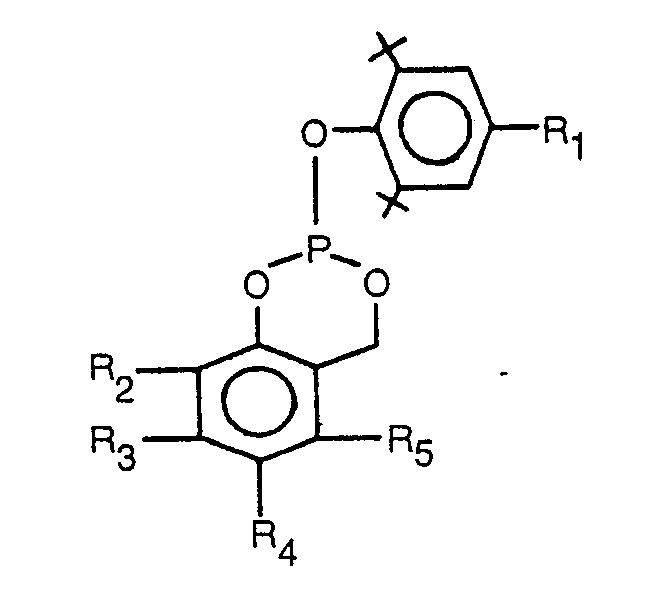
- Substituted 2-(2,6-di-t-butyl-4-alkylphenoxy)-4H-1,3,2,-benzodioxaphosphorins that are readily prepared, for example from hindered phenols and ortho-methylolphenols, are effective heat and anti-oxidant stabilizers for organic materials subject to degradation by heat and oxygen, and provide particularly efficient stabilizer systems when combined with hydroxyphenylalkylenenyl isocyanurates.
- R is hydrogen, a primary, secondary or tertiary alkyl group containing 1 to 4 carbon atoms as defined, or a ⁇ CH 2 CH 2 COOR 6 group wherein R 6 is an alkyl radical containing 1 to 4 carbon atoms; R 2 is hydrogen, a primary, secondary or tertiary alkyl radical containing 1 to 4 carbon atoms; R 3 is hydrogen or methyl; R 4 is hydrogen or a primary, secondary or tertiary alkyl radical containing 1 to 4 carbon atoms; and R 5 is hydrogen.
- R 1 is ⁇ H. ⁇ CH 3 , ⁇ t-C 4 H 9 as defined or -CH 2 CH 2 COOCH 2 CH 3 ;
- R 2 is -H, -CH 3 , or -t-C 4 H 9 ;
- R 3 is -H;
- R 4 is -H, -CH 3 , or ⁇ t ⁇ C 4 H 9 ; and
- R 5 is H.
- Typical compounds include 2-[4-methyl-2,6-bis(t-butyl)phenoxy]-6,8-bis(t-butyl)-4H-1,3,2-benzodioxaphosphorin; 2-[4-methyl-2,6-bis(t-butyl) phenoxy]-4H-1,3,2-benzodioxaphosphorin; 2-[4-methyl-2,6-bis(t-butyl)phenoxy]-6-methyl-4H-1,3,2-benzodioxaphosphorin; 2-[4-methyl-2,6-bis(t-butyl) phenoxy]-6,8-dimethyl-4H-1,3, 2-benzodioxaphosphorin; 2-[4-methyl-2,6-bis(t-butyl) phenoxy]-8-(t-butyl)-4H-1,3,2-benzodioxaphosphorin; 2-[4-methyl-2,6-bis(t-butyl)phenoxy]-8-(t-butyl)-4H
- the cyclic phosphites of this invention are the reaction products of hindered phenols, ortho-methylolphenols and phosphorous trichloride, to form a family of substituted 2-(2,6-di-t-butyl-4-alkylphenoxy)-4H-1,3,2-benzodioxaphosphorins.
- the ortho-methylolphenols have the general formula wherein R 3 is 1 to 4 hydrogen or alkyl groups containing 1 to 12, preferably 1 to 8 carbon atoms.
- R 3 is 1 to 4 hydrogen or alkyl groups containing 1 to 12, preferably 1 to 8 carbon atoms.
- the preparation of these materials is reported in the literature, and may be made for example by reacting phenols such as p-cresol and 2,4-dimethylphenol with aqueous formaldehyde in caustic solution. Another procedure is to conduct the reaction of the phenol and paraformaldehyde with boric acid in solution.
- Typical ortho-methylolphenols are 2,4-dimethyl-6-hydroxymethylphenol and 2,4-di-t-butyl-6-hydroxy- methylphenol.
- the hindered phenols have the general formula wherein Rg are t-alkyl groups containing from 4 to 12 carbon atoms, but preferably are t-butyl, and R 10 is hydrogen, t-alkyl as defined, or alkyl radical containing 1 to 8 carbon atoms, or an ester group, COOR 11 wherein R" is an alkyl group containing 1 to 8 carbon atoms and a CH 2 CH 2 COOR 6 group wherein R 6 contains 1 to 8 carbon atoms; such as 2,4,6-tri-t-butylphenol and 2,6-di-t-butyl-4-methylphenol.
- the cyclic phosphites are prepared by reacting the ortho-methylolphenol with the hindered phenol using phosphorous trichloride and a trialkylamine as a catalyst.
- a preferred method for preparing the cyclic phosphites is to react the ortho-methylolphenol, a phosphorodichloridite, in an organic solvent in the presence of the trialkylamine catalyst.
- the cyclic phosphite is isolated from the reaction mixture and purified with solvents, preferably at temperatures below 100°C, more preferably below about 75°C. Typical preparations of the ortho-methylolphenols and cylic phosphites therefrom are set forth in the following examples.
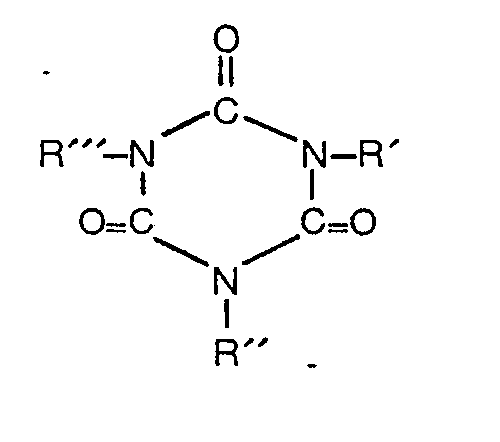
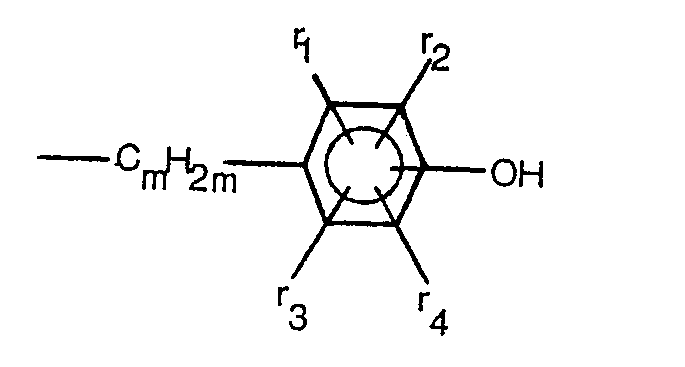
- hydroxyphenylalkyleneyl isocyanurate compounds used in combination with the cyclic phosphites of this invention have the formula wherein R' is a hydroxyphenylalkyleneyl radical of the formula where m is 1 to 4, r, is an alkyl radical having 1 to 18 carbon atoms and is positioned immediately adjacent to the hydroxy group on the ring; r 2 , r 3 and r 4 are hydrogen or an alkyl radical containing 1 to 18 carbon atoms; and R" and R"' are hydrogen, and alkyl radical containing 1 to 18 carbon atoms, or are the same as r'.
- symmetrical tris (3,5-ditert-alkyl-4-hydroxybenzyl) isocyanurates of the formula where n is 4 to 8.
- 4-hydroxybenzyl isocyanurate compounds are: tris-3-t-butyl-4-hydroxybenzyl) isocyanurate, tris-(3-cetyl-4-hydroxybenzyl) isocyanurate, tris(3,5-dimethyl-4-hydroxybenzyl) isocyanurate, tris-(3-methyl-5-isopropyl-4-hydroxybenzyl) isocyanurate, tris(3,5-di-t-butyl-4-hydroxybenzyl) isocyanurate, tris-(3-t-butyl-5-t-amyl-4-hydroxybenzyl) isocyanurate, tris-[3,5-di-(1-methyl-1-ethylpropyl)4-hydroxybenzyl] isocyanurate, tris-[3,5,-di-(1,1,2,2-tetramethylpropyl)-4-hydroxybenzyl] isocyanurate, bis-(3,5-dimethyl-4-hydroxybenzyl
- the amount of cyclic phosphite used may vary from 0.01 to 10 weight parts per 100 weight parts of material to be stabilized. More usually 0.1 to 4.0 parts are used for mixtures with the hydroxyphenylalkyleneyl isocyanurate.
- the hydroxyphenylalkyleneyl isocyanurate compound is used at a level from 0.01 part to 5 parts by weight, and more preferably at from 0.05 part to 3 parts by weight per 100 parts by weight of the organic material.
- the cyclic phosphite compound is employed at similar levels, i.e., from 0.01 part to 5 parts and preferably at 0.05 part to 3 parts by weight per 100 parts by weight of organic material.
- the combined weight of the compounds is normally from 0.02 part to 10 parts and more preferably from 0.1 to 6 parts by weight per 100 parts by weight of organic material.
- the hydroxyphenylalkyleneyl isocyanurate can be used in from 10:1 to 1:10 weight ratio of isocyanurate compound to cyclic phosphite compound. Excellent results are obtained at a 3:1 to 1:3 weight ratio.
- a 1:1 weight ratio of the compounds provides effective stabilization or organic materials.
- Both the cyclic phosphite and the combinations with the isocyanurate compound and the cyclic phosphite compound as defined herein provide exceptional heat stability to polyolefin polymers.
- the combination is especially useful for the stabilization of a-monoolefin homopolymers and copolymers, wherein the a-monoolefin contains 2 to 8 carbon atoms.
- High and low-density polyethylene, isotactic and atactic polypropylene, polyisobutylene, and poly(4-methyl-1-pentene) have excellent resistance to ultra violet light when stabilized with the combinations of the present invention.
- Ethylene-propylene (EP) copolymers and ethylene-propylene (EPDM) terpolymers generally containing less than about 10 percent by weight of one or more monomers containing multiple unsaturation provided, for example, by 1,4-hexadiene, dimethyl-1,4,9-decatriene, dicyclopentadiene, vinyl norbornene, ethylidene norbornene also are stabilized using the combination.
- organic materials which can be stabilized in accordance with the present invention include both natural and synthetic polymers.
- the stabilizers are useful for the stabilization of cellulosic materials; natural rubber, halogenated rubber, conjugated diene polymers, as, for instance, polybutadiene, copolymers of butadiene with styrene, acrylonitrile, acrylic acid alkyl acrylates or methacrylates, methyl vinyl ketone, vinyl pryidine; polyisoprene, polychloroprene; vinyl polymers such as polyvinyl chloride, polyvinylidene chloride, copolymers of vinyl chloride with vinylidene chloride, polyvinyl acetate, copolymers or vinyl halide with butadiene, styrene, vinyl esters, ⁇ , ⁇ -unsaturated ketones and aldehydes; homopolymers and copolymers of acrylic monomers such as methyl acrylate, methyl methacrylate, e
- the present compounds may stabilize a wide variety of other organic materials.
- Such compounds include: waxes, synthetic and petroleum-derived lubricating oils and greases; animal oils such as, for example, fat, tallow, lard, codliver oil, sperm oil; vegetable oils such as castor, linseed, peanut, palm, cotton seed, fuel oil; diesel oil, gasoline.
- the compounds are readily incorporated into materials by dissolving or dispersing them with the materials or in liquid, dispersion solutions and solid forms. If the material is a solid, especially a polymeric solid such as a rubber or a plastic, the compounds can be admixed using internal mixers as Banburys, extruders and two-roll mills, following conventional techniques.
- One way to disperse the compounds in plastic materials is to dissolve or suspend the compounds in a solvent, mix the mixture with a plastic in powder or solution form, and then evaporate the solvent.
- Compositions containing the novel combination of compounds can also contain other known compounding ingredients such as fillers like carbon black, silica, metal carbonates, talc, asbestos; pigments and colorants; curative ingredients like sulfur and perioxides and vulcanization accelerators; fungicides; processing aids, reinforcing agents and standard ingredients known to the art.
- Other ingredients known in the art as ultra-violet light, thermal and/or oxidative stabilizers can also be used in the stabilized compositions.
- Test samples were prepared by mixing the stabilizer compounds with polypropylene in a Bradender Plasticorder fitted with a Cam-Head (mixing chamber). The polypropylene is first masticated for 12 minutes at 190°C. The the stabilizer mixture is added, following by 3 minutes additional mixing. The mass is removed and pressed into 0.51 mm (20 mil) thick sheets. From these sheets are cut 2.54 cm x 2.54 cm (1" x 1 ”) plaques for oven-aging. Type C 7.62 cm x 0.32 cm (3" x 1/8") tensil bars are cut for US stability tests.
- Thermal/oxidative stability (oven-aging) testing consisted of aging the samples in triplicate in an air- circulating oven at 125°C. The time to catastrophic crumbling (failure) of the plaque is measured and reported as days to failure.
- test samples of polypropylene with 0.05 weight part each of tris(3,5-di-t-butyl-4-hydroxy-benzyl)isocyanurate and the cyclic phosphites listed below were prepared and tested in the air oven until failure. The results obtained were as follows:
Landscapes
- Chemical & Material Sciences (AREA)
- Organic Chemistry (AREA)
- Chemical Kinetics & Catalysis (AREA)
- Health & Medical Sciences (AREA)
- Medicinal Chemistry (AREA)
- Polymers & Plastics (AREA)
- Life Sciences & Earth Sciences (AREA)
- Biochemistry (AREA)
- General Health & Medical Sciences (AREA)
- Molecular Biology (AREA)
- Compositions Of Macromolecular Compounds (AREA)
Claims (17)





Applications Claiming Priority (2)
| Application Number | Priority Date | Filing Date | Title |
|---|---|---|---|
| US06/419,361 US4529533A (en) | 1982-09-17 | 1982-09-17 | Substituted 2-(2,6-di-t-butly-4-alkylphenoxy) 4H-1,3,2-benzodioxaphosphorins and compositions thereof |
| US419361 | 1982-09-17 |
Publications (2)
| Publication Number | Publication Date |
|---|---|
| EP0106169A1 EP0106169A1 (de) | 1984-04-25 |
| EP0106169B1 true EP0106169B1 (de) | 1988-01-07 |
Family
ID=23661923
Family Applications (1)
| Application Number | Title | Priority Date | Filing Date |
|---|---|---|---|
| EP83109126A Expired EP0106169B1 (de) | 1982-09-17 | 1983-09-15 | Substituierte 2-(2,6-Di-t-butyl-4-alkylphenoxy)4H-1,3,2-benzodioxaphosphorine und Zusammensetzungen, die sie enthalten |
Country Status (5)
| Country | Link |
|---|---|
| US (1) | US4529533A (de) |
| EP (1) | EP0106169B1 (de) |
| JP (1) | JPS5980690A (de) |
| CA (1) | CA1219274A (de) |
| DE (1) | DE3375142D1 (de) |
Families Citing this family (15)
| Publication number | Priority date | Publication date | Assignee | Title |
|---|---|---|---|---|
| JPH02163148A (ja) * | 1988-09-15 | 1990-06-22 | Ausimont Usa Inc | 改良した安定化したハロ重合体組成物 |
| JP2738037B2 (ja) * | 1989-07-05 | 1998-04-08 | 三井化学株式会社 | ポリオレフィン樹脂繊維 |
| US5100931A (en) * | 1990-03-12 | 1992-03-31 | Phillips Petroleum Company | Gelation of acrylamide-containing polymers with hydroxyphenylalkanols |
| US5264539A (en) * | 1992-04-09 | 1993-11-23 | Hoechst Celanese Corp. | Thermally stable oligomeric ultraviolet stabilizers |
| US5543102A (en) * | 1993-07-22 | 1996-08-06 | General Electric Company | Melt extrusion process |
| US5559167A (en) * | 1993-07-22 | 1996-09-24 | General Electric Company | Gamma irradiated thermoplastics and articles |
| ES2131162T3 (es) * | 1993-07-22 | 1999-07-16 | Gen Electric | Neodiolfosfitos como estabilizadores de polimeros. |
| US5500467A (en) * | 1993-07-22 | 1996-03-19 | General Electric Company | Polyolefin fiber and film resistant to gas fade |
| US5605947A (en) * | 1993-07-22 | 1997-02-25 | General Electric Company | Amorphous neo-diol phosphite compositions |
| US5500468A (en) * | 1993-07-22 | 1996-03-19 | General Electric Company | Process for stabilizing polymeric material |
| US5614571A (en) * | 1994-09-16 | 1997-03-25 | General Electric Company | Stabilizer blend containing phosphite |
| US5594053A (en) * | 1996-01-22 | 1997-01-14 | General Electric Company | Aromatic cyclic bisphosphite esters and polymeric compositions thereof |
| US5618866A (en) * | 1996-01-22 | 1997-04-08 | General Electric Company | Neo diol phosphite esters and polymeric compositions thereof |
| DE102005005879A1 (de) * | 2005-02-09 | 2006-08-17 | Schill + Seilacher "Struktol" Ag | Stickstoffhaltige verbrückte Derivate von 6H-Dibenz[c,e][1,2]-oxaphosphorin-6-oxiden, Verfahren zu ihrer Herstellung sowie ihre Verwendung |
| DE102006015084A1 (de) * | 2006-03-31 | 2007-10-04 | Schill + Seilacher "Struktol" Ag | Halogenfreie flammgeschützte Epoxidharz-Formulierungen |
Family Cites Families (9)
| Publication number | Priority date | Publication date | Assignee | Title |
|---|---|---|---|---|
| SU145747A (de) * | ||||
| NL217656A (de) * | 1956-05-31 | |||
| US3022330A (en) * | 1956-08-21 | 1962-02-20 | Union Carbide Corp | Neutral esters of bicyclo heterocyclic phosphoric acids |
| US3531483A (en) * | 1968-10-25 | 1970-09-29 | Goodrich Co B F | Hydroxyphenylalkyleneyl isocyanurates |
| US4025486A (en) * | 1973-10-15 | 1977-05-24 | The B. F. Goodrich Company | Hydroxyphenylalkyleneyl isocyanurate/pentaerythritol phosphite combinations as ultraviolet light stabilizers for polyolefins |
| US4087490A (en) * | 1975-07-31 | 1978-05-02 | Makhteshim Chemical Works, Ltd. | Cyclic phosphoryl and thiophosphoryl halides |
| IT1088576B (it) * | 1977-11-29 | 1985-06-10 | Montedison Spa | Stabilizzanti per polimeri e composizioni polimeriche con essi stabilizzati |
| US4439564A (en) * | 1982-09-29 | 1984-03-27 | The B. F. Goodrich Co. | 5-Membered cyclic phosphonates and compositions thereof |
| US4415686A (en) * | 1982-11-24 | 1983-11-15 | The B. F. Goodrich Company | Sterically hindered phenyl bis(naphthyl)phosphites and compositions thereof |
-
1982
- 1982-09-17 US US06/419,361 patent/US4529533A/en not_active Expired - Fee Related
-
1983
- 1983-09-08 CA CA000436322A patent/CA1219274A/en not_active Expired
- 1983-09-15 EP EP83109126A patent/EP0106169B1/de not_active Expired
- 1983-09-15 DE DE8383109126T patent/DE3375142D1/de not_active Expired
- 1983-09-16 JP JP58169480A patent/JPS5980690A/ja active Pending
Also Published As
| Publication number | Publication date |
|---|---|
| DE3375142D1 (en) | 1988-02-11 |
| US4529533A (en) | 1985-07-16 |
| JPS5980690A (ja) | 1984-05-10 |
| CA1219274A (en) | 1987-03-17 |
| EP0106169A1 (de) | 1984-04-25 |
Similar Documents
| Publication | Publication Date | Title |
|---|---|---|
| US4529533A (en) | Substituted 2-(2,6-di-t-butly-4-alkylphenoxy) 4H-1,3,2-benzodioxaphosphorins and compositions thereof | |
| US4912155A (en) | Antioxidant aromatic fluorophosphites | |
| US4956406A (en) | Bis-cyclic phosphite compounds and polymeric materials stabilized therewith | |
| US4210576A (en) | Stabilizers for polymers and polymers stabilized thereby | |
| US4882374A (en) | Dioxaphosphorinane compounds and polyolefin compositions sabilized therewith | |
| US4444929A (en) | Unsymmetrical phosphite-phenolic isocyanurate stabilizer combinations | |
| US4584146A (en) | Tetrakis(2,6-di-t-butyl-4-substituted phenyl)4,4'-bisphenyl diphosphites | |
| EP0047605A1 (de) | Polyalkylierte 4-Aminopiperidinderivate und diese enthaltende synthetische Polymere | |
| US4415686A (en) | Sterically hindered phenyl bis(naphthyl)phosphites and compositions thereof | |
| EP0128368B1 (de) | 2,4,6-Tris(substituierte Phenoxy)-1,3,5,2,4,6-Trioxatriphosphorinane | |
| US4439564A (en) | 5-Membered cyclic phosphonates and compositions thereof | |
| US4929654A (en) | Cyclic phosphites and stabilized polymeric compositions | |
| US5420326A (en) | Bis(pentaerythritol phosphate alcohol) hydrogen phosphonate | |
| US4526918A (en) | Phenolic phosphite antioxidant and process for preparation thereof | |
| US4495320A (en) | 3,6-Di-t-butyl-2-naphthyl catechol phosphite and compositions thereof | |
| US4520151A (en) | Tris (3,6-di-t-butyl-2-naphthyl) phosphite and compositions thereof | |
| CA1178276A (en) | Acetylene carbamide derivatives, processes for their production, and antioxidants for organic substances which comprise such derivatives as active ingredients | |
| EP0335262B1 (de) | Phosphit-Verbindungen | |
| US4474917A (en) | Phenolic phosphite antioxidant for polymers | |
| US4501684A (en) | 2-Naphthyl phosphoramidites and compositions thereof | |
| US5128066A (en) | Antioxidant aromatic fluorophosphites | |
| US5112893A (en) | Tris-(2-alkyl-4-alkoxyphenyl) phosphites as processing stabilizers for polyolefins |
Legal Events
| Date | Code | Title | Description |
|---|---|---|---|
| PUAI | Public reference made under article 153(3) epc to a published international application that has entered the european phase |
Free format text: ORIGINAL CODE: 0009012 |
|
| AK | Designated contracting states |
Designated state(s): BE CH DE FR GB IT LI NL |
|
| 17P | Request for examination filed |
Effective date: 19840914 |
|
| GRAA | (expected) grant |
Free format text: ORIGINAL CODE: 0009210 |
|
| AK | Designated contracting states |
Kind code of ref document: B1 Designated state(s): BE CH DE FR GB IT LI NL |
|
| ITF | It: translation for a ep patent filed | ||
| REF | Corresponds to: |
Ref document number: 3375142 Country of ref document: DE Date of ref document: 19880211 |
|
| ET | Fr: translation filed | ||
| PLBE | No opposition filed within time limit |
Free format text: ORIGINAL CODE: 0009261 |
|
| STAA | Information on the status of an ep patent application or granted ep patent |
Free format text: STATUS: NO OPPOSITION FILED WITHIN TIME LIMIT |
|
| 26N | No opposition filed | ||
| ITTA | It: last paid annual fee | ||
| PGFP | Annual fee paid to national office [announced via postgrant information from national office to epo] |
Ref country code: FR Payment date: 19900621 Year of fee payment: 8 |
|
| PGFP | Annual fee paid to national office [announced via postgrant information from national office to epo] |
Ref country code: GB Payment date: 19900626 Year of fee payment: 8 |
|
| PGFP | Annual fee paid to national office [announced via postgrant information from national office to epo] |
Ref country code: CH Payment date: 19900627 Year of fee payment: 8 |
|
| PGFP | Annual fee paid to national office [announced via postgrant information from national office to epo] |
Ref country code: DE Payment date: 19900703 Year of fee payment: 8 |
|
| PGFP | Annual fee paid to national office [announced via postgrant information from national office to epo] |
Ref country code: BE Payment date: 19900706 Year of fee payment: 8 |
|
| PGFP | Annual fee paid to national office [announced via postgrant information from national office to epo] |
Ref country code: NL Payment date: 19900930 Year of fee payment: 8 |
|
| PG25 | Lapsed in a contracting state [announced via postgrant information from national office to epo] |
Ref country code: GB Effective date: 19910915 |
|
| PG25 | Lapsed in a contracting state [announced via postgrant information from national office to epo] |
Ref country code: LI Effective date: 19910930 Ref country code: CH Effective date: 19910930 Ref country code: BE Effective date: 19910930 |
|
| BERE | Be: lapsed |
Owner name: THE B.F. GOODRICH CY Effective date: 19910930 |
|
| PG25 | Lapsed in a contracting state [announced via postgrant information from national office to epo] |
Ref country code: NL Effective date: 19920401 |
|
| GBPC | Gb: european patent ceased through non-payment of renewal fee | ||
| NLV4 | Nl: lapsed or anulled due to non-payment of the annual fee | ||
| PG25 | Lapsed in a contracting state [announced via postgrant information from national office to epo] |
Ref country code: FR Effective date: 19920529 |
|
| REG | Reference to a national code |
Ref country code: CH Ref legal event code: PL |
|
| PG25 | Lapsed in a contracting state [announced via postgrant information from national office to epo] |
Ref country code: DE Effective date: 19920602 |
|
| REG | Reference to a national code |
Ref country code: FR Ref legal event code: ST |